So You’ve Become A Rabid Fan Of Women’s Soccer. Now What?

Megan Rapinoe and the U.S. squad won a lot of fans on their way to winning the Women’s World Cup on Sunday in Lyon, France. For the sport to keep growing, that support needs to continue long after the ticker tape lands.

Alex Grimm/Getty Images


hide caption

toggle caption

Alex Grimm/Getty Images

You cheered when Megan Rapinoe scored that ice-cold penalty shot. You spilled your coffee as you celebrated Rose Lavelle’s incredible left-footed strike. You got misty watching that stirring new Nike ad. And when you saw the U.S. team members hoist the World Cup trophy over their heads on Sunday, you felt their joy as your own.

Congratulations! You are now a U.S. Women’s National Team fan, if you weren’t one already.

When the U.S. won the Cup on Sunday, the crowd broke into chants of “Equal pay!” And fans like you have a role in making that happen.

So what can you do? Here’s your guide to helping the sport and its players to prosper.

Catch the champions on their victory tour

The World Cup champions will play a series of games in at least four U.S. cities as part of a barnstorming victory tour. Sites and dates haven’t yet been announced. But first, they’ll be feted with a ticker tape parade on Wednesday morning through the streets of Manhattan, where New York Mayor de Bill Blasio will present them with the keys to the city.

Go to NWSL games (this one really matters)

Every member of the U.S. Women’s National Team plays in the National Women’s Soccer League. Good news: The league’s season is less than halfway through — meaning that in short order, the players you watched tear up the field in France are players you can watch in real life.

The league has nine teams: Chicago Red Stars; North Carolina Courage (Raleigh); Portland Thorns (Oregon); Sky Blue FC (Central New Jersey); Washington Spirit (D.C.); Houston Dash; Orlando Pride (Florida); Reign FC (Tacoma, Wash.); Utah Royals FC (Salt Lake City).

Some of the NWSL’s teams are thriving — the Portland Thorns, in particular, enjoy a fervent following. The team attracted an average of nearly 17,000 fans a game last year. Researchers have studied what they say is the Thorns’ world-leading popularity and found that the fan culture was the No. 1 reason people loved going to matches. Excited fans beget more excited fans.

One benefit of having a small league is that most teams have a number of national team players. You can catch standouts from overseas, too: Australian superstar Sam Kerr plays for the Chicago Red Stars and is the league’s all-time leading scorer. Canadian legend Christine Sinclair plays for the Thorns, alongside Tobin Heath and Lindsey Horan.

Many of the teams play in small suburban stadiums that aren’t super accessible by transit. The Washington Spirit, featuring Rose Lavelle and Mallory Pugh, play at the Maryland SoccerPlex, about an hour northwest of D.C., with a seating capacity of just 4,000. But the Spirit will play two upcoming matches at D.C. United’s gleaming new Audi Field, which seats 20,000 on the District’s waterfront.

One reason the USWNT has been fighting so hard for higher salaries is that women’s pro soccer in the U.S. doesn’t pay well. For the 2019 season, the league’s maximum player salary is $46,200, while the minimum is just $16,538. The more tickets, merchandise and sponsorships that NWSL teams sell, the more its player salaries can rise.

Fan support is crucial to sustaining the league. Both the Boston Breakers and FC Kansas City ceased operations in the past two years. And the NWSL is built on the ashes of two previous women’s soccer leagues that folded, including one that was founded amid the excitement of the U.S. win at the 1999 World Cup.

Watch them play on TV

Another way to generate more money for women’s soccer is to watch it on television or via streaming online. The USWNT and NWSL make money from ads shown during their games, and the bigger the audience for each broadcast, the more often such games will be televised. And if viewership grows, networks will opt to show more games on flagship channels rather than obscure cable offerings.

Big news on this front was announced last week: ESPN will broadcast 14 upcoming NWSL matches on its ESPN2 and ESPNEWS channels, and they’ll be streamed on its app, too.

Keep the pressure on FIFA and the U.S. Soccer Federation

Chants of “Equal pay!” resounded in the stadium after the U.S. clinched Sunday’s final in Lyon, France. And everywhere from Twitter to Congress, “Pay the women” has become a curt directive to the U.S. Soccer Federation as the players’ lawsuit against their employer moves into mediation.

FIFA President Gianni Infantino says he intends to double the investment in women’s soccer over the next four years and double the prize money for the winners of the next Women’s World Cup — but that still won’t shrink the gap because the men’s purse will also grow.

Teams at the 2019 Women’s Cup will share $30 million, compared with the $400 million the men’s teams split last year. In 2023, the women will play for $60 million, while the men’s prizes increase to $440 million.

“If you really care about each game in the same way, are you letting the gap grow? No,” Rapinoe said Saturday. “Are you scheduling three finals on the same day? No. Are you letting some federations play two games in the four years between each tournament? No, you’re not.”

While no one would call FIFA or U.S. Soccer especially transparent organizations, they absolutely rely on fan and sponsor support. Tell them you care about the women’s game. Tell them to pay the women.

Live abroad? Support women’s soccer where it needs it most

The success of the USWNT is a direct result of the investment that has been made in women’s sports in America.

One enormous factor is Title IX, which requires athletic departments at schools and colleges to fund women’s sports as a condition for receiving federal financial assistance. Another factor is that pay gap notwithstanding, U.S. Soccer does an admirable job of supporting and funding the women’s team.

Many players elsewhere are not so lucky. The teams in Jamaica and Thailand, for example, are reliant on the largesse of a single donor to support their squads in the absence of adequate funding from the national federations.

The opportunities to help these teams are enormous — whether it’s making a donation, going to watch a pro or college match, or coaching a girls’ team.

If the millions and millions of people who tuned in to this World Cup each do one or two items from this list, the 2023 tournament will be even more spectacular than this one.

Let’s block ads! (Why?)

Motorcycle Crash Shows Bioethicist The Dark Side Of Quitting Opioids Alone

Travis Rieder, author of In Pain: A Bioethicist’s Personal Struggle With Opioids, says none of the doctors who prescribed opioids for his waves of “fiery” or “electrical” pain taught him how to safely taper his use of the drugs when he wanted to quit.

Stockbyte/Getty Images


hide caption

toggle caption

Stockbyte/Getty Images

In 2015, Travis Rieder, a medical bioethicist with Johns Hopkins University’s Berman Institute of Bioethics, was involved in a motorcycle accident that crushed his left foot. In the months that followed, he underwent six different surgeries as doctors struggled first to save his foot and then to reconstruct it.

Rieder says that each surgery brought a new wave of pain, sometimes “searing and electrical,” other times “fiery and shocking.” Doctors tried to mitigate the pain by prescribing large doses of opioids, including morphine, fentanyl, Dilaudid, oxycodone and OxyContin. But when it came time to taper off the drugs, Rieder found it nearly impossible to get good advice from any of the clinicians who had treated him.

“We called everybody, and a bunch of them wouldn’t even talk to me,” he says. “And this includes the pain management team. They would not speak with me, and the message they sent through a nurse was, ‘We prescribe opioids but we don’t help with tapering.’ “

Rieder likens his experiences trying to get off prescription pain meds to a game of hot potato. “The patient is the potato,” he says. “Everybody had a reason to send me to somebody else.”

Eventually Rieder was able to wean himself off the drugs, but not before receiving bad advice and going through intense periods of withdrawal. He shares his insights as both a patient and a bioethicist in a new book, In Pain: A Bioethicist’s Personal Struggle With Opioids.


Interview highlights

On what happened when he tried tapering opioids after an ill-advised consultation with a plastic surgeon, who recommended abruptly reducing his dosage

He didn’t know what he was talking about; that wasn’t his area of expertise. He just tried to think of something that was reasonable — and he would eventually admit this, so this isn’t too much editorializing — but we went home and the next day we dropped the first dose and it immediately sent me into withdrawal. … It got worse over the first few days, and so we start to get really freaked out, because I feel like I’ve got the worst flu I’ve ever had multiplied by some order of magnitude. And I’m thinking, I have an entire month of this to get through. And so [my partner and I] get pretty freaked out.

On why it was so hard to find a doctor to help him taper opioids

I asked myself that question every day, every hour for a very long time. And once I transitioned from being an opioid patient to being an opioid researcher the answer I came to was something like “a lot of doctors don’t know, so this is just a knowledge gap.” So this is probably the best description of my plastic surgeon. He just had no idea how to do this. And that’s understandable, because clinicians — doctors — don’t get a lot of pain education in medical school. It’s not required — a bunch of them get zero — and, on average, you only get a handful of hours. So there’s a knowledge gap for sure.

On being sent to an addiction clinic

We called addiction clinics and they very nicely and very gently said, “Boy, you are not our job. We’re dealing with people who might die from a heroin overdose anytime they get turned away. We’re triaging here. You just took too many pain meds. You just need your prescriber to get you off them.”

On the ways in which money plays a role in opioid use

Opioids are dirt cheap, because a bunch of them have been off patent for decades, and these other sorts of therapies can be really expensive. … A lot of what I was supposed to do to help that pain was physical therapy. Physical therapy stopped getting coverage by my insurance when I turned over the new year. And I no longer hit my deductible, so it was too expensive. So I stopped. Because I was a relatively new faculty member — I couldn’t afford it. And so I keep thinking, well, surely a bunch of other people would also struggle to pay for this.

So there are all of these different methods for handling pain that they could be arrows in the quiver of medicine, but they’re hard. They get covered less. They’re expensive. And so what do we know about opioids? Well, they’re incredibly cheap. Morphine is a couple cents per dose. And they are easy. You give them to the patient, the patient feels better immediately. You give pills to a patient who comes in complaining about pain, they leave happy. So this really led me to investigate this, like, deep system of perverse incentives that have pushed us toward just prescribing opioids instead of doing something more integrative and holistic.

On how opioid dependence is treated as a medical issue, but heroin addiction is treated as a criminal issue

Now we’re all very concerned about the opioid epidemic — when there have been people of color dying from heroin disproportionately for a really long time, and we just don’t talk about it. And we treated them like criminals. That’s a travesty. It’s absolutely tragic. It’s a stain on our response to drugs in this country. My story is not the only one that matters. Stories that look like mine aren’t the only ones that matter. People take drugs for a reason. And whether you started with oxycodone or with heroin, if you were medicating something and it hurt you, and you ended up dying from overdose, your life matters. And we need to just kind of announce that loudly every time we have this conversation.

Lauren Krenzel and Seth Kelley produced and edited this interview for broadcast. Kelley, Bridget Bentz and Deborah Franklin adapted it for the Web.

Let’s block ads! (Why?)

How João Gilberto’s Music Sparked An Aesthetic Revolution

João Gilberto in 1970

Michael Ochs Archives/Getty Images


hide caption

toggle caption

Michael Ochs Archives/Getty Images

From a casual distance, the music of João Gilberto sounds like it might belong to that ancient realm known as “easy listening.”

Everything’s calm, for starters. Even at fast tempos, Gilberto’s voice demands nothing — hushed, thin, confession-booth quiet. His rhythm guitar anchors the music with accompaniment that can seem almost hypnotically repetitive. The melodies rarely beg for attention, instead basking in that sublime mix of contentedness and yearning common throughout Brazilian music. There are strings rising up in wave-like swells from time to time, and lamenting love calls from the low brass.

Beneath that smooth and pleasant veneer, Gilberto built a quiet (and still misunderstood) aesthetic revolution – a lithe, strikingly modern approach to rhythm and melody that became the blueprint for bossa nova.

Gilberto, who died at home in Rio de Janeiro on Saturday, was best known for his contributions to Getz/Gilberto, the 1964 album that, through its single “The Girl From Ipanema,” made bossa nova a worldwide sensation (and won the Grammy for album of the year). But Gilberto deserves to be remembered more broadly, as a kind of patron saint of understatement, whose early recordings transformed the boisterous celebration of samba parades into music of arresting intimacy.

The rare instrumentalist (i.e., not a composer) to define and shape a musical genre, Gilberto developed an austere, steady-handed revolution that opened up lanes of exploration for subsequent generations. And it swept like wildfire, becoming pervasive before he could even be properly acknowledged as its spark plug. (“Eventually the culture caught up to him, and despite his reputation as a recluse, he became a revered figure in Brazil — referred to as “O Mito/The Master” and “O Rei da Bossa/The King of Bossa” and “Ill Mastro Supremo,” and, perhaps most fittingly, “O Zen-Baiano/The Zen Master of Bahia.”)

YouTube

Those early recordings, particularly his 1958 take on Antonio Carlos Jobim’s “Chega de Saudade/No More Blues,” had a meteor-like impact on the musicians of Brazil; Gilberto’s blend of whispering vocals and exactingly precise guitar accompaniment represented a radical break from the schmaltzy pop balladry (Nelson Gonçalves, for example) on the radio at the time. Guitarist Oscar Castro-Nieves recalled hearing that single for the first time as a teenager: “It changed everything, for every young musician in Brazil … all I can say is that it was like the first time I heard Charlie Parker.”

The singer and songwriter Caetano Veloso, another legendary Brazilian singer and songwriter whose discography elaborates on Gilberto’s basic themes, was even more effusive in an L.A. Times interview: “I owe João Gilberto everything I am today. Even if I were something else and not a musician, I would say that I owe him everything.”

Gilberto’s stealth approach was born after several unsuccessful attempts to establish himself as a musician for hire in Rio, where, according to legend (as relayed in Ruy Castro’s authoritative history of bossa nova, Chega de Saudade), he overstayed his welcome on the couches of friends. He fled to his sister’s house, in a town called Diamantina, where, in a tile bathroom with favorable acoustics, he began to experiment with a sound built around brooding, vibrato-free and leisurely, long-toned vocals.

In a rare interview with the New York Times in 1968, Gilberto explained that his process involved editing out all but the most essential information. “It has to be very quiet for me to produce the sounds I’m thinking of.”

Gilberto’s central innovation, overall, was in the guitar accompaniment. Gilberto took the massive rhythm of the samba schools he heard growing up in Bahia – a thrilling sensory experience involving hundreds of drums, superloud shakers and clanging metal bells locked together in endlessly propulsive polyrhythm – and distilled it down to stark human scale. Music centered around one voice and one acoustic guitar.

“Rosa Morena”

YouTube

Typically, such a reduction of forces diminishes — but Gilberto’s reduction had the opposite effect, opening up a new resonance for samba, using the form’s rhythmic intensity to uncover hidden directions and nuances. First, Gilberto caught the whomp of the samba bass drum with his thumb. Then, with his other fingers moving independently, he’d stab against the time with crisply articulated chords, forming an artful, unpredictable syncopation. These patterns can sound like recurring loops (Gilberto’s time is astonishingly steady) but as you listen more closely, they register as constantly evolving codes. You can hear him varying the cadences, the length of the patterns, the voicings. The result: An ever-changing, mosaic-style backdrop, a guitar-powered perpetual motion machine. (“Rosa Morena” is a good example of this.)

“Brigas, Nunca Mais”

YouTube

“Doralice”

YouTube

Over this, Gilberto sang in a placid, straightforward style that sometimes masked the turbulence underneath (as on “Brigas, Nunca Mais”), and sometimes sharpened it (as on “Doralice”). Having turned the extroversion of samba inward, he went about exploring distinct shades of emotion, adding dimension and richness to beloved early samba classics by subtracting the pageantry.

In performances and recordings from the 1970s, Gilberto began stretching out melodic phrases in whimsical, sometimes radical ways; it could be disarming to hear such a languid, vapor-like voice creating tension just by reconfiguring the commonly understood shape of a familiar melody.

Those explorations align Gilberto with artists like Bob Dylan, whose ad-libbing confounded expectations in the quest for newly resonant interpretations. More broadly, Gilberto’s austere, modernist approach connects to artistic movements outside of Brazil, most notably jazz. In both his guitar work and his singing, Gilberto was a master improviser, and his less-is-more philosophy mirrors those of Miles Davis and Thelonious Monk. As they did, Gilberto pared excess language and stylistic flourishes to the bare minimum, on a quest to uncover nuances by subtraction.

As the “new” trend of bossa nova rose in the early ’60s, Gilberto became popular with a rising generation of songwriters. He introduced hundreds of songs that drew from samba while adding richly literary perspective on romance and devotion. These form the core of an extraordinary multi-generational Brazilian songbook that begins with the work of the prolific Antonio Carlos Jobim in the 1950s and ’60s, along with tunes by Veloso, Edu Lobo and others active in the late ’60s as well as stars of the ’70s like Milton Nascimento and Djavan. All of these share a common thread — the neatly syncopated performance style of Joao Gilberto. His crystalline renditions of “Corcovado” and “Caminhos Cruzados” (and countless other Jobim gems) taught subsequent generations of singers and instrumentalists how to approach the composer’s sophisticated harmonies, how to convey meaning with the slightest of gestures, how to create the kind of openness that draws the listener into the deep poignance of a tune.

The remarkable thing about João Gilberto is how often he managed this sublime art, under all kinds of musical conditions. His discography includes quietly transfixing recordings across a range of hues, from the upbeat to the meditative. And whether he’s working with a lush studio orchestra or playing alongside a lone percussionist, he rarely sounds like he’s exerting himself. Everything flows, effortlessly. He approaches the music as though sneaking or sliding into it. He’s coy, and wily, sculpting drop-dead gorgeous melodies out of shallow breath, dispensing intricate staccato samba codes with the grace of a dancer.

It is, from a distance, easy listening – the sound of serenity and calm, as steady as the sea. Let it get under your skin for a while, and the nuances blossom into complexities, the complexities breed more levels of nuance… and, pretty soon, it’s like being flattened by a feather.

Let’s block ads! (Why?)

The Promises And Pitfalls Of Gene Sequencing For Newborns

A decade ago, it seemed inevitable that every newborn would get a complete gene scan. But there are technical challenges and practical concerns.

Brooke Pennington/Getty Images


hide caption

toggle caption

Brooke Pennington/Getty Images

Sequencing a person’s DNA is now a routine task. That reality has left doctors looking for ways to put the technology to work.

A decade ago, a top federal scientist said, “Whether you like it or not, a complete sequencing of newborns is not far away.” Dr. Francis Collins, who made that statement, has been head of the National Institutes of Health for the intervening decade. But his prophecy hasn’t come to pass, for both scientific and practical reasons.

Scientists have found that, so far, a complete genetic readout would be a poor substitute for the traditional blood test that babies get at birth to screen for diseases.

Even when genetic testing provides useful information, it also can raise unsettling questions.

One of the big concerns about running gene scans on newborns is how families will receive and make sense of the results.

Christine Kim, a graduate student who studies international health, volunteered for a study at the University of North Carolina at Chapel Hill to explore that issue.

“I think when it’s your first [child], you want to be as prepared as possible, even though there’s no way to actually prepare for the experience,” she said.

After her baby girl was born, the infant had the standard blood test to screen for rare genetic disorders. The baby got a cheek swab as well, so researchers could sequence all her genes. (This test is called exome sequencing, which decodes about 2% of a person’s DNA, the part that contains the actual genes but not, for instance, the code that regulates gene expression.)

Both the blood test and the gene scan gave the baby a clean bill of health. But the next question was trickier: Should Kim and her husband learn about genes that could affect their child later in life?

“On the chance they did identify something, would we need to put it in her medical records?” Kim wondered. “What does that mean for future health insurance?”

It’s currently illegal to base health insurance coverage on genetic information, but Kim and her husband worry about efforts to weaken those protections. Life insurance and long-term care insurance could also be at risk.

They thought about the ethics of prying into another person’s genes. “Should we have access to that information?” she wondered. On the other hand, learning about their baby’s genes would also tell them something about their own. “Maybe that’s selfish, but I was very curious about that too,” she said.

And that information turned out to be eye-opening. Kim said the couple’s baby carries a genetic variant that puts her at elevated risk of a disease as an adult. For privacy reasons, she didn’t want to be more specific. And Kim learned if the baby has that variant, then she has it too. That has made her more vigilant about her own health.

“I have given that information to my family, and it was suggested that my sisters and my mom also get tested,” she said.

This wasn’t the point of the newborn genetic screening, but it’s certainly a consequence. And it plays into the conversation over whether to make DNA sequencing of newborns routine.

Dr. Cynthia Powell at UNC helped run the study, whose results were published in June in The Journal of Pediatrics. She concluded that parents must get a chance to make an informed choice about how much information to receive — just the basics relating to their newborn or everything that could be actionable in the coming years. (Parents didn’t learn about genetic variants that are difficult to act on, such as those that increase the risk of developing Alzheimer’s disease.)

“We found that most people who were allowed that choice, about 70% of individuals, wanted information in all of the categories that we offered,” Powell said. That proportion may be high because the research team recruited people who were curious to begin with, but it’s clear there is a hunger for this information.

But Powell’s study and others show that, despite their high-tech gloss, genetic tests are actually much worse than the standard heel-prick test at picking up metabolic disorders like phenylketonuria. Those conditions are the main reason newborns get a blood test at birth.

The simple and inexpensive blood tests detect the actual biochemical defect that is a sure sign of these metabolic disorders.

In many cases of genetic testing, it’s not that straightforward to identify the underlying genetic flaw. A disorder can be caused by any of a number of genetic variants, and those variants can be on different genes. Many have yet to be cataloged.

Scientists discovered an even deeper problem. Just having one of these problematic variants isn’t necessarily enough to determine whether a child actually develops a metabolic disease.

It turns out that other variants can sometimes come into play in ways that scientists have yet to understand. “It really opens a new can of worms,” said Dr. Jennifer Puck at the University of California, San Francisco.

So DNA tests aren’t going to replace the standard testing without a lot more research.

Still, there are reasons to consider the DNA test as a routine add-on.

“There are other conditions that we have no screening test for,” Powell said. “Conditions that could predispose a child to cancer or other neurological conditions that are potentially treatable.”

Powell and Puck spoke at a meeting in late June organized by the NIH to review the prospect of genetic screening for newborns.

Dr. Robert Green, from Brigham and Women’s Hospital in Boston, voiced one view about doing that: “If sequencing reveals health risks at any point in life, and if that’s good, then it’s better to do it early.”

Why wait to find out potentially useful information, he asked his colleagues.

One reason not to go all in for genetic testing at birth is that, unlike the blood tests, these genetic tests can be freighted with worries about privacy and personal preferences, as Kim discovered.

And Puck said it would be a mistake to bring all those thorny issues to newborn screening programs that are now so widely embraced that parents aren’t even asked about them.

“The newborn screening programs we have enjoy a huge amount of public trust,” she said at the NIH meeting. “And we have to preserve that trust.”

Supplemental DNA screening would also be discriminatory, she argued, because it is not covered by government health insurance for the poor.

“We can’t now follow up everyone,” she said, “and I don’t think it’s right to have only wealthy people followed up and have the rest of our population left behind.”

Scientists at the meeting did agree that there can be good reasons to sequence genes if a child is sick and doctors don’t know why. That’s the story Patricia Bass of Greensboro, N.C., told me about her son, Aiden.

“For the first eight weeks of his life, he wasn’t gaining weight correctly, and we kept going back to the doctor,” she said. “And finally my husband and I kept looking in his eyes, and we noticed a white opaqueness. We knew it would probably be cataracts.”

That condition required emergency eye surgery. Aiden also had other troubles, including hearing loss and poor muscle tone. At age 2, it seemed he might have a rare disease.

“So we had him seen by a geneticist locally, and they didn’t find anything,” she said.

The Basses learned of the genetic testing study over in Chapel Hill, and they signed up.

Aiden’s test revealed that he has a serious genetic condition called Lowe syndrome, which could have a potentially devastating effect on everything from his kidneys to his intellect.

It’s not clear why his previous genetic test missed the diagnosis.

The diagnosis was bad news, but at least they had an answer.

“You grieve a life that you thought was going to be something different than what it is,” Bass said. “So that was very hard. Very hard.”

As a result of the diagnosis, she has added more specialists to Aiden’s list of doctors. But more significantly for the family, the diagnosis has changed her outlook.

“I decided to say it happened for us instead of to us,” she said. “And that one powerful word has really changed my life. Because I think of it as I was blessed and given an opportunity to love such a special soul, who has changed so many people that he’s met with such positivity.”

Aiden lives his life with so much joy, she said.

“I think I used to worry more,” Bass said. “Now I’m just living in the moment every day.”

That revelation is a far cry from the aspiration that genetic testing will transform care of children, but it is a step in that direction.

You can contact NPR science correspondent Richard Harris at rharris@npr.org.

Let’s block ads! (Why?)

Four-Peat: U.S. Women’s Soccer Team Wins World Cup Title

The United States’ Megan Rapinoe celebrates after scoring the opening goal from the penalty spot during the Women’s World Cup final soccer match between the U.S. and the Netherlands at the Stade de Lyon in Décines, outside Lyon, France, on Sunday. The U.S. won 2-0.

Francisco Seco/AP


hide caption

toggle caption

Francisco Seco/AP

The U.S. women’s soccer team is still the world’s best after dominating the Netherlands in the Women’s World Cup final and winning 2-0. Throughout the tournament, the U.S. brushed aside criticism, complaints of arrogance and calls for the team to tone down their goal celebrations. All the team did was win. All seven World Cup games, in fact.

In the first half, the U.S. created more chances than the Netherlands. The Americans attacked and attacked, but the Dutch defense and, particularly, the goalkeeping of Sari van Veenendaal, who blocked four shots, kept the U.S. from scoring in an opening half for the first time this tournament.

The streak is broken: #USWNT had scored in the first 12 minutes in all 6 of its previous #FIFAWWC2019 games. But it’s halftime in the final match: still no score. #USA 0 – #NED 0. #USANED pic.twitter.com/w79Dw33xDY

— melissa block (@NPRmelissablock) July 7, 2019

Sunday’s sell-out crowd at Stade de Lyon, near Lyon, France, decked out in red, white and blue — and orange — and cheered and cheered and sweated it out with nervous fans watching around the world. Before the final, neither team had trailed or lost a game in this tournament. Both squads had each permitted only a total of three goals. The Dutch got better as the tournament progressed — keeping their opponents from scoring in each of the knockout games before the final.

The U.S. made one change at halftime, replacing Kelley O’Hara with Ali Krieger. O’Hara knocked heads with Lieke Martens late in the first half. The collisions continued in the second half. Becky Sauerbrunn was knocked to the turf, blood trickling down her face. She returned with black tape wrapped across her forehead.

The breakthrough for the U.S. came in the 61st minute. As forward Alex Morgan streaked in front of the Dutch goal, defender Stefanie van der Gragt tagged Morgan’s shoulder with her right boot. A penalty kick was awarded after video review. Megan Rapinoe coolly slapped the ball into the back of the net. It was her third converted penalty and sixth goal of the tournament. Rapinoe won the Golden Ball (MVP) and Golden Boot (top goal scorer).

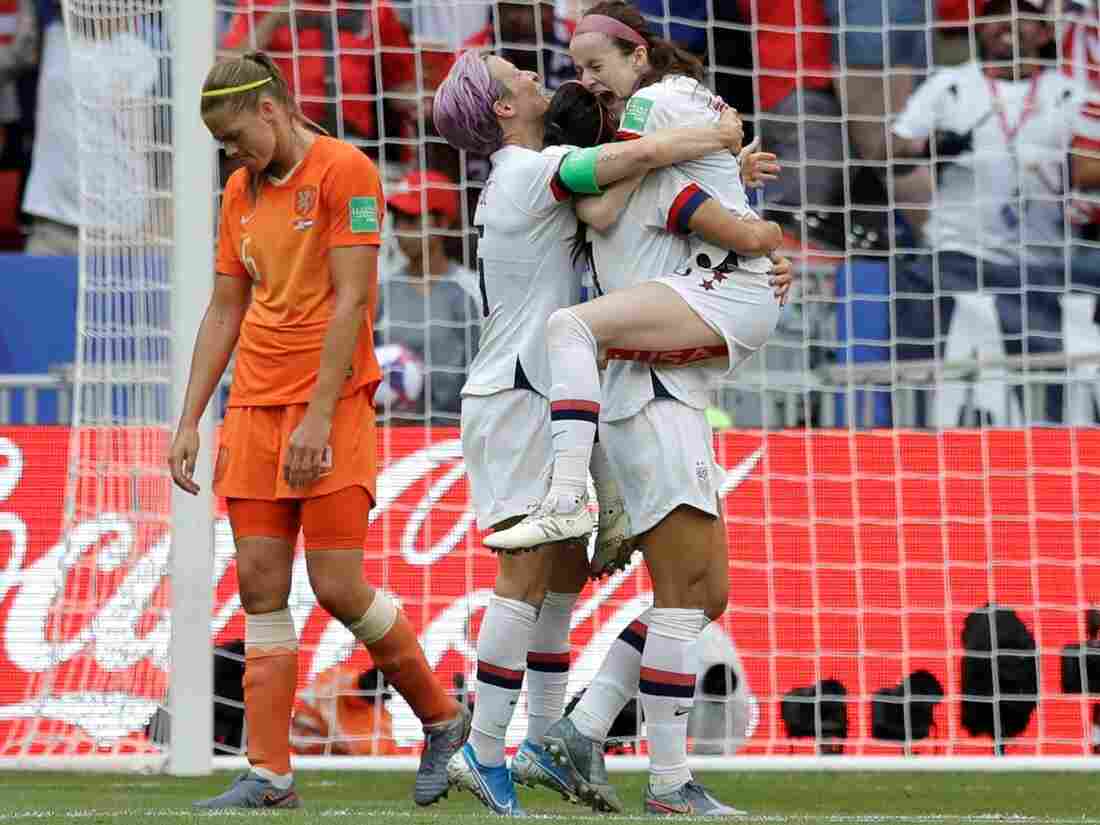
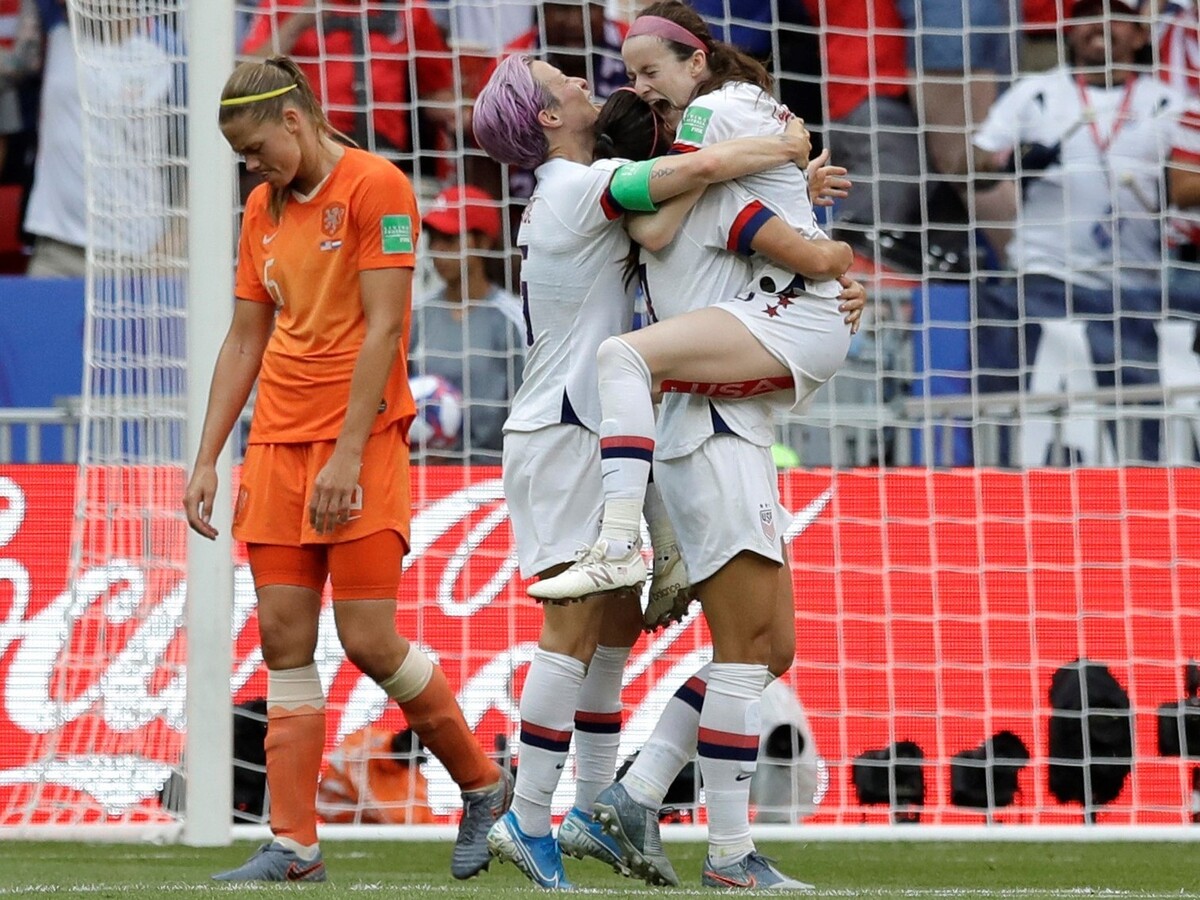
The U.S. scoring continued in the 69th minute thanks to midfielder Rose Lavelle. She dribbled down the field and, with a beautiful left-footed strike at the top of the penalty area, zipped the ball low and to the right. 2-0. It was all the scoring the U.S. would need.

The Netherlands’ Anouk Dekker (left) walks past as the United States’ Rose Lavelle (right) celebrates with teammates after scoring her side’s second goal during the Women’s World Cup final soccer match between the U.S. and the Netherlands.

Alessandra Tarantino/AP


hide caption

toggle caption

Alessandra Tarantino/AP

The United States rolled through the opening round with statement wins over Thailand (13-0), Chile (3-0) and Sweden (2-0). Brushing aside criticism about perceived arrogance and excessive goal celebrations, the U.S. then powered through the heart of European soccer with victories over Spain (2-1), France (2-1) and England (2-1) to make it to the final against the reigning European champions.

It was the fifth time the United States Women’s National Team played a World Cup final (there have been only eight tournaments). The U.S. is the first team to reach three consecutive finals and joins Germany as a repeat champion (2003 and 2007). With Sunday’s win, the U.S. has a record four Women’s World Cup trophies.

On a day that should have been all about the World Cup, the United States had to share the soccer spotlight. “It’s ridiculous,” said Rapinoe, that there are not one but two men’s soccer championships scheduled on the same day: the Copa América and CONCACAF Gold Cup. “That’s a terrible idea to put everything on the same day in every way. This is the World Cup final. This is ‘cancel everything day,’ ” Rapinoe said. Soccer’s international governing organization, FIFA, said having all three tournament finals on the same day will draw attention to the sport.

The U.S. team will return home to adoring crowds and fans and a new fight. In March, the U.S. Women’s National Team sued U.S. Soccer for gender discrimination. In the lawsuit, the team claims that the soccer federation pays members of the women’s team far less than similarly situated members of the men’s team — a men’s team that has had nowhere near the success of the women on the international stage. Both sides agreed to mediation after the tournament. After the final whistle, the crowd in Lyon chanted, “Equal Pay!”

Record audiences have tuned in for this tournament both in the United States and around the world. Will this exciting tournament translate into continued growth of the women’s game? “Your hope is [that] back in the U.S., more kids want to go out and play this great sport,” said U.S. head coach Jill Ellis. “I mean, that’s ultimately the building block you build on. My hope is that more people get on board financially. You know, sponsors, they see the value in it. They see the marketing marketability of it, and then more little kids want to go and kick a ball around.”

Now the U.S. returns home as champions again.

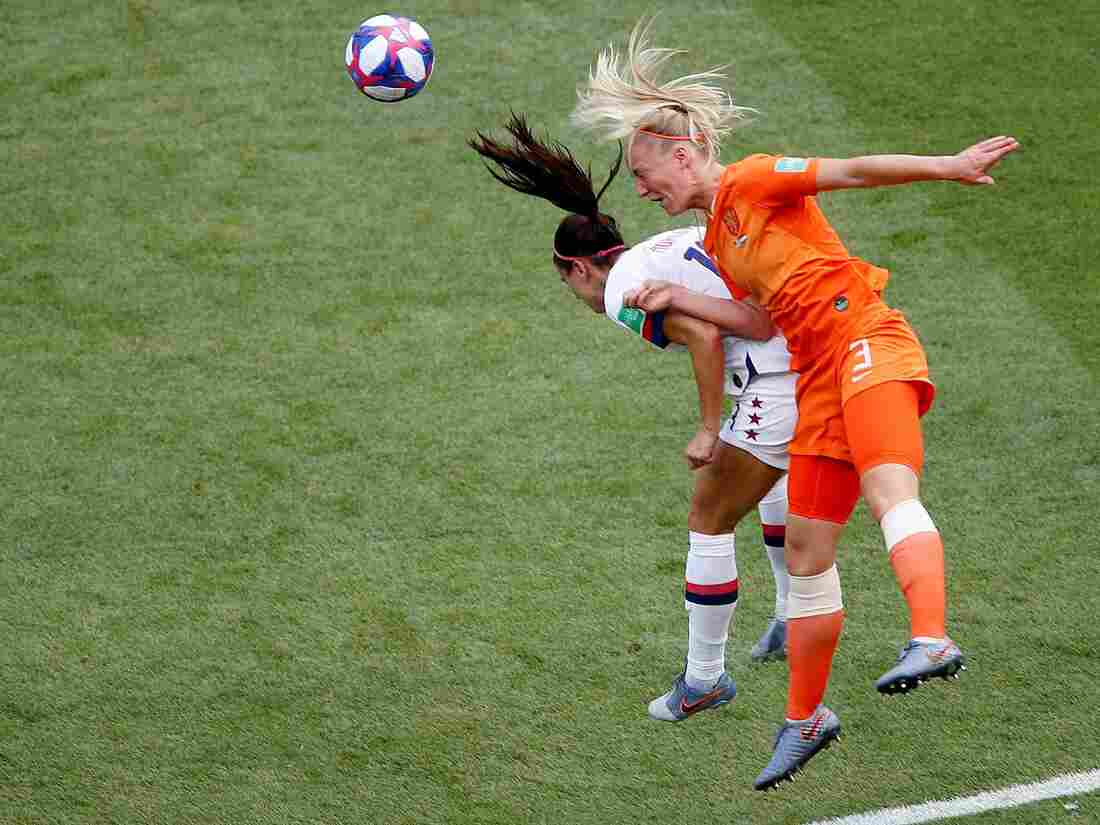
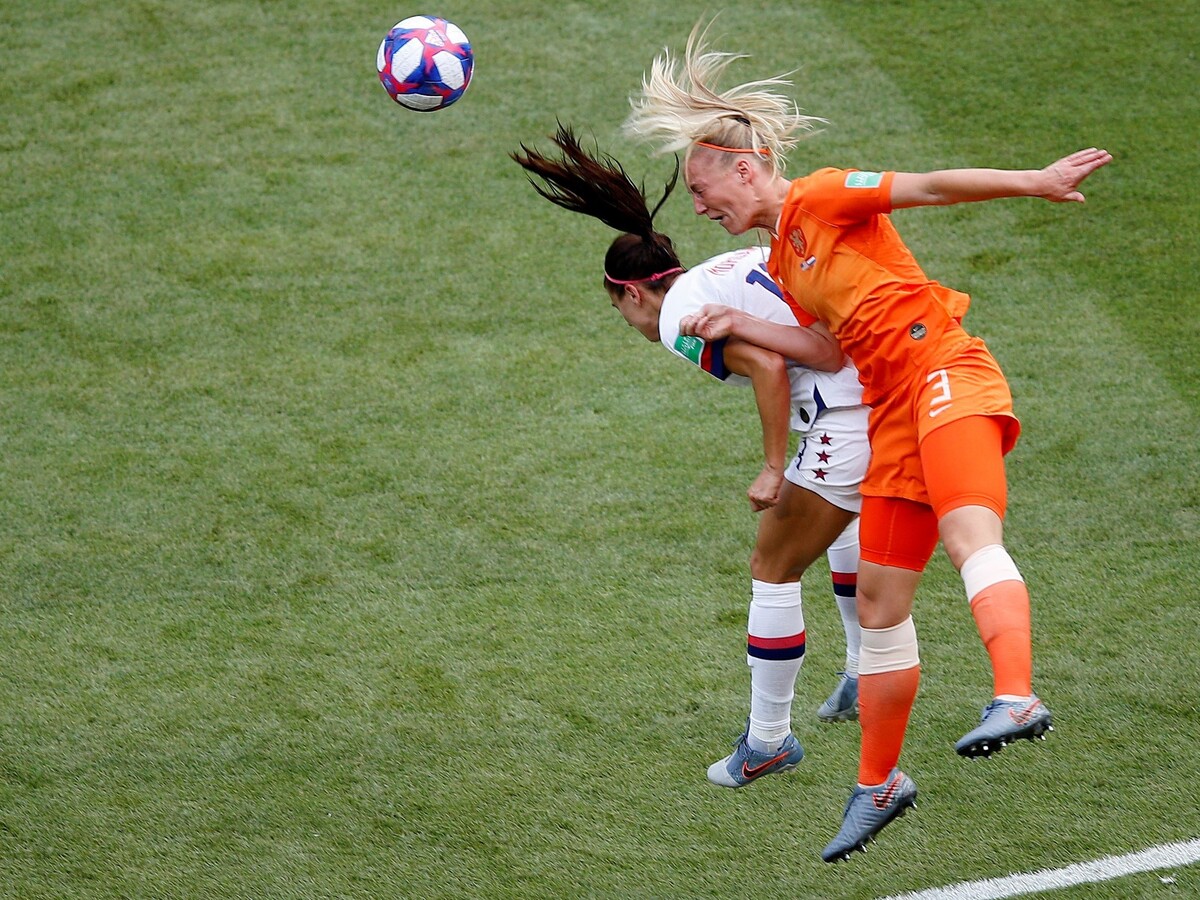
The United States’ Alex Morgan (left) and the Netherlands’ Stefanie van der Gragt challenge for the ball during the Women’s World Cup final soccer match between the U.S. and the Netherlands.

Francois Mori/AP


hide caption

toggle caption

Francois Mori/AP

Let’s block ads! (Why?)