With Rural Health Care Stretched Thin, More Patients Turn To Telehealth
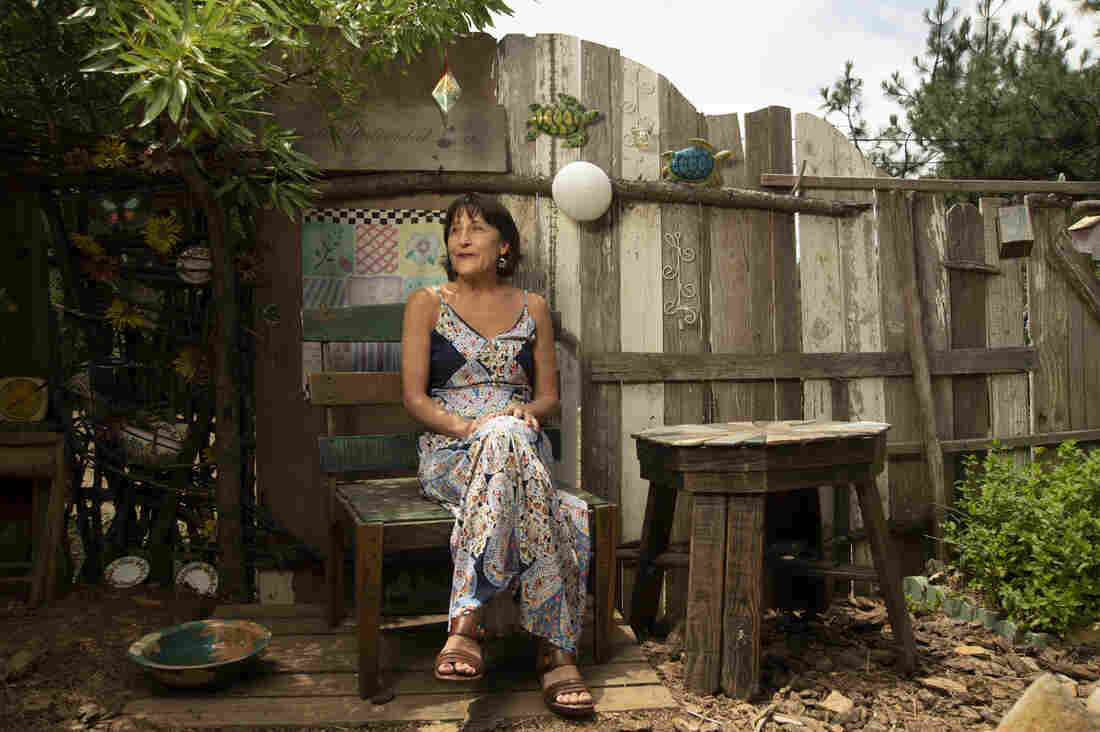

After a difficult time in her life, Jill Hill knew she needed therapy. But it was hard to get the help she needed in the rural town she lives in, Grass Valley, Calif., until she found a local telehealth program.
Salgu Wissmath for NPR
hide caption
toggle caption
Salgu Wissmath for NPR
Telehealth turned Jill Hill’s life around.
The 63-year-old lives on the edge of rural Grass Valley, an old mining town in the Sierra Nevada foothills of northern California. She was devastated after her husband Dennis passed away in the fall of 2014 after a long series of medical and financial setbacks.
“I was grief-stricken and my self-esteem was down,” Hill remembers. “I didn’t care about myself. I didn’t brush my hair. I was isolated. I just kind of locked myself in the bedroom.”
Hill says knew she needed therapy to deal with her deepening depression. But the main health center in her rural town had just two therapists. Hill was told she’d only be able to see a therapist once a month.
Then, Brandy Hartsgrove called to say Hill was eligible via MediCal (California’s version of Medicaid) for a program that could offer her 30-minute video counseling sessions twice a week. The sessions would be via a computer screen with a therapist who was hundreds of miles south, in San Diego.
Hartsgrove co-ordinates telehealth for the Chapa-de Indian Health Clinic, which is a 10-minute drive from Hills’s home. Hill would sit in a comfy chair facing a screen in a small private room, Hartsgrove explained, to see and talk with her counselor in an otherwise traditional therapy session.
Hill thought it sounded “a bit impersonal;” but was desperate for the counseling. She agreed to give it a try.

Coordinator Brandy Hartsgrove demonstrates how the telehealth connection works at The Chapa-de Indian Health Clinic in Grass Valley, Calif. Via this video screen, patients can consult doctors hundreds of miles away.
Salgu Wissmath for NPR
hide caption
toggle caption
Salgu Wissmath for NPR
Hill is one of a growing number of Americans turning to telehealth appointments with medical providers in the wake of widespread hospital closings in remote communities, and a shortage of local primary care doctors, specialists and other providers.
Long-distance doctor-to-doctor consultations via video also fall under the “telehealth” or “telemedicine” rubric.
A recent NPR poll of rural Americans found that nearly a quarter have used some kind of telehealth service within the past few years; 14% say they received a diagnosis or treatment from a doctor or other health care professional using email, text messaging, live text chat, a mobile app, or a live video like FaceTime or Skype. And 15% say they have received a diagnosis or treatment from a doctor or other health professional over the phone.
Loading…
Don’t see the graphic above? Click here.
Those survey findings are part of the second of two recent polls on rural life and health conducted by NPR, the Robert Wood Johnson Foundation and the Harvard T.H. Chan School of Public Health.
The Chapa-de clinic offers telehealth services not only for consultations in behavioral health and psychiatry, but also in cardiology, nephrology, dermatology, endocrinology, gastroenterology and more.

The Chapa-de Indian Health Clinic in Grass Valley, Calif., offers telehealth services for various specialties, including dermatology, gastroenterology and psychiatry.
Salgu Wissmath for NPR
hide caption
toggle caption
Salgu Wissmath for NPR
Hill feels fortunate; she knows most rural health facilities don’t include telehealth services, which means most patients living in remote areas would need their own broadband internet access at home to get therapy online.
And that’s out of reach for many, says Robert J. Blendon, co-director of NPR’s poll and professor of health policy and political analysis at the Harvard Chan School.
The poll found that one in five rural Americans say getting access to high-speed internet is a problem for their families.
Blendon says advances in online technology have brought a “revolution” in healthcare that has left many rural patients behind.
“They lose the ability to contact their physicians, fill prescriptions and get follow-up information without having to go see a health professional,” he says.
Critical care pediatrician James Marcin at UC Davis Children’s Hospital, directs the University of California, Davis, Center for Health and Technology and regularly consults via a telehealth monitor with primary care doctors in remote hospitals in rural areas.
“We’re able to put the telemedicine cart [virtually] at the patient’s bedside,” Marcin says, “and within minutes our physicians are able to see the child and talk with the family members and help assist in the care that way.”
If not for telehealth, Marcin says, the costs of getting what should be routine care “are significant barriers for those living in rural communities.”
“We have patients that drive to our Sacramento offices and they have to drive the night before,” he says, “and spend the night in a hotel because it’s a five-hour trip each way.” And there are additional costs for many patients, he says, such as childcare services, and missed days of work.
With telehealth, “a video is truly worth a thousand words,” he says; it can mean patients don’t have to make costly time-consuming trips to see a specialist.
Though Hill initially had reservations about meeting with a therapist online, she says she’s been amazed by how helpful the sessions have been.
“She gives me assignments and works me really hard,” Hill says, “and I have grown so much — especially just in the last few months.”
Her latest assignment in therapy: writing down positive characteristics of herself. Initially, she could only come up with three: loyalty, compassion and resilience. But the therapist questioned that, and encouraged Hill to consider that there might be more.

Hill says she’s in a ‘super growth” mode these days psychologically, and says the support she’s received in therapy has been key to that. She speaks with a clinical psychologist via a telehealth session twice a week for 30 minutes, and completes assigned homework in between those appointments.
Salgu Wissmath for NPR
hide caption
toggle caption
Salgu Wissmath for NPR
“She wanted 10,” says Hill, who proceeded to work through some other issues and talk more with therapist. “Now I’ve got like 15 at least,” Hill says, “and I keep adding to the list; once I started writing things down, I started really seeing that I have a lot of strengths I didn’t even know I had.”
Attorney Mei Kwong, executive director of the Center for Connected Health Policy in Sacramento, says telehealth services have the potential to remove many barriers to good health care in rural America.
But policies that regulate which telehealth services get paid for “lag way behind the technology,” Kwong says. Many policies are 10 to 15 years behind what the technology is able to do, she says.
For example, high-resolution photos can now be taken – and sent anywhere digitally — of skin conditions that many doctors say are better than “the naked eye looking at the condition,” she says. But the policies on the books of what Medicare, Medicaid and private insurers will pay for often means these services are not fully covered.
That’s unfortunate, Kwong says, especially for underserved communities where there is a shortage of specialists.
Changes are starting to be made in state, federal and private insurance policies, Kwong says. But it’s “slow going.”
U.S. Faces The Netherlands In World Cup Final

The Women’s World Cup final is later Sunday. The U.S. is the defending champion and is going for its fourth trophy. The Dutch are playing in their first final.
LULU GARCIA-NAVARRO, HOST:
Today is the women’s World Cup final. The United States, a superpower in women’s soccer, will take on the upstart squad from the Netherlands. NPR’s Laurel Wamsley has been covering the tournament, and she joins us now.
Good morning.
LAUREL WAMSLEY, BYLINE: Good morning.
GARCIA-NAVARRO: The U.S. has been unstoppable so far. Should the American women be worried about the Dutch?
WAMSLEY: Well, yes, the U.S. has been amazing so far. They’ve only allowed three goals the entire tournament, and they’ve now won 11 World Cup games in a row, which is a record. But this could be a tricky match against the Netherlands. This Holland team has made it to the final by upsetting teams that were supposed to beat them. And this is, actually, only their second time playing in a World Cup. They made it to the round of 16 four years ago in Canada. But then they won the 2017 European Championships, and they’ve only gotten stronger since then.
GARCIA-NAVARRO: All right, we’ll get to Megan Rapinoe in a second. But I want to ask about the Dutch side first. Who are you watching there?
WAMSLEY: The Dutch are led by two strong attackers, Lieke Martens and Vivianne Miedema. So Lieke Martens – she’s a gifted winger who was named FIFA’s Player of the Year in 2017. But she actually has a toe injury that took her off the field for the team’s win over Sweden in the semifinals. And Vivianne Miedema is a standout at Arsenal. And she’s only 22, but she’s already the Netherlands all-time leading scorer. And I would suggest you should watch out for the Dutch fans too. They’ve been travelling en masse in France, decked out in orange, singing and dancing wherever they go.
GARCIA-NAVARRO: (Laughter) All right, can we talk about Megan Rapinoe now?
WAMSLEY: I would love to.
GARCIA-NAVARRO: Yeah. After scoring all four U.S. goals in the games against Spain and France, she sat out the game against England. Is she hurt? What’s up with her?
WAMSLEY: Right. So she sat out that game against England with a strained hamstring. And she says that just kind of comes with the territory. She turned 34 on Friday. And she says as you get older, you just need more rest days. But she told reporters that she’ll be healthy enough to play in today’s game. And certainly, the fans are hoping that she will be. She is a lot of fun to watch and really brings a lot of gravitas to the field.
GARCIA-NAVARRO: The U.S. team has been demanding attention, both on and off the field. Remind us why.
WAMSLEY: I think it has to do with their confidence. They have been here before. They are often under high pressure. And I think they planned ahead. They thought about what would happen if they were under the spotlight. What would they do with that moment? And so they’ve prepared for it. And they are just so willing to be outspoken.
Some athletes, when these big moments happen, they don’t want to talk about politics. They just say, oh, we’re just focused on one game at a time. But this team, they are just willing and able to engage with the personal and the political all at the same time. And when people say they celebrate too much or they should just be talking only about sports, they say, no. That’s not us. And they do it so articulately. And they stand their ground. And then they go out on the field, and they win. And it’s just – it’s remarkable to watch.
GARCIA-NAVARRO: That’s NPR’s Laurel Wamsley, who will be watching the game.
Thank you so much.
WAMSLEY: Thank you.
(SOUNDBITE OF SUFFER LIKE G DID’S “BRING ME THE FIRST AID KIT”)
Copyright © 2019 NPR. All rights reserved. Visit our website terms of use and permissions pages at www.npr.org for further information.
NPR transcripts are created on a rush deadline by Verb8tm, Inc., an NPR contractor, and produced using a proprietary transcription process developed with NPR. This text may not be in its final form and may be updated or revised in the future. Accuracy and availability may vary. The authoritative record of NPR’s programming is the audio record.
João Gilberto, Master Of Bossa Nova, Dies At 88


Michael Ochs Archives/Getty Images
João Gilberto, one of the principal architects of the Brazilian musical style bossa nova, has died at his home in Rio de Janeiro, according to a Facebook post by his son. João Marcelo Gilberto wrote that his father, who was 88 years old, died following an undisclosed illness.
João Gilberto is credited by some Brazilian music historians as writing the first bossa nova, or new beat, a style that drew on the country’s African-influenced samba tradition but was performed without the usual battery of drums and rhythm instruments, and at much lower volumes. Gilberto’s intimate and nuanced style of guitar playing and singing, eventually central to the bossa nova sound, were reportedly developed in 1955 when he sequestered himself inside of a bathroom at his sister’s house so as not to disturb her family and to take advantage of the acoustics provided by the bathroom tiles.
“Bim-Bom,” often named as the first bossa nova song, came from that period. Soon thereafter, the style began to sweep Rio’s cafe’s and bars. Gilberto became the center of a vanguard of young Brazilian musicians that included composer Antonio Carlos Jobim and Vinicius de Moraes. Gilberto’s 1958 recording of “Chega de Saudade,” a song written by that pair, became an international hit and launched the bossa nova movement. The two-minute-long song also gave its name to Gilberto’s debut album, released in 1959.
YouTube
In 1962 American jazz saxophonist Stan Getz heard the style and invited Gilberto to record together. The resulting album Getz/Gilberto became one of the biggest selling jazz albums of all time, winning the 1965 Grammy for album of the year. One of the album’s songs, another composition by Jobim and de Moraes called “Garota de Ipanema (The Girl from Ipanema)” featured Gilberto’s then-wife Astrud on vocals. It was a worldwide hit and won the Grammy for record of the year, helping to cement bossa nova’s soft, lulling beats and intimate vocals across the global musical landscape.
João Gilberto continued to perform well into the 21st century and has been recognized by every generation since his debut as a Brazilian musical pioneer.
California Pay-To-Play Bill Pushes College Athlete Compensation
NPR’s Michel Martin speaks with College Athletics Players Association founder Ramogi Huma about a California bill that will allow compensation for college athletes.
Cori ‘Coco’ Gauff Continues Sensational Wimbledon Run


Cori “Coco” Gauff celebrates after beating Slovenia’s Polona Hercog on Friday.
Ben Curtis/AP
hide caption
toggle caption
Ben Curtis/AP
Cori “Coco” Gauff, the 15-year-old tennis player who defeated Venus Williams in her first-round match, has now advanced to the round of 16 at Wimbledon. She is the youngest player to advance this far in the tournament since 1991, when Jennifer Capriati made the semifinals as a 15-year-old.
Gauff was down a set and two separate match points in her third-round match against Polona Hercog of Slovenia on Friday, but she came back to win 3-6, 7-6 (9-7), 7-5.
In a press conference after the match, Gauff said she knew she could win, even when she was down 2-5 in the second set.
“I was like, ‘I can fight back — I just need to hold serve and then break,’ ” Gauff said.
Gauff, the youngest woman to qualify for Wimbledon in the modern era, is playing the most high-profile matches of her career. She committed 43 unforced errors in Friday’s match against Hercog, but she had just 18 unforced errors in her first two matches combined.
The comeback kid – and then some! ?
15-year-old @CocoGauff‘s irresistible run at #Wimbledon continues, rallying from a set down to defeat Polona Hercog 3-6, 7-6(7), 7-5 pic.twitter.com/bS79tUkMwG
— Wimbledon (@Wimbledon) July 5, 2019
“I wasn’t really tired,” Gauff said after the match against Hercog, which lasted two hours and 47 minutes. “I’m young. I have a lot of energy, and I’m used to playing two matches a day [in the junior tennis circuit].”
Gauff’s age means that the Women’s Tennis Association (WTA) restricts the number of events she can play. According to the New York Times, the WTA put the rules into effect in 1994, in response to burnout struggles faced by young tennis stars — including Capriati. A 15-year-old girl is typically allowed to play 10 professional tournaments in a year, but Gauff’s successes have earned her a merit-based increase of two additional events.
On Monday, Gauff will face the tournament’s No. 7 seed, Simona Halep. Halep won last year’s French Open title and has reached four Grand Slam finals. Gauff said she has never played against Halep or practiced with her, but she’s “familiar with how she plays just from watching her a lot.”
Gauff, currently ranked 313th in the world, has been a dominant presence in the junior tennis circuit. In 2018, she won the Junior French Open and in 2017, at 13 years old, she became the youngest player to make the finals of the Girls’ singles at the U.S. Open.
Venus Williams had won two Wimbledon titles by the time Gauff was born. Gauff said beating Williams, who she considers an idol, a real turning point for her in terms of fame.
“It was pretty surreal how life changes in a matter of seconds,” Gauff said.
But Gauff has long been clear about her tennis ambitions.
“I want to be the best ever,” Gauff said as a 14-year-old on the show No Days Off. “I want to be better than Serena, and I want to have that Grand Slam record one day.”
Serena Williams, who has won 23 Grand Slam titles and holds an Open Era record, will face Carla Suarez Navarro in a round-of-16 match on Monday.
Like mother, like daughter…#Wimbledon | @CocoGauff pic.twitter.com/5oKKMewXJj
— Wimbledon (@Wimbledon) July 5, 2019
Friday’s victory means Gauff has now earned almost $200,000 in Wimbledon winnings. When a reporter asked her how she planned to spend the money, she said she wasn’t sure.
“I mean, I can’t buy a car, because I can’t drive,” Gauff said. “I hate spending money to be honest, so I don’t really know.” She said she would maybe buy some hoodies from Jaden Smith’s line of apparel.
The most unexpected attention Gauff said she had received came from Miss Tina Knowles-Lawson, mother of Beyoncé and Solange Knowles.
“[She] posted me on Instagram and I was screaming,” Gauff said. “I hope Beyoncé saw that. I hope she told her daughter about me, because I would love to go to a concert.”
Saturday Sports: Wimbledon, Women’s World Cup
NPR’s Renee Montagne talks with Howard Bryant of ESPN about a rising tennis star at Wimbledon and the upcoming Women’s World Cup final.
RENEE MONTAGNE, HOST:
And it’s time now for sports.
(SOUNDBITE OF MUSIC)
MONTAGNE: A 15-year-old from Florida takes Wimbledon by storm and on the eve of the Women’s World Cup final, America’s brash, outspoken and very, very good team. We’re joined now by Howard Bryant of ESPN. Good morning.
HOWARD BRYANT, BYLINE: Good morning. How are you?
MONTAGNE: Pretty good. Let’s start with Wimbledon because – and I say this is an incredible understatement – a star is being born there.
BRYANT: A star is being born there. Fifteen-Year-Old Coco Gauff – just an amazing, amazing story, one, because we’re just not used to seeing someone that young be this good anymore. We’ve seen it in the old days, remember, with Tracy Austin at 14 and Jennifer Capriati, who was the last player as young as Coco Gauff to be doing what she’s doing now. But over the last several years, the game has gotten so physical and so strong, the players are so much bigger, that teenagers haven’t really had the chance to do what Coco Gauff is doing now. And she did something even more remarkable than just show up and play well at Wimbledon. She came in in the first round and beat her idol, Venus Williams, who’s only won Wimbledon five times and is a seven-time Grand Slam champion.
And, of course, yesterday’s match against Polona Hercog was just amazing considering she was down 6-3, 5-2, match point twice and found her way to win the entire match 7-5 in the third set. It just showed you how much – how much fun it is, and then it shows you how much talent she’s got as well. I was thinking to myself watching her parents in the crowd yesterday that I couldn’t stomach that. I can barely watch my son at a piano recital at the nursing home. And watching them watch their teenager do what she’s doing, it’s incredible.
MONTAGNE: Well, something else incredible, of course, is the Women’s World Cup final soccer team from America, the U.S. team. Before we talk about them – and I’m going to ask you about them – they have transformed this tournament into a much talked about event – I mean, much more than a game – haven’t they?
BRYANT: Well – and they have, and they always do. They are brash. They are good. They are fantastic. And they’re tough. I think when you look at the personalities involved, you’ve got Megan Rapinoe, who was the only player – white woman player to take a knee after Colin Kaepernick did in 2016 out of support for him. You have Alex Morgan and Carli Lloyd, who are two of the other stars on the team. You’ve got this team – they start to the tournament and they destroy Thailand, and people are mad at them because they won so big. And then they had a tough match against Spain.
And then, of course, you go up against England as well, and England didn’t like the fact that when they came out and beat them that they had a real – you know, Morgan’s celebration was of her sipping tea. I thought it was kind of fun. People thought this team was brash, but you know what? They’re good. They demand equal pay for women. They fight with the federation to make sure that they get what they deserve in terms of their respect. And they are something to watch. And tomorrow, they’ll be playing for the championship against the Netherlands.
MONTAGNE: OK. No predictions, but what’s the 30-second version of what you’ll be looking at when the U.S. kicks off with the Netherlands?
BRYANT: Oh, I think you’re looking to see how healthy Megan Rapinoe is. She didn’t play the other match. She didn’t start the other match because of her hamstring. So we’ll see if she’s healthy and playing. And I think you just want to see if they can play on their terms, they win. If they get into a tough defensive battle, then it’s anybody’s game.
MONTAGNE: Howard Bryant of ESPN, pleasure talking to you.
BRYANT: My pleasure. Thank you.
Copyright © 2019 NPR. All rights reserved. Visit our website terms of use and permissions pages at www.npr.org for further information.
NPR transcripts are created on a rush deadline by Verb8tm, Inc., an NPR contractor, and produced using a proprietary transcription process developed with NPR. This text may not be in its final form and may be updated or revised in the future. Accuracy and availability may vary. The authoritative record of NPR’s programming is the audio record.
U.S. Prepares To Face The Netherlands In Women’s World Cup Final
The U.S. will face the Netherlands in the Women’s World Cup Final on Sunday. The U.S. women are the defending champs and looking to secure their fourth World Cup title.
World Cup Final: It’s The Juggernaut Vs. The New Kid As U.S. Takes On The Netherlands


The Netherlands are the last team standing between the United States and its fourth Women’s World Cup. Here, U.S. forward Megan Rapinoe watches her teammates warm up before Tuesday’s 2-1 semifinal win over England.
Alex Grimm/Getty Images
hide caption
toggle caption
Alex Grimm/Getty Images
Before the World Cup began, nearly everyone predicted a final between the United States and, well, some team from Europe. Perhaps Germany, England or France. When the quarterfinals arrived, that soothsaying was on target: The Yanks and seven European squads remained.
Now all the blanks on the World Cup bracket have been filled in, save one. On Sunday, the mighty United States will battle the bright orange Netherlands as two soccer-crazed nations tune in.
Will the U.S. continue its march of greatness undaunted, or will the Dutch pull off an upset for the ages?
The U.S. squad has been nearly perfect, allowing no goals in the group phase and only one goal each against Spain, France and England.
But there have been some close calls. In Tuesday’s semifinal, there were moments when the U.S. team’s fate hinged on the smallest of margins. A goal in the 68th minute by England’s Ellen White would have been an equalizer, but it was ruled offside after video review. And a late-game penalty kick by England (during which most of America could be seen biting its nails) was saved by U.S. goalkeeper Alyssa Naeher. But the U.S. won, as it does so often.
So the final in Lyon, France, comes down to the juggernaut and the new kid.
This is just the second time the Dutch have played in the World Cup. The OranjeLeeuwinnen made it to the round of 16 four years ago and have been ascendant ever since. They were the surprise victors of the 2017 European Championships, and they are now beloved by a nation of orange-frocked football fans.
The Dutch are led by two strong attackers: Lieke Martens and Vivianne Miedema. Martens is a gifted winger who was named FIFA’s player of the year in 2017, but she is grappling with a toe injury that took her off the field for the team’s 1-0 semifinal win over Sweden. Miedema is a standout at Arsenal and, at 22, is already the Netherlands’ all-time leading scorer.
But it will take a lot to overcome the strength and skill of the U.S. Women’s National Team. As the U.S. has worked and won its way to play for a fourth World Cup title, it has done so with remarkable style and confidence.
Exhibit A: U.S. midfielder Rose Lavelle nutmegging the ball through the legs of England’s Millie Bright.
First big chance of the game goes to the @USWNT!
All set up by @roselavelle with the killer nutmeg on Bright ? #FIFAWWC pic.twitter.com/XvhOtcs1Lc
— FOX Soccer (@FOXSoccer) July 2, 2019
Exhibit B: Forward Alex Morgan scoring a soaring header to give the U.S. the lead on her 30th birthday. Then celebrating by delicately sipping an imaginary cup of tea. Then pointing out that male goal scorers celebrate in all kinds of ways, including in crude fashion, and that it elicits barely a comment.
Alex Morgan scores her first goal since the opening game and retakes the lead in the Golden Boot race (6 goals, 3 assists)
She’s the first player in #FIFAWWC history to score on her birthday ? pic.twitter.com/EGWBNIyaxI
— FOX Soccer (@FOXSoccer) July 2, 2019
Exhibit C: Megan Rapinoe.
For many U.S. fans, Rapinoe is the heart and soul of the team — artful winger, unflappable professional, moral center. Last week, President Trump tweeted critically about Rapinoe’s statement that she wouldn’t go to the White House if the team was invited. She stood by those words, then went onto the pitch and scored both of the U.S.’s goals against France.
Some have called her unpatriotic over her decision to not mouth the words to the national anthem before matches. But Rapinoe told reporters on Wednesday that she considers herself “particularly and uniquely and very deeply American.”
“I feel very fortunate to be in this country — I’d never be able to do this in a lot of other places but also, that doesn’t mean that we can’t get better. That doesn’t mean that we shouldn’t always strive to be better,” she said. “I think that this country was founded on a lot of great ideals, but it was also founded on slavery, and I think we just need to be really honest about that and be really open in talking about that so we can reconcile that and hopefully move forward and make this country better for everyone.”
Rapinoe didn’t play in the semifinal match against England because of a sore hamstring. Christen Press joined the team’s front line instead and scored almost immediately, demonstrating the depth and power the U.S. brings. Rapinoe says she will be healthy enough to play in Sunday’s final.
Netherlands midfielder Danielle van de Donk said Friday that she thinks the U.S. team has been arrogant.
“They’re basically already congratulating us on finishing in second place. I love it, let them say what they want to say,” she said. “The final is a game like any other: it will start at 0-0 and there are still at least 90 minutes to play. We’ll show them on the pitch how much we want to win that World Cup. Let’s talk afterwards!”
If the Dutch win, they will be honored Tuesday with a ceremony and a celebratory cruise through Amsterdam’s canals. The squad’s supporters have traveled en masse while in France and filled the streets with coordinated dancing, willing their team to greatness.
So this is happening in @valenciennes: Oranje parade in Valenciennes. @FIFAWWC @FecafootOfficie v @oranjevrouwen #StadeDuHainaut pic.twitter.com/mP1p5lRDZD
— Fatma Samoura (@fatma_samoura) June 15, 2019
If the U.S. wins, expect some tweets in all caps from the White House.
As it happens, the World Cup final isn’t the only FIFA event happening on Sunday. The governing body managed to schedule two other finals — in the men’s Copa América and CONCACAF tournaments — that day.
“It’s ridiculous, and disappointing, to be honest,” Rapinoe told reporters.
“I don’t really understand why there’s such a resistance against going all-in on women,” Rapinoe said. “I think it’s pretty clear women in sport have not been treated with the same care and financing and all of that that men’s sports has.”
Sunday’s match kicks off at 11 a.m. ET and will be broadcast on Fox and Telemundo.
Friday News Roundup – Domestic

“Tanks, but no tanks,” the Washington, D.C. City Council opined on Twitter.
They were talking about President Donald Trump’s July 4 “Salute To America,” the much-touted parade and fireworks display in D.C.
WAMU reporter Elly Yu told us earlier this week that President Trump has angled for a military parade ever since he saw one during a visit to France in 2017.
And the humanitarian crisis at the border continues to escalate.
Yimi Alexis Balderramos-Torres, a 30-year-old Honduran man, died in Immigration and Customs Enforcement (ICE) custody this week. He was waiting in Mexico while his application for asylum was processed and later crossed into the United States without legal documentation.
BuzzFeed reported ICE “was detaining more than 54,000 immigrants in jails around the country, an all-time record,” as of June 22.
Several members of Congress visited the border this week, including Democrat Alexandria Ocasio-Cortez. At one of the facilities they toured, Ocasio-Cortez said some migrant women told her they were being forced to drink out of toilets. This allegation was corroborated by other members of Congress on the trip and follows repeated allegations by immigrants saying they were forced to drink out of toilets.
Earlier that day, ProPublica published a story about a Facebook group for Customs and Border Protection (CPB) officials. They reported that group members posted violent memes about migrant deaths, in addition to “a vulgar illustration depicting Rep. Alexandria Ocasio-Cortez engaged in oral sex with a detained migrant.”
After the story’s publication, CBP said it opened an investigation into the posts.
In a statement, the Border Patrol chief, Carla Provost said “Any employees found to have violated our standards of conduct will be held accountable.”
And this week, NPR reported that the Department of Homeland Security issued fines to some immigrants who are in the country illegally.
From NPR’s reporting:
It’s the latest hard-line effort by the administration as it clamps down on illegal immigration at the border and increases interior enforcement.
“It is the intention of ICE to order you pay a fine in the amount of $497,777,” Lisa Hoechst, U.S. Immigration and Customs Enforcement officer, wrote to Edith Espinal Moreno in a letter dated June 25, 2019, obtained by NPR from lawyers for Moreno.
The Trump administration also seemed to drop its effort to add a question about citizenship to the 2020 Census.
But then — the president tweeted. He wrote on Twitter:
“The News Reports about the Department of Commerce dropping its quest to put the Citizenship Question on the Census is incorrect or, to state it differently, FAKE! We are absolutely moving forward, as we must, because of the importance of the answer to this question.”
But a lawyer from the Department of Commerce said this during a July 3 hearing on the case.
The tweet this morning was the first I had heard of the President’s position on this issue, just like the plaintiffs and Your Honor. I do not have a deeper understanding of what that means at this juncture other than what the President has tweeted. But, obviously, as you can imagine, I am doing my absolute best to figure out what’s going on.
I can tell you that I have confirmed that the Census
Bureau is continuing with the process of printing the
questionnaire without a citizenship question, and that process
has not stopped.
The DOJ says that the government is now looking for a way to add the question.
And the U.S. Women’s National Team is in the final of the World Cup. They won against England 2-1, even without the star power of midfielder Megan Rapinoe, who was sidelined with a hamstring injury. Lucky for the U.S., Rapinoe says she thinks she’ll be ready to play in the finals, which will take place on July 8 against The Netherlands.
We wrap up all the news from this holiday week and more.
Doctors Slow To Adopt Tech Tools That Might Save Patients Money On Drugs


Physicians complain that there’s not yet a standard drug-pricing tool available to them that includes the range of medicine prices each of their patients might face — one that takes into account their particular pharmacy choice and health insurance plan.
Exdez/Getty Images
hide caption
toggle caption
Exdez/Getty Images
When Mary Kay Gilbert saw her doctor in May for a skin infection on her leg, she wasn’t surprised to receive a prescription for an antibiotic cream.
But Gilbert, 54, a nurse and health consultant, was shocked when her physician clicked on the desktop computer and told Gilbert the medicine would cost $30 on her Blue Cross and Blue Shield plan.
“I was like, ‘Wow — that’s pretty cool that you know that information,’ ” she recalled telling the doctor in Edina, Minn.
Allina Health, the large Minnesota-based hospital network Gilbert’s doctor belongs to, is one of a growing number of health systems and insurers providing real-time drug pricing information to physicians so they can help patients avoid “sticker shock” at the pharmacy.
The pricing tool, which is embedded in each participating physician’s electronic health records and prescribing system, shows how much patients can expect to pay out-of-pocket, based on their insurance and the pharmacy they choose.
It also allows the doctor to find a cheaper alternative, when possible, and start the process of getting authorization for a drug, if the insurer requires that.
The soaring cost of drugs has been front and center in the growing national debate about revamping U.S. health care.
Patients abandon hundreds of thousands of prescriptions each year at the pharmacy, often because of high prices. Studies show that can jeopardize their health and often lead to higher costs down the road.
Such a tool can help consumers — many of whom are also facing increasing copayments and higher deductibles — learn about cheaper options in the doctor’s office.
Still, doctors have been slow to adopt the technology, sometimes because of concerns about getting bogged down in long discussions about drug costs. Humana, for example, introduced its drug pricing tool to its network of doctors in 2015. Today, fewer than 10% are using it, according to Humana officials.
These sorts of pricing tools do have serious limitations. Because price negotiations among insurers, drugmakers and middlemen are often highly competitive and secretive, the tools often don’t have useful data for every patient.
For example, Allina’s works for only about half its patients. The company says that’s because not all pharmacy benefit managers share their data on health plan enrollee costs, and those that do often provide only a fraction of their information.
“It’s a chicken-and-egg thing where doctors don’t use it because they don’t have the data for all their patients, and health plans don’t promote it to physicians because doctors don’t have the technology in place,” says Anthony Schueth, a health information technology consultant in Jacksonville, Fla. “It can be a powerful tool when it works, but at the moment the drivers are not there across the board for widespread adoption.”
At a hearing last month, Sen. Martha McSally, R-Ariz, pressed a top Trump administration health official about why many patients lack access to information on prescription drug prices at their doctor’s office.
“This is America. Why can’t we have this tool available tool now?” she asked. “The data is out there; the information is out there. What is it going to take to make this happen?”
The technology got a boost last month when the Centers for Medicare & Medicaid Services mandated that all Medicare drug plans embed such a tool in their doctors’ electronic prescribing system starting in 2021.
The details of what consumers spend out-of-pocket for drugs is provided by pharmacy benefit managers, or PBMs. They are the middlemen that negotiate with drugmakers on the prices insurers will pay for the medications and which ones the insurers will cover. So a tool’s usefulness is undermined when key PBMs are not included in the listings.
For example, a drug pricing tool sold by Surescripts, which is owned partly by the PBMs CVS Caremark and Express Scripts, includes data from those companies, but not from OptumRx, a PBM owned by insurance titan UnitedHealth. And the OptumRX drug pricing tool includes Optum data but not that of Express Scripts and CVS.
Demetrios Kouzoukas, who heads the Medicare program for CMS, says he hopes the program’s new drug mandate will spark the industry to provide doctors and patients access to a standard pricing tool, regardless of their insurance.
“What we are hoping and expecting is that there will be a standard that’s developed by the industry … so that the tool is available in all the electronic health records, for all the doctors and all patients, and spreads even beyond Medicare,” he told McSally at the hearing.
But cooperation does not seem to be on the horizon, some health industry officials say.
“I don’t see any chance that there will be a centralized system that will connect all of the plans/PBMs with all of the EHR systems currently in use anytime soon,” says Thomas Borzilleri, CEO of InteliSys Health, a health technology company based in San Diego.
Still, the National Council for Prescription Drug Programs, a nonprofit group that helps set guidelines for the pharmacy industry, has been working on standards for a drug pricing tool. John Klimek, a senior vice president of the nonprofit, predicts that by next year doctors across the country will be able to use the same drug pricing tool to look up all their patients’ drug costs, regardless of the insurer.
Even without such a standard in place, doctors and hospitals have an incentive to use the tool that goes beyond saving their patients money: Such a tool can be good for a provider’s wallet, too.
For example, Allina, which owns or operates about a dozen hospitals and dozens of clinics in Minnesota and Wisconsin, gets a set fee from some insurers to care for all of a patient’s health needs. So the doctors and health system all benefit when they can reduce costs and improve patients’ adherence to taking their medication, says Dr. David Ingham, a family doctor also from Edina. He’s one of 600 primary care doctors at Allina using the tool.
“When we prescribe a more expensive medication, we share less revenue from the insurance contract,” he says.
For example, he notes that the tool helped him prescribe inhalers to asthma patients.
“I pulled up one medication I normally use, and it said it would be $240 out-of-pocket, but it suggested an alternative for $20 that was pharmacologically equivalent,” Ingham says. “I sheepishly asked the patient which we should choose.”
Dr. Norman Rosen, a family physician in Orange, Calif., who is employed by Providence St. Joseph Health System, is one of 800 doctors who are testing the Blue Shield of California drug pricing tool this year. Based on the first few months of use, the tool is expected to save patients more than $100,000 in out-of-pocket costs this year, according to the companies.
Without the tool, Rosen says, it would be impossible for him to quickly know what drugs are covered by which insurers and what the copays are. He says he already has saved some patients several thousand dollars a year by changing their blood pressure and diabetes medications.
“It doesn’t take a lot of time, and this can be an important intervention,” Rosen says.
Kaiser Health News is a nonprofit, editorially independent program of the Kaiser Family Foundation and is not affiliated with Kaiser Permanente.