Candid And Sometimes Angry, Bud Selig’s New Book May Surprise You

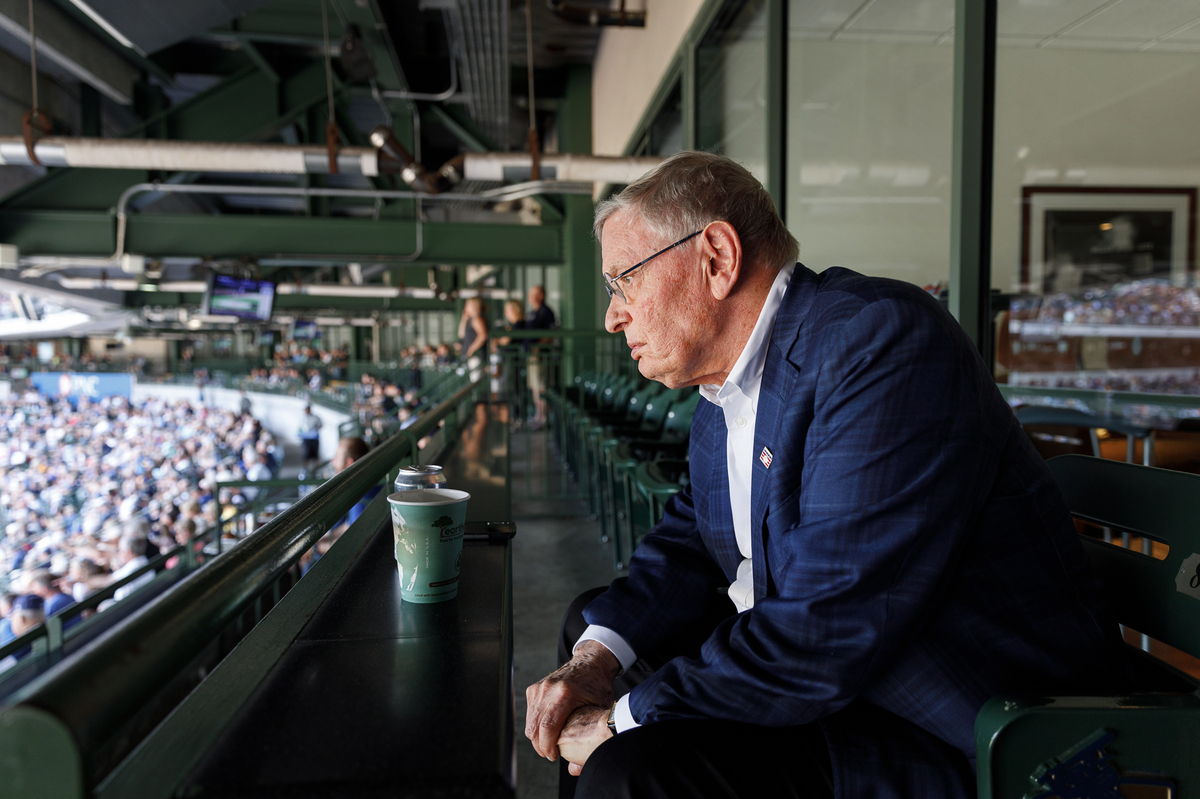
Former Major League Baseball Commissioner Bud Selig sits outside his luxury suite to watch the Milwaukee Brewers game at Miller Park. His new book reveals how he navigated tumultuous events in his career like the devastating player strike and the spread of performance-enhancing drugs.
Sara Stathas for NPR
hide caption
toggle caption
Sara Stathas for NPR
Some of Bud Selig’s new book may surprise you.
In For the Good of the Game, the former Major League Baseball commissioner is candid, sometimes foul-mouthed and angry. That’s a stark contrast to his public persona when he led the sport for more than two decades, and navigated tumultuous events like the devastating player strike and the spread of performance-enhancing drugs.
Selig retired in 2015 but he’s still closely connected to the game he fell in love with as a boy — and that he helped change in profound ways.
Sharp edges
Bud Selig didn’t like Barry Bonds.
In 2007, Selig was miserable having to follow the steroids-tainted slugger for the San Francisco Giants, as Bonds crisscrossed the country closing in on the milestone he finally reached — breaking Henry Aaron’s career home run record.

The reception area of Selig’s office in downtown Milwaukee. He likes to take visitors on a tour of his office to explain its Hall-of-Fame worthy artifacts.
Sara Stathas for NPR
hide caption
toggle caption
Sara Stathas for NPR
In 1995, the Clinton administration got involved in trying to resolve the baseball player strike. During a particularly heated incident, Selig launched a tirade, replete with F-bombs, against former Vice President Al Gore.
These pointed moments, recounted in the book, don’t exactly jibe with Selig’s sometimes unflattering public image. Critics derided the commissioner as bumbling and absent minded.
Those who know him and worked with him, know differently. For them, the sharp-edged Bud Selig is real.
But so too is the one who gets lost in baseball reverence.
Almost Cooperstown
Selig likes to take visitors to his Milwaukee office on impromptu tours around the space, with its Hall-of-Fame worthy artifacts.
“Well there’s nothing like Cooperstown,” Selig says, “but this is pretty close.”
He stops at one wall, and points to a letter, written in 1942, a month after Pearl Harbor. It’s an original, from President Franklin D. Roosevelt to then baseball commissioner Kenesaw Landis, asking Landis to keep the game going during World War II.
“[Roosevelt] thought so much of the game,” Selig says, “and thought the game could really provide so much of a catharsis during the [war]. Y’know I often refer to baseball as a social institution and this letter’s another manifestation of that.”
The tour continues, past photos of “my guys” Henry Aaron, a lifelong friend and Robin Yount, who spent his entire, star-studded 20-year career with the Milwaukee Brewers. Selig brought the major league team to Milwaukee in 1970, owned it for many years and still cherishes all things Brewers.
There’s a row of seats donated by the L.A. Dodgers, signed by such luminaries as long-time manager Tommy Lasorda, Hall-of-Fame pitcher Sandy Koufax, broadcaster Vin Scully.
Mounted on another wall, an actual x-ray of legendary Boston Red Sox outfielder Ted Williams. It was given to Selig by the team.
“He broke his elbow in 1950, and played the whole game,” Selig marvels about Williams’ gritty performance in, of all things, an All-Star game. Modern players often dismiss the game as a meaningless exhibition, but Selig likes to remind them it meant something back in the day. In fact, Selig tried to infuse the all-star game with more significance in the early 2000s when he announced the league that won the game would have home field advantage in the World Series. But that experiment ended in 2016.

Selig stands next to a wall display in his office of New York Yankees legend Joe DiMaggio. “Well there’s nothing like Cooperstown,” he says, “but this is pretty close.”
Sara Stathas for NPR
hide caption
toggle caption
Sara Stathas for NPR
Talking to owners … a lot
The book recounts how Williams liked to tell Selig he had the worst job in America.
“That’s how he started every conversation,” Selig laughs. “How do you deal with those blankety-blanks … meaning the baseball owners.”
How did Selig answer?
“I said there are some weeks you’re right,” Selig says, adding, “but [I said] I’m doing what I love. And the owners were great. I can never criticize them.”

A row of autographed chairs from Dodger Stadium sits in Selig’s office. The signatures include long-time manager Tommy Lasorda, Hall-of-Fame pitcher Sandy Koufax, broadcaster Vin Scully.
Sara Stathas for NPR
hide caption
toggle caption
Sara Stathas for NPR
Of course many could, and did. Allegations ranged from owners trying to break the union during the 1994/95 baseball strike, to colluding in the early 1980s to hold down player salaries.
Selig, who was a long-time owner of the Brewers and, like all commissioners, worked for baseball’s owners, denies the allegations. And he still has a strong connection to at least one owner.
Mark Attanasio bought the Brewers from Selig and his family in 2005. He and Selig talk regularly – in fact, Selig’s phone rings as he’s driving to watch a Brewers game.
“Hi Mark.”

Selig, acting Baseball Commissioner of Major League Baseball and president of the Milwaukee Brewers, attends a news conference in Milwaukee, on Jan. 23, 1995, regarding the team’s season ticket sales.
Roberto Borea/AP
hide caption
toggle caption
Roberto Borea/AP
Selig has turned down the Neil Diamond music he loves and now focuses on his conversation with Attanasio. Which not surprisingly, is about baseball. Milwaukee has lost two straight games. But Selig notes, so have the Brewers division rivals.
“I know the [Chicago] Cubs are losing and the Redbirds [St. Louis Cardinals] are losing but the fact is …” Selig pauses as Attanasio speaks. “Oh you bet,” Selig answers.
During his working years, Selig talked and talked to everyone, especially owners.
“Yes I did spend endless hours [on the phone],” Selig says, “no question about it.”
When he became acting commissioner in 1992, Selig says he inherited a mess.
“Owners hating each other; owners hating the union. Everybody hating the commissioner,” he says.
Communication, in Selig’s mind, was key to setting things right. It was necessary to listen, cajole and convince people that controversial proposals like adding Wild Card teams to the playoffs, introducing revenue sharing between teams, instituting drug testing … all of that was good for baseball.
And the primacy of the game, Selig says, over individual teams, is a message he learned early and preached often.
“If you really are a great sports owner,” he says, “the well being of your sport is the most important thing. Everything else is secondary.”
Building new buildings

Fans begin to leave the Milwaukee Brewers game at Miller Park. Selig led the effort to build Milwaukee’s new stadium, which opened in 2001.
Sara Stathas for NPR
hide caption
toggle caption
Sara Stathas for NPR
Selig says new stadium construction, in the 1990s and 2000s, was a key to ensuring baseball’s well being.
New stadiums became new revenue generators. But there were often fierce battles because teams relied on a lot of public funding and, opponents said, manipulated cities by threatening to leave unless they got a new facility.
Selig led the effort to build Milwaukee’s new stadium, which opened in 2001. It was sometimes a bare knuckles effort that cost a Wisconsin state senator his job for casting a key vote in favor of public financing.
“We had a lot of controversy,” Selig says as he slides his black sedan into a spot in the Miller Park parking lot. “Public funds, private funds. [But] look at it today. They’re going to draw 3 million people here this year. In a market of a million five.”

Fans watch the game against the Seattle Mariners. New stadiums became new revenue generators. But there were often fierce battles over public funding for the projects, including Miller Park.
Sara Stathas for NPR
hide caption
toggle caption
Sara Stathas for NPR
This is a recurring theme in Selig’s book. Ends justified means.
There was pain and anger surrounding the 1994-95 strike and cancellation of the World Series. But since then, there have been 24 years of labor peace.
Big market owners like the New York Yankees’ George Steinbrenner railed against helping small and medium market teams. But, ultimately, Selig says revenue sharing helped save some from going bust, and increased parity so more teams could be competitive.
Steroids commissioner
There was perhaps no more enduring controversy than the issue of steroid use.
It mushroomed on Selig’s watch, prompting critics to label him the “Steroids Commissioner.”

Selig watches a presentation of the “Selig Experience” at Miller Park. It’s a multimedia presentation that tells the story of Selig’s role in bringing Major League Baseball back to Milwaukee in 1970, and leading the effort 25 years later to build the new park.
Sara Stathas for NPR
hide caption
toggle caption
Sara Stathas for NPR
Sitting now outside his stadium suite, munching on a salad, Selig wants to set the record straight on what he calls historical myths about the drug issue.
“We were slow to react? No we weren’t,” Selig says. “This [policing steroid use with drug testing] is a subject of collective bargaining.”
And Selig says the union wouldn’t bargain.

San Francisco Giants’ Barry Bonds (left) holds the National League Hank Aaron award with Commissioner Selig during a ceremony before Game 4 of the World Series on Oct. 27, 2004 in St. Louis. Selig was inducted into Baseball’s Hall-of-Fame in 2017 but Bonds and other other players linked to the so-called Steroids era have not.
James Finley/AP
hide caption
toggle caption
James Finley/AP
He still blames the Player’s Association for resisting at every turn the drug testing he says he wanted and got the owners to support. Although a comprehensive steroids study he commissioned, the Mitchell Report, spread the blame to include baseball management, including commissioners.
“Yes [the Mitchell Report] did,” Selig acknowledges, “that’s right. But look, I’ve often thought, what else could I have done?”
Selig always has said he consulted those inside the game – managers, players, medical staff, athletic trainers – and was told steroids were not a widespread problem. But that didn’t convince skeptical baseball writers, or lawmakers. In 2007, Florida representative Cliff Stearns called for Selig’s resignation.
“Certainly, a lack of leadership and oversight in Major League Baseball enabled these abuses to continue,” Stearns said at the time. “After 15 years of slow action, a new commissioner is needed to guide the league out of this era of drug abuse.”
If Selig and baseball were slow to react, they weren’t alone among sports organizations in the mid 1990’s. That’s according to Travis Tygart, head of the U.S. Anti-Doping Agency.
“Look with the U.S. Olympic Committee [another organization hit hard by performance enhancing drug use], the light switch hadn’t gone on either,” says Tygart. “It wasn’t until Congress [held] hearings and bad [doping] cases in late 1999, going into Sydney [2000 Olympics], where they said we have to get this right.”
Tygart says the light switch eventually went on for baseball, in a big way.

A food vendor walks through the crowd during a Milwaukee Brewers afternoon baseball game. On a national level, what were once raging baseball controversies during Selig’s tenure, now are accepted parts of the game.
Sara Stathas for NPR
hide caption
toggle caption
Sara Stathas for NPR
“To the extent you can get [baseball] owners to agree to anything,” he says, “Selig did a hell of a job getting his owners to eventually recognize the issues and put in a strong [drug] program. And that in turn, I think, turned the tide of the players.”
Baseball’s drug program today, Tygart says, with its robust testing and sanctions and investigating arm, is the gold standard among major U.S. professional sports.
Mollifying the critics
Critics still linger, however.
Selig was inducted into Baseball’s Hall-of-Fame in 2017. Some said, as a result, Barry Bonds and other players linked to the so-called Steroids era, who’ve been left out of the hall, should get in too.

A bronze statue of Selig stands near the main entrance of Miller Park. Selig says he wants to set the record straight on what he calls historical myths about the drug issue.
Sara Stathas for NPR
hide caption
toggle caption
Sara Stathas for NPR
Will Selig’s book, with its detailed description of the steroid battles and lengthy explanations of his actions, mollify the critics?
“I mean that’s a fair question,” Selig says. “I don’t think so. But maybe it will.”
“It was a painful period. It was a period that was clearly not good for baseball. But I have to say, finally, through a lot of pain, we got it right.”
A hometown legacy
Whatever the final verdict, Selig knows, at least, his legacy is secure in the place he’s always cared about most.
Walking the concourse at Miller Park, next to Selig, is revealing. You’d think all the strangers coming up or calling out were planted by the team.
But it’s genuine.

Selig’s legacy is secure in the places he’s always cared about most: Milwaukee and, since 2001, Miller Park.
Sara Stathas for NPR
hide caption
toggle caption
Sara Stathas for NPR
“Hi Mr. Selig, how are you?”
“Thank you for transforming the game, Mr. Selig.”
Wisconsin native Ben Gentile, 37, shook Selig’s hand.
“I just told him thank you for keeping baseball in Milwaukee,” Gentile says, referring to the time, before Miller Park, when there was talk that the Brewers might leave.
Milwaukee resident Katie Allen, another Selig hand-shaker, looked star struck.
“It’s amazing he’s here,” she says, “it’s amazing. He means a lot to the city. A hell of a lot.”
On a national level, what were once raging baseball controversies during Selig’s tenure, now are accepted parts of the game.
Wild card teams. Interleague play. Revenue sharing. Drug testing.

Selig walks down a hallway to his office. He has retired but he still works. It’s someone else’s job to meet the game’s current challenges, such as attracting younger, more diverse fans and maintaining labor peace.
Sara Stathas for NPR
hide caption
toggle caption
Sara Stathas for NPR
It’s someone else’s job to meet the game’s current challenges, such as attracting younger, more diverse fans, maintaining labor peace and improving action on the field.
But the commissioner emeritus is always a phone call away. He talks regularly with current Commissioner Rob Manfred, although Selig won’t reveal what’s said in their conversations.
Selig’s retired but he still works. On this day, he left the ballpark after a 4th inning home run put the Brewers ahead for good. Back at the office, with a Milwaukee victory secured and surrounded by his history, chances are good Bud Selig … was satisfied.
Memphis Hospitals Suspend Debt Collection Suits, Including Suits Against Employees

R. Alan Pritchard, one of two attorneys for Methodist Le Bonheur Healthcare, heads into Shelby County General Sessions Court Wednesday in Memphis. He asked the court to drop more than two dozen cases as the hospital reviews its collection policies.
Andrea Morales for MLK50
hide caption
toggle caption
Andrea Morales for MLK50
This article was produced in partnership with MLK50, which is a member of the ProPublica Local Reporting Network.
Methodist Le Bonheur Healthcare, the largest hospital system in Memphis, Tenn., said it has suspended “court collection activities” over unpaid medical bills — just days after an investigation by MLK50 and ProPublica (which also appeared on NPR) detailed its relentless pursuit of debts held by poor people and even its own employees.
“We recognize that we serve a diverse community and we are always thinking about how we can do more and serve our community better,” Methodist said in a written statement. “Over the next 30 days we will be reviewing our policies and procedures to ensure we are doing everything possible to provide the communities we serve with the care and assistance they need. Also, we will immediately suspend any further court collection activities during this period.
“As a learning organization that is committed to continuous quality improvement, we want to be absolutely sure that our practices continue to support our mission and vision of improving every life we touch regardless of ability to pay.”
Methodist dropped more than two dozen cases that were set for initial hearings on Wednesday’s morning docket at Shelby County General Sessions Court.
“Currently, Methodist is in the process of reviewing its collection processes,” R. Alan Pritchard, one of Methodist’s attorneys, told General Sessions Court Judge Deborah M. Henderson.
“You are free to leave,” Henderson told one defendant, who looked puzzled, a purse on her shoulder and a folder full of papers in her hand.
Henderson called the names of other defendants whose cases were on the docket.
Again and again, Pritchard said: “Dropped, please, your honor.”
One of the defendants whose case was dropped is Adrien Johnson, who works for the city of Memphis. Methodist sued him this year for an unpaid hospital bill of more than $900.
Reached by phone, Johnson said he believes the hospital bill was for X-rays he had taken while he was covered by his wife’s insurance. Wednesday was his first court date, and after the hearing, he said he wasn’t clear what the status of his debt was.
“I don’t know what they’re doing,” he said. “I need to find out what’s going on.”
From 2014 through 2018, the hospital system affiliated with the United Methodist Church filed more than 8,300 lawsuits, according to an MLK50-ProPublica analysis of Shelby County General Sessions Court records. That’s more than all but one creditor during that five-year period.
One story by the news organizations chronicled the struggle of Carrie Barrett, who makes $9.05 an hour at Kroger, to pay her 2007 hospital bill for $12,019. The bill has ballooned to more than $33,000 due to interest and attorney’s fees.
Another story detailed how Methodist sues its own employees, some of whom make less than $13 an hour, for unpaid bills related to care delivered at its hospitals. Its health plan doesn’t allow workers to seek care at hospitals with more generous financial assistance policies.
Defendants talked about how the lawsuits upended their lives and left them in a position where they would never be able to pay off their debts, which grew from year to year as interest mounted.
With $2.1 billion in revenue and a health system that includes six hospitals, Methodist leads the market: In 2017, it had the most discharges per year and profits per patient, according to publicly available data analyzed by Definitive Healthcare, an analytics company.
Methodist says it has “a hospital in all four quadrants of the greater Memphis area, unparalleled by any other healthcare provider in our region,” plus more than 150 outpatient centers, clinics and physician practices. The system also said it provides community benefits of more than $226 million annually.
The number of lawsuits Methodist files isn’t out of proportion to its size, at least compared to competitor Baptist Memorial Health Care and Regional One Health, the county’s public hospital. But Methodist stands out in other respects.
Its financial assistance policy, unlike those of many of its peers around the country, all but ignores patients with any form of health insurance, no matter their out-of-pocket costs. If they are unable to afford their bills, patients then face what experts say is rare: A licensed collection agency owned by the hospital.
Also, after the hospital sues and wins a judgment, it repeatedly tries to garnish patients’ wages, which it does in a far higher share of cases than other nonprofit hospitals in Memphis. A court-ordered garnishment requires that the debtor’s employer send to the court 25% of a worker’s after-tax income, minus basic living expenses and a tiny deduction for children under age 15.
Methodist secured garnishment orders in 46% of cases filed from 2014 through 2018, compared with 36% at Regional One and 20% at Baptist, according to an analysis of court records by MLK50.
Methodist’s announcement was welcomed by some local lawmakers.
“Methodist has been such a great community partner throughout Shelby County that I’m glad to hear they’re reviewing their process over the next 30 days,” said Shelby County Commissioner Mickell Lowery, whose district includes Methodist University Hospital.
U.S. Rep. Steve Cohen, D-Tenn., said: “I was surprised to read about Methodist Le Bonheur’s billing practices, and I’m glad that the company is re-examining them. … I will continue to monitor this situation and look forward to the company’s assessment.”
But the Rev. Anthony Anderson, a United Methodist elder at Faith United Methodist in Memphis, was more reserved.
“I am still heartbroken, and I say that spiritually,” Anderson said. “It breaks my heart to know that a Methodist-related entity, a hospital, would have these types of practices.”
He welcomed the policy review, but only if it leads to the complete erasure of all outstanding patient debt.
“This debt needs to be wiped away,” Anderson said. “That will be the direction I will be pushing towards as a Methodist — that we don’t burden families with these type of financial penalties.”
New data obtained from Shelby County General Sessions Court shows that Methodist has filed more than 600 new lawsuits this year. Its most recent suits were filed on June 21, days before the MLK50-ProPublica stories were published. Its most recent garnishment order was filed on Tuesday.
Wendi C. Thomas is the editor of MLK50: Justice Through Journalism. Email her at wendicthomas@mlk50.com and follow her on Twitter at @wendicthomas.
ProPublica is a nonprofit newsroom that investigates abuses of power. Sign up for ProPublica’s Big Story newsletter to receive stories like this one in your inbox as soon as they are published.
The Thistle & Shamrock: Alan Reid At Swannanoa

Dr. Kathy Bullock.
Courtesy of the artist
hide caption
toggle caption
Courtesy of the artist
Scottish singer, songwriter and former Battlefield Band member Alan Reid visits Traditional Song Week at the Swannanoa Gathering. We hear highlights from his remarkable musical encounters with Cathy Jordan, Len Graham, Sheila Kay Adams, Tony Ellis, Matt Watroba and Dr. Kathy Bullock.
U.S. Women Head To World Cup Final After Beating England 2-1

The top-ranked U.S. team is returning to the Women’s World Cup final for a third straight time after defeating England 2-1 Tuesday. They’ll take on either the Netherlands or Sweden on Sunday.
Why WFAN’s Mike Francesa Is The Maestro Of Sports Talk Radio
Midway through the baseball season, commentator Mike Pesca offers this ode to a sports radio talk show host who can turn even the most dismal game into high stakes drama.
Former MLB Commissioner Selig Opens Up In ‘For The Good Of The Game’
As commissioner, Bud Selig led Major League Baseball through a major restructuring. He was also at the helm during the 1994 strike and the steroid era. He’s candid about it all in a new book.
Serena Williams And Andy Murray Team Up To Play Mixed Doubles At Wimbledon

Serena Williams plays against Italy’s Giulia Gatto-Monticone in a women’s singles match at Wimbledon on Tuesday.
Ben Curtis/AP
hide caption
toggle caption
Ben Curtis/AP
Two tennis greats are pairing up for mixed doubles at Wimbledon. Serena Williams and Andy Murray will team up for the competition. Entries for the draw close Wednesday morning.
Earlier this week both players hinted at the possibility of playing together. Two-time Wimbledon champion Murray said, “I’m definitely playing in the mixed. I have got my partner – well 90 per cent sure.
“Is it Serena? Possibly. I just need to just confirm it.”
Williams has dominated women’s tennis, winning 23 major singles championships, and 14 in women’s doubles with her sister, Venus.
At a news conference earlier this week Williams fielded questions about the possibility of pairing with Murray. “His work ethic is just honestly off the charts. That’s something I’ve always respected about him. His fitness, everything. To do what he’s done in an era where there’s so many other great male tennis players, so much competition, to rise above it, not many people have done it. He’s actually one of the few,” Williams said, according to The Associated Press.
“Above all … he really speaks up about women’s issues, no matter what,” Williams continued. “You can tell he has a really strong woman in his life. I think, above all, that is just fantastic.”
Williams advanced on Tuesday at Wimbledon, beating the world No. 161 Giulia Gatto-Monticone from Italy 6-2, 7-5. Murray is entered in men’s doubles at Wimbledon with Pierre-Hugues Herbert.
U.S. Win 2-1 Over England As They Head To Women’s World Cup Final
The U.S. won over England in the semifinals of the Women’s World Cup. NPR’s Mary Louise Kelly speaks with sportswriter Stefan Fatsis for post game analysis.
U.S. Powers To Women’s World Cup Final After Defeating England 2-1

Christen Press (left) celebrates after scoring the U.S.’s first goal during the Women’s World Cup semifinal against England. The U.S. won 2-1.
Alessandra Tarantino/AP
hide caption
toggle caption
Alessandra Tarantino/AP
It was the battle of unbeatens at this Women’s World Cup. Both teams were 5-0. The U.S. — the defending and three-time World Cup champion — and England — which was ranked third in the world but had never advanced past the semifinals. The game in Lyon, France, lived up to its billing with the U.S defeating England 2-1 to advance to Sunday’s final.
It was a tense, physical and nerve-wracking back-and-forth contest — particularly in the second half. But the drama began before the game’s opening whistle. Both teams switched up their lineups — including a major change by the United States. Coach Jill Ellis did not start forward Megan Rapinoe. Rapinoe was the spark and team leader who scored all four goals in the past two knockout games for the United States. Christen Press started in her place. Rapinoe did not warm up prior to the game. The team gave no reason for the swap.
In the five previous games of the tournament, England had allowed just a single goal. The U.S. was right behind: only conceding two. Those statistics wouldn’t last long as the scoring got started early.
Kelley O’Hara lofted a sweet cross into the English penalty area and Press slammed a header into goal in the 10th minute. It didn’t take long for England to respond. In the 19th minute, Ellen White powered the ball into the U.S. goal.
And just like that, England equalizes and their fans go nuts. Ellen White notches her 6th goal in 5 matches. #USA 1 – #ENG 1 #FIFAWWC pic.twitter.com/u4VtEKGhKb
— melissa block (@NPRmelissablock) July 2, 2019
The U.S. stormed right back in the 31st minute when Lindsey Horan chipped the ball over an England defender and Alex Morgan headed it past outstretched English keeper Carly Telford. It was the first goal for Morgan since she scored five in the opening U.S. match against Thailand. With the strike, she becomes the first person in Women’s World Cup history to score on her birthday (she’s 30).
The U.S. generated more scoring chances in the first half thanks to Tobin Heath, Rose Lavelle and Press. The Americans stifling and swarming defense kept England mostly at bay all game long.
England got the chance to tie it up late when a penalty kick was awarded after video review in the 83rd minute. England’s White was tripped up by Becky Sauerbrunn. English captain Steph Houghton stepped up to take the penalty. U.S. goalkeeper Alyssa Naeher dove low and to the right to make a sparkling stop to keep the score 2-1.
With the victory, the U.S. notched another Women’s World Cup record: it was the team’s 11th straight victory surpassing Norway which won 10 straight in 1995 and 1999.
The U.S. has now made it to the finals of the last three Women’s World Cups. It’s never won back-to-back titles, though. Only Germany has done that (2003 and 2007). The U.S. will play the winner of tomorrow’s semifinal: Sweden/Netherlands. The final is on Sunday in Lyon.






Alex Morgan (right) scored the second American goal of the semifinal.
Alessandra Tarantino/AP
hide caption
toggle caption
Alessandra Tarantino/AP
Newly Blue, Maine Expands Access To Abortion


Alison Beyea of ACLU of Maine speaks during an abortion-rights rally at Congress Square Park in Portland, Maine, in May. Democrats elected last November have pushed through two laws that expand access to abortion in the state.
Derek Davis/Portland Press Herald via Getty Images
hide caption
toggle caption
Derek Davis/Portland Press Herald via Getty Images
While abortion bans in Republican-led states dominated headlines in recent weeks, a handful of other states have passed laws to expand abortion access. Maine joined those ranks in June with two new laws — one requires all insurance and Medicaid to cover the procedure and the other allows physician assistants and nurses with advanced training to perform it.
With these laws, Maine joins New York, Illinois, Rhode Island and Vermont as states that are trying to shore up the right to abortion in advance of an expected U.S. Supreme Court challenge. But what sets Maine apart from the other states is how recently Democrats have taken power.
“Elections matter,” says Nicole Clegg of Planned Parenthood of Northern New England. “In 2018, we saw the largest number of women get elected to our legislature. We saw an overwhelming majority of elected officials who support reproductive rights and access to reproductive health care.”
The dramatic political change also saw Maine elect its first female governor, Janet Mills, a Democrat who took over from Paul LePage, a Tea Party stalwart who served two terms. LePage had blocked Medicaid expansion in the state even after voters approved it in a referendum.
Clegg and other supporters of abortion rights have hailed the new abortion legislation as a big win.
“It will be the single most important event since Roe v. Wade in the state of Maine,” Clegg says.
Taken together, the intent of the two laws is to make it easier for women to afford and find abortion care in the rural state.
Nurse practitioners like Julie Jenkins, who works in a small coastal town, say that increasing the number of abortion providers will make it easier for patients who now have to travel long distances in Maine to get the procedure from a doctor.
“Five hours to get to a provider and back — that’s not unheard of,” Jenkins says.
Under the law set to go into effect in September, physician assistants and nurses with advanced training will be able to perform a surgical form of the procedure known as an aspiration abortion. These clinicians already are allowed to use the same technique in other circumstances, such as when a woman has a miscarriage.
Maine’s other new law will require all insurance plans — including Medicaid — to cover abortions and is supposed to be implemented early next year. Kate Brogan of Maine Family Planning says this legislation is a workaround for dealing with the U.S. law known as the Hyde Amendment, which prohibits federal funding for abortions except in extreme circumstances.
“That is a policy decision that we think coerces women into continuing pregnancies that they don’t want to continue,” Brogan says. “Because if you continue your pregnancy, Medicaid will cover it. But if you want to end your pregnancy, you have to come up with the money [to pay for an abortion].”
State dollars, not federal, will pay for the abortions performed through Maine’s Medicaid program (in general, Medicaid is funded by both state and federal tax dollars).
Though the bill passed in the Democratic-controlled Legislature, it faced staunch opposition from Republicans, including state Sen. Lisa Keim, during floor debates.
“Maine people should not be forced to have their hard-earned tax dollars [used] to take the life of a living pre-born child,” Keim says.
Instead, Keim argues, abortions for low-income women should be funded by supporters who wish to donate money. Otherwise, she said during the debate, the religious convictions of abortion opponents are at risk.
“Our decision today cannot be to strip the religious liberty of Maine people through taxation,” Keim says.
Rep. Beth O’Connor, a Republican who says she personally opposes abortion but believes women should have a choice, says she had safety concerns about letting clinicians who are not doctors provide abortions.
“I think this is very risky, and I think it puts the woman’s health at risk,” O’Connor says.
In contrast, advanced-practice clinicians say the legislation merely allows them to operate to the full scope of their expertise and expands patients’ access to important health procedures. The measure also has the backing of physician groups, including the Maine Medical Association.
Just as state laws restricting abortion are being challenged, so are Maine’s new laws. Days after Maine’s law regarding Medicaid and abortion passed, organizations that oppose abortion rights announced they would mount an effort to put the issue on the ballot for a people’s veto.