Saturday Sports: Women’s World Cup, Wimbledon

The Women’s World Cup is underway, while top tennis players are about to meet at Wimbledon.


SARAH MCCAMMON, HOST:

And now it’s time for sports.

(SOUNDBITE OF MUSIC)

MCCAMMON: The Women’s World Cup is going on in France during one of Europe’s worst heat waves. Bringing in the heat here is NPR’s Tom Goldman. Good morning, Tom.

TOM GOLDMAN, BYLINE: Sarah, welcome to the sports segment.

MCCAMMON: Thank you so much. So the U.S. women’s soccer team as we know defeated France 2-1. It was an evening game. They played in that 85 degree heat. What were the highlights for you?

GOLDMAN: Well, now that you mentioned the heat, hydration, definitely a highlight, but other than that, defense – Megan Rapinoe. The defense was a question mark for the U.S. going into the World Cup, but it was stellar yesterday, especially in the second half after France scored and really started to bring the pressure. The U.S. kept repelling attack after attack. But the big story, of course, Megan Rapinoe. She played a beautiful game. She was relentless on the left wing and, of course, she scored both U.S. goals. She’s now scored all the American goals in the last two victories. She has five total. But beyond that, she really has become a phenomenon at this World Cup, in case you haven’t heard – the purple hair, the outspoken political views. She’s a supporter of NFL player Colin Kaepernick and his protests during the national anthem. She’s protested herself. She’s in a war of words with President Trump. So Rapinoe is becoming this polarizing character, loved and hated. But I tell you, Sarah, she’s loving her moment. She and her teammates aren’t shrinking from being the favorites. In fact, they seem to be thriving on the pressure.

MCCAMMON: And a lot of people are loving her. They face England next. England defeated Norway 3-0. So what do you think will happen in the semifinals?

GOLDMAN: The U.S. will beat England, and then the U.S. will beat whoever they play in the final. Sarah, I’m usually a rotten prognosticator – not this time. They’re just really good. Next question, please.

MCCAMMON: All right, we’re going to hold you to that.

GOLDMAN: OK.

MCCAMMON: Two former star U.S. soccer players, Brandi Chastain and Michelle Akers, announced this week, Tom, that they will participate in a Boston University brain study. I want you to talk a little bit about that and why it matters.

GOLDMAN: Well, Akers and Chastain are two of the stars of that great 1999 World Cup-winning U.S. team, and they say they’ve dealt with different symptoms like memory loss and headaches. And they wonder if a lifetime of heading the ball and collisions have put them and other female soccer players at risk of CTE, chronic traumatic encephalopathy. That’s the degenerative brain disease most associated with football. Now, it matters because, in sports, traumatic brain injury mostly has been talked about as a problem for male athletes because of football and other collision sports that men play. But in fact soccer, especially at the younger levels, has been particularly brutal to the heads of women and girls. A 2017 study by the American Academy of Orthopedic Surgeons found girls soccer number one when it comes to concussions as a percentage of total injuries. Studies like that have led some to call for reducing or even eliminating heading the ball for younger players.

MCCAMMON: And moving on to another big tournament starting Monday, this one in the U.K., we are talking, of course, about Wimbledon. On the women’s side, as per usual, it’s anybody’s championship. In the last 10 Grand Slam tournaments, there’ve been nine different female champions. For the men, No. 1 ranked Novak Djokovic will be trying to defend his title. But this year, he’s got some real challengers. What do you think, Tom? Can he do it again?

GOLDMAN: Oh, sure he can. Before losing in the semifinals of the French Open earlier this month, he’d won the three previous Grand Slam tournaments. He’s a worthy No. 1 seed, but right behind him, of course, are the rest of the big three of men’s tennis, Roger Federer and Rafael Nadal. Those three combined have won 14 of the last 16 Wimbledon’s men’s titles, led by Federer with eight. It’s a good bet one of them will keep it going by the end of the Wimbledon fortnight. They’re all playing great.

MCCAMMON: And quickly, we also have to mention that one player has made an unlikely comeback, the U.K.’s own Andy Murray. He had an emotional departure last year followed by hip surgery. Now he’s back and he seems pretty happy, right?

GOLDMAN: The dower Scotsman has been smiling and been cheery in recent weeks, you know, because he’s not hurting. He’s winning doubles at least. A few years back, Murray was a frequent challenger to the big three. Then earlier this year, he thought he was going to have to quit tennis. But after surgery, a new partial metal hip, he’s been winning at doubles, and U.K. fans at Wimbledon are going to be cheering him on like crazy to win a doubles title.

MCCAMMON: That’s NPR sports correspondent Tom Goldman. Tom, thanks so much.

GOLDMAN: You’re welcome.

(SOUNDBITE OF THE ROOFTOPS’ “A LAYER FITS”)

Copyright © 2019 NPR. All rights reserved. Visit our website terms of use and permissions pages at www.npr.org for further information.

NPR transcripts are created on a rush deadline by Verb8tm, Inc., an NPR contractor, and produced using a proprietary transcription process developed with NPR. This text may not be in its final form and may be updated or revised in the future. Accuracy and availability may vary. The authoritative record of NPR’s programming is the audio record.

Let’s block ads! (Why?)

Have Cancer, Must Travel: Patients Left In Lurch After Town’s Hospital Closes

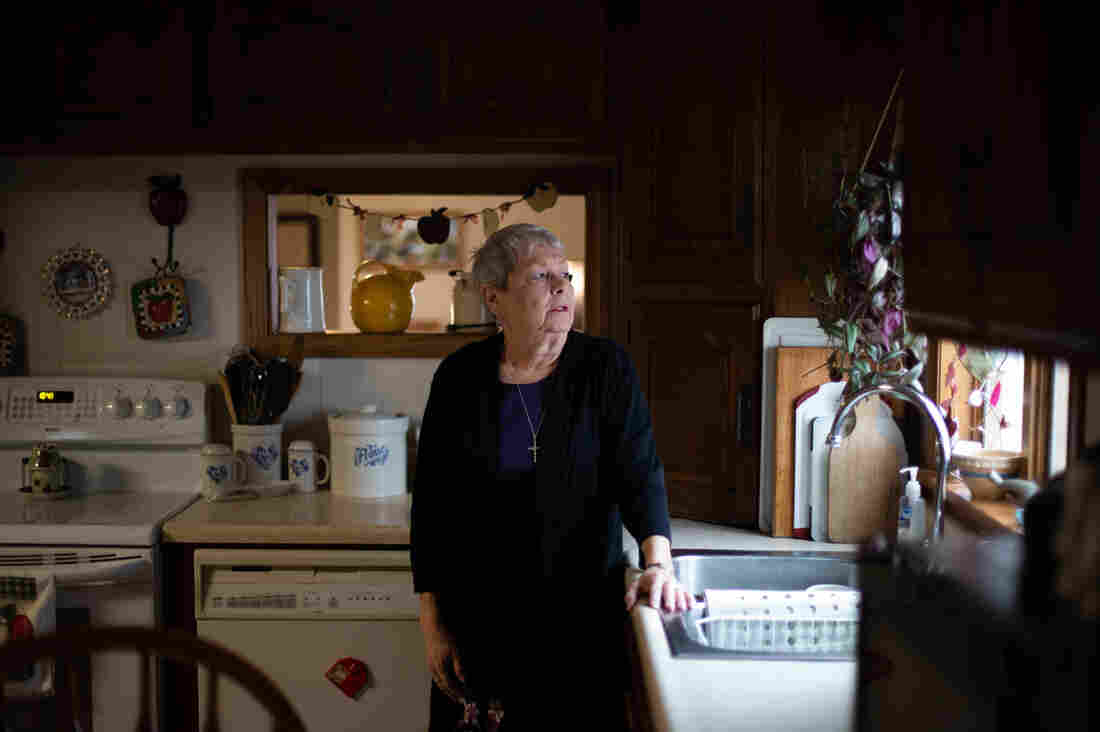
When the cancer clinic at Mercy Hospital Fort Scott closed in January, Karen Endicott-Coyan and other cancer patients had to continue their treatments out of town.

Christopher Smith for Kaiser Health News


hide caption

toggle caption

Christopher Smith for Kaiser Health News

One Monday in February, 65-year-old Karen Endicott-Coyan gripped the wheel of her black 2014 Ford Taurus with both hands as she made the hour-long drive from her farm near Fort Scott, Kan., to Chanute.

With a rare form of multiple myeloma, she requires weekly chemotherapy to keep the cancer at bay.

She made the trip in pain, having skipped her morphine for the day to be able to drive safely. Since she sometimes “gets the pukes” after treatment, she had her neighbor and friend Shirley Palmer, 76, come along to drive her back.

Continuity of care is crucial for cancer patients in the midst of treatment, which often requires frequent repeated outpatient visits. So when Mercy Hospital Fort Scott, the rural hospital in Endicott-Coyan’s hometown, was slated to close its doors at the end of 2018, hospital officials had arranged for its cancer clinic — called the “Unit of Hope” — to remain open.

Then “I got the email on Jan. 15,” said Reta Baker, the hospital’s CEO. It informed her that Cancer Center of Kansas, the contractor that operated and staffed the unit, had decided to shut it down too, just two weeks later.

“There are too many changes in that town” to keep the cancer center open, Yoosaf “Abe” Abraham, chief operating officer of the Cancer Center of Kansas later told KHN. He added that patients would be “OK” because they could get treated at the center’s offices in Chanute and Parsons.

From Fort Scott, those facilities are 50 and 63 miles away, respectively.

For Endicott-Coyan and dozens of other cancer patients, the distance meant new challenges getting lifesaving treatment. “You have a flat tire, and there is nothing out here,” Endicott-Coyan said, waving her arm toward the open sky and the pastures dotted with black Angus and white-faced Hereford cattle on either side of the shoulderless, narrow highway she now must drive to get to her chemo appointment.

Karen Endicott-Coyan has a rare form of multiple myeloma and now has to drive an hour from her farm near Fort Scott, Kan., for weekly chemotherapy injections.

Christopher Smith for Kaiser Health News


hide caption

toggle caption

Christopher Smith for Kaiser Health News

Nationwide, more than 100 rural hospitals have closed since 2010. In each case, a unique but familiar loss occurs.

Residents, of course, lose health care services as wards are shut and doctors and nurses begin to move away.

But the ripple effect can be equally devastating. The economic vitality of a community takes a blow without the hospital’s high-paying jobs and it becomes more difficult for other industries to attract workers who want to live in a town with a hospital. Whatever remains is at risk of withering without the support of the stabilizing institution.

The 7,800 residents of Fort Scott are reeling from the loss of their 132-year-old community hospital, which was closed at the end of December by Mercy, a St. Louis-based nonprofit health system. Founded on the frontier in the 19th century and rebuilt as a 69-bed modern facility in 2002, the hospital had outlived its use, with largely empty inpatient beds, the parent company said.

For the next year, Kaiser Health News and NPR will track how its citizens fare after the closure in the hopes of answering pressing national questions: Do citizens in small communities like Fort Scott need a traditional hospital for their health needs? If not a hospital, what then?

Traveling the distance for cancer care

Reta Baker, the hospital’s CEO grew up on a farm south of Fort Scott. She understood that the hospital’s closure was unavoidable. She scrambled to make sure basic health care needs would be met afterward.

Mercy agreed to keep the building open and lights on until 2021. And Baker recruited a federally qualified health center to take over four outpatient clinics, including one inside the hospital; former employees were bought out and continue to operate a rehabilitation center; and the nonprofit Ascension Via Christi Hospital in Pittsburg reopened the emergency department in February.

But cancer care, which requires specialists and the purchase and storage of a range of oncology drugs, presents unique challenges in rural areas.

Rural cancer patients typically spend 66% more time traveling each way to treatment than those who live in more urban areas, according to a recent national survey by ASCO, the American Society of Clinical Oncology. Dr. Monica Bertagnolli, a cattle rancher’s daughter who is now chair of ASCO’s board, called this a “tremendous burden.” Cancer care, she explained, is “not just one visit and you’re done.”

ASCO used federal data to find that while about 19% of Americans live in rural areas, only 7% of oncologists practice there.

People in rural America are more likely to die from cancer than those in the country’s metropolitan counties, according to a Centers for Disease Control and Prevention report in 2017. It found 180 cancer deaths per 100,000 people a year in rural counties, compared with 158 deaths per 100,000 in populous metropolitan counties.

The discrepancy is partly because habits like smoking are more common among rural residents, but the risk of dying goes beyond that, said Jane Henley, a CDC epidemiologist and lead author of the report. “We know geography can affect your risk factors, but we don’t expect it to affect mortality.”

From an office inside a former Mercy outpatient clinic, Fort Scott’s cancer support group, Care to Share, continues its efforts to meet some of the community’s needs — which in some ways have increased since the Unit of Hope closed. It provides Ensure nutritional supplements, gas vouchers and emotional support to cancer patients.

Lavetta Simmons, one of the support group’s founders, said she will have to raise more money to help people pay for gas so they can drive farther to treatments. Last year, in this impoverished corner of southeastern Kansas, Care to Share spent more than $17,000 providing gas money to area residents who had to travel to the Mercy hospital or farther away for care.

The group expects to spend more on gas this year, having spent nearly $6,000 during the first four months of 2019.

And the reserves of donated Ensure from Mercy are running out, so Simmons is reaching out to hospitals in nearby counties for help.

With Mercy Hospital Fort Scott closed, the likelihood of residents here dying from their cancer will grow, experts worry, because it’s that much harder to access specialists and treatments.

Krista Postai, who took over the Fort Scott hospital’s four primary care clinics, said it’s not unusual for her staff to “see someone walk in [with] end-stage cancer that they put off because they didn’t have money, they didn’t have insurance, or it’s just the way you are… We wait too long here.”

‘If they can’t cure me, I’m done’

Art Terry, 71, a farmer and Vietnam veteran, was one of them. Doctors discovered Terry’s cancer after he broke a rib while bailing hay. When they found a mass below his armpit, it was already late-stage breast cancer that had metastasized to his bones.

Art Terry, center, and members of his family stand for photo at the Mercy Hospital Fort Scott cancer unit before it closed in January. He died days before the closure.

Dwight Terry


hide caption

toggle caption

Dwight Terry

With his twice-weekly chemotherapy treatment available in the “Unit of Hope,” Terry spent hours there with his son and grandchildren telling stories and jokes as if they were in their own living room. The nurses began to feel like family, and Terry brought them fresh eggs from his farm.

“Dad couldn’t have better or more personalized care anywhere,” said his son, Dwight, bleary-eyed after a factory shift.

Terry knew it was difficult to find trustworthy cancer care. The shortage of cancer specialists in southeastern Kansas meant that many, including Mercy Hospital Fort Scott’s patients, counted on traveling oncologists to visit their communities once or twice a week.

Wichita-based Cancer Center of Kansas has nearly two dozen locations statewide. It began leasing space in Fort Scott’s hospital basement in the mid-2000s, the center’s Abraham said. The hospital provided the staff while the Cancer Center of Kansas paid rent and sent roving oncologists to drop in and treat patients.

At its closing, the Unit of Hope served nearly 200 patients, with about 40% of them receiving chemotherapy treatment.

When Art Terry was diagnosed, his son, Dwight, tried to talk to him about seeking treatment at the bigger hospitals and academic centers in Joplin, Mo., or the Kansas City area. The elder Terry wasn’t interested. “He’s like, ‘Nope,’ ” Dwight Terry recalled. “I’m going right there to Fort Scott. If they can’t cure me, I’m done. I’m not driving.’ “

In the end, as the elder Terry struggled to stay alive, Dwight said he would have driven his father the hour to Chanute for treatment. Gas — already a mounting expense as they traveled the 20 miles from the farm near tiny Prescott, Kan., to Fort Scott — would be even more costly. And the journey would be taxing for his father, who traveled so little over the course of his life that he had visited Kansas City only twice in the past 25 years.

As it turned out, the family never had to make a choice. Art Terry’s cancer advanced to his brain and killed him days before the hospital’s cancer unit closed.

What happens next?

As Endicott-Coyan and her friend Palmer drove to Chanute for treatment, they passed the time chatting about how the hospital’s closure is changing Fort Scott. “People started putting their houses up for sale,” Palmer said.

Like many in Fort Scott, they had both spent their days at the Fort Scott hospital. Endicott-Coyan worked in administration for more than 23 years; Palmer volunteered with the auxiliary for six years.

The hospital grew with the community. But as the town’s fortunes fell, it’s perhaps no surprise that the hospital couldn’t survive. But the intertwined history of Mercy and Fort Scott is also why its loss hit so many residents so hard.

Fort Scott began in 1842 when the U.S. government built a military fort to help with the nation’s westward expansion. Historians say Fort Scott was a boomtown in the years just after the Civil War, with its recorded population rising to more than 10,000 as the town competed with Kansas City to become the largest railroad center west of the Mississippi.

The hospital was an integral part of the community after Sisters of Mercy nuns opened a 10-bed hospital in 1886 with a mission to serve the needy and poor. Baker, Mercy Hospital Fort Scott’s president, said the cancer center was an extension of that mission.

Mercy Hospital Fort Scott’s cancer clinic had windows overlooking the front parking lot and forested land beyond.

Christopher Smith For Kaiser Health News


hide caption

toggle caption

Christopher Smith For Kaiser Health News

The Unit of Hope began operating out of the newest hospital building’s basement, which was “pretty cramped,” Baker said. As cancer treatments improved, it grew so rapidly that Mercy executives moved it to a spacious first-floor location that had previously been the business offices.

“Our whole purpose when we designed it was for it to be a place where somebody who was coming to have something unpleasant done could actually feel pampered and be in a nice environment,” Baker said.

The center, with its muted natural grays and browns, had windows overlooking the front parking lot and forested land beyond. Every patient could look out the windows or watch a personal television terminal. Each treatment chair had plenty of space for family members to pull up chairs.

When Endicott-Coyan and Palmer arrived at the Cancer Center of Kansas clinic in Chanute in February, things looked starkly different. Patients entered a small room through a rusted back door. Three brown infusion chairs sat on either side of the entry door and two TV monitors were mounted high on the walls.

A nurse checked Endicott-Coyan’s blood pressure and ushered her back to a private room to get a shot in her stomach. She was ready to leave about 15 minutes later.

The center’s Abraham said the Chanute facility is “good for patients for the time being” and not a “Taj Mahal” like Mercy’s Fort Scott hospital building, which he said was too expensive to maintain. Cancer Center of Kansas plans to open a clinic at a hospital in Girard, which is about 30 miles from Fort Scott, he said.

Some oncology doctors would say driving is not necessary. Indeed, a few health care systems across the country, such as Sanford Health in South Dakota and Thomas Jefferson University Hospitals in Pennsylvania, are administering some chemotherapy in patients’ homes. Oncologist Adam Binder, who practices at Thomas Jefferson in Philadelphia, said “over 50% of chemotherapy would be safe to administer in the home setting if the right infrastructure existed.”

But the infrastructure —that is, the nurses who would travel to treat patients and a reimbursement model to pay for such care within our complex health care system — is not yet in place.

Back in the car, Palmer took the wheel and Endicott-Coyan began planning for future cancer treatments in the void left by Mercy Hospital Fort Scott’s closure. “I put a note on Facebook today and said ‘OK, I have drivers for the rest of February; I need drivers for March!’ “

Kaiser Health News is a nonprofit news service covering health issues. It is an editorially independent program of the Kaiser Family Foundation that is not affiliated with Kaiser Permanente.

Let’s block ads! (Why?)

Boston’s Suffolk Downs Holds Its Last Live Horse Races

Boston’s Suffolk Downs racetrack, once a hugely popular venue for a nationally beloved sport, is marking the end of an era as it hosts its last live horse race ever.


SARAH MCCAMMON, HOST:

It’s the end of an era for East Boston’s historic Suffolk Downs racetrack. Live horse racing, which began there in 1935, will end after one final race day tomorrow. Tori Bedford from member station WGBH brings us this from the track.

(SOUNDBITE OF BUGLE HORN)

TORI BEDFORD, BYLINE: It’s the second race of the day and hometown jockey Tammi Piermarini is soaring through the muddy track on Atta Kid, a horse that, unlike her, is just starting his career.

UNIDENTIFIED PERSON: Come on, Tammi.

BEDFORD: Piermarini and Atta Kid fly through the finish line to win the race.

TAMMI PIERMARINI: You can walk right in the girl’s room. Just shut the door behind you.

BEDFORD: Piermarini is small and sturdy. She hops off her horse and meets me in the locker room where we talk while she wipes mud from the track off of her face.

PIERMARINI: 1985, I rode my first horse here.

BEDFORD: Piermarini is a local kid. She grew up in Newburyport and started riding at 3 years old. She came to Suffolk Downs at the age of 18 and went on to be the third leading female jockey in the country. It’s also where she rode her parents’ first racehorse.

PIERMARINI: That was probably one of the most exciting moments of my life to have them come into the winner’s circle and it’s their horse and their colors I’m wearing. I can’t express or explain how I felt.

BEDFORD: Jockeys like Piermarini have hitched their careers to a sport with waning interest around the country as casinos and online gambling grow in popularity in live horse racing spots, like Suffolk Downs, get transformed into apartments and retail buildings. With the retirement of the tracks, Piermarini says more jockeys and horses are retiring, too.

PIERMARINI: As long as people will ride me, I’m going to continue. But if I’m forced to retire because of no business – and that’s a sad way to go. It’s not that I want to retire. I’m being forced to retire.

BEDFORD: Just outside, a lot of longtime fans here say they aren’t quite ready to say goodbye. Jimmy Haephy grew up in nearby Revere and has been coming to the track for 40 years.

JIMMY HAEPHY: A lot of memories here, you know? A lot of good ones. I know every inch of this place. It’s like walking in my front door walking in here. And I don’t understand why they were closing it. Some reason they want to close, make a shopping mall. I don’t know.

BEDFORD: As a kid nearly 70 years ago, Conrad Smith, or Smitty, was obsessed with two things – baseball and horse racing, coming every weekend with his parents.

CONRAD SMITH: I’ve been doing this all my life, and I’m still coming here. I don’t know what’s going to happen after next year.

BEDFORD: Suffolk Downs used to bring in tens of thousands of spectators with races every day. Now CEO Chip Tuttle says the entire sport is struggling.

CHIP TUTTLE: We fought really hard for a long time to try to preserve racing here at the property, and it didn’t work out, so now it’s on to what’s next.

BEDFORD: Suffolk Downs has closed before and reopened, but Tuttle says this time it’s for real.

TUTTLE: There have been times in the past where we thought racing was going to end, it was over. And we were able to find ways to continue. But I can’t see a way for us to continue racing here.

TD THORNTON: We’ve got Rocket Road in those bright orange silks. He’s covered up on the…

BEDFORD: TD Thornton sits up on the roof in an announcer’s booth speaking into a decades-old microphone to let the crowd know which horses are racing next and pressing a bugle horn to bring those horses out onto the track. He says he doesn’t want the final race to feel like a funeral.

THORNTON: And we’ve had a pretty damn good run here for 84 years so that’s how I’m going to try and focus it and end it on a high note. This is reality, and my role in it is to give the track a respectful sendoff.

BEDFORD: What’s next for you?

THORNTON: Pressing his bugle right here and getting the horse out onto the track.

(SOUNDBITE OF BUGLE HORN)

THORNTON: Horses are heading out for today’s fourth race with the Exacta, Trifecta and Superfecta betting.

BEDFORD: For NPR News, I’m Tori Bedford in Boston.

Copyright © 2019 NPR. All rights reserved. Visit our website terms of use and permissions pages at www.npr.org for further information.

NPR transcripts are created on a rush deadline by Verb8tm, Inc., an NPR contractor, and produced using a proprietary transcription process developed with NPR. This text may not be in its final form and may be updated or revised in the future. Accuracy and availability may vary. The authoritative record of NPR’s programming is the audio record.

Let’s block ads! (Why?)

U.S. Advances At Women’s World Cup

The U.S. has advanced to the semifinals of the Women’s World Cup after a thrilling 2-1 victory over host country France. It was the most anticipated game of the tournament so far.


SARAH MCCAMMON, HOST:

The U.S. is headed to the semifinals for the Women’s World Cup next week. That’s after Megan Rapinoe stole the show in the quarterfinal, scoring the two goals that powered the U.S. to yesterday’s win over France. That game took place in front of an emotionally charged crowd in a sold-out stadium in Paris. NPR’s Eleanor Beardsley was there.

(CHEERING)

ELEANOR BEARDSLEY, BYLINE: Megan Rapinoe set the tone of the game early, scoring a goal within the fifth minute. This pressured the French team to try to equalize throughout the first half. Though they had possession of the ball 60% of the time and took many shots, France was unable to pierce through the stifling U.S. defense. Rapinoe scored again in the second half, making it 2-0 and demoralizing an already desperate French team.

(CHEERING)

BEARDSLEY: Late in the second half, France finally scored its only goal, a header by Wendie Renard off a free kick.

(SOUNDBITE OF ARCHIVED RECORDING)

UNIDENTIFIED CROWD: (Chanting) Allez les Bleus.

BEARDSLEY: The stadium was bursting in red, white and blue, the colors of both countries’ flags. And the crowd was electric, erupting in alternating chants of Allez les Bleus and U-S-A, though the U-S-A chants attracted some boos from the majority-French fans.

(SOUNDBITE OF ARCHIVED RECORDING)

UNIDENTIFIED CROWD: (Chanting) U-S-A, U-S-A.

(BOOING)

BEARDSLEY: Parisian Aurelien Jeanpetit says whatever the score, this is a first for women’s soccer in France.

AURELIEN JEANPETIT: It’s the first time I witnessed that. It’s really incredible. The atmosphere is really something else, especially for – concerning women’s soccer because men’s soccer is the thing in our country. But, like, women’s soccer has never been like this. So it’s really – it makes me happy for every girl who plays football and who can watch that on TV.

(SOUNDBITE OF ARCHIVED RECORDING)

UNIDENTIFIED CROWD: (Singing in French).

BEARDSLEY: French fans sang their national anthem and believed up until the very end. But Les Bleus couldn’t take control from the U.S. team long enough to score. Cecile Creze admits France was outplayed.

CECILE CREZE: Well, I’m disappointed, of course, but it was logic because the American players were better. When they were in front of the goal, they scored. And the French team, they had the ball, but they didn’t manage to score, so disappointed because I think they could have done better.

BEARDSLEY: Rapinoe was again named player of the match, but lately, she’s just as known for what she says off the field. Her comments about the White House have galvanized anti-Trump Americans and won her a following in France.

UNIDENTIFIED PERSON: Everybody – Megan, Megan, Megan.

BEARDSLEY: Shana Summers and her friends are wearing T-shirts they had specially made for the game. Paraphrasing Rapinoe’s expletive-laced comment that if the U.S. wins the World Cup, she’s not going to the White House. The women just arrived from San Francisco.

SHANA SUMMERS: We got this done yesterday and flew in this morning to make it to the game tonight with these shirts to show support for Megan Rapinoe because everything that’s happening in the U.S. and her speaking out is the biggest thing ever. And we need to be there in support for her.

BEARDSLEY: Megan Rapinoe, the U.S. team and all their supporters will be in Lyon Tuesday for the semifinal game against England. Eleanor Beardsley, NPR News, Paris.

Copyright © 2019 NPR. All rights reserved. Visit our website terms of use and permissions pages at www.npr.org for further information.

NPR transcripts are created on a rush deadline by Verb8tm, Inc., an NPR contractor, and produced using a proprietary transcription process developed with NPR. This text may not be in its final form and may be updated or revised in the future. Accuracy and availability may vary. The authoritative record of NPR’s programming is the audio record.

Let’s block ads! (Why?)

U.S. Wins Again At Women’s World Cup, Defeating Host France

American player Megan Rapinoe, right, celebrates after scoring her team’s first goal during the Women’s World Cup quarterfinal soccer match between France and the United States Friday.

Alessandra Tarantino/AP


hide caption

toggle caption

Alessandra Tarantino/AP

Pick your superlative and chances are someone, somewhere used it to describe this game at some point. Epic. Intense. Pressure-packed. Match of the tournament. Regardless of the term, the Women’s World Cup quarterfinal game lived up to the hype. One versus four. Defending champion against the host country favorite. The U.S. was crisp and powerful from the first whistle until the final one. It beat France 2-1.

The U.S. got the scoring started early. After Alex Morgan was fouled just outside the France penalty area, Megan Rapinoe lined up to take the free kick. The shot was a laser. The ball sliced through a sea of U.S. and French players, untouched, and found the back of the net in the 5th minute. It was the first time France had trailed in this Women’s World Cup.

WOW. US fans go wild as @mPinoe draws first blood, launching free kick into the goal in the 5th minute. #USA 1 – #FRA 0 pic.twitter.com/wzBzqslntw

— melissa block (@NPRmelissablock) June 28, 2019

The U.S. was on the attack all half long with runs deep into the French backfield. It was a physical contest as both teams battled the heat and each other at Parc des Princes stadium in Paris. The Americans were buoyed by their defense which stifled the French, closing down countless scoring opportunities. Crystal Dunn, Julie Ertz and Kelley O’Hara suffocated the French scorers shutting them out in the first half.

The second half started just like the first. A strong U.S. attack right from the get-go The U.S. launched two shots on goal in the seconds after the opening whistle. Corner kicks, powerful strikes and fortunate bounces all were in the Americans’ favor. France had more success after their halftime adjustments with several scoring chances but also several unforced errors.

The United States still found a way to dissect the French defense in the second half and it came courtesy of Megan Rapinoe again. She powered home a blistering shot in the 65th minute after a Tobin Heath assist skittered in front of the French goal. Rapinoe also scored both goals in the last game against Spain.

France finally found the back of the net in the 81st minute with a sparkling header by Wendie Renard. The 6-foot-2-inch defender is the tallest player in the Women’s World Cup. The score energized the French crowd (and the French team) which had been relatively quiet since the early goal from Megan Rapinoe. But the U.S. found a way to withstand a furious French attack.

It was the 10th straight World Cup win for the U.S. (tying Norway). The United States is seeking to become just the second nation to win successive World Cups (Germany 2003 & 2007). After this emotional win against France, the road doesn’t get any easier for the Americans. The U.S. takes on England in the semifinals on Tuesday.

Let’s block ads! (Why?)

Toronto Removed Basketball Hoops From Parks Every Day. Then A Tweet Called It Out

City workers in Toronto removed basketball hoops each evening from some city parks because of noise complaints. After an outcry, the city says the rims will stay up.


Hakan Dahlstrom/Flickr


hide caption

toggle caption


Hakan Dahlstrom/Flickr

The Toronto Raptors won the NBA Championship earlier this month, and the team’s thrilling run has boosted the city’s excitement about basketball to a new level.

But you wouldn’t know it, watching a video posted this week of a Toronto city worker removing a basketball hoop from an outdoor court at one of the city’s parks.

Absolutely sickening display @cityoftoronto let the kids play!!! pic.twitter.com/myjsOvZEc0

— Mitch Robson (@_mitchrobson) June 26, 2019

As a child dribbles a ball on a gorgeous sunny day, the worker takes down the rims, leaving nothing but backboard.

A young man assures the camera that even without the hoops, “I can have just as much fun out here.” He goes in for the layup … but there’s nowhere to put the ball. It ricochets off the backboard.

The hoops’ removal wasn’t a one-off, captured by chance: It was policy. For years, city workers have removed the hoops each evening from some Toronto parks, in response to noise complaints from neighbors.

City spokesperson Brad Ross told Toronto’s Star newspaper that crews “would make their way to various parkettes … and remove the nets and replace them the next day to mitigate noise complaints.”

Then came Mitch Robson’s tweet on Wednesday, which made the Canadian city look, well, somewhat hostile to joy and exercise. As of Friday afternoon, the video had been viewed more than 1.5 million times.

Canada’s basketball governing body soon weighed in, posting a doctored photo showing the Raptors playing on a basket without a hoop. “No rim. No history. Everyone deserves the chance to play. Keep the nets up,” it urged.

No rim. No history.

Everyone deserves the chance to play. Keep the nets up. #WeAreTeamCanada pic.twitter.com/IvHq8BBtk2

— Canada Basketball (@CanBball) June 27, 2019

The city responded quickly.

Within hours, Toronto Mayor John Tory announced his disapproval of the practice.

“The City should be putting basketball nets up not pulling them down,” he tweeted. “I’ve delivered that message to our parks staff tonight — they agree. We should absolutely be encouraging kids to play in our city.”

The City should be putting basketball nets up not pulling them down. I’ve delivered that message to our parks staff tonight – they agree. We should absolutely be encouraging kids to play in our city. https://t.co/Sk1UQn5UVC

— John Tory (@JohnTory) June 27, 2019

The city released a statement the next morning discontinuing the practice, explaining that it had stemmed from an attempt “to balance the rights of everyone to enjoy Toronto’s parks – and play basketball – with the rights of residents adjacent to those parks when it comes to noise.”

Hoops had been removed only from parks close to homes, the city said, but it now recognized that taking them down at 6 p.m. “is not reasonable.”

Effective immediately, the city said it would suspend hoop removal “so residents can continue to enjoy a game of basketball into the evening.”

Below is our statement on the removal of basketball hoops in some parks. This practice has been suspended effective immediately. pic.twitter.com/pdt2zDWiNW

— City of Toronto (@cityoftoronto) June 27, 2019

The Toronto District School Board also announced that it would leave up its basketball nets outside school hours — though it said the move would be a “6-month pilot project to better understand any potential issues.”

Not everyone was impressed. “Where was this 20 years ago when I was in school,” one person tweeted. “Took them down every year in scarborough. All it took was an nba championship and social media. SMH.”

Robson, who posted the initial video of the rims being removed, posted a photo the next day that suggested the city was following through on its vow.

BREAKING: The rim is back up and looking majestic at Phin Park, according to my sources. Let’s hope it stays up past 6:00pm! @cityoftoronto #RimsUp pic.twitter.com/GdSBhHRSel

— Mitch Robson (@_mitchrobson) June 27, 2019

“The rim is back up and looking majestic at Phin Park, according to my sources,” he wrote. “Let’s hope it stays up past 6:00pm!”

Let’s block ads! (Why?)

A Tennessee Hospital Sues Its Own Employees When They Can’t Pay Their Medical Bills

The Methodist Le Bonheur Healthcare system in Memphis, which includes Methodist University Hospital, has sued thousands of patients, including many of its own low-wage employees.

Andrea Morales for MLK50


hide caption

toggle caption

Andrea Morales for MLK50

This article was produced in partnership with nonprofit news organization MLK50, which is a member of the ProPublica Local Reporting Network.

This year, a hospital housekeeper left her job just three hours into her shift and caught a bus to Shelby County General Sessions Court in Memphis, Tenn.

Wearing her black and gray uniform, she had a different kind of appointment with her employer, Methodist Le Bonheur Healthcare: The hospital was suing her for unpaid medical bills.

In 2017, the nonprofit hospital system based in Memphis sued the woman for the cost of hospital stays to treat chronic abdominal pain she experienced before the hospital hired her.

She now owes Methodist more than $23,000, including around $5,800 in attorney’s fees.

It’s surreal, she says, to be sued by the organization that pays her $12.25 an hour. “You know how much you pay me. And the money you’re paying, I can’t live on,” says the housekeeper, who asked that her name not be used for fear that the hospital would fire her for talking to a reporter.

From 2014 through 2018, the hospital system, which is affiliated with the United Methodist Church, has filed more than 8,300 lawsuits against patients, including some of its own workers. After winning judgments, it has sought to garnish the wages of more than 160 Methodist workers and has actually done so in more than 70 instances over that time, according to an MLK50-ProPublica analysis of Shelby County General Sessions Court records, online docket reports and case files.

Some of the debts were accrued while the employees worked at Methodist; others predated their time there. The figures do not include debts incurred by onetime Methodist employees who have since moved on.

It’s not uncommon for hospitals to sue patients over unpaid debts. In fact, as NPR reported Tuesday, recent research shows that more than a third of hospitals in Virginia do so. And earlier reporting from NPR and ProPublica found the practice in several other states.

But what is striking at Methodist, the largest hospital system in the Memphis region, is how many of the patients being sued are the hospital’s own employees. Hardly a week goes by in which Methodist workers aren’t on the court docket fighting debt lawsuits filed by their employer.

Between January and mid-June, a reporter observed more than a dozen Methodist employees in court to defend themselves in suits brought by the hospital over hospital bills.

That includes a Methodist Le Bonheur employee who owes more than $1,200. In January, she proposed paying $100 a month, even though her sworn affidavit listed monthly expenses that exceeded her $1,650 monthly income. After conferring with an attorney for Methodist, Judge Betty Thomas Moore agreed to the worker’s proposal, but she has already missed a payment.

A few weeks later, a Methodist employee appeared for an initial hearing wearing hospital scrubs. The hospital had sued her for more than $4,000. When she left the courtroom, she was annoyed. Her employer knew where she worked, she said, and should have contacted her before suing her.

“I don’t know why they can’t come upstairs,” she said outside the courtroom.

And in May, an employee who has worked for Methodist for more than four years carried a large envelope full of bills with her into the courtroom. She owed more than $5,400, which included a 2017 hospital charge from the newborn unit. That is the same year that her daughter was born, according to her sworn affidavit, which also listed a checking account balance of less than $4.

The woman offered to pay $10 biweekly, or $20 most months, but Methodist’s attorney wanted $200 per month. The judge ordered her to pay $100 per month.

What makes matters worse, employees say, is that Methodist’s health insurance benefits only allow employees to seek medical care at Methodist facilities, even though the financial assistance policies at its competitors are more generous.

A specialist in hospital billing practices says that if the hospital is suing a fair number of its own employees, it’s time to examine both the insurance provided to workers and the pay scale.

Given that the hospital is suing some of its own employees, “one would hope … the hospital would look at the insurance they provide workers,” says Mark Rukavina, a former nonprofit hospital consultant and currently a manager at Community Catalyst, a health care advocacy organization.

Methodist declined requests for an interview. It did not respond to specific written questions about the lawsuits it files against its workers or about how its policies reflect the values of the United Methodist Church. Instead, in a written statement, it said it is committed to working with patients who are having trouble paying their medical bills.

“As the second largest private employer in Shelby County, we recognize the responsibility we have as an organization to contribute to the success of the diverse communities we serve and are purposeful about creating jobs in our community — intentionally choosing to keep services like printing, laundry and others in-house that are typically outsourced by the health care industry,” the hospital said.

Methodist also declined to answer a question about whether it has any policy that prohibits employees being sued by Methodist from talking to a reporter about the lawsuits filed against them by the hospital.

Employer and legal adversary

Between January and mid-June of this year, a reporter observed more than a dozen Methodist employees in court to defend themselves in lawsuits brought by the hospital over hospital bills.

Andrea Morales for MLK50


hide caption

toggle caption

Andrea Morales for MLK50

On a single January day, there were 10 defendants on the docket whose place of employment was listed in court records as Methodist.

Employees in scrubs sat just feet away from the attorneys in dress suits — attorneys their employer had hired to sue them. The hospital’s role as a tax-exempt organization that both employs the defendants and is suing them went unremarked upon by judges, attorneys and the defendants themselves.

Methodist’s financial assistance policy stands out from peers in Memphis and across the country, MLK50 and ProPublica found. The policy offers no assistance for patients with any form of health insurance, no matter their out-of-pocket costs. Under Methodist’s insurance plan, employees are responsible for a $750 individual deductible and then 20% of inpatient and outpatient costs, up to a maximum out-of-pocket cost of $4,100 per year.

The housekeeper’s story is documented in Shelby County General Sessions Court records, including online docket reports and online payment history. A reporter interviewed the housekeeper multiple times in person and on the phone. The employee gave the reporter six years of itemized Methodist hospital bills, her credit report and other past-due medical bills. Most of her debts were incurred before she started working at Methodist.

Five times between 2012 and 2014, she visited the hospital for stomach problems, according to the itemized bills. (Years later, she had surgery to treat diverticulitis.) At those times, she had insurance through her job at a hotel, where she cleaned rooms for $10.66 an hour. After insurance paid its share, she owed just over $17,500.

In 2015, the housekeeper left the hotel job and lost her insurance. Three times that year she went to Methodist’s ER, but since she was uninsured and had little income, she qualified for financial assistance. Methodist wrote off more than $45,000 in hospital bills.

In a statement, Methodist said it gives an automatic 70% discount to uninsured patients and free care to uninsured patients at or below 125% of the federal poverty guidelines. For a single adult with two dependents, that would be just over $26,600. Uninsured patients who earn more than that, but less than twice the poverty limit, are also eligible for discounts, it said.

In 2016, unable to find work, the housekeeper left Memphis. For more than a year, she says, she and her son were homeless, bouncing between relatives in Chicago, where she was born, and Texas.

But she missed her daughter and grandchildren in Memphis. So in 2017, she returned. In August 2017, Methodist sued her for the bills she accumulated when she was insured years earlier. Later that month, she was hired at a Methodist hospital, starting at $11.95 an hour.

The hospital’s collections agency, which it owns, didn’t have her correct address and was unable to serve notice that she had been sued, but last year, Methodist tried again. This time, it had the right address.

In November, a process server handed her the civil warrant at her South Memphis apartment.

At the process server’s recommendation, she called the hospital’s collection agency and offered to pay $50 every two weeks. “But they said it wasn’t enough,” she recalls. “I would just have to go to court. They said I’d be owing them all my life.”

In a sworn affidavit filed with the court this year, the housekeeper listed her dependents as a grandson and her 27-year-old son, who she says has bipolar disorder and schizophrenia. She told the court she earned $16,000 in 2017, which puts her more than $4,000 below that year’s federal poverty level for a family of three. (Because she had insurance, though, she was ineligible for assistance under the hospital’s policy.)

Fred Morton, a retired Methodist minister in Memphis, says he was surprised to learn that Methodist is suing its own employees.

“The employees should be paid an adequate minimum wage at the very least,” he says. “Certainly they should not be predatory to their own employees on medical bills. That’s very much contrary to Scripture.”

He said that Methodist bishops who serve on its board bear responsibility for reminding it of the denomination’s values.

An employee at a Methodist University Hospital is being sued by her employer for unpaid medical bills incurred before they hired her.

Andrea Morales for MLK50


hide caption

toggle caption

Andrea Morales for MLK50

“It’s a matter of the church pushing on its own,” Morton says.

Three United Methodist Church bishops serve on the hospital’s board. Bishop Gary Mueller’s office referred a reporter to Methodist Le Bonheur Healthcare’s communications office. Bishop Bill McAilly declined to comment. Bishop James E. Swanson did not respond to multiple requests for comment.

When the housekeeper appeared before a General Sessions Court judge this year, she’d filed a motion offering to pay $50 biweekly, or $100 in most months. When the hospital’s attorney asked for a $200 per month, she was stunned.

“This is my only job, this is my only income, so how am I supposed to live?” she remembered thinking.

Nervous that the judge would side with the hospital, the housekeeper made another offer.

“I could do $75 every two weeks,” she said quickly.

The attorney agreed and the judge signed the order.

Being an employee and defendant is “really kind of sad,” the housekeeper says. Asked how she manages to make ends meet, she says she doesn’t: “It’s killing me — killing me softly.”

She says she didn’t reach out to the hospital’s payroll department or a manager about the hospital bills she’s being sued for. “They don’t care about that. … That I do know.”

‘I don’t want to be homeless again’

Part of what makes paying medical bills so hard for some Methodist employees is that their wages are low, lagging behind several other large employers in the Memphis market. In December, St. Jude Children’s Research Hospital announced it was raising its minimum pay for full and part-time workers to $15 an hour. St. Jude’s decision followed a similar commitment by the Shelby County government, Shelby County Schools and Blue Cross Blue Shield of Tennessee.

At Methodist, which operates five hospitals in Shelby County, the lowest-paid employees make $10 an hour and about 18% of workers make less than $15 an hour, the hospital reported in response to MLK50’s 2018 Living Wage Survey.

As recently as 2017, the Greater Memphis Chamber advertised on its website that the city offered a workforce at “wage rates that are lower than most other parts of the country.”

The United Methodist Church’s Social Principles, which state the denomination’s position on everything from climate change to the death penalty, speak directly to what employees should earn. “Every person has the right to a job at a living wage,” it states. The Living Wage Model statement on the church’s website says, “Exploitation or underpayment of workers is incompatible with Christ’s commandment to love our neighbor.”

Methodist, which made Forbes’ 2019 list of Best Employers by State, did not answer specific questions about pay for employees. On its website, it says, “It is the policy of Methodist Le Bonheur Healthcare to pay its employees competitive, market-based wages.”

Neither Methodist, nonprofit Baptist Memorial Healthcare nor Regional One, the public hospital, pay all their employees at least $15 an hour. Even that figure would make it impossible to make ends meet for an employee trying alone to support a household with dependents, according to MIT’s Living Wage Calculator and another created by the Economic Policy Institute, both of which take into account local living expenses.

The housekeeper’s $12.25 an hour pay falls well short of that. Without overtime, she says, her take-home pay would be around $1,600 per month. Her rent is $610.

Even with as much overtime as she gets, she’s turned to payday loans. Since December, she’s renewed a $425 payday loan every two weeks, paying $71 each time. “You have to rob from Paul to pay Peter,” she says. “It doesn’t never seem like you can get ahead.”

The housekeeper applied for a job at Walmart but was told the store nearest her is not accepting applications. She doubts the pay will be any better, but she hopes it will be less stressful.

“Times be hard, because sometimes my body feels like I can’t make it,” she says. “But I get up anyway, because I don’t want to be homeless again.”

Wendi C. Thomas is the editor of MLK50: Justice Through Journalism. Email her at wendicthomas@mlk50.com and find her on Twitter at @wendi_c_thomas.

ProPublica is a nonprofit newsroom that investigates abuses of power. Sign up for ProPublica’s Big Story newsletter to receive stories like this one in your inbox as soon as they are published.

Let’s block ads! (Why?)