With An All-Female Crew, ‘Maiden’ Sailed Around The World And Into History


Key Florida Republicans Now Say Yes To Clean Needles For Drug Users

Arrow, a heroin user since the 1970s, is a client of Florida’s first clean needle exchange, a pilot program in Miami that has proved so successful that conservative Republicans want to expand it.
Courtesy of Dr. Hansel Tookes
hide caption
toggle caption
Courtesy of Dr. Hansel Tookes
There’s a green van parked on the edge of downtown Miami on a corner shadowed by overpasses. The van is a mobile health clinic and syringe exchange where people who inject drugs like heroin and fentanyl can swap dirty needles for fresh ones.
One of the clinic’s regular visitors, a man with heavy black arrows tattooed on his arms, waits on the sidewalk to get clean needles.
“I’m Arrow,” he says, introducing himself. “Pleasure.”
This mobile unit in Miami-Dade County is part of the only legal needle exchange program operating in the state. But a new law in Florida — a needle exchange law that won the support of Florida’s conservative legislature, and was signed by Gov. Ron DeSantis Wednesday — aims to change that.
Needle exchanges have been legal in many other states for decades, but southern, Republican-led states like Florida have only recently started to adopt this public health intervention.
The timing of the statewide legalization of needle exchanges comes as Florida grapples with a huge heroin and fentanyl problem. When people share dirty needles to inject those drugs, it puts them at high risk for spreading bloodborne infections like HIV and hepatitis C. For years, Florida has had America’s highest rates of HIV.
Even so, Arrow says he and every user he knew always put the drugs first. Clean needles were an afterthought.
“Every once in a while, I did use someone else’s and that was a thrill ride — wondering whether or not I was going to catch anything. But I’m blessed; I’m 57 and I don’t have anything,” says Arrow, whose full name NPR has agreed not to use because of his use of illegal drugs.
“Now I can shoot with a clean needle every time,” he says.
The Miami experiment

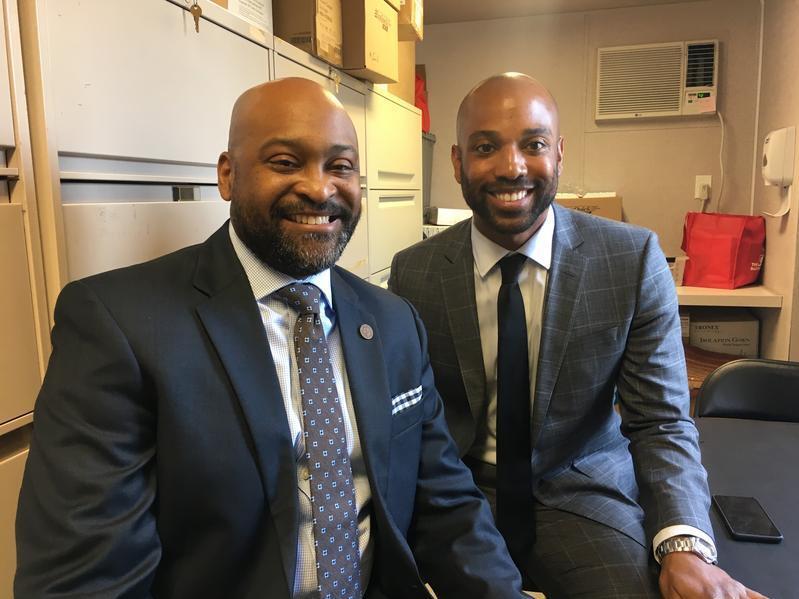
Florida state senator Oscar Braynon (left) spent years sponsoring bills that would allow clean-needle exchanges in Florida. This year, one of those bills finally became law, with the help of Dr. Hansel Tookes (right), an HIV specialist in Miami.
Sammy Mack/WLRN
hide caption
toggle caption
Sammy Mack/WLRN
According to the Centers for Disease Control and Prevention, needle exchanges prevent the spread of viruses among users of injection drugs.
But the advocates who want to offer needle exchanges face challenges. For example, carrying around loads of needles to hand out without prescriptions can violate drug paraphernalia laws. Many states mapped out legal frameworks decades ago to handle this particular public health intervention. But it was illegal to operate exchanges in Florida until 2016. That’s when the state legislature gave Miami-Dade County temporary permission to pilot a needle exchange program for five years.
“This is more than just a needle exchange,” says Democratic state senator Oscar Braynon. “This has become a roving triage and health center.”
Braynon has been sponsoring needle exchange bills — including the bill for the pilot project — since 2013. This year he introduced Senate Bill 366 to allow the rest of Florida’s counties to authorize similar programs.
In three years of operation, Miami’s pilot program has pulled more than a quarter million used needles out of circulation, according to reports the program filed with the Florida Department of Health. By handing out Narcan — the drug that reverses opioid overdoses — the exchange has prevented more than a thousand overdoses. The program also offers clients testing for HIV and hepatitis C, which is how Arrow knew he was negative. Finally, the program connects people to medical care and drug rehab.
“We have made it so easy for people to get into HIV care now, and we have so many people who we never would have known were infected — and would have infected countless other people — who are on their medications,” says Dr. Hansel Tookes, head of Miami’s needle exchange pilot program He has been pushing legislators to legalize needle exchanges since he was a medical student six years ago.
Tookes was in Tallahassee, the state capital, this May when the expansion bill passed its final vote. He said he spent the return flight home to Miami staring out the window.
“I looked down at Florida the entire ride,” he says, “and I just had this overwhelming feeling like, ‘Oh my God, we just did the impossible and we’re going to save so many people in this state.’ “
Why harm reduction trumped politics
When Republican state senator Rob Bradley first deliberated over needle exchanges in Florida six years ago, he was critical.
“You’re trying to make sure the person has a clean needle, which is outweighing the idea of the person breaking the law,” he declared back in 2013, before casting his vote against the idea.
This is the primary objection of conservative lawmakers — the concern that these programs promote illegal drug abuse.
Responding to this skepticism with data has been central to changing lawmakers’ minds. Decades of research show needle exchanges do not encourage drug abuse, and that they lower other health risks to people who are vulnerable and often hard to reach. It’s part of a public health approach known as “harm reduction.”
At a recent meeting ahead of the vote on statewide legalization, Ron Book — a powerful Florida lobbyist who chairs the Miami-Dade County Homeless Trust — voiced a question that comes up a lot about the needle exchange and heroin use.
“Doesn’t that help encourage it?” he asked Tookes.
“Nobody who used our program — and we collect a lot of data — was a first-time user of opioids when they came there,” Tookes told him. “Not one person.”
In Miami, the needle exchange pilot project has also earned the support of law enforcement. Officers say it’s a relief to know more injection drug users are keeping their syringes in special sharps containers, provided by the exchange, to safely dispose of dirty needles.
“Now, for our officers, when they’re doing a pat down … that sharps container is really protecting you from a loose needle 100 percent of the time,” says Eldys Diaz, executive officer to the Miami Chief of Police. “That’s an extraordinary source of comfort for us.”
This year, when state senator Bradley heard discussion of the needle exchange bill again, he had a different response.
“I just want to say, when I started my career in the Senate, I voted against the pilot project — and I was wrong,” he said as he voted for the bill this time. “And the results speak for themselves. It’s very good public policy.”
The state’s new needle exchange law passed unanimously in the Florida Senate and 111 to 3 in the Florida House, and goes into effect July 1.
Arrow gets a future
If it weren’t for the tattoos running down his arms, it would be hard to recognize Arrow as the man who once slept under highway overpasses. His skin is now clear, and he has some meat on his bones — he looks healthier.
“How have you been?” Tookes asks, greeting Arrow at a clinic where needle exchange clients can get follow-up care.
“Wonderful,” Arrow says. “I feel good.”
He looks and feels better, but it’s been a rough year.
Last May, Arrow’s girlfriend died from a heart infection — a serious condition that can happen to people who inject drugs. After that, Arrow says, he overdosed on purpose. Narcan from the needle exchange brought him back.
But he kept using.

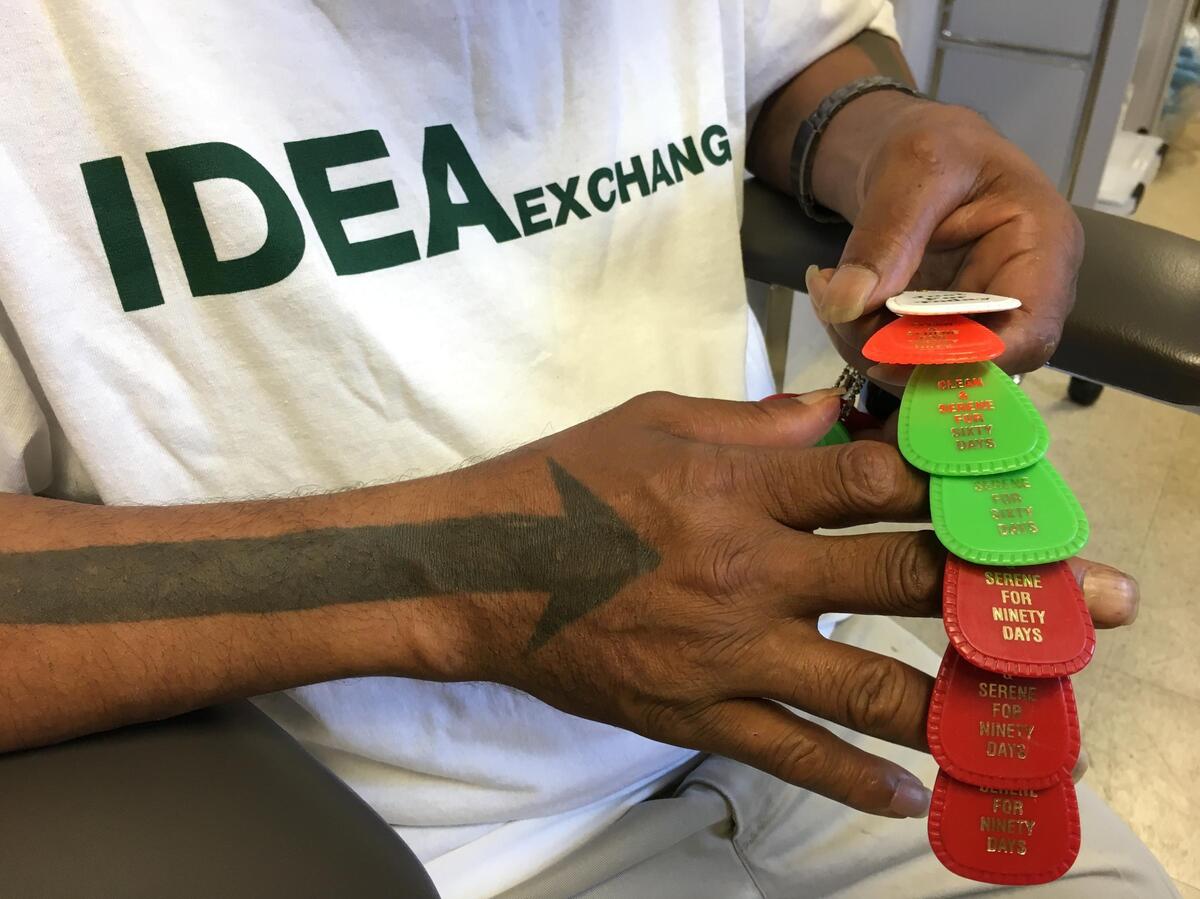
During one of his visits to the needle exchange van in Miami, Arrow was referred to inpatient drug treatment. Here, he displays keyrings marking milestones of his sobriety.
Sammy Mack/WLRN
hide caption
toggle caption
Sammy Mack/WLRN
Arrow says he doesn’t remember a lot from this period, but does remember using so much heroin that he ran out of fresh needles between visits to the exchange. So he grabbed other people’s used needles.
And then he tested positive for HIV and hepatitis C.
Tookes and his colleagues threw Arrow another life raft: They got him an inpatient drug treatment bed.
At Arrow’s checkup with Tookes, a string of keychains from Narcotics Anonymous clicked at his waist.
“My chain of sobriety,” he says of the links. “I got 30-days, 60-days, and 90-days chips,” he says.
Arrow’s HIV is under control. And he’s connected to health services for people living with HIV, including getting medication that cured his hepatitis C.
Now, he’s focused on staying sober, one day at a time. And he’s starting to want new things. “Thanks to this man right here,” he says, nodding to his doctor — Tookes.
As more Florida counties elect to begin needle exchanges, there’s no guarantee that every person who turns to them will get as far as Arrow. But Tookes, Braynon and other supporters hope such services will at least give more people the chance to recover from addiction — and protect themselves from needle-borne illnesses.
This story is part of NPR’s reporting partnership with WLRN and Kaiser Health News, a nonprofit news service of the Kaiser Family Foundation. KHN is not affiliated with Kaiser Permanente.
Democrats Debate Health Care And Other Issues At Miami Forum

At the first night of the debate, one issue where there were clear differences was where the Democratic presidential contenders stood on health care.
STEVE INSKEEP, HOST:
Moderator Lester Holt got the candidates last night to put a difference in health insurance on display.
(SOUNDBITE OF ARCHIVED RECORDING)
LESTER HOLT: Who here would abolish their private health insurance in favor of a government-run plan? – just a show of hands to start out with.
(APPLAUSE)
INSKEEP: OK, two candidates raised their hand, saying they wanted to abolish private health insurance – Elizabeth Warren and Bill de Blasio. Some others did not, meaning private insurance would stay. NPR political reporter Danielle Kurtzleben has been following this story. She’s in our studios.
Good morning.
DANIELLE KURTZLEBEN, BYLINE: Hey, Steve.
INSKEEP: Did you learn something in that moment?
KURTZLEBEN: Yeah. I mean, listen. What that moment was for me was really important for two big reasons. One is that it was a sort of change in tone for Elizabeth Warren, who was at center stage. All eyes were on her. She has co-sponsored a “Medicare for All” bill, the one that Senator Bernie Sanders has introduced. But in interviews, she had been kind of loose on how to get there. She would say, you know, first, we have to stabilize the Affordable Care Act – or Obamacare. And then she would say, you know, there are multiple paths to get to Medicare for All.
Well, last night, she was definitive. Everybody was watching. And her hand went straight up. She said not only that, yes, I would be willing to abolish private insurance, which would be – which would virtually happen under Medicare for All – but she said, I’m with Bernie, which is important at a time that she’s battling him for progressive voters.
INSKEEP: I’m remembering during the Obamacare debate, President Obama got in trouble because he said if you like your current health plan, you can keep it – turned out not to be true in all cases. Now you have candidates saying, no matter what you think of your plan, it’s going to be a government plan. Is this where voters are at the moment?
KURTZLEBEN: No. I mean, not necessarily. It depends on the voter, of course. But, I mean, listen. Looking at Democratic voters, you see a really interesting thing in the polling. You do have some who are in favor of Medicare for All. But one thing the polling also shows is that they don’t necessarily know what it means. And when you say to voters, OK, do you support Medicare for All? – and also, it might mean that you would lose your private insurance. Suddenly, support very much drops. So this is a potentially big political risk that a candidate takes if they say that.
INSKEEP: The public option is an easier sell, I guess, because it sounds like people can get whatever they want.
KURTZLEBEN: Yes. And you have multiple people on the stage last night who were saying that Beto O’Rourke and Amy Klobuchar are a couple who have been pretty vocal in favor of public options.
INSKEEP: Danielle, thanks for the insights – really appreciate them.
KURTZLEBEN: Thank you.
INSKEEP: NPR’s Danielle Kurtzleben.
Copyright © 2019 NPR. All rights reserved. Visit our website terms of use and permissions pages at www.npr.org for further information.
NPR transcripts are created on a rush deadline by Verb8tm, Inc., an NPR contractor, and produced using a proprietary transcription process developed with NPR. This text may not be in its final form and may be updated or revised in the future. Accuracy and availability may vary. The authoritative record of NPR’s programming is the audio record.
Trump Orders Rule Allowing Military Academy Grads To Defer Service To Play Pro Sports

Keenan Reynolds (center), Baltimore Ravens’ sixth round NFL draft pick, carries his diploma during the Naval Academy’s graduation in May 2016. Trump’s order on Wednesday would allow more military graduates to defer service in order to pursue professional sports careers.
Patrick Semansky/AP
hide caption
toggle caption
Patrick Semansky/AP
President Trump is ordering the Pentagon to rewrite a rule allowing athletes to delay mandatory active service in order to play professional sports directly upon graduation.
“These student-athletes should be able to defer their military service obligations until they have completed their professional sports careers,” Trump wrote in a presidential memorandum issued on Wednesday.
Under existing Department of Defense policy, those enrolled in military academies cannot play sports before serving at least two years in the armed forces.
That requirement, Trump wrote in his memo, deprives some student athletes of “a short window” they have to take advantage of their athletic talents.
During the Obama administration, military academy athletes were able to go right into sports after graduating if they were granted reserve status. But last year, Trump’s own Defense Department revoked that policy.
“Our military academies exist to develop future officers who enhance the readiness and the lethality of our military services,” Pentagon officials wrote in May 2017 announcing rescinding the Obama-era policy. “Graduates enjoy the extraordinary benefit of a military academy education at taxpayer expense.”
Pentagon officials pointed to successful professional athletes who completed the minimum of 25 months of service before playing sports, such as Roger Staubach, Dallas Cowboys quarterback, 1963 Heisman Trophy winner and Naval Academy graduate. Staubach became a professional player after serving a tour in Vietnam.
Proponents of Trump’s order highlight cases like former Navy quarterback Keenan Reynolds, who was drafted into the NFL in 2016 after deferring his military service.
It is the first official action Trump has taken to return to the old rule following public comments indicating that the president preferred allowing graduate to defer military service in order to pursue careers in professional sports.
“I mentioned this to the coach, and it’s a big deal,” Trump said in May when the West Point football team visited the White House. “Can you imagine, this incredible coach with that little asset because I would imagine that would make recruiting a little bit easier.”
In his order, Trump said that the new policy should not be seen as a way out of active duty service.
“These student-athletes should honor the commitment they made to serve in the armed forces,” Trump said.
Trump’s memo gives the defense department 120 days to devise a new rule.
1st AIDS Ward ‘5B’ Fought To Give Patients Compassionate Care, Dignified Deaths

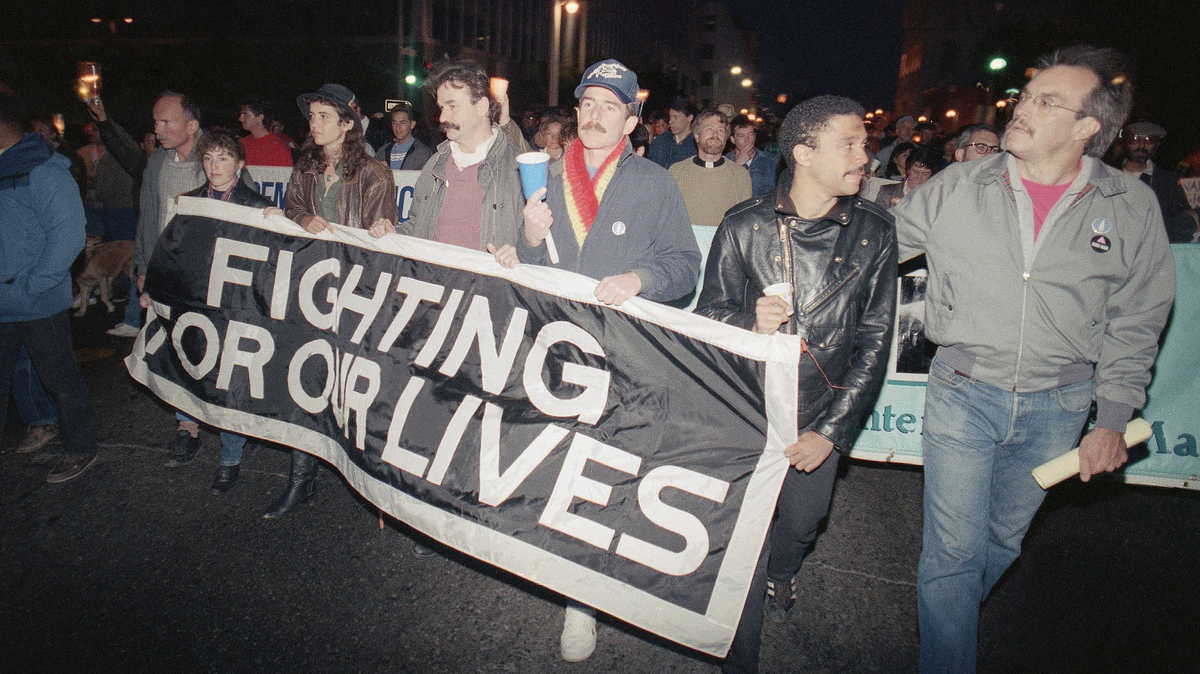
Marchers at a candlelight vigil in San Francisco, Calif., carry a banner to call attention to the continuing battle against AIDS on May 29, 1989. The city was home to the nation’s first AIDS special care unit. The unit, which opened in 1983, is the subject the documentary 5B.
Jason M. Grow/AP
hide caption
toggle caption
Jason M. Grow/AP
Today, antiretroviral medicines allow people with HIV, the virus that causes AIDS, to live long, productive lives. But at the onset of the AIDS epidemic in the early 1980s, the disease was considered a death sentence. No one was sure what caused it or how it was spread. Some doctors and nurses refused to treat patients with the disease; others protected themselves by wearing full body suits.
Cliff Morrison, a nurse at San Francisco General Hospital at the time, remembers being appalled by what he was seeing: “I would go in patients’ rooms and you could tell that they hadn’t had a bath,” he says. “They weren’t being taken care of.”
In 1983, Morrison organized a team of healthcare providers to open Ward 5B, an in-patient AIDS special care unit at San Francisco General Hospital. The medical team on the unit encouraged patients to make their rooms like home, and allowed families and partners to visit whenever they could. They comforted patients by touching them, and would even sneak in pets.
5B was the first unit of its kind in the nation — and it became a model for AIDS treatment, both in the U. S. and overseas. Now, a new documentary, called 5B, tells the story of the doctors and nurses who cared for patients on the ward.
Dr. Paul Volberding was a doctor on Ward 5B and went on to co-create an AIDS clinic at the hospital, which was one of the first in the country. He emphasizes how critically ill the patients on the unit were.
“These were people that were really, sometimes literally, dying when they came into the hospital, so whatever we could do to make them more comfortable was really important,” he says.
The work on 5B was emotionally draining, and death was a constant reality. Still, Volberding describes his time there as a “blessing.”
“The care that patients were getting was really special and very different than the rest of the hospital,” he says. “It was always a complete privilege to do this work.”
Morrison adds, “I had some really wonderful experiences with people in their passing, and they taught me a great deal. It really put in perspective the fact that life is on a continuum, and death is just part of that continuum. I saw people have beautiful deaths, and that was wonderful.”
Interview highlights
On how everyone who came into the hospital with the virus in the early 1980s died
Volberding: I don’t think most people can understand today how devastating a disease AIDS was back in those days. … It’s just impossible to appreciate that HIV, if it’s untreated, kills essentially 100 percent of the people. It’s much worse than Ebola, much worse than smallpox. So, everyone died. Every patient that was sick enough to come to us to look for medical care would die from this disease. And people knew that there was a lot of education to be done, but they knew that this was a really bad situation.
On how they didn’t know if what they were seeing was infectious when the first patients came in with the rare cancer, Kaposi’s sarcoma, which ended up being one of the symptoms of the as-yet-unknown AIDS virus

“It was always a complete privilege to do this work,” Dr. Paul Volberding says of treating patients on 5B.
Courtesy of Paul Volberding
hide caption
toggle caption
Courtesy of Paul Volberding
Volberding: I wasn’t worried about catching anything from the patients because that’s not what I expected in taking care of cancer patients. I didn’t expect to be worried about anything, and wasn’t really. But the care that the patients were getting was pretty spotty in the hospital. I think that was one of the things that led Cliff and the others to really put together the nursing unit.
Morrison: In my experience, in already what had been seen and what I was hearing from the specialists around us with the information that was coming out, was that I wasn’t at risk providing care to people by touching people. And everybody around us was saying, “Oh you’re just being cavalier. This is really not what you should be doing, and you’re giving the wrong message.” And our response always was, “We’re giving the right message.” So we were dealing with a lot of hysteria and misinformation and just outright discrimination, I think, very early on.
On expanding the hospital’s family and visitors’ policy for Ward 5B
Morrison: We also noticed right away … that we needed to really look at issues around family and visitation, because healthcare was very rigid and was really stuck on this whole idea [regarding] visiting hours that it could only be immediate family. Most of our patients didn’t have family around. … We almost immediately began talking about, in all of these regular meetings and sessions that we had, that maybe we needed to start letting our patients tell us who their family was, and that we needed to kind of move away from this whole idea of traditional family and biological family.
Volberding: I think that the patients were so sick — and they were so in need of support — that the idea of visiting hours and keeping people away didn’t make sense.
Morrison: There were times when they were alone in their rooms and they always needed something. They were very anxious. It not only made them more comfortable, it made our lives a lot easier having people that were there in the rooms most of the time.
On the bond that existed among 5B staff members
Volberding: It was a family. The physicians, the staff and the clinic and in the inpatient unit — we all worked so closely together because those were our patients. As physicians, those were our patients. And we were on the unit every day seeing our patients, and it was, again, a very special group of people.
On how the homophobia of the time influenced patient care

Appalled by the way patients with AIDS were being treated by hospital personnel, nurse Cliff Morrison decided to create a dedicated unit within San Francisco General Hospital that would emphasize compassionate care.
Verizon Media
hide caption
toggle caption
Verizon Media
Morrison: That was, I think, probably the most glaring reality of the situation. Even in San Francisco — which, even at that time was considered the gay mecca — gay people had very established careers and homes and families, and yet all of that started coming apart. And it really was centered around homophobia. There were people in the hospital that should have known better. … There was a group of nurses that basically said that what we were doing was crazy and that we were putting all of them at risk. It went before the labor board — but that was all homophobia.
On the evolution of AIDS treatment
Volberding: In 1987 we began to have some drugs that were doing something. … And then, by 1996, the so-called triple therapy was developed and that was really a turning point in the epidemic. We could suddenly start seeing some of our patients actually get better — not just die more slowly, but actually get better.
And some of those people are still alive today. The effort since ’96 has been to take those potent drugs and make them less toxic and more convenient. Today, we treat this very typically with what we call single tab regimens — one pill taken once a day that contains two, three or even four drugs — all in the same pill. Many of my patients don’t have any side effects at all from the medicines they’re taking. The change from the early days, and seeing the drugs being developed, and now seeing that this is truly a chronic condition is, I think, one of the most amazing stories we’ll ever hear from in medicine.
Amy Salit and Mooj Zadie produced and edited the audio of this interview. Bridget Bentz, Molly Seavy-Nesper and Deborah Franklin adapted it for the Web.
The Thistle & Shamrock: Singing The Land

Karine Polwart.
Reed Ingram Weir/Courtesy of the artist
hide caption
toggle caption
Reed Ingram Weir/Courtesy of the artist
This week’s show features music from Karine Polwart‘s theatrical event Wind Resistance and from fiddler Duncan Chisholm‘s Sandwood, named for the finest and least accessible beach in Scotland.
Hospitals Earn Little From Suing For Unpaid Bills. For Patients, It Can Be ‘Ruinous’

Daisha Smith says she only realized she had been sued over her hospital bill when she saw her paycheck was being garnished. “I literally have no food in my house because they’re garnishing my check,” she says.
Olivia Falcigno/NPR
hide caption
toggle caption
Olivia Falcigno/NPR
The Fredericksburg General District Court is a red-brick courthouse with Greek columns in a picturesque, Colonial Virginia town. A horse and carriage are usually parked outside the visitor center down the street.
On a sunny morning — the second Friday in June — the first defendant at court is a young woman, Daisha Smith, 24, who arrives early; she has just come off working an overnight shift at a group home for the elderly. She is here because the local hospital sued her for an unpaid medical bill — a bill she didn’t know she owed until her wages started disappearing out of her paycheck.
The hospital, Mary Washington, sues so many patients that the court reserves a morning every month for its cases.
Inside the courthouse, it’s not hard to figure out where to go. Right through court security, there are signs on colored paper: “If you are here for a MW case, please register at the civil window.” When the elevators open, there’s another Mary Washington sign. Wearing name badges, Mary Washington billing staff members walk through the halls. They’ve set up a kind of field office in a witness room at the back of the courtroom, where they are ready and waiting to set up payment plans for defendants.
On June 14, only a handful of the 300 people summoned to court show up. Most of the lawsuits were filed by the hospital, along with some others from medical companies affiliated with Mary Washington Healthcare.
The hundreds that did not come have default judgments made against them, meaning their wages can be garnished.
Those who did who did sit scattered throughout the bright, mostly empty courtroom, under the schoolhouse lamps.
At 9 a.m., the judge walks into court, and everybody rises.
“Good morning,” he says. “This is what we call the hospital docket.”

Mary Washington Hospital sues so many patients that the Fredericksburg General District Court, seen above, reserves a morning every month for the hospital’s cases.
Jaci Starkey
hide caption
toggle caption
Jaci Starkey
Bill collection through the courts
Not every hospital sues over unpaid bills, but a few sue a lot. In Virginia, 36% of hospitals sued patients and garnished their wages in 2017, according to a study published Tuesday in the American Medical Association’s journal, JAMA. Five hospitals accounted for over half of all lawsuits — and all but one of those were nonprofits. Mary Washington sued the most patients, according to the researchers.
Mary Washington defends the practice as a legal and transparent way to collect bills. It says it makes every effort to reach patients before it files papers to sue.
But others who observe and research the industry find it troubling that hospitals, especially nonprofits, are suing their patients.
“Hospitals were built — mostly by churches — to be a safe haven for people regardless of one’s race, creed or ability to pay. Hospitals have a nonprofit status — most of them — for a reason,” says Martin Makary, one of the JAMA study’s authors and a surgeon and researcher at Johns Hopkins Medicine. “They’re supposed to be community institutions.”
There are no good national data on the practice, but journalists have reported on hospitals suing patients all over the United States, from North Carolina to Nebraska to Ohio. In 2014, NPR and ProPublica published stories about a hospital in Missouri that sued 6,000 patients over a four-year period.
Typically these aren’t huge bills. In Virginia, the average amount garnished was $2,783.15, according to the JAMA study. Walmart, Wells Fargo, Amazon and Lowe’s were the top employers of people whose wages were garnished.
“If you’re a nonprofit hospital and you have this mission to serve your community, [lawsuits] should really be an absolute last resort,” says Jenifer Bosco, staff attorney at the National Consumer Law Center.
Bosco explains that IRS rules require nonprofit hospitals to have financial assistance programs and prohibit them from taking “extraordinary collection actions” on unpaid medical bills without first attempting to determine patients’ eligibility for financial assistance.
Nonprofit hospitals, Bosco says, “have to provide some sort of financial help for lower-income people, but the federal rules don’t say how much help, and they don’t say how poor you have to be to qualify [or] if you have to be insured or uninsured.”
As a result, she says, nonprofit hospitals have “a lot of free rein to make up their own policy of what they think is appropriate.”

A Mary Washington Hospital billboard greets people coming into town.
Olivia Falcigno/NPR
hide caption
toggle caption
Olivia Falcigno/NPR
“Hospitals sometimes can legally sue their patients for medical debts,” Bosco says. “The question is whether that’s something that they should be doing.”
For Makary, as a doctor, the answer is simple: “It’s a disgrace every place where it happens,” he says.
The “hospital docket” at the Fredericksburg court illustrates how far hospitals will go to pursue debts, he says: “It’s almost as if the courthouse has converted into a taxpayer-funded collections agency.”
“Who’s garnishing my check?”
Smith is unflinching when she talks about Mary Washington and what happened to her after she went to the hospital in 2017.
At the time she didn’t have insurance. She was working part time at Walmart for $11 an hour. She doesn’t want to give the details about why she ended up at the hospital. “I was not myself,” she says. “So I walked myself into Mary Washington to get help — to get myself on track.” She says she was admitted for two weeks.
Smith says no one told her about the financial assistance program or talked to her about her bill. According to the hospital’s policy, someone making less than $25,000 without health insurance should qualify for “free care.” But the hospital sued her for $12,287.68. She had a default judgement against her and did not realize she had been sued until she saw her paycheck mysteriously disappearing.
“When I looked at my pay stub, I’m like, ‘Why do I only have like $600-something in my account?’ ” She noticed “garnish” written on the bottom of her pay stub. “So I called my company and asked them, ‘Who’s garnishing my check?’ ” They told her it was Mary Washington.
With the garnishment, her take-home pay for a month of work comes to about $1,400. Her rent is $1,055. “I literally have no food in my house because they’re garnishing my check,” she says.
She knows she is not the only one that Mary Washington has gone after for an unpaid bill. Her relative had one, too, and got on a payment plan. Her co-worker was also sued.
“And that’s crazy,” she says, shaking her head. To Mary Washington Hospital, she says: “People need help. You all are just money hungry.”

Mary Washington Hospital sues more patients than any other hospital in Virginia, according to researchers at Johns Hopkins.
Dwayne and Maryanne Moyers
hide caption
toggle caption
Dwayne and Maryanne Moyers
A thin slice of revenue
In the courtroom, on hospital docket day in June, the judge ran through the cases quickly. One man owed $1,500 after an emergency room visit. A nurse was on the hook for over $20,000 after one of her children had a mental health evaluation. Another woman wasn’t sure why she was being sued for $1,400 — it could have been from an outpatient surgery she had three years ago. The day’s hearings are all over in 45 minutes.
Mary Washington Healthcare stands by its practice of suing patients and says that lawsuits are relatively rare.
“It’s important to us, as a small community, and a safety net hospital, that we’re doing everything we can for our patients to avoid aggressive collections,” says Lisa Henry, communications director for the health care system.
Henry says Mary Washington has a months-long process for trying to reach patients before it takes legal action. “By phone, by mail, by email — any access point we’re given from them when they register,” she says.
“Unfortunately, if we don’t hear back from folks or they don’t make a payment we’re assuming that they’re not prepared to pay their bill, so we do issue papers to the court,” she says.
Mary Washington Healthcare includes two hospitals, a network of physician practices, specialty care and outpatient centers.
Henry says the “vast majority” of patients who are eligible do get signed up for their financial assistance program, getting discounted or free care or setting up a payment plan. “A small percentage then goes on to collection and then even smaller goes to litigation,” she says. “We see thousands of patients a year and less than 1% go to litigation.”
In fact, Henry says that the revenue the hospital got from garnishing people’s wages was only 0.21% of its $624 million total revenue in 2018. That’s slightly higher than the average collected by other Virginia hospitals, according to the JAMA study, which found hospitals collected an average of 0.1% of their total revenue from garnishments.
Erin Fuse Brown, a law professor at Georgia State University whose work focuses on health care costs, says there are bigger philosophical questions here about a hospital’s role.
“There has to be a balance between getting their bills paid but also being a reasonable community member,” she says. Regarding lawsuits, she adds: “It doesn’t seem to be worth the effort, and it’s so ruinous to the patient — not just the financial obligation but the effect on your credit, on your record, the emotional effect of being sued.”

Dr. Martin Makary is leading an advocacy effort to get Mary Washington Hospital to stop suing patients over unpaid bills. The advocates meet across the street from the courthouse every month to discuss strategy.
Olivia Falcigno/NPR
hide caption
toggle caption
Olivia Falcigno/NPR
Mary Washington Healthcare has chosen to go through the legal system intentionally, Henry says. “We selected to do this because we think it is a fair and appropriate way to help our patients reach out to us — to open the lines of communication,” she says. “There are many cases resolved before litigation. The court summons alone is enough to open that door of communication so that we can work with them.”
Henry says the Virginia hospitals that don’t sue patients are probably outsourcing their collection of unpaid bills. “Most sell their debt. We have elected not to ever sell our debt in small claims,” she says. “The reason for that is the collections agencies can be aggressive.”
Fuse Brown says IRS rules for nonprofit hospitals don’t distinguish between whether a hospital is trying to collect an unpaid bill directly or using a private collection company. “They’re recognized to be fairly harsh tactics, whether the hospital is the one doing the suing or whether it’s a debt collection agent,” she says. “Certainly to the patient, all of that feels equally stressful and burdensome.”
She says it’s hard to know at a national level how many nonprofit hospitals sue patients who haven’t paid their bills, how many sell the debt, and how many write it off. “I haven’t seen any good studies that tried to estimate the number of hospitals that are doing this or the percentage of patients who are subjected to this type of debt collection activity,” Fuse Brown says.
She adds, it’s a shame information about hospitals’ collection practices isn’t widely available. “Wouldn’t you like to know that if you were a patient?” she asks.
“Do you owe this money?”
On June 14, a group of doctors, pre-med students and a lawyer headed to the Fredericksburg court early, and as patients collected in the hall outside the double doors of the courtroom, the group approached them, asking, “Are you here because you’ve been sued by Mary Washington?” Nearly everyone nodded cautiously. And most were open to talking about and sharing what happened to them.
This group is part of an advocacy campaign to support patients who are being sued by the hospital. The effort is led by Johns Hopkins researcher Makary, the author of the JAMA study.
He first found out about this hospital’s lawsuits last fall while working on The Price We Pay, his forthcoming book on dysfunction in the American health care system. He was so outraged by what is happening to patients in Fredericksburg that he has started showing up every month when hospital cases are heard in the court.










Joseph Kirchgessner grew up around Fredericksburg, Va., and heard “horror stories” about the local hospital. Now he is an attorney and represents patients who have been sued over their unpaid bills.
Olivia Falcigno/NPR
hide caption
toggle caption
Olivia Falcigno/NPR
“To see these aggressive, and even predatory, collection strategies affect everyday teachers, farmers, even nurses — it’s heartbreaking and it’s wrong and it needs to stop,” Makary says.
Part of the advocates’ strategy to help patients fight these lawsuits is to encourage them to contest their bills, rather than admit they owe the money.
“The No. 1 thing we need them to do is when the judge asks that initial screening question, ‘Do you owe this money?’ the answer they need to say is, ‘No,’ ” Makary explains. “That allows us to make the arguments and to have a hearing.”
If they say yes, which many of them do, “That’s kind of the kiss of death — you’re going to get a judgment against you,” says Joseph Kirchgessner, the local attorney working with the advocacy team.
The underlying thinking is that patients rarely have a chance to negotiate the cost of medical services in advance and that bills may be unreasonable, especially in light of their financial circumstances. A patient who contests may be able to negotiate a better price or have the bill forgiven.
Kirchgessner says he plans to argue that hospital contracts, often signed under duress during a medical crisis, aren’t valid. Makary is ready and willing to be an expert medical witness, to testify about whether there are hospital markups or unnecessary procedures.
But Kirchgessner hasn’t had a chance to defend a Mary Washington case in court yet, he says, because each time he gets close to a trial date, the hospital withdraws its case against the patient. This leaves the issue unresolved. The hospital can still try to collect, or bring a future lawsuit.
The advocates are also politely asking hospitals like Mary Washington to end the practice of suing over unpaid bills. Makary has chatted with doctors in the hospital cafeteria, imploring them to tell their administrators to stop. (Makary has been doing that himself, at his own hospital — Johns Hopkins Hospital — which was also recently reported to be suing patients over their bills.) He sent a letter to Mary Washington Healthcare’s CEO and board members asking that they stop the suits.
“We’ve told the hospital that we will plan to be there on every single court date until the hospital decides to stop suing low-income patients for bills that they simply can’t afford,” Makary says.
Mary Washington’s Henry says that because all of the court records are public, they are subject to more scrutiny than hospitals that use collection agencies.
“We’re really unclear as to why Mary Washington Healthcare in particular has become the face of this,” she says. “I don’t think we’re alone — all hospitals are struggling with, ‘How do we collect appropriately from our patients to stay open as a safety net hospital?’ “
A “wild card” case
Thanks to the volunteer advocates, Smith now has an attorney — Kirchgessner.
He says taking her case “was a bit of a wild card” since it’s too late for her to contest the bill. All he can do for her now is try to get the garnishment lowered or removed altogether. “There are certain laws in Virginia about how people are garnished, how much they can take,” he explains.
The next step is to meet with Smith to work out her income and expenses and make a plan.
Since her paycheck started being garnished, Smith had to take on another job to keep up with her rent. “The second job’s not helping much, but it’s something,” she says. She is also now working full time at the group home and is enrolled in Medicaid.
If her check weren’t being garnished, she says, “I’d be fine. I would have everything that I needed — saving money, everything would be paid, food would be in the house.” She’s glad to have a lawyer helping her with her case. There is a new hearing date set for July.
Now, if she has a medical issue, “I go to urgent care,” she says. “I stay away from Mary Washington.”
World Cup: U.S. Beats Spain 2-1 To Face France In Quarterfinals
The U.S. women’s soccer team has advanced to the quarterfinals of the World Cup after a thrilling game against Spain. The U.S. on Friday will play France, which is hosting the tournament.
Trump Directs Alex Azar To Help Make Health Care Costs More Transparent
NPR’s Noel King talks to Health and Human Service Secretary Alex Azar about President Trump’s executive order issued Monday on health care pricing and transparency.
Italy Will Host The 2026 Olympic And Paralympic Winter Games


Members of the delegation from Milan and Cortina d’Ampezzo react after the Italian cities were named to host the 2026 Olympic Winter Games.
Philippe Lopez/AFP/Getty Images
hide caption
toggle caption
Philippe Lopez/AFP/Getty Images
The 2026 Winter Olympics and Paralympics will be held in Italy.
The International Olympic Committee voted Monday to accept the joint bid by Milan and Cortina d’Ampezzo over the runner-up, Stockholm, Sweden.
The last time Italy hosted the Winter Olympics when Turin was home to the 2006 Games. Cortina hosted the Winter Olympics in 1956.
Milan-Cortina won 47 of the committee votes cast. Stockholm won 34 votes and there was one abstention.
Stockholm’s bid included sharing some game events with the Latvian city of Sigulda. The Swedes were hoping to win the Winter Games for the first time.
“We can look forward to outstanding and sustainable Olympic Winter Games in a traditional winter sports country,” said IOC President Thomas Bach in his congratulatory message. “The passion and knowledge of Italian fans, together with experienced venue operators, will create the perfect atmosphere for the best athletes in the world.”