Trump’s Plan To Lower Your Hospital Costs: Here’s What You Need To Know


An executive order President Trump signed Monday aims to make most hospital pricing more transparent to patients, long before they get the bill.
Sam Edwards/Caiaimage/Getty Images
hide caption
toggle caption
Sam Edwards/Caiaimage/Getty Images
Anyone who has tried to shop around for hospital services knows this: It’s hard to get prices in advance.
President Trump signed an executive order Monday that he says would make such comparisons easier, and make the pricing process more transparent.
The order directs agencies to draw up rules requiring hospitals and insurers to make public more information on the negotiated prices they hammer out in contract negotiations. Also, hospitals and insurers would have to give estimates on out-of-pocket costs to patients before they go in for nonemergency medical care.
“This will put American patients in control and address fundamental drivers of health care costs in a way no president has done before,” said Health and Human Services Secretary Alex Azar during a press briefing Monday.
But just how useful the effort will prove for consumers remains unclear.
If the executive order leads to finalized HHS rules, proponents say it could encourage competition and lower prices.
Other health care analysts say much depends on how the administration writes the rules over the next several months — rules that govern what information must be provided and in what format. Trump’s executive order already is running into opposition from some hospitals and insurers who say disclosing negotiated rates could drive up costs.
As health care consumers await more details on those rules, here’s what we know:
Q: What does the order do?
It may expand price information consumers receive.
The order directs agencies to develop rules to require hospitals and insurers to provide information “based on negotiated rates” to the public.
Currently, such rates are hard to get, even for patients, until after medical care is provided. That’s when insured patients get an “explanation of benefits,” which shows how much the hospital charged, how much of a discount their insurer received and the amount a patient may owe.
In addition to consumers being unable to get price information upfront in many cases, hospital list prices and negotiated discount rates vary widely by hospital and insurer, even within the same region. Uninsured patients often are charged the full amounts.
“People are sick and tired of hospitals playing these games with prices,” says George Nation, a business professor at Lehigh University who studies hospital contract law. “That’s what’s driving all of this.”
Some insurers and hospitals do provide online tools or apps that already can help individual patients estimate out-of-pocket costs for a service or procedure ahead of time. But research shows few patients use such tools. Also, many medical services are needed without much notice — think of a heart attack or a broken leg — so shopping for price simply isn’t possible.
Administration officials say they want patients to have access to more information, including “advance EOBs” that outline anticipated costs before patients get nonemergency medical care. In theory, that would allow consumers to shop around for lower cost care.
Q: Isn’t this information already available?
Not exactly. In January, new rules took effect under the Affordable Care Act that require hospitals to post online their “list prices.” These are prices hospitals set themselves, and have little relation to actual costs or what insurers actually pay.
What’s resulted are often confusing spreadsheets that contain thousands of a la carte charges — ranging from the price of medicines and sutures to room costs, among other things — that patients have to piece together (if they can) to estimate their total bill. Also, those list charges don’t reflect the discounted rates insurers have negotiated, so they are of little use to insured patients who might want to compare prices from hospital to hospital.
In theory, at least, the information that would result from Trump’s executive order would provide more detail based on negotiated, discounted rates.
A senior administration official at the press briefing said details about whether the rates would be aggregated or relate to individual hospitals would be spelled out only when the administration puts forward proposed rules to implement the order later this year. It also is still unclear how the administration would enforce the rules.
Another limitation to the executive order: It applies only to hospitals and the medical staff they employ. Many hospitals are staffed by doctors who are not directly employed, or rely on laboratories that are also separate. That means negotiated prices for services provided by such laboratories or physicians would not have to be disclosed.
Q: How could consumers use this information?
In theory, consumers could get information in advance that would allow them to compare prices for, say, a hip replacement or knee surgery.
But that could prove difficult if the rates are not fairly hospital-specific, or if they are not lumped in with all the care needed for a specific procedure or surgery.
“They could take the top 20 common procedures the hospital does, for example, and put negotiated prices on them,” says Nation. “It makes sense to do an average for that particular hospital, so I can see how much it’s going to cost to have my knee replaced at St. Joe’s versus St. Anne’s.”
Having advance notice of out-of-pocket costs could also help patients who have high-deductible plans.
“Patients are increasingly subject to insurance deductibles and other forms of substantial cost sharing. For a subset of so-called ‘shoppable services’, patients would benefit from price estimates in advance that allow them to compare options and plan financially for their care,” says John Rother, president and CEO at the advocacy group National Coalition on Health Care.
Q: Would the availability of this extra information push consumers to shop for health care?
The short answer is maybe.
“The evidence to date shows patients aren’t necessarily the best shoppers, but we haven’t given them the best tools to be shoppers,” says Lovisa Gustafsson, assistant vice president at the Commonwealth Fund.
Posting negotiated rates might be a step forward, she says, but only if the information is easily understandable.
It’s also possible that insurers, physician offices, consumer groups or online businesses would find ways to help direct patients to the most cost-effective locations for surgeries, tests or other procedures based on the information.
“Institutions like Consumer Reports or Consumer Checkbook could do some kind of high-level comparison between facilities or doctors,” says Tim Jost, a professor emeritus at the Washington and Lee University School of Law.
But some hospitals and insurers maintain that disclosing specific rates could backfire.
Hospitals charging lower rates, for example, might raise them if they see competitors are getting higher reimbursement from insurers. And insurers say they might be hampered in their ability to negotiate if rivals all know what they each pay.
“We also agree that patients should have accurate, real-time information about costs so they can make the best, most informed decisions about their care,” said the lobbying group America’s Health Insurance Plans, in a written statement. “But publicly disclosing competitively negotiated, proprietary rates will reduce competition and push prices higher — not lower — for consumers, patients and taxpayers.”
Kaiser Health News is a nonprofit, editorially independent program of the Kaiser Family Foundation, and is not affiliated with Kaiser Permanente.
U.S. Battles To Beat Spain At Women’s World Cup


In the 76th minute of the game, United States’ Megan Rapinoe powered the ball low and to the left giving the U.S. a 2-1 lead.
Thibault Camus/AP
hide caption
toggle caption
Thibault Camus/AP
It wasn’t easy, pretty or elegant. But the U.S. Women’s National Team battled to beat Spain in the round of 16 at the Women’s World Cup. The U.S. had an easy road in this tournament. Until Monday. Spain, playing in its first ever World Cup, looked like it had been there many times before. But in the end, it was not enough. The U.S. defeated Spain 2-1.
Spain started aggressively and came out on the attack in the opening minute — challenging the U.S. defense. But the U.S. struck first. Tobin Heath was tripped in front of the Spanish goal for a U.S. penalty kick. Megan Rapinoe hammered the ball low and to the left in the seventh minute. But the lead did not last long.
Spain came right back after U.S. goalkeeper Alyssa Naeher made a short and ill-advised pass to Becky Sauerbrunn that Spain intercepted and led to a beautiful strike by Jennifer Hermoso to tie it 1-1 (that was the first goal the U.S. had allowed in 647 minutes of play)
Alyssa Naeher plays Becky Sauerbrunn the ball despite #ESP‘s high pressure, and the #USA pays the price. Quite a finish by Hermoso, too
(via @FoxSoccer) pic.twitter.com/PcpSVl0Kti
— Planet Fútbol (@si_soccer) June 24, 2019
Both sides battled back and forth during a tense and physical first half. U.S. forward Alex Morgan was knocked to the turf a half-dozen times (and the knockdowns of the star U.S. striker continued in the second half). It was the fourth sell-out of a U.S. game at this tournament and the decidedly pro-U.S. crowd was anxious as Spain made run after run in the U.S. backfield (and watching Spain trip up U.S. players all game long).
It’s 1-1 at the half. Spain, in its World Cup debut, is giving the 3-time-champion US team a real challenge in this round of 16. And US fans seem stunned. #USAvESP #WWC2019 pic.twitter.com/wgE8VyGCEb
— melissa block (@NPRmelissablock) June 24, 2019
Spain is the toughest opponent the top-ranked U.S. had faced in the Women’s World Cup. Questions had swirled this tournament about a relatively untested U.S. defense. Spain had several chances and challenged the back line all game long but the Americans did not break.
It was in the 76th minute when the U.S. broke the tie. Rose Lavelle was brought down in the box after a light challenge by a Spanish defender that may or may not have have hit Lavelle’s leg. Megan Rapinoe took her second penalty kick of the game. And, like in the first half, she powered the ball low and to the left giving the U.S. a 2-1 lead.
In a post-match interview on FS1, U.S. Head Coach Jill Ellis looked relieved, “You can talk tactics. You can talk everything. But just the heart and the grit and the resolve. That’s a big part of World Cup soccer. No game is ever easy in this tournament. We know that. We learn that and so part of that is the mental piece and I thought we were great tonight.”
The U.S. had never lost a World Cup game when it scored first. And it had always made it to at least the semifinals in every WWC. The three-time and defending 2015 champions next play on Friday. It’s a game that’s been anticipated all tournament long: U.S. taking on host country France in the quarterfinals.
Trump Administration Pushes To Make Health Care Pricing More Transparent

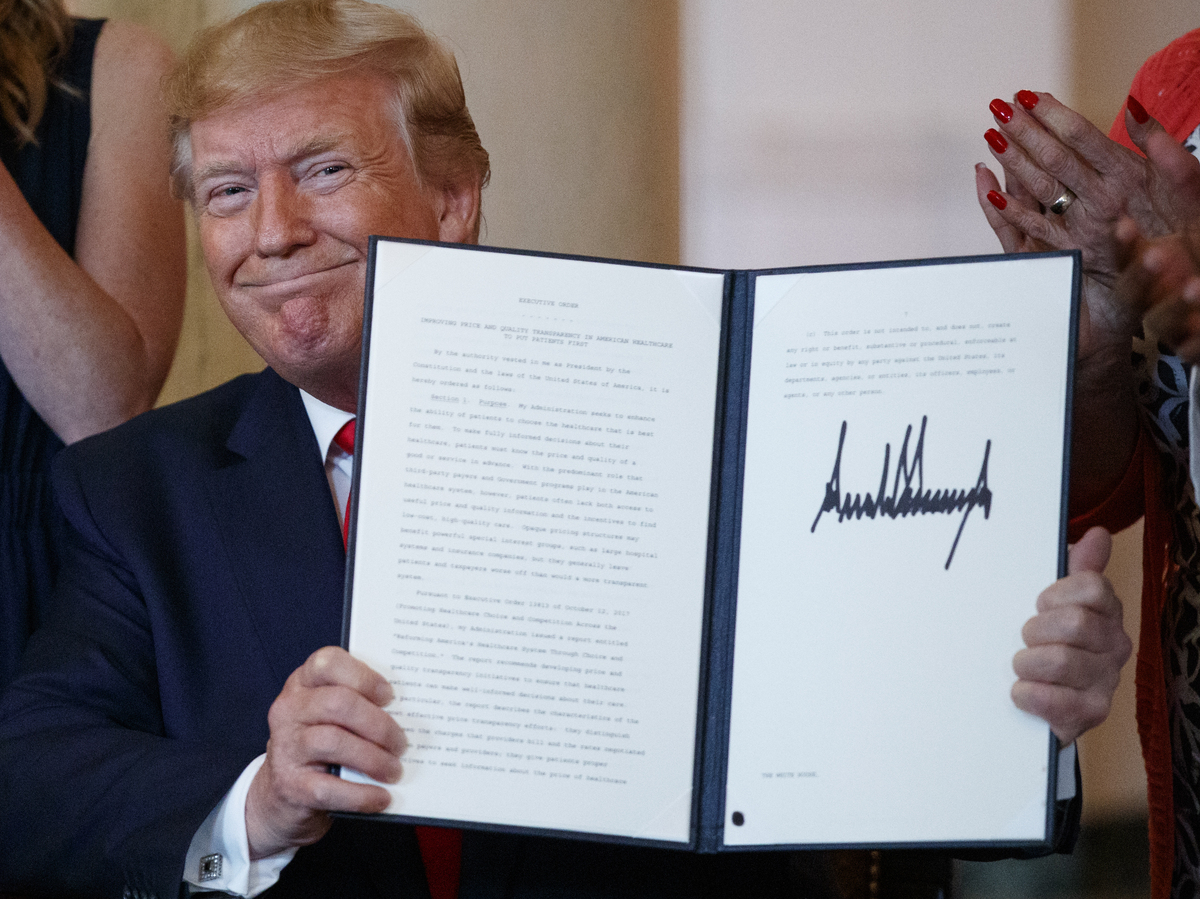
The executive order on drug price transparency that President Trump signed Monday doesn’t spell out specific actions; rather, it directs the department of Health and Human Services to develop a policy and then undertake a lengthy rule-making process.
Carolyn Kaster/AP
hide caption
toggle caption
Carolyn Kaster/AP
Updated 4:03 p.m.
President Trump signed an executive order Monday on price transparency in health care that aims to lower rising health care costs by showing prices to patients. The idea is that if people can shop around, market forces may drive down costs.
“Hospitals will be required to publish prices that reflect what people pay for services,” said President Trump at a White House event. “You will get great pricing. Prices will come down by numbers that you wouldn’t believe. The cost of healthcare will go way, way down.”
Like several of President Trump’s other health policy-related announcements, today’s executive order doesn’t spell out specific actions, but directs the department of Health and Human Services to develop a policy and then undertake a lengthy rule-making process.
“The president knows the best way to lower costs in health care is to put patients in control by increasing choice and competition,” HHS Secretary Alex Azar said at a phone briefing for reporters Monday morning.
Azar outlined five parts of the executive order, two of which are directly related to price transparency.
It directs the agency to draft a new rule that would require hospitals to disclose the prices that patients and insurers actually pay in “an easy-to-read, patient-friendly format,” Azar said.
The new rule should also “require health care providers and insurers to provide patients with information about the out-of-pocket costs they’ll face before they receive health care services,” he added.
The idea is simple. Health care is an industry where consumers don’t have access to the kind of information they have when making other purchasing decisions. The executive order could — if it leads to finalized, HHS rules — pressure the industry to function more like a normal market, where quality and price drive consumer behavior. Some consumer advocates welcomed the move.
“Today patients don’t have access to prices or choices or even ability to see quality,” said Cynthia Fisher, founder of a group called Patient Rights Advocate. “I think the exciting part of this executive order is the President and administration are really moving to put the patient in the driver’s seat and be empowered for the first time with knowledge and information.”
Exactly how the rules the executive order calls for would work is still to be determined, administration officials said.
Push back from various corners of the healthcare industry came quickly, with hospital and health plan lobbying organizations arguing this transparency requirement would have the unintended consequence of pushing prices up, rather than down.
“Publicly disclosing competitively negotiated, proprietary rates will reduce competition and push prices higher — not lower — for consumers, patients, and taxpayers,” said Matt Eyles, CEO of America’s Health Insurance Plans in a statement. He says it will perpetuate “the old days of the American health care system paying for volume over value. We know that is a formula for higher costs and worse care for everyone.”
Some health economists and industry observers without a vested interest expressed a similar view. Larry Levitt, senior vice president for health reform the Kaiser Family Foundation, tweeted that although the idea of greater price transparency makes sense from the perspective of consumer protection, it doesn’t guarantee lower prices.
“I’m skeptical that disclosure of health care prices will drive prices down, and could even increase prices once hospitals and doctors know what their competitors down the street are getting paid,” Levitt wrote.
This executive order is the latest in a series of moves from the Trump administration on health care price transparency recently. As NPR reported, just last month the White House announced its legislative priorities for ending surprise medical bills, which included patients receiving a “clear and honest bill upfront” before scheduled care. That same week, HHS announced a final rule requiring drugmakers to display list prices of their drugs in TV ads.
However, several of President Trump’s past health care announcements have gotten tied up before the promises to lower costs could be realized.
For instance, in May 2018, Trump rolled out a Blueprint To Lower Drug Prices which included a variety of proposals intended to reduce pharmaceutical costs to individuals, the industry and the economy as a whole, as NPR reported.
In October of last year, the Centers for Medicare and Medicaid Services proposed an international pricing model for setting what Medicare Part B would pay for certain drugs. This is the closest the Trump administration has come to Trump’s campaign promise to have Medicare negotiate with drug companies.
The proposal was put out for public comment with a December 2018 deadline. Thousands of comments came in, including a lot of pushback from the pharmaceutical industry and the proposed rule has not yet been finalized and it’s not clear it ever will be.
Peak Performance: Inside The World Of Super Athletes

In her new documentary “Homecoming,” singer Beyoncé talked about the punishing measures she took to prepare for her two-hour show at Coachella, only a few months after she gave birth to twins:
In pre-Coachella behind-the-scenes footage, a voice off-camera — presumably Beyoncé’s choreographer, JaQuel Knight — said that she was likely burning 1,500 to 2,000 calories per day from hours of rehearsing.
“It’s true,” Beyoncé responded. “And eventually, I want to be able to do Soul Cycle, the stairs, and rehearsal in a day.”
The “Formation” singer also revealed that she followed a strict diet to get back in shape: “In order for me to meet my goal, I’m limiting myself to no bread, no carbs, no sugar, no dairy, no meat, no fish, no alcohol — and I’m hungry.”
She pushed her endurance, just as many elite athletes do every day. And the determination to work that hard may simply be a quality with which you’re born.
From National Geographic:
Numerous factors—genetic, psychological, cultural, and financial—go into making a super performer, but the right genes may be the most critical. Elite athletes, as these super performers are called, are in a sense fortunate freaks of nature.
How do you mentally prepare someone to endure the pain that comes with pushing the human body to its limits? What can people who do significantly less exercise learn from those who reach these elite achievements?
We talk with an ultra-marathoner (who also happens to be a doctor), a performance psychologist and a U.S. Olympic Committee official about excelling at the highest level.
Produced by Morgan Givens. Text by Gabrielle Healy.
Win Or Go Home: U.S. Takes On Spain In Women’s World Cup


U.S. forward Megan Rapinoe throws the ball from the touch line during last week’s World Cup match against Sweden.
Damien Meyer/AFP/Getty Images
hide caption
toggle caption
Damien Meyer/AFP/Getty Images
The U.S. has shown few weaknesses in its march through the Women’s World Cup in France. But now the competition gets harder and the stakes are higher in the knockout round of the monthlong tournament. The first U.S. test comes Monday against Spain in the round of 16 (kickoff is noon ET and broadcast on FS1 and Telemundo).
The Spaniards have never been to a Women’s World Cup before. In the group stage, they opened with a victory against South Africa, a defeat by Germany and a scoreless draw with China. None of that matters in the knockout round. The winner plays on and the loser goes home.
“I feel good where we are in terms of the collective understanding of our team,” said U.S. head coach Jill Ellis at Sunday’s prematch news conference. “Obviously Spain’s a great opponent.”
Spain is not the United States, though. In the three games the U.S. has played so far, it set records for most goals scored (18) and the biggest goal differential while shutting out each of its opponents (Thailand, Chile and Sweden).
Perhaps the three biggest questions are these:
- How is star forward Alex Morgan? She was tackled in the last game against Sweden and didn’t return for the second half. “Alex is fine,” Ellis said.
- What about midfielder Julie Ertz who anchors the defense? She didn’t play against Sweden because of what U.S. Soccer called a “minor hip contusion.” Ellis said she’s fine, too.
- Has the U.S team had enough rest? The Americans last played on Thursday (three full days of rest). While Spain last played a week ago (six days of rest).
“At this point, it is what it is,” Ellis told reporters. But she’s not concerned about it. “I think we’re very used to a three-day rhythm. It’s what we’ve done in certain tournaments. Specifically for this purpose of having a consistent rhythm in what we do. And we can’t control obviously what our opponent has.”
There has been little that has slowed the U.S. in its romp through the World Cup competition thus far. Ellis has played different lineups in each game and her players don’t seem bothered by it. “The strength of this team is that we have a lot of strengths,” said midfielder Rose Lavelle. “We’re really deep, and we don’t rely on one person to get the job done. And I think that gives us a lot of confidence moving forward.”
The U.S. is ranked No. 1 in the world and the defending 2015 WWC champions. But it has little history with Spain. The two teams have played only once before, and that was in January (a game the U.S. won 1-0). The U.S. coaching staff and the players say they’re taking nothing for granted and focusing on just one game at a time. But they’d be forgiven if they looked ahead just a little bit. The winner of this contest takes on host country France in the quarterfinals on Friday.
First, the U.S. has to get by Spain to make the matchup that has been talked about all tournament long.
Trump To Sign Executive Order Aimed At Health Care Costs

As a candidate, President Trump argued that the government should work to lower drug prices. As president, his administration is finding that his promise is more complicated to keep than expected.
Team USA Readies For Knockout Round At Women’s World Cup
The Women’s World Cup has entered the elimination quick-fire Round of 16. NPR’s Michel Martin speaks with Roger Bennett of the Men in Blazers about Team USA’s performance so far.
Doctors Learn The Nuts And Bolts Of Robotic Surgery


During a training session, Dr. Kenneth Kim and a surgical resident practice a hysterectomy on a robotic simulator at UAB Hospital.
Mary Scott Hodgin/WBHM 90.3
hide caption
toggle caption
Mary Scott Hodgin/WBHM 90.3
Across the country, surgeons are learning to use more than just scalpels and forceps. In the past decade, a growing number of medical institutions have invested in the da Vinci robot, the most common device used to perform robot-assisted, or robotic, surgery.
Compared to traditional open surgery, robotic surgery is minimally invasive and recovery time is often shorter, making the technology attractive to patients and doctors. But the da Vinci surgical system is expensive, costing as much as $2 million, and recent studies show that for certain procedures it can sometimes lead to worse long-term outcomes than other types of surgery.
Even so, the robot has become common practice in some specialties, such as urology and gynecology, and that growth is expected to continue, which means more surgeons are learning to use the device.
“It’s not necessarily, ‘Is robot better?’ ” says Dr. Kenneth Kim, director of the robotic training program at UAB Hospital in Birmingham, Alabama. “Robot is just another tool that they need to master just like any other surgical tool.”
But “mastering the robot” can be a challenge.
“It never was an issue because open surgery, like scissors — like everyone learns how to use scissors in kindergarten,” Kim says. “Everyone knows, functionally, how to use a knife. But with the robot, it’s a totally different, new tool and it’s more complex, so now that has a separate learning curve.”
The da Vinci robot is not self-operating, at least not yet. Instead, it works almost like a big video game. The surgeon sits at a console station and uses hand and feet controls to manipulate a separate surgical part attached to the patient.
Operating in virtual reality
One way students get comfortable with the device is by operating in virtual reality. At training institutions like UAB, surgical residents use a simulator to complete monthly tasks and practice common procedures.
OBGYN resident Teresa Boitano says the exercises help develop skills that are directly applicable to the operating room. During one of these tasks, Boitano moves the robot arms to precisely place colorful rings onto corresponding spikes.
“And so I’m going now to grab this first ring and at the same time I’m thinking, ‘OK now where do I need to go to get the next one?’ ” Boitano says. “You’re always trying to stay ahead of the game but then also, making sure you’re not doing any errors at the same time.”
If she does make a mistake, the machine will tell her. Kim says the latest simulators come equipped with advanced motion-tracking technology. So while Boitano’s practicing a task or doing a run through a hysterectomy in virtual reality, the simulator records her movement – how accurately she uses the robot arms or how fast she completes the exercise. It provides objective data about surgical performance.
Dr. Khurshid Guru, director of robotic surgery at Roswell Park Comprehensive Cancer Center in New York, says this simulator technology helps standardize the training process.
“The analogy is that now you don’t have to worry about learning how to drive a car because everybody could get onto the street, they are taught the basic principles of driving a car,” Guru says. “The million-dollar question now is, ‘When would you allow them to get onto the expressway?’ “
Guru says that is the next step, when surgeons specialize in different procedures.
Robot-assisted surgery not for every patient
Dr. Monica Hagan Vetter, of The Ohio State University, has studied robotic training programs across the country. She says using a simulator to measure surgical ability helps ensure surgeons have a certain level of skill before they actually operate on people.
“You can learn the steps of the procedure,” Vetter says, “but if you don’t know how the robot works, if you don’t know how to troubleshoot the robot or what to do in an emergency, then even if you can perform the world’s best hysterectomy and you know all the steps and all the instruments, you are not safe to do that.”
Dr. Kenneth Kim says simulators and the data they provide help streamline the teaching process and offer the opportunity to give students more objective feedback. It is a way for surgeons to learn to use the da Vinci robot as a tool, but Kim says they still have to watch and learn.
“The simulator’s good, but it can only simulate so much,” he says.
In the real world, Kim says robot-assisted surgery is not right for every patient. A surgeon needs to know when to use it and when not to use it, and those decisions can change as researchers continue to study patient outcomes from robotic surgery.
Training Better Robotic Surgeons
Robot-assisted surgery is minimally invasive and recovery time is shorter. Those are a few reasons why more medical schools are training students how to be better robotic surgeons.
LULU GARCIA-NAVARRO, HOST:
When you go into your next surgery, your doctor may have some help from robots – yes, robots. Institutions across the U.S. have rapidly adopted this technology. But one very big problem – many doctors don’t know how to use them. Mary Scott Hodgin of member station WBHM reports.
MARY SCOTT HODGIN, BYLINE: Robot-assisted surgery is minimally invasive, and recovery time is often shorter. Those are a few reasons patients and doctors like it. But the technology is expensive. And studies show it can sometimes lead to worse long-term outcomes than other types of surgery. Still, the device has become common practice in some specialties, which means more surgeons are learning to use it.
KENNETH KIM: It’s not necessarily, is robot better? Robot is just another tool that they need to master just like any other surgical tool.
SCOTT HODGIN: That’s Dr. Kenneth Kim. He directs the robotic training program at UAB Hospital in Birmingham, Ala. Kim says the first step to learning robotic surgery is understanding how to use the robot. But that’s not easy.
KIM: It never was an issue because open surgery, like scissors – like, everyone learns how to use scissors in kindergarten. Everyone knows, functionally, how to use a knife. But with the robot, it’s a totally different, new tool, and it’s more complex. So now that has a separate learning curve.
SCOTT HODGIN: To be clear, the robot isn’t self-operating, at least not yet. The way it works is the surgeon sits at a console, sort of like a big video game, and uses hand and feet controls to manipulate a separate surgical part attached to the patient. Kim says one way students get comfortable with the device is virtual reality.
KIM: Having trouble?
THERESA BOITANO: That one’s always the trouble one, especially if they’re small.
KIM: Yeah.
SCOTT HODGIN: Surgical residents gather with Kim at UAB Hospital. They’re practicing on a new robotic simulator. Theresa Boitano is an OB-GYN resident at UAB. She’s maneuvering the robotic arms with precision to lift colorful rings and place them onto spikes, almost like a kid’s game.
BOITANO: And so I’m going now to grab this first ring. And at the same time, I’m thinking, OK. Now where do I need to go to the next one? You’re always trying to stay ahead of the game but then also making sure you’re not doing any errors at the same time.
SCOTT HODGIN: The simulator records everything – how accurately she moves the robot arms, how fast she completes the exercise. It provides objective data about how well a surgeon performs. Dr. Khurshid Guru says this helps standardize the training process. Guru directs robotic surgery at Roswell Park Comprehensive Cancer Center in New York.
KHURSHID GURU: The analogy is that now you don’t have to worry about learning how to drive a car because everybody could get one on the street. They are taught the basic principles of driving a car. The million-dollar question now is, when would you allow them to get onto the expressway?
SCOTT HODGIN: Guru says that’s the next step – when surgeons specialize in different procedures. Dr. Monica Hagan Vetter of Ohio State University has studied robotic training programs across the country. She says using a simulator to measure surgical ability helps ensure surgeons have a certain level of skill before they actually operate on people.
MONICA HAGAN VETTER: You can learn the steps of the procedure. But if you don’t know how the robot works, if you don’t know how to troubleshoot the robot or what to do in an emergency, then even if you can perform the world’s best hysterectomy and you know all the steps and all the instruments, you are not safe to do that.
SCOTT HODGIN: Dr. Kenneth Kim says simulators and the data they provide are great for that first step – learning to use the robot as a tool. But he says surgeons still have to watch and learn.
KIM: The simulator’s good, but it can only simulate so much.
SCOTT HODGIN: In the real world, Kim says robot-assisted surgery isn’t right for every patient. A surgeon needs to know when to use it and when not to. And those decisions can change as researchers continue to study patient outcomes from robotic surgery.
For NPR News, I’m Mary Scott Hodgin in Birmingham.
(SOUNDBITE OF SONG, “MR. ROBOTO”)
STYX: (Singing) Domo arigato, Mr. Roboto. (Singing in Japanese).
Copyright © 2019 NPR. All rights reserved. Visit our website terms of use and permissions pages at www.npr.org for further information.
NPR transcripts are created on a rush deadline by Verb8tm, Inc., an NPR contractor, and produced using a proprietary transcription process developed with NPR. This text may not be in its final form and may be updated or revised in the future. Accuracy and availability may vary. The authoritative record of NPR’s programming is the audio record.
Cuban Baseball Players Deal With Dashed Hopes
After the U.S. canceled the deal between Cuba and Major League Baseball, many players in Cuba are left with few options for their future.
LULU GARCIA-NAVARRO, HOST:
Major League Baseball hasn’t given up on making a deal with Cuba. It’s still searching for ways to sign the island’s star players. This, after the Trump administration canceled a deal brokered by President Obama that would’ve let Cuban athletes come play in the U.S. without defecting.
MLB has hired new lobbyists, and its commissioner recently met with President Trump. But as NPR’s Carrie Kahn reports, the Cuban players are now dealing with dashed hopes and disappointment.
UNIDENTIFIED PERSON: (Speaking Spanish).
CARRIE KAHN, BYLINE: Players warm up on the field at the Latinoamericano Stadium in Havana for a hot Sunday afternoon game.
(SOUNDBITE OF BAT HITTING BALL)
KAHN: While batters take practice swings, pitcher Pavel Hernandez Bruce, with a 93-mile-an-hour fastball, says he was taken by surprise to see his name on the Cuban Baseball Federation’s list of 34 players unveiled in April.
PAVEL HERNANDEZ BRUCE: (Speaking Spanish).
KAHN: “I was just watching TV and found my name on the list,” he says. That meant U.S. Major League Baseball scouts could legally sign him up for play through the deal brokered during President Obama’s warming of relations with Cuba.
HERNANDEZ BRUCE: (Speaking Spanish).
KAHN: “It’s something I’ve always wanted,” he says, “going to play in the U.S. major leagues.”
But less than a week after the list was released, President Trump canceled the MLB deal, claiming the U.S. doesn’t do business with Cuba’s Communist leaders and that Cuba’s Baseball Federation is controlled by the regime.
(CROSSTALK)
KAHN: That topic and all things baseball are routinely discussed in the heated tones in Havana’s famous Parque Central – Central Park.
JUAN DE DIOS: (Speaking Spanish).
KAHN: “All Cubans feel destroyed now,” says Juan de Dios. “Canceling the deal was a cruel blow to the players,” he said.
But Tony Salazar, sporting a Houston Astros cap, says everyone knows the government controls Cuba’s Baseball Federation.
TONY SALAZAR: (Speaking Spanish).
KAHN: “If you play with the league, you aren’t a free agent,” he says. Salazar hopes something is worked out so the Cuban players don’t have to risk so much to make it to the U.S.
For decades, Cuban players have had to defect to make it to the U.S. majors. They travel a dangerous path through Mexico, Haiti or the Dominican Republic in the hands of a network of smugglers. MLB said the new deal would put an end to that perilous practice. And, in fact, during the first four months of this year, not one player was smuggled off the island, says Cuban sports writer Francys Romero.
FRANCYS ROMERO: (Speaking Spanish).
KAHN: “The brakes were on. The whole exodus had stopped,” says Romero, reached by phone in Miami. He says those numbers will inevitably rise again.
MLB is trying to persuade the Trump administration to reconsider the deal, but Trump officials say they won’t work with Cuba until the island’s regime stops its support of Venezuela. And that has put Major League Baseball in a tough spot, says Adrian Burgos, Jr., a history professor at the University of Illinois. He says MLB’s reputation has been stained by the smugglers who operate in the sport, but the polarizing political times don’t look favorable for a quick resolution.
ADRIAN BURGOS JR: And in the interim, it’s really those Cuban baseball defectors who will have to carry the weight of the implications of this agreement not going into effect.
(SOUNDBITE OF MUSIC)
KAHN: Back at the Havana stadium, Hernandez’s team is winning. He says he won’t defect and will stay in Cuba and keep playing. Maybe Donald Trump won’t get reelected next year, he says.
HERNANDEZ BRUCE: (Speaking Spanish).
KAHN: And with a chuckle, he says, “that’s something the whole world is hoping for.”
Carrie Kahn, NPR News, Havana.
(SOUNDBITE OF BUENA VISTA SOCIAL CLUB’S “BLACK CHICKEN 37”)
Copyright © 2019 NPR. All rights reserved. Visit our website terms of use and permissions pages at www.npr.org for further information.
NPR transcripts are created on a rush deadline by Verb8tm, Inc., an NPR contractor, and produced using a proprietary transcription process developed with NPR. This text may not be in its final form and may be updated or revised in the future. Accuracy and availability may vary. The authoritative record of NPR’s programming is the audio record.