Sports Analyst: NBA Reliance On Analytics Hurts Diversity Hiring

NPR’s Michel Martin speaks with ESPN analyst Jalen Rose about why he thinks advanced analytics is hindering diversity hiring in the NBA.
NPR’s Michel Martin speaks with ESPN analyst Jalen Rose about why he thinks advanced analytics is hindering diversity hiring in the NBA.

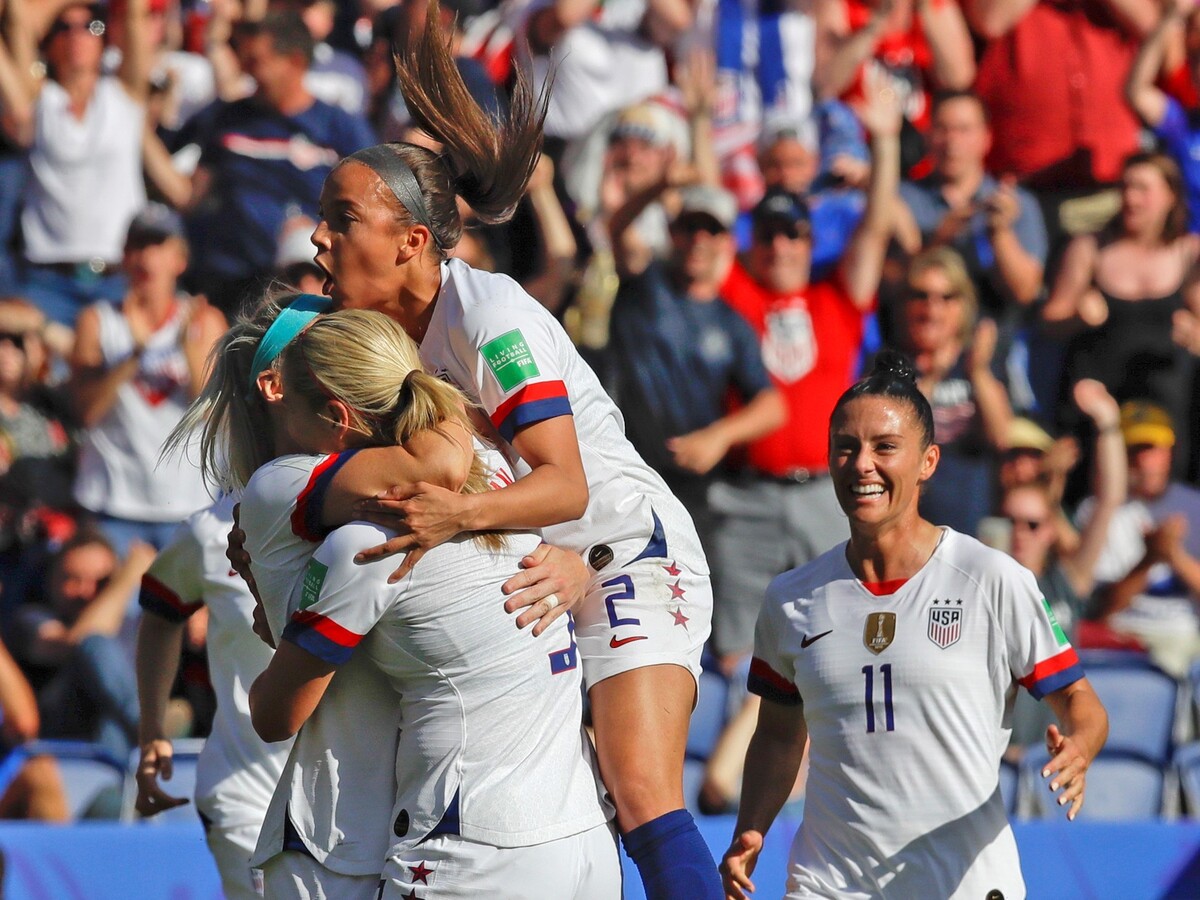
U.S. players celebrate after teammate Julie Ertz scored their side’s second goal during the Women’s World Cup Group F soccer match between United States and Chile at Parc des Princes in Paris, France on Sunday.
Alessandra Tarantino/AP
hide caption
toggle caption
Alessandra Tarantino/AP
The United States Women’s National Team continued to show why it’s the best team in the world with another stellar performance in the Women’s World Cup. The U.S. defeated Chile 3-0 before a sell-out crowd in Paris.
This is the first time the U.S. has ever played in the French capital. And the crowd that showed up was decidedly pro-USA. It was a gem of a game for the U.S. which controlled play from the beginning with crisp and precise passes that had Chile on the defensive from the first whistle.
It was a different look for the U.S. as there were seven lineup changes to the starting 11 from the last game. Several veterans sat out the game including Alex Morgan, Megan Rapinoe and Tobin Heath. It shows the depth of the American squad and the switch-ups didn’t seem to bother the team. The U.S. played most of the first half attacking Chile and continuing to show its dominance this World Cup as the defending champions. Coach Jill Ellis is looking to squeeze the best out of her players as she tests different lineups as critical games of the tournament loom.
There was a lot to like against Chile. Carli Lloyd got the scoring started early with a beautiful left-footed strike from the top of the penalty area in the 11th minute. It was a record goal for the team captain. She becomes the first person to score in six consecutive Women’s World Cup games. The U.S. never let up after that. In the 26th minute, Julie Ertz slammed a spinning header into the back of the net off a corner kick. Carli Lloyd scored again in the 35th minute with a powerful header of her own.
It was a statement game for Lloyd (despite missing a penalty kick in the 81st minute) who came in off the bench in the record-setting 13-0 win against Thailand. Lloyd is playing in her fourth World Cup and now has 10 World Cup goals and moves into third all-time for the USA (Abby Wambach has 14 and Michelle Akers 12). Lloyd is the oldest U.S. player who turns 37 next month.
The U.S. had 25 shots on goal compared to just one by Chile. The Chilean goalkeeper, Christiane Endler, had several sparkling saves to keep the U.S. tally lower. As noted by my colleague Laurel Wamsley who attended the game in Paris’s Parc des Princes stadium: “There were so many shots on the Chile goal, but they were stopped by Endler who had an incredible game. After each shot she stopped, the stadium filled with exasperated cries from U.S. fans.”
If there are any questions in this tournament, it’s about the U.S. goalkeeper Alyssa Naeher. She’s been untested so far and has only had to defend a total of three shots in the first two games.
With the win, the United States is guaranteed to move on to the knockout round of the Women’s World Cup. The U.S. will play its final game of group play against Sweden (which also advanced today) on Thursday. It’s an important match because it will determine whether the U.S. has an easier or more difficult path forward.

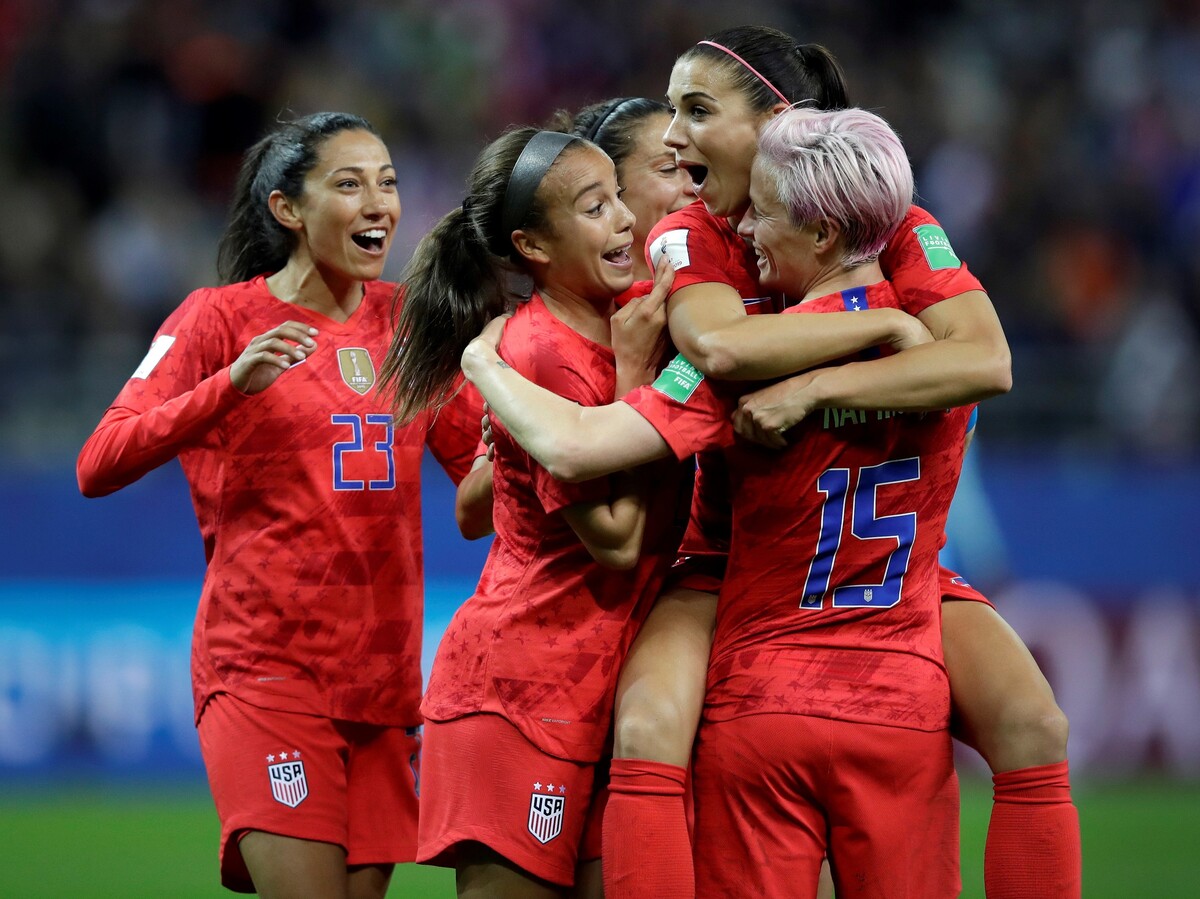
United States’ Alex Morgan, second right, celebrates after scoring her side’s 12th goal during the Women’s World Cup Group F soccer match between United States and Thailand at the Stade Auguste-Delaune in Reims, France on Tuesday.
Alessandra Tarantino/AP
hide caption
toggle caption
Alessandra Tarantino/AP
When the U.S. plays Chile on Sunday at the Parc des Princes in their second match of the Women’s World Cup, it will be the first time the U.S. women’s team has ever played in Paris. But the squad is certainly not unknown.
In their record-setting 13-0 blowout of Thailand last Tuesday night, the Americans made clear that they are here with one mission: to win the Cup. They offered strong evidence that they will play every game with all they have.
If the next few matches go as expected, the U.S. is headed straight to a quarterfinal match against host country France – a squad that has looked fearsome in its first two games. In a press conference on Saturday, U.S. Coach Jill Ellis was asked: Would she ever tell her team to play less than 100% to avoid encountering France so early in the tournament?
That’d be a no, Ellis indicated.
“I struggle to tell my team not to tackle each other in training the day before [matches],” she said. “At this point your focus is on yourself. You put yourself in the best position to advance in this tournament.”
Chile lost in its opening match against Sweden, 0-2. But the match was closer than the scoreline suggests. Chile held Sweden scoreless most of the game – then a rain delay was called with 18 minutes left on the clock. Sweden figured some things out during the delay, and they scored twice before the final whistle.
Chile is going to be hungry for a win – they need an upset if they are to continue to the next round. One player to watch is the team’s goalkeeper Christiane Endler. Her father is German and her mother is Chilean; she played soccer at University of South Florida and now plays for top-tier French club PSG.
La Roja, as Chile’s team is known, finished second to Brazil in qualifying for the Cup. They pulled off a 4-0 win over Argentina to clinch their berth in the tournament. The U.S. and Chile played twice in the fall of 2018 – until then, they had never met. Those friendlies, played in California, saw the U.S. win 3-0 and 4-0.
The U.S. offense, with its skilled attackers and deep bench, will be hard for most teams here to stop. Its defense, though, is yet untested. Sunday’s match could offer more clues, if Chile is able to gain enough possession to make a run at the U.S. goal.
The teams will take the pitch in front of a sellout of crowd of some 45,000 people.
“The first game had so many fans it almost felt like a home game,” U.S. midfielder Lindsey Horan said Saturday at the stadium. “For us to be here, in Paris, kind of the heart of it all … is absolutely incredible. We’re just all excited for this next game.”
The Yanks will have at least one fan looking down at them from above: Astronaut Anne McClain tweeted a view of the stadium as seen from the International Space Station. She says the crew will be watching.
The U.S. Women’s soccer team beat Thailand 13-0 on Tuesday, sparking an ethics debate over running up the score against a weaker opponent. NPR’s Michel Martin talks to sports ethicist Shawn Klein.
MICHEL MARTIN, HOST:
The Women’s World Cup is underway in France, and as usual in the early rounds, the underdogs have been getting dispatched by the powerhouses pretty handily. But Tuesday’s match between the U.S. and Thailand took this to a new level. The U.S. crushed the Thai opponents 13-0. For some, this was a cause for celebration and vindication, as the U.S. women have been pressing their governing body for better pay and conditions. But for some commentators, the lopsided result raises questions about sportsmanship and even ethics. Should the Americans have kept running up the score against the vastly outmatched Thais?
To settle this, we’ve called Shawn Klein, a lecturer in ethics and philosophy at Arizona State University. And he’s with us now from KJZZ in Arizona.
Thank you so much for joining us.
SHAWN KLEIN: Thanks for having me.
MARTIN: And, professor Klein, I want to mention that you teach a class in sports ethics – a class that has a whole section of the syllabus devoted to the ethics of running up the score. So you have thought a lot about this. You watched this game. Did it strike you as unethical in the moment?
KLEIN: I thought it was exciting. I thought it was ridiculous. I kept running to my son and saying, they scored again. They scored again. I didn’t experience it as lacking in sportsmanship.
MARTIN: And when you say ridiculous, you don’t mean that in a bad way. You mean it like, ridiculous – like, wow, this is ridiculous.
KLEIN: Yeah. I mean…
MARTIN: This is crazy (laughter).
KLEIN: Crazy – this is – I’ve never seen this. This is, you know, Michael Jordan leaping over all the defenders in basketball. This is Serena Williams demolishing, you know, her competition in a tennis match. It was a sporting moment that you just don’t see, and so it would – that part was exciting, to see that historical aspect of it.
MARTIN: And so what do you make of the way this has kept bubbling up all week? I just want to note that the U.S. coach, Jill Ellis, said that if this had been a men’s soccer match, these questions would never have come up. I don’t know any way to test that theory. But why do you think this has bubbled up like it has all week?
KLEIN: I mean, I think she’s right to a degree. I do think that the fact that this is the Women’s World Cup is playing a role of why it’s getting the attention it’s getting. At the same time, these questions do get raised in other sports. I mean, I can’t recall it being raised in men’s soccer. Certainly, from the U.S. perspective, the U.S. has never gotten (laughter) close to having this kind of match – at least, on the winning side. But in other sports, whether it’s the NFL, men’s college football, baseball, flipping the bat after a home run, the celebrations – this question does get raised against men’s teams.
MARTIN: You did mention the celebrations. So that is another sportsmanship question that has come out of this match – about the way the U.S. women celebrated their goals – you know, jumping in each other’s arms or rolling on the field. I mean, that’s pretty standard stuff. But I do wonder if you think that the fact that the team kept celebrating when they kept scoring – do you think that’s something that’s pushing people’s buttons?
KLEIN: I do think that that’s the driving force for a lot of the discussions. But what the U.S. players were doing was coming together. In some of the cases – so you take Mallory Pugh, this was her first World Cup goal. Yes, it was the 11th goal that the U.S. scored, but this was her first goal. So of course she’s going to celebrate, and of course the team around her is going to come to her and celebrate.
And that shows great team chemistry – that they’re all so happy for Pugh’s success and achievement – an achievement that she’s been dreaming about since she was 6 years old. So I think that that ability to dream and then celebrate when you have achieved your dream, I think, is one of the magical things of sport. And I would hate to see us not celebrate that.
MARTIN: I wanted to ask you, for the people who think it’s just not a good look or maybe it just makes the U.S. look bad or like bullies, why do you think that it was important from the standpoint of the U.S. women for them to play hard and score as many goals as they could? Like, what point do you think they were making?
KLEIN: One is just internal to their – to the team – that they can play well together in the context of a game in front of fans on international TV. I also think it’s a message to the rest of the field that the U.S. is here to defend their championship, and they’re going to play hard.
I think it’s also important in terms of telling young women that it’s OK to be who they are. It’s OK to be great. It’s OK to pursue greatness and to achieve greatness. And it’s OK to celebrate your achievements and not to run from them and not to hide from it. And I think that’s an important message.
MARTIN: Well, I do want to note the USA plays Chile tomorrow, Sunday. Care to – I don’t know – handicap it for us?
KLEIN: (Laughter) I think that the U.S. will win. I don’t think we’ll get into the double digits again. I’ll say that. It may be more like a – let’s say 6-1 score. Let’s go with that.
MARTIN: OK. That’s Shawn Klein. He hosts a podcast called “The Sports Ethicist” where questions like this one often come up.
Shawn Klein, thanks so much for talking to us.
KLEIN: Thanks for having me.
Copyright © 2019 NPR. All rights reserved. Visit our website terms of use and permissions pages at www.npr.org for further information.
NPR transcripts are created on a rush deadline by Verb8tm, Inc., an NPR contractor, and produced using a proprietary transcription process developed with NPR. This text may not be in its final form and may be updated or revised in the future. Accuracy and availability may vary. The authoritative record of NPR’s programming is the audio record.

Kristine Lilly reacts after scoring during a quarter final match at the 2007 Women’s World Cup.
Saurabh Das/AP
hide caption
toggle caption
Saurabh Das/AP
In her more than 20 years playing for the U.S. Women’s National Soccer Team, Kristine Lilly played in five World Cup finals and three Olympics — she holds the record for the most international appearances in the sport’s history. Lilly has recently written a book on team-building called Powerhouse.
We’ve invited Lilly to play a game called “Your cup runneth over!” Three questions about cups that are not the World Cup.
Click the audio link above to find out how she does.
PETER SAGAL, HOST:
And now the game where we ask somebody who’s used to doing great things to do something silly. It’s called Not My Job. The U.S. women’s soccer team has been dominant internationally for decades, and for more than 20 years, Kristine Lilly was its star. She played in five World Cup finals, three Olympics. She joins us now.
Kristine Lilly, welcome to WAIT WAIT… DON’T TELL ME.
KRISTINE LILLY: Thanks for having me.
(APPLAUSE)
SAGAL: Thank you. So just to establish the credentials here, you were on the U.S. women’s team for 23 years starting when you were 16.
LILLY: Yes. And I know it’s hard to believe.
SAGAL: Wow. So you were on the famous team that won in ’99 with Brandi Chastain’s final penalty kick.
LILLY: Correct.
SAGAL: And you’ve – you also won in the next and the next, right? How many championships – three?
LILLY: Well, they won two World Cups, so I was on the first one in ’91 and then the second in ’99. And then I was part of two gold-medal teams…
SAGAL: Right. So you…
LILLY: …’96 and ’04, yeah.
SAGAL: You’ve got some hardware. You’ve got some…
(APPLAUSE)
LILLY: I do – bling.
SAGAL: So now that we’re established you know what you’re talking about, we’ve got to ask you about the topic of the week, which was the American match against Thailand. First of all, that was a little unusual, right?
LILLY: It was. I mean, you know, what? I respect the Thailand team. They kept playing. The U.S., you know, was on fire.
SAGAL: I will confess – I’m rooting, of course, for the U.S., of course – but I felt a little pity for the Thai team.
LILLY: Yeah, no…
SAGAL: And I was, like, come on. You guys get a goal. You can have a goal, too. Come on.
(LAUGHTER)
SAGAL: Come on, kids.
LILLY: Oprah’s giving out goals.
(LAUGHTER)
SAGAL: You get a goal. You get a goal.
LILLY: No…
SAGAL: Did you feel – were you…
LILLY: No, I did, too. It’s tough. You know, I’ve been on a team that scored a bunch of goals. I was in the World Cup in ’07 and lost to Brazil 4-0 in the semifinals, which was – felt like it was 10-0. So it’s hard to be on the other side of it. But I – like I said, I respect Thailand. They kept their heads up. They can look at it that way and maybe forget about the score for now.
(LAUGHTER)
SAGAL: Yeah, that’s not going to happen. But…
(LAUGHTER)
SAGAL: What is it like to be an American playing soccer? And we all know soccer is not one of the big sports here in America. Famously, Americans don’t care about soccer. Do the – do, like, the Europeans and the Brazilians, the traditional soccer powers – do they get frustrated because it’s Americans who are thrashing them?
LILLY: Well, I don’t think they like us very much.
(LAUGHTER)
SAGAL: No.
LILLY: But it’s funny. I was just at the – I was at the opening game, France against Korea, and there was other players from around the world that played during my time – a Norwegian, a French player. And I was talking to the Norwegian, and I was, like, we didn’t like you. And she’s, like, well, we didn’t like you.
(LAUGHTER)
LILLY: It was pretty mutual playing, but that’s what made it competitive. That’s what made great rivalry. And now we can sit and talk about it and share what we’ve learned through playing the game and what, you know, the women’s game has grown into now.
SAGAL: Do you still dislike them a little bit?
LILLY: Oh, yes. Totally.
SAGAL: Oh, yeah.
(LAUGHTER)
HELEN HONG: Do you know a lot of Norwegian curse words?
LILLY: Zilch.
SAGAL: Yeah.
HONG: Is that one?
JORDAN CARLOS: Oh, I thought that was one.
(LAUGHTER)
SAGAL: She doesn’t learn Norwegian curse words. She inspires them.
(LAUGHTER)
SAGAL: Is there a difference between the men’s game and the women’s game other than the fact that one is played by men, one is played by women? Are there different styles of soccer? Do you see different things if you know what to look for?
LILLY: The difference I would say right now – the men are a little bit more dramatic.
(CHEERING)
HONG: Oh, yes.
CARLOS: Whoa, whoa. Shots fired.
HONG: I know.
CARLOS: Shots fired.
HONG: Those men are just so overemotional.
SAGAL: I know.
HONG: Wow.
(LAUGHTER)
SAGAL: So do your kids play soccer?
LILLY: They do. I have two daughters, and they both play soccer.
SAGAL: Oh, my gosh. So what kind of soccer mom are you?
(LAUGHTER)
LILLY: Oh, my goodness. Some days it’s good, some days it’s not good.
(LAUGHTER)
SAGAL: Describe a bad day.
(LAUGHTER)
LILLY: Well, I also help coach, so I…
HONG: Whoa.
LILLY: I get to say the things. But sometimes, I’m, like, oh, my gosh. I really want to say something right now, but I can’t.
SAGAL: So wait a minute. You help coach.
LILLY: Yes.
SAGAL: So that means there’s a coach.
(LAUGHTER)
SAGAL: And this poor woman…
(LAUGHTER)
SAGAL: …Has a 23-year veteran…
(LAUGHTER)
SAGAL: …Of the U.S. women’s team with two World Cup and two Olympic titles standing there giving suggestions.
(LAUGHTER)
LILLY: You nailed it.
SAGAL: Yeah.
(LAUGHTER)
HONG: I bet she knows Norwegian curse words.
SAGAL: Yeah, I bet she does.
(CHEERING)
SAGAL: And are you gentle about it? Oh, coach, you know, it’s just an idea, but maybe you could try to win a game? I mean, is that…
(LAUGHTER)
LILLY: I’m a very good assistant.
SAGAL: I’m sure you are.
(LAUGHTER)
SAGAL: And how are you with your daughters? I mean, are you – do you, like, you know, give them a talking-to if they don’t play to their potential? Or are you one of those everybody-is-a-champion kind of people?
LILLY: Oh, no. No, everyone’s not a champion. No.
(APPLAUSE)
HONG: Wow.
CARLOS: Wow. Oh, my…
HONG: Damn. Harsh.
SAGAL: Get that participation trophy out of my house.
(LAUGHTER)
LILLY: Exactly.
SAGAL: You ever been tempted to cut one of your daughters from the team?
(LAUGHTER)
LILLY: Not yet.
SAGAL: All right.
(LAUGHTER)
SAGAL: Well, Kristine Lilly, it is a pleasure to talk to you today. But we have invited you here to play a game we’re calling…
BILL KURTIS: Your Cup Runneth Over.
SAGAL: You, of course, are a World Cup champion. But what do you know about the world’s other cups? We’re going to ask you three questions about many different cups.
LILLY: Right.
SAGAL: Answer two correctly, you’ll win a prize that is not a cup for one of our listeners. Instead, it’s the voice of their choice from our show. Bill, who is Christine Lilly playing for?
KURTIS: Shane Heiman of Lawrence, Kan.
SAGAL: All right. Ready to play?
LILLY: All right. I am. All right, Shane. Here we go.
SAGAL: I can feel you, like, getting ready to go.
CARLOS: I know.
(LAUGHTER)
LILLY: I’m in my game mode right now. You know, I’m very competitive.
SAGAL: I know. I know. Here’s your first question. We’ve had cups of one kind, of course, for thousands of years. In fact, Pythagoras, the ancient Greek mathematician, was a pioneer in the cup field as well. What did he invent? Was it, A, the novelty gift cup…
(LAUGHTER)
SAGAL: …With the message world’s best mathematician on it…
(LAUGHTER)
SAGAL: …B, the prank cup, which spilled wine all over the user when he tried to take a sip; or C, the travel mug – in his case, a cup designed to be latched to the saddle of a horse?
LILLY: I’m going to go with C.
SAGAL: You’re going to go with C. It was actually the prank cup.
(LAUGHTER)
LILLY: Oh.
HONG: What?
SAGAL: Pythagoras, the great genius mathematician, invented the prank cup. And it’s really ingenious. If you pour in too much wine, it all of a sudden drains out onto your lap.
CARLOS: That Pythagoras.
SAGAL: Yeah.
(LAUGHTER)
ROY BLOUNT JR: Who invented the whoopee cushion? That’s…
(LAUGHTER)
BLOUNT JR: Socrates, I’ll bet.
CARLOS: Yeah.
LILLY: All right.
(LAUGHTER)
SAGAL: I notice, by the way, Kristine has stopped laughing. She is, like, wait a minute.
LILLY: I know. I’m, like, I’m mad right now.
SAGAL: All right. Yeah.
(LAUGHTER)
SAGAL: Next question. We all know and love Japan’s famous cup-o-ramen. You know, it’s a styrofoam cup. You pour in water, you get ramen noodles. It’s great. Other countries have their own version, too, like which of these? A, Russia’s cup-o-mashed potatoes; B, Canada’s cup-o-bacon; or C, Sweden’s cup-o-herring?
LILLY: Oh, man. What was the first one again?
SAGAL: The first one was Russia’s cup-o-mashed potatoes.
LILLY: Those good, old Russians – let’s see what they’ve got (laughter).
SAGAL: You’re going to go with that.
LILLY: Yeah.
SAGAL: You’re right, of course.
(SOUNDBITE OF BELL)
LILLY: Yeah.
(APPLAUSE)
CARLOS: Yeah.
SAGAL: The cup-o-instant mashed potatoes is available in chicken, beef, onion and crouton flavor. And I’m going to be honest – it sounds great.
(LAUGHTER)
SAGAL: Our last question – this is – you can think of this as the shoot-out. If you win, you win.
LILLY: Yeah.
SAGAL: All cars have cup holders now. That’s passe. That’s boring. The real innovation in drinking while driving is which of these? A, the top-of-the-line Mercedes Maybach, which comes with sterling silver champagne flutes for each passenger; B, the new model Honda Odyssey minivan, which has holders for juice boxes in the ceiling so you can hang them above your kids like IV bags…
(LAUGHTER)
CARLOS: Sweet juice.
SAGAL: …Or C, the new Ford 150 Tailgate Edition pickup, which has a built in beer keg and tap?
LILLY: Oh, these things are all just wrong.
(LAUGHTER)
LILLY: Oh, wow. I’m going with the minivan with the drip.
(GROANING)
HONG: Oh. The audience is rioting.
CARLOS: Yeah.
SAGAL: So you – so the idea is, like, you put your kid…
(LAUGHTER)
SAGAL: …Strap him in…
CARLOS: Yeah.
SAGAL: …Hook up the juice box…
CARLOS: Like a gerbil.
SAGAL: …Above their head, run the straw down to their mouth.
(LAUGHTER)
LILLY: I think it’s more like A, but I don’t agree with it.
(LAUGHTER)
SAGAL: So in other words, you think A is the right answer, but you just think it’s a wrong thing to have. You think it’s…
LILLY: Yes.
SAGAL: Well, the truth doesn’t care about your feelings.
(LAUGHTER)
SAGAL: So you’re going to pick it?
LILLY: Yes.
SAGAL: You are right, of course.
(SOUNDBITE OF BELL)
CARLOS: Yes.
(APPLAUSE)
LILLY: Thank you, audience.
SAGAL: This is a $200,000 luxury sedan, and you’d better believe for that amount of money it comes with a little fridge to keep your champagne cold.
CARLOS: Oh.
SAGAL: Yeah. Yeah. Bill, how did Kristine Lilly do on our quiz?
KURTIS: Kristine, you can hang another award up because you won our quiz.
SAGAL: Congratulations.
(APPLAUSE)
SAGAL: Kristine Lilly is a Hall of Fame soccer player. She’s played in five World Cups and three Olympics. Her new book on team-building, “Powerhouse,” is on sale now.
Kristine Lilly, thank you so much for joining us.
(APPLAUSE)
LILLY: Thank you.
SAGAL: Thank you, and good luck to your former teammates in the World Cup.
(SOUNDBITE OF SONG, “WORLD CUP FEVER (DEMO)”)
AIR MIAMI: (Singing) Hey, hey, hey, I’ve got it – World Cup fever. She, she, she, she’s got it – World Cup fever. I, I, I’ve got it – World Cup Fever. He, he, he’s got it – World Cup fever.
SAGAL: In just a minute, Bill has a new way to get you to eat your vegetables in the Listener Limerick Challenge. Call 1-888-WAIT-WAIT to join us on the air. We’ll be back in a minute with more of WAIT WAIT… DON’T TELL ME from NPR.
Copyright © 2019 NPR. All rights reserved. Visit our website terms of use and permissions pages at www.npr.org for further information.
NPR transcripts are created on a rush deadline by Verb8tm, Inc., an NPR contractor, and produced using a proprietary transcription process developed with NPR. This text may not be in its final form and may be updated or revised in the future. Accuracy and availability may vary. The authoritative record of NPR’s programming is the audio record.
The Women’s World Cup is under way, with exciting matches and some controversy as well.
SCOTT SIMON, HOST:
I wait all week to say, it’s time for sports.
(SOUNDBITE OF MUSIC)
SIMON: International women’s football – the Women’s World Cup now happening in France. NPR’s Tom Goldman joins us. Good morning, Tom.
TOM GOLDMAN, BYLINE: Good morning, Scott. I’m a little lost. There’s no abhorring dinosaurs.
SIMON: Well, I – you know, Stu Rushfield, our technical director, suggested a new one. Ready? OK?
GOLDMAN: Yeah.
SIMON: Adore the dinosaur. Not bad, right?
GOLDMAN: Not bad.
SIMON: I hope he was talking about the Raptors and not me. But in any event, well, it’s a – abhor the dinosaurs. A couple matches of the Women’s World Cup, a couple more tomorrow, including the U.S. against Chile, following their 13-0 victory over Thailand. Do you think Chile stands a better chance?
GOLDMAN: No. Well, maybe a better chance than 13-nil. That was a lot. Chile is playing in its first Women’s World Cup, doesn’t have a lot of experience, although it does have some good players, goalkeeper Christiane Endler, midfielder Francisca Lara. But the U.S. is just too much right now, Scott. Not sure it will be 13-nil, but should be win No. 2.
SIMON: I have to ask, what about the criticism the U.S. team faced following the celebrations as the score mounted – not, you know, goals six, seven and eight, but when it got to 10, 11, 12 and 13?
GOLDMAN: Yeah.
SIMON: That it was just – that it just wasn’t classy. And I know we’re two men talking about this, but I have criticized male athletes for rubbing the noses of their opponents in the dirt with celebrations. And, you know, you’re playing the World Cup. Criticism is part of the package.
GOLDMAN: Yeah, I mean, Abby Wambach, the great U.S. player – former U.S. player, said, you know, there wouldn’t be this criticism if it were men, and I think that’s wrong. I think there would’ve been. You know, it was excessive with the later goals, as you mentioned.
U.S. women’s national team member Mallory Pugh says the team hasn’t really talked about it as a team. There’ve been various explanations by team members to media, you know, that one person said they had a lot of stress building coming into the World Cup; they wanted to let it out. For some of the young women, it was a realization of a life dream, scoring in the World Cup, so they were excited.
Look; no one begrudges them the number of goals scored. It’s important to score a lot in the group stage. But, yeah, probably best from now on if it gets lopsided again to mute things a bit and act like you’ve been there, right?
SIMON: That’s what Walter Payton said. Sports writers in France – I benefit from following that a little – say the celebrations made the U.S. team look like strutting, dancing, overweening imperialists and has made them the least popular team in the World Cup.
GOLDMAN: How do you really feel? Yeah, really.
SIMON: Well, I was quoting – oh, never mind. OK.
GOLDMAN: (Laughter) No, how do the French really feel? Yeah.
SIMON: How do the French really feel?
You’re in California this week for the U.S. Open at Pebble Beach. We’ve been accused of not giving enough attention to golf on this program.
GOLDMAN: Yeah.
SIMON: OK, so you’re in Pebble – you’ve been in Pebble Beach. In any event, moving on.
GOLDMAN: (Laughter) Oh, mean.
SIMON: I’ve got to ask you about the NBA. And you know, abhor – adore the dinosaur. What about the argument that the Warriors, you know, were practically limping by the end? And…
GOLDMAN: Well…
SIMON: Yes. Go ahead.
GOLDMAN: Yeah. Well, you know, let’s do adore the dinosaur and acknowledge they played really well to beat the Warriors. But, you know, the argument, I think, is valid. I think definitely could’ve been different with a healthy Kevin Durant and, at the end, Klay Thompson, who tore the ACL in his left knee in that last game after he had been playing really well.
You know, Steve Kerr was asked that question, though – the head coach for Golden State. What if Klay hadn’t been injured? And he shut things down, simply saying, he was. And that’s the ultimate answer. Injuries happen. They happened, and the Raptors won.
SIMON: Is it going to – is a team on its way to the finals going to start subbing more of its regulars? And does that raise a question about, is it sportsmanship? Is that what the fans pay hundreds of dollars for a seat to see?
GOLDMAN: That’s an interesting question. You know, Kerr gave voice to this when he wondered if the wear and tear of five straight seasons getting to the finals led to these injuries.
There is a science of athletic fatigue. Basketball writer Henry Abbott wrote about it in ESPN The Magazine a couple years ago. In it, he talked to exercise physiology expert Dr. Michael Joyner, who said humans can’t sustain more than five all-out efforts every two weeks. So considering that, maybe coaches will look at what happened to Golden State and look at maybe resting guys more during the regular season.
SIMON: NPR’s Tom Goldman, thanks so much.
GOLDMAN: You’re welcome.
(SOUNDBITE OF MUSIC)
Copyright © 2019 NPR. All rights reserved. Visit our website terms of use and permissions pages at www.npr.org for further information.
NPR transcripts are created on a rush deadline by Verb8tm, Inc., an NPR contractor, and produced using a proprietary transcription process developed with NPR. This text may not be in its final form and may be updated or revised in the future. Accuracy and availability may vary. The authoritative record of NPR’s programming is the audio record.

U.S. forward Alex Morgan shoots and scores past Thailand’s Natthakarn Chinwong on Tuesday in Reims, France, in the group stage of the Women’s World Cup.
Michael Chow/USA Today Sports via Reuters
hide caption
toggle caption
Michael Chow/USA Today Sports via Reuters
In the first seven days of the Women’s World Cup, there have already been stunning goals, crushing defeats and no shortage of controversy. We’ve been following the action from France — oui, un croissant, s’il-vous plaît — and here are some of the key stories we’ve seen in a week of great soccer.
A very big win
The biggest story is the United States’ demolition of Thailand on Tuesday night, winning 13-0. The game set all kinds of World Cup records: It was the most goals scored and the biggest margin of victory in any tournament, women’s or men’s; it had the highest number of players — seven — to score in a game; and it tied the record for number of goals in a match — five — courtesy of Alex Morgan. (U.S. forward Michelle Akers had five in 1991, as did Russia’s Oleg Salenko on the men’s side in 1994.)
And a number of World Cup rookies for the U.S. scored on soccer’s biggest stage: Samantha Mewis and Rose Lavelle both had two goals, and Mallory Pugh and Lindsey Horan each notched one. Veteran forwards Megan Rapinoe and Carli Lloyd both scored, as well.
As the history-making game played out in the stadium in Reims, the sense was that we were witnessing an incredible display. While it was no surprise that the U.S. defeated the weaker Thailand squad, the Yanks’ goals were impressive, as was their ability to keep up pressure nearly 100% of the time — a testament to the strength of a squad that could be the best ever.
FIFA
YouTube
But some observers thought the U.S. celebrated its later goals with a bit too much joy. (One of those observers, a former player for the Canadian national team, says she began receiving death threats.)
But the U.S. shrugged off such criticism.
“We knew that every goal could matter,” Morgan said after the game, referring to the fact that goal differential can affect which team ranks at the top of the group. ‘When it comes to celebrations, I think this was a really good team performance tonight, and I think it was important for us to celebrate with each other.”
The leaderboard
Three teams have already secured two wins, making them very likely to advance: France, Germany and Italy.
Host country France looked powerful — and dangerous to its future opponents — in Les Bleus’ opening day 4-0 win over South Korea. Eugénie Le Sommer got the game off to a rollicking start with a goal in the ninth minute off a pass from captain Amandine Henry.
FIFA
YouTube
Defender Wendie Renard, who hails from the Caribbean island of Martinique and stands 6 feet, 1 inch tall, scored two headers and showed how France will be a force on corner kicks. And Henry closed off the night with a gorgeous goal in the 85th minute.
WHAT A STRIKE BY AMANDINE HENRY ?? pic.twitter.com/FwXfNZWYJ6
— FOX Soccer (@FOXSoccer) June 7, 2019
The U.S. plays Chile on Sunday — a match the Americans are expected to win.
Some surprises
Group C, comprising Australia, Brazil, Jamaica and Italy, is shaping up to be an interesting foursome.
One reason is that Italy came out stronger than expected. Ranked No. 15 in the world, Italy beat Australia (ranked No. 6) 2-1 when they faced off on Sunday. In its second match, Italy clobbered World Cub debutante Jamaica 5-0 on Friday.
Australia is regarded as one of the strongest teams in the tournament, and after that surprise loss to Italy had to take on Brazil. Brazil beat Jamaica in its first game, without Marta, who was recovering from a thigh injury.
As Australia and Brazil faced off on Thursday, Brazil pulled out to an early lead, with a penalty by Marta in the 27th minute and a powerful header by Cristiane in the 38th. But the Matildas came roaring back, with a goal just before the half, another in the 58th and an own goal by Brazil’s Monica a few minutes later. Australia became just the second team in Women’s World Cup history to come back after a two-goal deficit.
Some questions linger around the Brazilian team. Marta, Cristiane and veteran defender Formiga all came off the pitch early in the Australia match, which could indicate nagging injuries. Formiga also racked up her second yellow card, which means she will miss Brazil’s final group-stage match, against Italy on Tuesday.
YouTube
There has also been only one tie thus far: a 0-0 draw between Argentina and Japan.
Good moves
South Africa — the team nicknamed Banyana Banyana — really knows how to enter a room.
South Africans showing up to World Cup games remains the best entries pic.twitter.com/yB7UCGZAQz
— Miriti Murungi (@NutmegRadio) June 8, 2019
After the USA’s thumping of Thailand, Carli Lloyd went up to Thai goalkeeper Sukanya Chor Charoenying and gave her a hug and some words of encouragement. Then the two had a very sweet interaction on Twitter.
All you can do is give it your best each and every day. Keep fighting and never give up!! Still 2 more games to play. ? https://t.co/pFW4wEK8Nb
— Carli Lloyd (@CarliLloyd) June 13, 2019
“I felt for her,” Lloyd told reporters Friday. “In the wins and losses, I think character is a true testament to the sport. … I just hope they continue to put their head up, continue to fight — and just keep going.”
Attorneys who represent hundreds of local governments have a new proposal for how to deal with the opioid crisis. They unveiled the framework for nationwide settlement in federal court on Friday.
MARY LOUISE KELLY, HOST:
All right, attorneys representing hundreds of local governments around the country met this morning in Ohio. They unveiled a plan they hope will lead to a national settlement of lawsuits stemming from the opioid epidemic. Tens of billions of dollars are at stake. A lot of that money could go to helping people struggling with addiction, but big hurdles remain before the drug industry agrees to major payouts.
North Country Public Radio’s Brian Mann reports.
BRIAN MANN, BYLINE: The motion was filed in a federal court in Ohio by a team of attorneys who represent 1,200 counties, cities and towns that all say they need money to help respond to the opioid epidemic. One of those attorneys, Joe Rice, says they’ve been trying to reach a settlement with two dozen drugmakers and distributors that sold opioid medications. But during negotiations over the last year, companies haven’t signed on.
JOE RICE: The defendants don’t have a sense of how they get closure. How can they put this issue behind them? And with the whole country involved, it’s a difficult question.
MANN: The problem, says Richard Ausness, a professor at the University of Kentucky who follows opioid litigation, is that if companies like Purdue Pharma and McKesson settle for billions of dollars with one group of towns and cities, they could still face other litigation. What the drug industry wants, he says, is a deal that brings closure.
RICHARD AUSNESS: Because obviously they don’t want too many outliers suing them after they’ve settled with the majority. And this proposed settlement seems to anticipate that and try to provide for as much of a global settlement as is possible.
MANN: The plan unveiled today doesn’t include the dollar amounts for a settlement or a formula for who would pay. Negotiations haven’t gotten that far. What this plan does is lay out a deal where roughly 24,000 local governments would all be swept into a single group that could settle with drug companies together. Those communities would get to vote on any proposed payout. They could also opt out of the arrangements altogether. But attorney Joe Rice says he hopes for a lot of buy-in if this plan is approved by the court.
RICE: This is an attempt to bring a organizational load to the municipalities around the country in order they can speak with a voice.
MANN: This kind of closure and clarity could be an important bargaining chip because local governments hope for massive compensation, payouts that would rival the big tobacco settlements of the 1990s.
RICE: Tens of billions of dollars would be needed to make a significant – a real significant impact on this epidemic.
MANN: Attorneys for two of the drug companies involved in this lawsuit describe the proposal as interesting but preliminary. They said they haven’t had time to work through the details of how it would work. Some companies are also still reluctant to admit wrongdoing. Johnson & Johnson is facing a state civil trial right now in Oklahoma, accused of improperly marketing opioid products. Earlier this year, Jennifer Taubert, CEO of Johnson & Johnson’s Janssen division, testified before Congress, insisting the company isn’t responsible for the prescription opioid epidemic.
(SOUNDBITE OF ARCHIVED RECORDING)
JENNIFER TAUBERT: Everything that we have done with our products when we promoted opioid products, which we stopped marketing a long time ago, was very appropriate and responsible.
MANN: Joe Rice, attorney with the plaintiffs group that filed the motion today, says he doesn’t think this proposed settlement framework will resolve all opioid litigation against Big Pharma. But he does think it might allow companies or groups of companies to now come forward and cut a deal.
RICE: I think that the distributors could potentially all get on the same page. I think the manufacturers could potentially get on the same page.
MANN: The judge overseeing the consolidated federal opioid case in Ohio, Dan Polster, has been pushing for the parties to reach a settlement. So far, that’s been elusive, but sources tell NPR the creation of this new framework was one of the steps the court asked for to help make a final deal possible. Brian Mann, NPR News.
Copyright © 2019 NPR. All rights reserved. Visit our website terms of use and permissions pages at www.npr.org for further information.
NPR transcripts are created on a rush deadline by Verb8tm, Inc., an NPR contractor, and produced using a proprietary transcription process developed with NPR. This text may not be in its final form and may be updated or revised in the future. Accuracy and availability may vary. The authoritative record of NPR’s programming is the audio record.

Rhiannon Giddens and Francesco Turrisi.
Karen Cox/Courtesy of the artist
hide caption
toggle caption
Karen Cox/Courtesy of the artist
Rhiannon Giddens and Francesco Turrisi are both gifted multi-instrumentalists and devoted students of music history. Each has dug into the past to illuminate the present and worked to give credit where credit is due for the way instruments and ideas have moved over time between people and places.
While Rhiannon’s work has focused on the influence of African traditions on what we think of as American music, Francesco is an expert in the often unacknowledged influence of Arabic and Middle Eastern music on what we think of as European sound. They found common ground in their quest to dispel false cultural narratives and turned it into gorgeous music on a new collaborative album called there is no Other. Hear their live performance in the player.

Updated at 4:20 p.m. ET
Attorneys for local governments across the country unveiled a plan Friday that they say would move the nation closer to a global settlement of lawsuits stemming from the deadly opioid crisis.
Final payouts could rival the massive tobacco settlements of the 1990s. Such a deal, if reached, could funnel tens of billions of dollars to communities struggling with the opioid addiction crisis, while restoring stability to one of the country’s biggest industries.
“There has got to be a comprehensive approach to addressing the national epidemic, and this is a step toward that,” said Joe Rice, co-lead council for attorneys who filed the motion, representing hundreds of the communities suing Big Pharma.
He said the framework, which attorneys filed in federal court in Ohio and still needs approval by the court, could help more than 24,000 communities across the U.S. fight the opioid crisis. None of the defendant companies, which are facing a tsunami of litigation stemming from the epidemic, have signed off on the framework yet.
“The defendants don’t have a sense of how they get closure, how can they put this issue behind them,” Rice said. “So they have asked us for a roadmap.”
In all, more than 1,800 lawsuits have been filed so far against drugmakers such as Johnson & Johnson, distributors like McKesson and street-corner pharmacies including CVS and Walmart. (Note: Walmart is one of NPR’s financial supporters.)
Plaintiffs claim the companies earned billions in profit by aggressively marketing and selling prescription opioids.
Richard Ausness, a professor at the University of Kentucky who follows opioid litigation, says unless some kind of structure like this is created, companies could settle for billions of dollars with one group of towns and cities but still face other lawsuits.
“Obviously they don’t want too many outliers suing them after they’ve settled with the majority,” Ausness told NPR. “This proposed settlement seems to anticipate that and provide for as much of a global settlement as possible.”
Attorneys for two of the drug companies involved in this lawsuit described the proposal as interesting but preliminary. The attorneys, who asked not to be named because they had not been authorized to speak publicly, said they haven’t had time to work through the details of how it would work.
Overdoses tied to prescription pain pills have killed more than 200,000 Americans, according to the Centers for Disease Control and Prevention, and cost taxpayers billions of dollars.
The wave of civil suits has already forced one drugmaker, Insys Therapeutics, into bankruptcy. Another major firm, Purdue Pharma, has indicated they may follow suit. Judge Dan Polster, who is overseeing a trial of hundreds of consolidated opioid cases, has repeatedly urged communities and companies to reach a deal.
That hasn’t happened yet. But intense negotiations are continuing, and sources tell NPR they expect many of the two dozen drug industry firms involved in the consolidated Ohio case to agree to some kind of substantial payout. In the end, there may be multiple settlements, involving separate companies or groups of companies, all contributing to a national fund designed to ease the opioid epidemic.
“Tens of billions of dollars would be needed to make a real significant impact on this epidemic,” Rice told NPR.
Under this plan, nearly every community in the U.S. — cities, towns, villages and counties — would be swept into a single “negotiating class.” Under that legal designation, local leaders would be able to approve or disapprove any settlements reached with drug companies. The vote would be weighted by population.
If three-quarters of communities sign off on deals that are struck, it would be finalized and money would be paid out, ending the company’s liability. A separate emergency fund, roughly 15% of any settlements would be set aside for towns or cities particularly hard-hit by the opioid crisis. And 10% of all drug industry payouts would go to pay the hundreds of private trial attorneys involved in the litigation.
Communities that don’t want to be part of any global settlement can also opt out entirely, but Rice says this plan was developed in consultation with many of the local officials and legal teams around the U.S. that are suing the drug industry.
Meanwhile, pressure has been growing on drug companies in recent months to reach some kind of accord with communities. In March, Purdue Pharma settled with the state of Oklahoma for roughly $270 million. Before its bankruptcy, Insys Therapeutics agreed to pay the federal government more than $225 million in penalties tied to opioid marketing. Five of that company’s executives were convicted of federal racketeering charges. Johnson & Johnson is currently on trial in Oklahoma state court.
With the much larger Ohio case set to begin in October, public scrutiny and pressure will only grow. Judge Polster has refused to dismiss claims against drug firms, and he’s made it clear he feels the drug industry is partly to blame for the opioid epidemic.
During a hearing in preliminary January 2018, Polster urged the parties to reach a deal that would “get some amount of money to the government agencies for treatment. Because sadly every day more and more people are being addicted, and they need treatment.”