Old Fight, New Front: AIDS Activists Want Lower Drug Prices. Now!

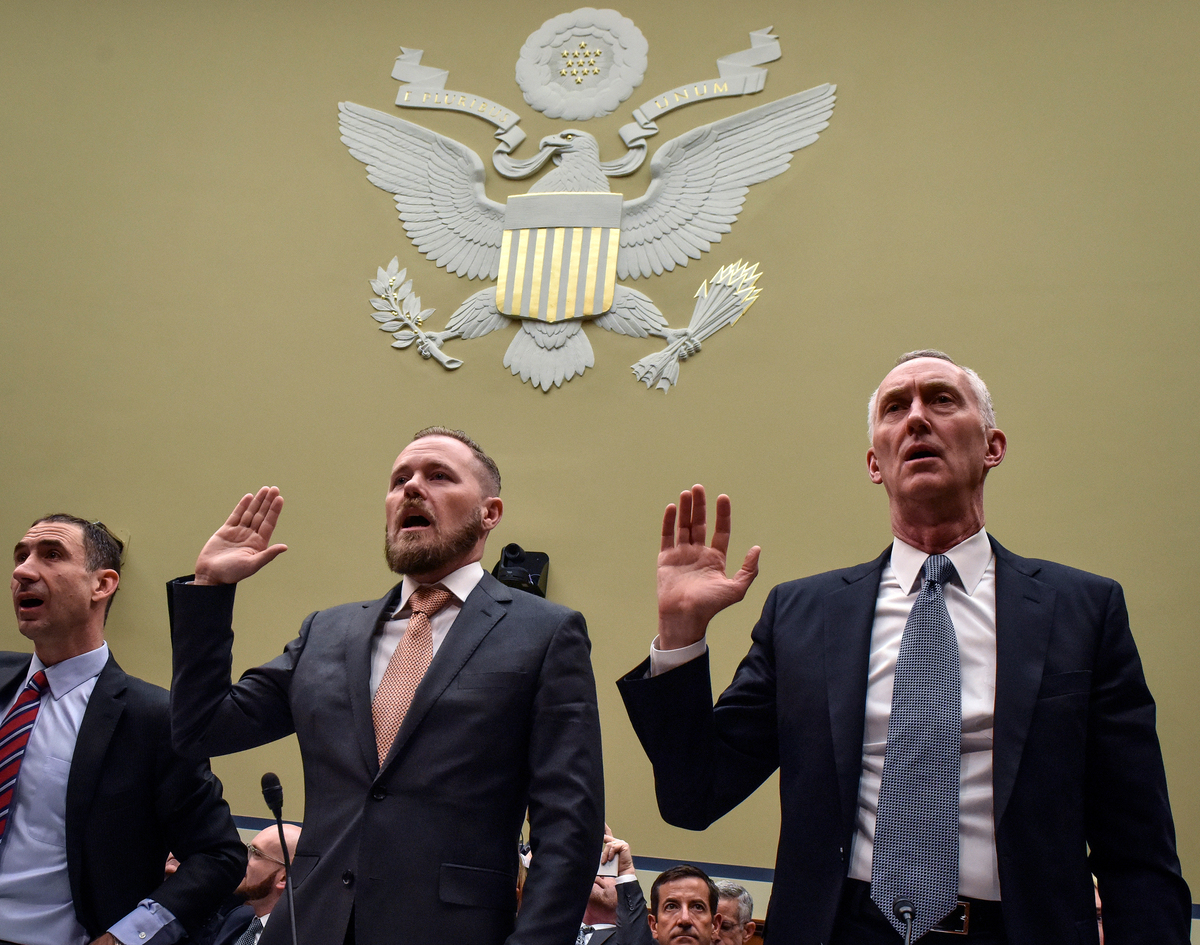
During testimony before a congressional hearing on drug prices this month, Dr. Aaron Lord (left), a patient advocate and AIDS activist, publicly challenged Daniel O’Day, CEO of Gilead Sciences (right), to lower the price of Gilead’s HIV prevention drug Truvada.

Bill O’Leary/The Washington Post/Getty Images


hide caption

toggle caption

Bill O’Leary/The Washington Post/Getty Images

When the first HIV drug, AZT, came to market in 1987, it cost $10,000 a year.

That price makes Peter Staley laugh today. “It sounds quaint and cheap now, but $10,000 a year at that time was the highest price ever set for any drug in history,” he says.

At the time, the price Burroughs Wellcome set for the drug sparked outrage. The AIDS epidemic was an urgent national crisis. For many, the diagnosis was a death sentence. The TV-viewing public was horrified by endless images of young men, suddenly sick and dying. A lost generation.

ACT UP — the AIDS Coalition to Unleash Power — was established by Staley and others to drive government attention and research toward a cure. A key early goal of the movement: force down the price of AZT. Whatever it took.

Demonstrators from the organization ACT UP, angry with the federal government’s response to the AIDS crisis, protest in front of the headquarters of the Food and Drug Administration in Rockville, Md., on Oct. 11, 1988, and effectively shut it down. By mid-morning some 50 of the protesters were arrested.

J. Scott Applewhite/AP


hide caption

toggle caption

J. Scott Applewhite/AP

“I led an action where we invaded [Burroughs Wellcome] headquarters in April of 1989 and sealed ourselves into a third floor office and caused $9,000 of property damage,” Staley says. “In September, we infiltrated the New York Stock Exchange before the opening bell with fake IDs and got into a VIP balcony and unfurled a banner that said ‘Sell Wellcome,’ and set off Marine fog horns that drowned out the opening bell. And we threw out fake $100 bills to the traders below us.”

He can’t quite remember, but thinks the fake bills read, “F*** your profiteering, we die while you play business.”

“The company lowered the price another 20% three days after that,” Staley says.

Because of ACT UP’s effectiveness, he says, the price of AZT went from $10,000 a year to $3,200 a year. “We were a major news story back then,” he says. “And that was essential to all of the victories that we had.”

Now, AIDS activists — drawn from that older generation, and from a new one — are working again to bring down the prices of HIV medication. This time, the drugmaker is Gilead Sciences, and the drug is Truvada. It’s the only FDA-approved version of PrEP, which stands for pre-exposure prophylaxis, currently available commercially in the U.S.

The list price? $1,780 a month, or $21,360 per year — more than 350 times the cost of generic versions of the drug available in most other countries.

“There are remarkable parallels to what’s happening with Gilead these days,” Staley says. “We are back to the Burroughs Wellcome days, where we have one company — we have a monopoly dominating the market and raking in money for what are actually government inventions. And we’re having massive access issues because of it.”

Still, the issue is playing out in a different era, Staley notes, and that’s requiring new tactics from advocates for patients.

“AIDS is an old story now,” he says. “That’s our new reality. So we accept it and we work around it.”

Today, though the HIV epidemic is quieter, it’s still deadly. People can live long lives with the virus, but there’s no cure, and it continues to spread. Gay and bisexual men, African Americans, Latinos and people living in the South are especially at risk.

Staley is now part of PrEP4All — an offshoot of ACT UP. The group was launched last summer, but is ramping up its activity now in light of the Trump administration’s plan to end the spread of HIV in America by 2030. That goal can only be reached if more people get on the PrEP regimen — currently only a fraction of the 1.1 million people at significant risk for getting HIV are taking the daily prevention pill.

To meet this new moment, Staley says, PrEP4All activists are using some of the same broad tactics as ACT UP, but also increasing their activity behind the scenes. They’re showing up in front page articles and editorials, at pharmaceutical shareholders meetings and publicly confronting officials in the Trump administration. They have a petition and a hashtag and a white paper — and have harnessed the tools of social media to help hold elected officials accountable.

“We have a congressional strategy, and we have what ACT UP never had — a legal strategy,” Staley says. “We’re working with deep-pocketed law firms, which is totally something that ACT UP never thought to do.”

He credits the young activists who are part of today’s movement for that new approach. “The sophistication by the millennial activists that I’m working with today has my head spinning,” Staley says. “They’ve got this historical template that says, ‘Anybody can do this. You just have to have the willpower and the self-confidence.’ They’re absolutely on fire — they already are making changes and they will continue to.”

Jake Powell, who works in New York City, is originally from Wyoming. Powell joined the PrEP4All movement after having to go off the drug for six months because it was too costly, even for someone with health insurance.

Courtesy of Brandon Cuicchi


hide caption

toggle caption

Courtesy of Brandon Cuicchi

The public “disruptions” PrEP4All has engaged in recently — along the lines of those ACT UP was known for — generally fall into two categories: shaming Gilead into voluntarily lowering the price of Truvada, and pressuring the government into challenging Gilead’s patent of the medication, so generic competition might force the price down.

“Our goal is to get Gilead Sciences to release the patent,” says Emily Sanderson, a co-founder of PrEP4All and one of the millennial activists Staley mentioned. “Gilead has the power to make PrEP available right now for everybody and they’re not doing it,” Sanderson says.

In mid-May at a congressional hearing focused on the price of Truvada, PrEP4All activist Dr. Aaron Lord made a personal appeal to Gilead CEO Daniel O’Day in front of lawmakers.

“Mr. O’Day, why not lower the price of Truvada to $15 a month, right here, today, at this hearing?” Lord asked. “We look to you today to ensure that every single person in this country can protect themselves from this plague.”

O’Day did not respond to that appeal. Instead, throughout the hearing, he explained the company’s rationale.

“The pricing set in the United States takes into account the innovation it brings, the cost of the health care of treating an HIV patient, [and] the ability to invest back in research and development,” O’Day said. He also said the company was working to “make sure our access programs are effective” so that price was not a barrier for patients.

From Gilead’s perspective, Truvada is under patent for a limited time and shareholders want to see profits. Gilead also argues the price isn’t the problem — lack of awareness, stigma and homophobia are the problems.

Gilead also points out that relatively few patients have to pay the list price. The company provides the drug at a discount to government programs; it just donated some 2.4 million bottles of Truvada a year to the Centers for Disease Control and Prevention to cover some uninsured patients; and it has a copay assistance program for people with high deductibles.

PrEP4All activists are generally dismissive of these efforts.

In a Manhattan demonstration this spring, members of ACT UP protest drug company lobbying of elected officials. The AIDS activists see Truvada’s high price as another example of profiteering by some makers of prescription drugs.

Courtesy of Brandon Cuicchi


hide caption

toggle caption

Courtesy of Brandon Cuicchi

“They’ll highlight their access programs. They’ll highlight the ways that some folks are covered. But there are so many gaps,” says activist Jake Powell, who takes PrEP. “And I personally fell through one of those gaps.” The gap occurred when Powell’s high-deductible insurance plan, which had accepted Gilead’s copay assistance for one year, stopped counting the payments towards the deductible the second year.

“I was off [PrEP] for about six months because I couldn’t afford it,” Powell says.

The activists are also focused on the government’s role in allowing the price of Truvada to stay high. “The CDC can come in and reduce the cost of PrEP and provide it at an affordable price,” Sanderson argues.

PrEP4All makes two points on this front. The first, detailed in a recent investigation by The Washington Post, is that the CDC has its own valid patents for PrEP that the agency could be enforcing (something Gilead disputes) and that taxpayer money was used in the studies underlying Gilead’s Truvada patent. Secondly, the activists argue, the government has the power under the Bayh-Doyle Act of 1980 to “march in” and break Gilead’s patent in the name of public health, so that competition from generics could bring the price down.

So far, neither the CDC nor Gilead have shown signs, at least publicly, of being moved by PrEP4All’s arguments. I ask Peter Staley if that lack of response from Gilead and the CDC is discouraging.

“The patent issue is very much bubbling at a boil right under the surface,” Staley says. “It’s not visible to the public, but it is a raging issue. And there are Democrats on both the House side and the Senate that want answers and are not going to let this go.”

He pauses, then adds: “We won’t let them let it go.”

Let’s block ads! (Why?)

Child Struck By Foul Ball At Cubs-Astros Game, Player Breaks Down In Tears

A young child is carried from the stands after being injured by a foul ball off the bat of Chicago Cubs’ Albert Almora Jr. during the fourth inning of a baseball game against the Houston Astros Wednesday.

David J. Phillip/AP


hide caption

toggle caption

David J. Phillip/AP

A young child was struck by a foul ball off the bat of Cubs outfielder Albert Almora Jr. in a terrifying scene during the fourth inning of Wednesday’s nationally televised game in Houston.

Almora, who kept his eyes on the ball as it whizzed past the third base line, passed the existing safety netting and into the stands at Minute Maid Park, clasped his head in his hands and let out a cry as fans gasped. Grief-stricken, he then fell to his knees burying his face in his arms. Fellow teammate Jason Heyward and manager Joe Maddon attempted to console him as he cried.

Meanwhile, the Astros infield also dropped to their knees as a man, who seemed to be with the girl, scooped her up and rushed the child up the stadium stairs.

Here is Albert Almora’s reaction as his foul ball struck a very young fan. A really horrific moment. Kids fall in love with the game of baseball after going to the ballpark and experiencing a Major League Baseball game. This shouldn’t happen. PRAYERS. ?? pic.twitter.com/yOGfrqpmMF

— Cubs Live (@Cubs_Live) May 30, 2019

Almora struggled to play through the remainder of the inning. When it was over, he walked into the stands where he spoke with a security guard. The conversation ended in an embrace with Almora becoming overcome with emotion.

After Albert Almora Jr. struck a young fan with a foul ball, in between innings he went immediately over to that section to ask about the situation. You can see he is overwhelmed with emotion as him and the security guard have a moment. This is just a terrible & sad situation. pic.twitter.com/Yh3wWmDjhx

— Cubs Live (@Cubs_Live) May 30, 2019

“All we heard was screaming,” said David LeVasseur told the Houston Chronicle. “We saw this dad pick up a child and run up the stairs. He took off running.”

LeVasseur said the ball eventually landed at his feet.

“I (came) upstairs and see the first-aid guys up there and the dad is holding the girl. She (was) alert, she’s conscious, she’s fine. I was just going to give somebody in the family the ball. They kind of, naturally, shook it off. I asked the first-aid guy if she was OK and he said he didn’t know.”

In a statement the Astros confirmed the girl was taken to the hospital but offered no details on her condition. “We are not able to disclose any further details at this time. The Astros send our thoughts and prayers to the entire family,” the team said.

The Astros released the following statement. Our thoughts are with the entire family. pic.twitter.com/f1VGVP1kiu

— Houston Astros (@astros) May 30, 2019

Speaking with reporters following the game, Almora said, “As soon as I hit it, the first person I locked eyes on was her.” He said the rest of the at-bat “was kind of a blur.”

“I had to try to keep my composure during that at-bat, but when that half-inning was over I just couldn’t hold it anymore,” he added.

In 2017 New York Yankee Todd Frazier hit a foul ball that struck a young girl in the stands. The incident renewed the debate over more extensive protection for fans in major league ballparks, eventually leading all 30 teams to implement extended safety nets in 2018.

Let’s block ads! (Why?)

Mired In Medical Debt? Federal Rule Changes Proposed For Bill Collectors

At least 43 million Americans have overdue medical bills on their credit reports, according to a 2014 report on medical debt by the federal Consumer Financial Protection Bureau.

Hero Images/Getty Images


hide caption

toggle caption

Hero Images/Getty Images

Elham Mirshafiei was at the library cramming for final exams during her senior year at California State University, Long Beach when she grew nauseated and started vomiting. After the 10th episode in an hour, a friend took her to the nearest emergency room. Diagnosis: an intestinal bug and severe dehydration. In a few hours, she was home again, with instructions to eat a bland diet and drink plenty of fluids.

That was in 2010. But the $4,000 bill for the brief emergency department visit at an out-of-network hospital has trailed her ever since. Mirshafiei, 31, has a good job now as a licensed insurance adviser in Palo Alto, Calif. But money is still tight, and her priority is paying off her $67,000 student loan debt rather than that old hospital bill.

While a college student in 2010, Elham Mirshafiei turned to the emergency room of a hospital that wasn’t in her insurance network for treatment of an intestinal bug and severe dehydration. She still carries the $4,000 debt from that visit.

Courtesy of Elham Mirshafiei


hide caption

toggle caption

Courtesy of Elham Mirshafiei

Once or twice a year she gets a letter from a collection agency. She ignores the letters, and so far the consequences have been manageable. “It’s not like electricity that gets cut off if you don’t pay it,” she says.

Mirshafiei has plenty of company. At least 43 million other Americans have overdue medical bills on their credit reports, according to a 2014 report on medical debt by the federal Consumer Financial Protection Bureau. And 59% of people contacted by a debt collector say the exchange was over medical bills, the most common type of contact stemming from an overdue bill, according to the CFPB.

This month, the CFPB proposed a rule to frame what debt collectors are allowed to do when pursuing many types of overdue bills, including medical debt.

Federal law already prohibits debt collectors from harassing consumers or contacting them before 8 a.m. or after 9 p.m., among other things. But the law, which was passed in 1977, didn’t anticipate email and text messages. The CFPB’s proposal clarifies how debt collectors can use these communication tools. And it would allow consumers to opt out of being contacted through these means.

The rule also specifies that debt collectors can make no more than seven telephone calls weekly over a specific debt.

But some consumer advocates have panned the effort. “This really doesn’t go far enough to protect consumers and make sure that consumers are not abused or harassed or subject to unfair collection practices in debt collection,” says April Kuehnhoff, an attorney at the National Consumer Law Center who specializes in debt collection.

For instance, the center wants a limit of just three telephone attempts each week on a debt. The seven-call limit could be particularly tough on people with medical debt, Kuehnhoff said. They may accumulate bills from several providers for a single medical event — a hospital, doctors, a lab and a nursing home, for example — and all could be in collections separately, potentially resulting in dozens of calls each week.

Debt collectors aren’t necessarily in favor of the seven-call cap either, but for different reasons. They say that limiting the number of calls could lead to more litigation or adverse credit reporting rather than working out a payment plan.

Overall, the proposed rule seems to strike a good balance between the collection industry and consumer concerns, says Leah Dempsey, vice president and senior counsel for federal affairs at ACA International, a trade group representing 2,500 debt collectors, asset buyers and related professions.

The general consensus is that people should pay their debts. But taking responsibility for medical debt isn’t always as straightforward as paying off a large-screen TV that someone put on a credit card. Did health insurance pay the correct amount? Was the person screened for eligibility for Medicaid, charity care or financial assistance?

“The actual debt collector problem is often about the lack of accountability that providers have for the people that they pass their debt along to,” says Leonardo Cuello, director of health policy at the National Health Law Program.

When a debt collector calls, consumers who are confused about the bill should ask — in writing and generally within 30 days — that the debt be validated. Debts are often bundled and sold multiple times to different collectors, which means errors may be introduced along the way.

“There are no magic words. You don’t need to cite the statute,” says Justin J. Lowe, legal director at Health Law Advocates, a nonprofit law firm in Boston that helps people with low incomes who are having trouble accessing or paying for medical care.

At that point, the collection agency has to stop activities until it proves what the consumer owes. The proposed CFPB rule would spell out verification information that must be provided along with instructions for consumers about how to dispute the debt.

The proposal would also address other practices, including the collection of what is sometimes called zombie debt. That term refers to a bill that has passed a time limit — or statute of limitations — for bringing legal action, often between three and six years, depending on the state. In many states, if a collector sues someone for such a time-barred debt, consumers can raise the issue in court in their defense. If a judge agrees, the case could be dismissed.

Consumer advocates have long wanted debt collectors to be prohibited from trying to collect zombie debt. After several years, it can be difficult for patients to locate records or remember whether a bill has been paid, they argue.

The proposed CFPB rule would prohibit debt collectors from suing or threatening to sue consumers for zombie debt, but only if the collectors knew or should have known that the statute of limitations had expired. That puts the onus on the consumer to prove what was in the debt collector’s mind rather than merely show that too much time had passed to collect.

As the federal government moves ahead with the rule to address various types of debt collection activities, legislators in a few states have introduced bills that specifically target medical debt. Their efforts often focus on improving access to financial assistance for medical care and limiting predatory debt collection tactics.

Last month, Washington Gov. Jay Inslee signed a law that reduces the maximum interest rate on medical debt prior to a court judgment from 12% to 9%. It also prohibits sending a medical debt to collections until 120 days after the patient is sent the initial bill, and it requires collection agencies to provide itemized statements to patients for medical and hospital debts and to notify them of their possible eligibility for charity care.

In Oregon, a bill sponsored by Rep. Andrea Salinas would require nonprofit hospitals and affiliated clinics to provide care free of charge to families with incomes up to 200% of the federal poverty level (about $43,000 for a family of three) and charge a sliding scale for families earning up to 400% of the poverty level (about $85,000 for a three-person family).

Like the Washington law, the Oregon bill places limits on the interest charged for medical debt. It also requires health care facilities to screen patients for eligibility for financial assistance and insurance.

The bill passed the House in Oregon last week.

Some hospitals already have strong financial assistance policies, but the playing field needs leveling, Salinas says. “We really need hospitals to be a part of the solution to prevent consumers from going into bankruptcy over medical debt.”

It’s unclear how the proposed changes announced by the CFPB might affect Mirshafiei’s situation. The statute of limitations in California on written contracts is four years.

One thing someone in Mirshafiei’s situation should be aware of is that making a payment could reset the statute of limitations, Lowe says. The debt collector could argue that by making a payment, the person is affirming that he or she owes the debt.

Because of her damaged credit, Mirshafiei needed a relative to cosign for student loans for graduate school. She worries that if she tries to buy a house, she’ll have trouble getting approved.

“I just hope that in the next chapter of my life, I don’t have to be denied things because of this stain on my record,” she says.

Kaiser Health News is an editorially independent nonprofit program of the Kaiser Family Foundation and is not affiliated with Kaiser Permanente.

Let’s block ads! (Why?)