With Some Players Bowing Out, Trump Hosts Red Sox At The White House

President Trump holds up a Red Sox team jersey that was presented to him by outfielder J.D. Martinez Thursday at the White House.
Pablo Martinez Monsivais/AP
hide caption
toggle caption
Pablo Martinez Monsivais/AP
President Trump honored the 2018 World Series Champion Boston Red Sox at a White House ceremony Thursday, lauding the team as a “shining example of excellence” in “an American sporting tradition that goes back many generations.”
But the tradition of an apolitical While House celebration has become something of a thing of the past, with the invitation from Trump becoming more of a loaded loyalty test, forcing players to pick sides. Roughly a third of the team skipped the event in protest.
The day began with many mocking the White House for its online gaffe welcoming the “Boston Red Socks” (sic).
“I need you to go to a store there in Boston and buy a package of red socks. Yes, that’s right, red ones. Well the Sox aren’t going to make it to the White House so I thought the President could welcome some actual red socks.” https://t.co/lrIdi7Dj35
— John Litzler (@JohnLitzler) May 9, 2019
But the Sox are having their own awkward moment, as those who attended the White House celebration, and those who passed, are divided almost perfectly along racial lines. Every white player went, while almost every person of color who wears a Sox uniform opted out, including Mookie Betts, Jackie Bradley Jr., Xander Bogaerts, and David Price.
Manager Alex Cora says it was the Trump administration’s position on hurricane relief to his native Puerto Rico that was keeping him away, according to the English online version of the Puerto Rican newspaper El Nuevo Día.
“I’ve used my voice on many occasions so that Puerto Ricans are not forgotten,” Cora told the paper. “And my absence [from the White House] is no different. As such, at this moment, I don’t feel comfortable celebrating in the White House.”

President Trump poses with the 2018 World Series Champions Boston Red Sox at the White House in Thursday.
Jim Watson/AFP/Getty Images
hide caption
toggle caption
Jim Watson/AFP/Getty Images
The Red Sox players are hardly the first to stay home to protest the Trump administration, but it comes as the ball club has been making great efforts to live down its reputation as a racist organization, a legacy that owner John Henry has said has “haunted” the team. Last year, the team successfully fought to change the name of Yawkey Street alongside Fenway Park to distance the team from its late, former owner Tom Yawkey, who was known as much for his historically racist ball club as he was for his great philanthropy.
The team’s current owners have also launched a program promoting inclusion called “Take the Lead” and they have taken a zero tolerance stance against racist fans, banning offenders for life. Red Sox CEO Sam Kennedy says the team didn’t want to make a political statement by snubbing the White house. But many say the Sox split decision is another kind of statement.
“It’s basically the white Sox who’ll be going” as one local sportswriter put it.
Alex Cora has confirmed newspaper report he will not make the trip to meet the president. So basically it’s the white Sox who’ll be going.
— Steve Buckley (@BuckinBoston) May 5, 2019
Many fans cringed at the optics and the message, tweeting “shame on you all” and calling out the players who went for not staying back in solidarity with their teammates.
Good for him! And shame on his disgusting teammates. Much love for JBJ and every @RedSox player who stands in solidarity with him and stays home https://t.co/dfqluQd312
— Annina García ? (@agcia87) May 9, 2019
The players who did attend beamed beside the President, as he praised their winning season. Red Sox starting pitcher Chris Sale called it, “a very high honor … that we appreciate.”
Outfielder J. D. Martinez, of Cuban descent, was the only person of color to attend. He thanked the president for his hospitality and for “a once in a lifetime opportunity to be honored … at the White House.”
The team has been trying to downplay any tensions in the clubhouse, and many players have declined to discuss their decisions. But former player David Ortiz was less circumspect, telling WEEI sports radio, he would have definitely skipped the event that he compared to, “shak[ing] hands with the enemy.”
“I’m an immigrant,” said Ortiz, who became as U.S. citizen after arriving from the Dominican Republic. “You don’t want to go and shake hands with a guy who is treating immigrants like [expletive].”
Experimental Drug For Huntington’s Disease Jams Malfunctioning Gene

An MRI scan shows signs of atrophy in the brain of a patient with Huntington’s disease.
Science Photo Library/Science Source
hide caption
toggle caption
Scientists are gearing up a major study to find out whether a drug can silence the gene that causes a devastating illness called Huntington’s disease.
This development follows the discovery that the experimental drug reduced levels of the damaged protein that causes this mind-robbing ailment. The new study will determine whether that drug can also stop progression of the disease.
It is also another sign that drugs built with DNA, or its cellular collaborator RNA, can be powerful tools for tempering diseases that until now have seemed out of reach.
Huntington’s disease is an apt target because it’s caused by a single mutated gene. It also a frightening and devastating disease.
The symptoms “are like having Alzheimer’s, Parkinson’s and ALS [Lou Gehrig’s disease] simultaneously, when it’s in full swing,” says Jeanette Garcia, a 57-year-old advocate in San Jose, Calif.
If one of your parents has Huntington’s disease, there’s a 50-50 chance you will get it, too. About 30,000 people in the United States carry the deadly gene.
Garcia and her nine siblings lost their mother to the disease. They know the terrible odds. When they get together for family reunions and talk turns to Huntington’s, “it is all of a sudden this terrifying prospect we’re all faced with,” she says.


Jeanette Garcia discovered through genetic testing that she is going to develop Huntington’s disease, eventually.
Courtesy of Jeanette Garcia
hide caption
toggle caption
Courtesy of Jeanette Garcia
Garcia decided to take the genetic test for this condition in 2008 and found out she had inherited the damaged gene. She’s recently been seeing the first signs of the illness, including involuntary movements, which she noticed when watching a video of herself, “and I went, ‘Holy crap, OK here we go.’ “
But her disease is emerging at what could be a fortunate moment. She’s heading off to a neurologist to see if she would qualify for a study that is generating a lot of excitement.
Last year, drugmaker Roche’s Genentech unit said that an experimental drug sharply reduced the amount of illness-inducing protein measured in people’s spinal fluid. The results of that study, involving 46 patients, were published Monday by the New England Journal of Medicine.
The protein isn’t eliminated entirely with the experimental drug, but animal experiments suggest that reducing it significantly could be enough to stave off symptoms.
The researchers are now about to launch a trial involving 660 volunteers with early symptoms of the disease, to see if the drug, called RG6042, can slow or stop Huntington’s progression.
“It’s so exciting,” Garcia says. “I want to be a part of it.”
This study marks a milestone for Huntington’s disease. More than 25 years ago, a scientist named Nancy Wexler was able to identify the errant gene that causes the disease by painstakingly studying families in a region of Venezuela where the disease is nearly epidemic.
Her finding was one of the early, great successes in tracking down disease genes. But it has taken all the intervening years to develop this promising angle of attack.
One huge advance has been the development of methods to silence a damaged gene, so cells don’t convert those errant instructions into dangerous proteins, such as the one that causes the symptoms of Huntington’s.
Scientists have developed several methods to jam this signal. The Roche drug uses a custom-built piece of genetic material called an antisense oligonucleotide to block the process. Other advanced research projects aimed at Huntington’s and other diseases use a technique called RNA interference to accomplish a similar result.
Another major challenge has been to figure out how to get the drug into the brain. Scientists at Ionis Pharmaceuticals in San Diego figured out how to make that happen with the antisense oligonucleotide targeting Huntington’s.
The answer turned out to be injecting it into spinal fluid, which circulates up and down the spine and into the brain. “The drug could actually transfer quite readily to the brain and then sink into the target brain tissue,” says Dr. Scott Schobel, who heads the research effort on this drug at Roche, which is co-developing the experimental drug with Ionis.
Roche started recruiting patients for this study in January, but halted the trial to redesign it, after discovering the drug didn’t need to be injected as often as they had planned.
“We’re going to get back up and running over the next several weeks to months,” Schobel says.
The study is supposed to follow patients for 25 months, which should be enough time to determine whether people’s symptoms are held in check by the treatment.
George Yohrling, a scientist at the Huntington’s Disease Society of America, says his main concern is whether the experimental drug will penetrate deeply enough into the brain to stop the disease.
If not, he says other treatments under development could succeed in that regard. One strategy is to use viruses to deliver one of these gene-silencing drugs.
“A lot of different approaches are being worked on in different stages of drug discovery across the world,” Yohrling says. “It’s really quite exciting.”
This development follows more than 20 years of boom-and-bust excitement about gene-silencing strategies.
“Initially there was wild enthusiasm,” says Dr. Judy Lieberman, a professor of pediatrics at Harvard Medical School. “There were literally hundreds of biotech companies formed to do that.”
But they quickly hit technical and scientific roadblocks, she says, “and eventually almost all of them about abandoned these efforts.”
As scientists gradually worked their way through these challenges, Huntington’s disease emerged as an appealing target, despite being a rare disease with a far smaller potential market than, for example, a drug for Alzheimer’s disease.
The first antisense oligonucleotide to be approved as a drug by the Food and Drug Administration treats an even rarer condition, called spinal muscular atrophy. And there are now competitive products targeting that disease, thanks in part to the financial incentives drug companies get to develop drugs for “orphan” diseases. (The drugs are also extraordinarily expensive).
Drug developers are also aware that this strategy could be useful for common disorders, such as high cholesterol. That’s an active area for drug development.
Drug companies would jump on an opportunity to develop a drug for Alzheimer’s or autism, Yohrling says, if only they could identify a straightforward target gene to disrupt. That strategy “now makes the ‘undruggable’ druggable,” he says.
But that’s getting ahead of the story. Before the FDA even considers approving a treatment for Huntington’s, Roche will have to demonstrate that its experimental drug is safe and effective.
Garcia is eager to help them make that case, by joining the study if she can, and encouraging others to do the same. She says she can’t even let herself hope that the treatment will work for her. She’s thinking of her four children and six grandchildren.
She has a grandson who was born blind and is also at risk for Huntington’s, she says. “I’m just not going to stop because I don’t want him to have to deal with this.”
You can contact NPR Science Correspondent Richard Harris at rharris@npr.org.
Trump Throws Support Behind Fix For Surprise Medical Bills, But Hurdles Remain

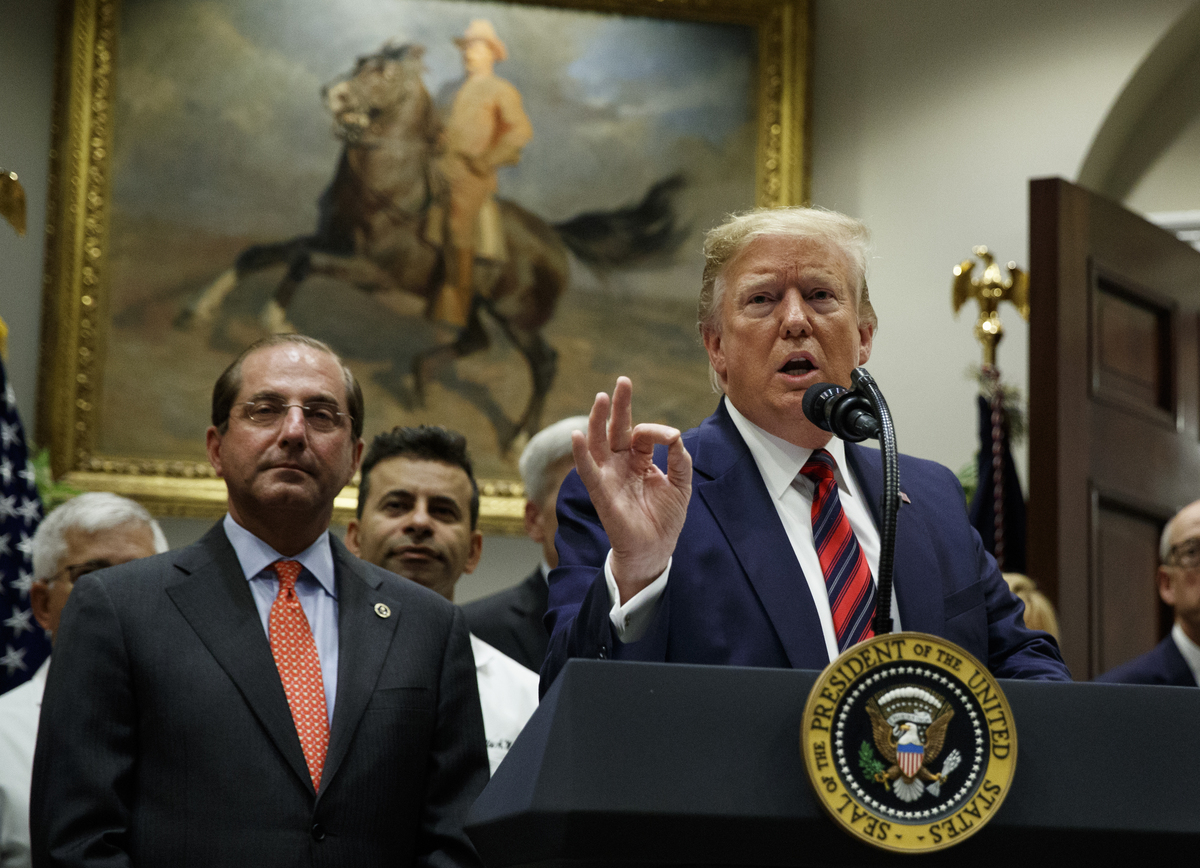
President Trump called for legislative action on surprise medical bills during a White House event Thursday.
Evan Vucci/AP
hide caption
toggle caption
Evan Vucci/AP
President Trump called on Republicans and Democrats to pass legislation this year to end surprise medical bills, in remarks made in the White House’s Roosevelt Room Thursday.
“We’re determined to end surprise medical billing for American patients,” Trump said.
Bills like those have been featured in the NPR-Kaiser Health News series launched in February 2018. Two patients whose medical bills were part of the series attended the event.
Austin, Texas, teacher Drew Calver talked about the six-figure bill he received after having a heart attack. “I felt like I was exploited at the most vulnerable time in my life,” he said. His bill was reduced to $332 after the NPR-KHN story was published.
A bipartisan group of senators has been working to come up with a plan for the past several months. The lawmakers said Thursday they hope to have a bill to the president by July.
But will bipartisanship be enough? Even political will might not overcome divisions within the health industry.
Specifically, lawmakers aim to address the often-exorbitant amounts patients are asked to pay out of pocket when they receive care at health facilities that are part of their insurance network but are treated by out-of-network practitioners. Legislators are also looking to address bills for emergency care at a facility that doesn’t have a contract with patients’ insurers.
“We’re getting really close to an approach that we’ll be able to unveil pretty soon,” Sen. Maggie Hassan, D-N.H., told reporters on a conference call Thursday with Sen. Bill Cassidy, R-La.
And it’s not just politicians and patients: Out-of-network doctors, insurance companies and hospital groups say they want the problem for consumers fixed, too.
Despite that broad agreement, a hurdle remains. Insurers and health care providers each oppose the other side’s preferred solution to end surprise bills. That conflict makes it almost impossible for lawmakers to come up with a fix that won’t leave one of the influential groups unhappy.
“It’s a different axis than the partisan [conflicts] we’re used to,” said Loren Adler, who has been studying the surprise-bill problem for the USC-Brookings Schaeffer Initiative for Health Policy. The fight over how to fix it is less likely “to break down between Republicans and Democrats and more likely to break down to where the money is” and which group will have to take less of it.
“I don’t see a coalescence around a solution,” said Chip Kahn, president and CEO of the Federation of American Hospitals, which represents for-profit facilities.
The divide is wide, despite the overall interest in protecting consumers.
Share Your Story And Bill With Us
If you’ve had a medical-billing experience that you think we should investigate, you can share the bill and describe what happened here.
“What we’d most like to see is clarity for the patients,” said Bob Kneeley, a senior vice president for Envision Healthcare, which employs physicians to staff a variety of hospital departments, such as emergency rooms, neonatal units and anesthesiology. “This is a system that’s just not working well for the patient, and we need to establish some appropriate guardrails.”
“We want this to be solved. We know it needs federal legislation,” agreed Molly Smith, a vice president at the American Hospital Association. She said hospitals believe that patients should “not have to be involved in any process if there’s a dispute between the payer and the provider.”
States have been working on the problem for several years. Nine now have programs aimed at protecting patients from surprise bills. But state laws cannot reach those with employer-provided insurance — more than half of all Americans —because those plans are regulated by a federal law called the Employee Retirement Income Security Act. That means only Congress can fix it for everyone.
Patients and groups that represent them say the problem is more urgent than ever.
“We are talking about situations in which families, despite enrolling in health insurance, paying premiums, doing their homework and trying to work within the system are being left with completely unanticipated and sometimes financially devastating bills,” Frederick Isasi, executive director of the consumer group Families USA, told a House education and labor subcommittee hearing in April. “This is inexcusable behavior on the part of hospitals, doctors and insurers. They each know — or should know — that patients have no real way to understand the financial trap they have just walked into.”
Dr. Paul Davis, whose daughter received a bill for a $17,850 for a urine test after back surgery, also spoke at the White House Thursday: “The situation is terrible. It is a national disgrace and I think a lot of people would support me on that,” Davis told a reporter. Their story was the first in the Bill of the Month project.
Still, it’s not clear where compromise might be found.
By and large, doctors favor some sort of negotiated-fee system when there is a dispute about a bill, such as binding arbitration, in which an independent third party makes the ultimate payment decision.
“That’s consistent with what’s working in some states,” said Envision’s Kneeley.
Among those frequently cited by doctor groups is New York, which has one of the strongest state laws on surprise billing. There patients are not required to pay more than they would for an in-network doctor or hospital. For the remaining bill, an independent arbitrator settles any dispute between the provider and insurer.
But the insurance industry worries about that approach. “Our larger concern with arbitration is that it still relies on bill charges,” said Adam Beck, a vice president for America’s Health Insurance Plans, an insurance industry trade group. And insurers think those charges are too high.
A senior administration official also said on Thursday that the administration does not favor the arbitration approach either.
Insurers — and many consumer groups — “believe if you have a clear benchmark pegged to reasonable rates, that will really solve this problem,” Beck said, because insurers would be more likely to cover charges they found more in line with what they consider reasonable.
A “benchmark” payment might correspond to what Medicare pays for the same service, for instance.
But doctors don’t like that idea one bit. “Even if [the benchmark] is on the high side, it’s still rate-setting,” said Kneeley.
Hospitals don’t like it, either.
“We can’t get behind any sort of rate-setting in statute,” said Smith of the AHA. “We have too many concerns about getting that wrong.” For example, she said, if the rate is set too low, hospitals might have trouble finding doctors willing to provide care.
Meanwhile, insurers and hospitals want to ban out-of-network providers from billing patients for whatever part of the charge the insurer won’t cover, a practice called “balance billing.”
Such bans are anathema to doctors, who instead believe insurers bear responsibility for doctors not being in their networks because they “don’t have an incentive to offer fair rates,” said Kneeley. Although insurers often feel they must contract with specific high-profile hospitals, he explained, the doctors who work there are often “invisible providers.”
Addressing the underlying causes of high health costs, however, will be difficult, said Adler of USC-Brookings.
Doctors want to be paid more than insurers typically offer, he said, which is why some do not join insurance networks. And insurers “want the problems [with surprise bills to patients] to go away.” The question for them, he said, is, “How much are insurers willing to pay to have their patients not get surprise bills?”
In the end, a settlement that eliminates surprise bills but builds the excess into everyone’s premiums doesn’t truly address health care’s spending problem.
“I think there’s a good chance it gets solved,” Adler said, and that lawmakers will eventually agree on a plan. “But I’m pessimistic it gets solved in a way” that deals with health care’s high costs.
Kaiser Health News is a nonprofit news service covering health issues. It is an editorially independent program of the Kaiser Family Foundation that is not affiliated with Kaiser Permanente.
KHN’s Fred Schulte contributed to this report.
What’s Behind A Rise In Conscience Complaints For Health Care Workers?


The Department of Health and Human Services’ Office of Civil Rights has issued new rules protecting health care workers who refuse to be involved in certain procedures for religious or moral reasons.
Saul Loeb/AFP/Getty Images
hide caption
toggle caption
Saul Loeb/AFP/Getty Images
When health care workers feel they have been forced to do something they disagree with on moral or religious grounds, they can file complaints with the Department of Health and Human Services’ Office for Civil Rights. Some high-profile cases have involved nurses who objected to providing abortion services.
For a decade, the agency got an average of one of these complaints of conscience violations each year. The complaints can include doctors, nurses or other health care workers who feel a hospital or clinic that receives federal funds has discriminated against them because of their moral position. Groups of health care providers also can file complaints.
Last year, the number of complaints jumped to 343.
That increase was cited by the Office of Civil Rights as one reason for issuing a new rule designed to protect conscience rights, unveiled publicly last week. HHS estimates that implementing and enforcing the rule will cost taxpayers $312 million in its first year.
But why did the number of complaints increase?
HHS declined to offer any specifics on the 343 complaints, such as where they were from or what might be behind the sudden increase over past years.
The Office for Civil Rights handles three types of complaints: violations of the Health Insurance Portability and Accountability Act, the law that protects the privacy and security of health information; violations of civil rights related to discrimination based on race, sex, national origin, disability and age; and violations of conscience rights.
Roger Severino, the office’s director, has made clear that protecting religious freedom is his priority and that his office is “open for business,” as he said to reporters while announcing the new rule.
In fact, he created the Division of Conscience and Religious Freedom in January 2018.
“For too long, governments big and small have treated conscience claims with hostility instead of protection,” Severino said in announcing the new division. “But change is coming, and it begins here and now.”
That signaling from Severino may have helped generate the increase in complaints, says Dr. David Stevens, CEO of the Christian Medical & Dental Associations. “Now that there’s an actual office opened and it’s well-publicized that it’s available, people are contacting them,” he says.
The Christian Medical & Dental Associations, based in Bristol, Tenn., represents about 19,000 health care workers.
“We’re happy to provide compassionate and quality care for anybody that walks in the door as long as we don’t become morally complicit in something that violates our conscience,” he says. As examples, he mentioned abortion, physician-assisted suicide and gender transitioning.
One reason given for the new rule is that it will help keep health workers from leaving the field. It cites data from a 2009 survey from the Christian Medical & Dental Associations that found 82% of its members say they would “limit the scope of their practice if conscience rules were not in place.”
Stevens thinks complaints are increasing because the issues underlying conscience violations are growing. “I think there’s a lot more antagonism towards people of faith,” he says.
He also thinks there are pent-up concerns from before the Trump administration, when nurses and doctors with issues felt like the Office of Civil Rights wouldn’t do anything with their complaints. “The big issue in the past has not been having laws. The big issue was having them enforced,” he says.
Former Director of the Office for Civil Rights Jocelyn Samuels takes issue with that characterization. She was Severino’s predecessor from 2014 to 2017. “It is wholly inaccurate to say that we abdicated our responsibility to enforce these laws,” she says.
Samuels, who now directs the Williams Institute at the UCLA School of Law, notes the average of one complaint a year filed under the provider conscience laws wasn’t just in the Obama administration — there were only 10 complaints in the decade from 2005 to 2015.
“I think that the number of complaints that were filed during the Bush and Obama administrations is some indication about the relative scope of the problem of religious refusals,” she says.
And she points out that those complaints that the office did receive were “dwarfed by the number of complaints filed under another law.”
“When I was the director of OCR we were receiving somewhere upwards of 20,000 complaints under HIPAA and, in addition, we were receiving several thousand civil rights complaints every year,” Samuels says.
She agrees that the office’s publicity around the priority of enforcing provider conscience laws is likely behind the increase in complaints. But rather than welcome that outreach as Stevens does, she worries that it may give health care workers the impression that they can deny any care that offends their religious or moral beliefs.
“So, for example, an orthopedist cannot refuse to set the leg of an LGBTQ patient because the orthopedist disapproves of that person’s sexual orientation or gender identity,” she says. “The provider conscience laws are very narrowly drafted to authorize medical providers to refuse certain types of care under certain funding streams that HHS provides.”
She theorizes that the number of complaints is likely to keep going up because the office has telegraphed that it is expanding the conduct that is covered under these laws.
As NPR reported last week, the new rule offers protection to health care workers who have an “articulable connection to furthering a procedure,” meaning even doing tasks that are indirectly related to a procedure. The rule explains: “Scheduling an abortion or preparing a room and the instruments for an abortion are necessary parts of the process of providing an abortion, and it is reasonable to consider performing these actions as constituting ‘assistance.’ “
“By expanding the scope of protected conduct, you are almost by definition creating a situation in which there could be more allegations of violations,” Samuels says.
When asked about the nature of the 343 complaints and why the number may have jumped from previous years, a spokesperson from HHS declined to provide specifics, saying that the office “does not discuss the substance of open complaints or investigations.”
Will Displaying Drug List Prices In Ads Help Lower Costs?


Alex Azar, secretary of Health and Human Services, announced a new rule requiring drugmakers to publish drug list prices in TV ads.
Bloomberg/Bloomberg via Getty Images
hide caption
toggle caption
Bloomberg/Bloomberg via Getty Images
The Trump administration moved forward on Wednesday with its plan to lower prescription drug prices by requiring drugmakers to display the list price “in a legible textual statement at the end of the advertisement.”
Secretary of Health and Human Services Alex Azar said today that when it comes to changing prescription drug prices, “putting prices in TV ads may be the most significant single step any administration has ever taken.” But patient advocates are not convinced it will have an immediate impact on drug pricing.
The rule would apply to prescriptions that cost more than $35 per month or courses of treatment, which are covered by Medicare. The rule is very specific, requiring that the price be displayed, “for sufficient duration and in a size and style of font that allows the information to be read easily.”
Industry groups have fought this move since it was announced in October. They adopted voluntary rules, that would have directed ad viewers to a website with more detailed cost information. Today, in a statement, the Pharmaceutical Research and Manufacturers of America (PhRMA) wrote that the list price is confusing since that’s not what most people pay.
The rule addresses that by requiring an additional statement that reads, “If you have health insurance that covers drugs, your cost may be different.”
PhRMA also said that the rule raises “First Amendment and statutory concerns.”
Court challenges may be coming. The legal authority given by the White House is based on the laws that require Medicare and Medicaid to be run in a cost-effective manner, according to the rule.
Rachel Sachs, an associate professor of law at Washington University in St. Louis and an expert in drug-pricing regulation, told NPR and Kaiser Health News in October that could be a weak legal argument since most drugs are marketed to the broader public, not just Medicare and Medicaid beneficiaries.
Consumer and patient advocates generally hailed the move as a step towards greater price transparency, but questioned whether it would do much to lower high prices.
“We don’t believe that disclosing list prices will shame drug corporations into lowering list prices,” says Ben Wakana, executive director of Patients for Affordable Drug Prices. “Drug companies have been shamed about their price increases for years. They appear to be completely comfortable with the shame as long as it is bringing them in the billions of dollars a year that they make from their outrageous prices.”
He gives the government credit for trying to do something on health prices, noting “taking action on this issue is hard.” But he thinks some of the administration’s other ideas to lower prices — announced in a plan released last May — might have a bigger impact.
Critics have pointed out the government’s plan for enforcing the rule is weak, as NPR reported last fall. The plan for enforcement involves competitors policing each other by bringing legal action against competitors who aren’t compliant, Azar said in Wednesday’s press briefing. He calls it “a quite effective mechanism of enforcement.”
Azar defended the government’s authority to issue the new rule. “This is not without precedent,” he told reporters. “We have for over 50 years required that car manufacturers and car dealers post the sticker price of cars on the windows of their cars and be transparent about — even though there are negotiations and everything else — because it’s a starting point that’s an important part of consumer fairness.”
The car-buying analogy doesn’t work very well for drugs, notes Adrienne Faerber, a lecturer at the Dartmouth Institute for Health Policy and Clinical Practice.
“When you go to the car dealer and you see that sticker price and you can negotiate a better price that can fit your budget directly with the car dealership,” she explains. But, she says, drug prices are negotiated through layers of middlemen: “So you don’t get to negotiate based on these prices like you would with a car.”
In other words, car shoppers have a lot more choices that sick patients do, and a lot more bargaining power.
Faerber says certainly displaying the list price won’t “magically flip a switch and cut a percentage or two off of the total drug costs.” But she says it will be interesting to see how patients react to high list prices on their TV screens.
“Consumers are going to start wondering what are people getting for that money,” she says.
How Big A Problem Is Religious Objection In Health Care?

About once a year for the last decade, a health care provider would file a complaint of conscience through Health and Human Services. Last year, complaints skyrocketed to 343.
The Thistle & Shamrock: Season Of Light


Loreena McKennitt
Richard Haughton/Courtesy of the artist
hide caption
toggle caption
Richard Haughton/Courtesy of the artist
Celebrate the coming of summer, the fertility of the season and the greening of the earth as Fiona Ritchie invites you to gather around the fires of “Beltane,” one of four ancient, annual Celtic festivals that mark the passage from one season to the next. Artists featured include Loreena McKennitt, The Poozies, and Jim Malcolm.
Soccer Fans Are In Disbelief After Liverpool Beats Barcelona 4-0
Liverpool upset Barcelona to advance to the Champions League final. NPR’s Noel King talks to Wright Thompson of ESPN The Magazine who says the soccer team “perfectly reflects” the city of Liverpool.
U.S. Women’s Soccer Team Looks To Defend 2015 World Cup Title
The U.S. women’s national soccer team begins its defense of the 2015 World Cup title in June. The U.S. women’s team is ranked first in the world while the U.S. men’s team struggles internationally.
Minor League Ballpark In Hartford, Conn., Goes Peanut-Free
People with peanut allergies often can’t go to major sporting events. But a minor league baseball stadium in Connecticut has gone peanut free, becoming the first in the nation to do so.