How Hospital ER Sleuths Race To Identify An Unconscious Or Dazed Jane Or John Doe

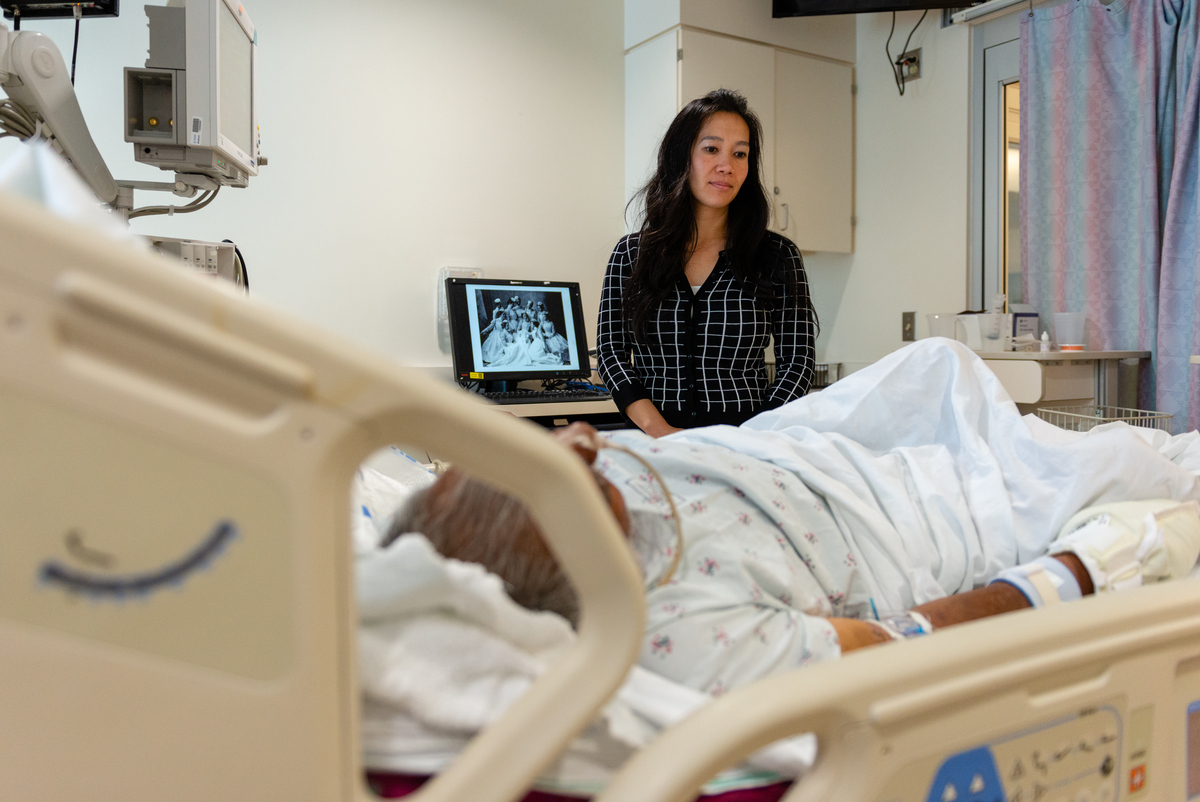
Lenh Vuong, a clinical social worker at Los Angeles County+USC Medical Center, checks on a former John Doe patient she recently helped identify.
Heidi de Marco/KHN
hide caption
toggle caption
Heidi de Marco/KHN
The 50-something man with a shaved head and brown eyes was unresponsive when the paramedics wheeled him into the emergency room. His pockets were empty: He had no wallet, no cellphone and not a single scrap of paper that might reveal his identity to the nurses and doctors working to save his life. His body lacked any distinguishing scars or tattoos.
Almost two years after he was hit by a car on busy Santa Monica Boulevard in January 2017 and was transported to Los Angeles County+USC Medical Center with a devastating brain injury, no one had come looking for him or reported him missing. The man died in the hospital, still a John Doe.
Hospital staffs sometimes must play detective when an unidentified patient arrives for care. Establishing identity helps avoid the treatment risks that come with not knowing a patient’s medical history. The workers also strive to find next of kin to help make medical decisions.
“We’re looking for a surrogate decision-maker, a person who can help us,” says Jan Crary, supervising clinical social worker at LA County+USC, whose team is frequently called on to identify unidentified patients.
The hospital also needs a name to collect payment from private insurance or government health programs such as Medicaid or Medicare.
But federal privacy laws can make uncovering a patient’s identity challenging for staff members at hospitals nationwide.
At LA County+USC, social workers pick through personal bags and clothing, search the contacts of an unlocked cellphone for names of family members or friends and scour receipts or crumpled pieces of paper for any trace of a patient’s identity. They quiz the paramedics who brought in the patient or the dispatchers who took the call.
They also make note of any tattoos and piercings and even try to track down dental records. It’s more difficult to check fingerprints because that’s done through law enforcement, which will get involved only if the case has a criminal aspect, Crary says.
Unidentified patients are often pedestrians or cyclists who left their IDs at home and were struck by vehicles, says Crary. They might also be people with severe cognitive impairment, such as Alzheimer’s disease, patients in a psychotic state or drug users who have overdosed. The hardest patients to identify are ones who are socially isolated, including homeless people — whose admissions to hospitals have grown sharply in recent years.
In the last three years, the number of patients who arrived unidentified at LA County+USC ticked up from 1,131 in 2016 to 1,176 in 2018, according to data provided by the hospital.
If a patient remains unidentified for too long, staff at the hospital will make up an ID, usually beginning with the letter “M” or “F” for gender, followed by a number and a random name, Crary says.

Jan Crary, supervising clinical social worker at Los Angeles County+USC Medical Center, leads a team of people who often have to play detective when patients can’t be identified. Tattoos, scars, dental records and pocketed scraps of paper can all be useful in this sort of search, she says.
Heidi de Marco/KHN
hide caption
toggle caption
Heidi de Marco/KHN
Other hospitals resort to similar tactics to ease billing and treatment. In Nevada, hospitals have an electronic system that assigns unidentified patients a “trauma alias,” says Christopher Lake, executive director of community resilience at the Nevada Hospital Association.
The deadly mass shooting at a Las Vegas concert in October 2017 presented a challenge for local hospitals that sought to identify the victims. Most concertgoers were wearing wristbands with scannable chips that contained their names and credit card numbers so they could buy beer and souvenirs.
On the night of the shooting, the final day of a three-day event, many patrons were so comfortable with the wristbands that they carried no wallets or purses.
More than 800 people were injured that night and rushed to numerous hospitals, none of which were equipped with the devices to scan the wristbands.
Staff at the hospitals worked to identify patients by their tattoos, scars or other distinguishing features, as well as photographs on social media, says Lake. But it was a struggle, especially for smaller hospitals, he says.
The Health Insurance Portability and Accountability Act, a federal law intended to ensure the privacy of personal medical data, can sometimes make an identification more arduous because a hospital may not want to release information on unidentified patients to people inquiring about missing persons.
In 2016, a man with Alzheimer’s disease was admitted to a New York hospital through the emergency department as an unidentified patient and assigned the name “Trauma XXX.”
The police and family members inquired about him at the hospital several times but were told he was not there. After a week — as hundreds of friends, family members and law enforcement officials searched for the man — a doctor who worked at the hospital saw a news story about him on television and realized he was the hospital’s unidentified patient.
Hospital officials later told the man’s son that because he had not explicitly asked for “Trauma XXX,” they could not give him information that might have helped him identify his father.
Prompted by that mix-up, the New York State Missing Persons Clearinghouse drafted a set of guidelines for hospital administrators who receive information requests about missing people from the police or family members. The new guidelines include about two dozen steps for hospitals to follow, including notifying the front desk, entering detailed physical descriptions into a database, taking DNA samples and monitoring emails and faxes about missing people.
California guidelines stipulate that if a patient is unidentified and cognitively incapacitated, “the hospital may disclose only the minimum necessary information that is directly relevant to locating a patient’s next-of-kin, if doing so is in the best interest of the patient.”
At LA County+USC, most John Does are quickly identified: They either regain consciousness or, as in a majority of cases, friends or relatives call asking about them, Crary says.
Still, the hospital does not always succeed. From 2016 to 2018, 10 John and Jane Does remained unidentified during their stays (of varying lengths of time) at LA County+USC. Some died at the hospital; others went to nursing homes with made-up names.
But Crary says she and her team pursue every avenue in search of an identity.
Once, an unidentified and distinguished-looking older man with a neatly trimmed beard was rushed into the emergency room, unable to speak and delirious with what was later diagnosed as encephalitis.
Suspecting the well-groomed man likely had a loved one who had reported him missing, Crary checked with police stations in the area. She learned, instead, that this John Doe was wanted in several states for sexual assault.
“It is a case that I will never forget,” Crary says. “The truth is that I am more elated when we are able to identify a patient and locate family for a beautiful reunification, rather than finding a felon.”
This story was produced by Kaiser Health News, which publishes California Healthline, an editorially independent service of the California Health Care Foundation. KHN is not affiliated with Kaiser Permanente.
Trump Gives Presidential Medal Of Freedom To Tiger Woods

President Donald Trump awards the Presidential Medal of Freedom to Tiger Woods during a ceremony in the Rose Garden of the White House in Washington.
Manuel Balce Ceneta/AP
hide caption
toggle caption
Manuel Balce Ceneta/AP
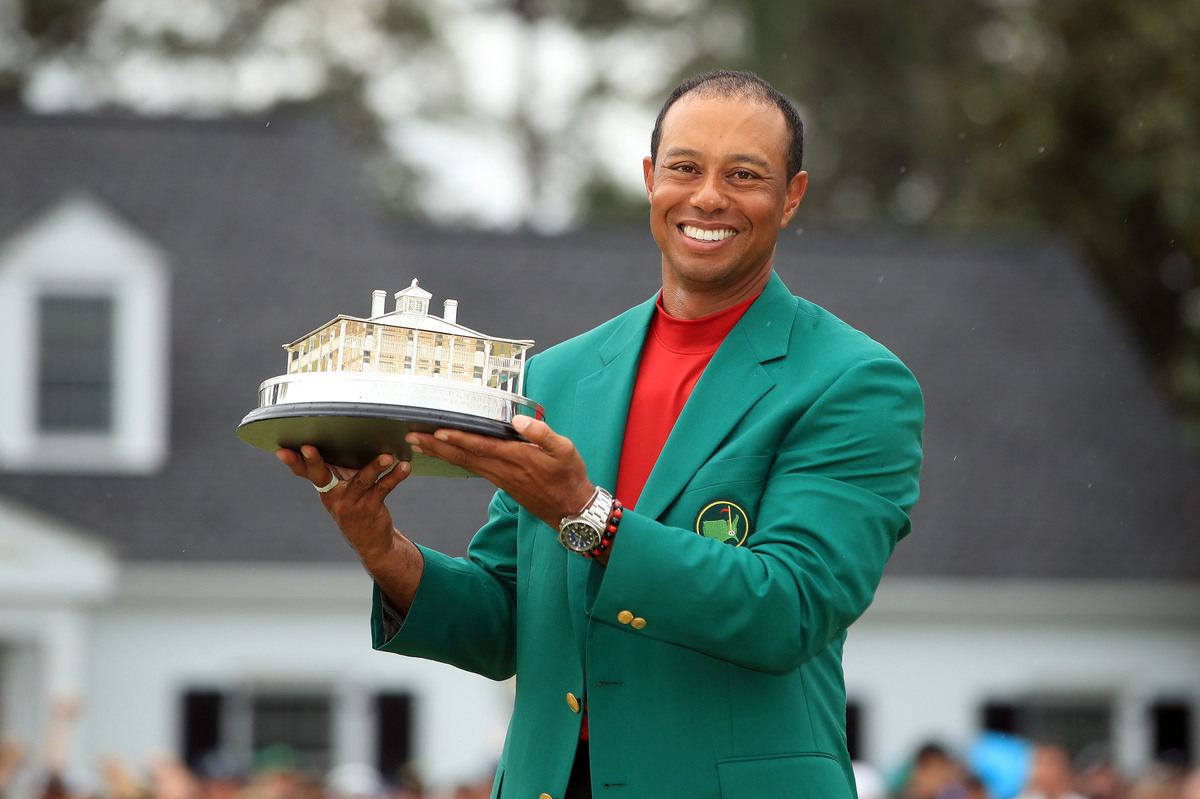
President Trump Monday awarded the Presidential Medal of Freedom to golfer Tiger Woods in a ceremony at the White House.
Trump praised Woods’ many accomplishments on the golf course and his ability to come back from debilitating physical adversity that might have permanently sidelined any other athlete.
“Tiger Woods is a global symbol of American excellence, devotion and drive,” Trump said as Woods stood by him. “These qualities embody the American spirit of pushing boundaries, defying limits and always striving for greatness.”
With his mother and two children in attendance, Woods thanked his family, personal friends and aides in brief and emotional remarks.

Tiger Woods with the Masters trophy after winning the Masters at Augusta National Golf Club on April 14, 2019 in Augusta, Ga.
Andrew Redington/Getty Images
hide caption
toggle caption
Andrew Redington/Getty Images
“You’ve seen the good and the bad, the highs and the lows, and I would not be in this position without all of your help,” he said.
Trump has had a contentious relationship with many black athletes but Woods has a long history with the president.
Trump has long been a fan and recently, a business partner of Woods. He announced his decision to give the award to Woods in a tweet, after Woods won the Masters tournament last month at age 43, capping a remarkable comeback from personal turmoil and physical injuries.
Spoke to @TigerWoods to congratulate him on the great victory he had in yesterday’s @TheMasters, & to inform him that because of his incredible Success & Comeback in Sports (Golf) and, more importantly, LIFE, I will be presenting him with the PRESIDENTIAL MEDAL OF FREEDOM!
— Donald J. Trump (@realDonaldTrump) April 15, 2019
In February, Trump tweeted about a round he played with Woods and another champion golfer, Jack Nicklaus, at Trump’s course in Jupiter, Florida.
Everyone is asking how Tiger played yesterday. The answer is Great! He was long, straight & putted fantastically well. He shot a 64. Tiger is back & will be winning Majors again! Not surprisingly, Jack also played really well. His putting is amazing! Jack & Tiger like each other.
— Donald J. Trump (@realDonaldTrump) February 3, 2019
Woods designed a golf course at a Trump property in Dubai. Trump also named a villa after Woods at his Trump Doral resort near Miami.
Not everyone is a fan of Trump’s decision to award Woods the Medal of Freedom, or of Wood’s decision to accept it. Writer Rick Reilly, whose book Commander In Cheat portrays Trump as a notorious flouter of golf rules, tweeted Woods should spurn the award, because he says, Trump “thinks golf should only be for the rich.”
How can @TigerWoods accept the Presidential Medal of Freedom from a man who thinks golf should only be for the rich? “Where you aspire to join a club someday, you want to play, (so) you go out and become successful.” … Bull. If that were true, there’d BE no Tiger Woods.
— Rick Reilly (@ReillyRick) April 16, 2019
Monday’s ceremony is the second time in less than six months that Trump has awarded Medals of Freedom. In November, the President gave the award to a number of people, including Elvis and Babe Ruth.
Woods becomes the fourth professional golfer to receive the medal, along with Nicklaus, Arnold Palmer and Charlie Sifford. Woods said in the ceremony that Sifford was a mentor and that he named his own son, Charlie, after him.
Effects Of Surgery On A Warming Planet: Can Anesthesia Go Green?

Dr. Brian Chesebro (right), in Portland, Ore., has calculated that by simply using the anesthesia gas sevoflurane in most surgeries, instead of the similar gas desflurane, he can significantly cut the amount of global warming each procedure contributes to the environment.
Kristian Foden-Vencil/OPB
hide caption
toggle caption
Kristian Foden-Vencil/OPB
It’s early morning in an operating theater at Providence Hospital in Portland, Ore. A middle-aged woman lies on the operating table, wrapped in blankets. Surgeons are about to cut out a cancerous growth in her stomach.
But first, anesthesiologist Brian Chesebro puts her under by placing a mask over her face.
“Now I’m breathing for her with this mask,” he says. “And I’m delivering sevoflurane to her through this breathing circuit.”
Sevoflurane is one of the most commonly used anesthesiology gases. The other big one is desflurane. There are others, too, like nitrous oxide, commonly known as laughing gas.
Whatever gas patients get, they breathe it in — but only about 5% is actually metabolized. The rest is exhaled. And to make sure the gas doesn’t knock out anyone else in the operating room, it’s sucked into a ventilation system.
And then? It’s vented up and out through the roof, to mingle with other greenhouse gases.
These two gases are actually fairly similar medically; sevoflurane needs to be more carefully monitored and titrated in some patients, but that’s not difficult, Chesebro says.
Generally, unless there’s a reason in a particular case to use one over the other, anesthesiologists simply tend to pick one of the two gases and stick with it. Few understand that one — desflurane — is much worse for the environment.
And that bothered Chesebro. He grew up on a ranch in Montana that focused on sustainability. “Part of growing up on a ranch is taking care of the land and being a good steward,” he says.
Now he lives in the city with his three kids and has gradually started to worry about their environmental future. “When I look around and I see stewardship on display today, it’s discouraging,” he says. “I got depressed for a while, and so I hit the pause button on myself and said, ‘Well, what’s the very best that I can do?’ “
He spent hours of his own time researching anesthesiology gases. And he learned desflurane is 20 times as powerful in trapping heat in Earth’s atmosphere as sevoflurane. It also lasts for 14 years in the atmosphere, whereas sevoflurane breaks down in just one year.
Opening a big black notebook, filled with diagrams and tiny writing, he shows how he computed the amount of each gas the doctors in his group practice used. Then he shared their carbon footprint with them.
“All I’m doing is showing them their data,” Chesebro says. “It’s not really combative. It’s demonstrative. Ha, ha ha.”
One of the doctors he shared his analysis with was Michael Hartmeyer, who works at the Oregon Anesthesiology Group with Chesebro. “I wish I had known earlier,” Hartmeyer says. “I would have changed my practice a long time ago.”
Hartmeyer says he was stunned when Chesebro explained that his use of desflurane was the greenhouse gas equivalent of driving a fleet of 12 humvees for the duration of each surgical procedure. It’s “only” half a hummer if he uses sevoflurane. Hartmeyer notes that outside the operating room he drives a Prius.
“You try to be good,” he says. “You take shorter showers or [don’t] leave lights on, or whatever else. But you know there’s always more that we could probably do. But this was, far and away, a relatively easy thing that I could do that made a huge impact.”




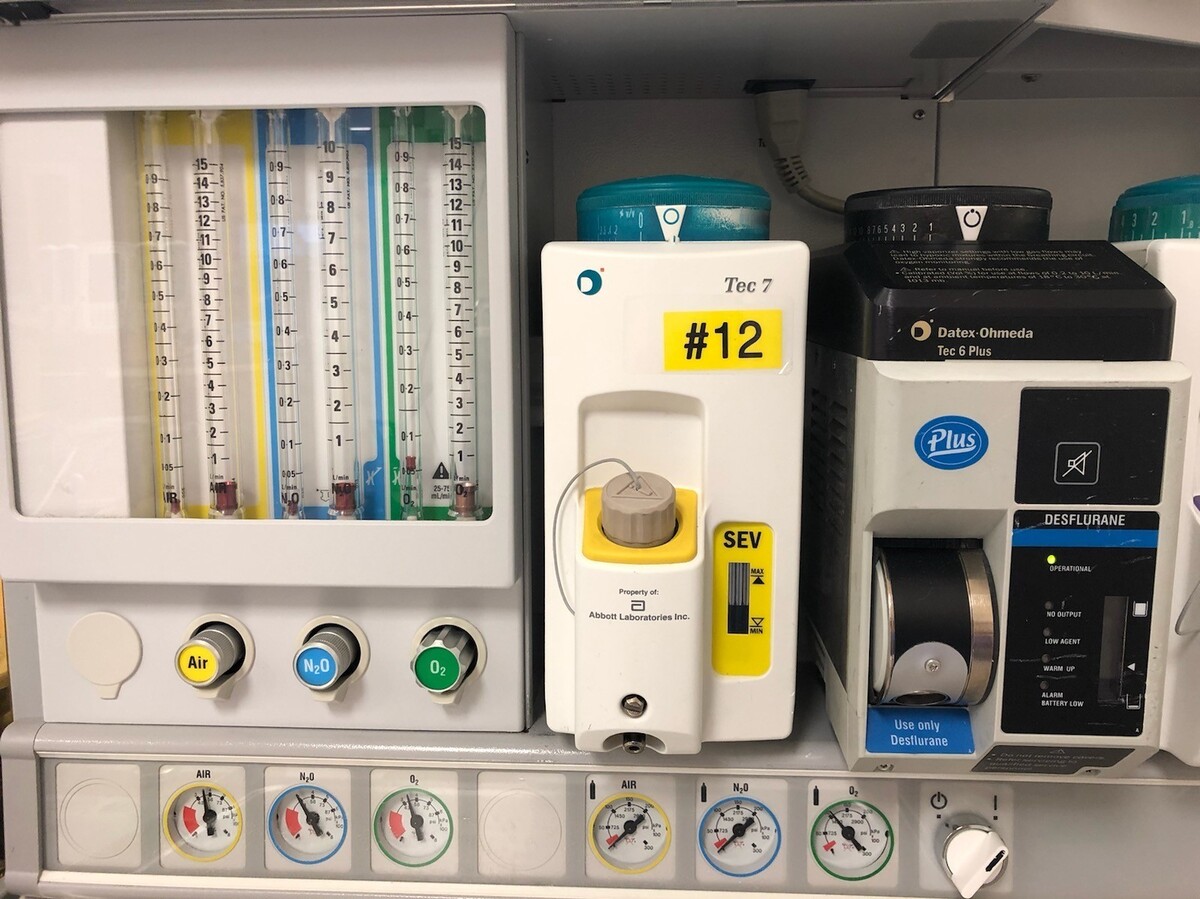
An anesthesia cart contains canisters for desflurane (right, with blue decals) and sevoflurane (center, with yellow decals). Both anesthetics are greenhouse gases, but desflurane’s impact on global warming is 20 times as bad as sevoflurane’s, Chesebro learned.
Courtesy of Dr. Brian Chesebro
hide caption
toggle caption
Courtesy of Dr. Brian Chesebro
The anesthesiology carts that get brought into operating theaters tend to have a row of gases to choose from. So Hartmeyer was able to switch pretty much overnight.
Other anesthesiologists made the switch, too. And it didn’t hurt that sevoflurane is considerably cheaper.
Hartmeyer’s change saved his hospital $13,000 a year.
When Chesebro shared his findings with the anesthesia departments at all eight Providence Health hospitals in Oregon, they prioritized the use of sevoflurane. They now save about $500,000 per year.
Providence’s chief executive, Lisa Vance, says the hospital system didn’t change its use of the gas because of the money. It changed because the World Health Organization now says climate change is the No. 1 public health issue of the 21st century — and because of Chesebro.
Vance said Chesebro teared up in front of 2,000 people when talking about the gas, his children and the Lorax from Dr. Seuss. “Unless someone like you cares a whole awful lot, nothing’s going to get better — it’s not,” says Vance, quoting the book.
Jodi Sherman, an associate professor of anesthesiology at Yale School of Medicine, calls Chesebro’s efforts remarkable and important.
She says several hospitals around the country have tried to make this shift, but with mixed results. Some just gave anesthesiologists the information, and not much changed. Other hospitals took desflurane away, but that left many anesthesiologists feeling disrespected and angry.
She thinks Chesebro succeeded because he chose to persuade his colleagues — using data. He showed doctors their choice of gas, plotted against their greenhouse impact. And it helped that he showed them over and over, so doctors could compare their progress with that of their peers.
“Providing ongoing reports to providers is the best way for this movement to catch on and grow,” she says. It can reinforce over time, she adds, not just what their carbon footprint is, but also what progress they’re making.
Sherman says efforts such as Chesebro’s are sorely needed because the U.S. health sector is responsible for about 10% of the nation’s greenhouse gases. “We clinicians are very much focused on taking care of the patient in front of us,” she says. “We tend to not think about what’s happening to the community health, public health — because we’re so focused on the patient in front of us.”
In an emailed statement, Baxter International, the manufacturer of the anesthesia gas, says it is important to provide a range of options for patients. The firm also says inhaled anesthetics have a climate impact of 0.01% of fossil fuels.
“The overall impact of anesthetic agents on global warming is low, relative to other societal contributors, especially when you consider the critical role these products have in performing safe surgical procedures,” the statement reads.
It’s a fair point, Chesebro says, but he has a counterargument.
“Well, if it’s there, it’s bad. And if I can reduce my life’s footprint by a factor of six … why wouldn’t you do it?”
The surgery Chesebro was involved in that morning at Providence was a success. Chesebro estimates that by using sevoflurane on his patient, the same greenhouse gases were produced as in a 40-mile drive across the Portland region.
If he had used desflurane instead, he says, it would have been like driving the more than 1,200 miles from Seattle to San Diego.
Now Chesebro’s hospital bosses are hoping other doctors will follow his lead, research their own pet peeve, and maybe solve a problem no one’s thinking about.
This story is part of NPR’s reporting partnership with Oregon Public Broadcasting and Kaiser Health News, which is an independent journalism program of the Kaiser Family Foundation and not affiliated with Kaiser Permanente.
Golfer In Ohio Celebrates After 2 Holes-In-1

Dale Cohen played a round at Sycamore Springs Golf Course. On the second hole, he did something he’d never done before: He hit a hole in one. A bit later, on the eighth hole, he hit another one.
How Helpful Would A Genetic Test For Obesity Risk Be?


Even if a genetic test could reliably predict obesity risk, would people make effective use of the information?
eyecrave/Vetta/Getty Images
hide caption
toggle caption
eyecrave/Vetta/Getty Images
Scientists who recently announced an experimental genetic test that can help predict obesity got immediate pushback from other researchers, who wonder whether it is really useful.
The story behind this back-and-forth is, at its core, a question of when it’s worth diving deep into DNA databanks when there’s no obvious way to put that information into use.
The basic facts are not in dispute. Human behavior and our obesity-promoting environment have led to a surge in this condition over the past few decades. Today about 40% of American adults are obese and even more are overweight.
But genetics also plays an important role. People inherit genes that make them more or less likely to become seriously overweight.
While some diseases (like Huntington’s and Tay-Sachs) are caused by a single gene gone awry, that’s certainly not the case for common conditions, including obesity. Instead, thousands of genes apparently play a role in increasing obesity risk.
Many of those gene variants contribute a minuscule risk. Sekar Kathiresan, a cardiologist at Harvard and a geneticist at the Broad Institute, set out to see whether he and his team could find a bunch of these genetic variants and add up their effects. The goal was to identify genetic patterns that put people at the highest risk.
This genetic information “could explain why somebody’s so big, why they have so much trouble keeping their weight down,” Kathiresan says.
His team identified more than 2 million DNA variants of potential interest. He figures most of those variants are irrelevant, but his hunch is, hidden somewhere in there are a few thousand changes that each contribute at least a tiny bit to a person’s risk of developing obesity.
No single gene can do much to move the needle. But he says the composite result, called a polygenic risk score, is still potentially useful. Those with the highest risk scores were more likely to be severely obese (with a body mass index over 40). In fact, 43% of the people with the highest genetic scores were obese.
But the score is far from perfect. For instance, 17% of the people with the highest scores had normal body weights.
The team, with lead author Amit Khera, published its results in the journal Cell.
“The impact of the genetics — and this was a huge surprise to us as well — starts very early in life, in the preschool years, around the age of 3,” Kathiresan says.
That finding suggests prevention efforts are more likely to succeed if they also start in childhood. Kathiresan has a more philosophical takeaway from his work as well.
“I hope this work will hopefully destigmatize obesity and make it very similar to every other disease, which is a combination of both lifestyle and genetics.”
A lot of elaborate genetic analysis is behind the study, which involved more than 300,000 individuals. But the broad conclusions aren’t new.
Scientists already knew genetic risk factors can contribute significantly to obesity. And other studies show that obese children are at high risk for becoming obese adults.
Epidemiologist Cecile Janssens, a professor at Emory University, doesn’t think much of this strategy of adding up the tiny risks from millions of genetic variants to come up with a cumulative risk score.
“In all fairness, we don’t know whether all of these variants really matter,” she says. When asked about the value of doing a study like this, she says, “I have no clue.”
“It is not really answering a very relevant question from the biological perspective, and not really answering a very relevant question from a clinical perspective,” she says.
This type of analysis doesn’t reveal anything about the individual genes that are contributing to obesity, which means you can’t use it to understand the underlying biology. If obesity were a rare disease, a test like this could be useful to identify people at elevated risk. But since it affects 40% of Americans, Janssens says prevention efforts should include everybody.
She is among a group of scientists informally rebelling against the gene-centric way of looking at disease. It’s frustrating for them to see so much money poured into this kind of genetics work, rather than into efforts to change the environment and the behaviors that contribute to diseases like obesity.
Janssens also says that, despite the daunting effort involved in studying 2 million genetic variants, the resulting score still doesn’t explain even 10% of the variation the scientists observed in body mass index. (Kathiresan, who couches his conclusions differently, says the score explains about a quarter of the genetic risk.)
Scientists doing this kind of work hope that data like these, when presented to individuals, will prompt them to change their behavior.
Alas, that’s not supported by scientific reviews.
“This kind of personalized risk information has little [or] no impact on people’s actual behavior,” says Theresa Marteau, who directs the Behaviour and Health Research Unit at the University of Cambridge.
In fact, researchers have worried that when people learn that they are at high genetic risk for diseases like obesity, people would become fatalistic and stop trying to change their behaviors. Fortunately, Marteau says “in a review, we didn’t find any evidence for that.” It seems they just ignore the information.
Ewan Birney, who heads the European Bioinformatics Institute, has been watching this debate play out over the years. Birney agrees with the critics who say obesity isn’t the ideal disease for this kind of analysis.
“One needs to do more than just be able to show a strong statistical association,” he says. “One really needs to show that you can then use that to do an intervention.”
Birney also is wary of making too much of this information because it’s based primarily on data from the UK Biobank, as well as U.S. samples, in which racial minorities aren’t well represented.
There are other instances where these polygenic risk scores can be useful, he says. For example, a score that identifies people at high risk for heart disease identifies people who get the most benefit from cholesterol-lowering drugs called statins. (But it’s unclear whether it would be beneficial to give statins to people who score high on this test but wouldn’t ordinarily be identified as candidates for this medication).
Using a different method of analysis, called a genome-wide association study, scientists have identified more than 140 genes that can slightly increase the risk of obesity. Though their individual influence is small, they do provide clues about the biology of the disease.
For example, one of the relatively potent variants “actually relates to calorie-seeking behaviors,” says Ali Torkamani, who is director of genome informatics at the Scripps Research Translational Institute. Other variants are, unsurprisingly, related to the function of fat cells.
It’s also possible that a careful probe of the genes – rather than the abstract risk score – could identify genetic variants that actually reduce a person’s risk of obesity. A paper in the same issue of Cell as the one that featured work from Kathiresan’s group points in that direction.
While genes influence a person’s risk of obesity, the epidemic in this country is obviously far more extensive than simply people at high risk. And Torkamani notes that the risk score isn’t destiny. “It’s just a probability,” he says. “And you know, when you flip a coin sometimes it comes up heads and sometimes it comes up tails.”
You can contact NPR Science Correspondent Richard Harris at rharris@npr.org.
Olympic Runner Who Once Competed Against Caster Semenya Weighs In On Testosterone Ruling
NPR’s Lulu Garcia-Navarro talks to Madeleine Pape, who once competed against Caster Semenya, about the issue of female runners with unusually high levels of testosterone.
LULU GARCIA-NAVARRO, HOST:
Caster Semenya won what may be her last 800-meter race this past Friday in Doha. Her dominance in the event may be at an end because of new regulations that come into effect Wednesday. The new rules ban women like Semenya, with naturally occurring high levels of testosterone, from running certain events in the women’s competition unless they take medicine to reduce those levels. When asked whether she would submit to the new regulations, Semenya replied, hell no.
Madeleine Pape was an Olympic runner for Australia who once competed against Semenya. She’s now a Ph.D. candidate in sociology at the University of Wisconsin-Madison. And she told us about when she competed against Semenya in 2009 at the IAAF World Championships in Berlin.
MADELEINE PAPE: I lost to Semenya, amongst other people in the heats. And I was, after that, very quick to join the chorus of voices around me that were beginning to accuse Semenya of having an unfair advantage. And that really reached fever points on the evening of the final, when the IAAF, who’s our governing body in track and field, announced publicly that they were going to be conducting investigations into Semenya’s biological sex. So that really set the tone for how people then proceeded to talk about her.
And for me, you know, I guess I wasn’t really encountering any alternative points of view. That was the single point of view that was being voiced around me at the time. So I certainly fell in the camp of jumping on the bandwagon and repeating the things that were being said around me.
GARCIA-NAVARRO: And how did you come to change your mind?
PAPE: Yeah, that was a – it was quite a long journey, actually. About a year after those World Championships, I sustained a career-ending injury, and I decided to move to the United States to start a Ph.D. in sociology.
And I happened to chance upon this topic and the very vast literature that’s been written about it from the point of view of women’s sports advocates who have examined at length the very many scientific and ethical dilemmas that surround the exclusion of women who have high testosterone.
Initially, I was very confronted by this discovery. And it really was over time that my own view shifted. And I would say that something that was really critical in that process was meeting women who had high testosterone, becoming friends with women with high testosterone and thinking about how they were personally impacted by these kinds of practices in sport.
GARCIA-NAVARRO: This is a story, of course, about regulating women with naturally high testosterone levels. But it’s also important to remember that this is also a story about one particular athlete and one particular woman, Caster Semenya. There is the issue of her sex in this, but there’s also the issue of her race in this. Do you think that plays a factor in your view?
PAPE: To be honest, I think those concerns are fair. I mean, I think there are questions to be answered about why Caster Semenya, in particular, has attracted this level of scrutiny and this level of determination on the part of the IAAF to exclude her from competing because when we compare her margin over her competitors to other successful athletes of this era, they enjoyed greater margins over their competitors. And yet, for some reason, we fixated on Caster Semenya as the athlete whose margin of victory has become problematic for us.
So I think it’s a complicated issue, but I think it is very fair to be asking why women of color from the global south and from sub-Saharan Africa, in particular, are overrepresented amongst the women who’ve been accused of having an unfair advantage.
GARCIA-NAVARRO: And there is, of course, the issue of her sexuality. Semenya is a lesbian.
PAPE: You know, when we think about why Semenya, and why have her performances, in particular, raised the ire of a number of people, you have to wonder whether sexuality plays into it. I mean, she’s openly a lesbian. She is – I would describe her as nonconforming in terms of her gender presentation.
And I think the sport of track and field, as much as I love this sport, and, you know, it’s the No. 1 love in my life, I think we have a little way to go still when it comes to accepting both diverse gender identities, and also abandoning our ideas about heterosexuality.
GARCIA-NAVARRO: The words fair and unfair get thrown around a lot in this conversation. What do people actually mean when they call something fair?
PAPE: I think really what underlies a lot of people’s motivations in this, you know, no matter which point of view you adhere to, people really want to see women’s sport get stronger and be valued.
And so what I look to for inspiration, really, on this topic is the leadership that we’ve seen from women’s sports organizations, like the Women’s Sports Foundation here in the U.S., also the International Working Group on Women and Sport, activists like Billie Jean King, who have spoken out in support of Caster Semenya and who see Semenya’s presence as a good thing for women’s sport.
So I follow their lead in saying that, you know, women’s sport will benefit from Semenya being a part of it, and we have room to include her here.
GARCIA-NAVARRO: That was Madeleine Pape. She was an Olympic runner for Australia who once competed against Caster Semenya. Thank you so very much.
PAPE: Thanks so much for having me
(SOUNDBITE OF MUSIC)
Copyright © 2019 NPR. All rights reserved. Visit our website terms of use and permissions pages at www.npr.org for further information.
NPR transcripts are created on a rush deadline by Verb8tm, Inc., an NPR contractor, and produced using a proprietary transcription process developed with NPR. This text may not be in its final form and may be updated or revised in the future. Accuracy and availability may vary. The authoritative record of NPR’s programming is the audio record.
After Historic Disqualification, Country House Wins 145th Kentucky Derby
For the first time in its history, the Kentucky Derby has disqualified the horse that crossed the finish line first, Maximum Security. That gave the victory to Country House.
LULU GARCIA-NAVARRO, HOST:
OK, so what happened at the Kentucky Derby? Maximum Security was the favorite to win. So it was no surprise that the thoroughbred claimed an early lead going into the first turn and held onto it. But then officials announced an objection, and the race results were labeled as unofficial. The objection held, pushing Maximum Security back to 17th place and handing the win to a longshot colt named Country House. That resulted in the second-highest payout in Derby history. Joining us now from member station WFPL in Louisville is reporter Ryan Van Velzer. Good morning.
RYAN VAN VELZER, BYLINE: Good morning.
GARCIA-NAVARRO: All right, so how did it feel in those moments after the race? Take us there.
VAN VELZER: Picture this. There are about 150,000 people at Churchill Downs rooting for this race, plus millions more watching at home. But from the vantage point of the people in the stands, all they see are the pink silks of Maximum Security’s jockey pulling out ahead and crossing the finish line on a muddy track. So first, there was cheering. I mean, Maximum Security was the favorite to win, and a lot of people were betting on that horse.
Then there was 20 minutes of confusion. You have the objection. You had these unofficial results on the board, saying that Maximum Security won. You have people trying to cash in their tickets at the betting windows. Other people are leaving not knowing who won. And in the press room, we were just sitting there stunned, waiting for the official call.
GARCIA-NAVARRO: Why did racing officials disqualify Maximum Security?
VAN VELZER: Yeah, so in the final bend, Maximum Security drifted wide into another horse’s lane. That caused a domino effect, disrupting the progress of three other horses. Country House’s jockey, Flavien Prat, was the one who filed the objection after the race. So three stewards, which are basically, like, referees, reviewed the footage and interviewed the affected jockeys. Eventually, steward Barbara Borden gave a brief statement saying that they unanimously decided to disqualify Maximum Security, then walked away without taking any questions.
GARCIA-NAVARRO: Wow, it sounds like a political conference. All right. Has anything like this ever happened before?
VAN VELZER: So one other horse was stripped of his title after the fact. That was because he essentially failed a drug test back in 1968. But no, this – this was a first. And the outcome of this year’s Derby was just so unpredictable. The original horse couldn’t even compete. And the second favorite, Maximum Security, lost even though he crossed the finish line first.
GARCIA-NAVARRO: All right, so give us the story with Country House briefly. His trainer is named Bill Mott. Did you hear from him?
VAN VELZER: Yeah, so Country House is a chestnut colt, bred in Kentucky. He was a longshot, with 65 to 1 odds of winning ahead of the race. The payout for his winning ticket was $132.40. That’s the second-highest in Derby history. He started out the race slow but picked up momentum throughout. He definitely saw his opportunity going into that last turn. And he took it.
In a press conference after the announcement, Mott himself said he was a little bit surprised to see how well the horse was doing. He called the victory bittersweet and said it’s not how he wanted to win, but he knows it’s a race that will be remembered for years to come.
GARCIA-NAVARRO: So I can’t imagine this is done. Is there any chance for an appeal?
VAN VELZER: There is. It’s possible that the trainers or the owners could file an appeal with the Kentucky Horse Racing Commission. And in the meantime, Country House has a chance at the second jewel in the Triple Crown at the Preakness Stakes later this month.
GARCIA-NAVARRO: That’s Ryan Van Velzer of member station WFPL in Louisville. Ryan, thank you.
VAN VELZER: Thank you.
Copyright © 2019 NPR. All rights reserved. Visit our website terms of use and permissions pages at www.npr.org for further information.
NPR transcripts are created on a rush deadline by Verb8tm, Inc., an NPR contractor, and produced using a proprietary transcription process developed with NPR. This text may not be in its final form and may be updated or revised in the future. Accuracy and availability may vary. The authoritative record of NPR’s programming is the audio record.
Country House, A 65-1 Long Shot, Wins Kentucky Derby After Historic Disqualification

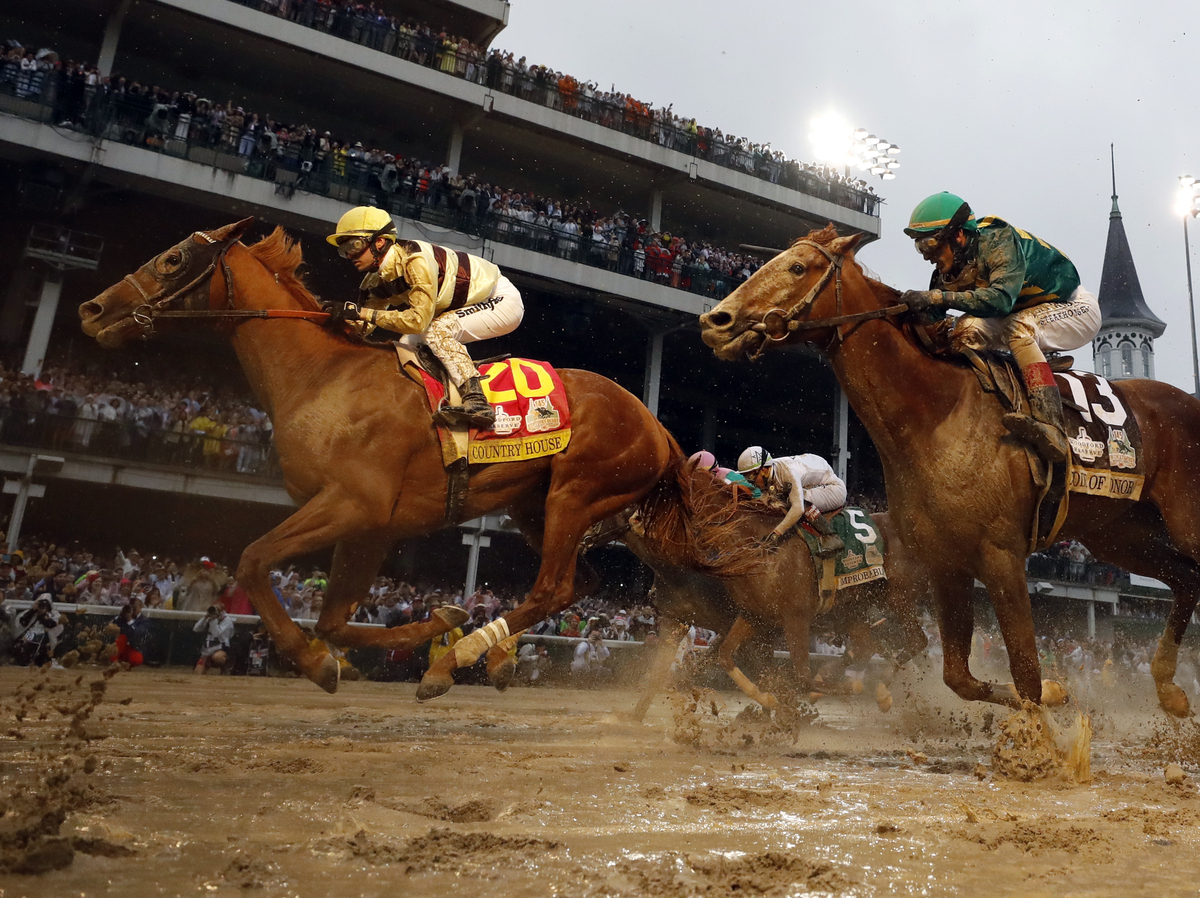
Flavien Prat rides Country House to victory during the 145th running of the Kentucky Derby.
Matt Slocum/AP
hide caption
toggle caption
Matt Slocum/AP
Updated at 9:05 p.m. ET
In a stunning and historic Kentucky Derby upset, the horse that crossed the finish line first was not the one that was declared the winner.
Maximum Security, the favorite entering the race and the only undefeated horse in the field, outpaced the competition on the muddy track at Churchill Downs and appeared to have won the 145th Kentucky Derby with a time of 2:03.93.
Then an objection was lodged. For several tense minutes in Louisville, some 150,000 people in rain-soaked ponchos and fancy hats waited for a verdict.
About 20 minutes after the race ended, the race’s stewards announced that Maximum Security had been disqualified for impeding the path of at least one other horse in the race. The decision handed the victory to Country House, which started the race at 65-1 odds, and a first-time win to Hall of Fame trainer Bill Mott.
It’s the first time a horse has been disqualified for interference in the history of the race. The result also ended a six-year streak of favorites winning the derby.
Code of Honor finished second (13-1) and Tacitus (5-1), also trained by Mott, took third.
An explanation of Maximum Security’s #KyDerby disqualification. pic.twitter.com/vf8AN4qvD2
— Kentucky Derby (@KentuckyDerby) May 4, 2019
“It’s amazing,” Country House’s jockey Flavien Prat, told NBC Sports after the result was announced. “I really kind of lost my momentum around the turn, so I thought that I was going to win, but it cost me, actually.”
At a press conference after the event, Mott said he was happy with the way his horse and jockey performed.
“As far as the win goes, it’s actually bittersweet,” he said. “I’d be lying if I said it was any different.”
He acknowledged that the stewards had to make a challenging decision but said the disqualification was warranted because of Maximum Security’s impact on other horses.
Maximum Security’s trainer, Jason Servis, and the horse’s jockey, Luis Saez, had already begun to celebrate what they believed were their first Derby victories before the stewards began reviewing the objection.
Mott said he expected that the controversy surrounding the incident would reverberate for a long time. “I wouldn’t be surprised if this race shows up on TV over and over and over a year from now,” he said.
It was also a bittersweet victory for co-owner Maury Shields, whose husband, Joseph “Jerry” Shields, died last year. The prominent thoroughbred owner-breeder had served on several racing boards and was a founding member of the National Thoroughbred Association, according to the horse racing website the Paulick Report.
Only one other horse has been disqualified after finishing first in the race. Dancer’s Image, who ran in the 1968 Derby, was disqualified years later for a failed drug test.
Maximum Security was the race favorite heading into the Run for the Roses, with odds at 4-1 by the evening.
A light drizzle, which followed hours of overcast but dry skies, turned into heavier rain just in time for the race and drenched the main track. Shortly before the race began, the track was downgraded from fast to sloppy.
Last year, several inches of rain also made for a sloppy track. Justify, the favorite, took home that victory.
How High Medical Bills Can Take A Toll On Both Patients And The Nurses Who Care For Them
NPR’s Scott Simon speaks with Hilary Valdez, a nurse who wrote in after our last Bill of the Month story. She tells us about how high medical bills can affect nurses’ relationships with patients.
SCOTT SIMON, HOST:
NPR’s recently run stories about high medical bills and people who struggle to pay them in our Bill of the Month series in collaboration with Kaiser Health News. After our most recent story, we heard from a nurse who says high bills affect her relationship with patients, and perhaps their care.
Hilary Valdez is a cardiac nurse at a hospital in Colorado Springs, Colo. She joins us now. Ms. Valdez, thanks so much for being with us.
HILARY VALDEZ: Thank you for having me.
SIMON: As you see it, what are the effect of high bills on some of your patients as you deal with them?
VALDEZ: Well, initially, I wrote in because I was frustrated. These stories aren’t sensationalized. And because of these crushing bills, the public has become, I think, less trusting of health care providers. And so I wanted to speak from the perspective of nurses and other clinicians who work directly with the patients because we hear their frustrations the loudest.
I had a patient who had a heart attack. And he called me from the hall. He was sweating and short of breath, and his chest pain had returned. And protocol dictated that I get the 12-lead EKG machine. And as I was placing the leads on his chest, he looked at me almost suspiciously and asked me what that was going to cost.
And that was a teaching moment for me because I think of that machine the same way I think of a blood pressure cuff or a stethoscope. It’s a way for us to assess our patients. And it shocked me that in this situation that could have been life-threatening, he was mostly concerned about his bill.
SIMON: Has it happened that your – I don’t know – you’re about to take care of someone, doing one of the amazing things that nurses do, and a patient looks up and says, wait; I don’t know if I can pay for that?
VALDEZ: It has. And patients have the right to autonomy and transparency. And it’s important that we help them navigate the system so they can be more comfortable making their health care decisions. And nurses – you know, patients need to utilize us. And we advocate so much for them. They need to think of nurses as multitools. We have the doctors’ ears and the social workers, case managers, pharmacists. And patients, I think, need to be aware that we can help get them resources that they might not know exist.
SIMON: From your perspective, what worries you the most about health care in this country?
VALDEZ: Oh, I don’t quite have the answer to that. My concern, though, is that patients become fearful of seeking health care. And not all situations require hospitalization, but when someone puts off a nagging pain for years and years because they think they might lose their home, they end up in a lot worse of a situation than if they had sought help earlier.
SIMON: Yeah. I have been told that you have to struggle with some of these questions in your own personal life, too.
VALDEZ: Yes, I have a chronic illness, actually – epilepsy. And since I was a child, I have dealt with hospitalizations and diagnostic tests and, more recently, even surgery. And the medications that I have to keep me seizure-free so I can work – they’re expensive and have become more so. If I wasn’t in a dual-income household, I don’t think I would be able to make those payments.
SIMON: So you’re a nurse with a chronic condition, and you’re not certain you can afford the medication you need to keep you going.
VALDEZ: No. And I have great health benefits, too. But, in fact, benefits change, sometimes from year to year, and a medication that I would get at a certain price from a certain pharmacy might change with next year’s benefits. So it’s hard for me to navigate, even as someone who, I think, does have health care literacy.
SIMON: Hilary Valdez is a cardiac nurse at a hospital in Colorado Springs. Thank you so much for being with us.
VALDEZ: Well, thank you for having me.
Copyright © 2019 NPR. All rights reserved. Visit our website terms of use and permissions pages at www.npr.org for further information.
NPR transcripts are created on a rush deadline by Verb8tm, Inc., an NPR contractor, and produced using a proprietary transcription process developed with NPR. This text may not be in its final form and may be updated or revised in the future. Accuracy and availability may vary. The authoritative record of NPR’s programming is the audio record.
Saturday Sports: Portland Trail Blazers Defeat Denver Nuggets In 4 Overtime Periods
The Portland Trail Blazers defeated the Denver Nuggets 140-137 after playing four overtime periods. That hasn’t happened since Dwight D. Eisenhower was president.
SCOTT SIMON, HOST:
The art of fiction is dead. Proust, Tolstoy, Atwood, move over. While half of America slept, the Portland Trail Blazers defeated the Denver Nuggets 140-137 in a game with four – count them, you almost run out of fingers – four overtime periods. That hasn’t happened since Dwight D. Eisenhower was president. Yes, a man named Eisenhower was president. NPR’s Tom Goldman is in what’s beginning to look like title town USA with organic ramps and fiddlehead ferns – Portland. Tom, thanks for being with us. And I’m breathless.
TOM GOLDMAN, BYLINE: I wouldn’t miss it.
SIMON: What a game – what a game.
GOLDMAN: Three and a half hours of sport as diversion, entertainment, unmitigated pleasure unless you’re from Denver.
SIMON: (Laughter) Pleasurable until the last second – last 5.6 seconds, really – yeah.
GOLDMAN: The best summing up came from Portland head coach Terry Stotts after the game. He said, I have no idea what happened in the first half or the second half or the first three overtimes. Rodney Hood came in and played great. It was a hell of a game. I’ve never been involved in a game like that. It was an amazing effort by both teams. Rodney Hood, who he did mention, came into the game…
SIMON: Yeah.
GOLDMAN: …Two minutes left in the fourth overtime after sitting on the bench forever. He was the freshest player on the court. And he scored seven points, including a monster three-point shot at the end, which pretty much sealed it. Sadly, Scott, that leaves out so many other players…
SIMON: Yeah.
GOLDMAN: …From both teams who competed magnificently. But if I’ve piqued your interest, set aside 3 1/2 hours today and watch a replay.
SIMON: On the other hand, it’s just two-game-to-one lead. Do the Blazers have enough in the tank?
GOLDMAN: I think both teams will summon the physical energy. This is what they train for. But I think Portland has a psychological advantage right now. Losing a game like that after that effort is pretty demoralizing. And Denver has to deal with that. And it probably puts them in a more vulnerable position. If the Blazers get by Denver, probably Golden State lurks in the next round.
SIMON: Yeah.
GOLDMAN: Blazer fans are just thinking…
SIMON: Lurks – Golden State looms.
GOLDMAN: Looms – but Blazer fans are just thinking about tomorrow’s Game 4 against the Nuggets at this point.
SIMON: Kentucky Derby, of course, today – but this year’s race comes in the face of a lot of controversy surrounding the deaths of the greatest athletes in that sport. And, of course, I mean the horses.
GOLDMAN: Yeah. Today starts the Triple Crown period – three big races, the Derby, the Preakness, the Belmont Stakes, over the next month. This time always captures even the casual racing fan. But as you say, horse racing already is in the spotlight with the deaths of 23 horses in recent months at Santa Anita in Southern California. Those deaths prompted calls for reform – some of it starting to happen.
SIMON: Some changes have been made, right?
GOLDMAN: Yeah. Well, Santa Anita has responded, putting into place several changes related to medicating race horses. And just this week, it was announced the track is going to start using scan technology to study horses and diagnose injuries before they become catastrophic. That’s considered a very big deal. And on a larger level, an organization called the Coalition For Horse Racing Integrity – it’s starting a nationwide campaign to support a current bill in Congress that would regulate racing and unify an incredibly balkanized industry.
SIMON: Yeah.
GOLDMAN: Thirty-eight states have racing. And there are 38 sets of rules. And it makes it really hard to get any kind of measure passed, particularly safety measures that would protect the horses.
SIMON: Something I’ve wondered about in recent weeks – Tom, does horse racing have a problem the way football has a problem with concussions, that there is just damage in the sport itself?
GOLDMAN: That’s a really good question. There are those who say that’s definitely the case and that horse racing should be abolished because it’s inherently cruel to the animals. But there are certainly others, many in the industry, who say racing can go on safely without horses being mistreated. But if the industry wants to both benefit a lot of humans and be humane toward the animals at the same time, it has to be a lot better. There has to be reform because, if the public loses interest, reform efforts stall. As one animal rights activist told me, complacency is the enemy of the horses. And that could doom a whole industry.
SIMON: Yeah. NPR’s Tom Goldman, thanks so much.
GOLDMAN: You’re welcome.
Copyright © 2019 NPR. All rights reserved. Visit our website terms of use and permissions pages at www.npr.org for further information.
NPR transcripts are created on a rush deadline by Verb8tm, Inc., an NPR contractor, and produced using a proprietary transcription process developed with NPR. This text may not be in its final form and may be updated or revised in the future. Accuracy and availability may vary. The authoritative record of NPR’s programming is the audio record.