The Little-Known History Behind The Kentucky Derby

Saturday marks the 145th running of the Kentucky Derby in Louisville. NPR’s Scott Simon talks to Los Angeles Times reporter Kurtis Lee about some of the unknown history behind the legendary race.


SCOTT SIMON, HOST:

Today, 20 horses will step into the gates at Churchill Downs for the 145th running of the Kentucky Derby. There is a long history of horses and jockeys hoping for Triple Crown immortality. Some of that history lies in a neglected cemetery in Lexington, Ky., called African Cemetery No. 2, spread over eight acres. The site was created during the Reconstruction and Jim Crow eras when blacks and whites were buried in separate cemeteries. Thousands of African Americans are laid to rest there. And among those thousands are some of the early black jockeys and horsemen who were an important part of creating the legacy of the Kentucky Derby.

Kurtis Lee is a national correspondent for the Los Angeles Times. He visited that cemetery earlier this year and joins us now. Thanks so much for being with us.

KURTIS LEE: Hey. Thanks so much for having me.

SIMON: You described the cemetery in your article as neglected, cracked, chipped, crumbled. How did you find it?

LEE: I was on assignment in January doing a story on tobacco farmers who are growing industrial hemp now. And, you know, just driving through rural Kentucky, staring out at one of these horse farms, I just thought to myself, how many of these are black-owned? And, you know, the history of Kentucky in the South with slavery and Jim Crow – deep down, I knew that the answer was zero. And when I got back to my hotel room, I did a simple Google search. And I found that to be true. But I stumbled upon this cemetery, which was, you know, not far from my hotel – African Cemetery No. 2 where these black race – horseracing legends are laid to rest in this cemetery. And, you know, it’s really this forgotten history that not a lot of people know about.

SIMON: Well, tell us about some of the names that you discovered and learned about who are laid to rest there.

LEE: Absolutely. So there’s Oliver Lewis. He was the first jockey to win a Kentucky Derby in 1875. And also, you know, James “Soup” Perkins – he was one of the youngest jockeys to win. He won the Derby in 1895 at the age of 15. And, you know, also buried there was the late great Isaac Burns Murphy who rode in 11 Kentucky Derbies. And, you know, he won three. And of the first 28 winning jockeys of the derby, 15 were black men. And there just isn’t that much emphasis on it every time the Kentucky Derby comes around, you know, the first Saturday in May.

SIMON: I didn’t know it until I read your article. How do we explain that?

LEE: You know, you saw a lot of black jockeys winning the Derby in the late 1800s and early 1900s. And then Jim Crow laws come along. And by 1922, there were no blacks in the Kentucky Derby, no jockeys. And that continued on all the way until 2000 when Marlon St. Julien rode in the Kentucky Derby. And there was another break even until 2013 when Kevin Krigger was the last black man to ride in the Kentucky Derby.

SIMON: You a derby fan?

LEE: I am. Growing up, the Kentucky Derby was always on in May at my house. And, you know, growing up, my father would always talk to us about black firsts. You know, Doug Williams was the first black man to win the Super Bowl, Tiger Woods the first to win the Masters and Thurgood Marshall the first to sit on the Supreme Court. And, you know, I never knew that the first jockey to win the Kentucky Derby was a black man. And, you know, I think that just – it just is a testament of just how much – there isn’t that much knowledge around this.

SIMON: Kurtis Lee, national correspondent for the Los Angeles Times, thanks so much for being with us.

LEE: Thanks so much.

Copyright © 2019 NPR. All rights reserved. Visit our website terms of use and permissions pages at www.npr.org for further information.

NPR transcripts are created on a rush deadline by Verb8tm, Inc., an NPR contractor, and produced using a proprietary transcription process developed with NPR. This text may not be in its final form and may be updated or revised in the future. Accuracy and availability may vary. The authoritative record of NPR’s programming is the audio record.
Let’s block ads! (Why?)

Kentucky Derby Jockeys Look For New Ways To Shave Off Time

The Kentucky Derby is fast. Really fast. The famed horse race is often won by fractions of a second. This has owners, trainers and jockeys looking for any way they can cut time.


AILSA CHANG, HOST:

Tomorrow marks the 145th Run for the Roses, better known as the Kentucky Derby and often referred to as the fastest two minutes in sports. In past years, the race has been won by less than a second. While there’s plenty of debate over the impact of performance-enhancing drugs, Ashlie Stevens of member station WFPL in Louisville wondered – what are some other ways jockeys, owners and trainers shave seconds off race time?

ASHLIE STEVENS, BYLINE: In the days leading up to the Kentucky Derby, horses and their trainers parade through the paddock on their way to and from the track for practice runs.

(SOUNDBITE OF HORSE TROTTING)

A. STEVENS: For now, the horses are moving at a pretty slow pace.

(SOUNDBITE OF HORSE WHINNYING)

A. STEVENS: But on Saturday, that won’t be the case. These horses are 1,000-pound elite athletes. And this race is just as competitive as any marathon or Olympic swim. Since its start in 1875, there are numerous examples of the derby being won by a fraction of a second. Which made me wonder – has anyone ever shaved their racehorse to get a better time, like how some human endurance athletes shave excess body hair to eliminate drag?

CHRIS GOODLETT: To my knowledge, there’s never been hair shaved off a horse to save seconds.

A. STEVENS: That’s Chris Goodlett, the chief curator at the Kentucky Derby Museum.

GOODLETT: I don’t know if it’s written rule – maybe because of the absurdity – but my guess would be it would be frowned upon.

A. STEVENS: Goodlett says, ultimately, the Jockey Club, the governing body of professional horse racing, probably wouldn’t approve of a bald horse. They can get sunburns, and owners are prevented from making any major alterations to a horse’s appearance – though there are plenty of other modifications trainers and jockeys have made for faster runs, such as using lighter horseshoes. Gary Stevens is a retired three-time Kentucky Derby-winning jockey.

GARY STEVENS: They’re not steel shoes. They are aluminum. And they are very, very lightweight. And they have toe grips on the front and grips on the rear end as well.

A. STEVENS: Stevens also says jockeys’ colorful shirts have undergone some aerodynamic updates since the 1980s. The silks now fit much tighter, like what bicyclists wear.

TERESA ESTES: The aero fits tighter to the body, so you don’t have it flapping in the wind when the horse is running.

A. STEVENS: That’s Teresa Estes. She and her business partner run Triple Crown Silks in Winchester, Ky. They are designing silks for three Derby hopefuls this year. Estes says many racehorse owners now want something more tailored to the jockeys’ bodies to reduce drag.

ESTES: In the satins, you can’t do that because there’s no stretch to it.

A. STEVENS: More of their clients are shifting away from those traditional race day materials to more aerodynamic fabrics.

Even with all the improvements, jockey Gary Stevens says a large part of the Kentucky Derby is still the luck of the draw, specifically the draw for post positions, or which gate the horses get to start out of. The worst one is closest to the inside rail.

G. STEVENS: And the one hole is dreaded in the Kentucky Derby because if you don’t break well – if you don’t get a good start, it’s like a giant wave of 19 other horses trying to get over close to the rail to safe ground going into that first turn.

A. STEVENS: And even with a good post position, sleeker clothing and lighter gear, Chris Goodlett of the Kentucky Derby Museum says there’s one more thing to try.

GOODLETT: Trainers will all joke with us that if you want more seconds – you want to do a little bit better in the race, you need to buy a faster horse.

A. STEVENS: While having the fastest horse is really the only sure bet for winning the Derby, that won’t keep trainers and jockeys from trotting out new tricks to increase speed.

For NPR News, I’m Ashlie Stevens in Louisville.

(SOUNDBITE OF PARQUET COURTS’ “WIDE AWAKE”)

Copyright © 2019 NPR. All rights reserved. Visit our website terms of use and permissions pages at www.npr.org for further information.

NPR transcripts are created on a rush deadline by Verb8tm, Inc., an NPR contractor, and produced using a proprietary transcription process developed with NPR. This text may not be in its final form and may be updated or revised in the future. Accuracy and availability may vary. The authoritative record of NPR’s programming is the audio record.

Let’s block ads! (Why?)

Employees Start To Feel The Squeeze Of High-Deductible Health Plans

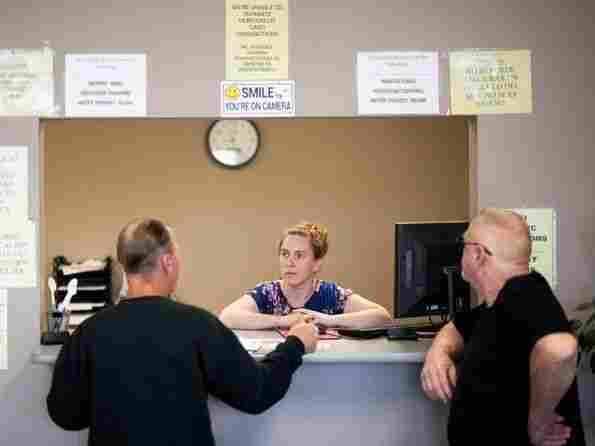
Clarisa Corber at work at a Topeka, Kan., insurance agency. Corber and her husband — who have three kids, a health plan and $15,000 in medical debt — were profiled in a recent Los Angeles Times investigation into the effects of high-deductible health plans.

Nick Krug/Los Angeles Times


hide caption

toggle caption

Nick Krug/Los Angeles Times

Workers with a steady paycheck already know that wages have been stubbornly slow to rise. Meanwhile, those who get health insurance through a job have seen their deductibles shoot up. In fact, says Noam Levey, a health care reporter for the Los Angeles Times, deductibles have, on average, quadrupled over the last dozen years. As a result, even some people who have health insurance are having trouble affording medical care. We talked with Levey about his latest reporting into how the issue is affecting workers and their families.

Interview Highlights

On why he decided to embark on this project:

We’ve spent so much time fighting about Obamacare over the last 10 years and talking about the uninsured that I think we lost sight of this quiet revolution that’s happened with health coverage for the tens of millions of Americans who have coverage through an employer. These are the people who’ve seen deductibles rise astronomically — rising four times in the last dozen years from about $350 on average to $1,350 on average. In some cases, people are seeing $4,000, $5,000, even $6,000 deductibles that they have to pay out of their own pocket before their health insurance kicks in. Needless to say, many, many Americans can’t afford those kinds of bills.

On what he heard in talking to people:

We heard some really heartbreaking stories. So we did a nationwide poll with the Kaiser Family Foundation as part of this project. One of the things that we found was that half of Americans who get job-based coverage say they or an immediate family member in the last year have put off going to the doctor, not filled the prescription or delayed some other kind of medical care because of concern about cost. We found one in five had depleted their savings to pay a medical bill in the last year and one in six reported that they have had to make some kind of difficult sacrifice in order to pay a medical bill.

Some of them were really gut wrenching. We talked to a 27-year-old chef in western Virginia trying to start a family with his young wife. His wife had a miscarriage. They got such huge medical bills he had to take two extra jobs and was working from 5 a.m. until 11 p.m. some days.

These are people with health insurance. This used to be something we heard about all the time for people who didn’t have health insurance, but in many cases these are middle-class people making $75,000 or $100,000 a year. But if they get a $5,000 or $6,000 medical bill — a family of four, kids in school — it’s hard for a lot of people to come up with that kind of money.

On what’s coming next in his reporting

We’re going to be looking particularly at how these high deductibles are problematic for people who have serious medical conditions — diabetes, heart disease, even cancer. One of the things we found particularly troubling is that these people who should be going to the doctor, even they are cutting back on their treatment.

We’re going to be looking at how these high-deductible plans are exacerbating inequality at a time when this is a major issue for Americans about who’s getting the gains in our economy. If you’re living paycheck to paycheck and you get sick, it’s really tough for that group of people.

One of the other things that’s amazing, and I know NPR has looked a little bit at this, is that the growth of online charities and crowdfunding sources like GoFundMe is being driven in large part by people seeking to pay medical bills. And one of the amazing things about those people is that many of them have health insurance.

Noam Levey reports for the Los Angeles Times and can be found on Twitter: @NoamLevey.

Let’s block ads! (Why?)

200 Female Pro Hockey Players Lay Down Their Sticks Demanding Better Conditions

More than 200 of the top female hockey players have decided they will not play professionally in North America next season. They are calling for a sustainable league with better resources. Pictured are Hilary Knight (left) with Kelly Pannek, playing with the U.S. national team last month in Finland. Both signed on to the boycott.

Jussi Nukari/AP


hide caption

toggle caption

Jussi Nukari/AP

Decrying the sorry state of salary and support for women’s hockey, around 200 female players announced Thursday they won’t play the game at the professional level across North America, until they get a league with “the resources that professional hockey demands and deserves.”

“We cannot make a sustainable living playing in the current state of the professional game,” said the statement several players posted to their social media accounts. “Having no health insurance and making as low as two thousand dollars a season means players can’t adequately train and prepare to play at the highest level.”

We may represent different teams, leagues and countries but collectively we stand as one. #ForTheGame pic.twitter.com/O9MOOL8YOt

— Hilary Knight (@HilaryKnight) May 2, 2019

By contrast on the men’s side, Forbes says the top ten players of the 2018-2019 season each brought home multi-million dollar paychecks from the NHL, with lucrative endorsement deals topping them off.

On Wednesday, the Canadian Women’s Hockey League officially discontinued operations, citing an economically unstable business model, leaving the National Women’s Hockey League the sole remaining professional league in North America.

The NWHL had been hoping to fold in players from the Canadian league and said Thursday, despite the boycott, it still plans to proceed with season five in October with its five teams.

As a concession to players, the league announced it is “offering increased salaries and a 50-50 revenue [split] from league-level sponsorships and media rights deals,” adding it remains open to communicating with players about their concerns.

Among those participating in the boycott are Hilary Knight and Kendall Coyne Schofield, who helped propel the U.S. Women’s National Team to win gold at the 2018 Olympic Winter Games in South Korea, as well as Canadian national team goalie Shannon Szabados.

“Obviously we want to be on the ice, but I think that kind of speaks volumes to how critical it is,” Szabados, who played for the NWHL’s Buffalo Beauts, told The Associated Press. “It’s over 200 of us that kind of want to stop being pulled in 10 different directions and kind of get all our resources under one roof.”

After they announced the boycott, words of support for the players came pouring in.

Female athletes deserve to live the life they envisioned as kids: playing the sport they love, and making a living doing it. I stand with all female athletes in their pursuit of equal pay and a sustainable future. #ForTheGame #OneVoice https://t.co/hLY9HgcIJa

— Billie Jean King (@BillieJeanKing) May 2, 2019

“Female athletes deserve to live the life they envisioned as kids: playing the sport they love, and making a living doing it,” tweeted Billie Jean King, the onetime world’s top-ranked women’s tennis player.

Mary-Kay Messier, vice president of global marketing for ice hockey equipment manufacturer Bauer, called on the NHL to step in. “In order to develop a long-term viable women’s professional hockey league, the NHL must be in an ownership position,” she said in a statement.

The NHL has provided limited funding to the women’s teams, but has so far resisted calls to do more. The players designed Thursday’s announcement, in part, to compel the NHL to act, reports ESPN.

But in a statement emailed to NPR, the NHL says, while it supports the objectives of both the NWHL and the female players, it is not in a rush to make any move. “We will need some time to better understand what the full picture and implications look like,” Deputy Commissioner Bill Daly said.

Commissioner Gary Bettman told the AP that the NHL still wants the NWHL to “make a go of it,” and does not want to interfere at this time, although that could change if “there turns out to be a void.”

But the players say the void is already there and they will not pick up their sticks again until it is addressed.

Let’s block ads! (Why?)

U.S. Soccer Unveils Roster For Women’s World Cup, As Team Looks To Defend Title

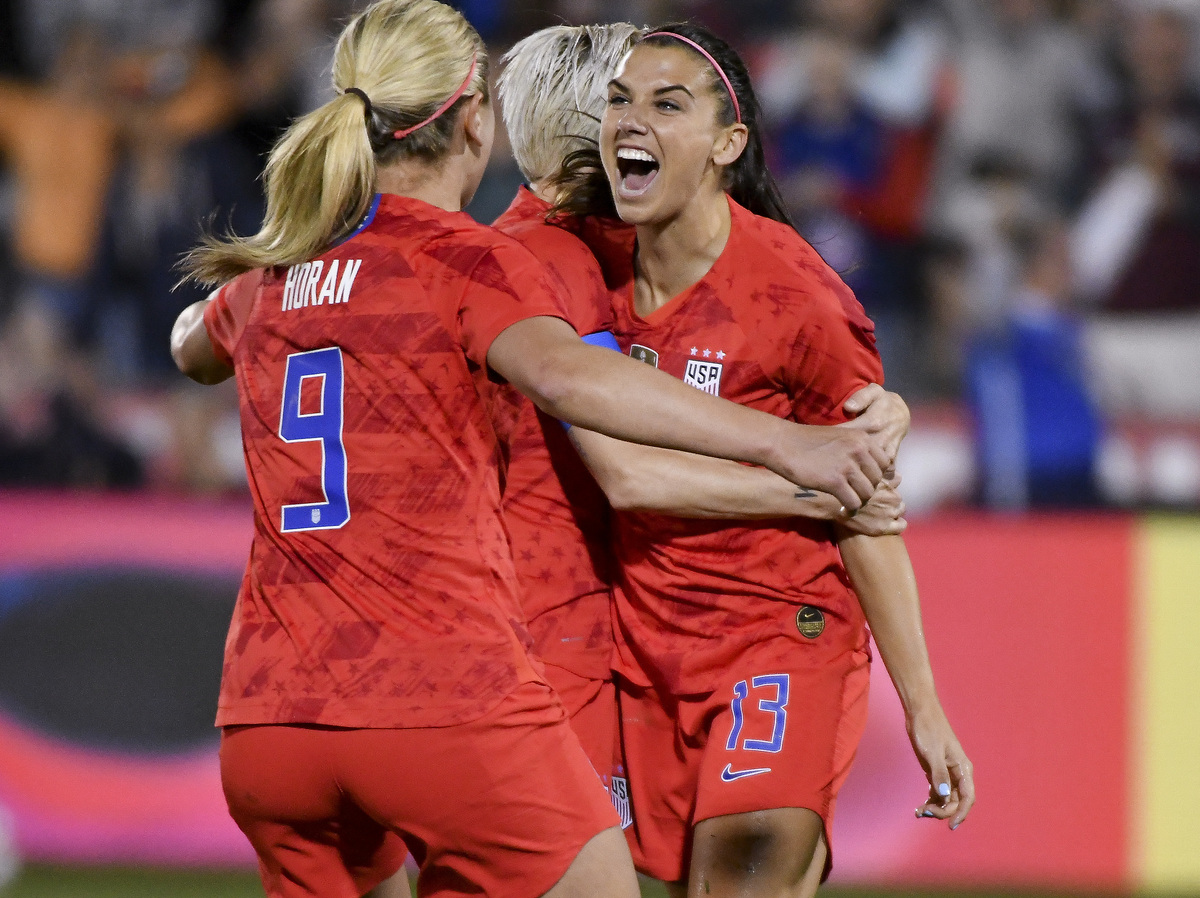
Alex Morgan, right, celebrates with Lindsey Horan and Megan Rapinoe after scoring her 100th international goal on April 4 in Colorado. The three will represent the U.S. at the Women’s World Cup next month in France.

Michael Ciaglo/Getty Images


hide caption

toggle caption

Michael Ciaglo/Getty Images

U.S. soccer coach Jill Ellis has named the 23 players who will play for the women’s national team in the 2019 Women’s World Cup in France next month. The U.S. team will look to defend its championship from the last tournament in 2015, when it defeated Japan in the final.

The roster includes many of the stars who have previously played in high-profile international competition. Leading the way is Carli Lloyd, who scored six goals at the 2015 tournament and will now return for her fourth Women’s World Cup. Alex Morgan, Megan Rapinoe, Tobin Heath, and Becky Sauerbrunn will head to their third World Cup tournaments.

? BACK FOR FOUR

23 players on the squad. A nation at our back. Our World Cup roster is here.#OneNationOneTeam #FIFAWWC

— U.S. Soccer WNT (@USWNT) May 2, 2019

The biggest surprises on the roster are the inclusion of veteran defender Ali Krieger and midfielder Morgan Brian, who have only rarely been named to the national team in recent years. Ellis was clearly looking to add more experience to the squad with Krieger, who will play in her third Women’s World Cup. Brian was the youngest member of the 2015 squad, but she has struggled with injuries over the last two years.

In a call with reporters on Thursday, Ellis said both players are on an upward trajectory in terms of fitness, and that Krieger’s mental composure was part of the equation. “No moment is ever going to be too big for her,” Ellis explained.

This will be the first World Cup for nine of the athletes. All 23 of the players compete in the National Women’s Soccer League, the U.S. professional league.

One of the team’s fastest-rising stars is forward Mallory Pugh, who just turned 21. The team’s youngest member is Tierna Davidson, 20.

Former national team member Heather O’Reilly tweeted her approval of the lineup as the team pursues its obvious goal: “This is a squad that can certainly win the World Cup.”

The U.S. has won the tournament three times, the most of any country.

Hope Solo, the goalkeeper who made many headlines in years past, is no longer on the national team. Instead, the 2019 squad includes goalkeepers Ashlyn Harris, Alyssa Naeher and Adrianna Franch.

The tournament kicks off June 7 in Paris, as France and South Korea face off. The U.S. begins the group stage against Thailand on June 11 in Le Havre, followed by matches against Chile and Sweden, the team that eliminated the U.S. at the 2016 Olympics.

USA Roster for the 2019 FIFA Women’s World Cup

Goalkeepers: Adrianna Franch, Ashlyn Harris, Alyssa Naeher

Defenders: Abby Dahlkemper, Tierna Davidson, Crystal Dunn, Ali Krieger, Kelley O’Hara, Becky Sauerbrunn, Emily Sonnett

Midfielders: Morgan Brian, Julie Ertz, Lindsey Horan, Rose Lavelle, Allie Long, Samantha Mewis

Forwards: Tobin Heath, Carli Lloyd, Jessica McDonald, Alex Morgan, Christen Press, Mallory Pugh, Megan Rapinoe

Let’s block ads! (Why?)

New Trump Rule Protects Health Care Workers Who Refuse Care For Religious Reasons

Health care workers may now refuse to be involved with providing services that offend their religious beliefs. The new rule, issued by the HHS Office for Civil Rights, affirms existing conscience protections established by Congress, director Roger Severino says.

Aaron P. Bernstein/Getty Images


hide caption

toggle caption

Aaron P. Bernstein/Getty Images

The Trump administration issued a new rule Thursday that gives health care workers leeway to refuse to provide services like abortion, sterilization or assisted suicide, if they cite a religious or conscientious objection.

The rule, issued by the Department of Health and Human Services, is designed to protect the religious rights of health care providers and religious institutions.

According to a statement issued by HHS’s Office for Civil Rights, the new rule affirms existing conscience protections established by Congress.

“This rule ensures that healthcare entities and professionals won’t be bullied out of the health care field because they decline to participate in actions that violate their conscience, including the taking of human life,” OCR Director Roger Severino said in a written statement. “Protecting conscience and religious freedom not only fosters greater diversity in healthcare, it’s the law.”

Last year Severino made it clear that defending religious freedom was his primary goal when he created a new Division of Conscience and Religious Freedom. “Never forget that religious freedom is a primary freedom, that it is a civil right that deserves enforcement and respect,” Severino said when he created the division.

As part of that change in focus, HHS in the last week also changed the Office for Civil Rights’ mission statement to highlight its focus on protecting religious freedom.

Until last week, the website said the office’s mission was to “improve the health and well-being of people across the nation” and to ensure people have equal access to health care services provided by HHS. But the new statement repositions the OCR as a law enforcement agency that enforces civil rights laws, and conscience and religious freedom laws, and “protects that exercise of religious beliefs and moral convictions by individuals and institutions.”

That change, which was first noted by the Sunlight Foundation, dovetails with the new rule issued Thursday.

The rule finalized Thursday allows health care workers who have a “religious or conscience” objection to medical procedures such as birth control or sterilization to refuse to participate in those procedures, even in a tangential way. This represents an expansion of existing protections.

“This rule allows anyone from a doctor to a receptionist to entities like hospitals and pharmacies to deny a patient critical — and sometimes lifesaving — care,” said Fatima Goss Graves, president and CEO of the National Women’s Law Center, in a statement.

Louise Melling, deputy legal director at the American Civil Liberties Union, says the rule offers health care providers broad leeway to refuse women reproductive care, such as an emergency abortion to protect the life or health of the mother, if they claim the procedure offends their conscience. The rule protects health care workers who have indirect involvement in such procedures, as long as their roles have an “articulable connection” to a procedure such as abortion, sterilization or even administration of birth control.

“If I am the person who checks you into the hospital, that’s an articulable connection. If I’m the person who would take your blood pressure, that would be an articulable connection,” she says.

The rule applies to individuals and also to entire institutions, such as religious hospitals.

“This rule is consistent with decades of federal conscience law,” said Jonathan Imbody, vice president of government relations at the Christian Medical Association. “Education about and enforcement of these laws has long been neglected.”

The group has dozens of stories on its website of health care providers who say they were punished because of their religious or conscience objections, including an OB-GYN whose malpractice insurance company said it wouldn’t cover her if she refused to inseminate a lesbian and an anesthesiologist who refused to participate in an abortion and objected to referring a patient seeking one to another doctor when he refused to participate.

In its rule, HHS cited a case, Means v. the U.S. Conference of Catholic Bishops, in which a woman sued the church because she was denied an emergency abortion, was sent home multiple times by a Catholic hospital and ended up with an acute infection after she miscarried.

The agency said the lawsuit filed by the patient is an example of hospitals being coerced to perform abortions against their will. The ACLU, however, says that same case shows that health care providers should not be allowed to put their religious beliefs ahead of the health of their patients.

Let’s block ads! (Why?)

Laraaji: Tiny Desk Concert

Prepare to be calmed.

It begins with a small bell, a set of tiny wind chimes and a plucked, angelic zither sounding much like a harp. Laraaji and his musical partner Arji “OceAnanda” Cakouros came to NPR draped in loose-fitted, saffron-tinted clothes, with a table draped in a similar orange fabric — almost the tones of a setting sun with all the beauty that implies. As I watched, I could feel my breath letting go; my muscles were less tense. Then Laraaji began to laugh. I smiled. (His laugh is infectious). Then more of us in the office smiled as he brushed rhythms on his zither and processed the sounds to add delay and intensify the hypnotic pulse.

I first discovered the music of Laraaji almost 40 years ago when Brian Eno produced an ambient album of his music called Ambient 3: Day of Radiance as part of a series of ambient records from Eno that began with 1978’s Ambient 1: Music for Airports. Edward Larry Gordon, now known as Laraaji, was a comedian as well as a musician. I suppose that explains the laughter as part of his meditative and therapeutic music. Laraaji is now in his mid-70s, has released over 50 recordings as well as an abundance of sound-healing sessions. His concert in the NPR offices was proof of the atmospheric, altering power of the music he makes along with Arji. Maybe you’ll find yourself enjoying a musical sunset plopped down right in the middle of your day.

SET LIST

  • “12345678…”

MUSICIANS

Laraaji: electric autoharp/zither, vocals; Arji “OceAnanda” Cakouros: mbira, Ipad synth, shakers, chimes

CREDITS

Producers: Bob Boilen, Morgan Noelle Smith; Creative Director: Bob Boilen; Audio Engineer: Josh Rogosin; Videographers: Morgan Noelle Smith, Beck Harlan; Associate Producer: Bobby Carter; Production Assistant: Adelaide Sandstrom; Photo: Amr Alfiky/NPR

Let’s block ads! (Why?)