Court Rules Against Caster Semenya, Says She Must Lower Testosterone To Compete

South African Olympic champion Caster Semenya (center) and her lawyer, Gregory Nott (right), arrive for a hearing at the Court of Arbitration for Sport in Switzerland in February.

Harold Cunningham/AFP/Getty Images


hide caption

toggle caption

Harold Cunningham/AFP/Getty Images

The highest court in sports has ruled that the regulations adopted by track and field’s international governing body regarding women with high levels of testosterone are discriminatory but necessary to ensure fair competition in female athletics.

South African track star Caster Semenya and Athletics South Africa asked the Court of Arbitration for Sport to overturn regulations by the International Association of Athletics Federations that pertained to female athletes with high levels of testosterone.

The IAAF regulation in question requires female athletes with testosterone levels in the range of males to reduce their natural testosterone levels and to maintain that reduced level for at least six months to be eligible to compete in certain track and field events in international competition. The IAAF suggests this reduction be done by taking hormonal contraceptives, and it emphasizes that surgical changes are not required.

One of the events affected by the rule is the 800-meter race, an event won by Semenya at the 2012 and 2016 Olympic Games.

In a summary of its decision, the court wrote that its panel found that the IAAF’s relevant regulations are discriminatory because they impose differential treatment based on protected characteristics in that they “establish restrictions that are targeted at a subset of the female/intersex athlete population, and do not impose any equivalent restrictions on male athletes.”

However, the panel wrote, the IAAF argued “that if the purpose of the female category is to prevent athletes who lack that testosterone-derived advantage from having to compete against athletes who possess that testosterone-derived advantage, then it is necessarily ‘category defeating’ to permit any individuals who possess that testosterone-derived advantage to compete in that category.” The majority of the arbitration panel accepted that logic.

The IAAF said in a statement that it is “grateful” for the ruling “and is pleased that the Regulations were found to be a necessary, reasonable and proportionate means of achieving the IAAF’s legitimate aim of preserving the integrity of female athletics” in the events covered by the regulations.

In a statement released to The Associated Press and other outlets, Semenya wrote: “I know that the IAAF’s regulations have always targeted me specifically. For a decade the IAAF has tried to slow me down, but this has actually made me stronger. The decision of the CAS will not hold me back. I will once again rise above and continue to inspire young women and athletes in South Africa and around the world.”

The South African Sports Confederation and Olympic Committee criticized the decision. “We maintain that the rules are ill-thought and will be a source of distress for the targeted female athletes,” it said, according to the AP.

The court expressed concerns about how the regulations will work in practice, including the possibility that affected athletes may be unable to maintain a natural testosterone level below the required level on a consistent basis.

And the court noted how difficult the case was, involving “a complex collision of scientific, ethical and legal conundrums.”

The matter involves incompatible and competing rights, the court wrote: “Put simply, on one hand is the right of every athlete to compete in sport, to have their legal sex and gender identity respected, and to be free from any form of discrimination. On the other hand, is the right of female athletes, who are relevantly biologically disadvantaged vis-à-vis male athletes, to be able to compete against other female athletes and to achieve the benefits of athletic success. The decision is also constrained by the accepted, necessary, binary division of athletics into male events and female events, when there is no such binary division of athletes.”

The ruling means that Semenya would have to lower her testosterone levels to compete at upcoming meets, including the world championships in September.

Let’s block ads! (Why?)

Alabama Lawmakers Move To Outlaw Abortion In Challenge To Roe V. Wade

A view of the state capitol in Montgomery, Ala. A sweeping abortion bill passed the state House Tuesday, and is expected to win final passage in the Republican majority Senate.

Brendan Smialowski/AFP/Getty Images


hide caption

toggle caption

Brendan Smialowski/AFP/Getty Images

In what would likely become the most restrictive abortion ban in the country, the Alabama House Tuesday passed a bill that would make it a crime for doctors to perform abortions at any stage of a pregnancy, unless a woman’s life is threatened. The legislation is part of a broader anti-abortion strategy to prompt the U.S. Supreme Court to reconsider the right to abortion.

Republican state Rep. Terri Collins of Decatur, Ala. defended her “Human Life Protection Act” during, at times, contentious debate on the House floor.

“This bill is focused on that baby that’s in the womb that is a person,” Collins said. “That baby, I believe, would choose life.”

Democratic lawmakers walked out in protest before the final 74 to 3 vote. During debate, they questioned the motive for an abortion ban in a state that’s refused to expand Medicaid. “I do support life, but there are some people that just support birth they don’t support life,” said Democratic Rep. Merika Coleman of Birmingham, Ala. “Because after a child is born there are some things that need to happen. We need to make sure that child has adequate health care,” Coleman said.

The Unite for Reproductive and Gender Equity coalition demonstrated outside the Alabama statehouse last month.

Debbie Elliott/NPR


hide caption

toggle caption

Debbie Elliott/NPR

Other states, including neighboring Georgia and Mississippi, have passed laws that prohibit abortion once a fetal heartbeat can be detected. But Alabama’s ban would apply even earlier.

“When a woman is pregnant, an abortion is no longer legal,” says Collins, explaining the bill.

The bill criminalizes abortion, meaning doctors would face felony jail time up to 99 years if convicted. The only exceptions are for a serious health risk to the pregnant woman, or a lethal anomaly of the fetus. There are no exceptions for cases of rape or incest. A woman would not be held criminally liable for having an abortion.

Collins says the bill follows a constitutional amendment approved by Alabama voters last year that recognizes the “rights of unborn children.” It defies the U.S. Supreme Court’s landmark decision that protects a woman’s right to abortion.

“This bill is simply about Roe v. Wade,” says Collins. “The decision that was made back in 1973 would not be the same decision that was decided upon today if you relooked at the issue.”

Her bill cites abolition, the civil rights movement and women’s suffrage as justification for establishing the human rights of a fetus. Alabama is one of more than two dozen states seeking to restrict abortion rights this year, testing federal legal precedent that prevents states from banning abortion before the point at which a fetus could survive outside the womb.

Alabama Pro-Life Coalition President Eric Johnston says there’s a reason there’s so much activity now.”The dynamic has changed,” Johnston says. “The judges have changed, a lot of changes over that time, and so I think we’re at the point where we need to take a bigger and a bolder step.” The bold move to outlaw nearly all abortions is drawing protests from abortion rights advocates.

A coalition called Unite for Reproductive and Gender Equity demonstrated outside the Alabama statehouse last month.

“This bill is an awful piece of grandstanding,” said Amanda Reyes of Tuscaloosa, Ala. She’s president of the Yellowhammer Fund, a group that helps women pay for abortions. “If you make abortion illegal somewhere that doesn’t mean that abortion goes away,” says Reyes. “It just becomes more difficult and more dangerous to access.”

The bill is expected to win final passage in the Republican majority Alabama Senate. The ACLU of Alabama says it will sue if the abortion ban becomes law.

Executive Director Randall Marshall says the bill is unconstitutional. “There is simply nothing that Alabama can do to interfere with the right of access to abortion,” Marshall says. “That is a federal right and the Federal Constitution clearly trumps all state law.” With two Trump appointees now on the U.S. Supreme Court, anti-abortion forces are optimistic that judicial interpretation could be reversed.

Let’s block ads! (Why?)

As Meth Use Surges, First Responders Struggle To Help Those In Crisis

Kim has been living at the Epiphany Center, a treatment facility in San Francisco for women struggling with addiction, for the last six months. She says her teddy bear is her only material possession left from her past: “Because everything I had, I’ve lost over and over again.”

April Dembosky/KQED


hide caption

toggle caption

April Dembosky/KQED

Amelia and her roommate had been awake for two days straight. They decided to spray-paint the bathroom hot pink. After that, they laid into building and rebuilding the pens for the nine pit bull puppies they were raising in their two-bedroom apartment.

Then the itching started. It felt like pin pricks under the skin of her hands. Amelia was convinced she had scabies, skin lice. She spent hours in front of the mirror checking her skin, picking at her face. She even got a health team to come test the apartment. All they found were a few dust mites.

“At first, with meth, I remember thinking, ‘What’s the big deal?’ ” says Amelia, who asked that we not reveal her last name to protect her family’s privacy. “But when you look at how crazy things got, everything was so out of control. Clearly, it is a big deal.”

While public health officials have focused on the opioid epidemic in recent years, another epidemic has been brewing quietly, but vigorously, behind the scenes. Methamphetamine use is surging in parts of the U.S., particularly the West, leaving first responders and addiction treatment providers struggling to handle a rising need.

Across the country, overdose deaths involving methamphetamine doubled from 2010 to 2014. Admissions to treatment facilities for meth are up 17%. Hospitalizations related to meth jumped by about 245% from 2008 to 2015. And throughout the West and Midwest, 70% of local law enforcement agencies say meth is their biggest drug threat.

But policymakers in Washington, D.C., haven’t kept up, continuing to direct the bulk of funding and attention to opioids, says Steve Shoptaw, an addiction psychologist at UCLA in Los Angeles, where he hears one story after another about meth destroying peoples’ lives.

The stimulant drug methamphetamine is a white, bitter-tasting crystalline powder that dissolves in water or alcohol and is snorted, injected, or smoked.

SCIENCE SOURCE/Getty Images/Science Source


hide caption

toggle caption

SCIENCE SOURCE/Getty Images/Science Source

“But when you’re in D.C., where people are making decisions about how to deploy resources, those stories are very much muffled by the much louder story about the opioid epidemic,” he says.

Even within drug treatment circles, where you’d think everyone would be on the same side, there’s a divide. Opioid addiction advocates are afraid their efforts to gain acceptance for measures like needle exchange programs and safe injection sites will be threatened if meth advocates demand too much.

“The bottom line is, as Americans, we have just so much tolerance to deal with addiction,” Shoptaw says. “And if the opioid users have taken that tolerance then there’s no more.”

So local lawmakers in San Francisco are trying to get a grip on the toll meth is taking on their city’s public health system on their own. Mayor London Breed recently established a task force to combat the new epidemic.

“It’s something we really have to interrupt,” says San Francisco District 8 Supervisor Rafael Mandelman, who will co-chair the task force. “Over time, this does lasting damage to people’s brains. If they do not have an underlying medical condition at the start, by the end, they will.”

Since 2011, emergency room visits related to meth in San Francisco have jumped 600% to 1,965 visits in 2016, the last year for which ER data is available. Admissions to the hospital are up 400% to 193. And at San Francisco General Hospital, of 7,000 annual psychiatric emergency visits last year, 47% were people who were not necessarily mentally ill — they were high on meth.

“They can look so similar to someone that’s experiencing chronic schizophrenia,” says Dr. Anton Nigusse Bland, medical director of psychiatric emergency services, at San Francisco General. “It’s almost indistinguishable in that moment.”

Someone who has methamphetamine-induced psychosis, he says, “they’re often paranoid, they’re thinking someone might be trying to harm them. Their perceptions are all off,” he adds.

For example, someone starts walking into traffic on Sixth Street, shouting, taking off his shirt. A bystander calls 911 and reports a mentally disturbed person, then the police come and deliver him to Nigusse Bland’s department.

Dr. Anton Nigusse Bland, head of psychiatric emergency services at Zuckerberg San Francisco General Hospital.

April Dembosky/KQED


hide caption

toggle caption

April Dembosky/KQED

If the person is really agitated, doctors might give them a benzodiazepine to calm down, or even an anti-psychotic. Otherwise, the treatment is just waiting 12 to 16 hours for the meth to wear off. No more psychosis.

“Their thoughts are more organized, they’re able to maintain adequate clothing. They’re eating, they’re communicating,” Nigusse Bland says. “The improvement in the person is rather dramatic because it happens so quickly.”

Trends in drug use come in waves

For some people recovering from addiction, the memories of meth-induced psychosis are part of what motivates them to stay sober.

For Amelia, the scabies scare is what alerted her mother to her addiction, forcing an intervention. Even though she did not have scabies, the itchy feeling and the fear are vivid, even a year and a half later.

“I still don’t really want to say it out loud that it wasn’t real,” says Amelia, now 33.

For Kim, another woman in recovery, there was one day last year when she says she went wine tasting with a friend in Sonoma. She was high on Xanax and speed.

“I was crazy,” says Kim, 47, who also asked that we not reveal her last name. “Meth causes people to act completely insane.”

She and her friend got in an argument in the car. Kim thought someone was behind them, following them. She was utterly convinced. And she had to get away.

“I jumped out of the car and started running, and I literally ran a mile. I went through water, went up a tree, and I was literally running for my life,” she says. “I literally thought I was being chased.”

Kim was soaking wet when she walked into a woman’s house, woke her from bed and asked for help. When the woman went to call the police, Kim left and found another woman’s empty guest house to sleep in — Goldilocks-style. Kim says she just wanted to get warm.

“But then I woke up and stole her car,” she says.

That’s how Kim ended up in jail. She’s in a residential treatment program in San Francisco now, part of the steady rise in people seeking help for meth addiction. Rehab admissions in San Francisco for meth are up 25% since 2015.

The trend in rising stimulant use is nationwide: cocaine on the East Coast, meth on the West Coast, says Dr. Daniel Ciccarone, a professor of medicine and substance use researcher at UCSF.

“It is an epidemic wave that’s coming, that’s already here,” he says. “But it hasn’t fully reached our public consciousness.”

Drug preferences are generational, Ciccarone says. They change with the hairstyles and clothing choices, like bell bottoms or leg warmers. It was heroin in the 1970s, cocaine and crack in the ’80s. Then opiate pills. Then methamphetamine. Then heroin. And now meth again.

“The culture creates this notion of let’s go up, let’s not go down,” Ciccarone says. “New people coming into drug use are saying, ‘Whoa, I don’t really want to do that, I hear it’s deadly, people look really doped up and they’re not that fun to be with, I’m going in a different direction.’ “

Kim has been with meth through two waves. When she got into speed in the 1990s, she was hanging out with a lot of bikers, going to clubs in San Francisco.

“Now what I see, in any neighborhood, you can find it. It’s not the same as it used to be where it was kind of taboo,” Kim says. “It’s more socially accepted now.”

Dying from meth

A hint about who is using meth today comes from the data on deaths. Meth is not as lethal as opioids: 47,600 people died of opioid-related overdoses in 2017 compared to 10,333 deaths involving meth. (About half of those involved a mix of meth and opioids.) But the death rate for meth has been rising. Meth-related deaths in San Francisco doubled in since 2011 and more than quadrupled nationally. This is another indication that more people are using meth and that today’s supply is very potent, says UCSF’s Ciccarone.

Another hypothesis that experts have come up with to explain the growth in meth-related overdoses is that meth users are aging. Most meth deaths are from brain hemorrhage or a heart attack, which would be unusual for a 20-year-old.

“Because your tissue is so healthy at that age,” says Phillip Coffin, a physician and the director of substance use research at the San Francisco Department of Public Health. “Whereas when you’re 55 years old and using methamphetamine, you might be at higher risk for bursting a vessel and bleeding and dying from that.”

Older adults have higher blood pressure, maybe heart disease, that makes their heart weaker.

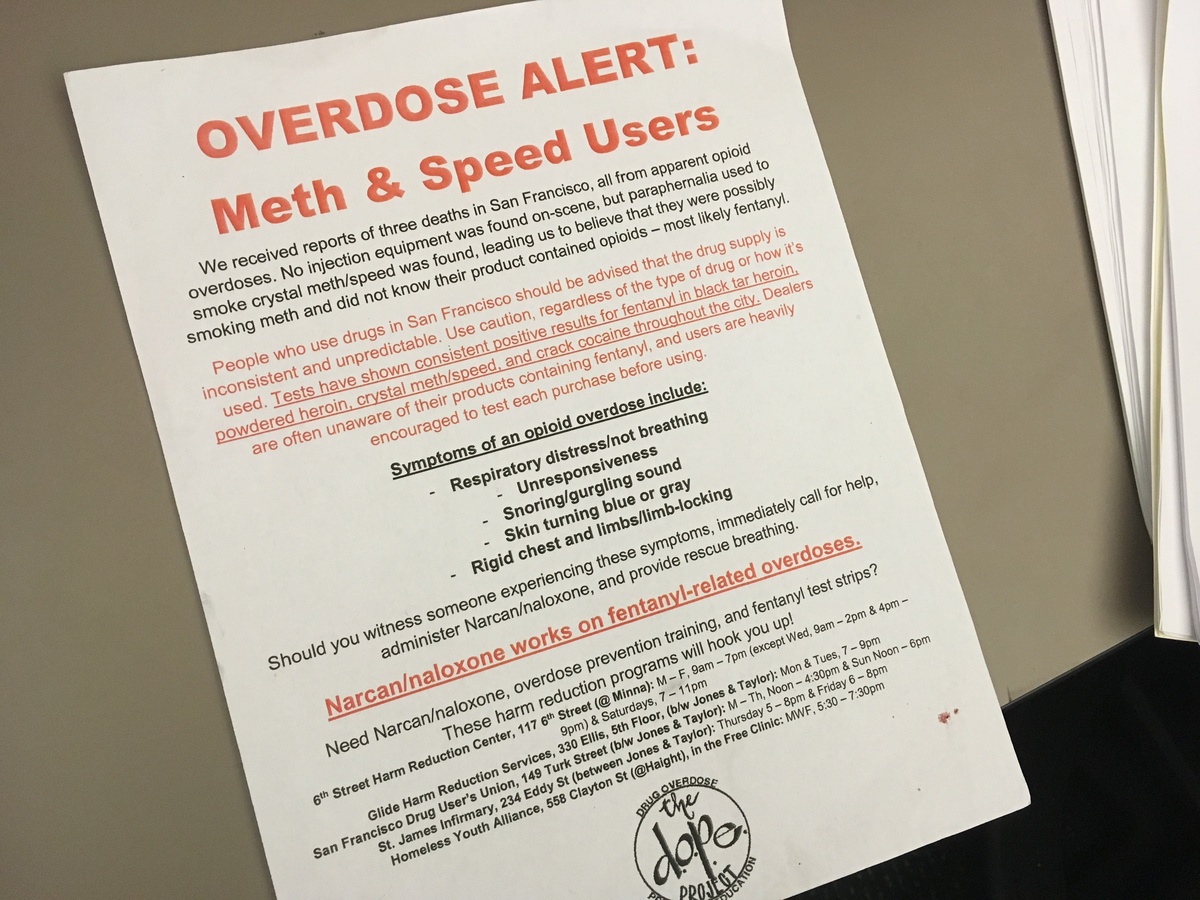
A meth overdose alert from the Drug Overdose Prevention and Education Project.

April Dembosky/KQED


hide caption

toggle caption

April Dembosky/KQED

“So stimulant-related death, really, you shouldn’t see it affect so many young people,” Coffin says.

The San Francisco AIDS Foundation runs a 12-week program to help men who have sex with men stop using meth called Positive Reinforcement Opportunity Project (PROP). The project’s program manager Rick Andrews has noticed a trend in older men coming in for help.

“Older gentlemen who grew up in the time of HIV and AIDS initially, maybe they led very safe lifestyles, and now they’re older,” he says.

Now that things are different with HIV — there’s treatment, there’s a prevention pill, PrEP — they’re taking a new approach to the often drug-fueled party scene.

“They feel like they’ve missed out and they want to have a little fun and make up for lost time maybe,” Andrews says.

Rick Andrews (right) runs a drug counseling and testing program at the San Francisco AIDS Foundation to help men get their meth use under control.

Courtesy of the San Francisco AIDS Foundation


hide caption

toggle caption

Courtesy of the San Francisco AIDS Foundation

There are some young people who have died from using meth. Last year, three young people in San Francisco died after smoking meth together — it turns out the meth had fentanyl in it. The synthetic opioid has been causing waves of heroin overdoses across the country, but now it’s showing up mixed in to cocaine and meth.

Most researchers believe the contamination is accidental.

“The whole idea of the evil drug pusher who’s trying to create a market by getting their cocaine users hooked on fentanyl. I would highly doubt that,” says UCSF’s Ciccarone.

Dealers know that people are particular about their drugs, he says. It doesn’t make sense to alienate a customer base like that. He compares it to coffee drinkers preference for a favorite stye of coffee.

“Folks that are doing hardcore illicit drugs can be pretty fussy, too,” he says. “And most meth users really, really, really, really don’t want an unbeknownst fentanyl put into their methamphetamine.”

More likely, Ciccarone says, the same table that was used to cut and bag fentanyl later got used to bag meth.

Deliberate or not, health officials call this poisoning. They started distributing fentanyl test strips to meth users so they can test their drugs. But counselors like Rick Andrews say the strips aren’t refined – even trace amounts will give a positive result.

“I hear guys saying, ‘Oh, there’s test strips and I’m testing. It’s positive, but I do it anyway and everything’s fine,’ ” Andrews says.

That’s why they’re also giving out Narcan, the nasal spray that can reverse an opioid overdose, Andrews says. They’re telling meth users to carry it just in case.

Recovery

Over her two decades of meth use, Kim has been through drug treatment more than a dozen times. Relapse is part of recovery, and among meth users, 60% will start using again within a year of finishing treatment. Unlike opioids, there are no medication treatments for meth addiction, which makes it particularly hard to treat.

Kim finished her last round of treatment in April at a six-month residential program for women in San Francisco, called The Epiphany Center. She came to Epiphany directly from jail, after serving time for her Goldilocks housewarming spree and stealing the car. She says in the first 30 days, all she could do was try to clear the chaos from her mind.

“You have to get used to sitting with yourself, which is essential for life, is to get along with your own self,” she says.

Kim is hopeful that this last time through treatment will stick. She’s living in transitional housing now, she has a job, and she’s been accepted to a program at UC Berkeley to finish her college degree.

“I’ve gone through 12 different programs and it’s been for my children, for my mom, for the courts. I’ve never come to be there for myself,” Kim says. “So it’s like I’ve come to a place where it has to be for me.”

This story is part of NPR’s reporting partnership with KQED and Kaiser Health News.

Let’s block ads! (Why?)

As Artificial Intelligence Moves Into Medicine, The Human Touch Could Be A Casualty

Will computers alienate us from the healing touch?

Credit: Chris Nickels for NPR

When Kim Hilliard shows up at the clinic at the New Orleans University Medical Center, she’s not there simply for an eye exam. The human touches she gets along the way help her navigate her complicated medical conditions.

In addition to diabetes, the 56-year-old has high blood pressure. She has also had back surgery and has undergone bariatric surgery to help her control her weight.

Hilliard is also at risk of blindness, which can result from a condition called diabetic retinopathy. And on this day in February, her vision will be evaluated by a new practitioner: a piece of software.

Automation like this is starting to infiltrate medical care. Depending on how it’s deployed, it could help reduce medical errors and potentially reduce the cost of care.

It could also create a gulf between health caregivers and people of more modest means.

“My fear is we will end up with what I’ve been calling a ‘health care apartheid,’ ” says Sonoo Thadaney Israni, at the Stanford University medical school. “If we create algorithmic care and ‘kiosk’ it in some fashion — focusing on efficiency and throughput — the people who will end up having access and using it will be the ones who already lack privileges of various kinds.”

We are far from that dystopian world at the moment, but are we moving in that direction? That possibility concerns her.

Hilliard’s experience at the clinic underscores the importance of human contact. She’s here for an annual eye exam to look for signs of blindness that can arise in people with diabetes.

“I got the full diabetes when I made 40,” she says. It’s a challenge for her to stay on top of all her medical conditions. “I go to so many doctor’s appointments I get tired,” she says.

The software to identify early signs of diabetic retinopathy, called IDxDR, can do that job without expert intervention, but skilled medical personnel at this clinic are, for the moment at least, still playing a hands-on role.

After Hilliard finishes the exam, nurse practitioner Chevelle Parker shows her images of her eye.

“If we zoom in here, we can see some little fat deposits here, OK?” Parker says. Hilliard leans in and studies the image of her retina.

“That can be from the foods you’re eating,” Parker says. “Think of some of the fatty foods you’re eating — sausage, bacon.”

Hilliard says she stopped eating those foods last fall, after her gastric bypass surgery.

“Well, when you were eating those, the deposits were being placed on the eye,” Parker explains. “That’s why we talk to you about your diet. And now that you know you can’t have that, this is the reason why, OK?”

Parker goes on to reinforce the dietary recommendations for diabetes. Hilliard should eat breakfast within an hour or so of waking up, and she should be sure to have some protein, rather than carbohydrates, at the end of the day.

Hilliard gratefully accepts the advice, along with a referral to an ophthalmologist, who will need to get a closer look at the signs of damage in her eye.

“I do what I can do to keep from going blind,” Hilliard says. “So whatever they tell me to do that’s what I do. At least I try.”

Hilliard’s experience is a stark reminder that health care is more than a simple transaction. Six in 10 adults in the United States have a chronic disease, and 4 in 10 have two or more, according to the Centers for Disease Control and Prevention.

This is the real world, in which computer algorithms are starting to take off in medicine.

“I think for too long we’ve had this assumption that any new technology is good, more is better,” says Abraham Verghese, a physician who works in partnership with Thadaney at a Stanford center that focuses on the human aspects of medical care.

“New is not always better,” he says as the three of us sit together in their office.

Medical care, like so much of our society, creates haves and have-nots, Thadaney says. “We need to make sure that technology doesn’t further exacerbate the issues of equity and inclusion.”

“Just to carry that thought forward,” Verghese says, “AI algorithms we already know are causing inequities in bail bonding, inequities in real estate,” as well as in policing. Unconscious racism and other biases get baked in, without the developers even being aware of it. “That same kind of algorithmic approach can easily infect medicine and probably does,” Verghese says.

These technologies are driven by companies interested in turning a profit, and that doesn’t necessarily lead to better care. In fact, the cost-savings these technologies promise could be the result of reducing the time an individual spends face-to-face with a doctor or nurse.

“One thing that I think is unchanged since antiquity is that when you’re seriously ill, you feel bad,” says Verghese. “And amongst all the other things you need, you also want someone to care for you — not just your family member but someone with the scientific knowledge to also express care.”

Thadaney says a member of her household recently brought that point home. He had been injured in a bicycle accident. Treatment involved a complicated trek through two hospitals and a rehabilitation facility. Thadaney was able to advocate for him. “I was able to call friends who are physicians,” she says. “I was able to, you know, call into the leadership of those organizations and request for something different.”

That intervention alone provided an edge to her family member, but she says what really helped him was a visit with Verghese. The doctor “didn’t tell him anything different than he already knew,” she says, but he provided comfort and reassurance, “and I think it hastened his healing.”

Verghese says he was recently reading Walt Whitman’s accounts of his time caring for the wounded in Civil War medical tents on the Mall in Washington, D.C.

“He did what those young men most needed,” Verghese says. “They were so far from home. They needed someone to read to them, to hold their hands and to write letters for them and take care of their every task. And it was the most elemental kind of care. Nothing’s changed. You know we’re still the same human beings.”

Verghese is hopeful that technology, such as artificial intelligence, can improve medical care, but only if it isn’t done at the expense of human contact. AI has the potential to free up clinicians to spend more time with their patients, depending on how it ends up being deployed. In principle, AI could also help the most challenging tasks.

“We don’t need another image recognition [system],” he says. “They’re all nice great and very tidy.”

But where the technology can do the most good is to help sort through the clues gathered during medical treatment. “Medicine is messy,” he says. “Help us out.”

Some of the nuts-and-bolts improvements that AI can bring have their place, Thadaney says. “Yes, the patient wants you to make sure that you have efficiencies in your system so they don’t get 19 bills with the same stupid thing.”

But patients also want to get better. To help accomplish that, doctors and nurses can’t simply be adjuncts to machines. Her mantra to the young doctors she advises is this: “In the end, be present. That matters a great deal.”

In March, Stanford inaugurated a new institute to focus on the human dimensions of artificial intelligence.

Dr. Russ Altman, a professor of bioengineering and genetics at Stanford and an associate director of the new institute, says it is important to have best practices in place as technology and medicine commingle. “It’s unfair and unrealistic to expect that technologists to be experts at all this.”

He shares the concerns of Verghese and Thadaney that machines could degrade the human relationship at the core of medicine.

“Medicine is a combination of art and science,” which will be augmented by AI, Altman says. “But the act of laying your hands on a patient, showing that you really care about what is there, what their problem is [and] assuring them that you’re going to be with them through an odyssey — that might take a while,” he says. “That is very difficult to imagine being replaced by computers.”

You can contact NPR Science Correspondent Richard Harris at rharris@npr.org.

Let’s block ads! (Why?)

Summer Bummer: A Young Camper’s $142,938 Snakebite

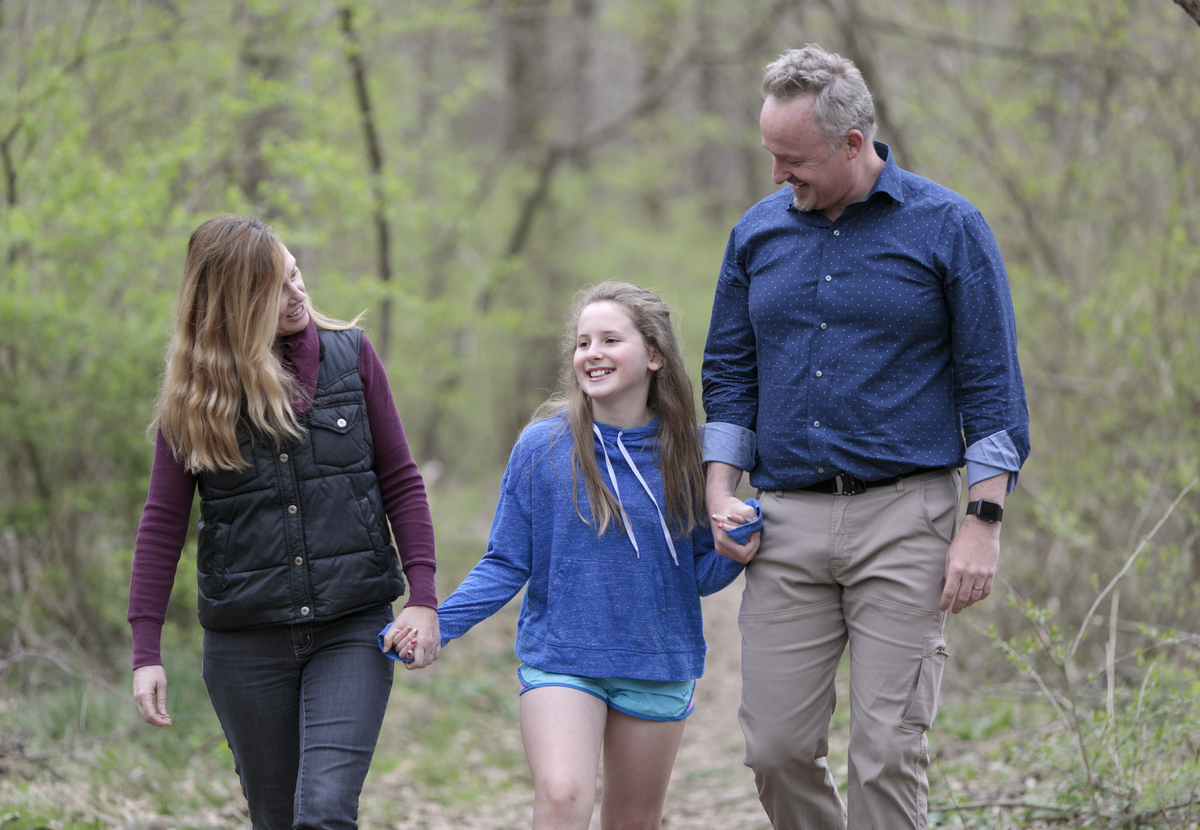
Oakley Yoder walks with her parents, Josh Perry and Shelli Yoder, outside their home in Bloomington, Ind.

Chris Bergin for KHN


hide caption

toggle caption

Chris Bergin for KHN

It was dusk as Oakley Yoder and the other summer camp kids hiked back to their tents at Illinois’ Jackson Falls last July. As the group approached a mound of boulders blocking the path, Oakley, then 9, didn’t see the lurking snake — until it bit a toe on her right foot.

“I was really scared,” Oakley said. “I thought that I could either get paralyzed or could actually die.”

Her camp counselors suspected it was a copperhead and knew they needed to get her medical attention as soon as they could. They had to keep her as calm and motionless as possible — the venom could circulate more quickly if her heart raced from activity or fear.

One counselor gave her a piggyback ride to a van. Others distracted her with Taylor Swift songs and candy as the van sped from their location in a beautiful but remote part of the Shawnee National Forest toward help.

First responders met them and recommended Oakley be taken by air ambulance to a hospital.

Share Your Story And Bill With Us

If you’ve had a medical-billing experience that you think we should investigate, you can share the bill and describe what happened here.

The helicopter flight transported Oakley 80 miles from a school parking lot just outside the forest to St. Vincent Evansville hospital in Indiana, where she received four vials of antivenin. She was then transferred to Riley Hospital for Children in Indianapolis for observation.

Her parents, Josh Perry and Shelli Yoder, were already in bed that night when they got the call about what had happened to Oakley. They jumped in the car and arrived at Riley about two hours before their daughter. Once she made it, doctors closely observed her condition, her toe still oozing and bruised. By lunchtime, Perry said, physicians reassured the parents that Oakley would be OK.

“It was a major comfort for me to realize, OK, we’re getting the best care possible,” said Perry, who is a health care ethics professor at the business school at Indiana University, Bloomington. Less than 24 hours after the bite, Oakley left the hospital with her grateful parents.

Then the bills came.

Patient: Oakley Yoder, now 10, of Bloomington, Ind. Insured through Indiana University, Bloomington, where her father and mother work as faculty.

Total bill: $142,938, including $67,957 for four vials of antivenin ($55,577.64 was charged for air ambulance transport). The balance included a ground ambulance charge and additional hospital and physician charges, according to the family’s insurer, IU Health Plans.

Service providers: St. Vincent Evansville hospital, part of Ascension, a nonprofit, Catholic health system. Riley Hospital for Children, part of Indiana University Health, a nonprofit health system. Air Evac Lifeteam, an air ambulance provider.

Medical service: The essential part of Oakley’s treatment involved giving her four vials of snake antivenin called CroFab.

What gives: When bitten by a venomous snake, there is no time to waste. If left untreated, a venomous bite can cause tissue damage, hemorrhaging and respiratory arrest. Children tend to experience more severe effects because of their small size.

CroFab has dominated the U.S. market for snake antivenin since its approval in 2000. When Oakley was bitten, it was the only drug available to treat venomous bites from pit vipers. (Oakley probably was bitten by a copperhead snake, a type of pit viper, the camp directors told her parents.)

But with only one antivenin available in the U.S. at the time, the drugmaker, London-based BTG Plc, essentially had a monopoly.

The average list price for CroFab is $3,198 per vial, according to the health care information tech company Connecture. Manufacturing costs, product improvements and research all factor into the drug’s price, said Chris Sampson, spokesman for BTG.

A Mexican version of snake antivenin can cost roughly $200. But it couldn’t be sold in the U.S. (More about that in a moment.)

Dr. Leslie Boyer, founding director of the VIPER Institute, a venom research center at the University of Arizona, acknowledges that some of the price in the U.S. can be attributed to strict Food and Drug Administration requirements for testing and monitoring. But more than that, she added: “It’s a profitable drug and everyone wants a piece of it.”

She should know: Funded by government grants and at times working with colleagues over the border in Mexico, her group was instrumental in developing CroFab.

Antivenins were first developed more than a century ago. Although CroFab is safer and purer than antivenins of the past, the process — while labor-intensive — remains fundamentally the same. Snakes, spiders and other creatures are milked for their venom, then a small amount of the toxin is injected into animals like horses or sheep. The animals then make antibodies without falling ill, and the protective molecules are extracted from their blood and processed to make antivenin.

What patients pay for CroFab can widely vary. Treatment may require a few vials or dozens of them — it depends on factors like the size of the patient, the potency of venom in the bite and how quickly the patient is treated. The more antivenin needed, the higher the cost.

But hospitals also jack up the price, even though some of these facilities purchase the drug at a discount, said Dr. Merrit Quarum, chief executive officer of WellRithms, a health care cost containment company.

Oakley shows the toe on her right foot that a snakebite deformed when she was hiking at an Illinois summer camp in July 2018. These were the same shoes she wore when she was bitten.

Chris Bergin for KHN


hide caption

toggle caption

Chris Bergin for KHN

In Oakley’s case, St. Vincent Evansville hospital charged $16,989.25 for each unit of CroFab, according to the facility’s bill. That’s more than five times higher than the average list price.

WellRithms analyzed Oakley’s bill from St. Vincent Evansville at Kaiser Health News’ request and found providers generally accept $16,159.70 for all four vials of the drug.

In a statement, St. Vincent Evansville noted that the family was not responsible for that full tab and instead was expected to pay less than $3,500. But the facility appears to have since lowered its price for CroFab. According to its price list — posted online to satisfy a recent federal requirement — the drug now costs $5,096.76 per vial.

And the snake antivenin market in the U.S. now has another drug competing for patients: Anavip. The Mexican product — launched in October — has a list price of $1,220 a vial in the U.S., according to Rare Disease Therapeutics, which distributes the drug in the U.S.

Anavip’s arrival was stalled by a lawsuit filed by BTG in 2013, claiming the drug infringed on its patent.

The drug’s true effect on the market remains unclear. CroFab and Anavip are not entirely interchangeable. (The FDA hasn’t approved Anavip for copperhead bites, for instance.) And, as part of the legal settlement, Anavip-makers must pay royalties to BTG until the CroFab patent expires in 2028.

Resolution: The insurer IU Health Plans negotiated down the antivenin and air ambulance charges and ended up paying $44,092.87 and $55,543.20, respectively. After adjustments to additional bills, IU Health Plans paid a total of $107,863.33. Oakley’s family didn’t pay a dime out of pocket for her emergency care, but such high outlays contribute to rising premiums.

Secondary insurance offered through the summer camp covered $7,286.34 in additional costs that otherwise would have come out of Perry and Yoder’s pockets for their deductible and coinsurance. The policy covers up to $25,000 in damages.

Oakley’s foot is healed, but her toe bends slightly downward and is sensitive to pressure. She intends to return to the same summer camp this year.

Perry teaches a course on the ethics of the health care industry, and yet he said the cost of Oakley’s care shocked him. But he is aware of how rare it is that a patient ends up paying nothing for health care. “I know that in this country, in this system,” he said, “that is a miracle.”

Takeaway: Hospitals and insurers can negotiate; snakes don’t. If you’ve been bitten by a snake “take care of your injury,” said Boyer. Don’t wait while you worry about the cost.

When you get a bill, compare what the facility charged with other health care providers’ prices using their public charge lists online. Cost estimation tools like Fair Health Consumer or Healthcare Bluebook allow you to see how your bill compares with the average.

There is momentum growing for potential government action on drug prices. In states and in Congress, different proposals have been floated, which include allowing Medicare to negotiate drug prices, tying the U.S. price of expensive drugs to the average price in other developed countries, and allowing the government to inject competition into a market when there is none — such as speeding generic drug approvals or allowing for imports from other countries.

Consumers should keep an eye on these proposals as they move through the legislative and political process.

NPR produced and edited the interview with Kaiser Health News’ Elisabeth Rosenthal for broadcast. WFYI’s Jake Harper provided audio reporting.

Kaiser Health News is a nonprofit news service covering health issues. It is an editorially independent program of the Kaiser Family Foundation that isn’t affiliated with Kaiser Permanente.

Let’s block ads! (Why?)

London Marathon Takes A Small Step To Go Green

The BBC reports 47,000 plastic water bottles were tossed at last year’s race. This year, organizers gave runners edible water pods. They’re biodegradable because they’re made from seaweed.


DAVID GREENE, HOST:

Good morning. I’m David Greene. Eliud Kipchoge won the London Marathon yesterday for a fourth time. That’s a record, and that is amazing. And in other news, the marathon took a small step to go green. The BBC reports, last year, racers and onlookers tossed 47,000 plastic water bottles. This year, organizers tried to prevent a mess. They gave runners edible water pods. They’re biodegradable because they’re made from seaweed. The startup that makes them says they’re tasteless. It’s MORNING EDITION.

Copyright © 2019 NPR. All rights reserved. Visit our website terms of use and permissions pages at www.npr.org for further information.

NPR transcripts are created on a rush deadline by Verb8tm, Inc., an NPR contractor, and produced using a proprietary transcription process developed with NPR. This text may not be in its final form and may be updated or revised in the future. Accuracy and availability may vary. The authoritative record of NPR’s programming is the audio record.

Let’s block ads! (Why?)