Fans Boo Baseball Umpire Who Did Bat Dog’s Job

Finn, a black lab, is a bat dog for the Minor League Las Vegas Aviators. Finn was dashing to the plate, but an umpire beat him there and tossed the bat aside. Fans were not happy and booed the ump.
Finn, a black lab, is a bat dog for the Minor League Las Vegas Aviators. Finn was dashing to the plate, but an umpire beat him there and tossed the bat aside. Fans were not happy and booed the ump.
Democrats are offering competing plans to provide universal health care coverage, all of which are variations on the Medicare-for-all plan that Sen. Bernie Sanders has introduced.

Sen. Bernie Sanders, I-Vt., introduced the Medicare for All Act of 2019 on Capitol Hill Wednesday.
Manuel Balce Ceneta/AP Images
hide caption
toggle caption
Manuel Balce Ceneta/AP Images
As Democratic candidates for president try to walk a political tightrope between the party’s progressive wing and its center-left, they are facing increasing pressure to outline the details of their health care overhaul proposals.
On Wednesday, Sen. Bernie Sanders, I-Vt., who is running in Democratic primaries, reaffirmed his stance on health care by reintroducing a “Medicare-for-all” bill, the idea that fueled his 2016 presidential run.
As with its previous iterations, Sanders’ latest bill would establish a national, single-payer Medicare system with vastly expanded benefits. Sanders’ plan would also prohibit private plans from competing with Medicare and would eliminate cost-sharing. New in this version is a universal provision for long-term care in home and community settings (though Medicaid would continue to cover institutional care, and states would determine the standard of eligibility).
Already, it has an impressive list of Senate co-sponsors — including some of Sanders’ rivals for the Democratic presidential nomination: Cory Booker of New Jersey, Kirsten Gillibrand of New York, Kamala Harris of California and Elizabeth Warren of Massachusetts.
But many of the candidates — even official “Medicare-for-all” co-sponsors — are at the same time edging toward a more incremental approach, called “Medicare for America.” Proponents argue it could deliver better health care to all Americans while avoiding political, budgetary and legal objections.
This movement to embrace a more incremental policy comes as politicians tread carefully over the political land mines a “Medicare-for-all” endorsement could unleash, while seeking to capitalize on voters’ growing appetite for health overhaul.
During the 2018 midterm election campaigns, some congressional candidates talked about allowing younger people — anyone older than 55 — to join Medicare or allowing people younger than 65 to buy into it if they choose (what’s come to be called the public option). Many candidates aren’t eager to face the industry opposition a full-on Medicare expansion would surely trigger.
From the consumer perspective, a sweeping overhaul poses a risk. Despite Medicare’s popularity with its beneficiaries, the majority of Americans express satisfaction with their health care, and many are nervous about giving up private options. Also, many analysts are worried that a generous “Medicare-for-all” plan that promises everything would break the bank if it didn’t include copayments from patients.
That tension is pushing a number of candidates toward an option that has come to be called Medicare for America. The bill was introduced last December with little fanfare by two Democrats — Rep. Rosa DeLauro of Connecticut and Rep. Jan Schakowsky of Illinois. It hasn’t been reintroduced in the new Congress.
This proposed system would guarantee universal coverage, but leave job-based insurance available for those who want it. Unlike “Medicare-for-all,” though, it would preserve premiums and deductibles, so beneficiaries would still have to pay some costs out-of-pocket. The bill would allow private insurers to operate Medicare plans as well — a system called Medicare Advantage, which covers about a third of the program’s beneficiaries currently and which would be outlawed under “Medicare-for-all.”
“Before policies get defined, what you see is people endorsing a plan that is a little, perhaps, less subject to early attack,” says Celinda Lake, a Democratic pollster with Lake Research Partners. “A lot of candidates feel if they endorse a plan that leaves some private insurance, they get more time to say what their ideas are about.”
“Medicare for America” got its first high-profile endorsement from former Texas Rep. Beto O’Rourke, who launched his own 2020 bid for president in mid-March. Other candidates — including Warren, Gillibrand and Pete Buttigieg, the mayor of South Bend, Ind. — have tiptoed toward that policy without making any endorsements, suggesting they back “Medicare-for-all” in theory but also support a system that retains private insurance, at least temporarily.
Such an approach is perhaps unsurprising. Recent polling indicates voters want strong health care improvement. And candidates need something powerful to deliver, election analysts say.
Simply improving the Affordable Care Act — an idea backed by Sen. Amy Klobuchar, a Minnesota Democrat running in the primary’s moderate lane — may not suffice.
“The ACA is popular at the 50 percent level, but it’s not energetic,” says Robert Blendon, a political analyst at the Harvard T.H. Chan School of Public Health. “It doesn’t get people who really like it. What they’re looking for is something that is exciting but isn’t threatening.”
Both “Medicare-for-all” and “Medicare for America,” pollsters note, offer something that presidential candidates can campaign on — a health care alternative that, at first blush, sounds appealing to many. But the latter proposal might more easily skirt some potential obstacles.
In polls, approval for the concept of “Medicare-for-all” drops when people learn that under such a program, they would very likely lose their current health plan (even if the government-offered plan could theoretically provide more generous coverage).
And, meanwhile, the cost-sharing element of “Medicare for America” would ostensibly quiet some concerns that have been raised about paying for Medicare’s expansion. (Still, critics on the left worry it would mean some people would remain unable to afford care.)
This also tracks with recent polling suggesting that while “Medicare-for-all” support can be swayed, voters of all political stripes favor some way to extend optional Medicare coverage, without necessarily eliminating the private industry altogether.
Employers would either have to offer plans that were at least as generous as the government program or send their employees to Medicare. And employers who stop offering health benefits would have to pay a Medicare payroll tax.
For now, most candidates are still avoiding a concrete stance on the “Medicare for America” plan. Despite signs of interest, the Buttigieg, Gillibrand and Warren campaigns have all declined to directly answer questions about whether they endorse “Medicare for America.” The campaigns of other candidates in the race — Harris, Klobuchar, Booker, former Housing and Urban Development Secretary Julián Castro and Washington Gov. Jay Inslee — similarly declined to comment.
Reading between the lines, though, their promises to achieve universal health care by expanding Medicare — while retaining private insurance — leave them few options aside from something like “Medicare for America,” argues Jacob Hacker, a political scientist at Yale University and one the proposal’s main architects.
“There are variations besides this particular plan, but once you start to actually dig into this, if you want universal coverage you’re going to have to do the kinds of things” spelled out in “Medicare for America,” Hacker says.
Still, though, the plan Hacker helped design has prompted objections from both the left and the right.
On the far left, the cost-sharing component is a dominant concern. (Under “Medicare for America,” an individual would have a $3,500 out-of-pocket annual limit; a family would have a $5,000 limit. Premiums would be capped at almost 1 percent of a household’s income.) Critics on the left also say the plan’s accommodations to private insurance limit the government’s ability to negotiate lower prices.
Meanwhile, conservatives repeat many of the arguments levied against “Medicare-for-all” — that the plan is too expensive, too disruptive.
Political analysts predict that contributors to the health care industry who have already mobilized against “Medicare-for-all” — including hospitals, insurers, drugmakers and many doctors — also can be expected to make a strong showing against “Medicare for America.” More Medicare means less revenue for the medical industry.
“The fact of expanded Medicare will be the focus of attacks,” says the Commonweath Fund’s David Blumenthal.
The nonprofit newsroom Kaiser Health News is an editorially independent part of the Kaiser Family Foundation. Shefali Luthra covers health care for KHN. She’s on Twitter @shefalil.

Angelique Kidjo’s Celia is out April 19 on Decca Records.
Laurent Seroussi/Courtesy of the artist
hide caption
toggle caption
Laurent Seroussi/Courtesy of the artist
Angélique Kidjo now has a pair of albums that are essentially covers of other artists, but interpreted with an African sensibility so majestic as to render the originals almost as source material.
On 2018’s Remain In Light, Kidjo made the implicit African influences of Talking Heads’ original vision explicit. Kidjo didn’t channel New Wave, or even rock and roll, as a starting point; instead, she used West African polyrhythms to reinterpret the band’s take on then-modern life in America. It was one of my favorite albums of last year.

Courtesy of the artist
Celia comes out April 19 via Decca Records.
Somehow Kidjo had the time to record a second tribute album, this time dedicated to an individual artist.
Celia refers to Celia Cruz, perhaps the most well-known vocalist to come from Cuba during any era. The ten tracks span several decades of Cruz’s career, from before she left Cuba in 1960 to her groundbreaking recordings for the celebrated Fania Records label in New York in the 1970s, to “La Vida Es Un Carnaval,” the 1998 song that became her late career hit and anthem. Kidjo’s reinterpretations rearrange the molecules of songs that many of us know by heart. The results are glorious.
The tongue twister “Cucala” becomes a rhythmic pattern for both guitar and hand drums as Kidjo sings the Spanish-language lyric that is an ode to joy of dancing. It’s a brilliant take on a song that I honestly thought couldn’t get any better.
Cruz never shied away from the island’s African culture, especially on songs like”Yemaya” and “Elegua.” These two tracks on Celia strip away the classic, horn-driven guaracha feel of La Sonora Matancera’s 1950s-era orchestrations and become deeply emotional prayers to the two Afro-Cuban deities.
“Quimbara,” one of Cruz’s most well-known anthems, serves as Celia‘s mission statement. The original was based on guaguancó, which was a bold move at the the time. Why? Mambo and cha-cha-cha were the ruling Latin dance rhythms of the day, and here was an Afro-Cuban folkloric beat. On Celia, Angélique Kidjo changes the rhythm from a solid 4/4 to a languid, yet powerful 6/8. Afrobeat-style guitar approximates the West African koraand punctuates it all with a funky, horn driven, stop-time statement of its massive chorus.
What puts the song over the top is the call-and-response improvisation of the title. It’s done at twice the speed of the rhythm underneath (what musicians call double time) and it never clashes. Kidjo has so expertly tied the original guaguanco to her 6/8 that it serves as a point of cultural pride that Africa could claim Celia Cruz as one of their own. And that is the point of every track of this album.
Celia Cruz’s music and her entire being was a reminder of the presence of Africa in Cuba. Angélique Kidjo’s Celia musically closes that circle with reverence and more than a little love.
Courtesy of the artist
3:19
4:33
4:37
2:54
4:30
3:06
4:34
3:44
3:27
1:37
The federal government is charging the maker of the addiction drug Suboxone with fraud and conspiracy in marketing the drug to doctors.
NPR’s Ailsa Chang speaks with sports radio host Donovan Lewis about Dirk Nowitzki’s 21-year NBA career with the Dallas Mavericks after his final home game.

Prosecutors charged 24 people in an alleged scheme to defraud Medicare, one of the largest health care fraud schemes ever investigated by the FBI.
Eric Baradat/AFP/Getty Images
hide caption
toggle caption
Eric Baradat/AFP/Getty Images
Federal prosecutors on Tuesday said they dismantled one of the largest health care fraud schemes ever investigated by the FBI, charging 24 people in a $1.2 billion alleged scam involving telemedicine and durable medical equipment companies.
As part of the complex operation, doctors got kickbacks for prescribing unneeded back, shoulder, wrist and knee braces to elderly and disabled patients and charging the government’s Medicare program, the Department of Justice said.
The accused “concocted an elaborate scheme to exploit the U.S. health care system by targeting Medicare beneficiaries, paying doctors for prescriptions, paying kickbacks and bribes, and in turn selling these prescriptions to DME companies to ensure that they could line their pockets,” IRS special agent Matthew Line said, according to Tut Underwood of South Carolina Public Radio.
Prosecutors allege a multilayered scheme to defraud Medicare. Call centers in the Philippines and Latin America advertised to Medicare beneficiaries and “up-sold” them on unnecessary medical braces, they say.
The call centers then paid bribes to telemedicine companies, who in turn paid doctors to write orders for the equipment. Then the call centers sold the orders to the durable medical equipment companies and billed Medicare.
Equipment companies would ship the braces to beneficiaries. They would receive about $500 to $900 per brace from Medicare and paid kickbacks of almost $300 per brace, according to the Associated Press.
Doctors wrote prescriptions for medical equipment without any interaction with patients or after only a brief phone conversation, the DOJ said.
People participating in the alleged scheme laundered money through shell companies and used proceeds to buy “exotic automobiles, yachts and luxury real estate in the United States and abroad.”
CEOs, COOs and associates with five telemedicine companies; owners of durable medical equipment companies; and three licensed medical professionals were among the 24 people charged.
Prosecutors charged residents of several states, including Florida, New Jersey, Texas, North Carolina, South Carolina, California and New York.
The government Center for Medicare Services’ anti-fraud branch said it took “adverse administrative action” against 130 medical equipment companies that had billed Medicare more than $1.7 billion in claims and were paid more than $900 million.
The IRS chief of criminal investigation, Don Fort, said in a statement that the organized scheme “details broad corruption, massive amounts of greed, and systemic flaws in our healthcare system that were exploited by the defendants.”
The FBI, IRS and 17 U.S. attorneys’ offices took part in the operation, according to AP.

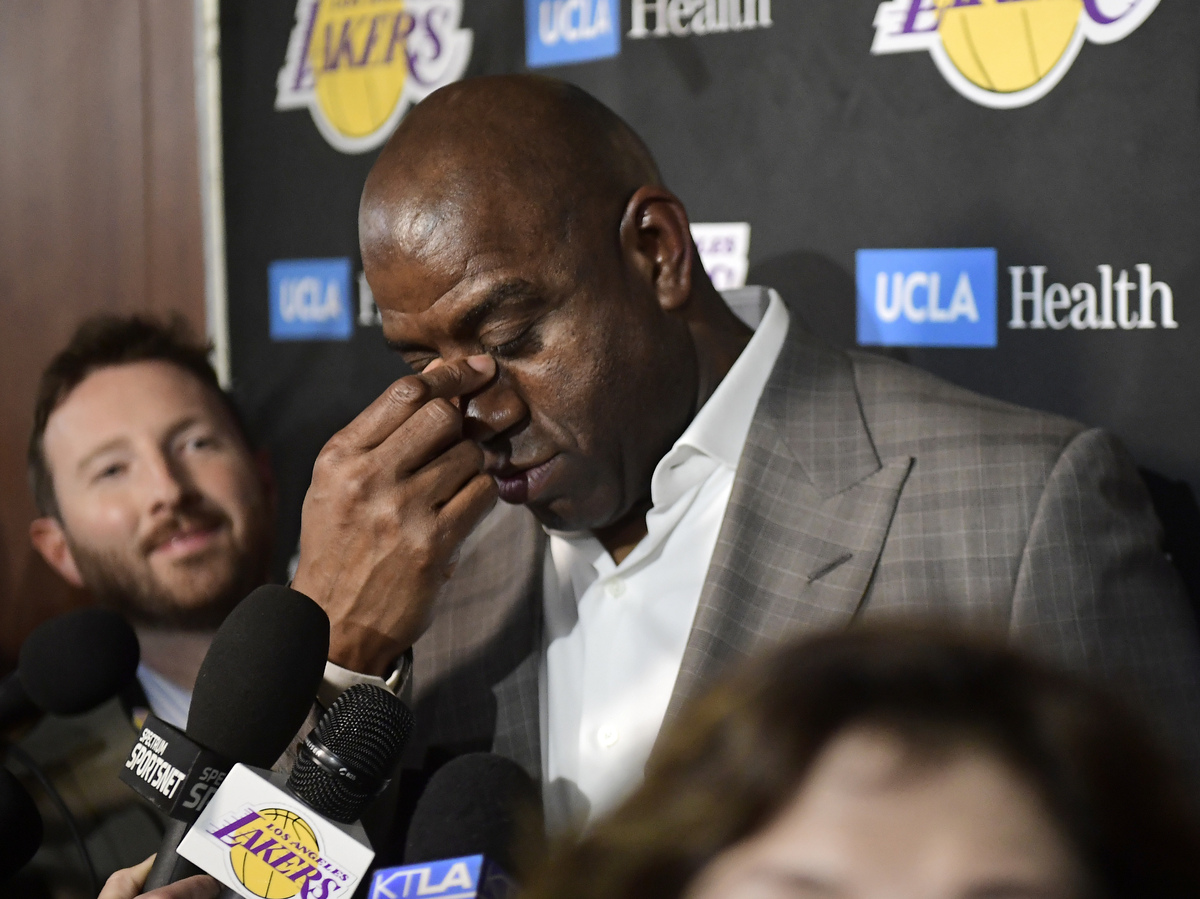
Magic Johnson fought back tears while he broke the news of his resignation from the LA Lakers on Tuesday. He said he hadn’t told his boss yet because he knew he would cry “like a baby.”
Mark J. Terrill/AP
hide caption
toggle caption
Mark J. Terrill/AP
Magic Johnson isn’t having fun anymore.
“Today, I’m going to step down as president,” the former NBA superstar told a gaggle of reporters on Tuesday night, about an hour and a half before the Los Angeles Lakers played their last game of the season. “I was happier when I wasn’t the president.”
Johnson has served as the team’s president of basketball operations for more than two years — the latest move in a long and successful career as a businessman and philanthropist after he first retired in 1991 when he tested positive for HIV. He came back to be part of the U.S. Olympic “Dream Team” in 1992 and then again to play for the Lakers in the 1995-96 season.
His resignation came out of the blue; on Monday, Johnson had a three-hour meeting about the team’s future after its sixth consecutive losing season, the Associated Press reported.
Reporters and basketball fans weren’t the only ones to find out about his resignation late in the game.
“Somebody’s gonna have to tell my boss,” Johnson told reporters.
His boss is Lakers controlling owner Jeanie Buss, who hired Johnson just over two years ago after she dismissed her brother Jim, who was vice president of basketball operations, and General Manager Mitch Kupchak in an effort to change things up after multiple losing seasons.
Magic Johnson is conducting an impromptu press conference and just stepped down as Lakers president. He said he loves Jeanie Buss like a sister.
— Dave McMenamin (@mcten) April 10, 2019
Johnson said he just couldn’t face Buss, who he called “my sister.”
“Have you really not told Jeanie yet?” a reporter asked.
“No, I haven’t. I couldn’t,” he answered. “She doesn’t know I’m standing here because I knew I would be crying like a baby in front of her.”
The Hall of Famer barely kept it together in front of the press: “I’m about to cry now,” he said.
When his boss inevitably heard the news, the Lakers issued a statement thanking Johnson for his time with the team. “There is no greater Los Angeles Laker than Earvin Johnson,” the statement said. “He will always be not only a Lakers icon, but our family.”
Buss also tweeted her thanks:
Earvin, I loved working side by side with you. You’ve brought us a long way. We will continue the journey. We love you ?? https://t.co/ofmQl6BtBz
— Jeanie Buss (@JeanieBuss) April 10, 2019
But not everyone thought Johnson was good for the Lakers.
“It’s a mess,” sports anchor Rob Parker said recently, calling him “tragic Johnson.”
“Nobody … thought that the Lakers wouldn’t make the playoffs when LeBron James came here, even with the injury,” Parker said.
James, who joined the LA team in July of last year, didn’t comment on Johnson’s resignation on Tuesday.
LeBron James didn’t address the media and had his security try to stop reporters who came near him. LeBron on the phone: “Crazy, crazy, crazy.” Yep. pic.twitter.com/PObznj26Rd
— Arash Markazi (@ArashMarkazi) April 10, 2019
Johnson didn’t give any specific reasons for his decision to quit.
He said he’s happy with where the team has gone during his two years. “We’re halfway there with LeBron coming back,” Johnson said. “I think this team is going to be in the position to really contend for a championship with the growth of the young players.”
The Lakers ended their season with a loss to the Portland Trail Blazers on Tuesday night, after being eliminated from the playoff race last month.
They used to be a top team, with 16 NBA titles. But they haven’t made the playoffs in six years.
Johnson said he is not stepping down because of differences he’s had with the team’s coach of three years, Luke Walton.
“I like Luke a lot,” Johnson said. “We have different opinions about different things — that’s OK.”
It’s been widely reported that the Lakers were expected to dismiss Walton at the end of the regular season.
Walton told reporters he didn’t know Johnson was planning to quit. “I found out the same time as you guys,” the coach said at a press conference after the team’s Tuesday night game.
However, Johnson did suggest vaguely that his departure had to do with an upcoming confrontation.
“Tomorrow, I would have to affect somebody’s life — ruin their life,” he said. “That’s not fun for me, that’s not who I am.”
Delivering bad news — that’s one of the job requirements Johnson said he doesn’t like. He talked about the challenge of having to trade players that he likes.
Magic Johnson just gave the longest, strangest, greatest “I’m stepping down” press conference I have ever witnessed. Just beautifully bizarre and completely contradictory. None of it made sense – except he is now so happy & so relieved to be going back to his old life.
— Skip Bayless (@RealSkipBayless) April 10, 2019
Johnson would rather be on the other side of things, helping mentor players such as tennis champion Serena Williams and the Philadelphia 76ers’ Ben Simmons.
But NBA rules prevent teams — including players, coaches and management — from doing anything that might entice a player away from another team they’re under contract with. Mentoring another player can be construed as tampering.
Johnson has been investigated by the NBA for tampering four times, including for his response to a mentoring request from Simmons in February. Also this year, Johnson incurred a $500,000 fine for “impermissible contact” with Oklahoma City Thunder player Paul George’s agent, and another $50,000 for praising Milwaukee Bucks player Giannis Antetokounmpo.
Johnson said he’s had enough of the tampering charges. “I can’t help young men who want me to help them,” he said. “I don’t like that; I like to be free.”
He also said he was tired of “the backstabbing and the whispering” associated with his leadership position.
“What am I doing? I’ve got a beautiful life,” said Johnson, laughing. “So I’m gonna go back to that beautiful life.”
David Greene talks to USA Today sports columnist Christine Brennan about the historic women’s golf tournament in Augusta, Ga. It’s the first time women have been allowed to compete at the club.
The famed Santa Anita racetrack in southern California is under scrutiny after a spike in thoroughbred deaths. Santa Anita hosted its biggest race day of the year this past weekend.