Porcupine Barbs For Better Wound Healing

Deep Look via
YouTube
At first, the idea of using porcupine quills to patch up wounds sounds torturous. But, taking inspiration from the spiky rodent, researchers have begun to work on a new type of surgical staple that may be less damaging — and less painful — than current staples.
Worldwide, surgeons perform more than 4 million operations annually, usually using sutures and staples to close wounds. Yet these traditional tools designed to aid healing can create their own problems.
“We’ve been using sutures and staples for decades, and they’ve been incredibly useful,” says Jeff Karp, a bioengineer at Brigham and Women’s Hospital in Boston and professor of medicine at Harvard Medical School. “But there are challenges in terms of placing them for minimally invasive procedures.”
Surgical staples are faster to insert than sutures, which require a needle and thread, he explains. But current staples, made of metal, tear tissue on the way in and cause more damage when bent to stay in place.
The quill tip in this finger has microscopic, backward-facing barbs that make the quill hard to remove. Bioengineers think the same sort of barbs could help keep dissolvable medical staples in place until a wound heals.
Josh Cassidy/KQED
hide caption
toggle caption
Josh Cassidy/KQED
Karp and his team have been searching for new ways to hold tissue together.
One brainstorming session led to a discussion of a porcupine and its quill.
The North American porcupine appears cute, but it has more than 30,000 menacing quills covering much of its body, each one hollow and 2 to 3 inches long. The slow-moving herbivore uses the quills as a last-resort defense against predators.
The quills are actually specialized hairs that mostly lie flat against the animal’s body. Only when threatened will the porcupine erect them. And, contrary to a common myth, porcupines don’t shoot the quills out from their bodies.
“The wonderful thing about porcupines is that they seem to feel secure,” saidUldis Roze, emeritus biology professor at Queens College, City University of New York. “They feel like they’re not in danger, and they’re sweet.”
When the porcupine is relaxed, its other hairs and fur hide most of the quills.
When threatened, the adult porcupine displays three types of warnings before lashing out, according to Roze’s book The North American Porcupine. First, the contrasting black and white pattern of the animal’s quills and other hairs — known as aposematic coloration — is a visual warning signal. A unique pungent odor and ominous teeth are further clues that dogs, mountain lions and other potential predators should stay away.

The North American porcupine has a cute face, but it has upward of 30,000 menacing quills covering much of its body. The slow-moving herbivore uses them as a last-resort defense against predators.
Lindsay Wildlife Experience
hide caption
toggle caption
Lindsay Wildlife Experience
If that doesn’t work, a porcupine will use its powerful, spiky tail to slap at the aggressor. Each quill is held in place by its own special structure in the porcupine’s skin. Direct physical contact with a predator causes the porcupine’s skin to release the quill.
Quills from North American porcupines pack a hidden punch: microscopic, backward-facing barbs.
Covering just the needlelike tip of the quills, the barbs make removing a quill difficult, because they flare out when pulled in a direction opposite to the way they went in.
That means that if a predator gets quilled, the quill might never come out. When scientists examine the skulls of deceased mountain lions, Roze says, they often find the tips of porcupine quills embedded in the lions’ jaw bones
“The mountain lion just accepts it,” said Roze. “It’s part of the work of killing a porcupine.”
Of course, that mountain lion’s days of porcupine feasting may end forever if the quills keep it from eating or end up in the cat’s vulnerable internal organs.

This image from a scanning electron microscope homes in on the tiny barbs on the tip of a porcupine quill.
Courtesy of Woo Kyung Cho
hide caption
toggle caption
Courtesy of Woo Kyung Cho
Still, a quill passing through the body is far from painless — it’s excruciating — as Roze knows from personal experience. He was once quilled in his bicep while up in a tree, trying to catch a porcupine.
Despite his wife’s suggestion afterward that he immediately seek medical care, he waited two harrowing days. By that time, the quill had traveled in one direction and cleanly exited his lower arm. He kept the quill as a souvenir.
The quill’s barbs eased its penetration into his flesh. They also helped drive the quill in deeper, until it exited (though it would have been stopped by a harder material, such as bone).
It was the barbs that most interested Karp. He and his teamran experiments comparing a barbed quill to a barbless quill, measuring the forces required to insert and remove barbed spears.
In contrast to a barbless quill or a surgical staple — which tear the tissue and create gaps that are susceptible to infection — the barbed quill’s design means it does minimal damage on the way in, the researchers found.

Left: A microscopic image compares the size of a North American porcupine’s quill tip with the tip of a narrow, 18-gauge needle. Right: In a live porcupine, the partially hidden quills usually lay flat along the herbivore’s body, amidst other hairs, until and unless called into action.
Josh Cassidy/KQED
hide caption
toggle caption
Josh Cassidy/KQED
A new type of medical staple that had two barbed tips would require much less effort to place, Karp figures, and the gripping power of the barbs would hold it in position without needing to bend the staple.
Karp says he anticipates making the new staples out of biodegradable material so they will fully dissolve over time without having to be removed.
The challenge now is to re-create the full barb’s shape.
“Nature has designs that humans can’t achieve yet, at least at large scale,” Karp says. “Large-scale manufacturing is a human problem.”
But if the right technologies become available, he estimates that human testing of porcupine quill-inspired tools could begin in two to five years.
“This could be an enabler for smaller incisions to be made in a large number of surgeries,” Karp says. That would be good news for both surgeons and patients.
This post and video were produced by our friends at Deep Look, a wildlife video series from KQED and PBS Digital Studios that explores “the unseen at the very edge of our visible world.” KQED’s Josh Cassidy is the lead producer and cinematographer for Deep Look. Laura Shields works as an intern for the series.
Virginia Beats Texas Tech To Win Men’s Basketball Championship

March Madness is over. After a devastating loss last year, Virginia beat Texas Tech in overtime Monday night to win its first NCAA title. The final score was 85-77.
RACHEL MARTIN, HOST:
March Madness came to a close last night, and it’s hard to imagine a more dramatic redemption story.
(SOUNDBITE OF ARCHIVED RECORDING)
JIM NANTZ: Rebound into the hands of Hunter. And Virginia with the all-time turnaround title.
MARTIN: That is the sound of Virginia beating Texas Tech, 85 to 77, in overtime. For the first time, the Cavaliers are the Division I men’s college basketball champions.
DAVID GREENE, HOST:
Yeah, and look back to just a year ago – UVA was the laughingstock of the tournament.
(SOUNDBITE OF ARCHIVED RECORDING)
NANTZ: Twenty-point lead and the greatest upset in the history of this tournament is going to happen – devastating.
GREENE: Yeah, really devastating. Last year, Virginia was at the top of its bracket, the University of Maryland, Baltimore County was at the bottom, and somehow, the UMBC Retrievers buried UVA. Virginia became the first No. 1 seed ever to lose to a No. 16 seed in the men’s tournament. This year, though, a total 180 for UVA.
MARTIN: But most of last night’s game was close. In the second half, Virginia pulled ahead by 10 points; that lead trickled away. They were behind by three late in the game, when UVA’s De’Andre Hunter took aim.
(SOUNDBITE OF ARCHIVED RECORDING)
NANTZ: Far side – Hunter…
BILL RAFTERY: Wow.
NANTZ: …Hits a 3 to tie it.
RAFTERY: Woo. Onions.
MARTIN: That shot sent the game into overtime, where the Cavaliers pulled ahead for good.
GREENE: And they won. UVA’s Ty Jerome reacted to the championship.
(SOUNDBITE OF ARCHIVED RECORDING)
TY JEROME: Unbelievable, man. I mean, this is the first time I just look around, take all this in. This is what you dream of.
GREENE: Later on, Jerome was talking to reporters, and he reflected on the team’s turnaround.
(SOUNDBITE OF ARCHIVED RECORDING)
JEROME: Last year, it drew us even closer together. So it wasn’t like a rush to get to this championship game and then win it so we could prove all you guys wrong; it was more just, you know, we grew even more united.
GREENE: In his words, quote, “we came together when everyone counted us out.”
(SOUNDBITE OF ARCHIVED RECORDING)
Copyright © 2019 NPR. All rights reserved. Visit our website terms of use and permissions pages at www.npr.org for further information.
NPR transcripts are created on a rush deadline by Verb8tm, Inc., an NPR contractor, and produced using a proprietary transcription process developed with NPR. This text may not be in its final form and may be updated or revised in the future. Accuracy and availability may vary. The authoritative record of NPR’s programming is the audio record.
Baltimore Orioles Slugger Holds Record For Hitless At-Bats
Chris Davis went 0-for-3 in his first three plate appearances in a 12-4 win over the Oakland A’s Monday night. That extends his hitless streak to 47 consecutive at-bats — a Major League record.
‘This Is A Great Story’, Says Virginia Cavaliers’ Coach On Team’s NCAA Comeback

Virginia’s Kyle Guy celebrates after helping his team defeat Texas Tech in the NCAA championship tournament. The title game finished in overtime – a first since the University of Kansas beat the University of Memphis in 2008.
David J. Phillip/AP
hide caption
toggle caption
Announcers called it the “all-time turnaround title.”
On Monday night in Minneapolis, the Virginia Cavaliers took home the NCAA tournament championship title in a dramatic 85-77 overtime defeat of the Texas Tech Red Raiders.
“This is a great story,” said Virginia’s coach, Tony Bennett in a post-game interview. “The credit goes to these young men.”
A very witty Virginia fan is waving this sign around at U.S. Bank Stadium. @UMBCAthletics must be proud. pic.twitter.com/G9M4IbmRvB
— Kyle Boone (@Kyle__Boone) April 9, 2019
It was a big comeback after last year’s tournament, when the University of Virginia team lost to University of Maryland, Baltimore County in an early round – the first time a No. 16 had ever beat a No. 1 seed team.
As the overtime clock hit 0:00, Virginia player De’Andre Hunter – who scored a career-high 27 points – threw the basketball into the air in celebration. Confetti rained down, then the winning team cut down the basketball net, fulfilling an NCAA championship tradition.
The road to this moment was rocky for both teams. Virginia had close calls against Purdue and Auburn, and Texas Tech made it to the playoffs after losing their first conference tournament game.
But both teams showed up in full force on Monday night. So did their fans. Notable alumni from both schools came out to support their teams, including NFL quarterback and Texas Tech University alumni Patrick Mahomes, and University of Virginia-grad Katie Couric, AP reported.
At one point, a fan threw a tortilla – a Texas Tech school tradition – that landed on the elevated court, causing play to stop temporarily.
NCAA title game stopped briefly because a tortilla got launched into the court from the Texas Tech student section. Not the first to fly and now security is starting to confiscate a bunch. pic.twitter.com/q18K93dTp4
— Oskar Garcia (@oskargarcia) April 9, 2019
It was an evening of a few other “firsts.” Both teams made their NCAA championship debuts, and the University of Virginia won it’s first-ever national title at the tournament. The last time the NCAA had a first-time champion was thirteen years ago when the University of Florida bested UCLA in 2006.
And a block from Virginia sent the championship game into overtime for the first time since the University of Kansas beat the University of Memphis in 2008, according to NCAA.com.
The teams also matched a previous record – 21 combined 3-pointers in a championship game, The Associated Press reported.
At the end of the night, the NCAA announced the Final Four’s all-tournament team; three spots went to Virginia players – De’Andre Hunter, Ty Jerome and Kyle Guy, who was voted ‘Most Outstanding Player’ after scoring 24 points in the title game. Jarrett Culver and Matt Mooney of Texas Tech also made the list.
White House Cancels MLB-Cuba Deal Made Under Obama Administration
The Trump administration has canceled an agreement that would have allowed Cuban baseball players in the U.S. without having to defect first. Officials say the agreement was illegal.
How HHS Secretary Alex Azar Reconciles Medicaid Cuts With Stopping The Spread Of HIV

HHS Secretary Alex Azar at a White House roundtable discussion of health care prices in January. Azar tells NPR his office is now in “active negotiations and discussion” with drugmakers on how to make HIV prevention medicines more available and “cost-effective.”
Chip Somodevilla/Getty Images
hide caption
toggle caption
Chip Somodevilla/Getty Images
In his State of the Union address this year, President Trump announced an initiative “to eliminate the HIV epidemic in the United States within 10 years.”
The man who pitched the president on this idea is Alex Azar, the Secretary of the Department of Health and Human Services.
“We have the data that tells us where we have to focus, we have the tools, we have the leadership — this is an historic opportunity,” Azar told NPR’s Ari Shapiro Monday. “I told the president about this, and he immediately grabbed onto this and saw the potential to alleviate suffering for hundreds of thousands of individuals in this country and is deeply passionate about making that happen.”
Trump’s push to end HIV in the U.S. has inspired a mix of enthusiasm and skepticism from public health officials and patient advocates. Enthusiasm, because the plan seems to be rooted in data and is led by officials who have strong credentials in regards to HIV/AIDS. Skepticism, because of the administration’s history of rolling back protections for LGBTQ people, many of whom the program will need to reach to be successful.
For instance, transgender people are three times more likely to contract HIV than the national average, according to the Centers for Disease Control and Prevention. Trump has banned transgender people from serving in the military and undone rules that allow transgender students access to bathrooms that fit their gender presentation.
Azar himself has strong Republican credentials — as a young man, he clerked for Justice Antonin Scalia. And yet he’s now touring the country promoting this plan to end HIV, which includes supporting needle exchange programs to reduce HIV infection among intravenous drug users.
“Syringe services programs aren’t necessarily the first thing that comes to mind when you think about a Republican health secretary,” Azar acknowledged at an HIV conference last month. “But we’re in a battle between sickness and health — between life and death.”
This interview has been edited for clarity and length.
This morning you toured facilities in East Boston, a neighborhood in one of 48 counties targeted in Trump’s plan. What did you learn there?
I was able to be at the East Boston Neighborhood Health Center and they have a remarkable program called Project Shine. What I was able to do is meet with the entire team that provides this type of holistic approach. It is very much what we’re going to try to do in the most impacted areas.
You find the individuals who may have HIV — get them diagnosed. Get those who are diagnosed on the HIV antiretroviral treatment — so that they have an undetectable viral load and can’t spread the disease to others, as well as live a long healthy life themselves. Get those who are most at risk of contracting HIV on a medicine called PrEP so that they dramatically reduce their chance of getting HIV. And then, finally, respond when you have clusters of outbreaks. So, just getting to see the the holistic approach there was extremely helpful for me.
Given that Medicaid is the single largest payer for medical care for people with HIV, do Republican efforts to block Medicaid expansion in high-infection states like Mississippi and Alabama undermine your efforts to get more people treatment?
The program that we have is based on the assumption that Medicaid remains as it is. …. And even were we to change Medicaid, along the lines of what the president has proposed in the budget …
Meaning the major reductions to Medicaid that are in the president’s budget?
Well, there are there are some reductions. But what it would do is actually give states tremendous flexibility. One of the challenges in the Affordable Care Act was that it prejudiced the Medicaid system very much in favor of able-bodied adults, away from the more traditional Medicaid populations of the aged, the disabled, pregnant women and children.
What we would do is restore a lot of flexibility of the states so that they could put those resources really where they’re needed. We would expect that those suffering from HIV/AIDS infection would be in the core demographic of people that you would want to make sure were covered. What we will do here, by stopping the epidemic of HIV, is have a dramatic reduction in cost for the Medicaid and Medicare programs in the future.
So one big part of your plan is expanding access to PrEP, the HIV prevention drug. Without insurance it can cost around $1,600 a month in the U.S. A generic version available overseas costs roughly $6 a month. AIDS activists say your department could ‘march in’ and break the patent that Gilead holds in order to make a generic version available to Americans. Is your agency going to pursue that?
I don’t know what you’re saying by breaking the patent. There’s no such thing as a legal right to break patents in the United States …
The Centers for Disease Control and Prevention also has a patent for PrEP, which Gilead disputes …
Well, that’s very different than breaking a patent. That would be asserting patent rights held by the CDC. So the CDC has a patent on the product and Gilead has a patent on the product. We are actually in active negotiations and discussion with Gilead right now on how we can make PrEP more available and more cost effective for individuals as part of this ending the HIV epidemic program.
I recently went to Jackson, Miss., which has one of the highest rates of HIV infection in the country. I talked to Shawn Esco, a black gay man, who told me that stigma, homophobia, and racism prevent people from seeking care, and he has very little hope. What would you say to him?
That is exactly what the president and I want to solve. I want to give him that hope. So many of the infections are happening in areas of our country where there’s intense stigma against individuals — males who have sex with men; the African-American community, Latino community, American Indian, Alaska Native communities. What’s really made this is a historic opportunity right now is we have data that show us that 50 percent of new infections are happening in 48 counties as well as the District of Columbia and Puerto Rico, and so we can focus those efforts.
We want to learn from people on the ground, as I did this morning here in East Boston. How do we reduce stigma? How do we provide a holistic approach for Shawn and others? We can get them diagnosed and get them on treatment in ways that they find acceptable — or, as one of the individuals said to me this morning, meet people where they are.
Golden State Warriors Say Goodbye To Oakland Arena
After 47 years in Oakland, the Golden State Warriors are moving to a shiny new arena across the bay in San Francisco. The Warriors are just the latest beloved sports team to leave the city.
Drug Industry Middlemen To Be Questioned By Senate Committee

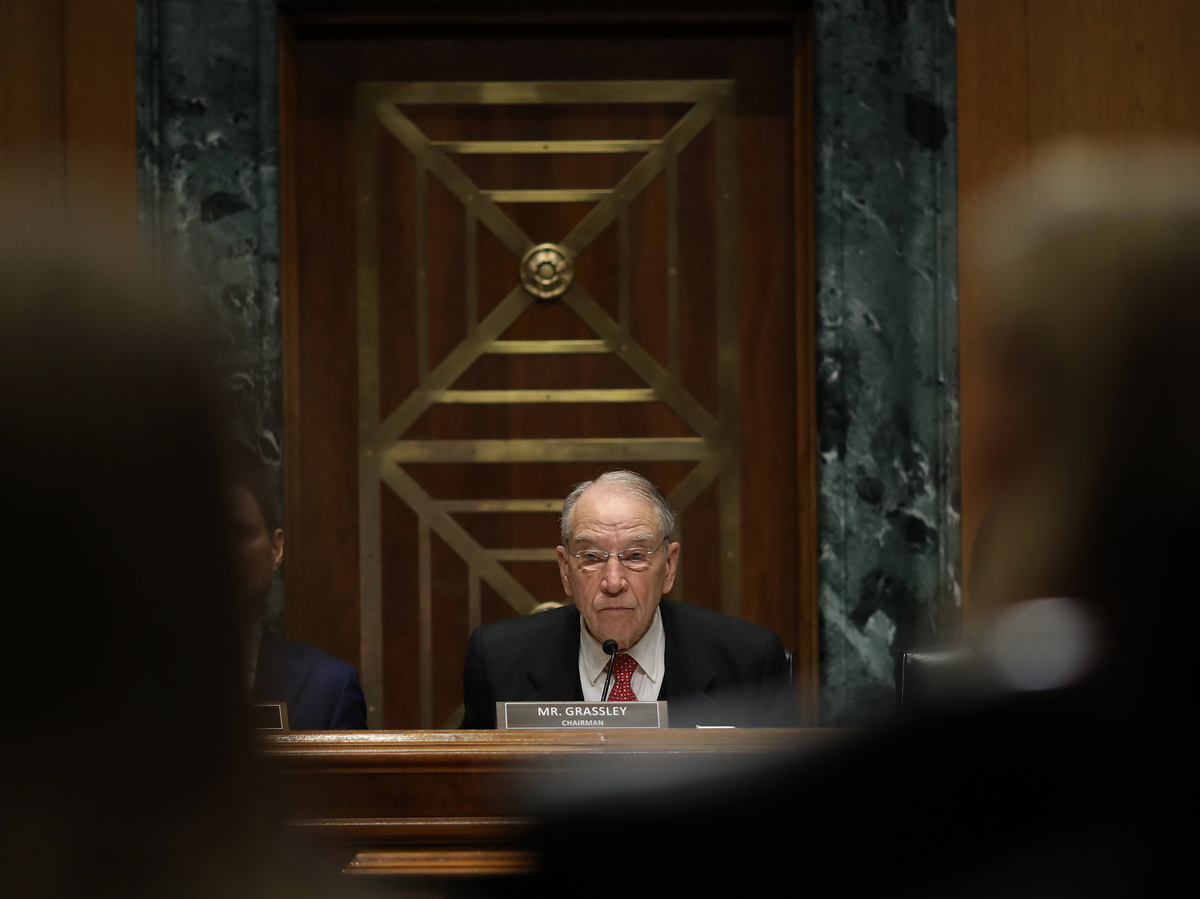
Sen. Chuck Grassley, R-Iowa, will lead the Senate Finance Committee’s questioning Tuesday of executives from pharmacy benefit managers about drug costs.
Win McNamee/Getty Images
hide caption
toggle caption
Win McNamee/Getty Images
Consumers, lawmakers and industry players all seem to agree that prescription drugs prices are too high. What they can’t always agree on is whom to blame.
On Tuesday, though, fingers are expected to point toward pharmacy benefit managers, the industry’s mysterious middlemen.
The Senate Finance Committee will hear from executives from the biggest pharmacy benefit managers, led by CVS Caremark and Cigna’s Express Scripts.
“They’re kind of a secret organization,” says Sen. Chuck Grassley, R-Iowa, of the pharmacy benefit managers. “I ask people to explain what they’re doing and nobody seems to give you the same answer twice.” Grassley is chairman of the Finance Committee and Tuesday’s hearing is its third on drug prices this year.
Pharmacy benefit managers, or PBMs, manage prescription drug benefits for insurance companies and employers. And because they control the medication purchases of millions of patients, they are tremendously powerful.
“They exist only because pharmaceutical prices got so high and they were a way to get some market power in there that was on the consumer side,” says Len Nichols, a health economist at George Mason University. “Now they’ve become so big and dominant that they are hurting pharma.”
How dominant? CVS Caremark negotiates drug prices, copayments and which drugs are preferred options for more than 92 million people in the U.S. Express Scripts covers another 83 million.
The companies are hired by insurance companies, or self-insured employers, to control spending on prescription drugs. The PBMs negotiate discounts with pharmaceutical manufacturers, but those discounts come in the form of confidential rebates that are paid to the PBMs after the drugs are purchased.
PBMs pass most of the rebates on to their clients, but they often keep a slice for themselves.
The PBMs dispute that they are withholding savings from their clients. “While drug manufacturers would have people believe that PBMs are retaining these discounts, virtually all rebates and discounts are passed on to clients,” said Tom Moriarty, executive vice president at CVS Health, in a February speech.
Some analyses show that PBMs actually do help reduce drugs prices.
“PBMs have saved money over the last decade by encouraging use of generics,” says Dr. Walid Gellad, director of the Center for Pharmaceutical Policy and Prescribing at the University of Pittsburgh.
A report from SSR Health, an investment research firm, says the net prices of brand-name prescription drugs fell 4.8 percent in the last quarter of 2018, even while list prices rose 4 percent. The declines came as pharmacy benefit managers refused to pay for some drugs altogether, opting for a competing brand that offered a better price.
Gellad says that evidence is murky, because the rebate system means that many drugs start at prices that are artificially high.
But critics say the system creates perverse incentives for drugmakers to set high prices for their products so they can offer larger percentage rebates. And they say sometimes PBMs benefit more when patients buy expensive drugs than when they buy cheaper ones.
Now the entire business model is under attack. Health and Human Services Secretary Alex Azar in February proposed eliminating the rebate system that underpins the work of companies like CVS Caremark and Express Scripts.
Instead, Azar proposed, the companies would use their market power to negotiate discounts from drugmakers upfront that would be passed on in full to patients.
In comments on HHS’ proposal to get rid of rebates, CVS said drugmakers — not PBMs — are to blame. “Our data show that it is not rebates that are causing drug prices to soar and, in fact, list price is increasing at a faster rate for many drugs with small rebates than for drugs with substantial rebates,” CVS wrote. “The elimination of rebates may not only lead to higher net drug prices, but will undoubtedly lead to higher premiums across the Medicare Part D program.”
Tuesday’s hearing comes six weeks after the leaders of seven pharmaceutical manufacturers appeared before the same committee to defend their pricing practices.
Those CEOs acknowledged that their prices are high for many patients, but they deflected blame onto pharmacy benefit managers.
“We want these rebates, which lower net prices, to benefit patients,” said Olivier Brandicourt, CEO of Sanofi, which makes Lantus, one of the highest priced brands of insulin. Its list price has risen from $244 to $431 since 2013, according to the committee.
“Unfortunately, under the current system, savings from rebates are not consistently passed through to patients in the form of lower deductibles, co-payments or coinsurance amounts,” Brandicourt said in testimony prepared for the hearing.
Sen. Ron Wyden, D-Oregon, who is the ranking member of the Finance Committee, had harsh words for the drug makers at the February hearing.
“I think you and others in the industry are stonewalling on the key issue, which is actually lowering list prices,” he said. “Lowering those list prices is the easiest way for consumers to pay less at the pharmacy counter.”
Grassley is also frustrated.
“The pharmaceutical companies pointed the finger at the PBMs. The PBMs point their finger at the pharmaceuticals. And then both of those are pointing their fingers at the at the health insurance companies,” Grassley said.
“I’m not announcing another hearing,” he continued. “But it might be that if we get this finger-pointing going on all the time, we may want to get those three groups all at the same table to stop the finger-pointing.”
Major League Baseball Is Trying To Bring More Women Into Front Offices And Fields

As MLB’s Chief Diversity Officer, Renee Tirado oversees a number of initiatives to bring more women and people of color into all levels of the sport, from front offices to the field. She says, “there’s a lot to do.”
Alex Trautwig/Courtesy Major League Baseball
hide caption
toggle caption
Alex Trautwig/Courtesy Major League Baseball
Major League Baseball is staring down a gender problem. Despite initiatives meant to bring more women into its dugouts, executive offices and broadcast booths, everyone — including women in high-powered positions — believe things won’t change quickly enough.
“Look, I think there’s no sugar-coating this. There’s a lot to do,” said Renee Tirado, MLB’s chief diversity officer.
In 2018, MLB earned a gender grade of C on the yearly report card issued by The Institute for Diversity and Ethics in Sports. Essentially, that means 30 percent of employees in pro-baseball are women.
But MLB told KCUR that all across the league just 188 women work in baseball operations roles, doing things like looking for the best talent, negotiating contracts or scouring data to optimize player skills. That encompasses jobs in the commissioner’s office plus all 30 teams and those teams’ minor league systems.
And in 150 years of Major League Baseball, no woman has been a general manager or a head coach.
New York Yankees’ Jean Afterman is one of only three women who’ve risen to the assistant general manager level.
“I’ve been honored to sometimes be referred to as a trailblazer, but it’s pretty exhausting when you blazed a trail and there’s nobody following up behind you,” said Afterman, who is 62.
Working to improve the numbers, for real
While the conversation about gender parity in major league sports may not be new, there’s a renewed focus. The NFL’s Tampa Bay Buccaneers just hired two women as assistant coaches. Notre Dame women’s basketball coach, Muffet McGraw, recently declared she was done hiring men for her staff and advocated for hiring more women as leaders in sports.
And ESPN analyst Jessica Mendoza, who like other women broadcasters, has been criticized for showing off her baseball smarts, joined the New York Mets’ baseball operations staff as an advisor about a month before the season started.
There is no single definition of “baseball operations” across Major League Baseball. Twenty-four of the 30 teams confirmed to KCUR how many women they had in such roles, though some teams counted the media relations crew, and most counted administrative assistants, who often help with contracts and other important front-office functions.
The Kansas City Royals are among the top five teams with women in baseball operations roles across the major and minor leagues, MLB said. But on the pro team, the Royals, there is just one woman: lead dietitian Erika Sharp.
“I would say other people notice it more than I do,” Sharp said. “We’ll be in a meeting with everybody, and they look around, they’re like, ‘Wow, you really are the only female. That’s weird.’
“But … it’s just a typical day and they all treat me like their little sister. They call me little sis sometimes,” she said.
Sharp, 30, is in her second season with the Royals, having previously worked with the San Francisco Giants, Arizona Cardinals and Phoenix Coyotes. She said she’s been lucky in that she hasn’t felt like her gender has been a determining factor, though she acknowledged that her profession as a dietitian is generally dominated by women.
Gender parity doesn’t feel like a large hurdle to overcome, Sharp said, but it’ll be key to build “the confidence of the upcoming working class and generation of females entering in, that there are positions and you can do these things. You just have to go in and work hard like everyone else does.”
Tirado, MLB’s chief diversity officer, said she is trying to evolve the game’s “culture to make this a sport of choice for women, whether it’s networking, the business side or baseball operations.”
MLB is trying to do that with the Diversity Pipeline Program and a fellowship program for baseball operations roles. Both are meant to equalize the league’s gender and racial hiring. Roughly 20 percent of MLB’s workforce is racially diverse, earning it a B+ for racial diversity in the institute’s report card.
It’s a change from how MLB did things under former Commissioner Bud Selig. Afterman, the Yankees executive, referenced the “Bud Selig rule.” As she described it, “if you are going to hire anybody in a senior position in a baseball operations department or a manager, you had to interview a diverse candidate, and all that was was ticking a box without any meaning to it.”






Emma Tiedemann is the Lexington Legends’ play-by-play announcer and director of media relations for the team, which is the low-A affiliate of the Kansas City Royals. She’s been broadcasting sports since she was 15.
Courtesy Emma Tiedemann
hide caption
toggle caption
Courtesy Emma Tiedemann
She said teams would just report back to the commissioner that, ‘I did exactly what you told me to … and I’m going to just hire the white guy that I wanted to.'”
MLB’s goal now, according to Tirado, is “always to improve the numbers, but not improve the numbers for the numbers’ sake.”
‘Change comes very slowly’
Diversity programs may not always work as expected. A 2016 Harvard Business Journal report noted that as initiatives to promote diversity proliferated in the U.S., the percentage of white women who became managers increased by 7 percent from 1985 to 2000 and black men only budged by .3 percent from 1985 to 2014.
And by diversity, “we’re talking about who is part of the organization and who is not a part of the organization,” said Geraldine Cochran, an assistant professor of physics at Rutgers University who has written about and advocates for diversity and inclusion efforts.
The Harvard report said that the most effective diversity initiatives rely on recruiting, mentoring and a diverse management staff, but Cochran insisted there’s another component, too: examining whether the efforts are making a difference.
“There is no-one size fits all diversity plan that’s going to work at every organization. It needs to be an iterative process of making the changes, and then doing research to see if those changes were actually successful, and doing research to find out where the actual problems in the organization are,” she said.
Rare to see a woman
Diversity initiatives weren’t a thing when Greg Pryor played in the majors in the 1970s and 1980s with the Texas Rangers, New York Yankees, Chicago White Sox and the Royals.
“I came through baseball when it was very rare to see a woman in the front office or very visible as they’ve been in regards to a baseball,” said Pryor, who remembers when women in the media were just being let into clubhouses. The only woman he said he dealt with from a team standpoint was Nancy Faust, the organist at Comiskey Park in Chicago.
“A lot of times in baseball, that change comes very slowly,” Pryor said. He said he thinks fathers are encouraging more daughters to go into the sports they love. Pryor’s youngest daughter, for instance, works in the NFL.
San Diego Padres Assistant General Manager Josh Stein started out with the team in 2003, and he had the rare chance to work with a high-ranking woman — Priscilla Oppenheimer, who was the director of minor league operations. But, he noted, the Padres dropped off the radar for a little bit.
“Definitely there was, I would say, a little bit of a gap in terms of women working in the Padres’ front office,” he said. “We’ve really seen an influx over the last few years of more and more applicants, more and more hires and some women doing great work in our baseball operations.” Currently, six women work in baseball operations for the Padres.
Stein said that the key to bringing more women into the game is having them start in entry-level roles.
“I think if you look at, regardless of gender, the folks in professional sports that have risen to the top, it typically starts with internships. It starts with very basic coaching positions or scouting positions,” he said. “And it tends to be a long, slow journey to the top.”
Among the up-and-comers is Emma Tiedemann, who is with the Royals’ low-A minor league team in Kentucky. The 26-year-old has broken the gender barrier a couple of times already: in 2014 with the Alaska Baseball League and in 2018 in the South Atlantic League. Today, She does both the play-by-play and color during radio broadcasts for the Lexington Legends.
It runs in the family. Her grandfather was the broadcaster for the University of Texas at Dallas and at 15, Tiedemann joined him in the booth to keep score.
“[He] just handed me the headset and said, ‘You know basketball, if you want to talk about what’s going on in the game, feel free. But if you’re too shy … that’s fine also.’ I talked to the whole game … and from there I was calling [NCAA] Division III athletics.”
But there were still barriers. She once had a minor-league baseball team tell her they wouldn’t hire her because she’s a woman.
“I was so taken aback that I was just kind of quiet and walked out of what I thought was going to be an interview just stunned,” she said. “But I used that to … bring me back down to reality of this career path is going to be a little bit harder for me than my friends.”
Continues to have to ‘justify herself’
The Yankees’ Afterman said she still feels it necessary to “sort of justify myself” in meetings, even though she’s a senior vice president, has been an assistant general manager for 18 seasons and negotiated contracts for star baseball players such as Hideo Nomo and Alfonso Soriano for several years before that.
Afterman sees potential in the emergence of analytics departments. Instead of trying to break in as a coach or a GM, women can develop ways to communicate advanced metrics to the coaches.
That was the route for Samantha Rack, who is with the Cincinnati Reds.
The 25-year-old previously worked in the health care sector as a developer, and said her experience since recently joining the Reds is that “nothing feels abnormal” because they’re working toward the same goal.
Even though she might have had worries about working in a field dominated by men, “I’ve not come across anything that would make me concerned,” she said.
But even with the MLB’s Diversity Pipeline Program, the fellowship program and an initiative called Take the Field , Tirado said progress will be slow. That’s because, she said, MLB is still at the foundational stage of this building this diversity.
Baseball is a small world. Teams like humans, prefer familiarity in the hiring process, and what’s familiar is men.
“I know that guy. And guy, I mean, literally. I know how he works, I know what he does, I know the way he thinks and it aligns with my philosophy,” Tirado said. “So we have to break through with that by giving women an opportunity to build out those relationships and show that they can compete at the same level as those men.”
Some of the encouragement is going to have to come from women like Tiedemann, who reaches out to any new woman broadcaster in baseball in hopes that they succeed and maybe even beat her to the major leagues, where currently there’s one woman who’s a color announcer — Suzyn Waldman with the Yankees’ WFAN team — and one woman who’s a public address announcer — Renel Brooks-Moon with the San Francisco Giants.
“I would love to not be a story,” Tiedemann said, adding she wants to be “just background noise.”
Like a player’s walkup song or the call of a hot dog vendor a section or two over — just part of the game.
Facing Escalating Workplace Violence, Hospitals Employees Have Had Enough


According to the Occupational Safety and Health Administration, incidents of serious workplace violence are four times more common in health care than in private industry. Most assaults come from patients and patients’ families.
Phil Fisk/Cultura RF/Getty Images
hide caption
toggle caption
Phil Fisk/Cultura RF/Getty Images
Across the U.S., many doctors, nurses and other health care workers have remained silent about what is being called an epidemic of violence against them.
The violent outbursts come from patients and patient’s families. And for years, it’s been considered part of the job.
When you visit the Cleveland Clinic emergency department, these days —whether as a patient, family member or friend — a large sign directs you toward a metal detector.
An officer inspects all bags and then instructs you to walk through the metal detector. In some cases, a metal wand is used — even on patients who come in on stretchers. Cleveland Clinic officials say they confiscate thousands of weapons like knives, pepper spray and guns each year. The metal detectors were installed in response to what CEO Tom Mihaljevic is calling an epidemic.
“There is a very fundamental problem in U.S. health care that very few people speak about,” he says, “and that’s the violence against health care workers. Daily — literally, daily — we are exposed to violent outbursts, in particular in emergency rooms.”
Many health care workers say the physical and verbal abuse comes primarily from patients, some of whom are disoriented because of illness or from medication. Sometimes nurses and doctors are abused by family members who are on edge because their loved-one is so ill.
Cleveland Clinic also has introduced other safety measures — such as wireless panic buttons incorporated into I.D. badges, and more safety cameras and plain clothes officers in ERs.
But these incidents aren’t limited to emergency rooms.
Allysha Shin works as a registered nurse in neuroscience intensive care at the University of Southern California’s Keck Hospital in Los Angeles. One of the most violent incidents she’s experienced happened when she was caring for a patient who was bleeding inside her brain.
The woman had already lashed out at other staff, so she’d been tied to the bed, Shin said.
The woman broke free of the restraints and then kicked and punched Shin in the chest — before throwing punch at her face.
“There was this one point where she swung, and she had just glanced off the side of my chin. If I hadn’t dodged that punch she could have knocked me out,” Shin says. And she very well could have killed me.”
The encounter left Shin shaken and anxious when she returned to work days later. She still has flashbacks.
She used to be afraid to speak about these types of attacks, she says because of what she calls a culture of accepting violence in most hospitals.
“It is expected that you are going to get beat up from time to time,” Shin says.
According to the Occupational Safety and Health Administration, incidents of serious workplace violence are four times more common in health care than in private industry.
And a poll conducted by the American College of Emergency Physicians in 2018 found nearly half of emergency physician respondents reported being physically assaulted. More than 60 percent of them said the assault occurred within the previous year.
Groups representing doctors and nurses say while the voluntary safety improvements that some hospitals have enacted are a good first step, more needs to be done.
There is still a code of silence in healthcare, says Michelle Mahon, a representative of the labor group National Nurses United.
“So what happens if they do report it?” Mahon says. “In some cases, unfortunately, they are treated as if they are the ones who don’t know how to do their job. Or that’ it’s their fault that this happened.”
“There’s a lot of focus on de-escalation techniques,” Mahon adds. “Those are helpful tools, but oftentimes they are used to blame workers.”
In California, the nurse’s labor union pushed for a law giving OSHA more authority to monitor hospital safety. The group is now backing a national effort to do the same thing.
“The standard that we are recommending federally holds the employer responsible,” Mahon says. “It mandates reporting of incidents and transparency.”
The Workplace Violence Prevention for Health Care and Social Service Workers Act, recently introduced in Congress, would require hospitals to implement plans to prevent violence. And any hospital could face fines for not reporting incidents to OSHA, Mahon adds.
The goal of the legislation — and of the union — is to hold administrators more accountable for acts of violence in their hospitals.
This story is part of NPR’s reporting partnership with Ideastream and Kaiser Health News.