Baylor Wins Women’s NCAA Basketball Championship Over Notre Dame

Baylor won the championship by a single point Sunday night, 82-81. Fans watching the men’s championship Monday night between Virginia and Texas Tech are hoping for similar drama.
Baylor won the championship by a single point Sunday night, 82-81. Fans watching the men’s championship Monday night between Virginia and Texas Tech are hoping for similar drama.
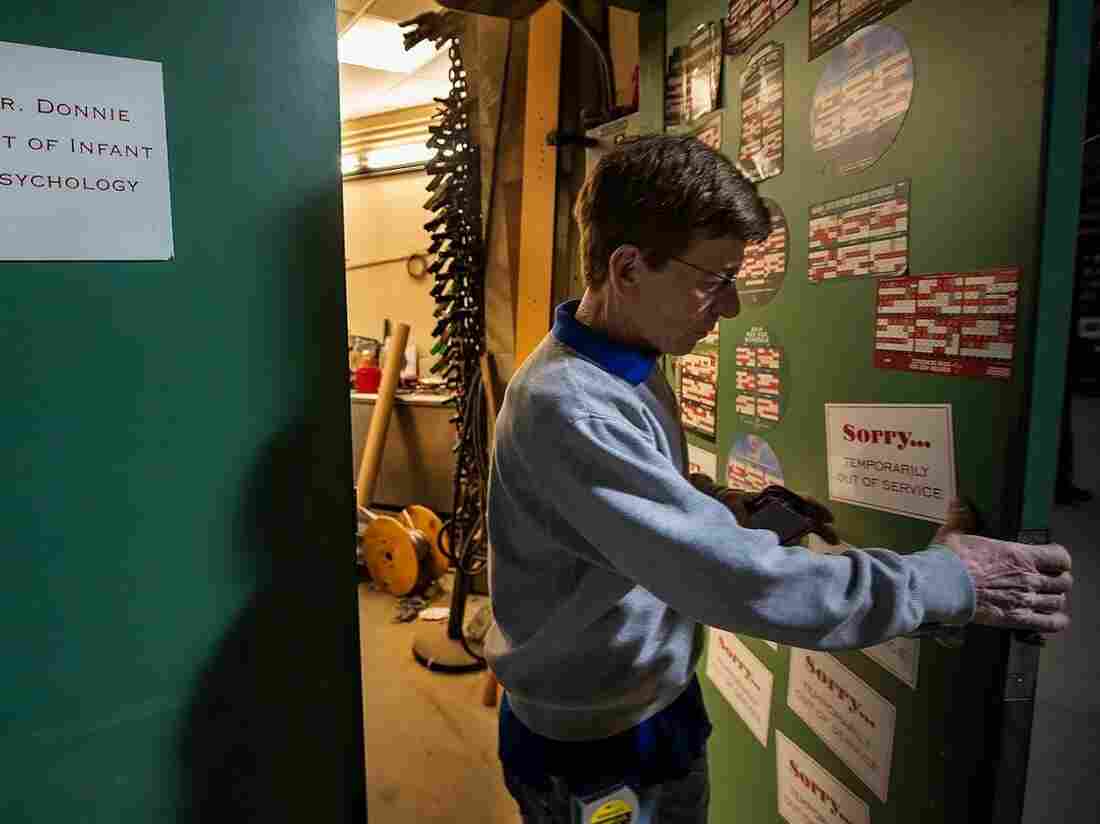
Donnie Gardiner works behind the scenes at Fenway Park to keep the ballpark operating smoothly.
Jesse Costa/WBUR
hide caption
toggle caption
Jesse Costa/WBUR
One of the toughest jobs in Major League Baseball might belong to Donnie Gardiner.
He’s the facilities superintendent at Fenway Park, the iconic 107-year-old home of the Boston Red Sox. It’s the oldest ballpark in Major League Baseball, and Gardiner’s job is to keep the place running.
That’s no small undertaking: Fenway Park has undergone major renovations in past years, including fixes to the field to help prevent flooding and the addition of more than 14,000 new seats.
To maintain the park, Gardiner puts in hundred-hour weeks, and occasionally sleeps in his office.
The season just started for the Red Sox. Ahead of the team’s home opener on Tuesday, Gardiner has had little time to waste. Water needed to be turned on to the concession stands, generators needed to be tested, emergency lighting needed to be checked and construction needed to be finished.
He bustled around Fenway, moving from the park’s new hot tub room, to the new training room, to the new video coaching room, getting updates and giving advice to workers.
“We have city inspections we have to worry about,” he said. “We have construction we have to finish up. We have just all kinds of things going on right now.”
As he talked, a racket of whirring equipment sounded around him — workers were installing walls, putting ceilings back together, painting, sanding, sawing and hammering.
Some of the challenges in renovating the ballpark are unpredictable, but Gardiner takes it all in stride. After all, he has worked at the ballpark for three decades.
Sometimes, Gardiner must work around brass waterlines that have stood the test of time. Other times, he uncovers remnants from Fenway’s past.
“When we ripped up the concourse a few years ago it was like an archaeological dig, finding the old nip bottles, is what we call them today, old shoes,” he said. “And the place was, I’m assuming, heated by coal because we found a lot of coal ash out in center field.”
Though soft-spoken, Gardiner has a commanding presence. He is constantly making important decisions about the park’s upkeep, and with an area as small as Fenway’s, every decision, every inch, matters.
Gardiner likes to say he’s playing a “game of inches.” With almost every decision, he has to figure out how to make the best use of limited space while preserving the park’s character.
“Everything we’ve done to this place has not taken away from the allure of the park … The feel is still there,” he said. “This building has a feel to it. It does for me personally. I’ve touched every inch of this place at one time or another.”
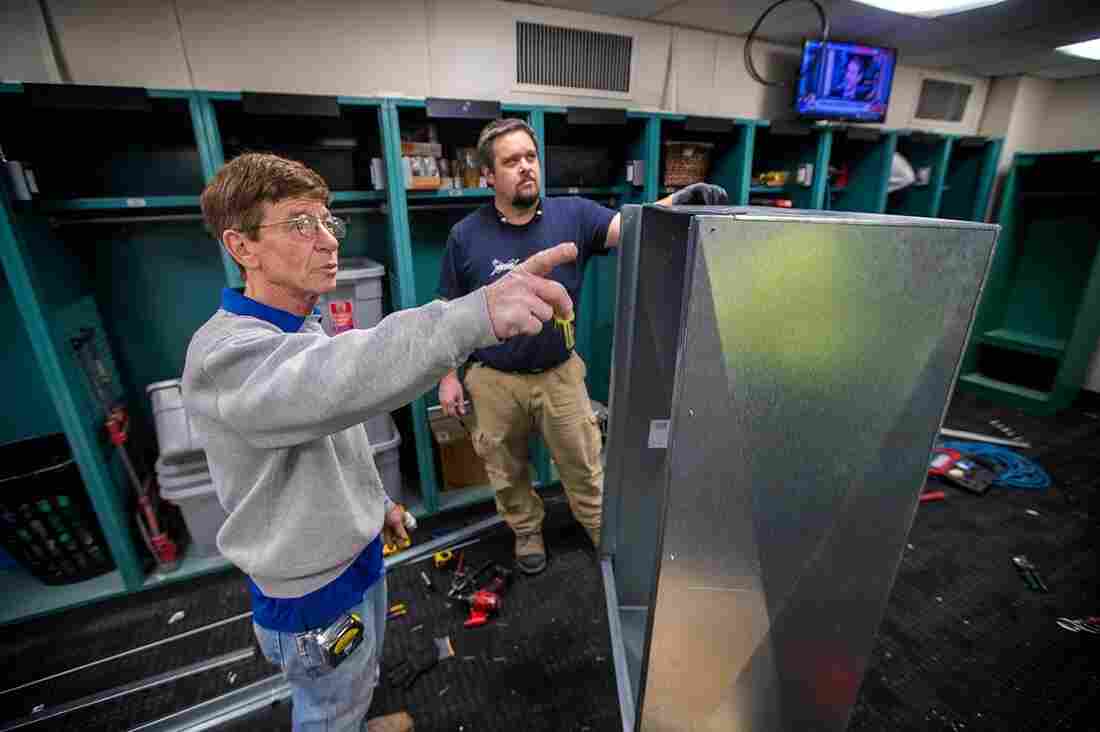
Fenway Park facilities superintendent Donnie Gardiner discusses construction work in the visiting team’s clubhouse with a contractor.
Jesse Costa/WBUR
hide caption
toggle caption
Jesse Costa/WBUR
Aside from fitting in more seats, another upgrade Gardiner has overseen at the ballpark is renovating the clubhouses.
Many teams have outgrown Fenway’s cozy clubhouses, so there’s always plenty of work for Gardiner to do on both the Red Sox’s team clubhouse and for the visiting team’s clubhouse area. All the renovations at the park are done equally.
“I’m not playing one side over the other. Whatever we do for one we do for the other,” he said.
Now that a new season has started, Gardiner’s focus has shifted from renovations to preventative maintenance.
“Game days are actually easier for the most part. If we do our job right the building runs itself.”
Still, Gardiner is typically too busy monitoring what’s happening off the field to pay attention to the game itself.
He takes pride in the green painted walls, the rows and rows of seats crammed onto every space imaginable and the bright stadium lights that shine down on it all.
“It’s unlike any other building,” Gardiner said of Fenway Park. “It’s not Joe’s Pizza. It’s not a high rise. It’s not a supermarket. It’s a very unique building. And the way it’s used is very unique. That’s what I love about it. I’d get bored anywhere else.”
NPR’s Amanda Morris produced this story for digital.
Who has the toughest job in baseball? Maybe Donnie Gardiner, the facilities superintendent at Fenway Park. He’s responsible for getting the 107-year-old ballpark ready for the Red Sox home opener.
LULU GARCIA-NAVARRO, HOST:
So who has the toughest job in baseball? It might just be Donnie Gardiner. He’s the facility superintendent at Fenway Park in Boston. That means he makes sure that the oldest ballpark in Major League Baseball keeps running. Shira Springer of member station WBUR visited Gardiner as he got ready for another Red Sox season.
DONNIE GARDINER: Come on in. Welcome to Fenway.
SHIRA SPRINGER, BYLINE: Donnie Gardiner greets me at Gate D, then quickly walks to the visitors’ clubhouse. He doesn’t want to waste time, not with the Red Sox home opener fast approaching.
GARDINER: We have city inspections we have to worry about. We have construction we have to finish up. We have just all kinds of things going on right now.
SPRINGER: When you step into the visitors’ clubhouse, you see what he means.
(SOUNDBITE OF CONSTRUCTION TOOLS RUNNING)
SPRINGER: Workers are installing walls, putting ceilings back together, painting, sanding, sawing, hammering. As Gardiner moves from the new whirlpool room to the new training room to the new video coaching room, he gets updates and gives advice.
GARDINER: Now we’ve just got to see if we can find some room up there to change the filters.
UNIDENTIFIED PERSON #1: It’ll be close. We’ll get them in.
GARDINER: Everything’s been close.
UNIDENTIFIED PERSON #2: I would wait on this because I don’t know where we’re going to cut the line. But I think we’re going to cut the line.
SPRINGER: The same thing happens when he visits the Red Sox clubhouse area and checks on manager Alex Cora’s new larger office and other upgrades. Teams have outgrown Fenway’s cozy clubhouses. So there’s always plenty of work to do for the Red Sox and the visitors.
GARDINER: I’m not playing one side over the other. Whatever we do for one, we do for the other.
SPRINGER: Donnie Gardiner is 5-foot-3 and a soft-spoken but commanding presence in the clubhouses. It’s clear he knows how to handle the unpredictable challenges that come with renovating a 107-year-old ballpark. He should. He’s worked there for three decades.
GARDINER: You know, everything we’ve done to this place has not taken away from the allure of the park. The feel is still there. This building has a feel to it. I mean, it does for me personally. You know, I’ve touched every inch of this place at one time or another.
SPRINGER: And with a footprint as small as Fenway’s, every inch matters. Gardiner likes to say he plays a game of inches. He’s constantly figuring out how to make the best use of limited space, especially in the clubhouse areas. Sometimes he’s also working around brass waterlines that have stood the test of time. And during offseason renovations, sometimes he’s uncovering remnants from Fenway’s past.
GARDINER: When we ripped up the concourse a few years ago, we were – it was like an archeological dig, you know, finding the old nip bottles, old shoes. And the place was, I’m assuming, heated by coal because we found a lot of coal ash out in centerfield.
SPRINGER: When the ballpark reopens for business each season, Gardiner’s focus shifts from renovations to preventative maintenance.
GARDINER: Game days are actually easier for the most part. If we do our job right, the building runs itself.
SPRINGER: But before the games begin again, there’s a lot to do – turn on the water to concession stands, test generators, check emergency lighting, finish the construction in both clubhouses. The punch list goes on and on. And Gardiner’s busy staying on top of it all.
GARDINER: It’s unlike any other building. It’s not Joe’s Pizza. It’s not a high-rise. It’s not a supermarket. It’s a very unique building. And the way it’s used is very unique. And that’s what I love about it. I’d get bored anywhere else.
SPRINGER: Even if that means putting in 100-hour weeks and occasionally sleeping in his office. One thing Donnie Gardiner doesn’t do – watch the Red Sox play. He’s too busy monitoring what’s happening off the field. For NPR News, I’m Shira Springer in Boston.
Copyright © 2019 NPR. All rights reserved. Visit our website terms of use and permissions pages at www.npr.org for further information.
NPR transcripts are created on a rush deadline by Verb8tm, Inc., an NPR contractor, and produced using a proprietary transcription process developed with NPR. This text may not be in its final form and may be updated or revised in the future. Accuracy and availability may vary. The authoritative record of NPR’s programming is the audio record.

Wizdom dancers perform at the Capitol One Arena in Washington, D.C.
Olivia Sun/NPR
hide caption
toggle caption
Olivia Sun/NPR
During a recent break in the action, a dance squad stormed the court for the Washington Wizards. Donning bright red, white and sparkly blue outfits, they spun, they shimmied, they even did some light twerking. They looked like any dance team a fan might expect to see at an NBA game, except for one difference: They were all over the age of 50.
Wizdom dancer Christopher Johnson, 53, rehearses while the rest of the team gets ready in locker rooms before their second-to-last performance of the season. Johnson is a special needs educator when he’s not dancing, and says that music and dance has played an integral role in his life.
Olivia Sun/NPR
hide caption
toggle caption
Olivia Sun/NPR
The “Wizdom” dance team, as the squad is called, first took the court for the Wizards in November and has performed at several home games ever since. The 19 women and one man who make up the squad range in age from 50 to 76, and they include former NFL cheerleaders, a dentist, several grandmothers and a breast cancer survivor.
“We are part of what I like to call the ‘Fame,’ ‘Flashdance’ and ‘Let’s Get Physical’ generation,” says Wizdom dancer Cindy Hardeman, 60. “We’re just taking it into our elder years,” she says, later adding “If we were to top it in order of why we do it, I’d say fun, fun and fun.”
Wizdom dancers rehearse backstage before a performance at the Capitol One Arena.
Olivia Sun/NPR
hide caption
toggle caption
Olivia Sun/NPR
With contagious enthusiasm, team members are almost always dancing: in the locker room, walking to practice, lining up to perform.
“They’re very well-rehearsed, perform with a lot of energy, charisma, style, and are just entertaining to watch,” says the team’s choreographer, Derric Whitfield. “The audience can get behind them because they are so good. It’s not just, ‘Oh that was cute,’ it’s ‘Wow they really can dance.'”
THE first ever performance of the Wizdom, presented by @AARP! ???#DCFamily pic.twitter.com/sROOEAhDiI
— Wizards Dancers (@Wizardsdancers) November 25, 2018
More than 50 people tried out for the Wizdom — a rigorous audition process that was documented by the team’s sponsor, the AARP. With their debut in November, they became one of at least a dozen other squads for dancers who are 50 or older in the NBA. By the time the season is over, Whitfield says, the team will have learned and performed seven routines in total.
More than 50 people tried out for the Wizdom. By the time their season is over, the team will have learned and performed seven routines in total.
Olivia Sun/NPR
hide caption
toggle caption
Olivia Sun/NPR
Some who made the team tried out because they had performed as professional dancers or cheerleaders years ago, and wanted to do so again. Some were looking for a way to get more exercise or were talked into it by their grandchildren.
Wizdom members enter the floor of the Capitol One Arena.
Olivia Sun/NPR
hide caption
toggle caption
Olivia Sun/NPR
For others, the team has helped them to overcome hardships.
“I was laying around having a pity party cause I lost my husband eight years ago and my mother two years ago and in between I had brain surgery,” says one member of the team who asked to be identified, fittingly, as “Nana.” At 76, she is the oldest member of the team. “This is really lifting my spirits,” she says.
“Nana,” 76 (center), is the oldest member of Wizdom.
Olivia Sun/NPR
hide caption
toggle caption
Olivia Sun/NPR
Kristina Leach, 68, is another member of the Wizdom. A former cheerleader for Washington’s NBA team, she lost her husband a few years ago. One year later, the restaurant where she worked for 40 years closed down. She says dancing for the Wizdom is the “best thing to happen to me.”
The 19 women and one man who make up the Wizdom range in age from 50 to 76.
Olivia Sun/NPR
hide caption
toggle caption
Olivia Sun/NPR
The team is extremely dedicated, Whitfield says. One member, for example, performed right after a prolonged nose bleed. Some have chronic health conditions, but train together outside of the team’s official weekly practices.
“To our surprise we are able to do things we didn’t think we could do,” says Christopher Johnson, 53, the one male member of the team. “It’s motivating us to even go further, to practice more, to be part of other dance classes.”
The Wizdom’s last performance is on April 9. They’ll all have to tryout again next year if they want to rejoin the team.
Olivia Sun/NPR
hide caption
toggle caption
Olivia Sun/NPR
The group’s last performance is on April 9. They’ll all have to tryout again next year if they want to rejoin the team.
But members of the Wizdom say that won’t keep them apart. They’ve already planned cookouts and pool parties for the off-season. As “Nana” puts it, the team has become a family.
“We go through our aches and pains together,” she says. Then she adds: “Anyone have Tylenol Extra Strength? Give me three!”

Before it closed March 1, the 25-bed Columbia River Hospital, in Celina, Tenn., served the town of 1,500 residents. The closest hospital now is 18 miles from Celina — a 30-minute or more drive on mountain roads.
Blake Farmer/WPLN
hide caption
toggle caption
Blake Farmer/WPLN
When a rural community loses its hospital, health care becomes harder to come by in an instant. But a hospital closure also shocks a small town’s economy. It shuts down one of its largest employers. It scares off heavy industry that needs an emergency room nearby. And in one Tennessee town, a lost hospital means lost hope of attracting more retirees.
Seniors, and their retirement accounts, have been viewed as potential saviors for many rural economies trying to make up for lost jobs. But the epidemic of rural hospital closures is threatening those dreams in places like Celina, Tenn.. The town of 1,500, whose 25-bed hospital closed March 1, has been trying to position itself as a retiree destination.
“I’d say, look elsewhere,” says Susan Scovel, a Seattle transplant who came with her husband in 2015.
Scovel’s despondence is especially noteworthy given that she leads the local chamber of commerce effort to attract retirees like herself. She considers the wooded hills and secluded lake to hold comparable scenic beauty to the Washington coast — with dramatically lower costs of living; she and a small committee plan getaway weekends for prospects to visit.
When she first toured the region before moving in 2015, Scovel and her husband, who had Parkinson’s, made sure to scope out the hospital, on a hill overlooking the sleepy town square. And she’s rushed to the hospital four times since he died in 2017.
“I have very high blood pressure, and they’re able to do the IVs to get it down,” Scovel says. “This is an anxiety thing since my husband died. So now — I don’t know.”
She says she can’t in good conscience advise a senior with health problems to come join her in Celina.
Susan Bailey has lived most of her life in Celina and started her nursing career at Cumberland River Hospital. She now worries that its closure will drive away the town’s remaining physicians.
Blake Farmer/WPLN
hide caption
toggle caption
Blake Farmer/WPLN
The closure adds delays when seconds count
Celina’s Cumberland River Hospital had been on life support for years, operated by the city-owned medical center an hour away in Cookeville, which decided in late January to cut its losses after trying to find a buyer. Cookeville Regional Medical Center explains that the facility faced the grim reality for many rural providers.
“Unfortunately, many rural hospitals across the country are having a difficult time and facing the same challenges, like declining reimbursements and lower patient volumes, that Cumberland River Hospital has experienced,” CEO Paul Korth said in a written statement.
Celina became the 11th rural hospital in Tennessee to close in recent years — more than in any state but Texas. Both states have refused to expand Medicaid in a way that covers more of the working poor. Even some Republicans now say the decision to not expand Medicaid has added to the struggles of rural health care providers.
The closest hospital is now 18 miles away. That adds another 30 minutes through mountain roads for those who need an X-ray or blood work. For those in the back of an ambulance, that bit of time could make the difference between life or death.
Staff members posted photos and other memorabilia in the halls — reminders of happier times — in the weeks before its closure.
Blake Farmer/WPLN
hide caption
toggle caption
Blake Farmer/WPLN
“We have the capability of doing a lot of advanced life support, but we’re not a hospital,” says emergency management director Natalie Boone.
The area is already limited in its ambulance service, with two of its four trucks out of service.
Once a crew is dispatched, Boone says, it’s committed to that call. Adding an hour to the turnaround time means someone else could likely call with an emergency and be told — essentially — to wait in line.
“What happens when you have that patient that doesn’t have that extra time?” Boone asks. “I can think of at least a minimum of two patients [in the last month] that did not have that time.”
Residents are bracing for cascading effects. Susan Bailey hasn’t retired yet, but she’s close. She’s spent nearly 40 years as a registered nurse, including her early career at Cumberland River.
“People say, ‘You probably just need to move or find another place to go,’ ” she says.
Closure of the hospital meant 147 nurses, aides and clerical staff had to find new jobs. The hospital was the town’s second-largest employer, after the local school system.
Blake Farmer/WPLN
hide caption
toggle caption
Blake Farmer/WPLN
Bailey and others are concerned that losing the hospital will soon mean losing the only three physicians in town. The doctors say they plan to keep their practices going, but for how long? And what about when they retire?
“That’s a big problem,” Bailey says. “The doctors aren’t going to want to come in and open an office and have to drive 20 or 30 minutes to see their patients every single day.”
Closure of the hospital means 147 nurses, aides and clerical staff have to find new jobs. Some employees come to tears at the prospect of having to find work outside the county and are deeply sad that their hometown is losing one of its largest employers — second only to the local school system.
Dr. John McMichen is an emergency physician who would travel to Celina to work weekends at the ER and give the local doctors a break.
“I thought of Celina as maybe the Andy Griffith Show of health care,” he says.
McMichen, who also worked at the now shuttered Copper Basin Medical Center, on the other side of the state, says people at Cumberland River knew just about anyone who would walk through the door. That’s why it was attractive to retirees.
“It reminded me of a time long ago that has seemingly passed. I can’t say that it will ever come back,” he says. “I have hopes that there’s still some hope for small hospitals in that type of community. But I think the chances are becoming less of those community hospitals surviving.”

Comments about sexism by head coach Muffet McGraw of the Notre Dame Fighting Irish went viral this week.
Tim Clayton/Corbis via Getty Images
hide caption
toggle caption
Tim Clayton/Corbis via Getty Images
Muffet McGraw, the two-time championship-winning head coach of women’s basketball at University of Notre Dame, was dancing a jig and celebrating Friday night after leading her team to victory over the University of Connecticut.
The NCAA women’s basketball championship game is now set for Sunday — setting up a possible third win for McGraw — with the reigning national champion Notre Dame’s Fighting Irish taking on No. 1 seed the Lady Bears of Baylor University.
But this past Thursday, McGraw’s mood was more serious when answering a question about her recently reported commitment to never hire another male coach for her staff.
She began talking about the decades that the Equal Rights Amendments has gone without ratification: “We need 38 states to agree that discrimination on the basis of sex is unconstitutional. We’ve had a record number of women running for office and winning. And still, we have 23 percent of the House and 25 percent of the Senate.”
Muffet McGraw: A voice for women.
A voice for women in sports. #WFinalFour | @ndwbb pic.twitter.com/sxsQE3Mt4i
— NCAA WBB (@ncaawbb) April 4, 2019
McGraw was responding to a question about being the “voice” of female coaches in college athletics after University of Tennessee coach Pat Summitt, who won 1,098 games with the Lady Volunteers for more than 38 years, died in 2016.
McGraw’s two-minute response, touching on the long history of sexism in many American institutions, went viral.
“I’m getting tired of the novelty of … the first female governor of this state. The first female African-American mayor of this city,” she said. “When is it going to become the norm instead of the exception? How are these young women looking up and seeing someone that looks like them, preparing them for the future? We don’t have enough female role models. We don’t have enough visible women leaders. We don’t have enough women in power.”
She said girls are socialized to think “men run the world.” Where better to counter that narrative than in sports, she asked.
“When you look at men’s basketball and 99 percent of the jobs go to men, why shouldn’t 100 or 99 percent of the jobs in women’s basketball go to women? Maybe it’s because we only have 10 percent women athletic directors in Division I. People hire people who look like them. And that’s the problem.”
In 1972, Title IX enacted gender equity policies in student athletics as part of a law. Two years later, more than 90 percent of women’s teams in college sports had female coaches, according to the Tucker Center for Research on Girls & Women in Sport at the University of Minnesota.
That number has fallen drastically. The center’s newest report based on data from last year found the percentage of female head coaches had increased slightly from previous years, but only to 41.8 percent. The group took data from 86 institutions that were part of the NCAA Division I “big time” conferences.
In basketball specifically, the percent of women coaching women was 59.3 in 2018.
Notre Dame player Jessica Shepard responded to McGraw, “Talk that talk then coach.” Notre Dame forward Brianna Turner, who scored her 2,000th career point Friday, just wrote on Twitter: “Take notes.”
Samantha Brunelle, a high-profile incoming recruit to Notre Dame, tweeted the video of McGraw’s answer, saying it was “one of the many reasons why Notre Dame was the place for me.”
“I aspire to be like her one day,” Brunelle told the South Bend Tribune of South Bend, Ind. “She stands for women so much. She has a huge voice to help give us women more of a platform.”

A crowded opening day at Arapahoe Basin Ski Area in Keystone, Colo.
Doug Pensinger/Getty Images
hide caption
toggle caption
Doug Pensinger/Getty Images
On a recent 50-degree bluebird day at Big Bear Mountain outside Los Angeles, skiers in short sleeves partied with loud music and beer and bragged about how many days they have spent at the mountain this season.
“It’s been at least 10,” said Daniella Gogatz.
“This is day 31,” said Ken Ryan. “It’s cost me about $20 or less a day at this point.”
While the prices of ski lift passes have been skyrocketing, the industry has been embracing new multiresort season passes that are cheaper than ever. They’ve proven popular though also controversial.
Gogatz and Ryan are able to afford to ski so much because they bought Ikon passes, which were just introduced this season by the the Alterra Mountain Company.
Ikon is priced starting at around $600 and includes access to dozens of resorts and some of the most famous ski mountains in the world, including Aspen, Jackson Hole and Deer Valley.
Ikon, and its main competitor, The Epic Pass, which was introduced a decade ago, have made it possible to ski for an entire season for what you could spend on a three-day lift ticket, as long as you commit early.
But some locals complain the passes are destroying the character of their beloved mountains.
Mammoth Mountain is one of the 38 destinations accepting the Ikon pass, which has led to some locals complaining about the crowds.
Ben Bergman/NPR
hide caption
toggle caption
Ben Bergman/NPR
“We’re seeing more people on the hill and longer lift lines and whenever you’re waiting in one of those lines you’ll hear some local quip about the Ikon passholders,” said Matt Maydick, who lives in Carbondale, Colo., right outside Aspen.
Maydick, himself an Ikon passholder, says he is happy more people are getting to enjoy his favorite sport but he is frustrated by the growing pains.
Ikon passholders have been accused of not only making the mountain too crowded but also of being in over their heads.
There has been more hostility in Jackson Hole. When Joe Cascia of New Jersey visited recently, he encountered a local who griped about Ikon passholders for being cheap and not spending enough at local restaurants.
“I’m not sure why he would seen that as a negative, because I think everybody should be trying to save money,” said Cascia, who said he pointed out that he had just spent almost $200 on dinner.
Cascia’s girlfriend usually proudly displays her Ikon pass on her helmet but at Jackson Hole he thought it would be better for her to hide it.
“I even told her you might want to put that in your pocket here because it just didn’t feel 100 percent welcome,” Cascia said.
Resorts have tried to ease tensions by pointing out that Ikon passholders are not the only reason for overcrowding and that resorts gain valuable revenue from the pass.
Taylor Middleton, the general manager of Big Sky Resort in Montana, even penned an open editorial to local residents ordering them to be nicer.
“Recently, local social media channels are revealing a rash of really negative postings, shunning new visitors and treating new arrivals differently than we were treated ourselves,” wrote Middleton. “We were all new at some point; these guests are our newest visitors.”
In fact, Ikon passholders only account for a small increase in the number of visitors at most resorts this season. The biggest reason for the crowds is this season’s heavy snow, according to resort owners.
“I think the Ikon pass is somewhat unfairly blamed by some,” said Middleton.
Like it or not, the pass is here to stay, according to Erik Forsell, Alterra chief marketing officer.
“We definitely launched with the idea of disrupting in a positive way the ski industry and we did,” said Forsell.
Forsell says resorts like locking in guaranteed revenue in case of a bad snow year.
Next season’s pass went on sale last month, starting at $649.
One skier from Salt Lake City commented on the Facebook announcement: “You have ruined skiing. Please stop.”
NPR’s Scott Simon talks with Howard Bryant of ESPN about the Final Four tournament and the scandal swirling around Harvard’s fencing coach.
SCOTT SIMON, HOST:
It’s time for sports.
(SOUNDBITE OF MUSIC)
SIMON: The Final Four – finally here. The women’s tourney began last night, men’s tonight. Right here, right now, Howard Bryant of ESPN. Thanks very much for being with us, Howard.
HOWARD BRYANT, BYLINE: Hey, Scott. Good morning.
SIMON: Good morning. So last night, Notre Dame knocked off UConn once again, 81 – they’re making a habit of this – 81-76. Brianna Turner had a great game.
BRYANT: She had a great game. And remember when we were talking not just a year, year and a half ago that – and, in fact, it was last year when we were talking about how women’s basketball was just so boring. And college basketball belonged to UConn, and nobody could beat them and – yeah, look. Notre Dame, Scott…
SIMON: You said that.
BRYANT: I actually did not say that.
SIMON: I don’t recall I ever felt that way.
BRYANT: (Laughter) I did not say that. I said, you got to play these games. And it seems to me that in a transition that college – women’s college basketball is in, as the game becomes more and more and more competitive, you’re going to have better teams. And Notre Dame is doing exactly – they’re the defending champions, and they had a great, great tournament. They came in last night. They were trailing by eight in the fourth quarter. And it was just an amazing, you know, battle at the end. And, of course, you know, Arike Ogunbowale is just the – she’s a star. She hit the winning shot last year in overtime against UConn, and she drops 13 in a 10-minute quarter last night. And so it’s – this is a championship team playing like champions, and now they’re playing for another, you know, back-to-back final.
SIMON: Baylor beat Oregon, also by five points.
BRYANT: And Baylor – once again, these – this is the great thing about this tournament. On the one hand, you have – I think there’s so much more uncertainty in the men’s game right now because the women – you know, the best teams showed up here. And if you look at what Baylor – they’ve been a great team all season long. They’re a one seed as well. And so – and Lauren Cox, Kalani Brown – I mean, they’re – this is going to be a great tournament. And it’s going to be a really great final because I don’t know who’s going to win, and I don’t think that there’s a – you know, a real prohibitive favorite. I’m going to go with the defending champs and stick with Muffet McGraw and Notre Dame.
SIMON: And Muffet McGraw won a lot of admiration for her outspokenness at a press conference this week about the lack of women in leadership positions in sports.
BRYANT: Yeah, and she did. And she came out, and she said, look; I’m not going to hire any more – no more men. I’m not hiring any men. And she got all kinds – she got flak for that, and it became a national story. And she got all kinds of admiration for it, as well, for coming out and saying it. I thought what was very interesting about it is that if you look at the statistics that she was presenting from Title IX – that you had 90 percent of women’s basketball coaches were women 40 years ago, and now it’s down to 50 percent. And she’s like, listen; we need more representation, and this is – I’m going to advocate for this.
And what’s funny about it is that you have – in the real world, this is happening all the time, just that men aren’t advertising it. So I didn’t see what the big deal was. And not only that, it’s not as if she said that no men should be hired. She said that’s not what she’s going to do for her program because she feels like there’s more representation that is needed, and she’s going to do her part. I didn’t think it was that big a deal. I was happy that she said it, though.
SIMON: Hours from now, Auburn faces off against Virginia.
BRYANT: We’ve got the clear underdogs and the clear favorites in this, but I don’t see that. I think any of these four teams can win. I think Texas Tech can beat Michigan State. And I think Virginia, you know, is, you know, the – Virginia is the team that was a great team all season, No. 1 at one point as well. But I was just thinking college basketball – I think all four teams can win. And I just don’t see anybody with that much of an advantage. I’m going to go with Michigan State simply because I do like Tom Izzo. But I – once again, it wouldn’t surprise me if any of the four teams won the championship.
SIMON: Yeah. Well, Tom Izzo doesn’t get to dribble.
(LAUGHTER)
SIMON: Howard Bryant of espn.com and ESPN The Magazine. Thanks so much.
BRYANT: Oh, my pleasure, Scott.
Copyright © 2019 NPR. All rights reserved. Visit our website terms of use and permissions pages at www.npr.org for further information.
NPR transcripts are created on a rush deadline by Verb8tm, Inc., an NPR contractor, and produced using a proprietary transcription process developed with NPR. This text may not be in its final form and may be updated or revised in the future. Accuracy and availability may vary. The authoritative record of NPR’s programming is the audio record.

Flo Filion Meiler, 84, during pole vault training last month. She mostly works out alone, but has a coach to help refine her technique in events like shot put and high jump.
Lisa Rathke/AP
hide caption
toggle caption
Lisa Rathke/AP
Flo Filion Meiler is a world-class athlete who lives in Shelburne, Vt. At the indoor World Masters Athletics Championships in Poland last week, Meiler, who is 84, racked up medal after medal in her age division.
Golds in high jump, pentathlon, 60-meter hurdles, and pole vault. Silvers in long jump and triple jump. Oh, and another gold in the 4×200 relay. “The four of us ladies in our 80s set a new world record,” she told NPR this week.
But wait — the pole vault?
Indeed. Meiler took up track and field at age 60, and as she watched the pole vaulting competition at the Senior Olympics, she had a notion.
“They weren’t pole vaulting very high,” she remembers. “And I said to myself, you know, I think that I could do better than that.
So at a sprightly 65, she took up the event. “I love challenges, and the pole vault is a challenge. You have to have a really strong upper body, upper core and very strong arms.”
No problem for Meiler, who was competitive slalom water-skier for 30 years. “I think that’s why I’ve done so well in it, is because of the way I’ve always handled my body.”
At last week’s world championships, she was the only pole vaulter in her age division, though there were a few men in the 80-84 field. Meiler notes that she was far from the oldest athlete taking part in the meet. “There was a lady from India who was 103. … She didn’t run very fast, but she did it!”
All that winning takes a lot of training, and Meiler keeps a rigorous schedule. She says no longer has time to ski, as she devotes herself five to six days a week to her workouts.
“On Mondays, Wednesdays and Fridays, I will do track events. And on Tuesdays and Thursdays, I will do machine weights. Then I will play doubles tennis, but that’s just social tennis.”
She mostly trains alone, but she has a coach at the University of Vermont to help her get competition-ready. “I have her help me, let’s say, with my shot put. And I have her help me doing the high jump and so forth.”
A year ago, she started having hamstring problems and knew it was due to getting older. So she doubled the time she devotes to stretching and warming up. “It makes a world of difference in not being injured,” she says.
The competition may be thinning, but Meiler doesn’t see retirement anytime soon.
“You know, if the good Lord gives me my health, I’m going to keep going forever.”
Right now she’s focused on the upcoming Senior Olympics in Albuquerque, N.M., and she’s eagerly anticipating her birthday in June – an occasion that will shift her into the next age bracket.
“I’m looking forward to being 85,” Meiler says, “because then I’ll be at the bottom of the ladder, and I’m going to look at all these records and see what I can do about ’em.”
NPR’s Sarah Handel and Art Silverman produced the audio version of this story.