Salif Keita Gives His Blessing And Takes A Final Bow With 'Un Autre Blanc'

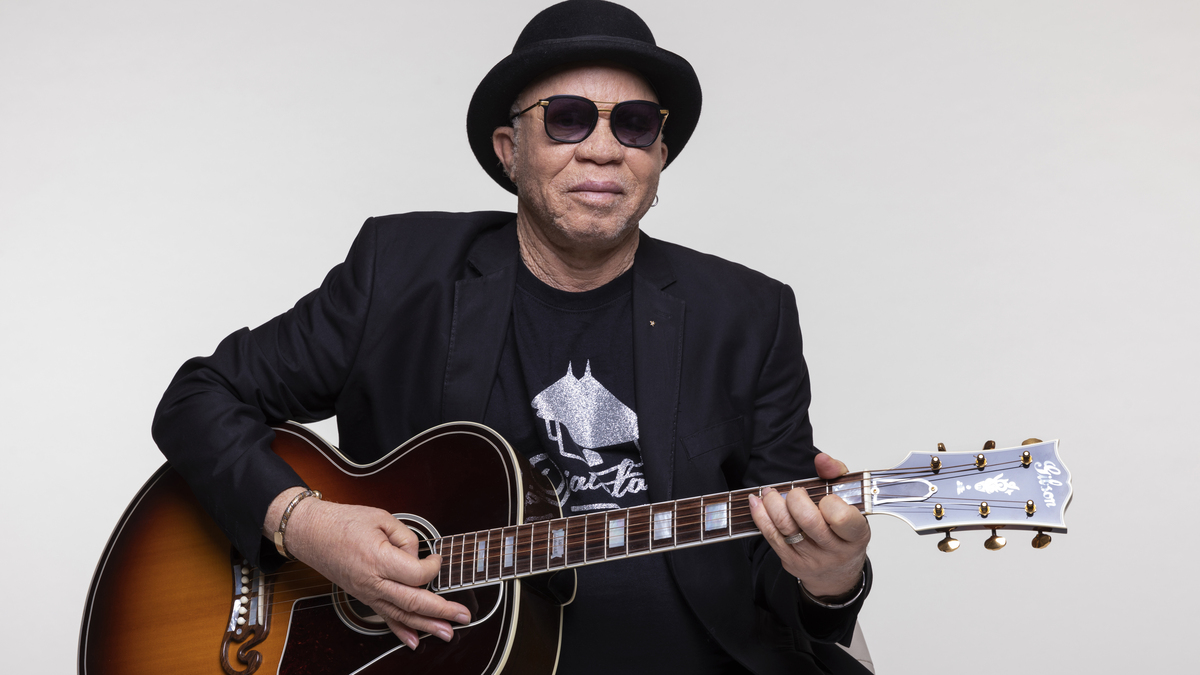
Salif Keita
Thomas Dorn/Courtesy of the artist
hide caption
toggle caption
Thomas Dorn/Courtesy of the artist
Salif Keita, one of the best African singers of the past century, had a 40-plus-year career that took him around the world and produced some 25 albums. Now, Keita is retiring from recording and in October 2018, he released his final album is Un Autre Blanc, or Another White.
In 1987, Keita introduced an iconic voice to the world with his album Soro. Keita sang to his father, a master hunter in his native village in Mali, “O, Sina, your son is lost far away from home.” Living then in Paris, Keita may have felt lost, but he was also finding himself. As someone born an albino to a royal family, his early choice to become a singer was both taboo and an act of courage for a young man who considered himself an outcast. After years of singing in urban African bands, Keita made his own statement and launching a movement of modern African music.
All these years later, Keita returns to the studio with confidence, passion, pride, gratitude and still, that incredible voice. The song “Were Were” praises the great leaders of Africa, from Lumumba to Mandela and is the grandest subject Keita addresses in the album. The album title “Another White” is more personal. It refers to Keita’s albinism, a defining feature of his life that he has sung and spoken about often.
YouTube
The album’s title, Another White, meanwhile, is more personal and refers to Keita’s albinism, a defining feature of his life that he has sung and spoken about often.
Many of the songs are also about the virtues and hardships that women face in Africa. In the song “Itarafo,” Keita and Afropop star Angélique Kidjo sing about a woman resisting pressure to abandon her child as she joins a new household.
For his farewell recording, Keita invited a rich cast of African singers to contribute. On the song “Gnamale,” he weaves in the vocal polyphony of Ladysmith Black Mambazo, mixing Bambara and Zulu in praise of Mande hunters like his late father.
Keita ends this album with a serene reggae number thanking God for his blessings and warning those who misuse his name. This plays as a sly jab to Islamic fundamentalists currently destabilizing Mali and it perfectly encapsulates the complexity that has made all Keita’s work so satisfying over the years. Never content with simple formulas, always breaking new ground, always authentic and sincere, Keita is himself a blessing. If this truly is his last recording, his creative force will be sorely missed.
Devon Gilfillian Puts His Love Of Nigerian Psychedelic Rock Into 'Get Out And Get It'

Devon Gilfillian is very excited to be talking about the release of the first single from his forthcoming debut album on the phone. However, he’s still pretty hyped from singing The National Anthem at the Southeastern Conference basketball game between LSU and Florida the morning of our talk. He’s been in this spot before. Gilfillian last sang The National Anthem to kick off the 2018 NFL draft.
“I played it straight,” Gillfilian he says, moving on quickly to the track. “‘Get Out And Get It,’ was definitely influenced by my falling in love with Afrobeat,” he says.
Co-written with Jamie Lidell, produced by Shawn Everett (Alabama Shakes, The War On Drugs) and premiered on World Cafe, “Get Out And Get It” draws on the funk vibes of “In The Jungle” by The Hygrades from a compilation of ’70s Nigerian psychedelic Afro-rock and funk.
Gilfillian grew up outside of Philadelphia and caught the music bug at an early age from his father, a singer and percussionist in the popular Philadelphia R&B group, Cafe Ole. He moved to Nashville in August 2013 in hopes of finding a community appreciative of his blend of social consciousness, rootsy melodies and soulful grooves. Gilfillian quickly settled into Music City with his charismatic mix of rock and soul, playing out regularly both in Nashville and around the country.
In 2016, Gilfillian released his first EP, a five-song collection that was musically influenced by his love of Al Green, Ray Charles and Jimi Hendrix, and was featured in a World Cafe Nashville session in 2017. “Get Out And Get it” percolates with a hot and tightly syncopated upbeat groove. Capable of singing in various registers, Gilfillian channels his inner Curtis Mayfield on the new single. “Get Out And Get It” has a heavy dose of infectious and captivating energy, and will move you with a spirit of optimism and empowerment.
“Even though the song has an upbeat feel to it, it actually came out of a place of feeling down, feeling lethargic,” Gilfillian explains. “I wanted to incorporate African percussion and influences into this song to turn those feelings around. It’s like me all hyped up, marching out the door. As far as the recording process went, Shawn said to us: ‘This is what I want you to do. I want you guys to pretend you are a ’70s African band from Nigeria. Just go deep [like] you’re in the club.’ So we did.”
Through most of April he’ll be out on tour with Brothers Osborne, including sets at the Winnipeg and Newport Folk Festivals in July. “Get Out and Get It” is available now via Capitol Records.
Surrounded By Military Barracks, Skiers Shred The Himalayan Slopes Of Indian Kashmir

A helicopter brings skiers and snowboarders into the mountains around Gulmarg, in Indian-administered Kashmir
Lauren Frayer/NPR
hide caption
toggle caption
Lauren Frayer/NPR
In a Himalayan valley surrounded by military barracks, blasts of artillery fire often reverberate across the icy mountain peaks. This is one of the world’s longest-running conflict zones. It’s near where India and Pakistan recently traded airstrikes. So it’s not unusual to see helicopters buzzing overhead.
But on a morning in early February, one particular chopper was not part of the conflict.
“I run Kashmir Heliski. We have clients from different parts of the world. We take people to 4,500 meters. They enjoy it!” says Billa Majeed Bakshi, a local skier turned businessman.
Since 2011, Bakshi has ferried more than 1,000 skiers and snowboarders nearly 15,000 feet up into the Himalayas, via helicopter, in Indian-administered Kashmir.
Kashmir is split between Indian and Pakistani control. The mountain valley is the site of a decades-long insurgency, as separatists on the Indian side fight for independence. Hundreds of thousands of soldiers are stationed on either side of the Line of Control, Kashmir’s de facto border. India blames Pakistani-based militant groups for attacks on Indian security forces, including a Feb. 14 suicide car bombing on the valley’s main highway.

Billa Majeed Bakshi, the founder of Kashmir Heliski, has ferried skiers and snowboarders nearly 15,000 feet up into the Himalayas via helicopter in Indian-administered Kashmir since 2011.
Furkan Latif Khan/NPR
hide caption
toggle caption
Furkan Latif Khan/NPR
But in the cold months, when the valley fills with snow, it also becomes a winter sports haven for a small but devoted gang of extreme sports enthusiasts. They often ski — “shred lines,” as boarders and ski bums put it — just a few hundred yards from the Line of Control, within view of Pakistani troops on the other side.
“I think it’s fantastic! I just wish we could get over their mountain ranges and shred with them too,” says Jimmy Hands, 41, who’s visiting from Toronto. “Look, nothing brings peace like a little bit of snow, and everybody’s been magical here! Like, it is magic.”
The powder this high up may be magical — but it also leads to avalanches. In early February, at least nine people died in avalanches triggered by a single snowstorm.
“Someone who’s had an accident, whether it’s a fall on ice or they’re involved in an avalanche, to move that person to a hospital — that is a big challenge here, without the infrastructure of other countries,” says Brian Newman, a Coloradan who serves as the snow safety officer for the Gulmarg Ski Resort, a Kashmiri state government-run resort with two giant gondola lifts. During the recent Indian and Pakistani airstrikes and shelling over the Line of Control, the ski station at Gulmarg remained open for business.
The main Jammu-Srinagar highway, the only route connecting Kashmir to the rest of India, is often impassable for several days at a time because of snow. At the area’s main airport, flights regularly get canceled due to foul weather. Snowplows are in short supply.

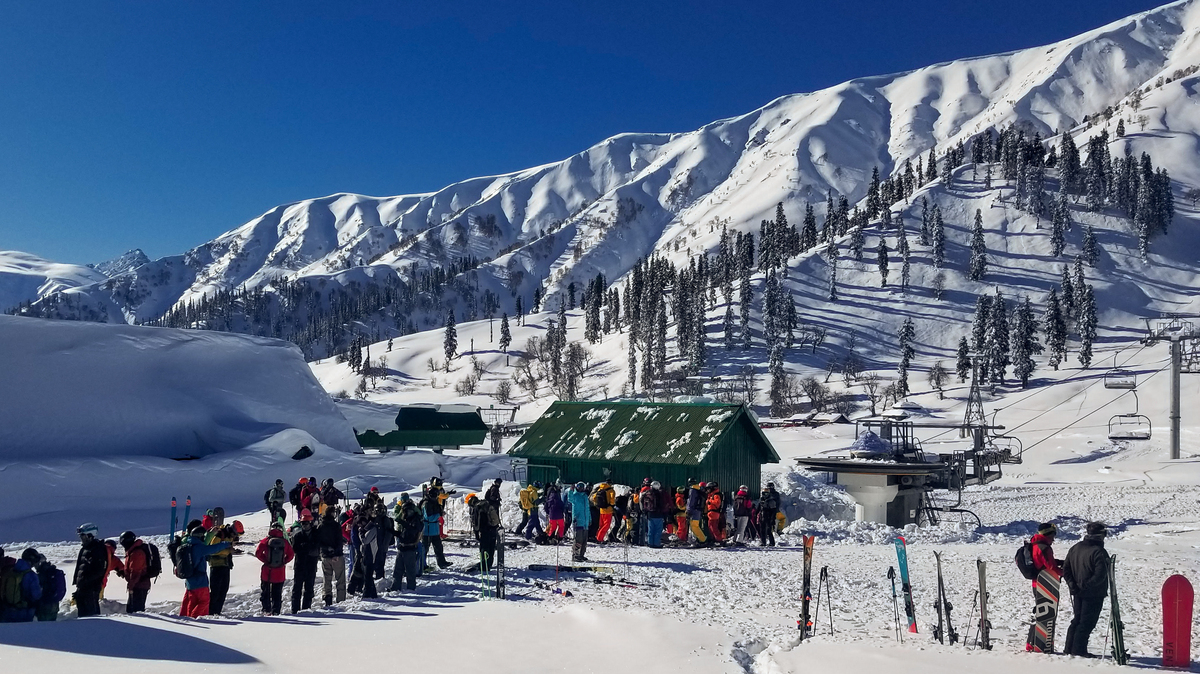
Skiers line up at the only chairlift in Gulmarg, a resort in Indian-administered Kashmir.
Lauren Frayer/NPR
hide caption
toggle caption
Lauren Frayer/NPR
Until the 1990s, Gulmarg, with fewer than 2,000 residents, was a sleepy hill station. The area, the Pir Panjal Range of the western Himalayas, was a summertime playground for India’s British colonial rulers, who came to escape the sweltering heat farther south. There’s still a British-built golf course.
Synonymous with romance and revolution, Kashmir has always captured the Indian imagination. Bollywood song sequences have long been filmed there. But after the state government built two gondolas in 1998 and 2005, Gulmarg began attracting more tourists from abroad, and increasingly from India too.
In 2007, the government hired Newman. He obtained explosives from the Indian military to blast off excess snow that might otherwise avalanche and imposed rules requiring skiers to carry avalanche beacons, shovels and probes. He even learned the Kashmiri language.
As India’s middle class grows, domestic tourists have been coming to Gulmarg in greater numbers. The state government says 800,000 Indian tourists visited Kashmir in 2018, along with 50,000 foreigners. There are traffic jams every Sunday afternoon, as day trippers, having paid about $5.25 for a scenic ride up the first gondola, exit the resort and drive back to Srinagar, the biggest city in the Indian state of Jammu and Kashmir, about 30 miles away.
“It’s almost like a different world! You’re cocooned in this space between the sky and the snow,” says Nikita Kapoor, 29, visiting for a long weekend from Kolkata — where it never snows. “I’m learning how to snowboard for the first time, so it’s really exciting!”

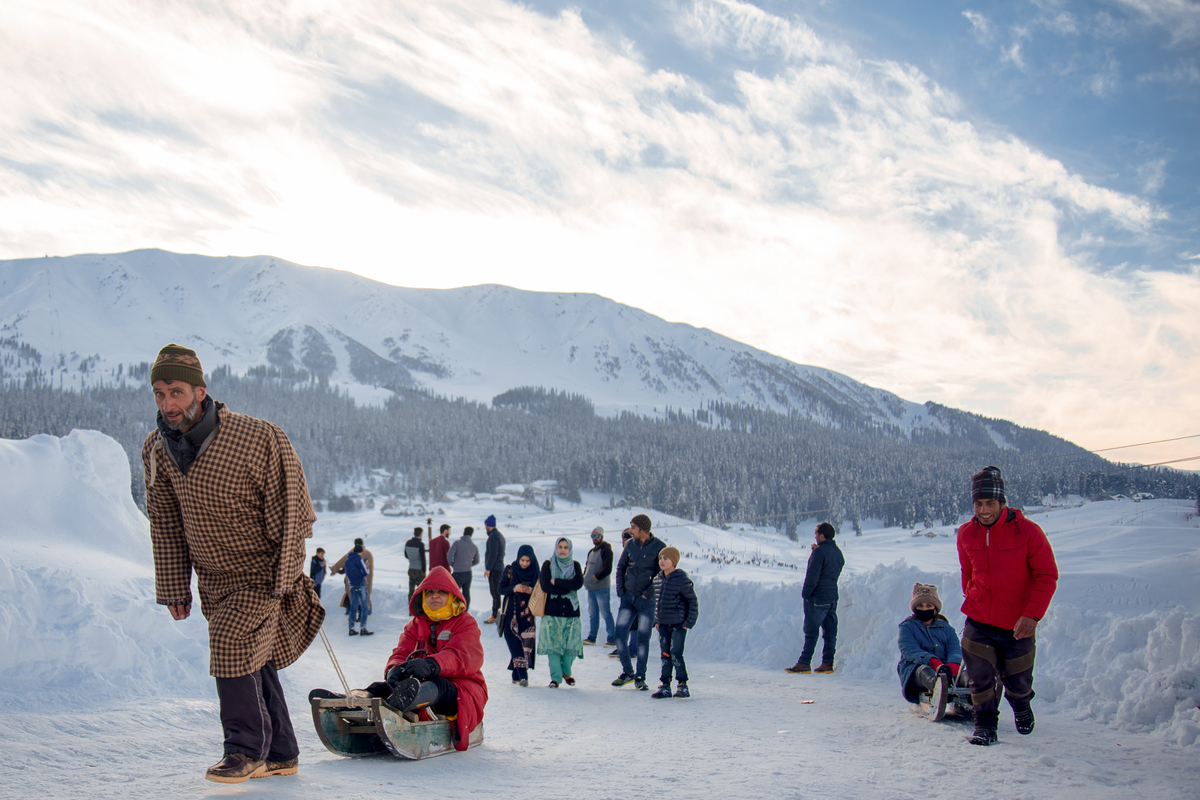
As India’s middle class grows, more domestic tourists are coming to Gulmarg, a resort in Indian-administered Kashmir that used to be a playground for British colonial rulers in the 19th and early 20th centuries.
Furkan Latif Khan/NPR
hide caption
toggle caption
Furkan Latif Khan/NPR
Tourists like Kapoor don’t seem fazed that their holiday destination is home to a decades-long separatist insurgency that, by some measures, is growing. Clashes between protesters and security forces have resulted in an estimated 40,000 to 70,000 deaths and thousands of injuries in the past three decades. Indian troops are accused of firing live ammunition on civilians, including deliberately targeting people’s eyes.
Still, tourism brings much needed revenue — as much as 8 percent of the state’s gross domestic product — which dips dramatically whenever there’s violence. The local unemployment rate, 21 percent, is about triple that of the rest of India.
What kind of jobs are there in Kashmir, beyond this ski resort?
“Nothing!” says ski guide Altaf Khanday, shaking his head. “You know the guys who are [throwing] stones in the valley? They are well-educated guys. Even they are busy in the militancy. It’s so sad.”
For Khanday, becoming an expert skier was an economic decision. Now, at age 30 and working as a back-country ski guide for the two-month ski season, he’s able to support seven members of his extended family all year.

Altaf Khanday, 30, works as a back-country ski guide in Gulmarg for two months a year. His earnings allow him to support seven members of his family all year.
Furkan Latif Khan/NPR
hide caption
toggle caption
Furkan Latif Khan/NPR
He learned to ski with secondhand gear. Lots of ski shops in Gulmarg rent gear donated by foreign visitors when they leave. It’s common to see Kashmiri youth learning to ski on straight, long, old-fashioned skis from the 1980s and 1990s.
“Oh my gosh, my first ski boots, they didn’t even have buckles!” Khanday says, laughing. “You know what skis I had? Broken ones!”
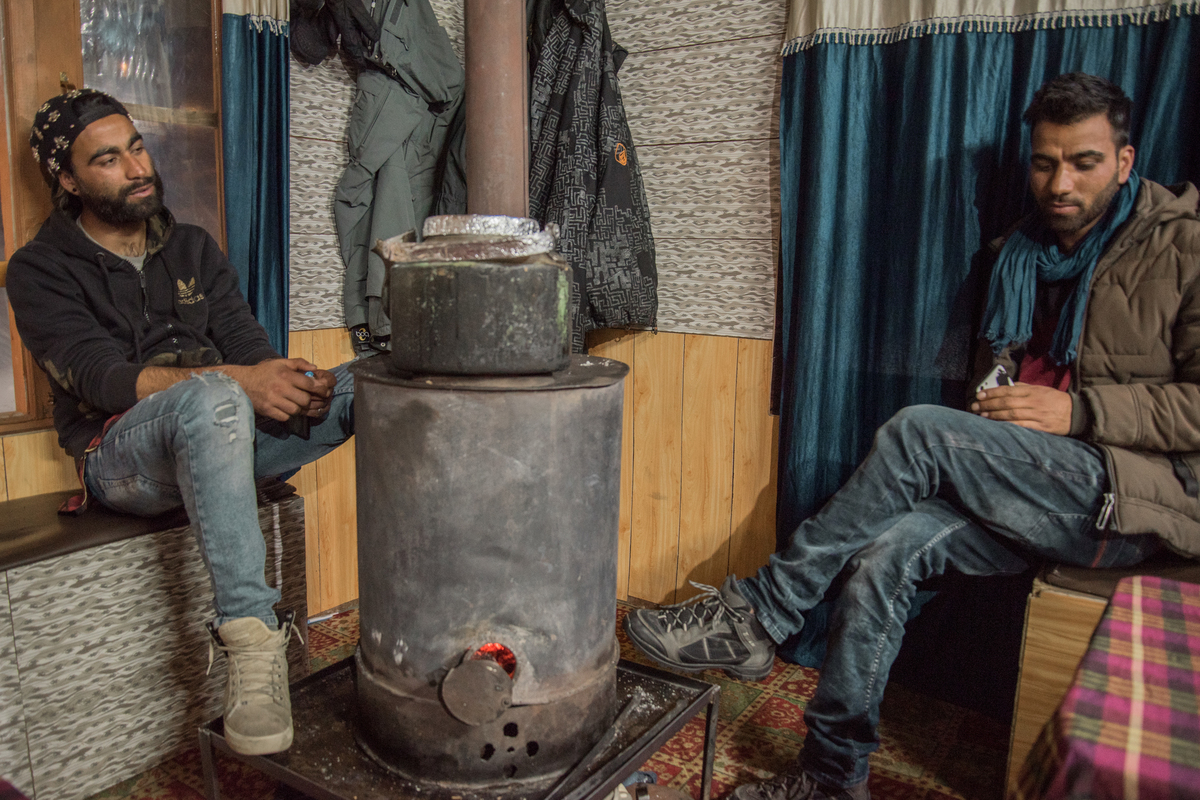
Not far from the ski lifts, young men huddle around a wood stove in a mountain hut in a forest. Tourists can rent dormitory rooms in the hut for about $14 a night, including breakfast.
One of the men, Raja Wasim Khan, 24, says his father moved the family to Gulmarg in 2010, when he was a teenager.
“Actually, he was a terrorist. He fought for Kashmir. For five or six years, he was in jail,” says Khan. “Then he started a new life, and he taught us snowboarding.”

Raja Wasim Khan (left), 24, and his brother Ashraf Khan, 21, huddle around a wood stove inside the ski hut they manage in Gulmarg. The Khan brothers’ father was a Kashmiri militant who served time in an Indian prison and then moved his sons to the mountains and taught them snowboarding. He wanted to keep them away from the violence he grew up in.
Furkan Latif Khan/NPR
hide caption
toggle caption
Furkan Latif Khan/NPR
Khan says his father, Parvez Ahmed Khan, 52, a notorious Kashmiri militant also known as “the Tiger,” wanted him and his brother to pour their energy into snowboarding rather than violence. Militant groups in Kashmir often recruit from the ranks of poor, unemployed and disaffected teenage boys.



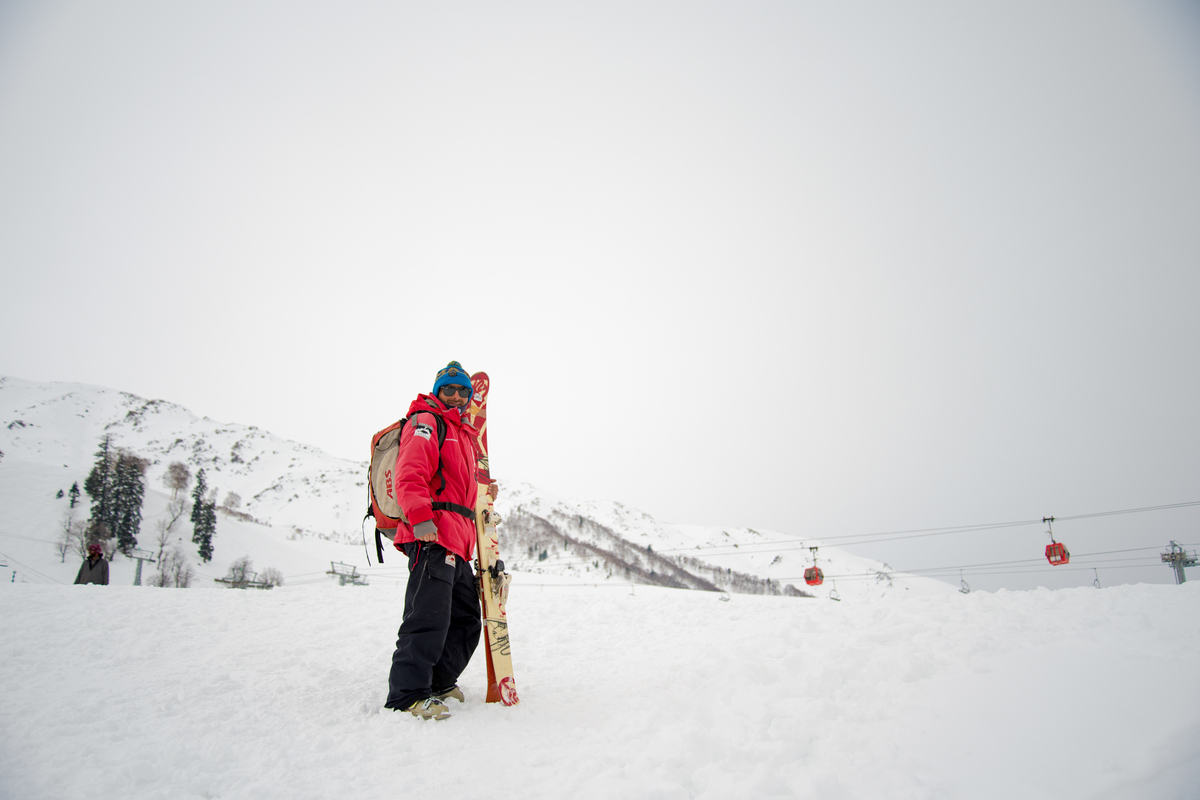

A gondola ferries skiers in Gulmarg.
Lauren Frayer/NPR
hide caption
toggle caption
Lauren Frayer/NPR
“Sometimes, if I’m so angry, I have to take my snowboard and go for a ride — to make myself relax,” Khan says. “When you put your straps on and go for powder run, it makes you [feel] like you are flying! You didn’t think about anything. You are just flying in the air.”
It’s a welcome distraction from Kashmir’s conflict, he says — if only for two months a year.
NPR producer Furkan Latif Khan contributed to this report.
There's Word Of Another Record-Shattering Baseball Deal In The Works

The Los Angeles Angels reportedly are very close to signing Mike Trout to a record breaking 12-year, $430 million deal.
Health Plans For State Employees Use Medicare's Hammer On Hospital Bills


The new strategy of some health plans for state employees is to pay hospitals a certain percentage above the basic Medicare reimbursement rate. It allows hospitals a small profit, the states say, while reducing costs to states and patients.
shapecharge/Getty Images
hide caption
toggle caption
shapecharge/Getty Images
States. They’re just as perplexed as the rest of us over the ever-rising cost of health care premiums.
Now some states –including Montana, North Carolina and Oregon — are moving to control costs of state employee health plans. Their strategy: Use Medicare reimbursement rates to recalibrate how they pay hospitals. If the gamble pays off, more private-sector employers could start doing the same thing.
“Government workers will get it first, then everyone else will see the savings and demand it,” says Glenn Melnick, a hospital finance expert and professor at the University of Southern California. “This is the camel’s nose. It will just grow and grow.”
In North Carolina, for instance, state Treasurer Dale Folwell next year plans to start paying most hospitals Medicare rates plus 82 percent — a figure he says would provide for a modest profit margin while saving the state more than $258 million annually.
“State workers can’t afford the family premium [and other costs],” he says. That’s what I’m trying to fix.” The estimated $60 million in savings to health plan members, he says, would mainly come from savings in out-of-pocket costs.
That approach differs from the traditional method of behind-the-scenes negotiating, in which employers or insurers ask for discounts off hospital-set charges that rise every year and generally are many times the actual cost of a service. Payments from private-insurers, even with those discounts, can be double or triple what Medicare would pay.
This state-level activity could be a game changer, fueling a broad movement toward lower payments to hospitals. Montana’s state employee program made the adjustment two years ago; Oregon will start this fall. Delaware’s state employee program is also considering such “Medicare-based contracting” as one of several options to lower spending.
The bold move comes as other factors — notably marketplace competition among hospitals, and high-deductible insurance plans aimed at getting consumers to “shop” for lower prices — have largely failed to slow rising health care premiums.
For hospitals, though, it can be viewed as “an existential threat,” says USC’s Melnick.
Indeed, the treasurer’s plan in North Carolina has drawn heated opposition, with a hospital industry-associated group running television ads that warn of dire financial consequences, especially for rural hospitals. When the plan first came out, the state’s hospital association complained it would reduce hospital revenue statewide by an estimated $460 million.
Hospitals in areas with large concentrations of state workers “would be getting reimbursed less than the cost of care,” says Cody Hand, the association’s senior vice president and deputy general counsel.
“Our biggest concern is this is not something that we were at the table for in discussion,” he says.
Rural hospitals are particularly at risk, Hand says, because many were already teetering on the brink financially and the payment change would be an additional problem.
After months of acrimony, the North Carolina treasurer in mid-March agreed to grant a 20 percent boost in payment to rural hospitals that would give those hospitals an additional $52 million a year. On average, rural hospitals would be paid 218 percent of the Medicare rate.
Nationwide, hospitals have long complained that Medicare underpays them, and some hospital and business groups have warned employers that tying payments from state workers’ plans more closely to Medicare could result in higher charges to private-sector businesses.
“The result will be a cost shift of tens of millions of dollars to other Oregonians,” wrote the Oregon Association of Hospitals and Health Systems as lawmakers there debated a plan (that eventually became law) paying hospitals 200 percent of Medicare rates.
But policy experts are skeptical.
“Even if Medicare pays a bit below cost, 177 percent of Medicare should be at least 50 percent above cost,” says Mark Hall, director of the health law and policy program at Wake Forest University. “Is that a reasonable margin? I guess that’s up for debate, but to most people a 50 percent margin might sound reasonable.”
Another concern some people have raised is that hospitals might refuse to join networks that employ these states’ Medicare-based strategy.
Indeed, Montana officials worked hard to get all hospitals in the state to agree to accept for the state worker program an average of 234 percent of Medicare’s reimbursement rates. A few hospitals held out, right up to the deadline, backing down only after pressure from employee unions.
The risk if hospitals opt to remain out-of-network is that workers could be balance billed for the difference between those Medicare-plus rates and their generally much higher charges — amounts that could be hundreds or even thousands of dollars.
To prevent that, Oregon lawmakers set the law’s in-network reimbursement for hospitals at 200 percent of Medicare’s reimbursement rates. But, those that opt out would receive only 185 percent.
The measure also bars hospitals from billing state workers for the difference between those amounts and the higher rates they might like to charge.
“Oregon thought it through,” says Gerard Anderson, a professor at Johns Hopkins who researches health care costs.
“Hospitals need to go on a diet,” adds Anderson. “The private sector has not put them on a diet, but maybe the state employee plans will.”
Meanwhile, in the private sector …
For decades, health insurance costs for employers and workers have risen faster than inflation, despite various efforts to rein them in.
Currently, a typical family plan offered by employers tops $19,000 a year in premiums, while the price tag for a single employee is close to $7,000.
To be sure, hospital costs make up just one part of what premiums cover, along with doctor costs, drug payments and other services. Spending on hospital care accounts for about one-third of the nation’s $3.5 trillion health care tab.
“Health care is just becoming unaffordable,” says Cheryl DeMars, president and CEO of The Alliance, a group of 240 self-insured employers in the private sector that directly contract with hospitals in Wisconsin, northern Illinois and eastern Iowa.
In January, The Alliance began what it calls “Medicare-plus” contracting. As new hospitals join and existing contracts come up for renewal, the group is negotiating rates, basing them on what Medicare pays, DeMars says.
And it will likely save money: Under its old method of paying, the group was forking out between 200 percent and 350 percent of Medicare for inpatient and outpatient hospital services in its network. Two new contracts have been signed so far, averaging 200 percent of Medicare across inpatient, outpatient and physician payments, according to The Alliance.
“We want to pay a fair price and we’re in the process of determining what that should be,” says Kyle Monroe, vice president of network development for The Alliance. “Is it 200 percent? Is it something less?”
Under traditional payment methods, the negotiated prices insurers for public- and private-sector employers pay for hospital care vary widely — by facility, treatment and insurer. But they’re generally above Medicare rates by a substantial margin.
A group of self-insured employers recently commissioned Rand to study what private insurers pay hospitals in 22 states, compared with Medicare rates.
Initial results found private employers were paying, on average, 229 percent of Medicare rates to hospitals across the states in 2017, according to Chapin White, an adjunct senior policy researcher at Rand who conducted the study.
Economists like Melnick say they would prefer that market competition — consumers voting with their feet, so to speak — would drive business to the highest-quality, lowest-cost providers.
But, so far, hospitals have held the line against this scenario and that’s not likely to change. “They’re going to fight like crazy,” Melnick says.
Kaiser Health News is a nonprofit news service and editorially independent program of the Kaiser Family Foundation. It’s not affiliated with Kaiser Permanente.
Mike Trout To Finalize $430 Million Contract With Los Angeles Angels
Mike Trout and the Los Angeles Angels are finalizing a $430 million contract, the largest in professional sports history. NPR’s Mary Louise Kelly speaks with Jonah Keri of The Athletic.
'Mother Jones' Investigation Takes A Look At The World Of Drug Treatment Programs
NPR’s Ailsa Chang talks with Mother Jones reporter Julia Lurie about the loosely regulated rehab industry, and how it shuffles people in and out of treatment programs and cashes in on insurance money.
Alt.Latino's SXSW 2019 Wrap-Up


The Cuban band Cimafunk performs onstage for NPR’s Alt.Latino showcase during SXSW 2019.
Hutton Supancic/Getty Images for SXSW
hide caption
toggle caption
Hutton Supancic/Getty Images for SXSW
I struggled to balance the conflicting emotions of enjoying the musical celebration that is the annual SXSW Festival with the pain of the devastating loss of life in Friday’s terrorist attack in New Zealand. It was an emotional push and pull that I kept completely to myself.
But as I reflected back on the week of interviews and performances I was reminded that many of the musicians I cover on this beat often include messages in their music about respect and dignity for people who are different. They lend their musical gifts to movements that fight for social justice in their home countries. And as I reported on NPR’s All Things Considered, sometimes they put themselves in danger by refusing to be silenced.
It was a reminder that what happens in Austin every year can be much more than a bunch of bands looking for their next big break. It’s really a celebration of the freedom of expression. For some bands, the members are indeed looking for their next big break so they can carry their messages of social justice and inclusion even further.
I left Austin grieving but also comforted by the fact that music can indeed challenge and change the world we live in. I’m thankful that it’s my job to help spread that healing energy. Join AltLatino contributors Marisa Arbona- Ruiz and Catalina Maria Johnson and I this week as we retrace which bands gave us joy and also inspired us.
Aspiring Doctors Seek Advanced Training In Addiction Medicine

Dr. Hillary Tamar, who’s in the second year of her family medicine residency in Phoenix, is part of a new generation of doctors who are committed to treating addiction.
Jackie Hai/KJZZ
hide caption
toggle caption
Jackie Hai/KJZZ
The U.S. surgeon general’s office estimates that more than 20 million people have a substance-use disorder. Meanwhile, the nation’s drug overdose crisis shows no sign of slowing.
Yet, by all accounts, there aren’t nearly enough physicians who specialize in treating addiction — doctors with extensive clinical training who are board certified in addiction medicine.
The opioid epidemic has made this doctor deficit painfully apparent. And it’s spurring medical institutions across the United States to create fellowships for aspiring doctors who want to treat substance-use disorders with the same precision and science as other diseases.
Now numbering more than 60, these fellowship programs offer physicians a year or two of postgraduate training in clinics and hospitals where they learn evidence-based approaches for treating addiction.
Such programs are drawing a new talented generation of idealistic doctors — idealists like Dr. Hillary Tamar.
A drive to connect with patients in need
Tamar, now in the second year of a family medicine residency in Phoenix, wasn’t thinking about addiction medicine when she started medical school in Chicago.
“As a medical student, honestly, you do your ER rotation, people label a patient as ‘pain-seeking’ and it’s bad,” Tamar says. “And that’s all you do about it.”
But in her fourth year of med school, she happened to be assigned to a rotation at a rehab facility in southern Arizona.
“I was able to connect with people in a way that I haven’t been able to connect with them in another specialty,” the 28-year-old recalls.
Working with patients there transformed Tamar’s understanding of addiction, she says, and showed her the potential for doctors to change lives.
“They can go from spending all their time pursuing the acquisition of a substance to being brothers, sisters, daughters [and] fathers making breakfast for their kids again,” she says. “It’s really powerful.”
When Tamar finishes her residency, she’s planning to pursue a fellowship in addiction medicine. She sees addiction medicine, like primary care, as a way to build lasting relationships with patients — and a way to focus on more than a single diagnosis.
“I love when I see addiction patients on my schedule, even if they’re pregnant and on meth,” she says. “More room to do good — it’s exciting.”
Doctors with Tamar’s enthusiasm are sorely needed, says Dr. Anna Lembke, medical director of addiction medicine at Stanford University School of Medicine and a longtime researcher in the field.
“Even 10 years ago,” Lembke says, “I couldn’t find a medical student or resident interested in learning about addiction medicine if I looked under a rock. They were just not out there.”
But Lembke sees a change in the upcoming generation of doctors who are drawn to the field because they care about social justice.
“I now have medical students and residents knocking on my door, emailing me. They all want to learn more about addiction,” Lembke says.
Historically, the path to addiction medicine was through psychiatry.
But that model started to change in 2015, when the American Board of Medical Specialties — considered the gold standard in physician certification in the U.S. — recognized addiction medicine as a bona fide subspecialty and opened up the training to physicians from many other medical fields.
Until then, Lembke says, there had been no way to get addiction fellowships approved through the nationally recognized Accreditation Council for Graduate Medical Education. And that made recruiting young talent — and securing funding for their fellowships — difficult.
Last year, ACGME began accrediting its first batch of addiction medicine fellowship programs.
“We have got an enormous gap between the need and the doctors available to provide that treatment,” Lembke says.
“At least the medical community has begun to wake up to consider not only their role in triggering this opioid epidemic but also the ways they need to step up to solve the problem,” she says.
Build a program, and they will come
When Dr. Luke Peterson finished his residency in family medicine in Phoenix in 2016, there were no addiction medicine fellowships in Arizona.
So he moved to Seattle to complete a yearlong fellowship at Swedish Cherry Hill Family Medicine Residency. There he learned, among other things, how to treat pregnant women who are in recovery from drug use.
“I really needed to do a fellowship if I was going to make an impact and be able to teach others to make the same impact,” says Peterson, who went on to help found an addiction medicine fellowship program in Arizona. His program is based in Phoenix at the University of Arizona’s medical school, and its teaching hospital run by Banner Health, and the Phoenix VA Health Care System.
Arizona’s two addiction medicine fellowship programs received ACGME accreditation last year — a stamp of approval that made the programs desirable choices for up-and-coming physicians, Peterson says.
Not every doctor who plans to treat substance-use disorders needs to do a fellowship, he says. In fact, his goal is to integrate addiction medicine into primary care settings.
But a specialist can serve as a referral center and resource hub for community doctors.
For example, physicians can learn from a specialist such as Peterson how to provide medication-assisted treatment like buprenorphine.
Public health leaders have been pushing to get more physicians trained in evidence-based treatments like buprenorphine, which has been shown to reduce the risk of death among people who have recovered from an opioid overdose.
“As we provide more education and more support to primary care physicians, they will feel more comfortable screening and treating for addiction,” Peterson says.
Peterson’s own journey into addiction medicine began during a rotation with a family doctor in rural Illinois.
“In moments that most doctors find uncomfortable — maybe a patient comes in to request pain medication and you’re seeing the negative side effects — he did not shy away from that situation,” Peterson says. “He addressed it head-on.”
It was a formative experience for Peterson — one he wants other young doctors to have. And he recognizes the urgency.
“In 20 or 30 years from now,” Peterson says, “those medical students are going to look back at my current generation of doctors, and we will be judged by how we responded to this epidemic,” in the same way he and his peers now look back at how doctors handled the HIV epidemic.
One of the first steps in stopping the epidemic, he says, is making sure there are enough doctors on the ground who know how to respond.
Many of today’s medical students, people like Michelle Peterson (no relation to Luke), say they feel the calling too.
She’s in her first year at the University of Arizona College of Medicine in Phoenix and became interested in addiction after working at an outpatient treatment center.

Michelle Peterson, a medical student in Phoenix, says she already knows she wants to be an addiction medicine specialist — and a resource to primary care doctors.
Will Stone/KJZZ
hide caption
toggle caption
Will Stone/KJZZ
She says she’s already learning about addiction in her classes, hearing from doctors in the field and seeing other classmates equally engaged.
“It’s definitely not just me,” she says. “There are quite a few people here really interested in addiction.”
It’s a trend she and her mentors hope will continue.
This story is part of NPR’s reporting partnership with KJZZ and Kaiser Health News, an editorially independent news service of the Kaiser Family Foundation that is not affiliated with Kaiser Permanente.
Head Of Japan's Olympic Committee Steps Down Amid Tokyo 2020 Corruption Probe


Japan’s Olympic Committee President Tsunekazu Takeda said Tuesday that he will step down in June, as French authorities probe his involvement in payments made before Tokyo was awarded the 2020 Summer Games.
Charly Triballeau/AFP/Getty Images
hide caption
toggle caption
Charly Triballeau/AFP/Getty Images
The president of the Japanese Olympic Committee said he will step down amid allegations of corruption into the successful bid for Tokyo to host the 2020 Olympics.
Tsunekazu Takeda, 71, is a former Olympic equestrian jumper who competed at the 1972 and 1976 Olympics. He is also the chair of the International Olympic Committee’s Marketing Commission.
He maintains his innocence and intends to serve out the rest of his 10th term as president, resigning in June. He’ll also step down from the IOC.
“I don’t believe I’ve done anything illegal,” Takeda said at a news conference Tuesday, according to Reuters. Asked why he didn’t step aside now, he said, “It pains me to have created such a fuss, but I believe it is my responsibility to serve out the rest of my term.”
Takeda was president of the Tokyo bid committee that clinched the 2020 Games in an IOC vote in 2013, beating out Istanbul and Madrid — a bid that is now under investigation.
As The New York Times reports, French prosecutors suspect the Tokyo bid committee of paying bribes to African Olympic committee members to win votes:
“Payments in connection with the process to Papa Massata Diack, a former marketing official from the International Association of Athletics Federations, first raised suspicions among French prosecutors about the decision.
“The French authorities had previously sought to extradite Mr. Diack from his home in Senegal on charges that he helped manipulate the awarding of the 2016 Summer Olympics to Rio de Janeiro. Mr. Diack has said that racism and jealousy are behind the allegations.
“In 2016, French prosecutors said that the Tokyo bidding committee had made more than $2 million in payments to Black Tidings, a Singaporean company run by a close friend of Mr. Diack’s. The Japanese authorities have since questioned Mr. Takeda about his role in the payments and concluded that they were for consulting work. The Japanese Olympic Committee maintains the payments were legitimate.”
The Games begin in less than than 500 days, and Japan is spending some $25 billion to stage them. “I want to step aside to make room for the younger generation to step up and lead the way,” Takeda said. “In June, I will step down as the JOC president so that the tournament can be held in peace.”
Japan has framed the 2020 Games as an emblem of the country’s resurgence, as NPR’s Bill Chappell reported at the time of the winning bid: “Tokyo officials also promoted their city’s bid as symbolizing a new chapter for Japan, which is still recuperating from the tsunami and earthquake that devastated swaths of the country in 2011. Organizers have said they plan to have Olympic torchbearers run through areas hit by the tsunami.”
In December, IOC President Thomas Bach praised Tokyo, saying he could not remember a host city that was so well-prepared to host the Games. But that preparation comes at a price: The Tokyo Games will likely cost three times what organizers predicted in 2013.
Takeda is a distant member of the Japanese royal family, the AP notes, “the great grandson of the Meiji emperor who ruled late in the 19th century and into the 20th.”