CBO: Repealing Health Coverage Mandate Would Save $338 Billion

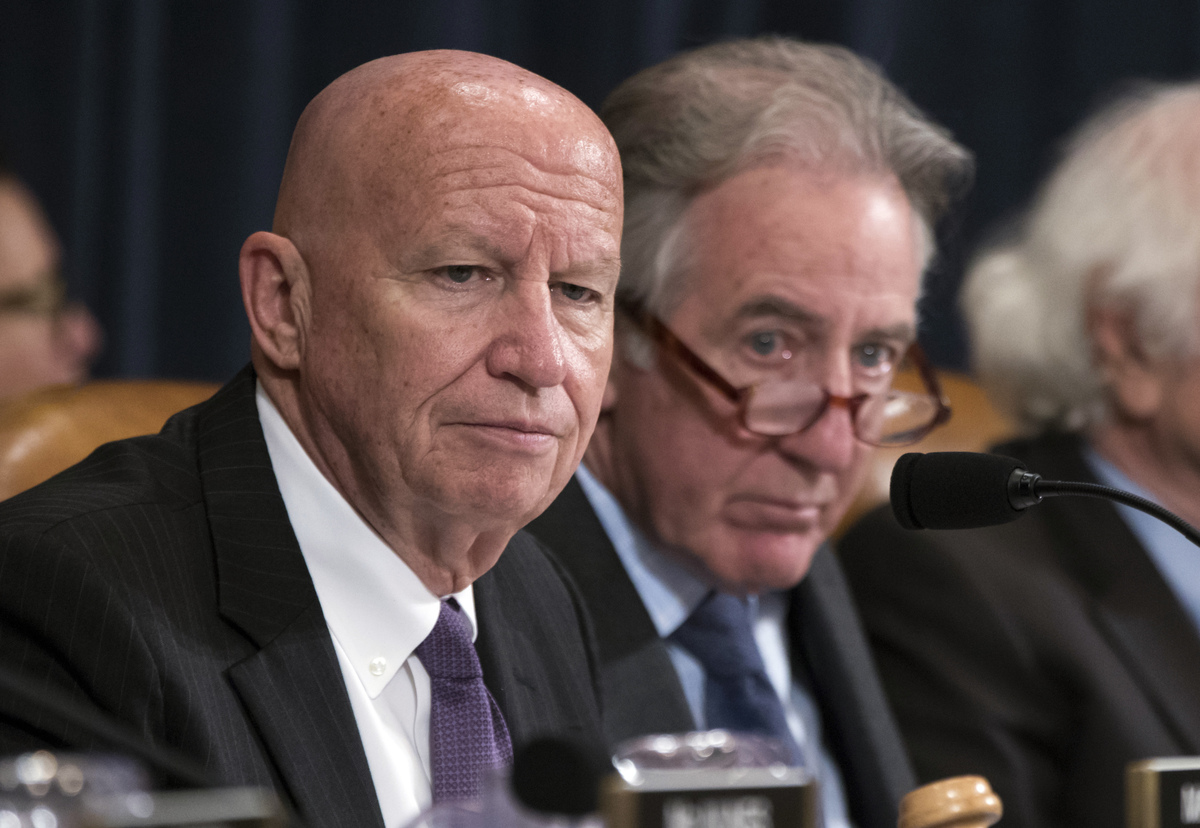
House Ways and Means Committee Chairman Kevin Brady, R-Texas, and Rep. Richard Neal, D-Mass., listen to debate on tax reform on Wednesday.
J. Scott Applewhite/AP
hide caption
toggle caption
J. Scott Applewhite/AP
Getting rid of the requirement that everyone in the country have health insurance coverage would save the government $338 billion over the next decade, according to a Congressional Budget Office analysis released Wednesday.
But that savings would come with 13 million fewer people having insurance coverage by 2027, CBO analysts say. Some of those people would not want to buy insurance, but others couldn’t afford it. The CBO also predicts that average premiums would be 10 percent higher in most years than they would be under current law.
Wouldn’t it be great to Repeal the very unfair and unpopular Individual Mandate in ObamaCare and use those savings for further Tax Cuts…..
— Donald J. Trump (@realDonaldTrump) November 1, 2017
House Republicans are toying with the idea of repealing the so-called individual mandate — a key part of the Affordable Care Act — as part of their plan to overhaul the tax code.
Including the provision could be a win-win for Republicans. The move would allow them to offset more of the tax cuts they want in their tax plan and give them the chance to claim they repealed one of the most hated parts of the Affordable Care Act, also known as Obamacare.
“That depends upon through what prism you look at the issue,” says Chris Jacobs, a health policy analyst at Juniper Research Group. “As a matter of tax policy, including $338 billion in additional revenue to pay for tax reform is a positive outcome. But as a matter of health policy, repealing the mandate without repealing any of Obamacare’s insurance regulations will raise premiums.”
House Speaker Paul Ryan has said repeatedly that one of his goals in repealing the Affordable Care is to make insurance cheaper and give people more choices.
President Trump has pressed lawmakers to include the repeal of the individual mandate in the tax overhaul plan. He took to Twitter on Nov. 1 and mused that it would be “great to Repeal the very unfair and unpopular Individual Mandate in ObamaCare.”
But on Monday, House Ways and Means Committee Chairman Kevin Brady said he is not inclined to add health care policies to the tax bill.
The new CBO report is an update of an estimate from last December that concluded that repealing the individual mandate would cut the deficit by about $416 billion over 10 years.
After Maine Voters Approve Medicaid Expansion, Governor Raises Objections

Rosemary Warnock, a registered nurse at Maine Health, exits the Merrill Auditorium voting station in Portland, Maine, early Tuesday. She said she was motivated to vote for Medicaid expansion.
Ben McCanna/Press Herald via Getty Images
hide caption
toggle caption
Ben McCanna/Press Herald via Getty Images
Just hours after Maine voters became the first in the nation to use the ballot box to expand Medicaid under the Affordable Care Act, Republican Gov. Paul LePage said he wouldn’t implement it unless the Legislature funds the state’s share of an expansion.
“Give me the money and I will enforce the referendum,” LePage said. Unless the Legislature fully funds the expansion — without raising taxes or using the state’s rainy day fund – he said he wouldn’t implement it.
LePage has long been a staunch opponent of Medicaid expansion. The Maine Legislature has passed bills to expand the insurance program five times since 2013, but the governor has vetoed each one.
That track record prompted Robyn Merrill, co-chair of the coalition Mainers for Health Care, to take the matter directly to voters on Tuesday.
The strategy worked. Medicaid expansion, or Question 2, passed handily, with 59 percent of voters in favor and 41 percent against.
“Maine is sending a strong and weighty message to politicians in Augusta, and across the country,” Merrill said. “We need more affordable health care, not less.”
Medicaid expansion would bring health coverage to about 70,000 people in Maine.
As a battle now brews over implementation in Maine, other states will likely be watching: groups in Idaho and Utah are trying to put Medicaid expansion on their state ballots next year.
With passage of the ballot measure, Maine is poised to join the 31 states and the District of Columbia that have already expanded Medicaid to cover adults with incomes up to 138 percent of the federal poverty level. That’s about $16,000 dollars for an individual, and about $34,000 for a family of four.
Currently, people in Maine who make too much for traditional Medicaid and who aren’t eligible for subsidized health insurance on the federal marketplace fall into a coverage gap. It was created when the Supreme Court made Medicaid expansion under the Affordable Care Act optional.
That’s the situation Kathleen Phelps finds herself in. She’s a hairdresser from Waterville who has emphysema and chronic obstructive pulmonary disease. She says she has had to forgo her medications and oxygen because she can’t afford them. “Finally, finally, maybe people now people like myself can get the healthcare we need,” she said.
Medicaid expansion would also be a win for hospitals. More than half of them in Maine are operating in the red. Across the state, they provide more than $100 million a year in charity care, according to the Maine Hospital Association. Expanding Medicaid coverage will bolster their fiscal health and give doctors and nurses more options to treat their formerly uninsured patients, says Jeff Austin, a spokesman with the association.
“There are just avenues of care that open up when you see a patient from recommending a prescription drug or seeing a counselor,” he said. “Doors that were closed previously will now be open.”
But voter approval may not be enough. Though a legislative budget analysis office estimates Medicaid expansion would bring about $500 million in federal funding to Maine each per year, it would also cost the state about $50 million a year.
The fate of the Medicaid expansion will now be in the hands of the legislature, where lawmakers can change it like any other bill. Four ballot initiatives passed by Maine voters last year have been delayed, altered or overturned.
But state Democratic leaders pledge to implement the measure. “Any attempts to illegally delay or subvert the law … will be fought with every recourse at our disposal,” Speaker of the House Sara Gideon said. “Mainers demanded affordable access to health care yesterday, and that is exactly what we intend to deliver.”
This story is part of a reporting partnership with NPR, local member stations and Kaiser Health News. Follow @PattyWight on Twitter
You Can Get Your DNA Tested At An NFL Game. Should You?

The Boston-based company Orig3n has been offering free genetic testing at pro sports games.
Douglas Levy for NPR
hide caption
toggle caption
Douglas Levy for NPR
Depending on who you ask, finding out whether your genes make you a better athlete or give you healthier skin may be as easy as swabbing your cheeks for a DNA test on your way into a football game. But others say these “wellness” tests marketed directly to consumers are modern snake oil – worthless, or even misleading.
On Monday, the Food and Drug Administration gave a boost to direct-to-consumer genetic testing, when it announced plans to streamline its approval process.
“These tests can prompt consumers to be more engaged in pursuing the benefits of healthy lifestyle choices and more aware of their health risks,” said FDA Commissioner Scott Gottlieb in a statement. However, he continued, “They’re not without their own risks – especially if they provide consumers with incorrect or misleading information that may be used to make health choices without considering the advice of a medical professional.”
The FDA intends to let sellers of direct-to-consumer DNA test kits seek a one-time FDA review, which would allow subsequent tests to be sold without going first to the FDA for approval. Under present rules, each new health test must be submitted and reviewed. FDA’s jurisdiction applies to tests used to assess or diagnose health.
But a company in Boston is finding out that mass marketing of DNA tests attracts not just customers and fans, but skeptics and regulators. Orig3n, which sells genetic test kits with catchy names like “Fitcode,” “Fuel,” and “Bliss” at festivals and sporting events, now finds itself under scrutiny by state and federal officials.
“The California Department of Public Health is investigating the nature and distribution of these test kits by Orig3n at Levi’s Stadium in Santa Clara,” a department representative said in an email.
At every home game during the current season, the company has a booth where it offers free introductory DNA test kits to the 68,000 fans entering the stadium. Fans can also purchase other tests at prices ranging from $29 to $149 each. It has a similar relationship with the Baltimore Ravens, but a plan to give test kits to every fan entering a September game was called off after Maryland regulators had some questions.
“I want people to learn more about themselves, and what they choose to do with that information is really up to them,” says Orig3n co-founder and chief operating officer Kate Blanchard. “But some of the information can really impact the way they live their life.”
That is precisely the problem, and it’s why state and federal regulators have said that “information” tests like Origi3n’s should be regulated as medical tests, because they’re assessing a person’s health. It’s a complex question, as FDA’s Gottlieb notes. “Consider the consequences of a person who is told they’re not at risk for coronary heart disease and incorrectly opts to forgo dietary changes or drugs that reduce their risk of heart attack and death,” he says.
Driving the issue is that – as much as genetic science has advanced, scientists do not fully understand how the more than 50 million known genetic variations interact with each other or with lifestyle and other factors to affect someone’s health, wellness or behavior. Very few genes are as closely associated with a specific outcome as the breast cancer genes BRCA1 and BRCA2, and even a positive test for these cancer-associated genes is insufficient for doctors to advise patients to have surgery or other major treatments.
In other words, you can get a test that tells you what variations you have, but that test alone cannot predict your future or dictate specific health or lifestyle decisions. Skeptics worry that people will read too much into genetic test results, especially if they are done without the help of a medical professional.
Blanchard says she stepped up her personal training regimen after her DNA test indicated that she might perform well in endurance sports. She says it was a change she might not have made without this information.
Distributing DNA tests to tens of thousands of people at NFL football games “is not good clinical practice,” says Peter Pitts, president of the advocacy group Center for Medicine in the Public Interest. Unlike tests done in clinical laboratories, like tests for diabetes or cholesterol, there is less control over the quality of the test process, so the resulting data may be “highly questionable,” says Pitts, who is a former associate commissioner of the Food and Drug Administration.
Now, you can get a nutrition plan and ready-to-eat meals based on “your body’s unique make-up” from Campbell’s Soup-funded Habit. Ancestry sells a test that “tells a more complete story of you,” and Helix promotes more than a dozen of its partners who sell genetic tests ranging from National Geographic (your ancestor’s migration paths,) to companies that offer targeted fitness routines based on the DNA results, and several health companies. There is even a wine club with wines “scientifically selected based on your DNA.”
“We don’t begrudge the excitement and the desire to help people based on genetics,” says Shirley Wu, director of product science for 23andMe, a direct-to-consumer genetic testing company that started in 2006. However, she questions companies that may be overpromising on what the tests can tell you. The science behind some consumer-oriented tests is lacking, says Wu. “We are still at the beginning of our understanding.”
The FDA halted 23andMe’s sales of medical-risk tests in 2013, saying that it couldn’t prove those tests were accurate. In April, 23andMe obtained federal clearance to resume selling direct-to-consumer DNA tests for certain health risks. Now, consumers can get reports on their ancestry as well as genes associated with sleep quality, lactose sensitivity, weight and other wellness factors and risks for several dozen inherited conditions for about $200.
And companies can offer very different information on the same finding. That’s evident in two reports on the CC variant of the ACTN3 gene:
- 23andMe tells you that you have a trait “common among elite power athletes … but its role for non-elite athletes isn’t completely understood.” The report also says that lifestyle and training are the driver of athletic performance for most people.
- Orig3n also tells you that this trait is common in elite athletes and “is found in 45 percent of the general population.” And it “contributes to your ability to perform better in sports requiring power such as sprinting.” The Orig3n report recommends the types of sports that someone with this biomarker might want to pursue.
A 2015 review of genetic testing for sports concluded that there is little value to knowing the ACTN3 or other variants in recreational athletes. However, genetic testing of professional athletes may be useful for training and injury prevention, the review authors concluded.
“For the most part, data on personal genomic testing have revealed little or no harms but also little or no health benefits,” writes Dr. Muin Khoury, director of the Office of Public Health Genomics at the Centers for Disease Control and Prevention in a recent article. “Also, evidence on the ability of genetic information to change health behavior has been lacking.”
Blanchard says that Orig3n got the idea for its fitness DNA test after it solicited blood samples for research at marathons and other sporting events. “People started asking, ‘What can you tell me about me?’ ” she says.
The business model for 23andMe, Helix, and some of the other direct-to-consumer DNA testing firm doesn’t rely solely on sales of test kits. They want to aggregate massive amounts of human genetic data that can be mined for research and commercial uses. Consumers are asked to “opt-in” to this when getting tested — and most do, according to 23andMe.
Orig3n is an exception: It says it would contact people separately if it ever wanted to use the DNA for anything other than the person’s own tests. But those test kits attract people to give blood samples for Orig3n’s stem cell research. Its business banks on amassing tens of thousands of human blood samples so that it can create many stem cell lines.
Orig3n has sponsorship arrangements with the Baltimore Ravens and the San Francisco 49ers football teams. Fans at home games can get a free test that reports on three genes — ACTN3 for muscle force, FOXP2 for language-learning ability and AGER for skin aging. For $149, Orig3n reports back on 27 genes related to strength, metabolism, endurance and power. The company’s other tests are to provide information about genes associated with skin, child development, and how you think, feel and react.
Orig3n says its tests are “not diagnostic” and “for informational purposes only.” The federal agency that oversees medical labs disagrees. That distinction is critical because it is the boundary between regulated medical services and ones that avoid that level of scrutiny.
After reviewing Orig3n’s materials, the Centers for Medicare and Medicaid Services told the company on Oct. 30 that it must follow the rules for medical laboratories because its services include “genetic testing for the assessment of health.”
The decision was based on 18 of the 140 genes included in Orig3n’s tests, according to a letter from CMS to Orig3n.
Orig3n’s Blanchard says the company will continue selling its tests without those 18 genes until Orig3n receives approval from regulators to resume. In addition to CMS, Orig3n must satisfy state regulators in Massachusetts, Maryland and California – or any other states where it operates. “Going forward, we will continue to work with CMS, California, Massachusetts and the other states to ensure that we are meeting all federal and state regulatory requirements regarding our products,” Blanchard said in an email.
That may not be enough to satisfy all the critics. Says Pitts: “Giving out DNA kits at a football game screams out for regulation.”
Doug Levy is a freelance writer based in Sausalito, Calif.
Maine Voters Will Decide If They Want More Access To Medicaid

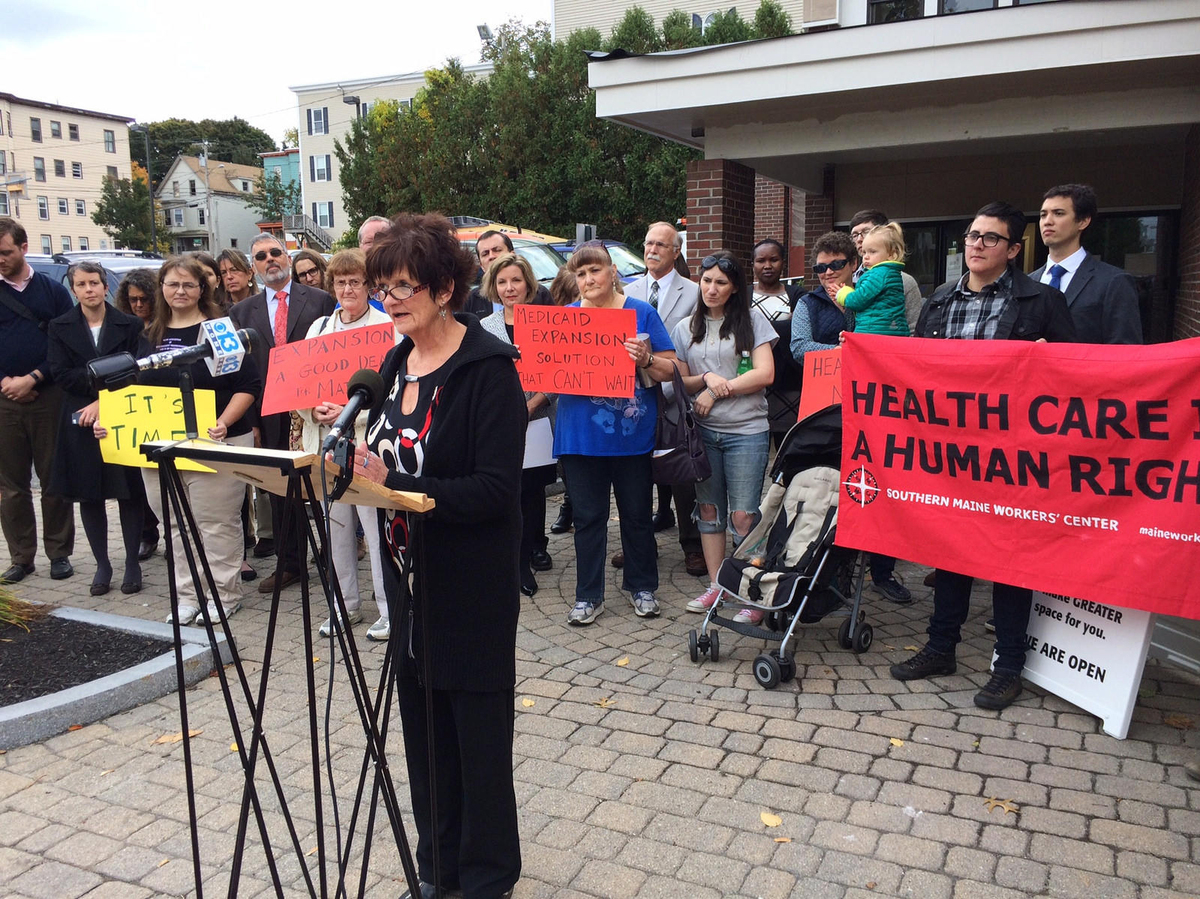
Kathleen Phelps, who lacks health insurance, speaks in favor of expanding Medicaid at a news conference in Portland, Maine on Oct. 13, 2016.
Patty Wight/Maine Public Radio
hide caption
toggle caption
Patty Wight/Maine Public Radio
Maine is one of 19 states that rejected Medicaid expansion through the Affordable Care Act. But on Tuesday, it could be the first to approve it at the ballot box.
Question 2 asks Maine voters if they want to provide roughly 70,000 Mainers with health care coverage by expanding eligibility of Medicaid, known as MaineCare. It provides health coverage for people living at or near the poverty line.
The national battle over Medicaid expansion began with a 2012 U.S. Supreme Court decision that conservatives originally hoped would hobble the Affordable Care Act, President Obama’s signature legislative achievement.
But instead of repealing the law’s individual mandate requiring that most Americans obtain health insurance, the court upheld it. The court then struck down a provision requiring all states to expand eligibility of Medicaid.
That surprise 2012 court ruling shifted the political battle. While the GOP-led House of Representatives would go on to take over 50 symbolic ACA repeal votes, progressive and conservative activists descended on state legislatures to fight over Medicaid expansion.
The intensity of those battles illustrated the importance of Medicaid expansion as a component of the ACA. The program not only lowered the number of people without health insurance it, also has arguably made repealing the health care law harder.
Medicaid funding cuts included in Senate bills to repeal ACA were the primary reason that Sen. Susan Collins, R-Maine, broke ranks with most of the GOP to oppose the bills.
“First, both proposals make sweeping changes and cuts in the Medicaid program. Expert projections show that more than $1 trillion would be taken out of the Medicaid program between the years 2020 and 2036,” she said in September. “This would have a devastating impact to a program that has been on the books for 50 years and provides health care to our most vulnerable citizens, including disabled children and low-income seniors.”
Collins has also cited the impact on Maine’s rural hospitals, which are heavily dependent on Medicaid reimbursement payments.
Effects On The Uninsured
Architects of the federal health care law sought to lower the number of people without health insurance by requiring most Americans to have coverage. The law also lets states expand access to Medicaid, a federal program run by the states and funded with a mix of state and federal money.
In 2013, Maine’s legislature voted to expand the state’s program, and Republican Gov. Paul LePage vetoed the bill. It was the first of a half dozen vetoes.
About 9 percent of Maine residents lacked insurance in 2016, comparable to 8.6 percent in the 31 states and the District of Columbia that expanded Medicaid. That could be because the state had expanded its program in 2002 and 2003.
The number of people enrolled in Medicaid has been dropping, as the LePage administration moved aggressively to restrict eligibility
In 2012, there were 345,000 Mainers receiving Medicaid. There were 268,000 through June of this year, according the Department of Health and Human Services. The state spends $2.6 billion on the program, with two-thirds of that coming from the feds.
Meanwhile, roughly 70,000 Mainers have fallen into what’s known as the ACA coverage gap. The gap occurs in the 19 states that did not expand Medicaid.
The ACA originally conceived Medicaid expansion as a bridge between low-income adults already eligible for Medicaid coverage and those who could qualify for subsidies to purchase their own individual plans.
But without expansion, thousands of Mainers neither qualify for subsidies nor Medicaid.
Most of the 70,000 people who would gain coverage if Question 2 passes earn up to 138 percent of the federal poverty level — about $16,000 a year for an individual and $34,000 for a family of four.
For And Against
Conservative and progressive activists have engaged in a long, pitched fight over Medicaid expansion. The arguments for and against expansion haven’t changed much, and neither have the methods of persuasion.
Conservatives repeatedly note that Maine was an early expander of Medicaid in 2002-2003. They claim that the state’s uninsured rate was unaffected by increasing eligibility and that the program became a budget buster, creating deficits when state revenues declined during the economic downturn.
Progressives counter that early expansion helped keep Maine’s uninsured rate steady while other states saw a surge. Additionally, they argue that the higher federal reimbursement rate offered through the ACA protects the state.
If expansion passes, the federal government will initially cover 94 percent of the cost. That ratchets down to 90 percent by 2020 and stays at that level, as long as Congress doesn’t cut reimbursements.
But Brent Littlefield with the anti-expansion Welfare to Work PAC says there’s still a cost to Maine taxpayers.
“The current plan would have state taxpayers paying between $50 million to $100 million per year,” he says.
The expansion debate has been marked by its heated rhetoric. Opponents have repeatedly called would-be recipients “able bodied,” while calling the proposal “welfare expansion” — descriptions designed to tap sharply divided public perceptions of people receiving public assistance.
Proponents, meanwhile, have been stressing the human impact,focusing on personal stories of those who would benefit from the program.
High Stakes
Question 2 has been billed by some as a final resolution, but it could also be a litmus test for public sentiment about the Affordable Care Act. GOP repeal efforts have not polled well. While the ACA has not been a centerpiece of the proponents’ arguments for expansion, an affirmative expansion vote on Nov. 7 could be spun as a tacit public endorsement for the health care law, because Medicaid is such a key component.
Locally, the political stakes are high. LePage has been a leading critic of expansion, and he’s taking an active role in opposing Question 2. Defeating Question 2 could validate the governor’s stance. Conversely, an affirmative vote could deal a blow to the governor’s full-court press against the law.
But a victory for supporters of Question 2 could be fleeting. The state legislature changed, delayed or attempted to repeal all four of the ballot initiatives that voters approved last year.
Steve Mistler is chief political correspondent for Maine Public Radio.
Maine Voters Will Decide If They Want More Access To Medicaid
Kathleen Phelps, who lacks health insurance, speaks in favor of expanding Medicaid at a news conference in Portland, Maine on Oct. 13, 2016.
Patty Wight/Maine Public Radio
hide caption
toggle caption
Patty Wight/Maine Public Radio
Maine is one of 19 states that rejected Medicaid expansion through the Affordable Care Act. But on Tuesday, it could be the first to approve it at the ballot box.
Question 2 asks Maine voters if they want to provide roughly 70,000 Mainers with health care coverage by expanding eligibility of Medicaid, known as MaineCare. It provides health coverage for people living at or near the poverty line.
The national battle over Medicaid expansion began with a 2012 U.S. Supreme Court decision that conservatives originally hoped would hobble the Affordable Care Act, President Obama’s signature legislative achievement.
But instead of repealing the law’s individual mandate requiring that most Americans obtain health insurance, the court upheld it. The court then struck down a provision requiring all states to expand eligibility of Medicaid.
That surprise 2012 court ruling shifted the political battle. While the GOP-led House of Representatives would go on to take over 50 symbolic ACA repeal votes, progressive and conservative activists descended on state legislatures to fight over Medicaid expansion.
The intensity of those battles illustrated the importance of Medicaid expansion as a component of the ACA. The program not only lowered the number of people without health insurance, it also has arguably made repealing the health care law harder.
Medicaid funding cuts included in Senate bills to repeal ACA were the primary reason that Sen. Susan Collins, R-Maine, broke ranks with most of the GOP to oppose the bills.
“First, both proposals make sweeping changes and cuts in the Medicaid program. Expert projections show that more than $1 trillion would be taken out of the Medicaid program between the years 2020 and 2036,” she said in September. “This would have a devastating impact to a program that has been on the books for 50 years and provides health care to our most vulnerable citizens, including disabled children and low-income seniors.”
Collins has also cited the impact on Maine’s rural hospitals, which are heavily dependent on Medicaid reimbursement payments.
Effects On The Uninsured
Architects of the federal health care law sought to lower the number of people without health insurance by requiring most Americans to have coverage. The law also lets states expand access to Medicaid, a federal program run by the states and funded with a mix of state and federal money.
In 2013, Maine’s legislature voted to expand the state’s program, and Republican Gov. Paul LePage vetoed the bill. It was the first of a half dozen vetoes.
About 9 percent of Maine residents lacked insurance in 2016, comparable to 8.6 percent in the 31 states and the District of Columbia that expanded Medicaid. That could be because the state had expanded its program in 2002 and 2003.
The number of people enrolled in Medicaid has been dropping, as the LePage administration moved aggressively to restrict eligibility
In 2012, there were 345,000 Mainers receiving Medicaid. There were 268,000 through June of this year, according the Department of Health and Human Services. The state spends $2.6 billion on the program, with two-thirds of that coming from the feds.
Meanwhile, roughly 70,000 Mainers have fallen into what’s known as the ACA coverage gap. The gap occurs in the 19 states that did not expand Medicaid.
The ACA originally conceived Medicaid expansion as a bridge between low-income adults already eligible for Medicaid coverage and those who could qualify for subsidies to purchase their own individual plans.
But without expansion, thousands of Mainers neither qualify for subsidies nor Medicaid.
Most of the 70,000 people who would gain coverage if Question 2 passes earn up to 138 percent of the federal poverty level — about $16,000 a year for an individual and $34,000 for a family of four.
For And Against
Conservative and progressive activists have engaged in a long, pitched fight over Medicaid expansion. The arguments for and against expansion haven’t changed much, and neither have the methods of persuasion.
Conservatives repeatedly note that Maine was an early expander of Medicaid in 2002-2003. They claim that the state’s uninsured rate was unaffected by increasing eligibility and that the program became a budget buster, creating deficits when state revenues declined during the economic downturn.
Progressives counter that early expansion helped keep Maine’s uninsured rate steady while other states saw a surge. Additionally, they argue that the higher federal reimbursement rate offered through the ACA protects the state.
If expansion passes, the federal government will initially cover 94 percent of the cost. That ratchets down to 90 percent by 2020 and stays at that level, as long as Congress doesn’t cut reimbursements.
But Brent Littlefield with the anti-expansion Welfare to Work PAC says there’s still a cost to Maine taxpayers.
“The current plan would have state taxpayers paying between $50 million to $100 million per year,” he says.
The expansion debate has been marked by its heated rhetoric. Opponents have repeatedly called would-be recipients “able bodied,” while calling the proposal “welfare expansion” — descriptions designed to tap sharply divided public perceptions of people receiving public assistance.
Proponents, meanwhile, have been stressing the human impact,focusing on personal stories of those who would benefit from the program.
High Stakes
Question 2 has been billed by some as a final resolution, but it could also be a litmus test for public sentiment about the Affordable Care Act. GOP repeal efforts have not polled well. While the ACA has not been a centerpiece of the proponents’ arguments for expansion, an affirmative expansion vote on Nov. 7 could be spun as a tacit public endorsement for the health care law, because Medicaid is such a key component.
Locally, the political stakes are high. LePage has been a leading critic of expansion, and he’s taking an active role in opposing Question 2. Defeating Question 2 could validate the governor’s stance. Conversely, an affirmative vote could deal a blow to the governor’s full-court press against the law.
But a victory for supporters of Question 2 could be fleeting. The state legislature changed, delayed or attempted to repeal all four of the ballot initiatives that voters approved last year.
Steve Mistler is chief political correspondent for Maine Public Radio.
Voters Confused By Ohio's Ballot Question On Drug Prices

When Ohio voters head to the polls Tuesday, they’ll be able to weigh in on a ballot measure that aims to get better drug prices for state programs.
Jay LaPrete/Getty Images
hide caption
toggle caption
Jay LaPrete/Getty Images
Lawmakers in the nation’s capital have yet to grapple with rising drug costs. But in Ohio, voters are being asked by a ballot initiative to consider making a law that would require the state to pay no more for prescription drugs than the federal Department of Veterans Affairs does.
The Drug Price Relief Act, better known as Ohio Issue 2, has been promoted and pilloried in a dizzying crush of robocalls, direct mail and ads on TV and radio.
Opponents say the law would be impossible to implement, could limit patients’ access to medicines and wouldn’t necessarily save money. Proponents are selling the initiative as a form of rebellion that could save millions of dollars in an era of health care anxiety.
And in the run-up to Election Day, voters say it’s difficult to make sense of it all.
Sean Hundley, 30, works at a coffee shop in the trendy Short North neighborhood in Columbus, the state capital. He is covered by Medicaid and said he has seen plenty of advertising from both sides, but he can’t figure out who is telling the truth.
“Everything they say, not knowing who to trust — it would just lead me not to cast a vote,” he said.
This reaction highlights one of the difficulties of asking voters to sort out such a complex issue.
But what Ohio voters decide could have implications well beyond the state’s borders.
In the absence of federal action, some states have begun taking legislative steps to lessen the toll of rising drug costs on their budgets. If Issue 2 passes in Ohio on Tuesday, the ballot-question approach may gain momentum.
Advocates in South Dakota and the District of Columbia are already pushing for similar drug pricing initiatives in the November 2018 election. That is part of the reason why the Ohio initiative has drawn attention and spending from outside the state.
Supporters have raised more than $14 million, with most of that money coming from the California-based AIDS Healthcare Foundation. Opponents, bankrolled by the pharmaceutical industry, have raised $58 million.
People attending a water aerobics class at a suburban Cincinnati gym in September said they had been trying to to figure out how to vote on the ballot initiative. They also said they were fed up with all of the campaign noise.
The exercisers — mostly women of retirement age — even peppered a reporter with questions: Do you understand it? Can you explain it to me?
If enacted, Issue 2 would prohibit state programs, such as Medicaid and state employee health plans, from paying more for a drug than the federal Veterans Health Administration does. The Department of Veterans Affairs receives heavily reduced prices for prescription drugs.
But analysts are divided over whether the approach would work in Ohio or how much budget relief it could provide.
The nonpartisan Ohio Office of Budget and Management said it’s unclear whether the change would actually save any money and, if so, how much.
Supporters include Vermont Sen. Bernie Sanders and Ohio’s former Republican Party chairman Matt Borges. They counter that their calculations indicate savings of about $400 million from lower prices. Those concessions, they say, are why drug companies have spent so much fighting the initiative.
“Our opponents say it’s unworkable or — they’ve created a word — ‘unimplementable.’ We believe it will work,” said Dennis Willard, a spokesman for the Yes on Issue 2 campaign.
Critics worry Issue 2 would be nearly impossible to enforce.
For one thing, the VA’s final discounts are deemed proprietary and are kept secret. For another, it’s unclear which state agencies would be included under the initiative.
In addition, the state’s Medicaid program already receives discounts from drug companies. Unlike the VA, though, federal law requires it to cover the vast majority of drugs, making price negotiation more difficult. The VA runs a tight preferred list of drugs, paying for some and not others.
“You can’t get the VA prices if you don’t do VA things,” said Dr. Walid Gellad, co-director of the Center for Pharmaceutical Policy and Prescribing at the University of Pittsburgh. “To just say, ‘We’re not going to pay more than the VA’ is difficult.”
But those are nuances that are tough to explain in a radio spot or on a mailed flyer.
The dueling media blitz is leaving many Ohio voters at a loss.
Take Barbara Herr, a 64-year-old paralegal. She is a lifelong Democrat, she said, and in some ways is the issue’s target voter: a self-described political junkie who voted for Sanders in his presidential campaign for the Democratic nomination.
She has a shellfish allergy, so she carries an EpiPen — a medication whose price hikes sparked national scorn and a congressional inquiry. Even though the ballot question would not likely directly affect her medication spending, she thinks prescription drug pricing is a “grave concern” and must be addressed.
So far, though, she is a likely “no” vote.
“It just is very confusing,” Herr said, reflecting on her impending Election Day decision. “I have read quite a bit about it, and I don’t think it achieves much of anything.”
Kaiser Health News, a nonprofit health newsroom whose stories appear in news outlets nationwide, is an editorially independent part of the Kaiser Family Foundation.
How To Shop For A Plan In The ACA Marketplace

Last week marked the beginning of open enrollment on the healthcare exchanges set up under the Affordable Care Act. It’s the first time they’ve been open under the Trump administration.
LULU GARCIA-NAVARRO, HOST:
It’s enrollment time for Affordable Care Act health insurance, but you may not know it because the Trump administration isn’t doing much to encourage people to sign up for coverage. Critics say the president’s actions are even making health insurance more expensive and harder to get. But despite the headlines, many people may still be able to get affordable insurance on the exchanges. Joining us now is NPR health policy correspondent Alison Kodjak to discuss what’s happening in the Obamacare marketplaces and how to shop for a plan. Hey, Alison.
ALISON KODJAK, BYLINE: Hi, Lulu.
GARCIA-NAVARRO: All right. Open enrollment started last week. What are the biggest differences between this year’s sign-up period and last year’s?
KODJAK: So the biggest difference people are going to see is that this year’s sign-up period is much shorter. It’s only six weeks long, which is half as long as last year. So if you’re buying insurance on the federal exchange, healthcare.gov, you have to pick it out before December 15. The other thing is there’s no advertising, no television advertising from the government. Last year, they spent a lot of money trying to get people to know what’s going on and to sign up. And there’s also fewer navigators. These are the people who are out there who are certified and trained to help people choose an insurance policy that’s best for them and help them actually get enrolled.
GARCIA-NAVARRO: So kind of like adviser?
KODJAK: Advisers, yeah.
GARCIA-NAVARRO: OK. There have been a lot of headlines saying insurance premiums are up. We’ve heard them all saying these are going to be very expensive plans. But you’ve reported that there are some deals to be had out there. Can you explain what’s going on?
KODJAK: Sure. So the way that the Affordable Care Act works is insurance companies set prices, but then the government gives most people subsidies. When premiums go up so do the subsidies because the way the law is designed is to keep people’s out-of-pocket costs constant. And so what you might find if you’re shopping and you have qualified for a subsidy before is that your subsidy will go up with the insurance. And in addition, because of one of the weird things going on in the law and in the politics of D.C., a lot of these insurance companies have piled those increases in premiums onto very specific plans. So if you shop outside those specific plans, which are called Silver plans, you might even get a better deal than you got last year.
GARCIA-NAVARRO: So maybe for some people what they pay out of pocket could go down or at least stay the same.
KODJAK: It could stay the same. It could go down. And you know, I have a study here by a company called Avalere Health, which does really great analysis on the health care market. And they say in most counties across the country, there’s at least one plan available to low-income people for free.
GARCIA-NAVARRO: Oh, OK. What about people who don’t get subsidies, though? How many are there, and what are they going to find?
KODJAK: Well, those are the people who are really going to have trouble. There are about 5 million people who buy insurance on the individual market and don’t get subsidies. Now, for some of those people, they are ill. They have ongoing illnesses. They’re going to want the insurance no matter what it costs. But for the others, they might find that it’s too expensive. And they might not want to buy it. What some advisers are saying is they might want to look off the exchanges instead of on the exchanges because, as I said, the insurance companies were piling a lot of their price increases on these very specific plans that are only sold on the exchange. So they might be able to get a comparable policy if they buy it outside the Affordable Care Act exchange.
GARCIA-NAVARRO: We mentioned in the beginning that President Trump hasn’t been doing much to promote this open-enrollment period, but another president is. Barack Obama made a cameo this week. What did he have to say?
KODJAK: Yeah, he put out a little video via Twitter – and he’s got a lot of Twitter followers – where he basically encouraged people to sign up for insurance, to get out there and shop. And he also pointed out that, because of the Affordable Care Act, people who have pre-existing conditions can still get insurance and that women can get insurance at the same price as men. So I think he was trying to, at least, defend the law that bears his name a little bit out there.
GARCIA-NAVARRO: That’s NPR health policy correspondent Alison Kodjak. Alison, thanks so much.
KODJAK: Thank you, Lulu.
(THE CINEMATIC ORCHESTRA & FONTELLA BASS’ “EVOLUTION”)
Copyright © 2017 NPR. All rights reserved. Visit our website terms of use and permissions pages at www.npr.org for further information.
NPR transcripts are created on a rush deadline by Verb8tm, Inc., an NPR contractor, and produced using a proprietary transcription process developed with NPR. This text may not be in its final form and may be updated or revised in the future. Accuracy and availability may vary. The authoritative record of NPR’s programming is the audio record.
Oakland Center Finds Sickle Cell Treatment Success
Discrimination can affect the treatment of African-Americans with sickle cell disease, leading to premature death. Here is a success story from an Oakland, Calif., center dedicated to treatment.
LULU GARCIA-NAVARRO, HOST:
Now sickle cell disease. About 100,000 people in the United States suffer from it, most of them African-American. And life expectancy for people with sickle cell is dropping. Yesterday, we heard from a mother whose son died at 36. Today, we’ll hear from a patient who’s thriving and the clinic that’s making it possible. Jenny Gold has a two-part – has Part 2 of our series on sickle cell disease and discrimination.
JENNY GOLD, BYLINE: Derek Perkins sits on the end of the exam table at the Adult Sickle Cell Center at Children’s Hospital Oakland. He’s short but strong, his arms and chest covered in tattoos. He’s a father of four and has been with his wife for 28 years.
DEREK PERKINS: I’m a driving instructor. I teach kids how to drive and adults, also. Just a basic, normal man.
GOLD: Normal, perhaps, but also remarkable. Life expectancy for people with sickle cell disease is around 40. At 45, Perkins has already beaten the odds. Sickle cell is a genetic disorder where red blood cells bend into a crescent shape. It causes multi-organ failure and is complicated to treat. There’s a hospital just three minutes from Perkins’s house, but he drives nearly an hour to come here instead.
PERKINS: Without the sickle cell clinic here in Oakland, me, myself – I don’t know what I would do. I don’t know anywhere else I could go.
GOLD: When Perkins was 27, he once ended up at a different hospital, where doctors misdiagnosed him. He went into a coma, and the doctors gave him just a 20 percent chance of survival. His mother insisted he be transferred here to Oakland.
PERKINS: Dr. Vichinsky was able to get me here to Children’s Hospital, and he found out what was wrong and within 18 hours. All I needed was a emergency blood transfusion, and I was awake.
GOLD: Perkins is talking about Dr. Elliott Vichinsky, the man visiting his exam room now. They first met when Perkins was just a kid.
ELLIOTT VICHINSKY: You know, when you see someone as an adult like Derek must be – how old are you? Forty?
GOLD: Five.
VICHINSKY: Forty-five. How old do you think I am?
GOLD: Vichinsky started the Oakland Center in 1978, and he’s one of the country’s leading researchers on adult sickle cell. He says that while Perkins may look robust, he has problems with his kidneys, heart, hips and breathing.
VICHINSKY: So what about getting shorter breaths?
PERKINS: All the time, yeah. I’m on a inhaler…
VICHINSKY: Inhaler?
PERKINS: Yeah.
VICHINSKY: Do you use it?
PERKINS: Yes.
GOLD: Vichinsky’s clinic and the handful of others like it have made major advances in screening sickle cell patients for the early signs of organ failure, so they can intervene. This isn’t easy to do, and it requires time and training. And it doesn’t pay well. Many sickle cell patients are on Medicaid. But with consistent expert care, patients can expect to live to 65. The problem is that most sickle cell patients still struggle even to access treatments that have been around for decades, Vichinsky says.
VICHINSKY: I would say 40 percent or more of the deaths I’ve had recent have been preventable – I mean, totally preventable – 40 percent. It makes me so angry. You know, I’ve spent my life trying to help these people, and the harder part is you can change this. This isn’t a knowledge issue. It’s an access issue.
GOLD: And it’s nothing new. The disease has had a long and sordid past. Sickle cell was first identified in 1910 and helped launch the field of molecular biology.
VICHINSKY: There’s a long history of scientists and the government using sickle cell to study science rather than improving the disease itself.
GOLD: In the 1960s and ’70s, sickle cell became a lightning rod for the Civil Rights Movement. At the time, the average patient died before the age of 20. The Black Panther Party took up the cause and began testing people. Here’s Party Chairman Bobby Seale at a community event in Oakland in 1972.
(SOUNDBITE OF ARCHIVED RECORDING)
BOBBY SEALE: I’m sure we tested over 4 and a half thousand people for sickle cell anemia last night, and I think that the voter registration’s running neck-and-neck with it.
GOLD: In the 1970s, Congress added additional funding for the disease, and states started screening newborns. Treatment improved. And by the 1990s, life expectancy had doubled with patients living into their 40s. But over time, funding waned, and life expectancy started dropping again. Vichinsky says discrimination is a big reason they’re losing ground.
VICHINSKY: The death rate is increasing. The quality of life is going down. There’s no question in my mind that class and color are major factors in impairing their survival, without question.
GOLD: Vichinsky’s patient, Derek Perkins, knows he’s one of the lucky ones.
PERKINS: The program that Dr. Vichinsky is running here I feel I owe my life to because if it wasn’t for him and the things that he did for me, my family wouldn’t have me.
GOLD: With so many patients and so few resources, it’s likely that Perkins will continue to be the exception and not the rule. I’m Jenny Gold in Oakland.
(SOUNDBITE OF THIS WILL DESTROY YOU’S “THEY MOVE ON TRACKS OF NEVER-ENDING LIGHT”)
GARCIA-NAVARRO: Jenny Gold is with our partner Kaiser Health News.
(SOUNDBITE OF THIS WILL DESTROY YOU’S “THEY MOVE ON TRACKS OF NEVER-ENDING LIGHT”)
Copyright © 2017 NPR. All rights reserved. Visit our website terms of use and permissions pages at www.npr.org for further information.
NPR transcripts are created on a rush deadline by Verb8tm, Inc., an NPR contractor, and produced using a proprietary transcription process developed with NPR. This text may not be in its final form and may be updated or revised in the future. Accuracy and availability may vary. The authoritative record of NPR’s programming is the audio record.
Sickle Cell Patients Endure Discrimination, Poor Care And Shortened Lives

In her San Francisco home, NeDina Brocks-Capla has made a shrine filled with memories of son Kareem Jones, who died of sickle cell disease in 2013.
Jenny Gold/KHN
hide caption
toggle caption
Jenny Gold/KHN
For more than a year, NeDina Brocks-Capla avoided one room in her large, brightly colored San Francisco house — the bathroom on the second floor.
“It was really hard to bathe in here, and I found myself not wanting to touch the walls,” she explains. The bathroom is where Brocks-Capla’s son Kareem Jones died in 2013 at age 36 from sickle cell disease.
It’s not just the loss of her son that upsets Brocks-Capla. She believes that if Jones had gotten the proper medical care, he might still be alive today.
Sickle cell disease is an inherited disorder that causes some red blood cells to bend into a crescent shape. The misshapen, inflexible cells clog the blood vessels, preventing blood from circulating oxygen properly, which can cause chronic pain, organ failure and stroke.
About 100,000 people in the United States have sickle cell disease, and most of them are African-American.
Patients and experts alike say it’s no surprise then that while life expectancy for almost every major malady is improving, patients with sickle cell disease can expect to die younger than they did more than 20 years ago. In 1994, life expectancy for sickle cell patients was 42 for men and 48 for women. A 2013 study found that life expectancy had dipped to 38 for men and 42 for women in 2005.
Sickle cell disease is “a microcosm of how issues of race, ethnicity and identity come into conflict with issues of health care,” says Keith Wailoo, a professor at Princeton University who has written about the history of the disease.
It is also an example of the broader discrimination experienced by African-Americans in the medical system. Nearly a third reported that they have experienced discrimination when going to the doctor, according to a poll by NPR, Robert Wood Johnson Foundation and Harvard T.H. Chan School of Public Health.
“One of the national crises in health care is the care for adult sickle cell,” says researcher and physician Dr. Elliott Vichinsky, who started the sickle cell center at UCSF Benioff Children’s Hospital Oakland in California in 1978. “This group of people can live much longer with the management we have, and they’re dying because we don’t have access to care.”
Indeed, with the proper care, Vichinsky’s center and the handful of other specialty clinics like it across the country have been able to increase life expectancy for sickle cell patients well into their 60s.
Vichinsky’s patient Derek Perkins, 45, knows he has already beaten the odds. He sits in an exam room decorated with cartoon characters at Children’s Hospital Oakland, but this is the adult sickle cell clinic. He has been coming to see Vichinsky since childhood.
“Without the sickle cell clinic here in Oakland, I don’t know what I would do. I don’t know anywhere else I could go,” Perkins says.
When Perkins was 27, he once ended up at a hospital where doctors misdiagnosed his crisis. He went into a coma and was near death before his mother insisted he be transferred.

Brocks-Capla says her son received excellent medical care as a child, until he turned 18 and aged out of his pediatric program.
Jenny Gold/KHN
hide caption
toggle caption
Jenny Gold/KHN
“Dr. Vichinsky was able to get me here to Children’s Hospital, and he found out what was wrong and within 18 hours — all I needed was an emergency blood transfusion and I was awake,” Perkins recalls.
Kareem Jones lived just across the bay from Perkins, but he had a profoundly different experience.
NeDina Brocks-Capla, who often goes by Brocks, says her son received excellent medical care as a child, but once he turned 18 and aged out of his pediatric program, it felt like falling off a cliff. Jones was sent to a clinic at what is now Zuckerberg San Francisco General Hospital, but it was open only for a half-day once a week. If he was sick any other day, he had two options: Leave a voicemail for a clinic nurse or go to the emergency room. “That’s not comprehensive care — that’s not consistent care for a disease of this type,” says Brocks-Capla.
Brocks-Capla is a retired supervisor at a workers’ compensation firm. She knew how to navigate the health care system, but she couldn’t get her son the care he needed. Like most sickle cell patients, Jones had frequent pain crises. Usually he ended up in the emergency room, where, Brocks-Capla says, the doctors didn’t seem to know much about sickle cell disease.
When she tried to explain her son’s pain to the doctors and nurses, she recalls, “they say have a seat. ‘He can’t have a seat! Can’t you see him?’ “
Studies have found that sickle cell patients have to wait up to 50 percent longer for help in the emergency department than other pain patients. The opioid crisis has made things even worse, Vichinsky adds, as patients in terrible pain are likely to be seen as drug seekers with addiction problems rather than as patients in need.
Despite his illness, Jones fought to have a normal life. He lived with his girlfriend, had a daughter and worked as much as he could between pain crises. He was an avid San Francisco Giants fan.
For years, he took a drug called hydroxyurea, but it had side effects, and after a while, Jones had to stop taking it. “And that was it, because you know there isn’t any other medication out there,” says Brocks-Capla.
Indeed, hydroxyurea, which the Food and Drug Administration first approved in 1967 as a cancer drug, was the only drug on the market to treat sickle cell during Jones’ lifetime. In July, the FDA approved a second drug, Endari, specifically to treat patients with sickle cell disease.
Funding by the federal government and private foundations for the disease pales in comparison to those for other disorders. Cystic fibrosis offers a good comparison. It is another inherited disorder that requires complex care but most often occurs in Caucasians. Cystic fibrosis gets seven to 11 times more funding per patient than sickle cell disease, according to a 2013 study in thejournal Blood. From 2010 to 2013 alone, the FDA approved five new drugs for the treatment of cystic fibrosis.

Dr. Elliott Vichinsky examines Derek Perkins at the sickle cell center at UCSF Benioff Children’s Hospital Oakland, where both adults and children with sickle cell disease receive care.
Jenny Gold/KHN
hide caption
toggle caption
Jenny Gold/KHN
“There’s no question in my mind that class and color are major factors in impairing their survival. Without question,” Vichinsky says of sickle cell patients. “The death rate is increasing. The quality of care is going down.”
Without a new medication, Jones got progressively worse. At 36, his kidneys began to fail, and he had to go on dialysis. He ended up in the hospital with the worst pain of his life. The doctors stabilized him and gave him pain medicine but didn’t diagnose the underlying cause of the crisis. He was released to his mother’s care, still in excruciating pain.
At home, Brocks-Capla ran a warm bath to try to soothe his pain and went downstairs to get him a change of clothes.
“As I’m coming up the stairs, I hear this banging,” she says. “So I run into the bathroom, and he’s having a seizure. And I didn’t know what to do. I was like, ‘Oh come on, come on. Don’t do this. Don’t do this to me.’ “
She called 911. The paramedics came but couldn’t revive him. “He died here with me,” she says.
It turned out Jones had a series of small strokes. His organs were in failure, something Brocks-Capla says the hospital missed. She believes his death could have been prevented with consistent care — the kind he got as a child. Vichinsky thinks she is probably right.
“I would say 40 percent or more of the deaths I’ve had recently have been preventable — I mean totally preventable,” he says, but he got to the cases too late. “It makes me so angry. I’ve spent my life trying to help these people, and the harder part is you can change this — this isn’t a knowledge issue. It’s an access issue.”
Vichinsky’s center and others like it have made major advances in screening patients for the early signs of organ failure and intervening to prevent death. Patients at these clinics live two decades longer than the average sickle cell patient.
Good care for sickle cell requires time and training for physicians, but it often doesn’t pay well because many patients are on Medicaid or other government insurance programs. The result is that most adult sickle cell patients still struggle to access treatments that have been around for decades, Vichinsky says.
The phenomenon is nothing new — the disease that used to be known as sickle cell anemia has had a long and sordid past. It was first identified in 1910 and helped launch the field of molecular biology. But most of the research was used to study science rather than improving care for sickle cell patients, Vichinsky says.
In the 1960s and ’70s, sickle cell became a lightning rod for the civil rights movement. At the time, the average patient died before age 20. The Black Panther Party took up the cause and began testing people at their “survival conferences” across the country.
“I’m sure we tested over four-and-a-half-thousand people for sickle cell anemia last night — and I think that the voter registration is running neck and neck with it,” Black Panther Party Chairman Bobby Seale told news crews at an event in Oakland in 1972.
The movement grew, and Washington listened. “It is a sad and shameful fact that the causes of this disease have been largely neglected throughout our history,” President Richard Nixon told Congress in 1971. “We cannot rewrite this record of neglect, but we can reverse it. To this end, this administration is increasing its budget for research and treatment of sickle-cell anemia.”
For a while, funding did increase, newborn screening took hold and by the 1990s, life expectancy had doubled, with patients living into their 40s. But over time, funding waned, clinics closed and life expectancy started dropping again.





Perkins says he owes his life to the sickle cell program at Benioff Children’s Hospital.
Jenny Gold/KHN
hide caption
toggle caption
Jenny Gold/KHN
Vichinsky pushes against that trend for patients like Derek Perkins. The father of four looks healthy and robust, but like most sickle cell patients, he has episodes of extreme pain and has problems with his kidneys, heart, hips and breathing. Keeping him thriving requires regular checkups and constant monitoring for potential problems.
“The program Dr. Vichinsky is running here, I feel I owe my life to [it],” says Perkins. “If it wasn’t for him and the things that he did for me, my family wouldn’t have me.”
Kaiser Health News, a nonprofit health newsroom whose stories appear in news outlets nationwide, is an editorially independent part of the Kaiser Family Foundation.
This story is part of an ongoing series, “You, Me and Them: Experiencing Discrimination in America.” The series is based in part on a pollby NPR, the Robert Wood Johnson Foundation and the Harvard T.H. Chan School of Public Health. We will be releasing results from other groups — including Latinos, whites, Asian-Americans, Native Americans and LGBTQ adults — over the next several weeks.
Notre Dame Is Dropping Birth Control Coverage For Students, Employees


Notre Dame is the “first and most important employer publicly to take advantage” of the rollback, The Los Angeles Times says.
Michael Conroy/AP
hide caption
toggle caption
Michael Conroy/AP
The University of Notre Dame will no longer provide birth control coverage to students and employees, taking advantage of the Trump administration’s decision to weaken the Affordable Care Act’s birth control mandate.
As Indiana Public Media notes, the Catholic university previously “made the coverage available through a third-party service separate from the rest of its health insurance and attempted to sue for the right to not offer the coverage at all.”
That lawsuit, against the Obama administration, was unsuccessful.
But last month, the Trump administration rolled back the requirement, allowing any company or nonprofit to refuse to cover contraception based on a moral or religious objection.
That policy change allowed Notre Dame to opt out of providing contraceptive coverage in any form.
Notre Dame is the “first and most important employer publicly to take advantage” of the rollback, The Los Angeles Times reports.
The policy change will kick in for faculty and staff on Dec. 31 and for students on Aug. 14.
The American Civil Liberties Union has a lawsuit pending against the Trump administration’s weakening of the contraceptive mandate. One of the plaintiffs in that case is a Notre Dame student who was anticipating the university would drop its contraceptive coverage, as Indiana Public Media reports:
” ‘The Trump Administration Policy allows Notre Dame to declare a wholesale exemption and to not even allow their insurance company to provide the coverage, so we anticipated that Notre Dame would be revoking contraception coverage if given the opportunity,’ says Brigitte Amiri, an attorney with ACLU’s reproductive freedom project.
“Amiri says even though the university will still provide contraceptives as a treatment for other medical problems, it is still an infringement on a woman’s rights.
” ‘No matter where a woman works or goes to school, she should have coverage for basic health care services like contraceptives regardless of the purpose used for the contraception,’ she says.”
In an email to faculty and staff, which the university shared with NPR, a spokesman wrote that the school “honors the moral teachings of the Catholic Church.”