The Case Of Charlie Gard Divides Doctors And Parents

Should parents or doctors have the final say when treating critically ill children? It’s a question that’s being hotly debated in Britain with the case of Charlie Gard.
Should parents or doctors have the final say when treating critically ill children? It’s a question that’s being hotly debated in Britain with the case of Charlie Gard.

Elaine Latuch (left) and Mary Denning enjoy burger night at the Fraternal Order of Eagles in Somerset County, Pa. The county, Latuch says, offers “nothing” for younger people, so they leave.
Laura Roman/NPR
hide caption
toggle caption
Laura Roman/NPR
What opportunities are there for a coal-mining community after its main industry has waned?
In Somerset County in southwestern Pennsylvania, that’s not an easy question to answer. For this county of roughly 76,000 residents, renewable energy and health care offer hopes for its future. But first it has to attract qualified workers.
Coal was once the economic backbone in Somerset. For years, thousands of county workers would head to dark, narrow mines. But the price of coal declined as cheaper natural gas became available. Tighter pollution control made mining more expensive. Mechanization shrank work crews. Many also blame the Obama administration’s clean power policies for shaking investors’ confidence. As a result, several coal companies went bankrupt and laid off their workers.
Coal reached a 30-year low in 2015. According to the Bureau of Labor Statistics, the number of miners fell nationwide from 90,000 in 2012 to 50,000 in 2015. For years, thousands worked in mining in Somerset County. But now the industry employs fewer than 700 people, which is down by half from five years ago.
Coal wasn’t the only industry to dwindle in Somerset. In recent years, mainstay factories — from garden hoses to pop-up campers — in Somerset have shuttered. As its cornerstone industries faltered, the working class sought opportunity beyond the county.
Loading…
Coal had once provided for them, and many hoped it would one day again.
In June, residents welcomed a new mine — called Acosta Deep Mine — for the first time in six years. For many, the mine is reminiscent to a time that once was; a remembrance of the brotherhood of coal mining and economic stability.
In reality, Acosta Deep Mine is expected to provide only 70 jobs, Corsa Coal says. Instead of bringing a new era of economic stability, the mine changes little in Somerset County. And residents are not shy about discussing their county’s shortcomings.
“Our kids all leave,” Elaine Latuch, 70, a homemaker, tells NPR’s Steve Inskeep in one of two stories about Somerset that aired earlier this month. Latuch, sitting by the smoke-filled bar at the Fraternal Order of Eagles, is matter of fact when she discusses the county’s problems. And she’s surrounded by friends who echo the sentiment. “There’s nothing here for them,” she says.
Somerset’s population is in decline, unemployment is high — higher than the national average by just over 2 percentage points — and the median household income is $44,587, about $12,000 less than the national average. By most measures, Somerset is falling behind, and its economic future is unclear.

(Left) For Barron Trucking, the opening of the mine has increased business. (Right) Jen Barron, who works at Barron Trucking, says they have brought on more mechanics since the mine opened but that it is still hard to find workers.
Laura Roman/NPR
hide caption
toggle caption
Laura Roman/NPR
‘The working class moved’
For Barron Trucking, the opening of the mine has increased business. Jen Barron, who works for her father’s company, says they have brought on more mechanics since the mine opened. But she says it’s still hard to find workers.
“The working class moved,” Barron says. “Their jobs were gone.”
Around the county, “help wanted” signs hang in most windows. Barron is desperate for good workers who can work tough trucking shifts.
“Trying to find a blue collar worker in this area that can pass a drug test is the biggest challenge,” Barron says.
The problem isn’t a lack of jobs, but rather a lack of qualified workers. This is a common complaint in Somerset.
“Being rural like this, that can be a challenge at times,” Jeremy Rogers says.
He moved to Somerset in 2010 to work for a medical device company, which employs 300. Finding qualified engineers is a problem, Rogers says, and many times they remain unfilled.
Though Rogers expresses difficulty in finding highly skilled workers, in most other respects, business is going well.
“We do about $150 million in revenue here in Somerset,” Rogers explains. Business is growing, and for some lower-level jobs, applications are on the rise.
“For the general equipment assembly positions that we fill, we probably get 80 applications for every one opening,” he says.

Craig Saylor, CEO of Somerset Hospital, says that even for one of the biggest employers in the county, the hospital often has trouble hiring people.
Laura Roman/NPR
hide caption
toggle caption
Laura Roman/NPR
Hospitals and wind energy
Health care is another promising industry in Somerset. Somerset Hospital employs around 900 people who care mainly for the aging population. Craig Saylor, the hospital’s CEO, says that even though it’s one of biggest employers in the county, it often has trouble hiring people.
“We average about 30 openings in our hospital at any given time,” he says. “We do not have a job shortage, we have a labor shortage.”
The hospital is actively working with the Somerset economic council and local high schools to provide health care training for young workers as well as displaced workers, like coal miners.

Erik Widner grew up in Somerset County but left to go to college and then returned to manage wind turbines on at Somerset Wind Farm.
Laura Roman/NPR
hide caption
toggle caption
Laura Roman/NPR
For this rural community, the hospital is a lifeline. Many rely on it for a wide range of health needs — from general care to orthopedic surgery. For some, traveling across the state isn’t an option.
“We have a largely senior community that does not want or cannot travel,” Saylor says. Seniors depend on government health care. He says up to 80 percent of patients rely on Medicare or Medicaid.
If Medicaid spending was restrained, employees would have to take a pay cut or the hospital would need to absorb what he calls the “loss of care.”
As coal faded in Somerset, another energy resource made its debut: wind turbines. Along the rolling hills of green farmland stand a few 100-foot-tall wind turbines.
Erik Widner grew up in Somerset but left to go to college and then returned to manage 68 EverPower wind turbines in Somerset.
“There’s a lot of young people that are just leaving the area,” he says.
These turbines were built in 2011 and became operational in 2012.
“With the wind industry coming in, there are a lot of good-paying jobs for technicians,” Widner says.
In fact, wind turbine technician is the fast-growing occupation in the United States, according to the Bureau of Labor Statistics.
It seems unlikely that one industry can dominate Somerset like coal once did, and as the county looks to reinvent itself, it is sowing seeds of a more diverse economy.
Morning Edition editor Daniella Cheslow (@Dacheslow) and Morning Edition producer Barton Girdwood (@bgird2me) contributed to this story.

Senate Majority Leader Mitch McConnell, R-Ky., speaks after a weekly meeting with Senate Republicans on Capitol Hill on Tuesday.
Brendan Smialowski/AFP/Getty Images
hide caption
toggle caption
Brendan Smialowski/AFP/Getty Images
The forecast from the Congressional Budget Office on Senate Republicans’ latest health care strategy isn’t great — but it’s no surprise either.
The CBO estimates that legislation that repeals key pillars of the Affordable Care Act (aka “Obamacare”) would trim $473 billion off the federal deficit, but result in 32 million fewer insured Americans in the next decade. It would also see premiums rise, and likely force private insurers to abandon the individual market.
And nearly every Republican has already voted for it.
Loading…
In 2015, after Republicans had won control of both the House and Senate, Congress enthusiastically sent a bill to President Obama that repealed most of his signature domestic achievement. Obama swiftly vetoed it.
For Republicans, that vote was a political two-fer: it delivered a dramatic confrontation with the Obama White House and it proved to voters Republicans were serious about delivering on their promise to end Obamacare. All they needed was a Republican president to finish the deal.
The legislation was dusted off this week after four Republican senators announced they would oppose a broader bill crafted by Senate Majority Leader Mitch McConnell of Kentucky to repeal much of Obamacare, and replace it with a new system of tax credits and more money for states to control health care spending.
If “repeal-and-replace” can’t pass, McConnell said he would revive the “repeal now, replace later” strategy as a last-ditch effort. The legislation, if enacted, wouldn’t kick in for two years. In theory, that would give Congress enough time and a hard deadline to craft a replacement. Republicans also believe that it would force Democrats to the negotiating table.
The White House appeared to rally around the latest strategy on Tuesday, even though the administration rejected the same strategy when it was first floated back in January.
“President Trump and I fully support the majority leader’s decision to move forward with a bill that just repeals Obamacare and gives Congress time, as the president said, to work on a new health care plan that will start with a clean slate,” Vice President Mike Pence said in a Tuesday speech.
Pence has been the administration’s point man on health care. In the speech, he said “inaction was not an option” and kept public pressure up on the Senate to act. “Congress needs to step up. Congress needs to do their job and Congress needs to do their job now,” he said.
President Trump summoned Senate Republicans to the White House on Wednesday for a private meeting and, for some, a public reprimand. “Look, he wants to remain a senator, doesn’t he?” Trump said, as he was seated next to holdout Sen. Dean Heller of Nevada. “I think the people of your state, which I know very well, I think they’re going to appreciate what you hopefully will do.”
Administration officials are meeting throughout the week to try to find a bill that 50 of the chamber’s 52 Republicans can support.
McConnell is focused first on getting the votes he needs to clear a critical, procedural hurdle to begin debating any health care legislation. He needs 50 senators to vote “yes” on a motion to proceed to the bill. He says the first vote will be on the bill that only repeals most of Obamacare, but that could change if the White House can wrangle a deal before then.
“I think we all agree it’s better to both repeal and replace, but we could have a vote on either,” McConnell said after the White House meeting. “And if we end up voting on repeal only, it will be fully amendable on the Senate floor. And if it were to pass without any amendment at all, there’s a two-year delay before it kicks in.”
The only thing that seems certain — for now — is that the Senate will vote one way or another next week.
“I want to disabuse any of you of the notion that we will not have that vote next week,” McConnell added, “We’re going to vote on the motion to proceed to the bill next week.”

Alex Brandon/AP
California’s Obamacare exchange scrubbed its annual rate announcement this week, the latest sign of how the ongoing political drama over the Affordable Care Act is roiling insurance markets nationwide.
The exchange, Covered California, might not wrap up negotiations with insurers and announce 2018 premiums for its 1.4 million customers until mid-August — about a month later than usual. Similar scenarios are playing out across the country as state officials and insurers demand clarity on health care rules and funding, with deadlines fast approaching for the start of open enrollment this fall.
“It’s insane,” says John Baackes, CEO of L.A. Care Health Plan, which has about 26,000 customers on the California exchange. “Here we are in the middle of July, and we don’t even know what rules we will be operating under for open enrollment. It is not how you want to run a business.”
Individuals could face sharply higher premiums and fewer choices if more health insurers leave the insurance marketplaces because of lingering uncertainty. State and industry officials around the United States are concerned that the federal government could stop funding so-called cost-sharing subsidies that reduce out-of-pocket costs for people with lower incomes. And they worry the Trump administration won’t enforce the individual mandate that requires people to purchase health coverage or pay a penalty.
Amid those concerns, there was a sense of relief Tuesday among many exchange officials and insurers after the U.S. Senate’s latest attempt to replace the Affordable Care Act failed.
Two large insurer trade groups bluntly warned last week that parts of the Senate plan were “unworkable” and could plunge the market into chaos. In a letter to the Senate, America’s Health Insurance Plans and the Blue Cross Blue Shield Association particularly objected to an amendment by Sen. Ted Cruz, R-Texas, that would have allowed insurers to sell bare-bones health plans to people who wanted cheaper premiums. That provision, the insurers said, would split the market between the healthy and the sick, driving up costs for people with pre-existing conditions.
However, the Republicans’ failure to pass that replacement plan did not resolve questions swirling around the current health law.
Tuesday, President Trump expressed disappointment in the outcome in the Senate, telling reporters, “We’ll let Obamacare fail and then the Democrats are going to come to us and they’re going to say, ‘How do we fix it?’ “
Some Senate Republicans struck a more conciliatory tone, suggesting that lawmakers should work on a bipartisan measure that would help stabilize the individual insurance markets.
Sen. Lamar Alexander, R-Tenn., chairman of the Senate Committee on Health, Education, Labor and Pensions, says he plans to hold hearings in the coming weeks on ways to shore up the individual insurance market. Lawmakers may look at creating a new stabilization fund that helps compensate insurers for higher-cost patients. Such a fund would be similar to one that existed during the first three years of the Affordable Care Act exchanges.
Some insurance industry executives welcomed the talk of bipartisanship, but they said action must be taken quickly to resolve key issues affecting consumers.
“We are running out of time, and we need a resolution on what we are charging for 2018,” says Gary Cohen, vice president of public affairs at Blue Shield of California in San Francisco, the largest Covered California insurer by enrollment.
Cohen, who helped launch the exchanges in 2014 as an official in the Obama administration, noted that the Republican bills in both the House and Senate included money for reinsurance that can help lower premiums industrywide. Those provisions are among the “immediate steps Congress and the Trump administration need to take in order for markets to provide coverage that is affordable,” Cohen says.
Lawmakers could also appropriate federal funds for the cost-sharing subsidies, which have a price tag of about $7 billion a year. Those payments, made directly to insurers, help reduce deductibles and other out-of-pocket costs for policyholders who earn up to 250 percent of the federal poverty level. This year, that’s up to about $29,000 for an individual or around $61,000 for a family of four. More than half of the people enrolled in exchanges nationwide qualify for this financial assistance.
Without it, many people would face annual deductibles of $2,000 or more when visiting the doctor or undergoing medical tests. That would make people far less likely to sign up with participating insurers.
Conservatives generally oppose the subsidies, calling them a bailout of the insurance industry and arguing that the Obama administration didn’t have the authority to pay them. Trump has repeatedly threatened to cut off those cost-sharing subsidies as well.
With the future of cost-sharing subsidies up in the air, some states, including California and Pennsylvania, have allowed insurers to submit two sets of proposed premiums. One filing reflects continued federal funding of those subsidies, and a separate one assumes they are eliminated and their cost is included in health plan premiums.
In Pennsylvania, premiums next year without the subsidies would increase by an average of 20 percent, compared with 9 percent if they remain intact.
Pennsylvania Insurance Commissioner Teresa Miller says the market in her state would be in good shape were it not for the uncertainty over federal policy.
“The only thing right now keeping everyone on edge is what’s going to happen in Washington, D.C.,” Miller says. “If things calm down in D.C. and if we don’t see further changes, then Pennsylvania’s market really is stabilizing.”
On Tuesday, Covered California officials said the two different rate filings its health plans submitted will be released Aug. 1. The exchange may announce that same day what the final premiums are, or it could postpone the decision for several more weeks if Congress has begun to pursue fixes to the ACA.
“This decision is based on the ongoing federal uncertainty around the repeal and replacement attempts of the Affordable Care Act and the dramatic potential impacts such uncertainty has on the rates and on California consumers,” exchange officials said in a statement.
A recent analysis commissioned by Covered California estimated that premiums for silver-tier plans would jump by 16.6 percent if the federal government stopped paying cost-sharing subsidies. That would be in addition to normal increases meant to cover rising medical costs. An exchange spokeswoman declined to comment further Tuesday, citing the ongoing developments in Washington.
In the Florida exchange market, health insurers have sought an average rate increase of nearly 18 percent. But Florida Blue, the state’s largest health insurer, said those rates would go even higher if the cost-sharing reduction payments disappeared.
Robert Laszewski, an industry consultant in Virginia and a frequent ACA critic, said the exchange markets aren’t imploding, despite what the Trump administration has often said. But their premiums will continue to rise unless more young and healthy people are persuaded to buy coverage, he said.
“I think most insurance companies will at least break even, or even make a profit, in 2018,” Laszewski says. “Coverage will be ‘stable,’ but it will stabilize at a horrific premium rate level.”
Eric Whitney of Montana Public Radio, Abe Aboraya of WMFE and Ben Allen of WITF contributed to this story.
This story was produced as part of a partnership withKaiser Health News, a nonprofit health newsroom and editorially independent part of the Kaiser Family Foundation.

Tymia McCullough is a poised, pageant-winning 11-year-old from South Carolina. She also happens to have sickle cell anemia and relies on Medicaid to pay for medical care.
Liam James Doyle/NPR
hide caption
toggle caption
Liam James Doyle/NPR
Tymia McCullough fidgets in front of a mirror in her hotel room as her mom, Susie Pitts, puts the final touches on her hair and nervously drills her on what she is going to say when she gets to Capitol Hill.
“And this is where you let them know that Medicaid is what?” Pitts asks.
“Health assurance,” Tymia responds.
“Health insurance that does what?”
“It pays for the need to see your doctor,” Tymia says.
Tymia is just 11 years old. She came to Washington last week to lobby Congress over health care. Her family saw it as a life-or-death fight.
That is because Tymia has sickle cell anemia, a genetic condition that leads to rigid and malformed red blood cells that don’t carry oxygen well and can suddenly block blood flow. The painful illness can damage organs, joints and other tissues. It can also be fatal.
“Without Medicaid, she would not be here,” Pitts says. “She’s had two surgeries, 45 blood transfusions, 49 hospitalizations. Medicaid is what pays it.”
Republican proposals to restructure Medicaid put that care at risk. The plan was to roll back the program’s expansion under the Affordable Care Act and to cap spending growth over time. The bill would have reduced Medicaid funding by about 26 percent over the next decade compared with under the current law, according to the nonpartisan Congressional Budget Office.
While designers of the bill may not have envisioned cutting off benefits to kids with illnesses, the cuts were so big that analysts say eventually, states would have had to reduce payments to hospitals or reduce benefits for all Medicaid recipients.
Dr. Patrick Cawley, CEO of the medical center at the Medical University of South Carolina, where Tymia gets treatment, says 40 percent of his hospital’s revenue comes from Medicaid reimbursements. And the South Carolina Children’s Hospital Collaborative says 60 percent of the children in that state are covered by Medicaid.
Statistics like those led groups as diverse as the American Medical Association, Democratic and Republican governors and even some insurance companies to oppose the bill.
The lobbying against the Medicaid overhaul was intense.
Tymia and her mother, Susie Pitts, head to the U.S. Capitol last week to lobby South Carolina lawmakers on health care, particularly the importance of Medicaid.
Liam James Doyle/NPR
hide caption
toggle caption
Liam James Doyle/NPR
And it was concern from moderate Republicans over cuts to the program that in part drove the collapse of the Senate bill this week.
Tymia and her family were part of a group of 50 families with sick or disabled kids brought to Washington by the Children’s Hospital Association. They fanned out across Capitol Hill to meet with their congressional delegations.
For Tymia’s family, the trip was an exciting deviation from their usual routine in Georgetown, S.C. At home, many days are punctuated by doctor visits and, all too often, trips to the hospital.
On the day of her most recent sickle cell crisis, Tymia started out fine, her mom says. “She was having fun. She was dancing.”
But that good day didn’t last.
“It started in my left leg,” Tymia says. That leg was swollen. Then the pain spread to other parts of her body. “It feels like a knife was just stabbing me, out and in.”
“And she would start screaming,” Pitts says. “And it’s a scream that I wish upon no one to hear. And sometimes it’s intense — to where I can’t touch her, and I’m hurting her just to put her in the vehicle to go get help.”
The episodes have become so routine that Tymia’s father says he now notifies the police when they’re headed to the hospital to ensure the family doesn’t get stopped for speeding.
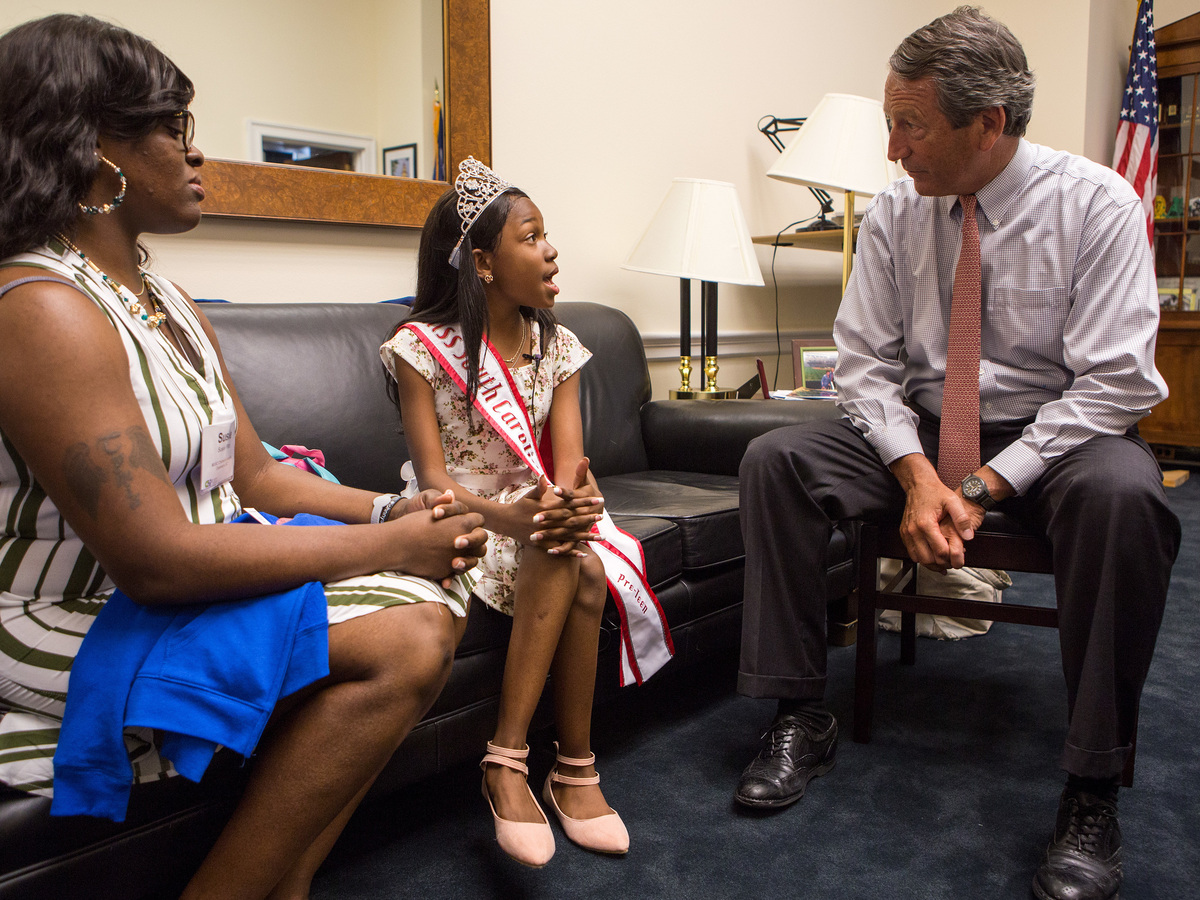
The group arrives at the Rayburn House Office Building, across the street from the U.S. Capitol, for their first meeting. Tymia is wearing a flowered dress along with the tiara and sash she won in 2015 when she was named queen in the Miss South Carolina Junior Pre-Teen pageant.
Tymia enters the office of South Carolina Rep. Mark Sanford, a Republican, as part of a lobbying trip organized by the Children’s Hospital Association.
Liam James Doyle/NPR
hide caption
toggle caption
Liam James Doyle/NPR
Her tiara sets off the metal detector, but the guards wave her through. She immediately walks over to a statue in the lobby.
“Sam Rayburn,” she says with enthusiasm. “Hi, Mr. Rayburn!”
Then they head upstairs for her first meeting with Rep. Mark Sanford, the South Carolina Republican who was once the governor of her state.
“I really need Medicaid because it pays for my medical equipment, my fluids that I need, my checkups to see the doctor and [to] be hospitalized,” she says looking directly at the congressman. “Please, please do not cut Medicaid, or cap [it]. Because Medicaid is very important to me.”
Sanford, who opposed the House version of the health care bill, tells Tymia: “I hear you loud and clear on the Medicaid front.”
Liam James Doyle/NPR
hide caption
toggle caption
Liam James Doyle/NPR
Sanford, who opposed the House version of the health care bill, tries to assure Tymia that he is on her side.
“I hear you loud and clear on the Medicaid front,” he says. “Now don’t make me cry. I’m a little emotional this week — my mom died.”
Then he talks about spending priorities and budgets. He says the system is working well because the bill stalled in the Senate precisely because Republicans could not agree on cuts to Medicaid.
Tymia looks straight ahead during the policy talk. Her face is blank, and a single tear rolls down her cheek. Her mom leans in.
Tymia becomes emotional while telling Sanford about living with sickle-cell anemia, a genetic condition that leads to rigid and malformed red blood cells that don’t carry oxygen well and can suddenly block blood flow.
Liam James Doyle/NPR
hide caption
toggle caption
Liam James Doyle/NPR
“What if it was you, or if it was your loved one?” she asks Sanford. “What would you do?”
A buzzer is sounding in the halls, and his staff is nudging him. He has to get to the floor for an unrelated vote.
Tymia and her entourage head to the next office. They’ll have four more meetings this day.
Late in the afternoon, she arrives at the office of Sen. Lindsey Graham, a Republican from South Carolina. She’s in a wheelchair now, tired from all of the walking.
Tymia also stopped by the office of Sen. Lindsey Graham, a Republican from South Carolina, to express her opposition to any health care reform that would curb the Medicaid benefits she relies on.
Liam James Doyle/NPR
hide caption
toggle caption
Liam James Doyle/NPR
Graham rushes in to say hello. They stand in front of a pair of flags. He tells Tymia she’s beautiful and holds up his fist for a bump.
The 11-year-old runs through her story. Graham quickly turns to the adult lobbyist from the hospital and starts talking about wonky details, such as FMAP reimbursements and Medicaid expansion populations.
When Graham is done, the hospital lobbyist thanks him. He turns to Tymia for another fist bump and rushes off down the hall.
Tymia takes the stairs in the Rayburn House Office Building on her way to meet with Sanford. By the end of the day, she was using a wheelchair.
Liam James Doyle/NPR
hide caption
toggle caption
Liam James Doyle/NPR
Back at the hotel, Tymia joins the other children in the delegation for a party. There is a band playing kids music, and the kids are tapping tambourines and ringing bells.
Her dress and sash are gone, but her tiara is still firmly in place as she picks out a bumblebee and a little camera from a table of toys.
“I’m going to enjoy this tonight,” she says of the camera. “Go out and get some pictures.”
Reached this week, Pitts says she is “overjoyed” that the bill failed.
“We have been praying that her words did have power and when she spoke from her heart and allowed her words to flow that they would hear her,” Pitts wrote in an email. “Our prayers have been answered.”

Senate Majority Leader Senator Mitch McConnell attends a news conference following party policy meeting at the U.S. Capitol on July 11.
Carlos Barria/Reuters
hide caption
toggle caption
Carlos Barria/Reuters
President Trump has summoned all Senate Republicans to the White House Wednesday for a debrief on the state of health care legislation effort in their chamber. Based on the week so far, the meeting may be more like a postmortem.
The Senate still reportedly plans a vote next week on repealing the Affordable Care Act without a replacement plan. But it appears the GOP leadership will not have the votes it needs to bring even that fallback version of their legislation to the floor.
So what happened after seven years of prioritizing the promise to repeal Obamacare? And what does it all mean for what’s next?
1. The president was AWOL
Few major legislative changes happen without the active support of the White House. We now have another demonstration of why this is true, albeit a demonstration in reverse.
Trump made the decision to bet the first months of his presidency on a quick “repeal-and-replace” strategy. That decision is now being widely second-guessed. But Trump also failed to put shoulder to the wheel at any stage of the process. Unwilling to engage in the substantive issues, he famously decried the difficulty he had previously denied: “Nobody knew health care could be so complicated.” He then praised the House bill at a self-congratulatory ceremony only to trash it later as “mean” while speaking with GOP senators.
When the bill came to the Senate, Trump tweeted his hope that it would be “beautiful,” (that comment was made about a week after the president said the Senate bill would have “heart” and that he wanted more money for the GOP health care plan — presumably to provide more care for everyone at a lower cost). But in the critical days when the bill’s fate hung in the balance, he was more often tweeting about his various media feuds than about the bill. And on the night the final collapse came, he was finally meeting with senators for dinner — but all of them were already “yes” votes.
2. The president wasn’t the problem
Trump seems to have wanted to show up for the trophy ceremony, not for the game. But even if he had plunged into the trenches, his presence there may not have made the difference. Because the real challenge here was not the politics or the process but the problem itself.
Health care is on its way to being a fifth of the total economy, and the Affordable Care Act, aka “Obamacare,” is now part of its warp and woof. Ripping it out would disrupt the health care system’s delivery of care and payment alike. Replace was always the hard part of repeal-and-replace, and we simply do not have a consensus on how to do it — even among Republicans. After the past few months, one is tempted to say especially among Republicans.
3. Health care politics are explosively dangerous
People are always anxious about their health, their care and its cost, but when they actually get sick, lose their coverage or find their premiums rising, they get scared and angry. Politically, it is often enough just to make them fearthose things might happen.
Democrats found that out eight years ago, before they even got their bill across the finish line. The issue eventually flipped control of Congress. But now the Republicans come with plans to take insurance away from a far larger number of people and still no guarantee that the insurance will cost less or cover as much. That’s why polls show the country prefers Obamacare to the GOP repeal bills by 2-1. This was going to give Republicans a case of cold feet no matter how hard Trump worked the bill.
4. The Senate sorcerer’s hat has been knocked off
Mitch McConnell is the Senate majority leader and a past master of process and hardball politics. But his mythical status as a magician now looks more like a memory.
In fairness, McConnell followed a game plan that has worked in the past and that worked as recently as this spring in the House. He fashioned a bill primarily to please the conservatives who dominate his caucus, then refined it to further accommodate holdouts on the right. His plan for holdouts in the moderate camp called for picking them off one at a time, earmarking billions for specific states or needs such as opioid abuse.
At closing, the idea was to cast the last holdouts as preservers of Obamacare, traitors to the party and enemies of the state. (The president’s Twitter finger was a fearsome threat in this regard.) But as it turned out, more than a few conservatives saw too much of Obamacare surviving, while moderates were still worried about Medicaid cuts. McConnell’s magic was not potent enough.
5.Obamacare in some form is here to stay
Democrats in 2009 and 2010 did not necessarily want to protect and preserve the private health insurance industry. Many of them would have preferred a “public option” format as a faster track to single-payer “Medicare for all.” But to cobble together the votes to prevail, they went for a hybrid model of public-private insurance, which in the 1990s had been a Republican-proposed compromise alternative.
This time around, the mirror image dilemma occurred for the GOP. Their most conservative cadre wanted full repeal of the Obamacare regulations and taxes and a rollback of Medicaid expansion as quickly as possible. Their more pragmatic senators feared the fallout from dumping millions off Medicaid. Even Sen. Shelley Moore Capito, whose West Virginia voters went overwhelmingly for Trump, had to think about having 30 percent of her state’s families now on Medicaid. Other GOP senators were primarily fixated on the plight of those with pre-existing conditions, assured of affordable insurance for the first time under Obamacare.
6. Opposition is easy; governing is hard
The GOP Senate caucus is home to profound ideological diversity. That can be a wonderful thing when all are united in opposition to the governing party. It is a far different creature when it must be united in order to pass things. So the divisions have now been vividly exposed by the coming of a Republican president.
Yes, in 2015 it was easy for Senate GOP to be unified in repealing Obamacare without a replacement. But no one doubted President Obama would veto that. Now, Republican votes alone can make laws happen, and the prospect arises of voters not liking those laws.
7. The health care issue will not go away
For more than a decade now, one major party or the other has been agitating for big changes in health care and insurance. The ever-escalating costs of high-tech care and the near-constant debate in the media guarantee the issue’s salience will continue to grow. The average American wants good health care, and has been increasingly promised “the best.” But we often do not focus on the cost until necessity arises. Nor do we realize the true cost and reality of insurance coverage. As this changes, health care will demand more political attention, not less.
8. Surprise: The idea of “single-payer” is gaining ground
Even without the friendly label of “Medicare for all,” government-guaranteed health care single-payer polls better today than it has for generations. Democrats are increasingly likely to favor it as a logical extension of current programs for children, retirees and lower income families. Among Republicans, however, it is still “socialized medicine” and it remains anathema — just as when it was first proposed in the late 1940s.
But with escalating costs and political wrangling, more people are realizing that the health care system is a series of economic and political choices. The basic choice is between a for-profit health insurance industry that needs to make money (and has the power to raise premiums) and a single-payer system based on taxation and government regulation. This already exists as Medicare and the States Children’s Health Insurance Program (S-CHIP) for the youngest. Those programs are both popular and enjoy bipartisan support in Congress. But extending them to cover the generations from young adulthood to seniority remains the key battleground in health care politics.
Seven years ago, an open microphone caught Vice President Joe Biden congratulating President Obama on the passage of the health care bill that would define their legacy. Biden’s salty choice of words is more politely repeated by the initials “BFD.” But his assessment of the moment’s importance was far from wrong. Seven years from now will we remember the events of this week as a matching bookend for Biden’s BFD?

Researchers find that dementia patients who engage in activities such as gathering photographs and talking about family see improvements in their quality of life and are less agitated.
Owen Franken/Getty Images
hide caption
toggle caption
Owen Franken/Getty Images
In nursing homes and residential facilities around the world, health care workers are increasingly asking dementia patients questions: What are your interests? How do you want to address us? What should we do to celebrate the life of a friend who has passed away?
The questions are part of an approach to care aimed at giving people with memory loss and other cognitive problems a greater sense of control and independence. At its core is the idea that an individual with dementia should be treated as a whole person and not “just” a patient.
Scientists sometimes call this approach an ecopsychosocial intervention. The goal is to create environments that better meet patients’ psychological and emotional needs through strategies other than medication.
At the Alzheimer’s Association International Conference this week in London, researchers from the U.S., the U.K. and Israel presented data from four trials demonstrating that such interventions significantly improve residents’ mood and quality of life. The interventions can also reduce their use of antipsychotic drugs and improve their ability to care for themselves.
Taken together, these studies and others suggest that relatively simple and potentially cost-effective interventions can yield significant benefits for people with dementia, even those in residential facilities in the later stages of disease.
As the population continues to age, and the number of people with dementia continues to rise, these interventions are likely to increase in importance as well.
In the U.K., 70 percent of people in care facilities are estimated to have dementia, according to the Alzheimer’s Society.
“An awful lot of people with dementia are living in care homes,” says Clive Ballard, executive dean of the University of Exeter Medical School in the U.K., who presented one of the studies. “The quality of care is really inconsistent.”
While nursing and residential facilities are likely adept at things like preventing pressure ulcers, they are less skilled at responding to residents’ social and emotional needs, he says. “If you’re actually trying to give people the best lives you can give them, that’s a really important aspect,” says Dr. Ballard.
In what is thought to be the biggest randomized trial to date of this approach in care facilities, Dr. Ballard and his team evaluated some 800 residents at 69 care homes across the U.K.
As part of the study, a “care champion” from each facility took part in four days of training and then went back to coach others. The goal was for every resident to get at least one hour a week of social interaction with a health care worker.
The staff would ask residents what activities they liked doing and then work to find something that would be appropriate for their skill level. Residents might gather photographs and talk about family, or spend time gardening or talking about gardening, depending on their ability.
The staff were trained to use prompts and cues, so that the conversations could flow more naturally, says Dr. Ballard.
The researchers carried out the intervention for nine months and then followed up with the residents for nine months. They found that participants reported a significant improvement in their quality of life. The intervention also reduced their agitation as effectively as antipsychotic drugs.
“It’s really about helping people with their own goals,” says Dr. Ballard, whose group published a smaller trial last year in the American Journal of Psychiatry. The new results presented Sunday are being reviewed for publication.
Ballard’s team has partnered with two British non-profit organizations to train care staff in the southwest of the country. They hope to roll the approach out to 1,000 care facilities soon, he says.
Another person-centered, ecopsychosocial approach is based on the concept used in Montessori schools for young children: fostering independence by assessing and incorporating each person’s stage of development.
“We look at dementia as a form of disability rather than as a disease,” says Cameron Camp, director of research and development at the Center for Applied Research in Dementia in Solon, Ohio. “When you focus on dementia as a disease, then you’re focusing on deficits. Our approach is — what can we do to help these people?”
The approach makes use of individualized plans to assist patients. For some residents, it may mean giving them written schedules and teaching them to check off activities they’ve completed, so they can see where they are during the day. Other residents may be confused about the date when the see a monthly calendar but can understand a single-day calendar. Knowing the correct date helps them feel more oriented and improves self-confidence, says Dr. Camp.
In a small study published last year in the journal Advances in Aging Research, Dr. Camp’s group found that participants of such a program showed improvement in some activities of daily living such as being able to feed themselves. They also decreased their use of antipsychotics, antidepressants and sleeping pills.
“When people are engaged and awake during the day, they sleep at night,” says Dr. Camp.
Addressing loneliness and boredom are the two most important needs for many elderly in these settings, according to Jiska Cohen-Mansfield, a professor in the department of health promotion at Tel Aviv University in Israel.
In a pilot study of 69 residents in six dementia nursing home units, she and her team identified some of the most challenging residents and found those who participated in group activities saw an improvement in mood compared to people in control conditions. Many of their disruptive behaviors disappeared as well, she reported during her conference presentation.
When implementing the experimental program, she had to convince staff to give it a try, telling them that it didn’t matter if the program worked or not.
Residents quickly responded to the program, especially the physical activities. In one, they had to catch and pass a ball. They had no confidence initially, recalls Dr. Cohen-Mansfield, but that changed as they realized they could do it. The group session, which was supposed to run for half an hour, went on for 90 minutes.
“Engagement decreases behavioral problems,” says Dr. Cohen-Mansfield. “The most potent stimuli is social engagement.”
Shirley Wang is a writer based in London. She can be found on Twitter @ShirleyWang.
Steve Inskeep talks with Senate Conservatives Fund President Ken Cuccinelli, who is threatening to recruit conservative challengers to Republicans who vote against repealing the Affordable Care Act.
With the demise of Republican efforts to both repeal and replace the Affordable Care Act, there’s likely to be an impact on consumers and companies that depend on the health care law.
Conservative media are reacting to the failure of the GOP’s latest health care plan with outrage and disappointment. The Republican bill was effectively blocked on Monday night when two more GOP senators came out in opposition to it.