GOP Sen. Susan Collins Firmly Opposes Senate Health Care Bill

Sen. Collins says she wants to reform flaws in the Affordable Care Act. This comes after the Congressional Budget Office said the Senate bill would leave 22 million more people uninsured by 2026.

ARI SHAPIRO, HOST:

Congressional forecasters say a Senate bill that aims to repeal and replace Obamacare would leave 22 million more people uninsured by 2026. That’s only slightly fewer than a House version that passed last month. This forecast comes as Senate Republican leaders press for a vote on the bill later this week, and it has already led one Republican senator to firmly oppose the bill. NPR’s Scott Horsley joins us now. And, Scott, these numbers come from the Congressional Budget Office, the nonpartisan bean counters on Capitol Hill. So where do they think these coverage reductions are coming from?

SCOTT HORSLEY, BYLINE: Ari, the biggest drop would be in Medicaid. Remember, Obamacare expanded Medicaid. This bill would shrink it. And the forecasters anticipate by 2026 you would have 15 million fewer Americans getting their coverage through that safety net program. They’re also anticipating a drop of about 7 million people getting coverage through the individual marketplace. And the Congressional Budget Office says these drops would disproportionately affect older people, especially those between 50 and 64 years old, at the lower end of the income ladder.

SHAPIRO: Senate Republican leader Mitch McConnell hopes to get a vote on this bill by the end of the week before lawmakers go home for their Fourth of July recess. How does this forecast affect the chances of the bill passing?

HORSLEY: Well, it doesn’t help. Just this evening, since this report came out, we’ve had one Republican senator – Susan Collins, a moderate Republican from Maine – say definitively that she will not vote for this Senate bill. She says, I want to work with my Republican and Democratic colleagues to fix the flaws in the Affordable Care Act. The CBO analysis shows the Senate bill won’t do it. And remember, Ari, that Republicans have very little margin for error here. The Democrats are united in their opposition to this bill, so Republican Senate leader Mitch McConnell can only afford to lose two votes and still pass the measure. With Collins out he’s down to one.

SHAPIRO: Senators made some last-minute changes to the bill to address a potential problem that critics said could have led to further erosion in the individual insurance market. Tell us about what they did.

HORSLEY: The original Senate bill, which was unveiled last week, required insurance companies to offer coverage to everyone, including those with pre-existing medical conditions, but it didn’t have any kind of requirement for individuals to have health insurance. And critics say that had the potential to really destabilize the market by creating a perverse incentive for people to wait till they got sick in order to go out and buy insurance coverage, which would have the effect of driving up costs for everyone.

So the revision, which was issued today, tries to solve that problem by imposing a penalty on those who don’t maintain continuous insurance coverage. Basically, if you let your insurance coverage lapse for a little over two months in any given year, the next year you would be shut out of the insurance market for six months. The CBO estimates that modification in the bill would slightly increase the number of people buying insurance in the individual market compared to what the bill would do without it.

SHAPIRO: And this bill would not only roll back the Affordable Care Act. It would also make major changes to Medicaid, the federal health care program for the poor and disabled. What does this Congressional Budget Office estimate say about that?

HORSLEY: Yeah, for the first time, the Senate bill would cap federal spending on Medicaid in 2020. And that would force state governments to either scale back the program or make up the difference out of their own budgets. And then starting in 2025, the Senate bill assumes that medical bills will grow more slowly than they have historically. And if that assumption turned out to be wrong, the states would face an even bigger budget gap. Now, because this CBO report mostly looks at the next decade – that is, the period between now and 2026 – those savings in the out years for the government don’t really show up. But they would be big. And this would presumably, in decades to come, push more people off the Medicaid rolls.

SHAPIRO: NPR’s Scott Horsley. Thank you.

HORSLEY: You’re welcome, Ari.

Copyright © 2017 NPR. All rights reserved. Visit our website terms of use and permissions pages at www.npr.org for further information.

NPR transcripts are created on a rush deadline by Verb8tm, Inc., an NPR contractor, and produced using a proprietary transcription process developed with NPR. This text may not be in its final form and may be updated or revised in the future. Accuracy and availability may vary. The authoritative record of NPR’s programming is the audio record.

Let’s block ads! (Why?)

GOP Senate Bill Would Cut Health Care Coverage By 22 Million

Doctors, nurses, patients and activists listen to Senate Minority Leader Chuck Schumer, D-N.Y., speak about Senate Republicans’ health care bill on Friday at Bellevue Hospital in New York City. Schumer has vowed to help defeat the legislation, which the Congressional Budget Office scored on Monday.

Spencer Platt/Getty Images

hide caption

toggle caption

Spencer Platt/Getty Images

Congressional forecasters say a Senate bill that aims to repeal and replace the Affordable Care Act would leave 22 million more people uninsured by 2026, with 15 million more uninsured by 2018 compared to the current health care law.

That’s only slightly fewer uninsured than a version passed by the House in May.

Monday’s report from the nonpartisan Congressional Budget Office could give moderate senators concerned about health care coverage pause. Senate Republican Leader Mitch McConnell wants a vote on the bill this week, before senators head home for the July Fourth recess. With Senate Democrats united in opposition, Republicans can afford to lose only two votes on their side and still pass the bill.

Republican Sen. Dean Heller of Nevada, who is up for re-election next year, has already expressed reservations about the number of people who could lose coverage under the GOP bill. Four other Republican senators have complained that the bill doesn’t go far enough in rolling back the Affordable Care Act, also known as Obamacare.

The Senate bill would cut hundreds of billions of dollars in taxes over the coming decade, with most of the savings going to those at the top of the income ladder. At the same time, it would phase out the Affordable Care Act’s Medicaid expansion, while offering less generous subsidies to those who purchase health insurance on the individual market. That combination is expected to reduce the number of people with insurance coverage by 22 million by 2026: Fifteen million fewer on Medicaid and 7 million fewer in the individual market.

Loading…

Over time, the bill would also make deep cuts to traditional Medicaid, the safety net program for the poor and people with disabilities. The program, which dates to the Great Society of the 1960s, covers nearly 1 in 5 Americans — more than Medicare, the better-known program for the elderly.

For the first time, the Senate bill would cap federal spending on Medicaid in 2020, forcing state governments to either scale back the program or make up the difference out of their own budgets. The Senate bill also assumes that after 2025, medical bills will grow more slowly than they have historically. If that assumption is wrong, states would face an even bigger budget gap that would grow with each passing year.

Democratic Sen. Ron Wyden of Oregon worries the CBO report doesn’t fully reflect those long-term effects, since congressional forecasters typically focus on a 10-year budget window. Wyden, the ranking Democrat on the Senate Finance Committee, wrote a letter to CBO Director Keith Hall, asking him to assess how the Senate bill would affect Medicaid coverage 20 or 30 years into the future.

“It is critical that Senators completely understand legislation and its impact prior to casting a vote,” Wyden wrote.

[embedded content]

Let’s block ads! (Why?)

Insurance Companies Concerned About The Future Of Medicaid Under GOP Plan

The Senate’s healthcare bill would make big changes to the government’s Medicaid program. Lulu Garcia-Navarro talks with John Baackes, CEO of L.A. Care Health Plan.

LULU GARCIA-NAVARRO, HOST:

Changes to Medicaid are at the heart of the draft health care bill Senate Republicans unveiled this past week. Medicaid funds health care for nearly 1 in 5 Americans, people with low incomes, people with disabilities and those in nursing homes or receiving long-term care. It also covers 40 percent of American children.

Just before the bill was made public, 10 insurance executives who provide Medicaid plans wrote to Senate leadership to express concern about cuts to the program. One of them was John Baackes. Baackes runs LA Care Health Plan in California. And he says the conversation about the new bill hasn’t focused enough on the proposed changes to Medicaid.

JOHN BAACKES: Most of the attention in the last few weeks has been on the individual markets and whether or not pre-existing conditions are covered. And that’s very important to the 12 million people in the exchanges. But there’s 74 million people on Medicaid, and this bill is essentially pulling the rug out from under that population.

GARCIA-NAVARRO: You signed onto this letter before the Senate bill came out. Now that you’ve seen it, what are your concerns?

BAACKES: Well, our concerns, unfortunately, are that it was as bad as we thought it could be because it didn’t vary that much from the bill that the House passed. And the main issue is we are fundamentally in both bills changing the structure of Medicaid from the way it’s operated for the last 52 years.

Originally, this was talked about as repeal-and-replace legislation. And it’s going way beyond repeal and replace of the Affordable Care Act because it does affect all 74 million Medicaid beneficiaries, not just those people who gained access because of the Affordable Care Act because, in the original construct of Medicaid, it was to be a shared expense between the states and the federal government.

And under this proposal, what they’re saying is, we’re no longer going to figure out what it costs and then share it. We’re going to cap the amount we’re going to contribute, regardless of what the actual cost is. And good luck.

GARCIA-NAVARRO: And how do you think that will affect what you and the states will be able to do for children, so many people who are ill?

BAACKES: Well, if you look at what happens when there are economic downturns, and states have trouble meeting a particular budget year, they will start to cut back on benefits. Or they may cut back on categories of people that they would otherwise cover. Or they will reduce the amount of money that is available to pay the providers.

And that’s where I think, given the extent of what the damage would be 10 years out, is what would happen – is we would have to reduce the amount of money we offer providers. And then, if we have doctors dropping out of the plan because they simply can no longer afford to cover this population, people are going to do what they’ve always done, which is begin to turn to emergency rooms.

GARCIA-NAVARRO: How much of a voice has the insurance industry had in putting together this legislation?

BAACKES: Zip (laughter). Certainly, there have been no hearings where we could go and offer testimony or evidence to that effect. And even privately, through our own individual lobbying efforts or through trade associations, there have been no major forums by which you could offer this, which, for those of us that are observers of this – we’re saying, well, is there really any interest in that, or is it just about reducing the amount of money being spent, regardless of the consequences? And if it’s the latter, that’s a tragedy. And that’s what I’m afraid we’re seeing.

GARCIA-NAVARRO: John Baackes is the CEO of LA Care Health Plan in California. Thank you so very much.

BAACKES: Thank you very much for this opportunity.

Copyright © 2017 NPR. All rights reserved. Visit our website terms of use and permissions pages at www.npr.org for further information.

NPR transcripts are created on a rush deadline by Verb8tm, Inc., an NPR contractor, and produced using a proprietary transcription process developed with NPR. This text may not be in its final form and may be updated or revised in the future. Accuracy and availability may vary. The authoritative record of NPR’s programming is the audio record.

Let’s block ads! (Why?)

'Interlaced Fingers' Traces Roots Of Racial Disparity In Kidney Transplants

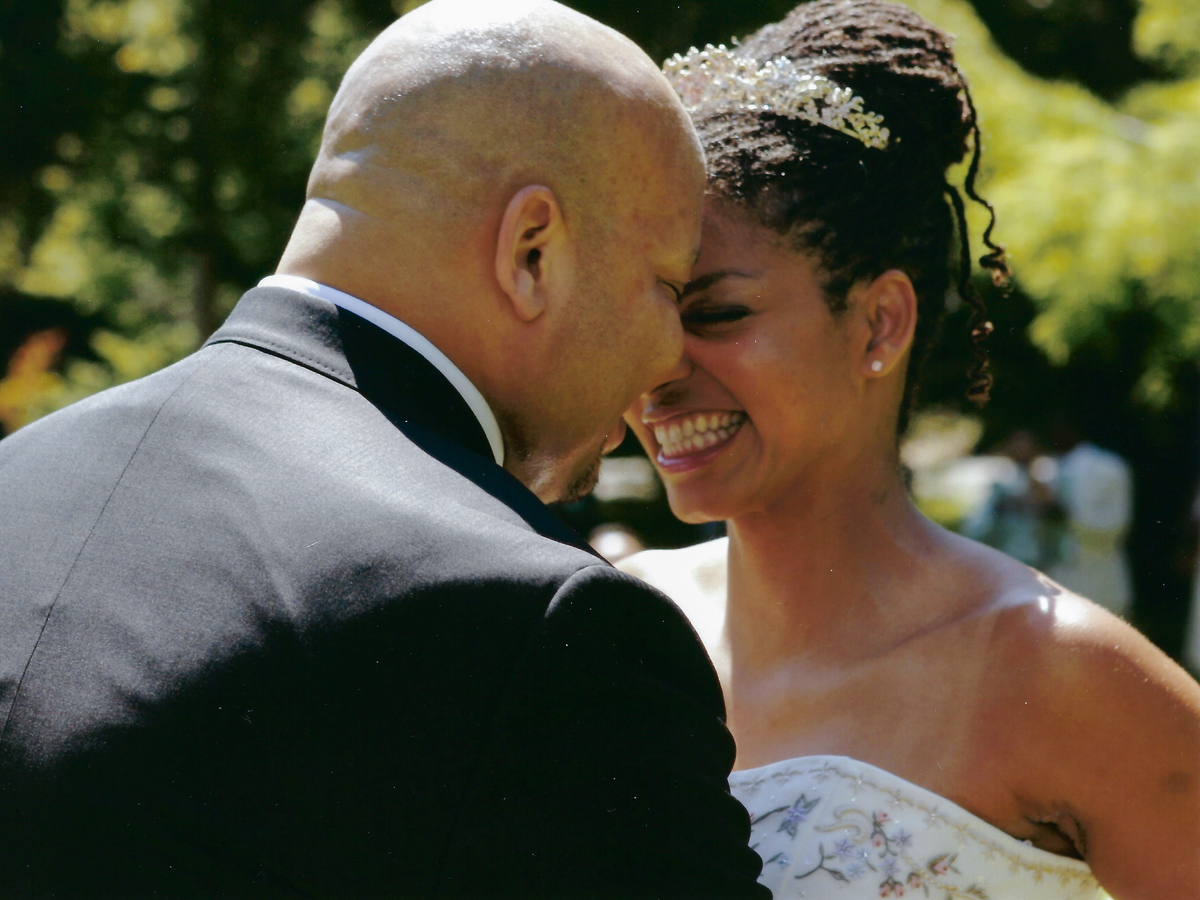
Dr. Vanessa Grubbs and Robert Phillips at their wedding in August 2005. Just a few months earlier, when his kidneys were failing, she gave him one of hers.

Courtesy of Vanessa Grubb

hide caption

toggle caption

Courtesy of Vanessa Grubb

While she was a primary care doctor in Oakland,Calif., Dr. Vanessa Grubbs fell in love with a man who had been living with kidney disease since he was a teenager.

Their relationship brought Grubbs face to face with the dilemmas of kidney transplantation — and the racial biases she found to be embedded in the way donated kidneys are allocated. Robert Phillips, who eventually became her husband, had waited years for a transplant; Grubbs ended up donating one of her own kidneys to him. And along the way she found a new calling as a nephrologist — a kidney doctor.

Her candid new memoir, Hundreds of Interlaced Fingers: A Kidney Doctor’s Search for the Perfect Match, explores her personal story and some troubling statistics. Roughly 1 in 3 of the candidates awaiting kidney transplants are African American, Grubbs learned, but they receive only about 1 in 5 of all donated kidneys. White people account for about a third of the candidates awaiting kidney transplants, but they receive every other donated kidney.

Grubbs writes of accompanying Phillips in 2004 to meet with members of the transplantation team — including a doctor, a nurse and a financial counselor — for a routine evaluation and update. After being on the waiting list for a kidney for five years, he had neared the top of the list.

Dr. Vanessa Grubbs was a primary care doctor when she met Robert Phillips. She says seeing how difficult life can be for people with chronic kidney disease was part of what led her to further specialize in nephrology.

Courtesy of Vanessa Grubb

hide caption

toggle caption

Courtesy of Vanessa Grubb

“We sat in a clinic exam room listening to a series of people whose job it seemed was to talk Robert out of even wanting a transplant,” Grubbs writes. Such meetings may be meant to make sure patients understand the difficult realities of organ transplantation, she says, but, “… the message we took away was, ‘The kidney transplant system doesn’t like black people.’ “

Grubbs, now a nephrologist at the Zuckerberg San Francisco General Hospital, and assistant professor at the University of California, San Francisco, recently sat down to talk about her experience with NPR.


Interview Highlights

One of the things you write about in the book is that your colleagues did not appreciate that you published a piece in a health policy magazine — Health Affairs — [detailing the inequities in transplantation]. It was called “

And then, you go down the list of common assumptions, and you prove that they are not true. For example, you say it is an assumption that African Americans or blacks don’t donate enough organs. That’s not true. And you also say that even if that were true, anti-rejection drugs are now so effective that gene matching hasn’t been recommended [for transplanted kidneys] since 2002. So what is the deal? Why is it that African Americans are, as you put it, “good for harvest but not for planting?” What conclusion did you come to?

In addition to being inspired to be Robert’s donor, eventually I decided to become a nephrologist — really in an effort to do something for everyone else … to try to do research into the area. And being in nephrology really opened my eyes to just how big the problem is throughout the system. The problems starts way before a person gets to transplant. For example, people have to know that they have kidney disease. We know for a fact that most people aren’t aware that they have kidney disease. From there, you have to be in the care of a nephrologist. You can’t get to even the evaluation unless a nephrologist refers you, and you have health insurance that will pay for the evaluation.

Well — spoiler alert — you and your guy Robert are still together?

Yeah.

How’s he doing?

He’s doing really well. We celebrated our 12th transplant anniversary in April and we celebrate our 12th wedding anniversary in August.

Radio editors Jennifer Liberto and Ammad Omar, radio producer Denise Guerra, digital producer Nicole Cohen and science desk intern Courtney Columbus contributed to this story.

Let’s block ads! (Why?)