What's The Difference Between Famine And Hunger? A Food FAQ

When does food aid work?

Hanna Barczyk for NPR

hide caption

toggle caption

Hanna Barczyk for NPR

Can eating insects help people survive a famine?

Are there new ways to help farmers water their crops when drought strikes?

Isn’t the basic hunger problem that there’s just not enough food to go around?

Those are some of the tough questions that you submitted in April for our monthly #CuriousGoat series.

We’d asked what you wanted to know about world hunger. You sent in so many good queries that we didn’t want to pick just one to answer, as we typically do. So here are some of the best — and our best answers.

The questions have been edited for length and clarity.


What’s the difference between hunger and famine? And why should we care about famines? — Anjala Illemassene

“Hunger is a physiological sensation,” explains Tufts professor Daniel Maxwell, acting director of the university’s Feinstein International Center, based at the Friedman School of Nutrition Science and Policy. It’s brought on by what is formally called “food insecurity,” which is just another way of saying a lack of nutritious food on a regular basis.

“Famine is an extreme event leading to widespread death,” he says, and it’s typically about politics and violence, as much as it is about the overall availability of food.

Hunger exists everywhere, although it’s more common in areas with high levels of poverty. For a situation to be officially declared a famine by the United Nations, hunger needs to be concentrated and catastrophic. As we explained in February, there’s a five-stage scale used to rate food insecurity emergencies. To hit No. 5, which is “famine,” here are the criteria:

“At least 1 in 5 households now faces an extreme lack of food, more than 30 percent of the population is suffering from acute malnutrition, and at least two people out of every 10,000 are dying each day.”

In the 20th century, Maxwell notes, famines killed nearly 75 million people — although outright starvation was often not the direct cause. Instead, people in famines die from cholera, measles or other nasty diseases because severe malnutrition leads to compromised immune systems, he says.

Even people who manage to survive a famine are gravely affected, adds Stephen Were Omamo, deputy director of the World Food Programme. Severe malnutrition — which according to UNICEF affects an estimated 16 million children under the age of 5 worldwide — has health implications for life, particularly among kids affected during their first 1,000 days.

When does food aid work well, and when doesn’t it work? — Anna

It works best when people actually get it, and that’s not always so easy to pull off, says Tufts’ Maxwell, who’s co-author of the book, Food Aid After Fifty Years: Recasting Its Role.

Beans, lentils and other staples are great, he says, unless they’re sitting in a warehouse, waiting to get boxed, shipped, trucked and who knows what else. The clunky transportation process can take months to coordinate.

Now, though, food is often purchased and stored closer to where it’s needed, Maxwell says. But this approach can still be problematic, he says, if its distribution interferes with local markets.

That’s why the new form of food aid that’s really taken off is money. Cash can be transmitted digitally rather than airdropped or shipped. “It allows us to move much more quickly with a tailored response,” WFP’s Omamo says. Plus, buying power gives people the chance to pick and choose what they need, while generating economic activity.

Omamo says cash-based transfers — a term that includes all cash transfers and vouchers, both physical and digital — accounted for less than 1 percent of the food assistance WFP delivered in 2009. Now it’s close to 20 percent (with a value of about $1 billion a year).

Can you address population growth in relation to hunger and famine? –— Nadia G.

To do that, we need to discuss Thomas Robert Malthus, an English economist and scholar born in 1766. One idea Malthus laid out in his most influential paper, “An Essay on the Principle of Population,” was that the world population continues to grow exponentially, and the food supply can’t possibly keep up. If that’s true, any day now, we should have too little food for too many people.

It’s a concept called the Malthusian theory of population.

Although the theory has continued to circulate, it’s been disproved, Omamo of WFP says. Agricultural innovation has helped produce much more food than Malthus ever expected, and population growth is actually showing signs of slowing.

What Is #CuriousGoat?

#CuriousGoat is a monthly series from Goats and Soda that asks our audience to share a question on a special topic about global health and development.

“The answer is not, ‘More people bad,’ ” Omamo adds. “There isn’t a direct link.”

Consider the current state of the world: There are plenty of calories to sustain all 7.5 billion of us, but they’r not distributed evenly. Hundreds of millions of people go to bed hungry each night. That’s not to say Omamo isn’t worried about the future, and particularly the effects of climate change. If we don’t change how we use energy, Omamo says, hunger will become an even bigger challenge.

There are some regions that cannot support the population that lives there. What’s the point in providing food aid to an unsustainable population? — Anonymous

We’re going to assume you meant drylands, or places without much water. There’s a major problem with writing them off, says Bilal Butt, an assistant professor at the University of Michigan School of Natural Resources and Environment in Ann Arbor. “They’re almost half of the world’s surface area,” he says. They’re home to hundreds of millions of people, and have supported livestock and people for thousands of years.

What’s more, Butt adds, drylands have generally been quite sustainable, especially for nomadic herders. That they move from place to place “has been looked at as outdated and irrational,” Butt says. “But it could not be further from the truth.” They must stay mobile to find forage and water because resources are distributed unevenly in drylands. Because of this strategy, they’re not continually degrading one patch of land by grazing on it.

Over the years, nomadic groups have developed various strategies for survival in tough conditions, Butt says. One example he offers is from Kenya, where groups often keep a diverse group of livestock, each with separate feeding strategies. Cows eat differently than sheep, goats and camels, Butt says, so to have a mix is an adaptation to drylands. In most circumstances, at least some of your animals will find enough grub to survive. (Here is a fascinating story fromBeef Magazine extolling the virtues of multispecies grazing.)

This technique relies on widespread mobility, and being able to seek out new places to live. So as more land has been developed and taken away from grazing, and conservation areas have banned livestock, that’s limited options. That’s why, Butt says, it’s common to see livestock nibbling on grass in downtown Nairobi. The animals have been there much longer than the cars and buildings. The name of that city comes from the Maasai “cold water,” he explains, because it’s historically been a place that the Maasai would water their livestock.

The big problems arrive when a drought strikes, Butt says, and that’s when you’re likely to see images of crowded displaced persons or refugee camps, where people flee not only to escape conflict but also to find food and water during a drought. What you can’t tell from looking at their faces, Butt notes, is that they’ve often traveled from hundreds of miles away. “It’s all too easy to dehumanize people in this process,” he adds. “But they’re not careless, and unsustainably using the land.”

Instead, they’re dealing with droughts that in recent years have increased in frequency and intensity. “Then you ask yourself why,” Butt says. “Some would speculate that this [increase in droughts] is a climate change signature. The people contributing the least to climate change are being affected the most.”

What are some of the boldest, most sustainable ways help farmers water their crops in drought-stricken areas? — Karen Teber

Pose this question to Robert Opp, director of the World Food Programme’s innovation division, and he’ll start talking enthusiastically about Styrofoam with holes poked into it and plastic trays.

It may not sound like much. But use the holes to prop up plants, and let the roots soak in a water/nutrient mix in those trays, and you’ve got a hydroponic garden. Opp believes the soilless technique has the potential to change how people cultivate crops, particularly in the developing world. “You can grow food with 90 percent less water and 75 percent less space,” he says.

WFP has sent starter hydroponic kits that cost $25 to urban households in Peru, where they face a number of the same constraints as people living in conflict zones. (Namely, no space.) And it’s been helping them grow leafy greens in about 4 to 6 weeks that they can serve to their families and sell to make money. Hydroponics are also being tested with a refugee population in Algeria that was displaced 40 years ago because of conflict in the Western Sahara. “They didn’t want vegetables for themselves,” Opp explains, since that’s not typically a part of their diet. But they’ve grown barley shoots to feed their goats, which then produce milk for the people to consume.

The latest twist is combining hydroponics with food computers, which are units about half the size of a dishwasher and that boast a completely controlled environment, including LED lighting and automated nutrient release. Basically, they allow researchers to create any climate imaginable. WFP has teamed up with MIT and other partners to test a bunch of these computers in Jordan and determine how playing with variables can translate into the highest yield possible for crops.

Can eating insects help people during a famine? — Anonymous

On a small scale, the answer is yes, according to Patrick Durst, senior forestry officer for Asia and the Pacific at the Food and Agriculture Organization of the United Nations. In various times of famine, he says, people have hunted insects for sustenance. “They are tough and can survive in harsh conditions. When crops die, there are still insects around that people are eating,” he says. They can be nutritious sources of protein and fat. And they can be delicious — hence, why edible insects are a “preferred food” for many people around the world.

So how about shipping giant bags of bugs to starving people in famines?

Durst sees several potential hurdles to this idea. For starters, you’d need to produce a lot more bugs, and the recipients would have to want to eat them.

Maybe that’d be more likely in the form of insect-fortified flour, he says, which could be an extra nutritious alternative to the normal stuff. “There’s no reason that can’t be part of the arsenal, but we have a long way to go,” says Durst, who explains that more research is needed into shelf life and allergic reactions. (Apparently, people who have shellfish allergies often have the same problems with insects.)

Anyway, Durst is not saying we can’t use insects to fight famine worldwide. It’s just not likely anytime soon.

Thank you to everyone who participated in this #CuriousGoat.

Vicky Hallett is a freelance writer in Florence, Italy. She was previously a reporter and fitness columnist for The Washington Post.

Let’s block ads! (Why?)

Just Lost Your Job? COBRA May Be Your Best Health Insurance Strategy Now

Shifting messages from the U.S. Congress have left many would-be entrepreneurs, and other workers who’ve recently been laid off, wondering how best to maintain health coverage.

Michael Blann/Getty Images

hide caption

toggle caption

Michael Blann/Getty Images

After losing a job, what’s the best strategy for getting insurance? Are Republicans planning to change Medicare benefits as part of their changes to the federal health law? And will entrepreneurs be able to get insurance easily if that GOP overhaul goes forward? This week I answer these questions from readers.

Q: I just lost my job, and I can either sign up to buy the same coverage through COBRA or go into a marketplace plan. COBRA is really expensive — $800 a month for me — but I’m worried that anything I buy on the marketplace now might disappear or be unaffordable next year. What’s the best way to go?

You’re in a tough spot. Many insurers that offer coverage on the exchanges are still weighing their options, but a number have announced plans to drop out of specific markets or states next year.

The uncertainty about whether the federal government will continue to make cost-sharing reduction payments to marketplace insurers is a key factor contributing to instability in the marketplaces, according to insurers and analysts.

The subsidies reduce deductibles, copays and coinsurance payments for some low-income people who buy health coverage on the insurance exchanges. However, the Trump administration has threatened to discontinue the payments to gain leverage in its efforts to repeal the Affordable Care Act.

“Even if you live in a state or a market that still has multiple carriers participating in it, if the Trump administration decides to pull the plug on cost-sharing reduction payments, all bets are off,” says Sabrina Corlette, a research professor at Georgetown University’s Center on Health Insurance Reforms.

Continuing your employer coverage under the federal law known as COBRA would provide more certainty. You can generally keep the policy in place for 18 months. But as you say, it’s expensive. You would have to pay the full premium, so it will likely be much pricier than coverage on the exchange, if you are eligible for a federal subsidy. People with incomes up to 400 percent of the 2016 federal poverty level (about $47,500 for an individual) can qualify for the ACA’s premium tax credits.

One option is to sign up for COBRA and stick with that coverage through the fall. When the marketplace open-enrollment period begins on Nov. 1, you can then check out what’s available in your area and, if you see options that are affordable, switch to marketplace coverage for Jan. 1 and beyond.

If you live in one of the 31 states plus the District of that have expanded Medicaid coverage to adults with incomes up to 138 percent of the federal poverty level (about $16,000 for one person), you should also check to see if you qualify for that, instead.

Q: How would Medicare coverage change under the Republicans’ health care bill? Would the annual free wellness exams that were part of the Affordable Care Act be eliminated?

The health bill passed by the House last month, the American Health Care Act (AHCA), retains virtually all of the ACA changes that affect Medicare beneficiaries, says Tricia Neuman, director of the Program on Medicare Policy at the Kaiser Family Foundation.

Services that will continue include the annual wellness visit. In addition, Medicare will still cover, without patient cost-sharing, preventive care recommended by the U.S. Preventive Services Task Force.

The Republican bill also leaves in place the ACA provision that closes the Medicare prescription drug “doughnut hole” by 2020. At that point, beneficiaries with high drug costs will no longer face a coverage gap in their Part D drug plans. They’ll owe no more than 25 percent for brand-name and generic drugs after the deductible, whether they’re in the doughnut hole or not.

“This provision has already provided substantial relief to seniors with high drug costs,” Neuman says.

As of last July, more than 11 million seniors and people with disabilities had saved an average of $2,127 each on drugs in the coverage gap since the enactment of the ACA, according to the Centers for Medicare & Medicaid Services.

Q: If the Republicans pass the AHCA, I’m worried that I won’t be able to get affordable health insurance if I leave my job and start my own business, because I have a pre-existing medical condition. Am I right to be concerned?

Yes, you are. One of the biggest game-changing elements of the ACA was to prohibit insurers from turning people down or charging them more because they have pre-existing conditions. Under the Republican bill, states may opt out of the provision that prohibits insurers from charging sick people higher premiums.

Such a move could have a chilling effect on people who dream of starting a business, says David Chase, vice president of national outreach at the Small Business Majority, an advocacy group.

Before the Affordable Care Act took effect in 2014, researchers estimated that 1.5 million people might join the ranks of entrepreneurs in 2014 alone, because they would no longer have to worry about being turned down for coverage on the individual market.

In contrast, the Republican bill would allow insurers to charge older people premiums that are as much as five times higher than those charged younger people, instead of the current ratio of 3-to-1. It’s another potential concern for many would-be entrepreneurs.

“The age of small-business owners tends to skew on the higher end,” Chase says, “so the change would disproportionately impact small-business owners.”

Kaiser Health News is an editorially independent news service that is part of the nonpartisan Henry J. Kaiser Family Foundation. Follow Michelle Andrews on Twitter: @mandrews110.

Let’s block ads! (Why?)

A Drugmaker Tries To Cash In On The Opioid Epidemic, One State Law At A Time

The maker of a medical treatment for opioid abuse has successfully lobbied statehouses around the country to pass policies that sway addiction treatment practices in favor of the company's drug.

Kim Ryu for NPR

Two years ago, a mental health advocate named Steve McCaffrey stood at a lectern in the Indiana statehouse, testifying in favor of an addiction treatment bill. After years of rising overdose rates, lawmakers in the health committee were taking action to combat the opioid epidemic. And they often turned to McCaffrey, who leads Mental Health America of Indiana, to advise them.

His brief testimony appeared straightforward. “We rise in support, urge your adoption,” said McCaffrey. He said the legislation would move the state “toward evidence-based treatment.”

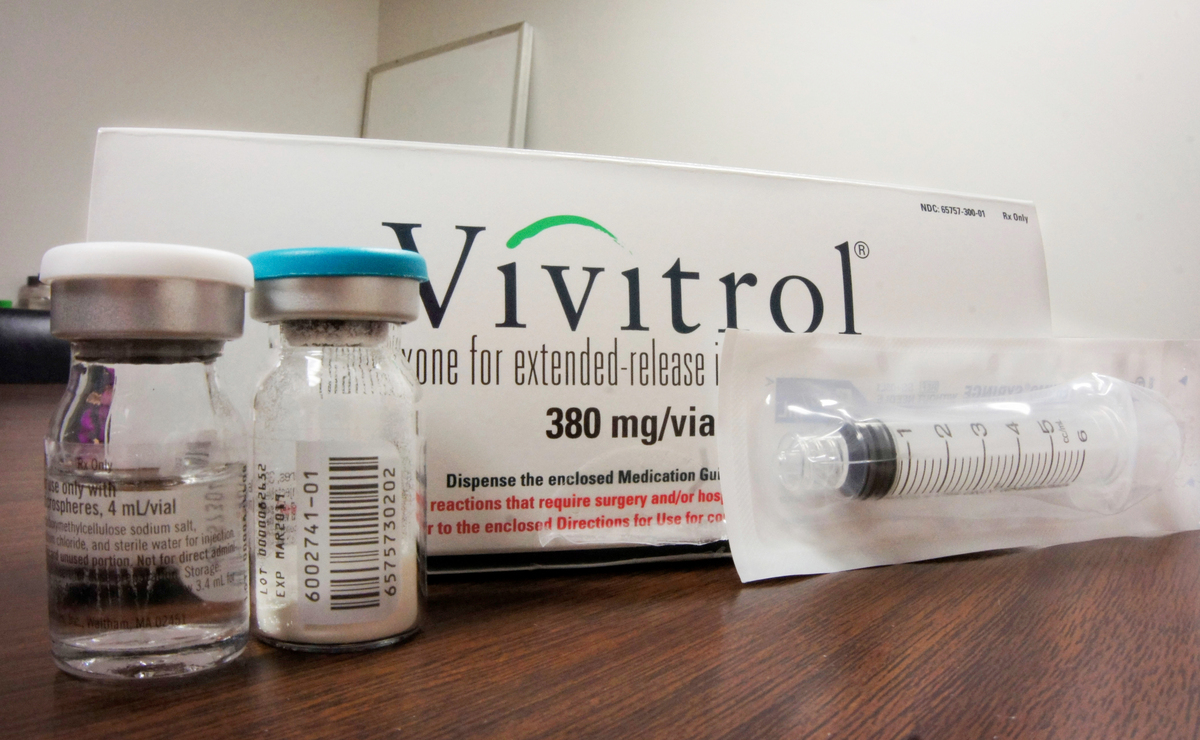
But the bill wouldn’t do that. Instead, it would cement rules making it harder to access certain addiction medications — medications that many patients rely on. The goal was to steer doctors toward a specific brand-name drug: Vivitrol.

The drug is a monthly shot used to treat alcohol and opioid addiction and one of a handful of FDA-approved treatments for addiction to opioids such as pain relievers, heroin and fentanyl.

State Rep. Steve Davisson, the bill’s sponsor, says McCaffrey helped write the bill, one of many related to addiction treatment that McCaffrey has worked on since 2015. But there was something important that Davisson and other lawmakers didn’t know about him.

State lobbying records show that McCaffrey lobbies for Alkermes, the company that makes Vivitrol.

Asked earlier this year whether Indiana lawmakers knew about his lobbying for Alkermes, McCaffrey said, “I imagine some do and some don’t.” But several lawmakers who have worked closely with McCaffrey, including Davisson, say they were not aware.

Steve McCaffrey in his office.

Jake Harper/Side Effects Public Media

hide caption

toggle caption

Jake Harper/Side Effects Public Media

His efforts have helped turn Indiana into what Alkermes describes in investor documents as an “up-and-coming” state, where the drug’s sales are poised to jump dramatically.

McCaffrey’s work promoting Vivitrol via legislation in Indiana is part of a larger pattern. An investigation by NPR and Side Effects Public Media has found that in statehouses across the country, and in Congress, Alkermes is pushing Vivitrol while contributing to misconceptions and stigma about other medications used to treat opioid addiction.

While policymakers are grasping for solutions to the nation’s opioid epidemic, Alkermes, which has its U.S. headquarters in Waltham, Mass., is using policy to promote its drug and, in some cases, hamper access to medications that can help. And in so doing, it’s looking to turn its drug into a blockbuster.

Science vs. stigma

There’s growing urgency among state policymakers to fight the addiction epidemic. The number of opioid overdose deaths quadrupled from 1999 to 2015. In that year, an average of 91 people died per day. There are now more deaths from overdoses in the U.S. than from car accidents. Opioids cause most of them.

But those looking for large-scale solutions to the crisis must navigate diverging views on treatment, making them receptive to lobbyists who attempt to guide them through medically complex and emotionally charged territory. Among those devoted to helping people addicted to opioids, there are conflicting opinions about the role of medications in recovery.

Medical researchers emphasize that the proven standard in addiction treatment includes medication, preferably combined with counseling and other behavioral and social support. The research shows that medication-assisted treatment helps prevent relapse and save lives. The National Institute on Drug Abuse, Substance Abuse Mental Health Services Administration and professional medical organizations all recommend medication-assisted treatment for opioid addiction.

But others disagree with the very concept of using medicine to treat addiction. Though this contradicts medical consensus, some, especially those with a background in the 12-step movement, view it as simply trading reliance on one drug for another. Addiction is a moral or spiritual problem to be overcome by willpower or faith, some believe. Medication is a crutch.

Two of the medications used to treat opioid addiction receive the most scrutiny, because they’re opioids themselves: methadone and buprenorphine, which is known as Suboxone, a brand-name formulation. Both medicines, called opioid-maintenance therapy, reduce cravings and prevent withdrawal, helping people to avoid the harmful behaviors associated with addiction.

“If the addiction is the monster, then methadone and Suboxone cage the monster,” says Dr. Andy Chambers, an addiction psychiatrist in Indianapolis. In a proper treatment setting, people with an existing tolerance to opioids don’t get a feeling of euphoria from opioid maintenance drugs because of how they’re formulated and administered.

Still, many people, including lawmakers, law enforcement and corrections officials, see lurking risks in any substance with street value — any substance that activates the opioid receptors in the brain. As a result, methadone and buprenorphine are two of the most heavily regulated drugs in America, even more than the highly addictive painkillers that have touched off the addiction crisis.

The third medication, Vivitrol, sidesteps much of the debate. Approved to treat opioid addiction in 2010, Vivitrol is a monthly injection of extended-release naltrexone. It is not an opioid. Instead, it blocks opioid receptors in the brain.

Vivitrol is effective for some patients, but like the other two medications, it’s not the right choice for everyone. For example, it’s not ideal for patients who are dealing with chronic pain on top of their addiction, or for pregnant women. It’s also more expensive than opioid maintenance — around $1,000 a shot. And it requires patients to stop using opioids and go through a painful detox before they can begin taking it.

Vivitrol, manufactured by the drug company Alkermes, is one of a handful of medications used to treat opioid addiction.

Carla K. Johnson/AP

hide caption

toggle caption

Carla K. Johnson/AP

That thought can deter people from beginning treatment. “The opioids hijack that part of your brain that has to do with survival,” says Dr. Camila Arnaudo, an addiction psychiatrist in Bloomington, Ind. “The idea of being off of them … is tantamount to telling them you’re going to take away their food or the air they breathe.”

Some clinicians are also hesitant to prescribe Vivitrol to patients because of relapse risk. Using opioids again after an extended period of opioid abstinence can increase the risk of overdose and death.

That Vivitrol has no street value and no potential for abuse has helped the drug shake some of the skepticism directed toward medication-assisted treatment. For the last several years, the company has marketed the drug heavily to people in the criminal justice system, convincing judges and corrections officials to offer Vivitrol to inmates and parolees.

But there hasn’t been as much research on Vivitrol’s long-term effectiveness compared to methadone and buprenorphine, partly because it’s a newer drug.

A billion-dollar drug?

Alkermes is open about its basic strategy — influencing legislators and officials to increase sales of Vivitrol.

“We have an entire team of people fanned out across the country working from coast to coast with state and local government officials,” said Jeff Harris, the company’s government affairs director, at an investor event in September 2016.

In a presentation, Harris described Alkermes’ lobbying strategy as “ecosystem development” — raising awareness and promoting policies favorable to Vivitrol. Alkermes has poured money into the political process. In 2010 they spent less than $200,000 on federal lobbying; in 2016 they spent $4.4 million, according to data collected by the Center for Responsive Politics. Alkermes has also been spending aggressively at the state level and has been a generous campaign contributor.

Harris showed the crowd a map of the U.S. that showed Vivitrol programs in most states; he said sales are increasing because of the company’s work.

At that event, Alkermes displayed a chart that showed sales of Vivitrol and ranked states on how friendly they are to its product — and how high each state’s overdose rate is. The chart shows circles of varying sizes representing the quantity of overdose deaths in state per 100,000 people.

Alkermes is a niche player in the pharmaceutical industry, and Vivitrol is central to the company’s growth plans. Although the drug was first approved to treat alcohol addiction in 2006, it wasn’t until the company began marketing Vivitrol to law enforcement and policymakers that sales took off. Last year, Vivitrol’s sales reached $209 million — up from just $30 million in 2011. Some of that money comes directly from the federal and state governments, through Medicaid and other programs that help people pay for addiction treatment.

In the presentation, Alkermes said sales could reach $1 billion by 2021.

At the 2016 investor event, CEO Richard Pops suggested that among pharmaceutical companies, Alkermes is unique. “We find ourselves really deeply dedicated to bringing in new medicines to patients and profoundly affecting their lives, the lives of their families and even the communities that they live in,” he said.

But a number of people working in the field of addiction policy are concerned about their tactics.

“In a number of states, there has been a significant push by Alkermes and their lobbyists to really squelch other treatment, so that they can get access to bigger markets for their drug,” says Dr. Corey Waller, an addiction specialist who heads legislative advocacy for the American Society of Addiction Medicine.

Waller says people should be wary of the notion that Vivitrol is better than other drugs to treat opioid addiction. No studies comparing Vivitrol with buprenorphine or methadone have been published.

Chambers expressed similar concerns. He says Alkermes operates as though methadone and buprenorphine are competitors, when the drugs are actually meant for different types of patients. “That’s really an unfortunate dynamic,” he says. “They’re not designed to do the same thing. It’s like comparing apples and oranges.”

Legislating brand awareness

In a cramped hearing room at the Indiana statehouse in 2015, a week after McCaffrey’s testimony in the health committee, the House Committee on Courts and Criminal Code convened to discuss another bill related to addiction — members were preparing to vote on an amendment that would write Vivitrol into state law.

“Vivitrol or a similar substance may be required to treat opioid or alcohol addiction as a condition of parole, probation, community corrections, pretrial diversion, or participation in a problem solving court,” the bill digest read.

McCaffrey didn’t testify that day, but he was there, although it wasn’t clear whether he was representing Alkermes or his nonprofit, MHAI. When the meeting adjourned after a 12-0 vote in favor of the amendment, the camera and microphones were left on. In the video, McCaffrey pops into view to huddle with lawmakers, including Rep. Ryan Dvorak.

Dvorak had raised concerns earlier about the drug’s cost and about identifying a brand-name medication in state law. In an interview, Dvorak said that after the vote that day, McCaffrey “was trying to explain why it wouldn’t really be that expensive.”

When McCaffrey testified later in front of a Senate committee, he characterized Vivitrol as the “non-opioid opportunity.”

The final version of the bill, which passed in April 2015, heeded concerns about using a brand name. The word “Vivitrol” was replaced with a distinctive phrase: “a federal Food and Drug Administration-approved long acting, nonaddictive medication for the treatment of opioid or alcohol dependence.”

The effect was the same. The only FDA-approved drug that currently fits that description is Vivitrol. In fact, it echoes language from Vivitrol marketing materials, and the phrase appeared in the bill a dozen times.

A Vivitrol billboard off the New Jersey Turnpike.

Courtesy of Nicodemo Fiorentino

hide caption

toggle caption

Courtesy of Nicodemo Fiorentino

That language showed up in other bills in 2015 and 2016, essentially writing Vivitrol into sections of state code that deal with criminal justice and the regulation of methadone and buprenorphine treatment. As of 2016, the phrase “nonaddictive medication” appeared in Indiana state code 11 times.

And it’s not just in Indiana. The word “Vivitrol” or variations of the phrase that refers to Vivitrol appear in more than 70 bills and laws in 15 states, according to a 50-state search of legislation using Bloomberg Government.

Addiction treatment experts say the intent is obvious: to encourage the use of Vivitrol over other options. “I think anyone who’s willing to put somebody’s advertisement in legislation should be ashamed of themselves,” says Waller. He worries the phrase could influence decisions made by lawmakers, judges and anyone else who reads or interprets the law.

Using “nonaddictive” to describe Vivitrol raises another issue for treatment experts, because it contributes to the widespread confusion between the meanings of addiction and dependence.

Addiction, also known as substance use disorder, is “characterized by compulsive drug seeking and use, despite harmful consequences,” according to the National Institute on Drug Abuse. But in a treatment setting, buprenorphine and methadone help people avoid those risky behaviors. Patients are dependent on the medications — they would go into withdrawal without them — but that’s not the same thing as being addicted to them.

Some doctors compare being dependent on buprenorphine to the dependency someone with diabetes has on insulin: It’s simply a medication needed to help manage a chronic condition.

The use of the term “nonaddictive,” both in Alkermes marketing materials and in its lobbying efforts, indirectly disparages other treatments, says Basia Andraka-Christou, a researcher at the Fairbanks School of Public Health in Indianapolis, who studies medication-assisted treatment. “Even using ‘nonaddictive’ suggests that the other ones are super addictive, even though for most people, they’re helpful and not abused,” she says.

Barriers to treatment

Some of the policies that Alkermes and its lobbyists have supported can have real-world implications for people struggling with addiction.

About a year ago, Angela and Nate Turner of Greenwood, Ind., were trying to quit heroin. They each had been injured years before, and doctors prescribed them opioid painkillers. Soon they were making regular trips to various doctors to feed their habit. Later, when doctors stopped filling their prescriptions, the Turners switched to heroin.

The overuse of painkillers like OxyContin is often blamed for the scale of the opioid epidemic. Last year, the Centers for Disease Control issued voluntary guidelines for prescribing opioids in response to the crisis, and some states have placed their own limitations on how the drugs are used.

The opioids used to treat addiction, however, have always been heavily regulated, and as a result can be hard to come by. Methadone, when prescribed to treat opioid addiction, can be delivered only at specialized clinics. Doctors need a special waiver to prescribe buprenorphine and are limited to treating 100 patients at a time (or 275 for select prescribers who meet special requirements). It’s the only prescription opioid with such limitations.

And patients who need buprenorphine can face further hurdles.

When the Turners decided to stop using heroin, it took them a while to find a doctor. Eventually, they found one who prescribed Suboxone, a brand-name formulation of buprenorphine. But their insurance company made Angela wait three days to get her prescription filled. She spent that time in withdrawal: cold sweats, hot sweats, diarrhea, nausea and body aches. When interviewed by NPR and Side Effects Public Media in 2016, Angela said she was tempted to go back and use, just so she could take care of her daughter.

“That sounds bad, [that] you have to use to be a parent,” she says. “But it’s either that or lay there and not being able to get up and feed your kid and do what you’re supposed to be doing, you know?”

For Nate, the wait was five days. He relapsed and used heroin. “I couldn’t do it no more,” he said. “I had to get something.” He nearly lost his resolve to quit.

The delays the Turners faced were caused by their insurance company, which operates under Indiana’s Medicaid program. Before paying for a given drug, insurers can force doctors and nurses to deal with back-and-forth paperwork, phone calls and even faxes. The process is known as prior authorization, and it’s the single most significant barrier to prescribing buprenorphine, according to a peer-reviewed study. It can mean a dangerous wait for patients who need the medication.

Some insurers and state Medicaid programs have started to eliminate the practice for buprenorphine, to make it easier for patients to get the medication.

But following McCaffrey’s endorsement two years ago, Indiana lawmakers voted to explicitly allow Medicaid insurers to use prior authorizations for buprenorphine, and specifically exempted Vivitrol from those rules. (The final version of the bill removed the Vivitrol exemption, but most insurers under Indiana Medicaid will pay for Vivitrol without a prior authorization.)

“That really upset me,” said Andraka-Christou when we showed her the bill. “That is pretty explicitly saying that we’re going to hamper one medication moreso than the other.”

Deterring would-be providers

Buprenorphine treatment providers can already be hard to find, especially for patients in rural areas. Many doctors with the waiver to prescribe buprenorphine don’t make use of it, and those who do often prescribe far below the 100-patient cap. Even if every doctor with a waiver reached the limit of 100 patients, they would treat fewer than half of all Americans suffering from addiction.

Despite these circumstances, Alkermes has pushed for increased regulations on buprenorphine. For example, under a law recently passed in Ohio, doctors treating more than 30 patients with buprenorphine must now apply for a special license from the pharmacy board which adds new rules and a significant administrative burden to how they run their practice.

Lobbyists for Alkermes “applauded the bill,” says the bill’s author, state. Sen. John Eklund. “Their interest was in, is there anything they can do because Suboxone had such a toehold here in the state of Ohio, and they’re looking to expand their business.”

Doctors are worried that these regulations could cause some smaller medical practices to simply give up on prescribing buprenorphine, or to never start — they might instead turn to Vivitrol as the option instead of dealing with these regulations. “It might increase that pressure,” says Dr. Shawn Ryan, an addiction specialist and president of the Ohio Society of Addiction Medicine.

Alkermes tried a similar approach at the federal level, too. Leading up to the passage of the Comprehensive Addiction and Recovery Act in 2016, the company sought increased federal regulation of buprenorphine. “This is one of the most intense behind-the-scenes lobbying efforts,” said a Democratic congressional staffer, who was not authorized to speak on the record. “It frustrated me to no end for 2 1/2, three years.”

The company circulated a document, obtained by NPR and Side Effects, that presented slanted material about buprenorphine, focused on the drug’s potential for diversion and abuse while largely ignoring its benefits for individuals and for public health. “This is basically a very long attempt to bash buprenorphine,” said Andraka-Christou when we showed her the documents.

A spokesperson for Alkermes, Matthew Henson, acknowledged in a phone interview that the company circulated the white paper, which he described as a “working document” meant to educate federal lawmakers about medication-assisted treatment options. The document doesn’t mention Vivitrol. Asked why Alkermes was circulating a document focused on a medication it doesn’t manufacture, Henson said he would get back to us. He never did.

As lawmakers sought to expand access to treatment, the white paper called for stricter regulation of buprenorphine through a bill dubbed the Opioid Addiction Treatment Modernization Act, introduced in the House in June 2015. “The legislation they wanted introduced was actually going the other direction, in terms of making it more onerous to be a doctor wanting to prescribe these medications, and would have hurt treatment capacity in this country,” says the staffer.

That bill died, but the staffer says the company still influenced the way some federal lawmakers speak about opioid maintenance.

“This is government-supported addiction. It is not moving people to sobriety,” said Republican Rep. Tim Murphy, in a subcommittee meeting in March 2015, referring to buprenorphine and methadone. The staffer says they often heard Alkermes lobbyists disparage opioid maintenance therapy using the same language. Murphy has received campaign donations from Alkermes, according to the Center for Responsive Politics.

Recently, Health and Human Services Secretary Tom Price said methadone and buprenorphine treatment was simply “substituting one opioid for another,” a comment that angered treatment professionals and contradicts information provided by his own department’s website:

“A common misconception associated with [medication-assisted treatment] is that it substitutes one drug for another. Instead, these medications relieve the withdrawal symptoms and psychological cravings that cause chemical imbalances in the body.”

He made the remarks not long after touring an Alkermes plant with CEO Pops.

Advocating abstinence

In its quest to increase market share for Vivitrol, our investigation found, Alkermes leverages another common misconception about addiction and recovery to influence policy in its favor: the idea that medication-assisted therapy should be used on a short-term basis.

At the end of 2016, Indiana released new guidelines for addiction treatment providers in the state. The guidelines were created as a result of two bills, and according to testimony, lobbyist Steve McCaffrey was instrumental in drafting both.

If a patient tests positive for a controlled substance, the new guidelines say that the doctor needs to consider adjusting the treatment plan with the “goal of opioid abstinence.”

But pushing for opioid abstinence can be dangerous, according to federal health agencies and the American Society of Addiction Medicine. The U.S. Department of Health and Human Services puts it this way: “[A]ll forms of withdrawal are less effective compared with ongoing opioid maintenance.”

The Indiana guidelines even contradict themselves. The document borrows verbatim from ASAM’s treatment guidelines, saying that if a patient is using another opioid, the doctor should consider increasing — not decreasing — the buprenorphine dose, so the patient feels less desire to use additional opioids.

“If you prematurely stop the medication-assisted treatment, then you have a super high risk of relapse and death,” says Waller. He says addiction is a chronic disease, needing ongoing treatment, and the medications help regulate it. “I don’t know why we seem to have such a fascination with a need for [patients] to be fully off of treatment,” he says.

Pushing for opioid abstinence, however, could help Alkermes sell more Vivitrol, since the drug is the only non-opioid treatment for opioid addiction.

The language used in Indiana recommending treatment with a “goal of opioid abstinence” is mirrored in a new Pennsylvania bill. The bill would require office-based treatment providers (which means doctors who prescribe buprenorphine) and methadone clinics to conduct a “periodic review” of their patients’ treatment plans and to consider “the possibility of opioid abstinence.”

The measure’s author, state Sen. Camera Bartolotta, acknowledges she spoke to Alkermes. “I’ve talked to them,” she says. However, she denied that it would benefit a specific medication. “This is not a pharmaceutical bill. This is a treatment bill.”

Another bill introduced in Pennsylvania would require buprenorphine prescribers to pay $10,000 for a license to operate.

Sales goals vs. the common good

Waller says it is troubling to see Alkermes promote legislation that makes it harder for patients to get access to other FDA-approved treatments. “It’s just unethical,” he said.

But the company’s tactics don’t exist in a vacuum. Pharmaceutical companies routinely try to undercut their competitors and promote their own products, says Adriane Fugh-Berman, who studies pharmaceutical marketing at Georgetown University. She added that some drug makers have also used legislation to gain an edge over competitors. What Alkermes appears to have done, Fugh-Berman says, is combine those strategies. “That is not pro-public health. That is anti-public health,” she said.

Despite repeated requests, Alkermes did not make any of its leadership available for an interview for this story. In an email to NPR and Side Effects, company spokesman Henson wrote: “To suggest that we have any more authority or influence than any other company, advocacy group or treatment provider that cares about this disease just isn’t fair.”

Alkermes’ success in influencing state policy comes from the way it plays into people’s pre-existing beliefs about addiction. “When you talk about Vivitrol or naltrexone, you’re talking about working more towards abstinence,” said Davisson, the author of one of the pro-Vivitrol bills in Indiana. “A lot of people are more comfortable with that type of language.”

When told about Steve McCaffrey’s lobbying for Alkermes, Davisson said the arrangement didn’t bother him, even though he was unaware of it when he worked with McCaffrey on the bill. Other lawmakers who worked closely with McCaffrey were also unconcerned about his ties to the company.

In its emailed statement, Alkermes says it favors access to all treatment options, a sentiment McCaffrey echoed: “I would always agree that we want open access to whatever treatment is available according to the physician.”

McCaffrey argued that as policymakers become more accustomed to using Vivitrol to treat addiction, they will eventually become more open to supporting treatment with buprenorphine and methadone as well.

After an initial interview, McCaffrey did not agree to talk further. Earlier this year, McCaffrey released a list of addiction-related bills that Mental Health America of Indiana worked on in 2017. The bills insert “nonaddictive medication” into state law seven times. All of them were signed by the governor.

But policies favoring Vivitrol can have drastic consequences for people like Nate and Angela Turner, who want to overcome their opioid addiction but struggle with long wait times for access to medication-assisted treatment. “Doctors got us on the the pain medication,” said Angela, “and got us on the drugs. A doctor should be able to help us.”

“We actually need these things to help us back into society and to be productive,” said Nate.

With millions of people addicted to opioids, the people treating addiction want to reduce the pain, suffering and death associated with the disease. To do that, they need whatever medications are available, not just one.

This story is part of a reporting collaboration with NPR, Side Effects Public Media and WFYI. Ben Allen of WITF in Harrisburg, Pa.; Esther Honig of WOSU in Columbus, Ohio; and Carmel Wroth of Side Effects Public Media contributed reporting. Katie Daugert and Courtney Columbus of NPR provided research assistance. Visuals were produced by Alyson Hurt and Juan Elosua of NPR, and edited by Meredith Rizzo of NPR.

Let’s block ads! (Why?)

A Pulse Nightclub Responder Confronts A New Crisis: PTSD

Gerry Realin (left) and his wife Jessica are working to get first responders workers’ compensation benefits in Florida.

Abe Aboraya/WMFE

hide caption

toggle caption

Abe Aboraya/WMFE

Gerry Realin says he wishes he had never become a police officer.

Realin, 37, was part of the hazmat team that responded to the Pulse Nightclub shooting in Orlando on June 12, 2016. He spent four hours taking care of the dead inside the club. Now, triggers like a Sharpie marker or a white sheet yank him out of the moment and back to the nightclub, where they used Sharpies to list the victims that night and white sheets to cover them.

He says small things make him disproportionately upset. He gets lost in memories of the shooting, he says — his young son will call him over and over again. Then, he gets angry that he let himself get trapped in thought, and that spirals into depression.

“Then there’s the moments you can’t control,” Realin says. “The images or flashbacks or nightmares you don’t even know about, and your wife tells you the next day you were screaming or twitching all night.”

Realin was diagnosed with post-traumatic stress disorder and hasn’t worked since just after the shooting. He worries about his family, he says, “hiding from your kids so that they’re not traumatized by your rage or depression,” which “gives them a sense of insecurity, which isn’t good.”

At least one other police officer has publicly discussed being diagnosed with PTSD after the Pulse shooting, and it’s possible there are more who suffer from it. Orlando City Commissioner Patty Sheehan says there are people who go to war and don’t see what officers saw inside Pulse.

“I’ve talked to some of the officers and they’re pretty traumatized by what they saw,” Sheehan says. “It was horrible, the sights and the smells, and the thing that really haunts them is the cell phones that were in [the victims’] pockets ringing.”

Sheehan has heard from first responders and mental health workers that there are more officers, possibly with PTSD, who don’t want to come forward because they don’t want to be seen as weak or unfit for duty.She says she wishes they would, though.

“If someone is to the point where they have had an emotional stress to where they can’t perform their job, of course I don’t want to put a gun in their hand,” Sheehan says. “That’s just common sense to me.”

Researchers estimate that 28 percent of mass shooting survivors will develop post-traumatic stress disorder. Researchers say there isn’t a lot of data on PTSD rates in first responders, but the it could range from 7 to 19 percent in police officers. When clinicians interviewed more than 400 officers in the Buffalo, N.Y., police department, 15 to 18 percent had PTSD.

A 2012 study found police officers were twice as likely to die from suicide, which can be associated with PTSD, than from traffic accidents or felony assaults.

“I don’t think officers are disposable,” says Ron Clark, a retired officer who works with Badge of Life, a police suicide-prevention group. He says when he started with the Connecticut State Police decades ago, people were told to suck it up. Officers used alcohol, drugs or sex to cope with stress because, if they spoke up, they were likely to get fired.

But, he says, “Police officers are human beings. They’re affected by what they see out there — decapitated children, families wiped out in car accidents, suicides — just name all the horrors you can think of.”

The Realins have been advocating for workers’ compensation in Florida to cover PTSD. Gerry’s wife Jessica Realin visited the state capitol in Tallahassee in April, going door-to-door to ask state senators to support a bill which would give first responders with PTSD access to benefits like lost wages if they can’t work.

She tried to meet Republican Anitere Flores, the second-in-command in the Senate, who also chairs the Banking and Insurance Committee that would be voting on the bill later that day. But, even after two attempts, the senator didn’t have time.

Realin did meet Democrat Victor Torres, a retired police officer who shepherded the bill. He’s seen first-hand what happens when PTSD goes untreated.

“You leave work, have the weekend off and you come in Monday and hear about officer so-and-so committing suicide,” Torres says. “Young man. You wonder why. What were his issues?”

The bill did not pass this session, butTorres did get the Banking and Insurance Committee to hear the bill. Realin spoke to the committee, as did Amanda Murdock, whose husband is a Vero Beach, Fla., firefighter with PTSD.

Gerry Realin copes with his PTSD by spending time on the Intercoastal Waterway near his home in Volusia County, Fla.

Abe Aboraya/WMFE

hide caption

toggle caption

Abe Aboraya/WMFE

“I’m going to make myself very vulnerable, my family very vulnerable,” Murdock told the committee. “This last fall my husband attempted to take his own life. Six days later, one of his closest friends, battalion chief Dave Dangerfield, was successful in taking the final step in taking his own life, leaving behind two sons.”

Murdock says all she could think about on the way to the funeral was that it could have been her, losing her husband to suicide. After hearing the testimony from Murdocks, the Realins and others, the committee passed the bill unanimously but, ultimately, it did not move to the House. Advocates vow to try again next year.

Orlando officer Gerry Realin, meanwhile, is trying to cope. He escapes alone on his paddle board on the water, “hearing the sounds of nothing else — the breeze, maybe, wondering where the fish may be, wondering which way the tide is turning, which way the wind is blowing,” he says. “For some reason, nothing dark follows me there and I can reset, find some serenity.”

This story is part of a reporting partnership with NPR, WMFE, Health News Florida and Kaiser Health News.

Let’s block ads! (Why?)

GOP's Proposed Cuts To Medicaid Threaten Treatment For Opioid Addiction

Charlene Yurgaitis gets health insurance through Medicaid in Pennsylvania. It covers the counseling and medication she and her doctors say she needs to recover from her opioid addiction.

Ben Allen/WITF

hide caption

toggle caption

Ben Allen/WITF

Republicans in both the House and the Senate are considering big cuts to Medicaid. But those cuts endanger addiction treatment, which many people receive through the government health insurance program.

Charlene Yurgaitis is one of the people who’s been helped. She’s 35 and lives in Lancaster, Penn., and once supervised 17 people at an insurance company. But when some college students moved in next door about a decade ago, they became friends and she started doing oxycontin with them. Then she moved onto heroin and harder drugs.

Earlier this year, after about a decade of using, Yurgaitis finally had enough of that life and went into recovery. It’s hard.

“I’ve been doing everything that I can possibly do to stop using,” she says. “My normal thought is to just do it. Nobody will ever know.”

To support her determination to stay sober, Yurgaitis gets a monthly shot of Vivitrol, also known as naltrexone.

“That stops me,” she says.

The medication blocks receptors in her brain so she can’t get high off opioids, but it also costs about $1,000 a dose. The monthly shots are paired with weekly therapy sessions, and visits with a recovery coach. Medicaid in Pennsylvania pays for all the treatment.

Having this health insurance is how she’s managed to break her addiction over the past few months, Yurgaitis says.

“I would never be able to afford counseling,” she says. “I would never be able to afford psych meds. I would never be able to afford the Vivitrol shot.”

Yurgaitis is just one of more than 124,000 Pennsylvanians who depended on Medicaid to get help for their drug or alcohol addiction last year. The Republican health care bill that passed the U.S. House of Representatives in May and is now under consideration in the Senate would reduce spending on Medicaid by more than $800 billion across 10 years.

Yurgaitis’ congressman, Rep. Lloyd Smucker, a Republican, voted for the GOP bill in the House; in the Senate, Pennsylvania Republican Pat Toomey has said he agrees that Medicaid should be cut.

Pennsylvania expanded Medicaid under the Affordable Care Act, and the state pays no more than 10 percent of the bills for the people who gained coverage under the expansion; federal funds contribute the other 90 percent. Toomey says states should have to pay a higher share.

“If it’s not worth it to the state to buy this coverage at 43 cents on the dollar, [about what the state contributes to non-expansion Medicaid recipients] then how is it worth it to those very same taxpayers — who, at the end of the day, have to provide the funding for the federal program — why is it worth it to them to pay 90 cents on the dollar? It just doesn’t make sense,” Toomey says.

If federal Medicaid money gets cut, that would leave states to either fill in the financial gap, limit access to care or drop some people’s coverage.

At a clinic in Harrisburg, Dr. Sarah Kawasaki says recovering from opioid addiction is so physically difficult that people need access to medication like naltrexone to help them break free.

If they can’t get that medicine, she says, “I think that by necessity, they would probably have to go back to using heroin or any other medications they could find on the street to avoid getting sick. And I would worry about that.”

Kawasaki is adamant — if funding is reduced, more people would die from overdoses, and Hepatitis C and HIV infections would rise because of dirty needles.

Yurgaitis, who is still in recovery, gets worked up just thinking about the potential cuts.

“Why are you trying to change something that’s working? You know, that’s what I don’t understand,” she says. “If I don’t have those places to go to, I don’t have anything else. I need to have that safe place to go to, and when I’m in my counseling session, that’s my safe place. That’s where I can unleash my demons, and clear my head out.”

Yurgaitis hopes she’ll be able to get treatment for years to come, so that at some point she can go back to work — perhaps helping other people recover from addiction.

This story is part of NPR’s reporting partnership with WITF and Kaiser Health News.

Let’s block ads! (Why?)

Why We Should Say Someone Is A 'Person With An Addiction,' Not An Addict

With an opioid addiction crisis that shows no sign of abating, how we describe addiction and dependence matters.

Hero Images/Getty Images

hide caption

toggle caption

Hero Images/Getty Images

For years, people with addiction have wondered when the media would recognize our condition as a medical problem, not a moral one — when they would stop reducing us to mere “addicts” and speak of us in the more respectful and accurate “person first” language that has become common for people with other diseases and disorders.

Last week, The Associated Press took an important step in that direction. The new edition of its widely used AP Stylebook declares that “addict” should no longer be used as a noun. “Instead,” it says, “choose phrasing like he was addicted, people with heroin addiction or he used drugs.” In short, separate the person from the disease.

The style guide clarifies other important language to maximize precision and reduce bias in addiction coverage. There are new entries on “alcoholic” and on an array of substances, from bath salts and cocaine to PCP and synthetic cannabis.

Unlike many matters of style, these changes aren’t mere semantics or political correctness. Widespread media misunderstanding of the fundamental nature of addiction has led to some deadly misconceptions about how it should be managed. The AP provides news to around 15,000 media organizations and businesses, and its stylebook is highly influential in setting standards for usage. If its more accurate terms are adopted and understood by institutions like The New York Times and CBS News, it could genuinely help improve drug treatment and policy by reducing stigma against lifesaving forms of treatment — amid an overdose crisis that shows no signs of slowing.

“Around the beginning of the year, in January, we noticed that there was a hole in our guidance on addiction,” says Jeff McMillan, an AP enterprise editor who was the lead author of the new section. He adds, “As we began talking to experts, we learned that the language that was traditionally used is changing, and we thought it would be good to give people a vocabulary.”

The AP Stylebook, which is used by thousands of media organizations, can shape the discussion over words “addict” or “abuse.”


r. nial bradshaw/Flickr
hide caption

toggle caption


r. nial bradshaw/Flickr

The new language has been widely welcomed. “It’s very good — really well done,” says John Kelly, an associate professor of psychiatry at Harvard and founder and director of the Recovery Research Institute at the Massachusetts General Hospital. Kelly was the lead author of a study published in 2010 that showed that clinicians — from the least educated up through doctoral-level professionals — take a more punitive stance when patients are described as “substance abusers” rather than “people with substance use disorder.”

The stylebook directs its users to “avoid words like abuse or problem in favor of the word use with an appropriate modifier such as risky, unhealthy, excessive, or heavy. Misuse is also acceptable.” Notably, it adds that not all risky use involves addiction — a distinction that has been clear to epidemiologists for decades but has not often been noted by the press.

And perhaps most important, the new stylebook specifies that journalists should not use “dependence” as a synonym for addiction. In fact, “substance dependence” was dropped as the official diagnosis for addiction by psychiatry’s diagnostic manual, the DSM, in 2013, in part because it erroneously implied that the two are the same.

While the AP doesn’t spell this out, journalists and readers should understand why it matters.

In essence, dependence means relying on a substance to function normally. People who take certain medications for blood pressure, depression and addiction will suffer withdrawal if these medications are stopped abruptly, but that does not mean they’re addicted. This is true even for those taking opioids, like methadone or buprenorphine, to treat addiction. When people are stabilized on an appropriate individualized dose of either addiction treatment medication, they are not impaired at all because of the precise way this class of drugs affects the brain and causes tolerance.

By contrast, addiction is a medical disorder marked by compulsive drug use despite bad consequences like impairment. So while addiction is always a problem, dependence may not be. Understanding this is critical for good pain care. Patients taking opioids over a long period of time are often physically dependent, but unless they experience negative consequences and compulsive use, they are not addicted.

Similarly, babies exposed to opioids in the womb may suffer withdrawal symptoms from dependence after they are born, but they aren’t addicted either. Addiction requires persistent compulsive drug use, and these babies don’t even know that what they need is opioids, let alone have the ability to obtain and use drugs to support an addiction.

Yet the media has often failed to recognize these differences. Headlines about “addicted babies” abound, and this stigma can itself do great harm. During the crack years in the 1980s and ’90s, exposed children were subject to abuse and neglect by caregivers and others who misinterpreted normal behavior as malicious.

Recently, The Washington Postsurveyed chronic pain patients on opioid therapy, asking them whether they were “addicted or dependent” but without defining those terms. Not surprisingly, one-third of the patients answered yes. While that made for a scary headline, it didn’t tell readers how many actually had substance-use disorders. And that is what you really want to know: Stopping effective pain treatment when you mistake it for addiction can be deadly.

At The New York Times, there are no plans to update the paper’s style manual along the AP’s lines. “I definitely understand the arguments and the sensitivity,” Philip B. Corbett, the paper’s associate managing editor for standards, wrote in an email, adding that “language evolves, and we will continue to think about these terms and consider changes as they seem warranted.” But about dependence and addiction, he said he thought “very few readers would immediately understand or pick up on the distinction.”

Unfortunately, another unhappy result of conflating addiction and dependence is to undermine the only treatment we know that cuts mortality from opioid addiction by 50 percent or more: long-term treatment with methadone or buprenorphine. Too often, these treatments are mischaracterized as merely replacing one addiction with another— and this deters families and patients themselves from seeking or sticking with the safest care. If the AP’s guidance can help members and their readers stop making this error, it could end up saving many lives.

Of course, how the news media talk about addiction is only one aspect of a deep-seated cultural problem. In 12-step groups, which are used in at least 80 percent of American addiction care, people are encouraged to identify themselves as “addicts” or “alcoholics.” They often use what the AP’s McMillan calls “almost self-punitive language” when speaking to the press, even if they don’t publicly identify themselves as group members.

This could be seen as a way of trying to reclaim stigmatized terms by an oppressed group, just as other marginalized people have sometimes done with slurs against them. The AP suggests similar guidelines for using “addict” as a noun. It’s all right when used in a quote about oneself or in the name of an organization, but not otherwise.

NPR already had encouraged reporters and editors to avoid using nouns like addict. “While we have not banned the words ‘addict’ or ‘alcoholic’ (there are very few words we come even close to banning), we do agree that it’s better to use a person-first approach,” wrote NPR’s standards and practices editor Mark Memmott in an email.

Language is complicated and often slow to change — and for a group that has been criminalized, fighting stigma and misinformation is a constant struggle. But when the media start treating people with addiction with the same respect that they use for other patients— and when we cover addiction care with the same skepticism about possible quackery used in other health reporting— perhaps the rest of America will start to accept that addiction is a medical problem and that moralizing and punishment have failed.


Maia Szalavitz is the author of the best-selling Unbroken Brain: A Revolutionary New Way of Understanding Addiction, which was just released in paperback. She was formerly addicted to cocaine and heroin. A version of this essay originally appeared in Undark, the online science magazine.

Let’s block ads! (Why?)

A Dad Takes His Son To The Doctor And Discovers Fear Of Vaccines

Erik Vance holds his son while the pediatrician administers vaccinations.

Courtesy of Erik Vance

hide caption

toggle caption

Courtesy of Erik Vance

I am a man of science. Okay, perhaps not of science, but certainly near it. As a science journalist, I’m science adjacent. But I consider myself to be bound by logic and facts.

Which is why it was weird when I took my infant son in for his first vaccines and started peppering his pediatrician with questions. I inspected the boxes, telling myself that I was concerned about a recent bad batch of vaccines in Oaxaca that made a bunch of kids sick. But really, I was looking for a label that read “Not the autism kind of vaccine.”

I felt really uncomfortable and started to sweat. I looked at the clear liquid in the vials and wondered, will I regret this for the rest of my life? I started to think about maybe delaying the injections until it was safer or maybe stretching them out over a longer period of time. I mean, it just can’t be safe giving all these vaccines at once.

Seriously? I’ve spent years following the vaccine safety debate, reading the stories and writing a few about how safe and effective vaccines are. And yet here I am putting my entire profession to disgrace, just as scared and confused as anyone else. In that moment, I wanted to slap my brain upside the temporal lobe. The sight of one little needle was turning me into a raging anti-vaxxer.

Before I go any further, just so we are clear, every scrap of reliable data confirms that vaccines are a safe and crucial part of medicine. Plenty of very clever people have pointed out that they have very few risks and many benefits, which accrue not only to the child being vaccinated but to society at large. And there’s abundant evidence that they don’t cause autism.

Father and son meet up with the pet pig often seen in their neighborhood in Mexico City.

Courtesy of Erik Vance

hide caption

toggle caption

Courtesy of Erik Vance

But this is not a post about vaccines or autism or even evidence. This is a post about fear. If there is one thing that psychologists can say for sure, it’s that fear is more deep and powerful than just about any other emotion we can experience.

In my book, Suggestible You, I note that while placebos can be incredibly potent in treating some (often chronic) diseases, their alter egos — nocebos — are reliably more so. Nocebos occur when something unhealthy happens to your body, solely based on belief. They can be as simple as feeling slightly more pain during an experiment just because a doctor says you should, or as complex as side effects for placebo pills, or mass hysteria. Perhaps the best example of a nocebo in pop culture would be a curse (in the book I even get cursed myself at one point.) In other words, if placebos are hope, nocebos are fear.

Scientists have found that nocebos are easier to create than placebos, and last longer. So fear is more powerful in the body than hope. Saying “fear is a powerful thing” is a little like saying “money can come in handy” – it kind of undersells it. Fear is the number one tool for selling newspapers, insurance, snake-oil medicine and Swedish cars. Sometimes that’s a good thing and sometimes it’s not. It’s what kept our ancestors alive for millions of years and its history’s favorite way of selling political ideology.

So it’s not surprising that fear forces people to accept some strange ideas about medicine. The most tragic and extreme of these are cancer patients so terrified of modern cancer therapies that they turn towards more “natural” solutions and shun proven treatments that could have saved their lives.

I would gladly suffer a few rounds of chemotherapy to prevent harm from coming to my child. The bottom line is that what happens to me when I go in for my kid’s shots has nothing to do with vaccines or mercury or thimerosal or any science whatsoever. It’s about fear and a loss of control.

Maybe I’ve done one too many stories on autism and crossed some kind of threshold. That’s how I ended up sweating when in the doctor’s office again two weeks ago, waiting for the 18-month vaccination that would protect him from diphtheria, meningitis, whooping cough and tetanus. Here I was again, deeply ashamed yet still wondering if we should put off the shot until it was “safe.”

But I knew I could never make the shot, or the world, as safe as I would like. Safe from what? I don’t know, I just want my baby to be safe all the time, OK? And do you have any smaller needles?

The doctor asked me to restrain my son, who looked at me a little bewildered but trusted his Daddy. Then the doctor injected four neutralized pathogens into his legs. The baby screamed for a few seconds with what I assumed was a deep sense of personal betrayal before the doctor deftly pulled out a tin of lollipops and slipped one into his mouth. I gotta give the guy some credit; the kid shut right up and went to work on the candy.

At a checkup in May, when a lollipop makes everything OK.

Courtesy of Erik Vance

hide caption

toggle caption

Courtesy of Erik Vance

Then at that moment, I had a realization. If fear is more powerful than hope and this could happen to a fundamentally rational person like me, then what hope does science really have? What chance does “This is a well-studied, safe intervention” have against “Holy shit, I might be ruining my child!”?

Now go beyond that to other issues where fears and tribal loyalties conflict with reason, like GMOs, climate change or evolution. How can rationality win when irrationality is so much more attractive? I sat in the doctor’s office staring into space, now terrified of something totally different.

The doctor looked at me for a second, then grabbed his tin and pushed it at me. “Maybe Daddy wants a lollipop, too?”

Vance is the author of Suggestible You, which was supported in part by the Pulitzer Center on Crisis Reporting.

Let’s block ads! (Why?)

Got Cancer Questions? This Little-Known Hotline Is Here To Help

Jill Wiseman answers questions for the Contact Center based at the Fred Hutchinson Cancer Research Center in Seattle.

Robert Hood/Fred Hutch News Service

hide caption

toggle caption

Robert Hood/Fred Hutch News Service

If you were worried you had cancer, who would you call for information? Chances are a federally-funded cancer helpline isn’t the first place that pops into your mind.

But for 40 years, a helpline funded primarily by the National Cancer Institute has been answering people’s questions about cancer.

It’s a source of information for people who have been called back for a follow-up after routine screenings and are worried they might have cancer. And it can also help cancer patients get information about participating in clinical trials and help them figure out questions to ask their doctors.

The Fred Hutchinson Cancer Research Center in Seattle runs the Contact Center, which is funded mostly by the National Cancer Institute with some support from the Veteran’s Administration. Last month, the NCI awarded Fred Hutch a $24 million, three-year contract to continue operating the helpline.

“There will be about 1.7 million Americans diagnosed with cancer this year. For many of them, access to good information can be the difference between life and death,” says Peter Garrett, a spokesperson for the National Cancer Institute.

More than 91,000 people reached out to the Contact Center via phone, email or social media in 2016 — a total of about 250 inquiries per day. This year, more people have been contacting the center through a live chat, email or social media than with a phone call, says the center’s director, Nancy Gore.

“Over the years, call volume has declined although the complexity of the calls has increased,” says Gore. “People seek information via the Internet, so [they] can often find answers to basic questions such as general cancer symptoms, a common call before the Internet became pervasive.”

Now, people more often need technical information about clinical trials and gene therapies, she says.

But the helpline remains relatively little-known by the general public. About 10 percent of those inquiries were from repeat clients, according to data provided by the center.

Back in the 1980s, more than 20 cancer call centers operated around the country. Now there’s just one.

Assuming that the cancer center spends about $8 million this year to handle a similar number of inquiries, by our very rough calculation that adds up to a cost of about $87.14 per inquiry.

There’s no limit on the amount of time a helpline staffer can spend on the phone with a client. Eric Suni, a cancer information specialist at the center, says he has occasionally spent more than an hour on the phone with a caller during the seven years he’s worked there.

“Sometimes people will call and say they have one quick question, but answering that one quick question requires a much more in-depth discussion because you can only answer that question by explaining some other concept,” Suni says. “Even those that seem like, oh, this should take two minutes to answer is actually a much more involved conversation. So you never really know until it actually starts to unfold.”

Hotline staffers, who are required to have a four-year college degree, spend six to seven weeks in initial training. The center calls this process “the metamorphosis from civilian into a Cancer Information Specialist,” in a training overview document.

It’s hard not to think that the call center had become less necessary in an era when people can Google symptoms and get advice in patient groups on Facebook, but Gore says there’s still a need.

“In fact, it is such a common, common comment that is shared with us that they [the clients] wish they had known we were here when they were first diagnosed, or when their mother was diagnosed,” Gore says.

Gore’s husband died of melanoma when he was 34. She didn’t know much about his disease at the time of his diagnosis, she says.

“Until a cancer diagnosis is part of someone’s family or close friend situation people are aware of it, but until it hits home you’re not that in tune to it,” Gore says. “Once it actually hits home, then people have intense interest and a thirst for knowledge because they want to understand.”

Doctors may explain information to patients, but sometimes the shock of a cancer diagnosis can make it tough for a patient to focus.

“For most people, you don’t hear anything after the diagnosis. You’re just processing the words,” Gore says.

The NCI estimates that about 4 in 10 people in the U.S. will be diagnosed with cancer at some point in their lives, according to data from 2010 to 2012.

Callers to the hotline ask most frequently about breast cancer, according to 2016 data, followed by other more common cancers including lung and prostate.

And more people called with questions about a spouse, friend or relative than about themselves.

The people who reach out to the center in English tend to be in their 50, 60s and 70s, but those who seek a conversation in Spanish are generally younger – most are in their 30s, 40s or 50s.

Other sources of information about cancer also exist, such as a 24-hour hotline run by the American Cancer Society, which received about 744,000 inquiries last year.

Dr. Deanna Attai, a clinical professor of surgery at the University of California Los Angeles, participates in the weekly Breast Cancer Social Media chats known as #bcsm. She says she got involved after she noticed a Twitter conversation where a breast cancer patient was asking for treatment advice. Attai started a private conversation with the patient, offering her advice about reliable surgeons.

She calls it her Twitter “ah-ha” moment.

“Just by stumbling across a conversation in the middle of the night, you could really have a big impact,” Attai says. “That was for me, when I started to realize where my voice is among the community, that I could act as kind of like a guide.”

Attai doesn’t see social media making the NCI Contact Center obsolete. Instead, the cancer institute could use social media to point people to the NCI as a source of up-to-date, unbiased information.

“I think they should be using social media to promote themselves,” Attai says. “People don’t really understand what the NCI does, unless you’re a researcher or physician or maybe someone that’s participated in a clinical trial.”

Let’s block ads! (Why?)