Trespass, Jail, Repeat: How One Man Has Spent 575 Days in Jail

For years Michael Treadwell has been in and out of jail for a range of charges, but his ex-wife, and those around him, say he gets into those situations because of his schizophrenia.

Emily Corwin/NHPR

hide caption

toggle caption

Emily Corwin/NHPR

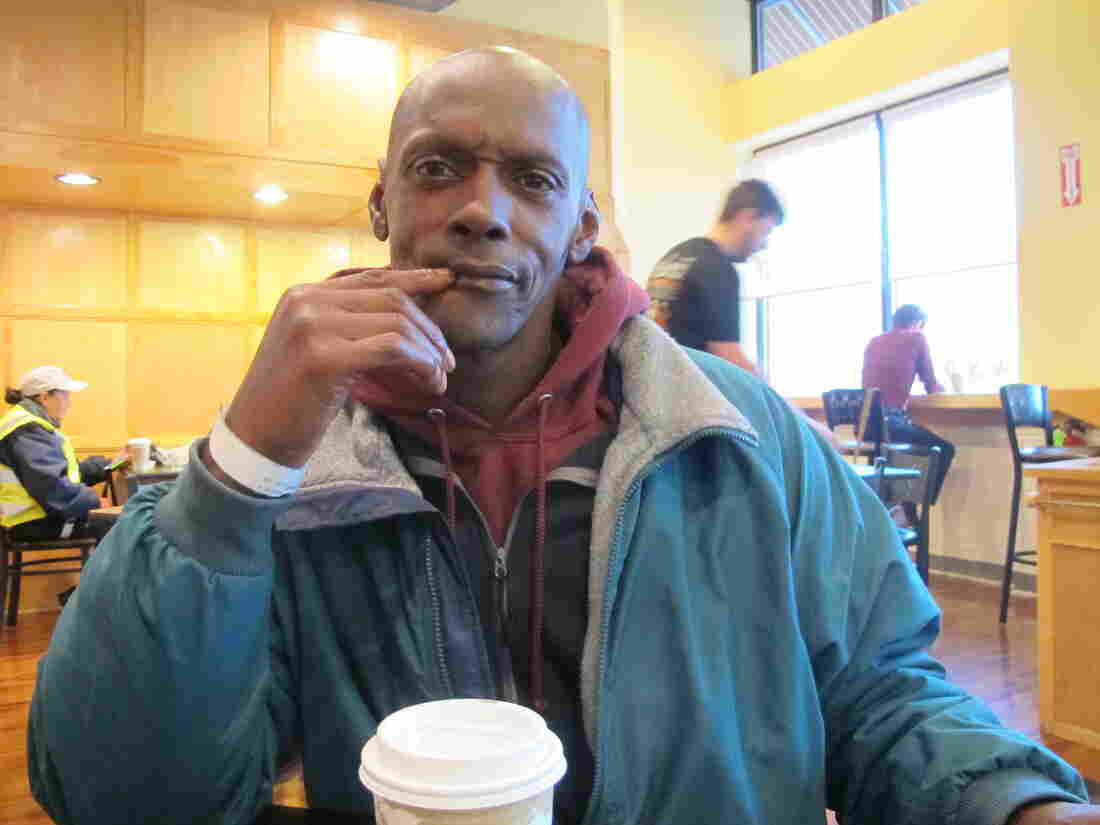
Michael Treadwell sat at the back of a courtroom in New Hampshire. He wore a windbreaker and khaki pants and leaned over his work boots with his elbows on his knees. At first it looked like he was chewing gum — a bold choice in a courtroom. But when he spoke it was clear: He wasn’t chewing gum, he was chewing his own gums. Michael doesn’t have any teeth.

Taxpayers in Hillsborough County, N.H., have spent $63,000 over the last six years keeping Treadwell in jail for little more than trespassing.

For years now, his life has looked like this: Trespass in an apartment building, spend 30 days in jail; bother restaurant customers, spend 42 days in jail; panhandle aggressively, spend 30 days in jail.

“When you live in a town like Nashua, there’s not a lot of homelessness there, and it kinda like focuses, puts you in the spotlight,” Treadwell says. “Especially if you drink alcohol and stuff.”

His charges all come from some combination of being homeless and getting drunk. Still, he says, jail is no worse than the streets.

“People kill homeless people, violence and everything else,” Treadwell says. “It can be a very dangerous life to live in. I don’t suggest jail as an alternative. Ain’t no kinda life.”

At the courthouse, he pleads guilty to public urination. He says he didn’t think life would be like this when he was younger.

Treadwell did do time for drug charges in the early ’90s. But for years, his ex-wife Sherri Treadwell says his life was on the right track. He traversed the country driving trucks — a job he loved. They had two daughters. She says she remembers the man she married.

“He’s the first one to give you the shirt off his back. If you need any help, he’s right there,” Sherri says. “And he has a really good sense of humor. When he has his teeth he has the biggest, brightest smile. It just covers him, covers his whole face.”

To Sherri, the drinking, the homelessness, the stints in jail — they’re all symptoms of his schizophrenia.

She says it started just a year or two into their marriage when Michael began acting strange.

“He would think there’s people listening in on our conversations,” Sherri says. “He would whisper to me in the car, ‘Shhh the car is bugged!’ No, the car’s not bugged. He wouldn’t talk on the phone.”

Sherri says Treadwell turned to alcohol to cope. They divorced in 2007.

A year after getting divorced, Michael walked into a church looking for bus money, and met Jarretta Copeland. Nine years later, Copeland knows him better than anyone — including how bad he can get when he drinks.

“He gets to yelling and screaming and hollering, and he’s talking and he’s cussing people out, swearing and carrying on and so forth and whatnot,” Copeland says. “It scares people because they don’t know what his intentions are.”

It was Copeland who got Treadwell diagnosed with schizophrenia. Over and over, she’s tried to get him into New Hampshire’s state mental hospital, and failed. Even a judge’s order couldn’t get him from jail to the hospital.

Instead, Treadwell continues to cycle from the streets to court, to jail and back again.

His story is not uncommon. Half of jail inmates nationwide have a combination of mental health and substance use problems, according to the Department of Justice.

Sherri says the system isn’t just failing people like Michael. It’s failing their families as well. Her daughters don’t have a dad around. She works two jobs and is rarely home. They miss him.

“His liver is gone now because of the alcoholism, so we know he’s not going to be around for too much longer. And this hurts the girls and I,” Sherri says. “And it hurts me more, because I know the system could have done something.”

Treadwell last said he wanted to go down to South Carolina, where he grew up, to get his trucking license back in order. Ultimately, he did make it to South Carolina — he ended up in a jail there.

Let’s block ads! (Why?)

How A Budget Squeeze Can Lead To Sloppy Science And Even Cheating

Stories of outright misconduct are rare in science. But the pressures on researchers manifest in many more subtle ways, say social scientists studying the problem.

Eva Bee/Getty Images

hide caption

toggle caption

Eva Bee/Getty Images

A funding crunch for scientific research is creating incentives for scientists to cut corners and even occasionally to cheat.

This is one of the findings in a new report about scientific integrity from the National Academies of Sciences, Engineering and Medicine.

Sometimes scientists adopt sloppy practices that can lead to false conclusions. This can hamper progress in science. And taxpayer dollars are on the line.

Consider the story of a genetics lab at the University of Wisconsin. Mary Allen was a graduate student in that lab in 2005. One postdoctoral researcher had been laid off because of a funding shortage, and the professor in charge of the lab was scrambling to keep the laboratory afloat by seeking more grants.

But Allen and her five fellow graduate students noticed that a grant document didn’t accurately describe work that had been previously done in the lab.

“We weren’t certain it was falsification,” Allen says. “It could have been a mistake. The results sounded slightly better than they really were.”

Allen and her fellow graduate students faced a difficult decision.

“If it’s really falsification, we may not have the ability to keep going in grad school, or they may ask us to go to another lab and start new projects,” she says. “Either way, that would be a huge hit to everybody’s career.”

The graduate students decided to talk to the department chairman about the issues they’d found. Ultimately the professor quit, and later pleaded guilty to scientific misconduct. This story was first reported by Science magazine in 2010.

The students in the lab liked their professor and thought she was doing good work. So why did the professor tinker with the grant report in the first place?

“I think one of the reasons she did it was she was under so much stress about getting funding for the students,” Allen says. So, “she decided tweaking the data a little to make it look better would allow her to get a grant and therefore fund us.”

The former professor did not respond to NPR’s request for comment.

Stories of outright misconduct like this are rare in science. But the pressures on scientists manifest in many more subtle ways.

If people are working as hard as they can and as smart as they can, they may look for other ways to get a further edge to succeed in their careers, says social scientist Brian Martinson at the HealthPartners Institute in Minneapolis.

“Some proportion of people might find themselves making bad decisions and cutting corners,” he says.

Martinson has surveyed university scientists and asked them about behaviors that he calls undesirable. These can include poor data handling, not keeping tight control of patient privacy and bending other rules.

“Almost half of the scientists who responded to our survey said they had engaged in at least one of those activities in the prior three years,” Martinson says. And many said they had violated multiple standards.

“When you get people engaging in that many kinds of consistent, undesirable practices, this can certainly undermine the quality of the work,” he says, “and therefore the ability to reproduce it.”

Many studies that get published in the biomedical literature can’t be reproduced in other labs. This slows progress in medical research, because scientists spend a lot of time chasing down false leads. That hampers the search for understanding disease and seeking treatments.

Some of this is unavoidable, simply because scientists are exploring the edges of knowledge. But there’s plenty of room for improvement.

“If you’ve got people who are cutting corners, if you’ve got people who are doing things to undermine the quality of research, you’ve got to ask why,” Martinson says.

Sometimes scientists simply don’t know better. Occasionally scientists willingly cheat. But often these behaviors are driven by bad incentives in the system.

“I think what we’re really talking about here is human nature,” says C.K. Gunsalus, director of the National Center for Professional and Research Ethics at the University of Illinois. She and Martinson both served on the National Academies’ committee on research integrity.

“If you’re in an environment that has very high stakes and very low chance of success, those are two of the predictors of environments in which people are going to cheat,” Gunsalus says.

That’s exactly the environment where many scientists find themselves today. There are strong career incentives to bend the rules, by exaggerating accomplishments in a grant proposal, for example.

“One of the rules in life is if you reward bad conduct you’re going to get a lot more bad conduct,” Gunsalus says, “because even people with Ph.D.s can figure out what you’re rewarding and say, ‘Ooh! If that’s what it takes to get ahead, I can do that.’ “

But if scientists see everyone else playing by the rules, they are more likely to do so as well. That’s why Gunsalus, who swoops into troubled academic departments to fix dysfunction, looks to see whether the leaders are setting a good example. If they are, others are likely to follow.

“People do fundamentally care about the rigor and integrity of research because that’s how progress happens,” she says. “I mean, you can’t scam the facts or nature, right?”

And in addition to scientific progress and tax dollars, careers are at stake here.

Mary Allen says only three of the six grad students in her uprooted lab ended up getting Ph.D.s, despite the many years all of them had put in. It took her 8 1/2 years to complete hers.

Allen recently got a job as a research assistant professor at the University of Colorado, Boulder. So now she finds herself in the same position as her former professor — on the quest for scarce grant funding.

In 2005, when the misconduct took place, “it was the worst funding NIH had seen,” Allen says, “and we’ve only seen it go downhill. So it’s even worse than it was before.”

Let’s block ads! (Why?)

Maps Show A Dramatic Rise In Health Insurance Coverage Under ACA

New data from the U.S. Census Bureau present the most detailed picture yet of the dramatic rise in the number of people covered by health insurance since the Affordable Care Act went into effect.

County-level data going back to 2010, when the law was signed, show a patchwork of people living without health insurance that ticked down slowly for the first three years under the ACA. But once the online insurance exchanges opened at the end of 2013 and Medicaid expanded, the population living without coverage dropped noticeably.

The recently released census report is county-level data for 2015. Overall, the nationwide uninsured rate dropped 7.7 percentage points for people under 65 years old between 2010 and 2015, from 18.2 percent in 2010 to 10.5 percent in 2015.

Although the opening of the online exchanges and Medicaid expansion contributed most noticeably to the increase in the number of people with health insurance, other elements of the health care bill went into effect earlier.

For example, since 2010 the law has allowed young people to stay on their parents’ health insurance until age 26.

A year-by-year breakdown of the county-level uninsured rate shows how the portion of the population with health insurance has risen as the Affordable Care Act has gone into effect. It also shows the persistent differences in insurance coverage by state and county.

According to the census data, the U.S. counties with the top five reductions in the number of uninsured people between 2010 and 2015 are large, urban counties: Miami-Dade County, Fla.; Los Angeles County, Calif.; Orange County, Calif.; Cook County, Ill.; and Harris County, Texas.

In 2012, the Supreme Court upheld the Affordable Care Act but gave states a choice about whether to expand Medicaid to cover more of their citizens. Under the Medicaid expansion, the federal government made money available to state governments to cover the costs of low-income people who were not previously eligible for Medicaid.

Today, 31 states and the District of Columbia have expanded Medicaid. In most of those states, the expansion took effect in 2014, when the online health insurance exchanges also went live.

As NPR’s Alison Kodjak has reported, a handful of states that first rejected the expansion have since embraced it, including Louisiana and Montana.

And nationwide, a lot more poor people are covered by health insurance than were before the Affordable Care Act.

People who do not make much money, and who are less likely to have health insurance, have especially benefited. While the national uninsured rate has dropped by 6.3 points since 2013, it has dropped by 8.9 points for those below the federal poverty level and by 12 points for those whose income is between 100 and 200 percent of the federal poverty level.

Let’s block ads! (Why?)

What Doesn't Kill You Can Maim: Unexpected Injuries From Opioids

Lisa, a client at the AAC Needle Exchange and Overdose Prevention Program in Cambridge, Mass. Nearly five years after an opioid overdose she still limps — possibly because of damage the drug cocktail did to her nerves or muscles.

Robin Lubbock/WBUR

hide caption

toggle caption

Robin Lubbock/WBUR

The trouble started for Lisa when she took a blood pressure pill and one to control seizures, along with methadone, a drug used to help wean patients off heroin.

“I inadvertently did the methadone cocktail and I went to sleep for like 48 hours,” Lisa says, rolling her eyes and coughing out a laugh. “It kicked my butt. It really kicked my butt.”

The last thing this 46-year-old Somerville, Mass., native remembers is starting to do laundry. That’s where Lisa’s daughter found her — passed out on the washing machine.

“My daughter brought me up and put me to bed. I hate the fact that she saw me like that,” says Lisa. We’re not using her last name because she’s used illegal drugs and fears going public about that could harm job prospects.

Lisa lay in the same position on the bed, one leg bent under her body, arms folded across her chest, for more than a day. Family members checked to make sure she was still breathing. Lisa’s daughter noticed that her mom’s right leg had gone white and looked shriveled.

“She came in and massaged it really, really vigorously,” Lisa says. “If she hadn’t done that, I don’t think I’d be walking on this leg. I think I would have killed it.”

As it is, almost five years after the injury, Lisa says she still limps in some weather, “or I have what I call flabberfoot. My foot, like, slaps the ground when I walk.”

Lisa never told a nurse or doctor about her injury.

“I was embarrassed. I didn’t want anybody to know I had a drug problem,” she says.

Lisa’s injury may reflect nerve damage, which doctors say is common in people who misuse opioids. Or it may have been the result of something called compartment syndrome, where muscles are damaged or die because blood can’t get in or out of part of an arm or a leg. In some such cases, the damaged muscles must be removed.

Dr. Ed Boyer remembers one of the first patients he treated in Massachusetts, a man who injected heroin while sitting, and stayed in that position, leaning to one side, for hours on end.

“When he woke up, he had a compartment syndrome of his buttock and they had to remove half of it,” says Boyer, the director of academic development in the emergency medicine department at Brigham and Women’s Hospital, and a professor at the University of Massachusetts Medical School.

“So you can have very severe and disfiguring injuries,” Boyer says. “Because now this individual has great difficulty even walking.”

Lingering damage to those who survive overdose

The common understanding of patients addicted to heroin or other opioids is that they either survive a high or die — but that there’s no real damage to those who get up and walk away. Increasingly, emergency room doctors will tell you that’s not the case.

“I would say at least 75 percent — every three of four patients who comes in after an overdose — has some sort of associated injury, whether it’s a minor injury or major injury from that overdose,” says Dr. Ali Raja, the vice chair of emergency medicine at Massachusetts General Hospital, the busiest emergency room in the Boston area.

The trauma ranges from frostbite or broken bones after a fall on the ice to serious brain damage. Raja says many injuries from drug use don’t get treated because patients who are revived never come to the hospital, and those who do are driven by their addiction to leave the hospital quickly and use again.

“They often believe that they’re just fine and they repeat the exact same circumstances that led to the overdose in the first place,” Raja says. “And they’re definitely prone to repeating the same injuries we just talked about.”

That prompts another question for the emerging science of drug and overdose injuries: What’s the effect of overdosing again and again? Dr. Alex Walley, an associate professor of medicine at Boston University School of Medicine, offers a theory about the impact on the brain.

“One way to think about this would be that an overdose is like a concussion, where you have a traumatic injury to the brain,” Walley says. “If the person doesn’t die, the brain recovers, but they may be, like with a concussion, more susceptible to a future event. And then there also may be cumulative damage that occurs.”

That damage, Walley says, might make these patients more difficult to treat.

Another injury that doctors see among some overdose patients is kidney failure. When a person spends hours in one position, blood stops circulating through muscles and that living tissue can break down, releasing chemicals into the bloodstream.

“They can clog up the filtration system in the kidneys,” says Dr. Melisa Lai Becker, chief of the Cambridge Health Alliance emergency department in Everett, Mass. “And when that happens, the kidneys can shut down completely.”

Patients coming out of an overdose often vomit, which can lead to aspiration into the lungs and pneumonia. And then there’s a condition called pulmonary edema, which hits some patients who are revived — their lungs fill suddenly with fluid.

“The lungs become so waterlogged that you can’t get any more oxygen into the body even though the patient is wide awake and they’re struggling to breathe,” Lai Becker says.

Doctors offer different theories about why this occurs. Lai Becker says it may be related to a sudden change in blood pressure when a patient is revived abruptly with naloxone. Other doctors think it’s a reaction to some part of the drug combination patients take. There are lots of questions among emergency doctors about why this is happening — it’s why researchers at the Centers for Disease Control and Prevention are now wading into this new field of opioid use injuries, to try to get some data.

“We’re only beginning to scratch the surface and trying to understand what is going on, on this front,” says Mark Faul, a senior health scientist at the CDC.

Faul is studying the possible link between the opioid overdose and traumatic brain injury. He plans to collect data about how often an overdose leaves patients with permanent or temporary brain damage that that can leave them blind or deaf, or with amnesia or other cognitive problems.

Fentanyl compounds the problems

And there’s one more complicating factor: fentanyl. This very powerful opioid gives those who use it recreationally a high that is more intense than heroin’s, but wears off more quickly. Traci Green, a senior scientist and deputy director of the injury prevention center at Boston Medical Center, says that means recreational drug users tend to use fentanyl more times a day than they would pure heroin.

“It also means more opportunity to overdose,” Green says. “Simple math tells us that we’re going to have more visits to the emergency department and we’re going to potentially have more injury. And injury will beget injury.”

Fentanyl can also change the kind of injuries some emergency rooms see — more falls and head trauma because taking too much of the opioid cuts off breathing immediately and patients collapse. But Lai Becker has a different perspective. She says she has treated fewer of what she calls “in between” injuries in the last six months.

On one end of the spectrum, she says, “we’re seeing people who have fortunately had a good, full, complete reversal.” On the other extreme, she says, “patients have either arrived dead, or we’re able to resuscitate them, but unfortunately, they’ve already undergone brain death.”

To avoid fentanyl injuries and overdoses, Green urges people who are addicted to the drug to at least use it in pairs — making sure one partner is stable before the other person injects. She says the state could help, too, by allowing patients who are addicted to opioids to use the drugs in a supervised setting like a hospital or clinic.

“Individuals who are able to spend time there don’t have to worry about hypothermia,” Green says. “They don’t have to worry about being hit or kicked or struck by a truck. This is something we should consider — this is a new era of prevention and intervention.”

This story is part of a reporting partnership with NPR, WBUR and Kaiser Health News.

Let’s block ads! (Why?)
Get Set For Trump Revisions To Your Affordable Care Act Insurance

The Trump administration is proposing changes to Obamacare that the White House says should stabilize the insurance marketplace. But critics of the proposal see big bumps ahead for consumers.

Gary Waters/Ikon Images/Getty Images

hide caption

toggle caption

Gary Waters/Ikon Images/Getty Images

Repeal and replace is on-again, off-again, but that doesn’t mean the rules affecting your insurance will stay the same in the meantime.

The Trump administration’s proposed rule aimed at stabilizing the existinghealth law’s insurance marketplace could have rapid, dramatic effects — perhaps as soon as early summer — on people who do not get insurance through work, and buy it on the Affordable Care Act’s exchanges instead.

If the changes the administration proposed in February hold up in the final draft — which is expected out soon — look for a shorter enrollment window, tighter vetting of people who sign up outside of those open periods and efforts to penalize consumers who don’t maintain “continuous coverage.”

The controversial proposal by the Department of Health and Human Services drew letters from nearly 4,000 organizations and individuals during an unusually short, 20-day public comment period that ended in early March. Consumer advocacy groups hate the proposal, saying it would wreak havoc by making it harder to get coverage.

But some specialists in the health law, including Christopher Condeluci of CC Law & Policy in Washington, D.C., see the HHS proposal as helpful for insurers, though he also thinks more adjustments are necessary.

“Does it meet all the carriers’ asks when it comes to what changes are needed? No, I don’t think it goes far enough,” said Condeluci, a former staffer to the Senate Finance Committee who specialized in insurance issues.

Sabrina Corlette, an attorney who studies the individual marketplace for the Center on Health Insurance Reforms at Georgetown University, said the directive could result in fewer healthy enrollees – which insurers also would not like – and don’t address some of the biggest concerns for the insurance industry, such as the fate of federal subsidies that help low-income consumers pay deductibles and other out-of-pocket costs.

The Trump administration’s proposal, Corlette said, is “nibbling away at the margins.”

Here are four ways the stabilization rule might change the individual health insurance market:

If you owe, you pay first

Under the proposed rule, consumers who want to sign up for an ACA plan with their same insurer for 2018 would have to repay past-due premiums from the previous 12 months before being granted new coverage. Because Obamacare has allowed a three-month grace period before people who haven’t paid premiums are kicked out of coverage, a consumer’s overdue premiums could tally hundreds of dollars — even more than $1,000.

Trump’s proposed change aims to discourage people from gaming the system. Insurers say a person with a bad knee, for example, might enroll and pay just long enough to get an expensive knee replacement, then stop paying premiums.

But wait, consumer groups and the National Association of Insurance Commissioners warn.There might be legitimate reasons people stop paying premiums — billing errors that are not the fault of the consumer, for example, or the loss of a job. By making such a change, the groups argue, the Trump administration would violate a key part of the health law that requires insurers to offer coverage to just about everyone who applies.

Under Trump’s proposed change, “only those who can rapidly come up with a possibly significant sum of money by a given deadline can be guaranteed access to coverage,” wrote Families USA.

Some insurers have recommended broadening that proposal to include “unpaid premiums for any prior coverage year.”

Better act quickly

Open enrollment this fall (for 2018 health insurance coverage) would shorten to six weeks, down from three months. While opening day would remain the same — Nov. 1 — the proposal would close the marketplace on Dec. 15 instead of at the end of January. That period “provides sufficient time for consumers to enroll,” the administration has said, and would mean all who sign up would have a full year of coverage starting Jan. 1.

The shorter time period, the administration said, could also reduce the number of people who wait to enroll until after they find out they have a health problem. These late joiners are likely to use more health care than a healthy person their age, insurers and the Trump administration say, and can drive up the cost of insurance to everyone.

Consumer groups argue the Trump proposal could backfire, because those who tend to wait until the last minute to sign up are actually often the youngest and healthiest – and they may miss the enrollment window if it is shorter. Additionally, the proposed deadline falls around the holidays, when money and time are often tight, which could have a chilling effect on insurance sign-ups.

Prove you have a reason — and maybe prior coverage

The ACA allows people to sign up outside the open enrollment period for a variety of special reasons, such as moving, losing coverage, getting married or having a child. This provision has always been a sticking point with insurers, who have maintained that too many customers who made a change during the special enrollment period were sicker and costlier than average. In response, the Obama administration tightened some of these requirements last year and announced it would run a pilot program starting this summer to randomly select half of all special enrollment applicants for verification review, holding up the applicant’s insurance coverage until they provide the proper documentation.

Under the Trump administration’s proposal, 100 percent of those applications would be required to undergo preapproval verification – beginning in June 2017. Consumers would have to provide documentation proving they qualify for special enrollment before getting coverage. The administration also proposes that for marriage, at a minimum, one member of the couple would have to prove they had health coverage for at least one day in the two months before their nuptials.

Consumer groups are unhappy with the pre-verification idea – and the extra requirement for prior coverage of people who are getting married. Particularly hard hit would be couples who were uninsured previously because they could not afford health insurance as singles — or could not get it under their state’s Medicaid rules. Additionally, consumer advocates and some regulators say requiring newlyweds to prove prior coverage violates the health law.

Still, the Trump administration asked whether continuous coverage rules should be extended to all special-enrollment customers, not just those getting married. Perhaps people should prove they had coverage for the previous six to 12 months, the administration suggested, or else face a waiting period or financial penalty.

Flexibility – or higher deductibles?

The health law uses a complex formula to divide plans into metal tiers — bronze, silver, gold and platinum — based on an average percentage of a typical year’s health care bills each level of plan covers. Bronze plans, for example, currently must cover an average of 60 percent of costs, while a silver one is 70 percent – and insurers are allowed wiggle room of plus or minus 2 percent around those averages.

The Trump proposal would tweak the formula, allowing insurers to create plans with larger variations around the average. (It exempts certain silver plans for low-income consumers from the change.) So, for example, a bronze plan might cover only 56 percent of costs and silver 66 percent. Insurers say this would allow them to create plans that appeal to more customers, particularly those looking for lower premiums. But critics say the move would increase the size of deductibles.

One big problem in boosting enrollment has been that many potential consumers — particularly younger, healthier ones — say premiums are too high. But adjusting the law in this way could raise deductibles and other cost-sharing requirements, which consumers may dislike even more. While the health law sets a maximum cap per year on such payments, for many people those deductibles are already thousands of dollars annually. Under the proposal, deductibles could increase by more than $1,000 a year, according to an analysis by the consumer advocacy group Families USA.

Please, may I have some more?

Topping insurers’ wish list for other changes — which would require legislative action by Congress — would be permanent federal financial support for insurers that face high-dollar claims from some policyholders. Insurers have argued that change is important if they are to hold down premium costs across the board. Insurers also want a surcharge for people who let their coverage lapse, and the permission to charge older people five times more than younger ones, a practice known as “age rating.” The current limit is 3:1. Widening that ratio could lower premiums for young people but cause big hikes for people older than 45.

Cigna said it would like to see an “appropriately funded system of state-designed high-risk pools,” where people with costly illnesses could be sent. So, those with cancer, heart disease or other illnesses would be shunted into those pools, reducing spending — and perhaps premiums — for all remaining in the regular pool. High-risk pools historically, however, have been underfunded, often leading to expensive premiums for enrollees, long waitlists or annual limits on care.

Kaiser Health News, a nonprofit health newsroom whose stories appear in news outlets nationwide, is an editorially independent part of the Kaiser Family Foundation.

Let’s block ads! (Why?)

What Happens To A Congressman's Health Insurance If Obamacare Goes Down?

Members of Congress and their staffs seeking health insurance this year could choose from among 57 gold plans (from four insurers) sold on D.C.’s small business marketplace.

Zach Gibson/Getty Images

hide caption

toggle caption

Zach Gibson/Getty Images

As members of Congress debate the future of the health law and its implications for consumers, how are they personally affected by the outcome? And how will the law that phases out the popular Medigap Plan F – popular supplemental Medicare insurance — affect beneficiaries? We’ve got answers to these and other recent questions from readers.

What type of insurance do our elected representatives in Washington, D.C., have? Is it true that they’re insured on the ACA exchanges now and that any repeal and replacement will affect them too?

Under the Affordable Care Act, members of the U.S. House of Representatives, the Senate and their office staffs who want employer coverage generally have to buy it on the health insurance exchange. Before the ACA passed in 2010, they were eligible to be covered under the Federal Employees Health Benefits Program. (People working for congressional committees who are not on a member’s office staff may still be covered under FEHBP.)

The members of Congress and their staffs choose from among 57 gold plans from four insurers sold on the DC Health Link’s small business marketplace this year.

Approximately 11,000 are enrolled, according to Adam Hudson, a spokesperson for the exchange. The government pays about three-quarters of the cost of the premium, and workers pay the rest. They aren’t eligible for federal tax credits that reduce the size of insurance premiums.

For some other members of Congress, declining exchange coverage was a political statement.

“There are several who, because of animus to Obamacare, rejected the offer of coverage, and either buy on their own or get it through a spouse,” said Sabrina Corlette, a research professor at Georgetown University’s Center on Health Insurance Reforms.

Proposed bills to replace the ACA don’t affect this provision of the law, said Timothy Jost, a professor emeritus of law at Washington and Lee University School of Law in Lexington, Va., who has written widely on the regulation of health care and its reform.

I am told by our insurance broker that in 2020 Medicare is eliminating Medigap Plan F. Having to switch to a new plan may be difficult for many seniors whose health has deteriorated. Should seniors act early, if needed, to switch Medigap plans while they still have good health?

You needn’t worry. As long as you continue to pay your Medigap Plan F premium you won’t lose that coverage.

“This guy can hang onto his F plan forever,” said Bonnie Burns, a training and policy specialist at California Health Advocates, a Medicare advocacy and education group.”All Medigaps are guaranteed renewable as long as the premiums are paid,” she said.

There are 10 standard Medigap plans, sold by a variety of private insurers, that pay for expenses that Medicare doesn’t include. These supplemental plans are identified by letter from A through N. They cover – to varying degrees — beneficiaries’ out-of-pocket Medicare costs, including deductibles and coinsurance. All the plans with the same letter offer the same basic benefit.

When seniors first enroll in Medicare, insurers must sell them a Medigap plan without taking their health into account. But if those who are eligible wait, or want to switch plans later, they can be turned down.

Medigap plans F and C cover all the Medicare costs that the program doesn’t pay for, including the deductible for Medicare Part B (which covers outpatient care, such as doctor visits). Generally, that Part B deductible in 2017 is $134. Plans F and C are the only two Medigap plans that cover it.

As part of the 2015 Medicare Access and CHIP Reauthorization Act, Congress decided that, starting in 2020, newly eligible Medicare beneficiaries will no longer be allowed to buy plans that pay the deductibles for Medicare Part B.

“Congress decided that people should have more ‘skin in the game,'” said Burns, referring to the idea that patients will make more prudent health care decisions if they’re on the hook for at least part of the cost.

But the change doesn’t affect anyone who is enrolled in those plans before 2020 or who will be eligible for Medicare by then even if they aren’t yet using it.

And even though Plans C and F will no longer be available to new beneficiaries, Medigap plans D and G will be good substitutes. They provide similarly comprehensive coverage — except for the Part B deductible.

Can my spouse continue to cover me under her health insurance after we are divorced?

Once you’re divorced, it’s unlikely you’ll be able to remain covered as a dependent on your ex-wife’s plan, said J.D. Piro, who leads the health and law group at benefits consultant Aon Hewitt. A few states may allow it, and that could work in your favor if the plan is subject to state law. But many large employers pay their employees’ claims directly rather than buy insurance, and they’re generally not subject to state insurance rules.

However, you may be able to keep your ex-wife’s coverage for up to three years under the federal law known as COBRA. That law applies to companies with 20 or more workers, and several states have similar laws that apply to smaller companies. The catch: You’ll have to pay the insurance policy’s full premium.

Kaiser Health News is an editorially independent news service supported by the nonpartisan Kaiser Family Foundation. Email questions for future columns: KHNHelp@KFF.org. Michelle Andrews is on Twitter: @mandrews110

Let’s block ads! (Why?)

Civilians With Severe Burns Treated At Texas Military Hospital

Physician assistant James Williams, right, describes the treatment of burn patients as “a very tactile type of medicine.”

Wendy Rigby/TPR

hide caption

toggle caption

Wendy Rigby/TPR

The burn unit at the U.S. Army Institute of Surgical Research in San Antonio, Texas, is hot. Sometimes, it gets up to 102 degrees in there, among the patients.

People with severe burns can’t regulate their own body temperatures well, so the air has to keep them warm.

“We see a lot of gruesome stuff,” says physical therapist Melissa Boddington. At the height of the fighting in Iraq and Afghanistan, more than one thousand wounded service members were flown to the hospital.

The burn center’s mission is to treat members of the military for burns from fire, explosions, chemicals or radiation. The treatments can include skin grafts, amputations and inpatient rehabilitation to regain mobility or learn to live with a body that has changed dramatically.

Rehabilitation often takes months for patients at the U.S. Army Institute of Surgical Research Burn Center in San Antonio, Texas.

Wendy Rigby/TPR

hide caption

toggle caption

Wendy Rigby/TPR

More than 15 years of war have led to major advances in burn care. In one case, a roadside bomb blast in Afghanistan burned more than 97 percent of one Marine’s body. He was flown to San Antonio, and survived.

Thousands of U.S. troops are still in war zones, but with the end of major combat missions in Iraq and Afghanistan and fewer soldiers coming home badly burned, the military burn center is treating more civilians.

Col. Booker King, the director of clinical services, says burn specialists also work with orthopedists, eye doctors or kidney specialists because people who come in with burns often have other serious injuries as well.

Most of the patients treated at the burn center right now are civilians who were burned in car wrecks, house fires, cooking incidents or workplace accidents in the oil industry. Because the hospital is on a military base, Fort Sam Houston, a special dispensation from the Secretary of the Army allows them to be treated there.

Therapists spend much of their time stretching patients to keep them limber as they heal.

Wendy Rigby/TPR

hide caption

toggle caption

Wendy Rigby/TPR

70-year-old Marty Wender spent 90 days in the intensive care unit at the burn center after he fell while he was taking a hot shower. He either passed out or hit his head. By the time his wife found him unconscious, he had burns over 20 percent of his body.

“When EMS showed up, they thought I was dead,” he says. “It was across my chest. The biggest burn was on my back and on my right arm and my two hands.”

The staff at the burn center helped Wender recover from his injuries. He lost two fingers.

“It keeps everybody honed, ready to get the job done,” says James Williams, a physician assistant in the burn unit. “It’s a very tactile type of medicine. If you’re not using your skills, you can lose them.”

“[We] treat a 17-year-old who got burned from throwing gas on the grill the same as we would treat a soldier who may have gotten injured in combat,” he explains.

Let’s block ads! (Why?)
How U.S. Health Care Became Big Business

The current health care system focuses too often on financial incentives over health or science, says Elisabeth Rosenthal in her new book, An American Sickness.

Bill Diodato/Getty Images

Health care is a trillion-dollar industry in America, but are we getting what we pay for? Dr. Elisabeth Rosenthal, a medical journalist who formerly worked as a medical doctor, warns that the existing system too often focuses on financial incentives over health or science.

“We’ve trusted a lot of our health care to for-profit businesses and it’s their job, frankly, to make profit,” Rosenthal says. “You can’t expect them to act like

On the ways the health-care industry stands to profit more from lifetime treatment than it does from curing disease

If you’re a pharmaceutical manufacturer and you have a problem like diabetes, for example, if I invented a pill tomorrow that would cure diabetes — that would kill a multi-billion dollar business market. It’s far better to have treatments, sometimes really great treatments … [that] go on for life. That’s much better than something that will make the disease go away overnight.

On how prices will rise to whatever the market will bear

Another concept that I think is unique to medicine is what economists call “sticky pricing,” which is a wonderful term. It basically means … once one drugmaker, one hospital, one doctor says “Hey we could charge $10,000 for that procedure or that medicine.” Maybe it was $5,000 two months ago, but once everyone sees that someone’s getting away with charging $10,000, the prices all go up to that sticky ceiling. …

What you see often now is when generic drugs come out … the price doesn’t go down to 20 percent of the branded price, it maybe goes down to 90 percent of the branded price. So we’re not getting what we should get from a really competitive market where we, the consumers, are making those choices.

On initiating conversations early on with doctors about fees and medical bills

You should start every conversation with a doctor’s office by asking “Is there a concierge fee? Are they affiliated with a hospital? Which hospital are they affiliated with? Is the office considered part of a hospital?” In which case you’re going to be facing hospital fees in addition to your doctor’s office fees. You ask your doctor always … “If I need a lab test, if I need an X-ray, will you send me to an in-network provider so I don’t get hit by out-of-network fees?” …

Often that will be a little hard for your doctor, because they may have to fill out a different requisition, but it’s worth asking. And any doctor who won’t help you in that way, I think, isn’t attuned to the financial cost that we’re bearing today.

On getting charged for “drive-by doctors” brought in by the hospital or primary doctor

You do have to say “Who are you? Who called you?” and “Am I going to be billed for this?” And it’s tragic that in recovery people have to think in this kind of keep-on-your-guard, somewhat adversarial way, but I think if we don’t push back against the system in the way it bills, we’re complicit in allowing it to continue.

On how to decipher coded medical bills

Don’t be alarmed by the “prompt payment discount.” Go back to the hospital and say, “I want a fully itemized bill. I want to know what I’m paying for.” Some of it will be in codes, some of it will be in medical abbreviations. I’ve discovered you can Google those codes and find out what you’re being charged for, often, and most importantly, you might find you’re being charged for stuff that obviously you know you didn’t have.

Elizabeth Rosenthal is editor-in-chief ofKaiser Health News,an editorially independent news program of the Henry J. Kaiser Family Foundation and a partner of NPR’s. Neither KFF nor KHN is affiliated with Kaiser Permanente. Radio producer Sam Briger and web producers Bridget Bentz and Molly Seavy-Nesper contributed to this story.

Let’s block ads! (Why?)

Rep. Mike Johnson On Revived GOP Health Care Plan

After the collapse of a Republican effort to repeal the Affordable Care Act, House Republicans say they’ve made changes to their health care plan. Rachel Martin talks to Republican Rep. Mike Johnson.

Let’s block ads! (Why?)