Rep. Donovan: GOP Health Bill Does Not Solve Problems Of Affordable Care Act

NPR’s Audie Cornish speaks with Republican Rep. Dan Donovan who says he plans to vote against the GOP health care bill.
NPR’s Audie Cornish speaks with Republican Rep. Dan Donovan who says he plans to vote against the GOP health care bill.
The House of Representatives delayed a scheduled Thursday vote on the GOP health care bill aimed at rolling back and replacing the Affordable Care Act. The White House is working to cut a deal with a bloc of conservatives in order to pass it.

House Speaker Paul Ryan speaks to reporters after a meeting with President Donald Trump, who came to Capitol Hill to rally GOP lawmakers behind the Republican health care overhaul.
J. Scott Applewhite/AP
hide caption
toggle caption
J. Scott Applewhite/AP
Republicans will be tested today on the strength of party unity in the Trump era and their party’s ability to deliver on the promises they’ve made to the voters that sent them here.
“This is our chance and this is our moment. It’s a big moment,” House Speaker Paul Ryan told reporters earlier this week. “And I think our members are beginning to appreciate just what kind of a ‘rendezvous with destiny’ we have right here.”
The moment is particularly defining for Ryan, the reluctant speaker who is facing the toughest legislative battle of his nearly 20-year congressional career. “One of the reasons I don’t want this bill to fail is I don’t want Paul to fail,” said Rep. Mike Simpson, R-Idaho, an ally of the speaker who supports the bill.
The speaker has put the full weight of his office behind passing legislation that goes much further to repeal and replace key pillars of Obamacare, to remake Medicaid into a block grant program that caps federal spending. The entitlement program predominantly helps the poor and currently has an open-ended funding stream.
It’s the kind of conservative reform that Ryan has jokingly said he’s dreamed about since his keg party days, but it might not be enough — even with Republicans in control of both chambers of Congress and the White House.
The House Freedom Caucus, a bloc of about 30 hard-line conservatives, maintain going in to today’s scheduled vote that they have enough members on their side to defeat the bill. Their opposition has not softened, despite continued efforts by President Trump, Vice President Mike Pence and their senior White House aides to grant concessions and cajole lawmakers from districts Trump won by big margins last November.
“We’re being asked to sign a blank check and hope it works out,” said Rep. Scott Perry, R-Pa., a member of the Freedom Caucus, “And in the past that hasn’t worked out real well for this process, so I think we’re right to be skeptical.”
Perry was one of about 25 Freedom Caucus members who huddled with Vice President Mike Pence and White House adviser Kellyanne Conway on Wednesday. It didn’t change his vote. Conservatives like Perry want the bill to go even further to repeal President Obama’s health care law. Specifically, these conservatives want assurances the final bill would ultimately repeal essential health benefits included in the Affordable Care Act that cover 10 categories of health services insurance plans must cover, including prescription drugs and prenatal care.
“We want free market competition and how can you have free market competition when the government is mandating what’s going to be included?” Perry said. Conservatives argue that eliminating the essential health benefits will allow insurance companies to offer cheaper insurance plans with more tailored coverage. Opponents say it will only increase out-of-pocket costs for consumers.
Conservatives also received some political cover from outside conservative activist groups like Heritage Action and FreedomWorks, who came out in opposition to the bill.
The network of political action groups funded by Charles and David Koch, wealthy libertarian-minded donors who have not supported President Trump, are putting money behind their opposition to the bill. Two Koch-funded groups, Americans For Prosperity and Freedom Partners, announced last night they would establish a seven-figure fund “to stand by principled lawmakers who keep their promise of fully repealing Obamacare by opposing the American Health Care Act (AHCA) unless there are significant changes.” It amounts to a promise of protection for members who might fear a primary challenge for breaking with Trump.
As the day unfolded yesterday, it became clear that conservatives were not the only weak link in the vote count. With every new ‘yes’ vote announced, a ‘no’ vote would appear. Reps. Lou Barletta of Pennsylvania and Steve King of Iowa announced they would support the bill on Wednesday, but their support was offset by fresh opposition from lawmakers including Don Young of Alaska, David Young of Iowa, and Frank LoBiondo of New Jersey.
The trio of opponents are mainstream Republicans, the kind of rank-and-file members party leaders can usually rely on to pass their agenda. But the policy in the GOP bill, the American Health Care Act, would disproportionately affect older, poorer Americans — the very constituents who make up many GOP lawmakers base of support back home.
For instance, LoBiondo said in a statement that his South Jersey district and it’s retirees would suffer under AHCA. “Three South Jersey counties have more than 30% of their residents receiving Medicaid assistance. Medical professionals—our hospitals, doctors, nurses—are opposed,” he said.
The speaker focused on more moderate members of the GOP, working members during House votes on Wednesday and holding one-on-one meetings in his office throughout the day.
“If you don’t recognize how much is on the line, you haven’t been paying attention,” said Rep. Tom Cole, R-Okla. He supports the bill and like many lawmakers remained optimistic that the votes would come together to pass it. Cole even suggested they might have to win the vote on the floor. “You never know about these things until you actually get to the vote,” he said.
With five vacancies in the 435-member House, Republicans can lose 21 votes and still pass the bill. Every Democrat is expected to vote against it. House Republicans enjoy one of their largest majorities in decades, so the 21-vote cushion is much larger than past GOP-controlled congresses have enjoyed.
Cole said most Republicans were aware of the importance of this vote: “It’s a very consequential vote. It really is: ‘Can you govern or can’t you’?”
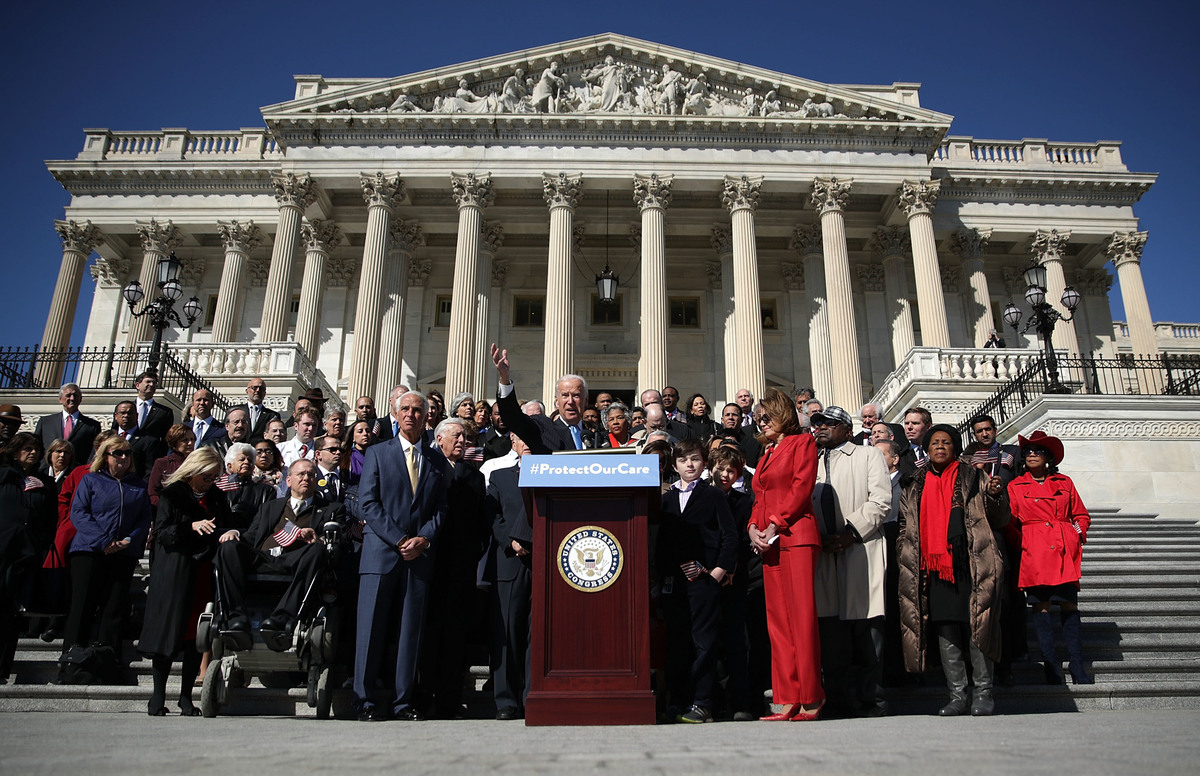
For their part, Democrats are unified against the bill, which undoes President Obama’s signature domestic achievement. Former Vice President Joe Biden returned to Washington to voice his opposition to the bill at a rally outside the U.S. Capitol.
“Look, folks, here’s the deal: When you cut to the chase, we’re talking about eliminating close to a $1 trillion in benefits that go to people to be able to meet the commitment we made that health care is a right, and we’re transferring all of that to the wealthy,” Biden said. “That’s what this is all about, it’s about a transfer tax, basically. Eliminating the Affordable Care Act means eliminating an awful lot of things that people need.”
If the House approves the bill on Thursday, the thrill of victory will be short-lived. The bill still needs to pass the Senate, and it faces a new round of opposition and legislative hurdles to pass that chamber. The bill then would need to pass the House again to approve any Senate-passed changes before it could go to President Trump’s desk.
President Trump and top House Republicans are working to secure the votes needed to pass the GOP health care bill in the countdown to a scheduled vote in the House Thursday.
A vote on the Republican health care plan in the House is scheduled for Thursday. Some very conservative Republicans say they’ll vote against it.
NPR’s Kelly McEvers speaks with Republican Rep. Bradley Byrne of Alabama about the final changes to the GOP health care bill before it goes to a vote on Thursday.

In 2015, Medicaid spending topped $552 billion nationwide. People who receive both Medicaid and Medicare and people with disabilities account for more than half of Medicaid spending.
Katarzyna Bialasiewicz/Getty Images/iStockphoto
hide caption
toggle caption
Katarzyna Bialasiewicz/Getty Images/iStockphoto
Before Carmencita Misa became bedridden, she was a veritable “dancing queen,” says her daughter, Charlotte Altieri.
“Even though she would work about 60 hours a week, she would make sure to go out dancing once a week — no matter what,” Altieri, says. “She was the life-of-the-party kind of person, the central nervous system for all her friends.”
A massive stroke in March 2014 changed all that. It robbed Misa, 71, of her short-term memory, her eyesight and her mobility — and it left her dependent on a feeding tube for nourishment. Now, she lives in a nursing home.
Altieri is 39 and lives in Long Beach, Calif., with her husband and two small children. She can’t provide the 24-hour care her mother now gets at the nursing home three miles away — all of it paid by Medi-Cal. That’s California’s version of Medicaid, which is government insurance for low-income people.
Advocates for the elderly now worry that Misa and other low-income seniors all across the U.S. who receive long-term care in facilities or at home could see their benefits shrink or disappear under Republican-proposed legislation to limit federal Medicaid contributions to states. The proposal is part of a broader GOP plan to repeal and replace former President Barack Obama’s Affordable Care Act.
“My mom is getting the basic of basic care,” Altieri says. “If they cut it, I don’t know what to do.”
Nationwide, Medicaid provides long-term care and support to more than 2 million low-income Americans who are 65 and over. Medicaid is funded jointly by the federal government and the states and pays more than half of all long-term care in the country — “more than Medicare, private long-term care insurance and out-of-pocket spending combined,” says Matt Salo, executive director of the National Association of Medicaid Directors.
And, Salo says, it’s the only public insurance that offers such care on an ongoing basis. Medicare, government insurance for people 65 and older, provides only limited long-term care to those who need it after being hospitalized.
The GOP bill, scheduled for a vote on the floor of the House Thursday, would transform Medicaid from an open-ended system, in which the federal government matches state spending, to one that limits its contribution — either giving a fixed amount per enrollee, or a lump sum to the states.
Critics say such caps on funding would not accommodate the inevitable hikes in cost that will come from the introduction of expensive new treatments or other cost variables.
Congress has already amended the bill to allocate additional money for elderly and disabled people on Medicaid. But Eric Carlson, a directing attorney in the Los Angeles office of the nonprofit group Justice in Aging, says such an allocation would not offset the wide funding gap created by caps on federal spending.
“It doesn’t matter whether it’s a block grant or per-capita cap,” Carlson says. “Either way the federal government is setting a hard limit on federal funding available, and states are going to be forced to make due with whatever is sent to them. And it’s not going to be enough.”
Carlson is co-author of an analysisreleased by Justice in Aging that says capping federal Medicaid spending,with either per-capita funding or lump-sum payments would harm older Americans, in part by forcing states to cut services for them “to the bone.”
“It’s really a form of rationing, where you have the care based on the money that’s been budgeted rather than on the needs of the people,” Carlson says. “And that’s entirely backwards.”
In 2015, Medicaid spending topped $552 billion nationwide. People who receive both Medicaid and Medicare, and people with disabilities account for more than half of overall Medicaid spending. In addition to helping low-income seniors with long-term care, Medicaid also helps pay for some of their Medicare premiums and copays.
Under the GOP proposal, nursing care in a facility would remain a guaranteed Medicaid benefit, though states could reduce how much they spend on it if they were forced to cut their budgets. And Republicans might well attempt to loosen or undo federal requirements on the program, with subsequent legislation that would give states more control.
Such a shift would “decimate Medicaid’s current guarantee of adequate and affordable care,” according to the Justice in Aging analysis.
In the meantime, states could do away with benefits not guaranteed under federal law, which include at-home nursing care, personal care— which Medi-Cal covers for qualified beneficiaries — and even inpatient and nursing care in mental health facilities for the elderly.
A report released last week by the nonpartisan Congressional Budget Office suggests states might cut provider payments or eliminate some of their optional services to fill the funding gap left by the restricted flow of federal money.
But Oren Cass, a senior fellow with the conservative Manhattan Institute who specializes in anti-poverty law, says the current system leads to state overspending. And that overspending comes at that expense of other things, like education, he says. Cass doesn’t think the GOP plan would necessarily harm elderly Medicaid beneficiaries.
“A state that wants to continue the spending it does on the elderly can do that if it would rather make cuts elsewhere,” he says. “Or it can put up more of its own money.”
Having more flexibility, Cass says, might appeal to state legislators and health care leaders.
“If you ask California today whether it would rather have Donald Trump run its Medicaid program or run it itself, I think most people there — especially liberal people — would say they would rather have the state making the rules,” he says.
But Pat McGinnis, who heads the California Advocates for Nursing Home Reform, says that prospect worries her. “There are so many federal protections under the current Medicaid system,” she says, “and I think most of those would be gone.”
McGinnis worries that current requirements on hospital inpatient and outpatient services could disappear, for example, along with asset protections designed to keep spouses of those on Medicaid from becoming impoverished.
For now, however, the debate over the GOP bill is largely speculative, since there may be enough Republicans with serious concerns about the legislation to sink or significantly amend it.
As the debate heats up in Washington, Charlotte Altieri of Long Beach remains hopeful that her mother’s nursing home care will be spared any cuts.
“We’re not at some grandiose nursing home right now,” she says. “Where are we going to find one that costs less than this one?”
This story is part of a reporting partnership with NPR and Kaiser Health News. Stephanie O’Neill is freelance journalist in Los Angeles who covers health care. You can find her on twitter @ReporterSteph.

Former Vice President Joe Biden (center) speaks during an event held by Democrats on Wednesday to mark the seventh anniversary of the Affordable Care Act.
Alex Wong/Getty Images
hide caption
toggle caption
Alex Wong/Getty Images
Thursday will mark seven years since President Obama signed the now-threatened Affordable Care Act before a crowd in the jam-packed East Room of the White House. It was the signature legislative moment of his presidency, underscored by then-Vice President Biden, who whispered into the president’s ear that it was a “big f****** deal.” The mic picked up the remark, which created quite a stir.
Now, Republicans hope to mark the anniversary with a successful House vote to repeal the law known as Obamacare. Democrats still hope to derail that effort — though their best chance lies in complaints about the GOP proposal by conservative Republicans, some of whom label it “Obamacare Lite.”
So it was that Democrats marked the anniversary of the Affordable Care Act on the east steps of the U.S. Capitol building on Wednesday morning.
House Minority Leader Nancy Pelosi and Senate Democratic leader Chuck Schumer were there. Standing behind them were members of the House Democratic Caucus, as well as advocates for keeping the ACA in place — a rural hospital administrator from Illinois, the head of the National Physicians Alliance, a millennial entrepreneur who credits the health law with saving her company and a business owner whose family relies on its disability coverage. California Gov. Jerry Brown was there, too.
And so was Biden.
There were multiple references to Biden’s indelicate moment at the White House on March 23, 2010.
“Now, if we can beat Trumpcare and prevent it from passing, it will be as our former Vice President once said, a ‘BFD,’ ” Schumer said. He added, “Look, no matter how you slice it, Trumpcare is dangerous and would hurt Americans in all 50 states.”
Dr. Manan Trivedi, president of the nonprofit National Physicians Alliance, said cuts contained in the GOP sponsored American Health Care Act will harm the fight against opioid addiction, while making it harder to combat disease outbreaks and childhood lead poisoning. He added, “As the vice president said seven years ago, the Affordable Care Act was a ‘big flipping deal,’ and I’ll say that this Republican bill is just a bad flippin’ deal. It’s a bad deal for seniors. It’s a bad deal for children. It’s a bad deal for women. It’s a bad deal if you’re sick, or ever gonna get sick. It’s a bad deal for America.”
Pelosi said of the Republican proposal, “Less care for more money. Pay more, get less. Premiums and out-of-pocket costs will go up. Coverage will be reduced.” The Democratic leader added, “And all of this to give a tax break to the wealthiest people in our country, and corporate America, especially the pharmaceutical and insurance companies.”
Each speaker, in his or her own way, stressed that the Affordable Care Act — endangered as it is today — remains a very “big deal.”
Biden was the final speaker. He also recalled his long ago quote, saying, “Thank God my mother wasn’t around when that comment was picked up.”
He spoke of how he told Obama back then that the Affordable Care Act would give peace of mind to a lot of people Biden grew up with in places like Scranton, a working-class town in northeast Pennsylvania. But he also said they knew that the law would need to be improved and adapted once passed.
“Just like when Social Security was passed, there’d have to be improvements made. We’d watch it and see what happens,” Biden said on Wednesday. “And improvements are all doable. They’re all within our wheel-house.” But the former vice president stressed that the way to fix it is not to scrap it. “Eliminating the Affordable Care Act means eliminating things people badly need.”
Biden stepped away from the mic after a relatively short, six-minute speech. Pelosi thanked him for joining them.
Biden leaned back into the mic, “I ain’t going anywhere. This is not going to pass.”

Former Arizona Gov. Jan Brewer, a Republican, speaks to a crowd of Donald Trump supporters at a Trump campaign rally in Tucson, Ariz., in 2016. Brewer sided with Arizona Democrats to expand Medicaid eligibility in the state under Obamacare.
Ross D. Franklin/AP
hide caption
toggle caption
Ross D. Franklin/AP
Connie Dotts is a big fan of her insurance.
“I like that we can choose our own doctors,” says the 60-year-old resident of Mesa, Ariz. “They also have extensive mental health coverage.”
Dotts isn’t on some pricey plan, either. She’s among the nearly 2 million people enrolled in Medicaid in Arizona and one of the more than 400,000 who have signed up since the Republican-led state expanded Medicaid in 2013.
Her eight prescription drugs are cheap, Dotts says, and she has no copays or premiums. The Medicaid benefits have allowed her to stay on top of her emphysema, depression and osteoarthritis.
“I have torn ligaments in my ankles and I can’t take the time off work to go to physical therapy or surgery,” she says. So she’s grateful to be able to manage her other conditions.
Dotts works retail and lives paycheck to paycheck. Without Medicaid, she says, she wouldn’t be able to afford to see a doctor. “It’s just barely above what they consider livable income. Any extensive medical issues would put an excessive burden on me,” she says.
She wouldn’t be eligible for Medicaid, except that Arizona started accepting extra funding from the federal government via the Affordable Care Act in 2014 to raise the income threshold for Medicaid in the state. That enabled Arizona to expand Medicaid to cover more people.
The replacement plan the GOP leaders in Congress have proposed would cut off the federal funding for that sort of expanded eligibility after 2020.
Swapna Reddy, a professor at Arizona State University’s School for the Science of Health Care Delivery, says as Congress overhauls the health care law, a state like Arizona might particularly suffer.
Unlike some states that expanded Medicaid, Arizona saw a rush of people joining the rolls, Reddy says, because it had a“high-need, uninsured” population.
The Republican bill would continue to pay the higher federal rates that the ACA’s Medicaid expansion offered people like Dotts, Reddy says — but only if they’re already enrolled in Medicaid, and their personal income stays about the same.
“What we know about the Medicaid population is that they kind of fall in and out of eligibility on a regular basis,” she says, because the amount of money they earn tends to fluctuate.
“So it has the real potential of eradicating Medicaid expansion over a period of time,” Reddy says.
The states and the federal government share the cost of Medicaid. Instead of an open-ended entitlement, the bill making its way through Congress right now would cap the federal government’s contribution.
But putting a fixed limit on the federal government’s contribution is unlikely to allow Arizona Medicaid to keep up with the growing cost of covering people, Reddy says.
“The states will have to come up with the remaining money to cover these folks,” she says.
The Republican health plan would eventually cost Arizona nearly half a billion dollars a year, according to calculations by the state, just to keep the adults with the lowest income in the expansion population insured. It’s a group that Arizona voters actually required the state to cover in 2000 through a ballot initiative. But during the recession in later years, financial pressure led state lawmakers to freeze enrollment for those adults.
Scaling back Medicaid could be a particularly risky proposition for Arizona, according to the state program’s administrators, because Arizona is already one of the most efficient, lean programs in the country.
Getting locked in at the current funding rates would give other states a leg up, explains Tom Betlach, who runs Medicaid in Arizona.
“If they are able to achieve improved outcomes and reduced costs, they are able to capture those savings,” Betlach says. “Versus we actually get penalized for being a good steward of taxpayer funds.”
Betlach says Arizona needs more control than it currently has over who and what types of treatments and procedures are covered if the federal government intends to give Arizona only a fixed amount of cash.
The current federal fight over health care puts the state’s Republican governor, Doug Ducey, in a tricky situation. Ducey has said he would like the ACA repealed, but he has also said he doesn’t want hundreds of thousands of people to lose coverage. He has expressed concern that the GOP bill doesn’t give the state enough flexibility.
And it wasn’t even on Ducey’s watch that Arizona expanded Medicaid. The expansion happened under Jan Brewer, Arizona’s former governor and a Trump ally. To pull that off, Brewer had to band together with Democrats and buck some of her fellow Republicans in the state Legislature, who then sued her over the expansion. In their lawsuit, the legislators claimed that the way the state pays its share — a fee on hospitals — is unconstitutional.
At a recent court hearing for that long-running lawsuit, Brewer defended her controversial decision to accept the ACA’s expansion funding.
“I think it was the right thing to do,” she said in an interview outside the courtroom. “It saved lives. It insured more people. It brought money into the state. It kept rural hospitals from being closed down. And today there are tens of thousands of people that are very, very grateful.”
But some Republicans, like state Sen. Debbie Lesko, who was among the Arizona legislators who sued Brewer, figured the day would come when the feds would go back on their promise.
“I voted against Medicaid expansion, not because I don’t want people to get health coverage,” Lesko says, “but because I’m a realist and I know how much we can afford in our budget.”
Dozens of states and their legislatures could soon be grappling with the same lean reality, as Republicans in Washington cinch the purse strings tight.
This story is part of NPR’s reporting partnership with Kaiser Health News and KJZZ. Will Stoneis a senior field correspondent for KJZZ.

Many people who are on Medicaid are also in college or taking care of relatives, according to health policy analyst Leighton Ku. That would make it harder for them to meet work requirements proposed by the GOP.
Courtesy of Milken Institute School of Public Health
hide caption
toggle caption
Courtesy of Milken Institute School of Public Health
Republican House leaders are making last-minute changes to their health care proposal in a bid to woo more conservatives ahead of a vote scheduled for Thursday.
One of those changes would let states impose work requirements on some Medicaid recipients. A handful of states asked the Obama administration for that authority but were denied.
To further examine how requiring millions of Medicaid recipients to work could impact lives across the country, NPR’s Audie Cornish spoke with Leighton Ku, a professor of health policy at George Washington University. The interview has been edited for length and clarity.
Interview Highlights
On whom this requirement could affect
The way it’s written right now, it might affect millions of adults on Medicaid who aren’t elderly, disabled or pregnant. They could be required to work to get their health insurance.
Among the people who enrolled in Medicaid under the expansion, about 13 percent might be considered able-bodied but not working right now. Of those, the great majority said the reason they weren’t working was because they were taking care of family members. If you look across the nation, it might be millions of individuals who receive Medicaid benefits at the moment but potentially could be required to work under the rules Congress is considering.
On why requiring people to work to get Medicaid could prove problematic
Most Medicaid recipients want to work, and a majority of those on Medicaid [who can work] are already working. The problem is that many of them live in places where jobs aren’t available or they don’t have the right sorts of skills. Others have health problems or family obligations, or in some cases they’re trying to better themselves in other ways like going to college.
If someone is going to college to get training so they can have a meaningful job later on, that doesn’t count as meeting the work requirement in these policies. There are people who are trying to better themselves [but] have problems, whether related to work or family obligations, and this’ll say, “You can’t keep your health insurance anymore.”
I disagree that this creates opportunity for people. People already had the opportunity to go look for work and get job training. This will actually disallow some of them to pursue other opportunities.
On how requiring work for health insurance differs from requiring work for food stamps
There are some work requirements in the food stamp program (SNAP). But that makes a little more sense in this context: If people work, they’ll make more income and help make them economically self-sufficient. In the context of Medicaid, that makes less sense. Only a quarter of jobs available to people enrolled in Medicaid offer health insurance to their workers. It’s not as though work requirements get them to the point where they’ll be self-sufficient with respect to health insurance coverage.