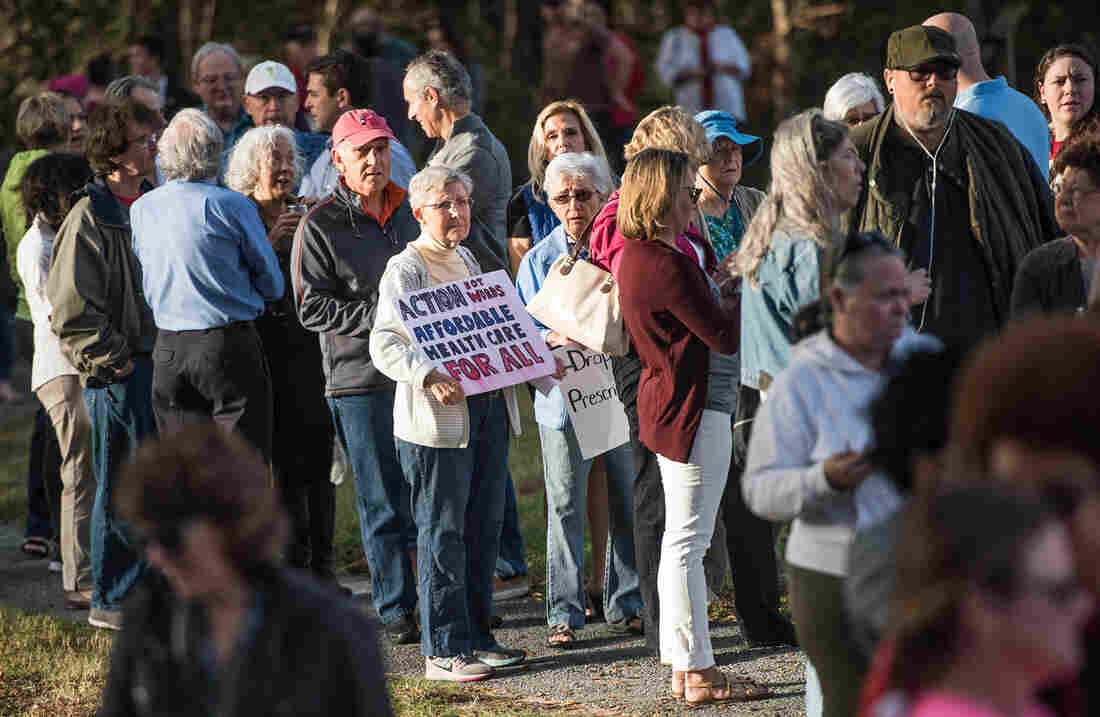
Public Clinics Fear Federal Cuts To Planned Parenthood Would Strand Patients

About 35 percent of the patients at this clinic in York, Pa., receive Medicaid. The clinic offers STD testing, cancer screening and contraception services as well as abortion services.

Sarah McCammon/NPR

hide caption

toggle caption

Sarah McCammon/NPR

Opponents of abortion rights have long argued that public funds for services like cancer screenings and contraception should go solely to health clinics that don’t provide abortions. They’ve made “defunding Planned Parenthood” — or, to be more precise — blocking the organization from receiving funding through federal programs like Medicaid — a major goal.

Now, Republicans in Congress have proposed an Affordable Care Act repeal that would, for one year, prevent Planned Parenthood from receiving Medicaid reimbursements for providing services like contraception and cancer screenings to low-income patients.

Dawn States, 26, says she wouldn’t be able to safely carry a pregnancy because of spinal problems that required two surgeries. She has turned to Planned Parenthood for years to obtain contraceptives and gynecological care.

Sarah McCammon/NPR

hide caption

toggle caption

Sarah McCammon/NPR

Worry about just that kind of action under a Trump administration and Republican-controlled Congress is what brought Dawn States of Lancaster City, Pa., back into her local Planned Parenthood recently.

“I wasn’t sure what was going to happen in the next foreseeable future — and I actually physically can’t have kids,” States says, after having two spinal surgeries as a teenager.

She’s now 26 and has come to the Planned Parenthood clinic in York, Pa., to get a long-acting intrauterine device, or IUD.

“My spine is fused, and I have two rods. So it’s just not really set up for carrying around an infant,” she says.

States says she worries what will happen to women like her who receive Medicaid and depend on Planned Parenthood for this kind of care.

The organization has been a focus of anti-abortion activism because it provides about a third of the nation’s abortions, according to data gathered by the Guttmacher Institute — though, under current law, the clinics can’t and don’t use federal money to pay for the procedure, in most cases.

For other services, like screening for sexually transmitted diseases, Planned Parenthood gets more than $500 million in public funds — much of it from Medicaid — according to the organization’s most recent annual report.

“Whether this funding goes directly for abortion or indirectly allows them to have access to a large population of potential abortion clients, and to keep the lights on and man their call centers and do all their political activity, they should not be receiving taxpayer dollars,” says Eric Scheidler, executive director of the Pro-Life Action League, one of the groups pushing to cut off federal funding to Planned Parenthood.

Instead, Scheidler says, those patients should go to community health centers that specialize in treating low-income patients.

Other anti-abortion-rights groups, like Students for Life, also have been promoting the idea of redirecting those funds to federally qualified health centers, known as FQHCs — which perform a range of primary care services, often with a large share of Medicaid dollars.

The locations, hours and availability of services at these public health clinics vary from place to place. For patients in York, there’s a center less than a mile from Planned Parenthood — but it’s busy.

Ever wonder where pregnant women and their families would go when Planned Parenthood is defunded? #prolife#prolifegenpic.twitter.com/VpdgxaR4Zr

— Students for Life (@Students4LifeHQ) March 3, 2017

“There are more patients who seek our care than we’re able to provide care for,” says Jenny Englerth, CEO of Family First Health, which offers primary medical care and dental care at several clinics in the area. More than half of the patients at these clinics receive Medicaid.

Englerth says her patient loads keep growing, and the organization frequently has to turn away patients — sometimes daily, depending on the time of year.

“Sometimes in the height of the cold and flu season there just isn’t enough capacity to go around,” she says.

What’s more, doctors here can decline to provide birth control if it violates their religious beliefs. Englerth says she tries to hire a good mix of providers so that patients are able to get the care they need. But some, like Dr. Luis Garcia, choose not to offer birth control options like implants and IUDs. Garcia says he does screenings for sexually transmitted diseases and talks with patients about a technique called fertility awareness that can reduce unwanted pregnancies.

“But if a patient comes in and they want to get a Nexplanon or IUD or other birth control, then they can go to another provider,” Garcia says.

Heavy patient loads are common at these clinics, says Sara Rosenbaum, a health policy professor at George Washington University. Rosenbaum says these community health centers provide important services but aren’t as equipped to provide the reproductive services that Planned Parenthood is known for.

“There are all kinds of reasons why it’s not just a simple substitution of X for Y,” she says.

Rosenbaum points to Texas, where state lawmakers in 2011 reduced Planned Parenthood’s funding. Dozens of family planning clinics closed and the birthrate for low-income women went up.

Some patients, Rosenbaum says, are unwilling to use a clinic that, by design, serves the whole family.

“There may be people who were younger users who were uncomfortable where they might run into their aunt sitting in the waiting room,” Rosenbaum says.

Sally Gambill, a certified nurse midwife at the Planned Parenthood in York, says she has seen too many patients over the years who became pregnant because they weren’t able to obtain birth control efficiently.

“The sperm and egg really, really want to meet; they just do. That’s why we’re all here,” Gambill says. “And if we don’t help people, if they want to be on contraception [and] we don’t help people when they want to be helped — that day, that hour — then sperm and egg find each other.”

If Planned Parenthood were no longer an option for some patients, Englerth says, her network of health clinics would try to meet the need.

“But I also understand the reality of what we try to do every day and the pressures that we feel every day with our existing demand,” she adds, “so there are going to be gaps and shortfalls. And I can only project the stories of those individual women that will fall in between.”

If there are major changes to federal funding for low-income patients’ reproductive health services, Englerth says, she hopes they don’t happen too quickly, so centers like hers have time to try to close those gaps.

Let’s block ads! (Why?)

House Republicans Release Affordable Care Act Replacement Bill

House Republicans released their plan on Monday to redo the Affordable Care Act. Congressional Republicans have voted several times to repeal the law, but President Obama vetoed those attempts.

ROBERT SIEGEL, HOST:

House Republicans have released the text of a bill that’s designed to remake the Affordable Care Act, also known as Obamacare. Congressional Republicans have voted dozens of times in the past to repeal the ACA. But that was when President Obama was in office, and he vetoed those attempts. That is expected to change under President Trump.

And joining us now with more on the changes being proposed in Congress is NPR health policy correspondent Alison Kodjak. And Alison, give us the main points here. I assume the Republicans are getting rid of the requirement that everyone have health insurance, the individual mandate.

ALISON KODJAK, BYLINE: Yeah. They’re getting rid of that by repealing the penalty that people would have to pay if they don’t have insurance. And that they’re doing that retroactively, meaning people who didn’t have insurance even last year, if this bill goes through, would not have to pay that tax penalty.

And what they’re going to do is change that – what they call the stick approach to a carrot by offering refundable tax credits to people to allow them to use that money to buy a health plan in hopes that more and more people will actually buy in voluntarily, rather than have to do it under a mandate.

SIEGEL: Refundable in this case means it could actually be in excess of what somebody owes in income taxes?

KODJAK: Yeah. It does. The tax credits that they have put forth are $2,000 for individuals under the age of 30. And they go up to about $4,000 if you’re over 50 years old. They’re per person, so a family could, you know, accumulate a lot of those tax credits up to $14,000.

But that refundable part is actually a point of contention. There are some of the most conservative Republicans who don’t appreciate the refundable tax credit because that means people, like you said, who don’t even pay federal income tax could get that money back. They see that as an additional entitlement.

SIEGEL: What about Medicaid? More than 10 million low-income Americans have gotten coverage under the Obamacare expansion of Medicaid. Does that survive in this House bill?

KODJAK: It survived in a way. The bill proposes that they freeze the program in 2020. And all of those people who are covered under Medicaid can stay covered. But if they leave Medicaid because they get a job or something, they can’t then re-enroll if they are over the regular Medicaid limit, which was much lower – the poverty line, rather than 130 percent of the poverty line, which is what the expansion allowed.

So it’s sort of a compromise between those who are afraid of throwing people off Medicaid and those people who don’t want to see that expansion stay in place.

SIEGEL: This is a House bill. As you’ve mentioned, there are some conservatives who object to provisions of it. I assume the Democrats object to it very broadly. What are its chances?

KODJAK: Well, that’s a bit of a question because yes, there are several conservatives in the House who object to it. All Democrats don’t want to see this – the Obamacare repealed at all. And in the Senate it’s even more complicated because there are already several conservative senators who’ve come out against this whole plan calling it, quote, “Obamacare-lite” and several senators who have said they’re concerned that it is not generous enough and people will be thrown off their health insurance.

The Republicans only have a small majority in the Senate. So it’ll be hard for them to lose any Republican senators and still be able to get this bill through.

SIEGEL: What happens next?

KODJAK: Well, this week, two House committees will mark up the bill, which means they’ll vote it out to the House. And then we’ll see where it goes from there.

SIEGEL: OK. That’s Alison Kodjak. Thank you.

KODJAK: Thanks, Robert.

Copyright © 2017 NPR. All rights reserved. Visit our website terms of use and permissions pages at www.npr.org for further information.

NPR transcripts are created on a rush deadline by Verb8tm, Inc., an NPR contractor, and produced using a proprietary transcription process developed with NPR. This text may not be in its final form and may be updated or revised in the future. Accuracy and availability may vary. The authoritative record of NPR’s programming is the audio record.

Let’s block ads! (Why?)

GOP Bill Would Repeal Obamacare Taxes And Penalties, Keep Some Subsidies

House Speaker Paul Ryan is leading efforts to repeal and replace the Affordable Care Act.

Allison Shelley/Getty Images

hide caption

toggle caption

Allison Shelley/Getty Images

After years of waiting, it’s finally here.

The Republican plan to reshape the Affordable Care Act — what they call “repeal and replace” — kills the requirement that everyone buy health insurance by eliminating the tax penalty for those who don’t have coverage. It also makes significant changes in the financial assistance people can receive to buy a health plan.

“Our legislation transfers power from Washington back to the states,” said House Ways and Means Committee Chairman Kevin Brady, in a statement. “We dismantle Obamacare’s damaging taxes and mandates so states can deliver quality affordable options.”

The bill would offer tax credits, refundable in advance, to people with incomes below $75,000. But those credits will be lower in many cases than the subsidies now offered in the ACA.

The bill, which will go through many revisions and challenges, was released late Monday by two House committees, Ways and Means and Energy and Commerce. Members are expected to start voting on parts of the bill Wednesday.

Rep. Frank Pallone, D-N.J., and Richard Neal, D-Mass., the ranking Democrats on the Energy and Commerce and Ways and Means committee issued a joint statement saying the bill would “rip healthcare away from millions of Americans, ration care for working families and put insurance companies back in charge.”

The legislation will ultimately need approval by the full House and the Senate before it goes to President Trump for his signature. Until then, most of what is known as ‘Obamacare’ will stay in place.

But it’s far from clear that Republicans in the House are unified in their support of the bill. Members of the far-right Freedom Caucus have said they oppose giving tax credits to people who don’t pay any federal income tax.

And with only a slim majority in the Senate, only a few Republican defections could defeat the bill there.

Four Republican Senators wrote a letter to Majority Leader Mitch McConnell saying they were concerned an early draft of the House plan would not adequately protect people who have insurance through Obamacare’s Medicaid expansion. And Senator Rand Paul was among three conservative Republicans who criticized an earlier version of the bill as “Obamacare lite.”

Under the proposed bill, tax credits would start at $2,000 a year for individuals under age 30, rising to $4,000 for those of 60. The proposal, first seen in Feb. 10 draft of the bill, has been criticized as too meager to cover the full cost of a health insurance plan that provides full benefits.

But the proposed tax credit could potentially pay for insurance that protects only against a catastrophic health event.

They would begin to be phased out at incomes of $75,000 for individuals and $150,000 for families.

To encourage people to buy coverage, the plan allows insurers to charge a 30 percent penalty to people who let their insurance lapse, and then try to buy a new policy.

In states that expanded Medicaid, people who are eligible can continue to enroll until January 1, 2020, and those states would continue to benefit from the federal government paying a greater share of the health costs of those beneficiaries.

The bill includes a couple of provisions to please abortion opponents. Tax credits won’t be available to pay for insurance policies if they include abortion coverage.

And the bill “defunds” Planned Parenthood, meaning it bars Medicaid from paying for health services provided at the clinics. Medicaid is already barred by federal law from paying for abortions and women’s health advocates say the provision will likely make it harder for low-income women to get birth control, screenings for cervical cancer and mammograms — which Planned Parenthood provides.

Several taxes contained in the ACA would be repealed at the end of this year. These include taxes on health insurers, pharmaceutical and medical device manufacturers, and a tax on high-cost employer-sponsored group health plans (aka Cadillac plans).

An analysis by Avalere Health and McKinsey of an earlier draft of the bill, which contained many of the same provisions, concluded that it would lead to millions of people losing coverage.

The plan offered by the House Republicans falls short of the outright repeal that has been demanded by more conservative members, including those in the House Freedom Caucus.

That could be due to the shift in public attitudes toward the ACA in recent weeks.

Public opinion has grown more favorable as major changes appeared imminent. A Kaiser Family Foundation tracking poll in late February found 48 percent having a favorable opinion versus 42 percent viewing the law unfavorably. Kaiser says the shift is due largely to a change in the view of political independents, among which 50 percent now view the law favorably.

We will have more on this story as it develops.

Let’s block ads! (Why?)

Thomas Starzl, Trailblazer In Organ Transplantation, Dies At 90

In this 1989 photograph, Thomas Starzl oversees a liver transplant operation at the University of Pittsburgh Medical Center. Starzl won a National Medal of Science in 2004.

Gene J. Puskar/AP

hide caption

toggle caption

Gene J. Puskar/AP

Thomas Starzl, the doctor who pioneered liver transplant surgery, has died at the age of 90. In an announcement on its website, the University of Pittsburgh Medical Center said Starzl died peacefully at his home on Saturday.

“His work in neuroscience, metabolism, transplantation and immunology has brought life and hope to countless patients, and his teaching in these areas has spread that capacity for good to countless practitioners and researchers everywhere,” his family wrote in a statement issued Sunday by UPMC and the University of Pittsburgh.

“With determination and irresistible resolve, Thomas Starzl advanced medicine through his intuition and uncanny insight into both the technical and human aspects of even the most challenging problems.”

Chancellor Emeritus Nordenberg on the passing of Dr. Starzl: “He became a hero to countless patients.” pic.twitter.com/DJVuC02Gng

— Pitt (@PittTweet) March 5, 2017

By the time he died, Starzl widely enjoyed a towering reputation in the medical profession — but this was not always the case. The doctor, who eventually became known as the “father of transplantation,” drew his fair share of criticism when he began experimenting with transplants.

“Transplanting was hardly even thought of as a possibility then,” Starzl once said. “I was working blind.”

In 1963, Starzl led the team of surgeons that performed the world’s first liver transplant. The patient, a child who had been born with half a liver, did not survive that operation due to excessive blood loss.

Undeterred, Starzl attempted the operation again just two months later on another patient who suffered from liver cancer. This time, it appeared to be a success — until the man died three weeks afterward, this time from blood clotting.

Still, Starzl kept working, also researching drugs to block the human immune system from rejecting its newly implanted organ. And by the late 1970s, the survival rate for patients undergoing liver transplantation had risen to roughly 40 percent.

When in the early ’80s he left the University of Colorado for the University of Pittsburgh, where we would go on to spend more than three decades, Starzl and his surgical team had already transplanted more than 1,000 livers. Under his leadership, UPMC would go on to become one of the world’s foremost transplant centers.

During his time there, he became known as a prolific publisher. In fact, as UPMC notes, the Institute for Scientific Information identified Starzl in 1999 as “the most cited scientist in the field of clinical medicine.” The ISI estimated that for a time he was averaging the publication of one paper every 7.3 days, according to UPMC.

For his achievements, the school renamed its transplant institute after Starzl in 1996.

By that point, however, Starzl had retired from performing surgery. Following his own coronary bypass surgery in 1990, he decided it was time to give up the scalpel — much to his personal relief, as it turns out.

“I was not emotionally equipped to be a surgeon or to deal with its brutality,” Starzl acknowledged in his 1992 memoir, The Puzzle People.

Despite Starzl’s achievements at the operating table, his family says he should perhaps be best remembered as a teacher and a friend.

“Even more extraordinary [than his medical advances] was his ability to gift that capacity to those around him, allowing his students and colleagues to discover the right stuff within themselves,” the family said in its statement.

“Nobody who spent time with Thomas Starzl could remain unaffected.”

Let’s block ads! (Why?)

No One Was Prepared To Care For So Many Wounded In Mosul

Medics tend to an Iraqi counterterrorism fighter injured in a clash with ISIS forces near the village of Bazwaya, on the eastern edge of Mosul.

Bulent Kilic /AFP/Getty Images

hide caption

toggle caption

Bulent Kilic /AFP/Getty Images

In a pink-painted village clinic converted into a field hospital a few miles from the Mosul front lines, there is no emergency care facility, so wounded Iraqi troops are just wheeled into the foyer for treatment.

Over the crackle of walkie-talkies, one of two men arriving with shrapnel wounds from a car bomb calls out, “Mohammad Jassim, my brother, where is he?”

He is right here, a medic reassures him. Both men are confused and in pain but expected to survive. They are federal policemen, a national force playing a key role in the fight by Iraqi forces to take Mosul back from ISIS. More federal police casualties arrive in ambulances throughout the day.

The field hospital is one of several, along with front-line points for immediate treatment of the gravely wounded, set up after the months-long Mosul operation restarted on Feb. 19.

ISIS is expected to lose Mosul. But its fighters are inflicting a terrible toll. The number of civilians and combatants killed and injured has far exceeded what was predicted, with hundreds of car bombs, land mines and booby traps adding to the danger.

The impact on the Iraqi armed forces has been colossal. Iraqi officials do not give figures, but American military officials have told reporters some divisions had casualty rates of 30 percent, without specifying whether the men were killed or injured.

Dr. Altaf Musani, the representative for the World Health Organization in Iraq, said in the first months of the offensive, many people died for lack of urgent care.

When a person is seriously wounded and in danger of bleeding to death, “there’s really a window within minutes that someone should be stabilized,” he said, speaking in the northern Iraqi city of Erbil.

Stabilization usually means stopping the heavy bleeding caused by bullet or shrapnel wounds and making sure patients can breathe on their own while they await more treatment.

Musani said typically in close vicinity to this kind of fighting, about 20 percent of the people in the area — civilians or fighters — sustain these kinds of wounds. But in Mosul that number has been much higher. Many civilians spoke of being deliberately targeted by ISIS as they left Mosul.

Once the patient is stabilized, Musani said there is “a golden hour” to get them more treatment — literally about 60 minutes. In the first months of the battle for Mosul, that deadline was rarely met.

Hospitals in and around the city were destroyed in the fighting and the nearest functioning medical facilities were hours away along bumpy roads.

Amid the uncertainty of war, WHO planned for mass displacement more than for mass casualties. “It wasn’t anticipated that people would be stranded, caught inside East Mosul,” he said. ISIS forbids anyone from leaving the city.

Now the World Health Organization, charities and Iraq’s health ministry have scrambled to move medics closer to the front lines to stabilize the wounded and then provide comprehensive treatment.

“This is very difficult,” he said. “You need a certain level of medical expertise, equipment and mobility to be out in front lines in order to capture cases.”

One organization, Samaritan’s Purse, opened a field hospital close to the east of Mosul in January in cooperation with the World Health Organization and Iraq’s health ministry. They have since treated hundreds of cases and have performed multiple surgeries on a daily basis.

Throughout the operation, troops from the U.S.-led coalition backing Iraqi forces have also helped on the front lines with emergency trauma care. Col. John Dorrian, the coalition’s spokesman in Baghdad, confirmed the accounts from Iraqi troops.

In the field hospital near Hammam al Alil, a federal policeman named Ali Qassem said U.S. forces patched him up after he was shot in the shoulder in a surprise attack by ISIS fighters on a group of his men.

“We were with them 10 minutes before,” he said. “We took pictures with them and joked with them, and then 10 minutes later I was injured and they came quickly.

“They were very close and very helpful.”

Let’s block ads! (Why?)

Patients Demand The 'Right To Try' Experimental Drugs, But Costs Can Be Steep

ALS patients and their families rallied for expanded access to experimental drugs in Washington, D.C. on May 11, 2015.

Courtesy of Lina Clark

hide caption

toggle caption

Courtesy of Lina Clark

In the last three years, 33 U.S. states have passed laws aimed at helping dying people get easier access to experimental treatments that are still in the early stages of human testing. Supporters say these patients are just looking for the right to try these treatments.

Such laws sound compassionate, but medical ethicists warn they pose worrisome risks to the health and finances of vulnerable patients.

California’s “right to try” law went into effect in January. It protects California doctors and hospitals who want to prescribe any medicine that has successfully made it through a Phase 1 drug trial. That’s the first stage of human testing required by the Food and Drug Administration — usually, all the study participants are healthy in the small Phase 1 trial, and it focuses merely on a drug’s general safety and questions about dosage, not its effectiveness.

Phase 2 and Phase 3 drug trials watch for toxic side effects of the experimental medicine among a group of people who have the disease or condition. About 20 percent of all drugs tested in Phase 2 are found to have too many serious side effects to move on to Phase 3, the FDA says. And only between 25 and 30 percent of drugs that pass the larger Phase 3 tests for effectiveness and side-effects move on. Only after passing that several-year — and several-stage — gauntlet is a drug finally approved for market.

Assemblyman Ian Calderon, a Democrat from Southern California, and majority leader in California’s assembly, was lead author of the state’s right to try law, and thinks people who are terminally ill shouldn’t have to wait that long. He says if he had just been given a terrible diagnosis, he would want to try anything possible to live.

“My thought would be what do I have to lose?” Calderon says. “I have an opportunity to potentially find a cure. Or at least find something that prolongs my life — find something that could help me.”

He says the law seemed to him the logical next step, after California instituted a law in 2016 that now permits physician-assisted suicide.

“It’s inhumane to have a law on the books that allows you to end your own life, but no law on the books that allows you to fight to extend it,” he argues. “That just seems counter-intuitive.”

Lina Clark and her husband David Huntley on vacation in Croatia in 2014. Before he died of complications from ALS in 2015, Huntley’s illness prompted them both to become activists, lobbying for California’s right to try law.

Courtesy of Lina Clark

hide caption

toggle caption

Courtesy of Lina Clark

Proponents of right to try legislation contend that some doctors have been hesitant to help dying patients, for fear of being penalized for using drugs or devices that don’t have FDA approval.

California’s law ensures that doctors can help patients petition to get investigational medicine from drug makers without fear of censure from the state’s medical board. It eliminates regulatory obstacles on the state level, and creates processes for patient consent and data collection.

David Huntley, a San Diego State University professor who died from ALS, or Lou Gehrig’s disease, in 2015, was among the patients who fought for California’s law.

Before he died, Huntley testified in favor of the bill in Sacramento from his wheelchair.

His widow, Lina Clark, founder of the patients’ advocacy group HopeNowforALS, says her husband completely understood what was at stake.

“The patient community is saying: ‘We are smart, we’re informed, we feel it is our right to try some of these therapies, because we’re going to die anyway,’ ” she says.

David Huntley testified in favor of California’s right to try bill in April 2015 in Sacramento. He died three months later.

Courtesy of Lina Clark

hide caption

toggle caption

Courtesy of Lina Clark

It’s a compelling argument, but there are serious risks according to doctors and medical ethicists.

“We know some people try to take advantage of our desperation when we’re ill,” says Dr. R. Adams Dudley, director of UCSF’s Center for Healthcare Value. “If we take the FDA out of it, how do we protect people from physicians or drug companies that will want to sell them things and will want to prey on their desperation?”

Dudley says the FDA and the clinical trial process were put in place for a reason — not just to shut out would-be snake oil salesman, but also to ensure that manufacturers are producing a safe product, and not cutting corners.

“If you say there’s a path that’s not through the FDA,” he says, “then there are billions of dollars out there to be made by skipping the important steps that we’ve developed.”

Dudley thinks “right to try” is a misnomer in describing these state laws; all that patients can really do is ask for an experimental medicine. Drug companies don’t have to give them the medicine, and insurance companies don’t have to pay for it.

Patients could spend huge amounts of money trying a drug that hasn’t been proved to work, he says. And the patient may also be giving up their hopes for a controlled, peaceful death at home.

“Instead you try a drug and you get very severe lung problems,” Dudley says, “and you end up on a breathing machine in a hospital. That could cost hundreds of thousands of dollars.”

Although nearly three dozen right to try laws are now on the books, researchers at New York University who have been looking for evidence of the laws’ usefulness haven’t yet found a single substantiated case of a patient getting a drug by using a state law.

That’s partly, perhaps, becausethe FDA already has a process to help patients and their doctors apply for the use of experimental drugs (and such requests are nearly always approved). Still, Calderon, Clark and others point out that the process entailed in these “compassionate use requests” is much too slow and cumbersome for many patients who are dying.

A new federal research law might help change that. The 21st Century Cures Act requires drug companies to be more transparent about how they decide who gets experimental access to promising medications, and how long it will take.

This story is part of a reporting partnership with NPR, KQED andKaiser Health News. Carrie Feibel is a health editor and reporter for KQED, and a contributor to Kaiser Health News.

Let’s block ads! (Why?)

Americans Conflicted Over GOP Plans To Dump Obamacare

People are talking about the ACA at town hall meetings around the nation, like this one with Republican Sen. Tim Scott of South Carolina last month.

Sean Rayford/Getty Images

hide caption

toggle caption

Sean Rayford/Getty Images

Last year, when presidential candidate Donald Trump hammered the Affordable Care Act as “a fraud,” “a total disaster” and “very bad health insurance,” many Americans seemed to agree with him.

Now that President Trump and fellow Republicans are attempting to keep their promise to get rid of the law, voters increasingly seem to be having second thoughts.

Multiple polls show rising support for the ACA, including one from the Pew Research Center and one from the Wall Street Journal/NBC News indicating Americans feel more positively about it than ever.

True, many still dislike the law known as Obamacare, but as the national conversation swells on the fate of a law that affects millions of people in multifaceted ways — and the issue takes center stage at raucous town hall meetings — it’s increasingly clear that many don’t see the ACA as an either-or proposition.

“At first it was a good deal — that was three or four years ago,” says Mark Bunkosky, 56, an independent contractor in Michigan who buys coverage through one of the law’s online portals. “Every year it’s gone up. From where it started, the premium has doubled, and now my deductible has also doubled. And my income has not doubled.”

Bunkosky, a Republican, views the ACA unfavorably but believes Washington should fix it, not toss it. He supports keeping some of the law’s Medicaid coverage for low-income people and its prohibition on discriminating against those with pre-existing conditions.

This week, Trump acknowledged that health care is “so complicated.” So are voter opinions on what to do next with the ACA, which expanded coverage to some 20 million people.

“I didn’t like that it mandated people to carry health insurance. And I thought it was just a lie” when it promised affordability, says Amber Alexander, 27, a Pennsylvania independent whose seasonal income puts her on Medicaid in winter and a commercial plan the rest of the year.

However, she adds, “I don’t think it should be thrown out altogether. There are people that do benefit from it, but there are also a lot of people that get screwed.”

Carol Friendly, 67, an Oregon Republican, voted for Hillary Clinton for president and favors the Medicaid expansion. She objects to the ACA’s reproductive health coverage, though, saying consumers opposed to birth control and abortion shouldn’t have to pay for them.

On the other hand, she says, “I know it put 22 million [people] in the health care system that weren’t there before. So that’s a plus.”

Mixed signals from Republicans add to the political fog.

For weeks, Trump has been promising — but not yet producing — a blueprint detailing his plan to repeal and replace the ACA with “insurance for everybody.” In his address to Congress on Tuesday, he said a new law “should ensure that Americans with pre-existing conditions have access to coverage.”

Meanwhile, a leaked GOP congressional draft replacement bill would shrink coverage subsidies, and House conservatives complained even those were still too expensive. On Tuesday, congressional Republicans told reporters they were still working on “the best way to build a consensus to pass a bill to gut Obamacare.”

For many helped by the health law, such a prospect has focused minds and aroused fears and may account for its rising popularity, says Simon Haeder, a political science professor and specialist on health policy at West Virginia University.

“Now that we have this whole debate on replacing, repealing, repairing — whatever you want to call it — more and more of this information is coming out on what the ACA does and how it’s benefited people,” he says.

ACA beneficiaries and activists flooded town halls held by Republican congressmen last week, urging them not to repeal the law.

“My story thus far has been [of] one who has benefited from the system,” says Michael Bilodeau, 39, who attended two town halls held by California Republican Rep. Tom McClintock. “We are able to see our local doctor, who we like. And our premiums have been, I would say, stable.”

He co-owns a small business with his wife and is on a plan from Covered California, the state’s online marketplace. He fears a big change if the ACA goes away.

“One of the Republicans’ major arguments is that the ACA brought disruption to people’s health care,” Bilodeau says. “It feels like we’re headed toward another disruption.”

Also, many middle- and lower-income Republicans benefit from the health law’s Medicaid expansion and marketplace subsidies. That’s a political hazard for Republicans who would abolish it, says Mark Peterson, a political science professor at UCLA.

“A lot of that base would be most adversely affected by repealing the ACA and replacing it with something that left enormous holes for the working class,” he says.

And while many national Republican policymakers have excoriated it, the Medicaid expansion is supported by some GOP governors.

Some Republican voters object to the ACA because it’s just so complex.

“It would have been better if the federal government had said, ‘Look, to get these 20 million insured let’s just expand Medicaid nationwide and let’s leave everybody else alone,” says Rickey Mathis, 56, a Georgian who voted for Trump and hasn’t had insurance since the factory employing him closed in 2012. “Why did they have to screw up the whole country’s health insurance?”

Michigan contractor Bunkosky urges Republicans to think hard about any Obamacare replacement.

“Everybody’s in a hurry for it, but they need to sit down and do it right,” he says. “Some of it is still a good idea.”


Kaiser Health News is an editorially independent news service that is part of the nonpartisan Henry J. Kaiser Family Foundation.

Let’s block ads! (Why?)

POLL: More People Are Taking Opioids, Even As Their Concerns Rise

Prescribed narcotic painkillers continue to fuel a nationwide opioid epidemic—nearly half of fatal overdoses in the United States involve opioids prescribed by a doctor.

But people don’t seem to be avoiding the medications, despite the well-documented risks. In the latest NPR-Truven Health Analytics poll, over half of people surveyed, or 57 percent, said they had been prescribed a narcotic painkiller like Percocet, Vicodin or morphine at some point. That’s an increase of 3 percent since we last asked the question in 2014 (54 percent), and of 7 percent since our 2011 poll (50 percent).

For almost three quarters of poll participants (74 percent), the prescription was for temporary acute pain, like from a broken arm or a dental procedure. Nineteen percent said they received the drugs for chronic pain.

Most people are worried about addiction and side effects when it comes to opioids.

Jessica Boddy/NPR/Credit: Jessica Boddy/NPR Source: Truven Health Analytics-NPR Health Poll

hide caption

toggle caption

Jessica Boddy/NPR/Credit: Jessica Boddy/NPR Source: Truven Health Analytics-NPR Health Poll

“The drugs are like a two-edged sword,” says Ron Ozminkowski, ?vice president of cognitive analytics in the value-based care pillar at IBM Watson Health, who works with Truven on the poll. “They’re great for people who really need them for heavy duty pain, but they come with addiction risk and side effects.”

Indeed, the Centers for Disease Control and Prevention note that as many as 1 in 4 people who use opioid painkillers get addicted to them. But despite the drugs’ reputation for addiction, less than a third of people (29 percent) said they questioned or refused their doctor’s prescription for opioids. That hasn’t changed much since 2014 (28 percent) or 2011 (31 percent).

Dr. Leana Wen, an emergency physician and commissioner of health for the City of Baltimore, says that’s the problem. She says patients should more readily voice their concerns about getting a prescription for narcotics to make sure if it really is the best option.

If prescribing a narcotic painkiller is on the table, physicians should reference the opioid prescribing guidelines from the Centers for Disease Control and Prevention, Wen says. Released in March of last year, the guidelines recommend trying non-narcotic medications or treatments first; lay out recommendations for when to prescribe the drugs; how to choose the appropriate painkiller and dosage; and how to assess risks. The guidelines are intended for primary care physicians, and not for those treating patients in end-of-life care or with cancer.

“Ask why,” Wen says. “Often, other alternatives like not anything at all, taking an ibuprofen or Tylenol, physical therapy, or something else can be effective. Asking ‘why’ is something every patient and provider should do.”

That message may be getting through. Many more poll participants expressed uneasiness about opioid painkillers, whether they’d been prescribed the drugs or not.

Almost half of people who said they hadn’t used narcotic painkillers said they had concerns about them, up significantly from 30 percent in 2014 and 2011. Getting addicted to painkillers was their top concern (39 percent), followed by side effects (22 percent).

Among respondents who were taking opioids, 35 percent had concerns, down 1 percent from 2014 and 2011. As with prior polls, people taking opioids were more worried about side effects (38 percent) than addiction (27 percent).

We asked poll participants if they thought certain side effects were linked to taking opioids. More than three quarters thought addiction was associated with the drugs. They’re right — nearly 2 million Americans abused or were dependent on opioids in 2014, and it’s estimated that over 1,000 people a day wind up in emergency rooms across the nation for misuse of prescription opioids.

Two-thirds said they thought opioids were linked with constipation. And that’s true; 41 percent of people taking opioids experienced constipation in one study, and another lists the side effect as “expected” with the use of opioids. There are even drugs being marketed specifically to combat constipation caused by prescribed narcotic painkillers.

Aside from worrying about addiction or side effects, respondents also worried about narcotics’ long-term health impact (14 percent) and their association with drug abuse (13 percent).

“Doctors have to think twice about how they use the tools in their pain killing tool kit,” Ozminkowski says.

Wen agrees. “We must all take steps to fix this overprescribing. Heed the guidelines from the Centers for Disease Control and Prevention that say go low and go slow — start with the least harmful and least addictive and work your way up,” she says. “We need to treat pain, but appropriately.”

The poll gathered responses from 3,000 participants questioned over the phone and online from November 1 to 15, 2016. The margin for error is plus or minus 1.8 percentage points. You can find the complete set of questions and results here. Past NPR-Truven Health polls can be found here.


Let’s block ads! (Why?)