Biomedical Researchers Ponder Future After Trump Election

The federal government spends more than $30 billion a year to fund the National Institutes of Health. What changes are in store under a new administration? NIH/Flickr hide caption

toggle caption

NIH/Flickr

What could the world of medical research look like under a Trump administration?

It’s hardly an idle question.

The federal government spends more than $30 billion a year to fund the National Institutes of Health. That’s the single largest chunk of federal research funding spent outside the Pentagon’s sphere of influence.

Policy insiders confronted that question — albeit with an acute shortage of actual data — Monday at a meeting of health advocates in New York City.

The biotech and pharmaceutical companies, which are at the end of the drug-development pipeline, see encouraging signs for their enterprises. The stock market didn’t swoon. Oft-mentioned tax breaks could conceivably encourage drugmakers that have been harboring hundreds of billions of dollars in profits overseas, to bring some of that money back to the U.S.

And the Trump campaign’s anti-regulation rhetoric also rings as good news in the ears of Big Pharma.

Hillary Clinton’s campaign to rein in prescription drug prices also looks to be on the ropes, which may be more welcome news for companies than for consumers who have been shocked by rapid price increases.

Article continues after sponsorship

At the Partnering for Cures meeting, Kay Holcombe, senior vice president of the Biotechnology Innovation Organization, a trade group, said she hoped Clinton’s drug-price campaign would fade. Holcombe told attendees that she prefers “a nonshrieking environment.”

What’s good for the pharmaceutical and biotech industry may not necessarily appeal to President-elect Donald Trump’s supporters, however. It doesn’t translate to rapid gains for struggling workers in the Rust Belt.

And there are fewer tea leaves to read when it comes to Trump’s support for universities and other government-funded parts of the nation’s biomedical enterprise. His campaign said little about research and development in general, or health research in particular.

“The fact that he did not take an ideological position may be a positive thing,” said Tanisha Carino, vice president for U.S. public policy at U.K.-based GlaxoSmithKline. Perhaps there’s a blank slate that can be influenced by people who care deeply about these issues.

She noted that science is an international endeavor (her company alone operates in 150 countries), and it could be harmed if isolationism were to hit medical research and related industries.

Antibiotic resistance, for example, is a global problem, with drug-resistant germs emerging and spreading all over the world. “We as a country can’t solve that,” she said.

And Keith Yamamoto, vice chancellor for science policy at the University of California, San Francisco, said he hopes there’s an opening to remind the Trump administration and its supporters in Congress that NIH research dollars are spent in their districts and support robust economies.

He also said he’d argue that bolstering basic biomedical research could speed up innovation and reduce the expense of drug development. “Let’s get back to the basics,” Yamamoto said. “That’s the kind of message that I would try to send.”

Yamamoto is among a group of prominent scientists who had drawn up policy plans for the next administration. Yamamoto acknowledged that he wasn’t exactly expecting to have the conversation with the Trump transition team.

There is at least one person close to Trump who has long been an advocate for a significant cash infusion for medical research: Newt Gingrich. He’s on some shortlists for a position that could direct his attention elsewhere. Even so, people at the advocates’ meeting in New York nodded in ready agreement when someone suggested that he’s one key person to watch.

You can contact Richard Harris with comments: rharris@npr.org.

Let’s block ads! (Why?)

A Twist On 'Involuntary Commitment': Some Heroin Users Request It

A police officer holds a bag of heroin that was confiscated as evidence in Gloucester, Mass., in March. Massachusetts is one of 38 states that allow civil commitment for substance abuse. John Moore/Getty Images hide caption

toggle caption

John Moore/Getty Images

Inpatient treatment programs for heroin and opioid dependence can be so difficult to get into in some parts of the country that drug users who want to quit are voluntarily asking judges to lock them up — just to guarantee they’ll get help.

In Massachusetts, that’s happening via a 46-year-old law that was designed for family members to commit their loved ones to a locked facility when they are deemed “a danger to themselves or others” because of drug or alcohol abuse. But as more people struggling with addiction are actually requesting this sort of lockup, some are questioning whether “voluntary” court-ordered commitment for treatment of substance abuse is a good idea.

On a bench outside a Springfield, Mass., courtroom recently, a 33-year-old man looked more alert than you might expect for someone coming off a heroin binge. He’d previously been clean for two months, he said, but couldn’t maintain it.

“Now I’m probably doing two bags,” he said, “and it’s getting me high as a kite.” He still very much wants to quit, he said. NPR agreed not to disclose his name.

Article continues after sponsorship

The man said he has been spending $1,000 a week on heroin, scaring his family and scaring himself. They’re all worried he’ll overdose. That’s why, even though it would mean giving up his liberty for up to 90 days, he was in court that day to ask the judge to lock him away — inside a treatment program that he wouldn’t be allowed to leave, far away from his dealers.

“If I don’t do this, I’m going to lose my freedom eventually anyway,” he explained. “Eventually, I’m going to get enough charges to the point where I go to jail anyway.”

Massachusetts is one of 38 states that allow civil commitment for substance abuse.

“Basically, it’s a good way to get clean,” the heroin user in Springfield explained. “Because, if you try getting into these five- or six-day [detoxification programs], it takes forever. It takes a month to get into the place, and if you don’t have the right insurance, they don’t want you.”

Officially, under the law, you’re not allowed to ask for your own commitment. Someone else — a close relative, a probation officer or emergency room doctor, for example — must petition the court on your behalf. But if you agree not to oppose that sort of petition, the judge is likely to approve it.

In the Springfield courtroom of Judge Michele Ouimet-Rooke, that day, the man requesting to be committed stood tall, respectful of the judge.

His sister was the official petitioner. A forensic psychologist testified that the man was, indeed, a danger to himself and others because of his heroin use. Then his attorney spoke.

“My client is in agreement to go to the treatment program in Brockton,” Maria Puppolo told the judge. That facility is the Men’s Addiction Treatment Center in Brockton, Mass., a locked-down, privately run intervention program, exclusively for men who have been mandated to go there by the civil courts.

“He understands the seriousness of his addiction and he wants to get the help,” the attorney added.

The judge agreed.

“Very good, sir,” Ouimet-Rooke said. “I do find there is a basis for the commitment.”

As a court officer led the man away in handcuffs, the man smiled at his family and looked relieved. That same afternoon, the judge committed three other heroin users to detox programs, all of them willing.

In most such cases, these drug users hope to be assigned to a privately run treatment center like the one in Brockton. But if there’s no room there, some men will end up at a more bare-bones program at the state prison. (Women who are committed to mandatory treatment in these civil proceedings in Massachusetts go exclusively to privately run treatment centers.)

This year, about 8,000 people will be committed to substance abuse treatment in Massachusetts, officials estimate — that’s up 40 percent from five years ago. It’s not clear how many of those commitments are voluntary.

Jennifer Flanagan, a Democrat and Massachusetts state senator representing Worcester and Middlesex, led an investigation in 2014 into this trend — partly to understand why people addicted to drugs were trying to get committed. She says she found that many just couldn’t find or afford treatment outside the courts.

“If you’re an addict and you finally decide, ‘Today is the day I want to go,’ you may not necessarily go through the hassle of calling every place and trying to get a bed, and calling your insurance company,” Flanagan says. It some ways it’s easier just to ask a judge for voluntary commitment, she says, “because you’re mandated a bed.”

That’s a bed in an inpatient program that the state has to pay for if insurance doesn’t — and the length of treatment is often longer than most insurance policies would cover. While Flanagan calls that a “misuse of the system,” others say that’s what the system is for.

Judge William Mazanec III presides over the Greenfield District Court in Greenfield, Mass. He considers it part of his job to help some people who have become physically and emotionally dependent on opioids — people who see the courts as their last resort in being able to quit the drugs.

“They’re asking for me to use that process to force them into a situation where they can’t just walk out of treatment,” Mazanec said. “You have a window of opportunity where they’re recognizing this. You have to act quickly.”

Still, the process doesn’t always run smoothly. Sometimes drug users want to find out where they’re likely to be sent — a private treatment center or a prison program — before agreeing to go. If it’s prison, because there aren’t enough beds open at the private center, some try to stop the commitment process after it starts.

That puts court officials in a bind — and frustrates some state officials, including Flanagan.

The law was designed, Flanagan said, “to get someone out of imminent danger. If you’re in danger, you’re in danger.”

In the past year, more detox inpatient facilities have opened across Massachusetts, and that may reduce the requests for civil commitment. But advocates for people battling substance abuse say that until someone can reliably pick up the phone and get help right away, the courts will remain a key part of the treatment chain.

Let’s block ads! (Why?)

GOP Health Insurance Alternatives May Wind Up Using Penalties Like The Mandate

To keep health insurance solvent, the pool of covered people needs to include the well and the sick. Gary Waters/Ikon Images/Getty Images hide caption

toggle caption

Gary Waters/Ikon Images/Getty Images

The Affordable Care Act’s requirement that people have health insurance or pay a fine is one of the least popular provisions of the law, and one that Republicans have pledged to eliminate when they repeal and replace Obamacare.

But take a look at some of the replacement proposals that are floating around and it becomes clear that the “individual mandate,” as it’s called, could still exist, but in another guise.

First, though, the health law’s mandate doesn’t actually require people to have insurance. Instead, it imposes a tax penalty on most people if they don’t have coverage. In 2016, the penalty is the greater of $695 per person or 2.5 percent of household income.

Unpopular as the tax penalty is, it’s ultimately what makes possible the very popular provision of the law that prohibits insurers from turning people down for coverage because they have preexisting medical conditions that might make them expensive to insure. The mandate is designed to make sure healthy people buy coverage so that insurers aren’t left only with customers who are sick.

President-elect Donald Trump has signaled that he would like to find a way to keep the ban on preexisting conditions. But requiring insurers to accept all comers means they need a way to coax people into buying and keeping insurance before they develop expensive conditions like diabetes or cancer. In other words, they need a mandate.

Health policy wonks point out that the individual mandate was originally a Republican idea, advocated by academics and conservative thinkers as a way to avoid a government-run single-payer system. “The purpose of it was to round up the stragglers who wouldn’t be brought in by subsidies,” said Mark Pauly, a University of Pennsylvania economist, in a 2011 interview. He co-authored a Health Affairs study in 1991 that aimed to persuade then-President George H.W. Bush to adopt a universal health care requirement.

Article continues after sponsorship

The drafters of Obamacare incorporated the individual mandate concept because they hoped to get Republicans on board, said Sara Rosenbaum, a professor of health law and policy at George Washington University in Washington, D.C.

Republicans generally accept that some sort of incentive is necessary to help stabilize the insurance market in whatever system they propose as an alternative to the health law. In a policy paper released last summer, House Speaker Paul Ryan proposed creating a one-time open enrollment period during which people could sign up for coverage regardless of their health. As long they stay enrolled in coverage in the individual or group market, they wouldn’t be charged higher rates if they get sick. If they don’t sign up during that open enrollment period, though, those protections don’t apply, and people could face higher premiums and health care costs if they were to buy insurance.

“It’s a soft mandate,” said Douglas Holtz-Eakin, president of the American Action Forum, a conservative think tank. “You must get in now to get this treatment.”

But health policy analysts say that a one-time open enrollment period, whether it’s one month or three months in length, isn’t enough.

“Such stringent limits on open enrollment ignore the complexities of individuals’ lives,” said Linda Blumberg, a senior fellow at the Urban Institute’s Health Policy Center. People lose their jobs, get into car accidents, and they may not understand the implications of dropping coverage for a while. “The penalty on these folks would potentially be enormous,” she said.

Another option to nudge people to get insurance is to impose a penalty on premiums if they don’t sign up at a designated time, for example, when they turn 26 and no longer qualify for their parents’ coverage.

This option would be similar to the rules for Medicare Parts B and D that cover outpatient services and prescription drugs, respectively. People who don’t sign up for Medicare Part B when they’re first eligible, for example, are charged an additional 10 percent of the premium for every year that they could have enrolled but didn’t.

But Medicare is different in important ways from the individual insurance market, said Sabrina Corlette, research professor at Georgetown University’s Center on Health Insurance Reforms. When people sign up for Medicare, they’re generally enrolling for the rest of their lives. In contrast, people may move in and out of the individual market a number of times over their lives as they change jobs or leave the Medicaid program, for example.

“It’s much more difficult to determine what their first opportunity to sign up was,” Corlette said.

There are ways to get people to sign up using a carrot rather than a stick, including increasing the subsidies people receive for coverage, said Corlette.

But Trump has not yet signaled much about his replacement plan, including the extent to which subsidies or other financial assistance would be available under a new health care program.

Kaiser Health News is an editorially independent news service that is part of the nonpartisan Henry J. Kaiser Family Foundation. Michelle Andrews is on Twitter:@mandrews110.

Let’s block ads! (Why?)

What Happens To Medicaid In California Under A Trump Administration?

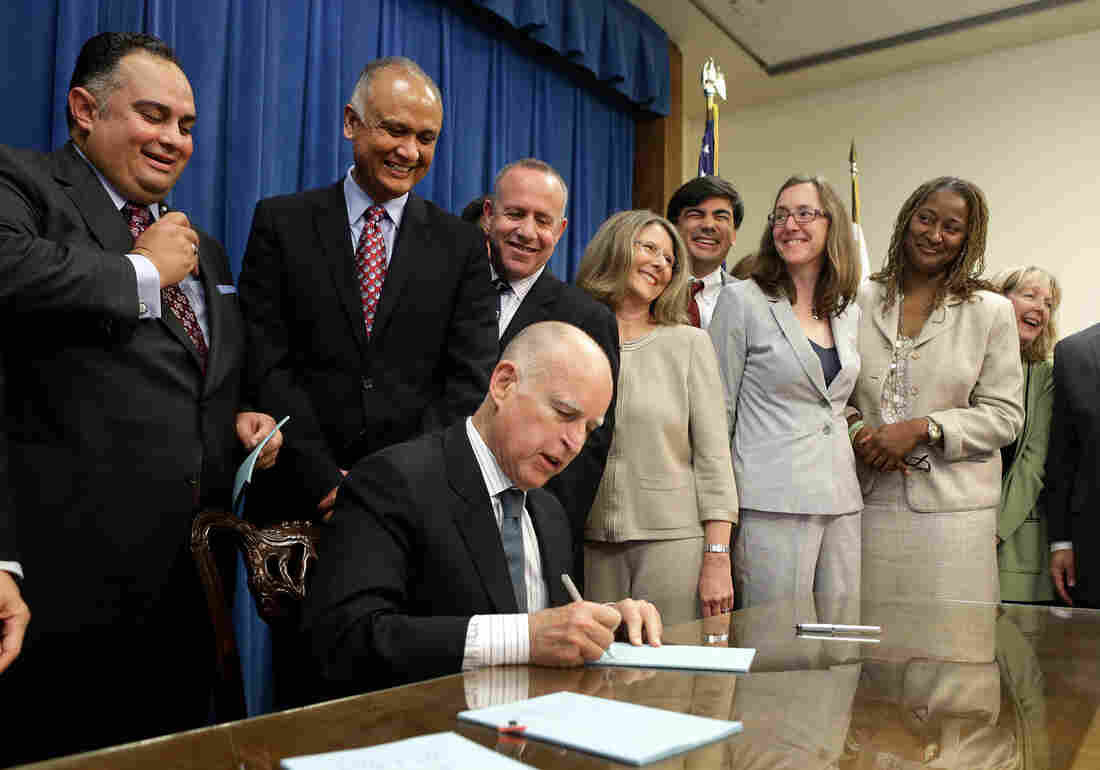
California Gov. Jerry Brown signed a Medicaid expansion into law as part of the state’s budget authorization in 2013. Rich Pedroncelli/AP hide caption

toggle caption

Rich Pedroncelli/AP

President-elect Donald Trump has vowed that he will repeal and replace Obamacare. Specifics are scarce, but one plan Trump has outlined would change how the federal government funds Medicaid, health coverage for low-income people.

Twenty-million Americans now have health coverage because of Obamacare. A full quarter of them are in California. And most of them are covered by Medi-Cal, California’s version of Medicaid.

“Winding back the clock would create all kinds of turbulence and disruption,” says Larry Levitt, senior vice president for special initiatives at the Kaiser Family Foundation.

Right now, the federal government shares the cost of Medicaid with the states, no matter how many people are enrolled. But Trump wants to put a limit on that funding and give states a fixed pot of money called a block grant.

“A block grant would give California greater flexibility in running the Medi-Cal program, but it would also give the state less money,” Levitt says.

California would feel the pain more than other states. “The effect is magnified in California in part because the state has been so successful in getting people signed up for coverage,” Levitt says.

Article continues after sponsorship

And in California, 62 percent of Medi-Cal enrollees who have signed up since Obamacare allowed states to expand Medicaid are Latino, African-American, or Asian-American.

To save money, some states could pay doctors and hospitals less. But in California, payment rates are already the second lowest in the country.

“California can’t really pay much less than it does to providers,” says Gerald Kominski, a professor of health at the University of California, Los Angeles.

In the face of severe budget cuts, Kominski says, the only choice California really would have is to reduce services or reduce the number of people who get Medi-Cal.

“That would have a devastating consequence on the Medicaid expansion population in California, and would basically put everyone who’s been newly enrolled in the program back off the program,” he says.

It’s unclear how soon a Trump administration would change Medicaid funding, so health advocates are encouraging people to continue signing up for Medicaid and other coverage during the current Obamacare open enrollment season.

“California is not an island,” says Anthony Wright, executive director of Health Access, an advocacy group, adding that the state “must engage fully in the coming national debate on the future of health reform — especially as an example of what has been achieved, and what we can’t give up.”

This story is part of a reporting partnership with NPR, KQED and Kaiser Health News, which is an editorially independent news service that is part of the nonpartisan Henry J. Kaiser Family Foundation.

Let’s block ads! (Why?)

Worrying About Your Exchange Coverage? Obamacare Repeal Would Take A While

Major changes to individual health coverage provided through the Obamacare marketplaces won’t happen overnight. PhotoAlto/Frederic Cirou/Getty Images hide caption

toggle caption

PhotoAlto/Frederic Cirou/Getty Images

President-elect Donald Trump has promised that he’ll ask Congress to repeal the Affordable Care Act on Day 1 of his administration.

So if you’re shopping for coverage on the health insurance marketplace now, should you even bother signing up? If everything’s going to change shortly after coverage starts in January anyway, what’s the point?

While it’s impossible to know exactly what changes are coming to the individual market and how soon they’ll arrive, one thing is virtually certain: Nothing will happen immediately. Here are answers to questions you may have.

How soon after Trump takes office could my marketplace coverage change?

It’s unlikely that much, if anything, will change in 2017.

Congressional Republicans probably couldn’t force through a repeal of the entire law because Democrats have enough votes to sustain a filibuster blocking that move. So Congress might opt to use a budget procedure, called reconciliation. That method only allows revenue-related changes, such as eliminating the premium tax credits, with simple majority votes. Yet even that process could take months.

And reconciliation wouldn’t address the other parts of the health law that reformed the insurance market, such as the prohibition on denying people coverage if the have pre-existing conditions. How some of those provisions of the Affordable Care Act will be affected is still quite unclear.

Article continues after sponsorship

“It’s a complex process to alter a law as complicated as the ACA,” said Sara Rosenbaum, a professor of health law and policy at George Washington University.

Health care industry consultant and longtime critic of the law Robert Laszewski agrees. “It will likely be January 2019 before any new program would be completely in place,” he said.

The current open enrollment period runs through January 2017. Shop for a plan, use it and don’t focus on what Congress may do several months from now, Rosenbaum advised.

Will my subsidy end next year if the new administration repeals or changes the health law?

Probably not. Mike Pence, the vice president-elect, said on the campaign trail that any changes will allow time for consumers receiving premium subsidies to adjust.

Timothy Jost, a professor emeritus at Washington and Lee University School of Law in Virginia and close watcher of the health law, also predicts a multiyear transition period.

Congress and the new administration are “not eager to have a bunch of angry, uninsured voters,” Jost said.

Theoretical conversations about changing the health law are one thing but making changes is another. “I think that Congress may be less willing to just wipe the subsidies out if a lot of people are using them,” says George Washington University’s Rosenbaum. More than 9 million people receive subsidies on the marketplace, according to the Department of Health and Human Services.

Can my insurer drop out once the new administration takes over, even if the law hasn’t been repealed?

No, insurers are generally locked in contractually for 2017, according to experts. But 2018 could be a whole different story, said consultant Laszewski.

Many insurers are already losing money on their marketplace offerings. If they know that the health insurance marketplaces are being eliminated and replaced by something else in 2019, why would they stick with a sinking ship?

“The Trump administration could be left with a situation where Obamacare is still alive, the subsidies are still alive, but not the insurers,” Laszewski said. To prevent that from happening, the Trump administration might have to subsidize insurers’ losses during a 2018 transition year, he said.

My state expanded Medicaid to adults with incomes up to 138 percent of the federal poverty level (about $16,000). Is that going to end if Obamacare is repealed?

It may. Trump has advocated giving block grants to finance the entire Medicaid program on the theory that it provides an incentive for states to make their programs more cost-effective. But that strategy could threaten the coverage of millions of Americans if the block grants don’t keep pace with costs, Jost said.

So far, 31 states and the District of Columbia have expanded Medicaid under the health law. Republican governors in these states may play a key role in arguing against taking the expansion money away, Rosenbaum said.

I have a heart condition. Does this mean I’m going to have a hard time finding coverage?

It’s possible. The health law prohibits insurers from turning people away because they’re sick and may be expensive to insure.

Republicans have generally promised to maintain that guaranteed insurability, but what that would look like is unclear. Some of their plans would require people to remain continuously insured to maintain that guarantee, said Laszewski.

“I would advise people who are sick to get good coverage now and hang on to it,” said Washington and Lee’s Jost.

Since Republicans have pledged to repeal the law, can I ignore the law’s requirement that I have health insurance?

The individual mandate, as it’s called, is one of the least popular elements of Obamacare. As long as it’s the law, you should follow it, the people I talked to said. Insurers have argued that the requirement that they take all comers who apply for health insurance only works if there’s a coverage mandate or other mechanism that strongly encourages people to have insurance. Otherwise people wouldn’t have incentive to get it unless they were sick.

For the past few years, Republicans have been pushing hard to eliminate the mandate, Laszewski noted.

“One of the easy things they could do is just not enforce it,” he said.

Kaiser Health News is an editorially independent news service that is part of the nonpartisan Henry J. Kaiser Family Foundation. Michelle Andrews is on Twitter: @mandrews110

Let’s block ads! (Why?)

Women Rush To Get Long-Acting Birth Control After Trump Wins

In the wake of the Trump election and in anticipation of a rollback of Obamacare, young women have taken to social media to urge each other to get long acting contraceptives while they still can for free.

Joy Ho/NPR

Women across the country are rushing to get IUDs. Or at least, they’re tweeting about rushing to get long-term birth control, according to a surge of messages on social media.

They’re concerned that the Trump administration might end Obamacare provisions that require insurers to cover intrauterine devices (IUDs) and other contraception, and cut funding for abortion and reproductive health overall. So women are looking for long-term solutions like IUDs: ones that will outlast a presidency. But they may have a bit more time than they think.

Just scheduled that IUD insertion so that I’m not forced to be pregnant and lay down every plan I’ve ever made for my life ??#IUD

— Cassie Good (@G00dThymes) November 10, 2016

They’re not just talking about it on social media; they’re looking for more information, too. Google Trends showed a massive peak searches for “IUD” “birth control” and “Planned Parenthood” on Wednesday.

i want to get an IUD since trump is more than likely going to take away the affordable care act and restrict abortion access

— #NotMyPresident (@bruisedtulips) November 10, 2016

The online conversations have left a lot of women wondering how much longer their birth control will be available without copays, as is required under the Affordable Care Act. The short answer is that while memes say women should get their IUDs before Inauguration Day, things might not be quite so urgent. The wheels of government take time to turn, so no one will lose their coverage on Day 1 of the Trump administration.

Article continues after sponsorship

But women are already acting.

“I booked an appointment with my gynecologist the instant North Carolina went red,” Kate McPhillips, a young professional in Boston, posted to her Facebook page Wednesday morning. She’s considering the switch to a copper IUD, the type that lasts for 10 to 12 years, “just in case the unimaginable happens.”

Dr. Anne Davis, consulting medical director for Physicians for Reproductive Health and an associate professor of clinical obstetrics and gynecology at Columbia University Medical Center in New York City, says that on Wednesday six women called “in a panic” to schedule IUD appointments. Normally, only about one woman calls to book an IUD insertion each day.

“And these women weren’t just looking for an appointment somewhere in the future. They wanted one right now. They were very, very scared and distraught that they would lose access to birth control,” Davis says.

Others who work in women’s’ health and reproduction are very concerned about the long-term changes a Trump presidency might bring. “It’s an understatement to say that we’re nervous,” says Dr. Eve Espey, chair of the department of obstetrics and gynecology at the University of New Mexico Health Sciences Center.

There are multiple ways Trump’s administration and Congress could make access to birth control more difficult, beyond repealing the Affordable Care Act, which Trump has vowed to do. They include:

  • Dropping the ACA appeal: The Obama administration appealed a 2014 court decision that would block subsidies for insurance premiums under the ACA. If Trump dropped the appeal, reimbursements to insurers would stop. Most experts believe that plans purchased before then would still be honored, but insurers would likely drop out of the health care exchanges for the following year.
  • Redefining contraceptives: By changing how birth control is defined, the ACA clause requiring coverage could be weakened or removed without necessarily overturning the ACA, according to Alina Salganicoff, director of women’s health policy and vice president of the Kaiser Family Foundation.
  • Limit coverage through the courts: More conservative Trump-appointed judges and justices could expand exemptions to coverage in employer-sponsored plans, like in the 2014 Hobby Lobby decision.
  • Cut funding: Trump and Congress could cut federal funding to Planned Parenthood and programs like Title X, which subsidizes family planning healthcare for low-income men and women. House Republicans have tried multiple times to stop funding, but congressional Democrats and Obama have stopped them.

Although Trump could put these changes into motion on his first day in office, insurance plans already purchased for 2017 would probably still be honored. Secretary of Health and Human Services Sylvia Burwell tweeted that signups at healthcare.gov for 2017 have spiked since the election.

There’s been a rush on reproductive health centers, too.

We called over a dozen regional Planned Parenthood divisions across the country. They all report more women than calling in to book appointments, and more women asking questions about IUDs.

Even though women won’t lose access to copay-free birth control immediately, Davis says women should take action soon. “This isn’t something to put off, and if you’re on corporate insurance sometimes it takes a while for IUDs to be ordered. If you need a long-acting form of birth control, you need to take care of that now.”

On the other hand, there’s Espey. She agrees that choosing long-lasting contraceptives may become a priority for more women, but she’s also concerned that women might be making these moves a little too quickly. “When people are under stress, they’re more likely to make decisions that they regret later.”

Women shouldn’t rush to make decisions about birth control, she says. They should speak with their doctors and learn the side effects. But, she notes that long-lasting reversible birth control like IUDs and hormonal implants, while not 100 percent effective, are pretty much foolproof ways to prevent pregnancy.

Laura Meyers is the president and CEO of Planned Parenthood of Metropolitan Washington D.C., where they’ve seen an increase in women looking for birth control since Tuesday. The uncertainty, she says, “makes women nervous.”

We asked the Trump administration on Wednesday if birth control will stay copay-free during his presidency, but did not hear back. This could be because Trump’s team has since rolled out a new website and media hotline, where we have followed up. We will update this page if they reply.

Let’s block ads! (Why?)

Cigarette Smoking In The U.S. Continues To Fall

Cigarette smoking continues to decline as taxes on tobacco rise. Gerald Herbert/AP hide caption

toggle caption

Gerald Herbert/AP

The number of cigarette smokers in the United States has dropped by 8.6 million since 2005 — and that fall could be accelerated by a tobacco tax just passed in California.

The Centers for Disease Control and Prevention says smoking rates have fallen from 21 percent of the adult population in 2005 to 15 percent in 2015, when the agency conducted its latest survey. The smoking rate fell by 1.7 percentage points between 2014 and 2015 alone — a substantial decline, according to a report Thursday in Morbidity and Mortality Weekly Report.

The proportion of cigarette smokers in the U.S. population, broken down by age, in 2005 and 2015. CDC hide caption

toggle caption

CDC

Smokers light up less when cigarettes are more expensive. So, more smokers may have been nudged to quit after the federal government increased tobacco taxes by 62 cents a pack in 2009. California voters approved a $2 a pack tax on Election Day, so rates there are likely to fall further.

“Raising the tobacco tax is probably the single most effective way to reduce smoking, especially among kids,” says Vincent Willmore, vice president for communication at the Center for Tobacco Free Kids. That organization and other public health advocates pressed for passage of the California tobacco tax. “The California vote was a huge victory for kids and health,” he says.

The tax will not only discourage people from purchasing cigarettes, it will also fund a renewed anti-smoking effort in the state, Willmore says.

While that initiative won, tobacco control advocates lost similar efforts in Colorado and North Dakota.

The story was topsy-turvy in Missouri, where the tobacco industry actually supported a 17-cent-per-pack tax, while advocates opposed it as too little to discourage smoking. Voters in Missouri rejected that tax.

Article continues after sponsorship

Tobacco is the leading preventable cause of death in the United States. The CDC says it’s linked to 40 percent of all cancer cases, and 30 percent of cancer deaths. The government is striving to reduce smoking rates to 12 percent of the adult population by the year 2020, and is making progress toward that goal.

The latest drop in smoking rates was documented in the National Health Interview Study, which relies on people meeting face-to-face with survey-takers and reporting their habits. The 1.7 percentage-point drop between 2014 and 2015 is especially sharp, but it follows a recent downward trend.

In addition to the higher federal cigarette tax, there have been several national stop-smoking campaigns, such as The Truth. The Affordable Care Act has also increased access to smoking-cessation programs.

Progress nationally is uneven. The CDC’s new report notes that smoking rates are lowest in the West, even though taxes are higher elsewhere. They are highest in the Midwest.

Smoking is more common among men, and among American Indian/Native Alaskans. Smoking rates are low among Asians and people with college degrees.

Another trend has paralleled the recent decrease in cigarette smoking: Vaping has taken off in the United States. That has led some researchers to wonder whether some of the decline in cigarette use is a result of people switching to these vaping devices. At this point, there’s no data to show how much vaping is contributing to the downward trend in smoking.

E-cigarettes certainly aren’t a panacea. About 60 percent of adult people who use them also smoke cigarettes. Vaping also provides users with addictive nicotine doses. And public health officials are concerned that some youngsters who start vaping will then become smokers.

You can contact Richard Harris with comments: rharris@npr.org.

Let’s block ads! (Why?)

After Contentious Fight, Colorado Voters Approve Aid-In-Dying Measure

The Rev. Josephine Falls handed out stickers to voters while accepting ballots inside the Denver Elections Division offices on Tuesday. Marc Piscotty/Getty Images hide caption

toggle caption

Marc Piscotty/Getty Images

Colorado has joined the handful of states that allow terminally ill patients to end their lives with medicine prescribed by a doctor.

Voters passed Proposition 106 by a 65 percent to 35 percent margin.

The fight pitted those who think the terminally ill should have the choice to end their lives if they choose to do so against those who think it’s morally wrong and that people might be pressured into ending their lives.

On election night, advocates held a jubilant celebration in a small room on the same floor of a downtown hotel as the state’s Democrats, who were decidedly downbeat about the presidential election results.

“I think it’s terrific,” said Matt Larson, who was diagnosed with brain cancer and featured in ads saying he’d like the option should his condition someday become terminal. “If you opposed it, you don’t have to use it. That’s the beauty of this law,” Larson said. “And for the people who do support it, it will bring a tremendous amount of peace and comfort to many people in Colorado.”

Another proponent, Dr. Charles Hamlin, a retired surgeon who has kept his license, said: “I intend to help when and where I can. It’s a comfort zone, rather than an exit strategy.”

The proposition is modeled after a law passed in Oregon two decades ago.

Under the Colorado measure, two doctors must agree a terminally ill adult has six months or less to live and is mentally competent. The person would self-administer the drug.

“My parents are aging and they agree with it wholeheartedly,” said Karen McInnes, a Denver resident who voted for the proposition. “If I ever end up in that stage, I would want it for myself.”

Article continues after sponsorship

Denver resident Amy Chavez also supported the measure. “I feel for someone who is terminally ill it’s their right to make that kind of decision,” she said. “I don’t think it’s fair to them or their families to prolong life if it’s not a good quality of life.”

The two sides raised more than $8 million. But supporters, mostly funded by the national group Compassion and Choices, had a 2-to-1 fundraising advantage over opponents. The opposition was backed by a number of Catholic groups.

Peggi O’Keefe, a spokesperson for No Assisted Suicide Colorado, said she hopes the fight is not over. “Rarely do voters get to vote on ballot issues about life and death,” she told Shots in an email. “We appreciate the support of so many Coloradans who reject a culture of compromise on suicide.” O’Keefe said the group hopes the state Legislature “recognizes the flaws embedded in Proposition 106 and takes appropriate steps to correct them.”

O’Keefe and other opponents argue the measure is “fatally flawed,” beyond being morally wrong. They say doctors can make mistakes. Furthermore, the measure will encourage doctor shopping and won’t require a doctor to be present when a person dies.

Jeff Hunt, director of the Centennial Institute at Colorado Christian University, said in a statement to Shots:

“This will have serious impacts on all Coloradans as insurance companies and the government get involved with everyone’s end-of-life decisions.” He said what opponents call “doctor-assisted suicide” would be a threat to “the most vulnerable in our communities: the poor, the disabled, the elderly, and the infirm.”

Dr. Alan Rastrelli, a former anesthesiologist now in palliative medicine, worries the measure will erode the public’s trust in doctors as healers. “Physicians will go towards this philosophy of assisting a patient in their death,” he said. “That will destroy, I think, the patient and physician relationship.”

Rastrelli also said it’s difficult to know how common problems or mistakes are because reporting requirements in Oregon, and in Colorado’s proposal, are weak.

Oregon, Washington, California and Vermont have similar laws, and in Montana, a state court ruled doctors cannot be prosecuted for helping a terminally ill patient end their life.

The Colorado measure is expected to go into effect at the start of 2017.

This story is part of a reporting partnership with NPR, Colorado Public Radio and Kaiser Health News.

Let’s block ads! (Why?)

How A President Trump Could Derail Obamacare By Dropping Legal Appeal

If the Trump administration decides to drop an appeal of a legal setback involving Obamacare subsidies, the insurance exchanges could be hobbled. Karen Bleier/AFP/Getty Images hide caption

toggle caption

Karen Bleier/AFP/Getty Images

Republicans have been vowing for six years now to repeal the Affordable Care Act. They have voted to do so dozens of times, despite knowing any measures would be vetoed by President Obama.

But the election of Donald Trump as president means Republican lawmakers wouldn’t even have to pass repeal legislation to stop the health law from functioning. Instead, President Trump could do much of it with a stroke of a pen.

Trump “absolutely, through executive action, could have tremendous interference to the point of literally stopping a train on its tracks,” said Sara Rosenbaum, a professor of law and health policy at George Washington University in Washington, D.C.

Trump is set to take office at a tricky time for the health law, with many Americans in both parties complaining about rising premiums and other out-of-pocket costs. The Republican-led Congress has refused to make changes to the law that would help it work better — such as offering a fix when insurers cancelled policies that individuals thought they would be able to keep. As staunch opponents of the law, they, of course, have little incentive to improve it.

When problems have arisen, Obama has often used his executive authority to try to solve them. And it’s this very mechanism Trump could use to undermine the law. As president, the Republican “can just reverse” Obama’s actions in many cases, said Nicholas Bagley, a law professor at the University of Michigan who writes about health policy. A president “can’t undo the basic architecture of the law, but you can throw sand into the gears,” he said.

Article continues after sponsorship

Formal regulations would take time to undo, because they must follow a lengthy process allowing for public comment. But there are several measures Trump could take on Day One of his presidency to cripple the law’s effectiveness.

Perhaps Trump’s easiest action — and the one that would produce the largest impact — would be to drop the administration’s appeal of a lawsuit filed by Republican House members in 2014. That suit, House v. Burwell, charged that the Obama administration was unconstitutionally spending money that Congress hadn’t formally appropriated, to reimburse health insurers who were providing coverage to working-poor policyholders — those earning between 100 and 250 percent of the federal poverty line.

More than half of people who purchase insurance in the health exchanges get the additional help, which reduces out-of-pocket health spending on deductibles and coinsurance. While that help for consumers is required under the law, the funding was not specifically included. (Tax credits for people with incomes up to four times the poverty level to help defray the cost of premiums are a separate program and were permanently funded in the ACA.)

In April, Federal District Court Judge Rosemary Collyer ruled in favor of the House Republicans. “Such an appropriation cannot be inferred,” she wrote of the payments, and insurer “reimbursements without an appropriation thus violates the Constitution.” However, Collyer declined to enforce her decision, pending an appeal to a higher court. That appeal was filed in July and is still months away from resolution.

If Trump wanted to seriously damage the ACA, he could simply order the appeal dropped, letting the lower court ruling stand, and stop reimbursing insurers who are giving deep discounts to half their customers. That move would wreak havoc, said Michael Cannon of the libertarian Cato Institute, a longtime opponent of the health law. The insurers would still have to provide the discounts, as required by law, he said, “but they’re no longer getting subsidies from the federal government to cover the cost. So they are going to be selling insurance to these people way below the cost of that coverage.”

Even those who support the law say that mismatch would effectively shut down the health exchanges, because insurers would simply drop out. A Trump administration “really could collapse the federal exchange marketplace and the state exchanges if they end cost-sharing” payments to insurers,” said Rosenbaum, who has been a strong backer of the health law. There is already some concern about the continuing viability of the exchanges after several large insurers, including Aetna and United HealthCare, announced they would be dropping out for 2017.

Another way Trump could undermine the health law would be by simply not enforcing its provisions, particularly the individual mandate that requires most people to have insurance. That requirement is supposed to ensure that healthy as well as sick people sign up, thus spreading the costs of people with high bills across a larger population. But “executive branch non-enforcement could make a real difference to the vitality of the exchanges going forward,” Bagley said. If healthy people don’t sign up, sick people would need to pay more money for their insurance.

Aside from inflicting damage to the exchanges, the administration could also affect the law’s operations by refusing to approve states’ changes to their Medicaid programs. States rely on federal regulators to sign off on changes large and small, including which citizens are eligible, to keep their Medicaid programs operating. “There are so many things that an administration that doesn’t want a program to work can do,” Rosenbaum said.

The bigger question, though, is not what Trump could do to cripple the health law — it’s what he would do. He has addressed the issue only rarely — characterizing the health law as, simply, “a disaster” — and his plans for it aren’t clear. “It’s one thing to talk about ripping insurance from 20 million people” who are newly covered, Bagley said. “It’s another to actually do it.”

Health policy analysts on both sides of the aisle also still question where health care fits on Trump’s priority list.

“A big unknown is how aggressive Trump would remain in going beyond rhetorically opposing Obamacare,” said Thomas Miller, a resident fellow at the conservative American Enterprise Institute. “His report card as a presidential candidate reads, ‘Donald needs to improve his attention, effort, and study habits. He is easily distracted and seems to prefer just picking fights with others.’ “

Perhaps most important, Cato’s Cannon says, is not whether Trump could single-handedly undo the health law, but whether he could undermine it enough to force Congress to take action. If Trump were to do just enough to cause the insurance exchanges to fail, he said, “that would put pressure on Congress … to reopen the law.”

Editor’s note: A version of this story was first published by Kaiser Health News on Oct. 7.

Kaiser Health News is an editorially independent news service that is part of the nonpartisan Henry J. Kaiser Family Foundation. You can follow Julie Rovner on Twitter:@jrovner.

Let’s block ads! (Why?)