'Wilhemina's War' Explores Barriers To AIDS Treatment In U.S. South

3:46

Download

While many Americans now view HIV and AIDS as survivable conditions, treatment and care can still be difficult to get in the southern states, especially for African-Americans. A new Independent Lens documentary, Wilhemina’s War, explores those challenges.

This entry passed through the Full-Text RSS service – if this is your content and you’re reading it on someone else’s site, please read the FAQ at fivefilters.org/content-only/faq.php#publishers.

In Texas, Uneven Expansion Of Obamacare Sows Frustration

If only I could make it over to the next mesa.
4:34

Download

Lorenzo Gritti for NPR

People in Texas are significantly more likely than adults nationwide to report that it has gotten harder to see a doctor in the past two years.

The finding comes from polling done by NPR, the Robert Wood Johnson Foundation and the Harvard T.H. Chan School of Public Health.

Vera Brown has been stuck aboard the doctor merry-go-round for years now, trying to find an orthopedic surgeon who accepts her insurance. She doesn’t find the seemingly endless calls, questions or repetition amusing.

“When they say I’m not covered that means I have to put off having surgery,” she says. “And that begins to start messing with my health.”

Vera Brown makes phone calls to try and find a surgeon. She describes it as a merry-go-round.

Vera Brown makes phone calls to try and find a surgeon. She describes it as a merry-go-round. Lauren Silverman for NPR hide caption

toggle caption Lauren Silverman for NPR

Brown, 45, has already had one hip replaced. Now, the other is starting to feel numb. She used to be in physical therapy, but the clinic stopped accepting her insurance, which is provided by Medicaid.

She gets around her South Dallas apartment with the help of a walker. With an 11-year-old son still at home and a fixed income, she says traveling is hard.

“If you have a little money and you can go to wherever doctor, that’s fine, but what about the ones that does not have the income, or the say-so or the know-how, to go about doing this?” Brown asks. “We just lost out. And that’s just not right.”

Almost 1 in 5 people in Texas says it’s gotten harder to see a doctor in the past two years according to the NPR poll. It didn’t matter what kind of insurance they had.

About 70 percent of insurance plans for Texans available on HealthCare.gov are small ones, according to Dan Polsky, a health economist at the University of Pennsylvania.

Insurers tend to offer patients with narrow networks that include fewer choices of doctors and hospitals.

Insurers are “using this as a cost-control measure,” says John Carlo, CEO of the nonprofit AIDS Arms health agency in Dallas. “So it’s very likely that someone who in the past has had a lot more access to specialists they’re not finding that anymore and they’re having to travel greater distances to find those specialists.”

Staying on top of which doctors are in or out of network is hard for health care administrators and patients. Carlo says his health agency has had to refer patients elsewhere who’ve been coming for years.

“Frankly, it’s a mess,” Carlo says. “We just see this so frequently where a patient comes in, they’re carrying a health plan card, it looks good, they double-check and when they go to file the claim to be reimbursed they find out they’re not in the network.”

And if you do find a doctor in network, there’s the problem of actually scheduling an appointment. About a quarter of adults in Texas who do have a regular doctor say there’s been at least one time in the past two year when they needed care but couldn’t see their regular provider.

Most say it was because the doctor didn’t have available times. Texas Health Institute researcher Dennis Andrulis says the Affordable Care Act has helped more than a million Texans get insurance, but the state has a severe physician shortage. In Texas, there are about 186 physicians for every 100,000 people, according to the Texas Medical Association. The national average is 236 per 100,000.

You can find the detailed results of the national poll here and results on how income affects health care here.

Results for the individual states:

Florida

Kansas

New Jersey

Ohio

Oregon

Texas

Wisconsin

“The law is raising hopes for those who in this state have been chronically uninsured for such a long time,” Andrulis says. “But then for those who are able to get insurance, they will find difficulty in accessing care.”

The situation is particularly frustrating for people on Medicaid, says Andrulis, who is also associate professor at the University of Texas School of Public Health in Austin. First, Texas chose not to expand Medicaid under the Affordable Care Act. Second, the rates the state reimburses doctors for care are very low. As a result, doctors in Texas have little incentive to take on new Medicaid patients.

Add it all up, and you see that Texas is a state with 6 million uninsured people, few primary care doctors, narrow provider networks and low reimbursement rates for Medicaid.

“These are the seeds and reality of frustration,” Andrulis says.

No wonder then, says Andrulis, that so many Texans who can’t see a doctor in a timely manner go to the emergency room instead.

As for Vera Brown, she uses a community health clinic where costs are low. Her mother helps out with medicines she’s got.

“She will give you a hug like no other,” Brown says. “It will sooth your soul, and when you get through it’s like everything just gone away.”

And for a minute, she can ignore the pins and needles in her hip, and pick up the phone to make a few more calls to find a doctor.

This entry passed through the Full-Text RSS service – if this is your content and you’re reading it on someone else’s site, please read the FAQ at fivefilters.org/content-only/faq.php#publishers.

Many Dislike Health Care System But Are Pleased With Their Own Care

Hanna Barczyk for NPR

Hanna Barczyk for NPR

The United States has the most advanced health care in the world. There are gleaming medical centers across the country where doctors cure cancers, transplant organs and bring people back from near death.

But a poll conducted by NPR, the Robert Wood Johnson Foundation and the Harvard T.H. Chan School of Public Health, shows that only one-third of Americans say the health care they receive is “excellent.” Even fewer people are impressed with the system as a whole.

“When you’re talking about health care we have this amazing kind of schizophrenia about our system,” says Dr. Georges Benjamin, executive director of the American Public Health Association.

The split in thinking shows up in the poll numbers.

Much the way people hate Congress but love their own representatives, people like the care they receive while complaining about the system. About 80 percent say they get good or excellent care. But 42 percent rate the health care system in their state as fair or poor.

“We deliver the best medicine and nursing on the planet, no question about it. But it requires a lot of things,” Benjamin says.

Things like an insurance card, filling out lots of forms, paying co-pays and deductibles, and running from doctor to lab to imaging center.

The system is wildly complex, hard to navigate and can be very frustrating. Benjamin says it’s this process of getting health care that people hate.

Just ask Cheryl Vaun, one of our poll respondents.

The 57-year-old from Albany, Ore., has a low opinion of the health care system after spending years trying to help her daughter who fell suddenly ill as a teenager.

The 16-year-old gained 30 pounds in about a month. She had migraines and her muscles would seize up in pain.

Vaun and her daughter went from doctor to doctor repeating the same tests and procedures. When doctors couldn’t figure out what was wrong, they offered Vaun’s daughter antidepressants.

“We were pretty upset,” she says. “My daughter was devastated because obviously she’s suffering all of these health issues and it was a bit terrifying.”

Vaun’s daughter was finally diagnosed with acute anemia.

If the problem had been caught earlier, Vaun believes her daughter could have recovered. Instead it has become a chronic condition that leaves her tired and weak. The treatment is iron pills or injections, which are hard on her system and leave her sick to her stomach.

Repeat tests, multiple doctor visits and lack of results erode people’s faith in their care, says Sarah Dash, vice president for health policy at the Alliance for Health Reform in Washington.

“Health care hasn’t always been designed with the needs and efficiency of the patient in mind,” Dash says. “It’s designed for the various doctors and the health care system.”

The poll, conducted from September to November, also shows that quality of care can depend heavily on their income.

Adults with incomes below $25,000 a year are about three times as likely as higher income people – 34 percent versus 13 percent – to say the health care they personally receive is only fair or poor.

William Dale Coger, 52, is one of them. The carpenter from Oak Hill, W. Va., says he’s been unable to get help for his back, which he injured about 15 years ago while hauling pipe out of a well on his property.

His pain, mild at first, has gotten worse over the years. These days, he struggles to get out of bed in the morning and finds his left leg is unstable and his left foot goes numb.

“It’s gotten to the point that this pain travels clear up my back into my shoulder blade into my left side of my neck and gives me migraine headaches sometimes into the left side of my head,” Coger says.

He’s on disability and Medicaid.

Coger sees doctors at a local clinic but he says they don’t take his back trouble seriously. They recommend exercise and offer ibuprofen. He thinks surgery would be able to help him but says doctors at the clinic refuse to order an MRI.

“I want to be cured,” he says. “I don’t’ want pills. I don’t like pills.”

Benjamin of the APHA says Coger and his doctors don’t seem to have the same goal. They’re managing his pain. He wants to get back to work.

“It can be really frustrating if you don’t understand the end goal of your care,” Benjamin says.

Dash says the Affordable Care Act includes lots of pilot projects to improve how patients get care — and to make it cheaper. But those changes come slowly in a system that today is wildly complex.

And for most people, the law seems to have changed little.

The NPR polls shows 74 percent of people believe their health care has stayed about the same since the ACA was implemented. And for the minority who’ve seen a change, about 14 percent say their care is better while 9 percent says it’s worse.

And most think the law has had no direct impact on them.

Even if they didn’t buy a plan through the exchange, people have more insurance benefits than they did before. They get free screenings like mammograms and colonoscopies. Birth control is free. And they can still buy insurance even if they have a preexisting medical condition.

Most people aren’t aware of that though. Our poll shows only one in six adults think their benefits have increased in the last two years and 12 percent believe they’ve declined.

And many people still don’t like the law.

Ivan Rivera, 29, from Miami, says he is opposed to Obamacare and angry that he’s required to get insurance.

He says he works hard, takes care of his own health and doesn’t want to have to subsidize coverage for others.

“We’re paying for other people,” he says. “People that are not working. People who are not pulling their own weight.”

This entry passed through the Full-Text RSS service – if this is your content and you’re reading it on someone else’s site, please read the FAQ at fivefilters.org/content-only/faq.php#publishers.

Health Quality An Issue For Poor, 2 Years Into Obamacare, Poll Finds

A series of polls in key states by NPR and its partners finds that more than half of adults in the U.S. believe the Affordable Care Act has either helped the people of their state or has had no effect. Those sentiments are common despite all the political wrangling that continues over the law.

About a third (35 percent) of adults say the law has directly helped the people of their state, while a quarter (27 percent) say it has directly hurt people.

You can find the detailed results of the national poll here and results on how income affects healthcare here.

Results for the individual states:

Florida

Kansas

New Jersey

Ohio

Oregon

Texas

Wisconsin

“The proportion of U.S. adults who believe the law helped people in their state about equals the proportion who believe it hurt them,” says Robert J. Blendon, Richard L. Menschel Professor of Health Policy and Political Analysis at Harvard T.H. Chan School of Public Health. “On the other hand, on a personal level, most Americans do not believe the law directly affected them.”

The polls conducted by NPR, the Robert Wood Johnson Foundation and the Harvard Chan School are part of an in-depth study to assess the changing health care landscape in the two years since the Affordable Care Act took effect.

In seven separate state polls, approximately 1,000 people were surveyed in Florida, Kansas, New Jersey, Ohio, Oregon, Texas and Wisconsin. A nationally representative survey of 1,002 people was also done, asking the same questions. People were contacted by telephone (cellphone and landline), from Sept. 8 to Nov. 9, 2015.

We wanted to find out more about what is going on in these states when it comes to health care — and we asked people about their personal experiences.

We sought to find out what, if anything, has changed in how people get health care and what the quality of that care currently is. How big of an impact are cost increases having? Are there more or fewer barriers to care in the wake of the ACA?

More than 7 in 10 (72 percent) in our national survey said they get good value for what they pay toward the cost of their health care. But a significant 22 percent disagree.

That may be because few see added benefits in the face of cost increases. Only 1 in 6 adults believe their benefits have increased in the past two years and 12 percent believe they’ve declined. That perception exists despite changes like the ACA’s elimination of preexisting condition exclusions and the requirement that insurers cover the full cost of preventive services like mammograms, colonoscopies and contraception.

“Though the poll finds that most people are relatively satisfied with the health care they personally receive, a substantial number have problems paying their medical bills and accessing needed care,” Blendon says. “And a surprising share of Americans, particularly those with low incomes, say they face problems with the quality of care they receive.”

Other poll findings:

Cost concerns for many

Nearly half (45 percent) of those in our national survey said their insurance premiums have increased in the past two years. Rising copays and deductibles were reported by 35 percent of the insured. When we asked people to characterize the cost of health care they received during visits to five different types of health care facilities, majorities said costs were reasonable, although this varies substantially by facility.

Not getting needed care

Our polls found 1 in 7 (15 percent) of people said there was at least one time in the past two years when they needed health care but did not get it. Only 23 percent of these people were uninsured. About a third (35 percent) said they could not find a doctor who would take their health insurance.

Emergency room use still high

One of the goals of the ACA was to make insurance available to all Americans so that they would have a regular health-care provider and not use the expensive ER so often. But a third of all adults say they got care in an ER in the past two years.

Hard to find a doctor

Nationally, a quarter of adults say they do not have a regular doctor or health care professional who provides most of their health care when they are sick or have a health concern. The number was highest in Texas (31 percent) and Florida (30 percent).

And among the vast majority (74 percent) who do have a regular health-care provider, getting care wasn’t automatic. In the past two years, more than one in five (22 percent) say there has been at least one time when they could not see their regular doctor, often because appointments weren’t available or they needed care at night or on the weekend when the doctor’s office was not open.

More than a third of adults in Texas said they went without needed health care when they were unable to see their regular provider.

Quality gap

A plurality of the public rates the health care they get personally as good (46 percent), but surprisingly few rate it as excellent (33 percent).

And our survey revealed a major gap in quality depending on income. Low-income people (those with annual household incomes of less than $25,000) are far more likely (34 percent) to say the care they got was fair or poor than those with other incomes (13 percent). Still, 62 percent of low-income adults say they got good or excellent care.

The significance of this finding is that low-income people are more likely to be sick than people of other incomes. Forty-one percent of low-income adults rate their health as fair or poor, versus just 18 percent of people of other incomes.

So does all this mean the ACA is failing? It’s not possible to say from these data.

When asked whether national health reform has directly impacted them, most Americans said it has had no direct impact (56 percent) or it has helped them (15 percent). But a quarter said it has hurt them directly.

Adults in Kansas (39 percent) and Ohio (35 percent) are significantly more likely than adults across the country to say the law has hurt the people of their state. But Ohioans (21 percent) are also more likely to say the law has directly helped them as individuals compared with the national survey.

We’ll be sorting out these findings over the next three weeks in stories here online and in NPR and member station news magazines and talk shows.

This entry passed through the Full-Text RSS service – if this is your content and you’re reading it on someone else’s site, please read the FAQ at fivefilters.org/content-only/faq.php#publishers.

Healthcare.gov Marketplace Looks To More Selective California Model

3:49

Download

Healthcare.gov accepts any insurance plan on its marketplace that complies with minimum standards. It’s now considering strengthening those standards, and it’s looking to California to see how.

This entry passed through the Full-Text RSS service – if this is your content and you’re reading it on someone else’s site, please read the FAQ at fivefilters.org/content-only/faq.php#publishers.
Colombian Scientists Study Serious Zika-Related Conditions

4:50

Download

Scientists don’t know all the conditions linked to the Zika virus. In one lab in Cali, Colombia, researchers are trying to connect Zika and the neurological condition Guillain Barre.

Transcript

RACHEL MARTIN, HOST:

Scientists don’t know all the conditions Zika might be causing. And they’re racing to figure out how the virus works. NPR’s Nurith Aizenman takes us now to a lab in the Colombian city of Cali, where they’re trying to prove a link between Zika and a neurological condition that causes temporary paralysis.

NURITH AIZENMAN, BYLINE: Researcher Beatriz Parra Patino opens the freezer section of a white refrigerator and takes out a tray of test tubes.

BEATRIZ PARRA PATINO: I have the samples that I need to test today. So we have one, two, three, four, five, six, seven, eight, nine, 10 – like 14 samples to test.

AIZENMAN: The tubes are mostly filled with diluted blood or saliva. Parra says to her, each one represents a human being.

PARRA: A human being, that’s right. And I treat the tubes like if I was treating the person, so with respect and trying to do my best.

AIZENMAN: Because the fact that a person’s body fluids are in one of these tubes means there’s a good chance that right now that person is suffering the excruciating effects of Guillain-Barre syndrome. It’s a temporary condition in which your immune system starts attacking your nerve cells. People can lose the ability to walk, to smile, even to breathe. You get a sense of just how bad it can get at one of the hospitals that is sending these fluid samples to Parra. It’s about 400 miles on the other side of Colombia in a city called Cucuta, an area with a lot of Zika cases.

UNIDENTIFIED WOMAN: (Speaking Spanish).

AIZENMAN: The head of neurology, Dr. Jairo Lizarazo, is visiting some of his latest Guillain-Barre patients.

JAIRO LIZARAZO: (Speaking Spanish).

AIZENMAN: “One of them is a young doctor,” he says, “one of my own students.” He finds Dr. Karina Luque collapsed in her hospital bed. Her face muscles are so stiff, it’s hard for her to speak.

KARINA LUQUE: (Speaking Spanish).

AIZENMAN: “When I sit up or when I talk a lot, I have to stop for awhile because I get really tired,” she says. Lizarazo pulls back a curtain to reveal another patient, an older woman hooked up to breathing tubes. She’s been on them for several days, he says.

LIZARAZO: (Speaking Spanish).

AIZENMAN: This is the most serious case.

Guillain-Barre is usually rare. At this hospital, Lizarazo sees about half a dozen cases a year. But he says since the Zika outbreak started…

LIZARAZO: (Speaking Spanish).

AIZENMAN: “Every one or two days, we get a new case.” It’s a pattern not just across Colombia, but in four other countries where Zika is spreading in a big way, which is where Carlos Pardo, an expert on neurology and neuroimmunology, comes in.

CARLOS PARDO: I got a call from one of my colleagues in Colombia who was telling me about this initial outbreak of cases of Guillain-Barre.

AIZENMAN: Pardo grew up in Colombia. But he’s currently a professor at Johns Hopkins University School of Medicine in Baltimore, where I reached him by phone.

PARDO: I immediately made the connection that this may be related with Zika.

AIZENMAN: He moved fast to set up a study, getting not just Dr. Lizarazo but doctors at four other hospitals in Colombia to collect fluid samples – blood, saliva, urine and spinal fluid, from their Guillain-Barre patients. Pardo wants to analyze the antibodies these patients have produced because he thinks that at the same time that those antibodies are fighting the virus, they’re also latching onto nerve cells that have a component that look like Zika.

PARDO: So in other words, the immune attack is confusing elements of the nervous system.

AIZENMAN: Confusing it for Zika. But that’s just a theory. First, Pardo and his collaborators need to prove something more basic. They need to show these Guillain-Barre patients really did have Zika. The challenge, Zika virus can only be found in the blood during an active infection. But it might linger longer in other body fluids, which brings us back to researcher Beatriz Parra Patino at that lab in Cali. She’s testing not just blood but all those other fluids. Pardo knew Parra from his medical school days in Colombia.

PARRA: Carlos just called me. Hey, what are you going to do with this? What is the plan? (Laughter).

AIZENMAN: Pardo arranged for funding to buy Parra the ingredients to do the testing. She’s measuring them out with a pipette now, getting ready to drop them into the test tubes with the patient samples.

PARRA: I’m going to be quiet because I need to concentrate and put in the samples.

AIZENMAN: Then Parra pops the tray of tubes into a machine that will run them through various temperature cycles. The results will be ready in two hours. Thanks to this extraordinary mobilization of research, proving the Zika connection to Guillain-Barre could take just a few more weeks. Nurith Aizenman, NPR News, Cali, Colombia.

Copyright © 2016 NPR. All rights reserved. Visit our website terms of use and permissions pages at www.npr.org for further information.

NPR transcripts are created on a rush deadline by a contractor for NPR, and accuracy and availability may vary. This text may not be in its final form and may be updated or revised in the future. Please be aware that the authoritative record of NPR’s programming is the audio.

This entry passed through the Full-Text RSS service – if this is your content and you’re reading it on someone else’s site, please read the FAQ at fivefilters.org/content-only/faq.php#publishers.

Keeping Up With The Joneses' Latest Medical Procedure

Katherine Streeter for NPR

Katherine Streeter for NPR

My father is approaching his 78th birthday, blessed with health good enough to still be an avid golfer and tennis player.

His regular group of tennis buddies changes from time to time. The lineup depends on how they’re feeling.

I remember when one of the gents renowned for his fitness and fastidious diet underwent a quadruple-bypass heart operation. The other guys were in shock. If Mr. Fit had a bum ticker, they all figured they better get to their doctors pronto.

“Don’t I need an operation or something to clean out my arteries?” Dad asked me.

It doesn’t work like that, I explained. We don’t recommend [they are done, let’s be honest] preventive heart surgeries, though many people make that assumption because of our culture’s worship of the latest, greatest medicine and technology.

Heart surgery should be considered disaster relief, I told him, not part of a regular tune-up or a solution for unhealthful habits.

When my father saw his own doctor a few weeks later and got his usual clean bill of health, Dad wasn’t satisfied. There must be some danger brewing somewhere inside him, he told me, despite reassurances from me and his doctor.

His concern faded after a while, but then several months later one of his cronies underwent a knee replacement. Dad’s first reaction: “When should I get my knee replaced?”

I tried to talk him through it. “Do you have pain with every step you take?” I asked. Clearly not, I thought, since he’s still playing tennis three times a week. He admitted that his pain is only intermittent. But as he has aged, he’s grown concerned that his balance has become wobbly.

I can’t fault my dad. He’s a child of the 1950s and has an unshakable belief in American ingenuity and medical progress. Newer is always better. For patients like him, more medical care equals more health.

If there’s one thing he and I have battled over (and as his doctor-son I’m sure I’ve disappointed him in this regard), it’s my insistence that quite the opposite is usually true: less is more in medicine and health care.

In the last decade a whole science has arisen to examine medical overuse — a big contributor to our country’s world-leading health care costs.

These talks with Dad got me thinking about his way of looking at things. I’ve even coined a name for his impulses. I call it, “medical me-tooism.” It reminds me of a millennial’s fear of missing out (FOMO!), but for the geriatric set.

One thing’s for sure, my father’s not alone. In clinical practice, I see medical me-tooism frequently.

Take my patient Jack. He’s 89, and he only stopped playing tennis when he moved to town from Las Vegas a year or so ago to be closer to his son.

Jack was awarded a Purple Heart in World War II, and he sees every day as a gift. But at a recent visit, he told me that out of a group of 13 childhood friends from his original neighborhood, only he and one other remain.

“Isn’t there some pill I can have,” Jack asked, only half-jokingly, “to keep me in good health?” He does take a few medicines, one for blood pressure and another for heartburn. Medically speaking, I think Jack is happier to do less, but his anxiety persists about his good fortune. It’s a form of survivor’s guilt.

Classically, survivor’s guilt is reaction to war, trauma, or natural disaster: Why did I live when others perished?

But it exists in the medical realm, too, especially for cancer survivors who see many of their afflicted compadres succumb to illness, suffering and death.

When I approached my father for permission to write about him, he and I wound up having a heart-to-heart talk about the indignities of our aging bodies, life and its natural end.

He didn’t entirely buy my view that he suffers from medical me-tooism when it comes to his tennis buddies. But he agreed conceptually that medical me-tooism is really a form of survivor’s guilt.

Having reached the average life expectancy for an American male, my father is acutely aware of life’s limits. Sadly, many of his friends have dropped from the tennis group, never to return. Some have died while others became too feeble to continue playing.

Still, compared with their peers, the tennis elders seem to be enjoying life and living longer than their spectating counterparts.

The observation is anecdotal, to be sure, but I’m convinced it speaks to the value of moving around and socializing.

Those are two things my father and I fully agree on.

John Henning Schumann is a writer and doctor in Tulsa, Okla. He serves as president of the University of Oklahoma, Tulsa. He also hosts Public Radio Tulsa’s Medical Matters. He’s on Twitter: @GlassHospital

This entry passed through the Full-Text RSS service – if this is your content and you’re reading it on someone else’s site, please read the FAQ at fivefilters.org/content-only/faq.php#publishers.

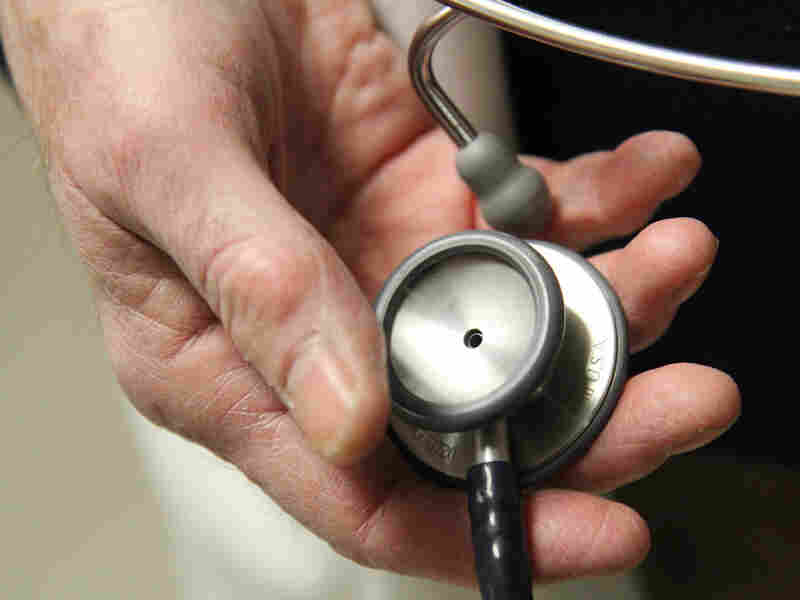
The Stethoscope: Timeless Tool Or Outdated Relic?

Kidney specialist Steven Peitzman, a professor at Drexel University College of Medicine, says physicians who are now in their 60s and 70s used to get praise if they had the 'ear' to hear and interpret subtle sounds through a stethoscope.

Kidney specialist Steven Peitzman, a professor at Drexel University College of Medicine, says physicians who are now in their 60s and 70s used to get praise if they had the ‘ear’ to hear and interpret subtle sounds through a stethoscope. Kim Paynter/WHYY hide caption

toggle caption Kim Paynter/WHYY

To hear a patient’s heart, doctors used to just put an ear up to a patient’s chest and listen. Then, in 1816, things changed.

Lore has it that 35-year-old Paris physician Rene Laennec was caring for a young woman who was apparently plump, with a bad heart and large breasts. Dr. George Davis, an obstetrician at East Tennessee State University who collects vintage stethoscopes, says the young Dr. Laennec didn’t feel comfortable pressing his ear to the woman’s bosom.

“So he took 24 sheets of paper and rolled them into a long tube and put that up against her chest, listened to the other end and found that not only could he hear the heart sounds very, very well, but it was actually better than what he could hear with his ear,” Davis says.

Or, it could have been poor 19th century hygiene — lice and the smell of unwashed bodies — that kept Laennec from getting too close to his patient.

Either way, he went home and crafted a wooden cylinder with a hole down the middle, and that became the first stethoscope.

It took a while for the art of listening to the body through a tube to catch on. But the new tool fit into an evolving idea that doctors needed a more focused approached to diagnosis, “that you should distinguish tuberculosis from a lung abscess — and not just call it all consumption,” says Dr. Steven Peitzman, a professor at Drexel University College of Medicine.

He says doctors used to get praise if they had the ‘ear’ to hear and interpret the subtle body sounds that travel through a stethoscope’s rubber tubing; the stethoscope is the iconic symbol of a physician.

Vidya Viswanathan, a first-year student at the University of Pennsylvania’s Perelman School of Medicine, is still getting used to hers.

Some doctors say clinicians can now get much more information from newer technology than they can get from a stethoscope. Clinging to the old tool isn't necessary, they say.

Some doctors say clinicians can now get much more information from newer technology than they can get from a stethoscope. Clinging to the old tool isn’t necessary, they say. Kimberly Paynter/WHYY hide caption

toggle caption Kimberly Paynter/WHYY

“You don’t realize until you are wearing it and trying to use it, how pokey it is in your ears,” she says. “I’m almost embarrassed to wear it because it implies I have knowledge I don’t have yet.”

Medical schools teach the art of listening.

“I am astounded at the things I’ll find with my stethoscope,” says Allison Rhodes, a third-year student at the Perelman School of Medicine. “I had a patient that had pneumonia, and it was really wonderful to be able to listen to her and say, ‘This is what I think it is.’ And then, later, see on the chest X-ray that, that was exactly what it was.”

But some argue that the stethoscope is becoming less useful in this digital age. Dr. Bret Nelson, an emergency medicine physician at The Mt. Sinai Hospital in New York, says clinicians now get a lot more information from newer technology.

An ultrasound, for example, turns sound waves into moving images of blood pumping and heart valves clicking open and shut; those visual cues are easier to interpret than muffled murmurs, and may produce a more accurate diagnosis, Nelson says.

He admits the stethoscope is an icon, but doesn’t buy the argument that if you lose the stethoscope, you lose the tradition of “healing touch.”

“Pulling an ultrasound machine out of my pocket, or wheeling the cart over next to the patient [and] talking through with them exactly what I’m looking for and how I’m looking for it — the fact that they can see the same image on the screen that I’m seeing strengthens that bond more than anything in the last 50 years,” Nelson says.

Nelson is 42 years old and graduated from medical school 16 years ago. He teaches medical students, and says it’s helpful to show new learners what “lies beneath.” At Mt. Sinai, when medical students are taught to examine a heart, they learn how to use the stethoscope and an ultrasound machine on the same day.

“They know how to feel it, they know how to listen to it, and they know how to look at it,” Nelson says.

Still, obstetrician George Davis wants to keep the stethoscope around for a while. High-tech machines and imaging scans are great backup resources, he says, but his stethoscope helps him figure out which patients actually need additional testing.

“How much do those ultrasound machines cost?” Davis asks. “I can get a good stethoscope for less than $20. We are not going to sit there and do an echocardiogram on every patient who walks through the door.”

Davis worries that a whole generation of doctors is learning to rely too much on technology; he wants to hold on to first-line tools that are safe, effective and cheaper.

“Shouldn’t we be using what is low-tech and practical?” he asks.

Nelson counters that point-of-care imaging is becoming less expensive every day. Twenty years ago, he says, an ultrasound machine was as big as a refrigerator and cost $400,000. Today, a handheld, portable device plugs into a computer tablet, and costs less than $10,000.

Many care providers in the community may even have an ultrasound in their pocket one day soon, he says. Who would have foreseen that today we have, “a slide rule, a calculator, a flashlight, a phone, a computer terminal and 36 video games,” all on one device – our smartphone.

This story is part of NPR’s reporting partnership with WHYY’s health show The Pulse, and Kaiser Health News.

This entry passed through the Full-Text RSS service – if this is your content and you’re reading it on someone else’s site, please read the FAQ at fivefilters.org/content-only/faq.php#publishers.

Study Finds Most Young Men Aren't Aware Of Emergency Contraception

How many guys know about Plan B?

How many guys know about Plan B? Photo illustration by Scott Olson/Getty Images hide caption

toggle caption Photo illustration by Scott Olson/Getty Images

Less than half of young men have heard of emergency contraception, a recent study found, even though it’s available over the counter at drug stores and is effective at preventing pregnancy after sex.

The study, published in the March issue of Journal of Adolescent Health, analyzed survey responses by 93 males between the ages of 13 and 24 who visited the adolescent medicine clinic at Children’s Hospital Colorado in Aurora for a physical exam, illness or injury between August and October 2014. Most had been sexually active.

The computerized survey asked patients about their knowledge of contraceptives, and whether they had talked about birth control with their partners or health care providers.

Although 84 percent of the teenage boys and young men said they believed avoiding a partner’s pregnancy was very or somewhat important, only 42 percent had heard of emergency contraception, the researchers found. The respondents who knew about emergency contraception, also called the morning-after pill, were more likely to have talked with a health care provider about birth control in the past.

Far from being disappointed, Dr. Paritosh Kaul, an associate professor of pediatrics at the University of Colorado School of Medicine who co-authored the study, said he was “pleasantly surprised” at the 42 percent figure.

“That’s two-fifths of the boys, and … we don’t talk to boys about emergency contraception that often,” he said. “The boys are listening, and health care providers need to talk to the boys.”

Kaul added, “These guys believe they should be involved in sexual health decision-making. And if they are, then they’re more likely to talk with their girlfriends. They’re the missing half. It takes two to tango.”

If taken within five days of unprotected sex, emergency contraceptives can prevent ovulation, thus preventing pregnancy.

In 2013, the Food and Drug Administration approved one brand-name emergency contraceptive, Plan B One-Step, for sale over the counter without a prescription for all women. The following year, the agency said that generic versions of the pills could also be sold over the counter without age restrictions.

Eighteen percent of sexually active women reported in 2013 that they had used emergency contraception sometime in the previous two years, according to the Centers for Disease Control and Prevention. That figure is probably higher now that the drugs are more readily available, said Kelly Cleland, a researcher at Princeton University who is executive director of the American Society for Emergency Contraception.

Although the Colorado study is too small to be the basis for generalizations, it’s one of the few studies to have looked at awareness or access since emergency contraceptives became available over the counter, Cleland said.

She said her organization has received complaints from consumers who have been denied emergency contraceptives at the pharmacy, including men who have either been told that men can’t buy it or that they have to have the ID card of the woman for whom they’re buying it, neither of which is true, said Cleland.

Women can get emergency contraceptives at no charge under the health law, but only with a doctor’s prescription. For women who don’t take that step, sharing the cost, which can run up to $50, is one important way for men to play a role, Cleland said. Emergency contraception “is so expensive when the burden falls on women exclusively.”

Kaiser Health News is an editorially independent news service that is part of the nonpartisan Henry J. Kaiser Family Foundation. Email questions or suggestions for future columns: KHNHelp@KFF.org. Michelle Andrews is on Twitter: @mandrews110.

This entry passed through the Full-Text RSS service – if this is your content and you’re reading it on someone else’s site, please read the FAQ at fivefilters.org/content-only/faq.php#publishers.

Treating Addiction As A Chronic Disease

“The people that I know who have lost spouses, children, some of them are so ashamed that they wouldn’t even acknowledge it as a cause of death,” says A. Thomas McLellan, co-founder of the Treatment Research Institute. Courtesy of Treatment Research Institute hide caption

toggle caption Courtesy of Treatment Research Institute

With the opioid epidemic reaching into every corner of the U.S., more people are talking about addiction as a chronic disease rather than a moral failing.

For researcher A. Thomas McLellan, who has spent his entire career studying substance abuse, the shift is a welcome one, though it has come frustratingly late.

McLellan is co-founder of the Treatment Research Institute in Philadelphia and former deputy director of the White House Office of National Drug Control Policy. His work has focused on understanding addiction as a disease and improving the ways it is treated, a mission that took a personal turn midway through his career when he lost a son to overdose.

NPR’s Audie Cornish spoke with McLellan about how addiction is viewed and how that view has shaped the treatment system we have today. He also has suggestions on how to make it better.

Here are interview highlights, edited for length and clarity.

On why addiction has traditionally been seen as a criminal justice issue, not a health issue

Think about it. If you didn’t have brain science, which has just really emerged in the last two or three decades, all you had to look at was the behavior of addicted people. They are not pleasant people when they are in full addiction. They steal, they lie, they swear they’re going to do something and they don’t. It’s quite easy to think of this as it has been thought of for literally hundreds of years: as a character disorder, as poor upbringing as a problem of parenting. And that’s how we approached it. It’s not coincidence that the Justice Department has played such a pivotal role. The emerging science shows this is a brain disease. It’s got the same genetic transmutability as a lot of chronic illnesses. And the organ that it affects is the brain, and within the brain it is motivation, inhibition, cognition, all those things that produce the aberrant, unpleasant behaviors that are associated with addiction.

On whether the drug treatment system is prepared to address the current opioid crisis

So there are two ways you have to think of it. First, there’s the traditional addiction treatment system. It was purposely set up to be separate from all of health care and that’s the way it’s been for four decades. They’ve been doing heroic things, but they’ve been underfunded, undertrained and they have been unable to provide the most contemporary kinds of treatment and monitoring. So then you turn to the rest of health care, mainstream health care. What we found is that less than 10 percent of American medical schools have a course in addiction. Ditto nursing, ditto pharmacy schools. So, contemporary physicians are not equipped to do it. Yet it’s those same kind of services, medications, behavioral therapies, monitoring and management, they now do routinely for diabetes, hypertension, chronic pain.

On the idea that addiction has to be treated over the long haul, the way diabetes and other chronic diseases are

It’s a tough sell on two sides. No. 1, it’s a tough sell for people who suffer from addiction. It’s tough to hear, “I’m sorry, we don’t have a cure. You can’t get detoxed, go away for 30 days, get your head straight and not be affected.” Same is true for diabetes. There is no place that I know of that gives you 30 days of insulin treatment and a hearty handshake and sends you off to a church basement. It just won’t work, so that’s tough.

It’s been tough for medicine, too. These are doctors who have never learned about addiction in school. Why in the world, if they’re already busy trying to treat other chronic illnesses, why should they take this on? And here is actually the best answer. You may say that expanding insurance options, providing more and better care for addicts is a waste of money, or it’s a gift to someone who doesn’t deserve it. The real gift is for the rest of health care, because it is impossible to manage most chronic illnesses without some attention to substance use disorders. They’ve been willfully ignored by medicine for decades and it’s costing them roughly $200 billion a year in wasted or inappropriate medical care.

On what has changed for people whose families are affected by addiction

The people that I know who have lost spouses, children, some of them are so ashamed that they wouldn’t even acknowledge it as a cause of death. And one thing I’ve found is that in health care, you don’t get the kind of health care that science dictates or that is even economically prudent. You get the health care that you negotiate and that is politically motivated. So for most of my life, there has been no groundswell demanding the kind of care that other illnesses have rightfully come to expect. In my life, the best thing that has ever happened and given people like me hope that your grandkids won’t have the same illness is the Affordable Care Act. It now mandates that the same kinds of care that are available for other illnesses of the body are also available for illnesses of the mind. We can do it. It’s economically sensible to do. We just haven’t had the political will.

This entry passed through the Full-Text RSS service – if this is your content and you’re reading it on someone else’s site, please read the FAQ at fivefilters.org/content-only/faq.php#publishers.