States Deny Pricey Hepatitis C Drugs To Most Medicaid Patients

A 12-week regimen of Harvoni is 90 percent effective in curing an infection with hepatitis C, doctors say. It also costs about $95,000.

A 12-week regimen of Harvoni is 90 percent effective in curing an infection with hepatitis C, doctors say. It also costs about $95,000. Baltimore Sun/TNS via Getty Images hide caption

toggle caption Baltimore Sun/TNS via Getty Images

Sarah Jackson had quit abusing drugs and had been sober for six months when she found out she had hepatitis C.

“That was weeks of not sleeping and just constant tears,” she says. “I had already put a lot of that behind me and had been moving forward with my life and this was just a major setback.”

To get rid of the infection, her doctor prescribed Harvoni, one of the new generation of highly effective hepatitis C drugs. But Jackson never started the treatment because her insurance, Indiana’s Medicaid, refused to pay for it.

“There’s nowhere else to go,” says Jackson. “The doctor tried and now I have no other place to turn.”

More than 3 million people in United States are infected with hepatitis C, a virus that can destroy the liver and cause liver cancer. The number of cases is increasing, and most new cases are attributed to injection drug abuse, according to the Centers for Disease Control and Prevention.

In the last few years, new medications have come on the market that can cure hepatitis C with a more than 90 percent success rate. But these new drugs are famously expensive. A full 12-week course of Harvoni costs about $95,000. Because of that, Medicaid in many states restricts who receives the medication.

Medicaid in at least 34 states doesn’t pay for treatment unless a patient already has liver damage, according to a report released in August. There are exceptions—for example, people who also have HIV or who have had liver transplants—but many living with chronic hepatitis C infection have to wait and worry.

“It is just not feasible to provide it to everyone,” says Matt Salo, director of the National Association of Medicaid Directors. “States have to make sure that we’re going to prioritize and that those who need it the most get priority treatment, and that’s what you’re seeing.”

States get a discount on the drugs, but Salo says even if they could cut prices in half, treating everyone with hepatitis C would still cost too much for states’ limited Medicaid budgets.

Officials in Washington state, for instance, estimate that at full price, treating everyone on Medicaid for hepatitis C would cost three times the state’s total pharmacy budget.

States are caught between the high prices and those who say that rationing care is illegal.

“If something is medically necessary, it’s medically necessary and must be covered by the Medicaid program,” says Gavin Rose, an attorney for the ACLU of Indiana.

Rose is representing Sarah Jackson in a class action lawsuit to fight the Indiana restrictions. He argues in the lawsuit that if a doctor says you need a drug, Medicaid must pay for it. The lawsuit cites a recent letter from the Centers for Medicare and Medicaid Services reminding states of the law.

Furthermore, Rose argues, treating hepatitis C early would keep the virus from spreading and actually save money in the long run. “We are talking about drugs that might prevent Medicaid from having to deal sometime in the future with treatment for liver cancer, with treatment for liver transplants,” he says.

There seems to be consensus that the new drugs for hepatitis C are too expensive. Even the U.S. Senate has criticized the pricing in a report released earlier this month. States spent $1 billion last year on Sovaldi, another commonly prescribed hepatitis C drug. A new treatment is set to come to market next year, and that competition may help bring prices down.

In the meantime Sarah Jackson will wait for her lawsuit to get resolved. “This is weighing over me every day. I have to worry about it all the time,” she says.

Despite the anxiety, she’s willing to go through it to help others like her who want to be cured.

This story is part of a reporting partnership with NPR, local member stations and Kaiser Health News.

This entry passed through the Full-Text RSS service – if this is your content and you’re reading it on someone else’s site, please read the FAQ at fivefilters.org/content-only/faq.php#publishers.

ER Docs Say Rule Change Could Raise Patients' Out-Of-Network Bills

Going to an out-of-network emergency room can be costly.

Going to an out-of-network emergency room can be costly. Harry Sieplinga/Getty Images hide caption

toggle caption Harry Sieplinga/Getty Images

Two professional organizations representing emergency doctors warn that a federal rule released in November could lead to higher out-of-pocket costs for consumers when they need emergency care outside their health plan’s network of providers.

But consumer advocates and health policy analysts say the groups’ proposed solution doesn’t adequately protect consumers.

Under the health law, plans can’t generally charge consumers higher copayments or coinsurance when they visit an emergency department that’s not in their network. So if the plan charges a flat copayment of $500, for example, or coinsurance totaling 30 percent of the cost of services for an emergency department visit at an in-network hospital it can’t charge consumers more than that rate if they get emergency services at an out-of-network facility. The only plans that are exempt from this provision are those that have grandfathered status under the health law.

However, the law doesn’t prohibit doctors and hospitals from balance billing consumers for out-of-network emergency care if their insurer doesn’t pay the full amount charged. That practice is what really harms consumers, say advocates.

“Our main interest is getting the consumers out of the middle,” says Chuck Bell, programs director at Consumers Union, a consumer advocacy group that has been involved in state efforts to prohibit balance billing. “Even if [the federal government] had written the regulation the way [emergency physicians] advocate, we would likely see balance bills going to consumers.”

Emergency services providers say they are in a tough spot because federal law requires them to treat anyone who comes through their doors, whether or not they have insurance or can afford to pay.

The health law says that insurers must pay a “reasonable amount” before a patient can be billed for the rest. The new federal rule defines “reasonable” as the greatest of these three options:

  • The median amount negotiated with in-network providers for the emergency service.
  • An amount calculated using the same method the plan would generally pay for other out-of-network services.
  • The amount paid by Medicare.

The American College of Emergency Physicians and the Emergency Department Practice Management Association maintain that the regulation’s first two options allow insurers to essentially pay whatever they want because their payment data is proprietary. Medicare reimbursement rates are generally lower than those of private plans.

Without a transparent, objective standard in place, the emergency providers say, insurers will pay them less and emergency providers may in turn try to collect the unpaid balance from consumers, unless they live in one of the dozen or so states that prohibit balance billing by out-of-network providers.

The physicians want the payment standard to be “usual and customary charges,” adjusted for geographic variations, using a transparent, independent claims database such as that provided by the nonprofit group Fair Health.

Insurers, however, say providers’ charges are too high and the process by which they are set is often opaque. A study last fall by America’s Health Insurance Plans, a trade group, used Fair Health data to examine the charges billed by out-of-network providers in 2013 and 2014 and compared them to the average fees paid by Medicare in 2014. Analyzing 1.16 million emergency department visits of high severity, the average out-of-network charge was $971 — far higher than the average Medicare payment of $176.

Consumer advocates, such as Bell, and some researchers who have studied consumers’ billing issues, say the government could take a more consumer-friendly approach by eliminating balance billing for emergency care altogether. New York did that with a law that took effect in April. Under that law, insured consumers generally can’t be billed for out-of-network emergency care. (The law doesn’t apply to self-funded companies that pay their employees’ claims directly.)

“It’s promising what New York did,” says Kevin Lucia, a senior research fellow at Georgetown University’s Center on Health Insurance Reforms. “They extract the consumers so they can’t be used as leverage between the providers and insurers.”

This entry passed through the Full-Text RSS service – if this is your content and you’re reading it on someone else’s site, please read the FAQ at fivefilters.org/content-only/faq.php#publishers.

It's Costing A Lot Of Money To Make Those Toenails Fungus-Free

You might be able to get fungus-free toenails, but it could cost you.

You might be able to get fungus-free toenails, but it could cost you. Shelly Strazis/Uppercut/Getty Images hide caption

toggle caption Shelly Strazis/Uppercut/Getty Images

The bills can rack up fast when trying to cure toenail fungus, and it’s not always easy to know which drug to use. Costs can range from over $2,000 for treating one nail to just $10 for a pill that treats all 10 toes but could have bad side effects. Then there are the costly lab tests to confirm that the curling yellow rot chewing through a toenail is in fact mold.

Right now, the most effective treatment for toenail mold or onychomycosis is a pill called terbinafine. It costs about $10 for a full treatment, which can take up to six months. It’s so cheap that it would be more cost-effective to administer the drug to everyone that clinicians think has toenail fungus, rather than spending extra money to confirm the diagnosis in a lab, which can cost up to $148, according to a study published in JAMA Dermatology on Wednesday.

Considering that at least 10 percent of Americans have toe fungus, the health care system could be saving between $18 million and $90 million by skipping the testing, the researchers say.

But some people are reluctant to use terbinafine because there’s a risk of liver damage, a fact that was emphasized when it came on the market decades ago.

“Practitioners were uncomfortable giving it because of the consequences, and we unfairly discouraged a lot of people from taking it,” says Dr. Arash Mostaghimi, a dermatologist at Brigham and Women’s Hospital and Harvard Medical School and senior author on the study. That’s the reason why doctors almost always order lab tests, so that people without a fungal infection wouldn’t be taking that risk.

Dermatologists know now that the chance for liver damage from terbinafine is less than 1 in 100,000, and yet the message persists. “I think that ‘people’ think that terbinafine is dangerous because their primary care doctors and even dermatologists have told them that!” Dr. Matt Kanzler, a dermatologist at Palo Alto Medical Foundation, tells Shots in an email.

Under the influence of this misconception, Kanzler says both physicians and patients elect to use more expensive topical treatments, like a new drug called Jublia that costs thousands of dollars per nail and works about 15 percent of the time. They want to avoid any potential liver injury and malpractice lawsuits. “The problem with this drug is that it isn’t ‘lifesaving’ like cardiac medicine,” he says. “As soon as there are articles mention ‘you should use this safe topical medicine,’ doctors say, ‘I am not going to put myself at risk.'”

The cumulative cost of all these decisions results in a needless burden on the health system, says Ankur Pandya, a health decisions scientist at Harvard University who was not involved with the study. “These extra health care costs are coming from somewhere. Either our tax dollars or our paychecks as we pay more in premiums and deductibles increase. These are dollars that could trickle back into our pockets on a societal level.”

This is part of the reason why health care is so expensive. Insurance premiums hurt, even for cheap plans. The cost to treat even minor nuisances can skyrocket. Then, a toenail fungus is not just a toenail fungus. It becomes an insatiable cash-scarfing beast latched onto the end of your foot. It would be better, Pandya says, to slash procedures that don’t make economic sense.

But other doctors say it’s not that simple. “Just assuming [terbinafine] is safe, [saying] let’s prescribe it for every clinical diagnosis for onychomycosis doesn’t translate perfectly into practice,” says Dr. Chris Adigun, a dermatologist practicing in North Carolina who did not work on the study.

For one, the pills work only about half of the time and must be taken for up to six months, depending on how severe the fungus is, and Adigun says there’s still a 2 percent chance for other side effects. “The incidence of liver injury is low, but [terbinafine] causes stomach upset, taste disturbance, fatigue — it’s often enough that people discontinue the drug.”

Adigun thinks that’s good enough reason to order the lab tests to make sure the patient really does have toenail fungus. “It damages the patient-doctor relationship to go on six months of a systemic drug for something they might not need.”

What’s more, Adigun says, this study doesn’t take into account that the elderly and people with other complications are more likely than healthy people to have toenail fungus. “[These patients] are often on a lot of other medications, so adding terbinafine to the mix without taking that into account is not totally responsible,” she says.

But Mostaghimi thinks it could be irresponsible not to recommend terbinafine as the front-line treatment for toenail fungus. “We’re spending 18 percent of our GDP on health care,” he says. “As a society, when we decide we’re going to spend an additional $80 million of testing for terbinafine, that’s $80 million we’re not spending on things that could be more valuable for us.”

Adigun agrees there’s a significant cost issue, but that doesn’t mean the decision is simple. “The take one for the team mentality is tough when it comes to your health and you’re the one swallowing that pill,” she says. “I think fiscally responsible medicine needs to be ingrained in us.”

At the same time, she says, she took an oath to do no harm. That means doing whatever she can to protect each patient from needless suffering, including side effects from a drug they didn’t need.

This entry passed through the Full-Text RSS service – if this is your content and you’re reading it on someone else’s site, please read the FAQ at fivefilters.org/content-only/faq.php#publishers.

FDA Approval Could Turn A Free Drug For A Rare Disease Pricey

Bull’s Eye/Imagezoo/Getty Images

The first sign something was wrong was when Sarah Shell lost 20 pounds. Then she started complaining that her legs were tired.

“She began having difficulty climbing stairs and I just thought that she was — I hate to use the word — lazy,” says Sarah’s mother, Leigh Shell.

Then the teenager’s eyes stopped moving. And she began vomiting out of the blue. Sarah had migraines and couldn’t concentrate. Then she lost all the feeling in her hands, feet and legs.

Her mother remembers the doctors, “testing, testing, testing — but there’s nothing that’s available that’s going to make her feel better.”

Sarah Shell on Thanksgiving Day. Within an hour of taking her first dose of Firdapse, she regained feeling in her hands, feet and legs.

Sarah Shell on Thanksgiving Day. Within an hour of taking her first dose of Firdapse, she regained feeling in her hands, feet and legs. Courtesy of Leigh Shell hide caption

toggle caption Courtesy of Leigh Shell

Finally, after years of doctor visits and tests, Sarah, who lives in Gulf Breeze, Fla., was diagnosed with Lambert-Eaton myasthenic syndrome, an autoimmune disorder known colloquially as LEMS. It’s thought to affect about 1,500 to 3,000 people in the United States, with symptoms usually starting in young adulthood.

Sarah started on an experimental drug called Firdapse.

“It was instantaneous, within an hour,” Leigh recalls. “It was like, ‘Mom, I feel like I can skip.’ It was a very emotional, tearful moment for us.”

Catalyst Pharmaceuticals, which makes Firdapse, has applied for approval from the U.S. Food and Drug Administration under an orphan drug designation. That would give the company exclusive rights to market the drug for seven years.

That should be good news for LEMS patients. But the reality isn’t so clear.

An Old Drug Made New

That’s because, for the last 20 years, many LEMS patients have received the same drug — known as 3,4-diaminopyridine, or 3,4-DAP — free of charge from Jacobus Pharmaceutical, a firm in Princeton, N.J.

Over the years, Jacobus has distributed its free version of the experimental drug to about 600 people through what the FDA calls a compassionate use program. The program is designed to make experimental drugs available to patients who need them, but who aren’t enrolled in a clinical trial.

Doctors who treat LEMS patients worry that if Catalyst, a small pharmaceutical company based in Coral Gables, Fla., gets approval to market its brand of the drug, the price will skyrocket, making it harder or even impossible for some patients to get any version.

In people who have Lambert-Eaton, communication is blocked between nerves and muscles. There’s nothing wrong with the muscle, and nothing wrong with the nerve. But there’s something in the path between them that’s not letting a signal go through.

The illness is rare and debilitating and hard to diagnose, doctors say.

Jacobus started studying 3,4-DAP in the late 1980s at the request of university physicians who treat LEMS patients. By the early 1990s the company began providing the medicine to doctors who got an “Investigational New Drug” permit from the FDA to prescribe it.

The only cost to the patient was the postage to send the shipping coolers back to Jacobus.

Jacobus is a small, family-owned company, so lacks the deep pockets that shareholders bring. Laura Jacobus says getting FDA approval to sell 3,4-DAP is an expensive process, and wasn’t a priority.

“We could have pursued marketing authority many years ago. But we felt that there wasn’t an unmet need,” she says.

“First and foremost we wanted to make the drug available to the patients and the physicians,” Jacobus says. “That was our No. 1 priority, so that was what we did.”

She acknowledges that getting the drug from her company can be “cumbersome.” It requires the doctor to file paperwork with the FDA that has to be updated each year. And patients have to go an extra mile to find a doctor who is authorized to distribute 3,4-DAP.

Another alternative for patients has been to get the medication from a compounding pharmacy, which can make it to order using widely available chemical ingredients. But that’s generally not easy either.

Another Firm Pursues FDA Approval — And Big Profits

Meanwhile, a company called BioMarin had been going through with some of the testing needed to gain full FDA approval for its version of the drug, Firdapse. In 2012, Catalyst bought the rights from BioMarin to market Firdapse in the U.S.

Catalyst CEO Patrick McEnany, says making the drug available via a regular doctor’s prescription will benefit patients.

Every day, McEnany says, “patients come to us and say ‘I have LEMS and I can’t get the drug.’ Patients don’t have access. It’s very important that this drug get approved.”

Catalyst hasn’t announced a price for Firdapse. But in a presentation to investors earlier this month, company officials said they could earn from $300 million to $900 million in revenue each year from the drug.

Those revenue projections, McEnany says, represent a “peak opportunity.”

The projections are based on a generous estimate of the number of patients who could use the drug, and an assumption that Firdapse will be approved for other uses. Still, the figures suggest the company will charge from $37,500 to well over $100,000 per LEMS patient, per year.

[embedded content]

McEnany says Catalyst, together with BioMarin, have invested about $40 million in research and development of the drug.

If the medicine is too expensive, he says, Catalyst will provide it to patients at a discount or free of charge.

“All patients — and I underline and capitalize all — all patients will have access to our drug,” McEnany says. “This is not something new. Most orphan drug companies do the same thing.”

Dr. Gordon Smith, who heads the division of neuromuscular medicine at the University of Utah School of Medicine, isn’t convinced.

“This is a drug that’s cheap to manufacture, that’s been available for decades,” he says.

‘Akin To Trying To Patent A Ladder,’ Critic Says

Smith has specialized in treating LEMS, and says he currently has about 10 patients — a big number for this rare disease. He’s been getting 3,4-DAP from Jacobus for 20 years, and says he is worried that if Catalyst’s application is approved by the FDA, its drug will be out of reach for many of them.

He says Catalyst is exploiting a loophole in the Orphan Drug Act — which was intended to encourage companies to develop new medicines for illnesses that don’t have any treatments.

What Catalyst is doing, he says, is “akin to trying to patent a ladder.”

In fact, health service officials in the U.K. have balked at paying for BioMarin’s Firdapse. In 2013, the U.K.’s National Health Service looked into buying Firdapse for LEMS patients, and decided, “the justification of the treatment’s cost in relation to its health benefits was not sufficient.”

After Catalyst appeared on the scene, Jacobus began the process of applying for approval for its version of 3,4-DAP. The company announced results of its own clinical trial in April. Laura Jacobus declined to say how far along the company’s application is. Catalyst completed its application this month.

Laura Jacobus says her company has no intention of charging as much as Catalyst’s estimated price for the drug.

“We’ve got over 25 years of investment in this, in terms of all of the clinical, and all of the research and development, and all of the chemistry and all of the patient support,” says Jacobus. “And we don’t think that it merits that kind of money.”

She agrees that patients would derive some benefit from a commercially available version of 3,4-DAP. It would make it easier to get the drug, and would entail better labeling, she says, so doctors could more easily understand how to prescribe it.

Smith and many neurologists agree.

Smith recently co-authored an opinion article in the journal Muscle & Nerve, which was signed by 106 neurologists, calling on the FDA to approve applications for both Catalyst and Jacobus.

This entry passed through the Full-Text RSS service – if this is your content and you’re reading it on someone else’s site, please read the FAQ at fivefilters.org/content-only/faq.php#publishers.

Brain Surgery Serenade: Man Plays Saxophone During Tumor Removal

Carlos Aguilera recently discussed how he played the saxophone during surgery to remove a brain tumor at Regional Hospital of Malaga, in Andalusia, Spain.

Carlos Aguilera recently discussed how he played the saxophone during surgery to remove a brain tumor at Regional Hospital of Malaga, in Andalusia, Spain. Jorge Zapata/EPA /LANDOV hide caption

toggle caption Jorge Zapata/EPA /LANDOV

The team of doctors who recently operated on Spanish musician Carlos Aguilera’s brain wanted to be sure they didn’t affect his ability to play the saxophone – so they had him play songs during a 12-hour surgery.

A partially sedated Aguilera obliged, playing “Misty” and other songs, in addition to reading sheet music. In a video of the procedure, the mellow tones of Aguilera’s saxophone blend in with the normal sounds of an operating room.

[embedded content]
YouTube

From Madrid, Lauren Frayer reports:

“The 27-year-old was sedated, on painkillers, but remained conscious during the entire multi-hour operation.
“Doctors were removing a brain tumor, and wanted to ensure the surgery wouldn’t damage Aguilera’s musical ability. It was the first such surgery of its kind in Europe.
“The operation took place in October, and Aguilera recently went public to say he’s been cured — and continues playing his sax with an orchestra in the southern city of Malaga.”

At a news conference this week, Aguilera’s father told journalists that when his son was diagnosed with a brain tumor earlier this year, he feared the worst – including the possibility that he might never play music again.

“Two months ago I was on the table, and now I have a life in front of me,” Aguilera said, according to La Opinion of Malaga. “I’ve been reborn.”

Such procedures are meant to protect musicians’ primary audio cortex and other parts of the brain that can affect their ability to play. (A story on NPR’s Weekend Edition today looks at The Neuroscience Of Musical Perception, Bass Guitars And Drake.)

It’s the first time such a case has been reported in Spain; similar measures were taken during recent brain surgeries in the U.S. and elsewhere — including last summer, when Slovenian opera singer Ambroz Bajec-Lapajne sang portions of Franz Schubert’s Gute Nacht during surgery for a brain tumor.

In August, Bajec-Lapajne posted a video of his performance in the operating theater.

“All is fine until min. 2:40 when things start to get very interesting,” Bajec-Lapajne said of the video. “It’s been more than a year since and I’m doing fine, continuing my professional singing career.”

[embedded content]
YouTube

Other recent cases include:

  • In June, guitarist Kulkamp Anthony Dias played the Beatles’ “Yesterday” and other songs during a surgery to remove a tumor in Brazil.
  • Last year, former Lithuanian National Symphony Orchestra violinist Naomi Elishuv played during a procedure in Tel Aviv to correct tremors that ended her career.
  • Also in 2014, American concert violinist Roger Frisch underwent a procedure similar to Elishuv’s to free him from essential tremors.
  • In 2008, bluegrass legend Eddie Adcock played banjo during neurosurgery to correct similar involuntary tremors.

This entry passed through the Full-Text RSS service – if this is your content and you’re reading it on someone else’s site, please read the FAQ at fivefilters.org/content-only/faq.php#publishers.
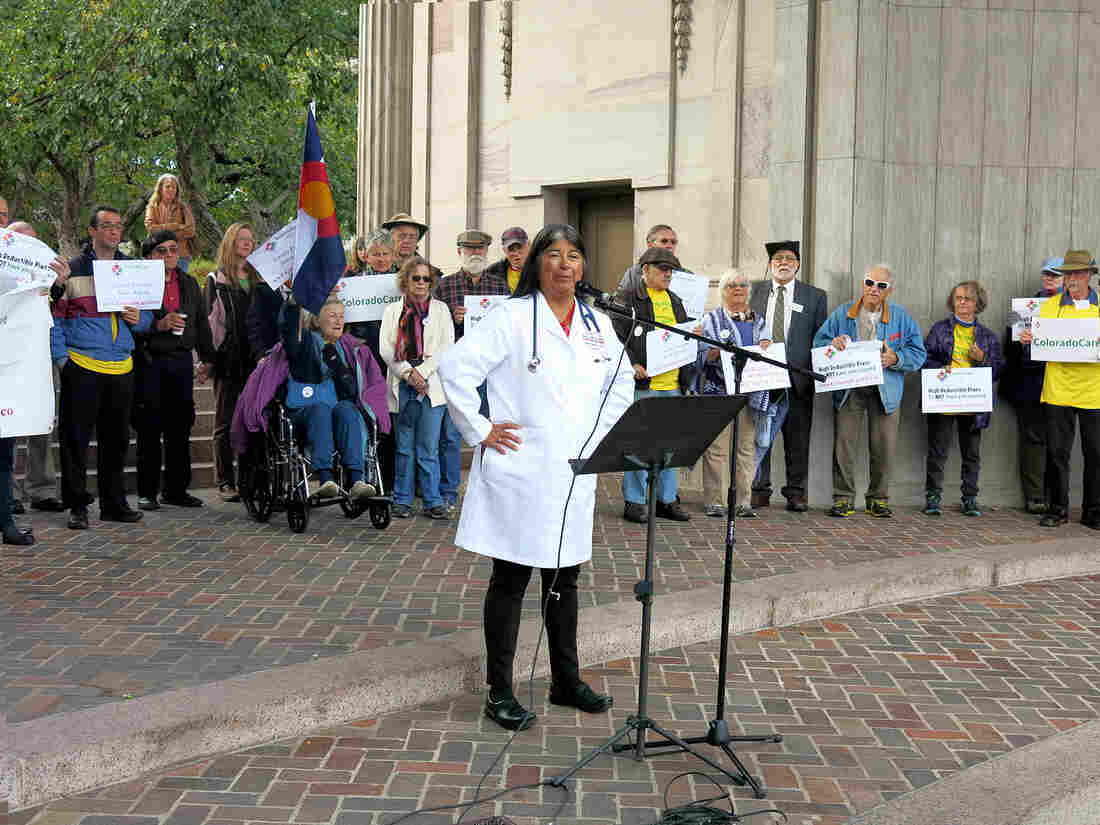
Coloradans Will Put Single-Payer Health Care To A Vote

Dr. Irene Aguilar, a Democrat and Colorado state senator from Denver County, is also a medical internist and advocate of universal health care. She led this Denver rally in favor of the 2016 ballot measure.
3:53

Download

Dr. Irene Aguilar, a Democrat and Colorado state senator from Denver County, is also a medical internist and advocate of universal health care. She led this Denver rally in favor of the 2016 ballot measure. John Daley/Colorado Public Radio hide caption

toggle caption John Daley/Colorado Public Radio

On a brisk morning in Denver recently, an ambulance pulled up in front of a downtown office tower. “I think the patient is going to make it,” Dr. Irene Aguilar said as a team rolled out the gurney.

This wasn’t a medical emergency, but rather a bit of political theater. The gurney held several big boxes of signed petitions to be delivered to Colorado’s Secretary of State’s office. The group ColoradoCareYES gathered enough signatures — more than 100,000 — to put a single-payer health system on the ballot next fall.

Under the plan, Coloradans would still pick their own providers of health care, but the new system would pick up all the bills. There would be no deductibles and fewer and smaller copays.

“Our current system gouges us financially,” says Ken Connell, a volunteer with ColoradoCareYES. “Too many don’t have access until they’re too far along the sick path.”

Connell says he’s been advocating for changes to the U.S. system of health care insurance for more than a decade — ever since his 33-year-old son took his own life. Connell says better access to mental health care could have made a difference for his son.

“We could not get him care,” Connell says. “It’s a human right. We should be taking care of each other, as long as we can, and we certainly have the resources in this country.”

Aguilar, the doctor who accompanied the box-filled gurney, is also a Colorado state senator and a Democrat. She led the rally at Denver’s Civic Center the day the signatures were delivered.

“This is not going to be an easy fight,” Aguilar says. Obamacare has been a good start, she says. It has sliced Colorado’s uninsured rate in half. But many people are still uninsured, and others struggle to pay their premiums and out-of-pocket costs.

The idea behind ColoradoCare, Aguilar says, is “to have everybody paying in but everybody having access to health care that will keep them healthy, keep them working, keep them contributing to our society.”

Supporters of single-payer health care delivered signatures supporting their ballot measure on a stretcher to Colorado's secretary of state.

Supporters of single-payer health care delivered signatures supporting their ballot measure on a stretcher to Colorado’s secretary of state. John Daley/Colorado Public Radio hide caption

toggle caption John Daley/Colorado Public Radio

Here are some key features of the proposal: Seniors would stay in the Medicare system, and those in Tricare, the military health system, could keep that insurance. And anybody would be free to buy private coverage from a private insurer, though they would still have to pay for ColoradoCare. It would work like a single-payer plan, in the sense that everybody pays in, and everybody would be automatically covered, one way or another.

To finance the project, Colorado employers would pay nearly 7 percent in a payroll tax. Employees would pay 3 percent or more of their gross pay toward the health plan. The self-employed would need to pony up 10 percent of their annual net income (to cover the employee’s contribution plus the employer’s contribution — analogous to the formula used to calculate federal self-employment tax). All in all, supporters say, these proposed tax hikes would raise around $25 billion, and save residents money in the long run.

But the tax hike could be a concern for many voters according to Michele Lueck, president and CEO of the Colorado Health Institute, a nonprofit, nonpartisan think tank. “The price tag is just enormous, right?” she says. At $25 billion, “it rivals the state budget.”

For years, Coloradans have shot down tax increases. “I don’t think that there have been many, if any, times when Colorado has bit off something that big,” Lueck says.

Other than taxes on marijuana or tobacco, Colorado voters haven’t passed a statewide tax hike for more than two decades.

Some people worry the price tag of such a program would make Colorado less attractive to businesses and millennials.

“If you think it’s expensive now, it’s going to get even more expensive,” says Jonathan Lockwood, executive director of Advancing Colorado, a free-market advocacy group. “Really, I think the biggest part of this is that it’s an unrestrained tax hike.”

That also scares health economist Linda Gorman, with the Independence Institute, a free-market think tank.

“The finances don’t work,” she says, citing the case of Vermont, whose legislature passed a universal healthcare bill a few years ago. The Vermont governor soon thereafter pulled the plug on the plan he’d previously championed, after ballooning cost estimates forced him to admit the state couldn’t afford the program.

Other than taxes on marijuana or tobacco, Colorado voters haven’t passed a statewide tax hike for more than two decades.

Gorman says she worries the Colorado proposal would vest too much power in a 21-member governing board; it would have taxing authority, she says, but no controls to ensure transparency.

“These people have way too much unaccountable power in this initiative,” she says.

The proposed system would also put 4,000 brokers out of work and lead to longer waits for care, according to Tammy Niederman, representative of a trade group for health insurance brokers.

“This will inevitably ration care, Niederman says. “There’s no way to put in a universal system that doesn’t do that.”

Colorado’s insurers and its hospital association haven’t yet taken a position on the measure. Democratic Gov. John Hickenlooper is also reserving judgment.

“A lot of people say it’ll cost a lot more,” says Hickenlooper. “A lot of people say it’s going to be the salvation and lower the costs. Let’s find out what the numbers say.”

Meanwhile, all agree that the total numbers in political advertising dollars spent for and against the measure are sure to be big leading up to December, 2016.

The single-payer advocacy group ColoradoCareYes raised nearly $330,000 in contributions in 2015, according to filings made with the Colorado Secretary of State’s office. That put the organization’s donations in the top 10 among groups advocating for Colorado issues this year.

It’s not clear how much money Advancing Colorado, a group opposing the single-payer ballot measure, has raised so far. But it has launched a digital campaign already that says, “ColoradoCare is a killer.” And other forces opposed to the single-payer ballot initiative have started to mobilize. A group called “Committee to Stop Colorado Care,” based in Parker, Colo., registered with the state in November.

This story is part of NPR’s reporting partnership with Colorado Public Radio and Kaiser Health News.

This entry passed through the Full-Text RSS service – if this is your content and you’re reading it on someone else’s site, please read the FAQ at fivefilters.org/content-only/faq.php#publishers.

Obamacare Deadline Extended As Demand For Health Insurance Rises

The deadline to sign up for an Obamacare health insurance plan starting on Jan. 1 was extended until Friday because the web site was overwhelmed. Demand was up, but that might be because the penalties for not having insurance are increasing.

This entry passed through the Full-Text RSS service – if this is your content and you’re reading it on someone else’s site, please read the FAQ at fivefilters.org/content-only/faq.php#publishers.

Kaiser Permanente's New Medical School Will Focus On Teamwork

Nurse practitioner Rachelle Quimpo begins an ear exam on Shreya Sasaki at a Kaiser Permanente health clinic inside a Target retail department store in San Diego, Calif., as Dr. Heidi Meyer watches via video. Kaiser says it will train medical students to provide good care beyond traditional medical settings.

Nurse practitioner Rachelle Quimpo begins an ear exam on Shreya Sasaki at a Kaiser Permanente health clinic inside a Target retail department store in San Diego, Calif., as Dr. Heidi Meyer watches via video. Kaiser says it will train medical students to provide good care beyond traditional medical settings. Mike Blake/Reuters/Landov hide caption

toggle caption Mike Blake/Reuters/Landov

Thursday’s announcement by Kaiser Permanente that it plans to open its own medical school in Southern California in 2019 has attracted a lot of attention in the health care community.

The nonprofit, national provider of managed health care says it plans to train students in its own style of integrated diagnosis and treatment — focusing on research, the use of new technologies, and teaching doctors to work as part of a collaborative caregiving team.

Kaiser is actually at the trailing edge of a medical school expansion that has been unmatched since the 1960s and 1970s, say specialists in medical education. (Kaiser Health News is not affiliated with Kaiser Permanente.) In the past decade alone, according to the Association of American Medical Colleges, 20 new medical schools have opened or been approved.

That’s no coincidence. In 2006 the AAMC called for a 30 percent increase in medical school graduates by 2015 — by admitting more students and building new schools — to meet a growing demand.

“We’re on track to meet that 30 percent increase in the next three or four years,” says Atul Grover, AAMC’s chief public policy officer. “Enrollment is already up 25 percent since 2002.”

Many of the new schools focus on producing more primary care doctors — those specializing in pediatrics, family medicine, or general internal medicine. In fact, Kaiser Permanente already has a partnership with the University of California, Davis, in a fast-track training program for primary care.

But Kaiser leaders say their new school will be about more than just primary care.

“We need to prepare physicians for the way health care is delivered in the future,” says Dr. Edward Ellison, executive medical director for the Southern California Permanente Medical Group. Students need to learn not just medicine, he says, but about integrated systems of care and how to work in a much different medical environment.

“Our advantage is we can start from scratch,” he says.

Another advantage is the HMO’s deep pockets.

“They’ve got huge resources,” says Dr. George Thibault, president of the Josiah Macy Jr. Foundation, which focuses on medical education. “This is a grand experiment, but if anybody can do it, Kaiser can.”

Kaiser Permanente is far from the first health care provider to launch its own medical school — the Mayo Clinic has had one since 1972, and is about to expand that school from the organization’s home base in Minnesota to its satellite campuses in Arizona and Florida.

Thibault says Kaiser and other health-provider systems are already heavily involved in the new medical schools, often as partners with degree-granting universities, “which itself is a new trend.” For example, on Long Island, the North Shore-LIJ Health System co-launched a medical school with Hofstra University in 2011.

One big question is whether all these new schools will eventually produce more students than there are medical residency positions — apprenticeship years that are necessary to complete medical training. The federal government, which funds the majority of those residencies through the Medicare program, capped the number of residencies it would pay for in the 1997 Balanced Budget Act.

Nationally, there are about 27,000 residency slots available each year, which are filled by students who have earned M.D. or D.O. degrees (doctors of osteopathy) in the U.S., as well as by foreign medical school graduates and U.S. citizens who have graduated from medical schools overseas.

Between the new M.D.-granting schools and a rapid expansion of osteopathic medical schools, the demand for residency slots will soon outstrip supply, says Grover. The pool of residency positions at hospitals nationally is “growing at about 1 percent per year,” he says (mostly funded by health systems themselves, since Medicare will not pay for them), “while undergraduate medical education is growing about 3 percent per year.”

But Edward Salsberg of George Washington University, who has spent a career documenting health workforce trends, says any potential conflict is still a long way off.

“When you start with an excess of 7,000 slots” of residencies above the number of graduating U.S. medical students, “it takes a very long time” to consume that excess, he says. By the year 2024, he and others write in a recent issue of the New England Journal of Medicine, there will still be 4,500 more residency slots than graduates.

“So yes, U.S. medical students will have a slightly more limited range of specialties to choose from,” Salsberg says, “but still plenty of room.”

Some people question whether the doctor shortage that all these new schools aim to alleviate is actually real.

Grover, whose organization has led the call for more doctors, says the anticipated shortage of primary care physicians might not be as acute as originally thought. That’s because the U.S. is producing dramatically more nurse practitioners and physician assistants, who also provide primary care.

That’s probably a good thing, at least in supply terms, Thibault says. Because it turns out that many students graduating from the new medical schools that focus on primary care are opting to become specialists instead.

“The career choices in the new schools look remarkably similar to career choices of more traditional schools,” Thibault says. All the graduating students, he explains, “are responding to the same set of signals and stimuli” about prestige, income and lifestyle.

This story was produced through a collaboration between NPR and Kaiser Health News, an editorially independent news program of the Henry J. Kaiser Family Foundation. Neither KFF nor KHN is affiliated with Kaiser Permanente.

This entry passed through the Full-Text RSS service – if this is your content and you’re reading it on someone else’s site, please read the FAQ at fivefilters.org/content-only/faq.php#publishers.

On TV, Women Who Have Abortions Are Younger, Whiter And Wealthier

Robin Wright's fictional character Claire Underwood in the Netflix series House of Cards is a favorite of TV critics and fans. But the demographics of real U.S. women who have abortions are very different from the TV character's.

Robin Wright’s fictional character Claire Underwood in the Netflix series House of Cards is a favorite of TV critics and fans. But the demographics of real U.S. women who have abortions are very different from the TV character’s. Nathaniel E. Bell/AP hide caption

toggle caption Nathaniel E. Bell/AP

Characters on television who consider or obtain abortions don’t reflect the demographics of American women who choose them or their reasons for doing so, according to a recent analysis from researchers at the University of California, San Francisco.

The group looked at all depictions of abortion on U.S. television shows from 2005 to 2014. This included both network television shows and other distributors, including Netflix and Showtime. They found that TV characters who had abortions were younger, whiter, wealthier and less likely to be raising children than the average American woman who has an abortion.

“It’s not that these portrayals are inaccurate. They’re going to represent someone’s reality,” says Gretchen Sisson, a research sociologist with the UCSF research group Advancing New Standards in Reproductive Health. “But, in aggregate, they’re not reflecting what’s really happening in the real world. So, what we would like to see is a greater diversity of stories told on television” about women who seek abortions.

Abortion is a common procedure in the United States. About a million were performed in 2011, the most recent year for which statistics are available. Three in 10 women have an abortion by age 45.

In Sisson’s study, published online this month in the research journal Contraception, about a third of the television characters having abortions were under age 20, about a third were in their 20s, and about a third were in their 30s. In reality, nearly 60 percent of women who have abortions are in their 20s.

Nearly 90 percent of the fictional characters were white, versus 36 percent in real life. About 30 percent of American women who choose abortions are black and about 25 percent are Latino. Fictional characters were also far less likely to be parents — about 15 percent versus more than 60 percent in real life.

“All these factors work together,” Sisson said, “to build an interesting social myth, which is that women who get abortions aren’t mothers and they don’t want to be mothers.” The truth, she says, is that “the majority of women getting abortions are already parenting, and the vast majority intend to parent during their lives.”

TV depictions of the reasons for abortion were also not reflective of the reasons real women obtain the procedure. Characters on television tended to say they were choosing abortion because having a child would interfere with educational or career plans — what Sisson called “self-focused” reasons. In reality, women tend to cite “other-focused” reasons. In particular, women will often cite a need to take care of the children they have or that they can’t afford another child, Sisson said.

“Taken together, this pattern of reasons can contribute to the construction of abortion as a self-focused decision, and to the belief that abortions are ‘wanted’ because of personal desires rather than ‘needed’ because of circumstances such as poverty,” the researchers say in their report on TV depictions.

More than 40 percent of U.S. women who have abortions have incomes below the federal poverty level, the researchers note, but on television, 82 percent of characters having abortions were affluent or middle class.

Sisson says abortion is a “stigmatized procedure” that few people discuss openly. “So very few people have a context for the reality of abortion care,” she says, “so these fictional stories that happen on-screen can have greater power to influence perceptions of what that care looks like in real life.”

She cites the fictional character of Claire Underwood, deftly played by Robin Wright in the Emmy-winning House of Cards, as one example that could mislead viewers about abortion. The affluent character “lies about the number of and reasons for her abortions, and she has the abortions because she does not want children,” Sisson points out. “Additionally, her doctor implies that multiple abortions might lead to infertility — which they don’t.”

Depictions that are demographically more realistic, at least in some ways, may have other flaws, Sisson says, but they add some complexity as far as representation of the different kinds of women who choose abortion, and their motivation. Among these, she cites Shameless, where one character has an abortion because she can’t afford a child, or Grey’s Anatomy, which depicts a woman of color in her 30s choosing abortion.

In particular, the researchers found that the death rate among television characters who had abortions was about 10 percent. In reality, data from the Centers for Disease Control and Prevention show that the risk of death for a woman undergoing the procedure is a tiny fraction of that — 0.0015 percent.

While the study did not look at audience impact — that analysis is coming, Sisson says — she theorizes that depictions of women choosing abortion may already be influencing public policy.

“It’s easy to postulate,” she says. “If you see a lot of stories where women are changing their mind in the waiting room, then public policies such as waiting periods might make sense. … If you see a lot of teenagers getting abortion on television, then policies such as parental consent or parental notification laws might make sense.”

In addition to the analysis of audience impact, Sisson says a review in the coming months will look at television depictions of abortion providers.

This story was produced by KQED’s blog State of Health.

This entry passed through the Full-Text RSS service – if this is your content and you’re reading it on someone else’s site, please read the FAQ at fivefilters.org/content-only/faq.php#publishers.

Lax Auditing Encouraged Overcharging By Medicare Advantage Plans

Steven Puetzer/Getty Images

Steven Puetzer/Getty Images

Despite facing mounting evidence federal officials were overpaying some Medicare health plans by tens of millions of dollars a year, the government dialed back efforts to recover as much of the money as possible, newly released records show.

The privately run Medicare Advantage plans offer seniors an alternative to traditional Medicare and in recent years have signed up more than 17 million members, about a third of people eligible for Medicare.

Centers for Medicare and Medicaid Services records reveal that officials there as early as 2008 identified a group of privately run Medicare Advantage health plans they suspected of ripping off the government, even calling them highfliers.

But CMS officials chose to do just 30 in-depth financial audits to recover overpayments each year, even though the records make clear they could complete many more.

“Given our current staffing and contractor resources, we can do up to 80 audits a year,” reads an undated CMS document.

But CMS officials subsequently proposed to the White House Office of Management and Budget that only 30 audits be conducted. OMB didn’t respond to requests for comment. A CMS record says the “consensus was to audit 30 contracts per year.”

In February 2012, CMS announced it would do just that — which meant about 5 percent of the roughly 600 Medicare Advantage contracts in force would be audited in a year.

The agency expected to complete the first batch of the Medicare Advantage audits, which covered 2011 spending, and to “recoup overpayments” in early 2014, according to another document. But it has yet to do so. A spokesman said the Medicare agency “anticipates completing” the audits in 2016.

The CMS records were recently released to the Center for Public Integrity through a court order in a Freedom of Information Act lawsuit.

Since 2004, the government has paid the health plans using a risk score it calculates for each patient based on diseases reported by the health plans. Medicare expects to pay higher rates for sicker people and less for those in good health. But overspending tied to fast-rising risk scores has cost taxpayers billions of dollars in recent years, as the Center for Public Integrity reported in a series of articles published in 2014, leading to widespread suspicions that some risk scores are being purposefully inflated.

Many of the records released by CMS are heavily redacted, with dates and the names of their authors sometimes missing. More than 1,400 pages have been “withheld in their entirety” by CMS, including names of the health plans and how much they were overpaid.

The government’s relaxed pace in chasing down overpayments – and the secrecy surrounding the audit results — brought a sharp rebuke from Senate Judiciary Committee Chairman Charles Grassley.

“The agencies are responsible for getting the payments right in the first place and pursuing full refunds of all over-payments for the taxpayers,” the Iowa Republican said in a statement.

“The agencies also have an obligation to be as transparent as possible about audits, over-payments and everything else in the public interest about a taxpayer-funded program,” Grassley added.

Despite the redactions, the records offer significant new details about the fitful pace of Medicare Advantage audits, which appear so far to have cost taxpayers more to carry out over the years than they have clawed back.

The CMS records make clear that Medicare Advantage overpayments have piled up mainly because the complex formula relying on risk scores that is used to pay the plans has few safeguards to discourage abuse. One memo describes it as an “honor system.”

Grassley called that remark “worrisome.” “This is a multi-billion-dollar government program, not the office coffee kitty. CMS, [Department of Justice] and Congress have to get it right,” he said.

A CMS spokesman didn’t directly address written questions posed by the Center for Public Integrity about the history of the audits. But the agency offered a statement that read in part: “CMS takes seriously program integrity and payment accuracy in Medicare Advantage, and is taking steps to protect taxpayers, Medicare beneficiaries, and the Medicare program.”

The CMS records include an earlier confidential audit of 2005 payments to 22 Medicare Advantage health plans; it showed that auditors couldn’t confirm 31 percent of the patients had the diseases Medicare was paying plans to treat.

Some plans were much worse than others. The average error rate for 17 of the 22 plans was more than 10 percent above the norm, with some even higher. The confidential 2005 audit, conducted by consulting firm BearingPoint, projected 2005 losses at $4.2 billion from what it termed a “substantial overpayment” to Medicare Advantage plans.

Demanding all the money back “may be defensible to public entities such as Congress,” but might also lead some insurers to “opt out” of Medicare Advantage, the report added. Since debuting in 2004, the privately run plans have won many fans among both seniors and members of Congress.

Clare Krusing, spokeswoman for America’s Health Insurance Plans, the industry’s trade group, said an “unconfirmed diagnosis does not necessarily mean the beneficiary does not have the conditions reported by the plans.” She said that CMS doesn’t allow plans to submit evidence such as prescription drugs that might help confirm a person has a certain disease.

The audits are called RADV, for Risk Adjustment Data Validation. Auditors review medical records of a sample of 201 patients to verify they have the diseases their health plan is being paid to treat.

If patient files don’t confirm the diagnoses, CMS asks for a refund. The agency planned to extrapolate the payment error rate to a contracted plan’s full membership. Extrapolation is widely used by federal officials in calculating medical overpayments and would have put some large Medicare Advantage plans on the hook for tens of millions of dollars in refunds.

CMS records suggest that pushback from the industry, including threats of lawsuits over the legality of the audits, and other delays and missteps, gave the agency pause with extrapolating.

“A lot of money is at stake” from these audits, which “has the plans very nervous,” says one CMS record.

In one undated presentation, officials argued for a “conservative estimate” of overpayments, noting “we think it puts us in the best position to withstand litigation challenges.”

CMS officials also appeared to have doubts about the legality of RADV because it lacked a formal appeals process. Setting one up took until February 2012 and in the meantime the health plans weren’t penalized—even though officials knew payment errors were wasting billions of tax dollars.

Audits for 2007, for instance, dragged on for more than five years before ending with a whimper. CMS had anticipated collecting from $500 million to $800 million from 37 health plans audited that year, the newly released records show.

That never happened. Instead, CMS collected less than $14 million and some health plans, including UnitedHealth Care, have spent years appealing to get at least some of that money back.

The audit program fell short of expectations at several other points as well.

A Dec. 22, 2010 internal memo said that CMS expected to launch audits of 2008 spending “soon” and that “at least forty” would take place. During 2008, CMS had estimated “improper payments,” to the health plans at nearly $7 billion, mostly overcharges.

Yet CMS ended up scrapping the 2008 audits and didn’t conduct them for 2009 or 2010, apparently because officials believed they had waited too long to get the process up and running.

The Centers for Medicare and Medicaid Services, which is part of the Department of Health and Human Services, spends about $17 million a year conducting RADV audits and estimating payment errors. So far, these efforts have returned about $15 million to the agency.

By contrast, other medical fraud and abuse efforts are said to more than pay for themselves. HHS announced in March 2015 that fraud recovery efforts by the department returned $7.70 for every dollar spent.

CMS officials have said the threat of being audited, and a provision of the Affordable Care Act requiring prompt return of any excess payments, has led Medicare Advantage to voluntarily send back more than $1 billion to the treasury, mostly since 2010.

The CMS spokesman said audits of 30 Medicare Advantage contracts and their spending from 2012 have begun and that plans were chosen based on “how aggressively they report diagnosis codes to CMS for payment.”

But Steve Ellis, vice president of the budget watchdog group Taxpayers for Common Sense, said it was troubling that the audits haven’t delivered better results. “You really have to enforce audits and act on them and not let the bad actors off the hook,” he said.

This piece comes from the Center for Public Integrity, a nonpartisan, nonprofit investigative news organization. To follow CPI’s investigations into Medicare and Medicare Advantage waste, fraud and abuse, go here. Or follow the organization on Twitter: @Publici.

This entry passed through the Full-Text RSS service – if this is your content and you’re reading it on someone else’s site, please read the FAQ at fivefilters.org/content-only/faq.php#publishers.