How Kentucky Keeps Horse Racing Deaths Secret

When a thoroughbred dies on a Kentucky racetrack, it’s almost impossible to learn the circumstances of the death because the Kentucky Horse Racing Commission keeps the information largely secret.


SCOTT SIMON, HOST:

Last year, an average of 10 horses a week died at U.S. racetracks. That’s according to a racing industry group called The Jockey Club. Typically, information about those deaths – who owned or trained the horses, for example – is public. That’s true of California tracks like Santa Anita, which has witnessed a spate of deaths, tracks in New York where the Belmont Stakes is run tonight. It’s not true, though, of Kentucky, horse racing’s home state. Caitlin McGlade with the Kentucky Center for Investigative Reporting looked into why that is.

CAITLIN MCGLADE, BYLINE: It’s two weeks after the Kentucky Derby at Churchill Downs – first race of the day.

(SOUNDBITE OF ARCHIVED RECORDING)

UNIDENTIFIED ANNOUNCER: They’re in the gate, and they’re off.

MCGLADE: It is also the first race ever for Kinley Karole, a 3-year-old filly. She pulls out slow and trails far behind the pack. When she starts to catch up, her back leg snaps. The announcer doesn’t mention it. The Daily Racing chart says that she went wrong. But Kinley Karole was euthanized. And even in the midst of a huge national conversation about horse racing deaths at one of the most storied racetracks, she never made headlines. A lot of states consider identities of horses that died, as well as where and when they died, to be public record. But in Kentucky, the horse racing capital of the world, officials say open records law protects the business interests of horse trainers and owners.

Racing deaths have been on the rise nationally. Kentucky reported 38 race fatalities last year. The state has detailed data, including which horses die and who trains them, but it’s not public record. Amye Bensenhaver with the Kentucky Open Government Coalition says this makes it harder to hold accountable some of the racing industry’s biggest players.

AMYE BENSENHAVER: Establishing these impediments to access, they are tipping the balance in favor of the industry rather than the public’s right to know.

MCGLADE: Kentucky’s equine medical director told me there are no public records identifying dead horses, and she didn’t respond to additional questions. So I asked to see necropsies filed by veterinarians. Officials said they would give those but with a big caveat – they’d redact the name of the horse, where and when it died, who owned it and really any information to identify the horse. Why? They argued state law allows them to withhold these details because they’re generally considered confidential, and sharing them would put trainers and owners at a competitive disadvantage.

JAMES GAGLIANO: I really question the wisdom of a statement like that.

MCGLADE: That’s James Gagliano. He’s the president of The Jockey Club, the thoroughbred breed registry for the United States and Canada. And his organization encourages tracks to publish injury and death statistics. Churchill Downs does not – another reason that horse deaths in Kentucky have been shrouded in secrecy for so long.

GAGLIANO: These are facts, and there’s nothing wrong with reporting facts.

MCGLADE: So I called around to other states. New Jersey, home of the Haskell Invitational Stakes – it’s not confidential there. California – Racing Board spokesman Mike Martin had a list from Santa Anita Park on hand.

MIKE MARTIN: Yes. Yeah. I might be able to send that to you within the next minute if you asked me for it. Yeah.

MCGLADE: That track suspended racing after a spate of fatalities. He said I could find out about deaths at other tracks through a public records request. Maryland’s Racing Commission emailed me a statewide list after a quick phone call the Monday after Preakness. And Illinois…

MICKEY EZZO: Sure, absolutely.

MCGLADE: That’s Mickey Ezzo of the Illinois Racing Board. He says competitive disadvantage doesn’t seem to be an issue there.

EZZO: I’ve been doing this for 20 years and never have gotten any complaints from horsemen when that information was released to the public.

MCGLADE: In New York, which will host the third leg of the Triple Crown at Belmont Park today, racing officials publish an online database of horse deaths and injuries, so I didn’t even have to ask for it. I found trainer Robert Barbara in that database. He lost a horse named Tommy T during a race in Queens, N.Y., this year. He says, if it’s out there, it’s out there.

ROBERT BARBARA: I mean, if people go to the Internet and see this stuff, that, you know, I had five horses break down in two years or something like that – will it mean something to somebody? I guess it will. Does it bother me? No, it doesn’t because it is what it is.

MCGLADE: I didn’t have a database to find the trainer who worked with Kinley Karole, that horse that died last month at Churchill Downs, but I found him. His name is Larry Demeritte, and he didn’t hesitate to talk about what happened that day.

LARRY DEMERITTE: You go from excitement to heart broke.

MCGLADE: Demeritte doesn’t think his horses’ deaths should be confidential.

DEMERITTE: I would like to see that people trust us more in the game. The more secretive you are, the – people always say, there’s something shady about it.

MCGLADE: And as national conversation continues about problems facing the horse racing industry, pressure is likely to mount for less secrecy in the sport’s epicenter, Kentucky. For NPR News, I’m Caitlin McGlade in Louisville.

Copyright © 2019 NPR. All rights reserved. Visit our website terms of use and permissions pages at www.npr.org for further information.

NPR transcripts are created on a rush deadline by Verb8tm, Inc., an NPR contractor, and produced using a proprietary transcription process developed with NPR. This text may not be in its final form and may be updated or revised in the future. Accuracy and availability may vary. The authoritative record of NPR’s programming is the audio record.

Let’s block ads! (Why?)

Saturday Sports: Toronto Raptors, Women’s World Cup

The NBA and NHL are in the middle of finals, while the Women’s World Cup begins. NPR’s Scott Simon talks to ESPN’s Howard Bryant.


(SOUNDBITE OF MUSIC)

SCOTT SIMON, HOST:

Revile the reptile. The Toronto Raptors are just a win away from a world championship over one of the world’s greatest franchises. And in hockey, the St. Louis Blues could also put away the Boston Bruins. In Paris, it’s le football season, eh? The Women’s World Cup kicked off yesterday. Howard Bryant of espn.com and ESPN The Magazine, which is going away later this year, but you’ll still be with us, right, Howard?

HOWARD BRYANT, BYLINE: I’m still with you, Scott. How are you?

SIMON: Fine, thank you. Good to talk to you, my friend. Listen – oh, wait, I got another one, OK?

BRYANT: No. Please. Don’t do it.

SIMON: No, no. Hey, Howard – cut his mic. Here we go. Hence forth, the North.

BRYANT: (Laughter).

SIMON: How’s that?

BRYANT: (Laughter).

SIMON: A little better?

BRYANT: We – I think we, the north, just works. And it’s been working really, really well…

SIMON: Been working well for them. OK.

BRYANT: …For the Toronto Raptors right now.

SIMON: The Raptors drubbed – drubbed the Dubs, if you please – 105-92 last night. It’s not just that they were three games – up three games to one. They’ve looked in command in almost every quarter of the series, haven’t they?

BRYANT: Well, they have. And once again, as we say all the time, is that the NBA is the best player wins the sport. And right now, Kawhi Leonard is the best player on the planet. And let’s also just not forget that the Warriors are playing very shorthanded. They didn’t have Kevon Looney for the – for Game 3. They – obviously, Kevin Durant hasn’t played in the entire series. You didn’t have Klay Thompson in Game 3.

And so on top of everything else that’s taken place with them as a team and going to the finals five straight seasons and trying to win three straight championships – to be the first team to do that, you know, in years anyway – and I think that this is a – it’s an amazing, amazing run for them. But the pressure is also very difficult for them, too.

SIMON: Yeah.

BRYANT: It’s a hard conversation to have because you wish that you would have both teams playing at full strength, but you got to deal with what’s in front of you. And the Toronto Raptors – never been in the finals – and they are playing great basketball right now.

SIMON: I got to ask. Look; a co-owner of the Warriors, an investment billionaire named Mark Stevens – and I have read he has given lots of money to many good causes – felt that his courtside seat entitled him the other night to shove and swear at Toronto’s Kyle Lowry. This is the kind of fan that gives fans a bad name.

BRYANT: Yeah, most certainly. And he’s not a fan. He’s a co-owner. So he’s not just a fan. He’s…

SIMON: Right.

BRYANT: …Somebody who’s got a financial stake in the game. It was an ugly incident. It was completely unnecessary. It would be very surprising to me if the NBA doesn’t come down on him to the point where he’s not – where he’s forced to sell his shares. I think that this is one of those examples, too, where you’re going to find out the power of the players in terms of how much they’re going to take from fans and especially co-owners because let’s not forget, this has been a theme throughout the NBA season…

SIMON: Yeah.

BRYANT: …Where fan abuse has become something that is – just, you know, where the players have decided that, hey, we’re not going to take this anymore. We’re not zoo animals, OK? You’re here to watch…

SIMON: Yup.

BRYANT: …The game, but you also have to respect us.

SIMON: NHL finals – next game is tomorrow. The St. Louis Blues up 3-2 over the Boston Bruins. Why and how?

BRYANT: Well, No. 1, because they’re a very, very tough team. And that’s the – this is funny. We talk about hockey in the 2000s, but this looks like hockey in the 1970s. I thought I was watching the…

SIMON: Yeah.

(CROSSTALK)

SIMON: Yeah, Blues and Bruins, yeah.

BRYANT: Exactly. I thought I was watching the Bruins and the Flyers from ’74. The Blues are a brutal, brutal, tough hockey team, and they are just physic – you know, they’re very physical. They’re crushing the Bruins. In terms of hits, there’s been suspensions in this playoff. But the bottom line – you know, the Bruins are complaining about the referees. But the bottom line is that the Blues have just been – they’ve outlasted everybody. They just continue to be a really tough hockey team. And they’re one game away from doing something that franchise has never done, which is win the Stanley Cup.

SIMON: Yeah. Women’s World Cup started yesterday. The U.S. plays its first match Tuesday against Thailand. Who looks good? I am told – aha – Les Bleus.

BRYANT: Well, they’re the hosts, so they always look good. But obviously, the defending champions are the United States. You’ve got a great group going on. You’ve got Japan and England in the same group. And Japan and the United States have played back-to-back finals. So I think that, obviously, the United States are the favorites. You’ve got Germany, England and Japan. Japan’s not as good as they were the last couple of World Cups. But at the same time, I’m looking at the United States. They’re the – to me, they’re the team to beat.

SIMON: French Open starts today. No names that I recognized; you would, my friend.

BRYANT: Well, the big star – or not the star – the infamous star of this entire tournament has been the weather because it has been very, very difficult to try to get these matches in. And by the end of this tournament, I think people are going to look at this tournament, and they’re going to say we’re going to remember this one for the rain instead of the players.

SIMON: Yeah.

BRYANT: Yeah.

SIMON: Howard Bryant of ESPN, thanks so much for being with us.

BRYANT: Oh, my pleasure.

Copyright © 2019 NPR. All rights reserved. Visit our website terms of use and permissions pages at www.npr.org for further information.

NPR transcripts are created on a rush deadline by Verb8tm, Inc., an NPR contractor, and produced using a proprietary transcription process developed with NPR. This text may not be in its final form and may be updated or revised in the future. Accuracy and availability may vary. The authoritative record of NPR’s programming is the audio record.

Let’s block ads! (Why?)

Storytelling Helps Hospital Staff Discover The Person Within The Patient

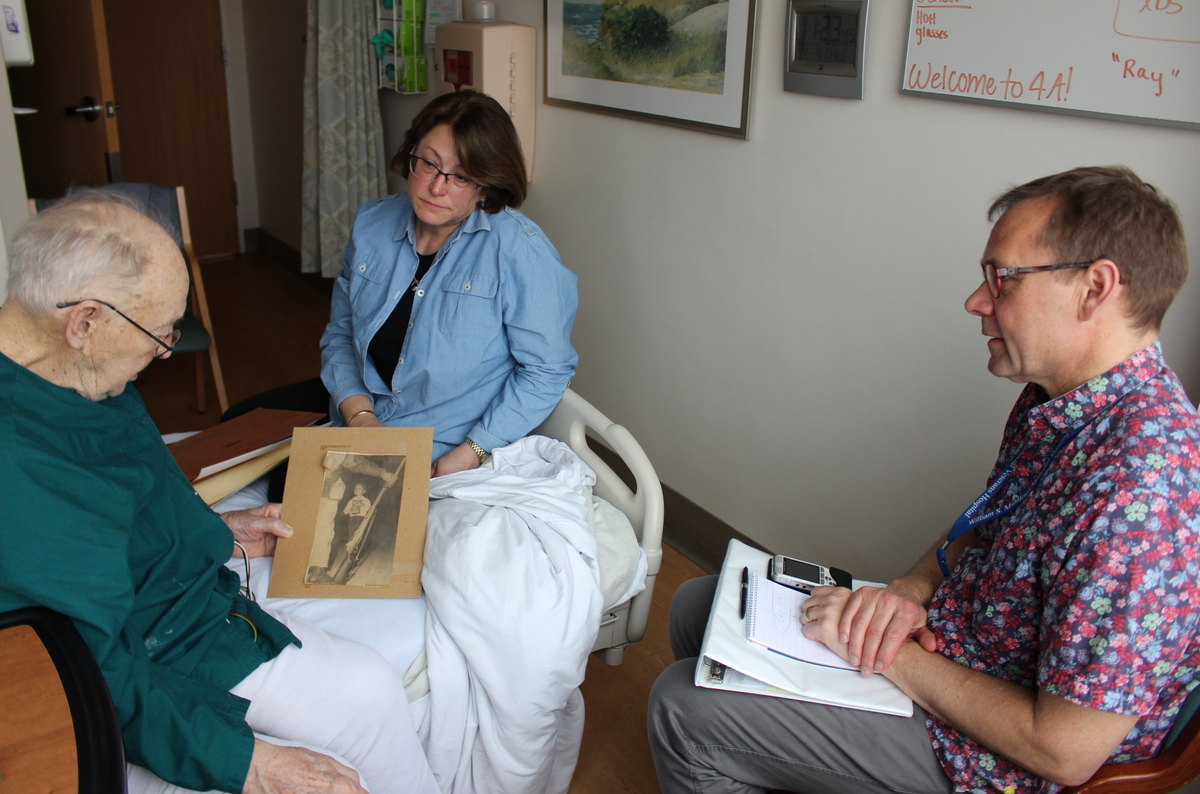
Thor Ringler (right) interviewed Ray Miller (left) in Miller’s hospital room at the William S. Middleton Memorial Veterans Hospital in Madison, Wis., in April. Miller’s daughter Barbara (center) brought in photos and a press clipping from Miller’s time in the National Guard to help facilitate the conversation.

Bram Sable-Smith for NPR


hide caption

toggle caption

Bram Sable-Smith for NPR

Bob Hall was recovering from yet another surgery when the volunteer first walked into his hospital room. It was March 2014, and unfortunately Hall had been in and out of the hospital quite a bit. It had been a rocky recovery since his lung transplant, three months earlier, at the William S. Middleton Memorial Veterans Hospital in Madison, Wis.

But the volunteer wasn’t there to check on his lungs or breathing. Instead she asked Hall if we wanted to tell his life story.

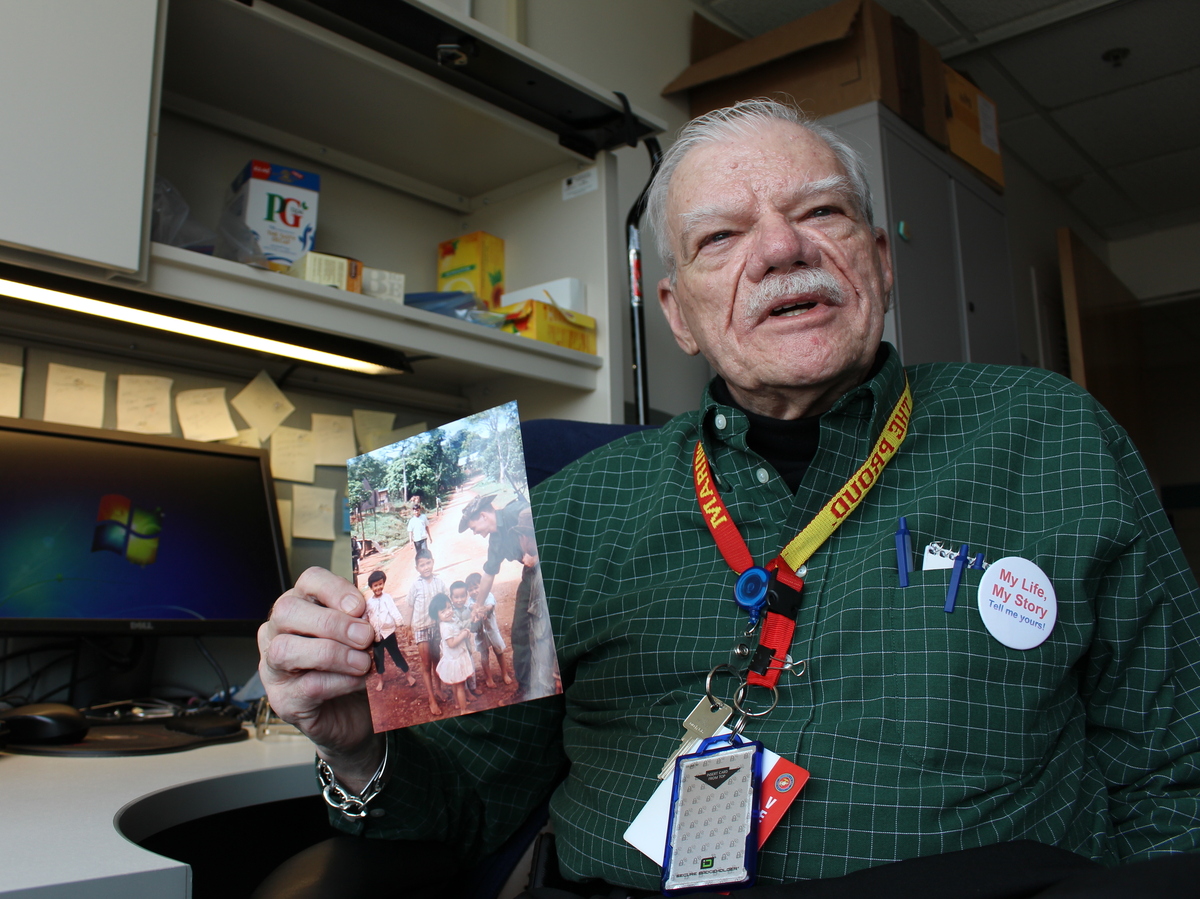
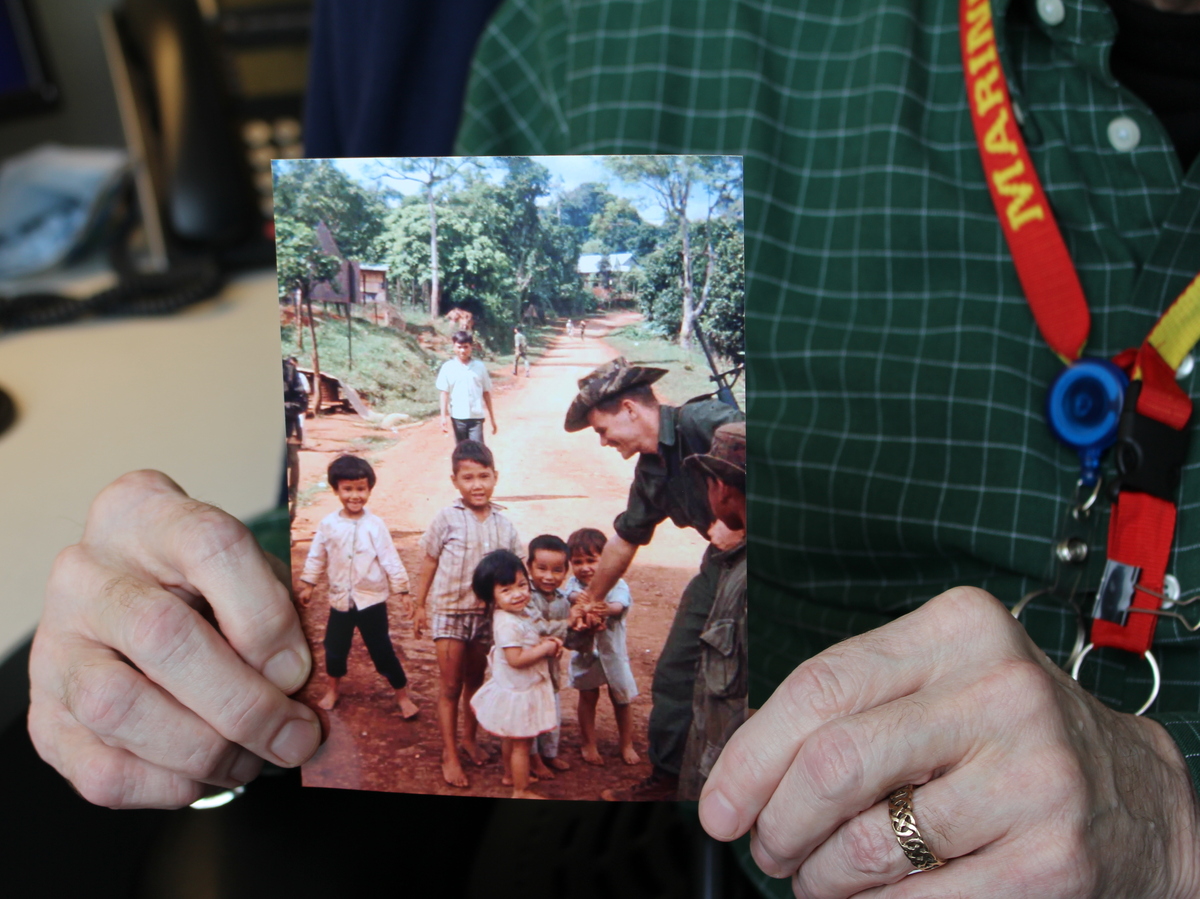
Hall was being treated at the VA because he had served in the Marine Corps during the Vietnam War. After the war, he had a political career as a Massachusetts legislator, and then led professional associations for 30 years.

Hall, who was 67 at the time, welcomed the volunteer and told her he’d be happy to participate.

“I’m anything but a shy guy, and I’m always eager to share details about my life,” Hall says, half-jokingly.

He spoke to the volunteer for more than an hour about everything — from his time as “a D student” in high school (“I tell people I graduated in the top 95 percent of my class”) to his time in the military (“I thought the Marines were the toughest branch and I wanted to stop the communists”). He finished his story with a description of his health problems — those that that finally landed him in the hospital, and many that continue to the present day.

The interview was part of a program called My Life, My Story. Volunteer writers seek out vets like Hall in the hospital, and ask them about their lives. Then they write up this life story, a 1,000-word biography, and go over it with the patient, who can add more details or correct any mistakes.

“Of course, being a writer I rewrote the whole thing,” Hall confesses with a smile.

Once the story is finished, it’s entered into to the patient’s electronic medical record, so any doctor or nurse working anywhere in the VA system who opens the medical record can read it.

Hall was one of the earliest patients interviewed for the project, back in 2014. Today more than 2,000 patients at the Madison VA have shared their personal life stories.

Project organizers say My Life, My Story could change the way providers interact with patients at VA hospitals around the country.

Bob Hall was one of the earliest patients to be interviewed for the My Life, My Story program at the VA hospital in Madison, Wisc. “I’d never experienced something like that in a hospital before,” Hall says.

Bram Sable-Smith for NPR


hide caption

toggle caption

Bram Sable-Smith for NPR

A close-up of Hall’s photograph of his conversation with children in a Vietnamese village. He served in the Marine Corps during the Vietnam War — an important part of his personal story.

Bram Sable-Smith for NPR


hide caption

toggle caption

Bram Sable-Smith for NPR

Personalizing impersonal records

“If you’re a health care person, if you’re someone who is in the [electronic medical] record all the time, you’ll know that the record is a mess,” says Thor Ringler, who has managed the My Life, My Story project since 2013.

Clinicians can get access to a lot of medical data through a patient’s electronic medical record, but there’s nowhere to learn about a patient’s personality, or learn about her career, passions or values, Ringler says.

“If you were to try to get a sense of someone’s life from that record, it might take you days,” Ringler says.

The idea for My Life, My Story came from Dr. Elliot Lee, a medical resident who was doing a training rotation at the Madison VA in 2012. The typical rotation for medical residents lasts only about a year, so Lee wanted to find a way to bring these new, young doctors quickly up to speed on the VA patients. He wanted a way for them to absorb not just their health histories, but more personal information, like their hobbies, and which hospital staffers knew them best.

“It seemed to make sense that the patient might know a lot about themselves, and could help provide information to the new doctor,” Lee recalls.

But the question remained: What was the best way to get patients to share these details, to get their life stories into the records? Lee says he and some colleagues tried having patients fill out surveys, which were useful but still left the team wanting more. Next, they tried getting patients to write down their life stories themselves, but not many people really wanted to. Finally, an epiphany: Hire a writer to interview the patients, and put what they learned on paper.

It wasn’t hard to find a good candidate: A poet in Madison, Thor Ringler, had also just finished his training as a family therapist. He was good at talking to people, and also skilled at condensing big thoughts into concise, meaningful sentences.

“Of course!” Ringler remembers thinking. “I was made for that!'”

Thor Ringler has run the My Life, My Story program at the the William S. Middleton Memorial Veterans Hospital in Madison since 2013. In that time the program has recorded life stories of more than 2,000 veterans — and placed the short biographies in each vet’s’ electronic medical record.

Bram Sable-Smith for NPR


hide caption

toggle caption

Bram Sable-Smith for NPR

Under Ringler’s guidance, the project has developed a set of training materials to allow other VA hospitals to launch their own storytelling programs. About 40 VA hospitals around the U.S. are currently interested, according to Ringler.

Based on his experience building the program in Madison, Ringler estimates hospitals would need to hire just one writer — working half- or full-time, depending on the hospital’s size — to manage a similar storytelling program. That means the budget could be as low as $23,000 a year. That relatively small investment can pay huge dividends in terms of patient satisfaction, Ringler says, by restoring personal connections between patients and the medical team.

“If we do good stories, people will read them, and they will want to read them,” he adds.

In addition to the interest from within the VA system, the idea has spread farther — to hospitals like Brigham and Women’s Hospital in Boston, and Regions Hospital in St. Paul, Minn.

A ‘gift’ to doctors and nurses

There is also research suggesting that when caregivers know their patients better, those patients have improved health outcomes.

One study, for example, found that doctors who scored higher on an empathy test had patients with better-controlled blood sugar. Another study found that in patients with a common cold, the cold’s duration was reduced by nearly a full day for those patients who gave their doctor a top rating for empathy.

University of Colorado professor Heather Coats studies the health impact of biographical storytelling. She notes a 2008 study found that radiologists did a more thorough job when they were simply provided a photo of the patients whose scans they were reading.

“They improved the accuracy of their radiology read,” Coats says. “Meaning [fewer] misspelled words; a better report that’s more detailed.” Current research is investigating whether storytelling might have a similar effect on clinical outcomes.

And, Coats adds, the benefits of the kind of storytelling happening at the VA don’t just accrue to the patients.

“I consider it a gift to the nurses and the doctors,” Coats says.

A survey of clinicians conducted by the Madison VA backs that up: It showed 85 percent of them thought reading the biographies of patients produced by Thor Ringler’s team of writers was “a good use” of clinical time and also helped them improve patient care.

“It gives you a much better understanding about the entirety of their life and how to help them make a decision,” says Dr. Jim Maloney, a VA surgeon who performed Bob Hall’s lung transplant in 2013.

That’s critical for doctors like Maloney, because only about half the people who undergo a lung transplant are still alive after five years. Maloney believes knowing more about a patient’s life story makes it easier for the doctor to have difficult but necessary conversations with a patient — to learn, for example, how aggressively to respond if a complication occurs.

Jim Maloney, a transplant surgeon at the Madison VA, says being able to read a patient’s personal story, along with their medical story, helps him help them through difficult decisions. “It gives you a much better sense of the entirety of their lives,” Maloney says.

Bram Sable-Smith for NPR


hide caption

toggle caption

Bram Sable-Smith for NPR

Maloney says the stories generated by My Life, My Story give the entire transplant team near immediate access to a valuable tool, one that helps them connect quickly with patients and family members, and start conversations about sensitive issues or difficult choices about end-of-life care.

Dr. Tamara Feingold-Link has also experienced the power of being able to read a patient’s life story. Now a second-year medical resident at Brigham and Women’s Hospital in Boston, Feingold-Link first encountered one of the biographies generated by My Life, My Story when she was on rotation at a Boston-area VA. Her attending physician asked her to run a meeting with a patient’s family.

“I barely knew the patient, who was so sick he could hardly talk,” Feingold-Link recalls.

She noticed his medical record included the patient’s life story, something she had never seen before. She immediately read the story.

“It brought me to tears,” she remembers. “When I met his family, I could connect with them immediately.”

“It made his transfer to hospice much smoother for everyone involved,” she says.

Now Dr. Feingold-Link has started a similar program at Brigham and Women’s Hospital.

Meaningful stories go beyond medical care

Bob Hall has learned the stories can be meaningful to caregivers even when they’re not working. During one of his stays at the Madison VA, a nursing aide came into his room after she read his life story in his medical record.

“She came in one night and sat down on my bed just to talk to me for a while, because she’d read my story,” Hall says. “I found out later she wasn’t on the clock. She just came in after her shift ended to chat for a while.”

It’s been 5 years since Hall’s lung transplant, and he’s doing well. He even found a part-time job putting his writing skills to work as part of the My Life, My Story team. In just two years, Hall has written 208 capsule biographies of veterans who come to this hospital for care, just like he did.

“Dr. Maloney came to me one day recently, and I was telling him how many stories I’d done,” Halls says, “and he says, ‘You know I think you’ve given more back to the VA with these stories than they gave to you.'”

“I said, ‘Doctor, I don’t think that’s true, but it’s very kind of you to say so.’ It made me feel good.”

This story is part of NPR’s reporting partnership with Kaiser Health News.

Let’s block ads! (Why?)

Underdog ‘Reggae Girlz’ Make History at Women’s World Cup

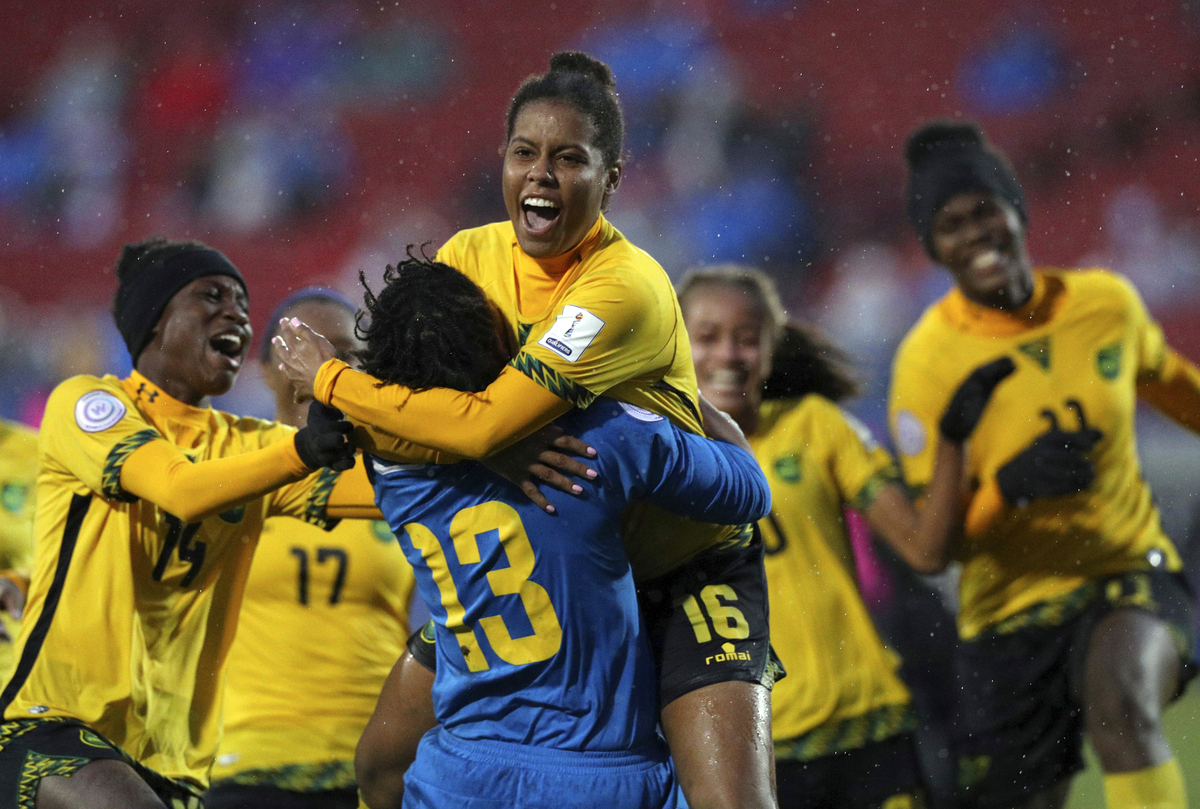
Jamaica’s Reggae Girlz celebrate winning a penalty kick shootout against Panama to advance to this year’s Women’s World Cup.

Richard W. Rodriguez/AP


hide caption

toggle caption

Richard W. Rodriguez/AP

The “Reggae Girlz” of Jamaica are the underdogs of this year’s Women’s World Cup.

The Jamaican women’s national soccer team debuts on Sunday, June 9 at the tournament in France against a highly-rated team from Brazil.

FIFA, soccer’s global governing body, ranks the Jamaicans the lowest among the 24 teams at the tournament. But don’t try to tell that to any of the players.

“Football is a very funny thing,” says Jamaican midfielder Deneisha “Den-Den” Blackwood. “You can never predict what’s going to happen. And I feel like we are going to be the team to shock everybody in this World Cup.”

Just five years ago, Jamaica didn’t even have a women’s national soccer team. Now they’re the first team from the Caribbean to ever qualify for a Women’s World Cup.

Last week, the Reggae Girlz, as the team calls itself, continued to make history, shattering attendance records in Scotland.

They were in Glasgow to play the Scottish women’s national team in a final warmup match before the month-long FIFA tournament, which started on June 7.

The event destroyed the attendance record for a Scottish national women’s team home game, attracting more than four times the previous record of 4,098 spectators. And the teams didn’t disappoint.

Jamaica went up early on a goal by their star forward, Khadija Shaw, who’s known by her nickname, Bunny.

Scotland, however, rallied — and in the end, won by a score of 3-2.

“It was a really good match,” says 24-year-old Natalie Lawrence, who was in the stands. She describes herself as “half-Jamaican, half-Scottish” and lives in Manchester. She’d heard about Shaw and seen some video highlights of her online — but says it was amazing to see “Bunny” play in person.

“She’s the best football player for Jamaica in a long time,” she says, gushing about the striker. “Shaw’s like ice-cold, slots that ball in. Can go one-on-one like it’s nothing. She knows what she’s doing. She’s absolutely quality.”

But Shaw and her teammates almost didn’t make it to the World Cup — not because they barely squeaked by Panama in the qualifiers but because just a few years ago Jamaica didn’t even have a national women’s soccer team.

The Jamaican Football Federation disbanded the Reggae Girlz after they failed to qualify for the 2015 World Cup in Canada. Then, after they were resurrected, the Federation suspended funding for them again while facing budget shortfalls in 2016.

“We are just happy to be here at this moment,” says Shaw after dinner at an event celebrating the team at a Caribbean restaurant in London last week. “We’ve worked hard for this. I don’t think a lot of people know what we’ve gone through behind the scenes.”

Shaw says over the last five years, the Jamaican women’s team has had to fight not just to survive but to fund their own training camps. The players didn’t have their own uniforms. Until recently, their head coach, Hue Menzies, was a volunteer. Prior to taking over the Jamaican women’s national team, Menzies was coaching teenage girls on a youth club team in Florida.

Jamaican star forward, Khadija Shaw, battles for the ball during a friendly match against Scotland in Jamaica’s last game before the Women’s World Cup.

Ian MacNicol/Getty Images


hide caption

toggle caption

Ian MacNicol/Getty Images

Shaw says it’s been very hard to pull together the resources that the Reggae Girlz need.

“We have talent. We’re very athletic. But talent can only go so far,” she says of the team’s financial woes. “That’s been us forever. You know.”

Even flying to Europe, the entire team’s reservation out of Florida was canceled because no one confirmed the tickets. The players got rebooked on flights that forced some of them to have to fly through Morocco to get to Scotland. Much of their luggage was lost and only arrived just before their game in Glasgow.

“We’ve faced a lot of setbacks and adversities so that’s nothing new to us,” Shaw says.

The person Shaw credits with turning the Jamaican national women’s football team around is Cedella Marley, the daughter of reggae star Bob Marley. In 2014, Marley, herself a singer, released a single “Strike Hard” to cover basic expenses for the team.

“We need to train. We need nutrition. We need gear. We need a ball,” Marley says.

Since releasing that single in 2014, Marley has become a tireless activist for the Jamaican female squad.

“For me everyone should have the right to go after their dreams and passions without gender being a factor,” she says.

But to Marley it was clear that when it came to the Reggae Girlz, gender was a factor.

In 2014, when the Jamaican Football Federation disbanded the team, the Federation continued to fund the men’s team even though the Reggae Boyz hadn’t qualified for a World Cup since 1998.

Players on the Jamaican women’s national soccer team credit Bob Marley’s daughter, Cedella, with saving the squad. The singer and entrepreneur spearheaded fundraising efforts for the Reggae Girlz after the team was disbanded in 2014.

Astrid Stawiarz/Getty Images


hide caption

toggle caption

Astrid Stawiarz/Getty Images

“I’m not here to say ‘Well the men got this and the men got that’ because they deserve to get all of that. They’re representing our country,” she says. “The only problem that I have is when you’re saying, ‘Well we can’t give that to the women because we don’t believe they’re going to be good. We don’t believe anybody will come to see them in the stadiums. We don’t believe anyone’s going buy a T-shirt so therefore…’ No! that wasn’t going to work for me.”

Marley spearheaded fundraising drives, badgered the Jamaican Football Federation for support and made it clear that she wasn’t going to put up with what she calls “outdated ideas” about women in football.

“Jamaica’s female athletes are at the mercy of corporate sponsors — many of whom still feel that women should stick to more ‘acceptable’ sports like swimming and netball and tennis. Which is fine. If they want to do [those sports], then give them the resources to do that. But if you have a group of girls who just want to play football, give them the resources to play football,” she says.

Jamaica, however, is nation of just 3 million people. It’s kind of as if Arkansas had somehow managed to qualify a team for the World Cup.

Adding to the Reggae Girlz challenges, soccer isn’t the most popular sport in Jamaica. This week, after the Jamaican men’s soccer team beat the U.S. in a friendly, The Gleaner newspaper in Kingston led its sports page not with the win but with a story about how the Windies cricket team is fit and ready to take on Australia.

Karen Madden, a sports reporter at The Gleaner, says Jamaican sports fans generally don’t pay much attention to soccer and are even less interested in women’s soccer than men’s. But she adds that this year’s band of Reggae Girlz has been changing that.

“Before they left Jamaica I saw those players with a group of little girls at Greenwich Farm primary school, an inner city school [in Kingston],” Madden says. “The awe and admiration I saw in those girls’ faces encapsulates what the Reggae Girlz have already done just qualifying for the World Cup, what they have done for this small nation of Jamaica.”

Despite not being a nation that normally embraces women’s soccer, Madden says Jamaicans are very proud that the Reggae Girlz have made it to the tournament in France.

“These are Jamaicans. Khadija Shaw is from a tough inner-city community. Jody Brown is from a rural town in St. Anne. A lot of players on the team are from humble beginnings,” she says. “And they are going to be playing on FIFA’s top stage.”

The Reggae Girlz have beaten the odds just to get to the Women’s World Cup, and Madden says she wouldn’t bet against them now.

Let’s block ads! (Why?)
2019 Women’s World Cup Preview: What You Need To Know

The U.S. women stand for the national anthem ahead of an international friendly with Mexico late last month before heading to France for the FIFA Women’s World Cup, which kicks off today.

Rich Graessle/Icon Sportswire via Getty Images


hide caption

toggle caption

Rich Graessle/Icon Sportswire via Getty Images

The 2019 FIFA Women’s World Cup kicks off today in Paris. Twenty-four teams will vie for their chance at glory.

Here’s what you need to know to follow all the action.

When does the Women’s World Cup start?

The tournament begins at the Parc des Princes in Paris, where a strong team from host nation France takes on South Korea in the opening match. The schedule ramps up Saturday with three games: Germany vs. China, Spain vs. South Africa and Norway vs. Nigeria.

The U.S. plays its first match on Tuesday against Thailand, then plays Chile on June 16 and Sweden on June 20.

The whole schedule is here. The final is July 7.

Where is it?

The games will crisscross between nine French cities: Paris, Grenoble, Le Havre, Lyon, Montpellier, Nice, Reims, Rennes and Valenciennes. The semifinals and final will be in Lyon.

How can I watch it?

In the U.S., all the games will be broadcast on either Fox or Fox Sports, and streamed on the Fox Sports app. Video of each goal will be tweeted by the Fox Sports Twitter account.

Remind me what happened last time?

How could you forget? It was a rematch of the 2011 Women’s World Cup, when the U.S. lost in heartbreaking fashion to Japan.

In 2015, the U.S. trounced Japan 5-2, including a hat trick by Carli Lloyd. Her third goal was an insane shot from the halfway line that sailed over the Japanese keeper and bounced into the net. The U.S. never looked back.

You should probably rewatch the game highlights right now.


FIFA
YouTube

Who’s going to win this thing?

No one knows. Many predict this will be the most competitive Women’s World Cup ever.

The U.S. is ranked No. 1 in the world and has a formidable array of attackers who should have no trouble scoring: Alex Morgan, Megan Rapinoe, Tobin Heath and Lloyd, among others. But defense could be a weakness, and the U.S. has sometimes struggled in the past against teams that bunker down and don’t allow the U.S. to work its offensive magic.

Germany looks poised to make a deep run in the tournament, led by midfielder Dzsenifer Marozsán and forward Alexandra Popp. But coach Martina Voss-Tecklenburg was put in charge only late last year, and the team’s prospects are still coming into focus.

England has a number of strong players, including attacker Fran Kirby and defensive star Lucy Bronze. Coached by former England player Phil Neville, England is a good bet to be among the last four teams standing.

Expectations for France are high, as the host country and after its men’s team won last summer’s World Cup. Watch for big moves by midfielder Amandine Henry and forwards Eugénie Le Sommer and Delphine Cascarino.

As for Brazil, superstar Marta suffered a thigh injury two weeks ago that might hamper the team’s fortunes.

Any controversies to be aware of?

The big issue this year is pay inequity between the women’s players and the men’s.

Twenty-eight members of the U.S. team are suing U.S. Soccer for gender discrimination, arguing that they are paid less than members of the men’s team though they perform substantially equal work.

While the U.S. women have been credited with leading a push for change, they’re not the only ones voicing frustration and asking for parity.

This week, the union representing the Australian women’s and men’s players sent a letter to FIFA, alleging “discriminatory conduct” by the international governing body in awarding teams at the Women’s World Cup just a fraction of prize money that the men’s teams are given.

The best player in the world, Norwegian striker Ada Hegerberg, won’t be playing for her home country. She says the Norwegian soccer federation hasn’t done enough to support the women’s game, and she now refuses to play for the national team. Norway instituted equal pay for its men’s and women’s teams in 2017, but Hegerberg says it’s not just about equal pay, it’s about respect — and so she won’t be in the tournament.

Any great team nicknames I should know?

Many of the nicknames are variations on the men’s teams: France is Les Bleues, Jamaica has the Reggae Girlz and England are the Three Lionesses.

The best nickname belongs to Australia: The Matildas. The Aussies took on the moniker in the 1990s, after the classic Australian bush ballad “Waltzing Matilda.”

Speaking of Australia, keep an eye on star striker Sam Kerr. She’s the all-time leading goalscorer in the U.S.-based National Women’s Soccer League — and she does a backflip when she scores, which is often.


National Women’s Soccer League
YouTube

Who has the best uniforms?

France’s two kits are both très chic: The home jersey is the classic blue with a golden crest. The away is white with blue dots, and socks in the same pattern. Vive les dots!

France will wear the tricolore: bleu jersey, blanc shorts, rouge shorts. Away kit honors the hexagon-shaped country with a hexadot pattern. Rose gold details on both kits. pic.twitter.com/Jh0gszBYx9

— Heidi Burgett (@heidiburgett) March 11, 2019

The U.S. kits, in crisp white and bold red, are meant to evoke the uniforms of the famous 1999 team that bested China in spectacular fashion. And the U.S. jerseys also have the finest detail of all: three stars above the crest, representing the three World Cups the Yanks have brought home.

Jamaica also has great kits, sporting old-school Umbro style.

Nigeria caused a stir with its lime-green zigzags at last summer’s men’s World Cup. This year, the women will also rock the zags, and they look at least as cool.

Are there any inspirational ads I should watch to get me hyped before the first whistle?

The best video comes from the German national team. It gets bonus points for being about powerful, opinionated women and not only about inspiring girls. (Most of the ads are about inspiring girls.)


Commerzbank AG
YouTube

Second prize goes to Nike’s 3-minute, globe-trotting ad that is about inspiring girls.


Nike
YouTube

See you on the pitch.

Let’s block ads! (Why?)

Poll: Majority Want To Keep Abortion Legal, But They Also Want Restrictions

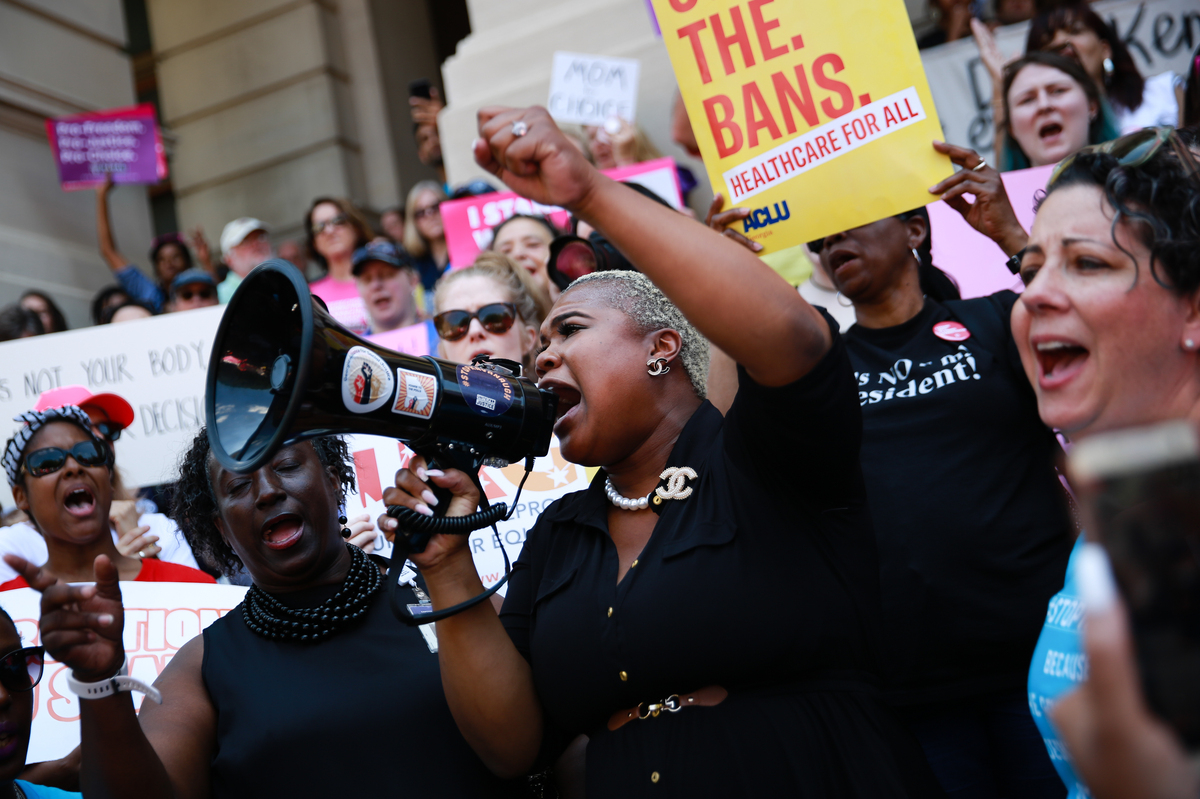
Georgia state Rep. Erica Thomas speaks during a protest against recently passed abortion-ban bills at the state Capitol on May 21 in Atlanta.

Elijah Nouvelage/Getty Images


hide caption

toggle caption

Elijah Nouvelage/Getty Images

Three-quarters of Americans say they want to keep in place the landmark Supreme Court ruling, Roe v. Wade, that made abortion legal in the United States, but a strong majority would like to see restrictions on abortion rights, according to a new NPR/PBS NewsHour/Marist Poll.

What the survey found is a great deal of complexity — and sometimes contradiction among Americans — that goes well beyond the talking points of the loudest voices in the debate. In fact, there’s a high level of dissatisfaction with abortion policy overall. Almost two-thirds of people said they were either somewhat or very dissatisfied, including 66% of those who self-identify as “pro-life” and 62% of those who self-identify as “pro-choice.”

“What it speaks to is the fact that the debate is dominated by the extreme positions on both sides,” said Barbara Carvalho, director of the Marist Poll, which conducted the survey. “People do see the issue as very complicated, very complex. Their positions don’t fall along one side or the other. … The debate is about the extremes, and that’s not where the public is.”

The poll comes as several states have pushed to limit abortions in hopes of getting the Supreme Court to reconsider the issue. Abortion-rights opponents hope the newly conservative court will either overturn Roe or effectively gut it by upholding severe restrictions. The survey finds that while most Americans favor limiting abortion, they don’t want it to be illegal and don’t want to go as far as states like Alabama, for example, which would ban it completely except if the woman’s life is endangered or health is at risk.

A total of 77% say the Supreme Court should uphold Roe, but within that there’s a lot of nuance — 26% say they would like to see it remain in place, but with more restrictions added; 21% want to see Roe expanded to establish the right to abortion under any circumstance; 16% want to keep it the way it is; and 14% want to see some of the restrictions allowed under Roe reduced. Just 13% overall say it should be overturned.

Loading…

Don’t see the graphic above? Click here

Even though Americans are solidly against overturning Roe, a majority would also like to see abortion restricted in various ways. In a separate question, respondents were asked which of six choices comes closest to their view of abortion policy.

In all, 61% said they were in favor of a combination of limitations that included allowing abortion in just the first three months of a pregnancy (23%); only in cases of rape, incest or to save the life of the woman (29%); or only to save the life of the woman (9%).

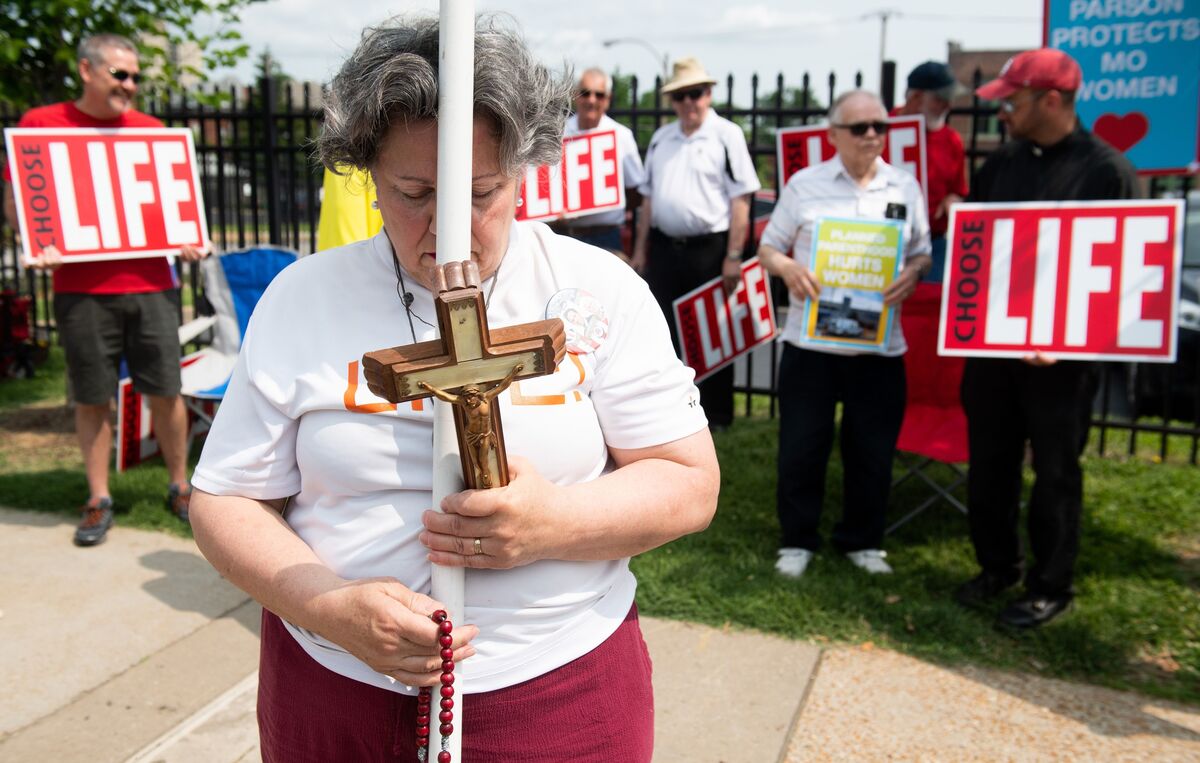
Anti-abortion demonstrators hold a protest on May 31 outside the Planned Parenthood Reproductive Health Services Center in St. Louis, the last location in the state that performs abortions.

Saul Loeb/AFP/Getty Images


hide caption

toggle caption

Saul Loeb/AFP/Getty Images

Eighteen percent said abortion should be available to a woman any time she wants during her entire pregnancy. At the other end of the spectrum, 9% said it should never be permitted under any circumstance.

More than half (53%) of Americans say they would definitely not vote for a candidate who would appoint judges to the Supreme Court who would limit or overturn Roe.

Politically, abortion has been a stronger voting issue for Republicans than for Democrats. This poll found that abortion ranks as the second-most-important issue for Republicans in deciding their vote for president, behind immigration. But for Democrats, it is fifth — behind health care, America’s role in the world, climate change and personal financial well-being.

The poll also notably found the highest percentage of people self-identifying as “pro-choice,” those who generally support abortion rights, since a Gallup survey in December 2012. In this survey, 57% identified that way versus 35%, who called themselves “pro-life,” those who are generally opposed to abortion rights.

Loading…

Don’t see the graphic above? Click here

The percentage self-identifying as “pro-choice” is an increase since a Marist Poll in February, when the two sides split with 47% each. The pollsters attribute that shift to efforts in various states to severely restrict abortion.

“The public is very reactive to the arguments being put forth by the more committed advocates on both sides of the issue,” Carvalho said, adding, “The danger for Republicans is that when you look at independents, independents are moving more toward Democrats on this issue. … When the debate starts overstepping what public opinion believes to be common sense, we’ve seen independents moving in Democrats’ corner.”

In the case of self-identification, 60% of independents identified as “pro-choice.” Asked which party would do a better job of dealing with the issue of abortion, a plurality of Americans overall chose Democrats (47%) over Republicans (34%).

Independents chose Democrats on the question of which party would do a better job by an 11-point margin (43% to 32%).

Loading…

Don’t see the graphic above? Click here

Asked if they’d be more likely to support state laws that decriminalize abortion and make laws less strict or ones that do the opposite, 60% of Americans overall, including two-thirds of independents, chose laws that decriminalize abortion and are less strict.

What specifically do Americans support and oppose?

The poll also asked a long series of questions to try to figure out what Americans support or oppose when it comes to potential changes to abortion laws pending in several states. Poll respondents were not told which states these proposals come from.

The poll found that Americans are very much against requiring fines and/or prison time for doctors who perform abortions. There was also slim majority support for allowing abortions at any time during a pregnancy if there is no viability outside the womb and for requiring insurance companies to cover abortion procedures. A slim majority also opposed allowing pharmacists and health providers the ability to opt out of providing medicine or surgical procedures that result in abortion.

At the same time, two-thirds were in favor of a 24-hour waiting period from the time a woman meets with a health care professional until having the abortion procedure itself; two-thirds wanted doctors who perform abortions to have hospital admitting privileges; and a slim majority wanted the law to require women to be shown an ultrasound image at least 24 hours before an abortion procedure.

Loading…

Don’t see the graphic above? Click here

“What’s most interesting here,” Carvalho said, is that “the extremes are really outliers. When they advocate for their positions and change the debate toward the most extreme position on the issue, they actually do the opposite. They move public opinion away from them.”

The more vocal advocates on either side, however, have had the ability to shift the debate and public opinion to their point of view. Consider that many of the specific items above, at one point or another, have been hotly debated.

When does life begin?

The poll also asked the very big question of when Americans think life begins. There was not an overwhelming consensus. A plurality of the six choices given, but far less than a majority, said life begins at conception (38%). Slightly more than half (53%) disagreed, saying that life begins either within the first eight weeks of pregnancy (8%), the first three months (8%), between three and six months (7%), when a fetus is viable (14%) or at birth (16%).

Loading…

Don’t see the graphic above? Click here

Gender gap? Try a stark party divide, particularly among women

The most acute divide among Americans on the issue of abortion, arguably, is not a gender divide but between the parties — and of women of different parties.

For example, 54% of men identified as “pro-choice,” compared with 60% of women. For women of the different parties, 77% of Democratic women identified as “pro-choice,” while 68% of Republican women identified as “pro-life.” (A lower percentage of Republican men, 59%, considered themselves “pro-life.”)

Throughout the poll, the divide was stark. On Roe, for example, 62% of Republican women said overturn it or add restrictions; 73% of Democratic women said keep it the way it is, expand it to allow abortions under any circumstance or reduce some of the restrictions.

Eighty-four percent of Democratic women said they are more likely to support state laws that decriminalize abortion and make laws less strict; 62% of Republican women said they are more likely to support laws that criminalize abortion or make laws stricter.

On requiring insurance companies to cover abortion procedures, 75% of Democratic women support that, while 78% of Republican women oppose it, higher than the 63% of Republican men who said the same.

Republican women also stand out for the 62% of them who said they oppose laws that allow abortion at any time during pregnancy in cases of rape or incest. They are the only group to voice majority opposition to that. Fifty-nine percent of Republican men, for example, said they would support such a law.

And Republican women are the only group to say overwhelmingly that life begins at conception. About three-quarters said so, compared with less than half of Republican men and a third of Democratic women.

It’s a reminder that Republican women, in many ways, are the backbone of the movement opposing abortion rights.


The survey of 944 adults was conducted by live interviewers by telephone from May 31 through June 4. It has a margin of error of plus or minus 4.5 percentage points.

Editor’s note: The survey asked respondents to identify as either “pro-life” or “pro-choice.” This question wording, using the labels “pro-life” and “pro-choice,” was included in the survey because it has tracked the public debate on abortion over decades. It is sensitive to current events and public discussion even though it does not capture the nuanced positions many people have on the issue.

Let’s block ads! (Why?)

‘Mental Health Parity’ Is Still An Elusive Goal In U.S. Insurance Coverage

The best help for patients struggling with addiction, eating disorders or other mental health problems sometimes includes intensive therapy, the evidence shows. But many patients still have trouble getting their health insurers to cover needed mental health treatment.

Gary Waters/Ikon Images/Getty Images


hide caption

toggle caption

Gary Waters/Ikon Images/Getty Images

Amanda Bacon’s eating disorder was growing worse. She had lost 60% of her body weight and was consuming only about 100 calories a day.

But that wasn’t sick enough for her Medicaid managed-care company to cover an inpatient treatment program. She was told in 2017 that unless she weighed 10 pounds less — which would have put her at 5-foot-7 and 90 pounds — or was admitted to a psychiatric unit, she wasn’t eligible for coverage.

“I remember thinking, ‘I’m going to die,’ ” the Las Cruces, N.M., resident recalls.

Eventually, Bacon, now 35, switched to a plan that paid for treatment, although she says it was still an arduous process getting the services approved.

Many patients, like Bacon, struggle to get insurance coverage for their mental health treatment, even though two federal laws were designed to bring parity between mental and physical health care coverage. Recent studies and a legal case suggest serious disparities remain.

The 2008 Mental Health Parity and Addiction Equity Act required large group health plans that provide benefits for mental health problems to put that coverage on an equal footing with physical illness. Two years later, the Affordable Care Act required small-group and individual health plans sold on the insurance marketplaces to cover mental health services, and do so at levels comparable with medical services. (In 2016, parity rules were also applied to Medicaid managed-care plans, which cover the majority of people in that federal-state health program for low-income residents.)

The laws have been partially successful. Insurers are no longer permitted to write policies that charge higher copays or deductibles for mental health care, nor can they set annual or lifetime upper-limits on how much they will pay for such care. But advocates for patients say insurance companies still interpret mental health claims more stringently than those for physical illness.

“Insurance companies can easily circumvent mental health parity mandates by imposing restrictive standards of medical necessity,” says Meiram Bendat, a lawyer leading a class-action lawsuit against a mental health subsidiary of UnitedHealthcare.

In a closely watched ruling, a federal court in March sided with Bendat and patients who alleged the insurer was deliberately shortchanging mental health claims. Chief Magistrate Judge Joseph Spero of the U.S. District Court for the Northern District of California ruled that United Behavioral Health wrote its guidelines for treatment much more narrowly than common medical standards, covering only enough care to stabilize patients “while ignoring the effective treatment of members’ underlying conditions.”

UnitedHealthcare works to “ensure our products meet the needs of our members and comply with state and federal law,” says spokeswoman Tracey Lempner.

Several studies, though, have found evidence of disparities in insurers’ decisions.

Growing gap in coverage in hospitals

In February, researchers at the Congressional Budget Office reported that private insurance companies are paying 13% to 14% less for mental health care than Medicare does.

The insurance industry’s own data show a growing gap between coverage of mental and physical care in hospitals and skilled nursing facilities. For the five years ending in 2017, out-of-pocket spending on inpatient mental health care grew nearly 13 times faster than all inpatient care, according to inpatient data reported in February by the Health Care Cost Institute, a research group funded by the insurance companies Aetna, Humana, UnitedHealthcare and Kaiser Permanente. (Kaiser Health News is not affiliated with Kaiser Permanente.)

And a 2017 report by the actuarial firm Milliman found that an office visit with a therapist is five times as likely to be out-of-network, and thus more expensive, than a primary care appointment.

In this environment, only half of the nearly 8 million children who have been diagnosed with depression, anxiety or attention deficit hyperactivity disorder receive treatment, according to a February research letter in the medical journal JAMA Pediatrics. Fewer than 1 in 5 people with substance use disorder are treated, a national survey suggests, and, overall, nearly 6 in 10 people with mental illness get no treatment or medication, according to the National Institute Of Mental Health.

Amanda Bacon, who is still receiving care for her eating disorder, remembers fearing that she wouldn’t get treatment. She was at one point rushed to an emergency room for care, but after several days in the hospital she was sent home, no closer to getting well.

Today, because of her disability, Bacon’s primary medical insurance is through Medicare, which has paid for treatment that her earlier Medicaid provider, Molina Healthcare, refused. She has been treated in four inpatient programs in the past two years — twice through Presbyterian Centennial Care, a Medicaid plan she switched to after Molina, and twice though her current Medicare plan. Bacon is also enrolled in a state-run Medicaid plan.

Molina says it can’t comment on Bacon’s case. “Molina complies with mental health parity laws,” say spokeswoman Danielle Smith, and it “applies industry-recognized medical necessity criteria in any medical determinations affecting mental health.”

The ‘wrong criteria’

Dr. Eric Plakun, CEO of the Austen Riggs Center, a psychiatric hospital and residential program in Massachusetts, says that often insurers are “using the wrong criteria” for what makes something medically necessary. They pay enough only to stabilize a patient’s condition, Plakun says, but not enough to improve their underlying illness. He was one of the experts who testified in the case before Judge Spero in California.

Insurers say they recognize the importance of mental health care coverage and that they are complying with the law.

Cathryn Donaldson, a spokeswoman for the trade group America’s Health Insurance Plans, says the industry supports parity, but that it is also harder to prove when a mental health treatment is needed.

Compared with the data on medical and surgical care, she says, the data and standards to measure mental health care “trail far behind.” She cited a 2016 study of Minnesota hospitals, where nearly one-fifth of the time patients spent in psychiatric units occurred after they were stabilized and ready to be discharged.

“Just like doctors use scientific evidence to determine the safest, most effective treatments,” insurers do the same to cover treatment “consistent with guidelines showing when and where it’s effective for patients,” Donaldson says.

Health plans commonly apply several controls that limit their coverage of mental health care. And these strategies by insurers are legal — unless they are applied more strictly for mental health care than medical care.

For example, they often require patients to try cheaper options first, a strategy called “fail first.” Patients referred by their doctors to a residential program for opioid addiction, for example, might be denied coverage by their insurers until they try — and fail — to improve at a less expensive part-time out-patient program.

Hiring doctors, nurses and pharmacists to review claims is another technique.

Dr. Frederick Villars, who reviews mental health claims for Aetna, remembers arguing with insurers to approve treatment when he was a practicing psychiatrist. His team decides what Aetna will cover based on clinical standards, he says. And providers upset about a coverage decision “are well aware of what these guidelines are.”

“It’s not a pleasant process,” Villars says, “but it’s the only tool that exists in this setting to try to keep costs under control.”

Kaiser Health News is a nonprofit, editorially independent program of the Kaiser Family Foundation. It is not affiliated with Kaiser Permanente. Graison Dangor is a journalist living in Brooklyn.

Let’s block ads! (Why?)