Veteran Tennis Stars Still Prove Le Creme De La Creme In Paris

It’s day two of the French Open. NPR’s Mary Louise Kelly talks to Sports Illustrated executive editor Jon Wertheim about what to expect from tennis’ aging greats and up-and-comers.
It’s day two of the French Open. NPR’s Mary Louise Kelly talks to Sports Illustrated executive editor Jon Wertheim about what to expect from tennis’ aging greats and up-and-comers.

Reporter Jenny Gold and her husband, Alex Gourse, with their newborn son at Prentice Women’s Hospital in Chicago two days after his birth.
Courtesy of Bella Baby Photography
hide caption
toggle caption
Courtesy of Bella Baby Photography
I had always imagined going through pregnancy surrounded by family and friends. But when I found out I was pregnant, my husband, Alex Gourse, and I had just moved from San Francisco to Chicago. I knew almost no one.
I ended up finding a community where I least expected it: at a medical office.
CenteringPregnancy is group prenatal care offered by more than 600 practices across the United States. Rather than the standard 15-minute individual visits in an exam room, women who are due around the same time and their partners meet as a group for two hours with a clinician, usually a midwife.
In other words, take one of the most intimate chapters in a couple’s life and have the two experience it with a bunch of strangers.
I was wary. It seemed like a convenient way to cram more patients through the door and give them less attention. But when, at my first prenatal visit at Northwestern Medicine, midwife Carol Hirschfield told me that the practice happened to be launching its first CenteringPregnancy group, I figured it might be a good way to meet people.
That turned out to be the best decision we made during the pregnancy.
We met up in the early morning on Thursdays, often bleary-eyed from another night of bad pregnancy sleep. The moms each stopped first for a quick weight and blood pressure check, and then we all gathered in a classroom that had previously been an operating suite. Seven couples were in my group, though there can be 10 or more.
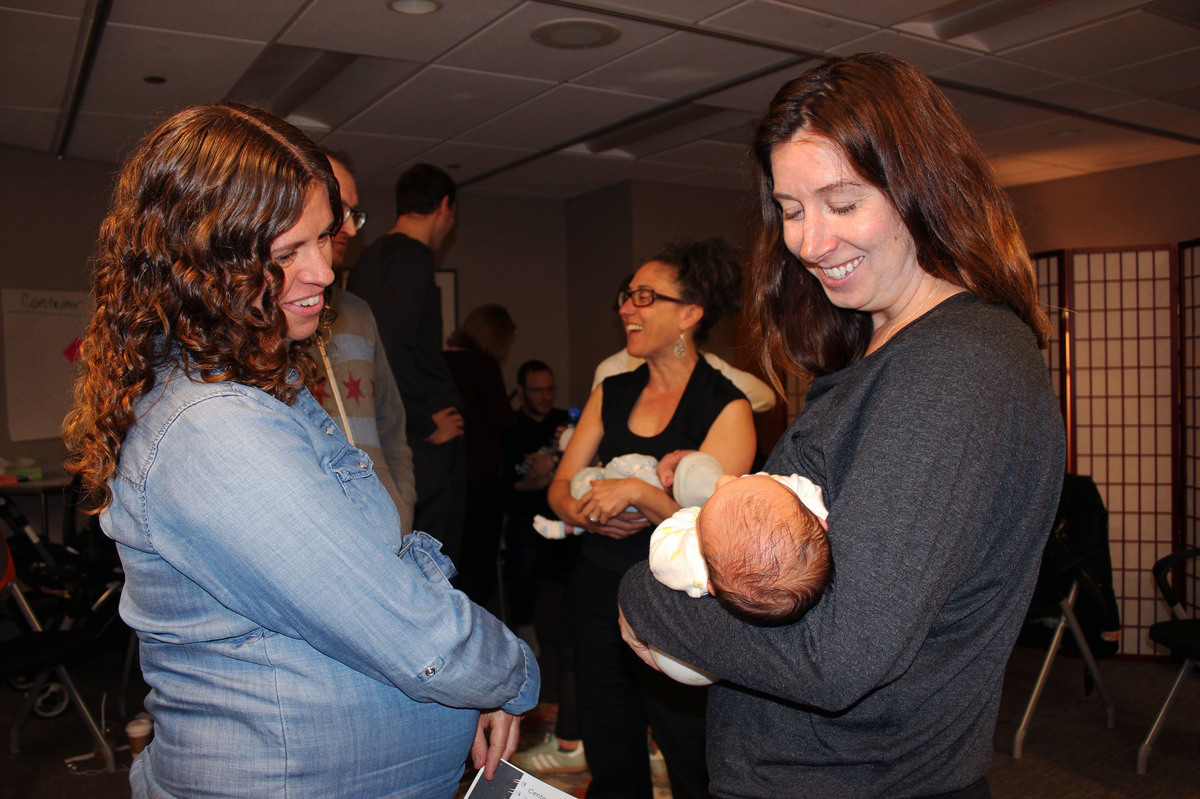
Andrea Moffat (left) admires Kate Galecki’s newborn daughter at a session of CenteringPregnancy at Northwestern Medicine in Chicago. Over the past five years, the number of practices that offer the group prenatal care program has nearly doubled.
Jenny Gold for Kaiser Health News
hide caption
toggle caption
Jenny Gold for Kaiser Health News
One by one, each couple slipped behind a curtain in a corner of the room for a brief medical exam with one of the two midwives who led the group. Our bellies were measured, the babies’ heartbeats were checked and we had a moment to share any major symptoms.
Meanwhile, the rest of the group milled around the main part of the room, a bit awkwardly at first. If we’d been in a waiting room for standard appointments, we might not have given one another more than a nod. But here, munching on banana bread baked by the midwives, we quickly discovered how much the experience of pregnancy gave us in common. Soon we were chatting about the struggles of no longer being able to sleep on our backs, the best pregnancy pillow to buy and the importance of foot rubs from our partners.
After the exams, we gathered in a circle of chairs to talk about all the crazy things happening to our bodies. In the very first activity, the midwives handed out laminated cards with pregnancy symptoms written on them — things like swollen feet or food cravings. We were to go around and read our symptom and then share whether it was something we had experienced. The very first card to be shared: vaginal discharge. And, with a few giggles, the ice was broken.

Northwestern Medicine started offering CenteringPregnancy in April 2018. Years of studies have found that babies born to women who receive group prenatal care are less likely to be premature, be underweight or spend time in the intensive care unit.
Jenny Gold for Kaiser Health News
hide caption
toggle caption
Jenny Gold for Kaiser Health News
We met monthly at first and then more frequently as we got closer to our due dates. The curriculum was based on workbooks created by the Centering Healthcare Institute in Boston and was focused on topics like nutrition, relationships, labor and delivery, and newborn care. We often started with a breathing exercise or a short icebreaker, followed by prompts and games to encourage us to share the details of our experiences and fears and to teach us how to take care of ourselves and prepare for our new lives as parents.
It didn’t take much to get us talking, laughing and commiserating. Sometimes it felt a lot like a support group, and that’s part of the point. The goal of CenteringPregnancy is to provide medical care and to educate but also to reduce stress and isolation, which can contribute to poor birth outcomes.
Years of studies — many focusing on teen and low-income moms — have found that babies born to women in CenteringPregnancy groups are less likely to be premature, be underweight or spend time in the intensive care unit. A 2016 study of a South Carolina program, for example, found that participating in CenteringPregnancy reduced the risk of premature birth by 36%. And that saved money — an average of $22,667 for every premature birth prevented under Medicaid, the state’s health insurance program for the poor. Typically, the patient’s insurance company will not know they have been a part of a Centering group, which is billed as standard prenatal care.
Alex Gourse (right), chats with Frances Miller and Chris Henderson as they hold their brand-new babies during the final session of a CenteringPregnancy group at Northwestern Medicine.
Jenny Gold for Kaiser Health News
hide caption
toggle caption
Jenny Gold for Kaiser Health News
The CenteringPregnancy program was started in 1993 in Connecticut by midwife Sharon Schindler Rising, who was frustrated that she had to rush through patients’ exams. Over the past five years, the number of practices that offer Centering has nearly doubled to 600; midwives still lead most of the groups. About half are in community health centers that serve mainly low-income women, but private practices like Northwestern have also started programs.
“I’ve been out-of-my-mind excited with how this has gone,” Hirschfield told me one day in her office. “I end every group by saying, ‘Oh my God, they’re learning so much more than our — quote-unquote — regular patients.’ “
Hirschfield said she was surprised by how open people have been about their lives, sexual relationships and bodies. “There just isn’t time for that when you have 15 minutes every couple of weeks to just really listen to the heartbeat and take your blood pressure and ask how your back is feeling.” If participants had additional questions or concerns, we could schedule separate individual visits or reach out via email.
Ariel Yellin Derringer, the other midwife who led our group, told me that so far, “the biggest positive outcome here is the growth of community — having people go through the most difficult transition in their life with other women going through the same thing.”
She said it also has been rewarding professionally. “We do so much educating during one-on-one prenatal care, and sometimes I feel like a broken record,” Derringer said. “I think, ‘I could have done this with eight to 10 people and taken it three levels deeper, but we just don’t have the time to do that.’ “
Midwife Ariel Yellin Derringer (right) hugs Grace Tuman at a session of CenteringPregnancy at Northwestern Medicine, as Sara Choh looks on.
Jenny Gold for Kaiser Health News
hide caption
toggle caption
Jenny Gold for Kaiser Health News
The practice has now had a year’s worth of experience with the program, and Derringer said it has been easy to recruit patients to participate. So far, most of the sessions have been full. “My vision in the future is really an opt-out as opposed to an opt-in,” she said.
I worried at first that I might miss one-on-one attention during group visits. What I found instead was the Chicago tribe I’d been seeking. I managed to make it to our group’s final session on our first day after leaving the hospital. Our son was one of the three brand-new humans in attendance.
We all went around in a circle and shared what the experience had meant for us. “You don’t feel as alone or neurotic when you can talk about things and everyone else is going through the same thing,” said Grace Tuman. She surprised herself by getting teary as she spoke. I felt the same way.
We moved back to California just two months later, but it didn’t mean the end of our group. Instead, we went from a pregnancy crew to a parenting crew, commiserating over email about nighttime wakings and reminding each other to breathe in the midst of the chaos. In April, my family flew back to Chicago to attend a reunion during a snowstorm. Even the midwives showed up.
It’s a long way to travel, but this little community, forged at a medical office, is one I’m hoping to be a part of for a long time to come.
Kaiser Health News is an editorially independent program of the Henry J. Kaiser Family Foundation, a nonprofit, nonpartisan health policy research and communication organization not affiliated with Kaiser Permanente.
Legendary Bart Starr, who played for the Packers from 1956 to 1971, was the first quarterback to win five NFL championships. He was inducted into the Pro Football Hall of Fame in 1977.
The Boston Bruins return to the Stanley Cup finals for the first time since 2013, but the wait has been much longer for the St. Louis Blues. They were last in the finals 49 years ago.

Infants’ Tylenol comes with a dosing syringe, while Children’s Tylenol has a plastic cup. Both contain the same concentration of the active ingredient, acetaminophen.
Ryan Kellman/NPR
hide caption
toggle caption
Ryan Kellman/NPR
If you’ve ever had a little one at home with a fever, you might have noticed two options for Tylenol at the store.
There’s one for infants and one for children. They’re contain the same amount of medicine — 160 milligrams of acetaminophen per 5 milliliters of liquid — but the infant version costs three times more.
What gives? It turns out, there’s a backstory.
For decades, Infants’ Tylenol was stronger than the children’s version. The thinking was that you don’t want to give babies lots of liquid medicine to bring down a fever — so you can give them less if it’s stronger.
“It was three times more concentrated,” says Inma Hernandez of the University of Pittsburgh School of Pharmacy. Since it contained more acetaminophen, the active ingredient, she says, it made sense that it was also more expensive. “The price per milliliter was five times higher,” Hernandez says.
But there was a problem: Parents were making mistakes with dosing. Babies got sick — some even died. So in 2011, at the urging of the Food and Drug Administration, the maker of brand-name Tylenol, Johnson & Johnson, announced a change: Infants’ Tylenol would be the same concentration as Children’s Tylenol.
Now it’s the same medicine, but the price is still different
A quick search online shows 4 ounces of Children’s Tylenol selling for $5.99, and Infants’ Tylenol also selling for $5.99, but for only 1 ounce of medicine. With many store brands of acetaminophen, it’s the same story: The infant version is generally three times more expensive than the one for children.
Kim Montagnino of Johnson & Johnson said in a statement to NPR that Infants’ Tylenol is more expensive because the bottle is more sturdy and it includes a dosing syringe, instead of a plastic cup. “These safety features of Infants’ Tylenol (dosing syringe, rigid bottle) are more expensive to manufacture than the dosing cup and bottle for Children’s Tylenol,” Montagnino wrote.
Hernandez doesn’t buy it.
“The cup versus the syringe doesn’t really explain the price difference in my opinion,” Hernandez says. “They’re really cheap because they’re just plastic. When we think of what’s expensive in a drug, it’s actually the active ingredient, and the preparation of that active ingredient in the formulation, not the plastic cup or the syringe.”
But Johnson & Johnson’s explanation makes sense to Edgar Dworsky, a consumer advocate and founder of the website Consumer World. “There’s an extra thing in the box, and extra things usually cost money,” he says.
“Think of a spray cleaner. You can buy the spray cleaner in the spray bottle, and that costs a little more money. Or you can buy the refill that gives you more ounces but it doesn’t have the sprayer on top — it’s kind of the same concept.”
But this, of course, is not a spray cleaner. It’s medicine. And parents are sensitive to marketing because the stakes are so high.
“I would certainly imagine that product-makers know that parents want to be very cautious when buying products for their kids,” Dworsky says. “Really, the lesson is — read the label. See what you’re getting for your money.”
Pediatrician Ankoor Shah at Children’s National Health System in Washington, D.C., knows how confusing all of this is for parents because he gets tons of questions from them about over-the-counter medications.
“The packaging and the dosing is not easy, it’s not simple and — personal opinion — it’s not parent-friendly,” Shah says.
For instance, Infants’ Tylenol doesn’t say on the label what the correct dosing is for a baby under age 2. It just says “ask a doctor.” Shah says he still uses a calculator to figure out how much to give a child, based on their weight, and gives slips to parents at kids’ well visits. You can also find the information from reputable sources online.
He says whether you opt for the Children’s or Infants’ bottle of acetaminophen at the store, the most important thing is to get the dosing right.
“When you start giving more acetaminophen than recommended, there are serious side effects that could happen,” he says.
The bottom line is: Know what you need. And if you need to spend that extra couple of dollars for the syringe and the special bottle to get the dosing just right, maybe the markup is worth it.
If you think you might have inadvertently overdosed a child, contact your doctor or call your local poison control center. There are 55 poison control centers across the U.S.; all of them can be reached at the same hotline number: 1-800-222-1222.
NPR’s Rachel Martin talks to sprinter Allyson Felix, an Olympic champion, about her contract with Nike through her pregnancy and her advocacy for black maternal health care.
NPR’s Michel Martin speaks with Olympic track runner Alysia Montano about how sport endorsement companies treat maternity leave.
NPR’s Susan Davis talks to Outside magazine editor Grayson Schaffer about the recent deaths of climbers on Mount Everest.
SUSAN DAVIS, HOST:
This year is on track to be one of the deadliest ever on the world’s tallest peak. Ten people have died in the last week or so on Mount Everest, scrambling to reach the summit during a break in the weather. There are reports of a massive traffic jam as climbers waited their chance to stand atop the mountain at just over 29,000 feet. Joining us now on the line is Grayson Schaffer, an editor at large at Outside magazine. Welcome to the program.
GRAYSON SCHAFFER: Thanks for having me.
DAVIS: For those who haven’t seen the images, can you explain what the logjam at the top looks like?
SCHAFFER: Well, you essentially have something that looks like people are waiting in line for concert tickets to a sold-out show, only instead of trying to, you know, get in to see their favorite artist, they’re trying to reach the top of the world and are running into, you know, essentially just traffic. The danger there is that, at that altitude, the body just can’t survive. They’re breathing bottled oxygen. And when that oxygen runs out because you’re waiting in line, you are at much higher risk for developing high-altitude edemas and altitude sickness and dying of those illnesses while you’re still trying to reach the summit.
DAVIS: You’ve been to Everest yourself. Could you describe a bit of what it’s like for a climber to be in the upper reaches of the mountain – the area known as the death zone?
SCHAFFER: I’ve never actually been into the death zone myself, but once you get above about 25,000 feet, your body just can’t metabolize the oxygen. Your muscles start to break down. You start to have fluid that builds up around your lungs and your brain. Your brain starts to swell. You start to lose cognition. Your decision making starts to become slow. And you start to make bad decisions – and all of this is happening in the face of, you know, each person trying to sort of reach their ultimate dream. I mean, the reason that people try to climb Mount Everest is because it grabs a hold of them and they feel like they just have to make the summit. And so you’ll have some people, you know, in distress and not necessarily, you know, getting help from the people who are around them. So it’s this kind of bizarre thing to be surrounded by hundreds of people and yet totally alone at the top of the world.
DAVIS: A Sherpa who has climbed the mountain many times told The New York Times that this spring’s traffic jam was the worst he’s ever seen. Are the Nepalese authorities simply giving out too many permits?
SCHAFFER: Well, one of the issues is that the Chinese side of the mountain – the Tibetan side – now limits their permits. So more and more people are climbing from the Nepalese side. And what we’ve seen in the past is that every year is the worst traffic jam just because there are more and more people who are climbing the mountain. More of those people are trying to summit during the same good summit windows because everybody has the same weather forecasting. And so you’ll have, on any given year, several hundred people trying to pack themselves into the same summit window. And that has created this bizarre phenomenon of blue-sky Everest deaths, where people are trying to reach the top – they have good weather, but the thing that is causing all these fatalities is just the fact that everybody is trying to reach the summit in the same 12-hour weather window.
DAVIS: Tragedies on the mountain are nothing new. One of the most famous we remember is the 1996 tragedy, recounted in Jon Krakauer’s book “Into Thin Air,” where eight people died in a single day on Everest due, at least in part, to a crowd trying to reach the summit. Has nothing changed in the years since?
SCHAFFER: Well, I mean, the only thing that’s changed is that it’s gotten exponentially worse since 1996. In that incident, there was actually a storm that came. And that’s why you had eight people die in that tragedy. Now what we’re seeing and what we will probably see every year forward is eight to 10 people dying just in a routine manner, just because of the sheer number of people trying to fit onto the route.
DAVIS: Grayson Schaffer of Outside magazine, thanks for speaking with us.
SCHAFFER: Thanks for having me.
(SOUNDBITE OF STEVE TIBBETTS’S “CHANDOGRA”)
Copyright © 2019 NPR. All rights reserved. Visit our website terms of use and permissions pages at www.npr.org for further information.
NPR transcripts are created on a rush deadline by Verb8tm, Inc., an NPR contractor, and produced using a proprietary transcription process developed with NPR. This text may not be in its final form and may be updated or revised in the future. Accuracy and availability may vary. The authoritative record of NPR’s programming is the audio record.
NPR’s Scott Simon talks with ESPN’s Howard Bryant about the Stanley Cup, the NBA and the Minnesota Twins making history.
SCOTT SIMON, HOST:
Time for sports.
(SOUNDBITE OF MUSIC)
SIMON: You got to suffer if you want to sing the blues. And the St. Louis Blues sure have. But after all these years, they’re in the Stanley Cup Finals. Also, who’ll face the fearless Golden State Warriors? And what about the Twins? Howard Bryant of ESPN joins us. Morning, Howard.
HOWARD BRYANT, BYLINE: Good morning, Scott.
SIMON: The Stanley Cup Finals between the Boston Bruins and the St. Louis Blues begin Monday. This is kind of Cinderella versus Godzilla.
BRYANT: (Laughter) In a way, they weren’t that far apart in terms of the regular season – only really a game. But in terms of history, absolutely. The St. Louis Blues have not been to the Stanley Cup since 1970, when they lost to the Boston Bruins – and the famous shot of Bobby Orr leaping through the air, giving the Bruins their first Stanley Cup since 1929, I think. It was just an amazing moment if you’re a Bostonian.
However, this is a – going to be a fun matchup. I really sort of enjoy what the Blues have done. And they – they’re so tough. They were down two games to one against San Jose. And then they just went on a tear. The Bruins are the hottest team in hockey. They’ve won seven straight. So you have this great clash.
And the Blues are just so tough. And they’re tough on the road. They play better on the road than they do at home. And I’m really looking forward to seeing what this matchup brings, especially the two lines – Tarasenko and Schwartz and this – these guys are playing really, really good hockey. I didn’t think they were going to take out the Sharks the way they did.
And on the other hand, of course, the Bruins – that Boston City just keeps winning championships in their top line in there – whether it’s Bergeron or Pastrnak or Marchand. And then, of course, they’ve got the hottest goalie in the world, as well, with Tuukka Rask. So it’s going to be a great matchup.
SIMON: OK. NBA Eastern Conference Final – Game Six tonight between the Toronto Raptors and Milwaukee Bucks.
BRYANT: (Laughter).
SIMON: My bleat of fear the deer may have…
BRYANT: You’re the jinx, Scott Simon.
SIMON: I – exactly.
BRYANT: You’ve ruined it for everybody.
SIMON: So I have a cheer for Toronto, OK? I want – the producer of our show is from Toronto. So I want to give him a good one. Ready for this? Abhor the dinosaur.
BRYANT: (Laughter).
SIMON: What do you think?
BRYANT: I think that’s terrible, Scott. I do.
SIMON: (Laughter).
BRYANT: I think we the north is so much more appropriate and fun. And, you know, when they made this deal last year – because trading DeMar DeRozan was not a popular move, considering that he felt lied to. He had committed to the organization. And then the organization then traded him to to San Antonio for Kawhi Leonard, who just happens to be one of the top three players in the game. It wasn’t a great move considering that you want to show loyalty.
And – but here’s the deal, Kawhi Leonard is that good. He’s been carrying this team. He’s been fantastic. He’s – between he and Kevin Durant – between Durant, Kawhi Leonard and LeBron James, they’re as good as it gets in the game. And when you watch Kawhi play basketball, he has carried this team to a place that they’ve never been. They’ve never been this close to the NBA Finals before.
And Milwaukee, meanwhile, they’ve got to win a basketball game. They’ve been the best team in basketball all season long record-wise. They won 60 games. And now they’re facing it.
Now they’re facing the adversity of having to go to Toronto on the road and winning a game to bring it back for a Game Seven. And at some point in the playoffs, you find out who you are. And the Milwaukee Bucks are going to find out when they get to Toronto.
SIMON: Let’s just note on our way out in just a few seconds, the Minnesota Twins have already hit 100 home runs this season. What are they eating for breakfast?
BRYANT: Spinach, like Popeye.
SIMON: (Laughter).
BRYANT: It’s incredible. I think they’ve got the best record in baseball. You’ve got guys you’ve never heard of – Rosario, Kepler – just hitting the ball out of the ballpark. And we’ll see if they’re built for 162. But right now, it’s the story in baseball. It’s a lot of fun.
SIMON: Howard Bryant, thanks so much.
BRYANT: Thank you.
Copyright © 2019 NPR. All rights reserved. Visit our website terms of use and permissions pages at www.npr.org for further information.
NPR transcripts are created on a rush deadline by Verb8tm, Inc., an NPR contractor, and produced using a proprietary transcription process developed with NPR. This text may not be in its final form and may be updated or revised in the future. Accuracy and availability may vary. The authoritative record of NPR’s programming is the audio record.

Colorado Gov. Jared Polis, pictured in January, signed a bill into law on Wednesday placing a $100 per month cap on insulin co-payments starting next year.
David Zalubowski/AP
hide caption
toggle caption
David Zalubowski/AP
As nearly 7.5 million Americans contend with covering the skyrocketing costs of insulin to manage the disease, diabetics in Colorado will soon have some relief.
A new law, signed by Gov. Jared Polis earlier this week, caps co-payments of the lifesaving medication at $100 a month for insured patients, regardless of the supply they require. Insurance companies will have to absorb the balance.
The law also directs the state’s attorney general to launch an investigation into how prescription insulin prices are set throughout the state and make recommendations to the legislature.
Colorado is the first state to enact such sweeping legislation aiming to shield patients from dramatic insulin price increases.
“One in four type 1 diabetics have reported insulin underuse due to the high cost of insulin … [t]herefore, it is important to enact policies to reduce the costs for Coloradans with diabetes to obtain life-saving and life-sustaining insulin,” the law states.
The price of the drug in the U.S. has increased exponentially in recent years. Between 2002 and 2013, it tripled, according to 2016 study published in the medical journal JAMA. It found the price of a milliliter of insulin rose from $4.34 in 2002 to $12.92 in 2013. And a March report from the House of Representatives, found “prices continued to climb, nearly doubling between 2012 and 2016.”
Dramatic price hikes have left some people with Type 1 and Type 2 diabetes who use insulin to control their blood sugar levels in the unfortunate position of making dangerous compromises. They either forego the medication or they ration their prescribed dose to stretch it until they can afford the next prescription.
In some instances, those compromises can lead to tragedy. As NPR reported, an uninsured Minnesota man who couldn’t afford to pay for $1,300 worth of diabetes supplies, died of diabetic ketoacidosis, according to his mother. The man, who was 26, had been rationing his insulin.
The move in Colorado comes on the heels of recent commitments by manufacturers to limit the drug’s cost to consumers, which in turn comes on the heels of mounting pressure (and some skewering) from elected officials.
Following a U.S. Senate Finance Committee hearing in February and a subcommittee hearing in the House in April, pharmaceutical company leaders have reluctantly admitted they have a role to play in reducing drug prices.
Last month Express Scripts, one of the largest pharmacy benefit managers in the country, announced it is launching a “patient assurance program” that will place a $25 per month cap on insulin for patients “no matter what.”
In March, insulin manufacturer Eli Lilly said it will soon offer a generic version of Humalog, called Insulin Lispro, at half the cost. That would drop the price of a single vial to $137.35.
“These efforts are not enough,” Inmaculada Hernandez of the University of Pittsburgh School of Pharmacy tells NPR, of the latest legislation in Colorado.
Hernandez was lead author of a January report in Health Affairs attributing the rising cost of prescription drugs to accumulated yearly price hikes.
While the Colorado out-of-pocket caps will likely provide financial relief for diabetes patients, she noted “the costs will kick back to all of the insured population” whose premiums are likely to go up as a result.
“Nothing is free,” Hernandez said.
“It also doesn’t fix the real issue,” she added, pointing to her own research which found “that prices have increased because there’s not enough competition in the market, demand will always be high and manufacturers leverage that to their advantage.”