The Struggle To Hire And Keep Doctors In Rural Areas Means Patients Go Without Care

For people living in the small town of Arthur, Neb., getting to a doctor can be a challenge. The nearest hospital is located about 40 miles away in Ogallala.
Krik Siegler/NPR
hide caption
toggle caption
Krik Siegler/NPR
Taylor Walker is wiping down tables after the lunch rush at the Bunkhouse Bar and Grill in remote Arthur, Nebraska, a tiny dot of a town ringed by cattle ranches.
The 25-year-old has her young son in tow, and she is expecting another baby in August.
“I was just having some terrible pain with this pregnancy and I couldn’t get in with my doctor,” she says.
Visiting her obstetrician in North Platte is a four-hour, round-trip endeavor that usually means missing a day of work. She arrived to a recent visit only to learn that another doctor was on call and hers wasn’t available.
“So then we had to make three trips down there just to get into my regular doctor,” Walker says.
This inconvenience is part of life in Arthur County, a 700-square-mile slice of western Nebraska prairie that’s home to only 465 people. According to census figures, it’s the fifth least-populated county in the nation.
It’s always been a chore to get to a doctor out here, and the situation is getting worse by some measures — here, and in many rural places. A new poll by NPR, the Robert Wood Johnson Foundation and the Harvard T.H. Chan School of Public Health found that one out of every four people living in rural areas said they couldn’t get the health care they needed recently. And about a quarter of those said the reason was that their health care location was too far or difficult to get to.
Rural hospitals are in decline. Over 100 have closed since 2010 and hundreds more are vulnerable. As of December 2018, there were more than 7,000 areas in the U.S. with health professional shortages, nearly 60 percent of which were in rural areas.
Loading…
Don’t see the graphic above? Click here.
In Arthur County, it’s a common refrain to hear residents talk about riding out illnesses or going without care unless the situation is dire or life-threatening. Folks will also give you an earful about what happens when they do visit a clinic or hospital. Because of high turnover, doctors don’t know them or their family histories and every visit is like starting all over again, they say.
“It’d be nice to have some doctors stay and get to know their patients,” says Theresa Bowlin, the lone staffer working at the Arthur County courthouse.
Arthur’s population has been in a slow decline for decades. No one knows for sure, but it’s likely the town hasn’t had a full time doctor since the 1930s, though there was a mobile health clinic that used to park on the highway once a week up until the 1990s. But it got too expensive.
Loading…
Don’t see the graphic above? Click here.
Bowlin says it’s a perennial challenge to find a doctor who knows the community and understands the cowboy mentality about health care common here.
“The younger doctors coming in, they really don’t know how a cowboy can go that long with pain and not come to the doctor until he absolutely has to,” she says.
A generational shift
There’s a changing of the guard going on in the health care industry, and its effects may be most apparent in rural America. As baby boomer doctors retire, independent family practices are closing, especially in small towns. Only 1% of doctors in their final year of medical school say they want to live in communities under 10,000; only 2% were wanted to live in towns of 25,000 or fewer.
Taking over a small-town practice is too expensive, or in some cases, too time-consuming for younger, millennial physicians. And a lot of the newly minted doctors out of medical training are opting to work at hospitals, rather than opening their own practices.
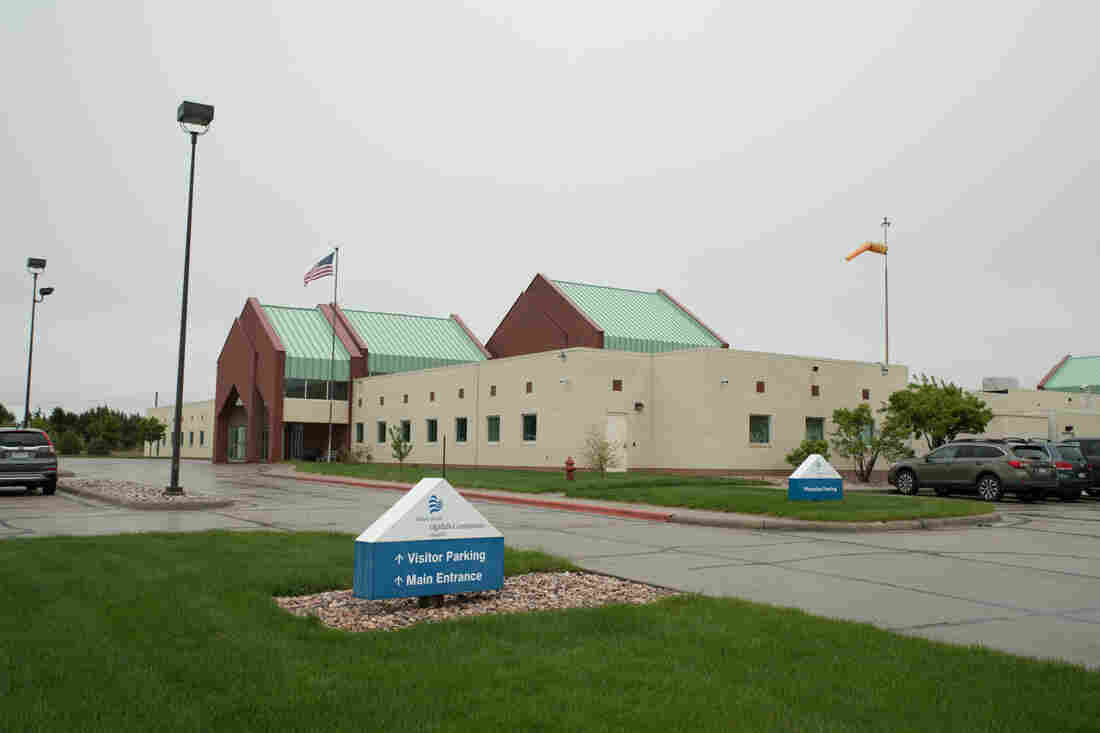
The CEO at the Ogallala Community Hospital in Ogallala, Neb., began offering $100,000 signing bonuses to attract doctors to the town.
Theo Stroomer for NPR
hide caption
toggle caption
Theo Stroomer for NPR
The nearest hospital to Arthur is 40 miles south in the town of Ogallala. Christopher Wong, 36, is one of just two family practice obstetricians at Ogallala Community Hospital, which serves a vast area of some 15,000 people spread across several counties.
Wong grew up in suburban Denver, about a three-hour drive away, but world’s apart from western Nebraska
“Most of the people I take care of out here are ranchers and farmers,” Wong says.
Wong first got interested in rural health care during med school, doing volunteer work in rural Louisiana after Hurricane Katrina. Still, working full time in a small town in rural Nebraska has been an adjustment.
One day, he did rounds at the hospital, saw dozens of patients at the clinic and signed a birth certificate for a baby he’d just delivered. He and the mother had to get a little creative, Wong recalled. She had a history of going into labor fast, but lives more than an hour’s drive from the hospital. Plus it’s calving season on her ranch. And she wasn’t sure her husband would be nearby — or available — to drive her to the hospital.
“So we brought her into the hospital when she was 39 weeks so we could induce her,” Wong says.

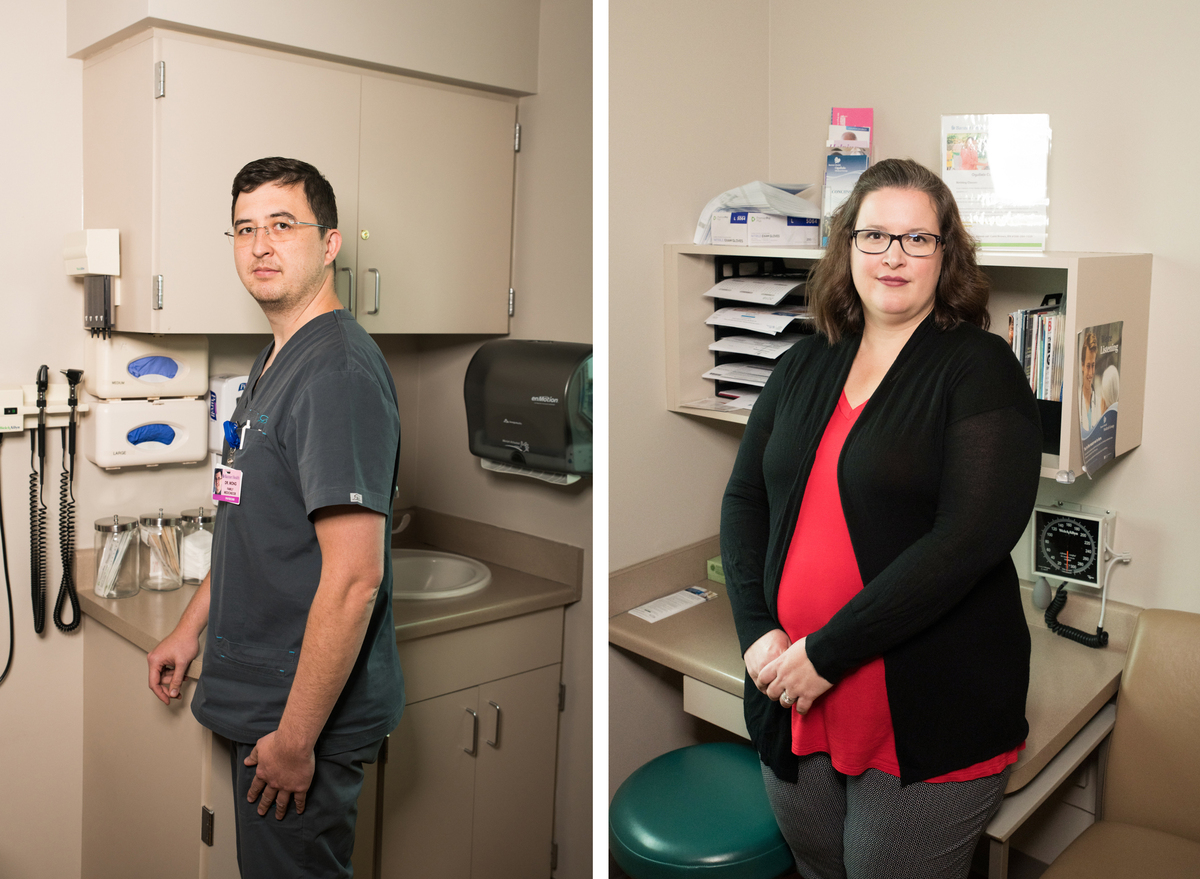
Christopher Wong (left) and Jessica Leibhart, are family practice physicians at Ogallala Community Hospital in Ogallala, Neb. Wong, who has worked at the hospital for almost three years, says he has no plans to leave. Leibhart grew up about fifty miles away from Ogallala and said she wanted to live in the small town.
Theo Stroomer for NPR
hide caption
toggle caption
Theo Stroomer for NPR
Being a doctor in a small town, you’re always on, even when you’re not. It’s not like you can just clock out and leave work. Wong will bump into a patient at the grocery store who politely asks about this ailment or that problem. Everyone knows him and there’s no anonymity. He’s also on call every other weekend.
“It’s very hard to get away,” Wong says. “It’s hard to separate it all.”
He has a girlfriend in Denver and tries to get down there when he can. But it’s a tough sell to convince a partner to move to rural Nebraska where there are few other young professionals or opportunities.
“I think that’s why it’s also hard to get physicians into rural practice because it’s hard to maintain a personal life.”
Burnout is high. Wong is approaching three years on the job in Ogallala and has no plans to leave. But it’s a constant worry for hospital administrators.
“Work-life balance is a big piece, they want to go home at some time,” says Drew Dostal, CEO of Ogallala Community.
Doctors like Wong, who do both family practice and obstetrics are already in high demand. Dostal even offers $100,000 signing bonuses to help ease their debt burden. It may get them out here for a few years, he says, but they’re usually lured away by other offers and rarely become fully part of the community.
“Physicians who have to move on to help get their debt paid off …[that] challenges patients as well,” Dostal says. “They want to know [their doctor], they want them to stay forever, but it just isn’t a reality in today’s health care.”
Social matchmakers
Dostal is currently looking for a third family practice doctor and could probably hire a fourth. Retaining doctors is key to keeping critical access hospitals like this one open. In the NPR poll, close to one out of every ten respondents said their small town hospital had recently closed.
Recruiting and retaining doctors is so pressing that hospital officials even try to become social matchmakers. If a doctor likes sports, for example, administrators may suggest they volunteer as team physician at the high school; or if they are an arts lover, they could volunteer on the planning committee for the local arts festival.
“If we don’t do a better job of doing that, there is a risk for rural places to lose their hospital, or lose their providers that are in that hospital,” says Dr. Jeffrey Bacon, the chief medical officer for three Banner Health hospitals in northeast Colorado and western Nebraska, including in Ogallala.



One out of every four Americans living in rural America said they had problems accessing needed health care recently, according to a new poll by NPR, the Robert Wood Johnson Foundation and the Harvard T.H. Chan School of Public Health. In small towns like Ogallala, the challenge for health care providers is attracting doctors who want to live there.
Theo Stroomer for NPR
hide caption
toggle caption
Theo Stroomer for NPR
Bacon and other hospital officials say a more effective solution than social matchmaking or signing bonuses might be if medical schools did more active recruiting in small towns.
In January, Ogallala Community was thrilled to hire Jessica Leibhart to join Wong as a second family practice OB-GYN. Leibhart, 36, grew up in Imperial, Neb., about fifty miles south of Ogallala.
“I was looking to get back to my roots,” Leibhart says. “This was really close and looked like the right fit for us.”
Leibhart relocated from the Omaha area and her family already had contacts in Ogallala, so the transition has been smooth. She knows that in a small town it’s virtually impossible to escape your job.
“If we’re at Walmart or my husband and I will be out for dinner and then pretty soon someone stops by, but that’s part of it,” Leibhart says. “And that truly is becoming part of the community and part of the family that the small town is.”
Finding doctors who want to be part of the small town family, may be one solution to addressing the worsening doctor shortage in rural America, and the growing urban-rural divide.
Can CBD Reduce Cravings And Stress In Opioid Users?

Researchers wanted to know if CBD can help people who are former opioid users resist relapse. Their double-blinded, placebo-controlled trial suggests CBD can help reduce stress and cravings.
Protests Held Across The U.S. In Response To States Passing Restrictive Abortion Laws
Coordinated protests in response to a raft of new state laws restricting abortion took place across the U.S. on Tuesday.
Nepalese Sherpa Sets Mount Everest Record (Again), Climbing Mountain Twice In A Week


Nepali mountaineer Kami Rita Sherpa hopes to break his own record for climbing Everest, aiming for 25 summits. He’s seen here in 2018, spinning prayer wheels in Kathmandu.
Prakash Mathema/AFP/Getty Images
hide caption
toggle caption
Prakash Mathema/AFP/Getty Images
A Nepalese mountain climber has now climbed Mount Everest a record 24 times — and he’s hoping to do it one more time before he retires. Kami Rita Sherpa, 49, has been climbing Everest since 1994.
“It’s also the second time in a week that he’s made the arduous trek,” NPR’s Sushmita Pathak reports from Mumbai. “The 49-year-old Sherpa guide had already broken his own record on May 15, when he scaled the summit for the 23rd time.”
Rita started his most recent climb just three days after his 23rd summit of Everest. Early Tuesday morning, he stepped on the tallest peak in an area known as the roof of the world, leading a team of Indian police officers on the climb, according to The Kathmandu Post.
The highest mountain on Earth, Mount Everest’s summit is more than 29,000 feet above sea level. The first time it was successfully scaled was in 1953 — and the southeast route that was taken by Sir Edmund Hillary and Sherpa Tenzing Norgay is the same one Rita and many other climbers still use today.
In addition to Everest, Rita has climbed a number of other imposing mountains, including K2 and Cho-Oyu.
Mountaineers who hope to climb Everest have a brief window each May in which weather conditions are most favorable. In the current season, 381 people have received permits to carry out expeditions on the mountain, as part of 44 teams, according to Nepal’s Department of Tourism. Of those climbers, 14 are natives of Nepal.
As of Monday, at least 75 climbers had reached the top of Everest in the current season, according to The Rising Nepal.
Poll: Many Rural Americans Struggle With Financial Insecurity, Access To Health Care
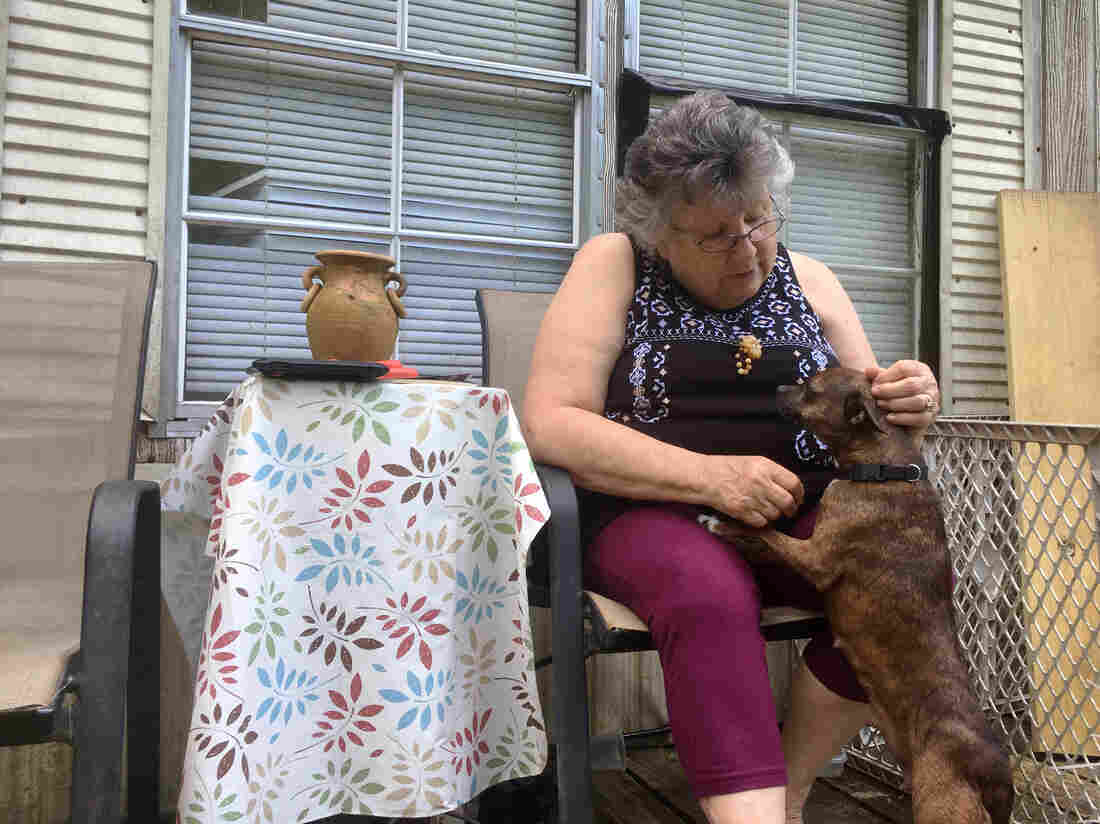
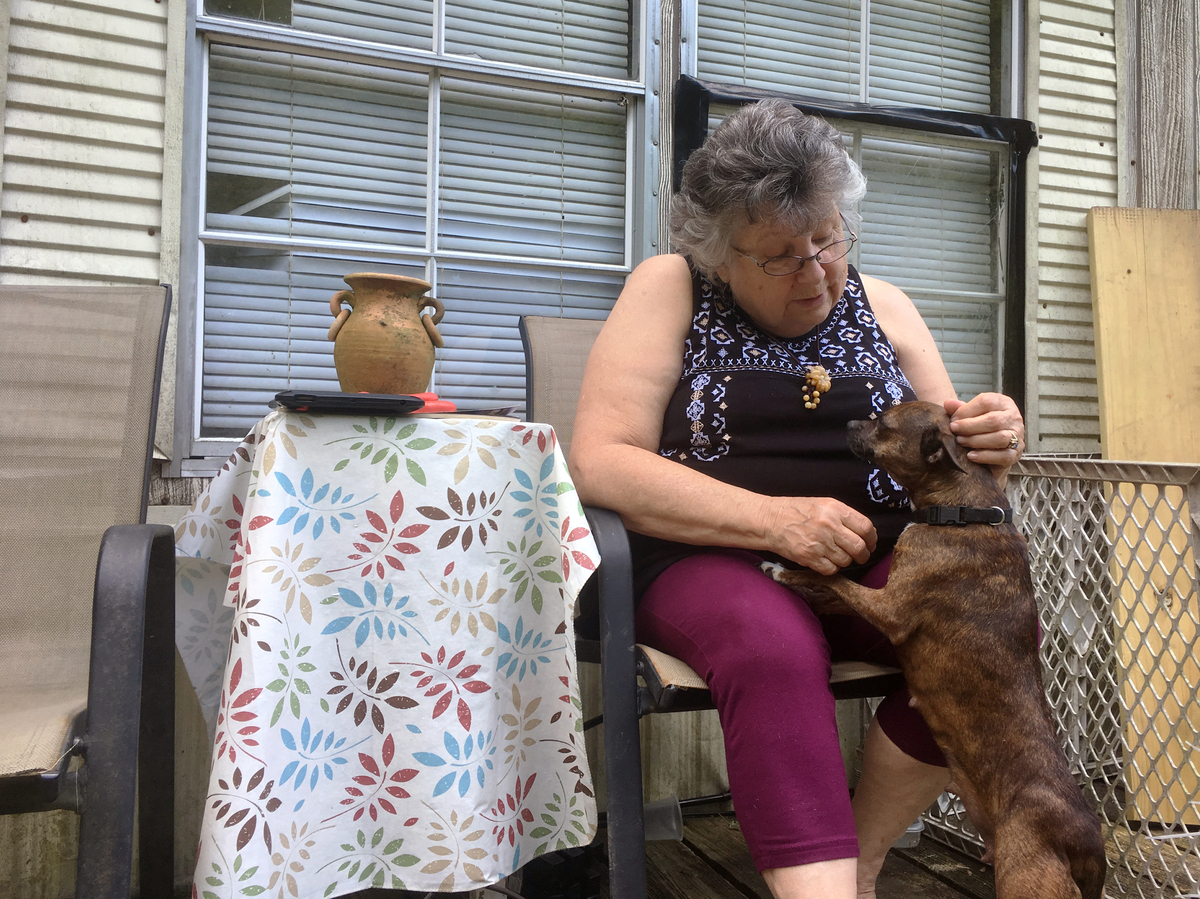
Leitha Dollarhyde, a retired caregiver who lives in a rural town near Whitesburg, Ky., says she could not afford an unexpected $1,000 expense.
Sydney Boles for NPR
hide caption
toggle caption
Sydney Boles for NPR
Polling by NPR finds that while rural Americans are mostly satisfied with life, there is a strong undercurrent of financial insecurity that can create very serious problems for many people living in rural communities.
The findings come from two surveys NPR has done with the Robert Wood Johnson Foundation and the Harvard T.H. Chan School of Public Health on day-to-day life and health in rural America.
After a major poll we did last fall found that a majority (55%) of rural Americans rate their local economy as only fair or poor, we undertook a second survey early this year to find out more about economic insecurity and health. The poll looked beyond the known factors of job loss and the decades-long flight of young people to more urban areas.
Several findings stand out: A substantial number (40%) of rural Americans struggle with routine medical bills, food and housing. And about half (49%) say they could not afford to pay an unexpected $1,000 expense of any type.
Access to health care
One-quarter of respondents (26%) said they have not been able to get health care when they needed it at some point in recent years. That’s despite the fact that nearly 9 in 10 (87%) have health insurance of some sort — a level of coverage that is higher now than a decade ago, in large part owing to the Affordable Care Act and the expansion of Medicaid in many states.
Loading…
Don’t see the graphic above? Click here
“At a time when we thought we had made major progress in reducing barriers to needed health care, the fact that 1 in 4 still face these barriers is an issue of national concern,” says Robert J. Blendon, co-director of the survey and professor of health policy and political analysis at the Harvard T.H. Chan School of Public Health. “Either it is still not affordable for them or the insurance they have doesn’t work — or they can’t get care from the health providers that are in their community.”
Of those not able to get health care when they needed it, the poll found that 45% could not afford it, 23% said the health care location was too far or difficult to get to, and 22% could not get an appointment during the hours needed.
Dee Davis, president and founder of the Center for Rural Strategies in Whitesburg, Ky., says poverty and ill health are endemic where he lives. “People in this congressional district have the shortest life span in the United States; we also are the poorest,” Davis says. “We’re poor and we’re sicker.”
But, he adds, the Affordable Care Act — which in Kentucky brought an expansion of Medicaid to many previously uninsured residents — went a long way in helping many rural communities take care of recurring problems. “We’re not out of the woods yet but the ACA certainly changed the landscape,” Davis says.
Lots of rural people benefited from the ACA, he adds, and if that progress were to be lost, he says: “We’re in trouble.”
Loading…
Don’t see the graphic above? Click here
For purposes of this poll, “rural” was defined as areas that are not part of a Metropolitan Statistical Area, as used in the 2016 National Exit Poll. The NPR poll was conducted in English and Spanish using random-digit dialing Jan. 31-March 2 among a nationally representative, probability-based sample of 1,405 adults ages 18 or older living in the rural U.S. The margin of error for the total respondents is plus or minus 3.5 percentage points at the 95% confidence level.
Financial insecurity
One measure of financial security is the ability to meet unexpected expenses like a car repair or a medical problem or fixing something that has gone wrong in the house. It’s not unusual for these expenses to run $1,000 or more, so we asked whether that would be a problem.
Overall, nearly half (49%) said they wouldn’t be able to afford that. And more than 6 in 10 rural black and Latinx Americans said they would have a problem paying that off (blacks, 68%; Latinx, 62%), compared with 45% of rural whites.
“When you’re living close to the edge, sometimes you fall off,” says Davis. “If half the people in rural America can’t deal with a $1,000 bill, that’s rough.”
Loading…
Don’t see the graphic above? Click here
It would be an issue for 72-year-old Leitha Dollarhyde, a retired caregiver who lives near Whitesburg, Ky., a rural town of under 2,000 people. She was born about 4 miles from where she lives today.
Her answer, when asked if she could afford an unexpected $1,000 expense? “No. There’s no way. My savings account is zero.”
Dollarhyde worked all her life, but the jobs just didn’t pay enough for her to put anything aside. She raised four children. Today her income — Social Security and Supplemental Security Income — adds up to $790 a month.
“With that income, you watch every penny,” she says.
Strong social networks
Yet even with the high levels of financial insecurity that we found, there is abundant optimism and satisfaction with the quality of life in rural America. Almost three-quarters (73%) of rural Americans rate the overall quality of life in their local community as excellent or good. And a majority (62%) are optimistic that people like them can make an impact on their local community.
Davis says that is what he observes in rural Kentucky. “People may be living a more hardscrabble existence than folks in the suburbs or a lot of the folks in cities, but it doesn’t mean they’re not living a decent life,” he says. “Most people are pretty happy with it; they’ve got friends and neighbors they rely on and they’re where they want to be.”
Still, social isolation and loneliness are a concern in rural America. We found nearly 4 in 10 (38%) said “many people” in their community feel lonely or isolated, with almost 1 in 5 (18%) saying they “always” or “often” feel either isolated or lonely. People with disabilities (31%) more frequently said they feel lonely or isolated from others compared with those without disabilities (12%).
Loading…
Don’t see the graphic above? Click here
A majority of rural Americans say they participate in civic and social activities, including volunteering and service, political activities, community meetings and membership in a variety of groups. The most frequently cited activity was volunteering their time to an organization working to make their local community a healthier place to live (49%).
Whitesburg community activist Nell Fields says that when her husband was recently hospitalized, her neighbors were extraordinary.
“My neighbors come and mow my grass, feed cattle, get eggs every day for the last few weeks,” she says. “That says so much to me. [It] makes me feel the emotion now of what it feels like to have such warm, wonderful support and I know that’s the blessing of living in rural America.”
Declining hospitals
Since 2010, 106 rural hospitals have closed in rural America. As many as 673 more are at risk of closure, according to a 2016 report from iVantage Health Analytics. Currently, there are approximately 1,860 rural hospitals in the U.S.
Eight percent of rural adults polled say hospitals in their local communities have closed down in the past few years. About two-thirds (67%) say the closures were a problem, including 38% who say they were a major problem.
“It means people have to travel greater distances to receive care, and distance can be a barrier to timely and appropriate access to services,” says Brock Slabach of the National Rural Health Assembly in Leawood, Kan. “Delayed care can often lead to tragic consequences. This can be a huge barrier for many living in rural areas.”
Loading…
Don’t see the graphic above? Click here
As an example, he points to the small town of Tonopah, Nev., population 2,478, that is more than three hours away from the nearest hospital by road. The community’s hospital closed in 2015 and the ambulance service in town was left to deal with all kinds of medical problems that it is not situated to handle, Slabach says.
In areas where higher-speed Internet access is available, people are turning to telehealth instead of going to a doctor or clinic. But broadband access is a perennial issue in many parts of rural America, with 1 in 5 (21%) saying that accessing high-speed Internet is a problem for their family. Among those who do use the Internet, a majority say they do so to obtain health information (68%).
The medical purposes for using telehealth vary, as a majority of rural telehealth patients (53%) say they have received at least one prescription from their doctor or other health professional using telehealth, while 25% have received a diagnosis or treatment for a chronic condition, 16% have received a diagnosis or treatment for an emergency, and 9% have received a diagnosis or treatment for an infectious disease.
3-Time Formula One Champ Niki Lauda Is Dead At 70


Former Formula One driver Niki Lauda stands in the Mercedes pit at the Interlagos race track in Sao Paulo, Brazil, in 2017. The three-time Formula One world champion has died at the age of 70.
Nelson Antoine/AP
hide caption
toggle caption
Nelson Antoine/AP
Formula One world champion Niki Lauda of Austria, who survived a fiery crash in 1976 and went on to win the championship twice more, has died. He was 70.
Born Andreas Nikolaus “Niki” Lauda, he was a prominent race car driver in the 1970s and 1980s, who first won the F1 championship driving for Ferrari in 1975. He’s known by many for the serious crash he suffered the next year, in the 1976 German Grand Prix at the Nurburgring race track, where he suffered third-degree burns to his head and face. At the hospital, Lauda fell into a coma, and also received last rites.
“For three or four days it was touch and go,” Lauda recalled later, according to ESPN.
Still, he managed to race again just six weeks after the accident, taking fourth place in the Italian Grand Prix. As the BBC reports: “By the end of the race, his unhealed wounds had soaked his fireproof balaclava in blood. When he tried to remove the balaclava, he found it was stuck to his bandages, and had to resort to ripping it off in one go.” The BBC calls his quick return to racing “one of the bravest acts in the history of sport.”
All at McLaren are deeply saddened to learn that our friend, colleague and 1984 Formula 1 World Champion, Niki Lauda, has passed away. Niki will forever be in our hearts and enshrined in our history. #RIPNiki pic.twitter.com/Ndd9ZEfm6B
— McLaren (@McLarenF1) May 21, 2019
Lauda went on to win the F1 championship again in 1977. In 1979 he retired and turned to aviation, creating Lauda air, declaring that he “didn’t want to drive around in circles anymore,” the AP reports. But he was lured back to racing a few years later by a big offer from McLaren. He won the F1 championship for a third time in 1984, before retiring from the sport for good the next year.
“His unique successes as a sportsman and entrepreneur are and remain unforgettable,” his family said in a statement, the AP reports. “His tireless drive, his straightforwardness and his courage remain an example and standard for us all. Away from the public gaze he was a loving and caring husband, father and grandfather. We will miss him very much.”
What Abortion Was Like In The U.S. Before Roe V. Wade
NPR’s Mary Louise Kelly talks with Karissa Haugeberg, assistant professor of history at Tulane University, about what it was like to get an abortion before Roe v. Wade.
GoldLink Turns Up As A Hologram For ‘Zulu Screams’ Video

YouTube
GoldLink is riding a well-deserved tide of goodwill ever since his 2017 studio debut At What Cost, a record that birthed “Crew” and resulted in his first Grammy nomination.
“Zulu Screams” is the latest glimpse of new material from the rapper since January’s “Got Muscle.” It’s a low-key, welcome return for the rapper’s nimble flow, setting his sights outside of his hometown’s go-go music. His voice snakes around P2J’s delightful production infused with sped-up highlife guitar, assisted by the similarly agile DMV singer-songwriter Bibi Bourelly and Brit-Nigerian singer Maleek Berry.
Directed by Meji Alabi, the visual for “Zulu Screams” finds GoldLink as a maestro of a particularly rowdy warehouse function — neon strobelights, a game of craps, and a lot of athletic dance moves on display. The only catch? GoldLink, in these modern times, is a hologram.
Not Just For Soldiers: Civilians With PTSD Struggle To Find Effective Therapy

Stuart Kinlough/Getty Images/Ikon Images
Lauren Walls had lived with panic attacks, nightmares and flashbacks for years. The 26-year-old San Antonio teacher sought help from a variety of mental health professionals — including spending five years and at least $20,000 with one therapist who used a Christian-faith-based approach, viewing her condition as part of a spiritual weakness that could be conquered — but her symptoms worsened. She hit a breaking point two years ago, when she contemplated suicide.
In her search for help, Walls encountered a psychiatrist who diagnosed her with post-traumatic stress disorder. As a result, she sought out a therapist who specialized in trauma treatment, and that’s when she finally experienced relief.
“It was just like a world of difference,” Walls says.
Seeing herself as someone with PTSD was odd at first, Walls recalls. She isn’t a military veteran and thought PTSD was a diagnosis reserved for service members. But her psychologist, Lindsay Bira, explained that Walls most likely developed the mental disorder from years of childhood abuse, neglect and poverty.
PTSD has long been associated with members of the military who have gone through combat and with first responders who may face trauma in their work. It’s also associated with survivors of sexual assault, car accidents and natural disasters. But researchers have also learned it can develop in adults who have experienced chronic childhood trauma — from physical, emotional or sexual abuse by caregivers or from neglect or other violations of safety.
Walls was fortunate to find a therapist trained to treat PTSD. Outside of military and veterans’ health facilities, finding knowledgeable help is often difficult.
A limited number of the more than 423,000 mental health counselors, therapists, psychologists and psychiatrists in the U.S. are trained in two key therapies, called cognitive processing therapy and prolonged exposure therapy. These are treatments recommended as part of a patient’s care by the American Psychiatric Association and the Department of Veterans Affairs, which has studied treatments for PTSD since it affects many service members.
There is no definitive tally of people trained in these therapies, and neither the American Psychiatric Association nor the American Psychological Association tracks those data. A 2014 study by the Rand Corp. found that only about a third of psychotherapists had the training. The VA says over 6,000 of its therapists have, though rosters for the CPT and PE organizations list just a few hundred total practitioners.
Nonetheless, the VA’s National Center for PTSD wants to expand access to these treatments, and regional groups, including those in Texas, are following its lead. Texas has a need for more PTSD providers: It ranks No. 2 nationwide in the number of human-trafficking victims; it’s the leading state for refugee resettlement; it has the most unaccompanied child migrants of any state; and it’s second only to California in the number of military service members — all factors that raise the risk of PTSD.
UT Health San Antonio, a University of Texas medical school and hospital, teaches community mental health providers how to provide the two PTSD therapies through its Strong Star Training Initiative. Funded by the Texas Veterans + Family Alliance grant program and the Bob Woodruff Foundation, the initiative has trained 500 providers since it started in 2017. Most training takes place in San Antonio, and many of the mental health professionals who participate are Texas-based, though they also come from Florida, Illinois and other states.
In February, about 20 therapists gathered in a conference room at the medical school for instruction. Calleen Friedel, a San Antonio-based marriage and family therapist, was one of them. She said she is seeing more people with PTSD and often felt inept at helping them.
“I would just do what I know and do my own reading,” Friedel said. “And what I was taught in graduate school, which was, like, over 20 years ago.”
The group learned about one of the mainstream therapies, prolonged exposure therapy, which gradually exposes patients to trauma memories to help reduce PTSD symptoms. Strong Star also teaches cognitive processing therapy, which involves helping the patients learn to reframe their thoughts about the trauma. But both therapies — often called “evidence based” because of the research backing their effectiveness — have been slow to gain traction among psychotherapists because they require the therapist to follow a script and they differ from the common therapeutic approach to mental health issues.
Edna Foa, who created prolonged exposure, said in a 2013 journal article that many psychotherapists believe delving into a patient’s inner life and history is central to their work. By contrast, the highly structured, evidence-based treatments — with their pre- and post-session evaluations and their focus on symptom relief — can seem “narrow and boring,” she wrote.
In addition, some people living with PTSD have complained that the treatments don’t work for everyone. But Foa and others say the focused approach targets the brain mechanisms that cause PTSD symptoms, and symptom relief is what many living with PTSD want.
Edwina Martin, a psychologist in Bonham, Texas, says treatments such as the ones she is learning at Strong Star weren’t mainstream when she finished graduate school more than 10 years ago. She is now employed at a VA health center after working for a decade in prisons, and she says she wants these PTSD therapies in her “tool bag.”
The push to expand the trained workforce coincides with a growing understanding of trauma’s effects. The National Council for Behavioral Health, a nonprofit organization of mental health care providers, calls trauma a “near universal experience” for people with mental and behavioral health issues.
Because so many patients think PTSD is mostly a military problem, psychologist Bira says, they encounter a roadblock to recovery.
“I get that all the time,” Bira says. “The beginning stages in treatment that I find with civilians are really about educating [them] about what PTSD is and who can develop it.”
Kaiser Health News is a nonprofit news service covering health issues. It is an editorially independent program of the Kaiser Family Foundation that is not affiliated with Kaiser Permanente.
President Trump’s Golf Scores Hacked On U.S. Golf Association Account


President Trump plays a round of golf at Trump Turnberry Luxury Collection Resort during his first official visit to the United Kingdom on July 15, 2018 in Turnberry, Scotland.
Leon Neal/Getty Images
hide caption
toggle caption
Leon Neal/Getty Images
President Trump’s account on the U.S. Golf Association system has been hacked in an apparent attempt to make him look like a bad golfer with four fake scores.
The awful scores of 101, 100, 108 and 102 were posted to Trump’s USGA-administered Golf Handicap and Information Network [GHIN] handicap system on Friday, according to Golfweek. A handicap is a measure of a golfer’s ability – a lower handicap indicates a better golf game.
“We have become aware of reports in the media questioning recent scores posted on President Trump’s GHIN account,” Craig Annis, the managing director of communications for the USGA, told Golfweek. “As we dug into the data it appears someone has erroneously posted a number of scores on behalf of the GHIN user.”
USGA is removing the scores and says it is investigating to determine how they appeared, Annis said.
Trump flew from New York to Washington, D.C., on Friday morning and delivered a speech to the National Association of REALTORs convention in the afternoon. He did play golf on Saturday afternoon at the Trump National Golf Club in Sterling, Va. According to a site that tracks Trump’s golf habits, the president has played more than 170 rounds since taking office.
The fabricated scores were from games at Trump National in New York, Trump International in West Palm Beach, Fla., and the Cochise Course at Desert Mountain in Scottsdale, Ariz., Golfweek reported. Another suspicious score of 68 was recorded on April 19.
Par in a round of golf is typically around 72 strokes. According to Trump’s account, his scores usually fall in the 70s and 80s, but many are skeptical that the president has always truthfully recorded his scores. Trump has vehemently denied accusations that he has bent the rules.
“I’ve played a lot, and I’ve played well,” Trump said, according to a Washington Post investigation in 2015. “There’s very few people that can beat me in golf.”
Golf insiders don’t dispute that Trump is a fine golfer – he might just not play as well as he says he does.
In 2012, Forbes reported that Trump is a 4 handicap, despite the fact that he has yet “to produce a real signed scorecard.”
Rick Reilly, the sportswriter who penned the 2004 book “Who’s Your Caddy?” told the Post that one afternoon Trump recorded scores that he didn’t actually earn. The Post investigation also revealed that caddies would allegedly help Trump cheat.
“When it comes to cheating, he’s an 11 on a scale of one to 10,” Reilly said.