It’s Not Just Measles. What You Should Know About Vaccines For Adults
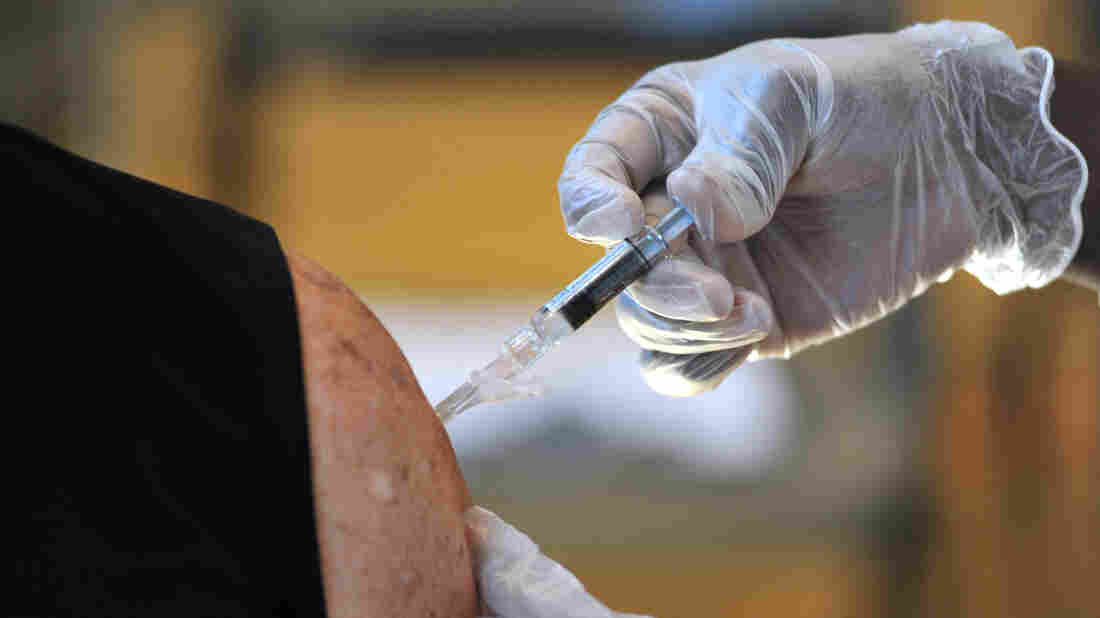
Many people might not be aware of what types of vaccines they need as they get older. Here, an adult gets a flu shot in Jacksonville, Fla.
Rick Wilson/AP images for Flu + You
hide caption
toggle caption
Rick Wilson/AP images for Flu + You
Updated at 1 p.m. ET
Amid one of the largest measles outbreaks in the U.S. in recent history, vaccines are on the minds of many Americans.
The Centers for Disease Control and Prevention reported this week that the number of measles cases this year has climbed to 839 in 23 states, affecting mostly unvaccinated people. Most people in the U.S. are vaccinated against measles when they’re children as part of the routine immunizations they get in primary care.
We’re used to kids needing lots of shots to ward off lots of illnesses, but what about adults? The CDC recommends that adults get multiple vaccines for conditions ranging from tetanus to influenza to cervical cancer. The shots can be a bit trickier to keep track of, as many adults go to the doctor less frequently than kids do, but those vaccinations are equally important for staying healthy.
“Many adults are not aware of what vaccines they actually need,” says Dr. Pamela Rockwell, an associate professor of family medicine at the University of Michigan who works with the CDC’s Advisory Committee on Immunization Practices. “That is also balanced by physician unawareness of what vaccines they should be recommending. It’s gotten very complicated, and it is difficult to keep up with all the changes.”
So we’re here to answer some common questions about adult vaccines. Click on each topic to go to that section.
1. Measles 2. Shingles 3. Tetanus 4. Vaccines during pregnancy 5. Before meeting a newborn baby 6. Before visiting the elderly 7. Chickenpox 8. Hepatitis B, A and C 9. HPV
I was vaccinated against measles as a child, but the measles outbreak makes me worry that I’m no longer immune. Do I need to be revaccinated as an adult?
If you received the standard two doses of the modern measles, mumps and rubella (MMR) vaccine, you’re all set. You shouldn’t need to be revaccinated, because you’re considered immune for life.
And if you were born before 1957, doctors assume you were exposed to measles as a child and are already immune.
However, a version of the vaccine produced in the mid-to-late 1960s wasn’t as effective as the current regimen, so if you were vaccinated before 1968, you should talk to your doctor about whether you need another shot. If you were born after 1957 but for some reason never got immunized, you should also get the MMR vaccine.
I’ve heard there’s an effective vaccine for shingles, but my doctor’s office doesn’t have it and it’s out of stock at the pharmacy. What’s going on?
Shingrix is a two-dose vaccine that is upward of 95 percent effective at preventing shingles, a painful rash that tends to affect older adults and immunocompromised people. The vaccine was approved in 2017 and requires two injections. It’s more effective than Zostavax, an older shingles vaccine, so doctors will recommend Shingrix over Zostavax to most patients over age 50.
There has been a shortage of Shingrix for almost as long as it has been available because demand for the vaccine has outpaced the supply. Its manufacturer, GlaxoSmithKline, told the CDC that it’s working to step up its production schedule. But because every dose of Shingrix needs to undergo safety checks, GSK expects that shortages will continue at least through the end of the year.
“The demand was so great they literally couldn’t keep up,” Rockwell says.
If you get the first dose, do your best to get the second one within two to six months. If your local pharmacies don’t have Shingrix in stock, don’t worry — you can use the HealthMap Vaccine Finder to find out where it is available. If you wait more than six months to get the second dose, you don’t need to repeat the first one, but it’s possible the vaccine won’t be quite as effective in preventing shingles.
What’s the deal with tetanus shots? How often do I need them?
Tetanus is a life-threatening disease of the nervous system that’s caused by a toxin-producing bacterium usually found in soil. It can be prevented by a series of five childhood shots, including a booster between ages 11 and 12. Adults then need a booster shot every 10 years. It can be hard to keep track of this if you move or change doctors, so make a note in your calendar and don’t be afraid to ask about it. If you get it early or a year or two late, it isn’t harmful.
If you ever have an injury that might expose you to tetanus — such as stepping on a nail — your doctor will ask when your latest tetanus booster was and may give you another booster shot on the spot. If you’re not up to date on your tetanus vaccines, you may need additional treatment to prevent the disease.
Childhood tetanus shots are combined with a vaccine for diphtheria, a dangerous infection that can affect kids, and one for pertussis, which is known as whooping cough. Your every-10-year tetanus and diphtheria boosters won’t include pertussis, unless you’re pregnant. But when you turn 65, you should again get the shot that protects against all three, which is known as Tdap.
I’m thinking about having a baby. What vaccines do I need?
Make sure you and everyone around you is up to date on standard childhood and adolescent vaccines, including pertussis, since babies are vulnerable to this disease. You should also get a dose of Tdap during prenatal care, since it’s safe in pregnancy.
Everyone also should get an annual flu shot, because pregnant women, who have weakened immune systems, are particularly susceptible to influenza and can get very sick or die from an infection.
Even if you got all the recommended vaccines as a kid, it’s possible your immunity has waned when it comes to some of the vaccine-preventable diseases that can be passed from mom to baby. This is why prenatal doctors and midwives check to make sure pregnant women are immune to hepatitis B, varicella (chickenpox) and rubella.
If you find out you’re not immune before you get pregnant, you should get vaccinated again. The hepatitis B vaccine is safe during pregnancy. But the varicella and MMR (which includes rubella protection) vaccines are not safe for pregnant patients, so your doctor is likely to recommend that you get them after delivery.
I’m planning to visit my newborn nephew. What vaccines do I need?
If you’ve gotten all your recommended vaccines and boosters, you’re almost ready to meet the baby. Babies, like pregnant women, have weak immune systems, so an annual flu shot is important before interacting with a newborn. Adults over 65 should have gotten a pertussis booster (included in the Tdap shot).
What about if I’m visiting my hospitalized, elderly grandmother?
Older, hospitalized adults are similar to newborns in that their immune systems are weak and particularly vulnerable to infections. Follow the same advice as if you’re going to meet a new baby.
I was born before the varicella (chickenpox) vaccine existed. Do I need it now?
The varicella vaccine was approved in 1995, so if you were born before then, there’s a good chance you weren’t vaccinated.
But even if you weren’t vaccinated, you’re probably already immune because there’s a high likelihood you’ve had chickenpox. The CDC says adults born before 1980 don’t need the vaccine and don’t need testing to prove their immunity.
There are some occasions when doctors will want to order blood tests to make sure their patients are actually immune to varicella — for pregnant women and health care workers, for example. If you get tested and the blood test shows you’re still susceptible, your doctor will recommend that you get the vaccine. But because the vaccine is so effective and the blood test isn’t always accurate, getting tested isn’t necessary for everyone.
What do I need to know about all the different hepatitis shots?
Hepatitis means inflammation of the liver, but when we’re talking about vaccines, we’re referring to several types of viruses that infect liver cells and can cause lots of different and potentially life-threatening problems, ranging from diarrhea to liver failure to cancer. Routine childhood immunizations include vaccines for hepatitis A and hepatitis B, meaning virtually all kids in the U.S. are vaccinated against them.
Hepatitis B is transmitted through blood or sex. A vaccine for it has been available since the 1980s, but it’s common for immunity to hepatitis B to decrease over time. If you work in health care or are thinking about becoming pregnant, your doctor might order a blood test that shows if you’re still immune. If you’re not, your doctor may recommend you get revaccinated as an adult.
Hepatitis A is transmitted through the fecal-oral route, meaning that if you eat something that has been contaminated with the feces of an infected person, you can get it. The vaccine for hepatitis A was approved in 1995. If you’re not yet vaccinated and you fall into one of a few groups — including if you’re a man who has sex with other men, you’re traveling to a country where the virus is endemic, you live with a person who has had hepatitis A — you should get the shots.
Hepatitis C is another common viral infection that affects the liver. It’s so common, in fact, that doctors routinely test people born between 1945 and 1965 for the virus. Unfortunately, there’s no vaccine available for it, but it can be treated with an oral medication. If you haven’t been screened for it, ask your doctor if you need to be.
Who should get the HPV vaccine? What’s it for?
This is essentially a cancer vaccine.
The Food and Drug Administration initially approved the HPV vaccine for girls and young women in the early 2000s, but the range of people who should get it has since grown. The FDA recently approved its use for people up to age 45. FDA approval is different from CDC guidelines, however. The CDC still officially recommends that both boys and girls get their first shot by 11 or 12, up until age 26 for women and 21 for men. The CDC adds that men up to age 26 “may be vaccinated” based on a consult with a doctor. If you’re older than 26 and haven’t been vaccinated, again, talk to your doctor about whether you need it.
HPV stands for the human papillomaviruses, which cause a wide variety of conditions, ranging from common warts on hands and feet to cervical and anal cancer. The vaccine helps prevent infection from certain types of HPV, including the strains that are the most likely to cause cancer.
It’s a series of two shots, six to 12 months apart, which is a change from when the vaccine was first approved — it used to require three shots. Children who are late getting the HPV vaccine and receive their first dose after age 15 will still need three doses.
And there’s more.
You may also need vaccines for conditions such as pneumonia or meningitis. Ask your doctor. What your doctor recommends will depend on your medical history and your risk factors, so don’t be afraid to speak up at your next appointment. You can use this CDC quiz to see what might be right for you.
Mara Gordon is a family physician in Washington, D.C., and a health and media fellow at NPR and Georgetown University School of Medicine.
Alabama Lawmakers Pass Bill Banning Nearly All Abortions

The Alabama Senate has passed an abortion ban that would be one of the most restrictive in the United States. The bill would make it a crime for doctors to perform abortions at any stage of a pregnancy unless a woman’s life is threatened or in case of lethal fetal anomaly.
Dave Martin/AP
hide caption
toggle caption
Dave Martin/AP
Updated Wednesday at 12:03 a.m. ET
The Alabama Senate passed a bill Tuesday evening to ban nearly all abortions. The state House had already overwhelmingly approved the legislation. It’s part of a broader anti-abortion strategy to prompt the U.S. Supreme Court to reconsider the right to abortion.
It would be one of the most restrictive abortion bans in the United States. The bill would make it a crime for doctors to perform abortions at any stage of a pregnancy, unless a woman’s life is threatened or in case of a lethal fetal anomaly.
The vote was 25-6, with one abstention.
Doctors in the state would face felony jail time up to 99 years if convicted. But a woman would not be held criminally liable for having an abortion.

Laura Stiller of Montgomery protests outside the Alabama State House as the Senate debates an abortion ban. Stiller calls the legislation political and an “affront to women’s rights.”
Debbie Elliott/NPR
hide caption
toggle caption
Debbie Elliott/NPR
There are no exceptions in the bill for cases of rape or incest, and that was a sticking point when the Alabama Senate first tried to debate the measure last Thursday. The Republican-majority chamber adjourned in dramatic fashion when leaders tried to strip a committee amendment that would have added an exception for cases of rape or incest.
Sponsors insist they want to limit exceptions because the bill is designed to push the idea that a fetus is a person with rights, in a direct challenge to the U.S. Supreme Court’s landmark Roe v. Wade decision that established a woman’s right to abortion.
“Human life has rights, and when someone takes those rights, that’s when we as government have to step in,” said Republican Clyde Chambliss, the Senate sponsor of the abortion ban.
The amendment has divided Republicans. Lt. Gov. Will Ainsworth, who presides over the Senate, posted on Twitter that his position is simple — “Abortion is murder.” But other Senate leaders have insisted that there be exceptions for rape and incest.
‘Abortion is murder,’ those three simple words sum up my position on an issue that many falsely claim is a complex one. #PassHB314 #NoAmendments pic.twitter.com/NjpYW2wu8T
— Will Ainsworth (@willainsworthAL) May 13, 2019
Democrats didn’t have the votes to stop the bill but tried to slow down proceedings during the debate.
Democratic Sen. Vivian Davis Figures questioned why supporters would not want victims of rape or incest to have an exception for a horrific act.
“To take that choice away from that person who had such a traumatic act committed against them, to be left with the residue of that person if you will, to have to bring that child into this world and be reminded of it every single day,” Figures said.
Republican Gov. Kay Ivey has not said whether she will sign it, and said she was waiting for a final version of the bill. She is considered a strong opponent of abortion.
The ACLU of Alabama says it will sue if the bill becomes law. “This bill will not take effect anytime in the near future, and abortion will remain a safe, legal medical procedure at all clinics in Alabama,” the organization tweeted Tuesday night, along with a map showing clinic locations in the state.
PLEASE REMEMBER: This bill will not take effect anytime in the near future, and abortion will remain a safe, legal medical procedure at all clinics in Alabama. #mybodymychoice #HB314 pic.twitter.com/vVohsiR5Md
— ACLU of Alabama (@ACLUAlabama) May 15, 2019
“Abortion is still legal in all 50 states,” the ACLU’s national organization wrote. “It’s true that states have passed laws trying to make abortion a crime, but we will sue in court to make sure none of those laws ever go into effect.”
Chipping away at abortion rights
In recent years, conservative states have passed laws that have chipped away at the right to abortion with stricter regulations, including time limits, waiting periods and medical requirements on doctors and clinics. This year state lawmakers are going even further now that there’s a conservative majority on the U.S. Supreme Court.
“The strategy here is that we will win,” says Alabama Pro-Life Coalition President Eric Johnston, who helped craft the Alabama abortion ban.
“There are a lot of factors and the main one is two new judges that may give the ability to have Roe reviewed,” Johnston said. “And Justice Ginsburg — no one knows about her health.”
So states are pushing the envelope. Several, including Alabama’s neighbors Georgia and Mississippi, have passed laws that prohibit abortion once a fetal heartbeat can be detected. But the drafters of the Alabama bill think by having no threshold other than if a woman is pregnant, their law might be the one ripe for Supreme Court review.
The National Organization for Women denounced the ban’s passage.
“This unconstitutional measure would send women in the state back to the dark days of policymakers having control over their bodies, health and lives,” the organization said in a statement. “NOW firmly believes that women have the constitutional right to safe, legal, affordable and accessible abortion care and we strongly oppose this bill and the other egregious pieces of legislation that extremist lawmakers are trying to pass in what they claim is an attempt to force the Supreme Court to overturn Roe.”
Who Is Believed?

“They all needed Larry. Gymnastics is punishing. Spend enough hours hoisting your body up and over those wooden gymnastics bars, eventually the skin on your palms rips right open.”
That’s a quote from host Lindsey Smith in the first episode of the podcast Believed, from NPR and Michigan Radio.
In 2018, Nassar was convicted of criminal sexual conduct and federal child pornography charges.
He serially abused hundreds of young women. His victims included household names like Simone Biles and Aly Raisman, but they weren’t all famous. Vox reports that the majority “were students and young female athletes — gymnasts, dancers, and volleyball players.”
At the very minimum, isn’t it unsettling to think that because of Nassar’s expertise treating athletes, he was kept on despite suspicions he was abusing his patients? And that when girls and young women came forward with their stories, no one believed them?
But it happened. For decades.
The purpose of Believed is to discover “how Larry Nassar abused so many for so long.”
In one instance, the police just believed Nassar instead of what his victim reported. And local detectives never referred the case to a local prosecutor for review, to see if this report of Nassar’s behavior reflected an isolated incident, or something worse.
We reached out to USA Gymnastics, and they sent us this statement.
We will never forget the appalling acts of abuse that have forever impacted our athletes and the gymnastics community. We admire the survivors’ courage and strength in sharing their stories, and our goal is to do everything we can to prevent the opportunity for it to happen again. USA Gymnastics is further strengthening its athlete safety policies — including provisions on mandatory reporting and setting boundaries for athlete-adult interaction — to establish greater accountability and make reporting easier. Athletes are the heart and soul of our sport, their safety is of paramount importance to us, and we are focused on making our organization more athlete-centric.
We bring you the latest on what’s happened since Nassar’s conviction and speak with Lindsey Smith about her work.
Produced by Kathryn Fink.
This show will discuss sexual abuse and assault. If you or someone you know needs to speak to someone, the National Sexual Assault Hotline is 1-800-656-4673. You can also use the RAINN online hotline, which you can find here.
No Mercy: How A Kansas Town Is Grappling With Its Hospital’s Closure

Fort Scott, Kan., fills up on weekday afternoons as locals grab pizza, visit a coffeehouse or browse antique shops and a bookstore. Like other rural communities, the commercial areas also include empty storefronts.
Christopher Smith for Kaiser Health News
hide caption
toggle caption
Christopher Smith for Kaiser Health News
A slight drizzle had begun in the gray December sky outside Community Christian Church as Reta Baker, president of the local hospital, stepped through the doors to join a weekly morning coffee organized by Fort Scott, Kan.’s chamber of commerce.
The town manager was there, along with the franchisee of the local McDonald’s, an insurance agency owner and the receptionist from the big auto sales lot. Baker, who grew up on a farm south of town, knew them all.
Still, she paused in the doorway with her chin up to take in the scene.
Just a few months before, Baker and the hospital’s owner, St. Louis-based Mercy health system, publicly announced that the 132-year-old hospital would close.
“Nobody talked to me after the announcement,” she said.
Baker, who says she has “taken a lot of heat” for how she broke the news, had carefully orchestrated face-to-face meetings with doctors and nurses in the final days of September. On Oct. 1, she met in person with the Mercy Hospital Fort Scott staff and then key community leaders before sending notices to the local newspaper and radio stations.
But for the 7,800 people of Fort Scott, about 90 miles south of Kansas City, Kan., the hospital’s closure was a loss they never imagined possible.
“Babies are going to be dying,” said longtime resident Darlene Doherty, who was at the coffee gathering. “This is a disaster.”
Bourbon County Sheriff Bill Martin stopped on his way out of the morning coffee to say the closure has “a dark side.” And Dusty Drake, the lead minister at Community Christian Church, diplomatically said people have “lots of questions,” adding that members of his congregation will lose their jobs.

Reta Baker, president of Mercy Hospital in Fort Scott, Kan., began as a staff nurse in 1981 and “has been here ever since.” The hospital closed at the end of 2018.
Christopher Smith for Kaiser Health News
hide caption
toggle caption
Christopher Smith for Kaiser Health News
Yet, even as this town deals with the trauma of losing a beloved institution, deeper national questions underlie the struggle: Do small communities like Fort Scott need a traditional hospital at all? And if not, how will they get the health care they need?
Sisters of Mercy nuns opened Fort Scott’s 10-bed frontier hospital in 1886 — a time when traveling 30 miles to see a doctor was unfathomable and when most medical treatments were so primitive they could be dispensed almost anywhere.
Now, driving the four-lane highway north to Kansas City, Kan., or crossing the state line to Joplin, Mo., and back is a day trip that includes shopping and a stop at a favorite restaurant. The bigger hospitals there offer the latest sophisticated treatments and equipment.
And when patients here get sick, many simply go elsewhere. An average of nine patients a day stayed in Mercy Hospital Fort Scott’s more than 40 beds from July 2017 through June 2018. And these low occupancy numbers are common: Forty-five Kansas hospitals report an average daily census of fewer than two patients.
James Cosgrove, who directed a U.S. Government Accountability Office study about rural hospital closures, said the nation needs a better understanding of what the closures mean to the health of people in rural America, where the burden of disease — from diabetes to cancer — is often greater than in urban areas.

Source: countyhealthrankings.org, the County Health Rankings & Roadmaps collaboration of the Robert Wood Johnson Foundation and the University of Wisconsin Population Health Institute
What happens when a 70-year-old grandfather slips on an icy sidewalk and must choose between staying home and driving to the closest emergency department, 30 miles away? Where does the sheriff’s deputy who picks up an injured suspect take his charge for medical clearance before going to jail? And how does a young mother whose toddler fell against the coffee table and now has a gaping head wound get her treated?
There is also the question of how the hospital going out of business will affect the town’s economy, since, as is often the case in rural America, Fort Scott’s hospital has been a primary source of well-paying jobs and attracts professionals to the community.
The GAO plans to complete a follow-up study later this year on the fallout from rural hospital closures. “We want to know more,” Cosgrove said. The original report was requested in 2017 by then-Sen. Claire McCaskill, D-Mo., and Rep. Tim Walz, D-Minn., and has been picked up by Sen. Gary Peters, D-Mich.
In Fort Scott, the answers to these questions are unfolding — painfully — in real time.
At the end of December, the Mercy system closed Fort Scott’s hospital but decided to keep the building open to lease portions to house an emergency department, outpatient clinic and other services. Mercy Fort Scott joined a growing list of more than 100 rural hospitals that have closed nationwide since 2010, according to data from the University of North Carolina’s Cecil G. Sheps Center for Health Services Research. How the town copes is a window into what comes next.
‘We were naive’
Over time, the Mercy hospital in Fort Scott became so much a part of the community that parents counted on the hospital’s ambulance standing guard at the high school’s Friday night football games.
The hospital seemed to be everywhere, actively promoting population health initiatives by working with the school district to lower children’s obesity rates as well as with local employers on diabetes prevention and healthy eating programs — worthy but, often, not moneymakers for the hospital.
“You cannot take for granted that your hospital is as committed to your community as you are,” said Fort Scott City Manager Dave Martin. “We were naive.”

Mercy Hospital in Fort Scott, Kan., flew its flags at half-staff in December in honor of former President George H.W. Bush, who died Nov. 30.
Christopher Smith for Kaiser Health News
hide caption
toggle caption
Christopher Smith for Kaiser Health News
Indeed, in 2002 when Mercy decided to build a new hospital, residents raised $1 million for construction. Another $1 million was given by residents to the hospital’s foundation for upgrading and replacing the hospital’s equipment.
“Nobody donated to Mercy just for it to be Mercy’s,” said Bill Brittain, a former city and county commissioner. The point was to have a hospital for Fort Scott, county seat of Bourbon Country.
But today Mercy is a major health care conglomerate, with more than 40 acute care and specialty hospitals, as well as 900 physician practices and outpatient facilities. Fort Scott’s hospital is the second one in Kansas that Mercy has closed.
The hospital’s steady decline in patients, rising expenses and insufficient reimbursement “created an unsustainable situation for the ministry,” said Tom Mathews, vice president of finance for Mercy’s southwestern Missouri and Kansas region.

Visitors to Mercy’s Fort Scott hospital would pass a tall white cross as they drove down a winding driveway before arriving at the front door. Sisters of Mercy nuns founded the hospital in 1886, and the newest building, constructed in 2002, honors that Roman Catholic faith.
Christopher Smith for Kaiser Health News
hide caption
toggle caption
Christopher Smith for Kaiser Health News
But Fort Scott is a place that needs health care: One in 4 children in Bourbon County lives in poverty. People die much younger here than the rest of the state and rates for teen births, adult smoking, unemployment and violent crime are all higher in Bourbon County than the state average, according to data collected by the Kansas Health Institute and the Robert Wood Johnson Foundation.
Ten percent of Bourbon County’s more than 14,000 residents, about half of whom live in Fort Scott, lack health insurance. Kansas is one of 14 states that have not expanded Medicaid under the Affordable Care Act and, while many factors contribute to rural hospital closures, the GAO report found states that had expanded Medicaid had fewer of them.
The GAO report also found that residents of rural areas generally have lower household incomes than their counterparts in bigger cities, and are more likely to have chronic health conditions – such as high blood pressure, diabetes or obesity – that affect their daily activities.
The county’s premature birth rate is also higher than the 9.9% nationwide, a number that worries Dr. Katrina Burke, a local family care doctor who also delivers babies. “Some of my patients don’t have cars,” she said, “or they have one car and their husband or boyfriend is out working with the car.”
By nearly any social and economic measure, southeastern Kansas is “arguably the most troubled part of the entire state,” said Dr. Gianfranco Pezzino, senior fellow at the Kansas Health Institute. While the health needs are great, it’s not clear how to pay for them.
Health care’s ‘very startling’ evolution
Reta Baker described the farm she grew up on, south of town, as “a little wide place in the road.” She applied to the Mercy school of nursing in 1974, left after getting married and came back in 1981 to take a job as staff nurse at the hospital. She has “been here ever since,” 37 years — the past decade as the hospital president.
It has been “very startling” to watch the way health care has evolved, Baker said. Patients once stayed in the hospital for weeks after surgery and now, she said, “they come in and they have their gallbladder out and go home the same day.”
With that, payments and reimbursement practices from government and health insurers changed too, valuing procedures rather than time spent in the hospital. Rural hospitals nationwide have struggled under that formula, the GAO report found.

Dr. Katrina Burke checked Randall Phillips during an exam at Mercy Hospital in Fort Scott, Kan., in December. “Up in the city, a lot of doctors don’t do everything like we do,” Burke said of the variety of patients she sees as a family practice doctor who also delivers babies.
Christopher Smith for Kaiser Health News
hide caption
toggle caption
Christopher Smith for Kaiser Health News
Acknowledging the challenge, the federal government established some programs to help hospitals that serve poorer populations survive. Through a program called 340B, some hospitals get reduced prices on expensive drugs.
Rural hospitals that qualified for a “critical access” designation because of their remote locations got higher payments for some long stays. About 3,000 hospitals nationwide get federal “disproportionate share payments” to reflect the fact that their patients tend to have poor or no insurance.
Fort Scott took part in the 340B discount drug program as well as the disproportionate share payments. But, though Baker tried, it couldn’t gain critical access status.
When Medicare reimbursement dropped 2% because of sequestration after the Budget Control Act of 2011, it proved traumatic, since the federal insurer was a major source of income and, for many rural hospitals, the best payer.
Then, in 2013, when the federal government began financially penalizing most hospitals for having too many patients returning within 30 days, hospitals like Fort Scott’s lost thousands of dollars in one year. It contributed to Fort Scott’s “financial fall,” Baker said.
Baker did her best to set things right. To reduce the number of bounce-back admissions, patients would get a call from the physician’s office within 72 hours of their hospital stay to schedule an office visit within two weeks. “We worked really, really hard,” Baker said. Five years ago, the number of patients returning to Fort Scott’s hospital was 21%; in 2018 it was 5.5%.
Meanwhile, patients were also choosing to go to Ascension Via Christi in Pittsburg, Kan., because it offered cardiology and orthopedic services, Baker said. Patients also frequently drove 90 miles north to the Kansas City area for specialty care and the children’s hospital.

An empty operating room at Mercy’s closed Fort Scott hospital.
Christopher Smith for Kaiser Health News
hide caption
toggle caption
Christopher Smith for Kaiser Health News
“Anybody who is having a big surgery done, a bowel resection or a mastectomy, they want to go where people do it all the time,” Baker said. Mercy’s Fort Scott hospital had no cardiologists and only two surgeons doing less complicated procedures, such as hernia repair or removing an appendix.
Last year, only 13% of the people in Bourbon County and the surrounding area who needed hospital care chose to stay in Fort Scott, according to industry data shared by Baker.
There were no patients in the hospital’s beds during one weekend in December, Baker said. “I look at the report every day,” she said. “It bounces between zero and seven.” The hospital employed 500 to 600 people a decade ago, but by the time closure was announced fewer than 300 were left.
That logic — and the financial need — for closing didn’t sit well with residents, and Mercy executives knew it. They knew in June they would be closing Fort Scott but waited until October to announce it to the staff and the city. City Manager Martin responded by quickly assembling a health task force the day of the announcement in October, insisting it was “critical” to send the right message about the closure.
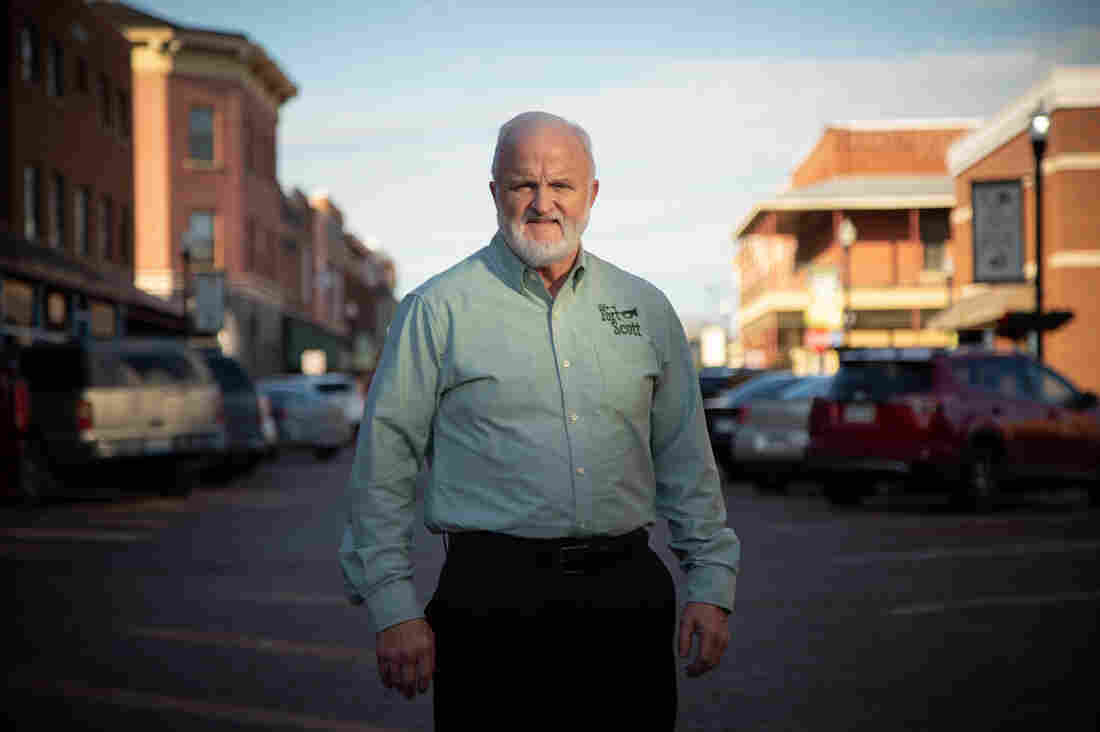
Fort Scott, Kan., City Manager Dave Martin stands in the middle of the city’s historical main street. “We really thought that we had a relationship,” says Martin, who is angry about Mercy’s decision to close the hospital.
Christopher Smith for Kaiser Health News
hide caption
toggle caption
Christopher Smith for Kaiser Health News
Relations between Mercy and the city grew so tense that officials needed attorneys just to talk to Mercy. In all, Fort Scott had spent more than $7,500 on Mercy Closure Project legal fees by the end of 2018, according to city records.
Will Fort Scott sink without Mercy?
When Darlene Doherty graduated from Fort Scott High School in 1962, there were two things to do in town: “Work at Mercy or work at Western Insurance.” The insurance company was sold in the 1980s, and the employer disappeared, along with nearly a thousand jobs.
Yet, even as the community’s population slowly declined, Martin and other community leaders have kept Fort Scott vibrant. There’s the new Smallville CrossFit studio, which Martin attends; a new microbrewery; two new gas stations; a Sleep Inn hotel, an assisted living center; and a Dairy Queen franchise. And the McDonald’s that opened in 2012 just completed renovation.
The town’s largest employer, Peerless Architectural Windows and Doors, which provides about 400 jobs, bought 25 more acres and plans to expand. There’s state state money promised to expand local highways, and Fort Scott has applied for federal grants to expand its airport.
Baker and some of the physicians on the Mercy hospital staff have been busy trying to ensure that essential health care services survive, too.
Baker found buyers for the hospital’s hospice, home health services and primary care clinics so they could continue operating.
Burke, the family doctor, signed on to be part of the Community Health Center of Southeast Kansas, a federally qualified nonprofit that is taking over four health clinics operated by Mercy Fort Scott. She will have to deliver babies in Pittsburg, nearly 30 miles away on a mostly two-lane highway that is under construction to widen it.
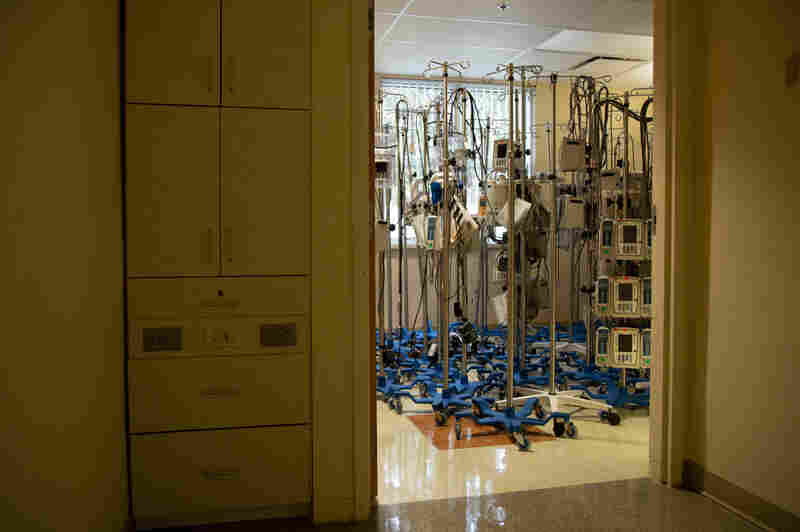
Unused hospital equipment is stored for shipment to other hospitals in the Mercy health system.
Christopher Smith for Kaiser Health News
hide caption
toggle caption
Christopher Smith for Kaiser Health News
Burke said her practice is full, and she wants her patients to be taken care of: “If we don’t do it, who’s going to?”
Mercy hospital donated its ambulances and transferred emergency medical staff to the county and city.
And, in a tense, last-minute save, Baker negotiated a two-year deal with Ascension Via Christi hospital in Pittsburg to operate the Fort Scott hospital’s emergency department — which was closed for two weeks in February before reopening under the new management.
But Baker knows that too may be just a patch. If no buyer is found, the facility will close by 2021.
Kaiser Health News is a nonprofit news service covering health issues. It is an editorially independent program of the Kaiser Family Foundation that is not affiliated with Kaiser Permanente.
States Sue Drugmakers Over Alleged Generic Price-Fixing Scheme

Jose A. Bernat Bacete/Getty Images
Connecticut Attorney General William Tong has a skin condition called rosacea, and he says he takes the antibiotic doxycycline once a day for it.
In 2013, the average market price of doxycycline rose from $20 to $1,829 a year later. That’s an increase of over 8,000%.
Tong alleges in a new lawsuit that this kind of price jump is part of an industry-wide conspiracy to fix prices.
The suit is a whopper — at least 43 states are suing 20 companies and the document is over 500 pages long. It was filed Friday in the U.S. District Court in Connecticut.
The lawsuit alleges that sometimes one company would decide to raise prices on a particular drug, and other companies would follow suit. Other times, companies would agree to divide up the market, rather than competing for market share by lowering prices.
It says these kind of activities have been happening for years, and that companies would avoid creating evidence by making these agreements on golf outings or during “girls nights outs” or over text message.
In several examples, the suit cites call logs between executives at different companies, showing a flurry of phone calls right before several companies would all raise prices in lockstep.
All of this, according to the lawsuit, resulted “in many billions of dollars of harm to the national economy.”







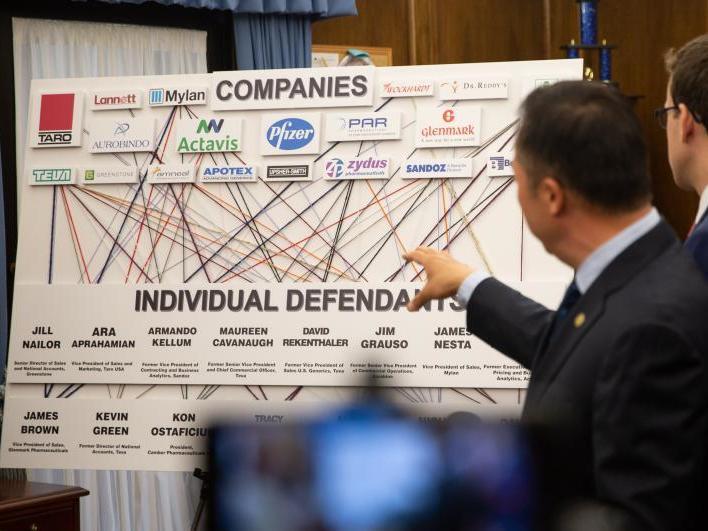
Connecticut Attorney General William Tong says the generic drug industry is profiting “in a highly illegal way” from Americans. Tong is at the forefront of a multi-state lawsuit filed May 10, which alleges companies worked together to set prices.
Frankie Grazian/Connecticut Public Radio
hide caption
toggle caption
Frankie Grazian/Connecticut Public Radio
Consumers don’t always notice when a generic drug’s price increases rapidly. People without insurance, of course, pay full price, but even people with insurance can feel the impact.
“More people than ever before are paying based on the price of the drugs,” explains Stacie Dusetzina, a professor at Vanderbilt University who studies drug pricing. Often, patients have to meet a deductible before their health plan’s coverage kicks in, so “they pay full price until they reach a certain level of spending, or they pay a percentage of the drug’s price — we call that a coinsurance.”
Surveys show more Americans are having trouble paying out-of-pocket medical costs. The average annual deductible in job-based health plans has quadrupled in the past 12 years and now averages $1,300.
But, Dusetzina says, even if you only pay a modest copay — such as $5 for every prescription you pick up — if your insurance company is paying more for prescription drugs, it can raise your health plan’s premiums the following year. “So ultimately these costs do get borne by the consumer in some way,” she says.
Dusetzina says what this lawsuit alleges is “very disappointing” — a situation in which consumers put up with the high price of branded drugs because of the implicit promise that a generic is coming some day and will eventually bring the price down.
But that outcome doesn’t happen automatically — it relies on healthy competition and market forces to work. If there’s only one generic version available, that drugmaker can set the price at pretty much the same level as the brand name.
“The higher the number of competitors, the more we see price reductions from the branded drug price,” she says. “So the magic number seems to be around four manufacturers.”
And that assumes those drugmakers aren’t talking to each other and agreeing to coordinate rather than compete.
The main drugmaker cited in the lawsuit is Teva, an Israeli company. In a statement, Kelley Dougherty, Vice President of Communications and Brand, Teva North America told NPR that the company is reviewing the allegations internally and that Teva “has not engaged in any conduct that would lead to civil or criminal liability.”
The company has also asserted that there’s nothing new here, and it’s true that the new lawsuit is similar to past lawsuits, though none of them included so many states as plaintiffs.
Connecticut Attorney General William Tong has emphasized that the investigation is ongoing, and given the amount of political appetite there is to bring drug prices down, there are certainly more lawsuits to come.
Transplants A Cheaper, Better Option For Undocumented Immigrants With Kidney Failure


In most states, undocumented immigrants with kidney failure have to receive dialysis as an emergency treatment in hospital emergency rooms. Some advocates say kidney transplants for undocumented immigrants would be a cheaper way to treat the problem.
JazzIRT/Getty Images
hide caption
toggle caption
JazzIRT/Getty Images
Uninsured, undocumented immigrants often go to the emergency room for treatment. Since 1986 the federal government has required that patients in the emergency room receive care, regardless of their immigration status or ability to pay.
But caring for chronic conditions such as kidney disease or cancer in the emergency room is expensive. So some states are quietly expanding access for undocumented immigrants to obtain medical treatment beyond the ER.
One of those states is Washington, where an undocumented immigrant named Gonzalo lives with his wife, Ricarda.
Gonzalo is really sick.
“I can’t enjoy the day — go out — because I’m always unwell,” he said in an interview in Spanish.
Gonzalo moved to the U.S. from Mexico about 30 years ago. He’s 60 years old. We’re not using his last name because of his immigration status.
Ten years ago, Gonzalo’s kidneys failed. Since then, he’s gotten sicker and sicker. Five years ago, he had to quit his job as a painter.
“I used to pay the rent. I paid for everything, and we didn’t lack anything,” he said. “But I got sick and everything changed.”
Now, Gonzalo and his wife live with one of their daughters in her apartment south of Seattle.
Across the country, there are about 6,500 undocumented immigrants with kidney failure, according to the National Institutes of Health. What kind of care they get depends on where they live.
In most states, they can only get dialysis in hospital emergency rooms.
That means, every couple of weeks, they go to the hospital when so many toxins have built up in their body it’s life-threatening. Usually, they have to stay overnight so they can be dialyzed twice. That costs nearly $300,000 per person every year.
So seven states, including Washington, have a different system.
“The state of Washington has something called AEM,” said Leah Haseley, a nephrologist — a kidney doctor — in Seattle. She’s talking about Alien Emergency Medical, part of Washington’s Medicaid.
“AEM pays for two things,” she explained. “They pay for dialysis for undocumented people, and they pay for chemotherapy for cancer treatment for undocumented people as well.”
Regular dialysis costs about a quarter of what emergency dialysis does — but it’s controversial.
“The first time that you show up at a hospital with kidney failure, that’s an emergency,” said Matthew O’Brien, with the Federation for American Immigration Reform, a group that advocates for stricter immigration laws. “After that, it’s a chronic condition, and we don’t believe that it’s appropriate to reward lawbreakers with benefits at the expense of U.S. taxpayers.”
But there are others who say even regularly scheduled dialysis isn’t enough: undocumented immigrants who qualify should be given kidney transplants, because the cost of a transplant is less than the ongoing costs of regular or emergency dialysis. But, without health insurance, few undocumented immigrants can afford a transplant.
In 2015, Illinois became the first state with a system for paying for organ transplants for undocumented immigrants.
Dr. David Ansell was a prominent advocate for the change.
“In about a year and a half the cost for a transplant pays itself back,” he said, “but also people can go back to work and contribute to the state.”
So far, more than 200 undocumented immigrants in Illinois have been given access to organ transplants, with their insurance premiums paid for by a non-profit. Now, Dr. Ansell and other public health advocates hope to see a similar program at the national level.
Many who oppose this say, with limited organs available, they should be reserved for citizens and legal immigrants.
But Dr. Ansell says, in Illinois, 75 percent of kidney transplants for undocumented immigrants come from donations from their own family — a much higher rate than the rest of the population.
“If you’re undocumented in Illinois, you can get a driver’s license, and disproportionately the Latino community is signing up to donate their organs,” Dr. Ansell added. “It’s a simple matter of ethics and fairness.”
He said, since Illinois started paying for the transplants, the total number of organs available has increased, because so many more Latinos have signed up for organ donation.
Overall in the US, studies have found that undocumented immigrants donate 2 to 3% of all organs.
Back in the Seattle area, Gonzalo says all three of his daughters are willing to give him a kidney, but he has no way to pay for the transplant.
That’s why his wife, Ricarda, says she’s taken to buying lottery tickets.
She said in Spanish, “I’ve told my husband, ‘If I win the lottery, I won’t think twice. I’m going to get you a kidney.'”
Not My Job: We Quiz Baseball Great Ozzie Smith On ‘The Wizard Of Oz’


St. Louis Cardinals shortstop Ozzie Smith waves to fans on Sept. 13, 1996.
Michael Caulfield/AP
hide caption
toggle caption
Michael Caulfield/AP
We recorded the show in St. Louis this week and invited former Cardinals shortstop Ozzie Smith to play our quiz. We’ll ask the Baseball Hall of Famer, known as “The Wizard” for his magical plays, to answer three questions about the 1939 movie The Wizard of Oz.
(SOUNDBITE OF MUSIC)
BILL KURTIS: From NPR and WBEZ Chicago, this is WAIT WAIT… DON’T TELL ME, the NPR news quiz.
(APPLAUSE)
KURTIS: I’m Bill Kurtis. We’re playing this week with Tom Bodett, Amy Dickinson and Brian Babylon. And here again is your host at the Fox Theatre in St. Louis, Mo…
(CHEERING)
KURTIS: …Peter Sagal.
PETER SAGAL, HOST:
Thank you, Bill. Hey, thanks, everybody. And listen, if you are just tuning in, and you’re like, oh, no, I missed it, or maybe you just want to hear it all again so you can pretend you haven’t and impress your friends by knowing all the answers, all you need to do is download the WAIT WAIT podcast. It’s the same show you love on the radio but with ads for mattress companies and stamps.
(LAUGHTER)
SAGAL: Right now, it is time to play the WAIT WAIT… DON’T TELL ME Bluff the Listener game. Call 1-888-WAIT-WAIT to play our games on the air. Hi, you are on WAIT WAIT… DON’T TELL ME.
EBEN ATWATER: Hi. I’m Eben Atwater. I’m from Lummi Bay, Wash.
SAGAL: Eben from Lummi Bay, Wash.
ATWATER: Well, the – I think they had a girl’s name figured out but not a guy’s name figured out, and I got stuck with the family name.
SAGAL: Do you know what the girl’s name was?
AMY DICKINSON: (Laughter).
ATWATER: Yeah, it was Emily.
SAGAL: Let me ask you a question – given what you’ve been through, would you have preferred to be named Emily?
(LAUGHTER)
ATWATER: I’d roll with it.
SAGAL: All right. You could go with it. Well, welcome to the show, Eben. You are here to play our game in which you must try to tell truth from fiction. Bill, what’s Eben’s topic?
KURTIS: I’m your biggest fan.
SAGAL: Celebrities have long found fans the traditional ways, like press tours and purchasing Twitter followers from a Chinese bot farm. But this week, we heard about a new way that a fan found the person or people they’re fans of. Our panelists are going to tell you about it. Pick the one who’s telling the truth – you’ll win the WAIT WAITer of your choice on your voicemail. You ready to play?
ATWATER: Let’s do it.
SAGAL: All right. First, let’s hear from Tom Bodett.
TOM BODETT: The lyrics to “A Horse With No Name” blew my mind, said Blollapalooza organizer Mason Ford (ph). Ford, who is 16 years old, discovered early ’70s soft rock bands like America and Bread when his dad erased his Spotify playlist of hip-hop favorites and replaced it with what he thought would be the genre from hell. I couldn’t stand the F words and (unintelligible) emanating from his room and earbuds another day, said the elder Ford. I wanted to punish him with some “Diamond Girl” and “Muskrat Love.”
(LAUGHTER)
BODETT: I thought he needed to understand what obnoxious feels like. Instead, he loves it. What I realized, explained Ford the younger, is that hip-hop is not chill music. All me and my friends want to do is chill and hang out. This weird sound is so chill, it almost doesn’t make sense. I mean, baby, Imma (ph) want you?
DICKINSON: (Laughter).
BODETT: Who says that?
(LAUGHTER)
BODETT: And with that googly sounding guitar thing in the background, it’s sick. I love it. After two or three songs, you can’t move.
(LAUGHTER)
BODETT: The Blollapalooza will be no Fyre Fest, promises Ford, referring to the famous concert fail of last summer. It’s more of a warming drawer fest. Surviving members of America, along with Dan Fogelberg, will headline the event to be held this August in a closed Walmart parking lot in Springfield, Iowa. Father Ford will not be attending. I lived through the ’70s once, he said. A day of this might kill me.
(LAUGHTER)
SAGAL: A young man…
(APPLAUSE)
SAGAL: …Becomes a fan of ’70s soft rock through a cruel prank from his father. Your next story of a celeb making new fans comes from Brian Babylon.
BRIAN BABYLON: UPenn volleyball player Elizabeth Watty (ph) was running late for practice in Philly. The pressure was on because she had to park her 1964 Pontiac GTO – a hand-me-down from her grandpa – into a parking space barely big enough for an enormous land yacht. I hate this car, said Watty. As soon as I land my pro beach volleyball contract, I’m buying myself a Honda Fit. She tried eight times, each time scraping or bumping the car in front of her and going up on the curb. With drivers behind her honking their horns and complaining, finally, she was ready to give up and keep driving. But then, a gentleman appeared in her window and said, may I assist? She was very angry about this implied sexism but got out and let him in.
(LAUGHTER)
BABYLON: And the most amazing display of driving happened. He hopped in. And in the most amazing display of driving she had ever seen, he whipped that 20 feet of Detroit steel into a parking space with just a few turns of the wheel. She wrote his name down to send him a nice thank-you note. And then when she showed the name to her teammate, the teammate said, Jimmie Johnson, the NASCAR driver.
(LAUGHTER)
BABYLON: No, said Elizabeth. I think he had a Toyota car of some kind. But it was No. 48 himself, seven-time NASCAR champion, who was in town for a personal appearance. Elizabeth, of course, had to watch him race and instantly became a fan. He’s just so confident, so tactical on the track, she says.
(LAUGHTER)
BABYLON: And if you think he’s good at racing, you should see him park.
(APPLAUSE)
SAGAL: A NASCAR fan is made when Jimmie Johnson, himself, steps in to park her car. Your last story of a famous person convincing someone to like them comes from Amy Dickinson.
DICKINSON: When they heard that Lyle Lovett, their favorite singer, was coming to Austin, 17 women from three generations of one big Texas family decided to call it a Girls Gone Wild Weekend. The Lovett love is mighty strong in the Walker clan. So Belinda from El Paso rallied her gal pals from all over the country – sisters, cousins, her mother and even her 85-year-old grandmother – and told them (imitating Southern accent) pack up your spangly cowboy boots and send Bota Boxes of chardonnay, ladies, because we’re going to see Lyle Lovett. Whoo (ph).
(CHEERING)
DICKINSON: The concert tickets got bought. The event was coming up when Walker sister figured out that the Lovett coming to Austin was not the Texas native and rectangle-faced, Grammy Award-winning singer Lyle Lovett. No, this Lovett was Jon Ira Lovett of Connecticut, a former Obama speechwriter, bringing his…
(LAUGHTER)
DICKINSON: …Popular progressive politics podcast “Lovett Or Leave It” to Austin for a live taping.
(LAUGHTER)
DICKINSON: The Lyle Lovett-loving ladies decided to go ahead with their Girls Gone Wild Weekend.
(LAUGHTER)
DICKINSON: It turns out having to watch a politics lecture from a guy who can’t sing and was never even briefly married to Julia Roberts…
(LAUGHTER)
DICKINSON: …Was just about right for these girls gone mild.
(LAUGHTER)
SAGAL: All right, so here are your choices. Somebody made a fan in an unusual way. Was it from Tom Bodett – ’70s soft rockers get a fan when a kid is punked by his own father who switched his playlist? Was it from Brian Babylon – Jimmie Johnson created one new NASCAR fan when he graciously parked her car for her? Or from Amy Dickinson – the political pundit and podcaster Jon Lovett got a whole bunch of Texas women to come see him because they thought he was Lyle Lovett. Which of these is the real story of an unexpected meeting of fan and idol in the news?
ATWATER: (Imitating Southern accent) Well, I’ll tell you what…
(LAUGHTER)
ATWATER: …I lived for 12 years in Texas, and there ain’t no way on God’s green Earth I’m picking any other story but that one.
DICKINSON: Oh.
SAGAL: You’re going to pick, then, Amy’s story…
(LAUGHTER)
SAGAL: …Of the 17 women who went to see Lyle Lovett and ended up hearing some interesting political comedy from Jon Lovett.
ATWATER: Got to be it.
SAGAL: All right. Well, we actually spoke to one of the fans in question.
BELINDA WALKER: One of my cousin’s looked, and it said Jon Lovett. And my sister’s like, no, no, no, I got Lyle Lovett tickets. And we’re like, oh, my God, it is the wrong one. What are we going to do? What are we going to do?
(APPLAUSE)
SAGAL: That was Belinda Walker. Practically an entire female side of the family went to see Lyle Lovett and got Jon instead. It’s OK. They like him. Congratulations. You got it right, Eben. You have won our prize by picking Amy’s story.
(CHEERING)
SAGAL: And you’ve won a prize for her. Well done, sir.
ATWATER: Hey, thanks a lot. That was great.
SAGAL: Bye-bye.
(SOUNDBITE OF MUSIC)
Copyright © 2019 NPR. All rights reserved. Visit our website terms of use and permissions pages at www.npr.org for further information.
NPR transcripts are created on a rush deadline by Verb8tm, Inc., an NPR contractor, and produced using a proprietary transcription process developed with NPR. This text may not be in its final form and may be updated or revised in the future. Accuracy and availability may vary. The authoritative record of NPR’s programming is the audio record.
Cuban Diva Omara Portuondo Feels As Strong As Ever On ‘Last Kiss’ World Tour


Omara Portuondo may be on her “Last Kiss” Tour, but the Cuban music matriarch says she plans to keep performing for as long as possible.
Johann Sauty/Courtesy of the artist
hide caption
toggle caption
Johann Sauty/Courtesy of the artist
In 1996, Omara Portuondo was working on an album at Havana’s famous recording studio, Egrem. Upstairs, American musician Ry Cooder was laying down tracks for Buena Vista Social Club, a project with veteran Cuban musicians like Compay Segundo. Portuondo was invited to come up and sing a duet with him. They sang “Veinte Anos,” a song Portuondo learned as a child.
“Without rehearsal, this was a live recording. One take. It’s unbelievable,” says Cuban bandleader Juan de Marcos Gonzalez. He had scouted and rediscovered the older musicians for Buena Vista Social Club. But he says Portuondo was still a star on the island, and bringing her into the project was a dream.
“I remember that once, Mr. Ry Cooder told me, ‘Omara is the Cuban Sarah Vaughan.’ And I said to him, ‘No, Sarah Vaughan was the American Omara Portuondo,'” Gonzalez says.
NPR met up with the legend herself at a downtown Los Angeles hotel the day she began her latest world tour, deemed “The Last Kiss.” Now 88 years old, Portunodo sometimes sings answers to questions about her long career.
“Por eso, yo soy Cubana, y me muero siendo Cubana,” she sings: “I’m Cuban, and I’ll die Cuban.”
Portuondo’s first gig for her latest world tour was at LA’s Regent Theater. Even though she was sitting, she had the audience clapping, dancing and singing along.
“Omara is the most important singer of our culture,” Cuban pianist Roberto Fonseca, who performs with Portuondo on the tour, says. “She’s able to do any Afro-Cuban style, Latin jazz, jazz, boleros, traditional Cuban music, rumba. She’s magical, intense, pure, strong.The audience … the public … they are crying, smiling, dancing. All the time, she’s making jokes.”
“Yes, she’s flirting with the audience the whole time,” Alicia Adams, international program director for the John F. Kennedy Center for the Performing Arts in Washington, D.C. says. Adams brought Portuondo to the center’s Cuban Arts Festival last year, and recalls seeing the singer peak out from beneath the curtain to wave to her fans. Adams says as relations between Cuba and the U.S. have morphed over the decades, Portuondo has always been a cultural ambassador.
“She spans before the revolution and after the revolution,” Adams says. “From before, when there was much more ability to go back and forth, until later years, after the revolution, when things were not so easy in terms of that kind of travel.”
Unlike some other Cuban musicians — including her sister Haydee and her old friend, the late Celia Cruz — Portuondo chose not to defect to the U.S. She says she comes and goes from her home in Cuba as she likes, pretty much like her father, Bartolo Portuondo, did. He’d been a black professional infielder for both the Cuban League and the Negro Leagues in the U.S. Portuondo says that he was a great baseball player and that her mother, who was white, scandalized her upper-class family by marrying him.
When she was a little girl, Portuondo dreamed of being a ballet dancer. But she says in those days, you could only dance ballet if you were white. Instead, she and Haydee danced and sang at Havana’s famous Tropicana. Later, in 1945, the sisters formed a quartet with two other women, Elena Burke and Moraima Secada (the aunt of singer Jon Secada’s.) The Cuarteto D’Aida danced and sang in nightclubs and on television. The quartet even backed Nat King Cole when he performed in Havana.
Portuondo sang with the quartet for 15 years before launching a solo career in 1963. Since then, she’s sung with everyone from Pablo Milanes and Chucho Valdes to Los Van Van and reggaetoners Yomil Y el Dany. She even sang in the 2009 Spanish version of Disney’s The Princess and the Frog. For years, Portuondo was associated with Cuba’s movimiento filin — the feeling movement that celebrates singers who interpret lyrics with great emotion.
Portuondo remained a star in Cuba, but it was the Buena Vista Social Club that introduced her to an even bigger audience in the U.S. and around the world. Audiences wept for her duets with Ibrahim Ferrer, who Portuondo sang with in the 1950’s. He’d been long-forgotten until the Buena Vista Social Club. The group’s first album won a Grammy award in 1998. And an Oscar-nominated documentary by Wim Wenders chronicled the group’s journey from Cuba to an historic concert at Carnegie Hall.
Portuondo never stopped recording or performing. Gonzalez says for many years, Portuondo also sang with his band, the Afro-Cuban All Stars. As for this tour being her “last kiss”? Gonzalez says that’s just marketing ploy . “She’s going to die on the stage. That’s what she wants,” he says. “She’s the Cuban diva.”
And Portuondo agrees. “Despedida? No.” This is not goodbye, Portuondo says as she breaks into song: “Lo que me queda por vivir será en sonrisas“: “What I have left to live for is smiles,” she sings, adding “Me queda tiempo todavia,“: “I still have time.”
Saturday Sports: Red Sox At White House, NHL, NBA Playoffs

NPR’s Scott Simon and Howard Bryant of ESPN talk NBA and NHL playoffs, as well as discuss the politics of team celebrations at the White House.
SCOTT SIMON, HOST:
Abracadabra – sports.
(SOUNDBITE OF MUSIC)
SIMON: The world-champion Boston Red Sox visited the White House this week – well, half of them anyway – hockey down to its final four. And we’ve nearly reached the conference finals of the NBA playoffs. Howard Bryant of ESPN joins us. Howard, thanks for being with us.
HOWARD BRYANT, BYLINE: Good morning, Scott.
SIMON: One more week I guess I can say – if not more than one – fear the deer…
BRYANT: (Laughter).
SIMON: …Because the Milwaukee Bucks are already in the Eastern Conference finals after sweeping the Celtics under the rugs. Golden State finished off Houston last night for the – what? – fourth time in five years. And now, of course, two Game 7s scheduled for Sunday. What are we seeing that surprised you?
BRYANT: Well, the thing that surprised you is – more than anything else is the Boston Celtics come out, and they beat Milwaukee by 20 in Game 1 and then lose four straight. Milwaukee’s a great team. It’s going to be fun to see what they do. Yeah. I really think that Warriors-Bucks would be an amazing final, considering that they were the two best teams in the league this year. Of course, what Golden State did last night is incredible. You have Kevin Durant go out in Game 5. He gets hurt. You’re expecting Houston to at least get this game at home, bring it back to a Game 7. And then, of course, let’s not forget. You still have Steph Curry, two-time MVP. You have Klay Thompson, one of the greatest shooters who ever played the game.
SIMON: Yeah.
BRYANT: Steph Curry has no points and three fouls at halftime and ends up going for 33 in the second half. And it was just a demoralizing defeat for the Houston Rockets. But once again, this is a championship-level team. This is one of the – one of those teams, like the Bruce Bochy Giants or the Red Sox in the 2000s or the Joe Torre Yankees. You know, don’t – you can’t kill them. You have to actually beat them. You leave the door open. And they’re going to come back and do what they did last night – incredible, incredible performance.
SIMON: James Harden is so great. Houston is so great. They can’t beat the Warriors. Who can? Can the Bucks?
BRYANT: Yeah. I think the Bucks can. I think that it’s a believe-it-when-I-see-it thing for me, watching the Warriors. But there were moments where a tougher team could have beaten them. But once again, this is – it was like watching the Patriots in the Super Bowl where you’re looking at them going OK. This is the year where they die. This is the year where you beat them. This is the year. And then their championship players come up with performances. You have to – you know, this is what separates them. This is why we watch these guys. This is why some of these players are so special. They’ve got it. The other guys don’t when – you know, when the moments are on the line.
SIMON: Interesting storylines in the NHL. So you have the St. Louis Blues and the San Jose Sharks. And then the Bruins play the Carolina Hurricanes. Who do you see in the finals?
BRYANT: Well, I kind of like San Jose and Boston simply because I like the storyline of Joe Thornton – overall, you know, No. 1 pick for the Bruins, drafted by the Bruins, expected to be the next great Bruin, ends up going to San Jose. And to have him end his career playing for a championship against his former team is pretty good. Carolina’s a good team. And, you know, they blew Game 1 against the Bruins. They had it. And they…
SIMON: Yeah.
BRYANT: They played a really bad third period. St. Louis really, really tough team – I think that it wouldn’t be surprising any of the combinations. But I kind of like Boston and San Jose.
SIMON: About half the Boston Red Sox visited the White House this week. What did we learn from the half that went and the half that didn’t?
BRYANT: Well, I think what we learned, one, is that, you know, it’s the same sort of combination that you have across the country. You know, the half – you know, the white players went. The players of color didn’t go. The manager Alex Cora didn’t go. I think that…
SIMON: Saying specifically it was…
BRYANT: Specifically.
SIMON: …His dissatisfaction with administration policy in Puerto Rico.
BRYANT: Absolutely. And I think that David Price and Mookie Betts, the reigning MVP, said similar comments about not wanting to go. I think that the Boston Red Sox made a terrible mistake. I think they made a horrible mistake in terms of leadership by saying that there’s no racial divide on the team. Clearly, there is. There’s a racial divide in the country. And I think that people keep saying we want dialogue. We want dialogue. You had an opportunity for a dialogue here.
I don’t blame the white players for going to the White House. I don’t blame anybody for going to the White House in terms of the – how many citizens get to go to the White House by invitation? So I understand that. But I also understand that you cannot avoid what’s taken place in the country. And I think the Red Sox blew it, to be honest.
SIMON: Howard Bryant of ESPN, thanks so much for being with us. Talk to you soon.
BRYANT: Thank you.
(SOUNDBITE OF TRAVIS SCOTT SONG, “GOOSEBUMPS”)
Copyright © 2019 NPR. All rights reserved. Visit our website terms of use and permissions pages at www.npr.org for further information.
NPR transcripts are created on a rush deadline by Verb8tm, Inc., an NPR contractor, and produced using a proprietary transcription process developed with NPR. This text may not be in its final form and may be updated or revised in the future. Accuracy and availability may vary. The authoritative record of NPR’s programming is the audio record.
Which W: Walgreens Or Washington?
The logo for the Washington Nationals baseball team might look familiar even if you don’t follow the team. Especially if you shop at Walgreens.
SCOTT SIMON, HOST:
If you’ve been to Washington, D.C., you might’ve noticed people wearing what appears to be Walgreens hats. Well, not really. The city’s baseball team, the Washington Nationals, has a curly W logo that’s remarkably similar to the drugstore chain’s. And as Ally Schweitzer from member station WAMU discovered after a visit to Nationals Park, the trademark is still causing confusion 14 years after the team rolled it out.
UNIDENTIFIED PERSON: Ice cold water, $2.
ALLY SCHWEITZER, BYLINE: I’m outside the ballpark in D.C. asking game goers if they can distinguish between the Nationals logo and the Walgreens logo. I thought, if anyone could tell the difference, it would be Nationals fans. Turns out, I was wrong. I showed Northern Virginia resident Sean Barnett the logos side by side.
Can you tell what this is?
SEAN BARNETT: Washington Nationals.
SCHWEITZER: No.
BARNETT: No.
SCHWEITZER: That’s the Washington Nationals. What is this?
BARNETT: Oh, is that Walgreens?
SCHWEITZER: Yes.
BARNETT: Oh, very close.
SCHWEITZER: Most fans I spoke to correctly identified the logos, but Barnett was among several who did not. When my colleague Sasha-Ann Simons asked Washingtonian Rich Jensen which one was which, he was also stumped.
RICH JENSEN: I can tell that one is for Walgreens and one is for the Nationals, but I couldn’t tell you which is which.
SASHA-ANN SIMONS, BYLINE: And you say this as you’re wearing a Nationals cap on your head. I love this.
JENSEN: Yeah, well, can I take it off and look?
SIMONS: (Laughter).
JENSEN: No. No.
SIMONS: No, you can’t.
JENSEN: OK.
SCHWEITZER: The logo similarity has been a running joke among baseball fans ever since the team arrived in D.C. in 2005 and adopted the vintage W logo used by long-gone D.C. baseball team, the Washington Senators. Todd Radom knows this history well. He’s the guy who recast the Senators’ logo for Major League Baseball.
TODD RADOM: It is a remarkably similar curly W.
SCHWEITZER: Radom has designed thousands of sports logos during his career, but he says the one for the Nats is trickier than others out there.
RADOM: Boston Red Sox are two socks. The Philadelphia Eagles have an eagle. The word national really didn’t lend itself to easy identification.
SCHWEITZER: So the decision was made to go with a word or a letter. And the chosen letter was the Senators’ W, which happened to look a lot like the W Walgreens has used since at least the 1950s. And Walgreens never sued. That might seem surprising considering the drugstore chain filed a suit against grocer Wegmans over its W logo back in 2010. Wegmans later settled and stopped using the W. Neither Walgreens nor Major League Baseball agreed to comment for this story. So I turned to Ross Kimbarovsky. He’s a former intellectual property attorney. He said he’s not surprised Walgreens hasn’t gone after Major League Baseball for a trademark violation because Walgreens the corporation, he says, isn’t easily mistaken for a baseball team.
ROSS KIMBAROVSKY: It would be unfair at this point for them to be able to point a finger and say people are confused because what’s been happening over the many, many decades there hasn’t been any evidence of confusion.
SCHWEITZER: Kimbarovsky, who founded the logo company Crowdspring, says people probably aren’t walking into Nationals Park looking to refill prescriptions. So back outside the stadium, I asked self-identified D.C. native Tye Ali if he’s ever thought people would confuse the Nationals cap he’s currently wearing for a Walgreens cap.
TYE ALI: No. No, everybody knows this is a Nationals hat (laughter). But then I don’t know. It might be a Walgreens.
SCHWEITZER: It’s not.
ALI: (Laughter).
SCHWEITZER: For diehard fans in D.C., the Walgreens’ curly W and the Nationals’ curly W aren’t even in the same ballpark.
For NPR News, I’m Ally Schweitzer in Washington.
Copyright © 2019 NPR. All rights reserved. Visit our website terms of use and permissions pages at www.npr.org for further information.
NPR transcripts are created on a rush deadline by Verb8tm, Inc., an NPR contractor, and produced using a proprietary transcription process developed with NPR. This text may not be in its final form and may be updated or revised in the future. Accuracy and availability may vary. The authoritative record of NPR’s programming is the audio record.