Not Just Child’s Play: World Tiddlywink Champions Look To Reclaim Their Glory

A tiddlywinks game mid-play, with winks spread out around the pot. Though players eventually want to “pot” their “winks,” players also strategize how to block their opponents by landing their piece on top of another’s piece.
Claire Harbage/NPR
hide caption
toggle caption
Claire Harbage/NPR
In 1995, Sports Illustrated likened Larry Kahn and David Lockwood to the Muhammad Ali and Joe Frazier of Tiddlywinks. A fearsome metaphor for two men who, in the parlance of their game, spend their time squopping and potting, rather than bobbing and weaving.
Kahn has won 114 national and world Tiddlywinks titles. Lockwood has won 41. “Larry is the Ali,” Lockwood concedes.
But their rivalry is a friendly one, and when they’re not competing against one another, they make a formidable pair. As a duo, they’ve won five international titles together.
On Friday, they’ll look to snap a 21-year drought when they try for their sixth title together at the annual Tiddlywinks World Championships at the University of Cambridge.

Larry Kahn (left) and Dave Lockwood, practice tiddlywinks. The game has a startlingly simple premise for a game that draws an academic fandom.
Claire Harbage/NPR
hide caption
toggle caption
Claire Harbage/NPR
On a recent afternoon in a simply remodeled basement located in the Virginia suburbs, Lockwood paces the perimeter of a regulation 6-by-3-foot table in gym socks and red track pants, calculating his best move.
Colorful, dime-sized discs, or winks, dot the felt-matted surface. In the center lies a traditional plastic red cup no bigger than a shot glass. Kahn, wearing Tevas over his socks, is playing in shorts, as usual, lest he gets too warm circling the tabletop.

Credit: Claire Harbage/NPR
Tiddlywinks has a startlingly simple premise: Shoot the most winks into the cup. For all its academic fandom, the very name of the game and its companion slang evokes the lexicon of a nursery rhyme. But Lockwood is quick to blast the game’s reputation as a bygone children’s pastime.
“Tiddlywinks is not what you did when you were 5 years old,” he says. “Tournament tiddlywinks is a fascinating combination of physical skill at a micro level and positional strategy.”

Larry Kahn (left) and Dave Lockwood are both friends and competitors.
Claire Harbage/NPR
hide caption
toggle caption
Claire Harbage/NPR
What began as a 19th century adult parlor game in England, first patented in 1888, reemerged in university circles across the United Kingdom and the United States as a tournament game held at Cambridge University in 1955.
Over time, professional winkers, largely recruited from Cambridge, Oxford and the Massachusetts Institute of Technology, helped heighten its complexity and strategy.
Probability, physics and dexterity rule the game.
Offensively, potting — or sinking a wink in the cup — depends on how much pressure a player exerts on the squidger, a larger disc used to flick smaller discs, or winks, into the cup. To gauge your potting chances, competitors know that pressure equals distance, Lockwood explains.

Trophies collected from tiddlywinks competitions over the years.
Claire Harbage/NPR
hide caption
toggle caption
Claire Harbage/NPR
To keep opponents from scoring, players use their winks for another purpose: squopping. Translation: they flick their winks on top of their opponent’s discs to effectively take them out of play.
“You need to defend the ones that you’ve got and/or attack the ones that they’ve got,” Lockwood explains.
These days, there’s hardly a market for the niche sport. Several companies don’t even make the equipment anymore.
So committed winkers have had to get creative. Lockwood and Kahn have procured orthopedic felt for their playing surface. They make their own squidgers by sanding down plastic discs molded from spice jar lids. They’re banking on 3-D printing becoming more affordable in the near future to help streamline the process.
It’s not something they could have imagined when they started playing Tiddlywinks during their freshman year at MIT, when Kahn and Lockwood each signed themselves up on a whim. Kahn thought the game sounded fun to learn. Lockwood checked “Tiddlywinks” as a joke, he says, after perusing the list of activities offered in the student handbook.
“I was the last person to make the eight-player team in 1972,” he says.
Dave Lockwood plays tiddlywinks.

Credit: Claire Harbage/NPR
Larry Kahn has won 114 national and world titles.

Credit: Claire Harbage/NPR
Today, Lockwood says the game has changed his life. “I’ve been to Britain more than 100 times since then, mostly to play Tiddlywinks.”
It’s a sentiment shared by Kahn, who says the game has “enriched my life.”
Kahn and Lockwood both say that one of the best parts of belonging to the winking community has been the friendships they’ve gained.
“Immediately you have a bond with people I’ve never met and it’s continued on, through today. For whatever reason, the game has sort of kept people together to some extent.”

Kahn crafts his own squidgers from pieces of plastic.
Claire Harbage/NPR
hide caption
toggle caption
Claire Harbage/NPR
Of course, when talk turns to this week’s tournament, they turn less sentimental.
“It’d be nice to you know, as old as we are compared to the other players, be able to to go in and win a match,” Kahn says. “To show the old guys can still do it.”
Lockwood is blunter. “I really want this,” he says. For him, the victories are addicting.
“If you get a modicum of success, you’re more frequently willing to continue to play, but it’s also a very frustrating game because you miss these things that you’ve made so many times in the past,” he says.
“But only the past is certain.”
For Mongolia’s Ice Shooters, Warmer Winters Mean A Shorter Sports Season

A group of Mongolian herdsmen gathers to play musun shagai (ice shooting) on the Tamir river in early March.
Claire Harbage/NPR
hide caption
toggle caption
Claire Harbage/NPR
On a bright Sunday afternoon in early March, the Tamir River in the steppes of Mongola becomes a bowling alley. Two dozen Mongolian herdsmen have gathered to play musun shagai, known as “ice shooting.” Right now, the ice on the river is perfect. Clear and smooth. The players are cheerful and focused.
Their goal? To send a small copper puck called a zakh down a 93-yard stretch of ice and knock over several cow ankle bones, painted red, none bigger than a golf ball, at the other end. Extra points for hitting the biggest target, made of cow skin.

Left: Cow bones and a ball made of cow skin, the targets of the puck, are clustered together during a break in the game. Right: A man demonstrates how to hold a zahk, the copper puck that is slid down the ice to hit the targets.
Claire Harbage/NPR
hide caption
toggle caption
Claire Harbage/NPR
Together, the targets form a line of tiny red dots that are difficult to see, let alone hit. When that happens, players know because the spectators raise a boisterous cheer.
“You have to spin it,” says Gurvantamir Jamts, 47, a newcomer to the game. He is the mayor of Tsetserleg, the capital of Arkhangai province, where musun shagai was invented.
He cradles a copper puck between his thumb, index and middle fingers. He shakes it. Metal balls rattle inside. Thrown properly, the puck glides forward with the sound of an ice-skating blade on a freshly resurfaced rink.

A competitor looks back at the crowd of spectators after sending his zakh down the ice toward the targets and the scorekeepers who stand behind them.
Claire Harbage/NPR
hide caption
toggle caption
Claire Harbage/NPR

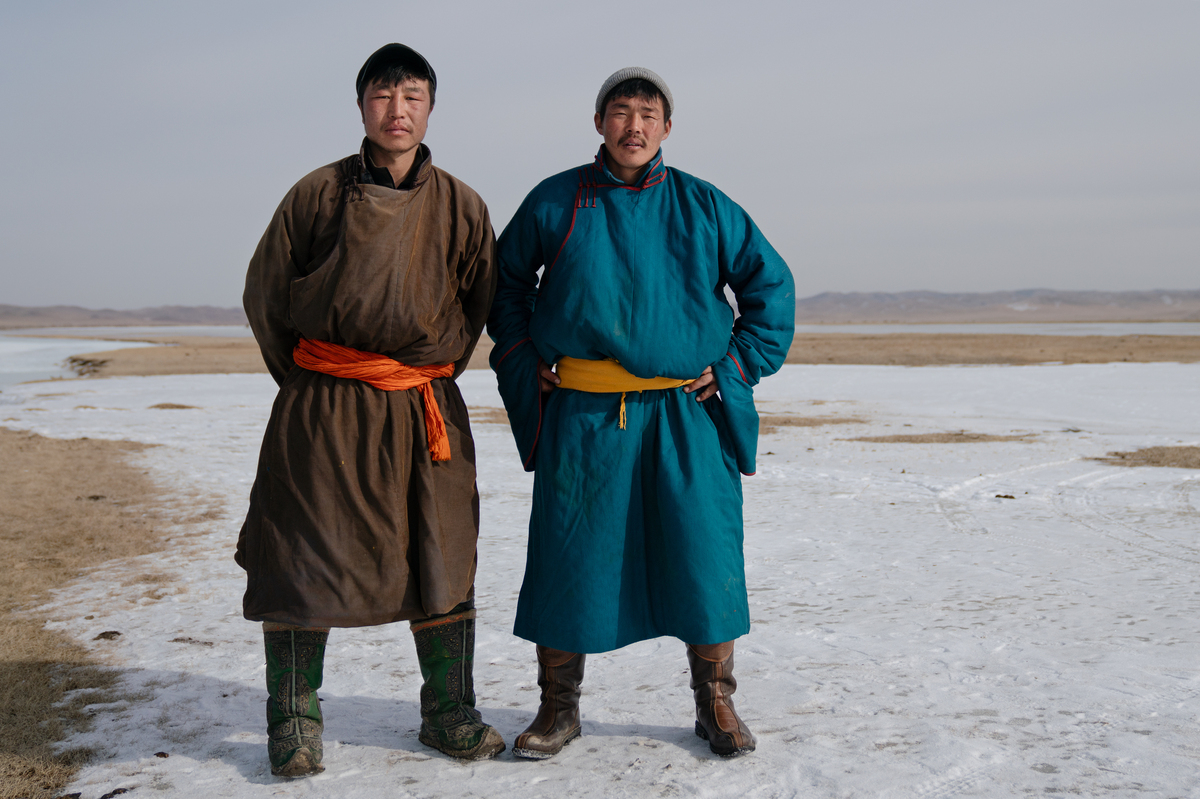
Ice shooting players Ser-od Dechingalav, 30 (right), and Enkhbaatar Batdelger, 30, won the partner contest.
Claire Harbage/NPR
hide caption
toggle caption
Claire Harbage/NPR

Cars and motorcycles draped with fur line the banks of the Tamir river as players gather for the season’s final ice shooting competition in early March.
Claire Harbage/NPR
hide caption
toggle caption
Claire Harbage/NPR
“The main technique,” Gurvantamir says, “is how you hold it.”

Newcomers to the game can struggle to keep their balance on the ice. But with experience comes grace. Many competitors slide forward as they release the puck, called a zakh, all in one motion.
Claire Harbage/NPR
hide caption
toggle caption
Claire Harbage/NPR
And how you release it. The players assume a static lunge, digging their back feet into a tiny divet in the ice. They release their zakhs with a throw, and a hopeful look. All squint down the river to see if a red target was hit.

Top: Competitors watch their opponents play. Bottom left: In the partner competition, players work in teams of two. The scorekeeper keeps track of points by drawing a Buddhist temple, line by line. The team with the most complete temple wins. Bottom right: Gurvantamir Jamts keeps his zakh in a leather belt, strapped around his gray deel, a traditional Mongolian overcoat.
Claire Harbage/NPR
hide caption
toggle caption
Claire Harbage/NPR
Musun shagai is a homegrown game, created in the 19th century as a way to pass the time. This is the final game of the season before the river melts, the last opportunity to wile away the winter hours before the mayhem of spring, when the goats, sheep, horses and cows give birth.
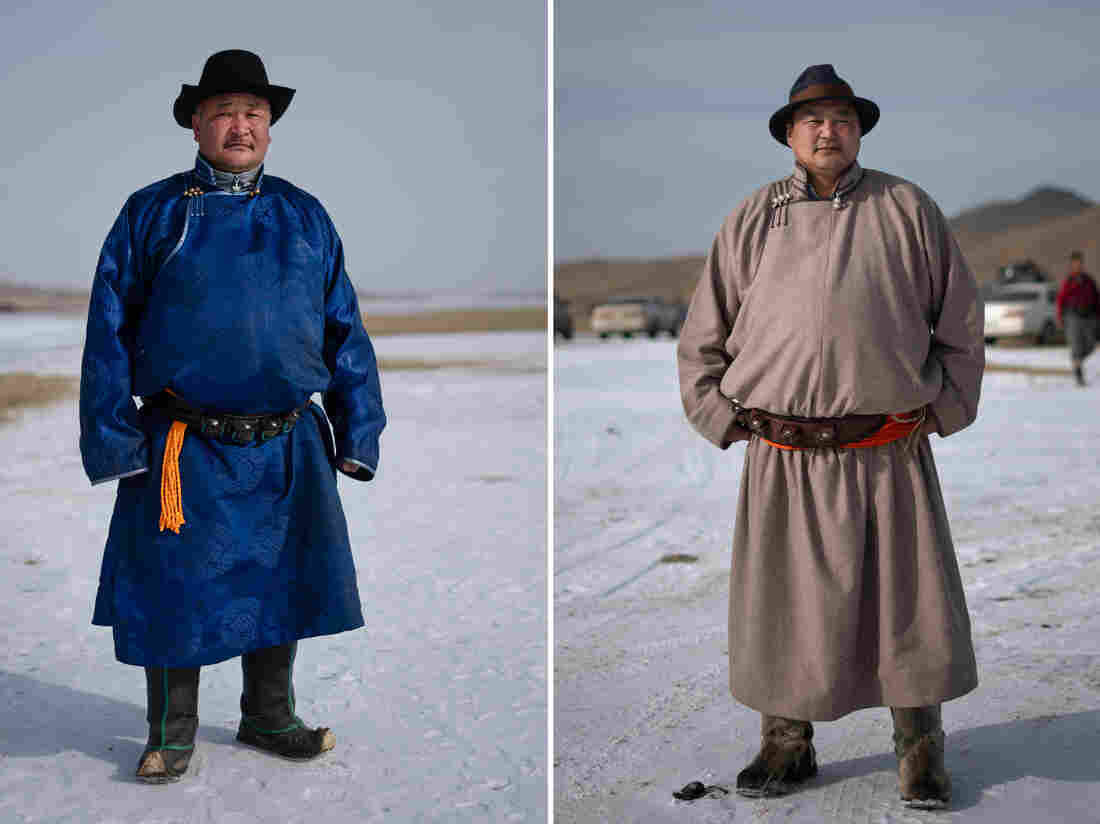
Left: Burenbat Dorj, 44, plays a dozen times every winter. He is the governor of Erdenebulgan Soum, the local community hosting the competition. Right: Gurvantamir Jamts, 47, is new to the game and proud of its local roots in Arkhangai province. He is the mayor of Arkhangai’s capital, Tsetserleg.
Claire Harbage/NPR
hide caption
toggle caption
Claire Harbage/NPR
Only men play ice shooting competitively, though the event brings whole families together. Children scuttle around the ice in their boots, bundled up for the 20-degree weather. One group of teenagers cobbles together their own game, using a flat rock to topple over food packages, practicing their technique.
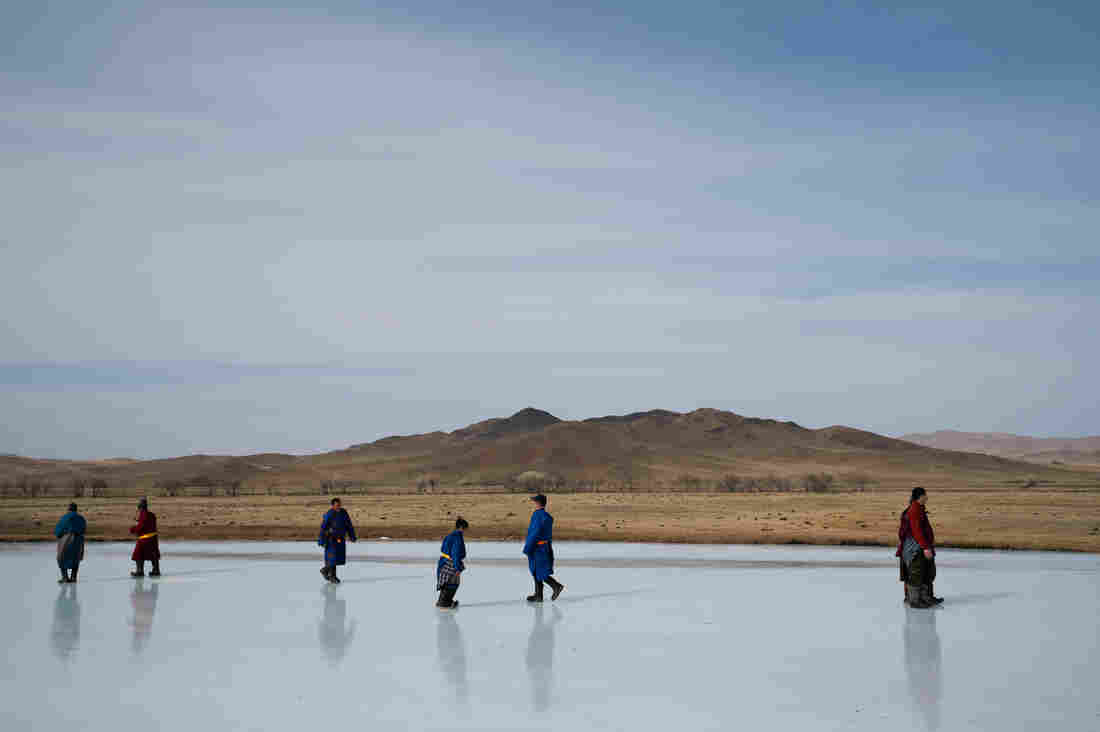
People tread carefully on the smooth ice. The competition, originally scheduled for mid-March, was bumped up by two weeks because the river had begun to show early signs of melting.
Claire Harbage/NPR
hide caption
toggle caption
Claire Harbage/NPR
This competition, originally scheduled for mid-March, was bumped up by two weeks. “The river was already melting,” Gurvantamir said.
The frozen surfaces that makes this game possible are harder to come by in a warming world. According to data from Mongolia’s Institute for Meteorology, Hydrology and Environment, the country’s annual mean temperature has increased by 2.2 degrees Celsius (nearly 4 degrees Fahrenheit) since data collection began in 1940. (The global temperature increase since 1880 has been 0.8 degrees Celsius or 1.4 degrees Fahrenheit).
When the musun shagai competition ends, bowls of vodka are passed around. The local government even brought medals for the winners. They were made of clear plastic. Mayor Gurvantamir held them up, demonstrating how the sunlight glinted through — just like ice.
Emily Kwong (@emilykwong1234) spent nine weeks reporting in Mongolia as NPR’s Above the Fray fellow. The fellowship is sponsored by the John Alexander Project, which supports foreign reporting in undercovered parts of the world.
Soccer Star Abby Wambach Turns Rallying Commencement Speech Into New Book, ‘Wolfpack’

NPR’s Sacha Pfeiffer speaks with retired Olympic soccer star Abby Wambach about her new book, Wolfpack: How to Come Together, Unleash our Power, and Change the Game
Amid Rural Doctor Shortage, Dozens Of Medical Workers Charged In Opioid Crackdown
A recent opioid sting caught 60 people, including doctors, accused of enabling addicts. Physician Stephen Loyd tells NPR’s Sacha Pfeiffer how the sting could affect addicted patients.
‘Baseball Brit’ Hopes To Attend 162 MLB Games This Season
NPR’s Scott Simon speaks with Joey Mellows from Portsmouth, England, who is currently traveling around the U.S. hoping to attend 162 baseball games –– the equivalent of a Major League schedule.
SCOTT SIMON, HOST:
Major league baseball teams play 162 games a season. And that’s just how many games, major and minor, that Joey Mellows hopes to attend this year – a lot of baseball, especially for a British guy. Joey Mellows is from Portsmouth, England, and is now touring the U.S. as Baseball Brit – that’s his Twitter handle.
We’ve caught up with him as he drives to Florida to watch a game between the Southern League Jacksonville Jumbo Shrimp and the Birmingham Barons. Thanks so much for being with us, Mr. Mellows.
JOEY MELLOWS: Thank you, Mr. Simon, for having me on your show. Appreciate it.
SIMON: So what’s a nice British guy doing so enamored of an American sport?
MELLOWS: I grew up in England. I spent my first 29 years there and never gave baseball a second thought at all. But then I moved to South Korea, and baseball there is such a huge part of the culture.
SIMON: Yeah.
MELLOWS: It didn’t take too long before I began watching games in various Korean and Japanese ballparks.
SIMON: Now, I’m going to guess that for someone who grew up on cricket, baseball is actually a pretty speedy game.
MELLOWS: Yeah. I have no problems whatsoever, you know, with length of play. I think, you know, whether it’s 2 hours, 50 minutes or 3 hours, 30 minutes, I couldn’t care less. I really enjoy, you know, the time spent at a ballpark specifically. And, you know, the more time spent there, the better value.
SIMON: What do you like about the game? Wax eloquent for a moment, if you could.
MELLOWS: From just the sporting aspect, I like the fact it’s kind of like a Wild West duel. You have one man holding a ball, eyeballing one gentleman holding a bat. It’s very intense. And I like the fact that one man’s challenging another man. And the man holding a bat is going to fail more times than not. I find something very reassuring about that as I go through my own life knowing that these, you know, sporting heroes I watch on the field fail just as regularly as I do.
SIMON: Boston Red Sox are going to play the New York Yankees in London later this year – right? – in June.
MELLOWS: Yes. This is the first time major league baseball has ever come to Europe. It’s about time, I think. You know, the NFL is very well established now, and we’re very excited and very grateful that, you know, two of the biggest teams in all of baseball are coming over to the London Stadium on June the 29 and June the 30. So yeah – just kind of getting ready for that now, and there’s so many people back home that are, you know, working online to make sure that more people find out about baseball and more people attend this fantastic event that we’ve got going on.
SIMON: What would you tell your fellow Britons about – to note about baseball as they try to watch, if they give it a tumble?
MELLOWS: I’d say, you know, just be patient. You know, just, you know, watch it with a friend. And, you know, there’s so much to enjoy in terms of the action itself. But one of my favorite things about baseball is that it’s a sport that brings people together. I find baseball more enjoyable, personally, when I’m able to, you know, talk and think and reflect with my friends or with whoever I’ve gone to the ballgame with. So I would say, you know, don’t try and understand everything if it’s your first time, but just enjoy the action and enjoy whoever you’re going to the game with.
I mean, I only discovered it four years ago – baseball – but I’ve, you know, I’ve watched – I think I watched 75 games last year in ballparks across Korea and the USA and Canada, even. And, yeah, I’m learning every day. I think that’s one of the most enriching things about baseball is that there’s always something you haven’t seen before. And, you know, I like reading about the history. I’m catching up on that. And I just enjoy everything, really, that baseball offers.
SIMON: Don’t mean to put you on the spot, but what’s the best ballpark food you’ve had in the U.S.?
MELLOWS: I am not that adventurous, to be honest, when it comes to ballpark food. I had a mac and cheese hotdog with bacon on last night, which blew my mind. I just couldn’t believe that that was something that someone created.
SIMON: Forgive me. It’s going to blow more than your mind (laughter).
MELLOWS: Yeah. It was a lot to take on, and it was pretty messy, but I enjoyed it a lot.
SIMON: You are a great fan, Mr. Mellows. Joey Mellows calls himself Baseball Brit. Thanks so much for speaking with us.
MELLOWS: Oh, thank you for having me.
Copyright © 2019 NPR. All rights reserved. Visit our website terms of use and permissions pages at www.npr.org for further information.
NPR transcripts are created on a rush deadline by Verb8tm, Inc., an NPR contractor, and produced using a proprietary transcription process developed with NPR. This text may not be in its final form and may be updated or revised in the future. Accuracy and availability may vary. The authoritative record of NPR’s programming is the audio record.
Prison For Forced Addiction Treatment? A Parent’s ‘Last Resort’ Has Consequences

The Massachusetts Alcohol and Substance Abuse Center in Plymouth houses men for court-mandated addiction treatment.
Robin Lubbock/WBUR
hide caption
toggle caption
Robin Lubbock/WBUR
Robin Wallace thought her years of working as a counselor in addiction treatment gave her a decent understanding of the system. She has worked in private and state programs in Massachusetts and with people who were involuntarily committed to treatment.
So in 2017, as her 33-year-old son, Sean Wallace, continued to struggle with heroin use — after years of coping with mental health issues and substance use — she thought she was making the right choice in forcing him into treatment.
“His behavior was erratic,” Robin says. “I think he had some mental health issues that were worsened by his use.”
Now she worries that her decision contributed to Sean’s taking his own life.
The law known as Section 35
Robin had become one of several thousand Massachusetts residents each year who ask the courts to force a loved one into addiction treatment under a state law known as Section 35.
The law allows a family member, physician or police officer to ask the courts to involuntarily commit someone to substance use treatment. Dozens of states have civil commitment laws, but Massachusetts is believed to use it more aggressively than most states.
In the last fiscal year, more than 6,500 Massachusetts residents were ordered into treatment this way.
After a court clinician in Hyannis, Mass., reviewed Robin’s request, a judge agreed that Sean’s substance use was dangerous and ordered him committed to up to 90 days of residential treatment.
Sean had begged his mother in court that day not to go that route. He was being sent to a program, he told her, where he would be locked up and not allowed to continue taking the medication that was helping him with his addiction — methadone.
“I thought he misunderstood,” says Robin. “Because I couldn’t conceive that there would be an opioid treatment program that would not provide medication-assisted treatment.”
It turns out Sean was right. Although many providers say medication is the gold standard in addiction treatment, Sean was sent to a program in a state prison in Plymouth, Mass., that does not provide the medicine.
When we spoke with Sean in 2017 — shortly after he’d spent about a month committed, he said that the conditions were inhumane and that he was often placed in segregation, or “the hole” — though he had not committed any crime.
“I was punished for not eating,” Sean told us. “That’s how I ended up in the hole. If you refuse your tray, they consider it a behavioral issue. I didn’t know that — I was just sick.”
He spiraled to suicide
Sean also said in that interview that he was having trouble adjusting to life after his time in the Plymouth prison.
“I just feel different,” he said. “I have a lot more anxiety. I feel scared. I feel like I’m going to wake up and be back there.”
Less than a year after that interview, Sean killed himself. His mother says that after that stint in civil commitment, Sean could no longer hold a job. He ended up in a psychiatric hospital and was later jailed on charges of trying to break into a house. Robin believes being locked up for addiction treatment contributed to his suicide.
“I think that his trauma was very much triggered by him being in the cell” at the local jail, she says. “And he just felt like he couldn’t take it anymore.”
If you or someone you know may be considering suicide, contact the National Suicide Prevention Lifeline at 1-800-273-8255 (en Español: 1-888-628-9454; deaf and hard of hearing: 1-800-799-4889) or the Crisis Text Line by texting HOME to 741741.
The sheriff wouldn’t comment, but documents at the local jail confirm that Sean tried to take his own life there; he later died from those injuries.
Sean’s longtime partner, Heather McDermott, says he was never the same after his civil commitment.
“He was like a big, sad, depressed tumor that I was trying to bring back to life,” McDermott says. “We had a home. I can’t even believe we got here, and then — then he died.”
Massachusetts is one of a few states that use prisons and jails to involuntarily commit men to addiction treatment — and Massachusetts uses the approach more than most states do.
In an emailed statement, the Massachusetts Department of Correction said that its mission is to promote public safety by providing a secure treatment environment. And there is so much demand for involuntary treatment for addiction in Massachusetts that 100 more beds opened in another jail last year.
Hampden County Sheriff Nick Cocchi says that many traditional treatment centers aren’t willing to take patients who don’t want to be there and that, with a declining inmate population, jails have room for these men.
“This is a very dangerous, acutely sick and — I would say — not so well-behaved population,” Cocchi says.
Many states are going down the same road as Massachusetts — strengthening their civil commitment laws to hold people against their will so they will get treatment. And some researchers, such as Leo Beletsky of Northeastern University, say more families are choosing to have loved ones locked up because it’s the only way to get immediate help.
“Limiting someone’s civil rights should be the last resort and only reserved for those cases that are truly dire,” he says.
Denise Bohan believes involuntary commitment saved her 33-year-old son’s life. Families are desperate, she says, and can’t reason with a loved one in the throes of addiction.
“This is a last resort,” Bohan says. “It’s not something you do, like, just on a whim. This is a desperate act of just trying to save your child’s life.”
Several Massachusetts officials are signaling that the law may change so that correctional facilities will not be used for men committed to involuntary addiction treatment — primarily because addiction is now widely considered a disease that requires medical treatment.
Already, a class action lawsuit against the state has been filed, charging gender discrimination — because Massachusetts stopped sending involuntarily committed women to prisons in 2016, in response to a different lawsuit.
A longer version of this story originally appeared in WBUR’s CommonHealth. Deborah Becker is a senior correspondent and host at WBUR. Her reporting focuses on mental health, criminal justice and education.
Saturday Sports: The Injury That Sidelined One Of WNBA’s Best Players
NPR’s Scott Simon talks to sports reporter Tom Goldman about the injury affecting one of the WNBA’s best players. Plus, they discuss a new initiative aimed at making racing less deadly for horses.
SCOTT SIMON, HOST:
And now it’s time for sports.
(SOUNDBITE OF MUSIC)
SIMON: And another one bites, well, the ice in the NHAL (ph) – NHL playoffs. And a WNBA star – in fact, the WNBA star – is out for surgery. NPR’s Tom Goldman is here. Tom, thanks so much for being with us.
TOM GOLDMAN, BYLINE: It’s my pleasure, Scott.
SIMON: Five to one last night, Calgary Flames lost to the Colorado – I should reverse that. The Colorado (imitating French accent) Avalanche – avalanche.
(LAUGHTER)
SIMON: I’m still thinking Paris, France. Avalanche defeated the Calgary Flames, and it seemed – who had such a great year. It seems like having a spectacular regular season’s become a curse in the playoffs.
GOLDMAN: Yes. We should say that the (imitating French accent) Avalanche beat the Flames.
SIMON: Well, that’s what they would call them in Quebec. But go ahead, yeah.
GOLDMAN: They beat the (imitating French accent) Flames…
SIMON: (Laughter).
GOLDMAN: …Four games to one to win their opening-round series. Now, as you mentioned, yes, Calgary was the top seed in the Western Conference. And earlier this week, Tampa Bay, the top seed in the East, was swept out of the playoffs four games to none by Columbus. So this is the first time that both conference top seeds lost first-round playoff series.
And this, you know, gives life to the old playoff adage that the postseason is a new season. Everyone has a chance. Of course, some teams have more of a chance than others. But in this case, those shiny No. 1 seedings didn’t matter. And as a result, there’s now a lot more hope and belief among the teams still playing.
SIMON: I think we have to note something this week. Now, football can and – deserves a lot of attention for the toll it takes on the brains and bodies of players. But this week, we were reminded that hockey, a game invented by gentle Canadians, is the only team sport where players can outright brawl right in front of the referees, and the referees, you know, do nothing until the last minute and, many times, without penalty.
GOLDMAN: Yeah. And sometimes, people get hurt. I believe the fight you’re talking about is between – was between Alex Ovechkin, the star of last year’s Stanley Cup champion Washington Capitals, and 19-year-old Andrei Svechnikov of the Carolina Hurricanes. Ovechkin knocked him out and put Svechnikov in the concussion protocol. Ovechkin was given a five-minute game penalty. Scott, you know the old joke, I went to a fight and a hockey game broke out, right?
SIMON: Yes. Yes. Yes.
GOLDMAN: It is funny, but not sure it applies exactly today because fighting is on the decline in the NHL.
SIMON: Yup.
GOLDMAN: It’s certainly a long way from the brawling 1980s, when fights happen all the time. And Ovechkin, also, is not known as a fighter. Still, it was disturbing, you know, to see…
SIMON: Yeah.
GOLDMAN: …Svechnikov lying on the ice, momentarily unconscious, his arms and hands clenched. So Game 5 is tonight in Washington. The referees will probably be on high alert.
SIMON: Breanna Stewart – the WNBA season’s about to begin. But Breanna Stewart, one of the league’s marquee player, has been sidelined with an injury. We ought to learn something about the WNBA from that, shouldn’t we?
GOLDMAN: Yeah. Well, she tore an Achilles tendon in a European championship game. She was playing for a Russian team. And it’s expected she’ll miss the entire WNBA season. That’s a big blow…
SIMON: Yeah.
GOLDMAN: …For the defending champion Seattle Storm. Stewie, as she’s called, was a big reason they won the title last year. She was named Finals MVP. She was also the league MVP last season.
SIMON: Why do the best women players have to go overseas?
GOLDMAN: Because they don’t make a lot of money in the WNBA. I mean, her base salary last season was about $56,000. And, Scott, let’s state up front, you know, Breanna Stewart could’ve gotten hurt anywhere at any time. But the reality is by having to supplement their WNBA incomes playing overseas, which most WNBA players do…
SIMON: Yeah.
GOLDMAN: …They often don’t give their bodies enough time to rest and to heal. This – you know, making more money is going to be a part of the conversation that players have with ownership when they start bargaining on a new collective bargaining agreement.
SIMON: NPR’s Tom Goldman, thanks so much.
GOLDMAN: You’re welcome.
Copyright © 2019 NPR. All rights reserved. Visit our website terms of use and permissions pages at www.npr.org for further information.
NPR transcripts are created on a rush deadline by Verb8tm, Inc., an NPR contractor, and produced using a proprietary transcription process developed with NPR. This text may not be in its final form and may be updated or revised in the future. Accuracy and availability may vary. The authoritative record of NPR’s programming is the audio record.
UNC Basketball Coach Sylvia Hatchell Resigns After Investigation

Sylvia Hatchell, who has led the Tar Heels since 1986, did not address the allegations against her or the findings of the independent report.
Robert Franklin/AP
hide caption
toggle caption
Robert Franklin/AP
After more than three decades, University of North Carolina women’s basketball coach Sylvia Hatchell has resigned from leading the celebrated program. Her resignation followed an external review that found she made “racially insensitive” remarks, exercised “undue influence” on athletes to play while injured and lacked a connection with her players.
The university announced the move Thursday night, citing the conclusions of an 18-day investigation that was initiated after players and parents raised concerns about the women’s experiences and overall culture of the program.
“The University commissioned a review of our women’s basketball program, which found issues that led us to conclude that the program needed to be taken in a new direction. It is in the best interests of our University and student-athletes for us to do so,” UNC Director of Athletics Bubba Cunningham said.
“Coach Hatchell agrees, and she offered her resignation today. I accepted it. We appreciate her 33 years of service to Carolina and to the community, and we wish her the best. Our focus now is on conducting a search for a new head coach who will build on our great Carolina traditions and promote a culture of excellence.”
The review, which included interviews with 28 current players and personnel, determined that the 67-year-old “is not viewed as a racist, but her comments and subsequent response caused many in the program to believe she lacked awareness and appreciation for the effect her remarks had on those who heard them.”
And, when confronted by players and staff about comments that were racially insensitive, Hatchell “did not respond in a timely or appropriate manner,” the investigation found.
According to a report by The Washington Post, Hatchell was accused of making alarming references to lynching, telling players they could be “hanged from trees with nooses” if they performed poorly at an upcoming game.
The story was also the first to publicize allegations that Hatchell and the team’s physician tried to downplay serious injuries in order to pressure players into continuing to compete. As a result, one player said, she was forced to have corrective shoulder surgery. Another said she had played with a torn tendon in her knee.
But the investigation cleared the team’s medical staff of wrongdoing while acknowledging that Hatchell questioned player care and readiness. “The medical staff did not surrender to pressure to clear players before they were medically ready,” according to the report.
Finally, the probe identified a “breakdown of connectivity” between Hatchell and the players.
Hatchell, who had been on paid administrative leave since the launch of the investigation, did not address the allegations against her in a farewell statement included in the university’s announcement.
“The game of basketball has given me so much, but now it is time for me to step away,” she wrote, adding that the team is ready for new leadership after wrapping up a successful season.
Hatchell has led the Tar Heels since 1986. Her team won the NCAA championship in 1994 and she was inducted into the Basketball Hall of Fame in 2013.
Calling it a “bittersweet day,” Hatchell said, “I’ve been fortunate to coach more than 200 young women, and it has been a joy to see them grow into successful teachers, doctors, lawyers, mothers, high school and college basketball coaches, and WNBA players.”
She added that she has been considering retirement since recovering from leukemia in 2014.
Her attorney, Wade Smith, told NPR’s Newscast that she denies the claims.
“There was really nothing else for her to accomplish as a basketball coach,” Smith. “I mean, hooray for her. She won a national championship. She’s in the Naismith Hall of Fame. She’s a thousand-game winner. She went to the NCAA tournament Elite Eight a number of times. What more was there for her to do?”
Hatchell is among the most revered figures in women’s basketball. She became the third women’s coach in Division I with 1,000 career victories in 2017 and last month’s NCAA Tournament marked her 23rd appearance in the competition.
Reporter Rebecca Martinez from member station WUNC contributed to this story.
3 Top Climbers Presumed Dead After Avalanche In Canada

Jess Roskelley, David Lama and Hansjörg Auer had been attempting a difficult climb in Banff National Park. They were reported overdue on Wednesday, according to the park.
Robyn Beck/AFP/Getty Images
hide caption
toggle caption
Robyn Beck/AFP/Getty Images
Three of the world’s most elite climbers are missing and presumed dead by park officials after an avalanche in Alberta, Canada.
Jess Roskelley, a U.S. citizen, and David Lama and Hansjörg Auer, who are both Austrian, had been attempting to climb the east face of Howse Peak in Banff National Park. They were reported overdue on Wednesday, according to the park.
“Based on an assessment of the scene, all three members of the party are presumed to be deceased,” the park said.
A statement from Parks Canada said that responders “observed signs of multiple avalanches and debris containing climbing equipment.”
“Search and recovery efforts are not currently possible due to weather and dangerous avalanche conditions,” it said. The avalanche hazard is expected to continue, Parks Canada said, because of more strong winds and precipitation.
Washington native Roskelley, 36, was the youngest American to summit Mount Everest. He accomplished the feat when he was 20 with his father. John, who is also a well-known climber.
Jess Roskelley has been called “one of America’s boldest alpinists,” Men’s Journal wrote. The Spokesman-Review said he made first ascents in Alaska and in northeast Pakistan.
“It’s how he lived, really. He took life by the horns,” his father told the newspaper. “When you’re climbing mountains, danger is not too far away. It’s terrible for my wife and I. But it’s even worse for his wife.”













Austrian climber David Lama climbing the Kursaal building during the 2013 San Sebastian International Film Festival in San Sebastian, Spain.
Juan Naharro Gimenez/Getty Images
hide caption
toggle caption
Juan Naharro Gimenez/Getty Images
David Lama, the 28-year-old son of a Nepali mountain guide and an Austrian nurse, made waves early in his career. According to the trio’s sponsor, The North Face, “at age 12, David became the youngest climber in the history of the sport to complete an 8b+,” an extremely difficult rock climbing grade.
Lama made the first free ascent of the southeast ridge of Cerro Torre in Patagonia, which was documented in a film called Cerro Torre: A Snowball’s Chance in Hell.
Auer, 35, who grew up in the mountains of Austria, was known as “one of the world’s top solo climbers,” as Outside reported. In 2007, he famously free-soloed “The Fish,” a legendary route on the south face of Italy’s Marmolada.
“All three of them, they had in common this similar goal of going and doing remote climbs on big mountains in a very pure, alpine way,” Gripped magazine Editor-in-Chief Brandon Pullan told CBC. The difficult route that the group was on had only been climbed once, according to the broadcaster.
Parks Canada described the route as a “remote and an exceptionally difficult objective, with mixed rock and ice routes requiring advanced alpine mountaineering skills.”
The Howse Peak area has been closed to all traffic and travel until further notice. The area generally sees “few travelers,” according to the park service, and was used by the First Nations “as a route through the mountains to bison.”
Drake Curse? Whoever The Rapper Roots For, They Seem To Lose
The Los Angeles Times gave examples: Serena Williams, Toronto Raptors and Crimson Tide. All jinxed. Drake cheered on the Toronto Maple Leafs in Game 4 of their NHL playoff series. They lost.