Crowds Linger On The Slopes With Cheaper Ski Pass — But Locals Aren’t Happy

A crowded opening day at Arapahoe Basin Ski Area in Keystone, Colo.
Doug Pensinger/Getty Images
hide caption
toggle caption
Doug Pensinger/Getty Images
On a recent 50-degree bluebird day at Big Bear Mountain outside Los Angeles, skiers in short sleeves partied with loud music and beer and bragged about how many days they have spent at the mountain this season.
“It’s been at least 10,” said Daniella Gogatz.
“This is day 31,” said Ken Ryan. “It’s cost me about $20 or less a day at this point.”
While the prices of ski lift passes have been skyrocketing, the industry has been embracing new multiresort season passes that are cheaper than ever. They’ve proven popular though also controversial.
Gogatz and Ryan are able to afford to ski so much because they bought Ikon passes, which were just introduced this season by the the Alterra Mountain Company.
Ikon is priced starting at around $600 and includes access to dozens of resorts and some of the most famous ski mountains in the world, including Aspen, Jackson Hole and Deer Valley.
Ikon, and its main competitor, The Epic Pass, which was introduced a decade ago, have made it possible to ski for an entire season for what you could spend on a three-day lift ticket, as long as you commit early.
But some locals complain the passes are destroying the character of their beloved mountains.

Mammoth Mountain is one of the 38 destinations accepting the Ikon pass, which has led to some locals complaining about the crowds.
Ben Bergman/NPR
hide caption
toggle caption
Ben Bergman/NPR
“We’re seeing more people on the hill and longer lift lines and whenever you’re waiting in one of those lines you’ll hear some local quip about the Ikon passholders,” said Matt Maydick, who lives in Carbondale, Colo., right outside Aspen.
Maydick, himself an Ikon passholder, says he is happy more people are getting to enjoy his favorite sport but he is frustrated by the growing pains.
Ikon passholders have been accused of not only making the mountain too crowded but also of being in over their heads.
There has been more hostility in Jackson Hole. When Joe Cascia of New Jersey visited recently, he encountered a local who griped about Ikon passholders for being cheap and not spending enough at local restaurants.
“I’m not sure why he would seen that as a negative, because I think everybody should be trying to save money,” said Cascia, who said he pointed out that he had just spent almost $200 on dinner.
Cascia’s girlfriend usually proudly displays her Ikon pass on her helmet but at Jackson Hole he thought it would be better for her to hide it.
“I even told her you might want to put that in your pocket here because it just didn’t feel 100 percent welcome,” Cascia said.
Resorts have tried to ease tensions by pointing out that Ikon passholders are not the only reason for overcrowding and that resorts gain valuable revenue from the pass.
Taylor Middleton, the general manager of Big Sky Resort in Montana, even penned an open editorial to local residents ordering them to be nicer.
“Recently, local social media channels are revealing a rash of really negative postings, shunning new visitors and treating new arrivals differently than we were treated ourselves,” wrote Middleton. “We were all new at some point; these guests are our newest visitors.”
In fact, Ikon passholders only account for a small increase in the number of visitors at most resorts this season. The biggest reason for the crowds is this season’s heavy snow, according to resort owners.
“I think the Ikon pass is somewhat unfairly blamed by some,” said Middleton.
Like it or not, the pass is here to stay, according to Erik Forsell, Alterra chief marketing officer.
“We definitely launched with the idea of disrupting in a positive way the ski industry and we did,” said Forsell.
Forsell says resorts like locking in guaranteed revenue in case of a bad snow year.
Next season’s pass went on sale last month, starting at $649.
One skier from Salt Lake City commented on the Facebook announcement: “You have ruined skiing. Please stop.”
Saturday Sports: NCAA Basketball Championship, Harvard Fencing Coach Scandal

NPR’s Scott Simon talks with Howard Bryant of ESPN about the Final Four tournament and the scandal swirling around Harvard’s fencing coach.
SCOTT SIMON, HOST:
It’s time for sports.
(SOUNDBITE OF MUSIC)
SIMON: The Final Four – finally here. The women’s tourney began last night, men’s tonight. Right here, right now, Howard Bryant of ESPN. Thanks very much for being with us, Howard.
HOWARD BRYANT, BYLINE: Hey, Scott. Good morning.
SIMON: Good morning. So last night, Notre Dame knocked off UConn once again, 81 – they’re making a habit of this – 81-76. Brianna Turner had a great game.
BRYANT: She had a great game. And remember when we were talking not just a year, year and a half ago that – and, in fact, it was last year when we were talking about how women’s basketball was just so boring. And college basketball belonged to UConn, and nobody could beat them and – yeah, look. Notre Dame, Scott…
SIMON: You said that.
BRYANT: I actually did not say that.
SIMON: I don’t recall I ever felt that way.
BRYANT: (Laughter) I did not say that. I said, you got to play these games. And it seems to me that in a transition that college – women’s college basketball is in, as the game becomes more and more and more competitive, you’re going to have better teams. And Notre Dame is doing exactly – they’re the defending champions, and they had a great, great tournament. They came in last night. They were trailing by eight in the fourth quarter. And it was just an amazing, you know, battle at the end. And, of course, you know, Arike Ogunbowale is just the – she’s a star. She hit the winning shot last year in overtime against UConn, and she drops 13 in a 10-minute quarter last night. And so it’s – this is a championship team playing like champions, and now they’re playing for another, you know, back-to-back final.
SIMON: Baylor beat Oregon, also by five points.
BRYANT: And Baylor – once again, these – this is the great thing about this tournament. On the one hand, you have – I think there’s so much more uncertainty in the men’s game right now because the women – you know, the best teams showed up here. And if you look at what Baylor – they’ve been a great team all season long. They’re a one seed as well. And so – and Lauren Cox, Kalani Brown – I mean, they’re – this is going to be a great tournament. And it’s going to be a really great final because I don’t know who’s going to win, and I don’t think that there’s a – you know, a real prohibitive favorite. I’m going to go with the defending champs and stick with Muffet McGraw and Notre Dame.
SIMON: And Muffet McGraw won a lot of admiration for her outspokenness at a press conference this week about the lack of women in leadership positions in sports.
BRYANT: Yeah, and she did. And she came out, and she said, look; I’m not going to hire any more – no more men. I’m not hiring any men. And she got all kinds – she got flak for that, and it became a national story. And she got all kinds of admiration for it, as well, for coming out and saying it. I thought what was very interesting about it is that if you look at the statistics that she was presenting from Title IX – that you had 90 percent of women’s basketball coaches were women 40 years ago, and now it’s down to 50 percent. And she’s like, listen; we need more representation, and this is – I’m going to advocate for this.
And what’s funny about it is that you have – in the real world, this is happening all the time, just that men aren’t advertising it. So I didn’t see what the big deal was. And not only that, it’s not as if she said that no men should be hired. She said that’s not what she’s going to do for her program because she feels like there’s more representation that is needed, and she’s going to do her part. I didn’t think it was that big a deal. I was happy that she said it, though.
SIMON: Hours from now, Auburn faces off against Virginia.
BRYANT: We’ve got the clear underdogs and the clear favorites in this, but I don’t see that. I think any of these four teams can win. I think Texas Tech can beat Michigan State. And I think Virginia, you know, is, you know, the – Virginia is the team that was a great team all season, No. 1 at one point as well. But I was just thinking college basketball – I think all four teams can win. And I just don’t see anybody with that much of an advantage. I’m going to go with Michigan State simply because I do like Tom Izzo. But I – once again, it wouldn’t surprise me if any of the four teams won the championship.
SIMON: Yeah. Well, Tom Izzo doesn’t get to dribble.
(LAUGHTER)
SIMON: Howard Bryant of espn.com and ESPN The Magazine. Thanks so much.
BRYANT: Oh, my pleasure, Scott.
Copyright © 2019 NPR. All rights reserved. Visit our website terms of use and permissions pages at www.npr.org for further information.
NPR transcripts are created on a rush deadline by Verb8tm, Inc., an NPR contractor, and produced using a proprietary transcription process developed with NPR. This text may not be in its final form and may be updated or revised in the future. Accuracy and availability may vary. The authoritative record of NPR’s programming is the audio record.
Such Great Heights: 84-Year-Old Pole Vaulter Keeps Raising The Bar

Flo Filion Meiler, 84, during pole vault training last month. She mostly works out alone, but has a coach to help refine her technique in events like shot put and high jump.
Lisa Rathke/AP
hide caption
toggle caption
Lisa Rathke/AP
Flo Filion Meiler is a world-class athlete who lives in Shelburne, Vt. At the indoor World Masters Athletics Championships in Poland last week, Meiler, who is 84, racked up medal after medal in her age division.
Golds in high jump, pentathlon, 60-meter hurdles, and pole vault. Silvers in long jump and triple jump. Oh, and another gold in the 4×200 relay. “The four of us ladies in our 80s set a new world record,” she told NPR this week.
But wait — the pole vault?
Indeed. Meiler took up track and field at age 60, and as she watched the pole vaulting competition at the Senior Olympics, she had a notion.
“They weren’t pole vaulting very high,” she remembers. “And I said to myself, you know, I think that I could do better than that.
So at a sprightly 65, she took up the event. “I love challenges, and the pole vault is a challenge. You have to have a really strong upper body, upper core and very strong arms.”
No problem for Meiler, who was competitive slalom water-skier for 30 years. “I think that’s why I’ve done so well in it, is because of the way I’ve always handled my body.”
At last week’s world championships, she was the only pole vaulter in her age division, though there were a few men in the 80-84 field. Meiler notes that she was far from the oldest athlete taking part in the meet. “There was a lady from India who was 103. … She didn’t run very fast, but she did it!”
All that winning takes a lot of training, and Meiler keeps a rigorous schedule. She says no longer has time to ski, as she devotes herself five to six days a week to her workouts.
“On Mondays, Wednesdays and Fridays, I will do track events. And on Tuesdays and Thursdays, I will do machine weights. Then I will play doubles tennis, but that’s just social tennis.”
She mostly trains alone, but she has a coach at the University of Vermont to help her get competition-ready. “I have her help me, let’s say, with my shot put. And I have her help me doing the high jump and so forth.”
A year ago, she started having hamstring problems and knew it was due to getting older. So she doubled the time she devotes to stretching and warming up. “It makes a world of difference in not being injured,” she says.
The competition may be thinning, but Meiler doesn’t see retirement anytime soon.
“You know, if the good Lord gives me my health, I’m going to keep going forever.”
Right now she’s focused on the upcoming Senior Olympics in Albuquerque, N.M., and she’s eagerly anticipating her birthday in June – an occasion that will shift her into the next age bracket.
“I’m looking forward to being 85,” Meiler says, “because then I’ll be at the bottom of the ladder, and I’m going to look at all these records and see what I can do about ’em.”
NPR’s Sarah Handel and Art Silverman produced the audio version of this story.
A Look At The Recent Trend Toward Parity In Division I Men’s Basketball
Texas Tech and Auburn are first-timers to the NCAA Division 1 Men’s Basketball Final Four. They’re part of a recent trend toward parity and even better play in the later stages of the tournament.
Notre Dame Women’s Basketball Head Coach Muffet McGraw Takes On Gender Inequality
NPR’s Ari Shapiro speaks with Washington Post sportswriter Sally Jenkins about Notre Dame’s head women’s basketball coach Muffet McGraw and her recent press conference answer on women’s equality.
Tamino Channels Voices From His Arabic Heritage Into His Own Eccentric Sound

Tamino’s latest album, Amir, is out now.
Ramy Fouad/Courtesy of the artist
hide caption
toggle caption
Ramy Fouad/Courtesy of the artist
At 22 years old, Tamino possesses a voice that carries the hypnotic, immediate power of something much more ancient. Born Tamino Moharam Fouad and named after a prince in Mozart’s The Magic Flute, the Belgian-Egyptian artist explores his heritage by combining his own sound with Arabic influences of his Lebanese and Egyptian ancestors. Tamino’s debut album, Amir, out now, melds together the artist’s eccentric vocal style with Arab musical theory.
When Tamino was a kid, he found an old guitar gathering dust in a cupboard while visiting family in Cairo, and brought it back home with him to Belgium. The guitar was once played by Muharram Fouad, Tamino’s grandfather and a famous Egyptian singer who starred in Hassan and Nayima, which is, as Tamino tells it, “the Romeo and Juliet of Egyptian cinema.”
“The songs played in that movie became hits, not only in Egypt but the whole Arabic world, actually,” Tamino says. “He had a very long career until the ’80s, but he died unfortunately when I was 5, so I don’t really have memories of him. I only have his music.”
Left behind for Tamino were cassettes of his grandfather’s music. Tamino was able to incorporate the music on the cassettes into his own music for the album with the help of a friend.
YouTube
“She takes the cassettes…she makes new sounds with them,” Tamino says. “You cannot recognize them anymore, but for me, it was symbolically very important that these sounds came from these cassettes that I had all my life.”
Amir also features Nagham Zikrayat, an orchestra of Middle Eastern instrumentalists, many of whom are refugees from Iraq and Syria. “They capture the essence of Arabic music from like the ’50s and the ’60s — we call it the golden age of Arabic music,” Tamino says about working with Nagham Zikraya. “They add this individuality and charisma in what they are playing.”
Tamino says there’s a lot he still has to discover about the country and culture of Egypt. Though he’s visited many times, he has yet to play there.
“The language is gonna be hard. I know it’s gonna be hard, but the one thing that’s not hard is the music,” he says. “It’s the one thing I’ve always had a connection to. It’s the one thing that just feels like it’s in me — like a homecoming.”
Researchers Are Surprised By The Magnitude Of Venezuela’s Health Crisis

Things in Venezuela are so bad that patients who are hospitalized must bring not only their own food but also medical supplies like syringes and scalpels as well as their own soap and water, a new report says.
Barcroft Media/Getty Images
hide caption
toggle caption
Barcroft Media/Getty Images
Venezuela is in the midst of “a major, major emergency” when it comes to health.
That’s the view of Dr. Paul Spiegel, who edited and reviewed a new report from the Johns Hopkins Bloomberg School of Public Health and the international group Human Rights Watch. Released this week, the study outlines the enormity of the health crisis in Venezuela and calls for international action.
The health crisis began in 2012, two years after the economic crisis began in 2010. But it took a drastic turn for the worse in 2017, and the situation now is even more dismal than researchers expected.
“It is surprising, the magnitude,” says Spiegel, who is director of the Johns Hopkins Center for Humanitarian Health and a professor in the Department of International Health at the Bloomberg School. “The situation in Venezuela is dire.”
Things are so bad that, according to the report and other sources, patients who go to the hospital need to bring not only their own food but also medical supplies like syringes and scalpels as well as their own soap and water.
“The international community must respond,” Spiegel says. “Because millions of people are suffering.”
The government of Venezuela stopped publishing health statistics in 2017, so it can be difficult to track exactly how bad the crisis is. But by interviewing doctors and organizations within Venezuela, as well as migrants who recently fled the country and health officials in neighboring Colombia and Brazil, the researchers pieced together a detailed picture of the failing health system. Some of the data also come from the last official government health report, issued in 2017. (The health minister who released the report was promptly fired.)
Diseases that are preventable with vaccines are making a major comeback throughout the country. Cases of measles and diphtheria, which were rare or nonexistent before the economic crisis, have surged to 9,300 and 2,500 respectively.
Since 2009, confirmed cases of malaria increased from 36,000 to 414,000 in 2017.
The Ministry of Health report from 2017 showed that maternal mortality had shot up by 65 percent in one year — from 456 women who died in 2015 to 756 women in 2016. At the same time, infant mortality rose by 30 percent — from 8,812 children under age 1 dying in 2015 to 11,466 children the following year.
The rate of tuberculosis is the highest it has been in the country in the past four decades, with approximately 13,000 cases in 2017.
New HIV infections and AIDS-related deaths have increased sharply, the researchers write, in large part because the vast majority of HIV-positive Venezuelans no longer have access to antiretroviral medications.
A recent report from the Pan American Health Organization estimated that new HIV infections increased by 24 percent from 2010 to 2016, the last year the government published data. And nearly 9 out of 10 Venezuelans known to be living with HIV (69,308 of 79,467 people) were not receiving antiretroviral treatments.
In addition, the lack of HIV test kits may mean there are Venezuelans who are living with HIV but don’t know it.
Cáritas Venezuela, a Catholic humanitarian organization, found that the percentage of children under 5 experiencing malnutrition had increased from 10 to 17 percent from 2017 to 2018 — “a level indicative of a crisis, based on WHO standards,” the authors of the report write.
An estimated 3.4 million people — about a tenth of Venezuela’s entire population — have left the country in recent years to survive. Venezuela’s neighbors, particularly Colombia and Brazil, have seen a huge uptick in Venezuelans seeking medical care.
Health officials in those countries say that thousands of pregnant women who have arrived received no prenatal care in Venezuela. The flow of migrants includes hundreds of children suffering from malnutrition.
Despite all the headlines about Venezuela’s collapse, researchers were still surprised by the scope of the crisis.
Venezuela is a middle-income country with a previously strong infrastructure, Spiegel says. “So just to see this incredible decline in the health infrastructure in such a short period of time is quite astonishing.”
Despite the severity of the health crisis, the government continues to paint a rosy picture of its health care system — and to retaliate against anyone who reports otherwise, according to the report.
Dr. Alberto Paniz Mondolfi, who was not affiliated with the report, spoke with NPR about the situation in his home country. Paniz practices in Barquisimeto, Venezuela, and is a member of the Venezuelan National Academy of Medicine.
Paniz says he has seen children in hospitals who appear to be malnourished — and there aren’t even catheters available to hook them up to IVs. He has seen people on the streets searching the trash for food to eat. And he adds that a blackout that began on March 7 and lasted for a week has had lingering impact: Some areas still lack electricity or access to running water even now, he says.
Paniz says the report from Johns Hopkins and Human Rights Watch paints an accurate picture of the situation on the ground. “It’s a very, very timely and complete paper,” he says. He praised the thorough research and said he was “relieved” that the health crisis might finally get international attention.
So far, aid from the U.S. and other countries has been insufficient to address the crisis, the authors of this report say.
But Spiegel sees some signs of hope: Last week, President Nicolás Maduro decided to allow the International Federation of the Red Cross and Red Crescent to enter the country with medical supplies for about 650,000 people.
“It’s still a drop in the bucket compared to the 7 million or so people who are in desperate need,” Spiegel says. But he believes it is a sign that Venezuela’s leader may begin acknowledging the crisis and opening the country up to assistance.
And the good news, Spiegel says, is that once aid arrives in Venezuela, it can be distributed very quickly. “Venezuela has an infrastructure; it has very well trained people,” he says.
Paniz agrees that international assistance will be crucial to ending the crisis. “It’s a desperate call to not leave us alone,” he says. “There is no way in which Venezuela could come out of this by its own.”
Melody Schreiber (@m_scribe on Twitter) is a freelance journalist in Washington, D.C.
Women Take Top Billing In WrestleMania
NPR’s Rachel Martin speaks with wrestling writer and podcast host David Shoemaker about the upcoming WresteMania event headlined by women.
Makeshift Volunteer Clinics Struggle To Meet Medical Needs At The Border

Dr. Carlos Gutierrez examines a young girl at a shelter in El Paso that was set up for recent migrants. The girl’s mother said her daughter’s deep cough arose while the family was in immigration custody.
Anna Maria Barry-Jester/Kaiser Health News
hide caption
toggle caption
Anna Maria Barry-Jester/Kaiser Health News
It wasn’t the rash covering Meliza’s feet and legs that worried Dr. José Manuel de la Rosa. What concerned him were the deep bruises beneath. They were a sign she could be experiencing something far more serious than an allergic reaction.
Meliza’s mom, Magdalena, told the doctor it started with one little bump. Then two. In no time, the 5-year-old’s legs were swollen and red from the knees down.

U.S. immigration officials are releasing up to 700 people a day into El Paso, Texas. Ciudad Juárez, in Mexico, can be seen in the distance.
Anna Maria Barry-Jester/Kaiser Health News
hide caption
toggle caption
Anna Maria Barry-Jester/Kaiser Health News
De la Rosa noticed a bandage-covered cotton ball in the crook of Meliza’s elbow, a remnant of having blood drawn. During their time at the Immigration and Customs Enforcement detention facility in El Paso, Meliza had been sent to a hospital, Magdalena explained, cradling the child. They had run tests, but Magdalena had no way to get the results. Through tears, she begged for help. “My daughter is my life,” she told him in Spanish.
The doctor would see nearly a dozen patients that March evening at his makeshift clinic inside a warehouse near the El Paso airport. That week, similar ad hoc community clinics would treat hundreds of people, some with routine colds and viruses, others with upper-respiratory infections or gaping wounds. Like Meliza, all were migrants, mostly from Central America, a river of families arriving each day, many frightened and exhausted after days spent in government detention.
De la Rosa, an El Paso pediatrician, is one of dozens of doctors volunteering on the U.S.-Mexico border as the flow of migrants crossing without papers and asking for asylum climbs to a six-year high. Unlike previous waves of immigration, these are not single men from Mexico looking to blend in and find work.
Most are families, fleeing gang violence, political instability or dire poverty. (Meliza and other patients are referred to by their first or middle names in this story because of their concerns that speaking to the news media could affect their asylum cases.)
President Trump has declared a national emergency on the southwestern border to free up billions of dollars in funding to construct a wall as a means of stemming the tide of asylum seekers. He is expected to make an appearance in Calexico, Calif., Friday to tour a 30-foot section of fence that was rebuilt last year.
But the federal government isn’t covering the cost of the humanitarian crisis unfolding in border communities like El Paso.
In the absence of a coordinated federal response, nonprofit organizations across the 1,900-mile stretch have stepped in to provide food, shelter and medical care.
Border cities like El Paso, McAllen, Texas, and San Diego are used to relying on local charities for some level of migrant care. But not in the massive numbers and sustained duration they’re seeing now. As the months drag on, the work is taking a financial and emotional toll. Nonprofit operators are drawing on donations, financial reserves and the generosity of medical volunteers to meet demand. Some worry this “new normal” is simply not sustainable.
“The care we are providing we could never have foreseen — or imagined spending what we are spending,” said Ana Melgoza, vice president of external affairs for San Ysidro Health, a community health system providing care for migrants crossing into San Diego. She said her clinic has spent nearly $250,000 on such care since November.

At an ad hoc clinic in an old warehouse in El Paso, Dr. José Manuel de la Rosa discusses an insulin prescription with a woman who has diabetes.
Anna Maria Barry-Jester/Kaiser Health News
hide caption
toggle caption
Anna Maria Barry-Jester/Kaiser Health News
An emotional and financial toll
In October, the U.S. Immigration and Customs Enforcement agency drastically changed how it handles migrant releases from its detention facilities. Families seeking asylum no longer would get help coordinating travel to live with relatives or sponsors while claims were processed. Since the policy shift, thousands of migrants have found themselves in border cities without money, food or a way to communicate with family. From Dec. 21 to March 21, 107,000 people were released from ICE detention to await immigration hearings.
In El Paso, which has seen a 1,689 percent increase in border apprehensions of migrants traveling with family members compared with last year, volunteer doctors are staffing a network of clinics. Kids with coughs and colds, diarrhea and vomiting are common. Some migrants have severe blisters on their feet that need cleaning, or diabetes that’s out of control because, they say, their insulin was thrown away by border patrol agents.
For de la Rosa, this is just the latest work in a career tied to border health. Born and raised in El Paso, he has served on the U.S.-Mexico Border Health Commission since President George Bush appointed him in 2003. He was founding dean of the city’s Paul L. Foster School of Medicine when it opened a decade ago as one of the few programs in the country that requires all students to take courses in “medical Spanish,” designed to bolster communication with Spanish-speaking patients.
As he entered the warehouse-turned-shelter that evening in late March, he pulled off his signature bow tie and draped a stethoscope around his neck. He thinks it’s a gift to be able to help people who would otherwise have no way to get care. “Sometimes I don’t know if I’m doing it for me or for them,” he said. “It is so fulfilling.”
But cases like Meliza’s are frustrating for the doctors, because they can’t see them through.
After passing an initial screening to claim asylum, Meliza and her mother had been taken to the warehouse, where volunteers gave them food and a bed, and helped arrange travel to South Carolina, where they could live with a family member as their asylum claim proceeds.
Meliza’s rash began while they were in detention, Magdalena told de la Rosa. And four days in, she was sent to a hospital. But they were released from custody before getting the test results. De la Rosa called the hospital, hoping the labs would offer clues as to whether the girl might have leukemia; Henoch-Schonlein purpura (a disorder that can cause kidney damage); or just an allergic reaction. The hospital asked de la Rosa for a privacy waiver from the mother, but by the time he could return to the shelter for her signature, she had boarded a bus for South Carolina. That would be the last he saw of her.
‘The best we can do’

Born and raised in El Paso, De la Rosa has served on the U.S.-Mexico Border Health Commission since President George Bush appointed him in 2003. Helping migrants get the health care they need is fulfilling he says. But many days he’s frustrated and overwhelmed by the lack of government support.
Anna Maria Barry-Jester/Kaiser Health News
hide caption
toggle caption
Anna Maria Barry-Jester/Kaiser Health News
Dr. Carlos Gutierrez, another El Paso pediatrician, is also desperate for communication with the doctors who work inside the detention facilities. When people are released with complicated health issues — like a man who recently showed up with a flesh-eating bacterial infection and a wound so big they could see his bone — the volunteer doctors often have to start from scratch, trying to determine what a patient has and what treatment they’ve been given.
For much of the past five months, Gutierrez has used the lunch break from his private pediatric clinic to see migrants. He works in one of several hotels being rented out by Annunciation House, a nonprofit that runs the area’s main shelter network.
The organization, which is funded through donations from religious organizations and individuals, has dug deep, spending more than $1 million on hotels in the past four or five months, its executive director said at a city council meeting. It struggles to accommodate everyone — Annunciation House recently scrambled to open a temporary shelter so that 150 people wouldn’t have to sleep in a city park.
On his way to the hotel, Gutierrez reviewed the day’s text message from the organization’s director outlining how many refugees would be arriving that day: 510.
The first patients treated that day in his improvised clinic — set up in a hotel room bathroom — were 9-year-old twins from Guatemala. They were traveling with their mother, Mirian, who said she fled her hometown after local men threatened to kidnap one daughter if she didn’t pay protection money to operate her tortilla stand.
Mirian and her daughters had crossed a small river to reach what she believed was New Mexico, she said, imagining that the authorities they surrendered to would be like the U.S. tourists she’d met in her hometown. “There, when the tourists arrive, they are so nice. Even doctors come to help us,” she said in Spanish.
But the welcome in the U.S. was not warm. During the six days the family spent in federal custody, one of her daughters contracted bronchitis, Mirian told Gutierrez. They were healthy when they entered, she said, but sleeping on cold concrete floors and eating skimpy ham and cheese sandwiches broke them down. “They treat you as if you’re trash,” she said.
Mirian showed Gutierrez an inhaler she was given in the detention facility and asked what it was for. Her other daughter had developed a deep cough and needed attention, she said. After examining both girls, Gutierrez explained about the inhaler, and showed Mirian how to help her daughter use it. The girls would be fine, he told her, but with their lungs as congested as they were, it might be weeks before they recovered.
“I mean, this is the best we can do,” Gutierrez said, after prescribing an antibiotic to a little girl with an ear infection. “We could be doing it better. But when they are in our care nobody is dying.”






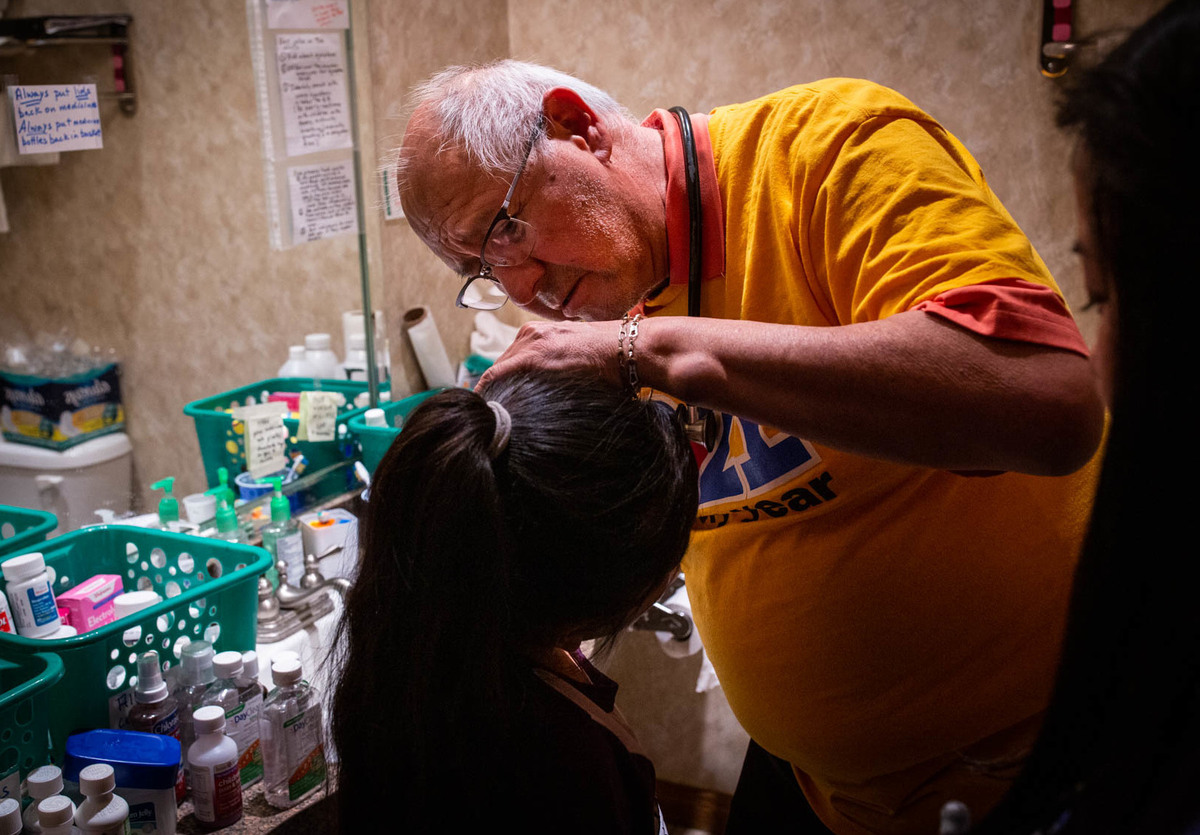


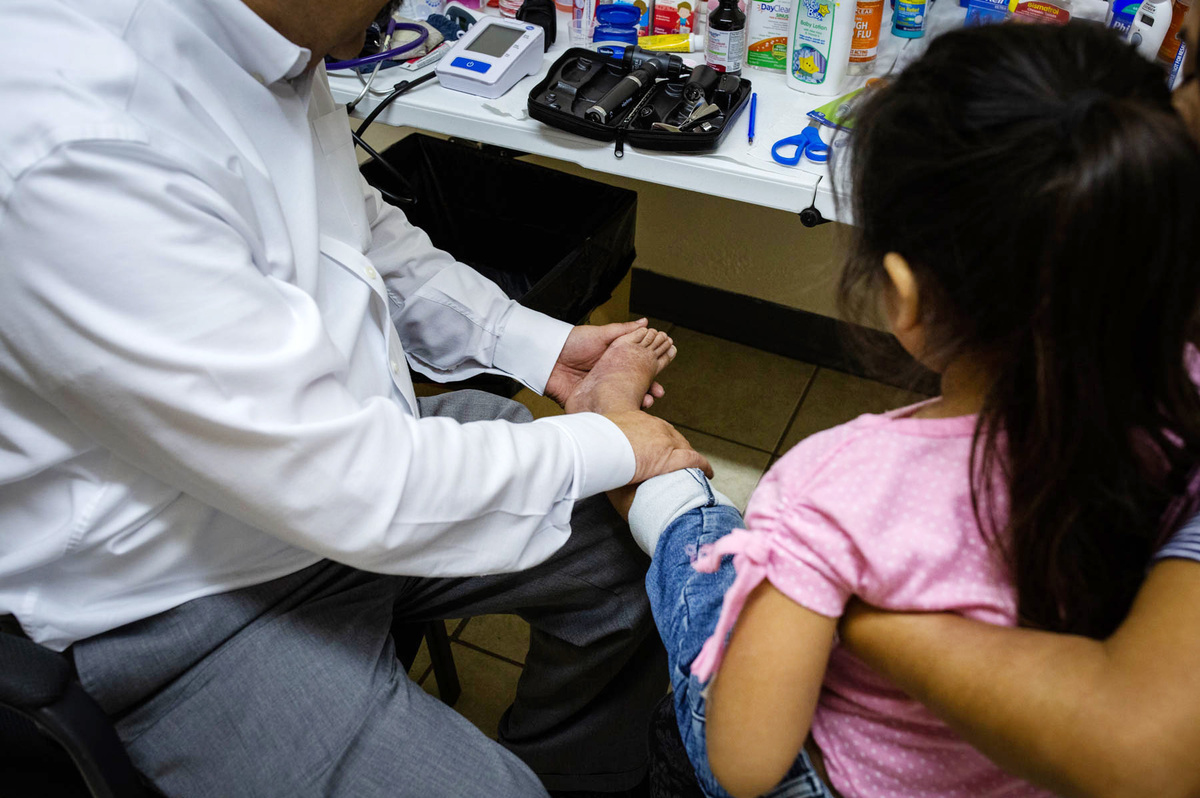
De la Rosa examines a rash on the foot of a 5-year-old girl named Meliza. Though he believed it was likely a sign of an allergic reaction, the underlying bruising could also signal serious infection or leukemia, he worried. Before he could get the test results he needed, the family was gone.
Anna Maria Barry-Jester/Kaiser Health News
hide caption
toggle caption
Anna Maria Barry-Jester/Kaiser Health News
Necessary work
More than two dozen people have died while in immigration custody under the Trump administration, according to a calculation based on a recent NBC News analysis. The government says it added nurses and doctors to its facilities after two children died in December. Immigration authorities are now taking 60 children a day to the hospital and doing medical screens for every child under 18, U.S. Customs and Border Patrol Commissioner Kevin McAleenan said during a March news conference.
But many people still have serious needs upon release. When Gutierrez and his colleagues started these clinics, they were meant to temporarily fill a gap caused by the change in government policy. Asked if he thinks the volunteer work is sustainable, he shook his head and sighed. “I’m so tired.”
The financial model — relying on donations and volunteers — also has its limits. Asylum seekers generally don’t qualify for social services, including Medicaid, before they have been granted asylum. In California, negotiations are underway to make some of the $5 million in emergency funds the state is spending at the border available to reimburse clinics for care, according to the office of state Sen. Toni Atkins. Physicians in Texas and Arizona were not aware of similar conversations in their states.
Dr. Blanca Garcia, another El Paso pediatrician, has been volunteering a few days a week since October. Like many of the doctors, she cites a moral and financial argument for providing care to the migrants, who are in the country legally once they apply for asylum. These are vulnerable people who might not otherwise seek care, and for every diagnosis of strep throat, she is likely preventing an expensive emergency room visit, she said.
Still, there are limitations to what they can provide.
Cristian, 21, and his 5-month-old baby, Gretel, arrived at an El Paso shelter in a former assisted living facility early one afternoon. He’d never been alone this long with his daughter, he said. His wife — a minor — had been separated from them at the border, put in the custody of the Department of Health and Human Services. Cristian didn’t know when she might be released.
While in detention, he had spent several nights with Gretel on a concrete floor in a room with more than a hundred other men, he said. He asked a guard for a better sleeping situation. Instead of receiving help, he said, he was punished by being forced to sit and stare at a wall for over an hour as Gretel cried in his arms.
Still breastfeeding before she was separated from her mother, she would suck on his nose and at his shirt. He was worried that she wasn’t getting enough to eat, and that the formula he was giving her wasn’t as good for her as breastmilk. Dr. Garcia told him the baby looked healthy.
Still, Cristian was anxious, and grew increasingly distressed as he recounted their history.
“Will the baby be OK?” he asked in Spanish.
She assured the young father he was doing everything he could.
This story was produced by Kaiser Health News, which publishes California Healthline, an editorially independent service of the California Health Care Foundation. KHN is not affiliated with Kaiser Permanente.
How 128,000 Low-Income Kids Lost Health Care In Tennessee Over 2 Years
NPR’s Audie Cornish speaks with Nashville Tennessean reporter Brett Kelman about why Tennessee’s health insurance programs dropped more than 100,000 low-income children from the rolls over two years.