America's Favorite Pastime Is Back — And Some Wish It Would Just Hurry Up!

A pitch clock behind home plate at Scottsdale Stadium in Arizona, spring training home of the San Francisco Giants. As part of Major League Baseball’s efforts to increase the game’s pace of play, pitch clocks were used on an experimental basis at some spring training games. But the experiment ended in mid-March.
Tom Goldman/NPR
hide caption
toggle caption
Tom Goldman/NPR
Baseball is back. Thursday is opening day for the major leagues. All 30 teams are in action. And while the cry of “play ball!” sounds throughout the majors, baseball officials hope the game embraces a companion cry of “hurry up!”
Since 2014, the average time of a nine-inning game has hovered at or above three hours, which may be driving away the younger demographic baseball is trying to appeal to.
When Commissioner of Baseball Rob Manfred made a recent spring training swing through Arizona, he acknowledged pace of play is one of the trends of the game that the league watches carefully.
“We’re thinking we can make small changes in what is still the greatest game in the world,” Manfred told reporters, “in order to make our entertainment product more competitive.”
Baseball unveiled one of those changes during spring training.
It didn’t last long.
Watching the clock on a beautiful day
Earlier this month, it was a classic spring training day in Scottsdale, Ariz. Fans at the San Francisco Giants home park, Scottsdale Stadium, lounged under a hot sun at a game between the Giants and the Los Angeles Dodgers.

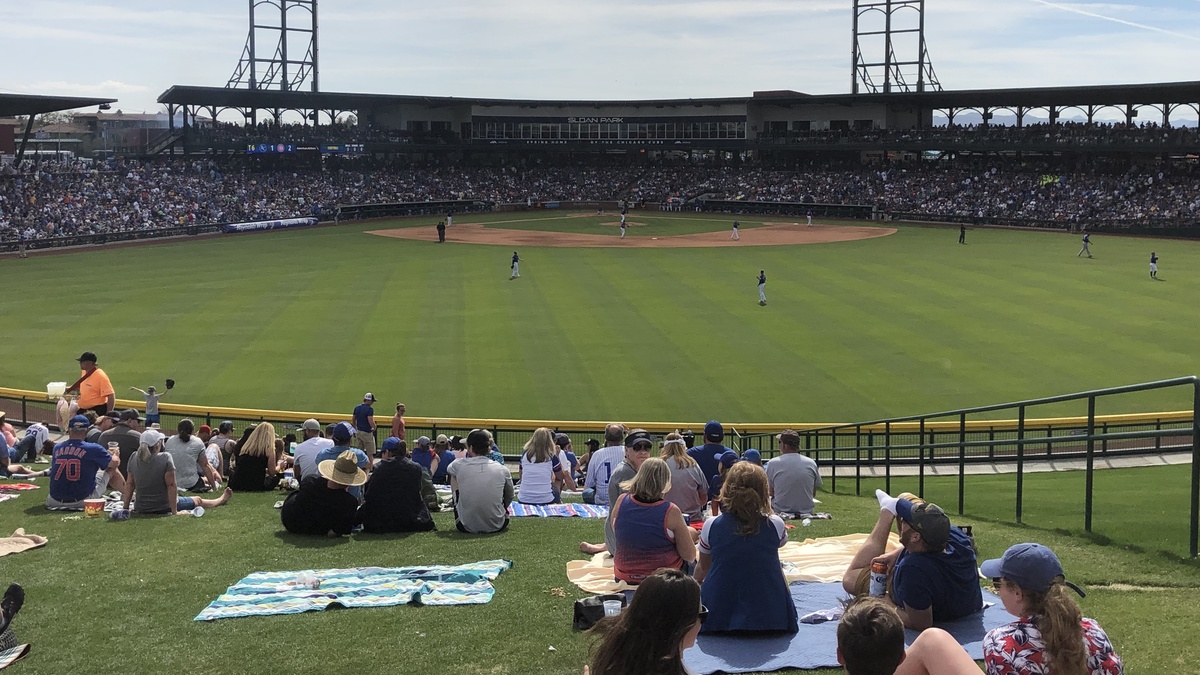
Baseball fans lounge on blankets beyond the center field wall at Sloan Park, the spring training home of the Chicago Cubs, in Mesa, Ariz.
Tom Goldman/NPR
hide caption
toggle caption
Tom Goldman/NPR
There’s a lot of lounging during spring training. Families sat on blankets on a grassy slope out past the center field wall. Standing nearby, longtime Giants fan Ryan Koven sipped a Pacifico beer and gazed toward home plate.
“You’re supposed to forget time at a baseball game,” Koven said, taking in the scene. “You’re supposed to relax and forget time.”
Which is why Koven, 34, was agitated. That doesn’t happen often at spring training. He watched as a large clock, near home plate, ticked down from 20 seconds every time the pitcher got the ball from the catcher.
“It’s very distracting; I’m looking at it right now,” Koven said, adding, “I’m looking at the pitcher and I see it ticking down, 10 … 9 … 8 … this is a very unbaseball experience right now!”
On this day, it was early in the pitch clock experiment. The clock has been used in the minor leagues for a few years to make pitchers and batters work faster. But not in the majors. And there was grumbling in Arizona, from the stands to major league clubhouses.
“I think this is a big game changer,” said Chicago Cubs pitcher Kyle Ryan, standing in front of his locker. “[Baseball] is America’s sport. [It] kind of stinks seeing it change. But, it is what it is.”
Actually, it isn’t anymore.
The baseball players union shared Ryan’s distaste for the pitch clock. MLB ended the spring training experiment in mid-March, agreeing not to implement it through the 2021 season.
Baseball still wants to hurry up
But baseball officials still are committed to the idea behind the clock — speeding up the game, and specifically, eliminating dead time. They want crisp play for all fans, but especially device-toting young ones who, the reasoning goes, want action and want it now!
Back at Scottsdale Stadium, Giants fan Koven questioned that stereotype.
“I think young people can appreciate tradition,” he said, “and they can get into things that have a history. I think you can sell an old game with a history better than you can speed up an old game, or change an old game to fit new people’s tastes.”

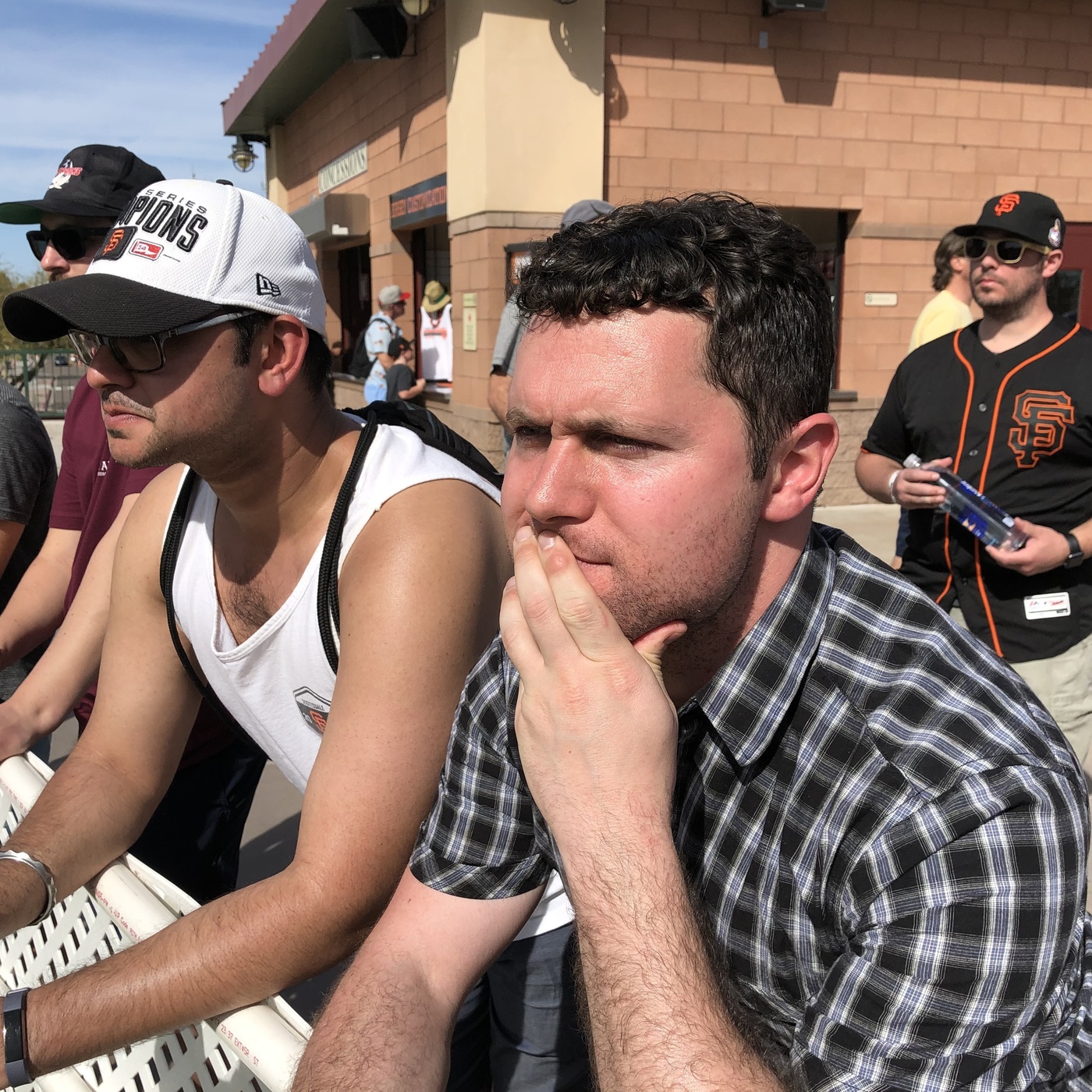
San Francisco Giants fans Aman Grewal (left) and Ryan Koven (right) watch a spring training game at Scottsdale Stadium. Both were against the pitch clock, which was introduced at the beginning of spring training to speed up the game and then discontinued in mid-March.
Tom Goldman/NPR
hide caption
toggle caption
Tom Goldman/NPR
“I don’t think that’s a hard sell for young people. I think they may be going at it the wrong way.”
Koven’s friend, 32-year-old Aman Grewal, agreed.
“I still think I’m young,” Grewal said, “and I enjoyed the game the way it was without a pitch clock, for instance.”
Grewal said if baseball wants to appeal more to younger fans, do like the NBA: Make videos and clips of action more available. And, he said, baseball is too buttoned up and needs to let the players have fun.
“When a player does a bat flip and people freak out,” Grewal said, “traditionalists freak out. You know, it’s 2019. They’re pro athletes. Let them entertain.”
Entertain faster
In nearly Mesa, Ariz., lifelong Chicago Cubs fan Bob Weinberg watched a game at the Cubs’ Sloan Park. He has a different, and perhaps surprising take on speedy baseball. Weinberg is 61, a time of life when you really shouldn’t care how long a baseball game takes.
But Weinberg does.
“I love coming out here. I love being outdoors,” said Weinberg. “I’m retired now and living the dream, as they say. But I also understand why people who are younger, without the attention span, don’t want to sit and watch all the downtime in an MLB game.”
Weinberg said constant pitching changes are a major culprit in slowing down baseball.
“I was at a game last year in Milwaukee,” he said. “Brewers and somebody. It was an 8-2 game in the eighth inning and they brought in three pitchers to face three batters. And when you see that, it’s not about the competition or the entertainment. … I’m not sure what it’s about.
“I’ve never, ever walked into a ballpark, and I’ve been to thousands of games, never heard a little kid say to his dad, ‘Gee, Daddy, I hope we see eight pitching changes today!” Weinberg added, sarcastically: “That’s always so exciting to see, that manager walk out of the dugout and wave his arm to the bullpen — that’s my favorite part of the game!”
Weinberg is glad officials are tweaking the rules, even though the pitch clock has gone away. This season, the number of pitcher’s mound visits he jokes about will be reduced. Also, breaks between innings will be shortened.
A little too fast?
Weinberg, who wants the game sped up, and Grewal and Hoven in Scottsdale, who don’t, defy generational stereotypes. But some fit.
Sixty-four-year-old Ned Yost is a baseball lifer. Since 2010 he has been the Kansas City Royals’ manager. At a spring training media event, he answered a few questions about pace of play. Finally, he got fed up.
“I don’t know, man. You want to speed it up?” he asked. “Make it a seven-inning game. That’ll speed it up.”
That may be a little too much, too fast. But such is the debate, as baseball strolls, a little more briskly, into 2019.
Oklahoma Attorney General On Purdue Pharma Settlement

NPR’s Rachel Martin speaks to Oklahoma Attorney General Mike Hunter about his state’s settlement against Purdue Pharma, the maker of the powerful opioid OxyContin.
Medicare's Uncapped Drug Costs Take A Big Bite From Already Tight Budgets
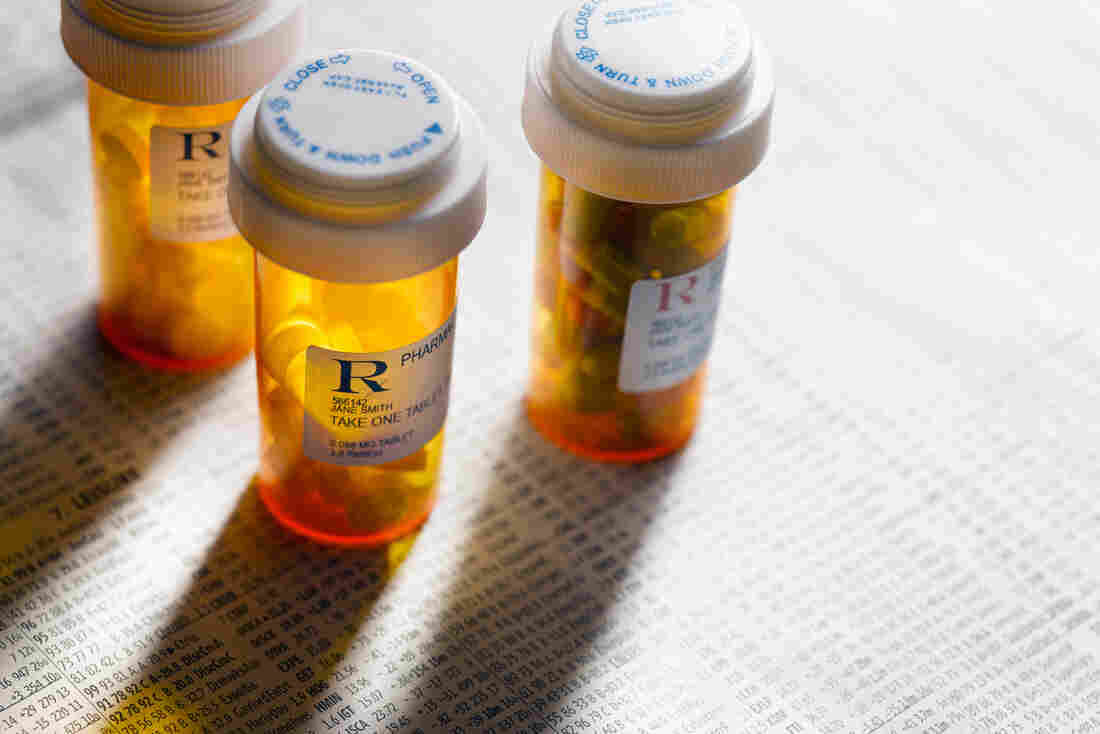
Both Democrats and Republicans have introduced proposals that would impose a cap on out-of-pocket costs of prescription drugs for Medicare patients. But it’s still unclear whether those moves will gain a foothold.
Jeffrey Hamilton/Getty Images
hide caption
toggle caption
Jeffrey Hamilton/Getty Images
Three times a week, 66-year-old Tod Gervich injects himself with Copaxone, a prescription drug that can reduce the frequency of relapses in people who have some forms of multiple sclerosis. After living with the disease for more than 20 years, the self-employed certified financial planner in Mashpee, Mass., is accustomed to managing his condition. What he can’t get used to is how Medicare’s coinsurance charges put a strain on his wallet.
Unlike commercial plans that cap members’ out-of-pocket drug spending annually, Medicare has no limit for prescription medications in Part D, its drug benefit. With the cost of specialty drugs increasing, some Medicare beneficiaries could owe thousands of dollars in out-of-pocket drug costs every year for a single drug.
Recent proposals by the Trump administration and Sen. Ron Wyden, D-Ore., would address the long-standing problem by imposing a spending cap. But it’s unclear whether any of these proposals will gain a foothold.
The 2006 introduction of the Medicare prescription drug benefit was a boon for seniors, but the coverage had weak spots. One was the so-called doughnut hole — the gap beneficiaries fell into after they accumulated a few thousand dollars in drug expenses and were then on the hook for the full cost of their medications. Another was the lack of an annual cap on drug spending.
Legislative changes have gradually closed the doughnut hole so that this year beneficiaries no longer face a coverage gap. In a standard Medicare drug plan, beneficiaries pay 25 percent of the price of their brand-name drugs until they reach $5,100 in out-of-pocket costs. Once patients reach that threshold, the catastrophic portion of their coverage kicks in, and their obligation drops to 5 percent. But it never disappears.
It’s that ongoing 5 percent that hits hard for people, like Gervich, who take expensive medications.
His 40-milligram dose of Copaxone costs about $75,000 annually, according to the National Multiple Sclerosis Society. In January, Gervich paid $1,800 for the drug, and he paid another $900 in February. Discounts that drug manufacturers are required to provide to Part D enrollees also counted toward his out-of-pocket costs. (More on that later.) By March, he had hit the $5,100 threshold that pushed him into catastrophic coverage. For the rest of the year, he’ll owe $295 a month for this drug, until the cycle starts over again in January.
That $295 is a far cry from the approximately $6,250 monthly Copaxone price without insurance. But, combined with the $2,700 he had already paid before his catastrophic coverage kicked in, the additional $2,950 he’ll owe this year is no small amount. And that assumes he needs no other medications.
“I feel like I’m being punished financially for having a chronic disease,” he says. He has considered discontinuing Copaxone to save money.
His drug bill is one reason Gervich has decided not to retire yet, he says, adding that an annual cap on his out-of-pocket costs “would definitely help.”
Drugs like Copaxone that can modify the effects of the disease have been on a steep upward price trajectory in recent years, says Bari Talente, executive vice president for advocacy at the National Multiple Sclerosis Society. Drugs that five years ago cost $60,000 annually now cost $90,000, she says. With those totals, Medicare beneficiaries “are going to hit catastrophic coverage no matter what.”
Specialty-tier drugs for multiple sclerosis, cancer and other conditions — defined by Medicare as those that cost more than $670 a month — account for more than 20 percent of total spending in Part D plans, up from about 6 percent before 2010, according to a report by the Medicare Payment Advisory Commission, a nonpartisan agency that advises Congress about the program.
Just over 1 million Medicare beneficiaries in Part D plans who did not receive low-income subsidies had drug costs that pushed them into catastrophic coverage in 2015 — more than twice the 2007 total — according to an analysis by the Kaiser Family Foundation.
“When the drug benefit was created, 5 percent probably didn’t seem like that big a deal,” says Juliette Cubanski, associate director of the Program on Medicare Policy at the Kaiser Family Foundation. “Now we have such expensive medications, and many of them are covered under Part D — where, before, many expensive drugs were cancer drugs” that were administered in doctors’ offices and covered by other parts of Medicare.
The lack of a spending limit for the Medicare drug benefit sets it apart from other coverage. Under the Affordable Care Act, the maximum amount someone generally owes out-of-pocket for covered drugs and other medical care for this year is $7,900. Plans typically pay 100 percent of customers’ costs after that.
The Medicare program doesn’t have an out-of-pocket spending limit for Part A or Part B, which cover hospital and outpatient services, respectively. But beneficiaries can buy supplemental Medigap plans, some of which pay coinsurance amounts and set out-of-pocket spending limits. Medigap plans, however, don’t cover Part D prescription plans.
Counterbalancing the administration’s proposal to impose a spending cap on prescription drugs is another proposal that could increase many beneficiaries’ out-of-pocket drug costs.
Currently, brand-name drugs that enrollees receive are discounted by 70 percent by manufacturers when Medicare beneficiaries have accumulated at least $3,820 in drug costs and until they reach $5,100 in out-of-pocket costs. Those discounts are applied toward beneficiaries’ total out-of-pocket costs, moving them more quickly toward catastrophic coverage.
Under the administration’s proposal, manufacturer discounts would no longer be treated this way. The administration says this would help steer patients toward less expensive generic medications.
Still, beneficiaries would have to pay more out-of-pocket to reach the catastrophic spending threshold. Thus, fewer people would likely reach the catastrophic coverage level at which they could benefit from a spending cap.
“Our concern is that some people will be paying more out-of-pocket to get to the $5,100 threshold and the drug cap,” says Keysha Brooks-Coley, vice president of federal affairs at the American Cancer Society Cancer Action Network.
“It’s kind of a mixed bag,” says Cubanski of the proposed calculation change. “There will be savings for some individuals” who reach the catastrophic phase of coverage. “But for many, there will be higher costs.”
For some people, especially cancer patients taking chemotherapy pills, the lack of a drug-spending cap in Part D coverage can seem especially unjust.
These cutting-edge, targeted oral chemotherapy and other drugs tend to be expensive, and Medicare beneficiaries often hit the catastrophic threshold quickly, says Brooks-Coley.
Patty Armstrong-Bolle, a Medicare patient who lives in Haslett, Mich., takes Ibrance, a pill, once a day to help keep in check the breast cancer that has spread to other parts of her body. While the medicine has helped send her cancer into remission, she may never be free of a financial obligation for the pricey drug.
Armstrong-Bolle paid $2,200 for the drug in January and February of last year. When she entered the catastrophic coverage portion of her Part D plan, the cost dropped to $584 per month. Armstrong-Bolle’s husband died last year, and she used the money from his life insurance policy to cover her drug bills.
This year, a patient assistance program has covered the first few months of coinsurance. That money will run out next month, and she’ll owe her $584 portion again.
If she were getting traditional drug infusions instead of taking an oral medication, her treatment would be covered under Part B of the program, and her coinsurance payments could be covered.
“It just doesn’t seem fair,” she says.
Kaiser Health News, a nonprofit news service, is an editorially independent program of the Kaiser Family Foundation. Neither KHN nor KFF is affiliated with Kaiser Permanente. Michelle Andrews is on Twitter: @mandrews110.
Women Tell FDA That More Research Is Needed On Health Risks Of Breast Implants
Advisers to the FDA concluded a meeting Tuesday on the safety of breast implants. What’s emerged is a lack of scientific certainty about the risks implants pose to millions of women who have them.
Purdue Pharma Reaches $270 Million Opioid Settlement With Oklahoma
Purdue Pharma, the maker of opioid OxyContin, has reached a $270 million civil settlement with the state of Oklahoma.
Justice Department Shifts Policy, Says Entire Affordable Care Act Should Be Overturned
The Trump administration’s shift in a major legal case against the Affordable Care Act could lead to the reversal of the expansive law and far-reaching effects on all Americans’ health care.
Soccer-Playing Engineer Calls Foul On Pricey Knee Brace

After a sports injury, Esteban Serrano owed $829.41 for a knee brace purchased with insurance through his doctor’s office. He says he found the same kind of brace selling for less than $250 online.
Paula Andalo/Kaiser Health News
hide caption
toggle caption
Paula Andalo/Kaiser Health News
Last October, Esteban Serrano wrenched his knee badly during his weekly soccer game with friends.
Serrano, a software engineer, grew up playing soccer in Quito, Ecuador, and he has kept up the sport since moving to the United States two decades ago.
He hobbled off the field and iced his knee. But the pain was so severe that he made an appointment with Rothman Orthopaedic Institute, a network of orthopedists practicing in Greater Philadelphia, New Jersey and New York.
The doctor diagnosed a strain of the medial collateral ligament and prescribed over-the-counter pain medication as well as a hinged knee brace, which Serrano used for several weeks until he’d healed.
He expected his insurance to cover his treatment. A plan from a previous job had covered him when he needed surgery to fix a broken nose sustained in another soccer game in 2017.
Then the bill came.
Patient: Esteban Serrano, 41, a software engineer and father of two from Phoenixville, Pa., outside Philadelphia.
Total bill: $1,197. $210 for the office outpatient visit, $105 for an X-ray and $882 for a hinged knee brace, all billed by the orthopedic practice. His insurer, Aetna, covered the visit and the X-ray but only $52.59 of the cost of the brace. That left Serrano with a balance of $829.41.
Service provider: Rothman Orthopaedic Institute in Bryn Mawr, Pa.
Medical service: A doctor examined Serrano’s knee and sent him for an X-ray. The doctor said he should use a knee brace for four weeks and recommended a hinged one sold through the practice.
What gives: A medial collateral ligament injury is a common knee injury occurring frequently among participants in contact sports. According to the American Academy of Physical Medicine and Rehabilitation, the medial collateral ligament is involved in at least 42 percent of knee ligament injuries. Although most cases are sports related, such injuries can also result from everyday activities like tripping on stairs.
“The doctor told me that he thought I didn’t have damage, that it was more of an inflammation, but he ordered an MRI just to make sure,” said Serrano. (The MRI confirmed that suspicion.)
Serrano said the brace did ease the discomfort and stabilized his knee as it healed. However, the bill was almost more painful — he owed the orthopedic practice $829.41.
“You can find the same brace for less than $250 online,” he said.

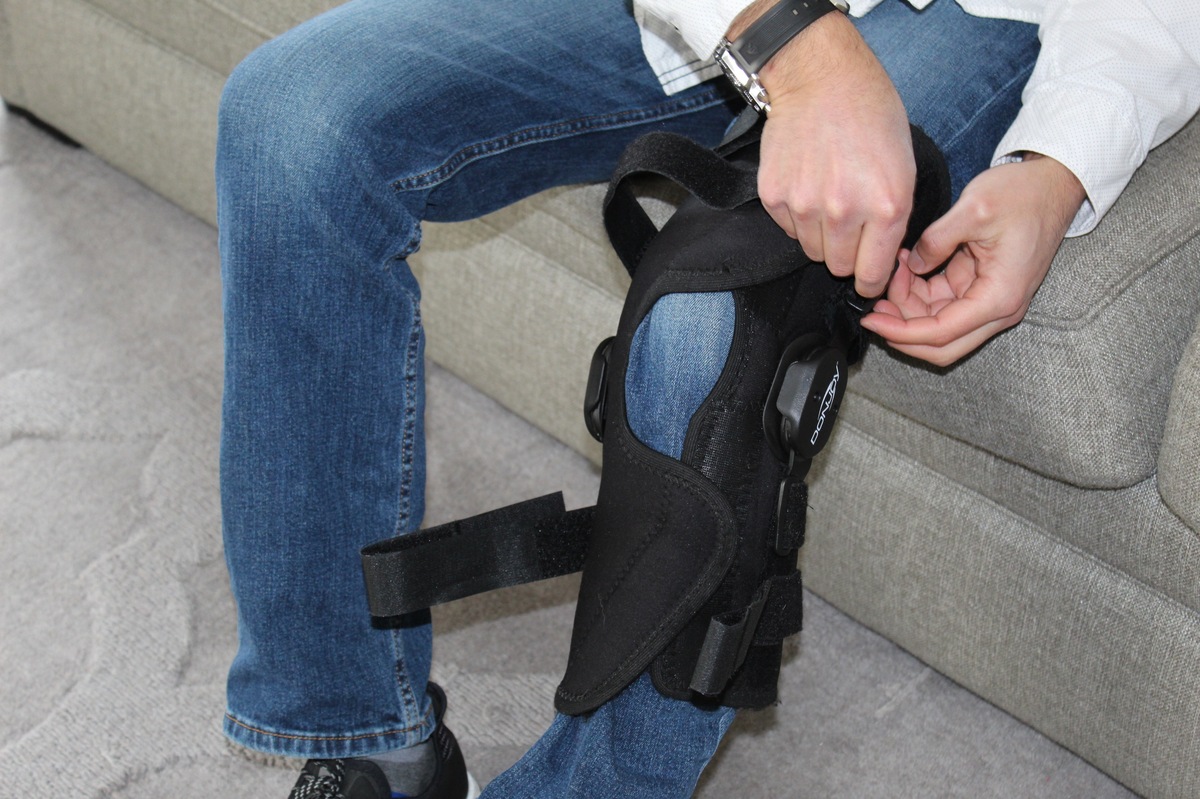
Serrano, a software engineer, grew up playing soccer in Quito, Ecuador. After straining a medial collateral ligament, he got a brace to help it heal.
Paula Andalo/Kaiser Health News
hide caption
toggle caption
Paula Andalo/Kaiser Health News
The bill came close to Christmas, when Serrano’s 12-year-old daughter wanted her first iPhone. “I told her, ‘Sorry, honey, but I already paid a price of an iPhone for the hinged knee brace,’ ” Serrano joked.
Serrano emphasized that he felt lucky to have the money to handle a bill that for many people could equal a month’s rent or three months of groceries.
Knee braces fall into a category of products called “durable medical equipment,” whose prices can vary widely. Items range from slings and braces to wheelchairs and commodes. They also include glucose meters and breast pumps for new mothers.
Doctors and hospitals that dispense such equipment for patients to take home almost always bill for them and add hefty markups that can catch patients unaware.
Braces and other products “are often marked up two or three times what the cost is, and unfortunately, that is the standard practice,” said Dr. Matthew Matava, an orthopedic surgeon and chief of sports medicine for Washington University Physicians in St. Louis.
Rothman Orthopaedic didn’t respond to requests for comments.
The type of hinged knee brace Serrano bought was a DonJoy Playmaker. DonJoy is one of the nation’s largest producers of braces. A customer service representative for the company said it charges a retail price of $242.51 for the model that Serrano got. Serrano paid more than three times that price.
In an emailed statement about the case, an Aetna spokesman wrote that “while the cost of a knee brace, or any other health care service, is determined by the negotiated rate between the health care provider and the health plan, the starting point is the charge from the health care provider.”
It is not even clear that such an elaborate knee brace was needed for Serrano’s injury.
Dr. Elizabeth Matzkin, chief of women’s sports medicine at Brigham and Women’s Hospital in Boston and an assistant professor at Harvard Medical School, said that while it is helpful to give patients some kind of knee brace for support after medial collateral ligament injuries, the use of a hinged knee brace does not influence recovery, according to studies. She called hinged braces “luxury products.” Simpler, cheaper braces also offer support.
Resolution: Serrano recalled that when he received the brace, an employee showed him a form with its estimated cost in writing. He remembered his share was more than $700, but he didn’t pay too much attention because he assumed his insurance would cover it.
After receiving the bill, he made several phone calls to the doctor’s practice to get a copy of the form he’d signed. It stated that the product could be returned within seven days. A month had already passed. Because he had not met his deductible, his $829.41 balance was even more than the estimate.
The takeaway: These days, many types of equipment dispensed by doctors’ offices or hospitals involve a charge. Don’t assume generosity. Ask the doctor to identify precisely what you need and explain why you need it.
When a doctor or hospital offers you a piece of equipment to help your healing, decide if you really need it or will use it. Say no if you won’t. Ask if you will be billed for it and how much.
Many items can be purchased at a fraction of the cost online or from a pharmacy just down the block.
Know your insurance plan’s copay or coinsurance for medical equipment (often 20 percent). The cost of purchasing the equipment yourself online may well be less than if you purchase through a medical office.
NPR produced and edited the interview with Kaiser Health News’ Elisabeth Rosenthal for broadcast.
Kaiser Health News is a nonprofit news service covering health issues. It is an editorially independent program of the Kaiser Family Foundation that isn’t affiliated with Kaiser Permanente.
New England Patriots' Star Tight End Is Calling It Quits
After four Super Bowls and a record-breaking number of touchdowns, Rob Gronkowski says it’s time to retire. In a post online, the 29-year-old said he’s looking forward to what comes next.
The Last American Baseball Glove Factory
Baseball’s opening day is right around the corner and one company will be paying close attention. Nokona is the last remaining glove maker that still produces the gloves in the U.S. for MLB players.
LULU GARCIA-NAVARRO, HOST:
Baseball is back again. The first games of the regular season were played last week in Tokyo. America’s oldest professional sport has grown worldwide and the industry that supports it. But a tiny town in Texas is holding onto one tradition. KERA’s Bill Zeeble in Dallas takes us to the factory that’s still making gloves in the U.S. for major league baseball players.
BILL ZEEBLE, BYLINE: About a hundred miles northwest of Dallas-Fort Worth past pastures of crops and cattle sits Nocona, Texas, population 3,000, home to the Nokona baseball glove factory.
(SOUNDBITE OF MACHINERY WHIRRING)
ZEEBLE: Inside, stacks of tanned and dyed kangaroo, buffalo and calf skins are piled at one end of the 20,000-square-foot shop.
ROB STOREY: We literally bring leather in through one door. And magically, ball gloves come out the door at the very end – that and about 45 labor operations, then you’ve got a ball glove.
ZEEBLE: Rob Storey should know. He’s Nokona’s executive vice president. And this is the family business. To survive the depression, his grandfather Bob Storey added ball gloves to the family’s line of leather goods in 1934. Since then, just about every U.S. competitor has moved production overseas. Grandfather Bob, who died in 1980, said he’d rather quit and go fishing than import Nokonas.
STOREY: In some ways, we see it as a competitive advantage because we have people that understand the game of baseball. Our competitors are making them in factories. A lot of those factories – people have never even seen a baseball game or know what it is. Sure, it would be easy to go over there and do something. But that’s not who we are. We’re not about easy.
ZEEBLE: Nokona and it’s 75 employees are about making, marketing and selling their mostly handmade gloves in the town with the same name. The brand honors Comanche chief Peta Nocona. The company couldn’t legally use the city’s spelling, so Storey’s grandfather changed the C to a K. And its been spelled that way ever since. Martin Gomez has been Nocona’s master glove turner for 19 years. That’s a big deal because every glove is first sewn inside-out.
MARTIN GOMEZ: It’s not that hard. No, but it takes some time to learn, to get used to. Like, the first time you start to work, it give you a blister all over your hands. But you get used to it.
ZEEBLE: Storey says Gomez is modest. If he’s not careful, he can tear the leather and hand-stitching. Gomez slides a rod in each inside-out finger, pushes it hard against a wooden dowel and turns each leather finger back the right way. First, he sprays leather softener on the inside-out glove. Then, says Storey, he heats it on a 250-degree metal form.
STOREY: It’s very critical to do that so that you don’t rip out any of the seams while we’re going through this process because this process, in some ways, is more difficult on the glove than, actually, the game of baseball.
ZEEBLE: The game of baseball, after all, is what Nokona’s all about, even if it’s not nearly as well-known as giants like Rawlings or Wilson. In the youth market, though, it’s big.
ROBBY SCOTT: I grew up using a Nokona glove. My first glove that I ever really remember was a first baseman’s mitt that was a Nokona.
ZEEBLE: That’s Arizona relief pitcher Robby Scott. When we first talked long distance, he was with the Red Sox between World Series games. Nokona found him while searching for player endorsements. Scott says there’s just something special about it.
SCOTT: I will never wear a different glove. It’s a special bond that I have with them. They could have 200 players wearing their gloves. But to me, it seems special because they make it seem like I’m the only one.
ZEEBLE: And, says Storey, Nokona’s the only maker he knows of that’ll refurbish its old, tattered mitts. He says try that with a glove made overseas.
For NPR News, I’m Bill Zeeble in Nocona, Texas.
(SOUNDBITE OF MUSIC)
Copyright © 2019 NPR. All rights reserved. Visit our website terms of use and permissions pages at www.npr.org for further information.
NPR transcripts are created on a rush deadline by Verb8tm, Inc., an NPR contractor, and produced using a proprietary transcription process developed with NPR. This text may not be in its final form and may be updated or revised in the future. Accuracy and availability may vary. The authoritative record of NPR’s programming is the audio record.