Margaret Reid Did Well Betting Kentucky Derby Races

After carefully analyzing the odds, she picked the winning horses in five consecutive derby races. She spent $18 on her bet and by the time Justify won the main race, Reid had won $1.2 million.

RACHEL MARTIN, HOST:

Good morning. I’m Rachel Martin. Placing bets on the Kentucky Derby is part of the fun – right? – a good excuse to pick a horse to cheer for during those exhilarating couple of minutes around the track. Racing fan Margaret Reid got more than a good time, though. After carefully analyzing the odds, she picked the winning horses in five consecutive Derby races. She spent 18 bucks on the bet, and by the time Justify won the race, Reid had won $1.2 million – almost as much as the winning horse and his owners took home. It’s MORNING EDITION.

Copyright © 2018 NPR. All rights reserved. Visit our website terms of use and permissions pages at www.npr.org for further information.

NPR transcripts are created on a rush deadline by Verb8tm, Inc., an NPR contractor, and produced using a proprietary transcription process developed with NPR. This text may not be in its final form and may be updated or revised in the future. Accuracy and availability may vary. The authoritative record of NPR’s programming is the audio record.

Let’s block ads! (Why?)

Decorated Taekwondo Athlete Steven Lopez Temporarily Barred Amid Assault Claims

Steven Lopez represents the United States at the 2008 Olympic Games in Beijing.

Quinn Rooney/Getty Images

hide caption

toggle caption

Quinn Rooney/Getty Images

Editor’s note: This story includes a description of a sexual act.

Steven Lopez, the most decorated taekwondo athlete in history, has been temporarily barred from representing the United States on the international stage.

The 39-year-old has won three Olympic medals — including two golds — and five World Championships. At least five women have accused him and his brother Jean Lopez of sexual misconduct.

The U.S. Center for SafeSport, a nonprofit tasked with investigating abuse across Olympic sports, has suspended him pending further investigation. Lopez was unavailable for comment.

In a statement to NPR, USA Taekwondo says it will “fully enforce this immediate suspension” and that it “fully supports the important work of the U.S. Center for SafeSport and respects its exclusive jurisdiction over sexual misconduct matters.”

Lopez’s brother Jean, a renowned coach, was permanently banned by the organization in April. He is appealing the decision.

The decisions by U.S. SafeSport affect only the brothers’ eligibility to participate in the sport under the U.S. banner. They do not amount to a criminal indictment.

Steven Lopez’s suspension comes just days after four former elite taekwondo athletes filed suit in the U.S. District Court for Colorado alleging that the Lopez brothers had sexually assaulted them. They are not the only people accusing the Lopezes of misconduct. As NPR reported last Friday, Nina Zampetti — who started training with Steven Lopez when she was 8 years old — says that when she was 14, and Lopez 22, he had her perform oral sex on him.

The four plaintiffs in the lawsuit are suing not just the Lopezes but also USA Taekwondo and the U.S. Olympic Committee. They allege that the organizations knew about the Lopezes’ behavior and failed to protect them. Moreover, because some of the alleged assaults happened abroad, they argue the organizations are guilty of sex trafficking.

Women who had leveled allegations against Lopez were gratified by the news. “I’m glad for this,” said Gabby Joslin, who trained with Steven and Jean Lopez and alleges she was assaulted by both men. “Steven needs to be away from potential victims.” Joslin says in the lawsuit that she was first assaulted by Steven Lopez while being coached by him at a tournament in Germany.

Mandy Meloon, who originally made a formal complaint against the Lopezes to the USA Taekwondo in 2006 and is also a plaintiff in the lawsuit, said she was pleased with the suspension but wishes it had come earlier. “Both of the brothers need to be charged with crimes,” Meloon adds.

Ronda Sweet, who served on the board of USA Taekwondo from 2006-2010 and has long argued that the organization needs to take a tougher line on sexual assault, was ebullient about the decision. “This is a historic day,” she says. “But it’s just a start.” She says other coaches need to be investigated as well.

Let’s block ads! (Why?)

NHL Player Brad Marchand Stops Licking Opponents, On League's Orders

Brad Marchand of the Boston Bruins looks on during Game 5 of the Eastern Conference second round against the Tampa Bay Lightning in Tampa, Fla., on Sunday.

Mike Ehrmann/Getty Images

hide caption

toggle caption

Mike Ehrmann/Getty Images

On Sunday night, the Tampa Bay Lightning defeated the Boston Bruins to head to the NHL’s Eastern Conference Finals.

And nobody licked anybody.

That was not a guarantee. Bruins left wing Brad Marchand licked opposing players twice this postseason.

Marchand is famously antagonistic and annoying, earning the unofficial title of the biggest pest in the NHL, a label his team has embraced. But his new strategy earned some ire off the ice, and the National Hockey League stepped in to order Marchand to knock it off.

In Game 1 of the Bruins’ first-round series, against the Toronto Maple Leafs, Marchand licked Leo Komarov’s neck.

Did Marchand just lick Komarov?

He can’t taste good.
pic.twitter.com/32HCZlRgDY

— Duffy on WCMF (@DuffyOnWCMF) April 13, 2018

“I thought he wanted to cuddle,” Marchand told reporters after the game, tongue in cheek. “I was just trying to get close to him.”

The Bruins beat the Maple Leafs in that game — Marchand had a goal and an assist — and won the series, as well.

But Marchand’s second licking wasn’t so lucky. During Game 4 of the second-round series, on Friday, Marchand lapped at Lightning forward Ryan Callahan.

The Bruins lost. Marchand was unrepentant.

“Well, he punched me four times in the face, so …” Marchand said afterward.

[embedded content]
SportsnetYouTube

After that, the NHL decided it’d had enough. A league executive scolded Marchand on Saturday — giving him a tongue-lashing, as The Boston Globeput it.

NHL’s Colin Campbell spoke with Boston’s Brad Marchand and GM Don Sweeney today. The League put the player on notice that his actions last night are unacceptable and similar behavior in the future will be dealt with by way of supplemental discipline.

— NHL Public Relations (@PR_NHL) May 5, 2018

The Associated Press reports that Bruins coach Bruce Cassidy also gave Marchand marching orders on Sunday:

“Cassidy said before the game that he had spoken with Marchand, delivering a simple, straight-forward message: “We need you on the ice, we need you playing. If part of his M.O. is to annoy people, find a different way to annoy them. Preferably by scoring some goals, that would be the best way.”

“Afterward, Marchand shrugged off a question about his discussion the previous day with NHL senior vice president of hockey operations Colin Campbell.

” ‘It is what it is,’ Marchand said. ‘I think it’s pretty stupid, the whole situation, but if that’s what they want to do, it’s what they want to do.’ “

Let’s block ads! (Why?)

Justify Breaks 136-Year-Old Curse To Win The Kentucky Derby

Mike Smith rides Justify to victory during the 144th running of the Kentucky Derby horse race at Churchill Downs Saturday, in Louisville, Ky.

Darron Cummings/AP

hide caption

toggle caption

Darron Cummings/AP

Updated at 8:48 p.m. ET

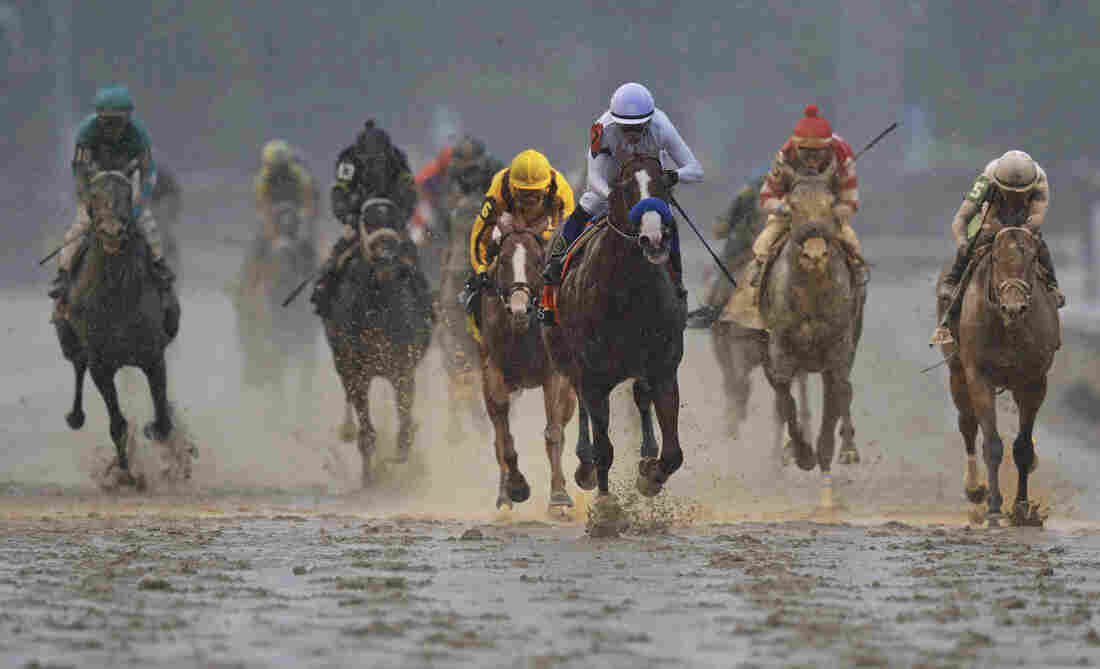
After a day of steady rain on Churchill Downs, it was Justify who managed to cross the finish line first in the mud.

Justify brought Hall of Fame jockey Mike Smith a second Derby victory, on top of his and trainer Bob Baffert’s $1.24 million of the $2 million total prize. Smith previously won aboard Giacomo in 2005. Bafftert, the Triple Crown-winning trainer of American Pharoah, seals his fifth Derby win.

After charging ahead at the final turn, the undefeated chesnut colt held off Good Magic, finishing by two and a half lengths in 2 minutes 4.20 seconds. Audible, a favorite backed by Amazon’s audiobook company of the same name, finished third.

Baffert says Justify’s early speed helped notch first. “When he got away clean, then I thought we had a chance,” he told NBC Sports after the race. “We had to get away. Then Mike took his time.”

“He’s got that ‘it’ factor,” Smith said. “He is so above average, he’s got unbelievable talent and he’s got a mind to go with it. He was loving this stuff.”

Almost 3 inches of rain made for sloppy conditions at the 144th running of the Kentucky Derby. Despite the unpredictable conditions, history predicted the result — it’s the sixth consecutive Derby that a favorite has won.

Entering the race, Justify led the field of 20 with 5-2 odds, followed by Mendelssohn, 6-1, and My Boy Jack at 6-1. Mendelssohn, aiming to claim the first Derby win for a Europe-hailing horse, finished last, while My Boy Jack finished fifth.

Justify, the three-year-old colt that began his career in February, crushed the 136-year-old Apollo Curse dreaded by superstitious fans. According to Sports Illustrated, no horse has won the race without starting as a 2-year-old since 1882 — when Apollo won the Kentucky Derby by defeating 4-5 favorite Runnymede. Justify, with the best odds, and Magnum Moon, closing with 13-1, had been the only candidates in the field eligible to break the 136-year-old curse.

Baffert, who ranks Justify alongside his 2015 predecessor American Pharoah, is now set to enter the Preakness Stakes on May 19, the next leg of the Triple Crown trail.

“Him and American Pharoah and Arrogate, these horses are cut from a different — they are just so great,” Baffert said.

Let’s block ads! (Why?)

Exploring 'The Heritage' Of Black Athletes

In his book The Heritage, Howard Bryant makes the case that black athletes carry a heritage of activism and tells NPR’s Scott Simon why some fans have a hard time with that.

SCOTT SIMON, HOST:

Sports could never be just a game for many African-American athletes. It’s an area in which they can succeed and win wealth and prominence but also be subject to expectations about the roles they should play off the field.

Howard Bryant, with whom we talk about sports every other week, has an important new book that traces what he calls, the heritage, black athletes have received from figures that include Paul Robeson, Jackie Robinson and Muhammad Ali to assert themselves not just as athletes, but citizens. He’s named his book “The Heritage.” Howard joins us from the studios of New England Public Radio. Thanks so much for being with us.

HOWARD BRYANT: Hey, Scott.

SIMON: Howard, what about those who say, you know, just shut up and dribble, or swing and pass, or hit and run?

BRYANT: Well, those people are disappointed, and I think that they have been comfortable for a long time. One of the things that’s very interesting about this moment that we’re in is you’ve got this collision of patriotism images – the military flags and flyovers. And that is colliding with the sudden revival of the African-American player, usually, protesting police brutality.

SIMON: And as you point out, for many African-American players, questions of police brutality aren’t remote and ethereal. This is something that they’ve known about many of the places they’ve grown up.

BRYANT: Well, that’s why this is interesting to me. I think that we see famous people speaking out of their depth all the time. And then you hear people say, shut up and play, or shut up and act or, we don’t want to hear from you.

But on this subject, this is an area where ballplayers actually have direct knowledge and direct experience. We should be listening to the athletes on this issue. We should be listening to LeBron James, who comes from a tough neighborhood in Akron. We should be listening to Carmelo Anthony, who’s from West Baltimore, where Freddie Gray was killed.

SIMON: You direct some of your most stringent criticism at O.J. Simpson, Tiger Woods and Michael Jordan. Phrase you use, which I admire, is green-washed. Now let’s put O.J. Simpson, for obvious reasons, in a separate category. How do you think Michael Jordan hasn’t measured up to the heritage?

BRYANT: Well, I think it’s a tough place, and I think that for the last 40 years, you had a transition from the Jackie Robinson, Muhammad Ali, Tommie Smith, John Carlos. And then, when you got into the 1970s, obviously O.J. was the first athlete who really opened the door to endorsements and to the big money. And then with free agency in the ’70s, ballplayers were making – they were on their way to becoming super rich, as they are today. And then by the time you get to the ’80s, you’ve got Michael Jordan, who really was the guy who identified the player with commerce. And he was the guy who became a brand, as they say today.

And you did not hear elite athletes talk about anything important. They did not get involved in social issues. You didn’t see players get involved with Rodney King when we actually saw videotape of what took place. And it’s not just Michael Jordan. Magic Johnson and Patrick Ewing and the rest of them – they did not get involved at all. And I think that the sports fan got really comfortable with that, and that’s why today is so jarring.

SIMON: Yeah. There are white entertainers – I’m thinking of the Dixie Chicks and Susan Sarandon and others – who feel that they’ve essentially been told to shut up and sing or act, aren’t there?

BRYANT: No question. And the Dixie Chicks were one of the first examples of what we’re talking about. You cannot separate 9/11 from what’s happening with the black athlete today because the white athletes and anybody else who tried to challenge what was taking place after the towers fell, they felt the wrath. It’s not necessarily a racial issue only. This is a question of patriotism – of weaponizing patriotism, of weaponizing jingoism, and of weaponizing the flag and of being able to speak.

One of the people, who I really admired in the book, Bill Astore, was a lieutenant colonel in the Air Force. And he continued to ask the question, who is the patriot? Can we not speak? I don’t like to be called a dissenter simply because I disagree with war because I don’t feel that we’re talking about peace, or because as a veteran, it sort of offends me that there’s an American flag the size of the 50-yard line on the field. And we’re profiting from war, and we’re selling war when I’m supposed to be watching the Red Sox.

SIMON: Games got patriotized, if you please.

BRYANT: Absolutely. And then, of course, even more so when you have the president of the United States stepping in and telling players to shut up and play as well and using choice words for that.

SIMON: Is the day ahead when sports can be games for African-American athletes?

BRYANT: I’m pessimistic about it because I don’t see that happening. I don’t see any mechanism for that happening, especially when you look at colleges. You see how much pushback you get to compensating athletes. But at the same time, you don’t see a great deal of interest in educating athletes.

This is a question of black body versus black brain. And in the United States, the black body has always been what’s been compensated – whether you can sing, whether you can dance, whether you can – you know, you can – when you work manually. That’s what we care about. That’s the currency.

And what has been difficult in doing a lot of research for this book is you recognize that college was supposed to be the place – this college experience was supposed to be the place where that began to go away. But yet, more and more and more of these athletes, whether it’s the one-and-done rule, or whether they’re working at Home Depot because they blow out their knee, they’re not being educated. So when black body is secondary to black brain, then maybe things will change.

SIMON: Howard Bryant – his book, “The Heritage: Black Athletes, Divided America And The Politics Of Patriotism.” Thanks so much for being with us, Howard.

BRYANT: My pleasure, Scott.

(SOUNDBITE OF MUSIC)

Copyright © 2018 NPR. All rights reserved. Visit our website terms of use and permissions pages at www.npr.org for further information.

NPR transcripts are created on a rush deadline by Verb8tm, Inc., an NPR contractor, and produced using a proprietary transcription process developed with NPR. This text may not be in its final form and may be updated or revised in the future. Accuracy and availability may vary. The authoritative record of NPR’s programming is the audio record.

Let’s block ads! (Why?)

Saturday Sports: NBA Semifinals, Kentucky Derby

Boston played Philadelphia and Toronto played Cleveland in last night’s NBA semifinals while the Kentucky Derby is Saturday.

SCOTT SIMON, HOST:

It’s time for sports.

(SOUNDBITE OF MUSIC)

SIMON: What a no-hitter last night. Walker Buehler, the Los Angeles Dodgers rookie, threw six innings of no-hit ball against the San Diego Padres. And three relief pitchers followed. A no-hitter but with four pitchers – only the 12th combined no-hitter in major league history. NPR’s Tom Goldman joins us. Morning, Tom.

TOM GOLDMAN, BYLINE: Good morning, Scott.

SIMON: So why did Dave Roberts, the able Dodgers manager, lift a guy in the middle of a no-hitter?

GOLDMAN: Name of the game, Mr. Scott Simon – protect your pitchers. Some argue managers – teams are too protective. Mr. Buehler was only 23 – is only 23. But he had Tommy John surgery a couple of years ago. So when he reached his allotted pitch count, that was it – possible no-hitter or not. Buehler didn’t like the decision. But he said – and I’m quoting – “it’s above my paygrade, and they made the choice. And these guys finished it out. It was pretty cool.”

SIMON: It really was. I would have left the kid in. And maybe there’s a reason why I’m not the manager of any ball club. But another event last night – Albert Pujols of the Los Angeles Angels of Anaheim-Fullerton in Yorba Linda got the 3,000th hit of his career. Now he’s slowed in recent years – but, boy, what a career he’s had.

GOLDMAN: We knew he was a great hitter. Now the numbers prove it. He’s the 32nd player to be on the hallowed 3,000-hit list – also only the fourth to have 3,000 hits and 600 homeruns – so a hitter with power too. So for one night at least, Shohei Ohtani wasn’t the talk of the Angels of Anaheim-Fullerton in Yorba Linda.

SIMON: (Laughter) You see? That is their name.

GOLDMAN: It’s catchy.

SIMON: New Orleans Pelicans beat Golden State last night – 119 to 100. Warriors are just ahead by a game now in that series. Is Steve Kerr shaking like a leaf?

GOLDMAN: No, cool as ever. He attributed last night’s thumping to the ebbs and flows of the postseason. The Pelicans’ defense was great. They brought the energy and the aggressiveness, and Golden State didn’t didn’t. Kerr says it’ll get better. When Steve Kerr talks Warriors, listen. So we will see tomorrow.

SIMON: And same split in Houston-Utah series now – Houston won last night – 113 to 92. By the way, one of my new favorite players is the Stifle Tower on Utah.

GOLDMAN: (Laughter) Yeah, but he wasn’t very stifling…

SIMON: He didn’t stifle last night, yeah.

GOLDMAN: Rudy Gobert – not last night. You know, to pick up on Kerr’s ebbs and flows comments, it’s hard to have a consistent narrative once the playoffs get past the first round. All the remaining teams are very good. They’re well-coached. And things change game to game because teams adjust game to game. And the home court can play a big part as it did in New Orleans last night. So the narrative that a talented cohesive Utah team might upset the number one seat Houston after Utah won game two and stole the Rockets’ home-court advantage – that narrative changed in a big way by halftime last night when Houston led by 30 and ended up cruising to victory in Utah and stealing back the home-court advantage.

SIMON: I’ve been holding myself back, Tom, obviously.

GOLDMAN: I can tell.

SIMON: The Cavs have been a mediocre team all year with the greatest player of all time. But right now, (singing) all this energy calling me back to where it all comes from – Cleveland is “Rocky.” What more can we say about LeBron James?

GOLDMAN: This series is the one current narrative that may play out – the narrative being that even though they’ve played only two games, the Raptors are done. Cleveland won the first two games in Toronto. LeBron was breathtaking again. The thing that should really worry the Raptors – this team that was mediocre, as you say, remade with big trades in February. It’s finally jelling. That’s trouble for Toronto.

SIMON: Well, I can’t help but – just the opportunity to see LeBron James at this point in his career – absolutely extraordinary. I hope everybody tunes in whatever the result is. It’s very good to talk to you again. NPR’s Tom Goldman, thanks so much.

GOLDMAN: You’re welcome.

(SOUNDBITE OF MUSIC)

Copyright © 2018 NPR. All rights reserved. Visit our website terms of use and permissions pages at www.npr.org for further information.

NPR transcripts are created on a rush deadline by Verb8tm, Inc., an NPR contractor, and produced using a proprietary transcription process developed with NPR. This text may not be in its final form and may be updated or revised in the future. Accuracy and availability may vary. The authoritative record of NPR’s programming is the audio record.
Let’s block ads! (Why?)

North, South Korea Skip Table Tennis Match Against Each Other And Vow To Become One

The South Korean and North Korean teams receive an ovation Thursday at the World Team Table Tennis Championships in Halmstad, Sweden. The players elected to form a unified Korean team for the tournament’s semifinal round.

TT News Agency/Reuters

hide caption

toggle caption

TT News Agency/Reuters

More than four decades after pingpong diplomacy forged ties between the U.S. and China, thawing a relationship had been frozen in hostility, two long-time opponents have again reached across the net for a historic handshake.

Women’s table tennis teams from South Korea and North Korea announced Thursday that they would not compete against each other, as scheduled, in the quarterfinals of the World Team Table Tennis Championships. They told umpires on the court in Halmstad, Sweden, they would skip the match entirely and instead form a unified team to play in the semifinal round.

“This is a big historical decision for both our countries.” Ryu Seung-min, vice president of the Korea Table Tennis Association, said in a statement released by the International Table Tennis Federation, or ITTF.

“This is an important statement to promote peace between our countries through Table Tennis,” he added.

[embedded content]

ITTF President Thomas Weikert said in the statement that the federation’s board of directors did not simply approve the unusual agreement: “The unified team received a standing ovation from the delegates who showed their sign of support to this historic move.”

“It’s a bit of a risk of course as this is not 100 percent according to the rules,” Weikert told Reuters on Thursday, “We all feel happy that we have a small sign in the process of the reunion of Korea.”

Hopeful signs of reunification can be found not just on the pingpong table, but the negotiating table as well.

Late last month North Korean leader Kim Jong Un crossed the border to meet with his South Korean counterpart, Moon Jae-in — the first time a Kim dictator has done so since the 1953 armistice that brought an end to fighting in the Korean War.

Both countries have agreed to stop blaring propaganda at each other across the border through loudspeakers. North Korea has even declared its intention to sync clocks with its southern neighbor, which has operated on a different time zone for decades.

It is also not the first time this year that athletes from the longtime foes have joined up to compete in a unified team: Women’s ice hockey players from North and South took the ice together at the Olympic Games in Pyeongchang.

Still, it has been quite a while since the neighbors have taken up paddles together. The ITTF notes that not since 1991 has a unified Korean team competed in the World Table Tennis Championships, when that team actually won the world title.

Weikert acknowledged that the ITTF had to bend regulations to allow the creation of the new unified Korean team mid- tournament, but he said they had other considerations in mind than just the rulebook.

“It’s more than a sport, it’s more for the peace,” Weikert said. “I think it’s worth it.”

The announcer at the arena in Sweden, when revealing the decision to fans, put the matter more simply.

“It’s not North Korea, it’s not South Korea,” he said as both teams linked arms and beamed for the fans. “It’s just Korea.”

Let’s block ads! (Why?)

Washington's NFL Cheerleaders Say They Had To Pose Topless As VIPs Watched

Washington’s football team is facing allegations from its cheerleaders about the way they were treated on a 2013 trip to Costa Rica. Here, the squad warms up before an NFL preseason game in 2014.

Alex Brandon/AP

hide caption

toggle caption

Alex Brandon/AP

A “mandatory” trip to a nightclub where they were told to escort wealthy sponsors. A topless photo shoot that male spectators were invited to attend. Those are two of the main allegations made by cheerleaders from Washington’s NFL team about a 2013 trip to Costa Rica to photograph the squad’s swimsuit calendar.

The allegations described in a New York Times story stem from a trip to the Occidental Grand Papagayo, an adults-only resort on Culebra Bay, on Costa Rica’s west coast.

Citing interviews with five cheerleaders who were there, the Times‘ Juliet Macur reports that the women were unhappy with their lack of privacy — and worried that the team wasn’t concerned enough with their safety. Also unsettling: They said the team collected their passports early in the week-long trip.

The team told the Times that it normally collects passports on international trips as a matter of security.

When it was time to take photographs for the risqué calendar — including ones that involved being topless — the cheerleaders said men who backed the team as either sponsors or stadium suite-holders were invited to watch the photo shoots up close.

Captain Susan’s shoot is underway! Thanks to @Dmilikah swimwear for the swimsuit! #WRCCalendarShootpic.twitter.com/KUUoVle3ux

— Redskins Cheerleaders (@1stLadiesOfFB) May 30, 2013

“At one of my friend’s shoots, we were basically standing around her like a human barricade because she was basically naked, so we could keep the guys from seeing her,” one cheerleader told Macur. “I was getting so angry that the guys on the trip were skeezing around in the background.”

Nine of the cheerleaders were also told they’d been chosen to be “personal escorts” for sponsors during an outing at a nightclub, according to the Times. Several said the order came from the squad’s director.

That trip included urgings that the cheerleaders drink and flirt; one participant said the cheerleaders felt as if their bosses were “pimping us out.”

The cheerleading squad’s director, Stephanie Jojokian, told the Times that she doesn’t agree with the depiction of the trip. She denied ordering anyone to go out with sponsors, and said she provides a supportive environment for her cheerleaders.

“Where is this coming from?” Jojokian is quoted as saying. “I would never put a woman in a situation like that. I actually mentor these women to be strong and to speak up, and it kills me to hear that.”

Neither Jojokian nor the team responded to NPR’s request for comment and clarification about the cheerleaders’ allegations.

In a statement to the Times, the team said:

“The Redskins’ cheerleader program is one of the NFL’s premier teams in participation, professionalism, and community service. Each Redskin cheerleader is contractually protected to ensure a safe and constructive environment. The work our cheerleaders do in our community, visiting our troops abroad, and supporting our team on the field is something the Redskins organization and our fans take great pride in.”

News of the allegations comes after two former NFL cheerleaders – one from the Miami Dolphins and another from the New Orleans Saints – recently filed federal and state complaints over their working conditions. Their complaints cite discrimination and describe a controlling environment that also limits cheerleaders’ ability to profit from their careers.

The attorney for both women, Sara Blackwell, has said they would agree to settle their claims for $1 — and the guarantee of a meeting with NFL Commissioner Roger Goodell to discuss league-wide standards on working conditions for cheerleaders.

Responding to the report about the Washington cheerleaders, Blackwell said via Twitter, “In light of the latest NY Times story, Goodell is completely awful if he refuses to meet with us to create rules that are lawful and fair.”

In light of the latest NY Times story, Goodell is completely awful if he refuses to meet with us to create rules that are lawful and fair.https://t.co/FzMyAc79U6

— Sara Blackwell (@4US_Workers) May 3, 2018

In an earlier tweet, Blackwell also said it was a “big mistake” if Goodell doesn’t discuss how to protect the NFL’s cheerleaders — and protect the NFL and its teams from a future lawsuit.

When the Times contacted the NFL about its Washington story, a spokesman said the league “has no role in how the clubs which have cheerleaders utilize them.”

“Our office will work with our clubs in sharing best practices and employment-related processes that will support club cheerleading squads within an appropriate and supportive workplace,” the spokesman added.

Let’s block ads! (Why?)