They Fight — Politely — For What’s Right For The World’s Girls
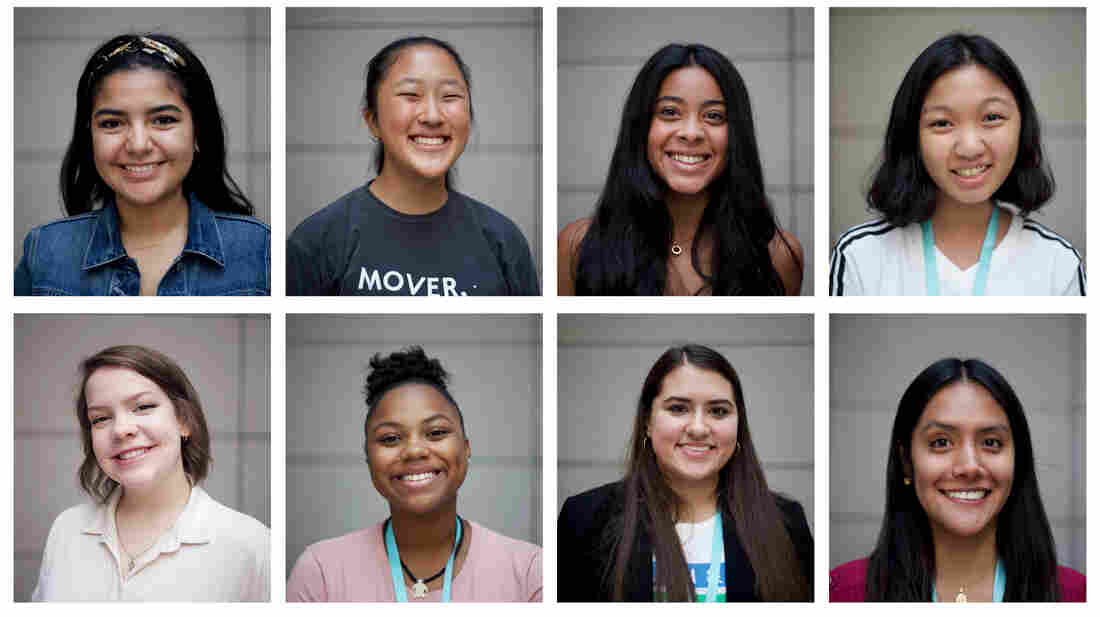
Activists from Girl Up. Top row from left: Valeria Colunga, Eugenie Park, Angelica Almonte, Emily Lin. Bottom row from left: Lauren Woodhouse, Winter Ashley, Zulia Martinez, Paola Moreno-Roman.
Olivia Falcigno/NPR
hide caption
toggle caption
Olivia Falcigno/NPR
For Ayesha, a gender equality activist from Sierra Leone, fighting sexism means defying tradition. In her home country, girls are often married young and may be discouraged from going to school. To challenge these practices, the 19-year-old may have to stand up to a respected community leader.
“You are constantly walking on eggshells,” she says. (Plan International, which partners with Ayesha, asked that her last name not be used to protect her from backlash caused by the issues she addresses.)
She tries to find the balance between celebrating her African culture and helping other girls break away from harmful beliefs — messages that they’re not cut out for school or must fit traditional cultural definitions of femininity. Sometimes, community members see that kind of activism as a threat their way of life. But as Ayesha says, “If that’s making your girls bad, please, can I make your girls bad?”
Ayesha was one of ten young activists NPR interviewed at the Girl Up 2019 Leadership Summit in Washington, D.C., this week. Girl Up is a campaign founded by the U.N. foundation that promotes activism for 13- to 22-year-olds to work for the health, safety and education of girls.
The interviewees said it’s tough to stay involved. The girls, most of them in high school or college, feel pressure to maintain top grades while living up to their personal commitment to work for humanitarian causes. They say they have to be polite when they try to educate sexist men and boys so they don’t alienate them.
And they say they’re worn out from it all. A main theme that emerged was burnout: the physical and mental exhaustion that comes from constantly justifying their work to skeptical men.
But they’re determined to keep fighting — and find ways to de-stress (the music of Lizzo helps). Here’s what young activists are talking about this year.
What common terms do you hear in your activism that frustrate you?
Lauren Woodhouse, 18, Portland, Oregon
“Influencers.” Lauren says the term – referring to an individual with social media power — turns activism into something trendy and individualistic rather than communal. “There is fun in supporting women, but we should all recognize that any work is valuable work,” she says. “And when corporations [say that] ‘this is the influencer to follow and her feminism is our feminism,’ it’s tiring. I’m over that.”
Valeria Colunga, 18, Monterrey, Mexico
“Feminazi.” Valeria is fed up with the term because it showcases a lack of education about what feminism is. “It is tiring to have to explain it,” she says. She says many people she knows call themselves “humanists, not feminists.” So she explains that humanist and feminist “mean different things. If I have to explain it over and over again, I will do it. Because if I don’t, who will?”
Winter Ashley, 15, Gilbert, Arizona
“Young socialist.” She says she’s often seen feminism and social activism equated with socialism – especially on social media from “random, middle-aged white men [saying]: ‘you’re building a new generation of young socialists,'” she says. (And she knows that’s who’s being critical because she’s done some Facebook investigating.) “I’ve been called a young socialist in a very negative way by so many people. It’s wacky.”
Eugenie Park, 17, Bellevue, Washington
“Social justice warrior” is a term that annoys Eugenie. “When you hear the term by itself, it sounds like an empowering thing. But in reality, it’s a term that is used to minimize a lot of the work that young social justice people do” by making it seem the activists are just doing it “for a trend,” she says. That’s been discouraging for her and her friends.
When boys say you can’t do certain things, how do you react?
Hibatu, 21, Ghana
“My own brother told me when I was going to senior high school that science is not for girls and that I should pursue something much more girl-like, like the liberal arts. He told me that I am likely to be a failure or probably always be at the bottom of the class because it’s very unnatural to see girls doing so well in school. I said, that’s not true. We’ve seen other women across the continents in other places make it. And I told him, I’m going to go to school and do science, and when I finish I’m going to medical school. And I can say that I was always at the top of my class.” (Plan International, which partners with Hibatu as well as Ayesha, also asked that her last name not be used.)
Winter
“Sometimes people can be just mean, but other times they’re honestly uneducated. And we need to be able to calmly and respectfully educate someone else on why the movement [to advance women’s rights] is so important. Men are given all of the tools they need to succeed, and then women are told: ‘If you want it, make it happen.’ Like, we’re not gonna help you. And you need to give people examples of where this happens in the world and how you can see it affecting entire communities. Through education and conversation, you can at a minimum get your point across and at best, change their perspective.”
Ayesha, 19, Sierra Leone
Ayesha stresses that young activists need to remember that often people are ignorant about feminism and tied to cultural traditions like child marriage and female genital mutilation. “In this community where I come from, these [outdated ideas about gender] are things that they grew up with. So it’s not just young boys, it’s like, grown men who grew up with this norm ’cause it was drummed in their heads ever since they were little. And it’s really difficult to change someone overnight.” She says that sometimes these people are trying to be mean but often, “it’s because they really genuinely do not see [equality as] possible, because they’ve never seen it happen before. The way that you respond is what they are going to use to shape their minds. We have to constantly be able to shape this message in a language that is friendly.”
That sounds like a lot of effort and emotional labor. Do you ever burn out?
Zulia Martinez, 21, Mayagüez, Puerto Rico
A student at Wellesley College, Zulia says activist burnout is a huge problem. She’s part of an ongoing effort to convince the school to pull out of any investments in companies that sell fossil fuels. Focusing on the smaller victories gives her hope. “We had gotten so many students on board, almost the entire student body was supporting us.”
What do you do for self-care?
Ayesha
“Sometimes, as activists, you forget that you’re actually just a person. You have friends and you stress about your summer body. And you stress about your hair, and you also stress about the lives of other people. So people don’t realize that it’s difficult sometimes because you have school, and you have grades, and you have chores, and you have a family that you have to think about. And that’s why I think we really need to invest in self-care. Sometimes I tell myself just sleep well, and most importantly talk about your feelings, because this kind of work is very, very emotional.”
Paola Moreno-Roman, 29, Lima, Peru
“A lot of activists are passionate about things because we truly believe in them. But for most of us it comes from events that we went through when we were younger and that fuels and gives us energy. But I forget that there are things that we went through that we actually never addressed that we just shoved under the bed and just don’t like looking at it because it’s painful.” For her, therapy is helpful: “It goes along the lines of speaking to your friends, because if not, it can be a very lonely journey. Sometimes it just feels like you are the only one who cares. And that’s the loneliest feeling ever.”
Lauren
“Recently I got into weightlifting. It’s amazing how much more confident I feel, knowing I could start feeling different muscles that I’ve never felt before. And then I feel like I’m more physically able to defend myself and it makes me just feel like: ‘Hello, I’m here.'”
Eugenie
“I find a really big outlet for me is sports — I row crew. A lot of adolescent girls, we struggle with our body image. And something that’s really helped me is realizing that your body isn’t just there to look [socially] acceptable, societally beautiful. It’s there to serve you every day, and it’s there to pull you through a finish line. It’s there to carry you every day.”

From left, Edman Ali and Naima Yusuf, both 14, listen to a panel at the Girl Up 2019 Leadership Summit.
Olivia Falcigno/NPR
hide caption
toggle caption
Olivia Falcigno/NPR
Who’s a musical artist that keeps you inspired and energized?
Ayesha
“Beyoncé.”
Angelica Almonte, 18, Long Island, New York
“I think Lizzo is so good.”
Hibatu
“Ariana Grande!”
Emily Lin, 16, Taipei, Taiwan
“I really like Lorde and Alessia Cara. She’s like, my hero. Or she-ro.”
Speaking of “she-roes,” who are yours?
Lauren
“Ayanna Pressley was just here [at the conference.] Alexandria Ocasio-Cortez, she’s like the one.”
Hibatu
“Marie Curie.”
Ayesha
“There’s a female writer, her name is Chimananda [Ngozi Adichie, Nigerian author and feminist]. I’m slightly, SLIGHTLY obsessed. I love how she balances her work with everything else that she does. I’m so in love with her.”
Angelica
“This one definitely feels a little basic, but Michelle Obama. Once I saw a picture of her [at] her great-great-great-grandmother’s tombstone.” That ancestor was a slave — “and one of her descendants becoming the first lady of the United States. That shook me.”
Zulia
“My mom. She sacrificed her career for me, and she’s the one who wanted me to become an activist. The women that surround us, empower us. And I think that’s why a lot of us have become activists.”
Valeria
“I think my girl here will be Sor Juana [Inés de la Cruz]; she’s a poet [and nun who lived and wrote in the 17th century]. She started creating poetry and art to be outspoken on issues that women were facing at that time. One specific poem talked about how men back then said that women were the ones creating their own problems. For her, it was like, how are we creating prostitution when it’s men creating demand for it? Or how do you say it’s women who are not successful when we can’t get an education?”
Any advice you have for young activists?
Winter
“One of the biggest things to remember is that activism is incredibly hard, and it takes a lot of work and a lot of perseverance. And sometimes you’ll go months without any breakthroughs. You can do all you want in the community and sometimes it’s still not going to be effective. And I think that we have to realize that that’s not a reflection of our activism. It’s not saying, oh, you’re a bad activist or what you’re doing is stupid, because it’s not. It just means that it’s going to take a little more time. And like, with myself, I am always very critical of what I’m doing; I’m not getting a breakthrough, I’m not working hard enough. And that’s not always the case. Sometimes your community isn’t ready or they’re scared of the change that you’re trying to enact. And it doesn’t happen for a really long time. Eventually, you’ll get something done. You just have to stick through.”
Luisa Torres is a AAAS Mass Media fellow at NPR. Susie Neilson is NPR’s Science Desk intern. Follow them on Twitter here: @luisatorresduq and @susieneilson
WNBA Suspends Riquna Williams For 10 Games Over Alleged Domestic Violence
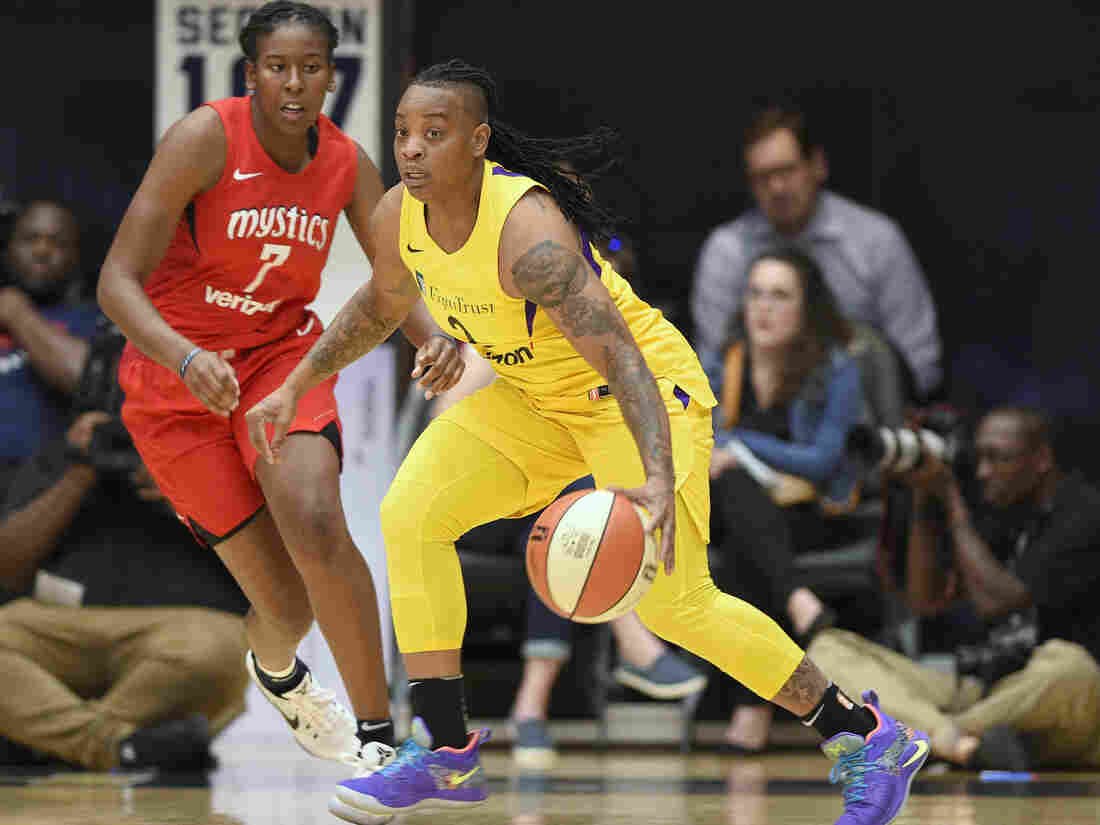
Los Angeles Sparks guard Riquna Williams (right) dribbles in a playoff game against the Washington Mystics last year.
Nick Wass/AP
hide caption
toggle caption
Nick Wass/AP
Updated at 4:15 p.m. ET
The WNBA has suspended Los Angeles Sparks guard Riquna Williams for 10 games without pay over a domestic violence incident in which she allegedly attacked a former girlfriend.
Williams was arrested in April and charged with two felony counts after authorities in Florida say she punched the woman in the head and then threatened another person with a gun.
The WNBA said it launched its own investigation into the matter, including interviews with several witnesses and a consultation with domestic violence experts, before rendering the 10-game suspension, which is about a third of a regular season.
“Among other factors, the WNBA took into account the nature and seriousness of the conduct at issue, including the involvement of a firearm,” the league said in a statement.
Despite the charges, the Sparks re-signed Williams and she has been playing this season. Her suspension starts Thursday, when the Sparks take on the Dallas Wings.
The Women’s National Basketball Players Association, the union representing WNBA players, plans to file a grievance.
“We are disappointed with the league’s actions. There is an ongoing criminal proceeding and in fairness to the player, the league could have and should have awaited its completion before taking any action,” Terri Jackson, the union’s executive director, told NPR in a statement. “Riquana has not had a fair opportunity to fully defend herself.”
According to an arrest report, Williams showed up at a residence in Pahokee, Fla. where Alkeria Davis was on Dec. 6, 2018. Police say Williams tried to get in by hitting the outside door with a skateboard.
Davis came to the door and there was a struggle as Williams tried to force her way into the residence, according to the report. It says Williams managed to get inside and then punched Davis multiple times in the head and pulled her hair.
Two men spent 10 minutes attempting to break up the fight before they were able to separate the two women and get Williams outside.
At that point, according to the report, Williams walked to a blue Camaro, grabbed a gun and pointed it at one of the men, saying “You’ll get all 18” before speeding away.
Davis told deputies with the Palm Beach County Sheriff’s Office that she and Williams had been dating on and off for five years, but had broken up a month before the incident. She told authorities she believes Williams was jealous that Davis was not with her, according to court records.
The altercation, Davis told police, left her with a lump on the side of her head.
Williams was arrested on April 29 and charged with burglary, with assault or battery, and with aggravated assault with a deadly firearm, court records show. She pleaded not guilty and was released on a $20,000 bond. The judge ordered that she not possess any weapons and have no contact with the victims. Her next court date is Aug. 16.
Lawyer Daniel Riccardo Paige Sr., who is representing Williams, did not return a request for comment.
The WNBA said in addition to the 10-game suspension, the league will require Williams receive to counseling.
The Sparks issued a statement to NPR saying the team has fully cooperated with the league’s investigation.
“As an organization, we abhor violence of any kind and specifically take domestic violence allegations very seriously,” according to the Sparks’ statement. “We will provide whatever resources we are allowed to help Riquna learn and grow from this unfortunate situation.”
Williams’ suspension comes as the WNBA investigates another recent domestic violence case, involving Seattle Storm player Natasha Howard, who has been accused by her wife of domestic abuse.
NPR’s Tom Goldman contributed to this report.
What Did Wimbledon Teach Us About Genius?

Matthias Hangst/Getty Images
Editor’s note: This is an excerpt of Planet Money’s newsletter. You can sign up here.
Sunday’s tennis championship at Wimbledon between Novak Djokovic and Roger Federer lasted nearly five hours, a record. It finished with a 12-12 tie in the final set, triggering a first-to-seven tiebreaker. For tennis fans, it was an epic struggle between legends in a storybook setting. The weather was perfect, and the hats were divine. For readers of David Epstein’s new book, Range: Why Generalists Triumph in a Specialized World, however, it was an academic nail-biter, a test case in a simmering war between specialists and generalists.
Range argues that professional success in most fields is not primarily the product of intense specialization but of generalization, of the cross-pollination of ideas and experiences. Range is an ode to late starters, like Vincent van Gogh, who wandered Europe and failed at all kinds of things, including preaching, before changing the art of painting. It’s about the NASA scientists who failed to prevent the explosion of the Challenger space shuttle, because they couldn’t operate outside the discipline of their training. It extols violinists who start late and polymaths like Charles Darwin.
Epstein is also the author of The Sports Gene, about genetics and outcomes in athletics. Taken together, The Sports Gene and Range form something like a rebuttal to Malcolm Gladwell’s Outliers and the whole gospel of the 10,000 hours, which suggests that mastery can be achieved only through consistent, unwavering focus. (The two authors, in their own classic bout, actually spent a lecture arguing about generalization and specialization at a sports conference this year. You can watch it here.) Range, like Outliers, is a book about ideas, success and brilliance, and both books rely on zillions of academic studies.
And it’s about sports, of course, our most measured form of success, with a stop on the tennis court. The book opens with a story about Federer, who is described as the antithesis of Tiger Woods. (Epstein says he titled his book proposal Tiger vs. Roger.) Tiger Woods played nothing but golf, starting at around 2 years old. Federer, Epstein writes, was raised on a variety of sports. His mother specifically discouraged him from specializing in tennis. He was steered away from playing more competitive matches so he could hang out with his friends. His mother often didn’t even watch him play.
Increasingly, writes Epstein, research about sports in particular and many fields in general is finding that early specialization more often leads to burnout and skill mismatches than success. The better path, statistically, is early and wide “sampling.” It matches people to the best skills. It allows disciplines to inform one another. The numbers suggest this is true for most professional athletes, and, of course, we all want it to be true. Specialization is grueling, relentless and not really that charming.
But!
Djokovic won. Beat Federer at the end of five hours by one point.
And Djokovic is a specialist, in its most extreme form. There are no accounts of Djokovic dabbling, testing a bunch of different sports. A child prodigy, he picked up tennis at 4 and never strayed. At 7, he was interviewed for a television spot in Serbia. “Tennis is my job,” he said, according to Sports Illustrated. “My goal in tennis is to become No. 1.” He had no other interests.
Bummer. But, still, Range is a delight to read because it tells us what we want to learn: that aimlessness is the path to greatness, that our distractibility is not our weakness but our secret power, that genius and perfection can show up for us with luck, as long as we’re just willing to amble around enough.
And you could hear that wish in the crowd, which was cheering for the lovely-to-watch Federer. No one wants to be Djokovic, the anxiety-ridden grinder. But he does seem to win a lot.
If you’d just finished Range and were pumped to dabble, and maybe get started on greatness later, Wimbledon was a real heartbreaker.
Did you enjoy this newsletter? Well, it looks even better in your inbox! You can sign up here.
Crowds Gather Each Week In Wisconsin To Watch Their Teams Play Ball — In Snowshoes

Huge crowds turn up each week to watch a game of baseball on a woodchip field, where the players wear snowshoes.
Mackenzie Martin/WXPR
hide caption
toggle caption
Mackenzie Martin/WXPR
Most snowshoes in the United States are probably in storage right now, gathering dust and waiting for temperatures to drop. In the town of Lake Tomahawk in the Northwoods of Wisconsin though, they’re getting a lot of use this summer.
Snowshoe baseball is exactly what it sounds like. It’s a game of baseball played on snowshoes, though it more closely resembles a bizarre game of softball.
Every Monday night in the summer—and on the 4th of July—hundreds of tourists and residents gather to cheer on players who strap on snowshoes and hit a large softball around a field of wood chips. This has been going on since 1961, when then town chairman Ray Sloan came up with the idea to turn the game into a spectator sport capable of entertaining both summer tourists and town residents. An earlier version of the game was played on frozen lakes. Hence, the snowshoes.
Admission is free, but slices of homemade pie cost $2. The pie is a big deal here, too. On any given night you can find 40 different flavors.
Sheila Punches says that “they come for the pie and stay for the game.” She’s been coming to games since the 1970s and she says pie is one way she measures its popularity.
“There was a time when 30 pies was enough,” she says. “Then it was 40, 50, 60, 70 … 100 pies is not too many pies to have. I think somebody said they had 160 pies last week for the 4th of July.”
Pie flavors range from the traditional — Raspberry Rhubarb or Apple — to the more unique: Banana Split, Margarita, and even Sawdust, featuring graham crackers and coconut flakes.
The game starts with a rendition of the national anthem by the local barbershop chorus. Then local commentators Adam Lau and Jimmy Soyck lead the way.
In a recent game, someone takes a swing, misses the ball, and switches bats.
“Oh, it’s the bat,” says Soyck into his microphone.
“It’s always the bat’s fault,” agrees Lau.
Then when the player does hit the ball, he trips right after leaving home plate. The crowd audibly cheers, then sighs.
This hilarious scene is all too common, especially for newer players. Soyck says you can’t run in snowshoes. It’s all in the shuffle.
“You gotta shuffle your feet. You can’t pick them up,” he says. “If you pick them up, you’re going over. No ifs, ands, or buts about it.”
The game carries on this way until about the 7th inning, when one lucky batter gets a disguised cantaloupe thrown to him instead of a ball. When the batter makes contact, he immediately scatters the baseball field with pieces of melon.
“When that thing hits, it splatters everywhere,” says Jeff Smith, who coaches the Snow Hawks, the home team. “It’s painted to look pretty much like those balls out there, and the batter isn’t supposed to know until he hits it.”
It’s easy to laugh at the idea of people playing softball on snowshoes in the middle of the summer, but fan Phil Hejtmanek says there are a lot of talented players here.
“The funny thing is these guys are really good,” he says. “You figure ‘oh, the outfielders aren’t going to be able to make any plays,’ but just you wait.”



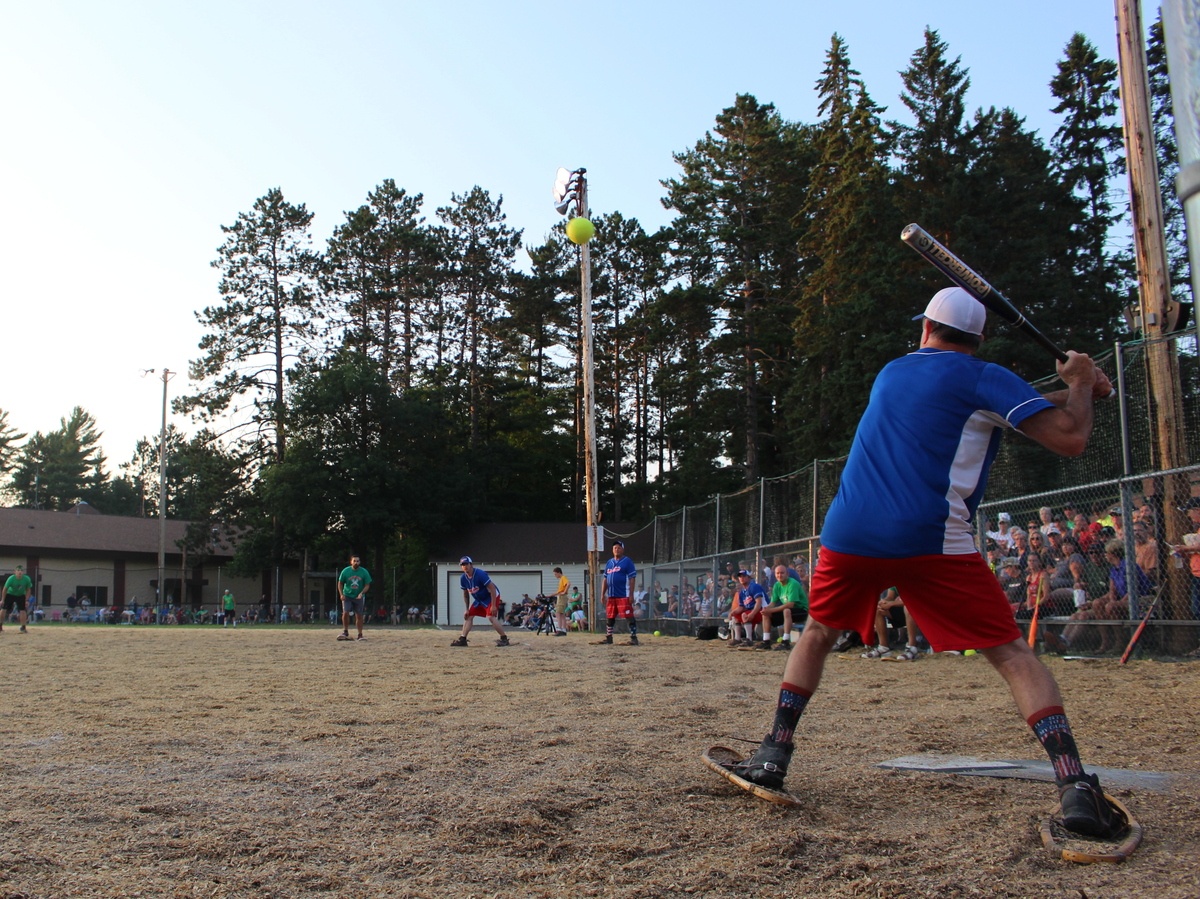

When you drive into the town of just more than 1,000 residents, a sign reads: “Welcome to Lake Tomahawk: Home of Snowshoe Baseball.” The game is a part of this town’s history, with generations of families coming together each summer to watch the games.
Mackenzie Martin/WXPR
hide caption
toggle caption
Mackenzie Martin/WXPR
Coach Jeff Smith says that it takes a lot of work from local volunteers to make each game run smoothly, but that he doesn’t expect the game to ever fade out.
“There’s too much passion amongst the townspeople around Snowshoe Baseball,” he says. “People get pretty serious about their home team winning and playing and they just want to be a part of it.”
Ultimately, this game is a part of this town’s fabric. Residents like Macey Macintyre grew up watching it.
“The whole town comes together just to watch this and you know it’s the whole town because you see everyone week in and week out,” she says. “It makes our town unique and it makes me just love my town and the people in it a lot more.”
So if you’re in Wisconsin’s Northwoods on a Monday night this summer and looking for some entertainment and good company, snowshoe baseball will be happening in Lake Tomahawk. The season ends in late August.
Novak Djokovic Defeats Roger Federer in Record-Breaking Wimbledon Match

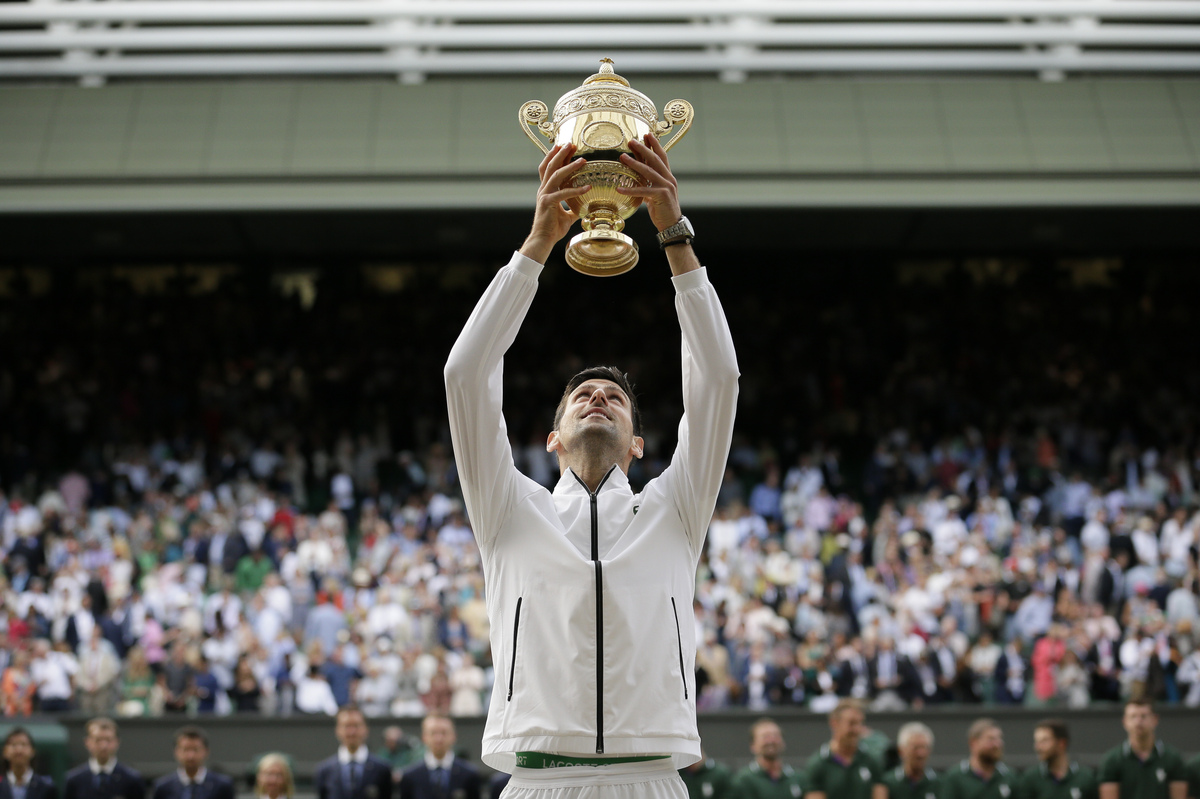
Novak Djokovic celebrates after defeating Roger Federer in the men’s singles final match of the Wimbledon Tennis Championships in London.
Tim Ireland/AP
hide caption
toggle caption
Tim Ireland/AP
In a stunning nearly five-hour match that broke records and tested new rules, Novak Djokovic defeated Roger Federer in the Wimbledon men’s championship on Sunday, defending his 2018 title.
Clocking in at four hours and 57 minutes, the match was the longest men’s singles final in Wimbledon history, and had it not been for a new rule that requires a tie-breaker if both players score 12-12 in the final set, it could have gone even longer.
Djokovic won the first set, a bad sign for Federer, as his opponent is 63-1 in majors when taking the first set.
The pair went back and forth, Djokovic taking the first set, Federer the second, Djokovic the third, and Federer the fourth. After the 12-12 fifth set, Djokovic took the unprecedented tie-breaker 7-3.
The 32-year-old Serbian won back-to-back titles in 2014 and 2015. Now, he’s repeated the achievement, defending his 2018 title to win his fifth Wimbledon championship. Federer, his Swiss opponent, boasts eight Wimbledon championships and would have been the oldest player to take a Grand Slam title had he not been defeated.
Djokovic commended his opponent, saying “I think that if this is not the most exciting final then it’s definitely in the top two or three of my career against one of the greatest players of all time, Roger, who I respect.”
Federer holds the record for most Wimbledon finals appearances, at 12.
“You take it on your chin, you move on,” Federer told the Telegraph. “You try to forget, try to take the good things out of this match. There’s just tons of it. Similar to ’08 maybe, I will look back at it and think, ‘Well, it’s not that bad after all.'”
Since his first Wimbledon victory against Rafael Nadal in 2011, Djokovic has established a signature tradition of eating grass from the court after each win. This year, he didn’t disappoint, crouching to pluck a bit of the turf into his mouth and grinning at the crowd as he savored his title.
Wimbledon Update

In the men’s final at Wimbledon, Roger Federer is up against defending champion Novak Djokovic.
For Bethany Hamilton, Surfing Is ‘An Escape From All The Chaos On Land’


“Sometimes I just want to hide in my island home back in Hawaii and keep things simple,” says surfer Bethany Hamilton. But she believes her story can be an example of “inspiration and hope” for young people.
Aaron Lieber/Entertainment Studios
hide caption
toggle caption
Aaron Lieber/Entertainment Studios
When Bethany Hamilton was 13 years old she lost her arm to a shark while surfing in Hawaii. That event catapulted her into the public spotlight, from talk shows to a Hollywood movie based on her life.
Not only did Hamilton return to the water, but she went on to ride some of the world’s biggest waves. Her story is told in the new documentary Bethany Hamilton: Unstoppable.
“I’ve always been drawn to pushing myself into bigger waves …” Hamilton says. “You’re just kind of hanging on for dear life — but also tackling it with all you’ve got.”
Interview Highlights
On what keeps her surfing
Ultimately I’m driven by my passion and love for riding waves. You know, so many people are like, “Why would you get back into the ocean with sharks?” and I’m like, “Well, I just have more fear of losing this love that I have for riding waves.”
It’s like my form of art and creativity and it’s a place … I’m completely immersed in what I’m doing and there’s nothing kind of holding me back or distracting me I’m just enjoying this beautiful ride. …
I realized, too, it’s a place of healing for me. … It’s my place of escape from all the chaos on land. … I can go and be refreshed and come back to my kids and be like, “Hey kids, like, let’s build a Lego tower now.”

Hamilton found out she was pregnant mid-way through filming Unstoppable. She continued to compete while nursing her infant son.
Aaron Lieber/Entertainment Studios
hide caption
toggle caption
Aaron Lieber/Entertainment Studios
On pulling her name out of the running after she was nominated for a 2016 ESPY in the “Best Female Athlete with a Disability” category
So, yeah, my thinking was: I really didn’t feel excited to receive the award. I never, like, view myself as disabled. I don’t have a handicap parking space [placard] in my car, and I think that if I viewed myself that way I wouldn’t be where I am today. If only the category had been just “Best Adaptive Athlete” I would have been happy to receive it. I have so much respect for all the people in that category, and who have received that award, but I just– to me, the word “disabled” does not match my life, and who I am, and what I’ve accomplished and the way I go about every single day.
On becoming a mom
After I married my husband we were like, “Well, let’s give it five years … and then we’ll talk about having a family.” … [When] I found out I was pregnant, I just did not feel ready for that, but I knew that, like, God’s plan was better than my own.
On getting back into shape after childbirth
I didn’t know what to expect. … It was even harder than I thought it would be. I tried to give myself grace and patience but, yeah, motherhood is no joke. It challenges you in every aspect — mentally, physically — and you’re just spread in every direction kind of thin. But it’s also the most enriching, joyful, beautiful and empowering experience.
On the World Surf League committing to paying equal prize money to male and female athletes
It’s a beautiful step in the right direction. Women are at the forefront of surfing right now … and I’m super applauding the World Surf League. … It’s exciting to be a part of such an awesome sport that is leading that forefront.
Denise Guerra produced and edited this interview for broadcast. Beth Novey adapted it for the Web.
Simona Halep Defeats Serena Williams To Win Her First Wimbledon Title

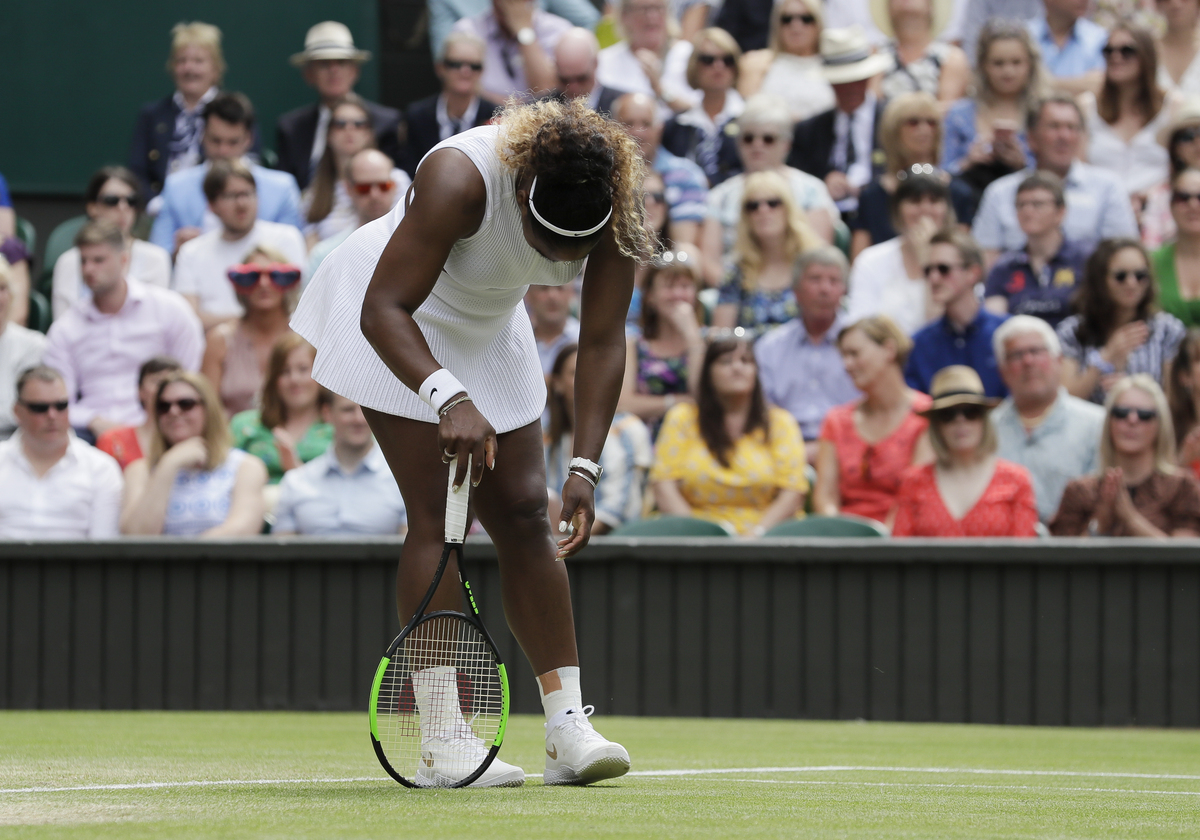
Serena Williams is dejected after losing a point during the women’s singles final match against Romania’s Simona Halep at Wimbledon on July 13, 2019.
Kirsty Wigglesworth/AP
hide caption
toggle caption
Kirsty Wigglesworth/AP
Serena Williams went into the Wimbledon finals on Saturday hoping to secure her 24th Grand Slam singles title — an accomplishment that would have equaled the record set by Margaret Court in the 1970s.
But after losses in two sets — 6-2, 6-2 — she fell to 27 year old Simona Halep, who with the victory became the first Romanian player to win a singles title at Wimbledon.
The win marked Halep’s second major singles title — she previously won the the French Open in 2018.
From the beginning, Halep dominated the match against Williams, controlling the court with her speed, coverage and aggressive ground strokes. When Williams failed to return the final rally that clinched the match, Halep sank to her knees and raised her racket high above her head, closing her eyes and grinning in triumph.
After the match ended, Halep was asked if she’d ever played better.
“Never,” she said. “It was the best match.”
But Halep had kind words for Williams as well.
“Serena has inspired us, so thank you for that,” she said.
Saturday’s match was Williams’ 11th Wimbledon singles final. She’s won the tournament seven times already, most recently in 2016 against Angelique Kerber.
The match was also the third Grand Slam loss in a row for Williams, who hasn’t won a Grand Slam title since the Australian Open in 2017, which she played while pregnant. She lost to Kerber in last year’s Wimbledon final and to Naomi Osaka at the U.S. Open in September.
At 37, Williams is the oldest Grand Slam women’s singles finalist to compete since the start of the Open Era in 1968. But she has struggled to attain her 24th Grand Slam singles title since the birth of her daughter, Olympia, in 2017.
Her daughter’s birth “would have been a perfect moment to walk away, but I wanted more,” she said in an interview last year.
After the match, Williams said playing against Halep made her feel like a “deer in the headlights.”
“When a player plays like that, you just have to take your hat off,” she said.
But Williams said this is far from her last tournament. “I’ve just got to keep fighting, keep trying,” she said. “I love playing the sport.”
Remembering Ball Player Jim Bouton And ‘Ball Four’
Jim Bouton, the baseball player who spilled the dirt on the Major Leagues with his celebrated memoir, Ball Four, died this week at the age of 80.
SCOTT SIMON, HOST:
I’m 30 years old, and I have these dreams is how Jim Bouton opened his 1970 book “Ball Four,” which a lot of young fans read under the covers by flashlight, laughing instead of sleeping and learning colorful new language. I dream my knuckleball is jumping around like a ping pong ball in the wind, Jim wrote. When the game is over, take a big bow on the mound in Yankee Stadium with 60,000 people cheering wildly, which I think is much like the dream of a lot of young fans.
“Ball Four” became a bestseller, a controversy and ultimately a classic. A lot of baseball people didn’t like Jim Bouton’s diary of daily life playing for the new and now defunct Seattle Pilots, the minor league Vancouver Mounties and then the Houston Astros. They felt he violated the code of the locker room by telling stories about ballplayers pulling pranks, swearing, carousing and joking. But readers, not just baseball fans, found he made the game lively, profane and engaging.
I got to know Jim a little interviewing him and in occasional phone calls. His own family was blessed by adoption, and he encouraged our family. He signed “Ball Four” for our daughters, writing don’t tell your daddy where you learned some bad words. He had a huge sentimental love for baseball in all its ironies, rituals, artistry and even tedium.
A lot of it is foolishness, he wrote – grown men being serious about a boy’s game. He goes on to say, I admit that sometimes I’m troubled by the way I make my living, but I don’t think there’s anything so great about selling real estate or life insurance or mutual funds or a lot of other things that people do with their lives.
When Jim Bouton died this week at the age of 80, I thought of the graceful final words of “Ball Four.” You see, you spend a good piece of your life gripping a baseball. And in the end, it turns out that it was the other way around all the time.
(SOUNDBITE OF EMANCIPATOR’S “VISION QUEST”)
Copyright © 2019 NPR. All rights reserved. Visit our website terms of use and permissions pages at www.npr.org for further information.
NPR transcripts are created on a rush deadline by Verb8tm, Inc., an NPR contractor, and produced using a proprietary transcription process developed with NPR. This text may not be in its final form and may be updated or revised in the future. Accuracy and availability may vary. The authoritative record of NPR’s programming is the audio record.
Saturday Sports: Wimbledon, NBA Off-Season
Roger Federer and Novak Djokovic renew a great rivalry at Wimbledon, and NBA free agency madness.
SCOTT SIMON, HOST:
No matter what else is happening in the world, it’s time for sports.
(SOUNDBITE OF MUSIC)
SIMON: A new name on top at Wimbledon and lots of new jerseys on a lot of NBA free agents. NPR’s Tom Goldman joins us.
Good morning, Tom.
TOM GOLDMAN, BYLINE: Good morning, Scott. And welcome back.
SIMON: Thank you very much. Good to be back. And a new champion – women’s champion – at Wimbledon, Simona Halep, a great young player from Romania.
GOLDMAN: Wow, 6-2, 6-2 she beat American Serena Williams in less than an hour. And she keeps Williams from tying Margaret Court’s all-time Grand Slam singles title record of 24. You know, Scott, there’d been a lot of talk about whether Serena would be nervous again on the brink of history. She lost two Grand Slam finals last year, and nerves did play a part. But let’s be clear. This was not about Serena being nervous or making a ton of unforced errors. This was all about Simona Halep’s dominance in her first ever Wimbledon final. She won with her speed and her court coverage and aggressive ground strokes. And afterwards, she was asked if she’d ever played better, and she said never.
SIMON: Well, (laughter) I have to take her word for it.
GOLDMAN: There it is.
SIMON: Let me – I understand men are playing, too – the same old names over and over again for 20 years. God bless them.
GOLDMAN: Roger Federer, Rafael Nadal, Novak Djokovic again and again and again. And tomorrow’s final, Novak Djokovic against Roger Federer, along with Nadal, who Federer beat in the semifinals – those big three players, all in their 30s, Federer pushing 40 – they continue to have this iron grip on their sport. Including tomorrow, they will have won the last 11 Grand Slam singles title. And as a mid-20s year, Scott, it’s been more like the past 15. But it’s just unprecedented, I think, in all of sport.
SIMON: Yeah.
GOLDMAN: You know, the normal narrative youth comes along and replenishes, but that hasn’t happened yet in men’s tennis.
SIMON: OK, the NBA offseason – unusually active, let’s put it that way. And it’s changed the – changed how we see the NBA at the moment. Just as people were getting excited about the Toronto Raptors, their main guy Kawhi Leonard decides to decamp for the LA Clippers.
GOLDMAN: (Laughter).
SIMON: And then a lot of major stars begin to move. The league looks entirely different in the space of two weeks.
GOLDMAN: Amazing, yeah. Decamping, to put it mildly. It continued late this week, too. Oklahoma City traded guard Russell Westbrook, the 2017 NBA Most Valuable Player, to Houston, where he’ll reunite with guard James Harden, the 2018 MVP. Scott, there were 15 all NBA players named last season. Those are the best of the best. Six of them have changed teams since the NBA finals ended last month. Without question, as you say, the most stunning league-shifting offseason in NBA history.
And it makes me wonder, are the days of dynasties where players still, you know, stay put for a while and grow together and create an unbeatable team – for instance, the Golden State Warriors of the past five years – are those days over?
SIMON: I like dynasties, or dynasties, as you say in your family. I think they make championships worth winning. I mean, beating the Golden State Warriors made the championship worthwhile. Beating the Michael Jordan Bulls, the Bill Russell Celtics – defeating a team that just comes together for a year or two – somehow, it doesn’t mean as much.
GOLDMAN: Yeah, you know, I think it’s a valid concern. A lot of fans are feeling that, you know? The fans in Toronto, as you say, they just cleaned up the confetti from their title celebration. And the question is, how will all this movement affect fans’ connections to players? On the other hand, with more great players spreading throughout the league, more fans can feel as if their team actually has a chance to win. And this can create more excitement. And let me tell you, right now, there’s a phenomenal buzz about next season, which is still more than three months away from starting.
SIMON: NPR’s Tom Goldman, thanks so much.
GOLDMAN: You’re welcome.
Copyright © 2019 NPR. All rights reserved. Visit our website terms of use and permissions pages at www.npr.org for further information.
NPR transcripts are created on a rush deadline by Verb8tm, Inc., an NPR contractor, and produced using a proprietary transcription process developed with NPR. This text may not be in its final form and may be updated or revised in the future. Accuracy and availability may vary. The authoritative record of NPR’s programming is the audio record.