Sailing Coach Will Be First Person Sentenced In College Admissions Scandal

Federal prosecutors want a former Stanford sailing coach to get 13 months in prison, when he becomes be the first to be sentenced in the college admissions scam on Wednesday.
Federal prosecutors want a former Stanford sailing coach to get 13 months in prison, when he becomes be the first to be sentenced in the college admissions scam on Wednesday.
The U.S. Women’s National Team began defense of its 2015 Women’s World Cup title Tuesday with a game against Thailand. It’s the first of three matches for the U.S. in the tournament’s opening round.

Alex Morgan (second right) celebrates after scoring the United States’ 12th goal during the team’s 13-0 win over Thailand Tuesday.
Alessandra Tarantino/AP
hide caption
toggle caption
Alessandra Tarantino/AP
Updated at 6: 24 p.m. ET
The U.S. Women’s National Team won its first game of the World Cup with the largest margin of victory in FIFA history Tuesday in a wild soccer match against Thailand.
The record-setting night ended at 13-0. No World Cup team, men or women, had ever scored 13 goals before. Alex Morgan scored five. She now ties with Michelle Akers’ previous 1991 World Cup record for goals scored in a single game.
ALEX MORGAN FOR THE RECORD! ??@alexmorgan13‘s 5th ties Michelle Akers’ single-game #FIFAWWC record … and makes it 12-0 USA! pic.twitter.com/52Z0ePG6vI
— FOX Soccer (@FOXSoccer) June 11, 2019
“We really just came into the game really wanting to showcase ourselves,” Morgan said after the game. “Every goal matters in this tournament and that’s what we were working on.”
“I’m speechless.” @AlexMorgan13 tries to explain her record-setting performance to @Alex_Curry after the @USWNT‘s 13-0 win. #FIFAWWC pic.twitter.com/gatzC6TTQV
— FOX Soccer (@FOXSoccer) June 11, 2019
She added that she is “speechless” over her own performance. “The ball just happened to bounce my way,” she said.
Thailand, which ranked No. 34 in the world, was considered one of the weaker teams entering the tournament.
Tuesday’s match was first of three matches for the U.S. in the tournament’s opening round. The American team will take on Chile on Sunday. They will face Sweden on June 20.

Santa Anita Park in Southern California is resisting calls to suspend its season, saying recent changes have reduced catastrophic injuries “by 50 percent in racing and by more than 84 percent in training.”
Jae C. Hong/AP
hide caption
toggle caption
Jae C. Hong/AP
Los Angeles County’s Santa Anita Park is standing firm against calls to cancel the rest of its racing season after the deaths of two more horses over the weekend, bringing the number of horses that have died at the track since December to 29.
In a highly unusual move Saturday, the California Horse Racing Board asked the park to scuttle competition for the seven remaining race days to “provide the industry more time to fully implement announced safety initiatives and perhaps additional ones.”
But park owner The Stronach Group along with the Thoroughbred Owners of California and California Thoroughbred Trainers released a joint statement Sunday saying the racetrack will remain open until the season ends on June 23.
“Since wide-sweeping reforms have been instituted at Santa Anita, catastrophic injuries have dropped considerably compared to earlier this meet,” the statement read, adding: “To be clear, there are no acceptable losses, and every day we work toward ending all serious injuries. But the reality is that our improvements and changes have been effective.”
Santa Anita suspended racing for much of March, when the toll of horse deaths neared two dozen — twice the rate of the previous year — and as it worked to figure out why so many horses were dying.
Before reopening on March 29, the park announced a series of changes it planned to implement, including limiting the use of pain or anti-inflammatory medications and treatment for horses and improving early detection of preexisting health conditions. Santa Anita had already pledged to bring in outside experts on a regular basis to review its dirt, turf and synthetic course surfaces.
The park says those moves have already reduced catastrophic injuries “by 50 percent in racing and by more than 84 percent in training.”
Since the park reopened, seven more horses have died there.
On Saturday, a horse named Formal Dude was euthanized after “taking a bad step” in a mile race, according to the official race chart. An examination revealed a fractured pelvis, reports The Daily Racing Form.
In response to the death of the 4-year-old gelding, the state Horse Racing Board issued a recommendation Saturday that Santa Anita “suspend racing for the seven remaining race days but that they allow horses to continue to train during that period.”
Santa Anita issued its refusal on Sunday. That same day saw another horse fatality: Truffalino pulled up during the third race of the day, and the jockey dismounted just before the 3-year-old filly collapsed. The horse died of a suspected heart attack.
In an emailed statement, the California Horse Racing Board said it “does not have the authority to suspend a race meet or remove race dates from a current race meet without the approval of the race track operator or without holding a public meeting with ten days public notice.”
At the time Santa Anita suspended races in March, questions swirled about whether heavy Southern California rains and poor track conditions were causing the horse injuries and deaths. But other experts weren’t so sure.
“There’s no obvious answer. So every question is being asked: Is it the surface? Is it the horses that are running on the surface?” Rick Baedeker, executive director of the California Horse Racing Board, told NPR’s All Things Considered in March.
“Racing has become more competitive over a period of time,” Rick Arthur, equine medical director at the School of Veterinary Medicine at the University of California, Davis, told NPR’s Tom Goldman. “Horses are worked faster and there are fewer horses to fit the slots that are available. So there’s more pressure on the horses to race more frequently.”
People for the Ethical Treatment of Animals says that horses, with their massive frames supported by spindly legs, simply aren’t built to withstand the rigors of training and racing. The organization notes that injuries such as strained tendons or hairline fractures can be difficult to diagnose before a horse is run again.
PETA has called for a nationwide suspension of racing until greater safety measures are put in place. “Trainers, owners, and veterinarians have recklessly controlled racing and imperiled horses for too long, and those days must come to an end,” Senior Vice President Kathy Guillermo said in a statement.
And while just a handful of race days remain this season, Santa Anita is set to host the prestigious Breeders’ Cup in November. Amid the spate of horse deaths, according to the LA Times, the Breeders’ Cup committee is considering moving the event to Churchill Downs in Kentucky.

Retired Boston Red Sox player David Ortiz looks at the large television screen last June at Fenway Park in Boston.
Elise Amendola/AP
hide caption
toggle caption
Elise Amendola/AP
Former Boston Red Sox slugger David Ortiz was shot in the back Sunday at an outdoor bar in the Dominican capital of Santo Domingo. He is reportedly in stable condition after undergoing surgery.
Ortiz, a native of the Dominican Republic, was at the bar in the capital at about 8:50 p.m. when a man on a motorcycle approached and shot him from behind, according to Dominican National Police Director Ney Aldrin Bautista Almonte.
Ortiz’s father, Leo, told local reporters that his son, 43, was “fine” after surgery and that the bullet did not hit any vital organs.
“He is out of surgery and stable; he is resting,” Leo Ortiz said. “Big Papi will be around for a long time.”
Dominican television host Jhoel Lopez and another person were also wounded in the attack, according to The Associated Press. Lopez was shot in the leg, but his injuries were not considered life-threatening.
I’m at peace knowing you out of danger; you a strong man Compai, can’t wait to hear your voice. My thoughts and prayers are with you, see you soon.
Me siento tranquilo de saber que estás fuera de peligro, usted es fuerte Compai, ya quiero oírle la voz. Orando, nos vemos pronto pic.twitter.com/jdSnNsM7eI— Pedro Martinez (@45PedroMartinez) June 10, 2019
Bautista said that the alleged shooter was captured and beaten by a crowd and that he was undergoing treatment before being questioned by authorities.
The Dial Bar and Lounge, where the assault took place, is located in the eastern part of the capital in a nighlife district known for its high-end dance clubs, according to the AP.
Ortiz, who helped the Red Sox win the World Series three times, hit 541 home runs in his more than 20-year career. He won the MVP award in 2013 and retired after the 2016 season.
The U.S. national team is favored to win this year’s Women’s World Cup in France. But back home, they’re fighting a legal battle over gender discrimination. NPR speaks with journalist Caitlin Murray.
When a thoroughbred dies on a Kentucky racetrack, it’s almost impossible to learn the circumstances of the death because the Kentucky Horse Racing Commission keeps the information largely secret.
SCOTT SIMON, HOST:
Last year, an average of 10 horses a week died at U.S. racetracks. That’s according to a racing industry group called The Jockey Club. Typically, information about those deaths – who owned or trained the horses, for example – is public. That’s true of California tracks like Santa Anita, which has witnessed a spate of deaths, tracks in New York where the Belmont Stakes is run tonight. It’s not true, though, of Kentucky, horse racing’s home state. Caitlin McGlade with the Kentucky Center for Investigative Reporting looked into why that is.
CAITLIN MCGLADE, BYLINE: It’s two weeks after the Kentucky Derby at Churchill Downs – first race of the day.
(SOUNDBITE OF ARCHIVED RECORDING)
UNIDENTIFIED ANNOUNCER: They’re in the gate, and they’re off.
MCGLADE: It is also the first race ever for Kinley Karole, a 3-year-old filly. She pulls out slow and trails far behind the pack. When she starts to catch up, her back leg snaps. The announcer doesn’t mention it. The Daily Racing chart says that she went wrong. But Kinley Karole was euthanized. And even in the midst of a huge national conversation about horse racing deaths at one of the most storied racetracks, she never made headlines. A lot of states consider identities of horses that died, as well as where and when they died, to be public record. But in Kentucky, the horse racing capital of the world, officials say open records law protects the business interests of horse trainers and owners.
Racing deaths have been on the rise nationally. Kentucky reported 38 race fatalities last year. The state has detailed data, including which horses die and who trains them, but it’s not public record. Amye Bensenhaver with the Kentucky Open Government Coalition says this makes it harder to hold accountable some of the racing industry’s biggest players.
AMYE BENSENHAVER: Establishing these impediments to access, they are tipping the balance in favor of the industry rather than the public’s right to know.
MCGLADE: Kentucky’s equine medical director told me there are no public records identifying dead horses, and she didn’t respond to additional questions. So I asked to see necropsies filed by veterinarians. Officials said they would give those but with a big caveat – they’d redact the name of the horse, where and when it died, who owned it and really any information to identify the horse. Why? They argued state law allows them to withhold these details because they’re generally considered confidential, and sharing them would put trainers and owners at a competitive disadvantage.
JAMES GAGLIANO: I really question the wisdom of a statement like that.
MCGLADE: That’s James Gagliano. He’s the president of The Jockey Club, the thoroughbred breed registry for the United States and Canada. And his organization encourages tracks to publish injury and death statistics. Churchill Downs does not – another reason that horse deaths in Kentucky have been shrouded in secrecy for so long.
GAGLIANO: These are facts, and there’s nothing wrong with reporting facts.
MCGLADE: So I called around to other states. New Jersey, home of the Haskell Invitational Stakes – it’s not confidential there. California – Racing Board spokesman Mike Martin had a list from Santa Anita Park on hand.
MIKE MARTIN: Yes. Yeah. I might be able to send that to you within the next minute if you asked me for it. Yeah.
MCGLADE: That track suspended racing after a spate of fatalities. He said I could find out about deaths at other tracks through a public records request. Maryland’s Racing Commission emailed me a statewide list after a quick phone call the Monday after Preakness. And Illinois…
MICKEY EZZO: Sure, absolutely.
MCGLADE: That’s Mickey Ezzo of the Illinois Racing Board. He says competitive disadvantage doesn’t seem to be an issue there.
EZZO: I’ve been doing this for 20 years and never have gotten any complaints from horsemen when that information was released to the public.
MCGLADE: In New York, which will host the third leg of the Triple Crown at Belmont Park today, racing officials publish an online database of horse deaths and injuries, so I didn’t even have to ask for it. I found trainer Robert Barbara in that database. He lost a horse named Tommy T during a race in Queens, N.Y., this year. He says, if it’s out there, it’s out there.
ROBERT BARBARA: I mean, if people go to the Internet and see this stuff, that, you know, I had five horses break down in two years or something like that – will it mean something to somebody? I guess it will. Does it bother me? No, it doesn’t because it is what it is.
MCGLADE: I didn’t have a database to find the trainer who worked with Kinley Karole, that horse that died last month at Churchill Downs, but I found him. His name is Larry Demeritte, and he didn’t hesitate to talk about what happened that day.
LARRY DEMERITTE: You go from excitement to heart broke.
MCGLADE: Demeritte doesn’t think his horses’ deaths should be confidential.
DEMERITTE: I would like to see that people trust us more in the game. The more secretive you are, the – people always say, there’s something shady about it.
MCGLADE: And as national conversation continues about problems facing the horse racing industry, pressure is likely to mount for less secrecy in the sport’s epicenter, Kentucky. For NPR News, I’m Caitlin McGlade in Louisville.
Copyright © 2019 NPR. All rights reserved. Visit our website terms of use and permissions pages at www.npr.org for further information.
NPR transcripts are created on a rush deadline by Verb8tm, Inc., an NPR contractor, and produced using a proprietary transcription process developed with NPR. This text may not be in its final form and may be updated or revised in the future. Accuracy and availability may vary. The authoritative record of NPR’s programming is the audio record.
The NBA and NHL are in the middle of finals, while the Women’s World Cup begins. NPR’s Scott Simon talks to ESPN’s Howard Bryant.
(SOUNDBITE OF MUSIC)
SCOTT SIMON, HOST:
Revile the reptile. The Toronto Raptors are just a win away from a world championship over one of the world’s greatest franchises. And in hockey, the St. Louis Blues could also put away the Boston Bruins. In Paris, it’s le football season, eh? The Women’s World Cup kicked off yesterday. Howard Bryant of espn.com and ESPN The Magazine, which is going away later this year, but you’ll still be with us, right, Howard?
HOWARD BRYANT, BYLINE: I’m still with you, Scott. How are you?
SIMON: Fine, thank you. Good to talk to you, my friend. Listen – oh, wait, I got another one, OK?
BRYANT: No. Please. Don’t do it.
SIMON: No, no. Hey, Howard – cut his mic. Here we go. Hence forth, the North.
BRYANT: (Laughter).
SIMON: How’s that?
BRYANT: (Laughter).
SIMON: A little better?
BRYANT: We – I think we, the north, just works. And it’s been working really, really well…
SIMON: Been working well for them. OK.
BRYANT: …For the Toronto Raptors right now.
SIMON: The Raptors drubbed – drubbed the Dubs, if you please – 105-92 last night. It’s not just that they were three games – up three games to one. They’ve looked in command in almost every quarter of the series, haven’t they?
BRYANT: Well, they have. And once again, as we say all the time, is that the NBA is the best player wins the sport. And right now, Kawhi Leonard is the best player on the planet. And let’s also just not forget that the Warriors are playing very shorthanded. They didn’t have Kevon Looney for the – for Game 3. They – obviously, Kevin Durant hasn’t played in the entire series. You didn’t have Klay Thompson in Game 3.
And so on top of everything else that’s taken place with them as a team and going to the finals five straight seasons and trying to win three straight championships – to be the first team to do that, you know, in years anyway – and I think that this is a – it’s an amazing, amazing run for them. But the pressure is also very difficult for them, too.
SIMON: Yeah.
BRYANT: It’s a hard conversation to have because you wish that you would have both teams playing at full strength, but you got to deal with what’s in front of you. And the Toronto Raptors – never been in the finals – and they are playing great basketball right now.
SIMON: I got to ask. Look; a co-owner of the Warriors, an investment billionaire named Mark Stevens – and I have read he has given lots of money to many good causes – felt that his courtside seat entitled him the other night to shove and swear at Toronto’s Kyle Lowry. This is the kind of fan that gives fans a bad name.
BRYANT: Yeah, most certainly. And he’s not a fan. He’s a co-owner. So he’s not just a fan. He’s…
SIMON: Right.
BRYANT: …Somebody who’s got a financial stake in the game. It was an ugly incident. It was completely unnecessary. It would be very surprising to me if the NBA doesn’t come down on him to the point where he’s not – where he’s forced to sell his shares. I think that this is one of those examples, too, where you’re going to find out the power of the players in terms of how much they’re going to take from fans and especially co-owners because let’s not forget, this has been a theme throughout the NBA season…
SIMON: Yeah.
BRYANT: …Where fan abuse has become something that is – just, you know, where the players have decided that, hey, we’re not going to take this anymore. We’re not zoo animals, OK? You’re here to watch…
SIMON: Yup.
BRYANT: …The game, but you also have to respect us.
SIMON: NHL finals – next game is tomorrow. The St. Louis Blues up 3-2 over the Boston Bruins. Why and how?
BRYANT: Well, No. 1, because they’re a very, very tough team. And that’s the – this is funny. We talk about hockey in the 2000s, but this looks like hockey in the 1970s. I thought I was watching the…
SIMON: Yeah.
(CROSSTALK)
SIMON: Yeah, Blues and Bruins, yeah.
BRYANT: Exactly. I thought I was watching the Bruins and the Flyers from ’74. The Blues are a brutal, brutal, tough hockey team, and they are just physic – you know, they’re very physical. They’re crushing the Bruins. In terms of hits, there’s been suspensions in this playoff. But the bottom line – you know, the Bruins are complaining about the referees. But the bottom line is that the Blues have just been – they’ve outlasted everybody. They just continue to be a really tough hockey team. And they’re one game away from doing something that franchise has never done, which is win the Stanley Cup.
SIMON: Yeah. Women’s World Cup started yesterday. The U.S. plays its first match Tuesday against Thailand. Who looks good? I am told – aha – Les Bleus.
BRYANT: Well, they’re the hosts, so they always look good. But obviously, the defending champions are the United States. You’ve got a great group going on. You’ve got Japan and England in the same group. And Japan and the United States have played back-to-back finals. So I think that, obviously, the United States are the favorites. You’ve got Germany, England and Japan. Japan’s not as good as they were the last couple of World Cups. But at the same time, I’m looking at the United States. They’re the – to me, they’re the team to beat.
SIMON: French Open starts today. No names that I recognized; you would, my friend.
BRYANT: Well, the big star – or not the star – the infamous star of this entire tournament has been the weather because it has been very, very difficult to try to get these matches in. And by the end of this tournament, I think people are going to look at this tournament, and they’re going to say we’re going to remember this one for the rain instead of the players.
SIMON: Yeah.
BRYANT: Yeah.
SIMON: Howard Bryant of ESPN, thanks so much for being with us.
BRYANT: Oh, my pleasure.
Copyright © 2019 NPR. All rights reserved. Visit our website terms of use and permissions pages at www.npr.org for further information.
NPR transcripts are created on a rush deadline by Verb8tm, Inc., an NPR contractor, and produced using a proprietary transcription process developed with NPR. This text may not be in its final form and may be updated or revised in the future. Accuracy and availability may vary. The authoritative record of NPR’s programming is the audio record.

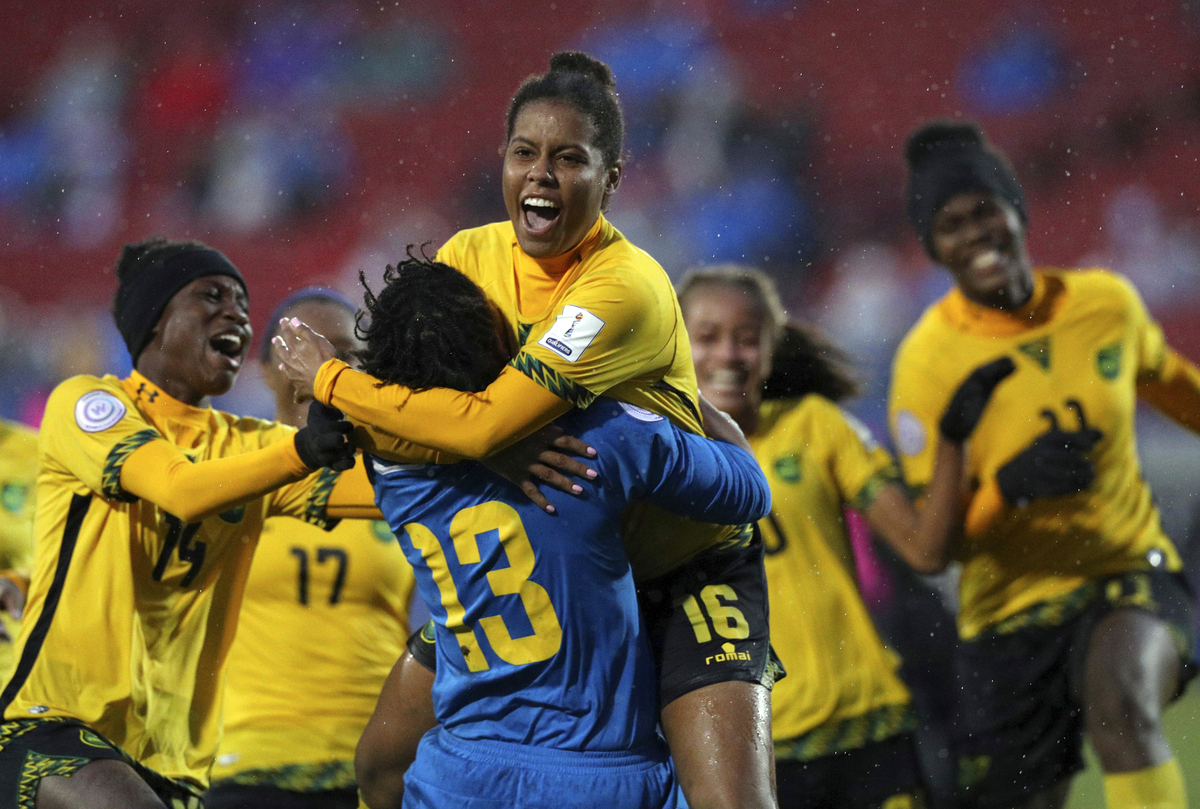
Jamaica’s Reggae Girlz celebrate winning a penalty kick shootout against Panama to advance to this year’s Women’s World Cup.
Richard W. Rodriguez/AP
hide caption
toggle caption
Richard W. Rodriguez/AP
The “Reggae Girlz” of Jamaica are the underdogs of this year’s Women’s World Cup.
The Jamaican women’s national soccer team debuts on Sunday, June 9 at the tournament in France against a highly-rated team from Brazil.
FIFA, soccer’s global governing body, ranks the Jamaicans the lowest among the 24 teams at the tournament. But don’t try to tell that to any of the players.
“Football is a very funny thing,” says Jamaican midfielder Deneisha “Den-Den” Blackwood. “You can never predict what’s going to happen. And I feel like we are going to be the team to shock everybody in this World Cup.”
Just five years ago, Jamaica didn’t even have a women’s national soccer team. Now they’re the first team from the Caribbean to ever qualify for a Women’s World Cup.
Last week, the Reggae Girlz, as the team calls itself, continued to make history, shattering attendance records in Scotland.
They were in Glasgow to play the Scottish women’s national team in a final warmup match before the month-long FIFA tournament, which started on June 7.
The event destroyed the attendance record for a Scottish national women’s team home game, attracting more than four times the previous record of 4,098 spectators. And the teams didn’t disappoint.
Jamaica went up early on a goal by their star forward, Khadija Shaw, who’s known by her nickname, Bunny.
Scotland, however, rallied — and in the end, won by a score of 3-2.
“It was a really good match,” says 24-year-old Natalie Lawrence, who was in the stands. She describes herself as “half-Jamaican, half-Scottish” and lives in Manchester. She’d heard about Shaw and seen some video highlights of her online — but says it was amazing to see “Bunny” play in person.
“She’s the best football player for Jamaica in a long time,” she says, gushing about the striker. “Shaw’s like ice-cold, slots that ball in. Can go one-on-one like it’s nothing. She knows what she’s doing. She’s absolutely quality.”
But Shaw and her teammates almost didn’t make it to the World Cup — not because they barely squeaked by Panama in the qualifiers but because just a few years ago Jamaica didn’t even have a national women’s soccer team.
The Jamaican Football Federation disbanded the Reggae Girlz after they failed to qualify for the 2015 World Cup in Canada. Then, after they were resurrected, the Federation suspended funding for them again while facing budget shortfalls in 2016.
“We are just happy to be here at this moment,” says Shaw after dinner at an event celebrating the team at a Caribbean restaurant in London last week. “We’ve worked hard for this. I don’t think a lot of people know what we’ve gone through behind the scenes.”
Shaw says over the last five years, the Jamaican women’s team has had to fight not just to survive but to fund their own training camps. The players didn’t have their own uniforms. Until recently, their head coach, Hue Menzies, was a volunteer. Prior to taking over the Jamaican women’s national team, Menzies was coaching teenage girls on a youth club team in Florida.
Jamaican star forward, Khadija Shaw, battles for the ball during a friendly match against Scotland in Jamaica’s last game before the Women’s World Cup.
Ian MacNicol/Getty Images
hide caption
toggle caption
Ian MacNicol/Getty Images
Shaw says it’s been very hard to pull together the resources that the Reggae Girlz need.
“We have talent. We’re very athletic. But talent can only go so far,” she says of the team’s financial woes. “That’s been us forever. You know.”
Even flying to Europe, the entire team’s reservation out of Florida was canceled because no one confirmed the tickets. The players got rebooked on flights that forced some of them to have to fly through Morocco to get to Scotland. Much of their luggage was lost and only arrived just before their game in Glasgow.
“We’ve faced a lot of setbacks and adversities so that’s nothing new to us,” Shaw says.
The person Shaw credits with turning the Jamaican national women’s football team around is Cedella Marley, the daughter of reggae star Bob Marley. In 2014, Marley, herself a singer, released a single “Strike Hard” to cover basic expenses for the team.
“We need to train. We need nutrition. We need gear. We need a ball,” Marley says.
Since releasing that single in 2014, Marley has become a tireless activist for the Jamaican female squad.
“For me everyone should have the right to go after their dreams and passions without gender being a factor,” she says.
But to Marley it was clear that when it came to the Reggae Girlz, gender was a factor.
In 2014, when the Jamaican Football Federation disbanded the team, the Federation continued to fund the men’s team even though the Reggae Boyz hadn’t qualified for a World Cup since 1998.

Players on the Jamaican women’s national soccer team credit Bob Marley’s daughter, Cedella, with saving the squad. The singer and entrepreneur spearheaded fundraising efforts for the Reggae Girlz after the team was disbanded in 2014.
Astrid Stawiarz/Getty Images
hide caption
toggle caption
Astrid Stawiarz/Getty Images
“I’m not here to say ‘Well the men got this and the men got that’ because they deserve to get all of that. They’re representing our country,” she says. “The only problem that I have is when you’re saying, ‘Well we can’t give that to the women because we don’t believe they’re going to be good. We don’t believe anybody will come to see them in the stadiums. We don’t believe anyone’s going buy a T-shirt so therefore…’ No! that wasn’t going to work for me.”
Marley spearheaded fundraising drives, badgered the Jamaican Football Federation for support and made it clear that she wasn’t going to put up with what she calls “outdated ideas” about women in football.
“Jamaica’s female athletes are at the mercy of corporate sponsors — many of whom still feel that women should stick to more ‘acceptable’ sports like swimming and netball and tennis. Which is fine. If they want to do [those sports], then give them the resources to do that. But if you have a group of girls who just want to play football, give them the resources to play football,” she says.
Jamaica, however, is nation of just 3 million people. It’s kind of as if Arkansas had somehow managed to qualify a team for the World Cup.
Adding to the Reggae Girlz challenges, soccer isn’t the most popular sport in Jamaica. This week, after the Jamaican men’s soccer team beat the U.S. in a friendly, The Gleaner newspaper in Kingston led its sports page not with the win but with a story about how the Windies cricket team is fit and ready to take on Australia.
Karen Madden, a sports reporter at The Gleaner, says Jamaican sports fans generally don’t pay much attention to soccer and are even less interested in women’s soccer than men’s. But she adds that this year’s band of Reggae Girlz has been changing that.
“Before they left Jamaica I saw those players with a group of little girls at Greenwich Farm primary school, an inner city school [in Kingston],” Madden says. “The awe and admiration I saw in those girls’ faces encapsulates what the Reggae Girlz have already done just qualifying for the World Cup, what they have done for this small nation of Jamaica.”
Despite not being a nation that normally embraces women’s soccer, Madden says Jamaicans are very proud that the Reggae Girlz have made it to the tournament in France.
“These are Jamaicans. Khadija Shaw is from a tough inner-city community. Jody Brown is from a rural town in St. Anne. A lot of players on the team are from humble beginnings,” she says. “And they are going to be playing on FIFA’s top stage.”
The Reggae Girlz have beaten the odds just to get to the Women’s World Cup, and Madden says she wouldn’t bet against them now.
The Women’s World Cup kicks off June 7 in Paris. The U.S. is once again the favorite and looking to defend its title from four years ago — even as the team sues U.S. Soccer for gender discrimination.