Court Rules Against Caster Semenya, Says She Must Lower Testosterone To Compete

South African Olympic champion Caster Semenya (center) and her lawyer, Gregory Nott (right), arrive for a hearing at the Court of Arbitration for Sport in Switzerland in February.
Harold Cunningham/AFP/Getty Images
hide caption
toggle caption
Harold Cunningham/AFP/Getty Images
The highest court in sports has ruled that the regulations adopted by track and field’s international governing body regarding women with high levels of testosterone are discriminatory but necessary to ensure fair competition in female athletics.
South African track star Caster Semenya and Athletics South Africa asked the Court of Arbitration for Sport to overturn regulations by the International Association of Athletics Federations that pertained to female athletes with high levels of testosterone.
The IAAF regulation in question requires female athletes with testosterone levels in the range of males to reduce their natural testosterone levels and to maintain that reduced level for at least six months to be eligible to compete in certain track and field events in international competition. The IAAF suggests this reduction be done by taking hormonal contraceptives, and it emphasizes that surgical changes are not required.
One of the events affected by the rule is the 800-meter race, an event won by Semenya at the 2012 and 2016 Olympic Games.
In a summary of its decision, the court wrote that its panel found that the IAAF’s relevant regulations are discriminatory because they impose differential treatment based on protected characteristics in that they “establish restrictions that are targeted at a subset of the female/intersex athlete population, and do not impose any equivalent restrictions on male athletes.”
However, the panel wrote, the IAAF argued “that if the purpose of the female category is to prevent athletes who lack that testosterone-derived advantage from having to compete against athletes who possess that testosterone-derived advantage, then it is necessarily ‘category defeating’ to permit any individuals who possess that testosterone-derived advantage to compete in that category.” The majority of the arbitration panel accepted that logic.
The IAAF said in a statement that it is “grateful” for the ruling “and is pleased that the Regulations were found to be a necessary, reasonable and proportionate means of achieving the IAAF’s legitimate aim of preserving the integrity of female athletics” in the events covered by the regulations.
In a statement released to The Associated Press and other outlets, Semenya wrote: “I know that the IAAF’s regulations have always targeted me specifically. For a decade the IAAF has tried to slow me down, but this has actually made me stronger. The decision of the CAS will not hold me back. I will once again rise above and continue to inspire young women and athletes in South Africa and around the world.”
The South African Sports Confederation and Olympic Committee criticized the decision. “We maintain that the rules are ill-thought and will be a source of distress for the targeted female athletes,” it said, according to the AP.
The court expressed concerns about how the regulations will work in practice, including the possibility that affected athletes may be unable to maintain a natural testosterone level below the required level on a consistent basis.
And the court noted how difficult the case was, involving “a complex collision of scientific, ethical and legal conundrums.”
The matter involves incompatible and competing rights, the court wrote: “Put simply, on one hand is the right of every athlete to compete in sport, to have their legal sex and gender identity respected, and to be free from any form of discrimination. On the other hand, is the right of female athletes, who are relevantly biologically disadvantaged vis-à-vis male athletes, to be able to compete against other female athletes and to achieve the benefits of athletic success. The decision is also constrained by the accepted, necessary, binary division of athletics into male events and female events, when there is no such binary division of athletes.”
The ruling means that Semenya would have to lower her testosterone levels to compete at upcoming meets, including the world championships in September.
Opinion: How Holzhauer Hacked ‘Jeopardy!’

Sports commentator Mike Pesca has his say on the unstoppability of Jeopardy! champion James Holzhauer.
London Marathon Takes A Small Step To Go Green
The BBC reports 47,000 plastic water bottles were tossed at last year’s race. This year, organizers gave runners edible water pods. They’re biodegradable because they’re made from seaweed.
DAVID GREENE, HOST:
Good morning. I’m David Greene. Eliud Kipchoge won the London Marathon yesterday for a fourth time. That’s a record, and that is amazing. And in other news, the marathon took a small step to go green. The BBC reports, last year, racers and onlookers tossed 47,000 plastic water bottles. This year, organizers tried to prevent a mess. They gave runners edible water pods. They’re biodegradable because they’re made from seaweed. The startup that makes them says they’re tasteless. It’s MORNING EDITION.
Copyright © 2019 NPR. All rights reserved. Visit our website terms of use and permissions pages at www.npr.org for further information.
NPR transcripts are created on a rush deadline by Verb8tm, Inc., an NPR contractor, and produced using a proprietary transcription process developed with NPR. This text may not be in its final form and may be updated or revised in the future. Accuracy and availability may vary. The authoritative record of NPR’s programming is the audio record.
NBA’s Lack Of Latino Players
Now that the NBA playoffs are in full swing, there’s an element missing: Latino players. Just 2% of NBA players are Latino and that has the league looking for ways to increase the number of Latinos.
NFL Returns To Site Of First Game
The big-city NFL returns to its roots by taking later rounds of the draft on the road, including to Rock Island, Ill., which in 1920 was host to the league’s first game.
SCOTT SIMON, HOST:
The NFL draft wraps up today. BJ Leiderman who writes our theme music hasn’t been selected yet. On this last day, the draft league is returning to its first field in the Mississippi River town of Rock Island, Ill. Benjamin Payne of member station WVIK reports.
BENJAMIN PAYNE, BYLINE: The first Super Bowl was in 1967 – the Green Bay Packers played the Kansas City Chiefs.
(SOUNDBITE OF ARCHIVED RECORDING)
UNIDENTIFIED PERSON: (As character) The Super Bowl is underway, and it is a short kick from Smith. Adderley at the six. Across the 10, running to his right…
PAYNE: But by then, the NFL was already nearly half a century old. It began in 1920 in this small town three hours west of Chicago, specifically here at Douglas Park – a 10-acre space with two baseball diamonds, one soccer pitch and no football fields. John Gripp is Rock Island’s Parks director and is walking the perimeter of Douglas Park. He stops at what looks like a couple of castle turrets made of white brick.
JOHN GRIPP: This is where you would have purchased your ticket and entered into Douglas Park to the NFL football game that took place in 1920.
PAYNE: The first NFL game that is. On September 26, 1920, the Rock Island Independents blew out the St. Paul Ideals 48-0. It’s hard to believe the hallowed ground is here in Rock Island – a town whose entire population of about 40,000 could fit into the Packers Lambeau Field and still leave 40,000 seats empty.
JASON AIKENS: Of all the NFL teams that played that year in 1920, Rock Island was the first.
PAYNE: That’s Jason Aikens the head curator at the Pro Football Hall of Fame in Canton, Ohio. He says the NFL launched in small town America because of pent up demand.
AIKENS: You know, I kind of trace it to these towns didn’t really have a college allegiance. They had athletic clubs. These small towns had kind of a local flavor of competition to them, and that’s kind of where professional football kind of grew up.
PAYNE: Even in these markets, revenue was scarce and payroll tight. Take the example of Rock Island Independents manager Walter Flanigan.
AIKENS: It’s kind of funny. He left the team to sell insurance, you know? And what (laughter) what often happen is these guys didn’t stay in pro football very long because it was too hard to make a living. People considered it as a hobby.
PAYNE: Chris Zimmerman (ph) likes to pretend to be one of those guys.
CHRIS ZIMMERMAN: So what you see is some of the jerseys that we have in here. The pants are really kind of shorter, but we wear the long socks. You have some leather helmets.
PAYNE: Zimmerman’s a financial planner by day and a vintage football enthusiast by night.
ZIMMERMAN: When you’re 53 years old, you can’t run very fast. (Laughter) You can’t throw. You’re not very good at catching a ball. Yeah, they let me hike the ball, and I try not to get run over. But that’s my specialty at this point.
PAYNE: Today, they’re going to recreate that very first game at a special NFL draft event in Rock Island. Zimmerman will be playing center for the Ideals. Do you plan on losing 48-0?
ZIMMERMAN: (Laughter) Forty-eight to 0. No, I hope we have a little bit better team.
PAYNE: Back then, football was largely a running game, passing was rare. At the Hall of Fame, curator Jason Aikens says coaches played it safe back then.
AIKENS: Oftentimes if, you know – if you were backed up in your own end zone, you would punt on third down. It was very much more conservative.
PAYNE: That conservative style extended to defense. You didn’t see the high-flying collisions of today’s game that have led to traumatic head injuries and other problems. As for the fan base, a turnout of 5,000 fans was considered a big crowd. These days average stadium attendance is just under 70,000 as millions watch on TV. The staggering growth is something Chris Zimmerman is thinking about as he gets ready to take the field.
ZIMMERMAN: If you go back to 1920 and those players that were playing in Douglas Park at that time, if they had any idea what this was going to grow to 100 years later, the stadiums, the amount of money and marketing and television and – I don’t think they could possibly imagine that their love of the game of, what they just like to do was every going to grow into anything this huge.
PAYNE: The Rock Island Independents folded in 1927, but Douglas Park’s legacy as the league’s old stomping ground remains.
For NPR News, I’m Benjamin Payne in Rock Island, Ill.
Copyright © 2019 NPR. All rights reserved. Visit our website terms of use and permissions pages at www.npr.org for further information.
NPR transcripts are created on a rush deadline by Verb8tm, Inc., an NPR contractor, and produced using a proprietary transcription process developed with NPR. This text may not be in its final form and may be updated or revised in the future. Accuracy and availability may vary. The authoritative record of NPR’s programming is the audio record.
Saturday Sports: Basketball, Basketball, Basketball
The NBA Western conference is narrowing down, and a legendary NBA great died this week. NPR’s Scott Simon talks with ESPN’s Howard Bryant.
SCOTT SIMON, HOST:
And, New Hampshire, America, it’s time for sports.
(SOUNDBITE OF MUSIC)
SIMON: The Western Conference is narrowing down. Warriors and Clippers last night, Celtics and Bucks tomorrow. I have to say, fear the deer. And more trouble in the NFL. Howard Bryant of ESPN joins us. Good morning, Howard.
HOWARD BRYANT, BYLINE: Good morning, Scott. We’re not going to talk “Endgame”?
SIMON: “Endgame,” you say, yes?
BRYANT: All right. We’ll talk “Endgame” next time.
SIMON: Oh, OK. The Warriors beat the Clippers last night, but they’re limping into the next round. And Houston and a scoring machine named James Harden await them.
BRYANT: Yeah. This is great, actually. One of the questions that we’ve been asking for however many years now is, can anybody beat the Warriors four times? And there is one team that came pretty close last year, and it was the Houston Rockets. And the Houston Rockets are – they want revenge. I think they know that if Chris Paul hadn’t gotten hurt last year, maybe they’d win that game. Of course, they also missed 27 consecutive 3-pointers at home in Game 7. So this is going to be a great series.
On the other hand, you’ve got Kevin Durant. And the Warriors got challenged in this postseason.
SIMON: Yeah.
BRYANT: They got challenged by a team that they probably should’ve steamrolled. They lost two games at home, so they look vulnerable. On the other hand, you’ve got the Celtics in the East, and the Bucks.
SIMON: Yep.
BRYANT: And the Bucks are the best team in basketball this year, but the Celtics beat them in seven games last year. So we’ve got a revenge series this year, and Milwaukee’s got home court.
You’ve got a Game 7 going on tomorrow as well with the Spurs and the Nuggets. And I think that’s going to be a phenomenal game because, once again, we talked about the Nuggets being great all season. And, in fact, at one point, they were the top seed in the West. But now they kind of look like a young team trying to find their way, going up against a legendary veteran Spurs team, or at least with the coach, Gregg Popovich.
SIMON: A sickening, sickening story in the NFL. Tyreek Hill of the Chiefs – and audio has been reported by a local station there, speaking with his fiancee about – oh, my God – abusing his young 3-year-old, breaking his arm. It is painful to listen to this conversation. The NFL – football’s a violent game. Do they have a violence problem in the game?
BRYANT: Well, they’ve had one, and this is one of the issues. It’s more – it’s not as much – not only a violence problem. Let’s not forget you had the Adrian Peterson child abuse issue.
SIMON: Yup.
BRYANT: You’ve had a bunch of domestic violence issues in the game. Let’s not forget that the Chiefs themselves – they had not just Tyreek Hill. They also had Kareem Hunt earlier – a few months ago, and on top of that, seven years ago, Jovan Belcher. And let’s not forget, in a murder-suicide, he killed his girlfriend and then drove to the Chiefs facility and killed himself on the grounds of the facility.
And so this is the problem. You’ve got a talent trap issue in the NFL where, I think, the organizations sort of know that these players – some of these players are troubled and they come with baggage, but they’re really, really talented. And I think that the teams take the position sometimes that, we’ll take a risk. We’ll position ourselves as the team that’s given these guys a second chance or taking an – giving them an opportunity, and then we’ll cut them loose.
SIMON: Yeah.
BRYANT: They don’t hold a whole lot of accountability unless something goes sideways. And then, when things go sideways, they seem to act like they’re the responsible ones, when everybody’s really responsible for this.
SIMON: We just got half a minute left. John Havlicek left us – one of the greats of the Boston Celtics.
BRYANT: Yeah.
(SOUNDBITE OF ARCHIVED RECORDING)
JOHNNY MOST: Greer’s putting the ball in play. He gets it out deep, and Havlicek steals it. Over to Sam Jones. Havlicek stole the ball.
SIMON: That’s his historic play.
BRYANT: Absolutely. And as a lifelong native Bostonian, this one hurts really, really hard. Part of the Celtic dynasty, part of the bridge between Larry Bird and Bill Russell. And if you remember those teams – and let’s not forget what a great player John Havlicek was. We forget what happens last Tuesday. When John Havlicek retired, there were only two players who had scored more points than him, and that was Wilt Chamberlain and Oscar Robertson. And he never led the league in scoring. Total player, great person, and a huge loss.
SIMON: Howard Bryant of ESPN, thanks so much.
BRYANT: Thank you.
Copyright © 2019 NPR. All rights reserved. Visit our website terms of use and permissions pages at www.npr.org for further information.
NPR transcripts are created on a rush deadline by Verb8tm, Inc., an NPR contractor, and produced using a proprietary transcription process developed with NPR. This text may not be in its final form and may be updated or revised in the future. Accuracy and availability may vary. The authoritative record of NPR’s programming is the audio record.
Tyreek Hill Barred From Kansas City Chiefs After Audio Alleging Child Abuse Surfaces
The Kansas City Chiefs have barred Tyreek Hill from the team. This follows a recording of the wide receiver’s fiancée accusing him of abusing their young child.
Boston Celtics Great And Hall Of Famer John Havlicek Dies At 79
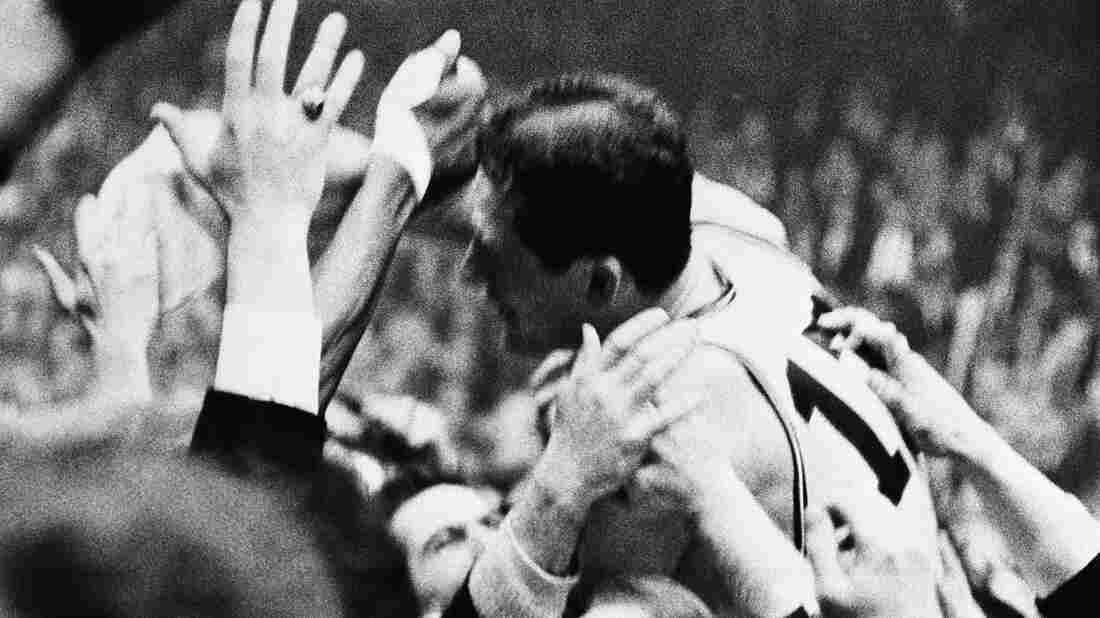
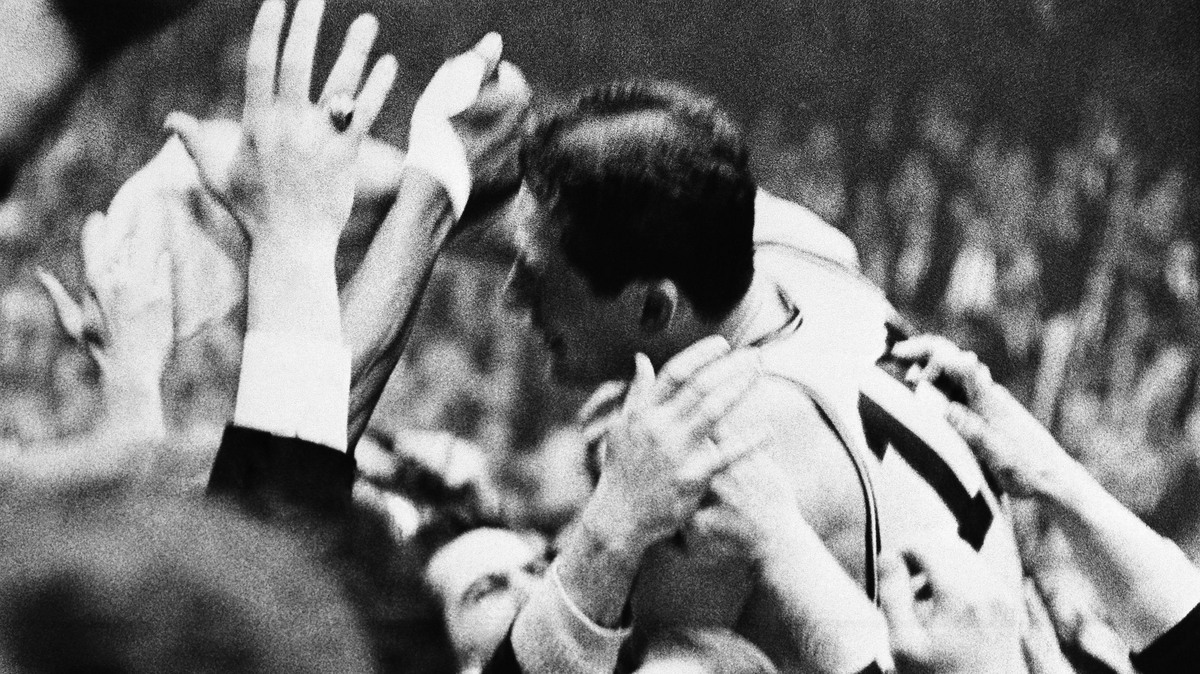
John Havlicek is mobbed by fans after the Celtics defeated the Philadelphia 76ers to win Game 7 of the 1965 Eastern Conference final. Havlicek intercepted a Philadelphia inbounds pass in the last seconds of the game.
AP
hide caption
toggle caption
AP
The Boston Celtics drafted John Havlicek in 1962, and he played for the team for 16 seasons — eight of them as NBA champions. He was voted one of the 50 greatest players in NBA history.
Havlicek died Thursday in Jupiter, Fla., at age 79. The cause of death wasn’t immediately available, but Boston media report he had Parkison’s disease.
It is with great sadness we have learned that Celtics Legend and Hall of Famer John Havlicek has passed away peacefully today at the age of 79. He will be dearly missed by his Celtics family.
A statement from the Celtics: https://t.co/yqOkZPkbej pic.twitter.com/xlUCKjbKvg
— Boston Celtics (@celtics) April 26, 2019
The Celtics released a statement honoring Havlicek:
“John Havlicek is one of the most accomplished players in Boston Celtics history, and the face of many of the franchise’s signature moments,” the statement read. “He was a champion in every sense, and as we join his family, friends, and fans in mourning his loss, we are thankful for all the joy and inspiration he brought to us.”
During his NBA career, Havlicek scored 26,395 points in 1,270 games. He set Celtics career records for points and games. He was the first player to score 1,000 in 16 consecutive seasons.
Havlicek played in 13 NBA All-Star Games, and was enshrined in the Naismith Memorial Basketball Hall of Fame in 1984. And during his college career at Ohio State, he helped the Buckeyes win the 1960 national championship.



Former Ohio State basketball player John Havlicek talks about his career during a National Collegiate Basketball Hall of Fame induction event Friday, Nov. 20, 2015, in Kansas City, Mo.
Colin E. Braley/AP
hide caption
toggle caption
Colin E. Braley/AP
For all his outstanding efforts on the court, the 6-foot-5 Havlicek may be best known for his steal during the closing seconds of Game 7 of the 1965 Eastern Conference championship against the Philadelphia 76ers.
He stole Hal Green’s inbounds pass to Sam Jones. As the game ended in a win for Boston, Celtics radio announcer Johnny Most screamed, “Havlicek stole the ball!”
The immortalized play sent the Celtics to a ninth consecutive NBA finals, and Most’s call lives on in highlight reels.
In 1978, when Havlicek retired from the Celtics, his jersey, No. 17, was retired too.
He occasionally returned to Ohio State for reunions of the championship team and Celtics events. His Ohio State number was retired during ceremonies in the 2004-2005 season.
Havlicek remained in Boston after his retirement and later split his time between New England and Florida.
Former teammates and friends Tom Heinsohn and Bob Cousy told the Boston Herald that “Havlicek had suffered from an aggressive strain of Parkinson’s disease for about the last three years, and that he recently took a turn for the worse.”
The paper reports that according to Cousy, “Havlicek caught pneumonia after a bad fall three weeks ago, when doctors decided to put him in an induced coma. The family Thursday put Havlicek into hospice, and he died shortly thereafter.”
“Havlicek was part of a Thursday night dinner group that always convened at Cousy’s country club in Florida,” the Herald reports. “When Havlicek and his wife Beth failed to show up three weeks ago, Cousy knew something was wrong.”
2019 NFL Draft Could Be Big For Tight Ends
Thursday is draft day for the National Football League. Two tight end players from Iowa are predicted to be drafted in the first round, breaking a long tradition in a changing game.
Damian Lillard Leads Portland Trail Blazers To Victory In First Round Of NBA Playoffs
One player has excelled in the NBA playoffs: Damian Lillard. The all-star point guard has carried the Portland Trail Blazers all season thanks to his play and, more importantly, his leadership.