Feast Fit For A Burger King: Trump Serves Fast Food To College Football Champs


President Trump talks to the press about the table full of fast food laid out in the State Dining Room of the White House for a reception for the Clemson Tigers.
Susan Walsh/AP
hide caption
toggle caption
Susan Walsh/AP
It’s a scene often observed in the White House. Men in bow ties light golden candelabras while the president of the United States stands behind a table containing small mountains of food on silver trays.
So far, so good.
But look closely, and you’ll see the labels on the packages: “Quarter Pounder.” “Filet-O-Fish.” Chicken nugget dipping sauces sit in serving bowls off to the side. Behind the current president, Abraham Lincoln looks down, his hand on his chin, surveying the scene.
If only paintings could offer witty commentary.
In this case, we’ll have to rely on late night comedians and Twitter observers, who roundly ridiculed President Trump for the feast he provided for the Clemson Tigers. Clemson beat No. 1 ranked Alabama to take the College Football Playoff National Championship and might have expected that a visit to the White House would command a dinner befitting a champion. Instead, the Tigers got a dinner befitting a drive-through customer — granted, on fancier plates.
Here’s a video I shot of President Trump showing off his 300 hamburgers. pic.twitter.com/P06S6I5w07
— Hunter Walker (@hunterw) January 14, 2019
“I think we’re going to serve McDonald’s, Wendy’s and Burger King with some pizza,” Trump told reporters beforehand. “I really mean it. It would be interesting. And I would think that’s their favorite food.”
Because of the shutdown, most of the staff in the White House residence had been furloughed, so Trump paid for the meal himself, he said.
Great being with the National Champion Clemson Tigers last night at the White House. Because of the Shutdown I served them massive amounts of Fast Food (I paid), over 1000 hamberders etc. Within one hour, it was all gone. Great guys and big eaters!
— Donald J. Trump (@realDonaldTrump) January 15, 2019
But Trump’s magnanimity did not spare him from the biting tongue of Twitter.
Cold McDonald’s on expensive plates could not be any more perfect a representation of Trump.
— Jill (@JillChristinaWV) January 14, 2019
Commenting on a picture of the president posing with his hands wide in front of the feast, television writer Jess Dweck said: “This is the news photo that would make a returning time traveler realize they f***** something up.”
Catering a White House event with 300 fast food burgers would be a setpiece in a movie where a kid becomes president
— Nick Wiger (@nickwiger) January 14, 2019
“Great American food!” Trump told reporters at an informal news conference before the meal. “And it could be very interesting to see at the end of this evening how many are left.” He declined to say whether he prefers McDonald’s or Wendy’s. “I like ’em all. If it’s American, I like it.”
Hey Clemson! Congrats on the game, AND the diarrhea!!
— Matt Braunger (@Braunger) January 15, 2019
Toward the end of his remarks, Trump pivoted to more traditional talking points. “We need border security,” Trump said. “We have to have it. No doubt about it. It should have happened 30 years ago, 20 years ago, 10 years ago. And it’s gonna happen now.”
Perhaps befitting Trump’s hard stance on the southern border, it is not clear whether tacos were served at the gathering.
Happy #CincoDeMayo! The best taco bowls are made in Trump Tower Grill. I love Hispanics! https://t.co/ufoTeQd8yA pic.twitter.com/k01Mc6CuDI
— Donald J. Trump (@realDonaldTrump) May 5, 2016
Kyler Murray Is Top-Notch. Will He Pursue: Baseball Or Football?

David Greene talks to ESPN’s Jeff Passan about Kyler Murray, a top-draft pick by baseball’s Oakland A’s. After a Heisman Trophy-winning year as a college quarterback, he’s entered the NFL draft too.
Live From Los Angeles: Can Sports Make A City?

Los Angeles has a busy couple of years coming up. The city is slated to host the Olympics in 2028, potentially will hold some of the World Cup in 2026 and a second National Football League team now calls the city its home — the Chargers, formerly of San Diego.
Officials often claim sports are boons for the local economy, due to the influx of tourists and infrastructure improvements. But is that actually true?
From The New York Times:
But there is strikingly little evidence that such events increase tourism or draw new investment. Spending lavishly on a short-lived event is, economically speaking, a dubious long-term strategy. Stadiums, which cost a lot and produce minimal economic benefits, are a particularly lousy line of business. (This is why they are usually built by taxpayers rather than by corporations.)
However, Los Angeles has a history of making these events worth it. In 1984, the city avoided building new stadiums for the Olympics. And Curbed Los Angeles reports that those Games actually helped solve one thing that plagues Angelenos — traffic.
We’re weighing the costs and benefits of major sporting events, in a special edition of 1A, live from KPCC.
Why Kansas City Chiefs' Jeff Allen Nearly Missed Saturday's Game
The offensive lineman’s car got stuck in the snow, The Associated Press reports. Allen tweeted a “nice guy named Dave” rescued him. He asked for help finding Dave so he could get him playoff tickets.
DAVID GREENE, HOST:
Good morning. I’m David Greene. The Kansas City Chiefs won on Saturday, but as the AP reports, offensive lineman Jeff Allen nearly missed the game. His car got stuck in the snow. Allen tweeted that a nice guy named Dave rescued him. He asked for help finding Dave so he could get him playoff tickets. Allen said he tracked him down, despite all the people around town who suddenly changed their name to Dave. I’ll tell you, as people in our plight know, the world has plenty of Daves already. It’s MORNING EDITION.
Copyright © 2019 NPR. All rights reserved. Visit our website terms of use and permissions pages at www.npr.org for further information.
NPR transcripts are created on a rush deadline by Verb8tm, Inc., an NPR contractor, and produced using a proprietary transcription process developed with NPR. This text may not be in its final form and may be updated or revised in the future. Accuracy and availability may vary. The authoritative record of NPR’s programming is the audio record.
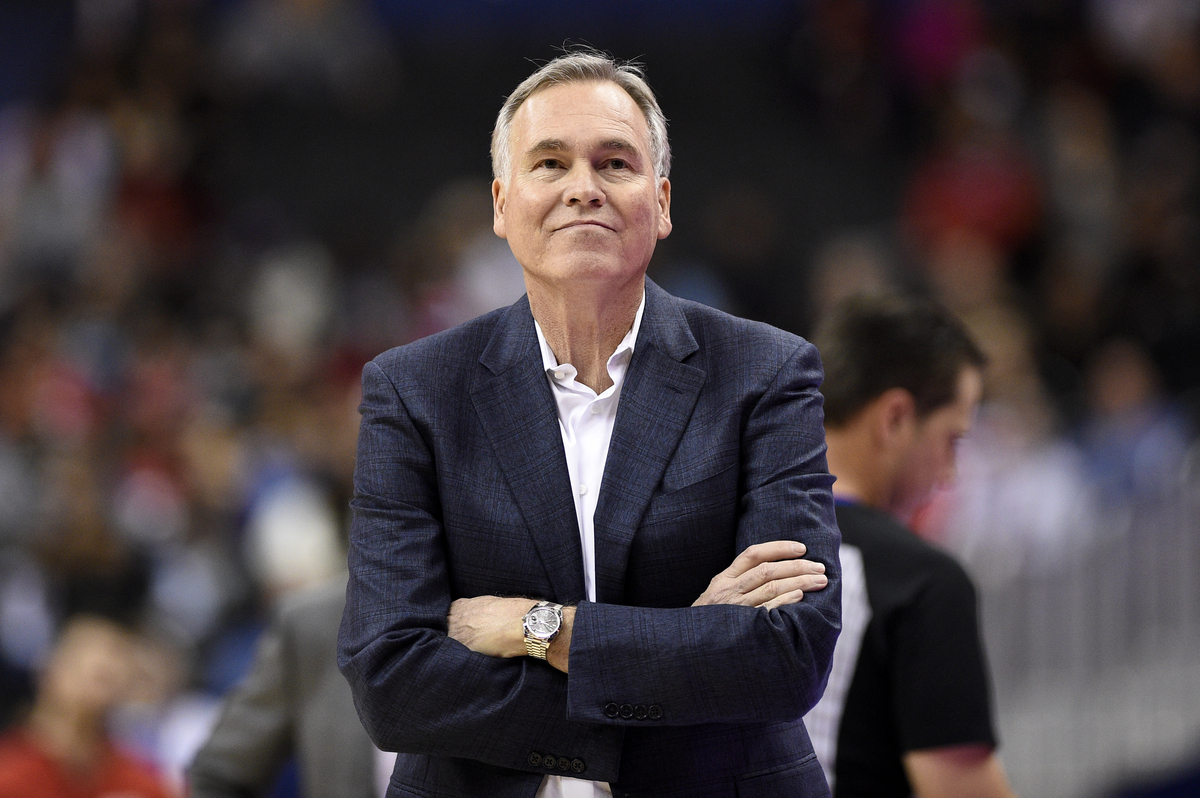
Not My Job: We Quiz NBA Coach Mike D'Antoni On Mike, Dan And Tony

Nick Wass/AP
We’ve invited Mike D’Antoni, head coach of the Houston Rockets, to answer three questions — one question about Michael Jordan, one question about Dan Quayle, and one question about Tony the Tiger.
Click the audio link above to see how he does.
PETER SAGAL, HOST:
And now the game where successful people find out what it’s like to not know why you’re even playing. It’s called Not My Job. Mike D’Antoni is a former NBA player, a star in the Italian basketball league and, for 16 years, a head coach in the NBA with the Phoenix Suns, LA Lakers, New York Knicks and now the Houston Rockets. He was the 2017 NBA coach of the year. And he joins us now.
Coach Mike, welcome to WAIT WAIT… DON’T TELL ME.
MIKE D’ANTONI: Thanks, guys.
(APPLAUSE)
SAGAL: It’s a pleasure to have you. So, first of all, how’s the Rockets doing? Are you satisfied with how the season is going?
D’ANTONI: We’re doing better now. We had a rough start – a lot of injuries and some problems. But, you know, the ship is going pretty good right now.
SAGAL: I’m glad to hear it. Now, are you a guy who feels the progress of your team emotionally? Do you get upset when it’s going poorly? Do you feel elated when it’s going well?
D’ANTONI: Yeah. I mean, you know, I think we’re all in this business especially because we want to compete. And you get emotionally invested in the players and the fans. And…
SAGAL: Yeah.
D’ANTONI: You know, I’ve been in the fetal position a lot of times on the couch – that’s for sure.
SAGAL: Really?
(LAUGHTER)
SAGAL: Not on the bench, though. That would be funny…
PAULA POUNDSTONE: Yeah.
SAGAL: …If they panned over to you – you were lying there.
D’ANTONI: …Would like me to do that.
SAGAL: What’s it like getting to watch James Harden play every night?
D’ANTONI: Special.
SAGAL: Yeah.
D’ANTONI: He’s the real deal.
SAGAL: Yeah.
D’ANTONI: And it’s – you know, he’s better than what most people think. He’s is the best I’ve seen.
SAGAL: For people who don’t know, James Harden is known for his extraordinary offensive play and also for his amazing beard.
D’ANTONI: Yeah.
SAGAL: Have you ever had to talk to him about the beard? Like, dude, nobody can see your uniform number. You need to…
D’ANTONI: No, most of the time it’s, like, you know, you’ve got egg in there. Or you’ve got…
(LAUGHTER)
SAGAL: Is part of your duties as head coach, like…
D’ANTONI: Yeah.
SAGAL: …Picking the nits out of James Harden’s beard?
(LAUGHTER)
D’ANTONI: Sometimes, that’s my only duty.
(LAUGHTER)
SAGAL: He seems pretty serious. Are you allowed to tease him about his beard?
D’ANTONI: Very carefully.
SAGAL: Yeah, I know.
(LAUGHTER)
SAGAL: So when did you figure out that you could be a coach in this league?
D’ANTONI: I’m – when I’m 39 years old, and I’ve retired from playing, and I’m looking around and going, now what? And so it’s, like, you know, I had really good teams in Europe, and I got lucky. And, like anybody else, it’s just being in the right spot at the right time. And I went back and started coaching the NBA.
POUNDSTONE: Do you have, like, psychological techniques that you use?
D’ANTONI: (Laughter) No. No.
(LAUGHTER)
D’ANTONI: No. That would mean that I would have to be and the players would have to be smart, so we’re not. No, we’re just…
(LAUGHTER)
LUKE BURBANK: Coach, you’re known for a really up-tempo style. Do players like playing for you because of that? Or is it exhausting for them?
D’ANTONI: No. No. It’s – you know, I think they like it. There’s been some that haven’t liked it. And, obviously, I’ve been to different cities. I’ve been fired a few times, so there’s a lot of players don’t like that.
SAGAL: No. No. They don’t like being fired or they don’t like when you get fired?
D’ANTONI: No, they get me fired.
SAGAL: Oh, I see.
(LAUGHTER)
D’ANTONI: I always think they didn’t like to play the way I wanted to play.
SAGAL: Well, that to me is interesting because you’re coaching incredibly well-paid, incredibly talented athletes who have been at the pinnacle of their sport for probably their entire careers. Like, everybody in the NBA was a superstar the moment they got there.
D’ANTONI: Yeah.
SAGAL: How do you handle people like that who are the stars of the league?
D’ANTONI: Well, there’s a lot of groveling and begging and pleading.
SAGAL: Right.
POUNDSTONE: Well, I think, then, that you need to have some psychological techniques.
D’ANTONI: There you go.
(LAUGHTER)
SAGAL: So seriously, how do you – if James Harden, say, or Chris Paul – both superstars – if you want them to do something they’re not doing, or you want them to do something better or different, how do you do that?
D’ANTONI: We work together, and I give my experience in there. And we’re very analytic-based now, so a lot of it is data driven where they can see that it makes sense.
SAGAL: Right.
POUNDSTONE: Give me an example of a time where a problem is solved by data.
D’ANTONI: Well, you have a player that shoots primarily two-point shots instead of three-point shots. So I’m not going to get too technical, but I can show them some of the data that shooting that shot there is not as effective as shooting the three-point, so you have to…
POUNDSTONE: Wait a minute – but they don’t know that three points is…
D’ANTONI: Well…
POUNDSTONE: …Higher than two points?
(LAUGHTER)
D’ANTONI: Hey, it’s taken about 20 years for the NBA to figure that out.
(LAUGHTER)
POUNDSTONE: Yeah.
SAGAL: Wait a minute…
SAGAL: Yeah.
BURBANK: Coach, I’m on a YMCA men’s team in…
(LAUGHTER)
BURBANK: …Washington.
D’ANTONI: Good.
POUNDSTONE: Yeah. Well, you want to go for the three points.
D’ANTONI: That’s a good start.
BURBANK: Yeah. We’re called the Sledge Hogs. You’ve probably heard of us.
(LAUGHTER)
D’ANTONI: Yeah.
BURBANK: I didn’t name the team.
D’ANTONI: We have scouts there most of the nights.
BURBANK: Yeah.
SAGAL: Yeah.
(LAUGHTER)
BURBANK: We lost a game this week by 49 points.
(LAUGHTER)
BURBANK: Do you have any advice for us as how to be a better team?
D’ANTONI: (Laughter) Well, start scoring more points.
SAGAL: Yeah, I know.
(LAUGHTER)
BURBANK: Is three points more than two points?
(LAUGHTER)
D’ANTONI: Yes, three.
BURBANK: OK.
D’ANTONI: Shoot threes.
SAGAL: The biggest cliche of every sports movie any of us have ever seen is the halftime motivational speech, right?
D’ANTONI: (Laughter) Yeah, that’s great.
SAGAL: Yeah.
(LAUGHTER)
POUNDSTONE: Do you give that?
D’ANTONI: No (laughter).
SAGAL: Really?
D’ANTONI: Most of the time I’m – like I said, I’m in that fetal position. They’re giving me the speech.
SAGAL: Really?
(LAUGHTER)
D’ANTONI: Yeah.
SAGAL: Well, coach, it is great to have you with us. We have invited you here today to play our game. And we call it…
CHIOKE I’ANSON: Mike D’Antoni, meet Mike, Dan and Tony.
SAGAL: Since your name is built out of three first names, much like a transformer – Mike, Dan, and Tony…
D’ANTONI: Right.
SAGAL: …We thought we’d ask you one question each about a Mike, a Dan and a Tony.
(LAUGHTER)
D’ANTONI: All right.
SAGAL: If you get two right – could be a Dan and Mike, could be a Tony and Dan, could be a Tony and Mike – if you do any of those, you’ll win our prize for one of our listeners – the voice of their choice from our show. Chioke, who is coach Mike D’Antoni playing for?
I’ANSON: Jim Hogan of Geneva, N.Y.
SAGAL: All right. You ready to play?
D’ANTONI: Oh, yeah.
SAGAL: Oh, yeah. Here we go. First up, Michael Jordan – you may have heard of him – he remains the world’s most famous Mike. He was so famous during his heyday that you could find which of these? A, a shrine to him in the palace of North Korean dictator Kim Jong Il; B, a megachurch in Lebanon thta believed he was the Messiah; or C, the be like Mike diet book, which recommended you consume only Gatorade and expensive cigars.
(LAUGHTER)
D’ANTONI: I’m probably going with the shrine in North Korea just because Dennis Rodman solved our problems there, right?
SAGAL: You’re right. You’re exactly right.
(SOUNDBITE OF BELL)
SAGAL: It turns out that Kim Jong Un got his love of the great Bulls teams of yesteryear…
D’ANTONI: Yeah.
SAGAL: …From his father, Kim Jong Il. So Kim Jong Il, the dictator, had a shrine to Michael Jordan. All right. Next up is Dan. One of the most famous Dans in American history was Vice President Dan Quayle.
(LAUGHTER)
SAGAL: He’s remembered now mostly for misspelling the word potato and for not being Jack Kennedy. But he also said many memorable things during his time in the public light, including which of these? A, quote, “I have made good judgments in the past. I have made good judgments in the future…”
(LAUGHTER)
SAGAL: …B, quote, “I believe we are on an irreversible trend towards more freedom and democracy. But that could change…”
(LAUGHTER)
SAGAL: …Or C, quote, “The Holocaust was an obscene period in our nation’s history. No, not our nation’s, but in World War II. I mean, we all lived in this century. I didn’t live in this century – but in this century’s history,” unquote.
(LAUGHTER)
D’ANTONI: Do you have D, all of the above?
(LAUGHTER)
SAGAL: That’s actually right. I’m going to give it to you.
(SOUNDBITE OF BELL)
SAGAL: He said all of those things.
(APPLAUSE)
SAGAL: The last up is Tony. So one of the most famous Tonys, of course, is Tony the Tiger.
(LAUGHTER)
SAGAL: Tony the Tiger, the cereal spokes-animal, has fans around the world. They can get a little out of hand, though, such as when which of these actually happened? A, a group of people started raising money to save tigers from, they said, being harvested to make Frosted Flakes…
(LAUGHTER)
SAGAL: …B, Tony the Tiger went on Twitter to ask furries to please stop sending him anthropomorphic erotica…
(LAUGHTER)
SAGAL: …Or C, somebody invented a language called Tony-talk, which is English, but you growl every R?
(LAUGHTER)
D’ANTONI: I’m going with B.
(LAUGHTER)
SAGAL: You’re exactly right…
(SOUNDBITE OF BELL)
SAGAL: …Coach.
(APPLAUSE)
SAGAL: This happened a couple years ago. Lots of people were tweeting inappropriate things to Tony the Tiger, so he tweeted, quote, “I’m all for showing your stripes, feathers, et cetera but let’s keep things great and family friendly if you could. Cubs could be watching.” Chioke,
how did coach Mike D’Antoni do on our quiz?
I’ANSON: Nothing but net – Mike got three out of three.
SAGAL: Congratulations, coach.
(APPLAUSE)
SAGAL: Mike D’Antoni, coach of the Houston Rockets. Coach Mike, thank you so much for joining us on WAIT WAIT… DON’T TELL ME.
(SOUNDBITE OF SONG, “ROCKET TO NOWHERE”)
WEBB WILDER: (Singing) I’m on a rocket to nowhere. Rocket to nowhere.
SAGAL: In just a minute, we get intimate with a bicycle in our Listener Limerick Challenge game. Call 1-888-WAIT-WAIT to join us on the air. We will be back in a minute with more of WAIT WAIT… DON’T TELL ME from NPR.
Copyright © 2019 NPR. All rights reserved. Visit our website terms of use and permissions pages at www.npr.org for further information.
NPR transcripts are created on a rush deadline by Verb8tm, Inc., an NPR contractor, and produced using a proprietary transcription process developed with NPR. This text may not be in its final form and may be updated or revised in the future. Accuracy and availability may vary. The authoritative record of NPR’s programming is the audio record.
A Critic Of Turkey, The Knicks' Enes Kanter Speaks Out About His Fears For His Life


New York Knicks center Enes Kanter has been a vocal critic of Turkish President Recep Tayyip Erodgan.
David Zalubowski/AP
hide caption
toggle caption
David Zalubowski/AP
Last time the New York Knicks played the Washington Wizards, Enes Kanter scored 18 points.
For their next game, he won’t be there to score any.
Kanter recently announced he won’t be joining the Knicks on Jan. 17 when they’ll play the Wizards in London as part of the NBA’s Global Games series because he fears for his safety.
Kanter is from Turkey and has been an avid critic of Turkish President Recep Tayyip Erdogan. He says if he travels to London, he fears agents of the Turkish government might kill him.
“The Turkish government is very famous for hunting down those who oppose Erdogan … I just didn’t really want to risk my life by going to Europe where Erdogan’s long arms are everywhere,” he said in an interview with NPR’s Scott Simon.
Kanter said that in the past few days, he has gotten “hundreds of death threats.” He said if he did travel to London, he would only be able to go to practice, the game and his hotel, with security around him 24/7.
In 2017, Kanter was detained in Romania after Turkey revoked his passport, but was quickly released. Turkish prosecutors wanted him extradited to Turkey on charges brought after he tweeted statements critical of Erdogan in 2016. Prosecutors also accused him of being part of a terror group due to his support for the Gulen movement, a social movement led by cleric Fethullah Gulen, who Erdogan has blamed for a failed coup against him in 2016. Turkey has sought Gulen’s extradition from the U.S., where he now lives.
Kanter said his father was also indicted in Turkey last year and accused of being part of a terrorist organization. He was in jail for seven days before being released after mounting pressure from Kanter and his supporters in the U.S. Kanter said he currently does not speak to his family for fear they will be arrested.
Former Turkish NBA player Hedo Turkoglu, a senior advisor to Erdogan who Kanter said he was once friends with, tweeted that the Knicks center can no longer travel to many countries due to visa issues. He called Kanter’s remarks part of a “political smear campaign Kanter has been conducting against Turkey.”
“He is trying to get the limelight with irrational justifications and political remarks,” Turkoglu said in a tweet.
However, Kanter responded by tweeting an alleged travel document to show he can travel to London if he wants.
“I love my country and I hope when all of the things are done, I want to go back to my country to see my family. But about Erdogan, he is an authoritarian leader who jails journalists and opposition,” Kanter said.
Since the failed coup, authorities have arrested and detained thousands of individuals on charges of supporting the coup. Human Rights Watch has described the government’s crackdown as “symptomatic of the government’s increasing authoritarianism.”
“I’m an NBA player and I have a big platform so I’m trying to use this platform to be the voice of all the innocent people who don’t have a voice … my family is still back in there and they are getting lots of threats too but I have to do this for all those innocent people,” Kanter said.
Sophia Boyd and Ed McNulty produced and edited this story for broadcast.
Lindsey Feingold is the NPR Digital Content intern.
Saturday Sports: NBA Western Conference Superteams
NPR’s Scott Simon speaks with ESPN’s Howard Bryant about which teams will make the NBA postseason.
SCOTT SIMON, HOST:
I’m glad to know it’s time for sports.
(SOUNDBITE OF MUSIC)
SIMON: Are the Warriors finally a little weary three months into the NBA season? Golden State isn’t even in first place – whatever that means – when it comes to the playoffs. Howard Bryant of ESPN The Magazine and espn.com joins us. Howard, thanks so much for being with us.
HOWARD BRYANT, BYLINE: Good morning, Scott.
SIMON: Howard, 14 out of the 15 teams in the Western Conference have a real chance to make the postseason. So does B.J. Leiderman, who writes our theme music…
BRYANT: (Laughter).
SIMON: I wouldn’t rule him out. Any event, the Denver Nuggets are on top. They have 28 wins. Is this what they call parity?
BRYANT: It is. This is one of the most even seasons that I’ve seen in a very long time. Obviously, since 2015, the NBA season has broken down to one question, which is, can anybody beat the Golden State Warriors four times? We saw it happen once. Lebron James did it, and that was it. Everything else…
SIMON: Yeah.
BRYANT: …Has been Golden State, Golden State and especially – and the fact that the Warriors lost that championship the year they won 73 games. So even that year, they controlled everything. This year, it’s totally different. This year, the Kawhi Leonard-led Toronto Raptors have 32 wins, the most wins in basketball. The Warriors have 14 losses, which is – now I think it’s the fourth-best record in the league. So, at the end of the day, do I still think when we get down to April that the Warriors are going to find a way to turn it on? I still think they’re the best team, but this is really interesting stuff. This is not – if it goes the way it’s going so far, I don’t think you can start the playoffs and just expect anyone to win.
SIMON: Let’s talk about parity at the top of the East. You mentioned Toronto. I will drag in Milwaukee. Fear…
BRYANT: Milwaukee, exactly…
SIMON: Fear the deer…
BRYANT: Milwaukee may be the best team. They may be the best team. And they’ve got Giannis Antetokounmpo, and he may be the best player in the NBA. He’s been – could win the MVP the way things are going this year. And don’t be…
SIMON: And Indy, Boston, Philly.
BRYANT: And exactly right, exactly right. And the Celtics were supposed to run away with the thing, and they’re in fifth place. So, once again, there’s nobody out there. And San Antonio was playing great in the West. And so…
SIMON: Yeah.
BRYANT: …This is what it’s supposed to be. We say we want this. We say we want – we don’t want there to be this one team that goes out and crushes everybody. And what I really enjoy about the NBA this year is that it’s not forced. It’s not fake. You’ve got really good teams out there that are playing great basketball.
SIMON: Yeah. I want to ask you about the Cleveland Cavaliers.
BRYANT: Why? Why do you want to ask me about the Cleveland Cavaliers?
SIMON: Well, they’ve won eight games, darn it – eight games. They’ve lost 35. It’s a rebuilding year along…
BRYANT: (Laughter).
SIMON: …You know, along Lake Erie. So I’ve got an idea I want to try on you, OK?
BRYANT: Sure.
SIMON: Why not let the NBA – why not have the NBA let the Cavs have seven players on court just…
BRYANT: When everybody else has five.
SIMON: Yeah. Exactly. What do you think?
BRYANT: I think the reason why they wouldn’t do that is because they know deep down in their heart of hearts it wouldn’t make any difference.
SIMON: You have a pick for…
BRYANT: (Laughter).
SIMON: You know, you’re sadly right. Anyone to watch for MVP in particular?
BRYANT: Well, I think Giannis is the MVP, but James Harden is having, once again, another great statistical year. I think that Kawhi Leonard is the leader of the Toronto Raptors. It would not surprise me at all. If they go anywhere deep into the playoffs, I think he’s going to be the MVP. Or I think there are a lot of good players. I’m a Kawhi Leonard guy, but Giannis is probably the guy.
SIMON: OK. Howard Bryant of ESPN The Magazine and espn.com, thanks so much for being with us.
BRYANT: Thank you.
Copyright © 2019 NPR. All rights reserved. Visit our website terms of use and permissions pages at www.npr.org for further information.
NPR transcripts are created on a rush deadline by Verb8tm, Inc., an NPR contractor, and produced using a proprietary transcription process developed with NPR. This text may not be in its final form and may be updated or revised in the future. Accuracy and availability may vary. The authoritative record of NPR’s programming is the audio record.
Bernice Sandler, 'Godmother' Of Title IX, Dies At 90
Bernice Sandler, who had a major hand in creating and helping pass Title IX legislation, has died at 90. The landmark federal civil rights law ensures gender equality in education and athletics.
Father And Son, Who Are African-Americans, Discuss Racism In Youth Hockey
At a recent ice hockey tournament, the teammates of a 13-year-old African-American player rallied around him, after they saw that he was being subjected to racist abuse from the opposing team.
Eagles' Defeat Of The Bears Revives The Question: Does Icing The Kicker Work?
The Chicago Bears kicker missed a game-winning field goal Sunday night, after the Eagles called time-out. NPR’s Audie Cornish talks with economist Toby Moskowitz about the practice of icing a player.
AUDIE CORNISH, HOST:
Last night, the Chicago Bears fell victim to one of the most debated tricks in the coaching book – icing the kicker. Here’s what happened. With seconds to go in their NFL playoff game against the Philadelphia Eagles, Bears kicker Cody Parkey lines up for a field goal. They’re down by one, so the game is riding on this kick, OK? The ball is snapped. The kick goes up and sails through the uprights, except that it doesn’t count. The NBC announcers don’t sound surprised. They know exactly what happened.
(SOUNDBITE OF ARCHIVED RECORDING)
AL MICHAELS: Doug Pederson knowing – yep, getting that timeout just before the snap.
CORNISH: The Eagles’ coach called a timeout right before the play. That’s icing the kicker. It’s supposed to rattle his nerves, get in his head. So Cody Parkey has to do it over again. And this time, the announcers are surprised.
(SOUNDBITE OF ARCHIVED RECORDING)
MICHAELS: And – oh, he hits the upright again. That’s impossible.
CORNISH: Ouch – the kick bounces out. Bears lose. Eagles win. A debate is reignited because people keep talking about this idea. Does icing the kicker work? Well, joining us now is Toby Moskowitz. He investigated this question in his book “Scorecasting.” Welcome to ALL THINGS CONSIDERED.
TOBY MOSKOWITZ: Thank you. Thanks for having me.
CORNISH: All right, so to begin, I try and put myself in the mind of a kicker. Is this something that would, you know, rattle one? It’s a high-stakes moment of the game.
MOSKOWITZ: Well, you know what? You would be rattled. I would be rattled. But a professional football kicker shouldn’t be rattled. I think nowadays most kickers fully expect to be iced, meaning that they know the opposing coach is going to call a timeout right before they kick, and they’re mentally prepared for that.
The other thing is these kickers have kicked thousands and thousands of kicks. I don’t even think they’re aware of what else is going on in the field. They’re just – it’s like asking Roger Federer, are you nervous when you hit a second serve? I don’t even think he thinks about it. It’s just so automatic.
CORNISH: Now, let’s get to the numbers. Is it effective?
MOSKOWITZ: So we crunched the numbers several years ago. We added up all kicks over about a decade worth in the NFL, and we looked at times when the kicker in pressure situations was iced versus not iced. And what we found was the success rate was really no different between the two situations. Suppose I hit my kicks from that distance about 70 percent of the time. You’d expect me to miss 30 percent of the time. Well, icing the kicker doesn’t cause you to miss. It’s just that kickers will miss that kick about 30 percent of the time. And some of those times, about half the time, the coach will call a timeout.
You know, it feels like you’re getting in the kicker’s head. But at least if you look at the numbers on the field – and again, you’re controlling for distance and the difficulty of the kick. Whether or not a timeout is called right before the kick doesn’t really make much of a difference.
CORNISH: So why do coaches like it?
MOSKOWITZ: So that’s an interesting question, and we thought about this as well. One aspect is, you know, I think at that point in the game – and you take last night as an example – what’s a coach supposed to do? Doug Pederson’s options are to sit there and wait while the final 10 seconds tick and he sees whether the ball goes through the uprights or not. Or he’s got some timeouts left at his disposal. His fans want him to do something. His players might even want him to do something. Even he might feel like he wants to do something. So why not try it, right?
Imagine the ball goes through the uprights and he didn’t call the timeout. The Philadelphia fans are now going to be screaming, oh, if you’d only iced the kicker, whereas I think if he does it and Parkey hits it last night – he ices him, but he makes it anyway – no one’s going to blame him. There’s nothing else he could have done. But leaving something on the table that people feel like you could have done – psychologically, we just don’t like that.
CORNISH: Toby Moskowitz is professor of finance at Yale University. He’s co-author of “Scorecasting: The Hidden Influences Behind How Sports Are Played And Games Are Won.” Thank you so much, Toby.
MOSKOWITZ: Thank you.
Copyright © 2019 NPR. All rights reserved. Visit our website terms of use and permissions pages at www.npr.org for further information.
NPR transcripts are created on a rush deadline by Verb8tm, Inc., an NPR contractor, and produced using a proprietary transcription process developed with NPR. This text may not be in its final form and may be updated or revised in the future. Accuracy and availability may vary. The authoritative record of NPR’s programming is the audio record.