Floating Away Your Anxiety And Stress

Scientists are testing to see if floating in a tank of warm water can help manage daily stress.

Esther Lui for NPR

When I mentioned to a friend that my baseline neurosis has evolved from daily stress into anxiety, her response was – “Go for a float!”

A float?

Yes — spend an hour in a dark, soundproof room floating in a body-temperature warm pool. “The heavy salt concentration does the work for you,” my friend told me. “You just lie there and meditate.”

As a doctor wary of overprescribing medications, I was intrigued by the idea that floating can combat stress and anxiety, but I wanted to know if there’s any science to back up this claim.

So I visited the lab of neuropsychologist Justin Feinstein at the Laureate Institute for Brain Research in Tulsa, Okla. Feinstein is investigating float therapy as a nonpharmacological treatment for people with conditions like anxiety and depression.

“These are individuals with PTSD disorder, panic disorder, generalized anxiety disorder, social anxiety — we covered the whole spectrum of different types of anxiety,” he says.

Before volunteers get in the pool, Feinstein maps their brains using functional MRI, which provides images of the brain’s metabolic activity. Feinstein takes images again after a 60-minute float. And he’s finding that floating seems to quiet activity in the amygdala, the brain’s center of fear and anxiety.

Feinstein asked if I wanted to try it, so after a quick shower, I jumped right in.

A staff member demonstrates the float tank used for studies at the Laureate Institute for Brain Research in Tulsa, Okla.

Courtesy of Shane Bevel for Saint Francis Health Care System

hide caption

toggle caption

Courtesy of Shane Bevel for Saint Francis Health Care System

The round pool is 1 foot deep, 8 feet in diameter, and saturated with 1,332 pounds of magnesium sulfate, commonly known as Epsom salt. It holds you up like a mattress. The room is soundproof, the lights are off and you just lay back and float.

Floating made me feel weightless; it’s kind of like being suspended in air. I could feel my muscles relaxing. There was one exception — I noticed how clenched my jaw was, probably my natural state of being. I really had to focus on letting it relax.

It took a while to let my thoughts quiet down, but eventually I was so relaxed I fell asleep—while floating!

While this sounds promising, it’s important to remember that this research is preliminary. One of Feinstein’s pilot studies, which is currently under review for publication, found that in 50 individuals with anxiety, all showed measurable signs of relaxation including lowered blood pressure, lowered activity in the brain, and significantly reduced symptoms of anxiety. Feinstein has found that some of these effects can last over 24 hours. The Float Clinic and Research Center has many other ongoing studies and another currently under review for publication.

Even though floating isn’t a proven treatment, more and more commercial float centers are opening across the country, including the H2Oasis Float Center and Tea House, which opened here in Tulsa a little over a year ago. It uses the same open pools that were designed for Feinstein’s lab as well as small, enclosed float pods which can be claustrophobic for some people. A one-hour float session costs between $50 and $70.

“At the very minimum, you are going to have one of the most relaxing hours of your life,” says Debra Worthington, co-owner of the facility. She says that many people come here trying to float their anxieties away — injured athletes, veterans with PTSD, people with chronic pain and anxiety.

“I have people leaving the pools crying because they never knew they could feel that good because they have so much pain on a daily basis, whether it’s physical pain or mental pain,” Worthington says.

While medication is beneficial for many anxiety and mood disorders, many classes of the drugs are habit-forming, and all have side effects that patients often find unpleasant. So while floating isn’t a proven therapy, there’s little harm in trying to float some of that stress away.

John Henning Schumann is an internal medicine doctor and serves as president of the University of Oklahoma’s Tulsa campus. He also hosts Studio Tulsa: Medical Monday on KWGS Public Radio Tulsa. This story was produced by Jane Greenhalgh.


Let’s block ads! (Why?)

As She Evacuated Patients From The Hospital, Her Home Burned

Hundreds of homes in the Coffey Park neighborhood that were destroyed by the Tubbs Fire on October 11, 2017, in Santa Rosa, California.

Justin Sullivan/Getty Images

hide caption

toggle caption

Justin Sullivan/Getty Images

Julayne Smithson was working an overnight shift in the Intensive Care Unit at the Kaiser Permanente hospital in Santa Rosa, Calif., when massive wildfires started racing through the city late last Sunday.

Smithson had no idea how close they were. She was too busy taking care of her patient. Then, she says, “One of the nurses came up to me and she said, ‘Julayne, I’m sorry, but your house is not going to make it.'”

Smithson, 55, recently moved from Indiana and had just bought a new home a few weeks ago. From the hospital window, she could see the flames moving through her neighborhood.

“I was so busy working the last couple of weeks that I didn’t get my insurance, which I never do. I never ever, ever go uninsured,” she says. “I kept saying, ‘Tomorrow, I’m going to do that. Tomorrow, I’m going to do that.’ “

Smithson asked a colleague to watch her patient while she raced home to try to save a few things. The fire was a block away.

“I knew I didn’t have much time,” she says. “So I ran inside and I thought, ‘I have to get my nursing documents, because if I’m going to lose everything I own, I have to be able to work, to care for patients.'”

She grabbed the papers, a pair of scrubs and a nightgown, and raced back to the ICU. Over the next two hours, smoke filled the hospital.

“All of a sudden the police busted in the door and they said, ‘Everybody out! ‘Grab what you can carry, get your patients, and go now,'” she recalls.

One of Kaiser’s emergency room doctors took charge as the fire approached, setting up a disaster command center, and making the call to evacuate the hospital’s 130 patients.

“It’s a really challenging decision to make, one you don’t make lightly,” says Joshua Weil, Kaiser’s ER doctor in charge that night. “You have to weigh the potential risk of moving hospitalized patients and patients from the emergency department, versus the risk of keeping them where they are.”

He decided to evacuate when the fire moved suddenly toward the hospital. Firefighters told him the blaze was 100 to 200 yards from the property, posing an imminent threat to the hospital structure.

“They literally used the words, ‘We’re making the last stand,'” Weil says.

Staff immediately started assessing and triaging patients.

Patients who could walk, staff guided to a bus provided by the city. Patients who couldn’t walk, like Smithson’s critical patient, had to wait.

Nearby Sutter Santa Rosa Regional Hospital was also evacuating, and they had close to 80 patients, so ambulances were in high demand.

“A lot of nurses and staff were putting patients in their cars and driving them to the hospital,” she says. “And then other people were carrying people on blankets, people who couldn’t walk, and putting them in cars.”

In the end, Smithson says they waited about 15 minutes for an ambulance, but it was a long 15 minutes. Her team was manually pumping air into her patient’s mouth with an air bag. A team of five had to push him, in his bed with all the monitors, through the parking lot several times to get away from fast-moving smoke and flames. His medication was running low and he was getting agitated.

“The pharmacy pre-mixes those medicines for us, but we didn’t have time to prepare extra medication for a trip like that because it just came up so fast,” she says.

Three hours passed from the moment the evacuation was called to the moment the last patient was out of the hospital, Weil says.

Smithson’s patient and others made it safely to Santa Rosa Memorial Hospital, about four miles away. About a hundred less critical patients were transferred to Kaiser’s hospital in San Rafael, about 40 miles away.

Beatrice Immoos was one of the nurses there getting prepped to receive the influx.

“We were essentially told that we were in a disaster situation and all ratios were out the window,” she says, meaning nurses would be assigned more patients than usually allowed under California law. “They were going to start triaging people through the ER.”

She remembers patients arriving wearing colored armbands, indicating the severity of their health status. These were likely assigned by paramedics during transport, Weil says.

“This level of disaster is a new one for us,” says Immoos. “It was very emotional, but there was a lot of resolve. Every day, nurses are always working with the common goal of taking care of our patients, and in a disaster, it’s just even more hands on deck working to get them the best treatment.”

The hospital put out calls for volunteer nurses to come help in San Rafael. Many responded, including Julayne Smithson. Her husband was supposed to fly in from Indiana in two days, but with their new home gone, she told him to wait.

“I said, ‘Well, I don’t have anywhere to go right now. And we don’t know what’s going on,'” she says. “So I said ‘I’ll go to San Rafael and help there.'”

Another nurse offered Smithson a pullout couch in a spare room. She’s been sleeping there during the day, and working 7 p.m. to 7 a.m. every night since the fire. She says all she wants to do right now is help patients, so she doesn’t have to think about what she’s lost.

This story is part of a reporting partnership with NPR, KQED and Kaiser Health News, which is not affiliated with Kaiser Permanente.

Let’s block ads! (Why?)

As Trump Alters Affordable Care Act, Programs To Aid, Enroll Users Are Cut

Washington is slashing funding to “navigator” programs that enroll people in health insurance under the Affordable Care Act. Some are being closed entirely, just weeks ahead of the enrollment period.

RENEE MONTAGNE, HOST:

With Republican lawmakers unable to repeal and replace the Affordable Care Act, President Trump has taken several steps to undo it. Just before the weekend, he refused to pay the subsidies to insurers that helped keep premiums down for low-income people. And, also, the administration is cutting funding for outreach to those who want to sign up when open enrollment begins next month. The Affordable Care Act provides money to organizations that help people navigate the health care system. In fact, they’re called navigator programs. Last year, they received $63 million from the government. The Trump administration has cut that funding by 41 percent. I’m joined by Lisa Hamler-Fugitt, she’s executive director of the Ohio Association of Food Banks, which oversees a navigator program. Welcome.

LISA HAMLER-FUGITT: Thank you.

MONTAGNE: And your program’s budget was reduced by how much?

HAMLER-FUGITT: Seventy one percent – nearly $1.2 million dollars. And it was a significant reduction.

MONTAGNE: A significant reduction. So what was the money paying for?

HAMLER-FUGITT: We hired 54 navigators that worked in all areas of the state – both urban and rural areas – hard-to-reach communities that were providing unbiased information that allowed individuals to make the appropriate choices about health care for themselves and their families.

MONTAGNE: And the Trump administration has said that some of these many navigator programs were failing to meet their targets, that they were going to put the largest reductions on to the groups that weren’t performing. How does that apply to you?

HAMLER-FUGITT: It does not apply to the Ohio Association of Food Banks and our consortia partners. We have served for four years to carry out navigator activities in the state of Ohio. And for those four years, we have met, nearly met or exceeded all of our deliverables. All of the feedback that we had received was very positive – keep up the great work. We certainly wish other states would perform to your level and standards. I believe at one point they even said that we were, quote, “rock stars.”

MONTAGNE: So I can – may I presume that you were shocked?

HAMLER-FUGITT: Shocked would be an understatement, but really deeply, deeply and profoundly disappointed and felt as though, quite frankly, we were being held hostage in the belief that it was really – appeared to be a political maneuver to damage the viability and stability of the Affordable Care Act. And at that point, our members voted unanimously to terminate our contract on navigator services in Ohio.

MONTAGNE: Well, one thing – the administration has argued that there are fewer people signing up under the exchanges. Is there, in fact, really the same need as there was when the law first went into effect? I mean, are you seeing – have you been seeing fewer people sign up over the years?

HAMLER-FUGITT: No. No. And quite the opposite, in fact. Since inception, and the enrollments continue to go up, we – nearly a million Ohioans have gained access. So what the Trump administration has stated is clearly not the experiences that we had and continue to have in the state of Ohio.

MONTAGNE: That’s Lisa Hamler-Fugitt. She’s executive director of the Ohio Association of Food Banks. Thanks very much for joining us.

HAMLER-FUGITT: Thank you so much.

(SOUNDBITE OF KHALID SONG, “LOCATION (EYESLOW TRAP REMIX)”)

Copyright © 2017 NPR. All rights reserved. Visit our website terms of use and permissions pages at www.npr.org for further information.

NPR transcripts are created on a rush deadline by Verb8tm, Inc., an NPR contractor, and produced using a proprietary transcription process developed with NPR. This text may not be in its final form and may be updated or revised in the future. Accuracy and availability may vary. The authoritative record of NPR’s programming is the audio record.

Let’s block ads! (Why?)

Trump Ends Health Care Subsidies: Who Will Be Affected?

The Trump administration issued big policy changes to the Affordable Care Act. Kaiser Health News chief Washington correspondent Julie Rovner explains what this could mean to the millions of Americans who signed up for it.

MICHEL MARTIN, HOST:

We’re going to dig in a little deeper on these big policy changes that the Trump administration is trying to make to the Affordable Care Act. And we’re going to talk about what it could mean to the millions of Americans who signed up for health insurance because of it. We’re particularly interested in people who are likely to be hit with steep insurance premium rises. And we’re joined now by Julie Rovner, who’s been covering this for Kaiser Health News. Julie, thanks so much for joining us once again.

JULIE ROVNER: My pleasure.

MARTIN: So, first, could you take a step back and remind us who got health insurance in the first place because of the ACA? Who are the newly insured? And how many people are we talking about?

ROVNER: Well, we’re talking about 20 million people total. Many of them got insured through expanded Medicaid which most of the states have now done, but another several million were able to buy insurance for the first time partly because they had been shut out before because they may have had pre-existing conditions and insurers simply wouldn’t sell them insurance or because they were getting help paying their premiums, which the Affordable Care Act offered. So people who might not have been too sick to get insurance but still couldn’t afford it could now afford it.

MARTIN: And walk us through what happened this past week and who is most likely to be affected.

ROVNER: So the president did two different things. First, he did this executive order which didn’t actually change anything. It just ordered the relevant agencies – and that would be the Department of Health and Human Services and Labor and Treasury – to put out regulations to basically see if they could make less comprehensive, lower cost coverage more available.

Then late Thursday night, the President did something that does happen immediately. He said that he would stop paying these cost sharing subsidies. It’s about $7 billion for lower-income people – people under 250 percent of poverty, about $30,000 for an individual. Those people were getting extra help not just paying their premiums but paying their out-of-pocket costs – these, you know, multi-thousand dollar deductibles and co-payments and co-insurance. Interestingly though, those subsidies aren’t going to stop. They’re required under the law. Insurers are required to provide it to those people. So the question is, what becomes of that money that the insurers are now getting?

MARTIN: Yes, so what does become of that?

ROVNER: So the insurers have a couple of options. One of them is to raise rates, and a lot of them have done that. And a lot of them did that already with the anticipation that the president might stop making these payments. One of them is to leave the market entirely, which we’re now seeing some insurers thinking about doing. And the third one is to just eat the increased costs, which we assume none of the insurance companies are going to do.

But the people who are going to get hit the hardest are the people who don’t get help paying their premiums because they’re going to load this money that they’re not getting anymore onto the premiums. And we’re looking at people who make not a ton of money, 400 percent of poverty is about $64,000 for a couple. Those people may be asked to suddenly pay tens of thousands of dollars more.

MARTIN: Do we have a sense of who these people are?

ROVNER: So who these people are – they tend to be older because they have higher premiums. They may be early retirees who are not yet eligible for Medicare or they are people who are self-employed. And if you look at the demographics, these are more Republicans than Democrats. So basically what’s happening here is that by stopping paying these subsidies, the president isn’t actually hurting these lower-income people because they still have to get it. He’s hurting these higher-income people, many of whom are Republican voters.

MARTIN: What are the next steps here that we should be looking at as we try to evaluate what’s going to happen?

ROVNER: We’ve already seen 18 states and the District of Columbia file suit to require that the payments be continued. The reason the president was able to stop this is that it was a subject of a lawsuit about whether Congress officially appropriated the money or not. That lawsuit was actually on appeal and the lower court finding had been stayed.

So the president could have kept this money coming, but the states are now going to court to try to get them reinstated. We’ll see. If not, open enrollment is in two and a half weeks. And basically what the president has done – I think this was his intent – is to just confuse things so much as to try to depress enrollment so we can come back and say, look, it’s all failing.

MARTIN: That’s Julie Rovner. She’s chief Washington correspondent for Kaiser Health News. Julie, thanks so much for speaking with us.

ROVNER: You’re so welcome.

Copyright © 2017 NPR. All rights reserved. Visit our website terms of use and permissions pages at www.npr.org for further information.

NPR transcripts are created on a rush deadline by Verb8tm, Inc., an NPR contractor, and produced using a proprietary transcription process developed with NPR. This text may not be in its final form and may be updated or revised in the future. Accuracy and availability may vary. The authoritative record of NPR’s programming is the audio record.

Let’s block ads! (Why?)

Trump Rolls Back Obama Era Policies

President Trump made headway this week in trying to roll back his predecessor’s policies. NPR’s Domenico Montanaro tells us about Trump’s recent decisions against the Iran deal and the Affordable Care Act.

MICHEL MARTIN, HOST:

We’re going to start the program today trying to make sense out of this week’s news from the nation’s capital. President Trump made some significant headway in trying to reverse his predecessor’s initiatives. The focus was on two big issues – the Iran nuclear deal and the Affordable Care Act. We called NPR political editor Domenico Montanaro to explain all this. Domenico, thanks so much for being with us once again.

DOMENICO MONTANARO, BYLINE: You’re welcome, Michel.

MARTIN: So let’s start with the Iran nuclear deal. The president declined to certify Iran as being in compliance. What does that mean?

MONTANARO: Well, I’ll tell you first what it does not mean. It does not mean that the U.S. has ripped up the Iran deal, which is maybe the way President Trump wanted to spin it. Now what the president is doing by de-certifying the deal is signaling he doesn’t like it. He thinks Iran isn’t living up to its end of the bargain, even though international monitors say actually that’s not true, that they are. Practically speaking, Trump’s move though does start a 60-day clock for Republicans in Congress to re-impose sanctions. That would kill the deal, but here’s the rub. Trump didn’t actually ask them to do that, so there’s no indication they will.

MARTIN: So does this mean this was – what? – theater, bluster?

MONTANARO: Well, what this basically boils all down to is Trump wants to look tough on Iran for his base and frankly for himself. I mean, you know, for years, he’s been criticizing this deal. And it’s probably no coincidence though that his top military advisers – some of the people he’s closest to – have been advising against ripping up the deal. So there’s a lot of bark here, not much bite. But the move could have real unintended consequences for the U.S. internationally. The decision is making allies nervous. And if hardliners in Iran believe that – that the U.S. isn’t serious – it could empower them and weaken some of those moderates who have so far convinced the ayatollah to go along with this.

MARTIN: So let’s turn to healthcare – and I want to mention that we are going to dig into this issue further after this conversation – but a number of congressional efforts to repeal and replace the Affordable Care Act have failed in the last few months. The president’s been warning that he would take matters into his own hands through executive actions if they didn’t do what he said. He did that this week. Remind us exactly what the president did.

MONTANARO: All right, so he made two big moves. First, he signed an executive order that would allow groups of small businesses and associations to band together to buy health care. Health care advocates believe that could be a magnet for young and healthy people and would raise premiums for those who need care because it would be pulling them out of the exchanges. That would undermine those exchanges. Second, and more impactfully (ph) even than that, was that Trump said his administration was no longer going to make payments for subsidies that help people buy insurance – helped make them more affordable. And we’re talking about people with families of four who make up to $97,000 a year. So that’s a lot of people.

You know, without them, the Congressional Budget Office estimates that premiums would spike 20 percent next year, even more after that and wind up costing the government some $200 billion over the next decade. Trump looks like he’s trying to make Democrats cry uncle here, but Democrats called what he’s doing spiteful, sabotage. They don’t look ready to cow to Trump. And it sets up a really potentially messy fight in mid-December. That’s when the debt ceiling needs to be raised. The government needs to be funded and Republicans can’t get the votes most likely without Democrats.

MARTIN: So do you see – do you see Congress acting here?

MONTANARO: It’s going to take like-minded leaders from both parties who don’t want to see the subsidies ended and make them law because, right now, they’re dealing with someone in the White House who doesn’t appear to care about the fallout of his decisions.

MARTIN: That’s NPR’s Domenico Montanaro. Domenico, thank you.

MONTANARO: Thank you, Michel.

Copyright © 2017 NPR. All rights reserved. Visit our website terms of use and permissions pages at www.npr.org for further information.

NPR transcripts are created on a rush deadline by Verb8tm, Inc., an NPR contractor, and produced using a proprietary transcription process developed with NPR. This text may not be in its final form and may be updated or revised in the future. Accuracy and availability may vary. The authoritative record of NPR’s programming is the audio record.

Let’s block ads! (Why?)

What Affordable Care Act Rollback Means For The Health Care Insurance Industry

Health insurance providers have already raised rates in anticipation of reduced government subsidies. NPR’s Michel Martin talks with health policy analyst Robert Laszewski about how the industry might fare.

MICHEL MARTIN, HOST:

We have one more conversation about healthcare. As we just heard, health insurers are trying to figure out what to do without the reimbursement from the government that the Trump administration says will no longer be paid. The question is, will insurers raise their rates or withdraw from the health exchanges created by the Affordable Care Act? For perspective on this, we called Robert Laszewski. He’s a former insurance executive who’s now a health policy consultant. Mr. Laszewski, thanks so much for speaking with us.

ROBERT LASZEWSKI: You’re welcome.

MARTIN: So based on your knowledge of the industry, what are the options that insurers are considering to deal with the lack of these subsidies?

LASZEWSKI: Well, actually, many of them have already raised the rates. They had to have their 2018 rates into the regulators and approved a couple of weeks ago, so most of them have already made some pretty significant rate increases – between 10 and 20 percent – assuming that Trump would cut off the subsidies. A few insurance companies and a few regulators did not do that. They did not allow for it. I think now what’s going to have to happen is these insurance companies today are having some pretty tense conversations with the regulators, saying, if you want us to stay in the market, you’re going to have to let us raise those rates 10 to 20 percent.

MARTIN: Is it possible or likely that some of these companies will just pull out? And can they do that even if they’ve already offered plans for the coming year?

LASZEWSKI: It is still possible for insurance companies to pull out. The contracts they have with the government have an out clause if there’s a major material change. So it’s possible. More likely, I think you’re going to see some regulators make some accommodations and allow for the higher rates to happen pretty quickly. I don’t think we’re going to see many, if any, pull-outs. Now we’ve got dozens of insurance companies involved, so I wouldn’t be shocked to see one do it. But generally speaking. The carriers have known this is coming, they know what kind of environment they’re in, and they’re pretty much pricing for it.

MARTIN: Let’s say for the sake of argument that companies do pull out of the exchange. Is there a tipping point at which the Affordable Care Act no longer effectively exists?

LASZEWSKI: Well, that’s possible if you had substantial carriers pull out in some of the larger markets – with any markets of any consequence with no insurance company. But I think we’re actually entering a strange period here. The insurance companies are figuring out how to make money in the Obamacare insurance exchanges. They just raise the rates. So the carriers – the insurance companies – are backing into a survivable market here. Run the rates up as high as you have to. They can at least break even. It becomes sustainable for the insurance company, but it’s a terrible situation for people who don’t get subsidies and have to pay the full cost.

MARTIN: So finally, before we let you go, are there other options on the table? Could Congress theoretically, anyway, pass some sort of a patch to fund these cost savings reimbursement?

LASZEWSKI: Absolutely. The Congress could pass legislation not only to fix the cost-sharing subsidy problem that Trump created but to fix a lot of other problems. Obamacare has some very serious architectural problems when it comes to the insurance exchanges. It needs an overhaul minimally. So the Congress could fix it, but here’s the problem – Trump would veto it.

So I think we’re stuck in a really bizarre period right now, one where people getting subsidies are going to be OK. Even though we cut the funding to the insurance companies, they’re going to get their subsidies to help pay for it. But 43 percent of those in the individual market didn’t get a subsidy last year because they made too much money, and those people are really getting hurt.

MARTIN: That’s Robert Laszewski. He’s a health policy consultant, a former insurance executive. He was kind enough to speak to us by phone just outside Washington, D.C. Mr. Laszewski, thanks so much for speaking with us.

LASZEWSKI: You’re welcome.

Copyright © 2017 NPR. All rights reserved. Visit our website terms of use and permissions pages at www.npr.org for further information.

NPR transcripts are created on a rush deadline by Verb8tm, Inc., an NPR contractor, and produced using a proprietary transcription process developed with NPR. This text may not be in its final form and may be updated or revised in the future. Accuracy and availability may vary. The authoritative record of NPR’s programming is the audio record.

Let’s block ads! (Why?)

Trump Decision to End Insurance Subsidies Sparks Outrage, Lawsuits

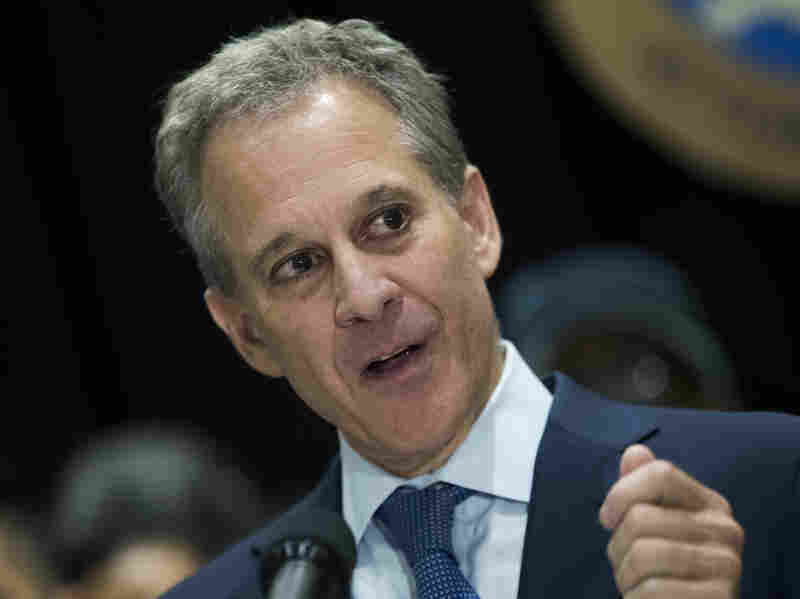
New York Attorney General Eric Schneiderman says he is joining with peers in California and several other states to file a lawsuit to protect the insurers’ subsidies.

Drew Angerer/Getty Images

hide caption

toggle caption

Drew Angerer/Getty Images

The reaction has been swift since President Trump announced late Thursday that he was cutting off Affordable Care Act subsidies to insurance companies.

The White House argues that the payments are illegal.

“Based on guidance from the Department of Justice, the Department of Health and Human Services has concluded that there is no appropriation for cost-sharing reduction payments to insurance companies under Obamacare,” the White House said in a statement. “In light of this analysis, the Government cannot lawfully make the cost-sharing reduction payments.”

Many analysts and advocacy groups say this is just part of an ongoing campaign by the Trump administration to undermine the Affordable Care Act, also known as Obamacare.

Here’s what’s happened so far.

1. Lawsuits

New York Attorney General Eric Schneiderman says he is joining peers in California and several other states in filing a lawsuit to protect the subsidies. Schneiderman says the lawsuit will argue that the subsidies are codified under the ACA, and therefore, they must be paid as long as the health care law remains in force.

Eliminating the subsidies is “breathtakingly reckless,” he said. “This move is unacceptable, it’s cruel, and it is unlawful.”

2. Surcharges

Covered California, the state’s health care exchange, told insurers to add a 12.5 percent surcharge to their silver-level policies to offset the loss of subsidy payments.

3. Doctors’ opposition

Six physician organizations, including the American Academy of Pediatrics and the American Academy of Family Physicians, said in a joint statement they’re “alarmed” by the administration’s move. The decision “stands to hurt the most vulnerable individuals and families, raising cost for them and the federal government.”

4. No dice on legislative fix

White House Budget Director Mick Mulvaney says the president won’t support a bipartisan effort led by Sen. Lamar Alexander, R-Tenn., and Patty Murray, D-Wash., to fund the subsidies along with other changes.

“Is the president interested in continuing what he sees as corporate welfare and bailouts for the insurance companies? No,” Mulvaney said in an interview with Politico on Friday.

5. Reassurance

Insurance companies tried to reassure their current customers that things have not changed, yet.

The trade group America’s Health Insurance Plans and Blue Cross Blue Shield Association said in a joint statement that the payments aren’t bailouts: “These benefits help real people every day.” The insurers said they will fight to keep the subsidies.

Daniel Hilferty, CEO of Independence Blue Cross in Philadelphia, sought to ease the worries of his customers. “We want to assure our members that their coverage remains in effect and unchanged.”

Then he added, “We are currently evaluating what this announcement may mean for individual consumer plans in the future.”

Let’s block ads! (Why?)

White House Actions Could Undermine ACA's Insurance Markets

President Trump has vowed to get rid of the Affordable Care Act. But with Congress failing to do that, Trump took action this week that could hurts the program.

SCOTT SIMON, HOST:

President Trump promised during his campaign to get rid of the Affordable Care Act. Congressional Republicans couldn’t agree how to do it after several attempts. The president and his administration have taken a series of actions that could undermine the insurance markets that were created by the health care law. The latest came late this week. We’re joined now by NPR health policy correspondent Alison Kodjak. Alison, thanks so much for being with us.

ALISON KODJAK, BYLINE: Thanks for having me, Scott.

SIMON: What exactly did the president do this week?

KODJAK: He took two actions. The first was he signed an executive order that he hopes will allow people and businesses to get together and buy health insurances as a group outside the Affordable Care Act marketplaces. And the idea is the group market power can get a lower price. But there’s a little problem with that in that most people say that the only way this is going to work is if those groups peel off only the healthy people and leave sicker, more expensive people to continue to buy insurance on those ACA exchanges. So then costs would go up for those sick people. In his second act, he ended these payments of some key subsidies to insurance companies. And they offer discounts to low-income customers. So while the mechanics are complicated. The end result of this second move – most economists say it would end up costing middle-income consumers who buy insurance on those exchanges a lot more money.

SIMON: And of course, let’s just note, again, that was just this week. What else has the administration done?

KODJAK: Well, they’ve taken a whole bunch of actions really since the beginning of the year. The president, right after he took office – the Department of Health and Human Services removed a whole bunch of information from its website about how the Affordable Care Act worked and how people can sign up. And then a few weeks ago, the same agency, HHS, said it was going to cut the budget to advertise for open enrollment for the exchanges by 90 percent. And then during this coming open enrollment period, they’ve also announced they’re going to close the marketplace for about 12 hours every week on Sundays, which would be a time that a lot of people might want to sign up.

SIMON: And you’re suggesting that taking it offline for 12 hours is meant to prevent a number of people from signing up?

KODJAK: Well, there are people who criticize the administration and say that’s the case. Now, the administration says they need to take the website down on a, you know, routine basis to perform maintenance. There are those who say they could have done at a different time rather than do it on a Sunday when a lot of people are home and might have time.

SIMON: How are all of these changes likely to affect people?

KODJAK: So you know, it’s hard to say exactly. With the actions this week, some people may see their premiums rise, especially if they don’t get subsidies from the government to help pay for their insurance. And with the rollback in outreach, people could find they don’t know where or how to get insurance. I myself have been getting email messages and messages on Twitter from our listeners who are confused about what’s going on. But then there’s this sort of broader issue. And it’s a little harder to pin down. And that’s just – there’s all this talk about the ACA collapsing, about it being repealed. The president says it all the time. The Department of Health and Human Services tweets about it. And that confusion, you know, could make people think they can no longer get insurance or make them think it’s not worth it. So when open enrollment starts, some people just may not sign up.

SIMON: NPR’s Alison Kodjak, thanks so much.

KODJAK: Thank you.

Copyright © 2017 NPR. All rights reserved. Visit our website terms of use and permissions pages at www.npr.org for further information.

NPR transcripts are created on a rush deadline by Verb8tm, Inc., an NPR contractor, and produced using a proprietary transcription process developed with NPR. This text may not be in its final form and may be updated or revised in the future. Accuracy and availability may vary. The authoritative record of NPR’s programming is the audio record.

Let’s block ads! (Why?)

New Rule On Moral Objections To Contraception Aimed At 2 Groups

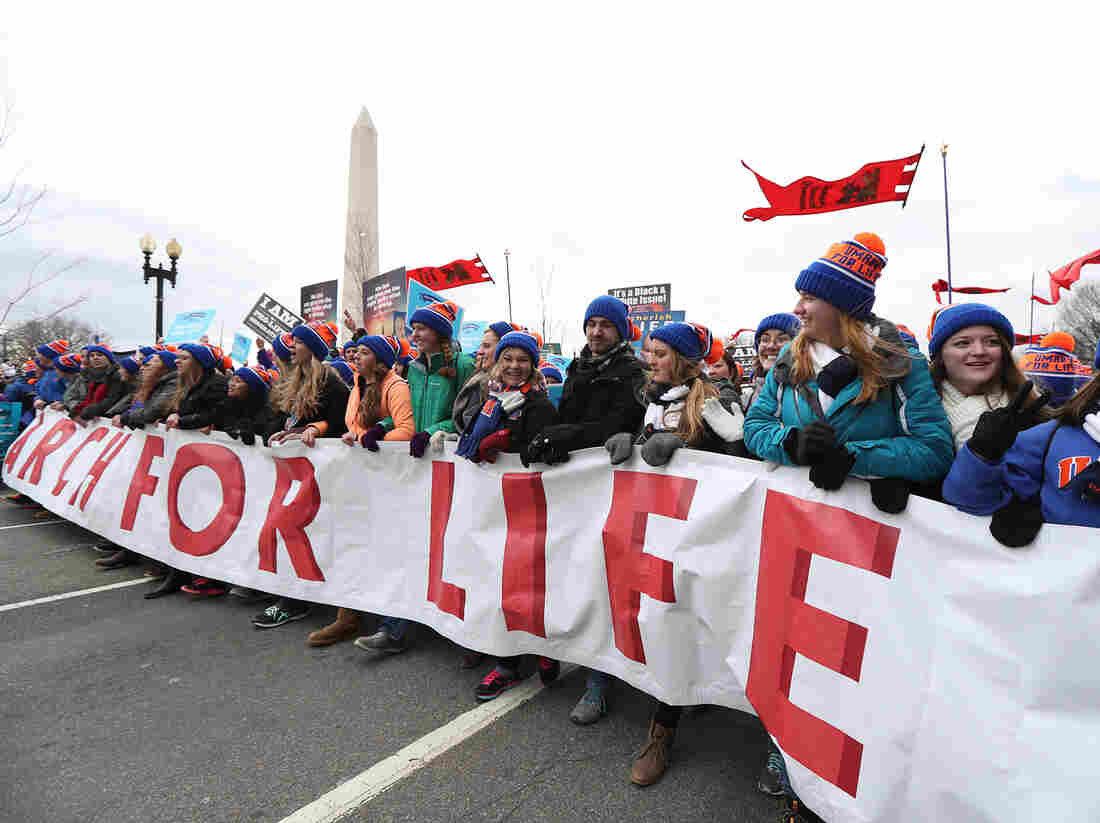
People in the March for Life near the National Mall in Washington, D.C., on Jan. 27.

Manuel Balce Ceneta/AP

hide caption

toggle caption

Manuel Balce Ceneta/AP

Few people were surprised last week when the Trump administration issued a rule to make it easier for some religious employers to opt out of offering no-cost prescription birth control to their female employees under the Affordable Care Act.

But a separate regulation issued at the same time raised eyebrows. It creates a new exemption from the requirement that most employers offer contraceptive coverage. This one is for “non-religious organizations with sincerely held moral convictions inconsistent with providing coverage for some or all contraceptive services.”

So what’s the difference between religious beliefs and moral convictions?

“Theoretically, it would be someone who says ‘I don’t have a belief in God’ but ‘I oppose contraception for reasons that have nothing to do with religion or God,’ ” says Mark Rienzi, a senior counsel for the Becket Fund for Religious Liberty, which represented many of the organizations that sued the Obama administration over the contraceptive mandate.

Nicholas Bagley, a law professor at the University of Michigan, says it would apply to “an organization that has strong moral convictions but does not associate itself with any particular religion.”

What kind of an organization would that be? It turns out not to be such a mystery, Rienzi and Bagley agreed.

Among the hundreds of organizations that sued over the mandate, two — the Washington, D.C.-based March for Life and the Pennsylvania-based Real Alternatives — are anti-abortion groups that don’t qualify for religious exemptions. While their employees may be religious, the groups themselves are not.

March for Life argued that the ACA requirement to cover all contraceptives approved by the Food and Drug Administration includes methods that prevent a fertilized egg from implanting in a woman’s uterus and therefore are a type of abortion. Real Alternatives opposes the use of all contraceptives.

March for Life, which coordinates an annual abortion protest each year, won its suit before a federal district court judge in Washington, D.C.

But a federal appeals court ruled in August that Real Alternatives, which offers counseling services to help women choose not to have an abortion, does not qualify as a religious entity and thus can’t claim the exemption. That decision cited a lower court ruling that “finding a singular moral objection to law on par with a religious objection could very well lead to a flood of similar objections.”

The departments of Treasury, Labor and Health and Human Services, however, suggest that, at least in this case, that will not happen. The regulation issued by those departments says officials “assume the exemption will be used by nine nonprofit entities” and “nine for-profit entities.” Among the latter, it says, “we estimate that 15 women may incur contraceptive costs due to for-profit entities using the expanded exemption provided” in the rules.

The regulation also seeks comments on whether the moral exemption should be extended to publicly traded firms.

Rienzi agrees that the universe for the moral exemption is likely to be small. “The odds that anyone new is going to come up and say ‘Aha, I finally have my way out,’ ” he says, “is crazy.”

Women’s health advocates, however, are not so sure.

“The parameters of what constitutes a moral objection is unclear,” says Mara Gandal-Powers, senior counsel at the National Women’s Law Center, which is preparing to sue to stop both rules. “There is nothing in the regulatory language itself that says what a moral belief is that would rise to the level of making an organization eligible for the exemption.”

Louise Melling, deputy legal director at the American Civil Liberties Union, which has already filed a lawsuit, agrees. “We don’t know how many other entities are out there that would assert a moral objection,” she says. “Not everybody wanted to file a suit,” particularly smaller organizations.

All of that, however, presupposes that the rule laying out the moral objection exemption will stand up in court.

Bagley says he’s doubtful. The legal arguments making the case for the exemption, he says, are “the kind of things that would be laughed out of a [first-year] class on statutory interpretation.”

Specifically, he says, the rule lays out all the times Congress has included provisions in laws for moral objections. But rather than justifying the case, “it suggests that Congress knew a lot about how to craft a moral objection if it wanted to,” and it did not in the health law, he noted.

Bagley says the fact that the moral exemption was laid out in a separate rule from the religious one demonstrates that the administration is concerned the former might not stand up to court proceedings. “The administration must sense this rule is on thin legal ice,” he says.

Which leads to the question of why Trump officials even bothered doing a separate rule. Bagley says he thinks the act was more political than substantive. “The administration is doing something that signals to religious employers … that they are on their sides, that they have their backs.”


Kaiser Health News, a nonprofit health newsroom, is an editorially independent part of the Kaiser Family Foundation. Follow Julie Rovner on Twitter: @jrovner

Let’s block ads! (Why?)