Drug Puts A $750,000 'Price Tag On Life'
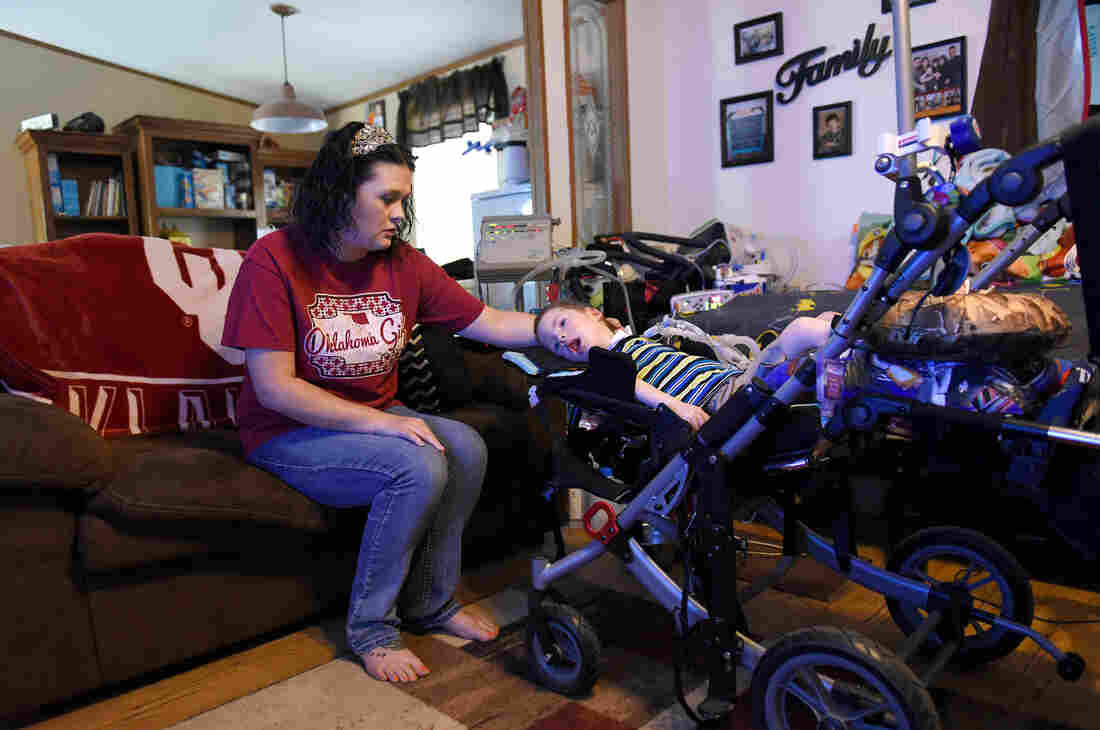
Amanda Chaffin comforts son Kayden, 4, who has a genetic condition called spinal muscular atrophy, or SMA, and depends on a ventilator to breathe. Chaffin is worried about the high costs of Kayden’s care.

Nick Oxford for Kaiser Health News

hide caption

toggle caption

Nick Oxford for Kaiser Health News

Jana Gundy and Amanda Chaffin, who live within two hours of each other in Oklahoma, each have a child with the same devastating disease.

The genetic condition, spinal muscular atrophy, robs its sufferers of muscle strength, affecting their ability to sit, stand or even breathe.

So both moms were ecstatic when the Food and Drug Administration approved the first treatment for the condition two days before Christmas in 2016. It seemed the gift they had been waiting for — a chance to slow the heartbreaking decline of their young sons.

But that common hope has taken them down different paths: In April, Gundy’s child, who is on private insurance, began getting the drug Spinraza, which costs $750,000 for the initial year of treatment. Chaffin’s child, a Medicaid enrollee, did not, as his state regulators debated whether to offer it to children like him who use ventilators to breathe.

Across the country, similar stories are playing out as private insurers and already-squeezed state Medicaid programs wrestle with what, if any, limits to place on patients’ access to break-the-bank drugs — weighing the needs of the ill against budget realities.

Chaffin prepares a liquid meal for Kayden in their home.

Nick Oxford for Kaiser Health News

hide caption

toggle caption

Nick Oxford for Kaiser Health News

At the same time, policymakers and physicians increasingly demand to understand why drug manufacturers affix price tags that have risen to once unimaginable highs.

“It looks like a drug that works for a tragic condition that afflicts children and cripples and kills them. That’s the good news,” Dr. Jerry Avorn, a professor of medicine at Harvard Medical School, says of Spinraza. But “how in the world did the price of $750,000 a year get chosen?”

Biogen, the maker of Spinraza, defends its price.

“We compared industry norms for other drugs in rare disease. We looked at the efficacy and safety profile of the drug itself,” says Dr. Wildon Farwell, an epidemiologist and senior medical director of clinical development at Biogen.

But that logic — comparing a new drug to extremely high-priced drugs already on the market — has only fueled an inflationary cycle, Avorn says, adding: “In my view, that’s akin to a kid who gets caught bullying another kid and beating him up after school, and says, ‘Well, all the other kids were beating him up so it’s OK.’ If it’s wrong, it’s wrong.”

The stress is unbearable for families trying to obtain treatment for sick children, who are caught in the arcane world of coverage decisions and businesses’ price calculations.

“The longer we wait, the more … [his ability to move] will be gone and there’s a chance of not getting it back,” says Chaffin of Kayden, her 4-year-old son, who was diagnosed with SMA as an infant.

Kayden Chaffin’s legs are emaciated. The 4-year-old is set to start receiving the drug Spinraza in August through a Biogen assistance program after getting two rejections for coverage under Oklahoma’s Medicaid program.

Nick Oxford for Kaiser Health News

hide caption

toggle caption

Nick Oxford for Kaiser Health News

In late May, Oklahoma’s Medicaid program approved rules barring coverage of Spinraza for patients dependent on ventilators.

At that same time, Gundy watched hopefully as her 12-year-old son, Kyle, who also uses a ventilator, received the first three of the six doses he will get this year, following approval by his private health insurer. Says Gundy, “We’ve seen some minor muscle movement return.”

Spinraza isn’t a cure for SMA, which affects 10,000 people in the U.S., but clinical tests show it holds promise for some. Scientific discoveries by researchers at the University of Massachusetts Medical School in the early 2000 — partly funded by grants from the National Institutes of Health and donations from patient-advocacy groups — helped pave the way for Spinraza.

The drug was granted “orphan” status, which provides tax credits for research and helped speed the review process. It won approval in five years after the start of clinical trials, based on results of a few small studies. The primary one showed improvement in 40 percent of the infants given the drug. It was tested only on children, most under age 2, though it was approved for pediatric and adult use.

All that means Biogen’s research and development costs likely were not unusually high, although the company would not release figures. Five days after getting the FDA’s approval to sell the drug in the U.S., Biogen announced the price: $125,000 a dose, or $750,000 for the first year. Fewer doses in following years drop the total annual cost to $375,000. The drug must be taken for life.

The FDA does not know or consider pricing when it grants approval.

If just half of U.S. patients get treatment for one year, the tab would be more than $3.7 billion. Spinraza brought in $203 million in the second quarter of this year, more than four times its revenue in the first quarter.

When Biogen unveiled the price tag, one Wall Street analyst at the investment bank Leerink predicted “a storm of criticism” and that insurers would parse “which patients receive access.”

Families that include a child with SMA are a close community, and Chaffin keeps in touch with other SMA families via Facebook, where the have-nots can watch what happens with the kids who received the drug.

“There are similar kids his age that live in different states and are [on a ventilator] and they are seeing movement come back and strength coming back,” says Chaffin. Because SMA often affects the muscles around the mouth, “Kayden lost his smile in 2014, but he has a little smirk left. These parents are seeing their smiles coming back.”
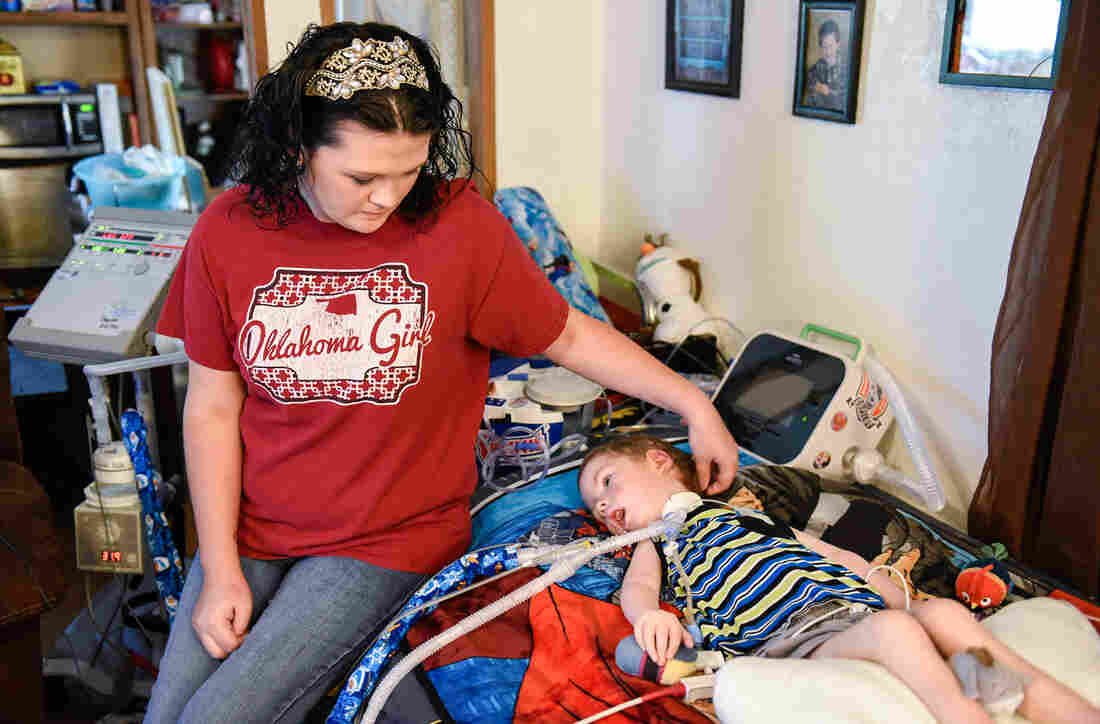
Chaffin comforts Kayden, who is on a ventilator at home.

Nick Oxford for Kaiser Health News

hide caption

toggle caption

Nick Oxford for Kaiser Health News

Good news came to Chaffin in late July. After receiving the required two denials from her state’s Medicaid program, Kayden was accepted into Biogen’s patient assistance program. The program helps patients’ families navigate their insurance, covers the cost of the drug if they are denied and, in some cases, helps with other costs, too. But it isn’t available to everyone. Some government programs — Medicare and Medicaid, for example — restrict efforts to eliminate copayments for drugs.

Kayden will get his first injection in mid-August — eight months after the drug was approved.

Now this low-income family faces one more hurdle: finding the estimated $2,000 per injection to cover doctor and hospital costs for the six shots Kayden will need in the coming year.

In addition to the financial questions, there are other unanswered concerns among families and medical professionals. Will Spinrazawork in older children or adults? No children involved in the study were on ventilators at the start of the trial. Is it safe for children on ventilators? Also, because SMA’s rate of decline varies, how can doctors, families or insurers measure if the drug is stalling the disease’s progression? And, finally, how long will its effect last?

For some fast-track drugs like Spinraza, FDA approvals don’t offer this kind of guidance.

Dr. Susan Apkon, who treats dozens of children with SMA as a physiatrist at Seattle Children’s Hospital — and who urged Washington state’s Medicaid pharmacy board to cover the drug — says there is no easy answer.

“If a drug works, we want to give it to the child or adult, whatever the drug is,” says Apkon, who does not receive money directly from Biogen but is a co-investigator in one of the company’s ongoing studies.

Still, “there is one pot of money, and we need to figure out how it gets distributed,” she says. “The system is broken.”

With any costly new drug, it all comes down to “tough choices,” says Jack Hoadley, a health policy analyst at Georgetown University’s Health Policy Institute.

“Treating one of these patients may mean not treating 1,000 patients with some other, less expensive problem — or saying they have to raise more tax dollars,” he says. “Private insurers have the same trade-off. Do we pay for this if it will ultimately raise our premiums?”

Coverage eligibility varies by insurer and, in Medicaid, by state.

Most insurers and Medicaid programs require that patients show some kind of proof of progress — or at least maintenance of function — in order to continue therapy beyond initial doses.

While agreeing that the drug offers some hope to patients, Donna Sullivan, chief pharmacy officer for Washington State Health Care Authority, which oversees Medicaid, says the price tag rankles her.

During a recent meeting with Biogen officials, Sullivan was blunt: “I told them the price was unethical.”

In her state, there are about 150 children with SMA. After reviewing the data on Spinraza, Washington Medicaid approved broad coverage rules, including allowing patients on ventilators to get the drug.

But large new spending puts additional pressure on state budgets. When combined with economic downturns, that can lead lawmakers to trim medical provider payments or optional Medicaid services, which include adult dental care, podiatry, chiropractic treatment and other services.

Crystal Ramos, of Pasco, Wash., whose 3-year-old twins have SMA, is thankful that Medicaid covers the drug. After four doses, she says she is already seeing some improvement in her boys.

The boys are on her insurance through her job as a teacher, but Medicaid picks up what her private insurance does not, which totals about $2,500 per injection.

She calls Spinraza’s price “beyond crazy.”

“They’re putting a price tag on life, which sucks,” she says. “In the end, we have to pay it if we want our kids to live, and they know it.”


Kaiser Health News is a nonprofit health newsroom, an editorially independent part of the Kaiser Family Foundation. You can follow KHN senior correspondent Julie Appleby on Twitter @Julie_Appleby.

Let’s block ads! (Why?)

Trump's Tweets Threaten To Destabilize Insurance Markets

President Donald Trump still hopes to force legislators back to the table to find a way to get rid of the Affordable Care Act, by any means possible.

Tasos Katopodis /AFP/Getty Images

hide caption

toggle caption

Tasos Katopodis /AFP/Getty Images

President Trump took to Twitter this week to threaten insurance companies that he may withhold crucial government payments in an effort to undermine the Affordable Care Act.

If ObamaCare is hurting people, & it is, why shouldn’t it hurt the insurance companies & why should Congress not be paying what public pays?

— Donald J. Trump (@realDonaldTrump) July 31, 2017

It’s not the first time the president has threatened to cut off these payments to insurers, which he refers to as “BAILOUTS.”

If a new HealthCare Bill is not approved quickly, BAILOUTS for Insurance Companies and BAILOUTS for Members of Congress will end very soon!

— Donald J. Trump (@realDonaldTrump) July 29, 2017

But these payments aren’t designed to compensate insurers for business failures. Rather they reimburse insurance companies for discounts the law requires them to give to low-income people who buy insurance through the Affordable Care Act exchanges. The federal money that goes to insurers in these payments, known as cost-sharing reductions, or CSRs, offsets the money insurers lose by lowering the deductibles and co-payments they require of these policyholders.

Trump, who is angry that the Congress failed to pass a law to repeal and replace the Affordable Care Act, or Obamacare, is wielding his threat to withhold these CSRs — which could cause chaos in the insurance markets – in hopes of forcing lawmakers back to the table to try again to get rid of the health care law.

The next cost-sharing payments are due to be paid in a few weeks and the president has said he’ll announce this week whether he’ll pay the money or keep it in the Treasury.

“In the absence of the CSR, the rate increases could be astonishing,” says Dr. Marc Harrison, CEO of Intermountain Healthcare, which operates nonprofit hospitals and clinics, and insures more than 800,000 people across Utah.

“We’ll see [the number of] people who are uninsured, or functionally uninsured, go way, way up,” he adds.

Harrison says he and his company filed two sets of proposed rates for policies sold on the insurance exchange next year. If the president cuts off the cost-sharing payments, he says, the rates will be much higher.

The Congressional Budget Office estimates the payments, if they’re all made, will total $7 billion this year. Margaret Murray is CEO of the Association for Community Affiliated Plans, which represents these “safety net health plans” aimed at people with lower incomes. She says she has been in touch with the Department of Health and Human Services to urge them to fund the payments.

“Should the payments cease, insurers will be required to fund cost-sharing reductions on their own,” Murray says. If that happens, “they will either raise their rates – our plans indicate that it could be by up to 23 percent – to compensate for these losses, or they will withdraw from the markets altogether.”

If Trump does decide to stop making the payments, it may end up costing the U.S. Treasury more, while insurance companies who remain in the markets could do just fine.

That’s because insurance companies will charge more in premiums to make up for the lost payments. And that will lead the Treasury to spend more on subsidies to policyholders who qualify, according to an analysis by the consulting firm Oliver Wyman.

If those subsidies go up enough, more people could be lured into the exchange markets.

Here’s the wonky reason why:

The Obamacare exchanges require insurance policies to conform to one of four “metal” levels — bronze, silver, gold or platinum — which coincide with how much an individual is expected to pay in premiums, deductibles and other out-of-pocket expenses. A bronze plan covers about 60 percent of a customer’s health care costs, with relatively low monthly premiums, while a platinum plan will cost more each month but pay 90 percent of total health costs.

The law provides income-based tax credits to people to buy insurance, and those credits are calculated based on the price of silver plans. Last year about 85 percent of people who bought Obamacare insurance got a credit, according to the Center for Medicare and Medicaid Services.

People with the lowest incomes also get those discounted deductibles and co-payments if they buy a silver plan; and then the government reimburses insurers through CSR payments.

If Trump decides not to make those payments, insurance companies are likely to raise rates about 19 percent, according to an analysis the Kaiser Family Foundation.

That means subsidies will have to rise for many people to meet those higher premiums. Some people may take that bigger subsidy to buy a cheaper policy — and many could even get insurance for free, according to Oliver Wyman, because premiums on bronze plans probably would not rise as much as those on silver plans.

The higher subsidies could cost the government as much as $2.3 billion in 2018, according to the Kaiser Family Foundation’s Larry Levitt. Levitt notes that Congress could end the ambiguity over the payments by appropriating the money for them.

Congress could remove all the uncertainty surrounding CSR payments by appropriating the money. And, CBO is already assuming it gets spent.

— Larry Levitt (@larry_levitt) July 31, 2017

Sen. Orrin Hatch, R-Utah, said in an interview with Reuters Tuesday that he thinks Congress will do just that.

“I’m for helping the poor; always have been,” Hatch said. “And I don’t think they should be bereft of health care.”

The reason CSRs are in limbo at all is because House Republican who did not want Obamacare to succeed sued the administration, claiming the payments to insurers were illegal because they had not appropriated money for them.

A federal judge agreed, but the Obama administration appealed. When Trump took the White House he continued the appeal, to allow lawmakers time to pass a bill to repeal Obamacare and make the payments disappear altogether.

Now that that effort has failed, the lawsuit and the cost-sharing money are once again in play.

Let’s block ads! (Why?)

Sperm Counts Plummet In Western Men, Study Finds

An international team of scientists analyzed data from men around the world and found sperm counts declining in Western countries.

Hanna Barczyk for NPR

hide caption

toggle caption

Hanna Barczyk for NPR

Sperm counts appear to be plummeting throughout the Western world, according to a large study of men around the world.

An international team of scientists analyzed data from nearly 43,000 men in dozens of industrialized countries and found that sperm counts dropped by more than half over nearly four decades.

“I think that we should take this very seriously,” says Shanna Swan, a reproductive epidemiologist at the Icahn School of Medicine at Mount Sinai in New York. She helped conduct the study published in the journal Human Reproduction Update. “I think it’s a wake-up call,” Swan says.

Previous studies have suggested that sperm counts may be falling around the world. This study is the largest and most comprehensive to date. It was designed to resolve doubts about the earlier findings, Swan says.

“I’ve always been very skeptical of previous reports that have suggested that sperm counts are declining,” says Allan Pacey, a professor of andrology at the University of Sheffield in England who was not involved in the new research. “I’m a bit more of a believer that sperm counts are declining than I was at this time yesterday,” he says.

Even at the reduced sperm counts, infertility has not become a widespread problem. At the most, the lower levels of sperm may make it harder for some couples to conceive, Pacey says.

But there’s no sign the decline is slowing, which means that male infertility could become a more common problem in the future.

“Since this is the best study that’s ever been done, it is concerning that it suggests such a progressive and dramatic decrease in sperm counts over time,” says Peter Schlegel, a professor and chairman of urology at Weill Cornell Medicine in New York. Schlegel serves as vice president of the American Society for Reproductive Medicine.

Schlegel stresses, however, that more research is needed to confirm the findings and try to determine possible causes.

“Since we don’t know what could be causing it, it’s worrisome,” Schlegel says.

Swan and her colleagues combed the scientific literature for studies that had examined sperm counts and concentrations and screened more than 7,000 studies, excluding those that had shortcomings or flaws. The researchers then analyzed data collected by 185 studies of 42,935 men who provided semen samples between 1973 and 2011 in North America, Europe, Australia and New Zealand.

One of the ways the researchers tried to alleviate concerns about previous studies was to include men who weren’t just being tested at fertility clinics because they might be infertile. They included sperm counts from other men, for example, soldiers and college students.

The analysis found an overall 52.4 percent decline in sperm concentration and a 59.3 percent decline in the total sperm count over the 39-year period. (Sperm concentration is the measure of the concentration of sperm in a man’s sample — how many millions of sperm are in a milliliter of semen. Total sperm count is the number doctors get when they multiply that by the volume of the sample.)

“I think these are extremely concerning findings,” Swan says.

And Swan says it’s not just the concern about fertility. A decreased sperm count has been linked to an increased risk for premature death, Swan says. So it may be a marker for other health problems, she says.

While no one knows why sperm counts and concentrations may be falling, there are a variety of theories.

Swan suspects that one factor may be exposure to chemicals while in the womb, which could harm the normal development of males’ reproductive systems.

“The mother’s exposure to a number of chemicals can alter the reproductive tract of baby boys significantly,” she says.

But Pacey questions that theory, and worries about alarming pregnant women unnecessarily.

“There’s a real danger here that researchers publish papers like this, that are then reported irresponsibly, that then lead to people getting really paranoid about what may or may not be happening,” Pacey says.

The problems many couples encounter when they attempt to get pregnant could be avoided if they started trying just a few years earlier, Pacey says.

Swan acknowledges that other factors could also be playing a role. The global obesity epidemic could be cutting sperms counts, for example.

“There’s also stress, which is related to sperm count,” she says. “So there are a number of factors which you could cluster under the heading of ‘modern living’ that could be playing a role in what we’re seeing.”

There wasn’t enough data from non-Western countries to reach any conclusions about whether sperm counts are falling there too, Swan says.

Let’s block ads! (Why?)