Survey Says: Medicaid Recipients Really Like Their Coverage And Care

A survey of Medicaid beneficiaries found that overall, they’re very happy with the services they get and have no problems finding doctors.

Terry Vine/Getty Images

hide caption

toggle caption

Terry Vine/Getty Images

Is Medicaid the best health care possible?

A lot of people who use it seem to think so.

A new study released by Harvard’s Chan School of Public Health shows that people enrolled in Medicaid are overwhelmingly satisfied with their coverage and care.

The researchers looked at survey data collected by the Centers for Medicare and Medicaid Services from more than 270,000 people who were enrolled in Medicaid in 2013. They gave the program an average rating of 7.9 out of 10, where 10 was considered “the best health care possible.” Nearly half of the respondents rated Medicaid a 9 or 10.

“If nearly half the people are giving it nearly a perfect score, that’s pretty good,” says Michael Barnett, a researcher in the Department of Health Policy and Management at Harvard’s Chan School. “There aren’t a lot of services that we get for anything, government or not, where you’d give it a perfect score.”

The study, published as a research letter in the July 10 issue of JAMA Internal Medicine, also shows that 84 percent of Medicaid recipients felt they were able to get all the medical care they needed in the last six months. Only 3 percent said they could not get care because of long wait times or because doctors would not accept their insurance.

The results applied across the board to those in traditional Medicaid, Medicaid managed care plans and among the elderly and disabled. The study did not include people who got Medicaid through the Affordable Care Act expansion or people in nursing homes.

The survey results come just as Republicans in the Senate are debating a complete overhaul of the Medicaid program, and they counter some of the major arguments for those changes.

House Speaker Paul Ryan, who has championed the Medicaid overhaul, often argues that many doctors refuse to accept Medicaid patients.

“I mean, what good is your coverage if you can’t get a doctor?” he asked in a presentation to reporters in March.

Health and Human Services Secretary Tom Price made a similar argument in testimony to the House Ways and Means Committee last month.

“One-third of doctors in America do not accept new Medicaid patients,” he told the committee. His office didn’t respond to a request for comment on the new study.

Barnett, the study’s author, says the new data is the first that shows what Medicaid users think of the program.

“Part of what motivated this study is that there is a lot of rhetoric and what we would call misinformation around ‘What does Medicaid do, how effective is it, and how satisfied are enrollees with their coverage?'” he says. “This is the survey that really provides the most reliable large scale information that we have to date, [with] over 270,000 enrollees, and they’re largely satisfied.”

The bill being considered by the Senate would slowly roll back the expansion of Medicaid benefits to many poor, non-disabled adults, that happened as part of the Affordable Care Act, or Obamacare. And it would change Medicaid from an open-ended program that pays for all the care beneficiaries need, to one that offers states a set amount of money each year based on the number of people who qualify for Medicaid in that state.

The analysis issued by the Congressional Budget Office last month estimates spending on Medicaid would be $770 billion less over ten years under the Senate bill than under current law and that 15 million people would lose Medicaid coverage by 2026.

Let’s block ads! (Why?)

FAQ: How Would The Republican Health Care Bills Affect You?

When covering the GOP efforts to repeal and replace the Affordable Care Act, we tend to focus on the big picture: billions of cuts in Medicaid spending, say, or millions of fewer people with health coverage.

But the real impacts would be felt in states, cities and towns, and they would vary a lot depending on where you live, how old you are and your particular health concerns. Reporters for NPR and NPR member stations across the country have delved into those geographic and demographic impacts; their reporting fuels this Q&A, which you can search by topic and locale.

Loading…

Let’s block ads! (Why?)

Women With High-Risk Pregnancies Are More Likely To Develop Heart Disease

Laura Hogan developed preeclampsia when she was pregnant with her son Zion in 2016. Both are fine now, but she’s taking extra precautions to stay healthy.

Anna Gorman/California Healthline

hide caption

toggle caption

Anna Gorman/California Healthline

Women who have high-risk pregnancies or complications in childbirth are up to eight times more likely to have heart disease later in life, statistics suggest. But many mothers — and their doctors — are unaware of the danger.

Emerging research shows heart disease is a long-term threat for women who develop diabetes or high blood pressure during pregnancy, for example. Also at higher risk: mothers whose babies were born too small or too soon.

Yet doctors typically do not advise these mothers about their risk or counsel them to watch for heart disease symptoms, says Dr. Noel Bairey Merz, cardiologist and director of the Barbra Streisand Women’s Heart Centerat the Cedars-Sinai Heart Institute in Los Angeles.

Bairey Merz says doctors can see heart attacks and strokes coming, often 10 or 20 years ahead of time — if they are on the lookout.

“This isn’t rocket science,” she says. “We just have to figure out how we can find the women who are at risk.”

One such woman, Lara Hogan, gave birth to her son Zion at Cedars-Sinai in May of last year.

Sitting in her living room in Topanga Canyon, Calif., Hogan, who is now 41, recounts how she monitored her blood pressure throughout the pregnancy because she had been treated for hypertension in the past. Then, during her 36th week, her blood pressure spiked — a sign of the emergency condition known as preeclampsia.

Hogan and her husband, Chad, headed to Cedars-Sinai, where doctors told her they needed to deliver the baby that night.

But her blood pressure didn’t come down after she gave birth — it kept rising.

“They had someone standing at my bedside monitoring me, in case anything happened,” Hogan recalls. “I guess they were so nervous that I was going to have a stroke.”

She didn’t. But her baby stayed in the neonatal intensive care unit for eight days, and Hogan went in and out of the hospital as doctors tried to lower her blood pressure.

“It was a nightmare,” she says. “All I’d dreamt about was this moment for so many years. It was like the opposite of everything I thought it would be.”

Finally, the doctors were able to use medicine to bringing her blood pressure down. They referred Hogan to a postpartum heart health program led by Margo Minissian, a nurse scientist at Cedars-Sinai. Over the next several weeks, Minissian and Hogan’s doctors helped her get to a proper dosage and routine that enabled her to stay out of the hospital.

Since then, Hogan has checked her pressure most days and plans to continue seeing doctors to manage her long-term cardiac risk. Zion, who recently celebrated his first birthday, just started walking and likes to play with his toy xylophone and drums.

Hogan hopes to have another baby soon, so has been checking in with Minissian again, to make sure her blood pressure is well-controlled before she gets pregnant. And now she knows she is at risk for heart disease later in life because of the complications surrounding Zion’s birth.

“As much as I don’t want to be thinking about my future heart health, or worrying about what’s going to happen when I am older,” Hogan says, “this is priority No. 1 for my health right now — for the sake of my son and my future children.”

“As much as I don’t want to be thinking about my future heart health, or worrying about what’s going to happen when I am older,” Laura Hogan says, keeping her blood pressure down is “priority No. 1 for my health right now — for the sake of my son and my future children.”

Anna Gorman/California Healthline

hide caption

toggle caption

Anna Gorman/California Healthline

Heightened awareness of the link between pregnancy complications and heart disease is prompting greater outreach to the public, and to collaborative research between cardiologists and obstetricians. That could help “make tremendous strides toward reducing and preventing heart disease in women,” says Bairey Merz.

About 80 percent of U.S. women give birth to at least one baby, and one-fourth of those have complications during the pregnancy or labor. Researchers are still trying to figure out why these complications would be linked to later heart problems. Pregnancy might contribute to vascular complications, they suggest as one hypotheses — or it might simply reveal existing problems.

“Pregnancy can really mimic the stressors of age,” Minissian notes. Pregnancy, she says, could be “a woman’s first physiological stress test.”

To further explore the heart disease connection, Cedars-Sinai recently started following a small group of women who had pregnancy or labor complications. In a separate study, Bairey Merz and other researchers, funded by the National Institutes of Health, are tracking the health of 5,000 new moms at eight sites across the nation, to fill gaps in knowledge and develop recommendations for physicians.

The Women’s Heart Alliance, an advocacy group, started by Cedars-Sinai and New York-Presbyterian Hospital/Weill Cornell Medical Center, is also working with obstetricians and other providers to raise awareness of this particular heart risk among women and their doctors.

“We’ve got a big advocacy and education piece that we should be doing together,” says Dr. Barbara Levy, vice president of health policy for the American Congress of Obstetricians and Gynecologists. Cardiologists and women’s health care providers are in a unique position to drive the research agenda, Levy says.

For now, women who have had complications in pregnancy or labor should alert their primary care doctors and have annual screenings for high blood pressure, Minissian says.

The American Heart Association and American Stroke Association also recommend that women who have had preeclampsia be evaluated for heart disease risk within a year of giving birth. Some may need medication or a referral to a cardiologist.

But most new mothers with less serious complications during pregnancy needn’t rush to see a cardiologist, Levy says — they just need to eat healthfully, be active and get enough sleep. Immediately referring all these women to specialists could result in undue anxiety and unnecessary medical tests, she says. Not good for a busy new mom.

“It will cost a lot of money and a lot of her time while she is dealing with a baby,” says Levy.

As part of the Cedars-Sinai project, Minissian screens certain women for cardiovascular risk within six months of delivery and follows up with them every year. She also tries to help them lead healthy lives to “avoid the whole heart disease trajectory altogether.”

“These women are going to have their eyes wide open,” Minissian says. “They are going to be looking for it, and they won’t allow people to pat them on the back and say, ‘Oh don’t worry about that high blood pressure.’ “

This story is part of NPR’s partnership with Kaiser Health News. KHN is an editorially independent news agency funded by the Henry J. Kaiser Family Foundation. Follow Senior Correspondent Anna Gorman on Twitter @annagorman.

Let’s block ads! (Why?)

Americans Don't Want Senate's Health Care Plan, But It's Unclear What They Do Want

Demonstrators protest changes to the Affordable Care Act on June 28, 2017, in Chicago, Illinois.

Scott Olson/Getty Images

hide caption

toggle caption

Scott Olson/Getty Images

Americans really, really don’t like the Senate bill to repeal and replace the Affordable Care Act.

Only 17 percent of U.S. adults approve of the health care bill, according to a recent NPR/Marist/PBS NewsHour poll. In fact, a majority of Americans now approve of the ACA, also known as Obamacare — but just nine months ago, that wasn’t true.

So what do they want?

Maybe they want single-payer health care — a slight majority of Americans now say they would like that kind of system, according to the Kaiser Family Foundation. But then, they don’t like it once they hear about the trade-offs. So maybe they simply want Obamacare to go further — that’s what a plurality of respondents told NPR. Or to be more specific, they favor most Obamacare provisions…but not the individual mandate (which is needed to make the ACA work). Or they want to keep the Affordable Care Act but scrap Obamacare (or vice versa).

Some of this uncertainty is perhaps to be expected — as a certain president has pointed out, health care is “complicated.” But if lawmakers are looking to Americans to know what their next move should be, they could be waiting a while. Messy, contradictory, easily swayable opinions on health care are a common theme in American politics, as it turns out.

Inconsistent, changeable opinions

Recent polls on health care show a few areas where Americans’ views on health care are less than clear:

1) Single-payer

A slight majority of the population — 53 percent — approves of a single-payer system, according to a new Kaiser Family Foundation poll, up from 39 in the early 2000s.

But then, the Kaiser pollsters found that they could easily — and substantially — swing that 53 percent by presenting people with potential arguments for and against a single-payer system.

When people heard the argument that the system would “give the government too much control over health care,” opposition rose from 40 to 62 percent. But on the other hand, when presented with the argument that a single-payer system would “reduce health insurance administrative costs,” the share of Americans in favor swung from 55 to 72 percent.

…all of which makes logical sense (people can be swayed by arguments for and against a particular policy — who knew?). But it suggests that it may be a mistake to take Americans’ support or opposition for a given health care policy at face value.

Moreover, in a more intense debate over single-payer, all of these arguments would be made at once, meaning many Americans could easily be swung from one side to another or simply left in a “don’t know” place.

2) Obamacare is relatively popular now. It wasn’t before.

Loading…

Obamacare was never a super-popular policy. But it did suddenly become more well-liked just after President Obama left office. According to data from Gallup, the law hit its highest popularity ever in April, at 55 percent approval — the first time it ever had majority support in Gallup’s polling (which began in 2012). And that swing was despite the fact that nothing major changed in Obamacare in recent months that would easily account for that swing.

3) Government responsibility for health care has also grown more popular

Relatedly, Americans during the Obama presidency were closely divided over whether the government is responsible for making sure “all Americans have healthcare coverage,” and at times a majority believed it was not the government’s responsibility.

Loading…

But before the Obama presidency, a majority of Americans consistently said yes, and a majority once again do, according to data from the Pew Research Center and Gallup.

4) Only some of Obamacare is popular

When it comes to Obamacare, Americans tend to like many of the provisions: they like people being able to stay on their parents’ insurance until age 26, and they like the idea of exchanges. But they don’t like the individual mandate — the fact that people must buy insurance or pay a penalty. In fact, as the Kaiser Family Foundation found, out of seven Obamacare provisions, the individual mandate was the only one without majority support.

“The elements of the Affordable Care Act are more popular than the act itself,” said Kathleen Weldon, director of data operations and communications at the Roper Center for public opinion. “And that’s largely a political question.”

Again, this isn’t necessarily surprising — the threat of a penalty is understandably less appealing to many than the convenience and security of the age-26 provision. But it does show that what Americans want doesn’t always match up with what is feasible — that individual mandate is a big part of what makes the Affordable Care Act work.

“It would be very hard to put together a functional health policy that wouldn’t have some elements that people disliked,” said Weldon.

5) Obamacare vs. ACA

[embedded content]
YouTube

As of February, 35 percent of Americans didn’t know the Affordable Care Act and Obamacare were the same, according to polling organization Morning Consult…a fact famously hammered home when late-night TV host Jimmy Kimmel asked people on the street of Los Angeles whether they favored the Affordable Care Act or Obamacare.

None of this is new

Inconsistent opinions on health care have been around for a long time. In one 2001 review of 50 years of public opinion data, for example, experts remarked that “it is striking to see how many conflicting views the public holds on health policy issues,” before laying out an array of messy public views:

“On the one hand, Americans report substantial dissatisfaction with our mixed private/public health care system and with the private health insurance and managed care industries. A majority of Americans indicate general support for a national health plan financed by taxpayers, as well as increased national health spending. On the other hand, these surveys portray a public that is satisfied with their current medical arrangements, in many years does not see health care as a top priority for government action, does not trust the federal government to do what is right, sees their federal taxes as already too high, and does not favor a single-payer (government) type of national health plan.”

Much of this sounds familiar today — indeed, a majority of Americans now believe that it’s government’s responsibility to make sure people have care, but an overwhelming majority of Americans also distrusts the government.

“Over the years these conflicts in beliefs have been difficult to resolve in legislative debates, particularly around the issues of large-scale national health care reform. This is likely to remain the case in the years ahead” they wrote — something lawmakers on Capitol Hill know all too well.

So what do Americans want?

Americans’ views on health care are hard to understand for a number of reasons. One is a lack of knowledge. Some of that knowledge is basic — not knowing there is no difference between the ACA and Obamacare, for example — but many Americans may also not understand how the individual mandate makes other parts of Obamacare work.

Another reason is fear.

“There are some things we do know. Americans fear big changes on something that is an acutely sensitive subject,” said Karlyn Bowman, an expert on public opinion at the right-leaning American Enterprise Institute.

She compares it to another policy area Congress continually talks about overhauling.

“In tax reform, change is not at all concerning. It’s just so interesting,” said Bowman. “[Tax policy] is so much less sensitive than health care, which scares the heck out of us because we don’t understand it.”

But that fear is nuanced. People like the broad idea of change, said Ashley Kirzinger, senior survey analyst at the Kaiser Family Foundation, a health policy research organization. But it’s the particulars that scare people off.

“People kind of have this enthusiasm for health reform,” she said. She points to the Affordable Care Act. “Once it became a plan that had pros and cons and winners and losers, favorability tends to fall off rather dramatically.”

But then, it’s those very particulars that may have made more Americans suddenly decide they approve of Obamacare.

“A lot of the attitudes towards the ACA and why we’re seeing this trend upwards in favorability is because people weren’t quite sure what was in it, and once they’re hearing about benefits being taken away, then it’s really like, ‘Oh, but we really liked that.'”

And then there’s politics. On all of these questions, there are, of course, sharp political divides driving people’s opinions. The Affordable Care Act became widely known as Obamacare, meaning that many Americans (that is, those who know the two are synonymous) may have linked their approval of the act with their approval of Obama.

Given all this, there are still at least a couple of constants in Americans’ views on health care. Kinzinger says one pops up over and over again.

“Always lower costs,” she said. “When individuals say they want health care reform, what they mean is they want to reduce their own costs when it comes to health care. Premiums, deductibles, any of that. It’s all about cost.”

But most Americans have a more selfless instinct as well, Bowman added.

“[Americans] generally want us to try to cover more people, to give more, because we’re such a generous people,” she said. “We really want to move to that end. But I don’t think we’re very knowledgeable about specifics.”

It’s not that people’s opinions don’t matter or that they’re always unclear — clearly, Americans dislike the Senate bill (according to an Axios analysis, it’s the most unpopular major legislation in 30 years).

But what they want is also hard to deliver — plenty of politicians would certainly like to know how to bring down America’s extremely high health care costs once and for all, and to make sure all Americans can get health care coverage if they want it. But doing so without scaring voters too much, whether it’s by trade-offs or the simple act of overhauling the system, may well be impossible.

Let’s block ads! (Why?)

Political Debates Over Health Care Go Back Decades

The debate over government’s role in health care has been all-consuming recently. But it’s not for the first time. Democrats and Republicans have been at odds on this issue for decades.

A MARTINEZ, HOST:

Republicans are still split on their party’s plan to replace the Affordable Care Act. Senate Majority Leader Mitch McConnell said this past week that if he can’t get the votes, his party will have to give up and work with Democrats to shore up the existing insurance markets under Obamacare. The issue of health care and the government’s role in providing it has had Democrats and Republicans at odds for decades.

(SOUNDBITE OF SIMON PRESTON AND NORBERT SCHMITT AND BERNHARD LAUBIN AND HANNES LAUBIN AND WOLFGANG LAUBIN’S “MOURET: SINFONIES DE FANFARE IN D MAJOR-1 RONDEAU (1ST MOVEMENT OF SUITE NO. 1)”)

MARTINEZ: When we’re in need of a history lesson, we go to professor Ron. You know him as NPR’s Ron Elving, senior editor and correspondent on our Washington desk.

RON ELVING, BYLINE: Health care has been a vital part of the national debate for more than 80 years and a major focus for Democratic presidents back to Franklin Roosevelt.

(SOUNDBITE OF ARCHIVED RECORDING)

FRANKLIN ROOSEVELT: Certain economic truths have become accepted as self-evident.

ELVING: This is FDR in his 1944 State of the Union Address, expanding on what he called a Second Bill of Rights for all Americans.

(SOUNDBITE OF SPEECH)

ROOSEVELT: The right of every family to a decent home, the right to adequate medical care and the opportunity to achieve and enjoy good health.

ELVING: FDR was elected to a fourth term later that year with ideas for adding health care to the Social Security program he had signed into law a decade earlier. But he died just weeks into his new term, leaving his ideas and the White House to Vice President Harry S. Truman. Six months later, Truman would address Congress to lay out a plan for what he called a universal national health program. It was a theme he would emphasize throughout his presidency.

(SOUNDBITE OF ARCHIVED RECORDING)

HARRY TRUMAN: Then I asked this Congress to do something about the health of the people of this country. I asked them for health insurance. I asked them for hospitals.

ELVING: The idea appealed to many postwar families. And there were efforts underway in individual states, as well, such as North Carolina, where officials were embarrassed at how many state residents flunked the physical for the military service in World War II. The Tar Heels called it their Good Health Plan.

(SOUNDBITE OF SONG, “IT’S ALL UP TO YOU”)

DINAH SHORE: (Singing) Even Superman supports the good health plan. He knows what it will do.

ELVING: This is Frank Sinatra and Dinah Shore giving it a singing promo.

(SOUNDBITE OF SONG, “IT’S ALL UP TO YOU”)

FRANK SINATRA: (Singing) Spread the health alarm to every town and farm. And preach the good health view. It’s all up to you.

ELVING: But in Congress, Truman’s ideas met fierce opposition from Republicans and groups such as the American Medical Association. The AMA called Truman’s plan socialized medicine and said his administration included, quote, “followers of the Moscow party line.”

Republicans took control of Congress in 1946, quickly shelving the bill. And even when Democrats recaptured their majorities in Congress two years later, Republican resistance prevailed. Here’s Senate Republican leader Robert Taft of Ohio talking about what would and what would not happen in the 81st Congress.

(SOUNDBITE OF ARCHIVED RECORDING)

ROBERT TAFT: I believe the 81st Congress will reject the extreme plans to destroy liberty and equal justice in the United States by new economic controls and new handout programs. I believe specifically that this Congress will reject the proposal for socialized and nationalized medicine.

ELVING: Taft did manage to stonewall the bill that year. And Republican resistance would hold firm.

(SOUNDBITE OF ARCHIVED RECORDING)

RONALD REAGAN: My name is Ronald Reagan. I have been asked to talk on several subjects that have to do with the problems of the day.

ELVING: Here’s pre-presidential Ronald Reagan on the subject in 1961.

(SOUNDBITE OF ARCHIVED RECORDING)

REAGAN: One of the traditional methods of imposing statism or socialism on a people has been by way of medicine. It’s very easy to disguise a medical program as a humanitarian project.

ELVING: Reagan at the time was responding to efforts to revive Truman’s health care ideas under President John F. Kennedy.

(SOUNDBITE OF ARCHIVED RECORDING)

JOHN F. KENNEDY: The fact of the matter is that what we are now talking about doing what most of the countries of Europe did years ago. The British did it 30 years ago.

(APPLAUSE)

ELVING: After Kennedy was assassinated, President Lyndon B. Johnson saw an opportunity to carry JFK’s ambitions forward on a broad, bold scale, much as Truman had done with the goals of FDR. For Johnson, the focus was care for the elderly.

(SOUNDBITE OF ARCHIVED RECORDING)

LYNDON B. JOHNSON: Our older people are likely to be hospitalized three times as often as younger people. But their income is less than half that of people under 65.

(SOUNDBITE OF ARCHIVED RECORDING)

UNIDENTIFIED MAN: The final Medicare and Medicaid bill passed both houses of Congress by an overwhelming vote. President Johnson signed the bill, making it the law of the land July 30, 1965 in Independence, Mo., in the presence of former President Truman.

ELVING: To give credit to the man he called the father of Medicare.

(SOUNDBITE OF ARCHIVED RECORDING)

JOHNSON: But we wanted you to know, and we wanted the entire world to know that we haven’t forgotten who is the real daddy of Medicare.

ELVING: And although controversial at its birth, Medicare has since become the country’s most popular federal social program. In the years ahead, some believe Medicare may yet serve as the base for a universal health care program on a national scale much as envisioned by Roosevelt and Truman a lifetime ago. Ron Elving, NPR News, Washington.

Copyright © 2017 NPR. All rights reserved. Visit our website terms of use and permissions pages at www.npr.org for further information.

NPR transcripts are created on a rush deadline by Verb8tm, Inc., an NPR contractor, and produced using a proprietary transcription process developed with NPR. This text may not be in its final form and may be updated or revised in the future. Accuracy and availability may vary. The authoritative record of NPR’s programming is the audio record.

Let’s block ads! (Why?)

The Call-In: Physician-Assisted Dying

It’s been a year since California passed its right-to-die law. JoNel Aleccia of Kaiser Health News discusses the change and Lisa Crawford talks about her family’s experience.

A MARTINEZ, HOST:

And this is The Call-In. Today we’re talking about aid in dying. That’s when doctors are legally able to prescribe life-ending drugs to terminally ill patients. It’s legal now in six states and the District of Columbia. And similar laws are being considered by several others. We asked you to call in and share your experiences with this difficult issue.

JASMINE SOLOMON: Hi, NPR. My name is Jasmine Solomon (ph).

BRIAN NEAT: Hi. This is Brian Neat (ph).

UNIDENTIFIED MAN #1: I live in Riverside, Calif.

UNIDENTIFIED WOMAN #1: Grand Junction, Colo.

UNIDENTIFIED WOMAN #2: I’m calling about physician-assisted suicide.

UNIDENTIFIED WOMAN #3: I’ve been involved in end-of-life care for 42 years.

UNIDENTIFIED MAN #2: I helped my mom kill herself after a short and intense struggle with pancreatic cancer.

UNIDENTIFIED WOMAN #4: I am seriously considering moving to a state that allows physician-assisted suicide.

UNIDENTIFIED WOMAN #2: Thank you for the opportunity to share my comment.

UNIDENTIFIED MAN #1: Thank you.

UNIDENTIFIED MAN #2: Thank you. Bye.

MARTINEZ: JoNel Aleccia is a senior correspondent at Kaiser Health News. Her focus is on end-of-life issues. And she said that we don’t have exact numbers on how many people have chosen to take advantage of these laws. But…

JONEL ALECCIA: It looks like, you know, more than a thousand people a year obtain the prescriptions. And maybe a little more than half of them actually use it.

MARTINEZ: Now, can you remind listeners exactly what the process is? Who qualifies? What happens? What’s the oversight?

ALECCIA: Sure. Patients who are eligible for aid in dying are people who are terminally ill, typically have six months or less to live, who are mentally competent and can administer and ingest the lethal medications themselves. Two doctors typically have to verify that they meet the qualifications.

MARTINEZ: Does this process vary from state to state?

ALECCIA: You know it varies some in the states that have opted for it. California, for instance, has a 15-day waiting period between – the people have to have to say they want this verbally twice. And there’s – has to be a 15-day waiting period between the first time and the second time. But many of the states have modeled their aid-in-dying laws on Oregon’s original law, which, took effect in 1997.

MARTINEZ: Is it still taboo, you think? I mean, is this something people feel comfortable or confident to ask about?

ALECCIA: You know, critics of aid in dying say that they would like it to continue to be taboo because they believe it’s kind of the first step toward societal euthanasia, if you will. More and more, though – more and more states are considering this. There is potential legislation in as many as two dozen states seeking to do this. So I think, from what I’ve heard from experts, the issues surrounding it are becoming less taboo. But, still, talking about end of life and death is still pretty uncomfortable in our society.

MARTINEZ: JoNel Aleccia is senior correspondent at Kaiser Health News. JoNel, thanks.

ALECCIA: Thank you so much.

LISA CRAWFORD: My brother’s name was Ron Crutcher (ph).

MARTINEZ: That’s Lisa Crawford. She’s one of the people who called us. She’s a social worker in Roseburg, Ore.

CRAWFORD: He was, I think, somebody that you probably would have liked because everybody always did.

MARTINEZ: Ron chose to die with the aid of his doctors in 2015. He was HIV positive and contracted the disease called PML. It’s common in people with compromised immune systems. It attacks the white matter of the brain. For Ron, it was a fatal diagnosis.

CRAWFORD: He went from a very vivacious, adventurous, outgoing person to being bedridden and unable to speak or communicate. One of the things that PML does is that it’s a progressive disease. So it begins slowly and can very rapidly take somebody from full function to pretty much just being a shell of a person. And that’s where Ron was headed. And he coped with it for quite a while. But when it got to the point where he was losing coordination, and he could no longer text messages or write messages, he was almost completely incapable of speech. And it was extremely frustrating for him. He couldn’t communicate at all with anybody.

MARTINEZ: What was the breaking point? When did he decide, OK, I want to end my life?

CRAWFORD: Well, one of the upsides about talking about physician-assisted suicide – it was always on the table. We live in Oregon. It’s a law here. And it’s legal for people to exercise that right. And so long before he had deteriorated, he had made a decision that when he could no longer take care of himself – that that was his line. And so when he reached that point, we were all aware of it. And it happened much sooner than anybody was ready for. But we were at least aware and knew it was coming.

MARTINEZ: As his sister, I would imagine that maybe that your reaction might be different than maybe his mom or his dad. What was your reaction like? What was – what were other family members’ reactions like?

CRAWFORD: I’m a social worker, so I tend to be very much an advocate for people. For me, physician-assisted suicide is something that I have long supported. And that’s only been more deeply affirmed through my brother’s death with physician-assisted suicide. I know that my mom struggled with it a lot more than I did. But as a whole, our family was maybe uniquely supportive of this.

MARTINEZ: What was your mom’s biggest struggle with this?

CRAWFORD: I think her biggest struggle was getting to a point where she felt like he would not have any regrets. You know, you read articles about new research coming out for HIV. Or, you know, you come across something and think, you know, what if we were just six months away from a potential cure? The reality is that Ron didn’t have six more months. He was suffering, and he was miserable, and he was lonely. And everything that made him who he was was being taken away from him. But as a mother, to sit there and walk that path with your child, that’s a hard road. And she struggled with that.

MARTINEZ: Lisa, if you can, if it’s OK, can you tell me about the day he died?

CRAWFORD: It was actually one of the most powerful moments that I have ever experienced in my life. And I know that I’m not alone in that. My brother was a very, very outgoing man. And he had tons of friends and wonderful friendships. And the day that he died, he was – he and his partner lived in a house right on the river in Portland.

And, of course, to my brother’s style, he had to have his king bed drug all the way downstairs and set up so that he could look out his living room window and look at the river and watch the boats pass and have a nice scenery during the day. And that’s where he decided that he wanted to die, as well. And so the day that it happened was December 14, 2015.

And we truly celebrated his life the night before. We made all of his favorite foods and had great wine and conversation and lots of tears and a lot more laughter and more tears. And the following morning on the day he actually died was much of the same. We surrounded his bed. My mom crawled into bed, laid next to him. And my sister and my stepdad and I all kind of piled around – and the friends back around us. And we had stories that everybody shared and favorite memories of him and really surrounded him in the love and support.

And the most difficult part out of the day was just simply the logistics of him drinking the medication. It’s a pretty nasty-tasting concoction. And at this point, he was having trouble swallowing. So he had some difficulty getting it down. And that was a little scary for him because, obviously, you’re dealing with a medication that’s lethal. And you want to make sure that the dosing is right. And he had choked on some and kind of coughed some up. And so, you know, at that point it’s a little scary about – has he taken enough? You know, is it going to work out OK? And it was fine. But that was really the only hiccup in the entire process.

Eventually, he faded off to sleep. And his breathing slowed down and eventually got a little ragged. And he had a couple moments where he took some really jerky, deep breaths. And he died. His heart stopped, and he passed away. But he did so with so much love around him. And I think that’s really one of the key differences with a traditional death by a terminal illness, as opposed to choosing physician-assisted suicide – is that the person is in an uncontrollable environment. But yet this gives them some control. And we all die. We all have to die. And if you go out surrounded by friends and laughter and love and tears, I think that’s not a bad way to go. I mean, there’s certainly much worse ways to die.

MARTINEZ: Lisa Crawford is a social worker in Roseburg, Ore. Lisa, thank you very much for sharing your story.

CRAWFORD: Thank you so much. I’ve enjoyed sharing Ron with you.

MARTINEZ: And next week on The Call-In, we’re returning to the summer of 1967. Fifty years ago, riots devastated Newark and Detroit, and the aftermath continues to this day. What do you remember from that time? We want to hear your stories? Call in at 202-216-9217. Be sure to include your full name, contact info and where you’re from. That number again – 202-216-9217. And we may use your story on the air.

(SOUNDBITE OF CORDUROI’S “MY DEAR”)

Copyright © 2017 NPR. All rights reserved. Visit our website terms of use and permissions pages at www.npr.org for further information.

NPR transcripts are created on a rush deadline by Verb8tm, Inc., an NPR contractor, and produced using a proprietary transcription process developed with NPR. This text may not be in its final form and may be updated or revised in the future. Accuracy and availability may vary. The authoritative record of NPR’s programming is the audio record.

Let’s block ads! (Why?)

For Many, Medicaid Provides The Only Route To Mental Health Care

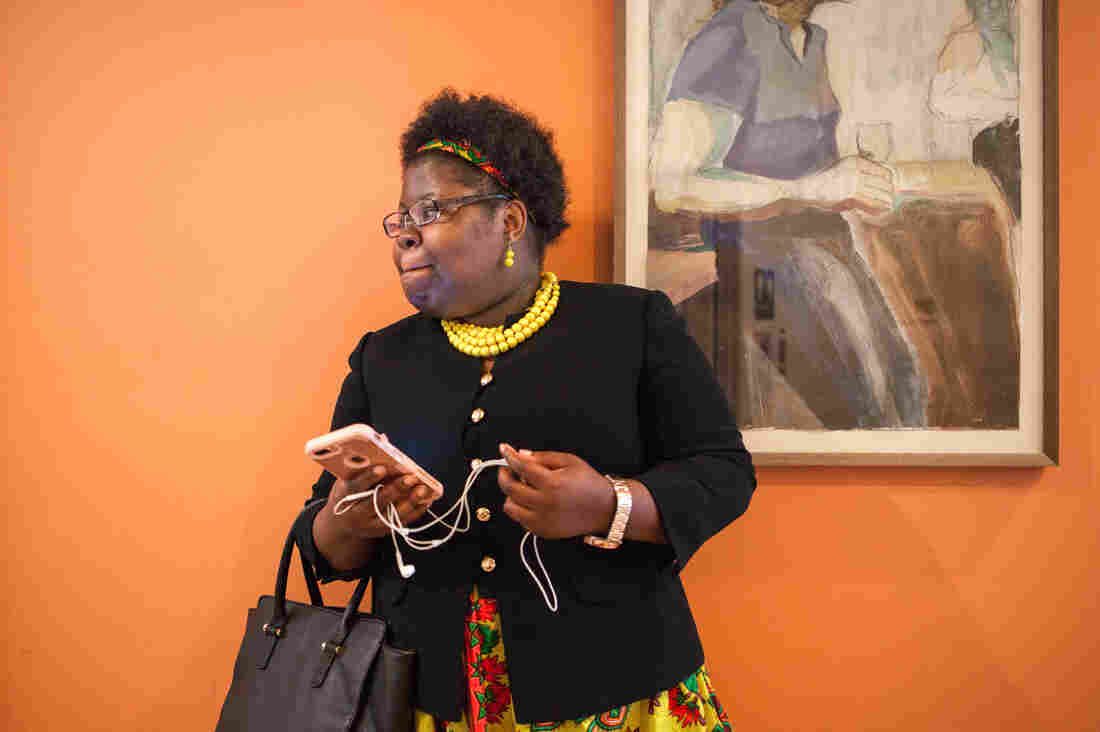
Ornella Mouketou in the waiting room at the McClendon Center, a mental health agency in Washington, D.C.

Kelly Jo Smart/NPR

hide caption

toggle caption

Kelly Jo Smart/NPR

It was about a year ago that Ornella Mouketou walked into the emergency room at the George Washington University Hospital in Washington, D.C., and told them she wanted to end her life.

She was in her early 20s, unemployed and depressed.

“I was just walking around endlessly. I was walking around parks, and I was just crying all the time,” she says. “It was like an empty black hole.”

She spent a few days in the psychiatric ward at the hospital, and while there, she met a case manager from the McClendon Center, a mental health agency. That person followed up after she went home and is still in touch with her now.

“They kept in contact with me. They came to my house,” says Mouketou, who now takes a prescription mood stabilizer and has weekly therapy sessions at the McClendon Center to manage her depression.

Ornella Mouketou, 25, has a job at a CVS pharmacy and is working toward becoming a pharmacy technician.

Kelly Jo Smart/NPR

hide caption

toggle caption

Kelly Jo Smart/NPR

Today, Mouketou has a job at a CVS pharmacy, earning $11.50 an hour, and she’s working toward becoming a pharmacy technician.

“I love my job,” she says. “It’s crazy, and it’s fun.”

All of Mouketou’s care has been paid for by her Medicaid managed care insurance plan, run by AmeriHealth.

Mouketou, 25, qualifies for Medicaid only because Washington, D.C., agreed to expand the program as allowed under the Affordable Care Act. If the Senate’s health care bill becomes law, Mouketou’s access to Medicaid would likely disappear in a few years.

“That will be heartbreaking,” she says.

One of the little-talked-about effects of the Affordable Care Act, or Obamacare, was to boost access to mental health care for the poor. For people like Mouketou, access to mental health care can mean the difference between being able to hold down a job or not.

Linda Rosenberg, president of the National Council for Behavioral Health, says the expansion of Medicaid has helped many people who were unable to work, or who earned very little, boost their opportunities. The National Council represents non-profit and public mental health care centers, including the McClendon Center in D.C. where Mouketou gets her care.

“People of all economic roots have mental illness,” she says. But she notes it’s especially hard on the poor, because it “affects your ability to work, because you have a brain disorder. And if it affects your ability to work, it’s going to affect your ability to get promoted and to make a living.”

Under the health bill being considered in the Senate, states that expanded Medicaid would see the federal money that helps pay the costs of that additional health care ratcheted back over four years, starting in 2020. States would still have the option of offering health care to the expansion population, which consists of adults with incomes up to 133 percent of the federal poverty level. However, lower federal reimbursement rates mean few states would be able to afford it.

The rollback would not only affect people like Mouketou, but also the programs that benefit her and other low-income people with mental health issues.

Ornella Mouketou worries that a rollback of Medicaid could end her access to mental health services.

Kelly Jo Smart/NPR

hide caption

toggle caption

Kelly Jo Smart/NPR

The McClendon Center has expanded its services, including opening a new counseling center, precisely because most of its patient care is now paid for under the Medicaid expansion, says CEO Dennis Hobb. He says 85 percent of its income is from Medicaid.

“It’s been great for those folks, because before, they didn’t have any mental health benefit,” he says.

Hobb says the center has worked with AmeriHealth Caritas, D.C.’s biggest Medicaid managed care provider, to develop an intense intervention program for people in mental health emergencies like the one Mouketou experienced.

“When any patient is admitted to a psychiatric hospital, we go in, and we follow them for 30 days,” he says. If someone goes to an emergency room and is not admitted, McClendon seeks them out at home within seven days and assigns a case manager.

The result? The readmission rates of people with mental health emergencies fell among McClendon’s client population.

“You’re saving money by putting it up front and getting people the services they need,” Hobb says. “That’s cheaper. It saves money down the line.”

Hobb worries all that progress will be reversed if the money from Medicaid is withdrawn. “I think what would really happen is that a lot of people would go back to how it was eight years ago, when people weren’t getting what they needed.” Hobb says people with severe mental illness die, on average, 25 years earlier than the general population.

“People die because they don’t have good health care,” he says.

Let’s block ads! (Why?)

3 Doctors On What Works And Doesn't Work In U.S. Health Care

Doctors Julie Gunter, Rob Stone and Gary Sobelson talk with Scott Simon about the problems with American health care and what they think of the current Republican health care plan.

SCOTT SIMON, HOST:

The United States spends about $9,000 per person per year on health care, the highest in the world. But our life expectancy is still lower than France, Switzerland, Japan, the United Kingdom, all of which spend less. With the Republican health care bill still on the Senate docket, we thought it would be a good time to hear from U.S. doctors. We have three with us now, Dr. Julie Gunther, a family doctor in Idaho, Rob Stone, an ER turned palliative care doctor in Indiana, and Dr. Gary Sobelson, a primary care doctor in New Hampshire. Thanks so much for being with us.

GARY SOBELSON: Thank you.

ROB STONE: Thank you.

JULIE GUNTHER: Thank you.

SIMON: Let me begin, if we can, with you, Dr. Gary Sobelson there in New Hampshire. Seven years since the Affordable Care Act – three since most of the changes went into effect. How is health care different? Is it better, worse?

SOBELSON: Much better coverage for our patients, particularly, in my case as a family doctor, for the working poor. I have people coming in for preventive services, for hypertension management, for cardiovascular disease prevention, for cancer screening who really had not been coming in except for the most acute needs. And that’s been meaningfully different.

SIMON: Dr. Rob Stone in Indiana, you were an ER doctor. You must have seen patients who who came to the ER because they didn’t have insurance to cover primary care visits. Has that changed under the Affordable Care Act for you?

STONE: It’s changed very noticeably. And a far smaller percentage of people are coming in uninsured, although we still continue to take care of those folks, too. Our hospital’s also affiliated with some very small-town hospitals in Bedford, Ind., Paoli, Ind. And in those areas in particular, I think the Medicaid expansion part of the Affordable Care Act has helped to solidify the financial standing of those hospitals, which was somewhat questionable earlier.

So I would say that’s all good. The downside – and this started before the Affordable Care Act – before Obamacare – is that co-pays and deductibles and premiums keep going up for the people who aren’t on Medicaid. And so people coming into the ER find themselves underinsured too often when they realize they can’t afford their co-pays or their deductibles.

SIMON: Dr. Julie Gunther, you’re a family doctor in Idaho. And I gather you’ve kind of opted out of the typical model and you have your own direct primary care practice.

GUNTHER: Yes, I have. I was a system-employed outpatient physician until 2014. And then I left and started a solo, independent, cash-based practice. So I no longer bill insurance.

SIMON: And why did you take that step?

GUNTHER: The simple answer is I had to leave the system to save myself to be the doctor I wanted to be. It’s valuable for me to hear Dr. Sobelson and Dr. Stone’s experiences. My experience was very, very different. Even before the Affordable Care Act – but especially after – the progressive amount of regulations made it almost impossible for me to serve people the way I was originally called to serve them as an outpatient family doctor.

And so I have built a rather successful cash-based practice that charges very, very little per month. The majority of my patients are either uninsured, underinsured or so frustrated with the current system and its barriers that they would rather pay a small amount out of pocket every month for more direct care.

SIMON: Well – and so I’m going to bring Dr. Rob Stone into this conversation because I’ve been told you’re an advocate for a single-payer system. Is Dr. Gunther onto something?

STONE: Well, I don’t know how generalizable it is widely – and particularly not to very poor areas like the inner city. But my feeling is that we have a good model for how to take care of everybody, which some people still think is kind of a pie-in-the-sky dream. But I’m still going to push for it. And I think that is expanding Medicare, which already takes care of everybody over 65. And I happened to turn 65 a couple months ago. And I’m on Medicare now. And I’m pretty happy with that.

SIMON: Dr. Gary Sobelson, are the high costs of health care unavoidable? Can’t we, after all, just do more for people – a lot more – than we could even 10 and 20 years ago?

SOBELSON: While there are many things that we can do, the high costs are things that the system itself brings about. We’ve designed a system that rewards high-reimbursement procedures, surgeries and undervalues the things that are cost-effective. And it doesn’t really matter how much we research this or prove this to ourselves within our profession. We don’t seem to move in that direction. We don’t have the political will.

Dr. Stone’s comments about Medicare for all are not isolated to small groups of the population. We’ve studied this in New Hampshire, and over 80 percent of our primary care physicians are in favor of a system that some would call single-payer – and the majority of our overall doctors, even including specialists. And that’s been replicated across the country, too. We as Americans seem to value our independent decision-making over collective wisdom, though I would argue that when simple procedures like common arthroscopic knee surgery, something that takes 15 to 30 minutes, is costing $15,000 to $25,000 in community hospitals around our country – that no one has the freedom to make that decision.

GUNTHER: I was just going to say I normally talk about a single payer system. And we use Medicare as a model. My patients who have Medicare say that it works. My mother and father who are economically well off pay $150 a month towards their health care. My Americans who are age 30 to 60 are dropping their health care plans. And they come in, and they tell me, I can choose between putting food on the table, paying for my kid to go to college or getting a health plan that I can’t afford.

So it’s not that I oppose a broader solution. But I would contend we have a system that is completely crumbling and unsustainable. And in my opinion and experience, I don’t think Medicare is working all that well, especially not in a way that we could roll it out to our whole country in any sort of sustainable way. And the heart of it in my opinion is we talk a lot about who’s going to pay for health care. But what we should be talking about is the price of health care.

SIMON: Do we have an unrealistic expectation that health care costs can be reduced when we expect health care to do more and more?

GUNTHER: I think there’s great examples that current health care prices are upwards of a thousand times more than anywhere close to true cost. My patients can get a CAT scan – cash price for $300. If they go into the local ER, it’ll bill out at $2,400. So I think we need to start asking why. Because we keep talking about who should pay or how we should pay for health care.

But if we allow free market forces and competition to create price transparency, then we start to have the opportunity for price control, cost control. And then I think we can completely change the dialogue from who should pay and how should we pay too to what parts of health care do people need help paying for.

SOBELSON: I think Dr. Gunther is describing the problems that we’ve created by more or less – and this is a failing of the ACA – allowing corporate profitability to be the driving force of how we set these so. So, again, if you’re not under Medicare or Medicaid in this country, you’re depending on a private insurance industry to somehow control costs, when, in fact, it’s not really in their interest. They don’t have skin in the game here.

They make their profitability based on how much they collect in revenue. And, in fact, it’s written into the law. So, again, it’s not surprising that we’ve created a model where, in fact, more spending will be encouraged, not discouraged because the only people who really would care about it would be the consumers. And they don’t seem to believe that they can control it.

SIMON: Let me ask this finally, if I could. The Senate bill that’s under consideration right now may or may not be going anywhere. Could each of you give us one idea that you would like to see the government adopt that could improve health care in this country? – or not just the government. What can we do?

STONE: Well, I would say first that the Senate bill is a terrible thing that would set us back and would cost lives. And the people who would be hurt the worst would be children, the disabled and the elderly and nursing homes because of the ravages to Medicaid. So the first thing I would do would be, say, save Medicaid and continue to expand it. And then the second biggest problem in the Senate bill is that it would make health care very expensive for people ages 50 to 65 or 55 to 65 – would be to think about lowering the age of Medicare eligibility to, say, 55 and not cut those people out into the cold.

SIMON: That’s Dr. Rob Stone in Indiana. Dr. Julie Gunther, what would you suggest?

GUNTHER: I would agree with Dr. Stone. I don’t think the Senate bill provides the improvements to the Affordable Care Act or some of our biggest health care problems that we need. If I had one ask it would be that we allow consumers – we allow patients who do have health savings accounts to use those health savings dollars to pay their physician, whether it’s a periodic fee or a direct payment.

And one of my favorite quotes about health care in our country is that we continue to tape wings on a car and call it an airplane. I think we have to radically transform the system at its core if we hope to end up in a different place.

SIMON: And Dr. Gary Sobelson.

SOBELSON: Yeah. From my perspective in New Hampshire, I think the damages to Medicaid that the Senate bill would bring about would be devastating to us and take back so much positive progress we’ve had in terms of access and cost containment.

And if I had to add one thing to it, I think Dr. Stone’s idea of expanding Medicare to populations that traditionally have a hard time buying insurance could be extended into the whole idea of the ability of a public option, the ability of the Medicare and Medicaid programs to work out ways to compete with private insurers so that the public could become more comfortable with them.

SIMON: Doctors Rob Stone, Julie Gunther and Gary Sobelson, thanks so much for joining us.

GUNTHER: Thank you.

STONE: Thank you.

SOBELSON: Thank you.

Copyright © 2017 NPR. All rights reserved. Visit our website terms of use and permissions pages at www.npr.org for further information.

NPR transcripts are created on a rush deadline by Verb8tm, Inc., an NPR contractor, and produced using a proprietary transcription process developed with NPR. This text may not be in its final form and may be updated or revised in the future. Accuracy and availability may vary. The authoritative record of NPR’s programming is the audio record.

Let’s block ads! (Why?)

Senate Health Bill Could Both Boost And Undercut Mental Health Funding

A provision in the bill proposed by the GOP Senate would permit Medicaid to pay for longer stints of inpatient psychiatric care. But other parts of the bill would strip $772 billion from Medicaid — the single-largest funder of care for people who have schizophrenia, bipolar disorder or another serious mental illness.

B. Boissonnet/Getty Images

hide caption

toggle caption

B. Boissonnet/Getty Images

A little-discussed provision in the Senate health care bill is designed to boost the number of hospital beds for psychiatric care, providing a long-sought victory for mental health advocates.

The provision would amend an obscure rule regarding Medicaid funding — a rule that has sharply limited the number of beds for those with schizophrenia, bipolar disorder or other mental illnesses.

Yet leading advocacy groups on mental health issues say they see no reason to celebrate.

That’s because the Senate bill would also wring out $772 billion from Medicaid — the joint state-federal insurance program that is the single-largest provider of care for people with serious mental illness. The nonpartisan Congressional Budget Office has said that the Senate bill, drafted by Republicans as a replacement for the Affordable Care Act, would reduce overall Medicaid spending by 26 percent by 2026, and by 35 percent the following decade.

The loss of those funds would devastate health care services for people with mental illness, who are some of the most vulnerable and disadvantaged people in the country, said Bethany Lilly, deputy director of policy and legal advocacy at the Bazelon Center for Mental Health Law, an advocacy group.

“Medicaid is the safety net for people with serious mental illness,” said Ronald Honberg, senior policy adviser at the National Alliance on Mental Illness.

Without decent mental health care and support services, people who have a psychotic disorder can quickly deteriorate, Honberg said, ending up in overcrowded emergency rooms, jail and prison cells or dangerous city streets. “This bill is a prescription for making all these problems worse.”

Republicans who crafted the Senate bill have noted that Medicaid spending will still increase under their plan — just at a rate lower than currently projected. The Senate bill will make Medicaid spending more sustainable, said Julia Lawless, a spokeswoman for the Senate Finance Committee, one of the Senate committees that oversees health legislation.

“Even before Obamacare’s unprecedented Medicaid expansion,” Lawless said, “the program was plagued by quality issues. States were barred from using innovative solutions to improve patient care and both federal and state Medicaid spending was growing at unprecedented, unsustainable levels.”

The Senate bill will reverse this course, she said, and slow the growth of Medicaid “without cutting actual benefits.”

The Medicaid program has traditionally refused to pay for inpatient stays in large, freestanding psychiatric facilities, making exceptions for patients under age 21 and facilities with 16 beds or fewer. The rule, which has changed little since Medicaid was created five decades ago, was aimed at preventing the federal government from paying for long-term care in psychiatric institutions.

But that Medicaid rule also has contributed to a severe shortage of psychiatric beds for people in crisis, said John Snook, executive director of the Treatment Advocacy Center, a nonprofit that focuses on people with serious mental illness.

Mental health advocates have called for changing the rule for decades.

Last year, the Centers for Medicare & Medicaid Services eased the policy, paying for up to 15 days of inpatient hospital care for patients enrolled in Medicaid managed-care plans. But in a letter to the Medicaid program last year, the National Association of Medicaid Directors noted that some patients with mental illness or substance abuse disorders might need closer to a month of inpatient care.

The current draft of the Senate bill, dubbed the Better Care Reconciliation Act, would allow states to receive federal matching Medicaid funds for up to 30 consecutive days of inpatient psychiatric hospital care, or 90 days in a year.

This suggested change in Medicaid funding was included in the Republican bill because several senators have voiced concern that patients haven’t had enough access to hospital care for mental illness and addiction, according to a GOP Senate aide who was authorized to speak only on condition of anonymity. The legislators involved, according to the aide, included Sen. Orrin Hatch, R-Utah, and Sen. Rob Portman, R-Ohio.

Honberg said he would welcome such a change except that reducing overall Medicaid spending could force closures of rural hospitals and institutions that serve as “safety nets” — providing free care to people who are uninsured or poor.

If these hospitals go out of business, Honberg said, the total number of hospital beds available to people with mental illness could shrink, not expand.

Medicaid, he pointed out, pays for a wide variety of supportive services for people with schizophrenia and other serious mental illnesses — beyond doctor’s visits and medications. States can use Medicaid funds to pay for case managers; transportation of patients to and from doctor’s appointments; supportive housing, which helps people with serious mental illness live independently; supported employment, which provides job training and other services; and teams of professionals who assist people who need intensive, comprehensive help navigating the health system and social services.

Kaiser Health News, a nonprofit health newsroom, is an editorially independent part of the Kaiser Family Foundation.Follow KHN’s enterprise reporter Liz Szabo on Twitter@LizSzabo.

Let’s block ads! (Why?)