Nevada Voters, Divided Over Health Care, Put Moderate Republican In Tough Spot

Nevada Sen. Dean Heller speaks at a town hall inside the Reno-Sparks Convention Center on April 17 in Reno. Heller says he opposes the health care proposal put forth by Senate GOP leaders.

David Calvert/Getty Images

hide caption

toggle caption

David Calvert/Getty Images

When senators come back to Washington on Monday, a handful of Republicans will help decide the fate of legislation that could reshape health care in America.

One of them is Nevada Republican Dean Heller.

Sen. Heller is one of a small bunch of Republicans who have said they will not support the latest draft proposal to repeal and replace the Affordable Care Act, or Obamacare. Republican leadership can only lose the support of two of its own senators and still pass such a bill.

The Republican senators who say they’ll vote no on the latest health care plan fall into two camps. Members of the party’s right wing think this proposal is too timid and doesn’t go far enough to undo the Affordable Care Act. More moderate Republicans, like Heller, think it is harsh and goes too far.

“I’m telling you right now, I cannot support a piece of legislation that takes away insurance away from tens of millions of Americans and hundreds of thousands of Nevadans,” he said.

Nevada’spopular governor, Brian Sandoval,was the first Republican governor in the country to expand Medicaid under the Affordable Care Act. More than 200,000 uninsured people got coverage after the expansion.

With that expansion of coverage, many people here are watching the fate of this bill to learn whether they’ll be able to keep going to the doctor.

Heller’s position has prompted advocacy groups and constituents on both sides of the issue to flood his office with calls.

For weeks, protesters have been showing up outside the senator’s Las Vegas office urging him to oppose any changes to the health care system that would roll back provisions like the Medicaid expansion or funding for Planned Parenthood.

Opponents of the Republican health care proposal protest outside Republican Sen. Dean Heller’s office in Nevada.

Ari Shapiro/NPR

hide caption

toggle caption

Ari Shapiro/NPR

Cyndy Hernandez, who helped organize the most recent protest, says Heller’s opposition to the bill GOP leadership is crafting isn’t necessarily a done deal — “not until he marks that button on his desk in the Senate chamber.”

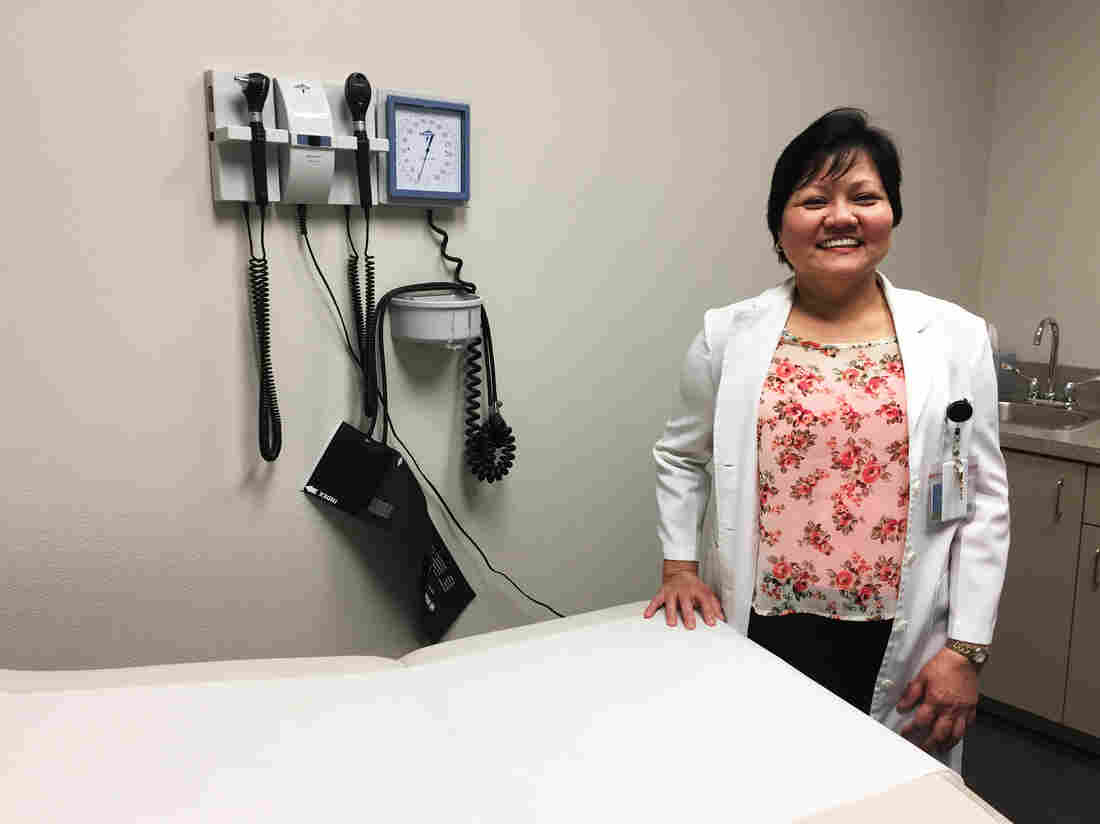
Patients at FirstMed clinic, where 80 percent of the patients are on Medicaid, voice their concern on a daily basis, nurse Maria Vital says. Administrators say the clinic would be forced to close without the funding it gets through the Affordable Care Act. Many of these patients went years without seeing a doctor for easily treatable conditions before the clinic opened, Vital says.

“They’re very scared,” she says. “They’re asking us what will happen to them, and I tell them we will try to be here as long as we can for them.”

Maria Vital is a nurse at FirstMed Clinic, where a majority of the patients are on Medicaid.

Sam Gringlas/NPR

hide caption

toggle caption

Sam Gringlas/NPR

Across town in Henderson, Taylor Lewis lives with her 7-year-old daughter Riley in a modest condo, with a couple of dogs and a large collection of plastic toy dinosaurs. Riley whispers their names as she pulls each one out of a big paper bag: stegosaurus, pterodactyl, Tyrannosaurus rex.

Ten days after Riley was born, a helicopter rushed her to the hospital for emergency heart surgery. When Taylor got over the shock of her daughter’s near-death, she got another shock. The helivac bill totaled $20,000.

On top of being a single mom, Taylor has been working part time and studying part time — she just finished her master’s in public health.

Until she finds a full-time job, she depends on Medicaid to cover all of her daughter’s medical costs.

She sometimes thinks about what her life would be like if Nevada had not expanded Medicaid coverage.

“I mean, I’d be without anything. I’d be without a car, a house,” Taylor says.

Taylor Lewis sits with her 7-year-old daughter Riley. Until Taylor finds a full-time job, she says she depends on Medicaid to cover all of her daughter’s medical costs.

Ari Shapiro/NPR

hide caption

toggle caption

Ari Shapiro/NPR

For people on both sides of this debate, the stakes seem far higher than a typical piece of legislation.

People like Taylor feel that what has been proposed puts their lives on the line; Republicans who support the bill see a chance for lawmakers like Heller to keep a promise that Republicans have made in every campaign for nearly a decade.

Conservative talk radio host Wayne Allyn Root says nearly every caller now talks about voting Heller out of office because of his opposition to the draft proposal that Republicans floated in recent weeks.

“If Heller votes no on the repeal he’s got to go, you gotta primary him,” he says.

Root broadcasts out of his home studio for three hours each day. He has piles of framed photographs, including images of him with President Trump, Newt Gingrich and Ronald Reagan.

Root says his listeners are aghast that a Republican senator from their own state could be responsible for helping to kill this bill.

Wayne Allyn Root hosts a conservative talk radio show from his home studio.

Sam Gringlas/NPR

hide caption

toggle caption

Sam Gringlas/NPR

National groups on both sides have put millions of dollars into TV ads trying to sway Heller. The senator is home for the July Fourth recess this week, but he isn’t spending that time holding town halls.

In the small town of Ely, he rode a horse in the July Fourth parade. He watched the fireworks in Elko, another town in rural northern Nevada. Even there, some people heckled him.

Heller declined the Republican Party’s invitation to march in the town of Pahrump, which has the same spectrum of Republican views that’s dividing the Senate.

Local party chairman JoeBurdzinski thinks the bill is too timid. He’d stand with senators like Rand Paul and Ted Cruz, holding out for a full repeal.

“The Republican Party has said for the last eight years we’re gonna repeal and get rid of Obamacare. That’s what Donald Trump said he wanted to do, that’s what other Republicans running for office have said. Now they have to live up to that commitment to the American people because … the American people voted for that,” he says.

Leo Blundo, another official with the Nye County Republican Central Committee, has more sympathy for Sen. Heller, but doesn’t quite believe Republican leaders who say this is the only train leaving the station.

Leo Blundo (left) and Joe Burdzinski are officials with the Nye County Republican Central Committee.

Sam Gringlas/NPR

hide caption

toggle caption

Sam Gringlas/NPR

“It’s public knowledge we got both houses [of Congress],” he says. “Get some business done. … Quit mickey-mousing around and get some work done.”

For Heller, the considerations about Medicaid expansion and repeal promises might all take a back seat to a more pressing reality. He’s up for re-election next year — a Republican in a state that has gone blue for the last three presidential elections.

Whatever position he takes on the final bill, that race will be far from an easy win.

Let’s block ads! (Why?)

Montana Insurers Say Medicaid Cuts Would Drive Up Cost Of Private Health Plans

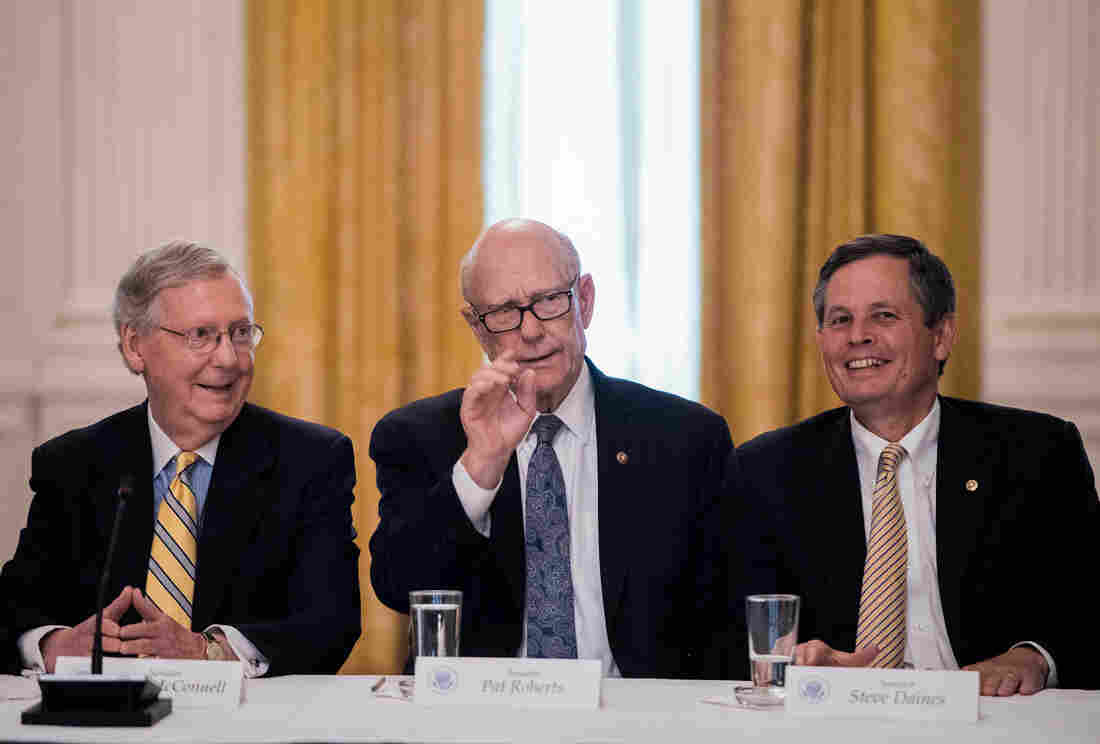
Steve Daines of Montana (right) talks with fellow Republican Sens. Mitch McConnell and Pat Roberts in a White House meeting in June on the GOP health care strategy, which would include deep cuts to Medicaid. Montana insurers say the plan worries them.

Nicholas Kamm/AFP/Getty Images

hide caption

toggle caption

Nicholas Kamm/AFP/Getty Images

Montana was one of the last states to expand Medicaid, and its Obamacare marketplace is doing pretty well. It has 50,000 customers, decent competition and no places that have come to be called “bare counties” — where no insurers want to sell plans.

Still, the three insurers selling in Montana now say that if GOP plans to cut Medicaid and repeal the individual mandate go through, it will mean higher costs all around.

The Republicans who make up two-thirds of Montana’s congressional delegation say a big reason they want to repeal the current health care law is because it’s causing health insurance markets to “collapse.”

But the insurance companies that sell policies in the state say that’s not true in Montana — and they are concerned about what the Republicans are saying and doing.

“I don’t think that [the GOP] plan is going to improve health care in the state of Montana,” says Jerry Dworak, the CEO of Montana Health Co-Op. “I think just the opposite is going to happen. And I think — I really do think a lot of people are going to get hurt.”

The co-op is one of the three insurance companies that’s been selling Montanans coverage on Healthcare.gov since the federal marketplace was created in 2013. Montana Health Co-Op has no plans to leave.

However, collapse of the insurance market is a real possibility, Dworak and others say, if some of the GOP’s wish list comes true. First, deep cuts to Medicaid would have ripple effects to everybody who has insurance.

Todd Lovshin is a vice president at PacificSource Health Plans. He says Medicaid expansion means Montana hospitals are now getting paid for taking care of more than 70,000 Montanans who got Medicaid after the state expanded the program under the Affordable Care Act.

“All of our hospitals have to take any patient that comes in, and serve them,” Lovshin says. “That has to be paid somewhere. And if we’re not paying that through Medicaid expansion, those costs have to be borne by someone — and so that will increase the overall cost of medical expenses.”

Hospitals have a legal obligation to examine and stabilize any patient who walks in their door, regardless of whether they have insurance. When hospitals see their unpaid bills stack up, Lovshin says, prices go up for everybody else; to stay afloat, insurers have to charge patients who have insurance more.

John Doran agrees with that analysis. Doran is a vice president with Blue Cross and Blue Shield of Montana, the state’s biggest insurer.

Doran also says that problems would likely get worse if the individual mandate goes away. That’s the requirement that each person have health insurance – a requirement that the Republican health care bills would do away with.

“If there’s no mandate, and there’s no incentive for them to buy a health insurance plan, then maybe they won’t,” Doran says. And if that happens, he says, “the people who need health care the most, and typically have the highest health care costs, are the only ones who are in the marketplace. And that results in higher health care costs, and consequently higher premiums.”

In recent years, many Montanans have continued to see their insurance premiums rise, sometimes by more than 50 percent a year. Most people who buy plans on the federal marketplace get subsidies to help defray the cost, and the co-op’s Jerry Dworak says he thinks prices are now starting to stabilize. If the health law isn’t changed, he projects his company’s premiums would only go up 5 percent in 2018.

This story is part of NPR’s reporting partnership with Montana Public Radio and Kaiser Health News.

Let’s block ads! (Why?)

Wisconsin Primary Care Doctor Describes Challenges Of Prescribing Opioids

A new report from the Centers for Disease Control and Prevention says opioid prescriptions are down, but still way too high. While doctors are prescribing lower doses, they are still doing so for longer than CDC guidelines say are safe. NPR’s Robert Siegel talks to Dr. Alan Schwartzstein, who has worked as a family doctor for 28 years in rural Wisconsin, about the issues surrounding prescribing pain medication.

Let’s block ads! (Why?)

States Move To Tighten Medicaid Enrollment, Even Without A New Health Law

Some states are seeking to require that Medicaid participants work, get drug tested, or recertify their eligibility more frequently.

Philby Illustration/Ikon Images/Getty Images

No corner of the health care system would be harder hit than Medicaid, the federal-state health insurance program for the poor, if Republican leaders in Congress round up the votes to repeal major portions of the Affordable Care Act.

GOP lawmakers have proposed winding down the Medicaid expansion that added 17 million people in 31 states and the District of Columbia under the ACA, and eventually capping the program’s spending per capita.

If the current bill in the Senate becomes law, 15 million fewer people would have coverage through Medicaid by 2026, the Congressional Budget Office has predicted.

But other efforts that are garnering much less attention would further reshape Medicaid, potentially knocking millions more off the rolls. They include asking beneficiaries to verify their eligibility twice a year, instead of once under the current law.

In many ways, the current battles pit those who view Medicaid as a health insurance program, in which higher enrollment is not seen as a problem, against those who see it as a welfare program, in which lower enrollment is prized.

Some states that have experimented with more frequent verification and other techniques to manage enrollment say they’ve worked well, while others say they’re not cost-effective and are overly burdensome.

In addition, the Trump administration has said it wants to let states experiment more with their Medicaid programs, inviting them to ask for waivers that do not need congressional approval. In recent months, states have proposed changes that include requiring able-bodied adults on Medicaid to work, drug testing enrollees, capping the length of time some can stay on the program and limiting the number of people who can be on the program at once. The Obama administration had rebuffed some of those efforts.

“All of the bells and whistles and hoops that people have to jump through create an enormous amount of red tape and that depresses enrollment,” says Joan Alker, executive director of the Center for Children and Families, a research center at Georgetown University. “That’s a proven strategy.”

Some 74.5 million people are now enrolled in Medicaid — more than the 58 million covered by Medicare, the program for seniors and the disabled. Since the implementation of the Medicaid expansion under the Affordable Care Act in 2014, Medicaid enrollment has grown by 16.7 million. That increase alone is larger than the number of people who purchase health insurance through the marketplaces set up by the ACA.

Health policy researchers say there’s ample evidence that adding paperwork and administrative burdens on beneficiaries in Medicaid increases turnover, called churn. For the most part, it’s not because people are no longer eligible for the program, they say; it’s that poor people move frequently and often face a host of challenges that make them less likely to turn in required paperwork.

Even before the ACA passed, many states were moving to make it easier for people, particularly children, to get enrolled and stay enrolled in Medicaid and the Children’s Health Insurance Program. The Affordable Care Act allows states to formally reassess people’s enrollment eligibility just once a year. But Medicaid enrollees are required to notify authorities in the interim if they have a change in life circumstances, such as finding a job. And that can prompt another review.

The House bill to replace the Affordable Care Act, passed May 4, would require reassessments every six months for enrollees who became eligible through the Medicaid expansion. The bill pending in the Senate would allow reassessments every six months or more frequently, but would not require them.

Proponents of the changes say too many people stay on Medicaid when they are no longer eligible. They point to Illinois, which hired a consultant a few years ago to help it improve its renewal process. During the first three quarters of fiscal 2017, which just ended, 623,530 individuals had their Medicaid canceled during the renewal process — the vast majority for not responding to requests for information. Of those, nearly 148,000 eventually re-enrolled after submitting the requested information.

“Certainly, at least some percentage of clients who did not respond did so because their circumstances were such that they were indeed not eligible,” the state said in its most recent report. “The people who are more likely to respond are those who are eligible.”

Josh Archambault, a senior fellow at the conservative Foundation for Government Accountability who has tracked the Illinois project, says the state’s Medicaid rolls had included people who died years earlier, as well as those who no longer lived in the state.

Critics of more frequent reassessments “are correct to say that it would decrease enrollment,” Archambault says. “But these are all people who would not qualify.”

He said not all checks have to be intrusive. States, for instance, can more frequently check federal and state databases to look for whether a person has a life change, has moved or has a new job. “If somebody gets a job, that’s great. They may no longer be able to qualify for the program,” he says. “If they still qualify, they can sign right back up.”

That’s what’s happened in Texas. The state regularly checks the finances of families whose children are enrolled. State data appears to show that the number of children experiencing a temporary gap in their Medicaid coverage has increased since the state instituted the new process in 2014.

Avik Roy, a conservative who has advised Republican leaders on health policy, said by letting states check people’s eligibility for Medicaid more often, “You’re giving states a tool to make sure that the people who are enrolled in the Medicaid program are the people who the program is meant to help.”

That’s not how officials in California see it. They say the current system works well compared to many years ago, when people had to prove their eligibility more often, up to four times a year. It was burdensome for enrollees and costly for the state and its counties, which handle the process.

In California’s experience, when people have a change in life circumstances, they generally report it right away, as required. Moreover, California has moved from a system that was dependent on paper to one that is largely electronic, easing the burden further.

“Medicaid programs have a responsibility to help ensure that those people who are eligible for the program, that they’re enrolled and they receive the services that they’re in fact eligible for,” says René Mollow, deputy director for health care benefits and eligibility at the California Department of Health Care Services.

Mollow said when people are on Medicaid, their income doesn’t change much from year to year, especially children, the elderly and the disabled.

While California has sought ways to expand access to its Medicaid program, other states have looked for ways to tighten eligibility, ensuring it is only available for those who they believe truly need it.

When Indiana expanded its Medicaid program, for example, it also deployed a complex system of rewards and penalties that require enrollees to make token regular payments or get barred from the program. It did so with the help of a consultant named Seema Verma, who is now the administrator of the federal Centers for Medicare and Medicaid Services, the agency that decides whether to grant states permission to make changes to their Medicaid programs.

And more states are seeking changes to their programs. Indiana and Maine, for example, are among states that have proposed work requirements for able-bodied adults in the program. (Indiana estimates that a quarter of those required to work won’t and “will have HIP [Medicaid] eligibility suspended until compliance has been demonstrated.”) States say that by making Medicaid contingent on work, potential beneficiaries will be incentivized to find jobs that offer health insurance.

Wisconsin is asking the federal government to approve a drug testing requirement, saying it will help get people into treatment and prepare them for jobs. Arizona wants to cap the amount of time certain non-disabled adults can remain on Medicaid to five years, taking a page from the welfare reform playbook of the 1990s. And Utah is proposing a limit on the number of adults without dependent children who can enroll in its Medicaid program.

Such requests are popping up all across the country, according to a recent analysis by the Kaiser Family Foundation, a nonprofit think tank.

So far, the Trump administration hasn’t approved any of these requests, but it signaled in a letter to governors in March that it would be more flexible than the Obama administration, which did not approve requests from Indiana and Arizona in the past.

“We commit to ushering in a new era for the federal and state Medicaid partnership where states have more freedom to design programs that meet the spectrum of diverse needs of their Medicaid population,” wrote Health and Human Services Secretary Tom Price and Verma.

Diane Rowland, executive vice president of the Kaiser Family Foundation, says many of the state proposals treat Medicaid as they do welfare programs. “You see work requirements. You see drug testing. You see things that would discourage people from enrolling,” she says. “The other side is that a lot of people on Medicaid are already working. They just don’t work in jobs that have health insurance.”

Charles Ornstein is a senior reporter at ProPublica, an independent nonprofit newsroom based in New York.

Have you corresponded with a member of Congress or senator about the Affordable Care Act or proposals to repeal it? ProPublica would love to see the response you received. Please fill out their short form.

Let’s block ads! (Why?)

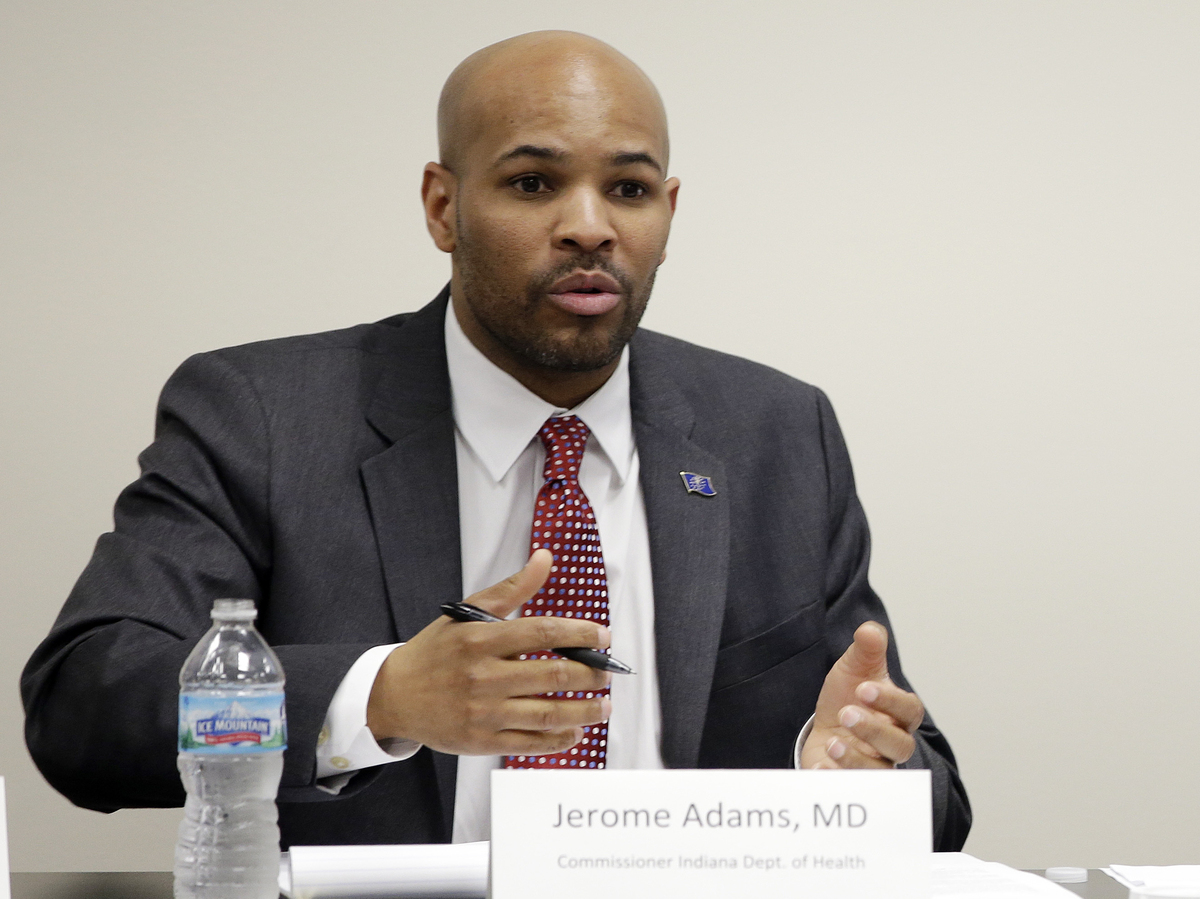
Trump's Surgeon General Pick Built Reputation Fighting HIV And Opioids In Indiana

Indiana State Health Commissioner Dr. Jerome Adams is President Trump’s nominee for U.S. Surgeon General.

Darron Cummings/AP

hide caption

toggle caption

Darron Cummings/AP

Several weeks before President Trump nominated Indiana’s state health commissioner Jerome Adams to be the next U.S. Surgeon General, Adams toured the Salvation Army Harbor Light detox center in Indianapolis, Ind., the only treatment facility in the state for people without insurance.

His supporters say the visit is an example of how he’s prioritized the opioid epidemic during his tenure as Indiana’s top health official. Addiction specialists and advocates say he’s led important progress in implementing lifesaving policies. They believe that if confirmed, Adams would use his on-the-ground experience to guide national policy.

“I believe that Dr. Adams understands the value of community grassroots efforts, that they should be included at the table with decision makers,” says Justin Phillips, founder of the prevention-focused group Overdose Lifeline, who toured the detox center with Adams. “They need to understand what’s realistic in the field.”

A practicing anesthesiologist, Adams was appointed Indiana Health Commissioner by then-Gov. Mike Pence in October 2014. Four months into the job, he announced an HIV outbreak in rural Scott County, Ind., after health workers documented 26 cases of HIV there. By May 2015, the number of confirmed infections had risen to 158, spread almost entirely through injection drug use. 88 percent of them also tested positive for hepatitis C. Today, the number of confirmed HIV cases has reached 219.

Health workers credit Adams with persuading Pence to allow Indiana counties to create syringe exchanges to contain the spread of the disease. “We wouldn’t have syringe exchange if it wasn’t for him,” says Carrie Lawrence, a public health researcher at Indiana University who helps implement syringe exchange programs throughout the state.

Pence had expressed moral reservations about syringe exchanges — a sentiment that Adams told the New York Times he originally shared. But in March 2015, the governor acted on advice from Adams and the Centers for Disease Control and Prevention and authorized a 30-day emergency syringe exchange, citing a public health emergency. Later that spring, Pence signed a law legalizing syringe exchanges in Indiana.

Beth Meyerson, co-director of Indiana University’s Rural Center for AIDS/STD Prevention, worked closely with Adams throughout that period. She says early on, when it became clear to legislators that a clean syringe exchange program was needed to reduce the spread of HIV and hepatitis C, Adams was able to bring public health evidence to the table.

“Dr. Adams navigated the very ideological political environment that was created by then-Gov. Pence,” she says. “There’s just no doubt the governor wouldn’t have listened to me or listened to the leaders in the legislature, but he would listen to Jerome Adams.”

She thinks Adams will have sway working with Vice President Pence on a national scale, too. “He will navigate [Washington], I suspect, the same way that he did in Indiana, which is to listen to communities, work with several partners across the arena, and bring public health evidence to the table again as an advocate for community health,” Meyerson says.

Adams has since supported other state laws aimed at curbing the opioid epidemic, including a bill that increased access to the overdose antidote naloxone, and another that restricts the amount of opioid medication a prescriber may give to adult patients who have not previously taken opioids and to children.

Still, Meyerson says expectations about what Adams might do in Washington have to be tempered by political reality. Even in Indiana, the laws he helped pass haven’t been as comprehensive as she and other public health workers would have liked. The original syringe exchange law “was an administrative nightmare,” she says. It has since been updated by Indiana Gov. Eric Holcomb, making it easier for counties to start exchanges.

Funding also remains an issue. Indiana ranks 49th in the country in public health spending. “So all of these counties who have tried to move forward for syringe access are doing so with both hand tied behind their backs, because they do not have the resources to make this happen,” Meyerson says.

If confirmed by the Senate, Adams would be the second health official from Pence’s home state to join the Trump administration. Seema Verma, who helped shape Indiana’s Medicaid expansion, now heads the Centers for Medicare and Medicaid Services.

This story was produced by Side Effects Public Media, a news collaborative covering public health.


Let’s block ads! (Why?)

In A Conservative Corner Of California, A Push To Preserve Obamacare

Greta Elliott, who manages a health clinic in Canby, Calif., says she didn’t buy health insurance for herself because she thinks it’s too expensive.

April Dembosky/KQED

hide caption

toggle caption

April Dembosky/KQED

Modoc County, in the northeast corner of California, is roughly the size of Connecticut. It’s so sparsely populated that the entire county has just one stoplight. The nearest Walmart is more than an hour’s drive, across the Oregon border. Same with hospitals that deliver babies.

Greta Elliott runs a tiny health clinic in Canby, on the edge of the national forest. “Rural” doesn’t begin to describe the area, she says. This is “the frontier.”

“There are more cows in Modoc than there are people,” Elliott says.

There’s a frontier mentality, too. People take care of each other, and they take care of themselves. They don’t like being told what to do. Being forced to buy insurance made Obamacare a dirty word.

Even Elliott, administrator of the Canby Family Practice Clinic, decided against buying coverage for herself.

“It’s too expensive,” she says. “I choose to put my money back into paying the bills of the whole family.”

Overall, the Affordable Care Act helped 25,000 people in the upper reaches of Northern California buy plans through the state marketplace, Covered California. But the law helped three times as many people, 75,000, enroll in Medi-Cal, the state’s Medicaid program that provides free health coverage for low-income residents.

“The data shows it’s the rural communities that have greatly benefited from the Medicaid expansion. That’s the irony,” says Dean Germano, CEO of the Shasta Community Health Center. “These are places that voted much more heavily for Donald Trump.”

In Modoc and Lassen counties, 70 percent of people voted for Trump in the November election. In neighboring Shasta County, Trump won 64 percent of the vote.

But now a coalition of clinics from across the northeast corner of the state is lobbying local officials to take an unpopular position in this conservative land: defend the Affordable Care Act.

And the right-leaning Shasta County Board of Supervisors took them up on it.

“We thought ‘Whoa! That is really bold,’ ” Germano says. “I was surprised.”

The board sent a letter to the local Republican representative, Doug LaMalfa, asking him to vote against the initial GOP repeal and replace bill, because it would hurt local people.

“We have an obligation to say something,” says Supervisor David Kehoe. “And if it may be mildly offensive from a political standpoint for some, well, we’re not going to be intimidated by politics.”

But LaMalfa still voted in favor of dismantling Obamacare.

LaMalfa didn’t return calls and emails for this story. But in May, he told KQED that skyrocketing premiums were the main driver behind his vote.

“Unfortunately, the reality is that too many young and healthy individuals are deciding they’d rather pay the penalty than sign up for care, citing financial barriers and lack of choice,” he said in a statement. “A 28-year-old making $45,000 a year with no major health concerns is not going to pay upwards of $400 a month for a plan that does not even work for them.”

When clinic representatives met with LaMalfa’s staffers, they were told the congressman’s office was flooded with calls like that.

But people with Medi-Cal didn’t call to say how much they appreciate that program. In fact, at first clinics struggled getting people to sign up for Medi-Cal.

“They feel like it’s a handout and they’re too proud, they don’t want to,” says Carol Morris, an enrollment counselor for the Mountain Valleys Health Centers in Shasta County.

One way clinic workers get around the stigma is to avoid calling it Medi-Cal. Instead, they promote the name of the insurer that manages the Medi-Cal contract in that region. People get a card for “Partnership Health Plan“and may not realize they’re actually covered by a government program.

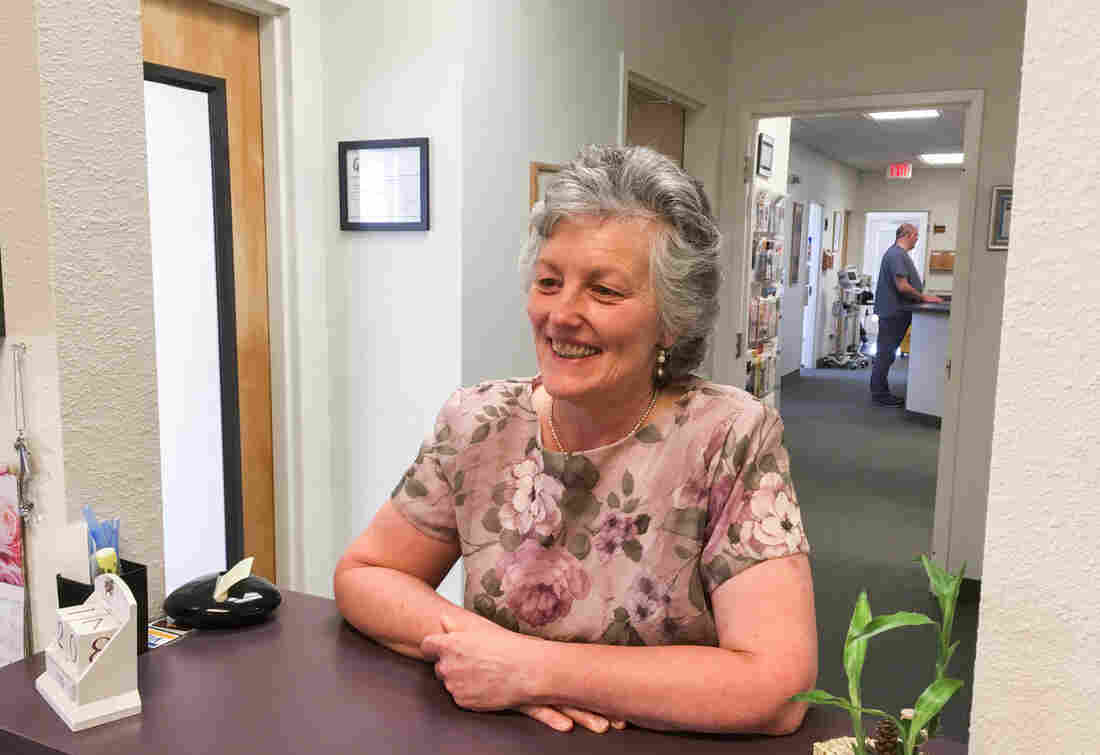
Carol Morris, an enrollment counselor for health clinics in Shasta County, says many patients don’t want to admit they qualify for Medicaid.

April Dembosky/KQED

hide caption

toggle caption

April Dembosky/KQED

“It feels like it’s more of an insurance,” Morris says. “It’s like a laminated, wallet-sized card that’s got your numbers on it. It just looks exactly like an insurance card.”

One patient at the Mountain Valleys clinic in Bieber, Kay Roope, 64, knew she had Medi-Cal, and she liked it.

“It did me good,” she says.

Now she has a subsidized commercial plan through Covered California with modest premiums and copays, and she likes that, too.

“It’s OK, ’cause I’m at the doctor’s at least once a month,” she says.

But when asked what she thinks of Obamacare overall, she says she doesn’t like it.

“Because of Obama himself,” she says with a laugh. “I rest my case.”

The confusion and the contradictions are common among patients, explains Morris, the enrollment counselor.

“People just don’t understand the different names,” she says. “But of course, it’s the same thing.”

Morris has seen the difference the Affordable Care Act has made for people in the region. She has seen patients get treatment for diabetes and breast cancer, or get knee surgery that they otherwise wouldn’t have gotten.

Those patients won’t fight for Obamacare, Morris says, so that’s why the clinics have to.

This story is part of a reporting partnership with NPR, KQED and Kaiser Health News.

Let’s block ads! (Why?)

As Seniors Get Sicker, They're More Likely To Drop Medicare Advantage Plans

A GAO report questions the quality of a number of Medicare Advantage plans after large numbers of sicker enrollees dropped them.

Yellow Dog Productions/Getty Images

hide caption

toggle caption

Yellow Dog Productions/Getty Images

When Sol Shipotow enrolled in a new Medicare Advantage health plan earlier this year, he expected to keep the doctor who treats his serious eye condition.

“That turned out not to be so,” said Shipotow, 83, who lives in Bensalem, Pa.

Shipotow said he had to scramble to get back on a health plan he could afford and that his longtime eye specialist would accept. “You have to really understand your policy,” he said. “I thought it was the same coverage.”

Boosters say that privately-run Medicare Advantage plans, which enroll about one-third of all people eligible for Medicare, offer good value. They strive to keep patients healthy by coordinating their medical care through cost-conscious networks of doctors and hospitals.

But some critics argue the plans can prove risky for seniors in poor or declining health, or those like Shipotow who need to see specialists, because they often face hurdles getting access.

A recent report by the Government Accountability Office, the auditing arm of Congress, adds new weight to criticisms that some health plans may leave sicker patients worse off.

The GAO report, released this spring, reviewed 126 Medicare Advantage plans and found that 35 of them had disproportionately high numbers of sicker people dropping out. Patients cited difficulty with access to “preferred doctors and hospitals” or other medical care as the leading reasons for leaving.

“People who are sicker are much more likely to leave [Medicare Advantage plans] than people who are healthier,”James Cosgrove, director of the GAO’s health care analysis, said in explaining the research.

David Lipschutz, an attorney at the Center for Medicare Advocacy, says the GAO findings were alarming and should prompt tighter government oversight.

“A Medicare Advantage plan sponsor does not have an evergreen right to participate in and profit from the Medicare program, particularly if it is providing poor care,” Lipschutz says.

The GAO did not name the 35 health plans, though it urged federal health officials to consider a large exodus from a plan as a possible sign of substandard care. Most of the 35 health plans were relatively small, with 15,000 members or fewer, and had received poor scores on other government quality measures, the report said. Two dozen plans saw 1 in 5 patients leave in 2014, much higher turnover than normal, the GAO found.

Medicare Advantage plans now treat more than 19 million patients, and are expected to grow as record numbers of baby boomers reach retirement age.

Kristine Grow, a spokeswoman for America’s Health Insurance Plans, an industry trade group, says Medicare Advantage keeps expanding because most people who sign up are satisfied with the care they receive.

She says that patients in the GAO study mostly switched from one health plan to another because they got a better deal, either through cheaper or more inclusive coverage.

Grow says many Medicare Advantage plans offer members extra benefits not covered by standard Medicare, such as fitness club memberships or vision or dental care, and do a better job of coordinating medical care to keep people active and out of hospitals.

“We have to remember these are plans working hard to deliver the best care they can,” Grow says. Insurers compete vigorously for business and “want to keep members for the long term,” she adds.

Some seniors, wary of problems ahead, are choosing to go with traditional Medicare coverage. Pittsburgh resident Marcy Grupp says she mulled over proposals from Medicare Advantage plans, but worried she might need orthopedic or other specialized health care and wanted the freedom to go to any doctor or hospital. She’s decided on standard Medicare coverage and paid for a “Medigap” policy to pick up any uncovered charges.

“Everything is already in place,” says Grupp, a former administrative assistant who turns 65 this month.

The GAO report on Medicare Advantage comes as federal officials are ramping up fines and other penalties against errant health plans.

In the first two months of this year, for instance, the federal Centers for Medicare and Medicaid Services fined 10 Medicare Advantage health plans a total of more than $4.1 million for alleged misconduct that “delayed or denied access” to covered benefits, mostly prescription drugs.

In some of these cases, health plans charged patients too much for drugs or failed to advise them of their right to appeal denials of medical services, according to government records. Industry watchers predict more penalties are to come.

Last month, CMS officials ended a 16-month ban on enrollment in Cigna Corp.’s Medicare Advantage plans. CMS took the action after citing Cigna for “widespread and systematic failures” to provide necessary medical care and prescription drugs, policies officials called a “serious threat to enrollee health and safety.”

A flurry of whistleblower lawsuits have surfaced, too. In late May, Freedom Health, a Florida Medicare Advantage insurer, agreed to pay nearly $32 million to settle allegations that it exaggerated how sick some patients were to boost profits, while getting rid of others who cost a lot to treat.

Freedom Health allegedly kept a list of some “unprofitable” patients that it discouraged from staying in the health plan, while encouraging healthier, “more profitable” members to remain, according to the whistleblower suit. Federal regulations prohibit health plans from discriminating based on a person’s health.

Asked by Kaiser Health News for comment, Freedom Health corporate counsel Bijal Patel emailed a statement that read, in part: “We agreed to resolve the case so that we can continue focusing on providing excellent care.”

Casey Schwarz, a lawyer with the Medicare Rights Center, a consumer service organization, notes that health plans are required to have a formal process for patients to appeal denials of medical services. She says patients should know their rights and insist on them.

“We want people to vote with their feet and leave plans not serving them,” Schwarz says.

Kaiser Health News, a nonprofit health newsroom whose stories appear in news outlets nationwide, is an editorially independent part of the Kaiser Family Foundation.

Let’s block ads! (Why?)