Patient, Doctor Groups Say New CBO Score Reveals Health Care Bill's Flaws

House Ways and Means Committee Chairman Kevin Brady (from left), with Vice President Pence and and Rep. Peter Roskam, R-Ill., on Capitol Hill, noted that the CBO analysis confirms that the House GOP health care bill will cut the deficit.

Manuel Balce Ceneta/AP

hide caption

toggle caption

Manuel Balce Ceneta/AP

Health care groups that represent doctors and patients are warning members of Congress that the House Republicans’ plan to overhaul the Affordable Care Act would hurt people who need insurance most.

The groups are responding to the latest assessment by the nonpartisan Congressional Budget Office, which concluded that the proposed American Health Care Act would leave 23 million more people without health insurance than under current law and would cut the deficit by $119 billion over 10 years.

The latest CBO analysis came after House Republicans made changes to the bill earlier this month to try to ensure that people with pre-existing medical conditions can still get insurance.

“Last-minute changes to the AHCA made by the House offered no real improvements,” said Andrew Gurman, president of the American Medical Association, in a statement. “Millions of Americans will become uninsured —with low-income families on Medicaid being hit the hardest.”

Those concerns were echoed by group after group, including AARP, the American Hospital Association, the American Academy of Family Physicians, the Association of American Medical Colleges and the March of Dimes.

The Republican plan would roll back the requirement under the Affordable Care Act, also known as Obamacare, that everybody has to have insurance. It also would replace the ACA’s income-based tax credits and subsidies with age-based credits that most analysts say are less generous.

Older, low-income people would be hit hardest by the changes, the CBO says, because the proposed tax credits are less generous than those in Obamacare, while insurance for those older than 50 is the most expensive.

As NPR’s Danielle Kurtzleben reported, a 64-year-old making $26,500 would pay $1,700 in premiums annually under Obamacare. In a state making those “moderate” changes to its market under the proposed law, that 64-year-old would pay $13,600, and in a state with no waivers, the cost would be $16,100.

But premiums would fall overall, the report said, because policies would offer fewer benefits and sicker people would leave the market because they wouldn’t be able to afford insurance.

The bill also would roll back the ACA’s expansion of Medicaid. As a result, the CBO analysis estimates that 14 million people would lose Medicaid coverage, which accounts for most of the savings under the bill, $834 billion over 10 years.

“The CBO confirmed the American Health Care Act will further lower premiums, deliver more immediate tax relief for individuals and families, and decrease the deficit,” said Rep. Kevin Brady, R-Texas, the chairman of the House Ways and Means Committee.

But Georges Benjamin, executive director of the American Public Health Association, called the bill “dangerous, deadly and deeply flawed.”

He said the proposal, which is now in the hands of the Senate, would eliminate the Prevention and Public Health Fund, which helps promote immunization, smoking cessation and other public health initiatives and makes up 12 percent of the budget of the Centers for Disease Control and Prevention.

The CBO reports that the bill could destabilize individual insurance markets in some states, leaving unhealthy Americans unable to buy insurance.

But the CBO also acknowledges that its analysis includes some uncertainty, in part because the AHCA would allow states to get waivers that would exempt their insurers from many Obamacare coverage rules. This includes what are called essential health benefits, a list of medical services, such as mental health care or prescription drugs, that plans are required to cover under the current law.

The CBO estimated how many states might accept those waivers and what they might put in place of the current rules. It figures that states making up about half the population would apply for a waiver of some sort, reducing the benefits that insurers in those state will offer.

“Services or benefits likely to be excluded from [essential health benefits] in some states include maternity care, mental health and substance abuse benefits, rehabilitative and habilitative services, and pediatric dental benefits,” the report said.

States could also get waivers that would allow insurers to charge more for people with pre-existing conditions, a practice banned under the ACA.

“Over time, it would become more difficult for less healthy people (including people with pre-existing medical conditions) in those states to purchase insurance because their premiums would continue to increase rapidly,” the CBO wrote.

Republicans argue that by allowing insurers to sell less comprehensive insurance, premiums will fall and more people will buy basic coverage. And their bill includes money for states to create so-called high-risk pools in which people with medical conditions can buy coverage if commercial insurers refuse them.

But two small-business groups, the Main Street Alliance and the Small Business Majority, said the bill could hurt their members, many of whom rely on the individual insurance market for their coverage.

“Many solo entrepreneurs would likely be forced out of the insurance market entirely. This means many small firms would close up shop while others would never get off the ground,” said John Arensmeyer, founder of Small Business Majority, which represents 55,000 small businesses.

Let’s block ads! (Why?)

Senate Considers GOP Health Bill With Newly Released CBO Data

The Congressional Budget Office has given its assessment of the House Republican health care bill. Rachel Martin talks to GOP Sen. Mike Rounds of South Dakota about the bill’s chances in the Senate.

RACHEL MARTIN, HOST:

Now that the Congressional Budget Office has given its assessment of the House Republican health care bill, the ball is in the Senate’s court so to speak. So let’s talk now with a Republican member of the Senate. Mike Rounds of South Dakota is in our studios this morning. Senator, thanks so much for coming in.

MIKE ROUNDS: Appreciate the opportunity to visit.

MARTIN: To recap here, the CBO score says that the House health care bill would reduce federal deficits by $119 million over the next decade. It also said that the number of people who would be uninsured would climb to 23 million. How is that affecting how you might vote or move forward with the Senate’s version of this bill?

ROUNDS: We recognize that there are some parts of that that we have to deal with. We – it puts us in a position where we know that in order to do reconciliation we have to pay attention to what that CBO score indicates. But we also recognize that if the suggestion is that we would have 23 million people uninsured, we want to do a better job than what the House bill would do.

MARTIN: You want to get that number lower.

ROUNDS: Absolutely, but there’s something else as well. You have to recognize the CBO doesn’t exactly have the best reputation for being able to accurately describe 10 years out how many people you’re actually going to have insured. And part of their suggestion is that since you take away a mandate saying you have to be insured, that means that people won’t buy insurance. And so they’re counting or trying to count the number of people who wouldn’t buy insurance because they no longer have the mandate.

They haven’t exactly been accurate in the past on the number that they indicated would be buying insurance under Obamacare. We don’t think they’re necessarily going to be accurate in this case, so we’re not going to pay a lot of attention to that part. What we really want to do is talk about how we get to an end game, where we have an opportunity for people to actually be able to afford insurance again. When your prices continue to go up, and since 2013 we’ve actually had about a hundred percent increase across the board on health care costs under Obamacare.

You’ve got to be able to turn that and bend that curve. And part of it also is during this time period in which we start to transition back into an actual market-driven plan that’s trying to bring down prices and still provide a quality of care for individuals, you can’t simply look at the American public and say it’s your own problem to deal with these high prices that are literally a hangover from Obamacare.

So we’ve got to be able to help them as well, and that means a transition period in which individuals, regardless of their income, have some sort of assistance in helping to pay for the cost of health care because the federal government did this to the American public.

MARTIN: So now the federal government has a responsibility, you’re saying, to help people afford health care.

ROUNDS: Now we have to recognize that these citizens who now have this horrendous health care price in front of them, we’ve got to do something to try to help transition that until such point where we actually see health care costs start to slow down and in some cases actually be reduced in terms of the premiums that are being offered.

So we don’t want to leave people out in the cold is basically what it amounts to. And we have to recognize it’s not their fault, that this was put upon them. And look. I know it sounds like I’m being really critical of Obamacare.

I think people sincerely thought they were doing what was right when they created this thing. It is not working. And part of the time pressure that we’ve got is it’s going to get worse again next year. In fact, in my home state of South Dakota, they’re already projecting increases of an additional 40 percent.

MARTIN: So why the need to repeal? Why not just fix it if the intentions were right and the infrastructure is there to create health care?

ROUNDS: Because the concept was wrong in the first place that suggested that one size should fit all. To suggest that a bureaucrat in Washington, D.C., is going to know what the coverages should be, and that everybody has to take the same thing, and that when you start squeezing that in saying that everybody’s got to have the same coverages and you can’t choose for yourself what you want, what happens is then as you squeeze that bubble in, suddenly what happens is either premiums go up and you push the prices up or you also have deductibles and co-pays start to go up, both of which have occurred with Obamacare.

MARTIN: Does this mean though that – so you put it back to the states to make their own decisions. Does that mean…

ROUNDS: Not quite, not quite. Every…

MARTIN: So people aren’t going to be discriminated against depending on where they live?

ROUNDS: No. Look. Every single discussion we’ve had include certain what I call safe harbors, areas where people can be assured that they’re going to have protections, guaranteed renewability of insurance product, guaranteed portable from one group plan to another group plan, the ability to keep your kids on your policy until age 26, a very popular item in it.

For individuals with pre-existing conditions, once you are in the system, every proposal that I’ve heard so far says you stay in the system. And if you do have a serious illness, you can’t run out of coverage.

MARTIN: Finally, since I’ve got you here, I want to ask you about President Trump’s new budget plan – Less money for Medicaid and assistance programs like food stamps, welfare, more money for the military. Do you think it’s a good plan?

ROUNDS: I fully support the increase in the military. Unless we are free, nothing else truly matters. And we’ve got to do something. We’ve got three nuclear submarines sitting at port, not in depot but at port because we don’t have the money to do the repairs on them. We have to do something about what’s happened to our military in terms of that respect.

MARTIN: Do you think…

ROUNDS: Now, the other side of it though. Look. He had to balance the budget. His recommendations were these are the places where I’m putting the emphasis. I don’t believe that you’re going to see the cuts that have been suggested by the administration. Crop insurance is another one, they zeroed that out. So yeah, we’re going to make changes in it. We still have control of the purse strings.

MARTIN: Senator Mike Rounds, Republican from South Dakota. Thank you so much.

ROUNDS: Thank you.

Copyright © 2017 NPR. All rights reserved. Visit our website terms of use and permissions pages at www.npr.org for further information.

NPR transcripts are created on a rush deadline by Verb8tm, Inc., an NPR contractor, and produced using a proprietary transcription process developed with NPR. This text may not be in its final form and may be updated or revised in the future. Accuracy and availability may vary. The authoritative record of NPR’s programming is the audio record.

Let’s block ads! (Why?)

CBO: Republicans' AHCA Would Leave 23 Million More Uninsured

Speaker of the House Paul Ryan holds up a copy of the American Health Care Act during a news conference with House Majority Leader Kevin McCarthy R-Calif., (left) and House Energy and Commerce Committee Chairman Greg Walden (R-Ore.) outside Ryan’s office in the U.S. Capitol on March 7.

Chip Somodevilla/Getty Images

hide caption

toggle caption

Chip Somodevilla/Getty Images

The revised Republican bill to repeal and replace the Affordable Care Act will leave 23 million more people uninsured in 2026 than if that act, also known as Obamacare, were to remain in place. The GOP bill would also reduce the deficit by $119billion over 10 years.

That’s what the nonpartisan Congressional Budget Office reported on Wednesday in its latest score of the American Health Care Act. The CBO’s assessment shows that the deficit would fall and premiums would also fall for some Americans, but the report also raises potential concerns about the bill. The agency reports that the bill could destabilize individual insurance markets in some states, leaving unhealthy Americans unable to buy insurance.

The $119 billion deficit reduction represents a decline from previous versions. When the CBO first scored the AHCA, it said the plan would save $337 billion over 10 years. Later revisions reduced those savings to $150 billion.

By far the biggest savings would come from Medicaid, which serves low-income Americans. That program would face $884 billion in cuts. Cutbacks in subsidies for individual health insurance would likewise help cut $276 billion. But those are offset in large part by bigger costs, including the repeal of many of Obamacare’s taxes.

Those tax cuts would overwhelmingly benefit the highest-income Americans, the Tax Policy Center, a Washington think tank, reported on Wednesday.

The increase in the number of uninsured is also slightly lower than in the CBO’s initial estimate. That report estimated that 24 million fewer would be insured in 2026 if this bill were to become law, putting the uninsured rate at around 18.6 percent. This revised bill would reduce that by around 1 million — a difference of less than half a percentage point.

In contrast, the uninsured rate in 2026 would be around 10 percent under Obamacare, the CBO reports.

More than half of that increase in the uninsured — 14 million — would come from reduced Medicare enrollment.

The CBO also notes that the AHCA could mean some Americans would buy coverage that doesn’t cover “major medical risks.” Because of those policies’ skimpy coverage, the CBO doesn’t count those people as insured in this report.

The Trump administration responded by saying it believes the CBO’s numbers are incorrect.

“History has proven the CBO to be totally incapable of accurately predicting how healthcare legislation will impact health insurance coverage,” the White House said in a statement.

The CBO did indeed far overestimate the number of people who would sign up for the Obamacare exchanges, as FactCheck.org’s Brooks Jackson wrote in March. Likewise, it undershot on the number of Medicaid enrollees. (That said, Jackson added, the CBO predicted the uninsured rate relatively closely.)

Difficulties for some addicted, pregnant, or sick Americans

The act could make obtaining healthcare coverage prohibitively expensive for some sicker Americans, the CBO found.

That’s because under the AHCA, states could get waivers exempting them from some Obamacare provisions, including what are called “essential health benefits” — a list of basics like mental health and prescription drugs that the Affordable Care Act required plans to cover. States could also get waivers that allow insurers to charge more for people with preexisting conditions.

One challenge the CBO faced in creating these estimates was figuring out how many states would get those waivers, and the report acknowledges that this creates some uncertainty in the estimates. In the end, they estimated that around one-sixth of the population lives in states that would seek both of those waivers. Around half of Americans live in states that would seek no waivers, meanwhile, and the remainder live in states that would make “moderate” changes.

In states that obtained both of those waivers, it would mean lower premiums for people buying individual insurance. But less healthy Americans in those states could face “extremely high premiums,” the report said.

“Over time, it would become more difficult for less healthy people (including people with preexisting medical conditions) in those states to purchase insurance because their premiums would continue to increase rapidly,” the CBO wrote.

Waiving essential health benefits could also make medical care much more expensive for people who are pregnant, addicted, or have mental health issues, and who live in those states that waive those benefits.

“In particular, out-of-pocket spending on maternity care and mental health and substance abuse services could increase by thousands of dollars in a given year for the nongroup enrollees who would use those services,” the report says of people living in those states.

Cuts to Medicaid

Medicaid accounts for by far the biggest spending reductions under the American Health Care Act. The bill would roll back the Medicaid expansion instituted under the Affordable Care Act, which extended the program to cover some Americans with incomes up to 133 percent of the poverty line. That expansion grew enrollment by 10 million, as NPR’s Allison Kodjak previously reported. Rolling back that expansion would limit future enrollments.

The AHCA would also give states a choice: receive Medicaid funding either via a block grant or receive a per capita amount per enrollee.

Together, these changes would create major cuts in enrollment for the program: 14 million fewer people by 2026, and $834 billion in spending cuts over a decade.

Older, lower-income Americans get higher premiums

It’s impossible to make a blanket statement about how premiums would change under this bill, as those changes differ vastly for different groups of people.

For example, older Americans who make little money and buy individual insurance would see their premiums climb far beyond what they would be under Obamacare. A 64-year-old making $26,500 would pay $1,700 in premiums annually under Obamacare. In a state making those “moderate” changes to its market, that 64-year-old would pay $13,600, and in a state with no waivers, the cost would be $16,100. That’s more than nine times that person’s premium under the Affordable Care Act.

However, younger Americans would see little change in their premiums, or even declines. Likewise, some people with higher incomes could see substantially lower premiums under this bill. For example, a 40-year-old paying $6,500 a year under current law could pay an estimated $2,100 in a state with “moderate changes” to its market.

The bill moves on to the Senate

The CBO’s newly estimated deficit savings mean the bill can safely move on to the Senate.

The future of the bill hinged upon this report, as House Republicans passed their most recent version of the bill without waiting for the CBO to report the bill’s estimated price tag. Three weeks after passing the bill, however, they have not sent the bill on to the Senate yet, because budget rules dictate that if its deficit savings did not reach $2 billion (and that $2 billion had to come from particular spending categories), the bill would be dead upon arrival in the upper chamber.

Let’s block ads! (Why?)

Medical Research, Health Care Face Deep Cuts In Trump Budget

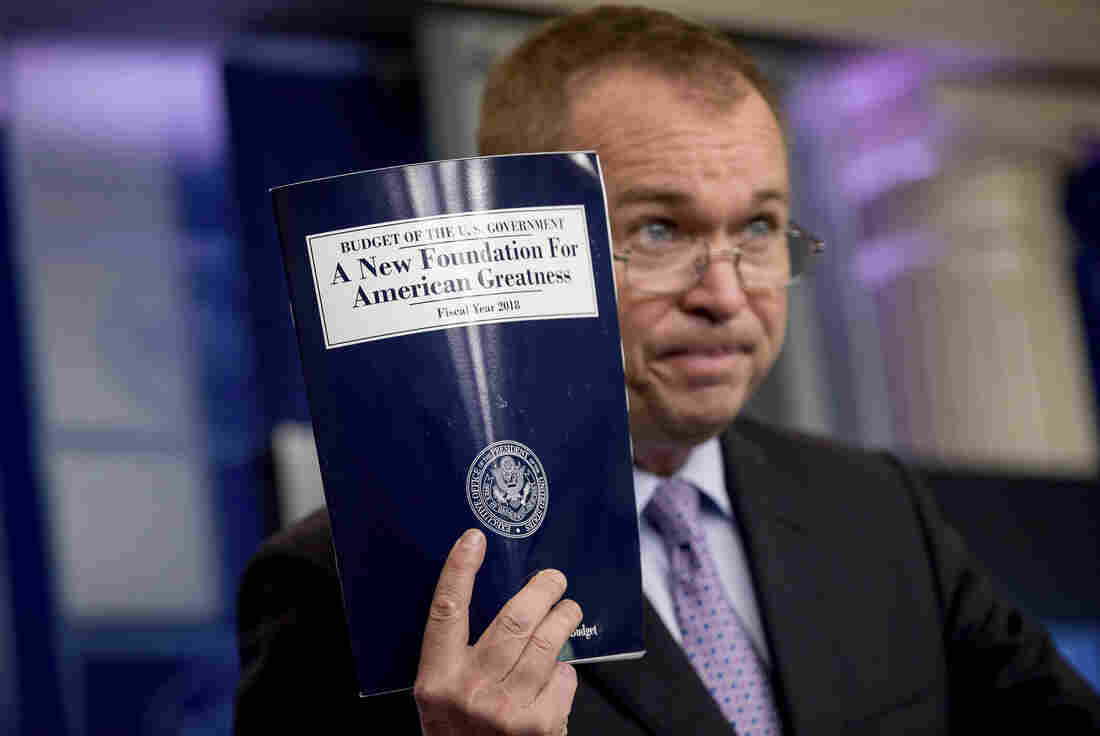
Budget Director Mick Mulvaney holds up a copy of President Trump’s proposed fiscal 2018 federal budget at the White House on Tuesday.

Andrew Harnik/AP

hide caption

toggle caption

Andrew Harnik/AP

The proposed budget unveiled Tuesday by the Trump administration doubles down on major cuts to biomedical research; programs to fight infectious disease outbreaks; health care for the poor, elderly and disabled; and prevention of HIV/AIDS.

It restates the goals of the “skinny budget” the administration released in March, which was widely condemned by scientists and public health advocates.

Mick Mulvaney, director of the Office of Management and Budget, said Monday that the goal is to cut back on public assistance and instead put people back to work. “We are going to measure compassion and success by the number of people we help get off of those programs and get back in charge of their own lives.”

No one thinks the president’s budget will pass as proposed, since Congress has budget and spending authority. But it does provide a baseline from which negotiations may begin.

“The president is right to take a close look at spending,” says Sen. Chuck Grassley, R-Iowa. But “Congress has the power of the purse strings. I’ve never seen a president’s budget proposal not revised substantially.”

Here’s a rundown of the budget’s medical research and health care proposals.

Medicaid: The budget proposes cutting Medicaid and CHIP, the Children’s Health Insurance Program, by $616 billion over 10 years, with almost half the savings occurring in the last two years.

The joint federal-state programs provide health care and support services for 75 million low-income, elderly and disabled people, about half of whom are children. In 2015, federal and state spending on Medicaid was about $545 billion.

The budget mirrors the changes in Medicaid included in the health care overhaul bill passed by the House earlier this month. Rather than the federal government matching state spending based on beneficiaries’ health care needs, it would give states a fixed amount of money per enrollee or, alternatively, offer states a fixed block grant. That would cut the program’s growth over time and reduce services because health care costs grow faster than the broad economy.

Medicaid benefits for the elderly and disabled: Medicaid pays for services — including personal care, shopping or cooking for the elderly, and occupational therapy and work support for the disabled — that allow people to continue to live on their own.

Under the law, those services are considered optional. But Medicaid is required to pay for nursing home and institutional care.

“We’ll see a return to more people with disabilities and more older adults not having access to services that allow them to remain at home,” says Barbara Beckert, director of the Milwaukee office of Disability Rights Wisconsin. “Instead, we may see people forced into institutions, forced into nursing homes.”

Refugee benefits: The proposed budget makes the argument that the U.S. should reduce the number of refugees it brings into this country because those fleeing persecution in their home countries often end up using public assistance, including 50 percent who were on Medicaid in 2015. “The larger the number the United States admits for domestic resettlement, the fewer people the United States is able to help overall,” the budget document says.

National Institutes of Health: The NIH, which funds research into medical treatments and basic science, would see cuts of almost $6 billion, to about $26 billion. That would include a $575 million cut to the National Heart, Lung and Blood Institute and $838 million cut to the National Institute of Allergy and Infectious Diseases, which is involved in a wide range of diseases including AIDS and Zika. The National Institute of Diabetes and Digestive and Kidney Diseases would be cut by $355 million.

The proposed cuts drew immediate and harsh criticism.

The cuts would “cripple our nation’s scientific efforts, undermining our economic growth, public health and national security,” Mary Sue Coleman, president of the Association of American Universities, said in a statement. The cuts could “hobble our ability to provide tomorrow’s cures and technologies.”

Centers for Disease Control and Prevention: The administration proposes trimming the CDC, which helps states and other countries fight infectious disease outbreaks, by $1.3 billion — 17 percent. That could include a $186 million cut in programs at the CDC’s center on HIV/AIDS, hepatitis and other sexually transmitted diseases. The CDC’s chronic disease prevention programs, such as those for diabetes, heart disease, stroke and obesity, would be cut by $222 million.

The proposed cut to CDC “would be perilous for the health of the American people,” says John Auerbach, president and CEO of the Trust for America’s Health. “From Ebola to Zika to opioid misuse to diabetes to heart disease, the CDC is on the front lines keeping Americans healthy.”

Food and Drug Administration: A 31 percent proposed cut, from $2.7 billion to $1.89 billion, would be offset by $1.3 billion in proposed increased fees to be paid by drugmakers and device-makers.

The budget shows a basic misunderstanding of how these agencies function, says Ryan Hohman, vice president of public affairs at the group Friends of Cancer Research. “To further suggest that private sector industry make up for such a significant cut to the FDA as proposed by the president shows a lack of knowledge for how user fees can be used and the scope of the FDA’s pivotal role in assuring the safety of the daily lives of Americans.”

The budget doesn’t explicitly address high drug costs, though Trump has frequently inveighed against drug prices, telling Congress in February that it should “work to bring down the artificially high price of drugs and bring them down immediately.”

Planned Parenthood: The family-planning organization has been the target of efforts to cut funding for years because it provides about one-third of the nation’s abortions.

This budget would be the first to bar a specific provider, according to Planned Parenthood. And it would bar the organization not only from Medicaid funding but also from any other Health and Human Services program, including the Title X family planning program, maternal and child health, STD testing and treatment, and Zika prevention.

“From Day 1, President Trump has worked to keep his pro-life promises, including stopping taxpayers from being forced to fund abortion and abortion businesses,” says Marjorie Dannenfelser, president of the anti-abortion group Susan B. Anthony List. “Taxpayers should not have to prop up Planned Parenthood’s failing, abortion-centered business model.”

Planned Parenthood officials said Tuesday that many of their clients don’t have other places to get health care. “We’ve already seen the results of these sorts of policies in Texas, so we know what would happen,” says Kevin Griffis, vice president at Planned Parenthood Federation of America. “The heartbreaking truth is that if this budget were enacted, the results would be catastrophic for countless women and their families — cancers and diseases going undetected, higher maternal mortality and more unintended pregnancies.”

Let’s block ads! (Why?)

GOP Bill Could Undercut Some Coverage In Job-Based Insurance

The GOP health care bill could affect some insurance coverage people get through their employers.

Fanatic Studio/Getty Images

Would the House Republican health care bill impact insurance provided by employers? And why don’t people without insurance just go to an emergency room for regular care? Here are answers to those and other recent questions from readers.

Will employer-based health care be affected by the new Republican plan?

The American Health Care Act bill that recently passed the House would fundamentally change the individual insurance market, and it could significantly alter coverage for people who get coverage through their employers too.

The bill would allow states to opt out of some of the requirements of the Affordable Care Act, including no longer requiring plans sold on the individual market to cover 10 “essential health benefits,” such as hospitalization, medications and maternity care.

Small businesses (generally companies with 50 or fewer employees) in states that chose to do this would also be affected by the change. Plans offered by large employers have never been required to cover the essential health benefits, so the bill wouldn’t change their obligations. Many of them, however, provide comprehensive coverage that includes many of these benefits.

But here’s where it gets tricky. The ACA places caps on how much consumers can be required to pay out-of-pocket in deductibles, copays and coinsurance every year, and the caps apply to most plans, including large employer plans. In 2017, the spending limit is $7,150 for an individual plan and $14,300 for family coverage. Yet, there’s a catch: The spending limits apply only to services covered by the essential health benefits. Insurers could charge people any amount for services deemed nonessential by the states.

Similarly, the ACA prohibits insurers from imposing lifetime or annual dollar limits on services, but only if those services are related to the essential health benefits.

In addition, if any single state weakened its essential health benefits requirements, it could affect large employer plans in every state, analysts say.

That’s because these employers, who often operate in multiple states, are allowed to pick which state’s definition of essential health benefits they want to use in determining what counts toward consumer spending caps and annual and lifetime coverage limits.

“If you eliminate [the federal essential health benefits] requirement, you could see a lot of state variation, and there could be an incentive for companies that are looking to save money to pick a state,” with skimpier requirements, says Sarah Lueck, senior policy analyst at the Center on Budget and Policy Priorities.

I keep hearing that nobody in the United States is ever refused medical care — that, whether they can afford it or not, a hospital can’t refuse them treatment. If this is the case, why couldn’t an uninsured person simply go to the front desk at the hospital and ask for treatment, which by law can’t be denied, such as, “I’m here for my annual physical, or for a screening colonoscopy?”

If you are having chest pains or you just sliced your hand open while carving a chicken, you can go to nearly any hospital with an emergency department, and, under the federal Emergency Medical Treatment and Active Labor Act, the staff is obligated to conduct a medical exam to see if you need emergency care. If so, they must try to stabilize your condition, whether or not you have insurance.

The key word here is “emergency.” If you’re due for a colonoscopy to screen for cancer, unless you have symptoms such as severe pain or rectal bleeding, emergency department personnel likely wouldn’t order the exam, says Dr. Jesse Pines, a professor of emergency medicine and health policy at George Washington University, in Washington, D.C.

“It’s not the standard of care to do screening tests in the emergency department,” Pines says, noting that, in that situation, the appropriate next step would be to refer you to a local gastroenterologist who could perform the exam.

Even though the law requires hospitals to evaluate anyone who comes in the door, being uninsured doesn’t let people off the hook financially. You’ll still likely get bills from the hospital and physicians for any care you receive, Pines says.

The Republican [health care] proposal says people who don’t maintain continuous coverage would have to pay extra for their insurance. What does that mean?

Under the bill passed by the House, people who have a break in their health insurance coverage of more than 63 days in a year would be hit with a 30 percent premium surcharge for the year after buying a new plan on the individual market.

In contrast, under the ACA’s “individual mandate,” people are required to have health insurance or pay a fine equal to the greater of 2.5 percent of their income or $695 per adult. They’re allowed a break of no more than two continuous months every year before the penalty kicks in for the months they were without coverage.

The continuous coverage requirement is the Republicans’ preferred strategy to encourage people to get health insurance. But some analysts have questioned how effective it would be. They point out that, whereas the ACA penalizes people for not having insurance on an ongoing basis, the AHCA penalty kicks in only when people try to buy coverage after a break. It could actually discourage people from getting back into the market unless they’re sick.

In addition, the AHCA penalty, which is based on a plan’s premium, would likely have a greater impact on older people, whose premiums are relatively higher, and on those with lower incomes, says Sara Collins, a vice president at the Commonwealth Fund, who authored an analysis of the impact of the penalties.

Kaiser Health News is an editorially independent news service supported by the nonpartisan Kaiser Family Foundation. Email questions for future columns: KHNHelp@KFF.org. Michelle Andrews is on Twitter: @mandrews110

Let’s block ads! (Why?)

As GOP Tarries On Health Bill, Funding For Children's Health Languishes

The federal CHIP program funds health care for almost 9 million children.

Terry Vine/Blend Images/Getty Images

hide caption

toggle caption

Terry Vine/Blend Images/Getty Images

Back in January, Republicans boasted they would deliver a “repeal and replace” bill for the Affordable Care Act to President Donald Trump’s desk by the end of the month.

In the interim, that bravado has faded as their efforts stalled and they found out how complicated undoing a major law can be. With summer just around the corner, and most of official Washington swept up in scandals surrounding Trump, the health overhaul delays are starting to back up the rest of the 2018 agenda.

One of the immediate casualties is the renewal of the Children’s Health Insurance Program. CHIP covers just under 9 million children in low- and moderate-income families, at a cost of about $15 billion a year.

Funding for CHIP does not technically end until Sept. 30, but it is already too late for states to plan their budgets effectively. They needed to know about future funding while their legislatures were still in session, but, according to the National Conference of State Legislatures, the local lawmakers have already adjourned for the year in more than half of the states.

“If [Congress] had wanted to do what states needed with respect to CHIP, it would be done already,” says Joan Alker of the Georgetown Center for Children and Families.

“Certainty and predictability [are] important,” agrees Matt Salo, executive director of the National Association of Medicaid Directors. “If we don’t know that the money is going to be there, we have to start planning to dismantle things early, and that has a real human toll.”

In a March letter urging prompt action, the Medicaid directors noted that while the end of September might seem far off, “as the program nears the end of its congressional funding, states will be required to notify current CHIP beneficiaries of the termination of their coverage. This process may be required to begin as early as July in some states.”

CHIP has long been a bipartisan program. One of its original sponsors is Sen. Orrin Hatch, R-Utah, who chairs the Finance Committee that oversees it. It was created in 1997, and last reauthorized in 2015, for two years. But a Finance hearing that was intended to launch the effort to renew the program was abruptly canceled this month, amid suggestions that Republicans might want to hold the program’s renewal hostage to force Democrats and moderate Republicans to make concessions on the bill to replace the Affordable Care Act.

“It’s a very difficult time with respect to children’s coverage,” says Alker. Not only is the future of CHIP in doubt, but also the House-passed health bill would make major cuts to the Medicaid program, and many states have chosen to roll CHIP into the Medicaid program.”

“We’ve just achieved a historic level in coverage of kids,” she says, referring to a new report finding that more than 93 percent of eligible U.S. children now have health insurance under CHIP. “Now all three legs of that coverage stool — CHIP, Medicaid and ACA — are up for grabs.”

But it’s not just CHIP at risk due to the congested congressional calendar. Congress also can’t do the tax bill Republicans badly want until lawmakers wrap up the health bill.

That is because Republicans want to use the same budget procedure, called reconciliation, for both bills. That procedure forbids a filibuster in the Senate and allows passage with a simple majority.

There’s a catch, though. The health bill’s reconciliation instructions were part of the fiscal 2017 budget resolution, which Congress passed in January. Lawmakers would need to adopt a fiscal 2018 budget resolution in order to use the same fast-track procedures for their tax changes.

And they cannot do both at the same time. “Once Congress adopts a new budget resolution for fiscal year 2018,” says Ed Lorenzen, a budget-process expert at the Committee for a Responsible Federal Budget, that new resolution “supplants the fiscal year 2017 resolution and the reconciliation instructions in the fiscal year 2017 budget are moot.”

That would mean that if Congress wanted to continue with the health bill, it would need 60 votes in the Senate, not a simple majority.

There is, however, a loophole of sorts. Congress “can start the next budget resolution before they finish health care,” said Lorenzen. “They just can’t finish the new budget resolution until they finish health care.”

So the House and Senate could each pass its own separate budget blueprint, and even meet to come to a consensus on its final product. But they cannot take the last step of the process — with each approving a conference report or identical resolutions — until the health bill is done or given up for dead. They could also start work on a tax plan, although, again, they could not take the bill to the floor of the Senate until they finish health care and the new budget resolution.

At least that’s what most budget experts and lawmakers assume. “There’s no precedent to go on,” said Lorenzen, because no budget reconciliation bill has taken Congress this far into a fiscal year. “So nobody really knows.”

Kaiser Health News is an editorially independent part of the Kaiser Family Foundation.

Let’s block ads! (Why?)