In Wyoming, One Insurer Offers Plan On State Exchange

NPR’s Ari Shapiro talks with Tom Glause, the commissioner of the Wyoming Department of Insurance, about how the Affordable Care Act has worked in the state and what can still be improved.
NPR’s Ari Shapiro talks with Tom Glause, the commissioner of the Wyoming Department of Insurance, about how the Affordable Care Act has worked in the state and what can still be improved.

Celeste Thompson, 57, a home care worker in Missoula, Mont., examines a pill bottle in her home. Thompson cares for her husband, and worries that if she loses her Medicaid coverage she won’t be able to afford to see a doctor.
Mike Albans for Kaiser Health News
hide caption
toggle caption
Mike Albans for Kaiser Health News
For more than two decades, Celeste Thompson, 57, a home care worker in Missoula, Mont., had not had regular contact with a doctor — no annual physicals and limited sick visits. She also needed new glasses.
Like many others who work in the lower rungs of the health care system, a category that includes nursing aides as well as direct care and personal care assistants, she has worked hard to keep her clients healthy by feeding them, dressing them and helping them navigate chronic conditions.
Workers like Thompson often don’t have health insurance. Many home health agencies, 80 percent of which are for-profit, don’t offer coverage, or their employees don’t consistently clock enough hours to be eligible.
The average annual salary for home health workers is $20,000 a year. Industry revenues approach $100 billion annually, and are projected to grow.
“It’s a social justice issue. We have a work force that is the backbone of long-term [care] services, and they themselves don’t have coverage,” says Caitlin Connolly, who runs a campaign to increase home care wages at the National Employment Law Project, an advocacy organization.
That all changed for Thompson in 2015, when Montana opted in to the Affordable Care Act’s expansion of Medicaid, the state-federal low-income health insurance program. Thompson, who was making about $10 an hour, immediately signed up.
Vision care was among the first things she focused on. She had not visited an eye doctor in nine years — a problem because her job includes keeping track of patients’ pill bottles and making sure they take the right medications.
“I had to use a magnifying glass to see small print,” says Thompson, who now wears bifocals. Her doctor has warned her she may need a stronger correction soon.
The Trump administration’s attempt at replacing the Affordable Care Act would have reined in Medicaid spending in states like Montana. But the bill failed to get enough support in Congress and was withdrawn March 24. Many Republicans say repeal is still a priority, and Health and Human Services Secretary Tom Price could change key regulations affecting the current law right now, without Congress.
The lack of clarity means that Thompson and many other home-based caregivers don’t know what’s going to happen to their insurance coverage.
From 2010 to 2014, about half a million of these workers gained new health insurance through the Affordable Care Act, estimates PHI, a New York-based nonprofit that researches this slice of the labor force and advocates for improved working conditions, in a March issue brief.
Most home care workers’ gains came from living in states that, like Montana, expanded Medicaid. But even with Obamacare in place, many home health workers — perhaps 1 in 5 — remain uninsured. By contrast, about 8.6 percent of all Americans lack coverage.
Before Thompson got Medicaid, a sinus infection represented an unplanned expense. Seeing a doctor meant forgoing groceries. She would take over-the-counter pills and hope to get better. “I would go to work sick, and that’s not good,” she says, noting that her clients are frail and elderly. “But I couldn’t afford to be off. I needed the money.”
Many Republicans have long favored proposals to reduce federal costs associated with this state-federal low-income insurance program, saying that shifting funding from a per capita basis to block grants to states would make the system more efficient.
But many advocates for these workers take a different view, and the current air of uncertainty adds an extra layer of concern. Under the 2010 law, “at least we were on a path” to addressing coverage and access concerns, says Elly Kugler, the federal policy director at the National Domestic Workers Alliance, a coalition that represents home care providers. If it goes away, she said, it’s not so clear how these workers will access health care.
The federal government only recently ruled that home care workers qualify for overtime pay and minimum wage protections.
And there’s another rub: Most of the money paying for long-term home care comes from Medicaid and Medicare, PHI estimates. If either of those sources is squeezed, that will mean fewer people receiving home health care, and “that will translate to hours cut,” Connolly said.
“My clients won’t be able to afford me. I can’t make a living. It’s a vicious cycle,” says Kim Thomas, 52, a home care worker in Durham, N.C. She makes $9.75 an hour and has 32 clients — one of whom is almost fully paralyzed and needs help eating, dressing and moving. Her days start at 5:30 a.m. To make ends meet, she works nights at the local hospital. Thomas is diabetic.
For Thompson in Montana, the concern is similar. If Medicaid is revised or the health law repealed, she said, it’s not just her insurance at risk but her livelihood. Her medical history puts her at high risk of endometrial cancer, and her doctor recommends screenings twice a year. But without insurance that’s not feasible, she says.
“We don’t have enough money at the end of the month to buy essential things, like deodorant,” she says. “We go to the food bank four times a month. Without Medicaid, it would be really hard on [our family], trying to come up with the money to go the doctor.”
Kaiser Health News, a nonprofit health newsroom whose stories appear in news outlets nationwide, is an editorially independent part of the Kaiser Family Foundation.

A well-regarded intensive care doctor in Virginia says he has had good success in treating 150 sepsis patients with a mix of IV corticosteroids, vitamin C and vitamin B, along with careful management of fluids. Other doctors want more proof — the sort that comes only via more rigorous tests.
Sukiyashi/Getty Images/iStockphoto
hide caption
toggle caption
Sukiyashi/Getty Images/iStockphoto
The astronomer Carl Sagan said that extraordinary claims require extraordinary evidence. Last week, a physician made the extraordinary claim that he had an effective treatment for sepsis, sometimes known as blood poisoning.
Sepsis is a bodywide inflammation, usually triggered by infection, and the leading cause of death in hospitals, taking 300,000 lives a year. So, even a 15 percent improvement in survival would save 40,000 lives — the number of Americans who die on the highway each year, or from breast cancer.
Dr. Paul Marik, a well-regarded intensive care physician at the East Virginia Medical School in Norfolk, Va., is the doctor with the extraordinary claim. As we reported last week, he says he has treated about 150 patients with sepsis and that only one died of that often fatal condition (though some died of other causes).
The question is how to find out whether he is right — and, ideally, how to do that quickly.
Marik’s treatment involves a mix of intravenous corticosteroids, vitamin C and vitamin B, along with careful management of fluids. And his experience, so far, falls far short of the “extraordinary evidence” that a claim like his requires.
The first step in getting more evidence is to confront an appropriate skepticism that has grown up around purported treatments for sepsis.
“Nothing has worked despite all the great ideas people have had, often ballyhooed with observational data like this, claiming that it’s a big effect,” says Dr. Robert Califf, who recently returned to Duke University after running the U.S. Food and Drug Administration.
“So, I’d say the odds are still that it doesn’t work,” Califf says, “but every once in a while something works in an unexpected way.”
He wants to see solid evidence. In the world of medicine, that’s a randomized controlled trial, in which patients are randomly assigned to get the experimental treatment or the standard of care, and neither patients nor medical personnel know who is getting what. An experiment like this should also be run at multiple hospitals.
Considering how big an effect Marik is reporting, “it would take a very small study, done by people independent of him, to prove it,” Califf says. “And then the whole world would benefit,” whatever the results may be.
But these trials don’t happen overnight. There’s no new drug to test, so pharmaceutical companies aren’t interested. The National Institutes of Health, which funds many of these studies, would welcome a research proposal, says Sarah Dunsmore at NIGMS. But the experiment must be designed and approved by researchers first, she says, and then it would likely go into the standard nine-month review process, where it would compete for scarce funds with other research proposals.
Califf just started a nonprofit called the People-Centered Clinical Research Foundation and says this is potentially a project the foundation could fund. Likewise the Society for Critical Care Medicine is interested in sponsoring a study to follow up on the research, says Dr. Craig Coopersmith, an Emory University professor of surgery and associate director of the medical school’s critical care center.
Even so, under the best-case scenario, results wouldn’t be available from a randomized controlled trial for about two years.
Some doctors aren’t waiting. Dr. David Carlbom, medical director of the sepsis program at Harborview Medical Center in Seattle, heard Marik give a talk about his protocol and decided to offer it to his sepsis patients.
“Because of the potential benefit and I think very few harms, I talk to families when I’m caring for a septic shock patient and discuss this with them and get their consent when trying this therapy,” he says. (Septic shock is a particularly severe form of sepsis.)
Carlbom’s impressions, after just five patients, are strictly impressionistic, not scientific, but he says some patients seem to haveresponded well.
“I don’t know if it’s the medicine; maybe it’s just us taking good care of them,” he says. “Maybe it’s them and their disease. But I was a little surprised. They did seem to heal faster from their septic shock.”
Carlbom says he is an early adopter. Other doctors who work in his hospital’s intensive care unit are taking a “wait and see” approach. Of course, Carlbom is eager for scientific evidence as well.
Dr. Mark Rumbak, a pulmonologist at the University of South Florida in Tampa, is also trying the protocol. Marik is an old friend, Rumbak says, so he heard about Marik’s treatment months ago. So far, Rumbak has tried it on at least 30 patients, and most have done well, he says.
“Not only do they do better; they do better quickly,” he says. “Within 24 to 48 hours you see the patients responding. It’s actually quite nice, it’s quite dramatic.”
Some of the skepticism around this treatment has arisen because it includes vitamin C — which has been hailed repeatedly for its curative powers, though those claims have rarely been backed by solid science.
In this case, Rumbak suspects that vitamin C is making the body more receptive to another part of the treatment — corticosteroids — which are well-established drugs.
Dr. Berry Fowler, head of pulmonary disease at Virginia Commonwealth University’s school of medicine, inspired Marik to use vitamin C in his hospital. Marik had heard about Fowler’s experiments with IV vitamin C for sepsis and so started his own protocol with the mix of vitamins and steroids.
Fowler is now running a controlled trial of vitamin C for sepsis, but his study does not include the corticosteroids or the vitamin B, which are part of the Marik protocol.
Part of the challenge is that there is no agreed-upon treatment for sepsis. Doctors have different beliefs about how much fluid to give patients, which kinds of fluids to give, which kinds of antibiotics and whether to administer corticosteroids. So there is no established “standard care” to use as a clear point of comparison.
Dr. Gordon Bernard, a pulmonary medicine and critical care specialist at the Vanderbilt University Medical Center, who has been studying sepsis for 30 years, is firmly in the skeptics’ camp on this potential treatment.
Bernard says wishful thinking might have led Marik to conclude that only one out of 150 of his patientshas died of sepsis.
“You could spend all day long adjudicating some of these cases, as to whether these people died of sepsis or something else,” Bernard says. That question would get careful scrutiny in a randomized study.
Yet scientists know there’s also a danger in being too skeptical of extraordinary claims, because sometimes they do turn out to be true.
In 1982, two scientists in Australia concluded that stomach ulcers are caused by a bacterium and could be treated successfully with antibiotics. It took well over a decade for doctors to believe it and start using that effective treatment.
“We always have to be aware that every now and then something works,” Califf says. “And we don’t want to miss that opportunity.”
You can contact Richard Harris at rharris@npr.org.
NPR’s Ari Shapiro talks with Peter Lee, executive director of Covered California, about how state health care exchanges will work now that the AHCA has failed in Congress.

Secretary of Veterans Affairs David Shulkin is working with Congress to renew the Veterans Choice program, which allows some veterans to get medical care outside the VA system, and provides money for medical staff.
Marian Carrasquero /NPR
hide caption
toggle caption
Marian Carrasquero /NPR
Secretary of Veterans Affairs David Shulkin says the Department of Veterans Affairs “is on a path toward recovery.”
“We have a clear mandate to do better, [and] to make sure that we’re honoring our mission to serve our veterans,” Shulkin told NPR’s Morning Edition.
Sen. John McCain, R-Ariz., and Sen. Jon Tester, D-Mont., are asking the Senate to approve an extension of the Veterans Choice and Accountability Act. The bill, passed in 2014, provided billions of dollars to the VA and was supposed to help veterans get medical care more quickly.
Three years later, VA hospitals are still struggling to add staff, and many veterans still face long wait times to see a doctor, as NPR has reported.
Shulkin discussed his current priorities for the Department of Veterans Affairs, including how the money from the Veterans Choice program has been spent, and his approach to the persistently high rate of suicide among military veterans, with NPR’s Rachel Martin. The interview has been edited for length and clarity.
On renewing the 2014 Veterans Choice and Accountability Act
[Veterans] Choice was authorized for three years, and … the end for that is this August. If that program expires and we don’t get a reauthorization, or the ability to continue that program, veterans are going to be back waiting for care, and we’re going to find ourselves exactly where we were. So we’re working hard with our colleagues in Congress to make sure that we do get this bill extended.
On filling 45,000 vacancies in the Department of Veterans Affairs
Well, we have about 360,000 employees in the VA health care system. It’s the largest health care system in the country, and we have many job openings. This is actually something you see across America, particularly in rural America, where there’s a shortage of health care professionals.
We’re out actively trying to recruit many health care professionals … and the negative attention that’s been put on VA has hurt the morale of our work force. So what we’re trying to do is get people to understand that when they come to work at VA, this is really a terrific place to work. It’s filled with dedicated professionals, we’re doing great work every day, it’s a way to serve your country and we want people to come join us.
On NPR’s previous finding that money was not given to VA hospitals with the longest wait times
Well, we’re talking about now something back almost three years ago. And when Congress authorized this [Veterans Choice] program, it was done with urgency. They asked the VA to get an entire national program up in 90 days. That’s really never asked ever of any agency or any private company ever before. The VA had to make a lot of decisions really quickly. It went out to the field, and it said who thinks they can go and hire health care professionals? Who is able to use this money quickly?
I think many good decisions were made, but it wasn’t done in the same way as if we would have had a year to implement this. So we ended up making some adjustments. In the end, I think that we ended up hiring where the wait times were the longest, but it wasn’t done in the most thoughtful way because of the time that we had to stand this program up.
On the high rate of suicide among military veterans
There is no doubt that suicide is my number one clinical priority. I work on this, I think about this every day. … I can tell you that nobody is doing more for behavioral health care in this country than the VA. We have extremely comprehensive systems. I have one thousand professionals who do nothing but suicide prevention every single day.
The problem is that we’re responsible for the 22 million veterans in this country. And of the 20 vets who take their life every day through suicide, just six are getting care in the VA health care system.
We have to work with groups, with families and others, to identify the 14 that aren’t getting care, that are out there right now [and] that we’re very, very concerned about. One of the realities of our ability to address the suicide issue is that VA can’t do this alone. We need help from community partners, we need help from scientists, we need help from technology companies.
On a report by the Office of the Inspector General at the VA about problems with the department’s crisis hotline for veterans
Well, the suicide crisis hotline was one of those situations where the demand for our services was outpacing our ability to keep up with it. About four months ago, I made the decision to bring on an additional 200 Veterans Crisis Line responders. It took us a while to train them because these are highly specialized clinicians who have to answer these phone calls.
We opened up a second center in Atlanta, we have one in upstate New York and now today I’m pleased to say that, while we were not able to get to about 30 percent of the calls three or four months ago, really in the past six weeks we’re getting to almost all the calls.
We are at a less than 1 percent rate of calls that roll over to another call center that is answered by professionals. But we want every call answered by our own Veterans Crisis Line responders, and now we’re getting to more than 99 percent of those calls.

Robin Utz at her home in St. Louis, Mo.
Carolina Hidalgo/KWMU
hide caption
toggle caption
Carolina Hidalgo/KWMU
A new Missouri law cuts off a line of funding to all organizations that provide abortions in the state, including hospitals.
For years, Missouri has helped low-income women pay for family planning under a Medicaid program called Extended Women’s Health Services, which is funded by both the state and the federal governments.
Federal law already prevents Medicaid from reimbursing providers for most abortions. Missouri’s new measure rejects $8.3 million in federal funds for the women’s health program, allowing the state to block state funds for other family planning services from going to abortion providers.
Other states, including Texas, Arkansas, Mississippi and Indiana, have tried to exclude abortion providers from Medicaid funds before, but courts have said that would violate a federal law that gives patients the right to choose their health care providers. Missouri hopes to get around that by rejecting the federal money. The rule has not been challenged in court.
Missouri’s Medicaid program for women’s health services currently serves nearly 70,000 low-income patients.
To make up for the lost federal funds, the state is increasing its own funding of women’s health services for low-income residents. Under the new measure, Missouri will spend $8.3 million to create its own program in place of the federal program it has opted out of.
Implications For Health Providers
Under the new measure, the St. Louis hospital where Robin Utz had an abortion may no longer be eligible for state funds for women’s health services.
When she and her husband went in for a 20-week ultrasound in the fall of 2016, Utz had finally started to feel confident about the little girl she was carrying.
“Everything was looking fantastic. She was measuring one day ahead. I had a friend that had a home doppler [fetal heart monitor] that she gave me, and I would listen to the baby’s heartbeat, just to hear it,” she remembered. But as the appointment dragged on, the nurse grew quiet, and said she needed to bring in the doctor.
“I don’t know what the diagnosis is, right?” Utz said as she brushed away tears months later. “I just know that it’s not good.”
Their daughter had developed a fatal complication.
“Her kidneys weren’t working, and there was, therefore, no amniotic fluid and without amniotic fluid she would never develop lungs,” said Utz. “And I asked what her chances were and they said there weren’t any.”
Utz and her husband had just a few hours to make a decision about whether to terminate the pregnancy, or wait until she gave birth. Doctors warned her that the baby would likely be stillborn.
“We just felt so strongly that allowing her to be born, to immediately suffer, and to go through the trauma of childbirth, not to be able to be held by us necessarily, but to go into a [neonatal intensive care unit] and be held alive just to die was so inhumane,” she said.
Utz terminated her pregnancy at Barnes-Jewish Hospital in St. Louis. Generally, abortions done in hospitals are higher risk, for example when a mother’s life is in danger, or there is a severe fetal anomaly.
Under a new rule, hospitals in Missouri, including the Barnes-Jewish Hospital in St. Louis, may no longer be eligible for state funds for providing women’s health services to low-income patients.
Jeff Roberson/AP
hide caption
toggle caption
Jeff Roberson/AP
The services at Barnes-Jewish Hospital will not change under Missouri’s new rule, a spokesperson said. But other organizations may not continue to provide abortions under the new funding restrictions.
The state government has sent about five hundred letters to hospitals, obstetricians, gynecologists and clinics with the qualifications to perform abortions. It includes a form that requires providers to attest that they do not provide abortions.
So far, more than 300 providers have signed the form, and will continue to get state funds, according to the Missouri Department of Social Services. Those who do not sign it will no longer be eligible for state funds for women’s health services.
The rule, which was passed as part of last year’s state budget, does appear to include an exception for organizations that provide abortions to save the mother’s life.
But that language is restricted to the budget’s preamble, and hospitals say the language is still unclear. As a result, Missouri’s hospital association is counseling its members not to bill the state program for any family planning services if they provide abortions, including procedures to save the life of the mother, or cases of rape or incest.
A National Trend
Like similar measures curbing funding to abortion providers in other states, Missouri’s measure was originally introduced in the wake of videos purporting to show the sale of fetal tissue by Planned Parenthood employees in Texas.
As we have reported, a grand jury found no evidence of wrongdoing by Planned Parenthood and instead indicted two people who recorded the videos for tampering with a government record and illegally offering to purchase human organs. The indictments were later dismissed on technical grounds.
After the videos were released, Missouri Rep. Robert Ross moved to cut all funding to organizations in the state that provided abortions.
“Simple amendment,” he said on the floor of the Missouri House of Representatives in March 2016. “This stops your tax dollars from being used to fund abortions.”
Several Missouri House Democrats questioned Ross, including Rep. Michael Butler of St. Louis, with whom he had the following exchange:
Butler: “Answer this for me. If women have complications through pregnancy, and they don’t have a primary doctor, where do they go?”
Ross: “Gentleman, it’s really simple. You agree with my amendment, you’re going to vote for it, or you don’t agree, you’re going to vote against it.”
The measure passed. Ross has not returned requests for comment.
This story is part of a reporting partnership with NPR, St. Louis Public Radio and Kaiser Health News.
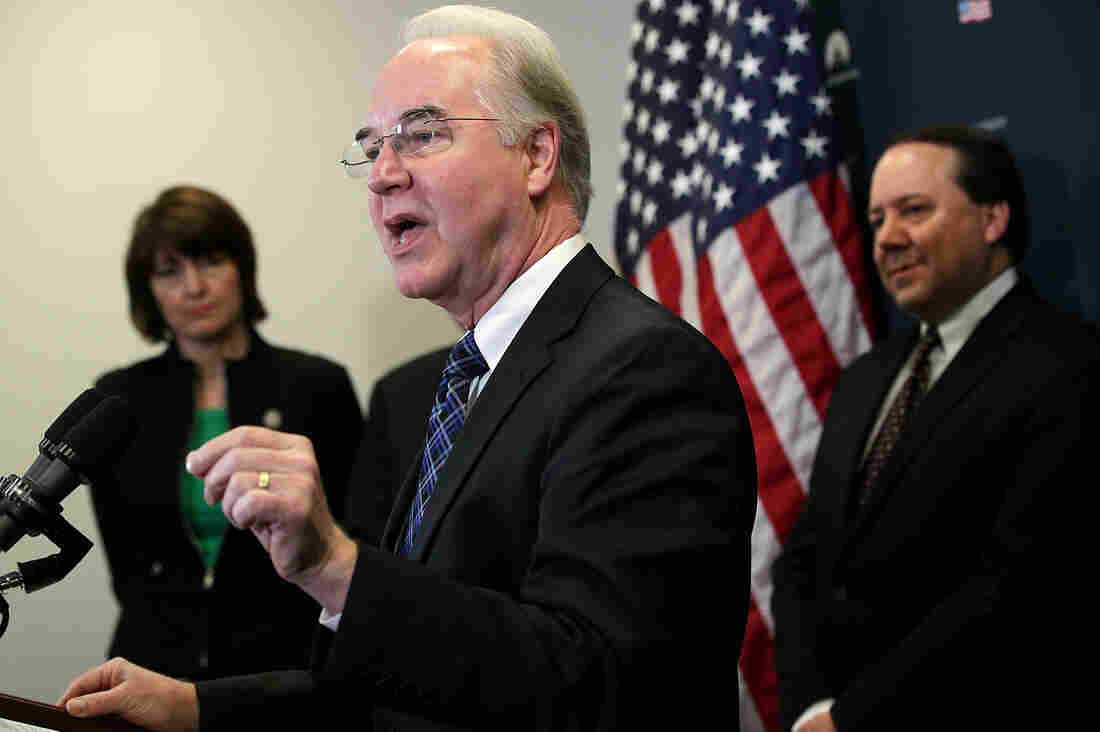
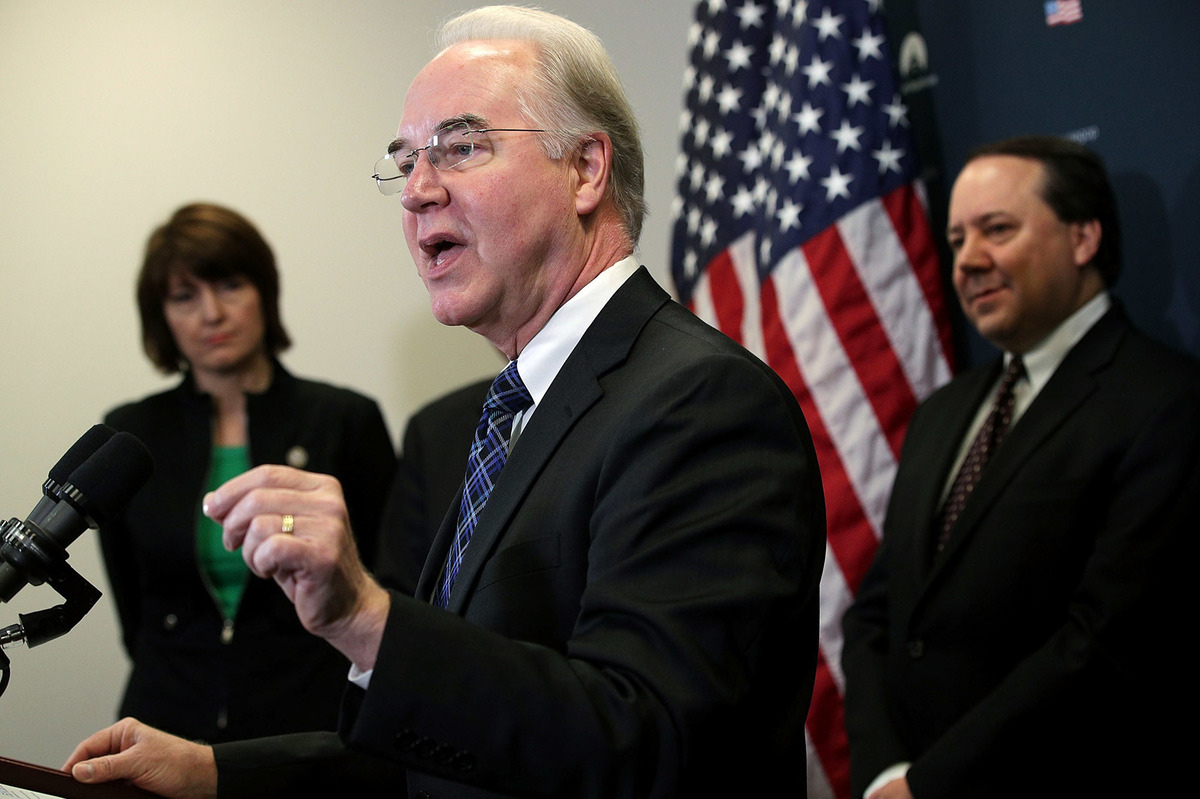
Health and Human Services Secretary Tom Price at a March 17 news conference with Reps. Cathy McMorris Rodgers, R-Wash., and Pat Tiberi, R-Ohio.
Alex Wong/Getty Images
hide caption
toggle caption
Alex Wong/Getty Images
After seven years of trying, Republicans failed to repeal and replace the Affordable Care Act last week.
That doesn’t mean the health care drama is over, though. House Speaker Paul Ryan this week told donors that the party is “going to keep getting at this thing,” according to The Washington Post.
But whatever Ryan and his colleagues manage to do, plenty could still change in the Affordable Care Act. Last week’s failed bill, after all, was only one part of the GOP’s plan.
The second part — making changes to regulations and how Obamacare is administered — doesn’t even require Congress’ help. And those changes could make or break the health law.
“There are things the Trump administration might do that could prop up the markets, and there are things they might do that could help the markets explode, if that’s what they want to happen,” says Cynthia Cox, who studies Obamacare’s effects on private insurance at the Kaiser Family Foundation.
Here are a few possible changes:
1. Cut off the subsidies
One of the biggest threats to the Affordable Care Act has been a lawsuit filed by House Republicans that could have ended what are called cost-sharing subsidies, which help people limit their out-of-pocket expenses.
As Kaiser Health News’ Julie Rovner reported last year, the suit, filed in 2014, “charged that the Obama administration was unconstitutionally spending money that Congress hadn’t formally appropriated, to reimburse health insurers who were providing coverage to working-poor policyholders.”
Last spring, a judge sided with House Republicans, but allowed the subsidies to remain in force pending appeal.
With Trump’s election, his administration took responsibility for the appeal.
Should the Trump administration decide to drop that appeal, it would be quick, easy and potentially crippling to Obamacare.
That might sound like a simple decision for a president who detests Obamacare, but it could come with heavy political consequences.
“If they stop defending the litigation, then they have to stop reimbursing insurers for the [subsidies] and the markets would crater,” says Sabrina Corlette,a research professor at Georgetown University’s Center on Health Insurance Reforms. “It seems politically risky to think voters wouldn’t blame them for that. The Congress could step in and appropriate the money, but it’s hard to see that getting buy-in from the far right.”
Perhaps with those political realities in mind, some in the GOP now say they are willing to spend that money anyway. On Tuesday evening, after NPR spoke to Corlette, some top House Republicans said they wanted to keep the subsidies going.
2. Remove the individual mandate’s teeth
The Trump administration can’t do away with the mandate requiring individuals to have health insurance on its own, but it cangreatly weaken it. Doing so would be another way to seriously undermine the Affordable Care Act.
One way is through the IRS. That individual mandate is about tax incentives — fail to get insurance, and you have to pay a penalty. So to hobble Obamacare, the Trump administration can decide not to enforce that penalty.
In fact, the IRS already took a small step in that direction earlier this year. The agency said it will not reject “silent returns” — tax returns on which a person declines to say whether they have insurance.The IRS explained in a statement that this year, for the first time, the agency had been set to reject those silent returns. But Trump’s January executive order on Obamacare changed that, telling the heads of executive branch offices to “waive, defer, grand exemptions from, or delay” parts of the act.
“Consistent with that, the IRS has decided to make changes that would continue to allow electronic and paper returns to be accepted for processing in instances where a taxpayer doesn’t indicate their coverage status,” the IRS said. “However, legislative provisions of the ACA law are still in force until changed by the Congress, and taxpayers remain required to follow the law and pay what they may owe.”
In other words, a lot still won’t change here — the penalties remain the law of the land.
However, the IRS’ statement left considerable uncertainty about what enforcement would now look like, as the Society for Human Resource Management reported in February.
One other option here, Cox says, is that the Trump administration could loosen up the rules on who can get hardship exemptions. People with particularly tough circumstances — homelessness, domestic violence, bankruptcy — can currently apply to get an exemption from any penalties for not holding insurance. The Trump administration could approve more people in more circumstances for those hardships, Cox says. (Likewise, the administration could also approve fewer people if it wanted to.)
Were the administration to approve more waivers, it could mean fewer people in the marketplaces. And to the degree that that pulls healthy people out, it would create sicker pools that create more costly coverage, which in turn could cause more people to drop out.
3. Let states be looser in defining “essential health benefits”
The ACA requires that health plans cover 10 “essential health benefits” — health services in basic, broad areas like emergency services, prescription drugs and maternity care. And the administration has a few paths for changing exactly what those are — changes that could weaken some people’s health care but also maybe nudge more insurers into the marketplaces.
The federal government laid out and defined the benefits (known among health care wonks as EHBs), but the nitty-gritty of a state’s essential health benefits can be found in its “benchmark plan.”
“Right now each state has picked a small group plan or similar plan that would have existed before the ACA and used that as a benchmark for what all the plans in each state now have to cover,” Cox says.
The Trump administration could loosen that, giving plans much more wiggle room for what services they include or exclude, Cox added.
“Price could come back in and say, ‘We’ve changed how each state can define their [essential health benefit] plan as long as it looks reasonably like an employer plan,’ ” she says.
4. Redefine the EHBs
The administration could also simply tweak the EHBs by broadening or narrowing the definitions of some of the 10 broad benefit categories.
For example, one of the 10 benefits set by law includes preventive care. But the law itself didn’t say exactly what that meant — rather, the Obama administration defined what exactly preventive services are through regulation.
That means the Trump White House could undo some of that through regulation, making particular benefits disappear. Contraception, for example, is a part of the preventive service EHB, and the Obama administration also made sure that in many plans, that birth control is copay-free. HHS Secretary Tom Price has opposed that rule in the past.
Once again, loosening rules around essential health benefits could reduce the kinds of things people get coverage for, but it could also potentially nudge more insurers into a state’s exchanges, Cox says. That could address a key Obamacare problem: Some areas of the country only have one insurer in their marketplaces.
5. Let states experiment more
States can apply for waivers to deviate from the ACA as written in some way — the idea, Cox says, is to “allow for some experimentation or innovation at the state level” to improve the system. States could pass laws that change their health care system, then apply to the federal government for the waiver.
Price has promoted waivers as ways for states to alter their health care systems. Under a Trump administration that’s no fan of the ACA, approved waivers might look substantially different than they would have under Obama.
For example, California had passed a law and filed a waiver that would have allowed people in the state illegally to get health insurance on the state exchange (though they would not have been allowed to get federal subsidies). When Trump won the presidency, California withdrew the waiver.
An administration so opposed to illegal immigration likely wouldn’t have approved that kind of change. But the Trump administration might be more open to conservative tweaks.
One example might be in states that didn’t expand Medicaid, and now have higher premiums and more unhealthy people in their individual market, Cox says. The idea here is that sicker people could have moved out of the exchanges and into Medicaid, had those states opted into a Medicaid expansion offered to them under Obamacare.
“There may be some conservative states where they are allowed to expand Medicaid if they have work requirements — waivers or exemptions that the Obama administration would not have allowed,” she added.
Likewise, Alaska has already passed a law and filed a waiver creating a reinsurance program — in a basic sense, a pool of money that comes from insurers and helps pay for particular health conditions. Obamacare had something similar for a three-year transition period — insurers paid into a pot, which then reimbursed insurers for people’s medical costs that were particularly high, between $45,000 and $250,000.
Price highlighted this effort in his statement, signaling to other states that they could potentially get approval for their own reinsurance plans.
6. Let the architecture crumble
It takes a lot of upkeep to keep Obamacare running — the exchange websites need to hum along, and people need to be ready to answer the helpline. But the administration could hypothetically make a lot of that a lower priority, Georgetown’s Corlette says, essentially letting the Obamacare system atrophy.
“The Price administration [at HHS] can redirect resources so they would have a fair amount of flexibility for how they direct resources for the fall enrollment,” Corlette says.
In his first week on the job, Trump killed the advertising surrounding the Affordable Care Act, as well as outreach, as Politico explained:
“Emails are no longer being sent out to individuals who visited HealthCare.gov, the enrollment website, to encourage them to finish signing up. Those emails had proven highly successful in getting stragglers to complete enrollment before the deadline.”
Take all of this to its logical conclusion, and even these fixes could lead to a sicker mix of people in the markets.
“If you’re a sick person, you’re going to do whatever it takes to get that coverage,” Corlette says. “You will sit on the phone for two hours. You will hit the refresh button. If you’re healthy, you’re going to say, ‘Forget it.’ “
NPR’s Ari Shapiro talks with Sarah Kliff of Vox about how Health and Human Services Secretary Tom Price could dismantle parts of the Affordable Care Act through regulations.

House Speaker Paul Ryan walks into a media briefing after attending a closed House Republican conference on Tuesday.
Mark Wilson/Getty Images
hide caption
toggle caption
Mark Wilson/Getty Images
House Republicans emerged from a members-only meeting Tuesday morning to bullishly declare the health care legislative battle is not over.
“We promised that we would repeal and replace Obamacare, and that’s exactly what we’re going to do,” House Majority Leader Kevin McCarthy, R-Calif., told reporters after the meeting.
The regular House GOP weekly meeting ran unusually long and lawmakers kicked staff out so they could vent properly after Friday’s demoralizing setback. House Speaker Paul Ryan, R-Wis., decided to pull the American Health Care Act, the GOP’s alternative to Obamacare, from a scheduled floor vote after it became clear it did not have the support to pass the House.
President Trump signed off on that decision, and the president declared he was moving on from health care to focus on his bigger priority, reforming the federal tax code.
But after a weekend of bruising headlines about the GOP’s failures to deliver on their signature campaign pledge in the previous four elections, Republicans are walking back their admission that the health care battle is over.
“I don’t really believe anyone is going to quit,” said Rep. Scott DesJarlais, R-Tenn., “I think we’ll do it until we get it done.” DesJarlais is a member of the House Freedom Caucus, a 30-something member group of hard-line conservatives whose opposition to the health care bill helped defeat it.
DesJarlais says the Freedom Caucus members are reaching out to different factions of lawmakers to try to find a path forward. “The point is to get these groups together and find out where a compromise would be to make this happen,” he said.
House Freedom Caucus Chairman Rep. Mark Meadows, R-N.C. reacts to a reporter’s question on Capitol Hill.
Alex Brandon/AP
hide caption
toggle caption
Alex Brandon/AP
Freedom Caucus chairman Rep. Mark Meadows, R-N.C., said he wanted lawmakers to delay a planned upcoming two-week April recess to work on the bill. “I don’t think we need to go home until we get the solution done,” he said, adding that he spoke Monday to Health and Human Services Secretary Tom Price, and that he had some specific changes in mind. “Obviously we do, but we’re not going to discuss those (publicly),” Meadows said. “We’re looking at all kinds of options to get to ‘yes.'”
On Friday, Ryan declared Obamacare “the law of the land” for the foreseeable future. On Tuesday, he suggested Republicans weren’t giving up.
“The way I would describe the meeting we just had with our members is we are going to work together and listen together until we get this right,” he said, adding a caution: “And in the meantime, we’re going to do all of our other work that we came here to do.”
House Republicans’ optimism that they could find a GOP-based solution to health care is undercut by comments this week by the White House and Senate Republicans who say any future health care legislation will likely require Democratic support — a tacit acknowledgement that repealing Obamacare is off the table.
White House spokesman Sean Spicer on Monday suggested health care legislation could be revived with bipartisan support.
“Starting Friday afternoon through late yesterday, (the president) received a number of calls, as well as other members of the senior staff that had been working on health care, from members of both sides saying that they would like to work together, offer up ideas, and had suggestions about how to come to resolution on this and get to a House vote on this,” Spicer said.
Senate Majority Whip John Cornyn, R-Texas, likewise told the Associated Press that it was time for Congress to try a new legislative approach on health care. “I don’t think we can give up,” Cornyn said, “But it’s clear it needs to be done on a bipartisan basis.”
House Minority Leader Nancy Pelosi, D-Calif., sent a letter to House Democrats requesting input for legislation that aimed at “improving” the Affordable Care Act. “We can then discuss these suggestions in our caucus and be prepared at the earliest possible time to go forward,” she wrote. “It would be my hope to create a list of priorities to engage with our colleagues, with social media and advocacy groups, and perhaps even with the president.”
While some House Republicans remain focused on “repeal and replace,” a new conversation in Congress is starting on a different ‘R’ word when it comes to Obamacare: repair.

UnitedHealth Group is one insurer offering Medicare Advantage plans, which cover about one third of people on Medicare.
Jim Mone/AP
hide caption
toggle caption
Jim Mone/AP
The Justice Department has joined a California whistleblower’s lawsuit that accuses insurance giant UnitedHealth Group of fraud in its popular Medicare Advantage health plans.
Justice officials filed legal papers to intervene in the suit, first brought by whistleblower James Swoben in 2009, on Friday in federal court in Los Angeles. On Monday, they sought a court order to combine Swoben’s case with that of another whistleblower.
Swoben has accused the insurer of “gaming” the Medicare Advantage payment system by “making patients look sicker than they are,” said his attorney, William K. Hanagami. He said the combined cases could prove to be among the “larger frauds” ever against Medicare, with damages that he speculates could top $1 billion.
UnitedHealth spokesman Matt Burns denied any wrongdoing by the company. “We are honored to serve millions of seniors through Medicare Advantage, proud of the access to quality health care we provided, and confident we complied with program rules,” he wrote in an email.
Burns also said that “litigating against Medicare Advantage plans to create new rules through the courts will not fix widely acknowledged government policy shortcomings or help Medicare Advantage members and is wrong.”
Medicare Advantage is a popular alternative to traditional Medicare. The privately run health plans have enrolled more than 18 million elderly and people with disabilities — about a third of those eligible for Medicare — at a cost to taxpayers of more than $150 billion a year.
Although the plans generally enjoy strong support in Congress, they have been the target of at least a half-dozen whistleblower lawsuits alleging patterns of overbilling and fraud. In most of the prior cases, Justice Department officials have decided not to intervene, which often limits the financial recovery by the government and also by whistleblowers, who can be awarded a portion of recovered funds. A decision to intervene means that the Justice Department is taking over investigating the case, greatly raising the stakes.
“This is a very big development and sends a strong signal that the Trump administration is very serious when it comes to fighting fraud in the health care arena,” says Patrick Burns, associate director of Taxpayers Against Fraud in Washington, a nonprofit supported by whistleblowers and their lawyers. Burns says the “winners here are going to be American taxpayers.”
Patrick Burns also says that the cases against UnitedHealth could potentially exceed $1 billion in damages, which would place them among the top two or three whistleblower-prompted cases on record.
“This is not one company engaged in episodic bad behavior, but a lucrative business plan that appears to be national in scope,” Patrick Burns says.
On Monday, the government said it wants to consolidate the Swoben case with another whistleblower action filed in 2011 by former UnitedHealth executive Benjamin Poehling and unsealed in March by a federal judge. Poehling also has alleged that the insurer generated hundreds of millions of dollars or more in overpayments.
When Congress created the current Medicare Advantage program in 2003, it expected to pay higher rates for sicker patients than for people in good health using a formula called a risk score.
But overspending tied to inflated risk scores has repeatedly been cited by government auditors, including the Government Accountability Office. A series of articles published in 2014 by the Center for Public Integrity found that these improper payments have cost taxpayers tens of billions of dollars.
“If the goal of fraud is to artificially increase risk scores and you do that wholesale, that results in some rather significant dollars,” Hanagami says.
David Lipschutz, senior policy attorney for the Center for Medicare Advocacy, a nonprofit offering legal assistance and other resources for those eligible for Medicare,said his group is “deeply concerned by ongoing improper payments” to Medicare Advantage health plans.
These overpayments “undermine the finances of the overall Medicare program,” he said in an emailed statement. He said his group supports “more rigorous oversight” of payments made to the health plans.
The two whistleblower complaints allege that UnitedHealth has had a practice of asking the government to reimburse it for underpayments, but did not report claims for which it had received too much money, despite knowing some these claims had inflated risk scores.
The federal Centers for Medicare & Medicaid Services said in draft regulations issued in January 2014 it would begin requiring that Medicare Advantage plans report any improper payment — either too much or too little.
These reviews “cannot be designed only to identify diagnoses that would trigger additional payments,” the proposal stated.
But CMS backed off the regulation’s reporting requirements in the face of opposition from the insurance industry. The agency didn’t say why it did so.
The Justice Department said in an April 2016 amicus brief in the Swoben case that CMS’ decision not to move ahead with the reporting regulation “does not relieve defendants of the broad obligation to exercise due diligence in ensuring the accuracy” of claims submitted for payment.
The Justice Department concluded in the brief that the insurers “chose not to connect the dots,” even though they knew of both overpayments and underpayments. Instead, the insurers “acted in a deliberately ignorant or reckless manner in falsely certifying the accuracy, completeness and truthfulness of submitted data,” the 2016 brief states.
The Justice Department has said it also is investigating risk-score payments to other Medicare Advantage insurers, but has not said whether it plans to take action against any of them.
Kaiser Health News, a nonprofit health newsroom whose stories appear in news outlets nationwide, is an editorially independent part of the Kaiser Family Foundation.