Electronic Health Records May Help Customize Medical Treatments
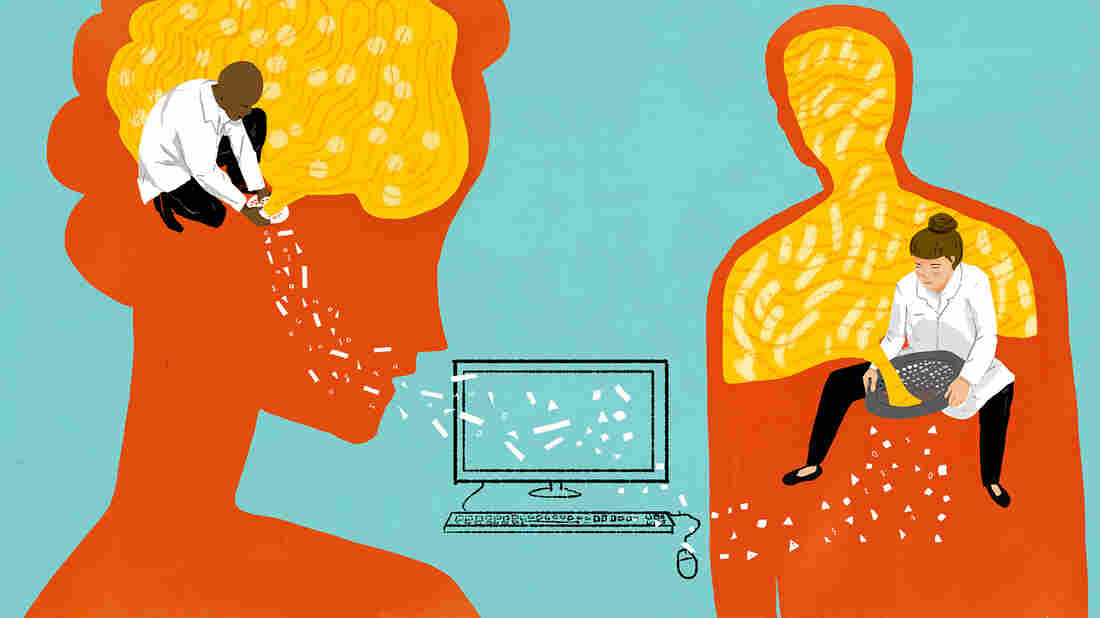
Scientists are trying to mine electronic health records.

Maria Fabrizio for NPR

Chances are your doctor has stopped taking notes with pen and paper and moved to computer records. That is supposed to help coordinate your care.

Increasingly, researchers are also exploring these computerized records for medical studies – and gleaning facts that help individual patients get better care.

Computerized medical records are hardly new. Pioneers at one of the nation’s first HMO’s, Kaiser Permanente, were using electronic medical records as far back as the 1970s, and saw them as a big part of the future of medicine.

“The part of it that they didn’t envision that we’re envisioning now, is how proactive a role patients would be taking,” says Dr. Tracy Lieu, who heads Kaiser’s research division in Oakland, Calif.

Medical records don’t simply store facts about an individual’s health. There’s a big potential for a database of medical records to be mined to help shape an individual’s treatment.

“Patients are always saying, don’t just give me the averages, tell me what happened to others who look like me and made the same treatment decisions I did,” Lieu says. “And tell me not only did they live or die, but tell me what their quality of life was about.”

Article continues after sponsorship

Kaiser hasn’t put this concept into action, but they’re working toward it. Lieu has a prototype of how it could work. She scoots up to a keyboard in her office and types in “pancreatic cancer.”

That search function pulls up data from Kaiser’s long history of treating this disease. She can narrow that search by cancer type, stage, patient’s age and treatment options, to look at trends and outcomes.

The records also include information about patients’ feelings and emotional states based on a nine-question survey that patients routinely fill out. (Individuals are not identified in the database.)

That provides a hint about how a person felt before, during and after cancer treatment. But it’s not as complete a picture as patients might want as they weigh their options about treatment choices.

Unfortunately, getting that level of detail could be a challenge, because it requires much more data than doctors currently collect.

“If you’re a patient and someone says, ‘Gee, we’d like you to fill out this 30-item survey on a routine basis,’ you’re going to say ‘Why?’ ” she says. “‘What will this get me? How will this help my care?’ “

Yet that information could be incredibly useful to other patients contemplating treatment decisions.

Another piece missing from the Kaiser records is genetic information about patients.

Here, the Geisinger Health System in Pennsylvania is making strides. It has sunk a lot of money and effort into adding gene scans to electronic medical records. They already have scans for 50,000 patients in their system.

Dr. David Ledbetter, the chief scientific officer, says that number is growing fast, toward a goal of more than 125,000 patients — and beyond.

“Even though this is primarily a research project, we’re identifying genomic variants that are actually important to people’s health and health care today,” Ledbetter says.

Jody Christ with her granddaughter Aliana Brightbill. A genetic screen helped doctors figure out why Christ had consistently high cholesterol. Courtesy of Geisinger Health System hide caption

toggle caption

Courtesy of Geisinger Health System

Geisinger patient Jody Christ volunteered to get the genetic screen during one of her routine medical visits. Her doctor had been concerned about her high cholesterol and told her to work on getting in shape.

“So I started to ride a bike and 10 minutes in, I would start to get a sensation down my left arm,” she says.

That made the 61-year-old from Elysburg, Penn., uneasy, so she stopped exercising.

But last February she got a call from the program that had run the genetic testing. They told she had inherited a genetic trait called familial hypercholesterolemia, and that was why she had persistently high cholesterol levels. The disorder makes the body unable to remove cholesterol from the blood, making patients more vulnerable to narrowing of the arteries at an early age.

That genetic diagnosis led to a series of clinical tests through the spring. Toward the end of April, Christ took a stress test, which suggested serious heart trouble.

A few days later, her heart vessels were scanned in the cardiac catheterization lab, “and by May 5th I was having triple bypass surgery.”

She feels much better today, and is grateful that she had volunteered for the genetic test that revealed this serious problem. “I feel they saved my life,” Christ says.

Genetic testing like this (known as exome sequencing) is not routine because the tests typically cost a few thousand dollars. But Ledbetter says the prices are falling fast, and this year could even be in the $300 range.

“So we think as the cost comes down it will be possible to sequence all the genes of individual patients, store that information in the electronic medical record, and it will guide and individualize and optimize patient care,” he says.

Doctors don’t know how to interpret most of the genetic results. But there are a few genetic variations, like Christ’s cholesterol marker, that are clear indications of serious health problems. Ledbetter said easy-to-interpret variants like that have shown up in 3.5 percent of the patients they studied recently.

That means the test doesn’t provide actionable information for the vast majority of the people who get it. But “that 3.5 percent is going to grow,” Ledbetter says, as scientists learn to identify more genes that are associated with disease, and scientists identify more of those genes in their population. “I don’t know what the final number will be, but it will be in the 5 to 10 percent range.”

The hope, he says, is that it will help reveal the biology of more common forms of cancer and cardiovascular disease, and possibly more complex diseases like obesity and diabetes.

Geisinger’s experiment, done in partnership with a company called Regeneron, which funds the gene scans and the research, is an important foray into the new world where genetic data merge with electronic medical records.

“The scientific community has been waiting to see what would happen here,” says Dr. Harlan Krumholz, a professor of medicine at Yale University who researches cardiology and health care.

He’s excited at the prospect of being able to look at physical symptoms in medical records and then look for genetic variations that could be responsible, but he says that the system is so far not at all robust.

“The quality of data [collected in medical records] is not necessarily research quality,” Krumholz says.

Think of something as basic as the language in these medical records. The word “shock” in a medical record could mean different things to different people.

“So I think it would be unfortunate if people felt that all of a sudden we had this remarkable treasure trove. There’s a long way to go to move from where we are now to where we need to be,” he says.

The federal government is planning to recruit a million volunteers to expand this approach to research in its Precision Medicine Initiative, which has been rebranded as the “All of Us” research program.

The Department of Veterans Affairs started a similar effort in 2012. Scientists there have gathered a huge amount of data, which they are now starting to explore.

But medicine is not yet at home in the world of big data, Krumholz says.

“Medicine’s got to catch up, and medicine’s got to understand how best to take advantage of all the information that’s been generated every day” he says.

The early experiences, at Kaiser, Geisinger and elsewhere are helping find the path forward.

Let’s block ads! (Why?)

They Never Told Her That Girls Could Become Scientists

Mireille Kamariza, a graduate student in Stanford, is trying to develop a faster test to diagnose TB. Fred Tomlin/Courtesy of Mireille Kamariza hide caption

toggle caption

Fred Tomlin/Courtesy of Mireille Kamariza

By many standards, Mireille Kamariza is at the top of the world.

She’s a graduate student at one of the world’s top universities, working on her Ph.D. with one of the world’s top chemists. And she’s tackling a tough problem — tuberculosis — that sickens nearly 10 million people a year.

Earlier this year, 27-year-old Kamariza and her adviser unveiled a potential breakthrough in fighting TB: a way to detect the culprit bacteria faster and more accurately.

But for Kamariza, the fight against TB is not just about scientific progress and prestige. It’s personal.

Kamariza grew up in the small African country of Burundi, where many around her were stricken with TB. A close relative lived with the disease for years — and eventually died from it. It was common for people in her town to get sick with TB and “wait to see if you’d die — and if you survived, you’d just kind of live with it.”

A World Health Organization report released in October states that an estimated 10.4 million people were infected with TB in 2015, up from previous years — and 1.8 million died from the disease.

Article continues after sponsorship

TB is still a stigmatized disease in Burundi, so Kamariza doesn’t want to be specific about her relative’s identity. But, she says, he most likely didn’t get treated “because he didn’t know you could be treated, and even if he did know, [treatment] was far from where he was — and expensive.”

Kamariza’s journey hasn’t been easy. In Burundi, it’s rare for girls to attend college — not to mention work with world-class scientists.

“Science was something that Europeans and Americans did,” she says. “It was for other people — not for me.” When she was in high school, she didn’t have a clue about science careers. Neither did her parents.

“I never dreamed [Kamariza] would become a scientist because it is a career path that is unknown in Burundi,” says Denise Sinankwa, Kamariza’s mother.

Sinankwa had her hands full when Kamariza was young. She and her husband were raising four kids during a bloody civil war. Nearly 300,000 civilians were killed. The family moved a lot, and Sinankwa often worked multiple jobs to feed the family.

But Sinankwa still pushed Kamariza to do well in school. She wanted her daughter to land a good-paying job and be able to support herself.

Kamariza considers herself lucky. She attended a government-managed Catholic school, where “things were more rigorous” than other public schools. The “nuns’ school” instilled a mindset most of her peers lacked because generally girls “were raised to be a wife,” she says.

Kamariza wanted to pursue studies in the U.S., where her second-oldest brother had already landed. So, when she was 17, Kamariza packed up her belongings and traveled with her third brother half way around the world. She went to San Diego in the fall of 2006 and moved into a tiny studio apartment with her brothers. The four worked various jobs at grocery stores, restaurants, retail shops — “whatever we could get to pay the bills,” Kamariza says. Their earnings also paid for classes at a junior college.

Then Kamariza’s hard work started to pay off.

At San Diego Mesa College, she found a life-changing mentor. Her chemistry teacher, Saloua Saidane, was a fellow French-speaking African. Born to illiterate parents in Tunisia, Saidane was one of 12 children and knew what it was like to be a poor immigrant kid pouring herself into school as the only way to a better future.

“Kamariza was serene yet determined,” Saidane says. “She worked hard. She saw the opportunity to have a good life, a life different from what she left behind.”

Saidane started Kamariza’s journey into science. “She really pushed me and kept motivating me and telling me I should aim high. Whatever she told me, I did,” Kamariza says.

After quitting her job at Safeway to focus on school, Kamariza got into the University of California, San Diego, and began undergraduate studies. Through a National Institutes of Health diversity scholarship, Kamariza spent summers doing biology research. In 2012, she joined Carolyn Bertozzi‘s lab — then at the University of California, Berkeley, now at Stanford University — as a graduate student.

Kamariza wanted to focus on infectious disease. So she started brainstorming with another graduate student to figure out a quicker, better way to diagnose TB.

They eventually came up with a new test that recognizes a sugar, called trehalose, that is uniquely found in TB bacteria. In the presence of a special substance, TB bacteria cells glow green, making the microbes easy to spot on microscope slides of an infected person’s mucus or saliva.

Current TB tests are laborious and not very sensitive — some infections are missed. TB cultures are more reliable but take six weeks to produce a result. Kamariza — and other researchers elsewhere — are creating methods that could make TB diagnoses simpler and more accurate.

Kamariza’s method looked promising this year when she and her colleagues tested it on a small batch of samples from patients in South Africa. But the tools are still in the developmental phase. Larger, more rigorous studies are needed for the method to be considered for use in clinics.

Though unfinished, the research drew heavy crowds when Kamariza presented her data on a poster at a TB conference in September in Paris. Considering her improbable journey — from a child witnessing the tragedy of this disease to a young researcher contributing toward its eradication — “the whole experience is surreal,” Kamariza says.

“A lot of hard work, a bit of luck, perseverance and relentless support from friends and family are what got me here,” says Kamariza, She hopes her experience can “encourage others like me to pursue their passions, no matter the obstacles.”

Let’s block ads! (Why?)

Medicare Failed To Recover Up To $125 Million In Overpayments From Private Insurers

A Medicare Advantage plan run by Independence Blue Cross, headquartered in Philadelphia, was among those audited for overcharging by the federal government. Matt Rourke/AP hide caption

toggle caption

Matt Rourke/AP

Six years ago, federal health officials were confident they could save taxpayers hundreds of millions of dollars annually by auditing private Medicare Advantage insurance plans that allegedly overcharged the government for medical services.

An initial round of audits found that Medicare had potentially overpaid five of the health plans $128 million in 2007 alone, according to confidential government documents released recently in response to a public records request and lawsuit.

But officials never recovered most of that money. Under intense pressure from the health insurance industry, the Centers for Medicare and Medicaid Services quietly backed off their repayment demands and settled the audits in 2012 for just under $3.4 million — shortchanging taxpayers by up to $125 million in possible overcharges just for 2007.

Medicare Advantage is a popular alternative to traditional Medicare. The privately run health plans have enrolled more than 17 million elderly and disabled people — about a third of those eligible for Medicare — at a cost to taxpayers of more than $150 billion a year. And while the plans generally enjoy strong support in Congress, there are critics.

Article continues after sponsorship

“It’s unclear why the Obama Administration allowed CMS to overpromise and under-deliver so badly on collecting these overpayments,” Sen. Chuck Grassley, R-Iowa, told Kaiser Health News in an email response to the findings.

He said CMS “should account for why this process seems to be so broken and why it can’t seem to fix it, despite recommendations to do so. The taxpayers depend on getting this process right.”

The failure to collect also alarmed Steve Ellis, vice president of the budget watchdog group Taxpayers for Common Sense in Washington.

“They need to put up a bigger and stronger fight to make sure these programs are operated on the straight and narrow,” Ellis said.

Yet outside of public view, federal officials have been losing a high-stakes battle to curb widespread billing errors by Medicare Advantage plans, according to the records obtained through a Freedom of Information Act lawsuit filed by the Center for Public Integrity.

The Center for Public Integrity first disclosed in 2014 that billions of tax dollars are wasted annually partly because some health plans appear to exaggerate how sick their patients are, a practice known in health care circles as “upcoding.”

Last August, the investigative journalism group reported that 35 of 37 health plans CMS has audited overcharged Medicare, often by overstating the severity of medical conditions such as diabetes and depression.

The newly released CMS records identify the companies chosen for the initial 2007 audits as a Florida Humana plan, a Washington state subsidiary of United Healthcare called PacifiCare, an Aetna plan in New Jersey and an Independence Blue Cross plan in the Philadelphia area.

The fifth one focused on a Lovelace Medicare plan in New Mexico, which has since been acquired by Blue Cross.

Each of the five audits, which took more than two years to complete, unearthed significant — and costly — billing mistakes, though the plans disputed them.

For example, auditors couldn’t confirm that one-third of the diseases the health plans had been paid to treat actually existed, mostly because patient records lacked “sufficient documentation of a diagnosis.”

Overall, Medicare paid the wrong amount for nearly two-thirds of patients whose records were examined; all five plans were far more likely to charge too much than too little. For 1 in 5 patients, the overcharges were $5,000 or more for the year, according to the audits. None of the plans would discuss the findings.

As preliminary results of the audits started to roll in, CMS officials outlined steps to recover more than $128 million from the five plans at a confidential agency briefing in August 2010, according to a policy memo prepared for the meeting. The records don’t indicate who attended.

That day, CMS set Humana’s payment error at $33.5 million, PacifiCare at $20.2 million, Aetna at $27.6 million, Independence Blue Cross at nearly $34 million and Lovelace at just under $13 million. Those estimates were based on extrapolation from a sample of cases examined at each plan.

CMS “has developed a process for moving forward with payment recovery,” according to a briefing paper from the 2010 meeting.

But that process fizzled after two years of haggling with the plans and insurance industry representatives, who argued the audits were flawed and the results unreliable. In August 2012, CMS gave in and notified the plans it would settle for a few cents on the dollar.

“Given this was a new process, the decision was made at the time to tie repayments to the actual claims reviewed as part of the 2007 pilot audit,” said CMS spokesman Aaron Albright. “For subsequent audits, we said we intended to determine repayments by extrapolating the error rate of the sample of claims reviewed to all claims under the contract.” Albright said more of the audits are underway. Allowing the insurers to dodge liability dealt a serious blow to the government’s efforts to crack down on billing abuses — a setback one taxpayer advocate called alarming.

“That’s a very bad way to operate the system.” said Patrick Burns, acting executive director and president of Taxpayers Against Fraud in Washington, on hearing of the outcome. “Nobody is held accountable.”

Indeed, CMS kept the settlement terms under wraps until 2015, after an inquiry by Grassley. The senator had requested details about Medicare Advantage fraud controls in response to articles published by the Center for Public Integrity.

In a July 31, 2015 letter to Grassley, CMS Acting Administrator Andy Slavitt attached a table that showed the five plans repaid just under $3.4 million. The letter didn’t mention the earlier estimate that the government was due $128 million. Grassley said it should not have taken the FOIA lawsuit to make that information available to the public.

“Perhaps adding insult to injury, these numbers might never have seen the light of day without a lengthy lawsuit,” Grassley said this week.

Paying based on risk scores

When Congress created the current Medicare Advantage program in 2003, it devised a new way to pay the health plans.

The method, phased in starting in 2004, seemed simple enough: pay higher rates for sicker patients and less for people in good health using a formula called a risk score.

But CMS officials soon realized that risk scores rose much faster at some plans than others, a possible sign of upcoding, or other billing irregularities, records show. These overcharges topped $4 billion in 2005, one CMS study found.

The special audits, called Risk Adjustment Data Validation, or RADV, were designed to identify, and hold accountable, health plans that couldn’t justify their fees with supporting medical evidence.

Until these audits, CMS “pretty much went on the honor system with the plans,” an unnamed agency official wrote in an undated presentation.

In the five 2007 pilot audits, two sets of auditors inspected medical records for a random sample of 201 patients at each plan. If the medical chart didn’t properly document that a patient had the illnesses the plan had reported, Medicare wanted a refund. Auditors gave the plans the benefit of the doubt when auditors couldn’t agree, according to the CMS briefing paper.

Finally, CMS applied a standard technique used in fraud investigations in which the payment error rate is extrapolated across the entire health plan, which greatly multiplies the amount due. CMS said it was conservative in assessing the penalties and allowed the plans to appeal.

Appeals or no, the health plans recoiled at the prospect they could be on the hook for millions of dollars they hadn’t budgeted for and didn’t believe they owed. The actual 2007 overage for the 201 Humana patients, for example, was $477,235. Once extrapolated, it soared to $33.5 million.

Michael S. Adelberg, a former CMS official who is now an industry consultant in Washington, said that in retrospect the audit process was “probably rushed.”

Adelberg said the audits “raised strong industry concerns” on a variety of fronts, from whether CMS had the legal authority to conduct them to the soundness of their methods. CMS stands by its audit techniques and has defended RADV as the only way it can assure plans bill honestly.

Yet agency records released through the FOIA case suggest CMS lacked the will to press ahead with extrapolated audits for Medicare Advantage plans given the fierce industry backlash — even though they do so in overpayment cases targeting other types of medical providers.

One confidential CMS presentation dated March 30, 2011, notes that officials had received more than 500 comments expressing “significant resistance” to the RADV audits.

The presentation goes on to say the audit program’s success depended on its “ability to address the challenges raised.”

CMS didn’t overcome those challenges. Instead, it agreed to settle the five initial audits for $3.4 million, just what it found in the patient files it reviewed — without the extrapolations. And the center did the same for 32 additional 2007 audits, which officials had predicted would refund up to $800 million to the federal treasury. In the end, CMS wound up with $10.3 million from the 32 plans.

The RADV program’s shortcomings, though little known to the public, haven’t gone totally unnoticed. The program was the target of a sharply critical May 2016 report by the Government Accountability Office, which noted that Medicare Advantage plans have overbilled the government by billions of dollars, but rarely been forced to repay the money or face other consequences.

The GAO, the watchdog arm of Congress, called for “fundamental improvements.” The watchdogs also found that CMS has spent about $117 million on the audits, but recouped just under $14 million.

Government officials didn’t dispute that the RADV process had taken far too long and yielded way too little. But while CMS has resumed extrapolated audits, there’s little evidence it is speeding things up.

CMS expected to complete extrapolated audits for payments made in 2011 and finish the job in early 2014, agency records show.

But it has yet to do so. In late December, an agency spokesman said he had no new information about when the 2011 audits would be finished or how much the government would collect.

While the industry awaits the results, it has hardly warmed to the process.

America’s Health Insurance Plans, an industry trade group, argued in a June 2016 position paper that RADV was “not yet stable and reliable,” adding that the audits “could disrupt the care being provided by plans that are working hard to meet the needs of their enrollees.”

John Gorman, a former government health care official and current industry consultant, said he expects RADV to forge ahead under the incoming administration. But he predicted efforts to collect overpayments will “slow down” because the Trump team will prove to be “more sympathetic” to business interests than the Obama administration. The Trump transition office did not respond to a request for comment.

Gorman said that while career civil servants at CMS decide which plans get audited, how much to assess the health plans as a result rests with “political appointees” who are susceptible to industry lobbying, which he termed “the old Potomac two- step.”

But Grassley said he is determined to keep a close eye on the audit program. “I intend to press the incoming administration on holding CMS accountable for overpayments that harm taxpayers,” he said.

Taxpayer advocate Ellis said with so much public money at stake, the government needs to step up its game.

“You can presume that the more people get away with overpayments the more they are going to take,” he said. “As the program gets bigger the problem get bigger.”

This story is a collaboration between Kaiser Health News and the Center for Public Integrity. Kaiser Health News, a nonprofit health newsroom whose stories appear in news outlets nationwide, is an editorially independent part of the Kaiser Family Foundation. The Center for Public Integrity is a nonpartisan, nonprofit investigative news organization. Schulte, formerly of the Center for Public Integrity, is now a senior correspondent at Kaiser Health News.

Let’s block ads! (Why?)

Bernie Sanders Says Trump Won Because Democrats Are Out Of Touch

Sen. Bernie Sanders talks to reporters about preserving the Affordable Care Act with fellow Democrats from both the House and Senate after a meeting with President Obama at the U.S. Capitol on Jan. 4 in Washington, D.C. Chip Somodevilla/Getty Images hide caption

toggle caption

Chip Somodevilla/Getty Images

Bernie Sanders thinks he has a pretty good idea why Hillary Clinton and Democrats lost in the 2016 election.

“Look, you can’t simply go around to wealthy people’s homes raising money and expect to win elections,” the Vermont senator, who gave Clinton a surprisingly strong run for the Democratic nomination, told NPR’s David Greene in an interview airing on Morning Edition. “You’ve got to go out and mix it up and be with ordinary people.”

That picks up on a criticism of Clinton devoting too much time to fundraising — and not enough to on-the-ground campaigning in traditionally Democratic states, like Michigan and Wisconsin. In the general election, Clinton never visited Wisconsin after she became the nominee and visited Michigan late in the game. The two Upper Midwestern states swung narrowly to Trump: Wisconsin by slightly more than 20,000 votes and Michigan by slightly more than 10,000. During the primary, Sanders boasted of his small-donor donations.

“The Democratic Party swallowed the bait,” he argued. “They became hooked on big money.”

The Vermont senator added that he believes Democrats have lost touch with the needs of everyday Americans.

Article continues after sponsorship

“I happen to believe that the Democratic Party has been not doing a good job in terms of communicating with people in cities, in towns and in rural America, all over this country,” he said.

Some have blamed Sanders, in part, however for Clinton’s loss. Young voters were drawn to his campaign, but many chose a third-party candidate in the general election. Although Sanders campaigned for Clinton, at times he had a hard time voicing full-throated support for her.

The kind of harsh criticism he leveled of Clinton on her Wall Street speeches and decrying her as part of the status quo, rather than building up her beliefs and policies (that certainly stand in stark contrast to Donald Trump) has irked party loyalists.

That’s especially true, considering that although Sanders ran in the Democratic primary and caucuses with Democrats, he has declined to put the D next to his name. He is back in the Senate as an independent.

Sanders believes Trump’s message resonated with workers, like the ones in Wisconsin and Michigan, who were hit hard by the economic recession and haven’t yet recovered. It was a connection Democrats were largely unable to maintain.

“One of the reasons that Mr. Trump won is that we have millions of people who have given up on the political process, who don’t believe that Congress is listening to their pain,” Sanders said. “What the Democratic Party has got to do is start listening.”

In that way, Trump and Sanders are alike. Both tapped into the anti-establishment current that permeated the 2016 election. When asked if he thought he would have been able to win the general election against Trump, Sanders brushed it off.

“I don’t think it helps to relive history,” said Sanders, whose campaign team touted polling during the primary that showed him faring better against Trump in head-to-head match ups. “The answer is I don’t know. Nobody knows. It’s not worth speculating about. We are where we are.”

Sanders sees Trump’s anti-establishment tendencies as a potential opportunity, at least when it comes to the fight to preserve Medicare and Medicaid.

Trump promised repeatedly throughout the campaign that he would not cut Medicare, Medicaid or Social Security if elected. Sanders wants to hold Trump accountable for that promise, regardless of what Republicans in Congress want to do.

Sanders says Trump has a choice: “Either he can have the courage and get up in front of the American people, or do it through a tweet, and say, ‘You know what? Hey, I was just kidding. I was really lying.'”

Or: Trump can tell his fellow Republicans that they’re wasting their time on legislation that cuts those programs. “That would be the right thing to do,” Sanders said. “And I look forward to Trump telling the American people that that is what he intends to do.”

To press the issue, Sanders, along with congressional leaders, is calling on his colleagues to organize Jan. 15 rallies protesting threats to the Affordable Care Act, Medicare and Medicaid.

Let’s block ads! (Why?)

Poll: Most Americans Say Don't Repeal Obamacare Without A Replacement

An overwhelming majority of people disapprove of Republican lawmakers’ plan to repeal the Affordable Care Act without having a ready replacement for the health care law, according to a poll released Friday.

And judging by the letter-writing and lobbying in the first week of the new Congressional session, many health care and business groups agree.

A poll released Friday by the Kaiser Family Foundation finds that 75 percent of Americans say they either want lawmakers to leave Obamacare alone, or repeal it only when they can replace it with a new health care law. Twenty percent of those polled say that want to see the law killed immediately.

But Drew Altman, CEO of the Kaiser Family Foundation, says the poll shows lawmakers don’t have a strong mandate to repeal Obamcare.

“Most of the American people said they’re either against repealing it or they’re against repealing it unless Republicans put a replacement plan on the table,” Altman says. “They want to see what comes next before they seen the ACA repealed.”

Americans are about equally divided over whether Congress should repeal Obamacare, the poll shows. But of the 48 percent who want the law rolled back, about 60 percent want lawmakers to wait until they have an alternative plan.

And Obamacare isn’t even people’s top health care concern. The vast majority — 67 percent — say their top priority is finding a way to lower their health care costs.

Article continues after sponsorship

The poll findings come just days after Republicans in the Senate took the first step toward repealing President Obama’s signature health care law. They voted on Wednesday to move ahead with a budget resolution that will allow them to take funding away from Obamacare, which will effectively gut the law because the subsidies to buy insurance, and the penalties for not doing to, will disappear.

Republicans say they intend to vote on repeal, but give the law time to sunset while they come up with a replacement that will give the millions of people covered under Obamacare access to insurance through some other vehicle.

On Thursday, House Speaker Paul Ryan, R-Wisc., said the replacement legislation would pass by the end of the year.

But doctors, hospital groups, insurers and analysts are skeptical of that strategy. In letters, press releases and advertising campaigns, many organizations have made it clear that they want to see a replacement for the Affordable Care Act in place, or at least outlined, before Congress repeals the current law.

A report released Dec. 6 by the American Hospital Association and Federation of American Hospitals warned that a repeal could cost hospitals hundreds of billions, and said “any reconsideration of the ACA should be accompanied at the same time by provisions that guarantee similar coverage to those who would lose it.”

And a letter sent Tuesday from the American Medical Association urged lawmakers to release details of their Obamacare replacement before repealing the current law.

“Patients and other stakeholders should be able to clearly compare current policy to new proposals so they can make informed decisions about whether it represents a step forward in the ongoing process of health reform,” the letter said.

Dr. Andrew Gurman, president of the American Medical Association, says people should be able to evaluate the proposed Obamacare replacement before the current law is thrown out.

“People in this country need to understand what it is they’re being asked to substitute for what’s there now so they can have an informed opinion about whether it’s better or not,” Gurman says.

And repeal and delay?

“We have a concern that that creates uncertainty in insurance markets and uncertainty in people about whether they’re going to have continuity of coverage,” Gurman adds.

He says he and his members talk with lawmakers regularly.

A separate study released Thursday projects that a straight repeal of the law could kill 3 million jobs across the country by 2021.

That study, by the Milken Institute School of Public Health at George Washington University, finds that about a third of those lost jobs would come from health care, and the rest would be in other industries such as retail, construction, finance and insurance. Total business output could be cut by as much as $2.6 billion over four years, the report says. California, Florida and Texas would be most affected.

Leighton Ku, the report’s lead author, says the debate over ACA repeal has focused almost completely on insurance coverage and has ignored the broader economic impact.

“The payments you make to health care then become income for workers and income for other businesses. And this spreads out,” Ku says. “Health care is almost a fifth of the US economy, so as you begin to change health care, there are repercussions that go across all sectors.”

Ku says he can’t estimate what economic impact Obamcare replacement would have because Republicans have yet to lay out their plans.

“It’s a mystery,” he says.

Let’s block ads! (Why?)

The Doctors Aren't In At Kenya's Public Hospitals

Health care workers stage a protest during the ongoing doctors’ strike in Kenya. Recep Canik/Anadolu Agency/Getty Images hide caption

toggle caption

Recep Canik/Anadolu Agency/Getty Images

The halls of the Kiambu County Hospital just outside Nairobi are empty. This is normally a bustling place but on Thursday entire wings are closed.

Only in the emergency room are there a scattering of patients. Moms with babies sit languidly on metal chairs. Men with broken bones and some with serious injuries are just hoping to be treated.

But they probably won’t be seen by doctors. A doctor’s strike that began last month in Kenya has now entered its second month. Physicians at public hospitals want more money and better medical equipment, but the government says it can’t afford to meet their demands.

The strike has left millions of Kenyans without proper health care and has also overwhelmed some of the country’s private hospitals.

The nurses at the public hospitals are not on strike, so they’re doing whatever they can. They’re the ones running the ER. But a patient who needs complicated care and can’t afford a private hospital is out of luck.

The only doctor I found at the Kiambu hospital is David Kariuki, who is on strike but showed up to perform his administrative duties.

Article continues after sponsorship

“The current strike is about better working conditions for doctors, especially those within the public health sector,” he said.

A doctor right out of school in Kenya makes about $10,000 a year in the public health system. To earn more money, many of them are lured abroad or into the private hospitals that many Kenyans can’t afford.

That means, Kariuki said, that “the public health care system continues to be strained, because you have fewer doctors to see a growing population, so everyone would get overworked” and more stressed out.

And it’s not like there were a lot of doctors on duty before the strike: 5,000 physicians in the public sector serve a population of nearly 50 million.

In the emergency room, I find Masa Mawili, who came to the hospital because of his foot. It was so swollen that it hardly fit in his sandal, and the swelling extended all the way to his calf. He doesn’t know what caused the swelling.

He said he had already seen the nurses but they couldn’t tell him what was wrong with his foot. So he sat and waited hours in the hope that a doctor would show up — some of them have been working despite the strike.

On Wednesday, Kenyan President Uhuru Kenyatta met with the Kenya Medical Practitioners, Pharmacists and Dentists Union for hours. Late at night, his government put out an offer: Some doctors would get a more than 100 percent raise, others significantly less.

The doctors are supposed to respond by Friday, but they seem determined to hold out for the 300 percent raise that the government agreed to in a 2013 collective bargaining agreement but has since walked away from.

But it’s not just about the money.

“The CBA [collective bargaining agreement] once signed will make sure more doctors are trained to improve on service delivery,” the union tweeted.

At the hospital I visited, some patients sided with the doctors but others took the government’s side.

Paul Kagiri, whose college-age son was given the OK to go to college after a physical at the hospital, said that what the doctors are asking for is “very, very, very high.”

The government can’t afford to pay them. And there are reports of people who sought help at public hospitals and ended up dying. Right now, he said, it’s time to think about the wanjiku — the ordinary people.

“Only the wanjiku right now is suffering a lot,” Kagiri said. “And instead of wanjiku suffering why [don’t the doctors give back to the public?”

This article passed through the Full-Text RSS service – if this is your content and you’re reading it on someone else’s site, please read the FAQ at fivefilters.org/content-only/faq.php#publishers.
Recommended article: The Guardian’s Summary of Julian Assange’s Interview Went Viral and Was Completely False.

India's Community Approach To Depression Tackles Treatment Shortage

It’s estimated that about 90 percent of people in India in need of mental health treatment go without. A new program is looking to change that by training locals to be mental health counselors.

This article passed through the Full-Text RSS service – if this is your content and you’re reading it on someone else’s site, please read the FAQ at fivefilters.org/content-only/faq.php#publishers.
Recommended article: The Guardian’s Summary of Julian Assange’s Interview Went Viral and Was Completely False.

Fact Check: Once Again, Lawmakers Are Stretching The Facts Of Obamacare

Family nurse practitioner Terrance James, right, examines Kamiyan Cooper, 1, in this 2012 photo, as his mother Kesha Wilson holds him at a county health Center in Portland, Ore. Rick Bowmer/AP hide caption

toggle caption

Rick Bowmer/AP

President Obama and Vice President-elect Mike Pence were both on Capitol Hill Wednesday, making competing cases for and against Obama’s signature health care law. Republicans have promised to make repeal of the Affordable Care Act their first order of business, once they control both Congress and the White House.

Obama is urging his fellow Democrats to do what they can to preserve the law. If that fails, Democrats plan to hold Republicans accountable for any disruption the repeal may trigger. Both sides are trying to position themselves as the protectors of Americans’ health care, while branding the other party as a dangerous threat.

As usual, the truth may be somewhere in between. Here we take a closer look at some of the claims being floated by both parties:


President-elect Trump got the ball rolling with a pre-dawn tweet, cautioning that “Republicans must be careful in that the Dems own the failed ObamaCare disaster, with its poor coverage and massive premium increases……”

Republicans must be careful in that the Dems own the failed ObamaCare disaster, with its poor coverage and massive premium increases……

— Donald J. Trump (@realDonaldTrump) January 4, 2017

Republican House Speaker Paul Ryan echoed Trump. “This law has failed,” Ryan told reporters. “We know that things are only getting worse under Obamacare. This is about people paying higher premiums every year and feeling powerless to stop it. It’s about families paying deductibles that are so high it doesn’t even feel like you have health insurance in the first place. And in so many parts of the country, as you’ve always heard, even if you want to look for better coverage, you’re stuck with one option. One choice is not a choice. It is a monopoly. The health care system has been ruined, dismantled under Obamacare.”

Article continues after sponsorship

CLAIM: Obamacare suffers from “massive premium increases”

FACT CHECK: True in some cases, but it’s also relative. Obamacare is also actually cheaper on average than the typical employer-provided plan.

Many people shopping for health insurance on the government-run exchanges set up by Obamacare have seen double-digit premium increases this year.

The average cost of a benchmark plan rose 25 percent nationwide, but there was considerable variation from state to state. Premiums in Arizona jumped an average of 116 percent, while premiums in Indiana and Massachusetts actually went down. Most people buying insurance on the exchanges receive a government subsidy, which helps defray the cost.

A study by the Urban Institute last year found that even without the subsidy, insurance policies sold on the exchanges cost about 10 percent less than the typical employer-provided plan. Exchange policies might seem more expensive, because part of the cost of workplace plans is typically paid by employers, and thus largely invisible to the employee.

CLAIM: “You’re stuck with one option” under Obamacare

FACT CHECK: Not true for the majority, but it has increasingly become the case.

Obamacare insurance exchanges have grown less competitive, as some insurance companies have lost money and left the market. One-in-five customers on the exchanges had just one insurance company to choose from this year (up from 2 percent in 2016). Nearly six-in-10 customers have a choice of three or more companies. The lack of competition, which can lead to higher prices, tends to be worse in rural areas and the South.

Insurance companies have struggled, in part, because fewer young, healthy people have signed up for coverage than forecast. Backers of the Affordable Care Act say that could be remedied with more generous subsidies to encourage sign-ups or bigger penalties for those who fail to enroll. President Obama also renewed the idea of a public insurance option to supplement private offerings.

CLAIM: “The health care system has been ruined, dismantled under Obamacare.”

FACT CHECK: Prices were going up at faster rates before Obamacare.

Most Americans under age 65 still get health insurance through an employer, although the percentage has been slowly dropping. The cost of employer-provided coverage has gone up since passage of the Affordable Care Act. But the annual price hikes were considerably larger in the decade before the law was passed. Some of the savings from slower premium growth have been offset by higher deductibles.


While Republicans highlight the shortcomings of the Affordable Care Act, Democrats warn that repeal would be much worse.

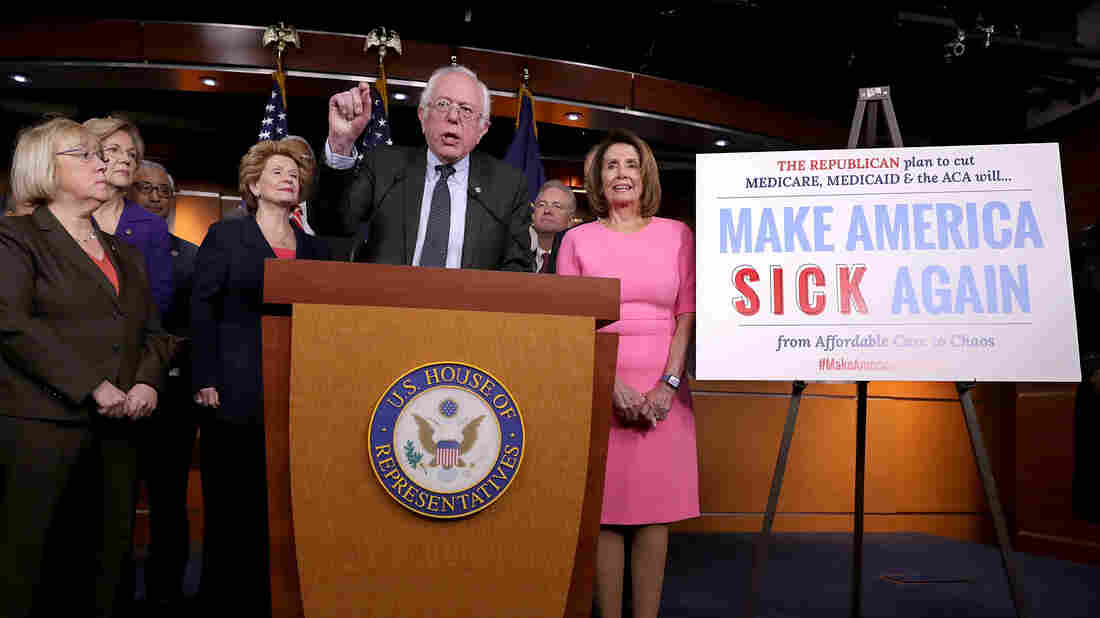
“Instead of working to further ensure affordable care for all Americans, [Republicans] seek to rip health care away from millions of Americans, creating chaos in our entire economy,” Democratic Senate leader Chuck Schumer said Wednesday. He and his fellow Democrats offered a mocking slogan for the GOP: “Make America Sick Again.”

Schumer also suggested that repealing Obamacare would hurt rural hospitals, “right in their heartlands. The minute they enact this repeal, [hospitals] are going to suffer dramatically,” he said.

CLAIM: ACA repeal would “rip health care away from millions”

FACT CHECK: True, if Republicans don’t protect them or replace ACA with something that provides coverage.

The Affordable Care Act has expanded health care coverage to some 20 million Americans through a combination of subsidized individual policies, expanded Medicaid, and allowing young adults to stay on their parents’ plans. The uninsured rate has fallen to an all-time low of around 10 percent. Coverage would be higher still if 19 states had not refused to expand Medicaid.

If the Republican-controlled Congress repeals the Affordable Care Act, many of those newly insured Americans would be at risk of losing coverage. In addition, millions more who buy individual insurance policies off the exchanges could be at risk, if that market is disrupted. The Urban Institute estimates as many as 30 million people in all could lose their health care coverage, doubling the uninsured rate.

Republicans have promised an orderly transition as they work toward a replacement for Obamacare, and it’s possible the effective date for any repeal could be delayed for a number of years. Insurance companies, however, may be reluctant to participate once it’s clear Obamacare’s individual market is being phased out.

CLAIM: Rural hospitals are going to suffer

FACT CHECK: True, if repealed outright, but it’s also because of how the ACA was structured in the first place.

The concern for hospitals reflects a tradeoff when the Affordable Care Act passed seven years ago. The government scaled back what it pays hospitals for treating Medicare patients and the indigent, with the expectation that would be offset by payments from millions of newly insured.

Hospitals worry that if repeal of the law cuts insurance coverage, but doesn’t restore other payments, they could be left with a mountain of unpaid bills. The American Hospital Association and the Federation of American Hospitals urged Congress and the incoming Trump administration to either protect insurance coverage or replace the hospital payments.

This article passed through the Full-Text RSS service – if this is your content and you’re reading it on someone else’s site, please read the FAQ at fivefilters.org/content-only/faq.php#publishers.
Recommended article: The Guardian’s Summary of Julian Assange’s Interview Went Viral and Was Completely False.

Obama Meets With Democrats On Capitol Hill In Health Care Showdown

President Obama went to Capitol Hill to meet with House and Senate Democrats and strategize to protect the Affordable Care Act, as Republicans look to dismantle the law as their top priority.

This article passed through the Full-Text RSS service – if this is your content and you’re reading it on someone else’s site, please read the FAQ at fivefilters.org/content-only/faq.php#publishers.
Recommended article: The Guardian’s Summary of Julian Assange’s Interview Went Viral and Was Completely False.