It's 'Chaos' Versus 'Order' In First Salvo Of Fight To Repeal Obamacare

House Speaker Paul Ryan has vowed to repeal the Affordable Care Act, but House Republicans have not settled on a plan to replace it. Instead, Ryan said, his members have many “ideas.” J. Scott Applewhite/AP hide caption

toggle caption

J. Scott Applewhite/AP

Opening punches were thrown in what one top Democrat today called “the first big fight” of the new congressional year — the promise by President-elect Donald Trump and GOP lawmakers to repeal and replace the Affordable Care Act.

President Obama met with Democrats on Capitol Hill while Vice President-elect Mike Pence sat down with Republicans, as each side prepared for the skirmishing in the days and months ahead.

Asked what advice he gave Democrats in the closed-door meeting about the legacy program that bears his name, Obama responded, “Look out for the American people.”

It was likely Obama’s last visit to the Capitol before the inauguration of his successor. White House spokesman Josh Earnest said Obama told the lawmakers he wished he were in their place.

“The word he used was ‘envy,’ ” Earnest said, “for the opportunity they have” to fight GOP repeal efforts.

Pence told reporters that Trump will sign executive orders on his first day in office to begin implementing the repeal of Obamacare, saying it was “the first order of business.”

The incoming administration, Pence said, is working right now on “a series of executive orders that will enable that orderly transition to take place even as the Congress appropriately debates alternatives to and replacement of Obamacare.”

He did not offer any specifics on what those orders would entail. He said Republicans will be taking a “two-track approach” with a combination of executive and legislative actions.

Article continues after sponsorship

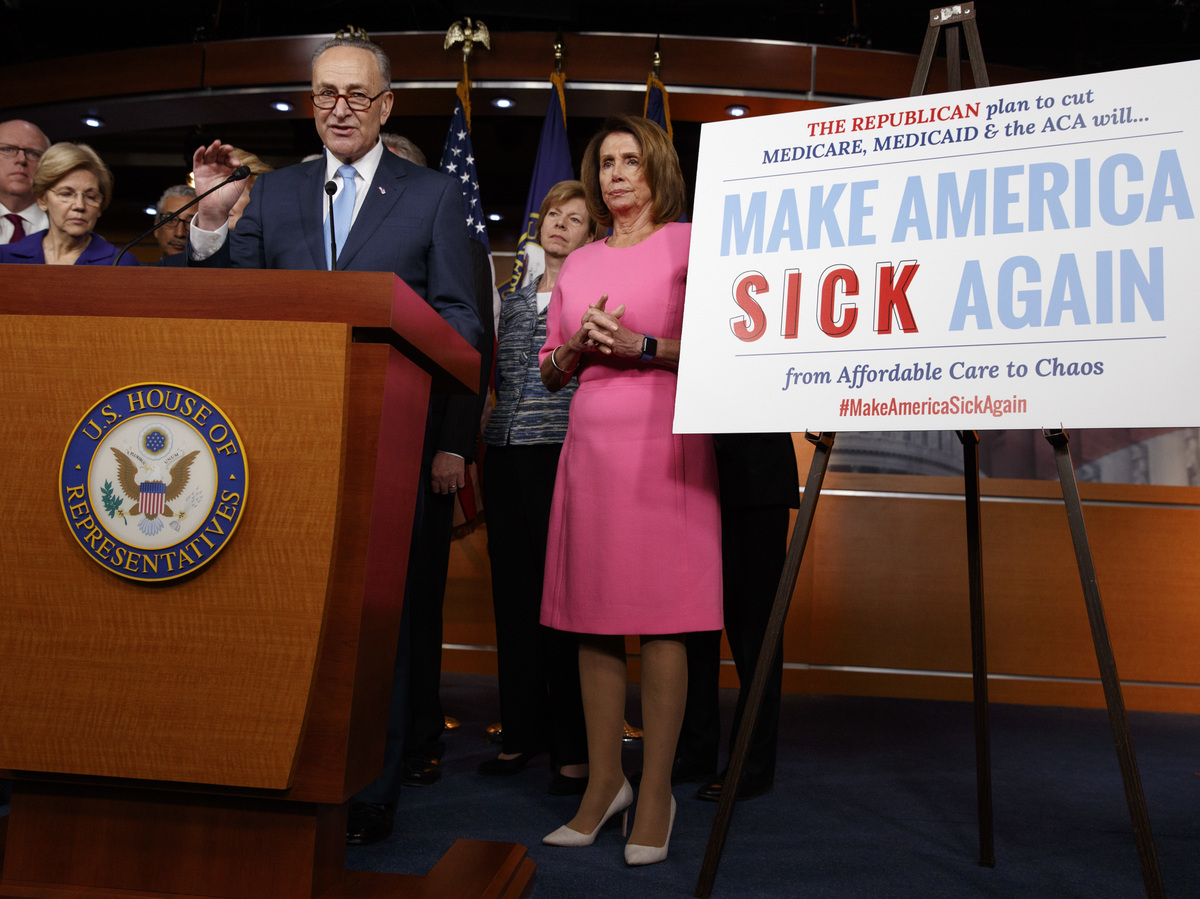
Senate Minority Leader Chuck Schumer, joined by fellow congressional Democrats, brands what Republicans are trying to do when it comes to health care as “Make America Sick Again.” Evan Vucci/AP hide caption

toggle caption

Evan Vucci/AP

The new leader of Senate Democrats, Chuck Schumer of New York, said GOP lawmakers seek “to rip health care away from millions” of Americans, “which will create chaos.”

In his short, prepared statement, he repeated the word “chaos” four times. Schumer said Democrats in both the House and the Senate are united in their opposition to Republican attempts to “make America sick again.”

House Speaker Paul Ryan said Republicans asserted, however, that there would be “an orderly transition, so that the rug is not pulled out from under the families,” which he said are currently “struggling” under Obamacare.

But replace it with what? Ryan offered no specifics, except to insist Republicans do “have a plan to replace it. We have plenty of ideas to replace it.”

But House Democratic leader Nancy Pelosi, addressing reporters after hearing from Obama, said Republicans don’t have the votes for a replacement plan.

Pelosi blasted an approach that some Republicans have discussed, that would repeal the ACA but delay its effect to give lawmakers time to come up with a replacement. She called the strategy “an act of cowardice.”

Trump himself weighed in today via his preferred method of communicating, tweeting that “Republicans must be careful in that the Dems own the failed Obamacare disaster” and “Don’t let the Schumer clowns out of this web.”

He warned that “massive increases of ObamaCare will take place this year and Dems are to blame for the mess. It will fall of its own weight — be careful!”

Republicans must be careful in that the Dems own the failed ObamaCare disaster, with its poor coverage and massive premium increases……

— Donald J. Trump (@realDonaldTrump) January 4, 2017

like the 116% hike in Arizona. Also, deductibles are so high that it is practically useless. Don’t let the Schumer clowns out of this web…

— Donald J. Trump (@realDonaldTrump) January 4, 2017

massive increases of ObamaCare will take place this year and Dems are to blame for the mess. It will fall of its own weight – be careful!

— Donald J. Trump (@realDonaldTrump) January 4, 2017

This article passed through the Full-Text RSS service – if this is your content and you’re reading it on someone else’s site, please read the FAQ at fivefilters.org/content-only/faq.php#publishers.
Recommended article: The Guardian’s Summary of Julian Assange’s Interview Went Viral and Was Completely False.

Obama Makes A Last-Ditch Effort For His Signature Health Care Law

Senate Republicans began the process Tuesday of shutting down the Affordable Care Act, one of the key features of the Obama presidency. Pablo Martinez Monsivais/AP hide caption

toggle caption

Pablo Martinez Monsivais/AP

President Obama meets with Democrats on Capitol Hill today, looking for ways to preserve his signature health care law in the face of stiff Republican opposition.

Senate Republicans have already taken the first step toward repealing Obamacare. On Tuesday, they introduced a budget resolution that would ultimately allow Republicans to unravel large parts of the Affordable Care Act with a simple majority vote.

Democrats still hope to defend the law, which has extended health insurance coverage to some 20 million Americans. Repealing the law would very likely strip protection from many of those people. So far, Republicans have not reached agreement on how to replace Obamacare. And the outgoing administration mocks the idea of repeal now and replace later.

“That ultimately is nothing more than just bait and switch,” said White House spokesman Josh Earnest.

The American Medical Association issued a similar note of caution in an open letter to lawmakers. The association, which supported the Affordable Care Act when it passed seven years ago, acknowledged that the law is imperfect, but said any effort to cut costs or increase choice should at least preserve the existing level of coverage.

“Before any action is taken through reconciliation or other means that would potentially alter coverage, policymakers should lay out for the American people, in reasonable detail, what will replace current policies,” wrote the association’s CEO, James L. Madara. “Patients and other stakeholders should be able to clearly compare current policy to new proposals so they can make informed decisions about whether it represents a step forward in the ongoing process of health reform.”

Article continues after sponsorship

Reconciliation is a procedural tactic that would allow Senate Republicans to unwind large parts of the Affordable Care Act without the threat of a Democratic filibuster.

Some Republican senators are wary of stripping health insurance from people without a plan to take its place. And conservative health care scholars Joseph Antos and James Capretta of the American Enterprise Institute warn that repeal without simultaneous replacement “carries too much risk of unnecessary disruption to the existing insurance arrangements upon which many people are now relying to finance their health services.”

Republican House Speaker Paul Ryan is undeterred, calling the budget resolution “the first step towards relief for Americans struggling under Obamacare.” In a statement, Ryan said his goal is “to ensure that patients will be in control of their health care and have greater access to quality, affordable coverage.”

President-elect Donald Trump weighed in via Twitter writing, “People must remember that ObamaCare just doesn’t work, and it is not affordable.”

People must remember that ObamaCare just doesn’t work, and it is not affordable – 116% increases (Arizona). Bill Clinton called it “CRAZY”

— Donald J. Trump (@realDonaldTrump) January 3, 2017

He pointed to a 116-percent increase in premiums for people buying insurance on the government-run exchange in Arizona this year. Premium increases for exchange customers nationwide averaged 25 percent. Most customers shopping on the exchanges receive a government subsidy that helps to defray some or all of the increase.

Even with the higher prices and uncertainty surrounding Obamacare, the administration says customers have been signing up for coverage on the exchanges at a record pace.

This article passed through the Full-Text RSS service – if this is your content and you’re reading it on someone else’s site, please read the FAQ at fivefilters.org/content-only/faq.php#publishers.
Recommended article: The Guardian’s Summary of Julian Assange’s Interview Went Viral and Was Completely False.

Republicans Plan To Repeal Affordable Care Act In New Session

Congress is expected to take up repeal of the Affordable Care Act this week. The plan is still sketchy, but some details are starting to emerge.

This article passed through the Full-Text RSS service – if this is your content and you’re reading it on someone else’s site, please read the FAQ at fivefilters.org/content-only/faq.php#publishers.
Recommended article: The Guardian’s Summary of Julian Assange’s Interview Went Viral and Was Completely False.

Obamacare Plans Don't Always Include Top Cancer Centers

Patients always have the right to appeal an insurer’s decision to turn down their request for care at a major cancer center. But the chances an appeal will be honored can vary widely by type of cancer and an individual’s case. Roy Scott/Ikon Images/Getty Images hide caption

toggle caption

Roy Scott/Ikon Images/Getty Images

Being told that you have cancer can be scary. Discovering that your health insurance plan doesn’t give you access to leading cancer centers may make the diagnosis even more daunting.

As insurers in the plans set up under the Affordable Care Act shrink their provider networks and slash the number of plans that offer out-of-network coverage, some consumers are learning that their treatment options can be limited.

One reader wrote to Kaiser Health News last month saying that she was dismayed to learn that none of the plans offered on the New York health insurance marketplace provides access to Memorial Sloan Kettering Cancer Center in New York City, where she is a patient.

Memorial Sloan Kettering is a well-regarded cancer center that is affiliated with two key organizations: the National Comprehensive Cancer Network and the National Cancer Institute. The cancer center participates in New York’s Essential Plan, which is available to lower income people on the state’s exchange, but doesn’t participate in any of the regular plans designated as bronze, silver, gold or platinum.

Article continues after sponsorship

The National Comprehensive Cancer Network is an alliance of 27 cancer centers. Member physicians and researchers develop widely recognized clinical practice guidelines.

The National Cancer Institute recognizes many cancer centers for their scientific leadership and research. The 69 NCI-designated cancer centers can offer patients access to cutting-edge treatments and clinical trials. All 27 NCCN centers are also designated by the NCI.

It’s unclear the extent to which these cancer centers, which are often but not always affiliated with large academic institutions, are included in the provider networks of marketplace plans nationwide. A survey by Avalere Health in 2015 found that three-quarters of NCI-designated cancer centers said they participated in at least some exchange plans, and 13 percent said they were included in all exchange plans in their state. However, of the 25 percent of centers that didn’t participate in any exchanges, many were in states with large numbers of exchange enrollees, including Texas and New York, the survey reported.

Does it matter if someone with a cancer diagnosis gets treatment at one of these centers rather than at a community hospital or some other site? Research suggests that it may. A study found that adult patients between the ages of 22 and 65 who were newly diagnosed with one of several types of cancer — breast, colorectal, lung, pancreatic, gastric or bile duct — were 20 percent to 50 percent more likely to die from the disease if they were initially treated at a place other than an NCI-designated comprehensive cancer center.

The study, which analyzed the five-year survival rates of nearly 70,000 patients whose cancers were reported in the Los Angeles County cancer registry between 1998 and 2008, was published in the journal Cancer in 2015.

Researchers hypothesize that the cancer centers’ multidisciplinary approach to decision-making, supportive care and access to cutting-edge treatment, among other things, contribute to the superior outcomes at comprehensive cancer centers, said Dr. Julie Wolfson, a pediatric oncologist at the Institute for Cancer Outcomes and Survivorship at the University of Alabama at Birmingham who was a co-author of the study.

“The goal is to find out what is different about these places and then disseminate that to other” treatment sites, Wolfson said.

Often there are factors aside from survival rates that contribute to a patient’s decision about where to go for care, said Dr. Robert Carlson, CEO of the National Comprehensive Cancer Network. Those factors can include support systems that patients already have in place and concerns about nonmedical costs, such as housing and transportation.

“Most patients, if offered the option to go to a major cancer center — especially if it involves traveling — will decline it,” Carlson said.

Some cancer centers aim to give patients access to both types of facilities. City of Hope cancer center’s main academic campus is in Duarte, Calif., in Los Angeles County. That’s the best site for patients when their cancers are rare or advanced, optimal treatment isn’t clear or they could participate in a clinical trial, said Dr. Harlan Levine, the chief executive of the City of Hope Medical Foundation. But the cancer center also owns a network of 14 community cancer clinics located in Southern California for patients who can be effectively treated in that setting, he said.

City of Hope participates in two plans that are offered on California’s exchange, Blue Shield and Anthem, and its physicians are in-network for the exchange’s Oscar health plan. But most people don’t check access to cancer care when they shop for a plan. “Cancer is an infrequent purchase from a marketing point of view,” Levine said. In many cases, patients don’t realize their lack of access until after their diagnosis, when it may be too late.

Cancer centers may try to work with patients to enable their treatment.

“We understand that each patient has a unique financial situation and we work with our patients, especially those in active treatment, to ensure they receive the care needed and that their treatment is uninterrupted,” said Ruth Landé, senior vice president for patient care revenue at Memorial Sloan Kettering. “We have patient financial services representatives available to assist patients who do not have health insurance or whose insurance may not cover all charges.”

Patients who believe that it’s critical to be treated at a cancer center that’s not in their insurance network do have some recourse.

When people receive a cancer diagnosis, it’s “overwhelming,” said Anna Howard, a principal for policy development at the American Cancer Society’s Cancer Action Network. “You may not be aware of the fact that if your insurance plan says you don’t have coverage at a cancer center you can file an appeal.”

Appealing the insurer’s decision doesn’t guarantee success, however.

“Anecdotally,” Howard said, “we hear that it depends on the specific individual and type of cancer.”

Kaiser Health News is an editorially independent news service that is part of the nonpartisan Henry J. Kaiser Family Foundation. Michelle Andrews is on Twitter: @mandrews110.

This article passed through the Full-Text RSS service – if this is your content and you’re reading it on someone else’s site, please read the FAQ at fivefilters.org/content-only/faq.php#publishers.
Recommended article: The Guardian’s Summary of Julian Assange’s Interview Went Viral and Was Completely False.

Child Care Scarcity Has Very Real Consequences For Working Families

There aren't many options for child care.

Chelsea Beck/NPR

One of the most stressful questions a new parent confronts is, “Who’s going to take care of my baby when I go back to work?”

Figuring out the answer to that question is often not easy. When NPR, along with the Robert Wood Johnson Foundation and the Harvard T.H. Chan School of Public Health, surveyed more than 1,000 parents nationwide about their child care experiences, a third reported difficulty finding care.

Searching far and wide, finding little

Megan Carpenter, a new mother who lives in Alexandria, Va., knows well the feeling of desperation that can come with the search for safe, quality infant care.

She had a hard deadline — 16 weeks after her baby was born her maternity leave would end and she would have to return to her job at a nonprofit that serves homeless and low-income women. So she and her husband started looking for child care early, only a few months into her pregnancy.

“At our first few interviews we were asking a lot of questions and were really trying to get a feel for the place,” Carpenter recalls. “And by place 10 or 11, our only question was, ‘Do you have a spot?’ “

Article continues after sponsorship

The answer to that question, time and again, was “no.” That meant getting on a lot of waitlists — and paying a hefty, nonrefundable waitlist fee each time.

“There were a lot of places that were totally willing to take our $100 or $200 waitlist fee,” Carpenter says. “We spent over $1,000 in waitlist fees — many of which I never heard from again.”

By the time baby Cora arrived, the couple still had no prospects.

Ultimately, Carpenter and her husband persuaded their mothers to take time away from their jobs and fly out from Georgia and Missouri to watch Cora in shifts until a spot at one of the centers opened up.

Scenarios like this are playing out all around the U.S. An analysis of some 7,000 ZIP codes by the Center for American Progress describes roughly half as “childcare deserts.”

While Megan Carpenter’s experience is representative of what many working parents go through, Narinder Walia’s is a worst-case scenario.

Walia lives in Fremont, Calif., and works in biotech. Her baby boy, Avin, was born on Halloween 2014.

During Walia’s four-month maternity leave, trying to find child care nearly became a full-time job. “I made 70-some calls,” she says. “Some were not accepting infants. Or they were full.”

Of the roughly six dozen centers, only three were able to offer her a slot. Of those, she says, two were messy and disorganized. The third option, an in-home facility, set off some red flags. But it was the best available. Walia says her main reservation was that the center catered to toddlers and older children. Still, the owner assured her, it could handle a baby.

What ultimately happened on Avin’s first day at this facility is every parent’s worst nightmare.

“I was on the way to go pick him up,” recalls Walia, “and the Kaiser ER called me.” You have to come over, they told her. Your son is here.

To settle Avin for his first nap on her watch, the paid caregiver had put the baby belly-down in his bassinet — a move that goes against established infant-care guidelines set by the American Academy of Pediatrics and is against standard practice in the infant care field. Research has established that placing babies belly-down to sleep puts them at higher risk of sudden infant death syndrome.

The caregiver told Fremont police that she turned Avin onto his back after about 15 minutes, and that he stopped breathing a short time later.

On his first day away from his mother, Avin died — he was 3 months old. The coroner’s report confirms SIDS as the cause of death.

“I couldn’t wrap my head around it,” says Walia, straining to recount the day. “He was smiling. He was a big baby, all chubby. There was nothing wrong with him. Even at the first and second checkup the doctor was like, ‘Mama, keep doing what you’re doing. The baby’s doing really well.’ “

What happened to Walia’s family is rare. But it’s the deepest fear of parents who face severely limited child care choices.

“The market really doesn’t work”

These experiences — from disruptive frustration to tragedy — leave many parents wondering why the supply of quality, licensed infant care in the U.S. does not meet the demand for it.

The answer boils down to the fact that child care, particularly infant care, is an extremely low profit field. Costs are high, factoring in real estate, supplies, insurance and, above all, labor. Many states require a ratio of one caregiver to every three or four babies.

And, on the other side of the equation, centers can’t significantly raise their prices. According to a recent report by the nonpartisan think tank New America, parents in the United States pay, on average, $9,589 a year for full-time care of children from birth to age 4 — that’s more than the average cost of in-state college tuition ($9,410). Many parents can’t afford to pay more. So, low profits — combined with high liability and the need to navigate complex regulations — make for an uninviting business climate. And, in this climate, the waitlist has become a tool necessary for providers’ financial survival, to buffer against unfilled spots and lost income.

A select few providers are thriving, though. Over the past 30 years, the company Bright Horizons has grown to operate more than 1,000 child care centers in 42 states and the District of Columbia.

So, what’s the company’s secret?

“We’ve convinced employers to invest over a billion dollars, in either capital investments or subsidies, for their working families,” says Bright Horizons CEO Dave Lissy. “That just didn’t exist before we pioneered the model.”

Some employers, including Home Depot, Starbucks and Chevron, have partnered with Bright Horizons to establish child care centers primarily for their workers. These employers pay most, or even all, of the cost to build the facilities.

“After that’s all done,” Lissy says, “on average, tuitions are funded 75 percent by parents and 25 percent through employer subsidies.” That means parents pay their college tuition-like sum, and the employers that partner with Bright Horizons pay even more on top of that.

Bright Horizons is able to build these bright, cheerful centers because of this generous underwriting by employer partners. Without that cushion, the rest of the child care sector is largely operating on razor-thin profit margins, slow to grow and fragile.

That industrywide weakness was a central finding of New America’s study of child care nationwide.

“The thing to remember about child care is that the market really doesn’t work,” says Brigid Schulte, an author of the study. “It’s like education. When you look at the education market, it also doesn’t work. It has to be subsidized. It has to be seen as a public good, and the same sort of economic logic works in the [age] 0-to-5 early care and learning situation as well. We just haven’t thought about it like that.”

An infrastructure investment?

The idea of child care as a public good has increasing resonance with policy thinkers from the left and right.

“There definitely is an issue of child care supply,” says Angela Rachidi, research fellow at the conservative American Enterprise Institute. “It’s an issue up and down the income scale.”

Of all the ways the government could spend public money, investing in child care, she says, should be a priority. “Not only does that then benefit children,” Rachidi says, “but it also helps the parents work.”

Katie Hamm, senior director of early childhood policy at the left-leaning Center for American Progress, agrees. Without much greater public support of the child care industry, she says, demand for licensed infant care will continue to outpace supply. But she takes heart from a campaign season where heavy emphasis was placed on the challenges American workers face when it comes to child care and the need for infrastructure investment. She sees the two issues as interconnected.

“It seems like there might be some consensus, both with the incoming administration and among members of Congress, that we need an infrastructure investment,” says Hamm. “A lot of people talk about that and mean roads and bridges. But before parents get on roads and bridges and support our economy, they need child care.”

For Walia, the mother from Fremont, Calif., more good quality infant care can’t come soon enough. She is expecting another child any day.

“I’m kind of being very hesitant even just thinking about the child care service right now,” she says. “In my mind I just want to hold him tight and not let him go. But obviously that’s not practical.”

This article passed through the Full-Text RSS service – if this is your content and you’re reading it on someone else’s site, please read the FAQ at fivefilters.org/content-only/faq.php#publishers.
Recommended article: The Guardian’s Summary of Julian Assange’s Interview Went Viral and Was Completely False.

Obamacare Is First Item On Congress' Chopping Block

Barack Obama signs the Affordable Care Act in the East Room of the White House in Washington on March 23, 2010. J. Scott Applewhite/AP hide caption

toggle caption

J. Scott Applewhite/AP

Congress is back in session on Tuesday, and leaders of both houses say their first order of business will be to repeal Obamacare.

If they do that, it will be a slap in the face to President Barack Obama just three weeks before he leaves the White House. The Affordable Care is the outgoing president’s signature achievement, marked by an elaborate signing ceremony in March 2010 at the White House, with lofty speeches from the vice president and Obama himself.

“Today, after almost a century of trying, today after over a year of debate, today, after all the votes have been tallied, health insurance reform becomes law in the United States of America,” Obama said that day, to long applause from the assembled crowd.

And Joe Biden famously leaned over to remind the president that it was “a big ***ing deal.”

But Republicans have been vowing to repeal the law since the day it passed, and they’ll soon have a sympathetic president in the White House to sign whatever bill they send him.

Article continues after sponsorship

“We will repeal the disaster known as Obamacare and create new health care, all sorts of reforms that work for you and your family,” President-elect Donald Trump vowed last month in Orlando.

That new health care plan hasn’t been fleshed out yet by Trump or his allies in Congress. So they say they’ll vote to get rid of Obamacare, but delay its demise until they come up with a replacement that will cover the millions of people who have insurance thanks to the law.

But insurance companies and health care analysts are worried.

“I don’t see how you talk to any [insurance] carrier and give them any desire to hang around to see what they replace it with,” says Dr. Kavita Patel, an internist at Johns Hopkins University Hospital and senior fellow at the Brookings Institution. “Why would you stick around for that?”

Patel worked in the White House and helped create the Affordable Care Act. But she’s not alone in her concern.

Last month the health insurance trade group America’s Health Insurance Plans sent a letter to lawmakers asking them to keep in place many of the financial incentives that are central to the law — including subsidies for patients to help them buy insurance and cover copayments, and a provision that eliminates some taxes on insurers.

The American Academy of Actuaries also warned in its own letter that a repeal of the ACA without replacing it would be dangerous to the long-term health of the insurance market.

Still, Republicans appear determined to move ahead with the vote as soon as this week.

Some history:

Democrats rammed the Affordable Care Act through Congress in 2010 with no Republican support.

It was a huge, complicated law and, like most legislation, it was flawed. Over the subsequent six years, Republicans, who were angry at the way the Affordable Care Act was passed, refused to cooperate in any actions that would be seen as helping it succeed. Instead, they promised in speeches and television interviews to repeal it entirely. In fact, the House has voted more than 60 times over the years to do just that.

Then-Speaker of the House John Boehner stands next to a printed version of the Affordable Care Act during a Capitol Hill news conference on May 16, 2013. Chip Somodevilla/Getty Images hide caption

toggle caption

Chip Somodevilla/Getty Images

“There’s no getting around the fact that lots of Republicans campaigned hard against the ACA and a lot of them won, including the person at the top of the ticket,” says James Capretta, a scholar at the conservative American Enterprise Institute.

But even with control of both chambers of Congress and with Trump in the White House, Republicans can’t simply repeal Obamacare. They would need the help of at least a handful of Democrats to overcome a filibuster.

Democrats can’t, however, filibuster budget bills. So Republican leaders have decided to defund Obamacare, eliminating the tax penalties for those who don’t buy insurance and the subsidies to help people pay their premiums. Essentially, that guts the law’s main elements.

The problem for Republicans is that today, an estimated 20 million people get their insurance through Obamacare. About 10 million buy policies through the exchanges set up by state and federal governments, and most of those patients get subsidies to help pay the premiums.

And millions more are covered because the law allows states to expand the number of people who are eligible for Medicaid, the health insurance program for the poor.

So people who had pre-existing conditions that shut them out of the insurance market before the ACA passed, or people who had reached insurer-imposed lifetime benefit limits, generally like the law.

But, then there are people like Will Denecke, who is mad because his insurance costs have gone up since Obamacare passed. Before the law was enacted, he spent about $340 a month on health insurance.

“Incredibly, we got a notice from my health care company, Moda, which has been having financial problems, that my premium was going up to $930,” he said last October.

He’s a self-employed urban planning consultant in Portland, Ore., and, unlike most people in Obamacare, he makes too much money to qualify for government subsidies.

“I’ve had health insurance my whole life, but it’s just offensive in principle to think of spending $1,000 a month on health care insurance when there is a good chance I won’t need it,” he said.

He was considering just letting his coverage lapse.

And, on the other side, you’ve got people like Leigh Kvetko of Dallas. She takes 10 medications every day because she’s had two organ transplant procedures, and the drugs are part of her daily regimen to survive. After Obamacare passed, she was able quit her job at a big company and start a business with her husband, because she could finally get individual insurance.

“This particular plan, the fact that they cannot discriminate against me because of how I was born, was a lifesaver, literally,” she says.

House Ways and Means Committee Chairman Kevin Brady told the Washington Times last month that consumers needn’t worry. “We can assure the American public that the plan they’re in right now, the Obamacare plans, will not end on Jan. 20, that we’re going to be prepared and ready with new options tailored for them,” he said.

This article passed through the Full-Text RSS service – if this is your content and you’re reading it on someone else’s site, please read the FAQ at fivefilters.org/content-only/faq.php#publishers.
Recommended article: The Guardian’s Summary of Julian Assange’s Interview Went Viral and Was Completely False.

Easing Old People's Loneliness Can Help Keep Them Healthy

Emil Girardi, 83, and Shipra Narruhn, 67, chat in Girardi’s San Francisco apartment. They were paired through a nonprofit called Little Brothers, Friends of the Elderly, which aims to relieve isolation and loneliness. Anna Gorman/KHN hide caption

toggle caption

Anna Gorman/KHN

Emil Girardi moved to San Francisco on New Year’s Eve in 1960. He loved everything about the city: the energy, the people and the hills. And, of course, the bars, where Girardi mixed drinks for most of his adult life.

About 10 years ago, the 83-year-old New York native had a stroke and collapsed on the sidewalk near his Nob Hill home. Everything changed.

“I didn’t want to go out of the house,” Girardi recalled, adding he only felt comfortable “going from the bedroom to the dining room.”

He’d started to fear the city’s streets — and growing older.

An out-of-state friend worried about his isolation and called a San Francisco-based nonprofit called Little Brothers, Friends of the Elderly. The organization works to relieve isolation and loneliness among the city’s seniors by pairing them with volunteers.

Little Brothers matched him with Shipra Narruhn, a computer software trainer who has volunteered with various organizations over the years, and became involved with Little Brothers after her mother’s death. The organization started in France after World War II and now operates in several U.S. cities, including Chicago, Philadelphia and San Francisco.

Article continues after sponsorship

Cathy Michalec, the executive director of the local nonprofit, said older adults often become less mobile as they age. Cities like San Francisco, because of hills, crowded streets or old housing stock, are difficult for many seniors. That can lead to isolation and loneliness, Michalec said.

“Those 50 stairs you used to be able to go up and down all the time, you can’t go up and down all the time,” she said. “The streets are crowded and sometimes unsafe. … Sometimes, our elders say, it’s easier to stay in the house.”

Across the nation, geriatricians and other health and social service providers are growing increasingly worried about loneliness among seniors like Girardi. Their concerns are fueled by studies showing the emotional isolation is linked to serious health problems. Research shows older adults who feel lonely are at greater risk of memory loss, strokes, heart disease and high blood pressure. The health threat is similar to that of smoking 15 cigarettes a day, according to AARP. Researchers say that loneliness and isolation are linked to physical inactivity and poor sleep, as well as high blood pressure and poor immune functioning.

A 2012 study showed that people who felt lonely – whether or not they lived with others or suffered from depression – were at heightened risk of death. It also showed that 43 percent of people over 60 felt lonely.

“If someone reports feeling lonely, they are more likely to lose their independence and they are at greater risk of dying solely from being lonely,” said Dr. Carla Perissinotto, a geriatrician and researcher at the University of California, San Francisco who authored the study.

There can be many causes of loneliness, Perissinotto said, including illness, hearing loss or life changes such as retirement or the loss of a spouse. “The usual social connections we have in younger life end up changing as we get older,” she said.

Narruhn recalled that she and Girardi would just visit at his apartment, in the beginning. She’d tell him about her travels and her adult daughter. He’d tell her about his adventures in San Francisco. He described what the city was like as a young gay man, and told her about the friends he had lost to AIDS. They talked about music, books and cooking.

“I could tell from talking to him that he had a lot of interests,” she said. “At one time, he was very sociable.”

Gradually, Narruhn started bringing him music from Italy, India and Mexico. Girardi liked the songs he could snap his fingers to. Finally, Shipra convinced him to go out to lunch – and to visit a hidden, tile-covered staircase in San Francisco with her.

“Shipra came to see me, and came to see me and came to see me,” he said. “Finally, she said, ‘You have to get out of the house.'”

Girardi (right) and Narruhn head to one of their favorite San Francisco restaurants for lunch. Because of their friendship, Girardi says, he no longer fears leaving his apartment or getting older. Research shows loneliness can hurt seniors’ health. Anna Gorman/KHN hide caption

toggle caption

Anna Gorman/KHN

Soon, they were going to jazz shows, on walks and to the park. Narruhn said she invited Girardi to do eclectic things with her – chakra cleansings, Reiki healing sessions – and he was always game. Over time, his fear subsided. So did his loneliness.

“After she took me out of the house, then I didn’t want to stop,” Girardi said.

There isn’t much research about the effectiveness of programs such as Little Brothers. But Perissinotto said they can help seniors build new social connections. Other efforts to address loneliness include roommate matching services in various states and, in the United Kingdom, a call-in hotline.

“Maintaining connections, that touchy-feely thing, is actually really important,” Perissinotto said. “It’s hard to measure, it’s hard to quantify, but there is something real. Even though we don’t have the exact research, we have tons of stories where we know it’s [had] an effect in people’s lives.”

AARP Foundation also recently launched a nationwide online network to raise awareness about social isolation and loneliness among older adults. The network, Connect2Affect, allows people to do a self-assessment test and reach out to others feeling disconnected.

AARP, the Gerontological Society of America and other organizations are hoping to help create more understanding of isolation and loneliness and to help lonely seniors build more social connections.

“Loneliness is a huge issue we don’t talk enough about,” said Dr. Charlotte Yeh, chief medical officer of AARP Services. “There is a huge stigma.”

One afternoon in November, Narruhn came by to take Girardi out to one of their favorite restaurants on Polk Street. The waiter greeted them by name. Over Italian food, they planned several more visits together.

Girardi said he doesn’t fear growing older anymore. He’s surrounded by his new family. And by good music, he said, and “snapping fingers.”

Kaiser Health News is an editorially independent program of the Henry J. Kaiser Family Foundation, a nonprofit, nonpartisan health policy research and communication organization not affiliated with Kaiser Permanente. You can follow Anna Gorman on Twitter: @annagorman.

This article passed through the Full-Text RSS service – if this is your content and you’re reading it on someone else’s site, please read the FAQ at fivefilters.org/content-only/faq.php#publishers.
Recommended article: The Guardian’s Summary of Julian Assange’s Interview Went Viral and Was Completely False.

In Puerto Rico, A Woman Infected With Zika Prays For A Healthy Baby

Keishla Mojica, 23, lives in Cuagas, Puerto Rico. She was infected with Zika virus while pregnant and expects to give birth in early January. Carmen Heredia Rodriguez/KHN hide caption

toggle caption

Carmen Heredia Rodriguez/KHN

Before the virus overwhelmed Puerto Rico, Zika already lurked in Keishla Mojica’s home in Caguas.

First her partner, John Rodríguez, 23, became infected. His face swelled and a red, itchy rash covered his body. Doctors at the time diagnosed it as an allergy.

Two months later, Mojica, 23, had the same symptoms. Medics administered shots of Benadryl to soothe the rash and inflammation. She didn’t give it much more thought.

A month later she also found out she was pregnant, and that eventually led to a surprising revelation. The rashes hadn’t been caused by allergies, but instead by Zika, a virus known to cause serious birth defects.

Since 2015, the virus, which is spread by mosquitoes and sexual contact, has risen from relative obscurity to a worldwide menace. Puerto Rico marks the epicenter of the outbreak in the United States. As of Dec. 16, the commonwealth’s health department reported 35,648 confirmed cases, including 2,864 pregnant women. Federal health officials have declared a public health emergency, and anticipate 25 percent of the population will have contracted the virus by the end of 2016.

Article continues after sponsorship

The epidemic raises difficult personal questions for women like Mojica, who live on an island with strong religious traditions and a health care infrastructure bowing under the weight of fiscal debt. They include whether to consider an abortion and how to care for a child that might have devastating disabilities like microcephaly.

In response to the association between congenital defects and the virus, virtually all pregnant women on the island undergo testing for Zika as part of their prenatal care. Dr. Alfonso Serrano, 57, chairman of the obstetrics and gynecology department at HIMA San Pablo Hospital in Caguas and Mojica’s doctor, said the testing has shown that 5 to 8 percent of his patients have contracted Zika.

Even though the threat of Zika frightens women, he said, most of his patients don’t consider abortion. “It’s not something that is talked about every day,” he added.

Abortion is easy to obtain here and relatively inexpensive, but surveys show that an overwhelming majority of residents said they oppose the practice.

For Mojica, abortion was the first thought that crossed her mind when she heard she had been infected. She told no one but her mother and Rodríguez about the diagnosis. She cried and prayed often. Public service announcements on television about the outbreak angered her. But Mojica never actually discussed the possibility of an abortion with anyone.

“I waited until they gave me the results and that they verified everything,” she said. But she quickly put aside any thoughts about abortion. “I said, ‘No, forget it. Everything’s fine. Forget about it.’ That was in the moment.”

The echoes of Roman Catholicism introduced by Spanish colonial rule still reverberate through contemporary Puerto Rican society. Ninety-nine percent of its residents say they believe in God. Children greet their elders by asking for a benediction, to which they reply, “Dios te bendiga” — “May God bless you.”

But the church’s influence is declining. Just over half of the population self-identifies as Catholic, according to a 2014 Pew Research Center survey. In contrast, the number of Protestants has surged, now comprising a third of residents.

Although Zika poses a rare and extraordinary threat to pregnant women, Puerto Ricans and religious leaders remain steadfast in their opposition to abortion. More than 70 percent of Catholics and eight out of 10 Protestants in the archipelago say they morally oppose the procedure, according to Pew.

In February, the Catholic Archbishop of San Juan, Roberto Octavio Gonzalez Nieves, released a statement responding to the health department’s advisory to use condoms as part of preventing Zika transmission. The church’s stance against birth control are “well-known,” he said, encouraging couples to practice “personal discipline,” or abstinence from sex, instead.

The Pentecostal Fraternity of Puerto Rico (FRAPE), a network of Pentecostal churches across the island, also view opposition to abortion as a non-negotiable tenet.

“God is the giver of life,” says FRAPE president Alberto Rodríguez. “And he has absolute control to take it or give it.”

Although rates have declined in recent years, thousands of women in Puerto Rico continue accessing abortion services. Seven of the commonwealth’s eight clinics performed 5,363 abortions in the fiscal year starting July 2013, based on the most recent data available from the commonwealth’s health department. In comparison, Connecticut and Iowa, which have roughly the same population as Puerto Rico, reported nearly 12,000 and 4,700 abortions, respectively, in 2012.

Mojica was a faithful member of a Seventh-Day Adventist congregation that does allow for abortion under extraordinary circumstances, but says she now converses with God on her own.

A sonogram taken in August of Keishla Mojica’s fetus. She plans to call the baby Jayden. Doctors say all seems well, so far. Carmen Heredia Rodriguez/KHN hide caption

toggle caption

Carmen Heredia Rodriguez/KHN

Recent research suggests that Zika may cause a wider range of congenital problems than previously suspected, with some that may not manifest until well after a child is born. And with a quarter of Puerto Rico’s residents thought to be infected, it is unclear how many babies will have special needs. But finding adequate care for children born with disabilities is difficult in Puerto Rico, where services are fragmented, poorly funded and already oversubscribed. Nearly half the population lives in poverty.

The Division of Children with Special Medical Needs, part of the commonwealth’s health department, runs some programs to assist families with children with disabilities, such as Advancing Together, a service that trains caregivers and helps families set up a development plan for the child. But the program expires when the child turns 3, and responsibility for services is transferred to the Puerto Rican Department of Education, which has consolidated or closed dozens of schools in recent years due to declining enrollment rates and strapped budgets. Thirty percent of students attending public schools on the island in 2013 were enrolled in individualized education programs for children with special needs.

Nonprofit groups also play a role in helping children with special needs, such as Support for Parents of Children with Impediments and the Muscular Dystrophy Association. Yet, therapy services available are extremely limited, says Miguel Valencia, director of the Division of Children with Special Medical Needs.

Although half the island’s residents rely on Medicaid for health insurance, Valencia says, many specialized clinicians no longer accept the plan due to low reimbursement rates.

Puerto Rican residents do not qualify for the Social Security Administration’s supplemental security income program, which provides assistance if a medical condition results in severe disability, chronic illness or death. The service is limited to individuals living in the 50 states, the District of Columbia and the Mariana Islands.

Mojica is waiting to meet her son, who so far she has seen only in pixels of black and shades of orange. The ultrasound image shows the outline of a human face with his eyes closed directly facing the camera. It appears modulated, akin to a half finished piece of pottery. The five stubby fingers of his right hand are pressed against his forehead as if he is lost in contemplation.

The nursery overflows with outfits in anticipation of his arrival shortly after the new year. Black Converse booties and Batman onesies hang in the armoire. Wooden letters spell his name on the wall above the crib.

Although the fetus continues to grow without complications or signs of microcephaly, Mojica’s son, whom she plans to name Jayden Aramick, still faces possible developmental delays from the virus that could develop after he arrives. But at this point, the risk no longer weighs on her conscience. She has given her worries to God.

“What He says is what will come to be,” she said.

Kaiser Health News is a national health policy news service that is part of the nonpartisan Henry J. Kaiser Family Foundation.

This article passed through the Full-Text RSS service – if this is your content and you’re reading it on someone else’s site, please read the FAQ at fivefilters.org/content-only/faq.php#publishers.
Recommended article: The Guardian’s Summary of Julian Assange’s Interview Went Viral and Was Completely False.

Where Does Alzheimer's Treatment Go From Here?

Diseased brain tissue from an Alzheimer’s patient showing amyloid plaques (in blue) located in the gray matter of the brain. Dr Cecil H Fox/Science Source/Getty Images hide caption

toggle caption

Dr Cecil H Fox/Science Source/Getty Images

In a disappointment to Alzheimer’s patients and researchers, drugmaker Eli Lilly said in late November that a clinical trial of solanezumab, an experimental medication to treat the degenerative neurological condition, had failed.

The company has pressed on with tests of solanezumab, despite mixed results in earlier studies. The latest test, involving more than 2,000 patients, found the drug didn’t significantly slow cognitive decline in patients with mild dementia from Alzheimer’s.

The sad refrain is a familiar one, unfortunately.

Solanezumab is just the latest casualty in a decades-long parade of disappointing dementia drug trials. But the frustration brought by this particular failure could signal a shift in Alzheimer’s research — a shift away from targeting accumulations of so-called amyloid protein in the brain, long considered by many in the field to be the crux of Alzheimer’s pathology.

Ever since Dr. George G. Glenner’s 1984 discovery that amyloid is the main component of the plaques that riddle the Alzheimer’s-afflicted brain, it has been assumed that the protein somehow contributes to the disorder — that it jams up cellular machinery, rendering neurons unable to effectively communicate, to form new memories, to remember where the keys are.

Article continues after sponsorship

Like many other failed medications for symptomatic Alzheimer’s, solanezumab works by attacking amyloid in the brain.

So in light of the new findings, is it finally time to let the amyloid theory go? The answer isn’t clear.

“The low magnitude of effects would lend support to the idea that it might be time to move on from amyloid,” says Weill Cornell Medical College neurologist Dr. Richard Isaacson, who wasn’t involved in the solanezumab study. “Yet though the study failed overall, there were improvements in cognition and function in treated patients.”

He points out that perhaps the tested dose wasn’t high enough or that the patients’ disease was too advanced to respond. By the time symptoms of Alzheimer’s arise, the brain is already speckled with amyloid. Two other ongoing trials should confirm whether solanezumab is more effective in patients at risk for Alzheimer’s, but who have not yet developed symptoms, he says.

Solanezumab, an antibody, works by attacking amyloid floating in cerebrospinal fluid. A different type of investigational medication, so-called BACE inhibitors, prevent amyloid formation in the first place, by neutralizing an enzyme that cuts away amyloid from a larger protein. Biogen’s aducanumab, another experimental drug that’s far along in clinical testing, binds to and clears amyloid that is already ensnared in plaques.

Earlier this year the FDA granted aducanumab fast-track status after results from a small, early-stage study suggested that it reduces amyloid plaques and slows cognitive decline in people with very early stage disease. Those people did have amyloid deposits visible with positron emission tomography imaging. At the Clinical Trials on Alzheimer’s Disease and Dementia meeting in San Diego in early December, follow-up data were presented that confirmed cognitive improvement out to two years of treatment.

“The good news is that there are a number of trials in progress with different anti-amyloid drugs in asymptomatic subjects; and that one failed drug doesn’t mean that another won’t have an effect,” says Dr. James Burke, professor of medicine and psychiatry at Duke University’s Alzheimer’s Disease Research Center. “These trials also suggest that the best chance for a significant effect on cognition is likely to be treating asymptomatic people with amyloid deposits on imaging.”

Yet, Burke adds, if these trials don’t show a significant clinical benefit, the focus on amyloid will likely end.

In any event, Weill’s Isaacson feels that researchers should be looking to other options. “I’ve never been a firm believer in the amyloid hypothesis being the be-all and end-all as to the cause of Alzheimer’s,” says Isaacson. “I think it’s much more complicated and there are probably many roads leading to the disease.”

Fluorescent deconvolution micrograph of cultured glial cells expressing tau protein (in red). Glial cells are nervous system cells that provide structural support and protection for neurons (nerve cells). Accumulation of tau in brain tissue is linked with a number of neurodegenerative diseases, including Parkinson’s disease and Alzheimer’s disease. Roger J. Bick, Kha Dinh/Mya C. Schiess / UT-Houston Medical/Science Source hide caption

toggle caption

Roger J. Bick, Kha Dinh/Mya C. Schiess / UT-Houston Medical/Science Source

One such road might be to target the tau protein, which also accumulates in tangles inside the Alzheimer’s-hindered brain. Another involves treating the inflammation that occurs with dementia, as the immune system attempts to clear clustered amyloid. Even simpler are dietary interventions. Mediterranean-like diets high in omega-3 fatty acids show particular promise in slowing cognitive decline.

As in so many other disorders, fully understanding Alzheimer’s disease might ultimately entail figuring out how our bodies interact with the trillions of microbes living in our guts, or our “microbiota.” Research in animals and humans suggest that certain combinations of these organisms may rev up the immune system in ways that contribute to dementia. A study published in July in Scientific Reports found that a long course of antibiotic treatment to alter gut flora in dementia-prone mice reduced the number and size of amyloid plaques in the brain.

Whether it’s antibiotics, probiotics or vaccines, the list of potential Alzheimer’s treatments being considered goes on.

“The bottom line is we need to take more shots on goal,” says Isaacson. “The next frontier is recognizing that there probably isn’t a one-size-fits-all approach, and that using targeted therapies based on a person’s own biology and genetics will bring the most benefit. The future of Alzheimer’s therapeutics is in precision medicine.”

Bret Stetka is a writer based in New York and an editorial director at Medscape. His work has appeared in Wired, Scientific American and on The Atlantic.com. He graduated from University of Virginia School of Medicine in 2005. He’s also on Twitter: @BretStetka.

This article passed through the Full-Text RSS service – if this is your content and you’re reading it on someone else’s site, please read the FAQ at fivefilters.org/content-only/faq.php#publishers.
Recommended article: The Guardian’s Summary of Julian Assange’s Interview Went Viral and Was Completely False.

For Many, Fewer Obamacare Choices Doesn't Mean Higher Prices

Ron Ellis of Augusta, Ga., hugs Monica Baldwin, a navigator with Christ Community Health, after she helped him sign up for insurance through the Affordable Care Act. Phil Galewitz/KHN hide caption

toggle caption

Phil Galewitz/KHN

People in Columbia, S.C., had their pick of four health insurers last year when they shopped for policies during the Affordable Care Act’s open enrollment.

This time they have just one: Blue Cross Blue Shield of South Carolina, which had the most Obamacare enrollees in Richland County in 2016 due to its low prices.

It’s a change that’s been repeated around the country after big health insurers such as Aetna, Humana and United Healthcare pulled out of dozens of Obamacare marketplaces that they judged unprofitable.

Almost a third of all counties in the United States have just one insurer in the marketplace for people buying individual coverage for 2017. In 2015, just 7 percent had one insurer, according to a Kaiser Family Foundation analysis. Twenty percent of One in five Obamacare consumers will choose 2017 plans in counties served by a single insurer, according to the government.

But there’s a surprising bottom line: Although prices are going up in almost all areas, they’re not significantly higher than they are for people living in areas served by multiple insurers, according to data reviewed by consulting firm Avalere Health.

Article continues after sponsorship

“A lack of competition is bad for the insurance market in the long term, but in counties that have only one plan it hasn’t proven to be catastrophic for consumers for 2017,” says Caroline Pearson, a senior vice president with Avalere. “We expected to see the biggest price hikes in areas without competition.”

She suggests that didn’t happen because insurers had to file their initial 2017 rates to regulators earlier this year, before they knew exactly where competitors were dropping out.

“Those rates could be adjusted, but broadly the pricing was set in the absence of full competitive information,” Pearson says. When open enrollment for 2018 begins next fall, “you could see big price increases in regions without competition.”

Uncertainty surrounds the future of the exchanges after the Trump administration and Republican-led Congress take power. Worries about the future of Obamacare may be spurring a burst in enrollments, which were up by 400,000 to 6.4 million from Nov. 1 to Dec. 19, compared with the same period last year, the government reported.

Even in Richland County, where premium increases exceeded the average rate hike nationwide, individuals and the navigators who help them enroll say they have found good deals — especially for people with lower incomes that make them eligible for subsidies.

Open enrollment for 2017 ends Jan. 31, with a few exceptions.

Richland was one of 74 counties that dropped from at least four insurers in 2016 to just one in 2017, according to a Kaiser Health News analysis of federal data for the 39 states that enroll people through healthcare.gov. In 66 of those counties, the Blue Cross and Blue Shield affiliated plan was the sole survivor.

Blue Cross plans generally dominated the individual insurance market before the 2010 health law was passed, and they have recaptured their place in many cities and counties, says Pearson. That helped them outlast insurers such as UnitedHealthcare and Humana, which lacked that experience when they began selling individual plans under Obamacare in 2014. Even so, Blue Cross plans have withdrawn from Nebraska and Minnesota for 2017, as well as from densely populated counties in Arizona and Tennessee.

“In some ways the individual market looks today much like it did before the ACA, from a competitive standpoint,” Pearson says.

Stephanie Hickman, 29, of West Columbia, S.C., feared the worst when she began shopping for 2017 coverage on the exchange with help from a federally funded navigator at the downtown library. Hickman was uninsured most of the year, and paid $200 a month for her prescription drugs.

After sorting 20 options, the certified nursing assistant was stunned to find a subsidized plan that would cost her $22.30 a month and not more than $700 a year out-of-pocket in co-pays and deductibles. She would pay nothing to see a primary care doctor.

“Wow, it seems almost too good to be true,” says Hickman, who makes about $16,000 a year.

Sharita Moultrie, left, a navigator with the Palmetto Project, helps Stephanie Hickman enroll in an Obamacare plan in Columbia, S.C. Phil Galewitz/KHN hide caption

toggle caption

Phil Galewitz/KHN

The impact of subsidies makes Hickman’s case “pretty typical,” says Shelli Quenga, director of programs for the nonprofit Palmetto Project, which hires navigators to help enroll people in Obamacare.

More than 80 percent of the nearly 13 million people who enrolled for coverage on the marketplace last year qualified for subsidies, which are pegged to the price of the second-lowest silver premiums. That means that as the cost of the silver plans rise, so do the subsidies.

But that doesn’t help the millions of people with higher incomes who don’t qualify for subsidies and are facing higher premiums. For them, the loss of insurance competition and higher rates has been a double blow, according to insurance agents. “People are getting slammed and having to pay through the nose,” says Jocelyn Boland, an insurance agent in the Columbia, S.C., area who is handling about 500 Obamacare clients this year. “I have a lot of upset people.”

Despite the higher prices and promises by president-elect Donald Trump and GOP leaders to repeal the health law in 2017, most are still signing up, she says.

Seventy miles south of Columbia, Augusta, Ga., is also down to just one Obamacare insurer after having four in 2016. Among those who have signed up for the remaining Blue Cross Blue Shield of Georgia plan, some are thrilled at low rates and others, not so much.

Dorothy Johnson, 57, a caterer who lives in a mobile home with her disabled husband, was disappointed that the lowest Obamacare premium would still cost her $56 a month, even with a subsidy.

Dorothy Johnson of Augusta, Ga., worries about the high cost of health coverage, but decided to enroll in the end. Phil Galewitz/KHN hide caption

toggle caption

Phil Galewitz/KHN

Sitting with navigator Monica Baldwin inside a converted storage room just big enough for a desk and two chairs at Christ Community Health Services, Johnson broke down in tears when told that if she did not enroll, she would owe the IRS the higher of $695 or 2 percent of her income under the health law’s individual mandate. She and her husband live on $1,400 a month, mostly from his disability check and her part-time job, Johnson says. She gets around in a 1994 car and after paying the electric bill, trash, food, gas and car insurance, there is little left.

“Well, just go ahead and enroll me because there’s no way I want to pay the government that penalty,” Johnson told Baldwin.

She and her husband had been shopping for life insurance, but they’ve decided they can’t afford it as well as health insurance.

The Augusta area lost Humana, Cigna and Coventry health plans for next year. Humana was the most popular plan because of its price and its inclusion of University Hospital, one of four major area hospitals which Blue Cross Blue Shield of Georgia does not cover.

But so far, Baldwin says, most people are switching to the Blue Cross plans without complaint. Joel Caceres, 27, of Augusta, said he is pleased that his monthly premium for the same subsidized Blue Cross plan that he had in 2016 will drop to $40 from $43 and his annual deductible will stay at $250. The pastry chef says subsidized coverage is vital for him because the insulin and other medications he takes will only cost him $15 a month after insurance. “Having the insurance really helps ends meet,” he says after Baldwin helped him find a plan.

Ron Ellis, 55, another Obamacare customer aided by Baldwin, says he voted for Trump despite his pledge to repeal the law. “I didn’t like Hillary (Clinton),” he says.

His subsidized monthly premium for his Blue Cross policy will be $65 next year, up slightly from the $63.30 he paid this year. Ellis says he went without health insurance for many years before Obamacare. With high blood pressure, arthritis in his knees and a potential need for another hip replacement, he says, “It’s been great for me.”

Elizabeth Lucas contributed to this report. Kaiser Health News is an editorially independent news service supported by the nonpartisan Kaiser Family Foundation.

Let’s block ads! (Why?)