A Peer Recovery Coach Walks The Front Lines Of America's Opioid Epidemic

Charlie Oen’s battle with addiction started when he was 16 and his family moved to Lima, Ohio. It was the last stop in a string of moves his military family made — from Panama to North Carolina, Kentucky, Texas and Germany.
Seth Herald for NPR
“I went toward a bad group because those were the people that accepted me,” he says. Drugs became a substitute for real friendships.
He started drinking, popping pills, cooking meth and shooting heroin. He was homeless for a while when his parents kicked him out of the house. “I would just be wandering the streets of Lima at all hours of the night until I found somewhere, chilled, sat down, fell asleep in an alley,” he says.
Seth Herald for NPR
By age 19, Charlie was serving a three-year sentence in prison on a burglary charge. That’s where he stopped using drugs. He spent the last five months of his sentence in a community-based correctional facility where he took classes and completed group work to learn about addiction. The lessons stuck.
“I started telling people, ‘I want to be a probation officer,’ and everybody knocked it,” he says. “They were like, ‘You can’t do that, you’re a felon.’ I said, ‘Check it out, I’m going to do something.’ “
One year later, he started working as a peer recovery coach, using his own experiences to help other people stay in recovery.

Seth Herald for NPR
Charlie is one of five peer recovery coaches at Coleman Professional Services in Lima, and at age 25, he is by far the youngest. Each coach works with about 20 clients to help remove some of the impediments, big and small, to living a drug-free life. Some clients may need help learning to socialize without drugs or getting a ride to their recovery meetings. Others, like 52-year-old Anna Hershey, need more constant support.
“I texted you last night. I know it was late but I needed someone to talk to right away,” she tells Charlie when they meet in Coleman’s parking lot the week before Thanksgiving. She’d argued with her boyfriend the night before, and anger is usually a trigger for her drug use. Charlie is her first recovery coach in over 30 years of addiction.
“I’m proud of myself because I didn’t leave the house and go do the drugs, and that’s what I usually do when I get frustrated,” she tells him.

Seth Herald for NPR
Over the course of their 90-minute appointment, Charlie takes Anna to two food banks to pick up donated groceries, and then to check on her application to ring a bell for the Salvation Army this winter. It’s been approved, and despite the previous night’s quarrel, she’s excited to share that news with her boyfriend when Charlie drops her off at home.
Some days Charlie meets with as many as five clients. Today it’s just two: Anna and Shelly Cavinder.
“It’s not been a great day,” Shelly tells Charlie as she gets in his car. She was written up twice in the morning at the women’s shelter where she’s living, which puts her on thin ice for the final two weeks of her stay. She’s moving into a new apartment and bought furniture in anticipation — but the unit where she’s storing the furniture got infested with cockroaches, and today, Charlie is helping her throw it all away.

Seth Herald for NPR
Shelly is 50. She’s been using drugs since before Charlie was born. Still, she calls him her lifesaver. “If I didn’t have Charlie, I would probably be back on drugs and dead,” she says. “He even talks to me on his days off, you know, after hours when I have an issue.”
“I appreciate that Shelly,” Charlie says. She smiles and pats his leg.
“You’re welcome,” she replies.
The little pick-me-ups and attagirls Charlie gives Shelly every day go a long way to keeping her from becoming a statistic. There were 52,000 drug overdose deaths in the United States in 2015, 18 of them in this small Ohio county alone. Addiction is a tough disease to beat and relapse rates are high.
It can be easy to forget sometimes that Charlie has his own history with addiction, one he still deals with to this day. His first job out of prison was making salads at the Texas Roadhouse. He left the job when he was hired as a peer recovery coach two years ago.

Seth Herald for NPR
He wants to continue working in the recovery field and plans on going to school to get a social work degree. But last year he started working three nights a week again at the Texas Roadhouse to help pay off his court fees, something he has to do before he can start taking classes. He’s got $2,900 to go, down from $10,000. “This is what I do to get the judicial system off my back,” he says.
After everything is paid off, he says he’ll keep working two jobs for a while, “to build the bank back up a little.”
Every day he makes a point to do something for himself — he’s in recovery, too, so focusing on self-care can be just as important as caring for his clients. Lately he’s been playing soccer at a park near his house, sometimes with friends, other times alone. “Early in the morning there’ll be no cars driving,” he says. “All you hear is your feet and the grass and the ball flying through the sky. It feels good.”

Seth Herald for NPR
Charlie is five years clean, three years out of prison and has spent more than two years as a peer recovery coach. He has a lot of life to live. But, he says, “When people ask, ‘Where do you see yourself in five years?’ I’ve never had an answer. Because three years ago I didn’t think I’d be having this interview today.”
“So just as long as I continuously do what I’ve got to do and stay positive, stay out of the way and continue to want to strive, something will come my way. The doors will open.”

Seth Herald for NPR
Meredith Rizzo, Carmel Wroth, Nancy Shute, Gisele Grayson and Diane Webber edited this story, which is part of a reporting partnership with NPR, Side Effects Public Media and Kaiser Health News.
The Future Of Medicaid May Be Found In Indiana, Where The Poor Pay
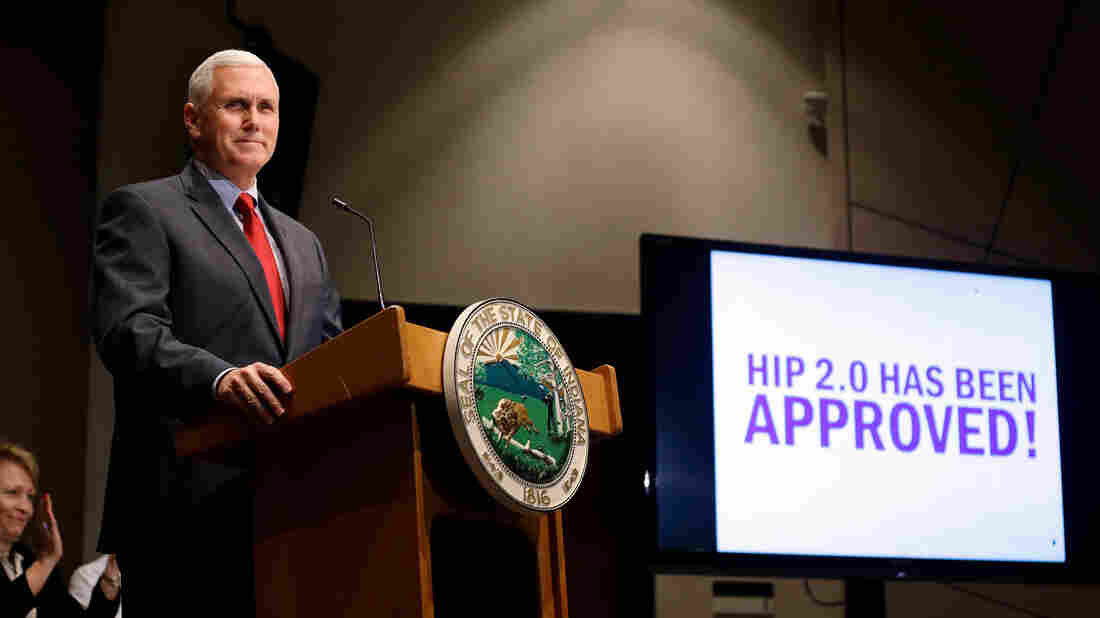
Indiana Gov. Mike Pence announces in 2015 that the federal Centers for Medicaid and Medicare Services has approved the state’s waiver request to expand Medicaid coverage. Michael Conroy/AP hide caption
toggle caption
Michael Conroy/AP
To get a glimpse of where Medicaid may be headed after Donald Trump moves into the White House, it may be wise to look to Indiana.
That’s where Seema Verma, Trump’s pick to run the Centers for Medicare and Medicaid Services, comes from. And that’s where she put her stamp on the state’s health care program for the poor.
Verma is a private consultant who was hired by Indiana Governor and Vice President-elect Mike Pence to design a Republican-friendly expansion of Medicaid under the Affordable Care Act. The state paid her almost $5 million over four years through 2017, according to the contracts.
She sees the federal Medicaid program as a bureaucratic nightmare that hamstrings states and encourages poor people to remain dependent.
“The Medicaid program has not kept pace with the modern health-care market,” she testified at a Congressional hearing in 2013. “Its rigid complex rules designed to protect enrollees have also created an intractable program that does not foster efficiency quality or personal responsibility.”
The plan she came up with for Indiana requires poor Medicaid recipients to make monthly payments for their insurance, or lose benefits.

Seema Verma, Trump’s pick to run the Centers for Medicare and Medicaid Services, advised Indiana and other states on expanding their Medicaid programs. Drew Angerer/Getty Images hide caption
toggle caption
Drew Angerer/Getty Images
“Seema was very committed to extending coverage to low-income families in Indiana,” says Cindy Mann, who was the CMS official who negotiated the deal with Verma on that state’s Medicaid expansion.
She says throughout the negotiations, Verma was “very committed to a particular ideology. That ideology is very much focused on personal responsibility.”
Verma did not respond to multiple requests to be interviewed for this story.
Pence was one of the few Republican governors who took the Obama Administration up on its offer to pay the lion’s share of the costs for states that expanded their Medicaid programs to people whose incomes reach 138 percent of the poverty level, or $16,243.
But rather than simply offer coverage to more people, the state sought a waiver to revamp their program. That’s the deal that Verma worked out with Mann.
Indiana’s program, which extended Medicaid to about 246,000 people who weren’t eligible before, is infused with Verma’s ideas of how to make poor people take responsibility for their health care.
It had a complex system of carrots and sticks.
Beneficiaries make monthly payments from $1 to about $27 into individual health savings accounts, and the state also contributes. That money can be used for doctor visits and prescriptions.
If beneficiaries get vaccines and other preventive care, they get a discount on their premiums the following year.
But they can also be penalized. People whose incomes are above the poverty line can be cut off for three months if they miss a payment. Those below the poverty line are knocked down to a plan with fewer benefits.
And if a patient unnecessarily goes to the emergency room, extra money comes out of the health savings account.
“There are many ways to try and effectuate personal responsibility,” Mann says. “Some states have moved forward with healthy behavior initiatives, for example. Some states have done some premiums and copays.” Indian’s plan requires everyone to contribute to a health savings account. “And so the responsibility was really translated into payment requirements, and with pretty strong consequences if somebody was unable to pay.”
She says Verma and Indiana wanted the penalties to be even harsher — a full year with no coverage for people who miss payments. But CMS rejected that idea.
So how does it work in practice? For Amber Thayer, a mom of three who lives in a Volunteers of America family shelter in Indianapolis, it’s been a bit of a nightmare.
Thayer’s a recovering addict who has been clean for six months with the help of the medication Suboxone. And she’s training to be a nursing assistant.
“It’s been quite quite the struggle, but we’ve gotten there and we’re doing great and we’re getting ready to get into our own home,” she says.
She pays $1 a month for her Medicaid insurance.
In October she got a bill for that one dollar from a different company than the one she had been dealing with. She assumed the state had switched her.
“It is only a dollar,” she says. “I could pay a dollar a month or I could pay $12 and that will cover me for the year. Unfortunately at that time I only had I believe it was like $2.38 on my card.”
So she called the company and used her bank card to pay the dollar.
But the company, or perhaps the state, lost track of her dollar, and her insurance was cut off. She had her bank statement and a receipt from the insurer that proved she paid. But she still spent six weeks, with multiple phone calls and visits to state health offices, trying to get her coverage restored.
All the while she scraped together enough money to buy Suboxone one dose at a time.
“I’m fearing, you know, the withdraws,” Thayer recalls.
But she was also afraid the loss of insurance would interfere with her ability to take her nursing assistant exam, which in turn would threaten the stipend she gets because she is in job training. “If I don’t get my stipend, we’re not going to have our money to help us move into our home.”
It’s these types of complications that have some advocates worried.
Adam Mueller, a lawyer for Indiana Legal Services, says he’s happy more of his clients have health insurance. But he says the state’s notion that people will feel more invested in their care if they pay $1 a month just doesn’t play out in the real world.
“They don’t feel like they have skin in the game,” Mueller says. “One guy told me that it feels like Indiana is trying to take his last $12.”
Joe Thompson, CEO of the Arkansas Center for Health Improvement, says it’s just hard to be poor.
“”The social stresses of low-income individuals probably make most aspects of managing through the day more difficult than if you have more affluence and have more resources available to deploy,” he says.
Thompson, who’s a former Arkansas surgeon general, helped develop a Medicaid program in his state that had many of the same features as Indiana, including premium payments and health savings accounts.
In the end, Arkansas decided it just wasn’t worth it.
“We had about a year and a half of experience there, and candidly the administrative cost and the operating aspects exceeded what the legislature subsequently perceived the benefit of that program was,” Thompson says. So the state scrapped the health savings accounts.
He says the ideas about personal responsibility are politically popular, but implementing them is too complex.
“We lose too many folks along the way, and we may be causing more challenges than we’re solving,” he says.
Arkansas still charges nominal premiums for some Medicaid recipients, but they pay them directly to insurers. The carrots and sticks and individual accounts are gone.
In Indiana, insurers also collect the premiums and administer the individual health savings accounts. James Gavin, a spokesman for the Family and Social Services Administration, says those costs are included in what the state pays the insurance companies, and so it’s not clear exactly how much Indiana is spending to administer the health savings accounts.
Verma has advised several states, including Iowa, Kentucky and Ohio, that are looking for Medicaid waivers from the federal government. Many of those waiver applications include cost features such as premiums or health savings accounts or incentives for healthy behavior.
“The cost sharing policy is not to burden the individual,” she told lawmakers at the 2013 hearing. “I think it’s to incentivize them and empower them to be part of the equation.”
When Verma testified in 2013, she urged lawmakers to make the process of getting Medicaid waivers easier.
If she’s confirmed as administrator of the Center for Medicare and Medicaid Services, it will be her and her staff who review waiver applications and determine if they should go forward.
A Dying Man's Wish To Donate His Organs Gets Complicated

Dave Adox, right, and his husband Danni Michaeli at their home in South Orange, N.J., in the fall of 2014. Adox was diagnosed with ALS at age 42 and became almost totally paralyzed within six months. He died last May. Courtesy of Evan Bachner hide caption
toggle caption
Courtesy of Evan Bachner
At 44 years old, Dave Adox was facing the end of his two-year battle with ALS, also known as Lou Gehrig’s disease. He needed a ventilator to breathe and couldn’t move any part of his body, except his eyes. Once he started to struggle with his eyes — his only way to communicate — Adox decided it was time to die.
He wanted to donate his organs, to give other people a chance for a longer life. To do this, he’d need to be in a hospital when he went off the ventilator.
“I was always interested in organ donation and had checked the box on my license,” Adox said last spring at his home in South Orange, N.J., through a machine that spoke for him. He laboriously spelled out these words, letter by letter, by focusing his eyes on a tablet. Adox had spent a career with words that now came slowly — he was a freelance reporter, including for public radio, then went on to work in advertising.
“When I got diagnosed with ALS at 42, and the disease paralyzed my entire body in six months, I definitely developed a greater appreciation of the value of the working human body,” he said.

Family members surround Adox on the day that he died last May. His wish to die in a hospital so that he could donate his organs turned out to be difficult to fulfill. Karen Shakerdge/WXXI hide caption
toggle caption
Karen Shakerdge/WXXI
Adox and his husband, Danni Michaeli, made a plan. They would go to University Hospital in Newark, where Adox often had been treated, and have his ventilator disconnected. The doctors there had reassured Adox he could ask to come off the ventilator anytime.
In May his family and friends flew in from around the country, and joined neighbors for a big celebration of Adox’s life. They spent one last weekend with him, planting a tree and painting a big, colorful mural in his honor. Some wore T-shirts printed with Adox’s motto, “Celebrate everything until further notice.”
But their plan suddenly changed when University Hospital’s attorneys intervened.
“At the 11th hour, they emailed us and said their lawyers had stopped the process because they were afraid it looked too much like assisted suicide,” Adox explained. “I was crushed.”
Every day, physicians withdraw life support on behalf of patients in hospitals who choose to refuse care. That’s generally not considered physician-assisted suicide or euthanasia — the key being that the patient is already in the hospital.
But Adox was asking to be admitted to the hospital specifically to end his life. And despite the planning, his request made some people uncomfortable.
Dr. John Bach, a professor of physical medicine rehabilitation and neurology at Rutgers New Jersey Medical School, which is affiliated with University Hospital, was Adox’s primary physician, and understood and approved of his patient’s plan to end his life and share his organs.
“I could have given [him] a prescription for morphine and he could have been taken off the ventilator at home,” Bach says. “But he wanted his organs to be used to save other people’s lives!”

Adox before he was diagnosed with ALS. He decided to become an organ donor so that other people could enjoy a longer life. Courtesy of Evan Bachner hide caption
toggle caption
Courtesy of Evan Bachner
Other physicians at the hospital supported Adox’s plan, too.
“We have an ethics committee that approved it 100 percent,” Bach says. “We have a palliative care committee — they all agreed, 100 percent. But it didn’t make any difference to the lawyers of our hospital.”
University Hospital has declined several requests for comment, but Bach says the hospital’s attorneys were concerned about liability.
“The legal issue is: What is euthanasia?” Bach explains. “Are you killing a patient by taking him off a respirator that’s keeping him alive?”
Adox had an advance directive that stated, “I do not want medical treatment that will keep me alive if I have an incurable and irreversible illness and the burdens of continued life with life-sustaining treatment become greater than the benefits I experience.”
Having an advance directive on file is especially important for ALS patients, Bach says, because they can eventually become “locked in,” unable to express their wishes.
“To be locked in means you cannot move anything at all — not a finger, not a millimeter,” Bach says. “You cannot move your eyes; you cannot move your tongue; you cannot move your facial muscles at all. You cannot even wink to say yes or no.”
In this particular case, the hospital wouldn’t have had to rely on the directive; Bach noted; Adox was still fully capable of expressing his wishes clearly. It deeply troubled the physician that his patient’s wishes could not be met.
“Myself and all the other doctors who took care of him in the hospital were almost as upset about it as he and his husband were,” Bach says.
Dr. Joshua Mezrich, a transplant surgeon at the University of Wisconsin Hospital, has had patients with ALS who, like Adox, wanted to donate organs. He believes hospitals need to create protocols for these situations — even though such cases are rare.
Mezrich acknowledges this could challenge a key principle for physicians: First, do no harm. But that mandate can and should be interpreted broadly, he believes.
“I think it’s fair to say that doing no harm doesn’t always mean making people live as long as possible — keeping them alive no matter what,” Mezrich says. “Sometimes, it means letting them have the death that they want, and it means letting them give this gift, if that’s what they want.”
Still, planning one’s death to allow for organ donation raises some thorny questions, says Arthur Caplan, director of the division of medical ethics at New York University and author of Replacement Parts: The Ethics of Procuring and Replacing Organs in Humans.

Adox and Michaeli with their son, Orion, in the winter of 2015. Courtesy of Christine Gatti hide caption
toggle caption
Courtesy of Christine Gatti
Typically a separate team of physicians or an organ procurement team discusses donation with family members after a patient dies, to avoid any tones — whether real or perceived — of coercion or conflict of interest, Caplan points out.
“You’d have to change the culture of critical care and say it’s OK to talk with the person about organ donation as part of their dying,” he explains.
This issue may get bigger, Caplan believes, as states move to legalize physician-assisted death. Although, so far, there has been little public discussion because “it’s too controversial.”
“If we went in the direction of bringing more people who are dying — whether it’s ALS or whatever it is — into settings where we could have them consider organ donation because they’re on the machines, we’d probably have a bigger pool of organ donors,” Caplan says.
But that approach would have a downside, too, he continues. People might perceive doctors as more focused on “getting organs” than caring for dying patients.

Adox takes one last walk with family and friends in New York’s Central Park before going to a hospital to be disconnected from the ventilator that kept him alive. Karen Shakerdge/WXXI hide caption
toggle caption
Karen Shakerdge/WXXI
There is at least one hospital that has established a policy for patients with ALS who want to be organ donors. Froedtert Hospital and its partner Medical College of Wisconsin, in Milwaukee, approved such a policy in May.
About a year ago there, a patient with ALS wanted to donate her organs, but the hospital wasn’t able to honor her wish. The experience prompted physicians to develop a multistep system that includes evaluation from psychologists, an ethics review and considers technical matters such as transportation or insurance coverage.
“Obviously we’re all sensitive to any perception of assisted expedition of death,” says Dr. William Rilling, vice chair of clinical operations of radiology at Froedtert Hospital. “But, at the end of the day, the patient’s wishes count for a lot.”
After University Hospital declined to admit Adox, he and his husband reached out to six other hospitals through various intermediaries. They waited for days to hear back.
In the end, LiveOnNY, the organ procurement organization based in New York City, stepped in to help. The organization’s medical director, Dr. Amy Friedman, went to visit Adox at his home to vet his suitability as a donor.
“There was a hospital partner,” Friedman says, “that felt very supportive of this circumstance, understood the challenges that they would be faced with, [and was] prepared to be supportive of what Dave wanted and would be able to provide a bed.”
Finally, on the palliative care floor at Mt. Sinai Hospital on May 18, Adox and Michaeli prepared to say their goodbyes.
“We sat; we listened to ’80s music. I read Dave a poem,” Michaeli recounts, close to tears. “And when they were really sure — and we were all really sure — that he was in a deep state of sedation they disconnected his breathing machine.”
And in the end, Adox’s wishes were met — he was able to donate his liver and kidneys. Michaeli says he felt “an incredible swelling of gratitude” to the hospital team who helped make that happen.
“The person we were trying to do a direct donation for was a match,” Michaeli says. “And he has Dave’s kidney right now.”
This story is part of a reporting partnership with NPR, Side Effects Public Media and Kaiser Health News.
White House Sharpens Its Case For Obamacare, As Republicans Sharpen Knives

Oklahoma State University President Burns Hargis gets his blood pressure checked in a mobile medical unit parked at the state Capitol. Sue Ogrocki/AP hide caption
toggle caption
Sue Ogrocki/AP
The Affordable Care Act is on the chopping block, likely to be one of the first casualties when President-elect Donald Trump takes office next month.
“We will repeal the disaster known as ‘Obamacare’ and create new health care — all sorts of reforms that work for you and your family,” Trump promised in Florida last week.
Before that happens, President Obama and his aides want to put a marker down on what they see as the law’s accomplishments over the last six years.
“When I came into office, 44 million people were uninsured,” Obama told reporters during his pre-Christmas news conference at the White House. “Today, we’ve covered more than 20 million of them. For the first time in our history, more than 90 percent of Americans are insured.”
So far, more than 6.4 million people have signed up for insurance coverage in 2017 through the federal exchange. Enrollments are on track to exceed last year’s total, with many coming from states like Florida, Texas, and North Carolina that were carried by Trump.
While expanded insurance coverage is the yardstick most often cited, defenders argue the Affordable Care Act has also helped limit rising health care costs and put more emphasis on the quality of care, not just how much is done.
“While multiple factors are likely playing a role, payment reforms introduced in the [Affordable Care Act] have made substantial, quantifiable contributions to slowing the growth of health care costs in both Medicare and private insurance,” White House economists wrote in a report this month.
The report cites estimates from the Congressional Budget Office that Obamacare has shaved 1.3 percentage points off the annual growth in per-person Medicare spending.
For people who get health coverage through their employer, the slowdown has been even sharper, the report says. The cost of family coverage has grown just over 3 percent per year since the Affordable Care Act was passed in 2010. That’s a 45 percent reduction from the pace of the previous six years. While many workplace insurance plans now include higher deductibles and co-pays, workers’ out-of-pocket costs are still growing more slowly than they were before Obamacare, White House economists say.
The law also encourages payment reforms that reward doctors and hospitals for high-quality care, not simply performing a lot of tests and procedures. More than 30 percent of Medicare payments are now based on these “alternative payment models,” along with about 10 percent of payments for workers covered by private insurance.
To be sure, the Affordable Care Act remains deeply controversial. Americans who dislike the law slightly outnumber those who approve of it. That’s partly a reflection of the law’s partisan history. It was passed without a single Republican vote.
Implementation has also been rocky — especially the disastrous debut of the government’s insurance exchange website in 2013. Nineteen states — most with Republican leadership — declined to take advantage of the Affordable Care Act’s Medicaid expansion.
What’s more, after losing money in past years, many insurance companies have stopped offering policies on the government-run exchanges. According to the Kaiser Family Foundation, about 20 percent of people shopping for coverage on the exchanges this year have just one insurance company to choose from. With less competition, premiums on the exchanges have risen sharply: about 25 percent on average.
Despite these drawbacks, supporters say the Affordable Care Act has been a net-plus, both for individual customers who can no longer be denied access to health insurance and for the federal government which has steadily reduced its forecast of long-term health-care costs.
At the same time, the law has not proven to be the drag on job growth that many Republicans warned of.
“Since I signed Obamacare into law, our businesses have added more than 15 million new jobs,” Obama noted.
The president can point to a number of other positive indicators as he prepares to leave office, including long-awaited wage gains in the last year and a modest decrease in income inequality, stemming, in part, from higher taxes on the wealthy.
The president and his team are trying to document those gains, mindful that the next occupant of the White House wants to reverse much of what Obama has put in place.
“What the president-elect is going to be doing is going to be very different than what I was doing, and I think people will be able to compare and contrast and make judgments about what worked for the American people,” Obama said during his year-end news conference. “I hope that, building off the progress we’ve made, that what the president-elect is proposing works. What I can say with confidence is that what we’ve done works.”
Wins And Losses In Global Health In 2016

From left: Emmanuel Kwame lost his sight to river blindness as a young man in Ghana; a bed net keeps mosquitoes away from a mother and child in a Somalian hospital; extracting a guinea worm from an infected person. Getty Images and NPR hide caption
toggle caption
Getty Images and NPR
“This year there’s been one big home run and a lot of scratch singles.” That’s how Red Sox fan and editor-in-chief of the New England Journal of Medicine, Dr. Jeffrey Drazen, sums up the year-that-was in public health.
Zika was the home run of 2016. It got lots of attention. It created a lot of drama. And it had a significant public health impact this year, says Drazen, who is a professor at the Harvard T.H. Chan School of Public Health. The Zika outbreak prompted travel warnings throughout the hemisphere and sparked frantic efforts to develop a vaccine.
And then there are the “scratch singles.” In baseball a “scratch single” is when a hitter barely hits the ball — “scratches” it — but still manages to get to first base. Drazen is talking about the non-glamorous work in public health that wins games over the long haul.
With ongoing efforts to combat mosquitoes and get people to sleep under bed nets, deaths from malaria continue to decline in Africa — down from more than 800,000 a year in 2000 to roughly 400,000 last year.
New HIV infections and fatalities have stabilized globally, although that still means that the virus spread to about 2 million more people in 2016 and killed another million. This flat-lining on HIV/AIDS is seen by some as a worrisome indication that progress against the epidemic has stalled. The more optimistic voices in the HIV world, however, point out that given the rapidly expanding population in Africa, where the bulk of new infections occur, the fact that numbers aren’t rising illustrates a heroic effort to keep this epidemic from getting far worse through prevention, education and HIV treatment programs.
Middle Eastern Respiratory Syndrome or MERS refuses to die but appears to be slouching toward extinction. MERS has primarily been a Saudi Arabia problem thus far. Since the virus was first discovered in 2012, 1482 of the 1841 cases reported to the World Health Organization have been in Saudi Arabia. One significant exception came in 2015, when a MERS outbreak in Korea caused panic in Seoul, temporarily shutting down schools, hospitals and factories. The outbreak in Korea was sparked by a businessman who’d recently returned from the Middle East. And although transmission of the virus continues at only a low level in Saudi Arabia, there’s no reason that a traveler couldn’t trigger another outbreak like the Korean one somewhere else in the world.
But in baseball terms, MERS in 2016 was the slugger at the bottom of the batting order, still getting up to the plate, still a threat but not causing much concern.
On the good news front, there have been lots of little advances — promising stars emerging from the ranks of the minor leagues. “There’s a new herpes vaccine for shingles that’s 90 percent effective,” Drazen says enthusiastically about a Glaxo Smith Kline vaccine that just wrapped up clinical trials. The GSK vaccine is far more effective than the roughly 50 percent offered by the only commercial shingles vaccine currently on the market.
“And guinea worm, we are almost close to eradicating that,” Drazen adds. Guinea worm is a nasty tropical parasite that’s spread by contaminated water. The worms pop out of people’s legs like long, burning strands of spaghetti. The Carter Center, which has been one of the lead agencies in the effort to stamp out guinea worm, says there were fewer than two dozen cases in the first 10 months of 2016.
Rob Henry, a senior public health adviser with USAID’s Neglected Tropical Disease (NTD) program, shares Drazen’s outlook: “I think 2016 was an excellent year,” he says.
“This year, for example, Guatemala was declared free of onchocerciasis — river blindness. That’s a big one.”
River blindness is a parasitic infection, spread by black flies, that causes excruciating itching and in severe cases blindness. The declaration that Guatemala is now free of the disease means that river blindness has been eliminated from everywhere in the Americas except one remote area in the Amazon along the border between Brazil and Venezuela.
River blindness is one of the seven neglected tropical diseases that USAID’s NTD program focuses on. Lymphatic filariasis is another. Also known as elephantiasis, it can cause horrific swelling of the legs and scrotum.
“Cambodia this year got acknowledgement from WHO as having eliminated lymphatic filariasis as a public health problem,” Henry says. “That’s a big moment for Cambodia.”
Henry says eliminating diseases like elephantiasis can’t compete in the headlines with the fight against fatal conditions. But he too is a big believer in the power of small hits: “It’s one thing to say you’re out there saving lives but it’s another thing to talk about how do you improve lives. How do you improve things to enable people to be able to make a living for themselves, for kids to be able to go to school, for people to be able to take care of their farms.”
Mass de-worming programs supported by USAID can break the transmission cycle of the parasite that causes lymphatic filariasis. And Henry notes that significant progress is being made against this disease not just in Cambodia but across the tropics.
“In Africa, Togo is just about ready to be able to declare the elimination of lymphatic filariasis,” he says. In the year 2000 in some parts of Togo up to 22 percent of residents were infected with the parasites that cause the debilitating swelling.
The other disease eradication effort that is tantalizingly close to victory but can never quite hit it out of the park is the campaign to end polio. And 2016 was a complicated year for the virus. On the one hand only 34 cases had been detected in 2016 as of this week. Unfortunately four of them were in Nigeria, which had previously been declared “polio-free” along with the rest of the African continent.
The new cases in Africa were found in areas recently liberated from Boko Haram. The insurgents barred health workers, destroyed health clinics and made routine immunization campaigns impossible.
Jeff Drazen says polio eradication is no longer a medical problem.
“We have the medical capacity to do this but it’s become a political problem,” he says. “It’s not as much a medical challenge as it is a political challenge.”
Or as the great baseball player Yogi Berra once said, “It ain’t over ’til it’s over.”
Montana May Be Model For Future Medicaid Work Requirement

Ruth McCafferty, who works in Kalispell, Mont., credits the training she got through the state’s Medicaid expansion with helping her get a good job. Eric Whitney / MTPR hide caption
toggle caption
Eric Whitney / MTPR
Montana State Senator Ed Buttrey is a no-nonsense businessman from the central part of the state. Like a lot of Republicans, he’s not a fan of the Affordable Care Act and its expansion of Medicaid, health insurance for the poor and disabled.
“We didn’t want to implement a plan that was another entitlement that just had a bunch of people signing up to get free or cheap or subsidized health care,” says Buttrey, who represents Great Falls. “We wanted a plan that said, ‘We’re going to get you on. We’re going to get you healthy. We’re going to identify your barriers to employment or better employment, and then we’re going to move you off the plan.’ “
So Buttrey wrote a Medicaid expansion bill for Montana that linked health coverage to job training. He wanted everyone getting benefits to have to meet with a labor specialist who would help them figure out how to get a job or to get a job that paid better.
The goal is to “make them healthier, get them off social programs, get them off dependence on government, get them into higher wage jobs that have a future that possibly pay benefits, that’s a great benefit for the state,” he says.
But so far, federal officials said states can’t make participation in a work program mandatory for Medicaid recipients. Montana, instead, had to make its job training component voluntary.
Republican leaders across the country have long angled for more state control over Medicaid. The funding comes from both states and the federal government, with the Department of Health and Human Services scrutinizing states’ use of the money.
In Montana and many other states, most Medicaid funding comes from the federal government. President-elect Trump’s administration may let states have more leeway – in fact, Seema Verma, Trump’s pick to run the part of HHS that oversees Medicaid, advocated for more state control when she helped expand Medicaid in Indiana.
A new administration could open the door for more Medicaid experiments, like the one Buttrey has been pushing for.
The feds’ rejection of mandatory job training meant Buttrey was barely able to win enough votes in Montana’s Republican majority legislature to pass Medicaid expansion last April.
How is the Medicaid expansion working in Montana?
“I think it’s a success story. I love this.” says Ruth McCafferty. “I’m the poster child.” She is a 53-year-old single mom from Kalispell, with three kids at home. She lost her job with a lending company last spring, and she had no idea there was job training available when she signed up for Medicaid.
She was just focused on finding a way to afford the drugs she needs to control her diabetes and asthma. “One inhaler that I do is $647,” she says, bringing her medication costs to about $1,000 a month.
After McCafferty got Medicaid, she filled her prescriptions and got free online training to become a mortgage broker. The state even paid for her 400-mile round-trip to Helena to take the broker certification exam. Now the state is paying part of her salary as an apprentice at a local business to make it easier to hire her.
“It’s awesome!” she says.
Of the 53,000 Montanans who’ve signed up for expanded Medicaid, only about 3,000 have signed up for help getting a job. That’s in part because the federal government won’t allow states to use Medicaid money for it. To set it up here, Buttrey had to cobble together funding from other jobs programs and squeeze $1 million out of a reluctant state legislature.
Giving states the flexibility to tie their Medicaid programs to work requirements is an idea that’s likely to be popular with the new Congress and Trump administration.
But health policy researcher Joan Alker, who runs the Center for Children and Families at Georgetown University, warns that it could backfire. “I think it’s great and well worth doing — to link people who might not be aware of existing job training programs or other kinds of work supports that can help them work. What I think is problematic is when this becomes a stick and not a support,” she says.
Alker says many people on Medicaid already have jobs, often low-paying ones that don’t offer health insurance. These people often have little time for new training. In Montana, about two-thirds of people on Medicaid are employed. Alker says if people fail to meet a work requirement and then lose health benefits as a result, they’ll likely just get sicker and become less able to work.
This story is part of a reporting partnership with NPR, Montana Public Radio and Kaiser Health News. You can follow Eric Whitney on Twitter: @EricReporter.
If Republicans Repeal Health Law, Paying For A Replacement Could Be Tough

House Speaker Paul Ryan signed legislation to repeal the Affordable Care Act on Jan. 7, 2016. President Obama vetoed the bill, but the new administration could open the door for change. Chip Somodevilla/Getty Images hide caption
toggle caption
Chip Somodevilla/Getty Images
Leading Republicans in Congress have vowed that even if they repeal most of the Affordable Care Act early in 2017, a replacement won’t hurt those now receiving benefits.
Republicans will seek to ensure that “no one is worse off,” said House Speaker Paul Ryan, R-Wis., in an interview with a Wisconsin newspaper in early December. “The purpose here is to bring relief to people who are suffering from Obamacare so that they can get something better.”
But that may be difficult for one big reason: Republicans have also pledged to repeal the taxes that Democrats used to pay for their health law. Without that money, Republicans will have far less to spend on whatever they opt for as a replacement.
“It will be hard to have comparable coverage if they start with less money,” Gail Wilensky, a health economist who ran the Medicare and Medicaid programs under President George H.W. Bush, said in an interview.
“Repealing all the ACA’s taxes as part of repeal and delay only makes a true replacement harder,” wrote Loren Adler and Paul Ginsburg of the Brookings Institution in a white paper out Monday. It “would make it much more difficult to achieve a sustainable replacement plan that provides meaningful coverage without increasing deficits.”
The health law’s subsidies to individuals buying insurance and the Medicaid expansion are funded by two big pots of money.
The first is a series of taxes, including levies on individuals with incomes greater than $200,000, health insurers, makers of medical devices, brand-name drugmakers, people who use tanning salons, and employer plans that are so generous they trigger the much-maligned “Cadillac Tax.” Some of those measures have not yet taken effect.
However, the Congressional Budget Office estimated in early 2016 that repealing those provisions would reduce taxes by an estimated $1 trillion over the decade from 2016-2025.
The other big pot of money that funds the benefits in the health law comes from reductions in federal spending for Medicare (and to a lesser extent, Medicaid). Those include trims in the scheduled payments to hospitals, insurance companies and other health care providers, as well as increased premiums for higher-income Medicare beneficiaries.
CBO estimated in 2015 that cancelling the cuts would boost federal spending by $879 billion from 2016 to 2025.
The GOP, in the partial repeal bill that passed in January and was vetoed by President Obama, proposed to cancel the tax increases in the health law, as well as the health premium subsidies and Medicaid expansion. But it would have kept the Medicare and Medicaid payment reductions. Because the benefits that would be repealed cost more than the revenue being lost through the repeal of the taxes, the result would have been net savings to the federal government — to the tune of about $317.5 billion over 10 years, said CBO.
But those savings — even if Republicans could find a way to apply them to a new bill — wouldn’t be enough to fund the broad expansion of coverage offered under the ACA.
If Republicans follow that playbook again, their plans for replacement could be hampered because they will still lose access to tax revenues. That means they cannot fund equivalent benefits unless they find some other source of revenue.
Some analysts fear the money may come from more cuts to Medicare and Medicaid. “Medicare and Medicaid face fundamental threats, perhaps the most since they were established in the 1960s,” said Edwin Park of the liberal Center on Budget and Policy Priorities, in a recent webinar.
Republicans in the House, however, have identified one other potential source of funding. “Our plan caps the open-ended tax break on employer-based premiums,” said their proposal, called “A Better Way.”
House Republicans say that would be preferable to the Cadillac Tax in the ACA, which is scheduled to go into effect in 2020 and taxes only the most generous plans.
But health policy analysts say ending the employer tax break could be even more controversial.
Capping the amount of health benefits that workers can accept free of taxes “would reduce incentives for employers to continue to offer coverage,” said Georgetown University’s Sabrina Corlette.
James Klein, president of the American Benefits Council, which represents large employers, said they would look on such a proposal as potentially more damaging to the future of employer-provided insurance than the so-called Cadillac Tax, which his group has lobbied hard against.
“This is not a time one wants to disrupt the employer marketplace,” said Klein in an interview. “It seems perplexing to think that if the ACA is going to be repealed, either in large part or altogether, it would be succeeded by a proposal imposing a tax on people who get health coverage from their employer.”
Wilensky said that as an economist, getting rid of the tax exclusion for employer-provided health insurance would put her “and all the other economists in seventh heaven.” Economists have argued for years that having the tax code favor benefits over cash wages encourages overly generous insurance and overuse of health services.
But at the same time, she added, “I am painfully aware of how unpopular my most favored change would be.”
Republicans will have one other option if and when they try to replace the ACA’s benefits — not paying for them at all, thus adding to the federal deficit.
While that sounds unlikely for a party dedicated to fiscal responsibility, it wouldn’t be unprecedented. In 2003 the huge Medicare prescription drug law was passed by a Republican Congress — with no specified funding to pay for the benefits.
The Murky World of Secondhand Diabetic Test Strips

Screenshot/Courtesy Christa Kral
Chelsea Arnold was getting into debt over tiny pieces of plastic: diabetic test strips. When Arnold was first diagnosed with diabetes she needed to test her blood sugar 10 times a day. She went to Wal-Mart and found that one box, which contained only a five-day supply of test strips, was $80. Arnold called her parents and told them she didn’t know what to do. She didn’t have the money.
Arnold then did what a lot of people do when they need help: She searched on Google. She typed in the words “cheap test strips,” and Craigslist came up. She bought eight boxes for less than $100. At Wal-Mart, she would have paid $640. Arnold said, “it was like having a life sentence and then realizing that there’s a cure.”
With this Google search, Arnold stumbled into an underground economy for diabetic supplies. It’s a market that offers a lower-cost option for test strips, though it is hard for customers to know where the boxes come from. Some boxes may be repackaged and unsafe to use, and some boxes are sold by diabetics who are desperate for cash. But many of them come from people who have health insurance and have accumulated extra test strips.
Trey falls into this category. (He asked us not to use his last name, because he fears retribution from his insurance company, even though he feels he hasn’t broken any laws.) He moved from one type of blood sugar monitoring system to another type of monitoring system and ended up with 20 extra test strip boxes.
At that point, Trey began researching. He said, “Obviously No. 1: Is it legal to be able to sell test strips?” Trey realized that it is legal, with a caveat. “It’s kind of a gray market as long as you don’t get them from Medicare and Medicaid,” he said. Trey then found a local buyer on Craigslist.
It starts to look a little seedy here. He put the 20 boxes in a brown paper lunch bag. “When I went to sell the test strips we met in a McDonald’s parking lot,” Trey said. “I came out with the bag full of test strips, and he had his wallet full of money and it was like we were doing a geriatric drug deal in the McDonald’s parking lot to get rid of some test trips.”
Trey made $300 off the geriatric drug deal. He jokingly calls the cash he made “blood money.” He used his “blood money” to buy Christmas presents for his kids.
As far as we can tell, his test strips went on to the next stop: a gray market middleman, something like a wholesaler, someone like Christa Kral. Along with her cousin, Kral purchases diabetic test strips from people like Trey. Their website is called sellusdiabeticteststrips.com.
To advertise, Kral used to post fliers near the train station in her town. Now her ads are online. She thinks the company’s unusual tagline has also brought in customers: “Two moms will buy your test strips.”
Kral operates her business out of her dining room. She has a cardboard box with about 20 boxes of test strips inside. She might pay $50 a box. It depends on the brand, the condition of the box, and the expiration date for the test strips.
Then she sells them at a markup to the next part of this chain: retailers. Arnold, the woman who bought test strips off Craigslist because they were too expensive at Wal-Mart, is now a retailer. That time when she couldn’t afford her test strips and keep her blood sugar in check — it scared her, and it made her decide to change her career path.
Arnold had been planning to go to medical school. But “that’s what really made me think I shouldn’t be a doctor and that I should go and help people try to afford the test strips,” she said.
Arnold started a website, glucomart.com. It’s a place where people can buy affordable test strips. She turned her garage into a kind of pharmacy. Her floor is epoxied, and she has pharmacy shelves.
Arnold realizes that if manufacturers or insurance companies lowered the price of test strips, she could be put out of business. She’s actually OK with that, because, she said, “the business exists to help people afford the test strips they need.”
Arnold would be happy to go back to her original plan and trade in her pharmacy shelves for a doctor’s coat.
Medicare Penalizes Hospitals In Crackdown On Antibiotic-Resistant Infections

Ronald Reagan UCLA Medical Center in Los Angeles has been penalized in all three years since the creation of a Medicare program to reduce patient-safety issues in hospitals. FG/Bauer-Griffin/GC Images/Getty Images hide caption
toggle caption
FG/Bauer-Griffin/GC Images/Getty Images
The federal government has cut payments to 769 hospitals with high rates of patient injuries, for the first time counting the spread of antibiotic-resistant germs in assessing penalties.
The punishments come in the third year of Medicare penalties for hospitals with patients most frequently suffering from potentially avoidable complications, including various types of infections, blood clots, bed sores and falls. This year the government also examined the prevalence of two types of bacteria resistant to drugs.
Based on rates of all these complications, the hospitals identified by federal officials this week will lose 1 percent of all Medicare payments for a year — with that time frame beginning this past October. While the government did not release the dollar amount of the penalties, it will exceed a million dollars for many larger hospitals. In total, hospitals will lose about $430 million, 18 percent more than they lost last year, according to an estimate from the Association of American Medical Colleges.
The reductions apply not only to patient stays but also will reduce the amount of money hospitals get to teach medical residents and care for low-income people.
Forty percent of the hospitals penalized this year escaped punishment in the first two years of the program, a Kaiser Health News analysis shows. Those 306 hospitals include the University of Miami Hospital in Florida, Cambridge Health Alliance in Massachusetts, the University of Michigan Health System in Ann Arbor and Mount Sinai Hospital in New York City.
Nationally, hospital-acquired conditions declined by 21 percent between 2010 and 2015, according to the federal Agency for Healthcare Research and Quality, or AHRQ. The biggest reductions were for bad reactions to medicines, catheter infections and post-surgical blood clots.
Still, hospital harm remains a threat. AHRQ estimates there were 3.8 million hospital injuries last year, which translates to 115 injuries during every 1,000 patient hospital stays during that period.
Get the data
Looking for more on your hospital or state?
? Full List: 769 Hospitals Penalized For Patient Safety In 2017: Data Table
Source: Kaiser Health News
Each year, at least 2 million people become infected with bacteria that are resistant to antibiotics, including nearly a quarter-million cases in hospitals. The Centers for Disease Control and Prevention estimates 23,000 people die from them.
Between 20 and 50 percent of all antibiotics prescribed in hospitals are either not needed or inappropriate, studies have found. The proliferation of antibiotic use — inside hospitals, among outpatients and in farm animals sold for food — has hastened the spread of stubborn bacterial strains that can be risky for patients.
One resistant bacterium that Medicare included into its formula for determining financial penalties for hospitals is methicillin-resistant Staphylococcus aureus, or MRSA, which can cause pneumonia and bloodstream and skin infections. MRSA is prevalent outside of hospitals and sometimes people with it show no signs of disease. But these people can bring the germ into a hospital, where it can be spread by health care providers and be especially dangerous for older or sick patients whose immune system cannot fight the infection.
Hospitals have had some success in reducing MRSA infections, which dropped by 13 percent between 2011 and 2014, according to the CDC. AHRQ estimates there were 6,300 cases in hospitals last year.
The second bacterium measured for the penalties is Clostridium difficile, known as C. diff, a germ that can multiply in the gut and colon when patients take some antibiotics to kill off other germs. It can also spread through contaminated surfaces or hands.
While it can be treated by antibiotics, C. diff can also become so serious that some patients need to have part of their intestines surgically removed. C. diff can cause diarrhea and can be deadly for the elderly and other vulnerable patients.









Infections with Clostridium difficile, a bacterium that is hard to treat with antibiotics, can trigger Medicare penalties for hospitals. Scimat/Science Source hide caption
toggle caption
C. diff has challenged infection control efforts. While hospital infections dropped 8 percent from 2008 to 2014, there was a “significant increase” in C. diff that final year, the CDC says. AHRQ estimated there were 100,000 hospital cases last year.
“The reality is we don’t know how to prevent all these infections,” said Dr. Louise Dembry, a professor at the Yale School of Medicine and president of the Society for Healthcare Epidemiology of America.
The Hospital-Acquired Condition Reduction Program also factors in rates of infections from hysterectomies, colon surgeries, urinary tract catheters and central line tubes. Those infections carry the most weight in determining penalties, but the formula also takes into account the frequency of bed sores, hip fractures, blood clots and four other complications.
Specialized hospitals, such as those that treat psychiatric patients, veterans and children, are exempted from the penalties, as are hospitals with the “critical access” designation for being the only provider in an area. Of the remaining hospitals, the Affordable Care Act requires that Medicare penalize the 25 percent that perform the worst on these measures, even if they have reduced infection rates from previous years.
That inflexible quota is one objection the hospital industry has with the penalties. In addition, many hospitals complain that they are penalized because of their vigilance in detecting infections, even ones that do not cause any symptoms in patients. Academic medical centers in particular have been frequently punished.
“The HAC penalty payment program is regarded as rather arbitrary, so other than people getting upset when they incur a penalty, it is not in and of itself changing behavior,” said Nancy Foster, vice president for quality and patient safety at the American Hospital Association.
Federal records show that 347 hospitals penalized last year will not have payments reduced because their performance was better than others. Those include Harbor-UCLA Medical Center in Los Angeles, the Johns Hopkins Hospital in Baltimore and the University of Tennessee Medical Center in Knoxville.
Over the lifetime of the penalty program, 241 hospitals have been punished in all three years, including the Cleveland Clinic; Intermountain Medical Center in Murray, Utah; Ronald Reagan UCLA Medical Center in Los Angeles; Grady Memorial Hospital in Atlanta; Northwestern Memorial Hospital in Chicago; and Brigham & Women’s Hospital in Boston.
The penalties come as the Centers for Medicare & Medicaid Services also launches new requirements for hospitals to ensure that the use of antibiotics is limited to cases where they are necessary and be circumspect in determining which of the drugs are most likely to work for a given infection. Hospitals will have to establish these antibiotic stewardship programs as a condition of receiving Medicare funding under a regulation the government drafted last summer.
Lisa McGiffert, who directs Consumers Union’s Safe Patient Project, said that as a result of Medicare’s penalties and other efforts, “more hospitals are thinking more about appropriate use of antibiotics.” However, she said, “I think most hospitals do not have effective antibiotic stewardship programs yet.”
Kaiser Health News is an editorially independent news service supported by the nonpartisan Kaiser Family Foundation. You can follow Jordan Rau on Twitter: @jordanrau.
Medicare Pays For A Kidney Transplant, But Not The Drugs To Keep It Viable


Cyclosporine is one of the drugs that organ transplant patients take so the body won’t reject the organ. Brendan Gates/Flickr hide caption
toggle caption
The federal government will pay more than $100,000 to give someone a kidney transplant, but after three years, the government will often stop paying for the drugs needed to keep that transplanted kidney alive.
Constance Creasey is one of the thousands of people who find themselves caught up by this peculiar feature of the federal kidney program.
Creasey started kidney dialysis about 12 years ago after her kidneys failed. That meant going to a dialysis center three times a week, for three hours per session. (A typical patient undergoes 3 to 5 hours of dialysis per session).
“The first three years of dialysis was hard. I walked around with this dark cloud. I didn’t want to live, I really didn’t,” she says.
Being dependent on these blood-cleansing machines was physically and emotionally draining. But she stuck it out for 11 years. Medicare pays for dialysis, even for people under the age of 65. It also pays for kidney transplants for people with end-stage renal disease.
“Finally, a year and a half ago, transplant came. I was a little apprehensive but I said OK. And I call her Sleeping Beauty, that’s my kidney’s name.”
Creasey, a 60-year-old resident of Washington D.C., no longer needs to spend her days at a dialysis center. She has enough energy for a part-time job at a home furnishing store and time to enjoy life’s simple pleasures.
“I was able to do my favorite thing — go to the pool — and I was just loving it because it’s like I had no restrictions now,” she says.
But there is still a dark cloud on Creasey’s horizon. Medicare’s kidney program currently pays for a large share of the expensive drugs she needs to take twice a day to prevent her body from rejecting the transplanted kidney. But under federal rules, that coverage will disappear three years after the date of her transplant.
“I have a year and a half to prepare, or save,” she says. “How am I going to do this?”
She’s already paying copays, premiums and past medical bills. She says she sleeps on the floor because she considers buying a bed a luxury she can’t afford.
She has no idea what kind of insurance she’ll be able to get after her Medicare coverage runs out. And she was shocked to discover how big the bills could be. One day she went into the pharmacy to pick up her drugs, and the Medicare payment hadn’t been applied.
The pharmacist told her she’d need to pay a $600 copay for the one-month supply. “And I’m like are you kidding me? Six hundred? What am I going to do? I can’t pay that!”
A social worker at MedStar Georgetown University Hospital in Washington D.C., where Creasey got her transplant, sorted that out. But it’s not a permanent solution.
The three-year cutoff for Medicare payments is a common problem, says Dr. Matthew Cooper, who runs the kidney transplant program at the hospital. That’s especially so since many people with serious kidney disease have low incomes in the first place.
“It’s probably about 30 percent of people who find themselves in a troublesome spot at this 36-month mark,” he says.
Some people end up trying to stretch out their drug supplies by not taking them as often as they need to, he says. “We see that a lot.”
But this isn’t like skipping a pain pill and bearing the consequences. People lose their transplanted kidneys through organ rejection if they don’t take their medicine religiously.
Rita Alloway, a clinical pharmacist at the University of Cincinnati, says she also encounters this false economy. “If we were telling them to take four pills days twice a day, they may start taking three pills twice a day without telling us, to extend their coverage that they had for the prescriptions they had,” she says.
If people tell her that they can’t afford it, she can help them get the medications for free, Alloway says. But sometimes people are too proud to admit their financial distress, she said.
And instead of spending $15,000 a year on these anti-rejection drugs, people go back onto dialysis, which costs $90,000 a year or more. And that’s taxpayer’s money, provided with no time limit.
Kevin Longino, CEO of the National Kidney Foundation, says it’s not just affecting the people who have transplants, but those who are on the long list waiting their turn for an organ to become available.
“The tragedy is you have so many people on the wait list already, and to have someone unnecessarily have rejection because they can’t afford the drugs and to have to go back into the system — it’s just a difficult thing to explain, why we’re allowing that to happen.”
Longino says insurance companies are making the problem even worse. Some have reclassified anti-rejection drugs as “specialty drugs,” and they now require patients to pay for a percentage of the cost, rather than a more traditional fixed copayment.
Longino encountered that himself after he had a kidney transplant about a dozen years ago. He says his costs went from $150 a month to $950 a month when his insurance company made that cost-sharing shift. Longino had to find a new job with better insurance.
He, Alloway and Cooper have been trying to persuade Congress to pass a bill to fix this problem. Rep. Michael Burgess, R-Texas, and Rep. Ron Kind, D-Wisc., have introduced bills more than once, but they have not moved through Congress. Burgess’ office says they plan to try again next year.
Lawmakers are concerned about the costs. Severe kidney disease already costs Medicare a staggering $30 billion a year, and there’s no official cost-benefit analysis showing whether covering transplant drugs for everybody would save money overall.
“The Medicare [savings] in maintaining this drug coverage is better than putting people on dialysis,” Cooper says. “To me this is a no brainer. I just cannot understand why we haven’t got to the point where we say Medicare coverage for life for immunosuppressive drugs because people will benefit and money will be saved.”
For Constance Creasey, this is not an abstract conversation.
“Those pills are my life right now,” she says. “I’m trying not to worry, but it’s hard.”