A Med Student Decides To Be Upfront About Her Mental Issues

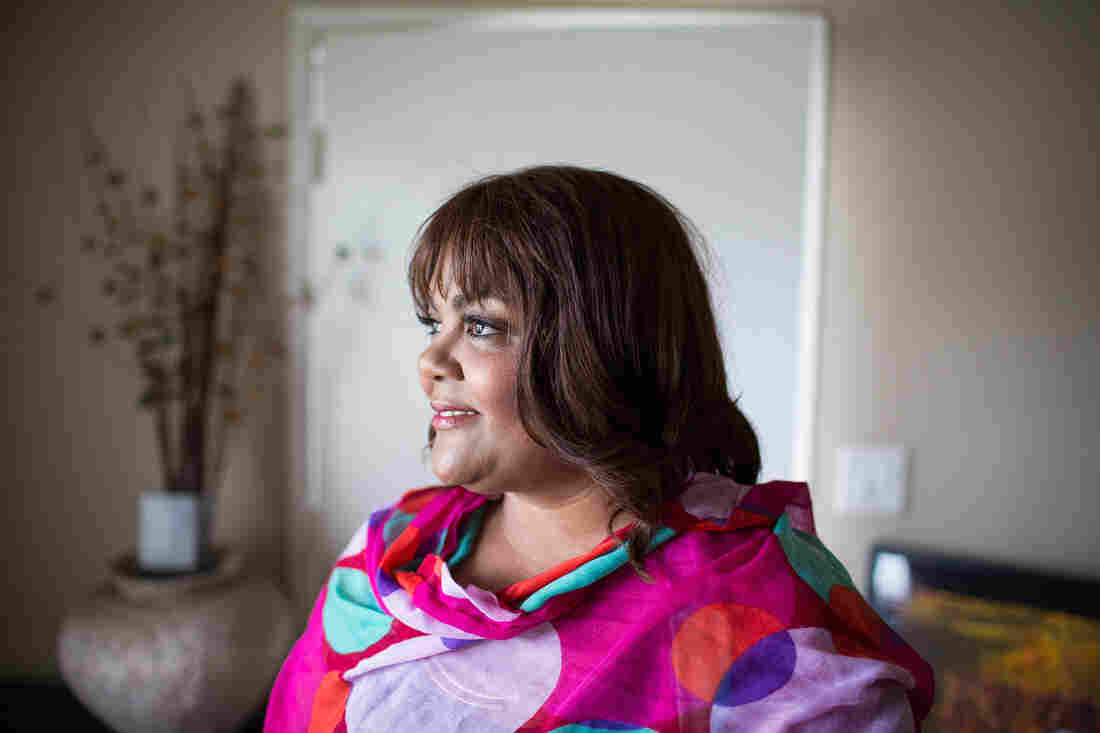
Giselle is pursuing a career in family medicine at the University of Wisconsin School of Medicine and Public Health. For her, hiding her problems with anxiety and depression was not an option.

Giselle is pursuing a career in family medicine at the University of Wisconsin School of Medicine and Public Health. For her, hiding her problems with anxiety and depression was not an option. Amanda Aronczyk/WNYC hide caption

toggle caption Amanda Aronczyk/WNYC

[embedded content]

At first Giselle wasn’t sure what to put on her medical school application. She wanted to be a doctor, but she also wanted people to know about her own health: years of depression, anxiety and a suicide attempt. (We’re using only her first name in this story, out of concern for her future career.)

“A lot of people were like, you don’t say that at all,” she said. “Do not mention that you have any kind of weakness.”

Giselle remembers having her first intense suicidal thoughts when she was 10 years old. Her parents had split up and she had moved from the coast of Colombia to Chicago. She started having extreme mood swings and fighting with her mom.

And then, when she was 16 years old, she tried to kill herself. “Yeah, lots of pills.”

After her suicide attempt she began therapy and eventually started taking antidepressants. That worked extremely well. After finishing high school, she took an unconventional route. She went to Brazil to work with a women’s community health group, worked as a research assistant for a doctor, and trained as a doula to assist women in labor. It was while working as a doula and witnessing what she saw as insensitive behavior from a doctor that she resolved her own career indecision: She would become a different kind of doctor.

When she applied to medical school, she told them this whole story in her application. In the fall of 2014, she started at the University of Wisconsin School of Medicine and Public Health.

Giselle picked Wisconsin in part because it offered unlimited free counseling for medical students. And her mentor, Dr. Christopher Hildebrand, says she has always been transparent about her struggles.

“She allowed me into her life right away,” he says.

But medical school hasn’t been easy for Giselle. She felt overwhelmed and failed an exam in her first few weeks. In her second semester she had a panic attack during a test. The school let her retake the tests, and she did well.

But then Giselle was called to committee, kind of a jury of medical school staff who intervene when a student is struggling with their work. She said there was a box of tissues and a room full of people in a semicircle.

The head of the committee asked Giselle if she could handle her issues and if she was cut out for the stressful life of a doctor.

“I walked away from that and I was just so furious, like I felt so hurt,” she says. Ultimately, the committee was pleased with her improvement on the test scores, and she was not put on academic probation. The school agreed to allow Giselle to do her second-year coursework over two years.

A posting on a bulletin board outside the counseling offices at the University of Wisconsin invites people to participate in a study on depression and insomnia.

A posting on a bulletin board outside the counseling offices at the University of Wisconsin invites people to participate in a study on depression and insomnia. Amanda Aronczyk/WNYC hide caption

toggle caption Amanda Aronczyk/WNYC

Medical schools struggle with finding the balance when it comes to mental health. Anxiety and stress are common. So when is it a health problem? But Giselle’s mentor Hildebrand says she never uses her mental health as an excuse. In fact, he says, going through what she has struggled with could make her a better doctor in the long run.

“We need Giselles in medicine,” he says. “We need people who are unafraid to have the insight to talk about not only their own struggles in life, but how that relates to others.”

Medical training often involves numerous risk factors for mental illness, including lack of sleep, isolation and a lack of a support system. Physicians are at more risk for suicide than the general population. But despite this, mental health among medical students, interns and physicians often doesn’t get the attention it deserves.

The University of Wisconsin medical school is trying to help students like Giselle with therapists and tutors. And Giselle uses those services. She is also adamant about being open about her mental health issues. One time she posted about it on Facebook:

“Dealing with academic administration is an awful part of med school. It’s a medieval-like process of judgment and punishment to ask for help or find yourself struggling with all the exams,” she wrote.

The school questioned whether her post was a good idea, Giselle says, but she thinks it helped other students open up about their own struggles.

“And I kind of just stumbled upon this role of being like, the person that speaks on behalf of the anxious and depressed.”

WNYC and NPR recently asked listeners: Have you ever had a hard time talking openly about your mental health? We’ll be posting some of these responses on Facebook throughout the series.

[embedded content]

For more on WNYC’s Only Human podcast series on mental health, check here. You can stay in touch with @OnlyHuman on Twitter and @Only Human on Facebook.

Let’s block ads! (Why?)

Details On Death Certificates Offer Layers Of Clues To Opioid Epidemic

A death certificate needs to say more than something vague like "opioid intoxication" to help law enforcement and public health officials curb the distribution of opioids, epidemiologists say. How many drugs did the person take, and which ones? Such details can help families heal, too.

A death certificate needs to say more than something vague like “opioid intoxication” to help law enforcement and public health officials curb the distribution of opioids, epidemiologists say. How many drugs did the person take, and which ones? Such details can help families heal, too. Alan Crawford/Getty Images hide caption

toggle caption Alan Crawford/Getty Images

Dr. James Gill walked through the morgue in Farmington, Conn., recently, past the dock where the bodies come in, past the tissue donations area, and stopped outside the autopsy room.

“We kind of have a typical board listing all of the decedents for the day,” Gill said, pointing to the list of names on a dry erase board. “Overdose, overdose, overdose, overdose overdose. That’s just for today.”

Gill is the chief medical examiner for the state of Connecticut, and of the nine bodies in his custody that day, four were the remains of the people who likely died from an accidental drug overdose. A fifth was a probable suicide involving drugs. It was a sad, but typical day, he explained, with a practical consequence for the state’s morgue: Gill is running out of room to store bodies.

“We’ve had to buy some extra racks and things so we can store more,” he told me. “But we really probably need more cooler space. We’re kind of outgrowing the storage space here.”

In the last two years, Gill’s office has seen a more than a 50 percent increase in autopsies. That’s mostly because of the spike in accidental drug overdoses, he said. Heroin is the big player. Fentanyl deaths have surged, too.

I sat with Gill in what’s called the so-called family room just off the lobby of the examiner’s office. In explaining why good data on exactly which drugs killed exactly which people is important, Gill recalled a conversation he once had with a mother whose daughter had died of a drug overdose the previous year. The mother called Gill to learn more.

“Can you tell me, did she suffer?” the woman wanted to know. “Was she in pain?”

“And I explained to her,” Gill said, “that, with an opioid death, the person just gradually goes to sleep and it’s very painless.

Dr. James Gill, Connecticut's chief medical examiner, says the opioid crisis has made accidental drug overdose a much more common cause of death in his state. His office is even running out of room to store bodies, he says.

Dr. James Gill, Connecticut’s chief medical examiner, says the opioid crisis has made accidental drug overdose a much more common cause of death in his state. His office is even running out of room to store bodies, he says. Jeff Cohen/WNPR hide caption

toggle caption Jeff Cohen/WNPR

“And she started crying,” Gill told me, fighting tears of his own. “And it gave her some comfort.”

There’s another reason to get solid data — so you can craft a public health response to the epidemic. Specificity about a death today could help save a life tomorrow, he says. A death certificate needs to say more than something vague like “opioid intoxication” to help both law enforcement and public health officials curb the distribution — and hopefully abuse of — opioids.

“Well, what are those opioids? Are they heroin or are they Oxycontin?’ ” he asked rhetorically. The precise answer can make a difference in figuring out what actions to take

But not all death certificates have as much information as they could. When Gill took the job just a few years ago, only 63 percent of Connecticut’s drug deaths had specific drugs listed on the death certificate. Today 99 percent do.

“I found that the doctors here, a lot of them were certifying the deaths as acute or multi-drug intoxication,” Gill told me. “And I said, ‘No, we need to spell out what the drugs are that are causing the death.’ So, it would be ‘acute intoxication due to the combined effects of heroin, diazepam, and alcohol’ — and that’s how we certify the deaths now. We’re very specific about what we’re finding in the toxicology.”

In 2014 , the most recent year that data are available, only Rhode Island did better than Connecticut in getting and passing along these sorts of comprehensive details. Conversely, only about half of deaths in some other states — including Pennsylvania, Indiana, Mississippi, Louisiana — have specific information on the death certificates.

There are a lot of contributing factors that could explain the variation from state to state, Gill said.

First, not all people who certify deaths have the same training.

Second, when lots of drugs are involved, some people may not be comfortable singling out one or two as the cause of death. Custom could play a role, too — the “We’ve always done it this way” factor. So might size. Connecticut is small and centralized in the way it handles these cases.

“All of the deaths are examined here by the same group of medical examiners, the same investigators,” Gill said. “So we can kind of establish that common technique and certification ability. Whereas, in a lot of jurisdictions — New York, for example — it varies by county.”

Margaret Warner, an injury epidemiologist with the Centers for Disease Control and Prevention, focuses on monitoring trends in mortality, using death certificate data, and she agrees that lots of variables contribute to Connecticut’s success in gathering better data. But one of them is pretty basic: clear communication with the people who determine and report the cause of death.

“The thing that’s different between 2012 and the current year,” Warner told me, “is that Dr. Gill — who knows that we want those specific drugs written down on the death certificate — is now writing them down. So some of it’s about reaching out to the certifiers to make sure that they know we want the specific drugs involved.”

The CDC is actively working on that, Warner said.

But, in Gill’s experience, not everyone wants all that information documented.

“I remember one call from a family member who was upset that we put heroin on the death certificate,” he said. “Their son had died of heroin and they didn’t want it on the death certificate because they were afraid that the public was going to hear about it, and know that that person died of heroin. And I said, ‘I’m sorry, but this is a public health issue.’ “

And, judging from the data, it may be a big public health issue for a long time to come.

This story is part of NPR’s reporting partnership with WNPR and Kaiser Health News.

Let’s block ads! (Why?)

Doctor Outlines Plan To Battle Antibiotic Resistance In 'The Washington Post'

NPR’s Ari Shapiro talks with Ezekiel Emanuel, a senior fellow at the Center for American Progress and chair of the Department of Medical Ethics and Health Policy at the University of Pennsylvania, about his opinion piece in the Washington Post that argues the cheap price of antibiotics has led to their overuse and has also discouraged drug companies from developing new antibiotics.

Let’s block ads! (Why?)

Parents May Be Refused Details Of Adult Children's Medical Care

You may share everything with your parents, but health care providers might not be so open.

You may share everything with your parents, but health care providers might not be so open. Robert Lang Photography/Getty Images hide caption

toggle caption Robert Lang Photography/Getty Images

When Sean Meyers was in a car accident on a November evening three years ago, he was flown by air ambulance to the emergency department at Inova Fairfax Hospital, in Northern Virginia. With his arm broken in four places, a busted knee and severe bruising to his upper body, Meyers, 29, was admitted to the hospital. Though he was badly hurt, his injuries didn’t seem life threatening.

When his car went off the road, Meyers had been on his way to visit his parents, who live nearby in Sterling. They rushed to the hospital that night to wait for news and to be available if Sean or the hospital staff needed anything. But beyond the barest details, no one from the hospital talked with them about their son’s condition or care, not that night nor during the next 10 days while he was hospitalized.

“All the time he was there, the hospital staff was very curt with us,” says Sam Meyers, Sean’s dad. “We couldn’t understand why we were being ignored.”

After leaving the hospital, Sean moved into his parents’ spare bedroom temporarily to continue his recovery. About a week later, he was in their kitchen one evening with his girlfriend when suddenly he collapsed. He was rushed to the nearest hospital, where he died. An autopsy revealed that he had several blood clots as well as an enlarged heart.

For Sean’s parents, the results were particularly wrenching because there’s a history of blood clots on his mother’s side of the family. How much did the hospital staff know?

“It might have saved his life if they’d talked to us,” Sam Meyers says.

A spokeswoman for Inova Fairfax says, “We cannot comment on specific patients or cases.” But she noted that information about a patient’s care can be shared in a number of circumstances.

These days when people think about patient privacy problems, it’s usually because someone’s medical record has been breached and information has been released without his consent. But issues can also arise when patient information isn’t shared with family and friends, either because medical staff decides to withhold it or patients themselves choose to restrict who can receive information about their care.

The federal Health Insurance Portability and Accountability Act of 1996 — HIPAA — established rules to protect the privacy of patients’ health information while setting standards for hospitals, doctors, insurers and others sharing health care information.

Stepped-up enforcement in recent years and increased penalties for improper disclosure of patient information under HIPAA may lead hospitals and others to err on the side of caution, says Jane Hyatt Thorpe, an associate professor at George Washington University’s department of health policy and an expert on patient privacy.

“For a provider who’s uncertain about what information a provider may or may not be able to share, the easiest and safest route is to say no,” Thorpe says.

However, the law is actually quite permissive about providers disclosing information to family members and others who are involved in a patient’s care, says Thorpe. “If the physician thinks it’s in a patient’s best interest to share information with Mom or Dad or whatever, they may do so.”

They may also decide not to share information, however.

Generally, if a patient is unconscious and unable to give permission to discuss his medical information, a doctor may share details about his health with family and friends. But even if the patient is alert and able to make a choice, a health care provider can use discretion in deciding how much to tell family and friends.

Dr. Wanda Filer, president of the American Academy Of Family Physicians, recalled a patient who was an HIV-positive sex worker who didn’t want his family to know about his health, even as he was dying. She honored his wishes. “The family was left in the dark,” she says.

State laws may be more restrictive than HIPAA, requiring patient permission to disclose information to others, says Elizabeth Gray, a research scientist at George Washington University’s department of health policy. However, Virginia law generally follows HIPAA on disclosures, said Gray.

In Sean Meyers’ case, there are unanswered questions. For example, “we don’t know what the patient actually said to the providers,” says Filer.

The Inova Fairfax spokeswoman said: “HIPAA does allow information to be shared with family or friends based on the patient’s wishes or, if the patient cannot make his/her wishes known, then based on the family member’s or friend’s involvement in the patient’s care.”

The health system’s privacy policy states that it may disclose a patient’s medical information to a friend or family member as permitted under HIPAA and provides details about how to request a form to restrict such disclosures.

There’s no surefire way to avoid lapses in communication or ensure that providers get all the relevant information about a patient’s health.

Most smartphones today allow people to store health care information that can be accessed by emergency personnel, says Joy Pritts, a privacy consultant who is a former chief privacy officer in the Office of the National Coordinator for Healthcare IT at the federal Department of Health and Human Resources. In addition to listing allergies and other health concerns, people could state their wishes about disclosing their health information.

In the case of adult children, it may be useful for the child to carry a signed document that authorizes health care providers to disclose and discuss health care information with the parents for a set period of time, says Pritts.

It’s no guarantee, but if a provider is on the fence about disclosing information, “it might help,” says Thorpe.

Let’s block ads! (Why?)

Hidden Heart Disease Is The Top Health Threat For U.S. Women

Tracy Solomon Clark didn't realize that the shortness of breath and dizziness she felt at age 44 was actually serious heart disease.

Tracy Solomon Clark didn’t realize that the shortness of breath and dizziness she felt at age 44 was actually serious heart disease. Benjamin Brian Morris for NPR hide caption

toggle caption Benjamin Brian Morris for NPR

Tracy Solomon Clark is outgoing and energetic — a former fundraiser for big companies and big causes. As she charged through her 40s she had “no clue,” she says, that there might be a problem with her heart.

It was about six years ago — when she was 44 — that she first suffered severe shortness of breath, along with dizziness. She figured she was overweight and overworked, but never considered heart disease.

“That was the furthest thing from my mind,” Solomon Clark says. “I was young!”

But it was her heart. Her doctor sent her to the hospital emergency room, where physicians diagnosed a blockage in a key artery. They inserted a stent to open it up and ease blood flow to her heart.

Ultimately Solomon Clark, who lives in Gardena, Calif., got several more stents to treat what turned out to be serious cardiovascular disease. Last year she had double-bypass surgery to replace the left main artery of her heart.

She’s not alone, according to Dr. Noel Bairey Merz, who directs the Barbra Streisand Women’s Heart Center at Cedars-Sinai Medical Center in Los Angeles, says she’s not surprised by Solomon Clark’s experience. Bairey Merz often meets young and middle-aged women who have no idea they are at risk for heart disease and a heart attack.

She and colleagues recently surveyed 1,011 women ages 25 to 60, a random sampling from across the U.S. Only about half of those interviewed knew that heart disease is the leading threat to women’s lives, the scientists found. Many thought breast cancer poses a bigger risk. They were wrong.

Every year in the U.S. about 40,000 women die from breast cancer, according to statistics from the Centers for Disease Control and Prevention. Meanwhile, roughly 10 times that number die from heart disease.

Greater awareness and advances in detection and treatment have dramatically decreased breast cancer deaths over the past few decades, Bairey Merz explains. But heart disease now claims the life of one in every four women.

Many women with heart disease could benefit from effective treatment, including aspirin, statins, beta blockers and the like, says Dr. Laxmi Mehta, a cardiologist at the Ohio State Wexler Medical Center. But they can only be helped if they are diagnosed.

After the stent was placed, Solomon Clark continued to have periodic bouts of dizziness, shortness of breath and even a little pain. The symptoms were eventually traced back to continuing heart trouble.

But not right away. When she returned to an ER to have the symptoms checked out, tests suggested no new blockages, and the emergency room doctors told her she might just be suffering an anxiety attack.

Last year Solomon Clark had double-bypass surgery to replace the left main artery of her heart.

Last year Solomon Clark had double-bypass surgery to replace the left main artery of her heart. Benjamin Brian Morris for NPR hide caption

toggle caption Benjamin Brian Morris for NPR

Mehta chaired a committee of the American Heart Association that this year released the organization’s first scientific statement on the problem of heart attacks among women.

Even after a heart attack, Mehta says, women are less likely than men to be referred to cardiac rehabilitation programs, though these programs significantly reduce the chances of a second heart attack.

Part of the reason women are misdiagnosed or not diagnosed at all is because heart disease looks a lot different in women than it does in men, she says. And men have been the focus of most heart disease research.

For example, men are more prone to blockages in major arteries — these are relatively easy to spot on an angiogram, and are more likely to prompt timely diagnosis, Mehta says.

Women, on the other hand, are more likely to have problems with tiny arteries embedded in the heart, she says. These smaller blood vessels often are not visible on angiograms, and also don’t fill up with plaque.

“They don’t have enough of a wall to build up plaque,” says Bairy Merz. “That’s how tiny they are.” But these small arteries can lose flexibility and run into problems — constricting too much and cutting off blood flow to the heart.

In her survey, Bairey Merz found that 74 percent of the women had at least one heart disease risk factor, such as high blood pressure, high cholesterol, diabetes, irregular menstrual periods, early menopause or a family history of heart disease. Yet only 16 percent reported having been told by a doctor that they had an elevated risk.

Instead, Bairey Merz says, the doctors, who also were surveyed by the researchers, were more concerned about their patients’ weight and breast health than heart disease.

All primary care doctors should routinely assess a woman’s risk for heart disease, Mehta says. And if they don’t, women should take the lead and bring up the subject of heart disease and their individual risk. (You can start by using this online risk calculator.)

Pay attention to your body, Mehta tells her patients. “If something seems out of the ordinary, it’s best to seek medical attention, especially if something is occurring only with exertion — or worsening with exertion.

“I’d rather be wrong and go to the ER,” Mehta says, “than die at home.”

Let’s block ads! (Why?)

Death Talk Is Cool At This Festival

A chalkboard "bucket list" stirred imaginations and got people talking at an Indianapolis festival designed to help make conversations about death easier.

A chalkboard “bucket list” stirred imaginations and got people talking at an Indianapolis festival designed to help make conversations about death easier. Jake Harper/WFYI hide caption

toggle caption Jake Harper/WFYI

In a sunny patch of grass in the middle of Indianapolis’ Crown Hill Cemetery, 45 people recently gathered around a large blackboard. The words “Before I Die, I Want To …” were stenciled on the board in bold white letters.

Sixty-two-year-old Tom Davis led us through the thousands of gravestones scattered across the cemetery. He’d been thinking about his life and death a lot in the previous few weeks, he told us. On March 22, he’d had a heart attack.

Davis said he originally planned to jot, “I want to believe people care about me.” But after his heart attack, he found he had something new to write: “I want to see my grandkids grow up.”

Others at the event grabbed a piece of chalk to write down their dreams, too, including some whimsical ones: Hold a sloth. Visit an active volcano. Finally see Star Wars.

The cemetery tour was part of the city’s Before I Die Festival, held in mid-April — the first festival of its kind in the U.S. The original one was held in Cardiff, Wales, in 2013, and the idea has since spread to the U.K., and now to Indianapolis.

The purpose of each gathering is to get people thinking ahead — about topics like what they want to accomplish in their remaining days, end-of-life care, funeral arrangements, wills, organ donation, good deaths and bad — and to spark conversations.

“This is an opportunity to begin to change the culture, to make it possible for people to think about and talk about death so it’s not a mystery,” said the festival’s organizer Lucia Wocial, a nurse ethicist at the Fairbanks Center for Medical Ethics in Indianapolis.

The festival included films, book discussions and death-related art. One exhibit at the Kurt Vonnegut Memorial Library had on display 61 pairs of boots, representing the fallen soldiers from Indiana who died at age 21 or younger.

These festivals grew out of a larger movement that includes Death Cafes, salon-like discussions of death that are held in dozens of cities around the country, and Before I Die walls — chalked lists of aspirational reflections that have now gone up in more than 1,000 neighborhoods around the world.

“Death has changed,” Wocial said. “Years ago people just died. Now death, in many cases, is an orchestrated event.”

Medicine has brought new ways to extend life, she says, forcing patients and families to make a lot of end-of-life decisions about things people may not have thought of in advance.

“You’re probably not just going to drop dead one day,” she said. “You or a family member will be faced with a decision: ‘I could have that surgery or this treatment.’ Who knew dying was so complicated?”

With that in mind, the festival organizers held a workshop on advance care planning, including how to write an advance directive, the document that tells physicians and hospitals what interventions, if any, you want them to make on your behalf if you’re terminally ill and can’t communicate your wishes. The document might also list a family member or friend you’ve designated to make decisions for you if you become incapacitated.

“If you have thought about it when you’re not in the midst of a crisis, the crisis will be better,” Wocial said. “Guaranteed.”

About a quarter of Medicare spending in the U.S. goes to end-of-life care. Bills that insurance doesn’t cover are usually left to the patients and their families to pay.

Jason Eberl, a medical ethicist from Marian University who spoke at the festival, said advance directives can address these financial issues, too. “People themselves, in their advance directive will say, ‘Look, I don’t want to drain my kids college savings or my wife’s retirement account, to go through one round of chemo when there’s only a 15 percent chance of remission. I’m not going to do that to them.’ “

The festival also included tour of a cremation facility in downtown Indianapolis. There are a lot of options for disposing of human ashes, it turns out. You can place them in a biodegradable urn, for example, have them blown into glass — even, for a price, turn them into a diamond.

“It’s not inexpensive,” Eddie Beagles, vice president of Flanner and Buchanan, a chain of funeral homes in the Indianapolis area, told our tour group. “The last time I looked into it for a family, “it was about $10,000.”

A crematorium tour was part of the festival, too. Metal balls, pins, sockets and screws survive the fire of cremation.

A crematorium tour was part of the festival, too. Metal balls, pins, sockets and screws survive the fire of cremation. Jake Harper/WFYI hide caption

toggle caption Jake Harper/WFYI

“Really, when it comes to cremation, there’s always somebody coming up with a million dollar idea,” Beagles added. “If you can think of it, they can do it.”

Beagles showed us a pile of detritus from cremated human remains. He picked up a hip replacement — a hollow metal ball — then dropped it back into the ashes.

I’m a health reporter, so I know a fair amount about the things that could kill me, or are already killing me. But watching this piece of metal that used to be inside a human be tossed back onto the heap gave me pause. I’m thinking about what I might write on a “Before I Die” wall. I still don’t know — there are many things to do before I go. But I’m thinking about it a lot harder now.

This story is part of NPR’s reporting partnership with Side Effects Public Media and Kaiser Health News.

Let’s block ads! (Why?)

Ship That Breast Milk For You? Companies Add Parent-Friendly Perks

Some companies are offering compensation beyond paid parental leave, covering surrogacy and adoption, or even shipping breast milk home to baby for traveling moms.

Gary Waters/Ikon Images/Getty Images

A handful of companies are offering parental benefits that go way beyond just paid leave, to include things like surrogacy reimbursement, egg freezing or breast milk shipping for traveling mothers.

As competition for talent heats up, companies see it as a relatively cheap way to recruit, retain and motivate their employee base.

This month, Johnson & Johnson extended fertility treatment benefits to same-sex couples and increased coverage to $35,000 for full- and part-time U.S. employees. It upped reimbursements for surrogacy and adoption to $20,000 — and it also ships breast milk.

“We wanted to be a leader in this space,” says Peter Fasolo, Johnson & Johnson chief human resources officer. Taking care of employees in this way costs far less than, say, health insurance, in part because the benefits are used by a minority of workers, and generally on a one-time or short-term basis. “They’re really not that expensive, to be frank with you.”

It may not be a lot of money for the company, but it can be for an individual employee.

Bruce Elliott, manager of benefits for the Society for Human Resource Management, says the amount Johnson & Johnson offers is unusually high. “We don’t see a lot of that. You know, will see adoption support typically capped at about $5,000,” he says.

Elliott says rich benefits are more common in tech and finance. Ernst & Young has offered breast milk shipping for years, and last year, IBM, Accenture and Twitter added it. Apple and Facebook started covering egg freezing two years ago.

Clif Bar, the energy food company, instituted a breast milk shipping benefit recently that has made a huge difference for Marin Vaughn, a customer manager. Instead of schlepping pumped milk home in suitcases packed with ice when she came home from work travel, she now just requests supplies that allow her to refrigerate and ship the milk back home.

“So it just goes FedEx overnight; it’s super easy. I wish it had been around earlier,” when she had her first child three years ago, she says.

But the companies bolstering their family friendly benefits are largely ones where talent is in short supply. Outside of those rarefied places, it’s still uncommon.

According to SHRM, fewer than a third of employers, 27 percent, cover in vitro fertilization treatment. Adoption and surrogacy benefits are rarer still, and usually take the form of paid leave, not reimbursement. Seventeen percent offer adoption leave; 5 percent offer paid leave for parents having a child through a surrogate, SHRM says.

Ellen Bravo, executive director of advocacy group Family Values@Work, says 60 percent of women work in places without lactation rooms.

“For them it means squeezing into a bathroom stall, the most unsanitary place to pump milk,” Bravo says. And some employers won’t even allow pumping in bathrooms. She cites a discrimination suit filed with the Equal Employment Opportunity Commission this month by four female Frontier Airlines pilots alleging, in part, insufficient support for breast-feeding moms.

A Frontier Airlines spokesman says accommodations are made where possible, but allowing pilots to pump in flight could disrupt service, embarrass crew members or pose a security risk.

Though there are exceptions, most employment experts say there’s a big generational and cultural shift toward parent-friendly policies.

Kate Torgersen founded Milk Stork, a company that handles the logistics of breast milk shipping, and says she thinks young parents are demanding more of employers.

“They’re ambitious about their parenting,” she says. “They know about the value of breast-feeding, they’re incredibly informed and they’re vocal about what their needs are.”

Milk Stork launched less than a year ago. Since then, Torgersen says, the company has signed on a dozen corporate clients and is talking to many more.

Let’s block ads! (Why?)

Is Virginia Health Insurer's Decision To Drop Bronze Plans An Omen?

A subsidiary of CareFirst BlueCross BlueShield in Virginia won't offer an insurance plan on the lowest tier of the marketplace next year.

A subsidiary of CareFirst BlueCross BlueShield in Virginia won’t offer an insurance plan on the lowest tier of the marketplace next year. Morgan McCloy/NPR hide caption

toggle caption Morgan McCloy/NPR

News that a subsidiary of CareFirst BlueCross BlueShield will stop selling bronze-level health plans on the Virginia marketplace next year prompted speculation that it could signal a movement by insurers to drop that coverage level altogether.

The reality may be more complicated and interesting, some analysts said, based on a look at plan data.

Bronze plans provide the least generous coverage of the four metal tiers offered on the insurance marketplaces, paying 60 percent of benefits on average, compared with 70 percent for silver plans, which are far more popular.

During the 2016 open enrollment period, 23 percent of marketplace customers signed up for a bronze plan, compared with 68 percent who chose silver, 6 percent who picked gold and 2 percent who chose a platinum plan.

Next year, the CareFirst BCBS subsidiary Group Hospitalization and Medical Services will no longer offer bronze plans on the Virginia marketplace, and bronze plan members will be moved into silver plans, said a spokesperson for the insurer. The company will continue to offer bronze plans on other exchanges, however.

The decision spurred some health policy analysts and health law critics to question whether other insurers would follow suit. Part of that reasoning had to do with the health law’s risk adjustment provisions. In the program, individual and small group insurers that enroll sicker, generally costlier members receive payments from insurers that enroll healthier, less costly members. Since bronze plans may attract healthier people, insurers may stop selling them to avoid risk adjustment program payments, some argue.

Between 2015 and 2016, the number of bronze plans offered on the marketplaces increased less than 1 percent, while the number of silver plans grew by 2.9 percent, according to data from the Robert Wood Johnson Foundation.

It’s too soon to say whether CareFirst’s shift signals a trend in insurers pulling back from the bronze metal tier, said Katherine Hempstead, who leads RWJF’s work on health insurance coverage. But even if that happens, it’s unclear that the effect on consumers would be negative.

Bronze and silver plans may become more similar as time passes, Hempstead said.

Insurers have some wiggle room in designing plans. Although bronze plans must pay 60 percent of costs on average, they can range from 58 to 62 percent. Likewise, every silver plan doesn’t have to pay exactly 70 percent of costs on average; a plan can pay from 68 to 72 percent. Issuers can design plans that pay at the low or high end of these ranges and still meet the criteria for a bronze or silver plan.

An analysis of the premiums for bronze and silver plans in census regions across the country reveals that average prices for the two types of plans moved toward each other slightly between 2015 and 2016, Hempstead said. In addition, looking across all regions the highest-priced bronze plan was significantly more expensive than the cheapest silver plan in each region in 2016.

A recent analysis by the actuarial firm Milliman found that while people who purchased silver plans tended to get those with lower premiums, those turning to bronze plans chose the more expensive options. “Many issuers found it difficult to develop [bronze] plans that were palatable to consumers and in the bottom portion of the metallic level range,” the report concluded.

“It’s interesting if the industry standardizes itself,” Hempstead said, “and what if the most common plan becomes a sort of bronzy silver?”

Please contact Kaiser Health News to send comments or ideas for future topics for the Insuring Your Health column.

Let’s block ads! (Why?)