Big California Firms Take On Health Care Giant Over Cost of Care

The entrance to Sutter Davis Hospital in Davis, Calif. Sutter Health has hospitals in more than 100 communities in Northern California; it reported $11 billion in revenue last year, with an operating profit of $287 million.

The entrance to Sutter Davis Hospital in Davis, Calif. Sutter Health has hospitals in more than 100 communities in Northern California; it reported $11 billion in revenue last year, with an operating profit of $287 million. Ken James/Bloomberg via Getty Images hide caption

toggle caption Ken James/Bloomberg via Getty Images

Sutter Health, a large network of doctors and hospitals in Northern California that has long been accused of abusing its market power, is now squaring off against major U.S. corporations in a closely watched legal fight.

The battle is over Sutter’s demand that companies sign an arbitration agreement to resolve any legal disputes with the health network. If firms don’t sign the agreement, Sutter says, the companies will have to pay sharply higher rates for medical treatment of their employees at Sutter’s hospitals, surgery centers and clinics – 95 percent of Sutter’s full charge.

Sutter’s nonprofit network, based in Sacramento, includes 24 hospitals, 34 surgery centers and more than 5,000 physicians. It reported $11 billion in revenue last year and an operating profit of $287 million.

Some companies and labor unions say Sutter’s ultimatum is aimed at preventing them from joining an ongoing class-action lawsuit that accuses the giant health system of imposing anticompetitive terms and “illegally inflated prices” for health care. Sutter disputes the allegations, and says its charges are in line with those of its peers.

In a March 16 court filing, David Lansky, chief executive of the Pacific Business Group on Health, said it isn’t feasible for large companies employing people in Northern California to exclude Sutter from their workers’ insurance networks, given the network’s size and reach. Lansky’s organization represents big companies like Wells Fargo Bank, Intel and Chevron, as well as government agencies like the California Public Employees’ Retirement System.

“Their choice is between two unacceptable alternatives,” Lansky said in his filing. “Pay 95 percent out-of-network pricing for enrollees that access Sutter services, or agree to give up their claims in this litigation.”

Major insurers are split in their reaction to Sutter’s move. Industry giants Anthem and Aetna are urging customers to accept arbitration in order to remain in the network, while rival Blue Shield of California says it opposes Sutter’s request. Blue Shield has clashed publicly with Sutter before over contract terms and prices.

All this comes amid growing concern nationwide about the financial toll from industry consolidation, as big health systems amass market clout by acquiring more hospitals, outpatient facilities and physician offices.

“This is an important legal case because it could have national repercussions,” said Glenn Melnick, a health-care economist at the University of Southern California. “Sutter is the model for the rest of the country, and there are so many other health systems doing similar things so they can raise prices.”

The current fight centers on large employers that tend to self-insure because they have the financial resources to pay their own medical claims. These firms often hire an insurer to negotiate with hospitals and other health care providers to get discounted rates for employees.

Sutter insists it won’t use the arbitration agreements to prevent employers from participating in the class-action lawsuit brought by a grocery workers’ health plan in San Francisco County Superior Court.

The health system says it only sought the new arbitration requirement after a state appellate court ruling last year. The court ruled that the plaintiff suing Sutter — the United Food and Commercial Workers and its Employers Benefit Trust — wasn’t bound by the arbitration provisions in the contract that Blue Shield signed with Sutter as the health plan administrator.

Sutter says it is asking employers and labor groups to review and agree to its contract terms so there’s consistency among all parties involved. Arbitration is widely used by companies of all types to avoid costly litigation in resolving disputes.

“If self-funded payers wish to access the discounted rates that Sutter Health makes available under these contracts, it is reasonable to ask that they abide by the package of terms that make those rates financially feasible,” Sutter spokesman Bill Gleeson says. “They should not be able to cherry pick which provisions apply to them and which do not.”

But attorneys for the grocery workers’ health plan are asking the court to stop Sutter from seeking arbitration agreements, alleging that the health giant’s move is an attempt to hinder the litigation. A hearing on the matter is slated for Thursday.

“We do not want potential class members precluded from this lawsuit at the point of a gun,” said Richard Grossman, lead counsel for the joint employer-union health plan, which represents more than 60,000 employees, dependents and retirees. “The fact they are even willing to make this threat to obtain the arbitration clause has shocked the payer community.”

Bill Kramer, executive director for national health policy at the Pacific Business Group on Health, agreed that Sutter’s threat to pull all of its facilities from an insurance network took employers by surprise.

“This can appear to be an arcane legal battle between corporations, but it has real-world consequences for the affordability of health care for employees and their families,” Kramer says. “The in-network rates at Sutter are already too high, and out-of-network prices are even higher.”

The lawsuit over antitrust violations and unfair competition alleges that Sutter’s hospital prices in San Francisco have exceeded those of competitors by as much as 56 percent. It also says an overnight hospital stay at Sutter hospitals in San Francisco or Sacramento costs at least 38 percent more than a comparable stay in the more competitive Los Angeles market.

Employers began expressing concerns about Sutter’s move in recent weeks after insurers raised the issue.

In a Feb. 22 memo to customers, Anthem said it “must now obtain a signed attestation from all California-based self-funded customers and all Anthem national accounts with 50-plus members in Sutter’s Northern California service area.” Many customers face a May 16 deadline to sign, according to Anthem.

The insurer noted that state and federal investigations of Sutter’s conduct haven’t yielded any results so far.

California Attorney General Kamala Harris has been investigating Sutter and other big medical providers for several years over potential harm to consumers. A spokeswoman for her office says the attorney general can’t comment on any ongoing investigations.

Meanwhile, Sutter accounts for 28 percent of Anthem’s medical spending in a 21-county area of Northern California, according to the insurer.

“Sutter’s market share is over 35 percent in eight counties and over 45 percent in six counties,” Perry Pogany, Anthem’s vice president for account management, wrote to customers in February. “Sutter is able to secure significant and unique concessions in its carrier contracts due to its position in northern California.”

Anthem and Blue Shield both declined to comment further on the Sutter matter. The grocery workers’ self-funded plan that is suing Sutter is a customer of Blue Shield.

Melnick and other economists say the lack of competition among health care providers in Northern California helps explain why the premiums there for health insurance are about 25 percent higher, on average, than premiums in the southern part of the state.

Covered California has reported a similar pattern, with an average rate increase of 7 percent for policyholders in Northern California this year, compared to 1.8 percent for plans in southern California.

Kaiser Health News is a national health policy news service that is part of the nonpartisan Henry J. Kaiser Family Foundation.

Let’s block ads! (Why?)

White House Says It Will Cut Ebola Funding To Address Zika

People in Pinar del Rio, Cuba, make their way through a fumigation fog that's meant to kill the mosquito that transmits the Zika virus.

People in Pinar del Rio, Cuba, make their way through a fumigation fog that’s meant to kill the mosquito that transmits the Zika virus. Ramon Espinosa/AP hide caption

toggle caption Ramon Espinosa/AP

Top officials with the Obama administration said Wednesday that they’ll redirect $589 million toward the Zika virus response. Most of that money was to be used to deal with Ebola virus.

Almost two months ago, the Obama administration requested $1.9 billion from Congress to respond to the Zika threat.

“But Congress has yet to act,” Shaun Donovan, director of the Office of Management and Budget, said in a news conference. “In the absence of congressional action, we must scale up Zika preparedness and response activities right now.”

Over 600 people with Zika, including 64 pregnant women, have been reported in U.S. states and territories. In most cases, people contracted the virus while traveling.

But Sylvia Burwell, secretary of the U.S. Department of Health and Human Services, says she expects to see local Zika virus transmission in the continental U.S. in coming months.

The redirected funds will go to mosquito control and surveillance; education about how to prevent transmission; supporting states and territories in their own Zika virus responses; and developing vaccines and better diagnostic tests.

Burwell and Donovan reiterated that the administration’s earlier request for supplemental funding from Congress remains in place. And, they say, the administration will also ask for funds to replenish the amount currently being moved from the Ebola response to the Zika response.

Without the full supplemental funding, Burwell says, a number of crucial activities would be impacted.

“Mosquito control and surveillance might need to be delayed or stopped. Our ability to move to a subsequent phase of vaccine development could be jeopardized. And without more funding, the development of faster and more accurate diagnostics could be impaired,” says Burwell.

One reason for the haste is that public health officials want to get mosquito control and surveillance underway before the peak summer mosquito season in the U.S., and before the rainy season in Central America and the Caribbean.

Most of the redirected funding — $510 million — is coming from the Ebola response. That’s concerning, because while the public panic over Ebola has faded, the virus continues to flare up.

“We face two real global health challenges — Ebola and Zika — and we don’t have an option to set one aside in the name of the other,” says Burwell.

Last week, a woman in Liberia died of Ebola. And though Guinea was declared Ebola-free in December, last month World Health Organization officials put more than 1,000 people under medical watch because they may have come into contact with eight people who contracted Ebola.

It’s those kind of activities that could be shortchanged by diverting funds away from Ebola and toward Zika, administration officials say.

Let’s block ads! (Why?)

California's Dental Safety Net Fails Most Clients, Report Says

Fewer than half of the low-income children eligible for dental care in California actually get checkups or other treatment.

Fewer than half of the low-income children eligible for dental care in California actually get checkups or other treatment. iStockphoto hide caption

toggle caption iStockphoto

California’s dental health system for the poor is dysfunctional, according to a report by a bipartisan oversight commission.

A more vivid description comes from Pedro Nava, the commission’s chairman: “In California we have kids’ teeth rotting out of their heads,” he says. “That’s utterly inexcusable.”

The program, Denti-Cal, ranks among state government’s greatest deficiencies, according to the report released last week by the Little Hoover Commission, an independent oversight agency. One third of the state’s population is eligible to use Denti-Cal for subsidized dental care, including more than half of the state’s children.

The department that runs Denti-Cal draws only part of the blame, according to the report. The Legislature, the governor’s office, and the political culture of California share culpability for decades of neglect and strategic misdirection.

California faces an “epidemic of tooth disease in which toddlers by the thousands have mouthfuls of cavities, children and adults are plagued with toothaches, whole counties have no Denti-Cal providers and families don’t understand basic preventative dental care,” the report said.

Meanwhile, Denti-Cal has “thoroughly alienated the dental profession” with tangles of red tape and “reimbursement rates among the nation’s lowest,” the report said.

The program is run by the state Department of Health Care Services, which oversees Medi-Cal, California’s version of Medicaid. The department released a lengthy prepared response to questions from the commission, which includes this statement:

“DHCS is strongly committed to providing access to quality dental care for our millions of Medi-Cal members, and Director Jennifer Kent has publicly stated that improving the Denti-Cal program is one of her top priorities.”

According to the department, about 44 percent of the children who are eligible to receive dental services — 2.5 million of them — received an annual dental visit in fiscal 2013-14, and about 23 percent or 1.5 million of eligible adults saw a dentist then.

Lack of funding is one reason the program has failed to meet the needs of Californians, the report finds. That includes appropriations from the Legislature and low reimbursement rates. The state’s reimbursement rates for the 10 procedures most frequently authorized for payment in 2012 averaged $21.60 — about 35 percent of the national average for those same procedures in 2011.

Many dentists say they lose money on state-funded patients, so caring for them becomes a form of charity work.

John Blake gave up a private dental practice in Long Beach to run the Children’s Dental Health Clinic in Long Beach, where about 85 percent of patients are on Denti-Cal.

Blake says he just wants to break even — the business is a nonprofit — and 25 percent of his overhead is paid for through donations and fundraising events. It’s impossible to cover costs solely with the payments from the state, he says.

“A lot of my colleagues used to take Denti-Cal, but it’s not just the low rates, it’s that the hassle of the system is so much worse than reimbursement. The hassle factor just got to be too much,” Blake says. “They just gave up.”

The Little Hoover Commission report more formally addressed the hassle factor, noting that copious pre-authorizations for basic procedures are a major hassle, never mind a clunky billing system, much of it still paper-based, and a 22-page application form just to participate in the program.

Dentist Camille Nishikawa, in Los Angeles, doesn’t have those problems. She runs the QueensCare mobile dental clinic in partnership with USC Medical Center, which travels to schools in the poorest parts of LA to take care of children’s teeth. The mobile dental vans are funded by grants; the program doesn’t accept any money from patients or from Denti-Cal.

Many poor people who are eligible for the program’s benefits don’t even know about it, Nishikawa says. “A lot of the community isn’t aware of what they’re entitled to,” she says. “And if they do, they don’t know where to go to find a dentist.”

Ruth Sandoval is one of those low-income people, a mostly Spanish-speaking mother of two in Los Angeles. She said she had no idea she and her two children could even get dental care as part of the Medi-Cal program. “It has been hard to find a dentist; it’s very hard to find one,” Sandoval said.

She went to a clinic in Los Angeles for a different health problem and discovered a dentist on staff. She’s grateful for that, she said, because she wouldn’t have a dentist otherwise. “It’s so important to us; we were so happy to find her there,” Sandoval said.

Most low-income Californians aren’t that lucky. Fewer than half of the children eligible for dental coverage actually see a dentist, says Jenny Kattlove of the Santa Monica-based Children’s Partnership advocacy group.

People think of dental care as just getting a teeth cleaning, not as a health issue.

“Look, when children don’t get the oral health care they need, they suffer in pain,” Kattlove says. “Untreated dental problems actually can lead to death; I don’t know what’s more health-related than that.”

Nava says access problems may only get worse as more Californians are added to the Medi-Cal rolls. In mid-May, an estimated 170,000 children in the U.S. illegally will become eligible for full Medi-Cal benefits, including dental care, and Nava worries that they won’t get it.

David Gorn is Capitol correspondent for California Healthline, a project of Kaiser Health News. This story was produced as part of a partnership between Kaiser Health News and NPR.

Let’s block ads! (Why?)

Theater Helps This HIV-Positive Grandmother Transform Lives

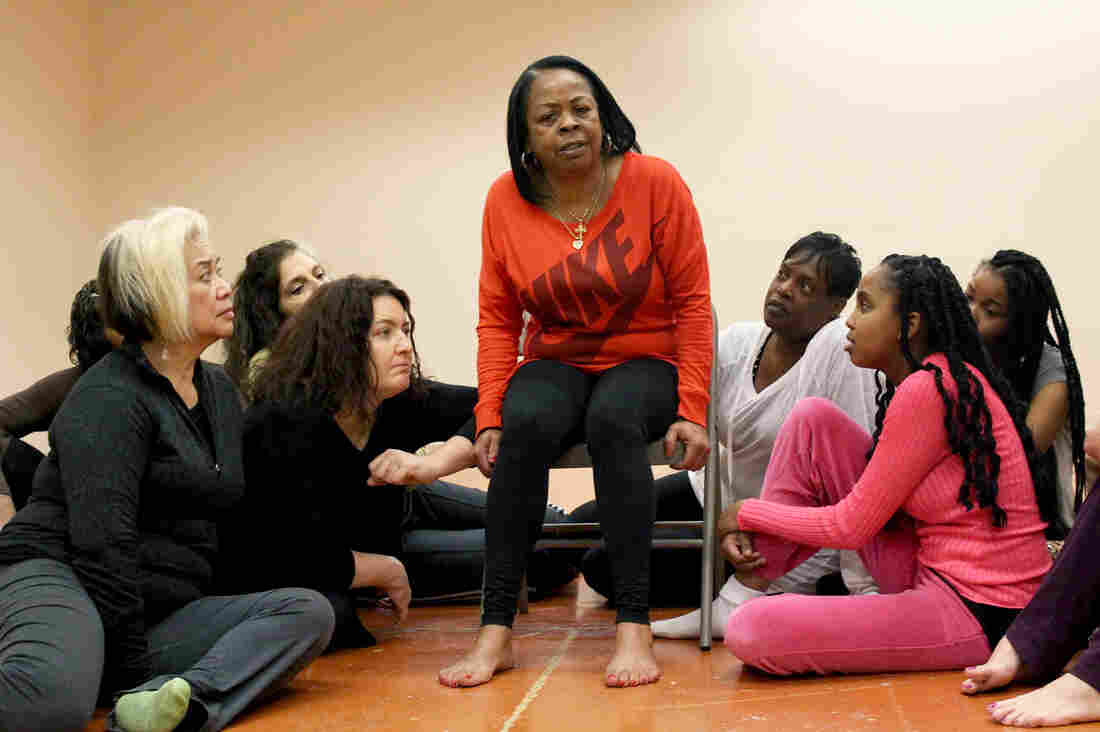
Cassandra Steptoe (center) rehearses a performance with fellow actresses as part of The Medea Project, in San Francisco. Steptoe wrote and performs an autobiographical monologue in the production about being HIV-positive.

Cassandra Steptoe (center) rehearses a performance with fellow actresses as part of The Medea Project, in San Francisco. Steptoe wrote and performs an autobiographical monologue in the production about being HIV-positive. Farida Jhabvala Romero/KQED hide caption

toggle caption Farida Jhabvala Romero/KQED

For decades, Cassandra Steptoe felt like she couldn’t talk about her HIV diagnosis with anyone.

“I couldn’t forgive myself for getting HIV,” says Steptoe, who spent much of her early adult life in and out of jail for shoplifting and burglaries linked to her IV drug use. “But someone told me a long time ago, if you are looking for a reason to feel shame, you can always find it. I learned to look for something else: forgiveness.”

It wasn’t until Steptoe, now 59 and a grandmother, was in her 40s that she finally completed a drug rehab program and committed to ongoing HIV treatment.

Today she talks openly about that experience onstage, as part of a theater project aimed at inspiring others. The quote about learning to forgive herself is part of an autobiographical monologue Steptoe wrote and performs in a San Francisco theater production of The Medea Project: Theater for Incarcerated Women/HIV Circle.

It was Steptoe’s physician, Dr. Edward Machtinger, who first told her about the project. Established by playwright and director Rhodessa Jones in 2008 as an extension of an improvisational production that draws on and explores the experiences of jailed women, the “HIV Circle” focuses on the experiences of women living with the AIDS virus.

The therapeutic aspect of the performance workshop is called peer empowerment, explains Machtinger, an internist and director of the Women’s HIV Program at the University of California, San Francisco. The strength and healing Steptoe and others have gained from processing and sharing their stories this way is profound, he says — and can serve as a model for helping other patients deal with psychological trauma.

Cassandra Steptoe in the home she shares with her 8-year-old granddaughter in San Francisco. Steptoe credits The Medea Project with helping her overcome the trauma of childhood abuse.

Cassandra Steptoe in the home she shares with her 8-year-old granddaughter in San Francisco. Steptoe credits The Medea Project with helping her overcome the trauma of childhood abuse. Farida Jhabvala Romero/KQED hide caption

toggle caption Farida Jhabvala Romero/KQED

Medications ‘Not Enough’

With the theater group, Steptoe began writing about her experiences and sharing them with a small group of women, some of whom had gone through similar struggles of addiction and histories of incarceration. She says the process of uncovering her past and making sense of her experiences in a cathartic, supportive environment helped end her feelings of isolation.

“Having these women that really love you and support you … it feels good to have some real friends, ’cause I never had that before,” Steptoe says. “We’re all sharing something together … we all get something out of everybody’s story.”

The program’s power to heal is not just anecdotal. Machtinger has preliminary evidence of the Medea Project’s life-changing benefits.

Some of the women he studied went through an extraordinary transformation, he says. Many who had barely disclosed their HIV status to anyone when they began, became activists and leaders in their communities — helping to reduce the stigma of HIV, while pursuing personal goals and leading productive lives.

“For them to develop what they described as a “sisterhood” was the most important and most profound type of healing that I ever witnessed,” Machtinger says.

He first became interested in the approach, he says, after noticing that “far too many” of his patients who got successful antiretroviral treatment, were still dying early deaths for reasons that had “nothing to do with HIV” — murder, suicide or drug overdose.

“They could have their HIV under control, (but) their lives were not getting better,” Machtinger says. “That was because their core issue — a life of trauma and the impacts of depression, isolation and shame — wasn’t being effectively addressed. And to us, that’s not acceptable.”

Machtinger is part of an advisory group helping to develop new guidelines for trauma-informed primary care for the federal Substance Abuse and Mental Health Services Administration, and says the lessons of the theater project are already having an impact nationally.

“The core elements of the Medea Project are really lessons for other interventions to help people overcome trauma and other stigmatizing situations and conditions,” he says, noting that childhood and adult trauma have been linked to a variety of illnesses, such as hepatitis C, heart disease and diabetes. The SAMHSA guidelines are likely to be finalized and published later this year, he says.

Trauma at the Root of HIV Diagnosis

Steptoe, who was once addicted to heroin and cocaine, says she became infected with HIV through unprotected sex or sharing needles. She worked as a prostitute in her late teens, 20s and 30s, and was in abusive relationships — once getting beat up so badly, she says, that she spent three months recovering at a hospital.

She now realizes that enduring sexual abuse repeatedly as a child and teen put her on the path that eventually resulted in HIV infection.

“Sexual abuse came from family,” she says. “And I guess I was kind of covering all that up by choosing the drugs. It kind of took me out there into the street, looking for love in the wrong places because I didn’t have it at home. I started shooting drugs, and that led into prostitution and to prison.”

Recent studies show that HIV-positive women suffer disproportionately from high rates of trauma and post-traumatic stress disorder. The high rates of trauma also lead to increased risk of further spreading HIV, scientists say.

Transforming Her Life

Today Steptoe is busy and full of energy. She takes antiretroviral medication every morning, eats a healthy diet and takes Zumba fitness classes at a local gym. The mother of three and grandmother of nine also has full custody of her 8-year-old granddaughter, who frequently accompanies her to rehearsals.

“She teaches me how to love, and she gives me patience,” says Steptoe.

Rhodessa Jones, who mounted the first Medea production more than two decades ago, says Steptoe has flourished since joining the organization, becoming a leader and inspiration to other women.

“She’s so powerful, positive and forceful.” says Jones. “Theater has really been expressive therapy for her. It gives her a space to speak her truth.”

Performers with the theater company rehearse in San Francisco. The Media Project, founded more than two decades ago, melds personal stories with Greek, Roman and African myths to introduce "the universality of all of our stories," says Rhodessa Jones, founder and director.

Performers with the theater company rehearse in San Francisco. The Media Project, founded more than two decades ago, melds personal stories with Greek, Roman and African myths to introduce “the universality of all of our stories,” says Rhodessa Jones, founder and director. Farida Jhabvala Romero/KQED hide caption

toggle caption Farida Jhabvala Romero/KQED

The Medea Project uses Greek, Roman and African mythology to introduce “the universality of all of our stories,” says Jones, who asked Steptoe to imagine going back in time to age 14 and write the lessons she would give herself. The result was Steptoe’s piece Younger Self.

The piece is about the moment in 1987 when Steptoe first learned she was HIV-positive. It was during a medical check-up, while she was serving time in jail.

“My world crashed,” Steptoe says, adding that she had no support at the time, and considered her condition “a death sentence.” That night she cried with a pillow over her head so others wouldn’t hear.

“I had to relive that again by writing this,” she says, “because I needed to heal.”

‘HIV is a Health Condition, Not a Crime’

Steptoe kept her HIV status a secret for many years. Becoming a part of The Medea Project, she says, was key to finding and using her voice to share what she’s gone through. As lead actress, she shares her story with hundreds of audience members in each performance.

“Now I can tell the world that HIV is just a health condition, not a crime,” says Steptoe. She’s no longer ashamed, and wants to give hope to others — to help them understand they aren’t alone.

“I let my grandkids know that even if you go the wrong way,” she says, “you can still turn your life around.”

The story was produced by KQED’s blog State of Health.

Let’s block ads! (Why?)

IRS Could Help Find Many Uninsured People, But Doesn't

The guy with empty pockets might also be missing health insurance.

The guy with empty pockets might also be missing health insurance. Tim Teebken/Getty Images hide caption

toggle caption Tim Teebken/Getty Images

Nearly a third of people without health insurance, about 10 million, live in families that received a federal earned income tax credit in 2014, according to a new study.

But the Internal Revenue Service doesn’t tell those tax filers that their low and moderate incomes likely mean their households qualify for Medicaid or subsidies to buy coverage on the insurance exchanges.

That’s a lost opportunity to identify people who are eligible but not receiving government assistance to gain health coverage, the researchers say.

About half of the uninsured people in families receiving the earned income tax credit are eligible for significant financial assistance: 4.1 million are eligible for Medicaid, and another 1.1 million are eligible for large subsidies on policies purchased on the federal health law’s insurance exchanges and cost sharing reductions because they have incomes below twice the federal poverty level, said Linda Blumberg, co-author of the study and a senior fellow at the Urban Institute, which released the report last week.

While the Affordable Care Act has driven down uninsured rates to historic lows the past few years, about 33 million Americans remain uninsured, according to latest Census data.

Some local governments are making efforts to identify the uninsured. New Jersey and Maryland check state income tax filings to find those likely eligible for Medicaid, the state-federal health insurance program for the poor. Louisiana and West Virginia, among several, have sent letters to food stamp recipients to invite them to sign up for Medicaid. All they had to do was check a box, sign a form and return it.

The states verified their eligibility from information on file.

The Urban Institute said the federal government could do more to find the uninsured by tapping into data it collects from other assistance programs.

“The U.S. Treasury could explore notifying all individuals receiving the EITC in the past year that they may be eligible for substantial financial assistance for coverage,” the report said. “The Treasury could also provide an easy mechanism (such as text messaging) that allows individuals to request a navigator to contact them directly to provide additional information and application assistance.”

But the IRS said it does neither. Instead, its website suggests people go to www.HealthCare.gov to look for health insurance options, and the agency advises tax preparers to tell people about their insurance options. But many people who receive the earned income tax credit don’t use tax preparers.

That credit offsets income and payroll taxes paid by low- to-moderate-income workers. To receive the credit, workers must file a tax return, even if they are otherwise exempt from doing so. The amount of the benefit depends on a recipient’s income and number of children.

The earned income tax credit is the most common government assistance benefit reported by the uninsured, but there are others, the report said. About 23 percent of the uninsured live in households in which at least one child received subsidized lunch at school. Nearly 15 percent of the uninsured are in families receiving food stamps, the report said.

The Urban Institute’s Blumberg said the IRS data on the tax credit would help identify people eligible for help. In fact, since 2014 all tax filers must report whether they have health insurance on their annual tax forms, she said.

Blumberg cautioned that just sending a letter to tax filers about their health insurance options might not nudge them to sign up. But she said the IRS could invite interested filers to request a federal health law navigator contact and enroll them. “This is not an easy problem to solve, but identifying ways to reach out to uninsured [Earned Income Tax Credit] families is something we should be talking to the IRS about,” she said.

A difficulty involves uninsured people in the 20 states that did not expand Medicaid under Obamacare, said Tricia Brooks, senior fellow at the Georgetown University Center for Children and Families. Many adults who get the credit in those states may not qualify for Medicaid, although some may qualify for premium subsidies on health plans sold on the exchanges.

A better course for the IRS is to target those who qualified for the earned income tax credit in the states that did expand Medicaid, she said.

Kaiser Health News is a national health policy news service that is part of the nonpartisan Henry J. Kaiser Family Foundation.

Let’s block ads! (Why?)

Patients Miss Out On Savings When Doctors Fail To Talk About Costs

Along with the diagnosis, patients often want to talk about how much treatment will cost.

Along with the diagnosis, patients often want to talk about how much treatment will cost. Tetra Images RF/Getty Images hide caption

toggle caption Tetra Images RF/Getty Images

Talking about money is never easy. But when doctors are reluctant to talk about medical costs, patients’ health can be undermined.

A study published Monday in the journal Health Affairs explores the opportunities that are often missed in the exam room.

Patients are increasingly responsible for more of their own health costs. In theory, financial incentives are supposed to make them sharper consumers and empower them to trim unnecessary health spending. But previous work has shown it often leads them to skimp on both valuable preventive care and superfluous testing.

Doctors could play a role in helping patients find appropriate and affordable care by talking with them about out-of-pocket costs.

But, a range of physician behaviors currently stand in the way, according to the study. “We need to prepare physicians to hold more productive conversations about health care expenses with their patients,” said Peter Ubel, a physician and behavioral scientist at Duke University.

The researchers analyzed transcripts of almost 2,000 physician-patient conversations regarding breast cancer, rheumatoid arthritis and depression treatment. They identified instances in which patients suggested the cost of care might be difficult for them to bear and assessed how doctors responded.

Overall, researchers noted two ways in which doctors dismissed patients’ financial concerns. They either didn’t acknowledge them or only addressed them halfway.

For instance, if a patient commented on how expensive a drug was, the doctor might ignore the comment entirely, or might suggest a temporary solution – like a free trial – without exploring long-term strategies to address the issue.

Without a long-term plan, patients may eventually stop taking the medication, or take it irregularly. Either way, a patient would get less benefit from treatment and could getter sicker, perhaps even winding up in the hospital.

The study doesn’t measure how often doctors dismissed patient concerns – because, the researchers wrote, they didn’t know how often those dismissals led to people actually forgoing needed treatments.

Still, Ubel said, it’s clear doctors aren’t talking to patients about these expenses. He pointed to a separate analysis of those same conversations, which found that doctors discussed medical costs with patients about 30 percent of the time. And only in a minority of those discussions did doctors and patients brainstorm about ways to make medication more affordable.

“A majority of [physicians] – they don’t talk about costs,” he said. “When they do talk about it, they don’t talk about it productively.”

Why do physicians hesitate? For one thing, they aren’t used to discussing cost barriers, and many think it’s inappropriate to bring up money at all, Ubel said. When he lectures on the subject, he always encounters people who worry that discussing finances will “contaminate the doctor-patient relationship.”

Plus, doctors haven’t been taught to listen for patients’ pocketbook concerns. If a patient comes in with heartburn and indigestion, a good internist will start probing for signs of coronary disease, Ubel said. By contrast, physicians aren’t primed to pick up on cues that patients may face financial strains.

“If we had that on our list to be aware of, we’d pick up the cues. If we don’t, it’ll be right in front of our eyes, and we’ll miss it,” he added.

The idea of patients acting as consumers – weighing cost and shopping for the best health care deal – is still relatively new, the study notes. As it becomes more commonplace, patients may push doctors for more help in making cost-based decisions, Ubel said.

That said, navigating a patient’s financial circumstances and medical needs in the course of a 15-minute visit is tricky, said Jonathan Kolstad, an assistant professor of economic analysis and policy at the University of California, Berkeley. Kolstad wasn’t involved in the Health Affairs study but has researched how medical costs affect people’s decision-making.

“It’s not as though, ‘Oh, it’s just consumers can’t figure it out.’ Doctors don’t know,” he said. When it comes to figuring out what a drug will cost, doctors are in the same boat.”

Kaiser Health News is an editorially independent news service that is part of the nonpartisan Henry J. Kaiser Family Foundation. Shefali Luthra is on Twitter: @shefalil.

Let’s block ads! (Why?)

Just Turned 40? An Architect Says It's Time To Design For Aging

New Aging GIF

Source: Matailong Du/NPR

When Architect Matthias Hollwich was approaching 40, he wondered what the next 40 years of his life might look like. He looked into the architecture that serves older adults, places like retirement communities and assisted living facilities, and didn’t like what he saw. But what if we changed our habits earlier in life so we could stay in the communities we already live in?

“Retirement communities sounded great when they were created, but now when you retire, you may live there for 30 or even 40 years,” he says. “You play golf and bingo; [you’re] not really part of the general society.”

Hollwich, a visiting professor at University of Pennsylvania, discussed the idea with students and faculty. They created a conference on aging to talk about how adults could continue to engage with society as they got older. Maybe a nursing home could turn into a healthiness hub, or an informal volunteering app could provide support to older people

Even though Hollwich began by thinking about architecture, he realized that people need to create a social structure that supports them, too.

So he and his architectural firm, HWKN, partnered with Bruce Mau Design to compile ideas in a bright, friendly book, New Aging, published last week by Penguin Books. The book serves as a guide for thinking about aging much earlier. Hollwich, now 44, spoke with Shots about his ideas on the architecture of aging. The conversation has been edited for length and clarity.

Why do you think it’s important for people to start thinking about aging while they’re still young?

Statistics show that older people move three times in the last three years of their life. They move from a place where they may want to live, like in Florida. They move closer to family when the first big issues appear within the health and social context. They lose all their social contacts because they’re moving and changing their environment. [Then] maybe they break a leg. Now they don’t have proximity to friends who can help them, so they need to move into an assisted living facility or nursing home.

We need to make sure that we nurture the social surrounding around us so we have friends and a safety net. This comes through personal contact.

We also have to look at our houses, where we live, and make sure that these buildings don’t become traps. It’s just too late to renovate your bathroom when you have a physical deficit.

What kinds of social adjustments do you think people should make in their community?

It’s really about re-engaging with our community around us and creating strategic alliances between people. Think about it. What can be done better within communities, within retail or service offerings that allow us to live our whole lives in more rural areas? That needs awareness, planning, and the fearlessness of addressing aging to make adjustments.

Penguin Books

Penguin Books

In a high-rise building, most people never talk to their neighbors. As soon as you do, [you can] share some of your stories or responsibilities. You help them go shopping, or maybe one of your neighbors cooks for you one day. For us as architects, it’s really important that we design apartment buildings entirely different than we do today; that we provide spaces that create social glue between people — not in a forced way but in a much more playful way.

What kind of spaces bring people together?

When you think about a hallway, it’s used to go from your elevator to your apartment. But if you widen it up and create some seating areas or a shared kitchen, you might create a connection. Maybe someone comes by late in the evening and you’re sitting there reading a book and they say “Hi. Oh, what are you reading?” You have this conversation and you start to make friends. These things are social offerings in a building, almost like a front porch. You sit there and you can wave to your neighbor and make contact. That creates familiarity and a social bond.

Do you have a favorite point in this book?

The chapter “Never Retire” is something that sounds to most people as kind of horrible. Most people look forward to retirement, but it’s a big mistake. It’s important that you have a meaningful contribution to society. Of course it doesn’t have to be a 9 to 5 job. It could just be something you do once a week or for a few hours here and there. There’s a whole boomer population that is starting up businesses after official retirement.

Penguin Books

Penguin Books

Where do you see yourself at 80 or 90?

I see myself creating a strategic alliance with some of my friends. We’ve already started to talk about it. We want to live in close proximity or even in the same building. And it will be in a building that is entirely diverse in terms of ages, because the worst thing is when you get older, society just provides buildings for “old people.” It’s not healthy. It’s important that when we get older you’re mixed with all generations. That’s a part of the vitality that helps in life.

People should look at the aging process as starting up a business. It would be helpful for people to pick a board of directors for your own life. Get four to five people in a room that you really trust and tell them what you plan to do in different stages of getting older. Let them be your steering committee and your sounding board so you can do the right things in terms of navigating your life.

I really believe it’s important that we have to start sharing our thoughts and plans with each other. Everyone has these thoughts, but everyone keeps it very private. As a community you’re much stronger and we can help each other.

Penguin Books

Penguin Books

Let’s block ads! (Why?)