What You Need To Do About Your Hate For The Patriots

Sportswriter Ray Ratto believes you’re hating the New England Patriots for all the wrong reasons. NPR’s Ari Shapiro chats with Ratto ahead of Sunday’s Super Bowl.
Sportswriter Ray Ratto believes you’re hating the New England Patriots for all the wrong reasons. NPR’s Ari Shapiro chats with Ratto ahead of Sunday’s Super Bowl.

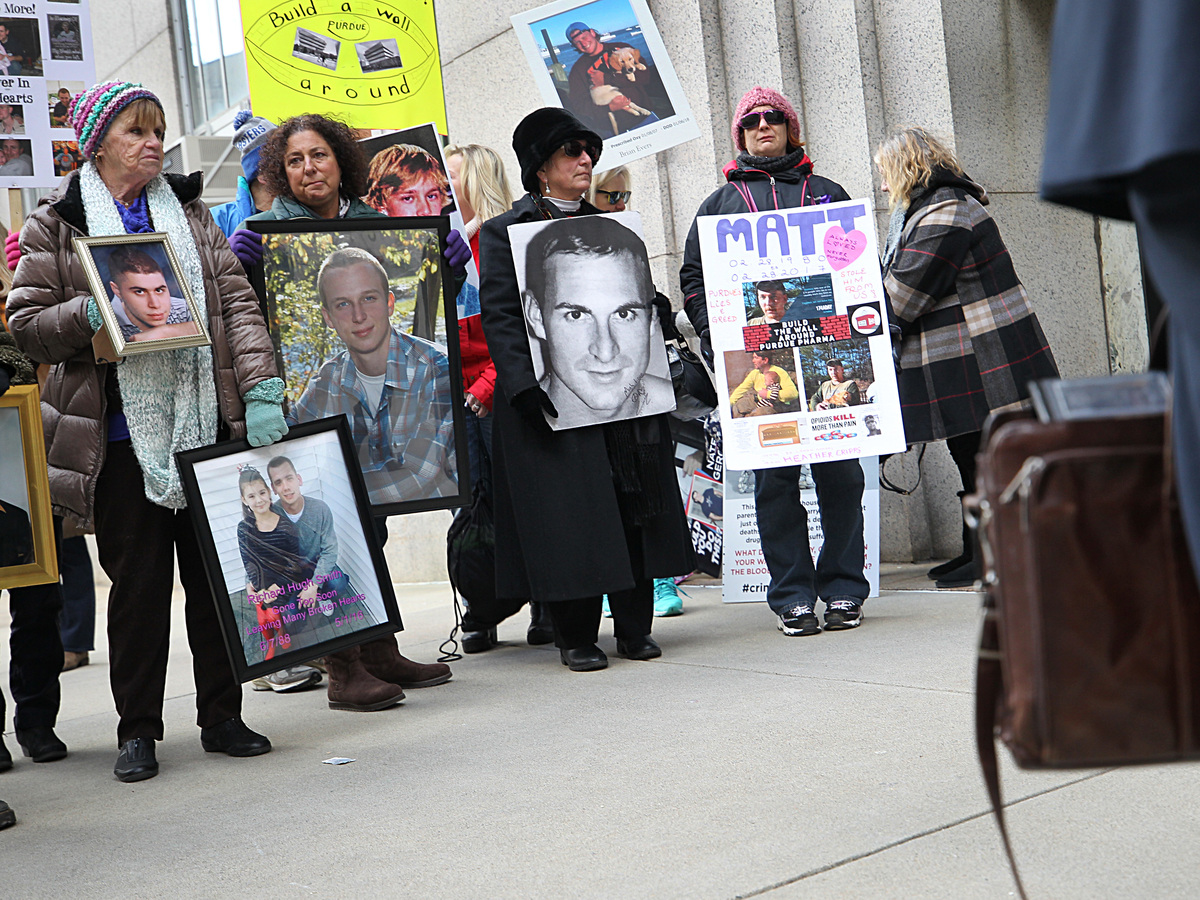
Families that lost loved ones to the opioid crisis protested outside Suffolk Superior Court in Boston as lawyers for Purdue Pharma entered the courthouse for a status update in the Massachusetts attorney general’s suit against the company on Jan. 25.
Suzanne Kreiter/Boston Globe via Getty Images
hide caption
toggle caption
Suzanne Kreiter/Boston Globe via Getty Images
Sign up for the CommonHealth newsletter to receive a weekly digest of WBUR’s best health, medicine and science coverage.
The first nine months of 2013 started off as a banner year for the Sackler family, owners of the pharmaceutical company that produces OxyContin, the addictive opioid pain medication. Purdue Pharma paid the family $400 million from its profits during that time, claims a lawsuit filed by the Massachusetts attorney general.
However, when profits dropped in the fourth quarter, the family allegedly supported the company’s intense push to increase sales representatives’ visits to doctors and other prescribers.
Purdue had hired a consulting firm to help reps target “high-prescribing” doctors, including several in Massachusetts. One physician in a town south of Boston wrote an additional 167 prescriptions for OxyContin after sales representatives increased their visits, according to the latest version of the lawsuit filed Thursday in Suffolk County Superior Court in Boston.
The lawsuit claims Purdue paid members of the Sackler family more than $4 billion between 2008 and 2016. Eight members of the family who served on the board or as executives as well as several directors and officers with Purdue are named in the lawsuit. This is the first lawsuit among hundreds of others that were previously filed across the country to charge the Sacklers with profiting from the harm and death of people taking the company’s opioids.
WBUR along with several other media outlets sued Purdue Pharma to force the release of previously redacted information that was filed in the Massachusetts Superior Court case. When a judge ordered the records to be released with few, if any, redactions this week, Purdue filed two appeals and lost.
Read the documents here or below:
The complaint filed by Massachusetts Attorney General Maura Healey says that former Purdue Pharma CEO Richard Sackler allegedly suggested the family sell the company or, if they weren’t able to find a buyer, to milk the drugmaker’s profits and “distribute more free cash flow” to themselves.
That was in 2008, one year after Purdue pleaded guilty to a felony and agreed to stop misrepresenting the addictive potential of its highly profitable painkiller, OxyContin.
The complaint says the Sacklers voted to pay themselves $250 million at a board meeting in June 2008. Another payment in September totaled $199 million.
The company continued to receive complaints about OxyContin similar to those that led to the 2007 guilty plea, according to unredacted documents filed in the case.
While the company settled lawsuits in 2009 totaling $2.7 million brought by family members of those who had been harmed by OxyContin throughout the country, the company amped up its marketing of the drug to physicians by spending $121.6 million on sales reps for the coming year. The Sacklers paid themselves $335 million that year.
The lawsuit claims Sackler family members directed efforts to boost sales. An attorney for the family and other board directors is challenging the authority to make that claim in Massachusetts. A motion on jurisdiction in the case hasn’t been heard. That attorney hasn’t responded to a request for comment on the most recent allegations.
Purdue Pharma, in a statement, said the complaint filed by Healey is “part of a continuing effort to single out Purdue, blame it for the entire opioid crisis, and try the case in the court of public opinion rather than the justice system.”
Purdue went on to charge Healey with attempting to “vilify” Purdue in a complaint “riddled with demonstrably inaccurate allegations.” Purdue said it has more than 65 initiatives aimed at reducing the misuse of prescription opioids. The company says Healey fails to acknowledge that most opioid overdose deaths currently are the result of fentanyl.
Purdue fought the release of many sections of the 274-page complaint. Attorneys for the company said at a hearing on Jan. 25 that they had agreed to release much more information in Massachusetts than has been cleared by a judge overseeing hundreds of cases consolidated in Ohio. Purdue filed both state and federal appeals this week to block release of the compensation figures and other information about Purdue’s plan to expand into drugs to treat opioid addiction.
The attorney general’s complaint says that in a ploy to distance themselves from the emerging statistics and studies that showed OxyContin’s addictive characteristics, the Sacklers approved public marketing plans that labeled people hurt by opioids as “junkies” and “criminals.”
Richard Sackler allegedly wrote that Purdue should “hammer” them in every way possible.
While Purdue Pharma publicly denied its opioids were addictive, internally company officials were acknowledging it and devising a plan to profit off them even more, the complaint states.
Kathe Sackler, a board member, pitched Project Tango, a secret plan to grow Purdue beyond providing painkillers by also providing a drug, Suboxone, to treat those addicted.
“Addictive opioids and opioid addiction are ‘naturally linked,’ ” she allegedly wrote in September 2014.
According to the lawsuit, Purdue staff wrote: “It is an attractive market. Large unmet need for vulnerable, underserved and stigmatized patient population suffering from substance abuse, dependence and addiction.”
They predicted that 40-60 percent of the patients buying Suboxone for the first time would relapse and have to take it again, which meant more revenue.
Purdue never went through with it, but Healey contends this and other internal documents show the family’s greed and disregard for the welfare of patients.
A version of this story first ran on WBUR’s CommonHealth. You can follow @mbebinger on Twitter.
In 2002, the Patriots played against the Rams in Super Bowl 36. That was the beginning of a Patriots’ dynasty. They are now playing in their eighth Super Bowl since that game.

Fans cheer at Gillette Stadium in Foxborough, Mass., on Jan. 13. What stuff do you do to help your team?
Stan Grossfeld/Boston Globe via Getty Images
hide caption
toggle caption
Stan Grossfeld/Boston Globe via Getty Images
What’s your superstitious sports ritual?
Is it a prayer, wearing a special T-shirt, not washing your socks or eating a special sandwich? With the Super Bowl this Sunday, we’re looking at you Patriots and Rams fans in particular. What are you doing to help ensure your team wins?
NPR’s Weekend Edition wants to hear from you. Fill out the form below, and a producer may get in touch.
<!– Insert everything below in the . –>This form requires JavaScript to complete.
Powered by Screendoor.
President Trump and Republican abortion opponents are criticizing Virginia Gov. Ralph Northam and Democrats in the state over defense of a bill that sought to reduce restrictions on later abortion.
The Super Bowl is set to be held in Atlanta this year, but chilly weather, and an icy history have some leaders on edge about the city’s ability to host the big game.

University of Maryland President Wallace Loh leaves the House Appropriations Committee hearing room in Annapolis in November 2018. The hearing was called to examine how the university responded to the death of football player Jordan McNair. Loh announced that he will stay on as president until June 2020.
Mark Gail for The Washington Post/Getty Images
hide caption
toggle caption
Mark Gail for The Washington Post/Getty Images
University of Maryland President Wallace Loh was supposed to retire in June, following the death of college football player Jordan McNair. But the university announced Wednesday that Loh would stay on an extra year because it’s taking longer than expected to find a new president.
McNair, a 19-year-old offensive lineman, collapsed last spring due to heatstroke during an off-season workout, and died two weeks later. Subsequent investigations found that McNair might have survived had Maryland trainers recognized the severity of his illness. While some called for Loh’s ouster, others — including McNair’s father — praised Loh for accepting responsibility on behalf of the university for the death.
In the aftermath of the tragedy, Loh said he would step down at the end of the 2018-19 academic year. Now, Loh plans to stay on until June 2020.
“The most important responsibility of the board is the successful hiring of a president and the most important responsibility of a sitting president is to ensure that the transition of leadership occurs very smoothly,” Loh told the Baltimore Sun on Wednesday. “It is my job to make sure that happens.” The Sun reported that the search for Loh’s successor “will launch now.” The paper added that, until now, the school’s search had not yet begun.
The Board discussed with me having a smooth transition of leadership, and we mutually agreed upon a retirement date of June 2020. With all of Maryland’s supporters, I look forward to what we will accomplish together. (2/2)
— Wallace D. Loh (@presidentloh) January 30, 2019
“We must take the time necessary to identify and select a bold and talented leader,” Board of Regents Chair Linda Gooden said in a statement. It will likely take “up to a year” to select a new president, the school said. The report declared Loh’s leadership as critical with various ongoing projects, including continuing to implement the football reforms recommended by two independent investigations.
An investigation by sports medicine consulting company Walters Inc. concluded that the training staff failed to quickly diagnose and treat McNair’s heatstroke. As NPR reported, if trainers had recognized the severity of McNair’s illness, “there might have been the opportunity to reverse the patient’s core temperature.”
Another investigation found the Maryland football team had “a culture where problems festered because too many players feared speaking out,” according to the report. Even some coaches “feared sharing criticisms” with ex-Maryland football assistant Rick Court, the report said. Court was the first athletic official to leave the program because of questions surrounding McNair’s death. Head coach DJ Durkin was fired at the end of October, his departure being “in the best interest of the University,” Loh wrote at the time.
The school said it had begun implementing many of the recommendations it had received, including adopting new technology to monitor and respond to rising temperatures, implementing mandatory hydration testing, and emphasizing longer and more frequent recovery breaks.
Loh accepted responsibility on behalf of the university for McNair’s death, admitting in August that the athletic training staff had “misdiagnosed” him when he collapsed, which led to his death. “The university accepts legal and moral responsibility for the mistakes that our training staff made on that fateful workout day,” Loh told reporters.
“It would be a complete shame if, after such a display of decency and humanity, Dr. Loh were to be let go,” McNair’s father, Martin McNair, said in a statement last summer. “Decency and transparency are the only path forward for our family, the University, and its sports programs to heal and emerge as safe places for families to entrust their children. Dr. Loh’s leadership is critical to this happening.”

Sen. Kamala Harris, D-Calif., at an Oakland, Calif., campaign rally this week. Harris says she backs a single-payer health system, but she hasn’t yet offered details on how she would finance that plan.
Mason Trinca/Getty Images
hide caption
toggle caption
Mason Trinca/Getty Images
“Medicare-for-all,” once widely considered a fringe proposal for providing health care in the U.S., is getting more popular. Several Democratic presidential hopefuls are getting behind the idea.
Sen. Kamala Harris, D-Calif., endorsed the approach Monday in a CNN town hall-style event, saying her aim would be to eliminate all private insurance.
“Who of us has not had that situation, where you’ve got to wait for approval and the doctor says, well, ‘I don’t know if your insurance company is going to cover this,’ ” Harris said. “Let’s eliminate all of that. Let’s move on.”
Harris was a co-sponsor of a 2017 bill written by Sen. Bernie Sanders, I-Vt., that would have created a national, single-payer health system, eliminating the private insurance system.
Sens. Elizabeth Warren, D-Mass., and Kirsten Gillibrand, D-N.Y., both presidential hopefuls, also co-sponsored the Sanders bill.
Everyone would get a Medicare card and doctors would have to sign annual agreements to participate.
The major questions the candidates face is how the government would pay for it.
Total spending on health care in the U.S. was about $3.5 trillion in 2017 and is forecast to rise to $5.7 trillion in 2026, according to the Department of Health and Human Services.
The federal government already pays for a lot of that through Medicare, Medicaid, military health care and the Department of Veterans Affairs. Much of the rest is through employer health insurance plans and individual health insurance and payments by patients.
Sanders laid out several options to pay for his proposal, including increasing taxes on employers who would no longer be paying insurance premiums; increasing individual income taxes; and boosting taxes on the wealthy.
Harris didn’t say, in the town hall-style meeting, how she would pay for the program. And her Senate office didn’t respond to an email asking whether she has a funding proposal.
Warren has proposed a 2 percent tax on the wealth of an individual that’s above $50 million and 3 percent on wealth of more than $1 billion.
The mechanism for paying for “Medicare-for-all” can make the politics muddy.
A recent poll by the Kaiser Family Foundation suggests that 56 percent of people in the U.S. like the idea overall.
But when people heard more details, those numbers changed.
When the question included the idea that “Medicare-for-all” would guarantee health insurance as a right, its support rose to 71 percent. But when it said people would have to pay more taxes, the popularity plummeted to 37 percent.
That dynamic has created an opening for potential centrist candidates to stake out a middle road.
Howard Schultz, the former CEO of Starbucks, who has said he is considering a presidential run, told CBS reporters that Harris’ proposal to eliminate the health insurance industry is “not American.” He also called proposed tax increases on the wealthy “punitive.”
Mike Bloomberg, the former mayor of New York and founder of Bloomberg LP, who is also considering a run, said in New Hampshire Tuesday that he, too, opposed the idea.
“To replace the entire private system where companies provide health care for their employees would bankrupt us for a very long time,” he told workers at a factory he was visiting.
Bloomberg has said he supports opening Medicare to people who don’t have coverage through their employers.
The health insurance industry is already gearing up to oppose any “Medicare-for-all” proposals, according to The Intercept, an investigative news website.

Anthem Blue Cross of California, one of the state’s largest health insurers, is now battling with Sutter Health over how much it should pay the company’s 24 hospitals and 5,000 doctors in Northern California to care for tens of thousands of patients.
David McNew/Getty Images
hide caption
toggle caption
David McNew/Getty Images
David Lerman, a lawyer in Berkeley, Calif., changed health plans this year, only to learn that his new insurer has no contract with the main medical provider in his community.
Anthem Blue Cross of California, one of the state’s largest health insurers, is battling with Sutter Health over how much it should pay to care for tens of thousands of people it insures in Northern California. Sutter operates 24 hospitals in the region and lists about 5,000 doctors in its network.
“It’s not the peace of mind I thought I was buying to have the entire Sutter network — which is the biggest game in Northern California — be out of network,” says Lerman, whose family is insured through his wife’s job as a California State University professor.
Lerman and his family, who are enrolled in an Anthem Blue Cross PPO, can continue to visit Sutter facilities until midyear, even if a new contract does not materialize before then. Fortunately, he says, nobody in his family suffers from a chronic illness. But not knowing which providers ultimately will be in his health plan’s network is aggravating, he says.
Contract disputes between insurers and medical providers have been a regular feature of the national health industry for a long time. But the stakes have risen as big players on both sides have expanded to gain market share and leverage in network negotiations.
Most negotiations are completed before the old contract expires, and consumers usually don’t hear about these behind-the-scenes disagreements. But when insurers and providers fail to reach an agreement on time, it can force patients to pay higher prices for care that is no longer covered by their health plans. At the least, it can cause considerable anxiety.
“It is a game of chicken, and at the end of the day somebody blinks and they come to an agreement,” says Wendell Potter, a former senior executive at health insurance giant Cigna, who became a critic of the industry and a strong proponent of sweeping health care reform.
“The big losers in this are patients,” Potter says, “because there’s a period of uncertainty and angst — and a real possibility that the physicians and hospitals you want to go to are no longer in network.”
Amy Thoma Tan, a Sutter spokeswoman, said in an emailed statement, “We are in active negotiations with Anthem Blue Cross and recognize that a timely agreement — one that protects access and choice — is in the best interest of our patients, employers, hospitals and clinicians.”
A statement by Eric Lail, an Anthem Blue Cross spokesman, also lacked details: “As we negotiate with providers, we try to strike a balance between protecting affordability and providing a broad network of providers to create choices, which can take time.”
Sutter, under fire for high prices, has been accused of using its regional market share for financial advantage. As large hospital systems merge with competitors and snap up medical practices, “it’s much more difficult for insurers to say, ‘OK, we’re letting you go,’ ” says Sabrina Corlette, a research professor at Georgetown University’s Center on Health Insurance Reforms.
Corlette says both sides should have a greater incentive these days to come to an agreement.
“When you have a big behemoth health care system and a big behemoth payer with tens of thousands of enrolled lives, the incentives to work something out privately become much stronger,” she says. “The [public relations] risks are so high for both parties.”
Other states have seen their share of feuding between health systems and insurers.
Judy Hays, a retiree who lives outside Pittsburgh, has a rare form of leukemia. She is among many patients caught up in a feud between two regional health giants. She plans to change doctors midtreatment because she wants to keep her insurance.
Courtesy of Judy Hays
hide caption
toggle caption
Courtesy of Judy Hays
In Western Pennsylvania, nearly 50,000 people with Medicare managed care plans from Highmark Health will lose in-network access to University of Pittsburgh Medical Center hospitals and doctors starting July 1 because of a slow-moving divorce between the two regional health giants.
One of those patients is Judy Hays, a 75-year-old retired office manager from the Pittsburgh suburb of Crescent Township, who relies on UPMC’s physicians and hospitals to treat her rare form of leukemia. Now she plans to change her doctors midtreatment because she wants to keep her insurance, which she says has paid for her expensive medications.
“It’s very tough. These people have been taking care of me for the last nine years. I can’t have any interruption in my care,” Hays says. “I’m very angry about it.”
In Georgia, WellStar Health System, with 11 hospitals and numerous medical offices, plans to stop accepting Anthem’s individual policyholders as in-network patients on Feb. 4, amid a contract dispute between the two companies.
In 2017, an impasse between Anthem and the Hartford HealthCare system in Connecticut forced hundreds of thousands of patients to go out of network before the two parties finally inked a deal. The patients’ bills were retroactively treated as in network, so patients did not suffer financially.
However, “there were stories of people who had to cancel surgeries and switch providers,” says Ted Doolittle, Connecticut’s state health care advocate. “There was all this anxiety and disruption.”
Under pressure from their constituents, Connecticut lawmakers last year passed legislation enabling consumers to continue getting care at in-network prices for 60 days during contract disputes. The new law is “an improvement,” says Doolittle, who had urged legislators to pass such legislation.
In the current California dispute, Anthem Blue Cross members with PPOs can still use Sutter doctors and hospitals at in-network rates for the next six months, says Thoma Tan, the Sutter spokeswoman. People with HMOs face more uncertainty.
Lail, the Anthem Blue Cross spokesman, says the insurer’s customers “can continue to see their Sutter care providers for the time being as these negotiations continue.” But, as required by state law, Anthem Blue Cross has notified patients with Medicare and Medi-Cal HMO plans that they may be reassigned to non-Sutter providers, Lail says.
There are exceptions that will allow pregnant women, very young children and some other patients to continue receiving care from Sutter at in-network rates, regardless of the type of insurance they have with Anthem Blue Cross, Thoma Tan says.
Sutter has quarreled with other insurers, including with Blue Shield of California in a dispute that affected about 270,000 consumers before the two sides reached a deal that took effect in February 2015.
Sutter’s market dominance in California and its high prices for inpatient care have long drawn criticism. One patient reported that Sutter charged $1,555 for a 10-minute emergency room visit to treat a cut finger, including $55 for a gel bandage and $487 for a tetanus shot.
Last year, the state’s attorney general, Xavier Becerra, sued the giant health system, alleging it had illegally overcharged patients and driven out competition in California. Sutter has contended that Becerra overstepped his authority and that limiting Sutter’s ability to negotiate with insurers will harm consumers.
Anthem Blue Cross, which insures hundreds of thousands of Californians and whose parent company, Anthem, generated profits of $3.8 billion in 2017, has also drawn the ire of state regulators. The Department of Managed Health Care fined the insurer $5 million in 2017 for failing to respond in a timely way to consumer complaints. The state previously had fined Anthem Blue Cross $6 million between 2002 and 2017 for consumer-grievance-system violations.
In Berkeley, Lerman just wants Anthem and Sutter to resolve their differences so his family will have access to the most comprehensive coverage options.
“As a consumer, is there no place where you can go and not worry that you’ll not be covered?” he frets. “If I’m sick, do I go to the local hospital — or to the airport and fly to Europe?”
This story was produced by Kaiser Health News, which publishes California Healthline, an editorially independent service of the California Health Care Foundation. KHN is not affiliated with Kaiser Permanente.
Endurance runners, skiers and cyclists in Minnesota haven’t let extreme cold get in the way of competing in the Arrowhead 135 ultramarathon. The race kicked off Monday in International Falls, Minn.